



Abstract
As a growing number of students with learning disabilities (LD) receive science instruction in general education settings, students with LD continue to perform significantly lower than their non-disabled peers. The shift from textbook-driven instruction to inquiry-based approaches to science learning supports students who struggle with reading. However, research continues to show that for students to fully access the science curriculum, it is critical to address effective ways to increase reading comprehension of expository science text. This meta-analysis identified 20 studies from 12 articles that evaluated the efficacy of such interventions. Effect sizes were calculated for each study. Across all studies, a mean effect size (ES) of 0.98 was obtained. Findings align with past research on reading comprehension of expository text indicating that students with LD benefit from explicit vocabulary instruction (ES = 1.25) and the use of multicomponent interventions (ES = 0.64) when reading science-related material.
Research on reading comprehension interventions for students with learning disabilities (LD) has been well documented over the past 30 years (e.g., Mastropieri & Scruggs, 1997; Snider, 1989; Swanson, 1999; Talbott, Lloyd, & Tankersley, 1994). One reason for this focus is the increasing expectations for students with LD to complete grade-level material and to make adequate progress through the general education curriculum. Researchers have focused on “learning to read,” and recently there has been more of an emphasis placed on students to use “reading to learn” (Gajria, Jitendra, Sood, & Sacks, 2007).
The reading demands placed on students with LD take place not only during typical “reading” instruction but also across the content areas. For instance, in science classes, students are often required to use reading skills to comprehend material from textbooks, complete practice problems, and access information from additional resources. Students with LD are receiving the majority of their education in general education settings (Aud et al., 2012), warranting the use of effective comprehension strategies for teaching content area reading. Reading instruction cannot be isolated to “reading” time alone; it must also take place within math, social studies, and science instruction (Gajria et al., 2007).
Recent reports indicate that more than 80% of students with LD receive their science instruction in the general education setting (Aud et al., 2012). However, the National Assessment of Education Performance from 2009 indicated that students with disabilities often do not receive the instructional support they need in science (Fleischman, Hopstock, Pelczar, & Shelley, 2010). Inadequate support in science has, in turn, resulted in students with special needs scoring significantly lower than their general education peers on both hands-on and computer-based science assessments (Fleischman et al., 2010).
Classroom Science Instruction
Over the past decade, science education has seen a shift from the traditional textbook approach to a more constructivist inquiry-based method (Scruggs & Mastropieri, 2007). Within inquiry-based instruction, students develop their own questions, make observations, and create investigations as a means to understanding the big ideas in science (Maroney, Finson, Beaver, & Jensen, 2003). Despite the change in instructional practice, much of the content is still derived via expository science text (i.e., textbooks, research materials, and websites).
When reading, students with LD often experience difficulty with fluency, decoding, and word recognition. These difficulties interfere with students’ ability to adequately comprehend text (Jenkins, Fuchs, van den Broek, Espin, & Deno, 2003; Petersen-Brown & Burns, 2011). Students with LD also often lack the prior knowledge that is strongly connected to understanding higher-level concepts (Dexter & Hughes, 2011; Snider, 1989). Prior knowledge is important because students need to make meaningful connections between the text and their previous knowledge to retain and generalize information (Snider, 1989).
In addition, students with LD often struggle to monitor their comprehension during reading. When students read texts without adequate prior knowledge and fail to implement meta-cognitive strategies during reading, they struggle to draw inferences (Baumann, 1984; Dexter & Hughes, 2011; Snider, 1989), identify main ideas, and describe details from text (Kim, Vaughn, Wanzek, & Wei, 2004). Without the use of effective enhancements and strategies during reading, students with LD may fail to comprehend the material and learn the content at hand (Bos & Filip, 1984; Wong, 1994).
Science Text
Science texts are examples of expository prose. Expository prose is created with notably different text structures and vocabulary than narrative prose (Gajria et al., 2007), and the vast amount of new vocabulary and information in these texts “may make science texts the greatest reading challenges that students with LD encounter in school” (Mason & Hedin, 2011, p. 215). To assist students with LD in inquiry-based science classrooms, many researchers advocate for the use of structured supports or supplemental instruction in specific skill areas, such as reading comprehension (Holahan, McFarland, & Piccillo, 1994; Scruggs & Mastropieri, 2007; Therrien, Taylor, Hosp, Kaldenberg, & Gorsh, 2011).
To increase student’s comprehension of science texts, students with LD benefit from explicit instruction of supplemental information (Therrien et al., 2011) and cognitive processing strategies (Swanson & Hoskyn, 1998). Several reviews have documented the efficacy of these interventions (Berkeley, Scruggs, & Mastropieri, 2010; Dexter & Hughes, 2011; Gajria et al., 2007).
Gajria and colleagues (2007) analyzed 29 studies that used expository text combined with a reading comprehension intervention for students with LD. The results were aggregated into two categories: cognitive strategies and content enhancement. Overall, the findings from this synthesis indicate that cognitive strategy instruction is more effective than the use of content enhancements (ES for cognitive strategy = 2.07 and ES for content enhancements = 1.06) for increasing reading comprehension.
Gajria and colleagues (2007) included comprehension interventions, such as paragraph restatement, self-questioning, self-monitoring, paraphrasing, summarization, and other processes that encourage meaningful interactions with expository text in their definition of cognitive strategy. The aim of such interventions is to support students’ comprehension monitoring and enhance their ability to access knowledge versus teaching mastery of specific content (Gajria et al., 2007). They defined content enhancements as instructional methods that enhance students’ retention of knowledge. These include mnemonic illustrations, graphic organizers, visual representations, and the use of a semantic feature matrix.
Gajria et al. (2007) indicated that graphic organizers and a matrix of semantic features were used most frequently and produced the largest effect size (ES = 1.12). Treatment effects were also high for studies using mnemonic illustrations (ES = 1.19). The text used within these studies focused primarily on social studies or science content. However, most studies used mixed content materials and did not separate them by a specific subject area.
Five of the content enhancement studies reviewed by Gajria and colleagues (2007) did separate out the results of interventions using only science texts (Bos & Anders, 1990; Darch & Eaves, 1986; Griffin, Simmons, & Kame’enui, 1991; Mastropieri, Scruggs, & Levin, 1987; Scruggs, Mastropieri, McLoone, Levin, & Morrison, 1987). Among these studies, mnemonic illustrations (Mastropieri et al., 1987; Scruggs et al., 1987), graphic organizers (Darch & Eaves, 1986; Griffin et al., 1991), and semantic feature analyses (Bos & Anders, 1990) indicated high effects for increasing reading comprehension in science. Unfortunately, given the small number of studies within each intervention sub-category, no conclusive results could be drawn regarding overall effectiveness of the individual content enhancement approaches.
Mason and Hedin (2011) updated the expository text synthesis conducted by Gajria and colleagues (2007) by exploring effective content enhancements and cognitive strategies for teaching reading comprehension of science text. In their review, they identified studies that fostered prior knowledge of science content, included text enhancements, or used strategy instruction during science reading for students with LD. Their extensive review of the literature suggests that these instructional elements are keys to increasing the comprehension of science text for students with LD. Unlike the Gajria et al. (2007) synthesis, Mason and Hedin (2011) did not include overall effect sizes in their review.
Therefore, we conducted the current meta-analysis to expand on the findings from previous literature on effective strategies for teaching reading comprehension of science text. First, this article focuses on the work of Mason and Hedin (2011) by targeting reading comprehension interventions for science text geared toward students with LD. Next, it broadens the scope by including interventions that emphasize teaching vocabulary for the purpose of increasing comprehension. Last, to further expand on past findings, we used meta-analytic techniques to analyze the data. Specifically, this meta-analysis examines the following research questions:
Method
We conducted a literature search to identify studies published from 1980 to 2012 that focused on teaching reading comprehension to students identified with LD, using science texts. First, we reviewed the studies that focused on using literary strategies to increase students’ comprehension of science text in Gajria et al. (2007), which produced seven articles (Bakken, Mastropieri, & Scruggs, 1997; Bos & Anders, 1990; Griffin et al., 1991; Lovitt, Rudsit, Jenkins, Pious, & Benedetti, 1986; Mastropieri et al., 1996; Mastropieri et al., 1987). Next, we reviewed the science studies (n = 8) included in the article by Mason and Hedin (2011) and found one more study that matched our criteria (MacArthur & Haynes, 1995). Then, the ERIC and PyschInfo databases were searched using the following key terms: “reading disabilit*” and “reading comprehension”; “reading disabilit*” and “reading strateg*”; “learning disabilit*” and “reading comprehension”; “learning disabilit*” and “reading strategy”; “science,” “vocabulary,” and “disability”; and “science,” “reading comprehension,” and “disability.” In addition, we hand-searched the special education journals identified by Berkeley et al. (2010) to ensure we located all of the studies matching our study criteria. The journals searched included Exceptional Children, Learning Disabilities Research and Practice, Journal of Learning Disabilities, Learning Disability Quarterly, Journal of Special Education, and Remedial and Special Education. This process produced an additional four studies (Billingsley & Wildman, 1988; Bos & Anders, 1990; Horney et al., 2009; Lovitt, Rudsit, Jenkins, Pious, & Benedetti, 1985). One article (Scruggs, Mastropieri, Sullivan, & Hesser, 1993) was initially included in this meta-analysis but then was later excluded because of how the data were reported (i.e., the MSE was the total MSE that was reported and was not representative of the MSE for “Study A” [the mnemonic instruction condition compared with the direct teaching condition] and for “Study B” [the elaborative interrogation condition compared with the direct teaching condition]).
Next, to ensure the studies reviewed were methodologically sound, we analyzed them for quality characteristics according to the Council for Exceptional Children Standards for Evidence-Based Practices in Special Education (Cook et al., 2014). Of the 24 quality indicators that applied to group studies, the 20 studies identified possessed on average 20 of the quality indicators (range = 17–22). One hundred percent of the studies met the qualifying criteria under context and setting; participants; description of practice; internal validity; and data analysis. Thirteen studies reported information on adequate internal reliability; however, only 3 studies reported implementation fidelity data.
Then, the first two authors reviewed the articles to ensure they met the final inclusion criteria: (a) the study was a quantitative group study (included quasi-experimental, excluded single subject); (b) the participants were students in Grades 3 to 12; (c) at least one participant was identified as having a learning disability; (d) the independent variable of the study was a vocabulary or reading comprehension strategy to use while reading/comprehending science text; and (e) the dependent variable of the study assessed a student’s reading comprehension using science text (e.g., filling in missing words within science passages, reading text and answering question, or recalling the main ideas or details of a text). All coders came to an agreement on whether to include articles. As a result, we identified 12 articles yielding 20 studies for inclusion in this meta-analysis.
Calculation of Effect Sizes
The identified studies were dummy coded and analyzed collaboratively. We coded each study for random assignment (yes or no); whether or not participant IQ information was reported; if IQ was reported, the mean IQ of the participants; who provided the intervention instruction; the number of participants; the skill area(s) on which the intervention focused; the setting in which intervention was delivered; the number of sessions for the intervention; and the length of each session (i.e., shorter or longer than 45 min). Table 1 provides a summary of the studies.
Summary Table of Studies That Matched Our Inclusion Criteria.
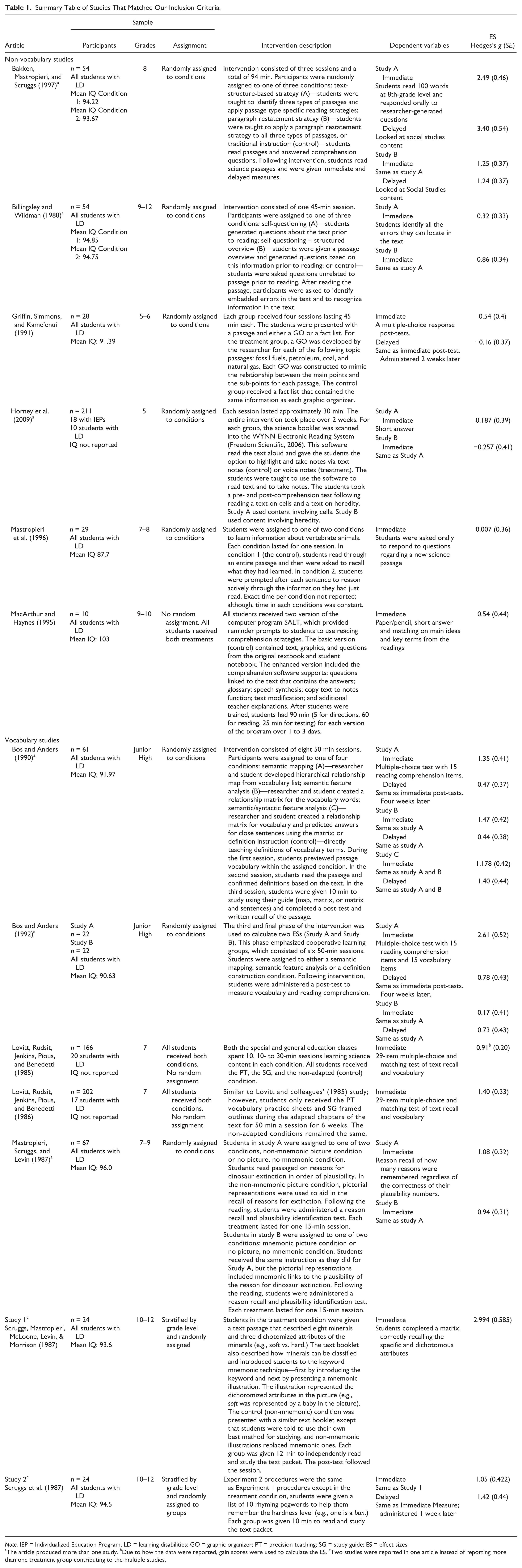
Note. IEP = Individualized Education Program; LD = learning disabilities; GO = graphic organizer; PT = precision teaching; SG = study guide; ES = effect sizes.
The article produced more than one study. bDue to how the data were reported, gain scores were used to calculate the ES. cTwo studies were reported in one article instead of reporting more than one treatment group contributing to the multiple studies.
We used the Hedges’s g statistic, which accounts for small sample sizes, to calculate effect sizes (Hedges, 1981). To ensure the independence of our data (Lipsey & Wilson, 2001), we calculated only one effect size for each study. Therefore, we identified and used only the reading comprehension measure (the measure closely aligned with our research question; Cook et al., 2014) for this meta-analysis. If two immediate reading comprehension measures were used, we selected the most conservative measure (i.e., the measure that produced the lowest ES). For studies that reported the necessary data, we calculated one effect size for delayed and generalization reading comprehension measures using this same procedure.
After calculating effect sizes, we conducted a Q test of heterogeneity (null hypothesis equals homogeneity of the distribution; Lipsey & Wilson, 2001). The results of the test of heterogeneity (Q = 62.67, p = .00) indicated that significant variability was present, larger than expected by sampling error alone; therefore, further examination of study characteristics was appropriate. As indicated by Borenstein, Hedges, Higgins, and Rothstein (2009), we used a random-effects model because we could not conclude that all of the studies had the same true effect size. We calculated the effect sizes and performed the data analysis using the Comprehensive Meta-Analysis software (Borenstein, Hedges, Higgins, & Rothstein, 2005).
Result
Overall Study Characteristics
The 20 studies identified had an average sample size of 76 students (Mdn = 54), ranging in size from 10 to 211 and included students in Grades 5 to 11. (No identified studies included students in Grades 3, 4, or 12.) Of these studies, 80% reported IQ information, with the average IQ being 93.67 (Mdn = 93.53). The interventions had an average of eight sessions (Mdn = 3) and lasted an average of 35 min (Mdn = 30) per session. Researchers in 85% of the studies randomly assigned students to either treatment or control condition, and a member of the research team implemented 70% of the interventions.
After analyzing the studies descriptively, we looked at each study characteristic meta-analytically. Despite knowing that variation existed between the studies (Q = 62.67, p = .00), we found no statistically significant differences among studies in terms of the following variables: random assignment; whether participant IQ information was reported; if IQ was reported, the mean IQ of the participants; who provided the intervention instruction; the number of participants; the skill area(s) on which the intervention focused; the setting in which the intervention was delivered; the number of sessions for the intervention; and the length of each session (i.e., shorter or longer than 45 min). Therefore, we were not able to contribute the between-study variance to any of these study characteristics.
Comparisons of Interventions
To answer our first research question, we identified the immediate reading comprehension measure aligned with our research questions. Again, if two immediate reading comprehension measures were used, we selected the most conservative measure (i.e., the measure that produced the lowest ES). Using this measure, we calculated one effect size for each of the 20 studies. The studies’ effect sizes for the reading comprehension measure are reported in Table 1. Once we calculated effect sizes for each individual study, we obtained a combined effect size. Under a random effects model, the studies produced a combined ES of 0.98 (standard error [SE] = 0.15). (Cohen, 1988, identified a small ES as being less than .5, a moderate effect from .50 to .80, and a large effect at or above .80.) Second, studies were examined to see whether there was a difference between those that reported a combined ES for students with LD and general education students (n = 18) compared with those that reported an ES for students with LD (n = 2). Results indicated that there was not a significant difference between the studies (Q = .120, p = .729) in this regard. Third, we examined the efficacy of the interventions on delayed measure. We calculated ESs for the 7 studies that reported delayed measure data. Together, the 7 studies produced an ES of 0.69 (SE = 0.21).
To answer our second research question, we aggregated the interventions into two groups: studies that implemented an intervention that taught vocabulary definitions to students to improve science text reading comprehension (n = 11), and studies that implemented a non-vocabulary reading comprehension strategy (n = 9). Vocabulary studies included interventions that explicitly taught vocabulary to increase reading comprehension. Studies that explicitly taught vocabulary used either a direct instruction or cognitive strategy instructional approach to pre-teach necessary vocabulary for the purpose of advancing the comprehension of science text. The vocabulary studies included in this review used repetition, practice, and semantic mapping (highlighting the relationship between the words and content) to increase vocabulary knowledge.
Whereas the vocabulary studies focused on teaching students the meaning of select words, the remaining studies—the non-vocabulary studies—did not strictly focus on teaching the meaning of pre-identified words. Instead, these studies taught students a broad and generalizable instructional strategy (i.e., how to use a graphic organizer, how to better understand paragraph structure) to influence reading comprehension. We calculated a combined ES for the vocabulary studies (ES = 1.25) and the non-vocabulary studies (ES = 0.64). A test of heterogeneity indicated a significant difference between the two groups (Q = 4.56, p = .03). Therefore, we can conclude that the differences between the studies (n = 11 for vocabulary studies and n = 9 for non-vocabulary studies) exist because of the components inherent to each category. See Table 1 for the list of studies under each category.
To better understand what makes vocabulary instruction or non-vocabulary instruction effective at increasing the reading comprehension of science text for students with LD, it is necessary to break down the instructional components inherent in each of the studies.
Vocabulary Studies
In 2007, Gajria et al. aggregated the studies they reviewed into two categories: cognitive instructional strategies and content enhancement. Similarly, the studies that make up the vocabulary category in the current review can be viewed as studies aimed at enhancing content; however, this category (vocabulary) is much more exclusive than the content enhancement category used by Gajria and colleagues (e.g., we placed studies that used graphic organizer into our non-vocabulary strategy). Therefore, instead of making the connection to the content enhancement category used by Gajria, it would be more beneficial to make the connection between our vocabulary category and (a) the direct instruction and (b) the combined (cognitive strategy instruction and direction instruction) categories used by Swanson and Hoskyn (1998).
Swanson and Hoskyn (1998) described direct instruction as instruction that focused on explicitly teaching a small sub-component explicitly, using fast-paced lessons. Students in direct instruction conditions are often given multiple opportunities to respond while the teacher provides immediate constructive feedback. One of the main differences between cognitive strategy instruction and direct instruction is that direct instruction does not focus as strongly on explaining the general process to use, why to use the strategy, and the meta-cognitive processing that should also take place. Swanson and Hoskyn also described how some studies have characteristics of both categories, making up what they called the combined strategy.
Looking at the vocabulary studies (n = 11), we see that Bos and Anders (1990) compared interactive vocabulary instruction, representative of the combined category in Swanson and Hoskyn (1998), to a direct instruction condition. Bos and Anders found that each treatment condition (semantic mapping, semantic feature analysis, and semantic/syntactic feature analysis) was more effective than using direct instruction to systematically teach vocabulary knowledge. See Table 1 for the description of the intervention components for Studies A and B. In 1992, Bos and Anders published another similar study, implementing an instructional model derived from schema theory and concept development theory. The intervention (Phase 3) allowed the students opportunities to develop and apply meta-cognitive strategies (commonly associated with cognitive instructional strategy; Swanson & Hoskyn, 1998). In addition, they focused on using student-to-student dialogue to increase science text reading comprehension. Again, the semantic mapping was the most effective treatment (ES = 2.61); however, the second time around, the semantic feature treatment produced very small effects (ES = 0.17).
The Lovitt et al. (1985) article also took on a more interactive vocabulary approach by comparing precision teaching (PT) and study guide (SG) sheets with a control group (Lovitt et al., 1985). Although, there was no statistically significant difference between PT and SG, there were significant differences between each treatment group and the control group (t = 4.63, p = .001). The two treatment conditions were unique in that they “stressed the basic vocabulary of the chapter, and required students to practice the basic words and ideas repeatedly” (Lovitt et al., 1985, p. 283). The 1986 study by the same authors (Lovitt et al., 1986) was similar in that it also used vocabulary exercises and fill-in-the-blank outlines (similar to the SG condition) to supplement the general education curriculum. The use of these interventions was effective for both general education students (t = 9.14, p < .05) and students with LD (t = 6.07, p < .05).
Although Bos and Anders (1990, 1992) and Lovitt et al. (1985, 1996) demonstrate that a more interactive vocabulary instructional approach (e.g., understanding the relationship between concepts, representative of the combined category) is more effective at increasing the comprehension of science texts, Mastropieri et al. (1987) and Scruggs et al. (1987) concluded that directly teaching (e.g., direct instruction only) vocabulary words can also be effective at increasing students’ reading comprehension. In these studies, the researchers used mnemonic strategies to teach vocabulary words from science text. The results indicated that with this approach, students are able to better understand the meaning of science reading passages. Specifically, Mastropieri et al. (1987) and Scruggs et al. (1987) compared the effects of presenting students with science texts with or without mnemonic illustrations. In all four cases (each article contributed two ESs [or two studies] to our overall findings), students were able to remember significantly more information in the treatment conditions. See Table 1 for a description of the interventions, along with the corresponding ESs.
Non-Vocabulary Strategies
The nine studies that were part of the non-vocabulary strategy produced an ES of 0.64. These studies focused on teaching students to better understand the text structure in expository text or how to use an additional reading strategy before, during, and after reading to increase reading comprehension. For instance, Study A in the article by Bakken et al. (1997) compared the effectiveness of teaching students to understand the structure of science passages to easily find the main idea and related details, whereas in Study B, students were taught how to summarize science passages after reading. The results of both studies were compared with a group of students instructed to read each passage and answer questions. Although both studies were effective (ES = 2.49, ES = 1.25), the results indicated that explicitly teaching students the text structure associated with science has a significant impact on reading comprehension for students with LD.
Text structure is also emphasized when students use graphic organizers by highlighting the main ideas and the relationships between concepts (Brigham, Scruggs, & Mastropieri, 1995). Like other researchers (Kim et al., 2004), Griffin et al. (1991) found graphic organizers to be effective (ES = 0.54) at increasing reading comprehension.
Although emphasizing text structure highlights the main idea of science text, Billingsley and Wildman (1988) chose to highlight the main idea for students before reading. They found using a self-questioning technique alone was not effective (ES = 0.32), but when the self-questioning technique was paired with a passage overview, the efficacy of the treatment increased (ES = 0.86). See Table 1 for the intervention description.
While Billingsley and Wildman (1988) looked at pre-reading strategies, four studies looked at strategies to use during reading. Mastropieri et al. (1996) used a cognitive elaboration technique that required students to ask why the facts in passage made sense. Cognitive instructional strategy was also examined in the study conducted by MacArthur and Haynes (1995) that tested two versions of a computer software program: a basic program and an advanced program. Both programs emphasized and supported the use of learning strategies, but the enhanced version, which was found to be statistically more beneficial (t = 0.021), incorporated links between the text and questions, highlighted important parts of the passage (e.g., main idea and details), and provided additional supplementary explanations for students. Horney et al. (2009) compared the benefit of digital note taking using typed notes with digital note taking using voice notes. The authors in this study highlighted that taking notes is a form of self-regulation (a meta-cognitive process). Although the authors found that students in the voice-taking group performed better than the students in the text-taking group in one of the two studies, note taking had an overall positive effect on student achievement.
Discussion
Although many science classrooms are moving away from a traditional textbook approach to a more inquiry-based method of instruction, texts are still heavily relied on in science classrooms. Research indicates that students with LD often struggle with reading vocabulary-laden expository texts in science classrooms (Mason & Hedin, 2011). Using evidence-based approaches to teach content area literacy to students with LD will allow them to make more meaningful connections through their learning. Therefore, the aim of the current meta-analysis was to better understand how to improve the reading comprehension of science text for these students by answering two research questions: (1) What interventions were the most effective for increasing the reading comprehension of science text among students with LD, and (2) what moderating variables (if any) affected the ESs of interventions used to teach reading comprehension of science text among students with LD?
To answer Research Question 1, we identified 20 studies aimed at increasing the reading comprehension of science texts for students with LD. The data indicated that all of the interventions were effective at increasing student’s reading comprehension of science texts (ESs > 0.50). Specific intervention descriptions are included in Table 1.
To answer our second research question, we found that the studies used either vocabulary instruction (n = 11) or non-vocabulary instruction (n = 9). Comparing ESs between the vocabulary studies (ES = 1.25) and the non-vocabulary studies (ES = 0.64) showed that teaching students the meaning of vocabulary words found in science text had a greater impact on the comprehension of that text for students with LD than other non-vocabulary interventions.
Our findings suggest that effective vocabulary instruction should focus on semantic mapping (Bos & Anders, 1990, 1992), use direct instruction (e.g., precision teaching, Lovitt et al., 1985, 1986), or supply the students with mnemonics (Mastropieri et al., 1987; Scruggs et al., 1987). Furthermore, our findings indicate that explicitly teaching (using a direct instructional approach or a cognitive strategy approach) students the definitions of vocabulary words can increase reading comprehension. In addition, supplementing a meta-cognitive component (e.g., students are actively reflecting on their thinking) in combination with providing direct instruction of vocabulary to students was found to be more effective on overall reading comprehension (Bos & Anders, 1990).
Validating our findings, many other studies have also found a strong relationship between vocabulary knowledge and reading comprehension—especially for students who may struggle with reading. For instance, in 2009, Elleman, Lindo, Morphy, and Compton conducted a meta-analysis of vocabulary interventions aimed at increasing reading comprehension for students in Grades pre-K through 12. The 37 studies resulted in a mean ES of 0.50 for researcher-generated measures and a mean ES of 0.10 for standardized measures. After controlling for moderating variables, the researcher-generated variables contributed to a mean ES of 1.23 for students with reading difficulties and a mean ES of 0.39 for students without reading difficulties.
Elleman et al. (2009) built on the meta-analysis by Stahl and Fairbanks (1986), which analyzed 52 studies concerned with the effects of vocabulary instruction on reading comprehension for students in Grades 1 through college. Stahl and Fairbanks found an ES of 0.97 for the proximal passage comprehension measures and an ES of 0.30 for the more distal measures. Together, these meta-analyses (Elleman et al., 2009; Stahl & Fairbanks, 1986) support our finding that teaching the definition of vocabulary words helps students to better understand text.
Although the studies that focused on vocabulary instruction (n = 11) produced higher effects on reading comprehension, findings from the non-vocabulary studies (n = 9) suggest that students with LD also benefit from instruction that helps students to better understand expository text structure (Bakken et al., 1997). Students who have a strong prior knowledge of a topic often do not rely heavily on text structures for comprehension. However, students with little background relating to the text content (common among students in content area reading) do rely heavily on these features for understanding (Goldman & Rakestraw, 2000). Recognizing the importance of background knowledge reaffirms the need for strong vocabulary connections to be made prior to reading but also reemphasizes the importance of teaching students about the structure of expository text. For example, understanding signal words for comparing and contrasting helps students to retrieve important information from the text (Carnahan & Williamson, 2013).
To understand the structure of science text, it is important to teach students to identify main ideas and supporting details while reading. To accommodate students through this process, graphic organizers have been found to be effective (Billingsley & Wildman, 1988), along with explicitly teaching students the main ideas and important details prior to reading (Griffin et al., 1991). Whereas the first two findings emphasize helping students to organize new learning materials, it is also important to teach and require students to be active learners constantly reflecting on what is being read (e.g., having the student ask or write down notes about why something would be true; Mastropieri et al., 1996). Past researchers also found that explicitly teaching meta-cognitive skills (thinking about thinking) is an effective way to increase the reading comprehension ability of students with LD (Gersten, Fuchs, Williams, & Baker, 2001).
Limitations
This current meta-analysis has two specific limitations. First, we located only a small number of studies that met the identified criteria (n = 20). Despite the significant difference between intervention types (i.e., vocabulary vs. non-vocabulary), the small number of studies made it difficult to compare other study variables. Second, the majority of the vocabulary studies used researcher-generated dependent measures. Given that these measures are often more proximal and sensitive to growth, the high overall effects for vocabulary should be examined with some caution.
Future Research
Further investigations examining the use of non-vocabulary and vocabulary interventions to increase the reading comprehension of science text for students with LD are needed. As increasingly more students with LD receive science instruction in the general education setting, research examining the feasibility and effectiveness of reading instruction in inclusive settings is warranted. In addition, the use of experimental designs that incorporate reliable dependent measures while focusing on generalizability will enhance the educational implications for teaching students to read and comprehend science text.
Practical Implications
As science classrooms move away from textbook-based instruction to more inquiry-based approaches, content-area literacy continues to be a gateway to student learning. Both reading and inquiry-based science learning require students to predict, infer, and question new content. Reading strategies assist students with LD in the understanding of science-related articles, websites, and books, and enhance overall science performance. In addition, incorporating evidence-based instruction to enable students to attach meaning to content-area vocabulary facilitates further learning in science.
Conclusion
The results of the present review replicate and extend previous reviews in reading comprehension of science text by broadening the criteria to include vocabulary studies. Similar to other literature in the area of reading comprehension, non-vocabulary studies produced medium-to-large effects and increased the reading comprehension of students with LD. Extending the research further, studies including interventions focused on teaching content vocabulary as a means of increasing reading comprehension produced significantly larger effects than non-vocabulary studies.
Footnotes
Declaration of Conflicting Interests
The author(s) declared no potential conflicts of interest with respect to the research, authorship, and/or publication of this article.
Funding
The author(s) received no financial support for the research, authorship, and/or publication of this article.