



Abstract
For students with mathematics difficulties (MD), math word problem solving is especially challenging. The purpose of this study was to examine the effects of a problem-solving strategy, bar model drawing, on the mathematical problem-solving skills of students with MD. The study extended previous research that suggested that schematic-based instruction (SBI) and cognitive strategy instruction (CSI) delivered within an explicit instruction framework can be effective in teaching various math skills related to word problem solving. A multiple-baseline design replicated across groups was used to evaluate the effects of the intervention of bar model drawing on math problem-solving performance of students with MD. Student achievement was measured in terms of increased correct use of cognitive strategies and overall accuracy of math word problem solving. Results showed that bar modeling drawing is an effective strategy for increasing elementary students’ accuracy in solving math word problems and their ability to use cognitive strategies to solve the problems.
Keywords
The following article was selected by CLD’s Research Committee as the winner of the 2016 Outstanding Researcher Award. Presented annually, this award is designed to promote and recognize doctoral or master’s level research conducted within the last five years. Winners receive a certificate and a cash award during the Distinguished Lecture at the International Conference on Learning Disabilities sponsored by the Council for Learning Disabilities.
A report from the National Council of Teachers of Mathematics (NCTM) indicates that math word problem solving must be a fundamental part of mathematics, and underscores the interdependence between problem solving and successful conceptualization of mathematics across content and grade levels (Cai & Lester, 2010). However, math word problem solving continues to be a problem for many students. A report issued by the National Mathematics Advisory Panel (NMAP; 2008) cited an example in which 45% of eighth-grade students were not able to solve a word problem that involved dividing fractions. In response to the importance of math word problem solving and the continued difficulty students display in this area, the NCTM has given problem solving priority by listing it first in its process standards since first highlighting it as a critical standard in 2000.
Math word problem solving is especially difficult for students with mathematics difficulties (MD). Estimates for the prevalence of MD vary from 3% to 9% of the school-age population (Swanson, 2012). This large variance reflects a lack of clarity and uniformity in the identification of MD, or a “lack of consensus” among researchers on how to identify those students (Mazzocco, Devlin, & McKenney, 2008, p. 319; Watson & Gable, 2013).
Word Problem-Solving Difficulty
When investigating student weaknesses in math skill sets implicated in MD, researchers often divide these skills into procedural and conceptual skills. Procedural skills involve computational fluency or fact retrieval, whereas conceptual skills involve number sense or problem-solving skills (Seethaler & Fuchs, 2010). Seethaler and Fuchs (2010) found that conceptual skills, or number sense, in kindergarten was a better predictor of MD than were procedural skills. The research of Jordan, Glutting, and Ramineni (2010) supported this finding. Through their longitudinal work with students from first through third grades, Jordan et al. found that number sense is a strong predictor of later mathematics achievement. They asserted that, while number sense was correlated with strengths and weaknesses in later calculation skills, it was even more strongly correlated with later applied problem-solving ability. One reason for this could be the focus of word problems on conceptual understanding, rather than rule-driven procedural computation (Maccini & Gagnon, 2002).
Several researchers have asserted that students with MD often are ineffective word problem solvers because they seem to have difficulty understanding embedded concepts in the problems, have calculation skill deficits, and do not use strategies effectively (Andersson, 2007; Fung, Swanson, & Orosco, 2014; Garrett, Mazzocco, & Baker, 2006; Rosenzweig, Krawec, & Montague, 2011). Math word problem solving is a multifaceted task that simultaneously requires decoding information presented linguistically and applying math concepts, creating representations, identifying and carrying out appropriate procedural operations, and accurately executing calculations that require math fact retrieval (Garrett et al., 2006; Jordan & Montani, 1997; Palincsar & Brown, 1987). These skills and tasks become more challenging when the students performing them have deficits in reading (decoding and/or comprehension), cognitive processes (e.g., working memory [WM] capacity), and mathematics cognition (e.g., number knowledge). These deficits may hinder the students’ ability to successfully solve math word problems (Andersson & Lyxell, 2007; Fuchs et al., 2008; Peake, Jiménez, Rodríguez, Bisschop, & Villarroel, 2015; Swanson, 2012, 2015).
Math Word Problem-Solving Strategy Interventions for Students With MD
Researchers have established cognitive strategy instruction (CSI) as an empirically supported strategy for assisting students with MD in math word problem solving (Fuchs et al., 2005; Garrett et al., 2006; Montague & Applegate, 1993; Rosenzweig et al., 2011). CSI typically involves a representational aspect. Research also supports schematic-based instruction (SBI) as an effective intervention in supporting students in word problem solving (Jitendra et al., 1998; Xin, 2008; Xin, Jitendra, & Deatline-Buchman, 2005). SBI typically integrates cognitive strategies within the explicit instruction of the strategy. Thus, each strategy complements the other and could easily be bundled for greater possible effect.
SBI
To address the cognitive deficits of students with MD, researchers have investigated the effectiveness of SBI. SBI is based on the schema theory, which emphasizes the need for students to conceptualize the problem schema, the underlying structure of the problem, to successfully solve math word problems (Jitendra et al., 2013). Swanson, Lussier, and Orosco (2013) contended that visual-schematic strategies supported the visual-spatial WM of students with MD. SBI has produced positive outcomes by supporting students with MD in math word problem solving across problem types and student age groups (Jitendra et al., 1998; Xin, 2008; Xin et al., 2005).
CSI
Researchers have found that students with deficits in metacognition can be supported in math word problem solving by building awareness of task demand and providing direct instruction of appropriate word problem-solving strategies (Krawec & Montague, 2012; Montague, 2007). CSI addresses these cognitive and metacognitive deficits. CSI combines and inserts metacognitive strategies into structured cognitive sequences (Krawec & Montague, 2012). CSI has consistently yielded positive effects for students of varying age and ability groups (Fuchs et al., 2005; Garrett et al., 2006; Montague & Applegate, 1993; Rosenzweig et al., 2011).
Research Gaps
Although SBI has yielded some positive results, it is not supported by the research that supports CSI either in quantity or span of years. In addition, much of the research on the topic of SBI has been conducted by a handful of researchers. As identifying evidence-based practices necessitates that the effect of an intervention be replicated across a range of researchers (Horner et al., 2005), more research is needed. Also, there is a dearth of research that systematically combines CSI and SBI. Finally, studies focusing on SBI have utilized graphic organizers that have only limited application, rather than as a method that can be used more broadly and generically across word problem types. That is, one type of schematic diagram, the bar model, which can be used across word problem types may hold promise as a means to combine SBI and CSI to support students with MD to solve correctly word problems (Ginsburg, Leinwand, Anstrom, & Pollock, 2005).
Purpose
The purpose of this study was to investigate the effects of bar model drawing as a strategy that combines SBI with CSI for teaching various mathematics skills related to word problem solving. In the present study, the instructional strategy, bar model drawing, reflected a heuristic schema that allowed students to work across word problems. The research questions were as follows:
Method
A multiple-baseline design replicated across groups was used to evaluate the effects of the intervention of bar model drawing on student performance on math world problem solving. This design has been used by researchers for more than 40 years to effectively demonstrate functional relationships between educational interventions, which cannot be “taken away” (i.e., withdrawal or reversal designs) once taught, and mastery of skills that has been achieved (Gast, 2010; Hersen & Barlow, 1976; Kennedy, 2005).
Participants
Participants were six third-grade students from a small urban public school district that serves about 1,300 students from Grades K to 12. Initially, a pool of possible participants were identified as at risk of failure in math based on benchmark testing and current grades. Students diagnosed with disabilities other than learning disabilities (e.g., autism, emotional disabilities) or who had comorbid disabilities, including attention deficit hyperactivity disorder (ADHD), and students for whom English is a second language were not eligible to participate in the study. In addition, students at risk of failure based on attendance issues were not eligible. Six students were identified by the researcher as having a math difficulty, defined as scoring at or below the 16th percentile (i.e., one standard deviation below the mean) on the KeyMath–3 (KM-3; Connolly, 2007) assessment and scoring below 80% on 15 word problems taken from released Standards of Learning (SOL) tests. Characteristics of the six participants are presented in Table 1.
Participant Demographic Characteristics.
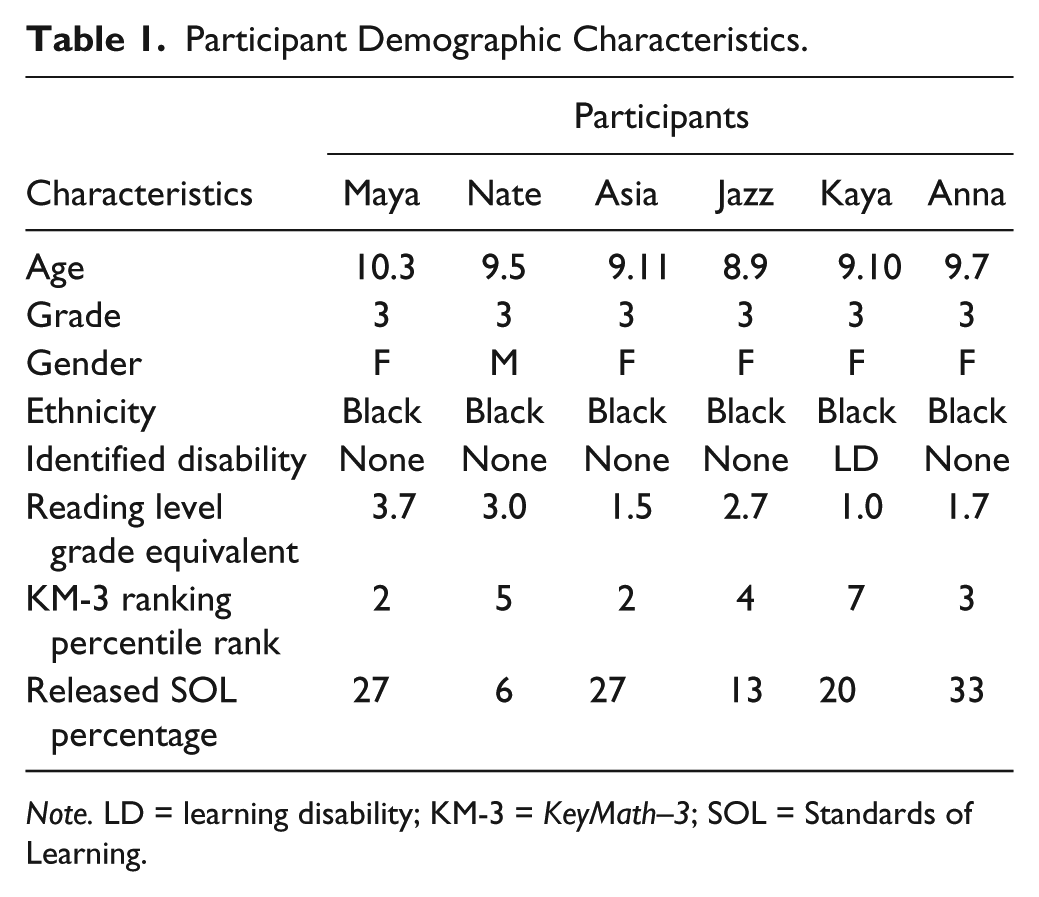
Note. LD = learning disability; KM-3 = KeyMath–3; SOL = Standards of Learning.
Setting
All research was conducted at the participants’ elementary school. A conference room off of the library was made available to the researcher. The room contained a large rectangular table with the capacity to seat six students, typical of a classroom table used for group work. The room was devoid of decoration of any type. Testing took place on a one-to-one basis, while baseline and intervention sessions took place in dyads. Pretesting took place during school hours. Baseline, intervention, and posttesting took place daily after school in the room provided.
Materials
Participants were assessed through the administration of the KM-3 (Connolly, 2007) assessment that served as a screening instrument. The KM-3 is a comprehensive assessment of mathematical skills. Students were administered all KM-3 subtests.
Virginia SOL (i.e., Virginia’s high-stakes tests) test questions taken from third- and fourth-grade released tests from 2007 to 2010 also were used in screening. Chosen word problems involved computation of basic mathematical operations (i.e., addition, subtraction, and multiplication). There were no SOL word problems involving division. Both of these instruments were readministered following the completion of the intervention to serve as pretest/posttest measures.
A bar model drawing protocol adapted from Forsten (2010) and mathematical word problem questions were developed by the first author for baseline, intervention, and criterion probes and mastery checks. A social validity survey was given to participants upon the completion of the intervention. Participants had access to standard classroom-issue calculators.
Procedures
Baseline
For each baseline session, participants were given eight math word problems that represented the eight levels of instructional concepts that would be taught in the intervention condition (see Figure 1). Each baseline test differed only in terms of story context and numerical values and continued to represent the eight levels of instructional concepts. Participants were assigned to dyads via a random drawing. After the first dyad, Maya and Nate, completed five baseline sessions with a nonascending trend, they were introduced to the intervention condition. Participants randomly chosen to be the second dyad, Asia and Jazz, and the third dyad, Kaya and Anna, were also probed at five different points as they remained in baseline. When a stable baseline was achieved for each dyad, reflecting the percentage of word problems solved accurately and the numbers of cognitive strategies used in problem solving, intervention was begun for that dyad. Correct solutions of problems included both the accurate answer and use of cognitive strategies, as not just numerical accuracy, but also learning a process that enhances number sense and equips students with a conceptual tool is necessary to assist students in achieving mastery of math word problem solving. Throughout the study, participants were allowed to use a calculator as needed, and received any requested help with reading the word problems.
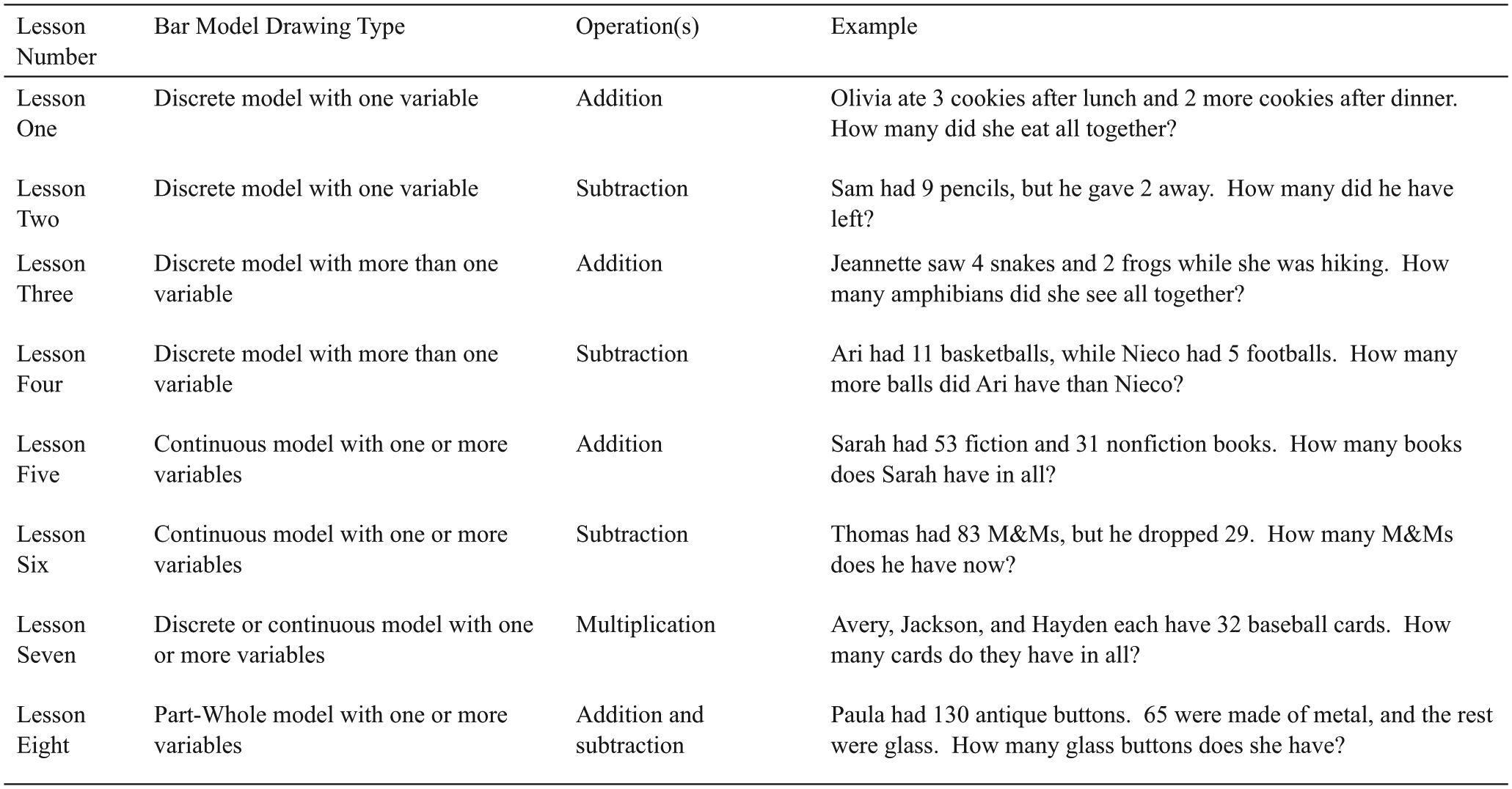
Lesson sequence outline.
Intervention
Intervention instruction was delivered by the first author. Intervention procedures will be described in three sections: (a) General procedures, (b) Criterion probes, and (c) Instructional sequence.
General procedures
Intervention involved the introduction of eight math word problem-solving lessons that increased in difficulty and were based upon mastery of previous lessons. Each instructional session ranged from 25 to 40 min; sessions were conducted at the end of each school day. During each session of the intervention, the instructor first administered a criterion probe to check for understanding of the previous lesson taught. Criterion mastery was set at 100%. If the participant demonstrated mastery of both the intervention strategy and the word problem type taught in the lesson, the participant continued on to the next lesson or the researcher remediated the previous lesson. After ascertaining what the participant knew about the current lesson, the instructor modeled the bar model drawing strategy, specifically as it applied to the particular word problems in a given lesson and provided examples. The content of lessons varied according to skills taught. During all intervention sessions, the instructor used explicit instruction to teach the lessons. Explicit instruction is defined as a step-by-step presentation of a strategy along with teacher modeling and think-aloud of specific examples, and student opportunities for practice with corrective feedback. Corrective feedback included explicit correction that showed participants the incorrect use of steps while problem solving and teacher modeling of correct use and application of the protocol, and elicitation. The plan was to show participants the correct use of the strategy of bar model drawing by asking questions and asking them to reformulate their work (Tedick & Gortari, 1998). Although lessons were scripted, scripts were used as a guide, rather than verbatim reading. Lessons adhered to the strategy sequence protocol based on Forsten’s (2010) guidelines. The instructional sequence followed the same order for each lesson:
Read the entire problem.
Rewrite the question being asked in sentence form, leaving a space for the answer.
Determine who or what is involved with the problem.
Draw the unit bar(s).
Chunk the problem and identify the missing variable.
Correctly adjust the unit bar(s) and compute (for which participants could use calculators) to solve the problem.
Write the answer in the previously written sentence, making sure the answer makes sense.
Participants were provided a copy of the protocol and allowed to use it as long as they needed. By the time participants reached the concluding mastery checks following the last intervention, all participants phased out the protocol sheet on their own, having memorized the steps through extensive practice throughout the intervention phase. The researcher used only the strategies directly associated with explicit instruction and those stated in the strategy sequence protocol.
The strategy sequence protocol previously outlined scaffolded the task and provided procedural prompts for students to solve the problem. Using this approach, cognitive strategies were used as a procedural facilitator for students to learn the steps to solve math word problems (Baker, Gersten, & Scanlon, 2002). For example, in Step 2 of the protocol described above, students were reminded to rewrite the question as an answer statement, which required accurate paraphrasing, and in Step 4, they were reminded to construct a bar model, which required visualization of the word problem. In Step 6, students manipulated the bar model (i.e., hypothesized about problem solutions), and in Step 7, students had to write the answer in the previously written answer statement and ensure it made sense (i.e., checking work), all of which are cognitive strategies embedded in the bar model drawing protocol.
Criterion probes
Each lesson began with a four-question criterion probe of the previous material presented formatted to the same specifications described in the baseline probe condition. If a participant was not able to correctly solve problems from material covered in the previous lesson, that lesson was remediated. In addition, a cumulative four-question mastery check of Lessons 1 through 4 was given following individual mastery of those four lessons. The participants were required to demonstrate 100% on the mastery check before continuing on to Lesson 5. Following demonstration of mastery of Lessons 5 through 8, as evidenced by individual lesson criterion probes, another four-question mastery check of those cumulative four lessons were given following the same protocol as the first mastery check (Lessons 1–4). Participants were also required to demonstrate 100% mastery on the second mastery check. Then, a cumulative eight-question mastery check of all lessons was given. The participants were required to demonstrate 100% mastery on the final cumulative mastery check.
Once the first dyad of participants demonstrated 100% accuracy on the mastery check for Lessons 4 through 8 and the final cumulative mastery check, the second dyad, Asia and Jazz, simultaneously began intervention, following the same intervention protocol outlined for Maya and Nate. Once Asia and Jazz reached mastery on the final mastery checks, the third dyad, Kaya and Anna began intervention.
Instructional sequence
Word problem instruction was delivered sequentially beginning with word problems that involved addition with one variable, which could be solved using a discrete bar model (see Figure 1). Although students were able to solve simple addition problems, to learn the procedures and to understand the conceptual foundation for bar model drawing, instruction began at students’ levels of math proficiency (i.e., simple addition and subtraction problems) and increased in difficulty. For example, in the word problem, “Olivia ate three cookies after lunch and two more cookies after dinner. How many did she eat all together?” there is only one variable, cookies, and it can be solved by drawing three discrete bars, and then two more, for a total of five bars. Lesson 2 involved subtraction with one variable that could be solved using a discrete model (e.g., “Five birds were sitting in a tree. Three flew away. How many birds are still sitting in the tree?”). Lesson 3 taught participants to solve addition problems that have more than one variable, but could still be solved using a discrete model. For example, in “Jeannette saw four snakes and two frogs while she was hiking. How many amphibians did she see all together?” there are two variables, snakes and frogs. The problem can still be solved with each bar model representing one-to-one correspondence. Lesson 4 involved subtraction with more than one variable using a discrete model (e.g., “Seven cats and five dogs live on Virginia Avenue. How many more cats are there than dogs?”).
The continuous model was introduced next to support participants in solving word problems in which bar model drawing can no longer be used with one-to-one correspondence. Lesson 5 taught addition word problems with one or more variables using the continuous bar model. For example, in “Sarah owned 53 fiction and 31 nonfiction books. How many books does Sarah have in all?” the participants can no longer draw a bar representing one-to-one correspondence. Instead, they will draw “continuous” bars. Lesson 6 followed with subtraction involving one or more variables and the continuous bar model.
In Lesson 7, participants were introduced to multiplication with one or more variables that could be solved using the continuous or discrete model. Lesson 8 involved addition and subtraction with one or more questions that could be solved using the part–whole bar model. For example, the problem, “There were 321 baseball fans in the stadium. 203 were Phillies fans. The rest were Mets fans. How many Mets fans were there?” is solved by specifically manipulating the continuous bar model to represent the whole, the part, and the other missing part. These word problems correspond to five different mathematical word problem types in other SBI literature that uses a specific schema for a specific type of mathematical word problem. These schemata are known as Change Schema, Group Schema, Compare Schema, Vary Schema, Equal-Group Schema, and Part–Whole Schema (Jitendra, DiPipi, & Perron-Jones, 2002; Jitendra, Griffin, Deatline-Buchman, & Sczesniak, 2007; Jitendra & Kameenui, 1993).
Generalization
The 15 word problems, which were taken from released Virginia SOL tests and administered as a posttest, served as a generalization measure. These questions were analyzed for accurate use of cognitive strategies and accuracy in math word problem solving.
Maintenance
One week after each participant achieved mastery, he or she was retested using the same eight-question mastery check that was representative of each of the target lessons.
Treatment Fidelity, Interobserver Agreement, and Social Validity
All intervention sessions were videotaped. Treatment fidelity (both content and process) was assessed by a doctoral student. She viewed 35% of the taped sessions for each dyad (randomly selected by using the Integer Generator on Random.org) to ensure that the instructor adhered to the content and intervention procedures.
All baseline probes, 35% of all intervention probes for each dyad (randomly selected by using the Integer Generator on Random.org), and all mastery checks were graded by the doctoral student to ensure that these had reached 100% accuracy and 100% strategy use. As inaccurate computation was taken into consideration, meaning a computational-type error did not automatically produce an incorrect response when determining correct use of cognitive strategies if all other components of the word problem solution were correct, mastery checks were graded separately and compared to produce a reliability measure. A criterion level of 85% and above interobserver agreement was established to ensure accuracy of data collected. Interobserver agreement, calculated by reporting agreements on occurrences or accuracy divided by agreements plus disagreement (A / [A + D]), met 85% or greater for each dyad.
A social validity survey was administered to participants upon completion of the study. This survey was comprised of four questions employing a 5-point Likert-type scale to measure attitude toward and usefulness of bar model drawing for math word problem solving. These factors are related to socially important outcomes, a quality indicator for single subject research (Horner et al., 2005).
Results
According to Kratochwill et al. (2010), single subject designs may only achieve evidence standards by meeting four criteria:
The independent variable, or intervention, must be methodically, intentionally manipulated by the researcher. (p. 14) The study must include interrater reliability on each condition, meeting at least minimal standards of agreement. (p. 15) The study must demonstrate the effect of the intervention over three points in time or over three phase repetitions. (p. 15) Each phase must have at least three data points. (p. 15)
The present study met these standards for single subject design. Manipulation of the independent variable, bar model drawing instruction, was carefully planned in advance and was carried out accordingly to study the effects of the intervention on the problem-solving skills of students with MD. Interobserver agreement was assessed for 35% of data points in each phase resulting in 91% agreement. The research was replicated across three dyads of participants and each phase (i.e., baseline and intervention) included at least five data points for each dyad. As this research met the criteria for single subject design standards, it can be analyzed to determine if there is evidence of an effect (Kratochwill et al., 2010).
The independent variable for each research question was explicit instruction of word problem solving using bar model drawing combined with CSI. The dependent variable in Question 1 was the frequency of accurate use of cognitive strategies while solving word problems. The dependent variable in Question 2 was accuracy in word problem solving. Both dependent variables were measured through criterion checks that followed each lesson, mastery checks that occurred midway and following the intervention, and pre- and posttests that consisted of word problems compiled from released Virginia’s SOL tests.
Systematic visual analyses were conducted to examine the stability, level change, and trend direction of participants’ performance within and between phases. Specifically, when at least 80% of data points fell within 20% of the median and trend lines, the data were considered stable. Relative and absolute level changes between phases are reported. Trend direction was identified by examining whether the direction of the data path was zero celerating (flat), accelerating, or decelerating. Split-middle analysis was used to construct a trend line. Points of nonoverlapping data (PND) are reported to determine effect size. PND is calculated by comparing data across conditions. Typically, a higher PND equates to a greater effect of the intervention (Gast, 2010).
Each research question is answered individually.
Research Question 1
To what extent will explicit instruction of the bar model drawing strategy improve the use of cognitive strategies of urban students with MD when solving math word problems?
Visual analyses of data
Baseline and intervention for each participant is discussed. Refer to Figure 2 for a graph of the results.
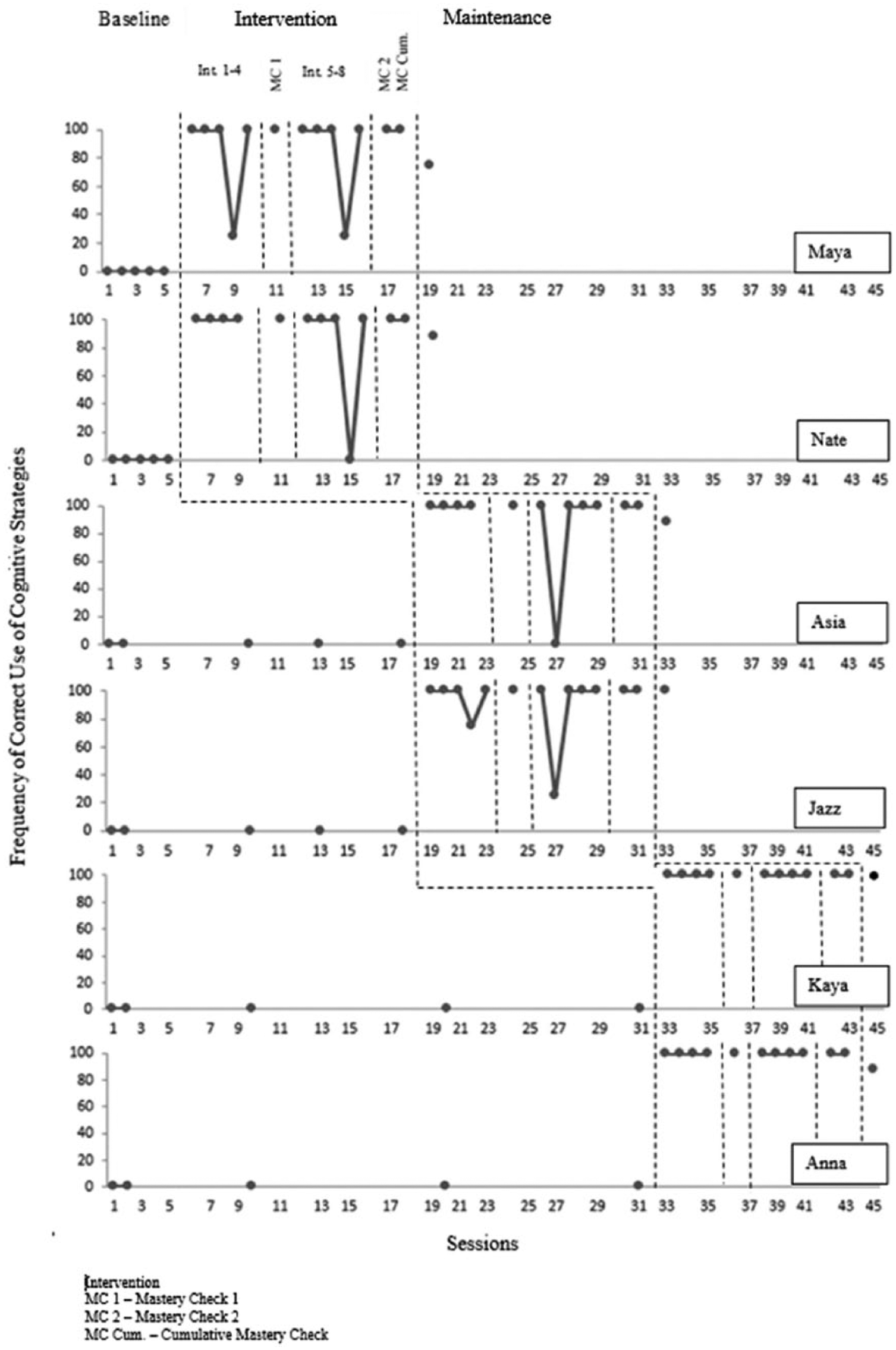
Frequency of bar model drawing and the use of accurate cognitive strategies to solve word problems.
Baseline
Systematic visual analyses of within-condition phases indicated that none of the six participants accurately used cognitive strategies during the five baseline sessions. This resulted in a median, mean, and range of 0% and a trend line of zero.
Intervention
Intervention results are reported by participant.
Maya
Maya received a total of 10 intervention sessions. The use of cognitive strategies immediately increased to 100% when the intervention was implemented and maintained at that level for eight of the 10 intervention sessions (M = 87.5% correct; range = 25%–100%). Overall, the trend line for Maya was stable, with 80% of data points falling on the trend line.
Nate
Across nine sessions, the median for Nate immediately increased to 100% when the intervention phase was introduced. Nate had a mean of 88.9% (range of 0%–100%) for the percentage of accurately used cognitive strategies. The level was stable, with eight out of nine intervention points falling on the median, and a relative and absolute level change of zero.
Asia
Like Maya and Nate, the median increased to 100% during the intervention phase for Asia as she demonstrated mastery of cognitive strategy use across the nine sessions. The mean was 88.9%, with a range of 0% to 100%. The level was stable with 8 out of 9 points falling on the median. The relative and absolute level changes were both zero. Trend during intervention was stable, with 8 out of 9 points falling on the trend line.
Jazz
The median increased to 100% during 10 sessions of the intervention phase for Jazz, reflecting effective cognitive strategy use. The mean was 90% and the range was 25% to 100%. The level was stable with 8 out of 10 intervention points falling on the median.
Kaya
As all eight intervention points were 100%, reflecting perfect mastery of each lesson on cognitive strategy use across different math word problem types, the median, mean, and range for Kaya were all 100%, reflecting stability. The relative and absolute level changes were zero. The trend, too, was stable, with all 8 points falling on the trend line.
Anna
The performance of Anna showed the same results for the intervention phase as Kaya. She demonstrated 100% mastery across all eight intervention sessions (M = 100%, median = 100%, range = 100%), thus achieving stability across the intervention phase. With all 8 points falling on the trend line, it was stable, with relative and absolute level changes of zero.
Summary of analyses between conditions
As baseline and intervention phases were stable within conditions for all participants, the relative and absolute changes in level for all participants between conditions increased from 0% to 100%, demonstrating a positive effect. The PND were 100% for Maya, Jazz, Kaya, and Anna. The PND for Nate and Asia were 88.9%, reflecting a large effect size between all participants’ baseline and intervention conditions.
Summary of analyses across conditions
As noted previously, all participant baseline conditions were similar, showing no use of cognitive strategies during baseline. When comparing intervention conditions for all participants, the median level rose to 100% and all levels were stable with a zero celerating trend and stable direction. Means indicated growth from a range of 0% to 0% in baseline to a range of 85% to 100% during intervention.
Summary of visual analyses of data
Within conditions, between conditions, and across conditions, analyses reveal the presence of a functional relation between the intervention and accurate use of cognitive strategies through the bar model drawing model intervention. When analyzing the data within conditions, a median and mean of 0% for all baseline points rose to a median of 100% and a mean ranging from 85% to 100% for the intervention phases. Between conditions analyses showed positive changes in relative and absolute levels from baseline to intervention, rising from 0% to 100% for all participants. PND (ranging from 88.9% to 100%) demonstrated that the large majority of data points during interventions did not overlap with baseline data points.
Generalization
Fifteen word problems taken from released SOL math tests were analyzed for accurate use of cognitive strategies. Accurate use of cognitive strategies divided by opportunities to use cognitive strategies (i.e., four cognitive strategies for 15 questions) yielded scores ranging from 10.71% to 92.50%, with a mean score across students of 54.33%. This measure will be discussed in greater detail in the pre/postmeasure.
Maintenance
A maintenance probe was administered at least 1 week following the completion of intervention for each participant. Students demonstrated that they were able to maintain their accurate use of strategies with maintenance scores ranging from 75% to 100%, with a mean score of 91.8%.
Research Question 2
To what extent will explicit instruction of the bar model drawing strategy increase the ability of urban students with MD to accurately solve math word problems?
Visual analyses of data
Refer to Figure 3 for a graph of the results and Table 2 for the means across phases. Analyses within conditions, between conditions, and across similar conditions revealed the presence of a functional relation between the intervention and accuracy of word problem solving through the bar model drawing model. When analyzing the data within conditions, a median ranging from 0% to 50% for baseline points rose to a median of 100% and to a mean ranging from 85% to 100% for the intervention phases. Between conditions analyses showed positive changes in relative levels from baseline to intervention, rising from a range of 19% to 50% at baseline to 100% at intervention for all participants. PND (ranging from 80% to 100%) demonstrate that most data points of probes during interventions did not overlap with baseline data.

Bar model drawing and accuracy in solving math word problems.
Phase Means for Accuracy in Solving Math Word Problems.

Pre/Postassessment Results
Pre- and post-SOL questions
Students were given word problems taken from released Virginia’s SOL tests prior to and following intervention. On pre- and posttests, Question 1 was the same, and Questions 2 through 15 varied only by noun and proper noun changes. Problem order remained the same. Posttest released SOL questions were assessed for accuracy and correct use of cognitive strategies and served as generalization measures. Each question, except for Question 1, in which participants had to choose the correct representation for a problem rather than drawing their own representation, was analyzed for use of paraphrasing, visualizing, hypothesizing, and checking. In terms of accuracy, participant scores on the pretest ranged from 6% to 33% correct (M = 21%). All participants’ posttest scores rose, ranging from 60% to 87% correct (M = 71.17%). Refer to Figure 4.
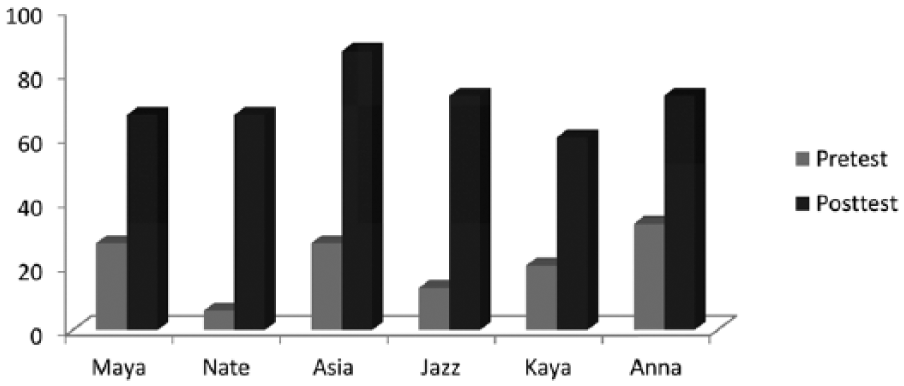
Released SOL word problem questions (by percentage).
Pre- and post-KM-3 assessments
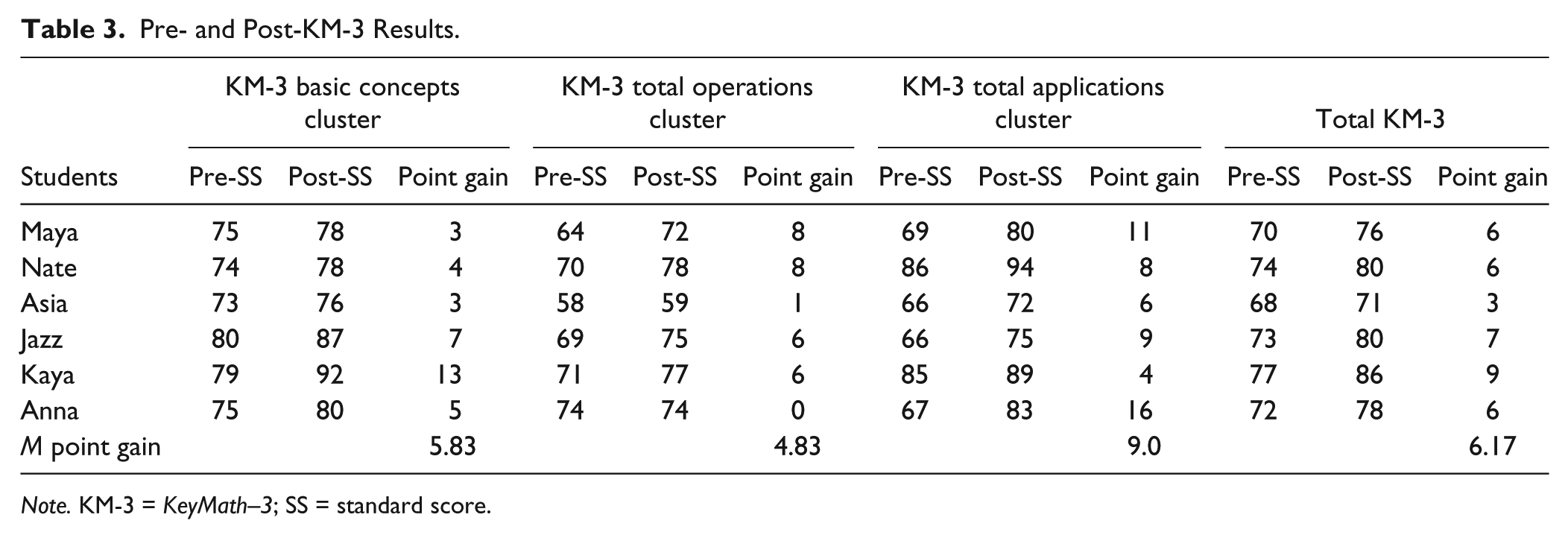
The KM-3 was administered to participants prior to and following intervention. Form A of KM-3 (Connolly, 2007) was administered as both the pre- and postassessment due to a lack of availability of Form B. The KM-3 manual reports high test–retest reliability (.97 for Total Test) and a small practice effect, about 1/5 of a standard deviation (i.e., SD = 3 on subtests; SD = 15 on three main areas and total test). Participant results are found in Table 3.
Pre- and Post-KM-3 Results.
Note. KM-3 = KeyMath–3; SS = standard score.
On the pretest, all participants fell within the first through the seventh percentiles, in the below average and well-below average ranges. During posttesting, all participants made point gains (range = 3–9, M = 6.17) on the Total Test, with scores between the third and 17 percentiles, in the below average to just within the average range. The participant (Asia) with the lowest pretest score made the lowest overall point gain (i.e., 3 points), while the participant with the highest pretest score (Kaya) made the greatest overall point gain (i.e., 9 points). Furthermore, while participants made gains in all three areas, they made the largest gains (M = 9 points) in the Applications cluster, which focused on problem solving.
Social Validity Survey Results
Participants were given a social validity survey to determine their perceptions regarding ease of learning and use of bar model drawing and their perceptions of its practical application. Participants completed the four-question Likert-style survey anonymously. The surveys were collected by the school secretary who passed all the surveys to the researcher. All surveys from six participants were returned. Table 4 shows the results of the survey.
Social Validity Statements and Scores.

Discussion
Research Question 1
To what extent will explicit instruction of the bar model drawing strategy improve the use of cognitive strategies of urban students with MD when solving math word problems?
Visual analyses of individual participant’s performances during intervention, on pre- and posttests, suggest that the use of bar model drawing to solve math word problems is an effective strategy for improving participants’ use of cognitive strategies. Prior to intervention, participants’ baseline performances showed no use of cognitive strategies. During intervention, participants were able to successfully implement the use of cognitive strategies. Although some remediation was necessary, participants’ median level of cognitive strategy use rose to 100% during intervention. The levels remained high during the maintenance phase, which occurred at least 1 week after intervention using novel word problems.
Instruction in the use of four cognitive strategies was included within the direct instruction of bar model drawing. These four cognitive strategies were paraphrasing (i.e., rewriting the question as an answer statement), visualizing (i.e., constructing a bar model), hypothesizing about problem solutions (i.e., manipulating the bar model), and checking work (i.e., writing the answer in the previously written answer statement and ensuring it made sense). Each of the strategies was explicitly taught through the use of the bar model drawing protocol.
Participants demonstrated growth in their ability to solve the SOL word problems. However, participants varied widely in their use of the strategies on this measure. Maya and Jazz used all four strategies consistently. Nate used visualizing only once. Asia failed to use the paraphrasing or checking work strategies. Kaya used the strategies inconsistently across word problems, using each strategy correctly between 8 and 10 times. Finally, Anna used very few cognitive strategies, using visualizing twice and hypothesizing 4 times across the entire test. Maya and Jazz were no more successful in posttesting than participants who did not consistently use the cognitive strategies; participants who favored one or two strategies and failed to use the others were no more successful or unsuccessful than Anna, who failed to use almost all strategies. Participants found one cognitive strategy, paraphrasing, extremely difficult and distasteful. All six of the third-grade participants struggled with rewriting the question as an answer statement.
It is possible that this problem with writing answer statements may have been associated with the participants’ reading levels. Only two participants, Maya and Nate, read on the third-grade level. Three participants read on first-grade level, and one on a second-grade level. The struggle with forming answer statements raises some questions. The question arose, “Is this weakness or lack of development in the area of language associated with, or separate from, the math weaknesses participants demonstrated during pretesting?”
Research Question 2
To what extent will explicit instruction of the bar model drawing strategy increase the ability of urban students with MD to accurately solve math word problems?
Visual analyses of the single subject data, along with pre- and posttesting in the form of grade-appropriate word problems from released SOL tests and the KM-3 suggested that the use of bar model drawing is an effective strategy for improving students’ accuracy in solving math word problems. During the baseline phase prior to intervention, participants’ accuracy in solving sample math word problems was low, with a mean range of accuracy of 12.6% to 47.6%. Perhaps due to lack of interest or being ill-equipped in even the most basic math concepts, including number sense, four out of six participants (Nate, Jazz, Kaya, and Anna) displayed decelerating trend lines, meaning that their accuracy decreased over time. The other two participants (Maya, Asia) maintained stable baselines that demonstrated consistently low accuracy. During intervention, participants were able to successfully and accurately solve five different types of word problems across eight to 10 sessions of intervention. Although some remediation was necessary, participants’ median level, ranging from 0% to 50%, rose to 100% during intervention. Levels remained high during the maintenance phase.
When solving the posttest word problems of the sample released SOL, participants showed gains in accuracy, with a mean accuracy gain across participants of 51.17%. Participants also demonstrated gains between pre- and posttesting on the KM-3, with a mean gain of 6.17 points across participants. Despite these results, several questions regarding participants’ ability to accurately solve word problems were raised.
Asia achieved the smallest gain, 3 points, which is the typical gain for practice effect between the KM-3 pre- and posttest scores; however, she achieved the highest score on the released SOL word problems posttest, scoring 87%. Although she did not use the protocol sheet during her completion of the SOL measure, her work on the SOL word problems posttest demonstrated a close adherence to the steps outlined in the bar model drawing protocol used throughout the lessons. This calls into question whether the protocol and bar model drawing instruction served as a conceptual or procedural support for Asia. While SBI is designed to assist students to conceptualize word problems, it is possible that the steps in the protocol served as a procedural aid in arriving at the accurate answers for the word problems given. This would explain the disparity between the extremely modest gain in KM-3 posttest scores and the success Asia achieved on the SOL measure.
Limitations
This study was conducted with only six participants in the third grade in an urban school setting, so the generalizability of the results to students in other grade levels is limited. In addition, all participants were African Americans. Only one participant was male. Therefore, the results may not apply to students in other locations or from other ethnic backgrounds. As the intervention was provided in small groups of two (i.e., dyads), the results may not be applicable to other types of school settings, such as inclusion classrooms or self-contained special education classrooms when instruction is given in larger groups.
Also, as the study was conducted during the spring, from March to June, classroom preparation for math SOL testing was a high priority in the setting in which the study was conducted. Some successful results attributed to the study, such as KM-3, may have been a result of classroom activities, producing internal validity threats in the form of history and maturation.
All intervention lessons were taught by the first author. Researcher bias is a realistic threat to the validity of the study. In addition, the use of nonstandardized testing instruments for the screening, baseline, intervention, and maintenance probes, and pre- and posttesting measures (except for the KM-3) is another limitation.
Implications for Action
As math word problems are an important component of math instruction with which students often struggle, this research offers practical, long-term implications in the classroom. First, as empirical evidence supports explicit instruction in the use of cognitive strategies for participants who have difficulty with math word problem solving and because SBI implicitly includes cognitive strategies, emphasizing the connection between the two strategies that have historically been studied separately increases the value of SBI.
The application of a cognitive strategy at the outset of solving a math word problem, such as restructuring the question being asked into an answer statement and leaving a blank for the answer, supports the student in paraphrasing the problem and thinking about how the problem needs to be answered, structured, organized, and computed. It may train students to thoughtfully form their own procedural foundation for successfully solving the problem. In Virginia, this is particularly important as paraphrasing is a key English standard for third graders and a powerful comprehension strategy (Hagaman & Reid, 2008). The present research suggests that paraphrasing of math word problems may deserve more attention in the classroom, and this process may have to be explicitly taught.
Finally, the generalizability of all components of bar model drawing in comparison with other forms of SBI could mean that, as is the case with its use in Singapore, young students could be taught to use the model to support their understanding of the earliest, most fundamental word problems, and then teachers could build on this same conceptual understanding of bar model drawing each year to support gradually more complex word problem solving (Forsten, 2010). In this manner, students can build upon their prior knowledge of bar model drawing and math word problem solving to lay a foundation for higher level, more complex problems in later grades. For example, word problems involving ratios and percentages can be solved using bar models, so that students can base their new understanding on a solid conceptual foundation built while solving other types of word problems.
Footnotes
Declaration of Conflicting Interests
The author(s) declared no potential conflicts of interest with respect to the research, authorship, and/or publication of this article.
Funding
The author(s) received no financial support for the research, authorship, and/or publication of this article.