



Abstract
One of the most persistent areas of difficulty in mathematics for children with learning disabilities (LDs) and difficulties is fractions. We report the development and initial testing of an intervention designed to increase access to and advancement in conceptual understanding. Our asset-based theory of change—a tested and confirmed learning trajectory of fraction concepts of students with LDs grounded in student-centered instruction—served as the basis for our multistage scientific design process. We report on foundational (i.e., a theory of change, establishment and refinement of learning trajectories, and core instructional components) and evaluative (pilot data on student outcomes) components of the intervention. The results of the study reveal positive effects of the program’s fidelity and potential to improve student outcomes in school settings. The positive outcomes support continued exploration and expansion of a new framework for supplemental intervention grounded in trajectories of student learning.
One of the most persistent areas of difficulty in mathematics for children with learning disabilities (LDs) and mathematics difficulties (MDs) is fractions (National Center for Education Statistics, 2013). Because conceptual understanding mediates performance differences in fractions between students with and without LDs (Vukovic, 2012), developing and testing interventions that bolster fraction concepts is paramount. Mathematics education researchers suggest utilizing learning trajectories that consist of a goal, developmental stages of thinking, and activities designed to explicitly promote the stages of thinking to design instruction bolsters concepts of fractions. Unfortunately, although basing instruction on learning trajectories is often recommended, “there is little direct evidence to support this approach” (Clements et al., 2020, p. 3), especially in special education intervention research.
One reason for the shortage of evidence may be due to how little is known regarding how students with LDs evidence stages of thinking over time (Vukovic, 2012). For example, one learning trajectory for the development of fraction concepts validated in mathematics education research is based on stages of thinking that involve the development, coordination, and abstraction of partitioning and iterating processes (Hackenberg, 2007; Norton & Wilkins, 2010; Wilkins et al., 2013). Yet, students with LDs may follow a different trajectory for learning fraction concepts than their peers or they may follow a similar trajectory yet experience cognitive differences that may interplay with the stages of learning in unique ways (Davis et al., 2009; Steffe, 2017). Researchers must document whether students with LDs utilize partitioning and iterating to build conceptual understanding of fractions before documenting the impact of an intervention program designed to utilize this learning trajectory as a content basis for fractions.
In this article, we share foundational and evaluative components of an asset-based intervention grounded in documented trajectories of fractional thinking of students with LDs developed over 5 years. We begin by reviewing the literature on evidence-based intervention practices for students with LDs. We summarize research relevant to the current study in mathematics broadly and fractions specifically. Next, we present the initial design of the intervention reported on in this article; we compare and contrast our intervention’s theory of change and core components with the existing evidence base. Then, we summarize the results of the first 4 years of the project, which documented students with LDs’ initial knowledge of fractions, along with learning trajectories based on partitioning and iterating processes over time. Finally, we report the results of a study done in the project’s fifth year. This study tested the potential of an intervention based on learning trajectories to positively impact student outcomes. We address the following research questions:
Evidence-Based Practices in Special Education—Mathematics
Previous research has examined evidence-based intervention practices in mathematics for students with LDs and MDs (e.g., Chodura et al., 2015; Gersten et al., 2008; Stevens et al., 2018). For example, Gersten et al. (2008) synthesized experimental and quasi-experimental research that reported enhanced mathematics performance of students with LDs or MDs in 1st through 12th grade. Four of the eight main findings are relevant to the current study. First, the authors report the positive effects of explicit instruction (i.e., step-by-step, problem-specific instruction where teachers utilize modeling and think aloud) on students’ mathematics performance and implied its “key role” in mathematics intervention design. Second, student verbalization of reasoning (i.e., verbalizing problem steps and use of self-questioning, utilized during initial learning and/or after problems were solved) also increased mathematics performance gains. Third, utilizing multiple visual representations modeled by the teacher produced positive effects on performance, especially when combined with other evidence-based instructional components, such as verbalization. Finally, a range and sequence of examples positively impacted students’ mathematics performance; researchers hypothesized carefully sequenced examples were especially useful when learning new concepts.
In subsequent years, research affirmed findings by Gersten et al. (2008) and expanded upon them. Chodura et al. (2015) conducted an international meta-analysis for elementary students with MDs and LDs, examining the fit between characteristics of interventions and their participants. Results suggested that the use of assisted instruction increased mathematics achievement for students with MDs and LDs. The researchers also reported positive effects that were significant for students with LDs of certain evidence-based practices within specific content, such as the use of explicit instruction on the four operations (i.e., arithmetic).
Stevens et al. (2018) conducted a meta-analysis of mathematics interventions for students with LDs or MDs in Grades 4 to 12. Results bolstered the evidence base for explicit instruction and self-explanations and expanded the evidence of the use of these practices within other content areas, such as fractions (e.g., Fuchs et al., 2017). Stevens et al.’s (2018) findings also supported the notion that the use of one evidence-based practice on its own may not afford opportunities for increased mathematics understanding. For example, combining several aspects of evidence-based practice yielded significant increases in fraction performance.
Evidence-Based Practices in Special Education and Fractions
Previous research has also examined evidence-based practices that target fraction content for students with LDs and MDs (Hwang et al., 2019; Misquitta, 2011; Shin & Bryant, 2015a). Misquitta (2011) reviewed the quality and effectiveness of intervention research specific to fractions. Across 10 studies, Misquitta reported that the use of a purposive instructional sequence and explicit instruction benefited students with LDs in terms of conceptual understanding and procedural skill, mirroring findings from reviews of mathematics interventions more generally (Chodura et al., 2015; Gersten et al., 2008; Stevens et al., 2018). Shin and Bryant (2015b) synthesized intervention studies focusing on improving fractions skills for students in 3rd to 12th grade with MDs. These authors also reported that the use of explicit instruction, a range and careful sequence of examples, and the use of real-world problems benefited students’ performance and conceptual understanding in fractions.
Hwang et al. (2019) extended Shin and Bryant (2015a) and Misquitta (2011) by distinguishing results of interventions for students with LDs and MDs, examining the effectiveness of interventions when compared with business as usual conditions, and reporting on possible alternate influential variables on reported study effects. The researchers reported a carefully sequenced use of multiple representations positively impacted achievement for students with LDs along with components of explicit instruction within a meaningful context, complimenting previous research (Gersten et al., 2008; Shin & Bryant, 2015a). Moreover, the author’s results suggest that the fraction interventions that comprise the current literature base did little to bolster basic understanding of fractions for students with LDs (Hwang et al., 2019). Furthermore, researchers report current interventions were more effective for improving outcomes for students with MDs than for students with disabilities, pointing to opportunities for innovation.
Theory of Change
When conceptualizing our intervention, we included four innovations with respect to the existing literature on evidence-based practice as presented in Figure 1.
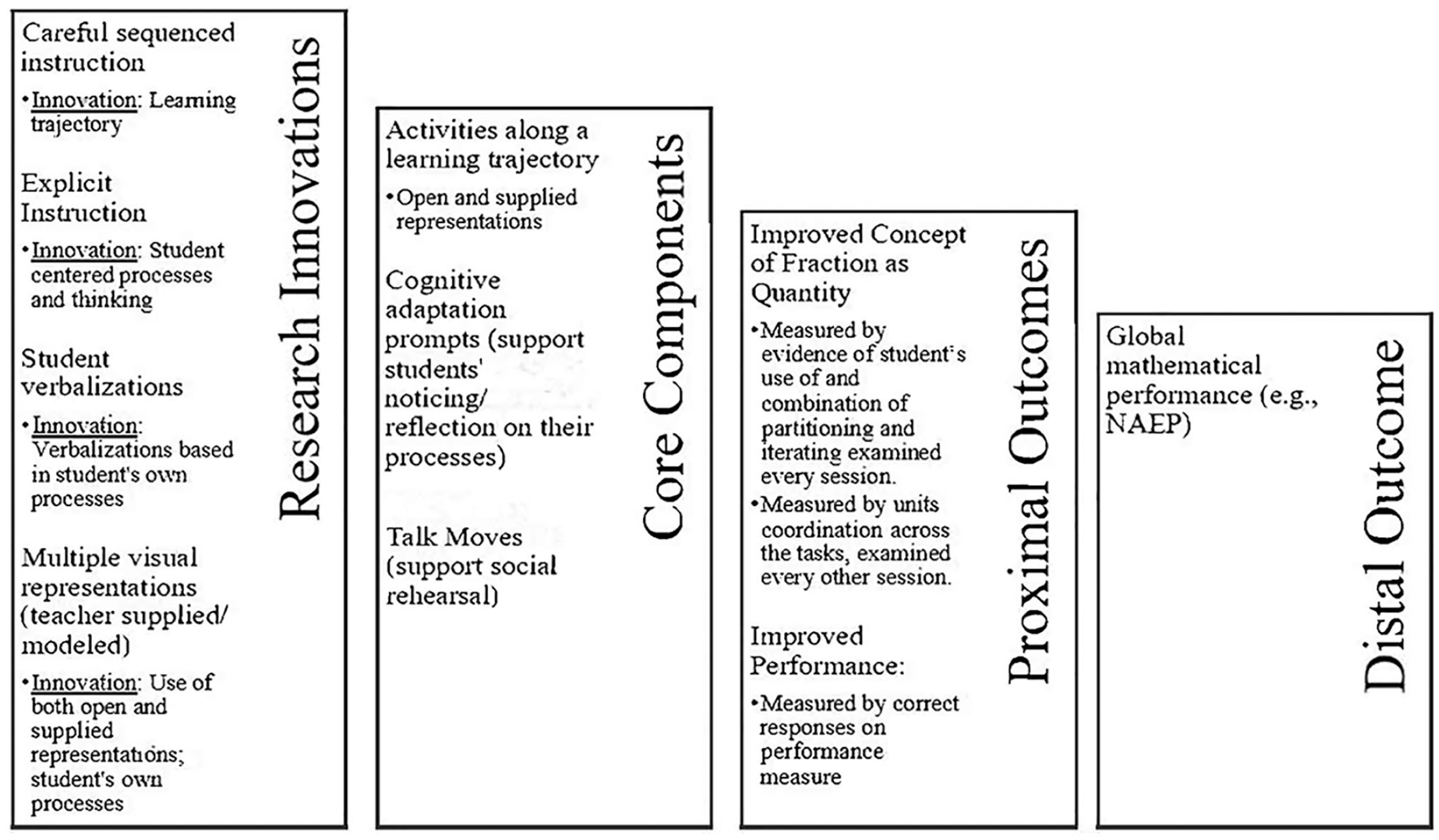
Theory of change.
The first innovation addressed carefully sequenced tasks (Gersten et al., 2008; Hwang et al., 2019; Shin & Bryant, 2015a). Our innovation involved the use of learning trajectories upon which to base the intervention. Learning trajectories are distinct from traditional depictions of sequencing—they are not the same as a buildup of skills (e.g., Carnine et al., 1997), a task analysis, or longitudinal cognitive patterns. Instead, learning trajectories consist of a learning goal, developmental stages of thinking, and activities designed to explicitly promote the stages of thinking (Clements et al., 2020). The stages of thinking are grounded in students’ conceptual development toward the goal, with each stage more sophisticated than its predecessor. Each stage depicts “specific concepts (e.g., mental objects) and processes (e.g., mental ‘actions-on-objects’) that underlie mathematical thinking at [that stage]” (Clements et al., 2020, p. 2) which connect to students’ learning in subsequent stages. Learning trajectories are innovative as they are seldom, if at all, utilized in special education as a theoretical grounding for interventions.
Concept of Fractions: Units Coordination
The learning trajectory utilized in the current study addresses the concepts of fractions as a coordination of units. Units coordination is defined as the number of units children can bring into fraction problems to think and reason with (Hackenberg et al., 2016) and involves the processes of partitioning, iterating, and the eventual combination of partitioning and iterating into a single mental operation (Hackenberg, 2007; Norton & Wilkins, 2010; Wilkins et al., 2013). Partitioning is the mental or enacted action of dividing a unit into equal-sized parts. As students become more fluid with partitioning, they can mentally pull out a created fractional unit from the whole and understand it in relation to the whole without destroying the whole. They begin to iterate, or repeat, the fractional unit to make larger units (e.g., use
The second innovation involved explicit instruction, which has an extensive evidence base in special education. Intervention research utilizing students’ own problem-solving activity (as opposed to following teacher’s modeling or think aloud) within a learning trajectory is practically nonexistent. Hunt (2014) and Hunt and Vasquez (2014) tested an intervention based on a learning trajectory of ratio reasoning from mathematics education that utilized explicit instruction in place of student-centered instruction on mathematics performance of both third-grade and sixth-grade students. Sixth-grade students showed functional increases in performance; third-grade students outperformed controls. Yet, qualitative analyses embedded within the third-grade study revealed students with LDs had misconceptions about ratio equivalencies and also used atypical strategies that persisted after the intervention was completed. Arguably, the misconceptions and atypical strategies were an issue of access in terms of the lack of opportunities and students with LDs had to use their own reasoning within the context of the intervention. Together, the studies showed promise for learning trajectories as a basis for instruction and potential affordances of using students’ own reasoning as an innovation within a learning trajectory approach for students with LDs. In our intervention, we utilized students’ own reasoning, as opposed to teacher-modeled steps or strategies.
The third innovation addresses students’ verbalization of reasoning, or self-explaining (Gersten et al., 2008; Stevens et al., 2018), which are defined in the evidence-based practice literature as verbalizing of problem steps during or after problem-solving. In our innovation, students explained their own thinking process within the activities designed to explicitly promote the stages of units coordination. During problem-solving, the teacher’s role was to support the student to notice and reflect upon his or her own reasoning to promote advancements to subsequent stages of the trajectory (see Hunt & Tzur, 2017). For example, reshowing or restating the exact actions or words of a student’s verbalization helped students to notice their actions; asking what happened and if that is what the student thought would happen helped students to reflect on their actions (Hunt et al., 2018; Hunt & Tzur, 2017). After problem-solving, the teacher used talk moves (i.e., restating—asking a student to put another’s verbalization in their own words; adding on—asking a student to add onto another’s reasoning; explaining—asking a student to explain another’s reasoning, Hunt et al., 2018) to support students to share their reasoning.
The final innovation involved visual representations (Gersten et al., 2008; Hwang et al., 2019). The practice is currently defined as teacher-modeled or teacher-supplied visual representations throughout the instructional sequence. The innovation to this practice rested in the placement of supplied representations (i.e., representations given to the student to act upon in the problems) or open representations (i.e., problems in which no representations were supplied and students were told use a representation that made sense to them) within the trajectory activities. For example, the activities of the first stage included open representations while the second and fourth stages include teacher-supplied representations; the third stage began with open representations and moved to supplied representations. Open representations were conceptualized as more accessible to students’ prior knowledge; supplied representations were constrained to bring forward particular actions necessary to advance student thinking.
Core Intervention Components as a Cohesive Program
The innovations that formed our intervention core components were based on two related hypotheses. First, we hypothesized that students would benefit from instruction that brought forward their own reasoning and challenged it to grow. Second, we hypothesized that students with LDs would engage in partitioning, iterating, and splitting to grow their conceptions of fractions in similar ways to those demonstrated by students without disabilities. That is, the learning trajectory mapped in mathematics education among students without disabilities would be similar to that of students with LDs. An advance organizer of the project’s goals, work plan, research questions, and main findings is given in Figure 2.

Design process and key findings.
Given the enormous evidence base on explicit instruction and the dearth of literature regarding the development of fractional thinking of elementary students with LDs, we designed the first 4 years of the project to explore, document, and ultimately test the two hypotheses on a small scale. We were interested in documenting whether trajectories of student thinking would originate and progress in ways similar to those documented in mathematics education.
Year 1: Initial Stages of the Trajectory
In Year 1, we documented the initial stages of fractional reasoning of students with LDs and the extent to which they converged with or diverged from thinking of students without LDs in authentic school settings. We completed 21 interviews of students with LDs and 23 interviews of students without LDs in the second through fifth grades. We interviewed students with and without LDs in the same school to provide mitigative grounding for real-time contextual factors, such as school instruction, in our research design. We were also able to test a core assumption of our project (i.e., students with LDs would evidence similar operations as students without LDs).
Data sources included a set of six activities for use in the study based upon syntheses of prior research (e.g., Hunt, 2011). Semi-structured clinical interviews (Ginsburg, 1997) were done with each student individually and were video recorded. Constant comparison was used to document the processes students used to solve problems; emergent coding documented students’ overall stages of units coordination. Mann–Whitney U tests were used to document and evaluate differences in stage evidenced by students with and without LDs.
Together, the indicators evidenced an initial three-stage trajectory of students’ units coordination (Hunt, Westenskow, et al., 2016). At Stage 1 (40% of students with LDs; 20% of students without LDs), students were using one level of units coordination to partition parts within a whole, through trial and error. At Stage 2 (50% of students with LDs; 45% of students without LDs), students were developing two levels of units coordination through partitioning based on halving and a nascent linking to the number of sharers to create and coordinate created units in relation to a whole. At times, students began to use a trial-and-error-based iteration to test the units they created through partitioning against the whole. At Stage 3 (10% of students with LDs; 35% of students without LDs), students came in with two levels of units coordination, using partitioning linked to the number of sharers to create a fractional part and testing the coordination of fractional part in relation to the whole through a planned iteration. No evidence of splitting was detected nor were significant differences in stage found between students with and without LDs.
We concluded that students with LDs evidenced the initial operations and conceptions of fractions in ways that were not unlike their peers without disabilities. The next step was to document the trajectories of student learning over time. The purpose of these experiments was to discern if eight case study students would (a) evidence more sophisticated processes that bring about fractions (i.e., partitioning, iterating, and splitting) and (b) use those operations within their own reasoning to evidence the larger aspects of learning trajectories mapped in mathematics education when supported by adaptive pedagogies. Our findings are summarized below.
Years 2 Through 4: Expanding and Testing the Trajectory and Its Activities
Eight students took part in the longitudinal teaching experiments (Steffe & Thompson, 2000). Seven of the students met the following criteria: (a) an individualized education program with goals in mathematics; (b) a cognitively defined label of LDs with working memory as the dominant cognitive factor; (c) identification through clinical interview data that the child used two as a usable unit; and (d) identification by the classroom teacher as not benefiting from supplemental, small-group instruction in fractions from a textbook or supplemental curriculum over at least a 2-year period (see Note 1). Exploratory (i.e., become aware of the student’s current concept by observing the student’s processes within and across sessions) and experimental (e.g., generate and test hypotheses regarding boundaries of the students’ processes and, thus, stage of reasoning) teaching sessions (Steffe & Thompson, 2000) were utilized to document student learning over time. Activities used within each experiment included an expansion of those used in Year 1 and were planned to afford students access to their own thinking processes and/or advancement of them over time. Four different sets of activities were utilized.
The first activity set consisted of multiple-item equal sharing problems (Hackenberg et al., 2016) that produced a fraction
The second activity set involved equally sharing a single item among varying numbers of people. We conjectured these tasks would support students’ partitioning processes yet also bring forward iterating processes through a task constraint. That is, students were asked to use a single partition to estimate the length of one of
The third activity set involved both open and teacher-supplied representations that stood for
The final activity set used a supplied representation of
A three-level qualitative analytic plan was employed in each experiment. Specifically, we employed (a) ongoing analysis to examine critical events in the child’s thinking and learning, (b) retrospective analysis to identify broad indicators of conceptual growth, and (c) fine-grain analysis to consider how learning advanced from one moment to the next. We also utilized emergent coding (Creswell & Plano Clark, 2018) to consider activities or teacher ← → student interactions that affected learning in a significant way. Finally, we conducted a comparitive analysis across cases to examine consistencies in reasoning.
Two main findings were consistent across the cases. First, students with LDs did advance their fractional reasoning through partitioning and iteration processes in similar ways to those documented in mathematics education; as a result, the initial trajectory was confirmed and refined (see Figure 3). For example, Activity Set 1 supported Stage 1 reasoning through varied forms of partitioning (i.e., trial and error, halving, planned, Hunt, MacDonald, & Silva, 2019; Hunt, Silva, & Lambert, 2019; Hunt, Tzur, & Westenskow, 2016). Activity Set 2 supported Stage 2 reasoning (Hunt, Welch-Ptak, & Silva, 2016) through halving and a nascent, linked partitioning and trial-and-error iteration for all but one student who had visual-motor integration differences that precluded his ability to make sense of length representations (Hunt, MacDonald, et al., 2019). Activity Set 3 promoted Stage 3 reasoning via trial-and-error or planned iteration and linked partitioning (Silva et al., revisions). Holistically, students showed impressive growth, advancing fraction conceptions to two-level structures.

Revised learning trajectory.
Second, in all cases, students’ own processes and responsive pedagogies supported movement across the trajectory stages (Hunt, MacDonald, et al., 2019; Hunt, Silva, et al., 2019; Hunt, Tzur, et al., 2016; Hunt, Welch-Ptak, et al., 2016; Hunt, Westenskow, et al., 2016). For example, students explaining the use of their own actions within the activities designed to explicitly promote the stages of units coordination promoted advancement. The research afforded us nuanced information about the cognitive prompts the teacher used in response to students’ thinking that aided the students’ verbalization of their process (Hunt & Tzur, 2017). Specifically, our prompts supported the student to notice and reflect upon his or her own reasoning in the midst of solving a problem and after solving a problem to promote advancements to subsequent stages of the trajectory (Gersten et al., 2008; Hunt, 2018; Stevens et al., 2018). We concluded students’ processes and the overall trajectory became evident in similar yet nuanced ways from those documented in mathematics education literature. That is, each case consistently demonstrated students’ use of partitioning, iterating, and a coordination of the two processes.
Year 5: Testing Outcomes From Instruction Based on the Trajectory
Our aim in the final year of the project was to empirically test whether students would advance their fractional reasoning in a student-centered approach based on a learning trajectory of units coordination. The concluding sections address our second research question. We share results of a pilot test of the trajectory and its effects on promoting student outcomes.
Method
Participants and Setting
The pilot study took place in one elementary school located in the southeastern United States. The school enrolled approximately 1,200 students: 5% received special education services, 4% are English learners, 4% were eligible for free or reduced lunch, and 15% were minorities. The site implemented a year-round school schedule where students and teachers were placed into staggered semi-overlapping attendance blocks across the year.
The selection of students was defined both in terms of our study goals and in terms of school needs and involved five criteria: students had to have (a) been in the fourth or fifth grade, (b) been previously identified as requiring at least Tier 2 mathematics intervention in response to sustained low performance and poor progress on a grade-level curriculum, (c) had a teacher-identified weakness in fraction concepts and applications, (d) evidenced low performance (below 30%) on a fraction screener consistent with the state’s end-of-grade course examinations, and (e) provided informed parental consent and student assent.
The process yielded a total of 13 students who participated in the study (see Table 1). These 13 students were assigned to one of the three intervention groups, with four students in Group 1, four students in Group 2, and five students in Group 3. Of the 13 students, 7 were females and 10 were White, 1 was Asian, and 2 were Hispanic. Students were between 9 and 11 years of age. Two of the participating students received special education services for LDs and two of the students received 504 or Tier 3 services for math difficulty. Intervention attendance for the 13 students was high (100%) with the exception of two students (described below).
Characteristics of the 13 Pilot Study Participants.
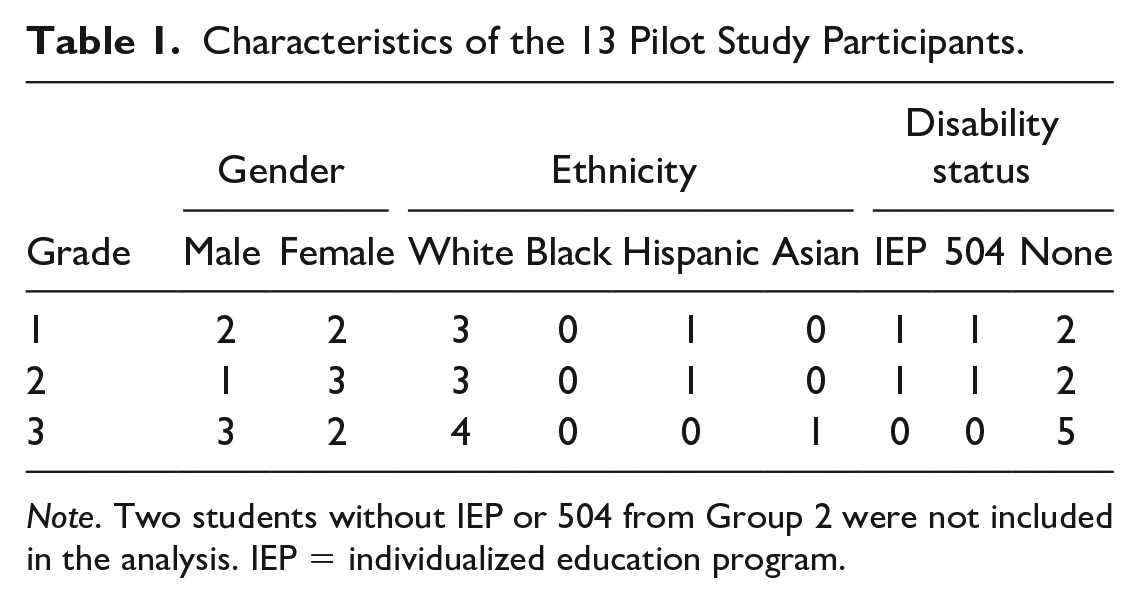
Note. Two students without IEP or 504 from Group 2 were not included in the analysis. IEP = individualized education program.
It is worth noting that our intervention was designed to support the fraction learning of students with LDs. However, due to a request from the school to support all students who were deemed to need additional support in fractions, our pilot study was inclusive of students with LDs and MDs already receiving supplemental instruction in other mathematics content areas. We honored the school’s request and conjectured our intervention, based on the learning trajectory constructed and refined in previous years, would prove viable not only for students with LDs but also for all the students who struggled with fraction concepts. Twelve of the original 13 students successfully completed the 4-week pilot version of the intervention. One student from Group 2 left due to a scheduling conflict. Another student in Group 2 had several days of missing data due to illness. Data from these students were excluded from the analysis of all outcome measures. Thus, our analysis focused on data from 11 of the 13 original students.
Data Sources
Two proximal measures from our theory of change were tested in the pilot study: (a) a measure of student’s employed process—partitioning, iterating, and the combination of the two processes—before and after instruction and (b) close observation and coding of students’ actions throughout the intervention, as well as changes in students’ units coordinating.
Proximal measure of conceptual advance
Data sources for conceptual advance included video data, accompanying student work, and researcher field notes for each session. Activity sets that grounded the students’ work are described in the literature review.
Proximal measure of performance
Eight items adapted from the Fractions Schemes Test (Wilkins et al., 2013) were used as a proximal measure of performance because they measured the processes (e.g., partitioning, iterating) addressed in the intervention. The measure was group administered and included four items measuring students’ processes (i.e., two on partitioning and two on iterating) and another four on overall fraction concept. Original representations from the tests were altered in some cases to align with those used in the intervention. Internal consistency reliability and criterion-related validity were reported by the authors of the measure. Internal consistency is a measure of reliability that considers how well a set of items designed to measure a particular construct consistently measures the construct. Cronbach’s
Study Design and Procedures
We employed a mixed methods quasi-experimental design (Creswell & Plano Clark, 2018) with one phase of data collection. Priority was given to the qualitative data (i.e., conceptual change measured across the intervention) due to the small sample size and the emphasis of the intervention program on changing students’ conceptions. Quantitative data were embedded in the design (i.e., performance changes measured preintervention and postintervention). Due to diversity in incoming fraction knowledge and the relatively small number of participants in the study, the unit of analysis for the qualitative data was the individual student. We analyzed each student’s problem solutions to document changes in fraction conceptions throughout the intervention. We also documented the levels of units each student used and in what ways (i.e., brought into their solution vs. needed action in the problem to access) at different points of the intervention. The unit of analysis for the quantitative data was the group of 11 students to link to practical considerations of the school site.
Assessment procedures: Conceptual advance
Daily lesson data were used to analyze each student’s conceptual advance. Students’ solutions to each problem, their written representative work, and researcher field notes were considered in tandem.
Assessment procedures: Pretest and posttest
A space in the back of the school media center was set up for purposes of administering the pretest–posttest measure; consenting students were excused from their classrooms for one 30-min interval for testing. A member of the research team administered and scored the pretest and posttest. The tests were given to students as a group; students were told they were going to complete questions about fractions and to do their best, but gave no other direction. Questions were read aloud to students as needed.
Lesson procedures
The intervention took place for 30 min for 3 days per week for 3 weeks, excluding pretesting and posttesting days. We utilized the activity sets described in Years 2 through 4 of the study. Each activity set was implemented for 2 to 3 instructional days; anywhere from two to three problems from the set were completed each day based on time. Student-centered problem-solving constituted the bulk of the lesson (18–20 min) and was structured by a think-pair-share, which consisted of students working on each task given on their own, then in pairs, and finally sharing out as a group. During think time, students solved the task on their own for 3 to 4 min and the teacher did not model for students how to solve the problems. Instead, the teacher used prompts described in the theory of change (i.e., reshowing; restating; asking what happened; using counterarguments; challenging assumptions; asking for justification) to promote students’ noticing and reflection of own thinking.
During pair time, students shared their solutions with a partner. The teacher promoted students to share with each other using verbal and physical positioning and continued to use the aforementioned prompts to support student cognition and reasoning. During share, the selected students shared their solutions with the group. The teacher supported the group conversation by utilizing the talk moves described in the theory of change (i.e., restating; adding on; explaining). The conclusion of each instructional period composed of students either playing a brief game that was a part of the task set or discussing a worked example of a problem from the upcoming task set. In the worked example, students discussed which mock solution they felt was correct and why. The teacher continued to use talk moves to help students discuss their ideas.
Instructional fidelity procedures
Fidelity of implementation data was recorded via a checklist and gathered by graduate students who observed intervention sessions in person or by video. During the implementation of the intervention sessions, a randomly selected sample of 30% of the sessions was observed for fidelity to the teacher decision-making guide. A checklist containing instructional elements for each day was used to evaluate the extent to which the teacher utilized the guide to implement each lesson (e.g., implemented the tasks, cognitive prompts, student positioning moves, and social rehearsal talk moves). The checklist contained a box for each instructional element; raters checked “yes” or “no” for each element of the instructional trajectory observed. Two members of the research team trained on the use of the checklist conducted the fidelity checks. Point-by-point interrater reliability across instructional elements was 89%. Fidelity was rated moderately high by each observer, with 90% of the instructional elements observed across the sessions rated as “yes.”
Data Analysis: Conceptual Change
Data analysis to detect conceptual change was done on four levels. First, constant comparison methods were used to document students’ partitioning and iterating processes within each problem for each student. Researchers worked on data across sessions for the first two students as a team. The team examined each problem solved by watching the video for each session along with examining the student work and anecdotal notes for each problem for each session. The team used the previous years’ trajectory as a coding framework. Specifically, for each student, researchers examined (a) observable processes (i.e., partitioning, iterating, both processes together), (b) discernible nuances described by our trajectory (e.g., halving-based partitioning; trial-and-error partitioning), and (c) the overall nature of the student’s reasoning (i.e., nuances, utterances, quantification language). Researchers also informally noted possible evidence related to units coordinating that began to emerge in the data. As more tasks and interviews were coded, we carefully compared each new chunk of data (i.e., each problem solution) with data coded previously and searched for confirming and disconfirming evidence to ensure consistency and validity (Leech & Onwuegbuzie, 2007). Codes were compared using peer debriefing and collaborative work (Grbich, 2007). The comparison resulted in a slight refinement of the codes and the corresponding codebook. The iterative process of coding, comparing, and refining continued through five additional rounds of independent coding (Leech & Onwuegbuzie, 2007) until all tasks in all interviews were coded. Interrater reliability for the entire set of data was 90% when comparing the individual analysis of codes. Peer debriefing was used to resolve any disagreements; 100% reliability resulted.
Second, researchers used emergent coding to document how students’ observable processes across the tasks and after the second, fourth, sixth, and ninth instructional sessions were or were not consistent with the stages of units coordinating learning trajectory confirmed in previous years of the project. Generally, researchers looked for evidence of the stages of units students could either (a) brought into the situation (before activity in the problems) to reason with or (b) used with activity in the problems. The analysis was iterative and included multiple perspectives to make confirmatory claims about patterns in the data consistent with conceptual advance (Grbich, 2007). Interrater reliability (IRR) (85%) was established for overall units coordinating.
Third, researchers prepared a classical content analysis (Grbich, 2007). We used this analysis to determine the percentages of each process as well as the stages of units coordinating displayed across the intervention (i.e., after Sessions 3, 6, and 9). This descriptive information about the data complemented the constant comparative analysis. Researchers used the codes (partitioning, iterating, both operations together) and stages of units coordination for the analysis. Researchers counted how many occurrences of each code were evident across the students after the third, sixth, and ninth intervention session (i.e., how many times trial-and-error partitioning was utilized). We then divided the totals by the total number of all coded processes (i.e., how many instances of trial-and-error partitioning divided by the number of all instances of partitioning) to obtain descriptive percentages over the course of the intervention.
Finally, researchers utilized data visualization techniques to visually examine trends across the course of the intervention for each student (Ward et al., 2010). Specifically, researchers prepared heat maps of each student’s coded partitioning and iterating processes in each session, as well as their coded units coordination. The map displays nuances reflected in the coded data across the sessions (i.e., lighter gray/darker gray = earlier/later forms of partitioning and iterating; units coordination). Researchers used the heat map to consider which processes, if any, led to conceptual change for individual students and the group.
Data Analysis: Performance Measure
To detect initial differences in performance as a result of the instructional trajectory (i.e., before and after the intervention within the same group of students), a one-tailed paired sample t test was used to evaluate statistically significant differences on the fraction measure. The independent variable (IV) was time; the dependent variable (DV) was score. The level of significance was set at
Results
Below, we present the findings of students’ conceptual change and performance differences before and after the intervention. Findings are preliminary.
Conceptual Change
Analyzed data are presented in three parts. First, the results of the constant comparison analysis are presented. Specifically, nuances in partitioning and iterating processes documented within the intervention are discussed and quantified with respect to the previously documented trajectory stages. Within, we embed the results of the classical content analysis to illustrate quantifiable changes in processes over time. Second, results of emergent coding in terms of units coordination are defined, related to the trajectory stages, and quantified. Classical content analysis results illustrating changes in units development stages over time are embedded. Finally, we discuss the results of visual trend analysis via the heat map.
Constant comparative analysis
Constant comparison analysis confirmed four stages of partitioning, three stages of iterating, or two stages of both operations present, as shown below.
Partitioning
Four nuances in partitioning consistent with our learning trajectory were coded across the intervention sessions: (a) in action trial and error, (b) in action halving, (c) in action linked, and (d) before action linked partitioning. After Session 3 of the intervention, 9% of students used in action trial-and-error partitioning, 82% of students used in action halving-based partitioning, and 9% and 0%, respectively, used in action planned or before action linked partitioning. After Session 6, 9% of students continued to use in action trial-and-error partitioning, while in action halving-based partitioning (18% of students), in action linked partitioning (64% of students), and before action linked partitioning (9% of students) increased. After the ninth session, only 9% of students were still using in action trial-and-error partitioning or halving-based partitioning, while 64% and 18% used in action or before action planned partitioning. Taken together, the increased use of more sophisticated forms of partitioning alongside the decrease of more rudimentary forms showcases students’ growth.
Iterating and both processes
The forms of iteration coded in the analysis were (a) no iterating (i.e., no evidence of iterating was present in any task set), (b) in action trial and error (i.e., students used an object to stand in for a part and adjusted the part for accuracy within the problem), and (c) planned (i.e., students accurately created an equal share and used iterating to confirm the part as
Emergent analysis and data visualization
Advances in units coordination emerged in the data that were consistent with students’ advances in conceptual processes. Specifically, after Session 3, most (82%) of the students coordinated two levels of units in action (i.e., had to act within a problem to think about fractions as coordinated in magnitude with a whole), while 9% of students came into the problems coordinating two levels of units (i.e., anticipated unit fractions coordinated with one whole), and 9% of students came into the problems coordinating one level of units. After Session 6, the percentage of students who could now bring in two levels of units into problem activity increased to 45%; at the same time, the percentage of students coordinating two levels of units in action fell to 45%. No students could coordinate three levels of units in action after Session 6. After the ninth session, 73% of students brought two levels of units into the problems and 9% of students were able to coordinate a third level of units in action. Nine percent of students continued to bring in one level of units or coordinate two levels in action.
Figure 4 presents a heat map visualization of the partitioning, iterating, and units coordination data by student across the intervention sessions.

Heat map of conceptual change across instructional sessions.
The visualization reveals trends in conceptual processes (partitioning, iterating, both together) that were in line with the coded stages of units coordination, confirming gains in students’ conceptions of fractions along a learning trajectory. Eight students advanced their units coordination from two levels of units in action to two levels of units ahead of action, which corresponds with a full trajectory stage change. One student advanced their units coordination from two levels in action to three levels in action, reflecting a two full trajectory stage change. One student continued to bring in one level of units, reflecting thinking within the trajectory stage. For three students, advanced in partitioning processes appeared to occur alongside advances in iterating processes, that is, one process did not seem to advance ahead of or more than another. For one student, partitioning processes appeared to lead development as opposed to iteration. For seven students, advanced in iterating processes led development.
Performance change
A paired samples t test was conducted to compare the performance score on a measure of students’ partitioning, iterating, and unit fraction before and after participating in the instructional trajectory. A histogram confirmed the normality of the data. There was a statistically significant difference in score from pretest
Discussion
The results of the study support the continued exploration of the current program as an effective method of instruction to promote conceptual change and increased performance for the students tested. All but one student used more sophisticated processes of partitioning and iterating throughout the intervention alongside evidence of increasingly sophisticated stages of units coordination over time. The conceptual change lends support to the program’s potential to increase fraction outcomes. More research is needed to test this assertion.
Our program adds innovations to the current intervention literature (Gersten et al., 2008; Shin & Bryant, 2015b; Stevens et al., 2018). Specifically, when used together, carefully sequenced activity sets along documented and confirmed trajectories of learning of students with LDs, students’ engagement in and explanations of their own reasoning, and open and focused representations bolstered students’ concepts of fractions. However, we do not yet know if particular innovations contributed more to student outcomes than others. Future research might document if particular innovations (e.g., the intervention with and without the use of students’ explanations; the intervention with and without the open and focused representations) bolster students’ conceptions more than others and, if so, how.
The prior knowledge that students bring into interventions provides affordances and constraints that ground conceptual advances, and performance increases over time. One student with MDs (i.e., 3C, see Figure 3) did not show conceptual changes in units coordinating or iterating over time. Yet, this same student, who began the intervention not partitioning, showed emergence of the operation in the fifth session. This subtle change suggests that despite no changes in performance or units coordination holistically, the student did show microshifts in partitioning operations. Because partitioning processes are necessary yet not sufficient for conceptual change in fractions (Hackenberg, 2013), it follows that larger gauges of change, such as units coordination and performance, did not emerge for this student after the ninth intervention session. It is unclear whether this student would show further advances with a longer or more intensified intervention. Future research might document whether increases in intervention length and/or frequency or intensity might support longitudinal conceptual change for students who require additional opportunities to bring forward fractional operations and units coordination.
Limitations of Intervention
Important limitations of this work should be noted. First, the researcher delivered all the intervention sessions. Subsequent tests of the program are currently underway with teachers implementing the program in school settings. A portion of this follow-up study will measure teacher fidelity of implementation and their perspectives on feasibility along with student outcomes. A second limitation involves the population. Our intervention was designed to support the fraction learning of students with LDs. Due to school requests, our pilot study was inclusive of students with LDs and MDs already receiving supplemental instruction. Future work might utilize larger populations where differences based on LD classification may be uncovered or place the intervention within other tiers where specific populations can be studied at a smaller scale (e.g., Tier 3; special education settings). Finally, because the emphasis on this pilot study was on students’ conceptual stage advance, a control group was not used and the sample size was too small to run more sophisticated statistical tests. More research is needed to document the effects of the intervention when compared with other instructional methods.
Implications for Practice
To help students develop a conceptual understanding of fractions and build upon their prior knowledge, it may be worth reconsidering an essential feature of instruction not found in current intervention approaches: a focus on students “solv[ing] problems that are within [their] reach [while] grappling with key mathematical ideas that are comprehendible but not yet well formed” (Hiebert & Grouws, 2007, p. 387). Interventions built upon documented and confirmed learning trajectories of students with LDs may prove an ideal starting point. Continued research into instruction that provides ways for students to build upon current knowledge of partitioning and iterating to solidify fractional units as coordinated quantities seems paramount.
Footnotes
Authors’ Note
Any opinions, findings, and conclusions or recommendations expressed in this material are those of the author(s) and do not necessarily reflect the views of the National Science Foundation.
Declaration of Conflicting Interests
The author(s) declared no potential conflicts of interest with respect to the research, authorship, and/or publication of this article.
Funding
This work was supported by a grant from the National Science Foundation, DR-K12, grant number 1708327.
