



Abstract
Writing in science can be challenging for all learners, and it is especially so for students with cognitive or language-based learning difficulties. Yet, we know very little about how to support students with learning disabilities (LD) or who are English learners (EL) when asked to write for authentic purposes during science instruction. Therefore, we conducted a systematic review of 14 high-quality studies to identify effective writing instruction elements for students with LD, those who are EL, and for at-risk learners more generally. We analyzed the studies according to purpose, participants, dependent variables, and interventions. Then, we categorized instructional elements into two broad types of support: (a) cognitive skills and processes and (b) linguistic skills and processes. Quantitative analyses showed students (regardless of disability or language status) who received structured cognitive instruction on text features demonstrated substantial growth in writing. Conversely, although language in science differs from everyday language, it is absent from this literature. Thus, our findings provide insights into necessary cognitive and linguistic supports for these students, and implications for designing effective writing instruction.
Writing has a prominent role in higher education and employment (Graham & Harris, 2006). White-collar employers consider how workers write in hiring and promoting decisions, and 80% of blue-collar workers report writing as part of their job (National Commission on Writing in America’s Families, Schools, and Colleges, 2004). Moreover, writing helps individuals reflect and evaluate their understanding (Bangert-Drowns et al., 2004; Graham & Hall, 2016). In recent years, it has not only been used to promote communication skills but also to develop conceptual knowledge (De La Paz et al., 2017; Klein & Boscolo, 2015).
Writing is complex, requiring spontaneous coordination of content, mechanics, and organization (Hayes, 1996) and is a learned skill that matures only with instruction and practice (Kellogg, 2008). Moreover, good writing is characterized by appropriate lexical choices that present ideas in a coherent and logical manner (Klein & Boscolo, 2015). To produce good writing, one needs to synthesize new and familiar information, plan and organize relevant ideas, and present them effectively to readers (Bangert-Drowns et al., 2004). Therefore, it is common for even adults to experience challenges when writing (De La Paz & McCutchen, 2017).
The fact that many students struggle with writing is therefore not surprising, and evident in national assessments such as the 2011 National Assessment of Educational Progress (NAEP) report. According to this report, only 27% of eighth and 12th-grade students achieved proficiency in writing (National Center for Education Statistics [NCES], 2012). The cognitive load when writing often overwhelms students with learning disabilities (SWLD) and those who are English learners (EL), who are typically developing foundational writing skills (Bangert-Drowns et al., 2004). Only 1% of EL scored at or above a proficient level (Beck et al., 2013). Furthermore, students with disabilities performed significantly lower (p <.001) compared with students without disabilities (NCES, 2012).
Students with LD and EL are at greater risk for writing difficulties than writers without learning or linguistic challenges (Graham & Hall, 2016). To illustrate, SWLD often have limitations in working memory, processing, memorizing, and information recall and show weakness in executive functioning (De La Paz, 1999; Gillespie & Graham, 2014). Difficulties in these areas interfere with efficient recall and organization of information (Benedek-Wood et al., 2014; Hebert et al., 2018; Mason et al., 2006). These challenges are magnified by struggles with foundational skills such as transcription, mechanics, and spelling (Graham et al., 2015).
When writing in English-dominant settings such as American schools, EL must gain command over a new language to express their ideas (Lee, 2005). Thus, EL struggle with written communication partially because they have not learned to use appropriate forms of language expected in a discipline, which relates to their genre-knowledge (Beck et al., 2013). A lack of exposure to academic content and experience using language in content areas are factors that impede clear written communication (Fang, 2005).
Other learners struggle with academic skills, including writing. Many students struggle significantly with writing due to underlying cognitive, language-based, and/or motivational difficulties similar to SWLD and ELs but are described as at-risk students. Such students are at risk for LD (Fuchs et al., 2004) and reportedly make up close to a quarter of the general education classrooms (U.S. Department of Education, 2010). In fact, struggling learners often face similar challenges—and benefit from similar interventions—as those with LD or who are EL, if their academic challenges include writing (De La Paz, 1999; De La Paz & Sherman, 2013). Although the terminology has changed over the past 20 years (e.g., the terms low-achieving or poor writers often arose when standardized testing was used to formally identify struggling writers), we use the term “at-risk students” as more affirming, and searched to find out what we could about the needs of this group in addition to SWLD and EL. To be clear, all three populations are at risk for having difficulties with written language, not to mention students with LD who are EL, or those who are at risk-for LD as well as EL.
Writing in Science Classrooms
Recently, the National Research Council (NRC, 2013) initiated significant reforms to the K–12 science curriculum by publishing the Next Generation Science Standards (NGSS). The new standards place special emphasis on the practice of argumentation, which comprises both the processes and products of inquiry and evidence-based reasoning about scientific phenomena (NRC, 2013). Even high-stakes standardized science tests require students to construct scientific arguments. Lee et al. (2013) indicate that students are now expected to “read, write, view, and visually represent as they develop their models and explanations” (p. 224). To do so, students should be encouraged to learn language forms that have been observed in scientists’ written language.
Ideas in science are often lexically dense (Fang, 2005). For example, prepositions, conjunctions, auxiliary verbs, adverbs, determiners, and pronouns are non-content carrying words. In daily language, there are usually two to three content words per clause, whereas, in written language, there are four to six content words per phrase. In addition, Halliday (1998) noted that scientific writing has 10 to 13 content-carrying words per clause. Because lexical density is linked to breadth of vocabulary, many ELs have smaller vocabulary size (Zwiers, 2014). Impoverished vocabulary has also been shown to be problematic for SWLD and students at-risk for LD (Akkus et al., 2007; Benedek-Wood et al., 2014; De La Paz, 1999; De La Paz & Graham, 1997), although for different reasons. Regardless of the reason, this limitation often translates to difficulties when writing in science.
Scientific writing is also abstract. Halliday (1998) suggests that one way to make use of abstract expressions is through transforming verbs or adjectives into nouns or noun phrases, or nominalization that then become the subject or object in a clause or phrase. One example is the use of the word “growth,” instead of the word “grow.” Although, from a grammatical perspective, nominalization condenses information, in the example here, the shift may be used to provide an explanation of an underlying mechanism (Whittaker et al., 2006). Nominalizations require a complex understanding of the English language (Terblanche, 2009). Many ELs do not have the level of command needed to flexibly use verbs and nouns, resulting in fewer nominalizations compared with native English speakers (Nesi & Moreton, 2012).
Another feature commonly seen in scientific writing is technicality (Fang, 2005) or the use of technical vocabulary (Wignell et al., 1993) to convey content-specific meaning. Technical terms also function to condense information, and in science, they help construct a chain of reasoning (Schleppegrell, 2004). Examples include the nouns “frogspawn” or “froglet” to explain the life cycle of frogs. Such words are rarely used outside the discipline, so students are not exposed to them often. Because technicality is also largely dependent on the breadth of vocabulary knowledge, it has been shown to occur less often in the writing of EL (Lee, 2005), SWLD or those at-risk for LD (Akkus et al., 2007; Benedek-Wood et al., 2014).
Writing in science often assumes a tone of authoritativeness (Fang, 2005). In school, science content is conveyed as accurate and is written in an assertive tone to emphasize the objectivity of presented information. Schleppegrell (2004) notes that writers begin to establish authoritativeness by refraining from (a) first-person point of view, (b) mental processes (e.g., I think), (c) fillers (e.g., you know, well), (d) direct quotes (e.g., it says, “I am tired”), or (e) vague terms (e.g., sort of, stuff), which are common in spoken language. For example, “A large molecular size is expected to retard the compound’s rate of diffusion” is an authoritative proposition (p. 124). Speaking and writing require students to develop control of grammar in different ways; thus, authoritativeness is another skill for EL (and likely a similar one for SWLD and students at risk for LD [see Note 1]) to develop (Zwiers, 2014).
Finally, having linguistic knowledge means that writers are familiar with the written conventions at subsentence levels (e.g., spelling, morphology) as well as at the sentence level (Schleppegrell, 2004). Many ELs have less exposure and practice using academic language (Lee, 2005). Gee (2002) posits that students equipped with adequate linguistic knowledge and limited academic language develop deeper understandings about science and the nature of science. In order for this to develop, students need to understand how language functions in its various forms in science. Therefore, ELs should receive instruction that helps them make connections between the form(s) and purpose(s) of language in science to develop skills for writing about a scientific phenomenon.
What We Know (and Don’t Know) About Effective Writing Instruction
Cognitive and linguistic paradigms dominate research on writing instruction with novice and struggling learners such as SWLD, students who are at-risk for LD, and EL (Gere et al., 2019; Newell et al., 2011). Whereas some researchers focus primarily on teaching cognitive processes underlying proficient writing (i.e., planning, translating, reviewing, and revising (Hayes, 1996; Kellogg, 2008), others primarily consider linguistic structures and context (i.e., setting, purpose, and function of language; (Halliday, 1998; Schleppegrell, 2004). More broadly, communities of experts establish norms and criteria for language use in specific disciplines (De La Paz & Levin, 2018). Scientists, in particular, value scientific explanations because they express mechanisms that underlie a phenomenon (Whittaker et al., 2006). Although we are primarily interested in comparing both paradigms in support of our greater aim to determine how to help struggling writers (regardless of etiology) to improve their scientific writing, we first summarize interventions that address cognitive processes and linguistic skill development.
Cognitive Models and Supports
Cognitive theories have been the focus of much research on writing and writing instruction since the 1980s when the cognitive processing movement began and is most often used to remediate the writing needs of SWLD (De La Paz & McCutchen, 2017). Cognitive models focus on the mental processes required to compose text (Hayes, 1996), and interventions targeting these skills are generally known to improve students’ understanding of writing structure and effective underlying processes. Writers typically engage in planning (brainstorming and organizing ideas), transcribing by hand or computer, then monitoring and revising actively as they construct ideas. Scardamalia and Bereiter (1987) further distinguish between generating and restructuring information, often referred to as knowledge-telling versus knowledge transformation.
Fortunately, there are several evidence-based recommendations for teaching writing. Gillespie and Graham (2014) identified several effective instructional elements, including (a) strategy instruction, (b) goal setting, (c) dictation, (d) using a process approach, and (e) word processing. Graham et al. (2015) added the following as effective: (a) shared writing, (b) goal setting, (c) feedback, (d) teaching foundational writing skills (i.e., handwriting, spelling, sentence construction), (e) content and genre knowledge, (f) vocabulary instruction, and (g) a writing process approach. What Works Clearinghouse (WWC, 2010) also identified the self-regulation strategy development (SRSD) model of instruction as an effective form of instruction for teaching novice and struggling writers (e.g., De La Paz, 1999; De La Paz & Graham, 2002; De La Paz & Sherman, 2013; Gillespie & Graham, 2014; Graham & Hall, 2016).
Sociolinguistic Models and Supports
Researchers who explore how to support EL’s writing development stress the need to consider the context in which language is used (i.e., social, cultural, and contextual norms), focusing on environmental factors, previous language experience, cultural norms for language use, and the writer’s primary reason for communication (Fang, 2005; Lee, 2005; Newell et al., 2011; Schleppegrell, 2004; Whittaker et al., 2006). Many such researchers refer to approaches that emphasize the importance of context as Systemic Functional Linguistics (SFL). A recent review by Olson et al. (2015) identified the following practices as effective for teaching writing to students who are EL: (a) strategy instruction; (b) modeling; (c) scaffolding; (d) explicit instruction on vocabulary, grammar, text-structure knowledge; and (e) opportunities to practice. These instructional practices support students’ language development through cognitive and language-based scaffolds. Researchers, who support the development of writing for EL, place special emphasis on language features such as vocabulary and grammar.
Genre study is also commonly used to frame instruction for EL. Schleppegrell (2004) explained how this instruction highlights linguistic structure (e.g., textual structures, sentence-level features) through guided instruction in (a) deconstruction of the text, (b) joint construction of the text, and (c) independent construction of the text. It is important to note that genre more generally refers to both the structural features of text and the illocutionary purposes that texts serve within specific disciplines and discourse communities (De La Paz & McCutchen, 2017), thus reading different genres (e.g., description, sequence, comparison, cause–effect, and problem–solution) to determine underlying text structure is an effective scaffold that supports students’ writing (Williams, 2018). A summary of effective writing instruction elements for SWLD and EL is provided in Table 1.
Summary of Effective Elements of Writing Instruction for SWLD or Who Are ELs.

It is important to identify effective approaches to writing instruction for learning and writing in science classrooms. Gere and colleagues’ (2019) describe writing assignments that are associated with conceptual learning gains in science. Analysis of 49 studies at both K–12 and college levels led the authors to identify instructional components that produced improved retention of scientific ideas, which the NGSS refers to as disciplinary core ideas (NRC, 2013). They considered four components in assignments as important: (a) meaning-making writing tasks, (b) interactive writing processes (which draw on sociocultural meanings of writing and learning), (c) clear writing expectations, and (d) metacognition (as described by Bangert-Drowns et al., 2004). They determined that assignments with all four components fostered conceptual learning of science, especially when students were given multiple opportunities for interactive processes; however, they could not address differential effects for students from multiple ability levels because their studies did not provide data about student abilities. Thus, the field lacks an exploration of effective approaches for teaching SWLD, EL, and students who are at-risk for LD how to write for authentic reasons in science classrooms. Furthermore, we lack information on how writing interventions benefit these populations.
Purpose and Significance
The ability to write well is important in science, yet we lack information about how to teach SWLD, EL, and at-risk students to become proficient writers, especially with respect to expressing conceptual understanding in science. Through our study, we aimed to identify and compare approaches to science writing for these populations. We hypothesized that a combination of cognitive and sociolinguistic supports would likely be beneficial, because SWLD, EL and students at risk for LD are likely under-identified in studies due to many factors, such as limited description of participants in some studies, and the shared challenges that these subpopulations face when writing. In addition, we hypothesized that effective instructional elements of science writing intervention would differ for each population, based on what we know about their specific learning needs and what has been done in previous studies. Three research questions guided this systematic review:
Method
Location and Selection of Studies
We identified studies for this synthesis using a multistep process following Cooper and Hedges’ (2009) guidelines as follows. First, we looked for writing interventions in a science-learning context. Second, at least one outcome variable measured writing (e.g., writing quality, genre knowledge) or used writing to demonstrate learning (e.g., a science test with short or long responses). Third, we focused on students in K–12 settings because school science writing is different from actual scientific writing. Finally, we included SWLD, EL, or studies with at-risk students. We conducted the search using multiple research databases like Education Source, PsycINFO, and ProQuest and looked for studies published between 1987 and 2019. We did not include studies that were published more than 35 years ago because much of the published earlier work relies on less rigorous research designs and with poorly specified student populations, making it difficult to draw meaningful conclusions regarding the findings.
Different combinations of the following descriptors guided the search: writing instruction, English learner, learning disabilities, science writing, and science education. We applied Boolean operators (e.g., AND) to narrow the search results by logically linking these terms (i.e., “English learners,” “learning disabilities,” “at-risk” “science education,” “writing instruction,” “explanation,” “science writing,” and “argumentative writing”). These searches initially yielded 1,000 articles. We reviewed the abstracts of these articles to determine eligibility. After reading all the abstracts derived through the search, we identified eight studies.
We conducted a hand search of four relevant special education journals: Learning Disability Quarterly, Remedial and Special Education, Learning Disabilities Research and Practice, and Exceptional Children and three science journals: International Journal of Science Education, Journal of Research in Science Teaching, and Research in Science Education. In the special education journals, we queried “writing and learning disabilities, writing and English learners, and writing and disability.” In Learning Disability Quarterly, the three queries produced 353, 153, and 296 studies, respectively; in Remedial and Special Education, it produced 474, 230, and 479 studies; in Learning Disabilities Research and Practice, it produced 231, 134, and 231; and finally, Exceptional Children produced 429, 234, and 438 studies. None of these searches produced articles that met the inclusion criteria for the review. We selected the science journals in the hopes of finding articles that included our three target learner populations. In these journals, we queried “writing and learning disabilities, writing and English learners, and writing and disability.” In the International Journal of Science Education, the three queries produced 42, 588, and 16 studies; in the Journal of Research in Science Teaching, it produced 119, 374, and 65 studies; and finally, Research in Science Education produced 25, 148, and 11 studies. After reading the abstracts derived through the search, we included six more studies.
Procedures for Evaluating Quality Indicators of the Studies
We evaluated the quality of each group experiment and a single-case design (SCD) study using the Council of Exceptional Children’s (CEC; WWC, 2010) quality indicators. Each item was rated on a 2-point scale and the average percentage was taken at the end to determine the study quality (i.e., high-quality > 70%). These quality indicators include internal validity (e.g., study design, description of the intervention) and validity of the outcome measures and analytic approaches. A graduate student in special education coded 36% (n = 5) of randomly selected studies after receiving a 2-hr training session prior. We used Cohen’s (2016) guideline to determine substantial or sufficient agreement between two raters (Kappa = .80). Cohen’s Kappa coefficient between the two raters was .81.
All articles were coded to identify the types of instructional approaches used to teach SWLD and EL. We derived the following codes based on the type of instructional supports that were present in our sample: strategy instruction (SI), procedural facilitators (PF), vocabulary instruction (V), grammar instruction (G), study of exemplar texts and deconstructing texts (SE), opportunities for practice (OP), and modeling (M). Then summarized these codes in three categories: (a) cognitive support, (b) sociolinguistic supports, or (c) general supports (see Note 2). Procedural facilitation, modeling, and providing students with opportunities for practice occurred in studies with all learner subgroups, so we categorized them as general writing supports. A graduate student coded 36% (n = 5) randomly selected studies after a 2-hr training session. Cohen’s Kappa coefficient between raters was .80. Table 1 provides information on instructional components in each study.
Results
The systemic review yielded 14 studies (three randomized control trials, nine quasi-experimental, and two single case design studies). All were identified as high-quality studies. Table 2 provides an overview the studies and Table 3 lists effective instructional elements that were included in each intervention. Table S1 (see Supplementary Materials) provides writing outcome data for each student population, describing the variables that improved as well as degree of improvement (percentage of nonoverlapping data [PND] and effect sizes).
Description of Included Studies.

Note. Quasi = quasi-experimental; AR = students who are at risk for LD; A = argumentative writing; P = Performance assessment (content learning); EL = English learners; I = informational text; SCD = single case design; SWLD = students with disabilities including learning disabilities; RCT = randomized control trial study design; E = explanation writing, L = lab report writing.
Presence of Effective Instructional Elements.
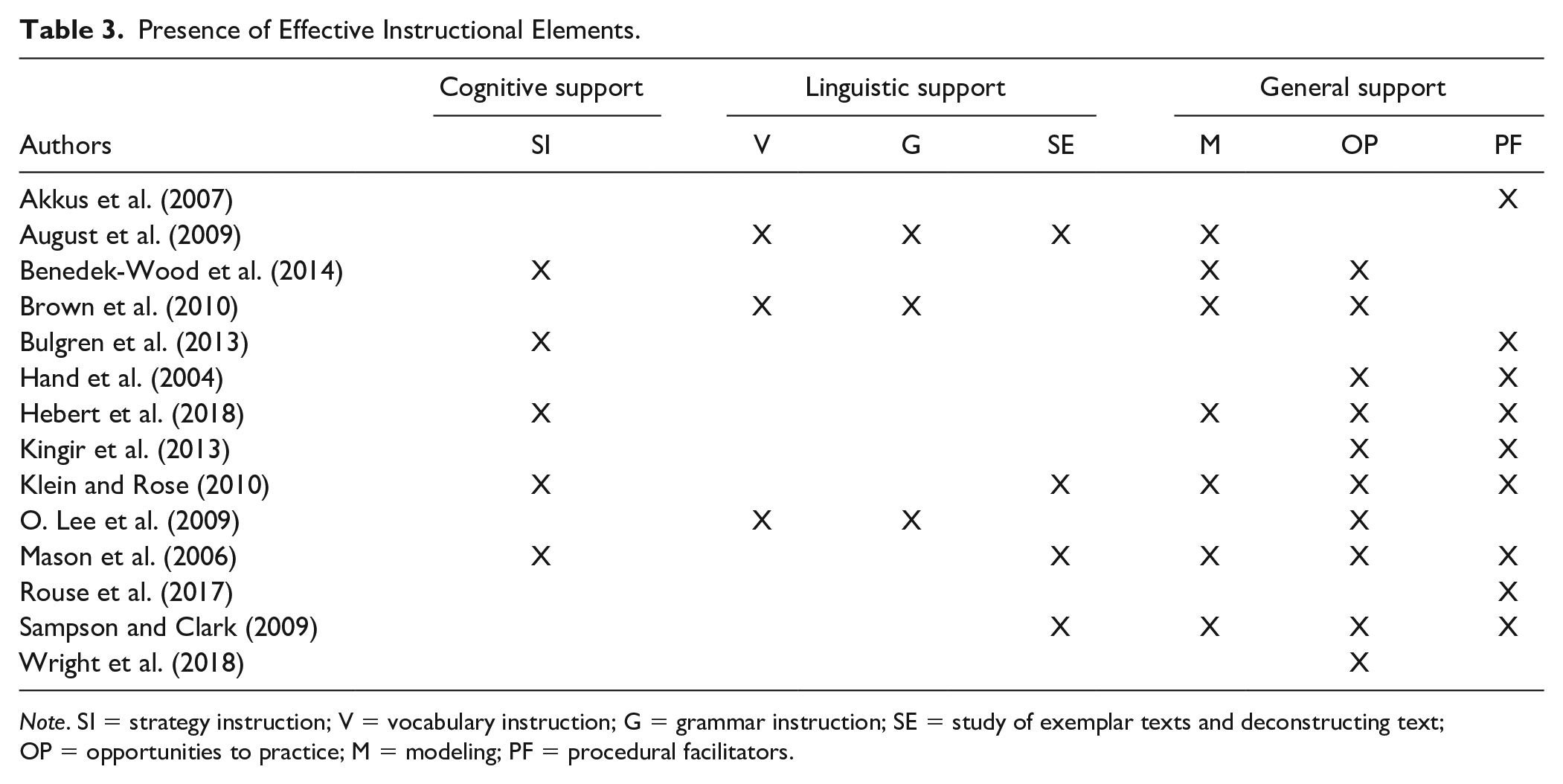
Note. SI = strategy instruction; V = vocabulary instruction; G = grammar instruction; SE = study of exemplar texts and deconstructing text; OP = opportunities to practice; M = modeling; PF = procedural facilitators.
Participant Description
Our sample included studies with students with disabilities (n = 5), students who are EL (n = 6), and at-risk learners (n = 3). Students with disabilities included those with LD, and included learners with emotional disturbance, or attention-deficit/hyperactivity disorder in addition to LD—for simplicity, we refer to all five studies as including SWLD. EL predominantly spoke Spanish as a first language. Half of the studies included students from Grades 3 to 5; the other half specified Grades 6 to 12.
Writing Tasks and Length of Instruction
Over half of the investigators focused on teaching argumentation (n = 6) or explanation (n = 4). Toulmin’s model was often used to teach argumentation. Explanations typically focused on describing mechanism(s) causing a given phenomenon. In two studies, students wrote lab reports after carrying out investigations that required them to test hypotheses and collect evidence in response to scientific questions. In these studies, students wrote lab reports using argumentative text structure (e.g., claim, evidence, reason, conclusion). In contrast, studies with younger students (n = 4) focused on genres common in multiple subjects (i.e., informational texts). To illustrate, Benedek-Wood et al. (2014) and Mason et al. (2006) taught students to write an introduction, details, and a conclusion. In contrast, Hebert et al. (2018) taught multiple genres: description, compare and contrast, and sequence writing. Three of these studies required students to demonstrate content learning through writing (Akkus et al., 2007; August et al., 2009; Hand et al., 2004). Finally, the duration of the interventions ranged from about one-half hour to 1 year.
Dependent Measures
Most studies used researcher-designed assessments, making comparisons across studies difficult. Some researchers evaluated students’ ability to convey scientific information (n = 3) through testing, where students had to explain, argue, or write about a topic using clear and concise language that others could understand (e.g., Akkus et al., 2007; August et al., 2009; Hand et al., 2004). One limitation of this approach is that students’ accuracy of scientific concepts affected any evaluation of their writing quality. Three teams of researchers (i.e., August et al., 2009; Benedek-Wood et al., 2014; Bulgren et al., 2013) disaggregated the results for specific populations. Others reported findings for all participants, including SWLD and EL, which made it difficult to evaluate the treatment effect for particular groups of students.
Some researchers measured the clarity of written language (Rouse et al., 2017; Wright et al., 2018), while others evaluated the organizational quality, consistency, or coherence of the writing. For example, informational texts were evaluated for (a) grammar, (b) spelling, and (c) organization (Benedek-Wood et al., 2014; Hebert et al., 2018). In terms of organization, these rubrics assessed for the presence of topics, details, and an ending, and number of science ideas.
When writing arguments, many researchers (n = 6) prompted students to include alternate views. Their written reasoning skills were rated by the presence of counterarguments, rebuttals, and countered rebuttals (Klein & Rose, 2010; Sampson & Clark, 2009). High-quality explanations were rated by the presence of causal mechanisms, a description of the entities involved, and how they interact to cause a given phenomenon. Furthermore, the quality of explanations was determined by the description of the underlying causal mechanism. Klein and Rose (2010) used descriptiveness and coherence between entities and processes as indicators for rating the quality of students’ explanations. Other criteria were organization and accuracy of scientific facts.
Presence of Effective Instructional Elements
In five studies, SWLD received systematic cognitive support (i.e., strategy instruction), received some combination of general supports in all studies, but they rarely received linguistic supports like vocabulary or grammar instruction, or the study of exemplar texts (n = 2). Students at risk for LD received few specific supports: linguistic supports occurred once, and cognitive support was never provided. In contrast, at-risk students received general supports in all but one study. EL did not receive systematic cognitive support in any study. They received linguistic supports in all but two studies and received some combination of general supports in all studies. Dictation, an element known to be effective for SWLD to bypass translating constraints (De La Paz & Graham, 1997; Gillespie & Graham, 2014), was not provided (see Table 3).
Procedural facilitators (PF)
Ten studies included PF to guide students’ thinking when writing; these scaffolds included prompts (Akkus et al., 2007; Bulgren et al., 2013; Hand et al., 2004; Kingir et al., 2013; Rouse et al., 2017; Sampson & Clark, 2009) or directions (Benedek-Wood et al., 2014; Hebert et al., 2018; Klein & Rose, 2010; Mason et al., 2006) and these tools helped students generate ideas, reason, and organize the content. The use of PF was most common for at-risk students (n = 3; 100% of the studies), compared with its occurrences for SWLD (n = 5; 80% the studies) or EL (n = 2; 33% of the studies).
Researchers who taught lab reports and argumentative writing used a specific PF, “science writing heuristics” (SWH) typically including questions for sections that are traditionally used in laboratory reports: (a) questions or hypothesis, (b) tests or procedures, (c) observations, (d) claims, (e) evidence, and (f) reflection (Hand et al., 2004). These questions facilitated students’ thinking and reasoning (e.g., “What are my questions?” “What did I do?” “How do I know?”; Akkus et al., 2007; Hand et al., 2004; Kingir et al., 2013).
Other researchers developed sets of questions that corresponded to other forms of text. Rouse et al. (2017) came up with a short list of questions (e.g., “What is happening?” “Are you noticing patterns?”) that helped students think and generate arguments. However, Bulgren et al. (2013) developed a more extensive list with nine questions (e.g., “What is the claim?” “What evidence is presented?”) to tackle the same task.
In some instances, text structure was itself used as a PF. Benedek-Wood et al. (2014), and in other instances, researchers used specific textual structure (e.g., descriptive, comparison, sequence) to design general steps to help students think and reason while writing. For example, Benedek-Wood et al. (2014) and Mason et al. (2006) developed a more specific PF based on a more general structure of informational texts (Topic, Important details, Elaborate, Ending). They used this to help students generate content for their writing. Sampson and Clark (2009) developed a PF using aspects of quality arguments: (a) include an explanation, evidence, and reasoning, (b) identify what counts as a good evidence, and (c) explain why your information is correct using how scientists validate their claims; however, their directions were tailored for arguments, unlike those of SRSD researchers.
Strategy instruction (SI)
SI was provided primarily for SWLD and at-risk students. Five studies included SWLD (Benedek-Wood et al., 2014; Bulgren et al., 2013; Hebert et al., 2018; Klein & Rose, 2010; Mason et al., 2006). The most common form of SI was SRSD (Benedek-Wood et al., 2014; Hebert et al., 2018; Mason et al., 2006). SRSD emphasizes teaching self-regulation along with cognitive processes required to write, and typically involves six phases (develop background knowledge, describe it, model it, memorize it, support it, and independent performance; cf., De La Paz, 1999; De La Paz & Sherman, 2013; Graham et al., 2015). In the studies cited here, the focus of instruction was to teach students to ask questions and make predictions, then revise and evaluate their work (Benedek-Wood et al., 2014; Bulgren et al., 2013; Mason et al., 2006). Students also learned mnemonics specific to the writing process and the general organization (e.g., POW+TIDE, AER, TWA-PLANS).
Klein and Rose (2010) and Hebert et al. (2018) also employed SI, focusing on text structure and related features, instead of strategies or mnemonics. For example, they used rhetorical moves (e.g., evidence, rebuttals, counter rebuttals) to teach arguments. Hebert et al. (2018) used text structures to teach informational text structures (e.g., comparison, descriptive, sequence). They introduced steps to introduce text structures: (a) pick your idea, (b) organize your notes, (c) write the topic sentence, and (d) review to check for content and coherence, helping students to gain an understanding of the general organization and structure of different genres of science writing (e.g., informational, argument, explanation).
Vocabulary instruction (V)
One approach to V involved teaching the function of words. August et al. (2009) used textbook examples to clarify the role of vocabulary words. Brown et al. (2010) provided a more systematic instruction on the function of the words. They first disaggregated science content from language by asking students to explain what they know about the topic (e.g., “What things do all plants need to grow?”), then provided accurate scientific information using nontechnical language. When students understood the science content, they made an explicit connection between the form and function of language. Two latter stages of instruction focused on connecting science ideas to technical language (e.g., “carbon dioxide” instead of “air that humans breathe out”) and on practicing writing.
Grammar instruction (G)
Although sometimes enhanced by focusing on vocabulary, only EL students received specific instruction on grammar. To illustrate, August et al. (2009), Brown et al. (2010), and Lee et al. (2009) focused on cognates and the function of words. These studies focused on root words, base words, and affixes to learn both general academic (e.g., structure) and discipline-specific words (e.g., organism). Lee et al. (2009) taught affixes (e.g., in- and de- for words like inflate and increase), positional (e.g., in/on) and comparative terms (e.g., colder) to introduce and highlight how these words are used to describe or explain a science idea. Although their instruction relied heavily on expanding students’ breadth of vocabulary knowledge, they introduced grammatical structures when using newly acquired terms. This approach focused on both discipline-specific and general academic words and how they were used in sentences.
Study of exemplar texts and deconstructing texts (SE)
This instructional practice involved highlighting and identifying text structures and discipline-specific vocabulary. August et al. (2009) focused on the appropriate use of vocabulary. Students reviewed concrete examples when learning vocabulary, but they did not have the opportunity to dissect and interact with the text, resulting in a less systematic approach to instruction. In contrast, Klein and Rose (2010), Mason et al. (2006), and Sampson and Clark (2009) adopted a more systematic approach to analyzing texts through deconstructing parts of writing that are critical to their specific genre.
Klein and Rose (2010) asked students to analyze texts to identify rhetorical moves (e.g., evidence, rebuttals, counter rebuttals) to understand the structure or organization and reasoning specific to argumentations. Sampson and Clark (2009) asked students to highlight similar aspects of arguments such as explanation, evidence, and reasoning. Mason et al. (2006) taught informational texts and asked students to identify the main idea, detail, and trivial detail, which is appropriate for informational texts but not as relevant for writing in science. Sampson and Clark (2009) deconstructed exemplar texts and provided exemplar texts and weak examples to contrast writing quality. These exemplar texts provided concrete examples of high-quality scientific reasoning, communication, organization, and general conventions.
Modeling (M) and opportunities for practice (OP)
Modeling was found in studies for SWLD (n = 4) and EL (n = 3). Typically, this approach followed an I do, we do, you do model of instruction, where teachers slowly faded out the support when writing sentences or paragraphs. SRSD researchers often used modeling to demonstrate expert thinking during the writing process to offer cognitive support. For example, Benedek-Wood et al. (2014) and Mason et al. (2006) modeled how to use POW+TIDE to generate and organize ideas for an informational text with topic, details, elaborations, and ending through a think-aloud. Similarly, August et al. (2009) modeled how to use vocabulary words to generate sentences. Brown et al. (2010) modeled connections between science ideas and language through discussion. Modeling of target skills was often preceded by OP to help students apply newly acquired writing skills or knowledge. Unlike M, OP was found in interventions for all subgroups (n = 10), including at-risk students who did not receive systematic instruction (n = 2).
Writing Outcomes for SWLD
Given cognitive support for organizing ideas and the process of writing, SWLD learned to write better arguments. They learned text structures such as claim, evidence, reasoning, and conclusion, and improved the quality of their evidence. In Benedek-Wood et al. (2014; PND = 100%) and Mason et al. (2006) found an increase in the use of transition words contributed to their overall organizational quality. Students who received instruction on text structures of informational writing in Hebert et al.’s (2018) study wrote with better organization. These researchers saw improvement in simple descriptions (d = 0.66), compare/contrast essays (d = 0.61), and sequence writing (d = 0.94).
Students generally demonstrated improvement in the delivery of scientific knowledge and concepts after intervention. Mason et al. (2006) found that students were able to recall more information from science or social studies passages; however, not all found similar effect on the accuracy of scientific knowledge. Klein and Rose (2010) found a small effect (
Klein and Rose (2010) attributed the discrepancy in improvement between students’ written explanations and arguments to the current school practices as their control group received school curriculum that placed heavy emphasis on writing argumentation. Therefore, students in the control group received sufficient instruction and practice on writing arguments by default, leaving little room for growth. However, instruction on writing explanation was less common and, thus, easier to capture a treatment effect.
Understanding the structure and organization of science writing helped students engage in more sophisticated scientific reasoning. For example, Bulgren et al. (2013) found that students made substantial gains in identifying and writing arguments (d = 1.1). Furthermore, students’ abilities to evaluate the quality of evidence correlated with their abilities to use appropriate evidence to corroborate their own reasoning. They also found that their intervention had various effects on different student populations. Students who were average (d = 1.70) or gifted and talented (d = 1.5) demonstrated more improvement.
Writing Outcomes for English Learners
Most students who are EL received explicit instruction on the text structure, vocabulary, and grammar instruction. Improvements in the quality of informational texts were reported by some but not all authors. For example, Sampson and Clark (2009) found that students wrote higher quality arguments (d = 0.41). Furthermore, students were able to generalize learned skills when writing arguments about topics that were not taught during the intervention (d = 0.57). Brown et al. (2010) reported that formal instruction on text features led to a notable improvement in writing informational text (d = 1.74). From their findings, it appears students who had multiple opportunities to practice using vocabulary while adopting appropriate grammatical structures demonstrated improvement in students’ overall writing quality. Given the amount of intensive instruction on vocabulary, students naturally used more discipline-specific words.
However, August and colleagues (2009) and Rouse et al. (2017) did not find significant gains in the quality of students’ argumentative writing after instruction, yielding an effect size of .28 and .15, respectively. Similarly, Wright et al. (2018) found that students made some, but not significant improvement in the quality of their argumentative (d = 0.24). To elaborate, students wrote descriptions rather than arguments even after intervention (Wright et al., 2018). Furthermore, Lee et al. (2009), Rouse et al. (2017), and Wright et al. (2018) found minimal-to-no-improvement in students’ vocabulary usage and scientific accuracy (d = 0.15). In sum, this body of literature demonstrates mixed results for organizational quality, clarity, and overall scientific reasoning.
Writing Outcomes for Students At-Risk for LD
Most researchers who worked with this group of learners focused on developing students’ conceptual understanding when reasoning in science. Therefore, the use of PF like the science writing heuristic (SWH) was common. Generally, effect sizes could not be calculated. After instruction, students’ argumentative writing and laboratory reports improved in clarity and accuracy (Akkus et al., 2007; Hand et al., 2004; Kingir et al., 2013).
Students who used SWH to write demonstrated a better understanding of the science concepts in the extended response questions (Akkus et al., 2007; Hand et al., 2004; Kingir et al., 2013). Those who wrote explanations using SWH as part of the intervention demonstrated better conceptual understanding than those who wrote laboratory reports (Hand et al., 2004). The use of SWH in instruction also reduced the achievement gap between the high-achievers and students at-risk for LD (Akkus et al., 2007). In summary, students demonstrated better conceptual understanding through SWH that made the thinking process when writing more explicit.
Discussion
We had several purposes for this review, initially determining the types of learners and writing tasks in the science writing intervention literature with SWLD, EL, and at-risk student populations. We then explored whether researchers embedded recommended instructional supports from prior reviews (Gere et al., 2019; Gillespie & Graham, 2014; Graham et al., 2015; and Olson et al., 2015); and finally, we determined the effects these supports had on students’ written language outcomes. Three major conclusions were drawn from the findings, which relate to differences in (a) tasks provided to learners based on subpopulation and age, (b) prevalence in instructional element use based on subpopulation focus, and (c) type of learning outcomes associated with task complexity and choice of dependent measures.
Before we begin, it is important to note that very few science writing intervention studies include SWLD or EL, many from the 14 analyzed here include more than one struggling writer population, and some included average learners. Furthermore, even within this small set of studies, a few report learning outcomes specific to each type of learner. The NGSS (NRC, 2013) considers science as a body of knowledge and a way of knowing, as scientists engage in knowledge-based practices (such as developing and using models, planning) by carrying out investigations, constructing explanations, and engaging in argument from evidence (Levin et al., in press). In addition, Gere et al. (2019) recommended students engage in conceptually meaningful scientific writing tasks with clearly defined expectations, and that they do so through interactive opportunities to engage in metacognition about the conceptual learning of science and writing processes. Taken together, these recommendations provide clear guidelines for the types of writing tasks that should be given to struggling writers in science classrooms.
Our first main conclusion is that tasks provided to learners varied based on type of learning challenge and their age, or developmental levels. Tasks that were valued by scientists and science educators, commonly resulted in improved learning outcomes (e.g., scientific reasoning and content learning), based on available effect sizes (e.g., Sampson & Clark, 2009; see Supplemental Materials). We also found that meaningful purposes and tasks were more likely to be given to older students (who were more likely to write explanations, arguments, laboratory reports). Such tasks require justification of claims with analysis of scientific ideas or causal connections between variables. In contrast, tasks given to younger students focused primarily on genres such as writing informational reports. Rouse et al.’s (2017) writing to learn study in fourth grade science classrooms provides a notable exception to this pattern.
Our second conclusion is that the type of instructional elements used in interventions appears related to the subpopulation to which students belonged. Although students received at least two supports in all but two studies (with modeling, multiple opportunities for practice and procedural facilitation commonly occurring), we found interesting patterns in relative use of instructional features for each population of struggling writers. Systematic cognitive supports were routinely provided through strategy instruction or SRSD to guide SWLD through the writing process, whereas the study of exemplar texts and deconstructing texts through modeling, procedural facilitators, and multiple opportunities for practice were commonly provided for EL students. SWLD received additional language support though deconstruction of exemplar texts in only one study. We were surprised that dictation was not used, despite it being an effective tool to improve students’ writing (De La Paz & Graham, 1997; Gillespie & Graham, 2014).
Students who were EL were also more likely to earn about genre and/or language, but generally without explicit cognitive supports. Interestingly, whereas procedural facilitators were primarily used to teach SWLD about text structure, they were used to teach EL to apply newly acquired vocabulary or genre knowledge. Modeling was often provided for EL during vocabulary instruction (in half of our studies), but they rarely studied models (i.e., writing samples) that made linguistic and texture features explicit. At-risk students generally received little systematic cognitive or linguistic supports. Instead, they were given procedural facilitators (i.e., prompts or directions) to plan and organize their writing without modeling. One such tool, the Science Writing Heuristic, was a template that promoted reasoning about the science content (e.g., Klein & Rose, 2010). The level of support that this group of students received may well be explained by their perceived academic needs and learner characteristic and they sometimes made growth without structured cognitive or language instruction (e.g., Kingir et al., 2013).
Our third conclusion is that the benefits from these interventions are associated with task complexity and choice of dependent measures. Although we hoped to determine learning and writing outcomes and effect sizes for learners who participated in science writing interventions, the fact that different researchers focused on different tasks, and used different instructional supports, with varying outcomes, translates to different conclusions, not all of which are related to disciplinary goals in science. To illustrate, SWLD and those at risk were more likely to receive strategy instruction or SRSD than EL students, and those who did, demonstrated larger effect sizes on general writing outcomes such as organizational quality (e.g., Hebert et al., 2018). This was likely due to instruction that included modeling, careful scaffolding, and opportunities for practice (e.g., Benedek-Wood et al., 2014). Furthermore, SWLD and EL benefited from text structure instruction (e.g., Hebert et al., 2018; Wright et al., 2018).
Surprisingly, writing gains for EL were less consistent across studies. Although they generally made gains in target areas such as vocabulary or science reasoning (e.g., August et al., 2009; Sampson & Clark, 2009), not all made gains in disciplinary writing skills in science (e.g., Rouse et al., 2017; Wright et al., 2018). The variability in findings may be due to differences in the intervention, but we cannot rule out the differences in the dependent measures. Conclusions about students who are at risk for LD are limited as effect sizes could not be calculated. With respect to SWLD, many studies reported here targeted simpler writing tasks, which tend to inflate effect sizes. To illustrate, writing counterarguments and rebuttals requires more complex skills than informational texts that are grounded in recall. More complex tasks may require more intensive support and the effects of the intervention may be less pronounced. We expect that SWLD, at-risk students, and EL may have a harder time learning more complex writing genres like argumentation or explanation. To fully test such claims, however, we need more studies teaching SWLD to focus on argumentation.
Study Limitations
We acknowledge limitations inherent in this literature that complicate our efforts to generate conclusions. First, investigators did not consistently disaggregate their findings based on learner characteristics (e.g., disability or English language learner status, academic performance). Second, it was difficult to independently evaluate the effectiveness of each instructional element because nearly all studies reviewed here combined instructional elements. Third, standardized assessments for writing in science are not available. We found variances that are associated with use of different dependent measures (i.e., writing outcomes based on the organizational structure of a given sample, accuracy of science content, and clarity of language) and different definitions of key constructs (e.g., scoring arguments for the presence of claim, evidence, and conclusion or for additional elements of rebuttals, counterarguments, countered rebuttals). With such variability in dependent measures, comparisons are difficult to make.
Implications for Practice
Findings from the review indicate that struggling learners benefit from both cognitive and linguistic supports when writing in science classrooms. We call attention to providing students with knowledge of text structure, echoing Williams’ (2018) assertions about its value in writing instruction, which places special emphasis on the larger structure and organization of science writing. Another important implication is that there are a number of ways to teach students about text structure, such as through use of strategy instruction, SRSD, or procedural facilitators. In practice, we recommend that science teachers provide writing instruction that teaches students both function and form of language. In addition, teachers should provide specific instruction in linguistic features that are common to science language (Fang, 2005; Schleppegrell, 2004). To be effective, teachers must first examine, analyze, and understand the language expected in the science curricula. Science teachers might include a mini-lesson on text structure, domain-specific vocabulary words, and teach specific linguistic features that define science writing.
Conclusion
One of the primary reasons for our review was to identify writing instruction that focuses on the cross-cutting concepts promoted by NGSS (NRC, 2013). The fact that we struggled to find an adequate number of studies to include in this review provides evidence that there are only a handful of researchers who focus on developing scientific reasoning skills for SWLD, at-risk students and EL. Our review shows that effective cognitive writing supports (cf., Gillespie & Graham, 2014; Olson et al., 2015) were often evident in the science writing interventions; however, even when present, the language supports did not sufficiently address the language needs of SWLD or those at risk for LD.
Even more important, it appears that SWLD, at-risk students, and EL are not always asked to focus on disciplinary or scientific reasoning when asked to write in science. On one hand, it is understandable that some students in these groups need and benefit from instruction that focuses on domain-general tasks such as using writing to demonstrate knowledge of science content. On the other hand, our results also indicate that if researchers do not routinely employ both cognitive and linguistic elements in their instruction, these writers may not learn to grasp aspects of scientific language. We suspect that many SWLD, at-risk students, and EL are not provided with writing interventions that are centered on the disciplinary demands of science—they are not learning to practice scientific argumentation, at least when judged by the standards and objectives (e.g., teaching students nominalization, or establishing objectivity) outlined here.
Learning to write in science is a complex task that requires time and practice, and it is important to provide students with developmentally appropriate, disciplinary writing tasks such as explanation and argumentation, to promote analytical thinking and scientific reasoning. In addition, vocabulary, clause-level structure, and tone have specialized uses in science writing but many struggling writers lack linguistic knowledge and rarely practice using them. Attempting such challenging goals will likely require further refinement of the type of specialized instruction that is provided to SWLD and EL. Fortunately cognitive apprenticeships, which are domain specific forms of strategy instruction (see De La Paz et al., 2017, for an example in history and Lee & De La Paz, in press, for an example in science) appear to be promising models for instruction. Clearly, more work is needed to deepen our understanding on how to promote deep learning in science through written language.
Supplemental Material
sj-docx-1-ldq-10.1177_07319487211018213 – Supplemental material for Science Writing Intervention Research for Students With and At Risk for Learning Disabilities, and English Learners: A Systematic Review
Supplemental material, sj-docx-1-ldq-10.1177_07319487211018213 for Science Writing Intervention Research for Students With and At Risk for Learning Disabilities, and English Learners: A Systematic Review by Yewon Lee and Susan De La Paz in Learning Disability Quarterly
Footnotes
Declaration of Conflicting Interests
The author(s) declared no potential conflicts of interest with respect to the research, authorship, and/or publication of this article.
Funding
The author(s) received no financial support for the research, authorship, and/or publication of this article.

Notes
Supplemental Material
Supplementary material for this article is available on the Learning Disability Quarterly website along with the online version of the article.
References
Supplementary Material
Please find the following supplemental material available below.
For Open Access articles published under a Creative Commons License, all supplemental material carries the same license as the article it is associated with.
For non-Open Access articles published, all supplemental material carries a non-exclusive license, and permission requests for re-use of supplemental material or any part of supplemental material shall be sent directly to the copyright owner as specified in the copyright notice associated with the article.
