



Abstract
Previous studies of K–12 dyslexia legislation have described broad trends in legislative content, such as the presence or absence of screening and intervention requirements. This study uses document analysis to provide a finer-grained description of the laws to highlight critical variation in policy that will directly affect (a) the number and type of students identified as having or being at risk for specific reading disabilities, including dyslexia, (b) the types of supports they receive, and (c) the implementation of the laws. Results of the study indicate that differences in legislative content across states, and ambiguity within states, may lead to heterogeneous effects on student and school outcomes. Areas needing special analytic attention by researchers and policy implementers are discussed.
Over the past two decades, 47 states have passed legislation concerning the education of K–12 students with dyslexia (National Center on Improving Literacy, 2018). Previous studies of this legislation have described broad trends in policy (Gearin et al., 2018; Phillips & Odegard, 2017; Youman & Mather, 2015, 2018) but relatively little research attention has been paid to variation within these broad trends. For instance, it has been noted that states increasingly screen for dyslexia in the early grades (Gearin et al., 2018; Phillips & Odegard, 2017; Youman & Mather, 2015, 2018) but specific screening requirements often differ across state lines, as do the state and district bureaucracies tasked with implementing them (National Center on Improving Literacy, 2018). Differences in legislative requirements and their implementation could potentially have ramifications on the laws’ ultimate effects. It is important to document and understand these differences so future policy analyses can draw valid inferences about the effect of dyslexia legislation. To promote a finer-grained understanding of the dyslexia legislation, this article highlights differences in the policies’ (a) psychometric, (b) instructional, and (c) administrative content. It also cross-references findings in these areas with previous research on state approaches to specific learning disability (SLD) identification (Zirkel & Thomas, 2010) and third-grade retention laws (Council of Chief State School Officers, 2019). It concludes by briefly explaining how differences in legislative content could affect implementation; the number and types of students identified as being at risk or having learning disabilities; the instructional supports students receive; and ultimately, student learning.
What Is Dyslexia?
To begin, it is useful to consider the history of dyslexia as a concept because it sheds light on how and why school systems are increasingly, but unevenly, attempting dyslexia education reform. The term dyslexia was introduced by Rudolph Berlin in the late 19th century to describe “word blindness” or receptive aphasia, a condition first described by Adolph Kussmaul some years prior (Anderson & Meier-Hedde, 2001). Early research on dyslexia focused primarily on adult subjects, but by the 1910s, researchers and physicians in Europe and the United States had extended the concepts of word blindness and dyslexia to include congenital reading difficulties. From this point forward, there was a growing awareness that there were children with normal to high intelligence and typical mathematics ability, who nevertheless exhibited difficulty in learning to read (Anderson & Meier-Hedde, 2001). It was (and continues to be) believed by many researchers and educators that such children should be given special consideration when designing and providing reading instruction.
Over the next century, the taxonomy of reading disabilities and dyslexia’s place within it would evolve. It is beyond the scope of this article to review the scientific advancements and practical concerns that spurred this evolution (for reviews, see Anderson & Meier-Hedde, 2001; Fletcher et al., 2019; Peterson & Pennington, 2015; Tannock, 2013; Tønnessen, 1997). Suffice it to say that the definition of dyslexia remained generally vague and inconsistent in both reading scholarship and policy for most of the 20th century (Fletcher et al., 2019), in part to accommodate the heterogeneous characteristics of individuals with reading difficulties (e.g., Murphy & Pollatsek, 1994). An important turning point occurred in 2002 when the International Dyslexia Association (IDA) undertook a dyslexia definition consensus project with the National Institute of Child Health and Development (Lyon et al., 2003). The definition subsequently adopted by IDA is as follows: Dyslexia is a specific learning disability that is neurobiological in origin. It is characterized by difficulties with accurate and/or fluent word recognition and by poor spelling and decoding abilities. These difficulties typically result from a deficit in the phonological component of language that is often unexpected in relation to other cognitive abilities and the provision of effective classroom instruction. Secondary consequences may include problems in reading comprehension and reduced reading experience that can impede growth of vocabulary and background knowledge.
The IDA definition of dyslexia is notable because it clarifies dyslexia’s relationship to the broader and more amorphous concept of “specific reading disability/disorder,” which is described in the Diagnostic and Statistical Manual of Mental Disorders (5th ed.; DSM-5; American Psychiatric Association, 2013), and which is provided under the Individuals with Disabilities Education Improvement Act of 2004 (IDEA). It does so by specifying that dyslexia reflects challenges related to word-level reading ability. It also specifies that dyslexia can be identified when individuals have difficulty decoding single words fluently and accurately, and when they spell poorly (Fletcher et al., 2019). These aspects of the definition are useful because they have the potential to help researchers and educators distinguish students with different instructional needs. For example, students with a limited vocabulary and relevant background knowledge may struggle while reading certain texts, but the IDA definition specifies that, among students with dyslexia, limited vocabulary and background knowledge could be secondary characteristics resulting from poor reading experiences. Improving vocabulary alone would not substantially improve the reading ability of such individuals.
Defining dyslexia as a word reading disability was also useful because it allowed dyslexia to be understood within the Simple View of Reading (Gough & Tunmer, 1986; Hoover & Gough, 1990). The Simple View of Reading is a theoretical model that describes reading comprehension as the product of decoding ability and linguistic comprehension. It has empirical support in many languages and can explain most of the variance in reading comprehension in the elementary grades (Kim, 2017). Although it has sometimes faced criticism for its simplicity (e.g., Concannon-Gibney & Murphy, 2010), it has been particularly influential in educational policy, especially in Anglophone countries (Savage et al., 2015). The reasons for the model’s popularity are likely complex, but one of its benefits is that facilitates systematic approaches to supporting students with disabilities by suggesting points of weakness upon which educators might intervene (e.g., comprehension, word reading). In other words, the synergy between the IDA definition of dyslexia and the Simple View of Reading may help explain the popularity of the former. This potentiality seems likely considering that are ongoing scientific disagreements about how dyslexia should be defined (Brady, 2019; Fraga González et al., 2019; Miciak & Fletcher, 2020; Protopapas & Parrila, 2019), with different definitions often reflecting the objectives of researchers working in different disciplines (e.g., education, cognitive psychology, neuroscience; Tønnessen, 1997).
Dyslexia and the Policy Context
Regardless of the precise reasons for the apparent uptake of the IDA definition, it is clear from records of legislative activity that there has been widespread interest in reforming how students with dyslexia are educated and supported in the United States. At the time of this writing, nearly every state in the United States has passed some type of law addressing the education of students with dyslexia in grades K–12. Studies of broad trends in dyslexia education policy have noted that there are some essential features of legislation that tend to be present across states. For instance, most state laws define dyslexia and address universal screening and intervention in the early grades. These common features are, in part, a reflection of the coordinated political activity of advocacy groups such as Decoding Dyslexia (Gearin et al., 2018; Youman & Mather, 2015). Common sets of historical pressures, such as federal education reforms (e.g., Reading First, Race to the Top), have also indirectly contributed to a coherent reform agenda (Gearin et al., 2018).
Despite the existence of a basic cross-state reform agenda, it would be a mistake to view the laws as monolithic or uniform, especially if one is interested in understanding their likely effects. For instance, of the 47 states with dyslexia legislation, 35 have laws requiring universal screening for reading difficulties including dyslexia, 26 require instructional interventions, 26 require in-service professional development for practicing educators, and 16 address pre-service training for aspiring educators (National Center on Improving Literacy, 2018). Only eight states have laws addressing all these components. To the extent that these components can be considered potential causal mechanisms that will influence student outcomes, there are clearly some important differences in state legislative content. The presence or absence of these legislative components may contribute to variation in the laws’ ultimate impact.
Another and hitherto unstudied source of heterogeneity is variation within the common components of dyslexia legislation. Prior research suggests that states differ in terms of (a) how they define dyslexia, (b) what they require in terms of universal screening, (c) what they require in terms of intervention, (d) whether and how they specify the relation between screening results and SLD determinations, and (e) the administrative mechanisms that exist to guide policy implementation (Gearin et al., 2018; Youman & Mather, 2018). Variation within these components will directly and indirectly affect student and school outcomes, such as the number and type of student identified as being at risk for dyslexia. They will also directly and indirectly affect the interventions students receive. For instance, laws that promote the use of different screeners could result in different numbers of students being identified as at risk. This potentiality exists because different screeners often have different levels of classification accuracy. They may also differ in terms of their criterions for operationalizing risk.
A third source of potential heterogeneity in policy impact is the presence or absence of laws that may amplify or constrain the impact of dyslexia-specific legislation. For instance, state special education policies have high potential for influencing what happens to students who are classified as being at risk for dyslexia. Although state special education laws are theoretically uniform in terms of their subordination to the federal IDEA, states do not follow identical protocols for identifying SLDs (Zirkel, 2017; Zirkel & Thomas, 2010). The three most widely used approaches in the United States are the severe discrepancy model (SD), which considers whether a student’s academic achievement is commensurate with his or her intellectual ability; response to intervention (RTI), “a process based on the child’s response to scientific, research-based interventions” (IDEA; § 300.307[a][2]); and establishing a pattern of strengths and weaknesses (PSW) in cognitive and academic abilities (Zirkel, 2017; Zirkel & Thomas, 2010). In a study of state SLD legislation, Zirkel and Thomas (2010) identified nine major approaches to these three classification models. States may require one or more approaches; they may prohibit the SD model; or they may allow for combinations of approaches (Zirkel & Thomas, 2010). The divergent approaches to SLD classification suggest that even states with similar dyslexia laws could experience different implementation challenges and outcomes if they have sufficiently diverging approaches to SLD identification. Furthermore, these differences may not be readily apparent from an analysis of dyslexia legislation because they may have been determined by separate legislation that is not specific to dyslexia.
A fourth source of potential variation is the presence or absence of pre-existing laws that address reading, but which are not dyslexia specific. At least 26 states have passed what are sometimes called “third grade reading laws” (Council of Chief State School Officers, 2019). These laws variously promote prevention, intervention, and retention strategies to improve early literacy achievement. These laws overlap with dyslexia legislation (and in some cases can be considered dyslexia legislation), but they may also introduce unique sources of variance. Third-grade reading laws often promote screening and progress monitoring, attention to the science of reading, and intervention–practices that are basically consistent with the dyslexia legislation. Some states have laws that also require students to be retained if their reading achievement is not proficient by grade three. The provisions concerning retention are a potential causal influence on student outcomes that is generally not found in the dyslexia laws. In addition, the presence of a third-grade reading law may provide funding and support mechanisms through which the dyslexia legislation might be executed. It is therefore important to consider trends in dyslexia legislation alongside third-grade reading policies.
To gain a better understanding of cross-state differences in dyslexia legislation and potential effects, we posed the following research questions:
Method
Data
The data analyzed in this study were collected for a previous study of state-level dyslexia policy (Gearin et al., 2018). In the previous study, we used document analysis to inductively identify major themes in all extant dyslexia laws, which were described across 76 documents. We also coded 75 state education agency technical assistance documents, 10 newspaper articles, and 2 federal documents to provide contextual information about the laws. Results from the study were used to create State of Dyslexia, an open-access interactive webtool that allows users to view trends in dyslexia legislation within and across states. Coding results are made verifiable to users of the webtool insofar as users are provided with excerpts of the relevant primary source material for each code. In the present study, we re-analyzed the dyslexia legislation and technical assistance documents to parse the broad codes from the first study through directed content analysis. Analysis occurred from June to November of 2019, and again in June 2020. The dataset was updated in between studies so the dataset included legislation from after 2018.
Analysis
We answered Research Questions 1–4 through directed content analysis of state legislation and guidance documents (Hsieh & Shannon, 2005). Specifically, we posed guiding questions that we generated after the initial analysis in the first study (see Table 1; Gearin et al., 2018). We worded the guiding questions to (a) minimize subjective interpretation and (b) provide a finer-grained description of the laws than we previously achieved. The scope of the first study was such that variations in the broad legislative trends could not be adequately addressed. For example, if a law contained a provision stating that instructional intervention provided in response to dyslexia screening must be, “evidence-based, multisensory, direct, explicit, structured, and sequential approach to intervention,” and another state’s law only requires a subset of these characteristics, both states’ laws were simply coded as “requires intervention.” Although this procedure was useful for the aims of the previous study, it overlooked the differing constraints placed on intervention choices and the varying levels of evidence supporting each of the components (e.g., Al Otaiba et al., 2018; Stockard et al., 2018; Wanzek et al., 2016, 2018).
The present study addresses the limitations of the previous study by using objective frequency counts to provide finer-grained information about the state laws. We created codes based on the guiding questions listed in Table 1. All guiding questions that begin with the phrase, “To what extent do states . . .” (Questions 4–9, 11, & 13), were written so they could be answered with a simple two- to six-step process that results in a two or three-level variable denoting whether the legislative component was required, encouraged, or not addressed. To answer these questions, a keyword search was performed to determine whether each state had a law that was relevant to the question. Keywords appear in bold in Table 1. Next, the coder read the policy excerpt to locate unambiguous language denoting whether the law’s provision was a requirement or (when applicable) merely addressed. Examples of unambiguous language include “Schools must . . .” or “schools shall . . .” Results were then recorded. In the case of Questions 5–8, negative results led to an examination of state guidance documents to determine whether the components were at least promoted through any non-disparaging discussion of the component.
Research Questions and Guiding Questions.
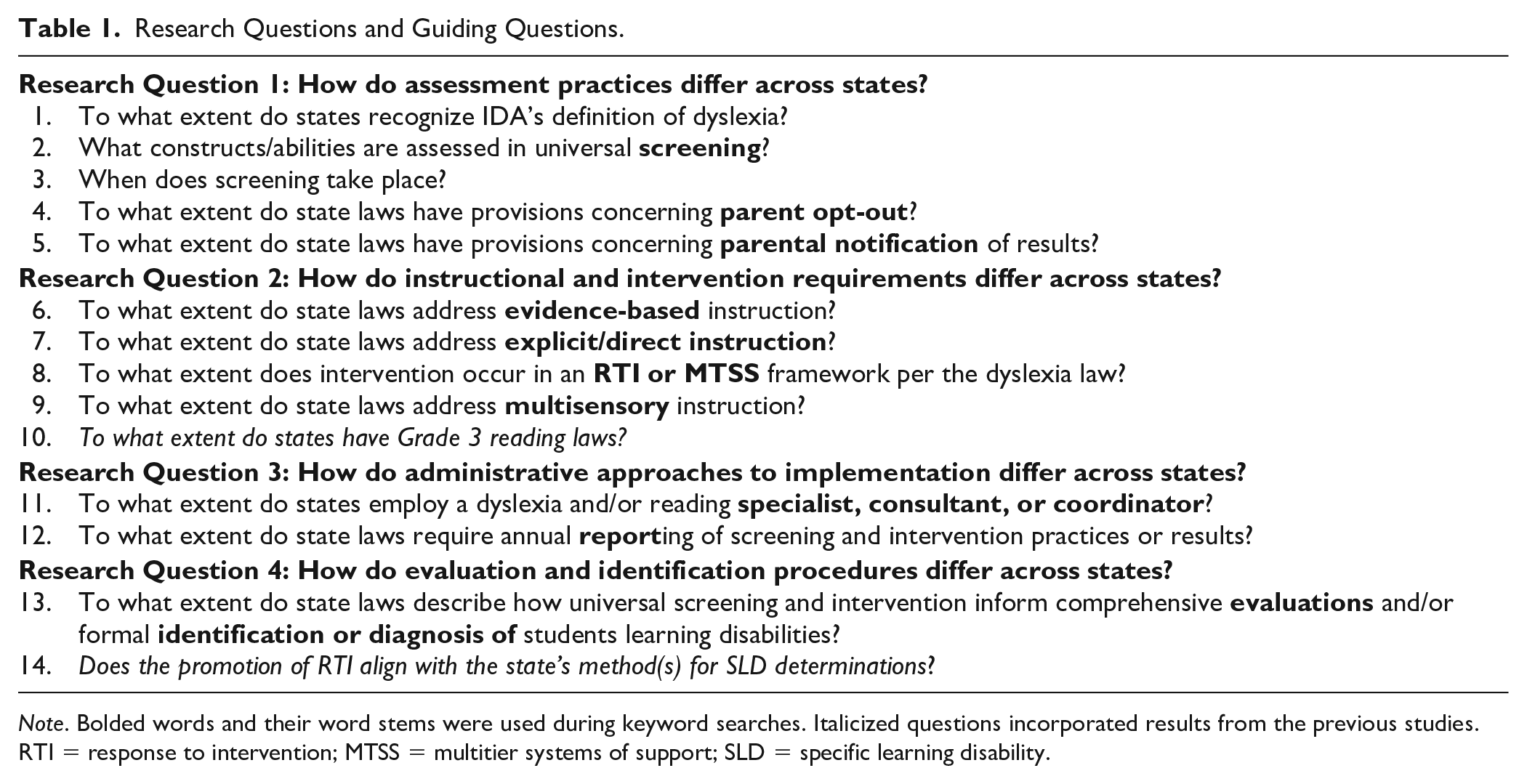
Note. Bolded words and their word stems were used during keyword searches. Italicized questions incorporated results from the previous studies. RTI = response to intervention; MTSS = multitier systems of support; SLD = specific learning disability.
Questions 1–3 in Table 1 were answered using similar procedures, but included an inductive component. In cases where there was no relevant legislation, they may have also involved coding state education agency technical assistance documents. We knew from our previous study that most states followed IDA’s definition of dyslexia. However, we did not have an exact count, and we were uncertain about the extent to which alternative definitions were in use. Thus, to answer the guiding question, “How do states define dyslexia?” we reviewed state legislation and dyslexia handbooks to determine whether the state recognized IDA’s definition. For states with dyslexia legislation that did not utilize IDA’s legislation, we next reviewed definitions to look for commonalities across definitions to create new codes. However, no commonalities emerged. We therefore coded these instances as “state-specific definitions.” Similarly, we knew from the previous study that there were more than a dozen screening targets mentioned across states (e.g., decoding, comprehension), but it was unclear how many there were or how they related to each other. We therefore created a spreadsheet and recorded state-by-screening-target frequencies, creating new columns each time we encountered a new screening target. The timing of screening was coded in the same manner. For each state, we simply recorded each grade in which screening was required by law. We used this information in conjunction with any qualifying language to calculate the minimum number of times a student should theoretically be screened as they move from kindergarten through the upper grades. Qualifying language, when present, typically indicated the number of times per year students must be screened.
Finally, we utilized results from two pre-existing studies to answer Questions 10 and 14, which concern SLD identification and third-grade retention. These two questions were substantial enough to warrant their own investigations and would otherwise have been beyond the scope of this study. To investigate how SLD eligibility policies and the dyslexia laws relate to one another, we incorporated the results of Zirkel and Thomas (2010) into our dataset. We selected this study because, to our knowledge, it is the most recent, high-quality, peer-reviewed study that comprehensively classifies how states approach the most common models of identifying SLDs (i.e., SD, RTI, PSW). In the present study, we simply examined whether states that required or permitted the use of RTI also required or promoted the use of RTI or MTSS in their dyslexia policies to synthesize new information (i.e., Table 1, Question 14). Similarly, we used the results of a study by the Council of Chief State School Officers to determine the presence or absence of third-grade reading laws and their specific components (Council of Chief State School Officers, 2019). We selected this study because, to our knowledge, it was the most recent and highest quality study that addressed retention requirements in reading laws.
Reliability
To check the reliability of our analysis, we took two main steps. First, we sent a draft of planned revisions to the webtool to 15 state education agency personnel and 74 dyslexia education advocates for a review. The review occurred from January 2020 to the end of February 2020. The review covered all results reported here except for 2, 3, 10, and 13 because they are not explicitly addressed by the webtool and because they can be answered objectively. Specialists and advocates were asked to review the information for their respective states for accuracy and completeness based on their familiarity with the content. They were instructed to provide references to any recommended changes so that we could verify the appropriateness of their suggestions. Most states did not receive any suggested revisions during the review process. When revisions were recommended, they generally addressed (a) legislation or policy that we had not yet reviewed (e.g., because they were passed during the study or were not dyslexia specific) or (b) pending legislation. Suggested revisions concerning errors of omission resulted in review and coding of the legislation to confirm the accuracy of the recommendation. Suggestions concerning pending legislation were rejected. The next most common type of suggested revision was to include a more detailed description of state policy in the legislation or handbook excerpts. These recommendations, which did not affect coding results, were intended to provider users of the webtool with important information and were therefore accepted.
At the request of an anonymous reviewer of this article, we also double-coded results for 10 randomly selected states, which is in keeping with the recommendations for qualitative research methods (O’Connor & Joffe, 2020). The initial coding for all states was performed by the lead author of this article. The secondary coding was performed by a trained undergraduate employee who helps maintain the webtool. There was 91% agreement across codes. Errors of omission were the most common reason for disagreement. In these cases, one coder failed to apply a code because they missed a keyword, such as “must” or “shall.” The next most common source of disagreement was the result of unanticipated legal requirements that did not precisely correspond to our codes. Specifically, there were a few instances where states were required to carry out an action, such as providing professional development on screening, but there was no requirement indicating that educators had to use their training. Our original coding instructions were ambiguous as to whether such instances should be considered a requirement. Ultimately, we did not count such instances as requirements.
Results
Table 2 summarizes the select results by state. In the sections that follow, we describe our results by each research and guiding question. Up-to-date information about legislative trends can be found on the State of Dyslexia webtool.
A Snapshot of Select Dyslexia Screening and Intervention Requirements Across the United States.

Note. IDA = International Dyslexia Association; RTI = response to intervention; MTSS = multitier systems of support; NA = not applicable; NE = no evidence found.
Uncommon qualifications or ambiguities noted.
Research Question 1: How Do Assessment Practices Differ Across States?
To what extent do states recognize IDA’s definition of dyslexia?
We found that 33 of the 50 states recognized the IDA definition, five recognized an alternative definition, and the remaining 12 did not recognize any definition, usually because they do not have dyslexia legislation or are in the early phases of reform. We did not recognize any commonalities across non-IDA definitions that would have allowed further coding, though they tended to be shorter and had fewer criteria. We found one state (i.e., Texas) where the handbook contains both the IDA definition and a different definition from state law.
What constructs/abilities are assessed in universal screening?
Within a given a state, universal screening generally entails assessing five or six basic early literacy skills. Across states, screening laws and guidance documents required or encouraged many more constructs to be assessed. It is difficult to provide an exact count of constructs and skills because targets are not always defined, and even when they are, one must impose a taxonomy of skills to facilitate cross-state comparisons. For instance, one state may require screening for decoding, another letter-sound correspondence, another phonics, and another nonsense word fluency. Arguably, nonsense word fluency is a type of letter-sound correspondence knowledge or phonics, which is in turn a type of decoding. However, any taxonomy we produced could be subject to debate and would necessarily result in information-loss, such as whether a state specifically requires that screening of nonsense word fluency as opposed to decoding. Because it is not possible to provide an exact count, we created a taxonomy that suggests a plausible range for the number of screening targets that exist across states. Using this taxonomy, we found that states could be said to screen for as few as 8 or as many as 23 abilities (see Table 3). The most targeted abilities were phonological and phonemic awareness, decoding, rapid naming, phonics/letters-sound knowledge, and alphabet knowledge. Infrequent targets included nonsense word repetition, written expression, comprehension, and family history. DIBELS (University of Oregon, 2018) and AIMSweb (Shinn & Shinn, 2002) were the most frequently mentioned screening systems, addressed by 17 and 14 states, respectively.
A Min/Max Taxonomy of Screening Targets Across the 50 States.
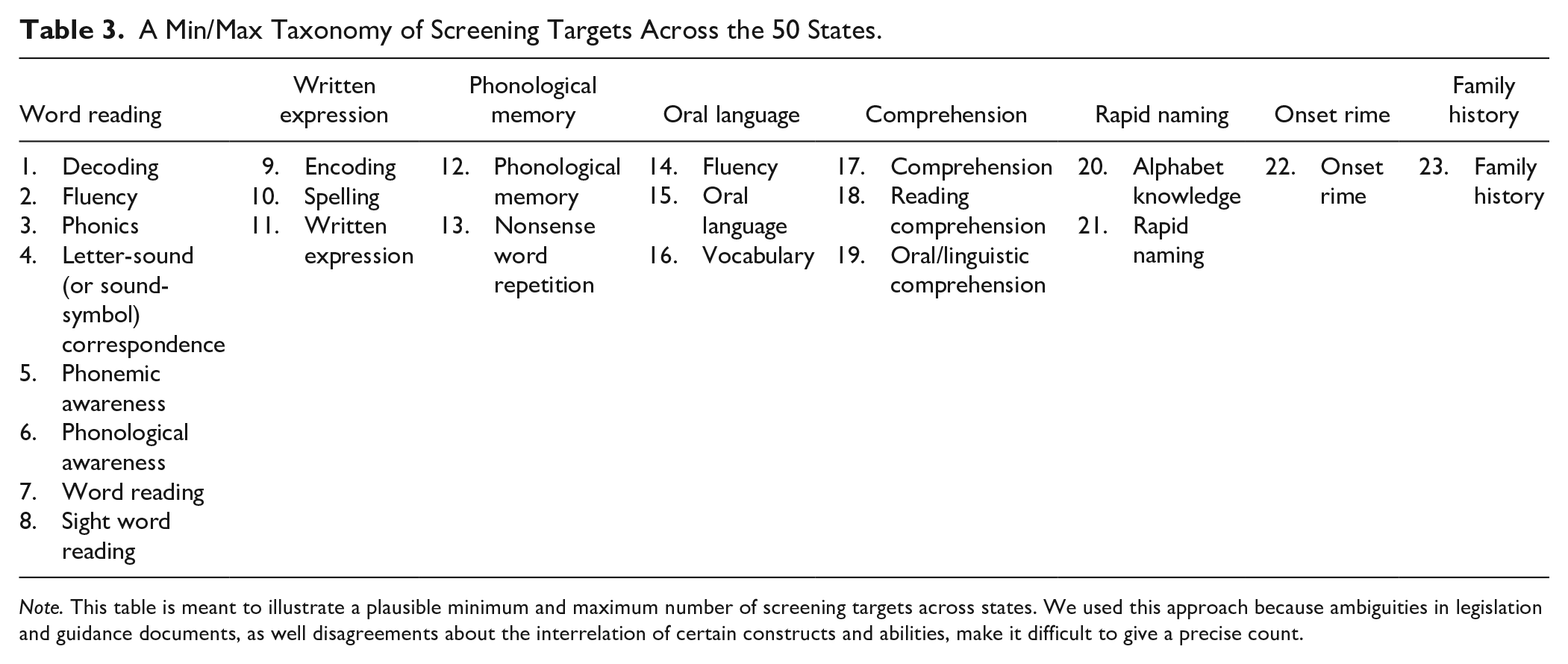
Note. This table is meant to illustrate a plausible minimum and maximum number of screening targets across states. We used this approach because ambiguities in legislation and guidance documents, as well disagreements about the interrelation of certain constructs and abilities, make it difficult to give a precise count.
When does screening take place?
Of the 33 states that require universal screening for reading difficulties including dyslexia, 13 required screening in Grades K–3, five required screening in K–2, six required screening K–1, two required screening only in kindergarten, one required screening only Grade 1. We could not determine when screening was required for the remaining six states due to ambiguities in the law or handbook. These results imply that most states screen students at least four times as they progress through elementary school, but this is not a necessary conclusion. Some screening protocols recommended screening multiple times per year. There was also one instance (i.e., New Jersey) where a guideline promoted screening in Grades K–5, but the law only required that students be screened by Grade 2.
To what extent do state laws have provisions concerning parent opt-out?
We found three state dyslexia laws that addressed the possibility of opting out of universal screening. This count does not include opt-out rights granted by non-dyslexia specific legislation and therefore may be an underestimate. For instance, we were informed during the review process that parents in Massachusetts can opt out of any assessment for religious reasons or a record of a recent assessment. It is possible that other states have similar provisions that we did not code. California, meanwhile, allows parents to opt out of state mandated testing, but universal screening is not currently required. The applicability of the opt-out law to universal screening was therefore unclear to us.
To what extent do state laws have provisions concerning parental notification of results?
We found 14 states had provisions about notifying parents of screening results, though most did not specify required content for the letter in any detail. This count overlooks any pre-existing policies about the communication of assessment results to parents, such as those developed in response to the enactment of IDEA, as well as those that are not dyslexia-specific. A report on third-grade reading laws by the Council of Chief State School Officers (2019) suggests 20 state have laws concerning parental notification when a student is classified as struggling or at risk of retention.
Research Question 2: How Do Instructional and Intervention Requirements Differ Across States?
To what extent do state laws address evidence-based instruction?
The federal Every Student Succeeds Act of 2015 provides for the use of evidence-based practices. Non-regulatory guidance documents define an evidence-based intervention as being supported by four possible levels of evidence: strong, moderate, promising, or demonstrates a rationale (U.S. Department of Education, 2016). We found evidence that 17 states require the use of evidence-based interventions and/or instruction. An additional six states encouraged their use. One state required the use of “research-based” intervention. The distinction between “evidence-based” and “research-based” practices may be important because the former is defined in federal legislation (U.S. Department of Education, 2016).
To what extent do state laws address explicit/direct instruction?
Explicit or direct instruction is a method of instructional delivery that is often contrasted with “discovery-based” and constructivist approaches to pedagogy. In a review of explicit instruction literature from 2000 to 2016, Hughes et al. (2017) found that explicit instruction is most typically associated with (a) the segmenting of complex skills, (b) think-alouds, (c) the systematic use of prompts by the teacher, (d) opportunities for students to receive and respond to feedback, and (e) purposeful practice opportunities (Hughes et al., 2017). We found that nine states had laws requiring the use of explicit or direct instruction. Four additional states had laws that encourage or address explicit or direct instruction. We did not code state definitions of explicit or direct instruction, but it is our impression that the definitions generally overlapped with the components described by Hughes et al. (2017).
To what extent does intervention occur in an RTI or MTSS framework per the dyslexia law?
Multitier systems of support (MTSS) is an umbrella-term for frameworks for supporting struggling students, often by focusing resources on students who need them the most. It includes approaches such as RTI and positive behavioral and intervention support (PBIS; Sugai & Horner, 2009). RTI is both an MTSS and a potential approach for identifying students with SLDs as described by IDEA (Zirkel, 2017). The National Center on Intensive Intervention defines RTI as follows: Response to intervention integrates assessment and intervention within a multi-level prevention system to maximize student achievement and to reduce behavioral problems. With RTI, schools use data to identify students at risk for poor learning outcomes, monitor student progress, provide evidence-based interventions and adjust the intensity and nature of those interventions depending on a student’s responsiveness, and identify students with learning disabilities or other disabilities.
The presence or absence of an MTSS/RTI requirement may introduce heterogeneity into the effects of dyslexia legislation (Gersten et al., 2017; Wanzek et al., 2016, 2018). We found that seven states require the use of RTI or MTSS for intervention. This count does not reflect prior legislation permitting or requiring the use of RTI as an approach to identifying SLDs. According to Zirkel and Thomas (2010), seven other states require the use of RTI. In these states, it may have been redundant to specify that intervention should occur in an RTI or MTSS framework. Conversely, Georgia did not have an unambiguous dyslexia-specific intervention requirement, but it did require dyslexia screening in the context of RTI. We counted this dynamic as a de facto intervention requirement.
To what extent do state laws address multisensory instruction?
The term multisensory instruction appears in the laws of 12 states, but we found that it is only defined in one. In this law, multisensory instruction is defined as instruction that “incorporates the simultaneous use of two or more sensory pathways during teacher presentations and pupil practice” (Nevada Revised Statutes 388.417, 2015). State-issued dyslexia handbooks sometimes provide overlapping or alternative definitions. For instance, one handbook equates multisensory instruction with visual, auditory, kinesthetic, and tactile (VAKT) learning, which is described as, “Teaching is done using all learning pathways in the brain (visual, auditory, kinesthetic, tactile) simultaneously in order to enhance memory and learning” (Birsh, 2018, p. 26). “Children are actively engaged in learning language concepts and other information, often by using their hands, arms, mouths, eyes, and whole bodies while [Moats & Dakin, 2008, p. 58]” (Texas Education Agency, 2018, p. 39). Another handbook states that “simultaneous multisensory (multimodal) instruction incorporates two or more modalities simultaneously. The nature of every oral and written language task requires integration of at least two sensory pathways” (California Department of Education, 2017, p. 66).
To what extent do states have Grade 3 Reading Laws?
At least 26 states have passed what are sometimes called “third grade reading laws” (Council of Chief State School Officers, 2019). According to a study by the Council of Chief State School Officers (2019), at least 19 states have laws that require students to be retained if their reading achievement is not proficient by Grade 3, and as late as 2019, five states had laws that focused on retention without addressing prevention and intervention (Council of Chief State School Officers, 2019). The report also indicates that 16 states have laws providing for state support or assistance of the legislation’s implementation. Third-grade reading laws have the potential to contribute to the heterogeneity of effects by amplifying or constraining the effects of the dyslexia legislation, and by changing when low-achieving students are assessed in terms of their developmental age.
Research Question 3: How Do Administrative Approaches to Implementation Differ Across States?
Implementation science frameworks often hold that policy, provider characteristics, and organizational factors can all influence an intervention’s effects. We therefore looked for legislative trends that fell under these categories.
To what extent do states employ a dyslexia specialist or coordinator?
We found that 14 states had appointed a specialist or coordinator to the state education agency. Typically, these individuals were tasked with some aspect(s) of the law’s implementation. For instance, most states that require screening publish lists of potential screening assessment as a form of technical assistance to schools. The creation of these lists is the type of guidance that a dyslexia specialist is often directed to provide. Coordinators may also oversee the state-efforts to provide professional development and the publication of guidance documents. In some states, the laws also specified minimum qualifications for the position. To the extent that coordinators contribute to a laws’ implementation, their presence may contribute to heterogeneity of effects.
To what extent do states require annual reporting of screening and intervention practices or results?
We found that 14 states require annual reporting of screening and/or intervention practices and/or results by LEA to SEA. Typically, the nature of the reporting requirements was not described in any detail so we cannot describe the scope of the typical content of the reports, but they often include the number of students identified as being at risk for reading difficulties.
Research Question 4: How Do Evaluation and Identification Procedures Differ Across States?
Our final research question was aimed at understanding the relation between screening, evaluation, and the identification of disabilities. We noticed in our previous study that the dyslexia laws seldom described the identification of dyslexia and special education despite the preambles to many bills emphasizing that dyslexia is an SLD. The lack of specificity regarding the relation between assessment, intervention, and identification has the potential to influence the effects of the laws. If it is the case that states do not have a clear policy about when and under what conditions assessment results should lead to formal evaluations or identification, it is possible that the laws will not promote change in identification rates. Alternatively, they may not lead to change in the intended or expected direction. We therefore posed two guiding questions:
To what extent do state laws describe how universal screening and intervention inform comprehensive evaluations and/or formal identification or diagnosis of students’ learning disabilities?
Among the states that require screening, 23 had policies that addressed the connection between screening and diagnosis and/or evaluation and identification. However, this count reflects a very loose operationalization of the word “address,” with any mention of screening and any subsequent diagnostic or evaluative assessment reflected in the count. For instance, a section of Alabama law simply indicates that each state-approved assessment system must “[p]rovide screening and diagnostic capabilities for monitoring student progress. Measure, at a minimum, phonological awareness, the alphabetic principle, decoding, encoding, accuracy, vocabulary, and comprehension. Identify students who have a reading deficiency, including identifying students with characteristics of dyslexia.” In contrast, Louisiana Administrative Code, Title 28 (2008) is specific about how screening should relate to intervention and follow-up evaluations, and the conditions that would lead to the identification of dyslexia in a student. For instance, Chapter 7 section G states, “A student shall be determined to have characteristics of dyslexia if the following criteria are met.” It then describes specific inclusionary and exclusionary criteria.
The above count does not include information found in state guidance documents, but we noted similar variation in the extent to which state handbooks provide specific guidance regarding follow-up assessments and classification decisions. For example, Texas’s handbook has an entire chapter on procedures for the evaluation and identification of students with dyslexia. The chapter describes federal guidance on the relationship between dyslexia and IDEA, timelines for dyslexia referrals, relevant state and federal law, and procedures for evaluation, including various data sources that should be considered and pathway for evaluation under both 504 and IDEA. The guide indicates that the two pathways can lead to different types of service, with the 504 path potentially resulting in “standard protocol dyslexia instruction” and meaningful access to a free and appropriate public education, and the IDEA path potentially resulting in “specially designed instruction” and an individualized education plan that provides a meaningful educational benefit (p. 35). Texas’s dyslexia handbook also emphasizes that, “it is not one single indicator but a preponderance of data (both informal and formal) that provide the [504] committee with evidence for whether [reading and spelling] difficulties are unexpected” (Texas Education Agency, 2018, p. 44). Other state handbooks also address additional data sources and procedures (Utah State Board of Education, 2018; Wyoming Department of Education, 2019) and the applicability of federal guidance around IDEA (California Department of Education, 2017) but typically in less detail.
Does the promotion of RTI align with the state’s method(s) for SLD determinations?
Although we did not examine state policies for identifying SLDs ourselves, previous studies have classified their approaches, which allowed us to give a basic description of the connection between dyslexia laws and state SLD approaches. In 2010, Zirkel and Thomas (2010) found that most states permitted the use of both SD and RTI for identification, while 12 states required the use of RTI. We found that 11 states that promoted or required the use of RTI or MTSS for dyslexia. Of these states, five had previously permitted RTI, but did not require it.
Discussion
Most states in the United States have passed legislation concerning the education of K–12 students with or at risk for dyslexia. As is common with state-level reform efforts, there are important cross-state similarities in the legislative content. For example, state laws tend to promote screening and intervention, especially in a manner that is consistent with findings from the National Reading Panel (2000). However, there is also cross-state variation in terms of what school practices the laws aim to change. Some states have taken comprehensive approaches to reforming K–3 reading (Council of Chief State School Officers, 2019; Gearin et al., 2018). Others have made comparatively small changes to pre-existing policy (Council of Chief State School Officers, 2019; Gearin et al., 2018). Similar-looking reforms may also belie variation in provisions that can affect policy impact, such as differences in how screening and intervention are implemented. The cross-state differences documented in this study suggest that dyslexia legislation will have uneven effects on student and school outcomes.
Assessment Practices
One reason that states may experience different effects from dyslexia legislation is that they utilize different screening practices. Dyslexia and risk-for-dyslexia are continuous conditions that are generally operationalized through arbitrary cut scores (Fletcher et al., 2019). They are also heterogeneous conditions in that not all students present with exactly the same symptoms (Miciak & Fletcher, 2020). These aspects of dyslexia mean that equally valid assessment regimes could promote different conclusions about how a child should be classified (Peters & Ansari, 2019). While previous analyses illustrated that states vary in terms of whether they have a screening requirement (Gearin et al., 2018; Youman & Mather, 2015, 2018), the present analysis illustrated that even states that require screening may approach screening differently. They may define dyslexia in different ways; screen for different abilities; screen with different frequencies and at different times; take different approaches to promoting parent involvement; and make exceptions to screening requirements for different reasons. It is important to understand this variation to make valid inferences about the consequential validity of screening programs and the effects of dyslexia legislation.
Instruction and Intervention Practices
Similarly, previous research established that a growing number of states require schools to provide instructional intervention for students with or at risk for dyslexia (Gearin et al., 2018; Youman & Mather, 2015, 2018). The present study illustrates that the nature of these instruction and intervention requirements varies across states in terms of whether they are (a) evidence-based, (b) delivered in an RTI or MTSS framework, (c) include direct or explicit instruction, (d) include multisensory instruction, or (e) involve student retention. It is possible that cross-state variation in these characteristics will introduce heterogeneity into policy effects because they are supported by varying levels of scientific research. For instance, there is ample and strong evidence supporting the use of explicit or direct instruction to promote beginning reading (Carnine et al., 2009; Sermier Dessemontet et al., 2019; Stockard et al., 2018), but comparatively little evidence regarding the benefits of multisensory instruction (Al Otaiba et al., 2018). The intervention characteristics could also introduce heterogeneity because they may involve deep changes to school practice. For instance, schools will presumably need to pay greater attention to research that promotes causal inference to meet the evidence-based intervention requirements (U.S. Department of Education, 2016). They may also need to become more systematic about intervening with fidelity and monitoring student progress to meet RTI/MTSS requirements (e.g., Coyne et al., 2018).
Administrative Approaches to Implementation
Our results indicate that the amount of oversight and technical assistance schools are likely to receive will be uneven across states due to differences in administrative aspects of implementation. We found that 13 of the states requiring dyslexia screening had a dyslexia coordinator or specialist. The same number of states required some type of annual reporting of screening and/or intervention practices to the state education agency (or another administrative body). Uneven levels of technical assistance and accountability pressure may affect the degree to which schools implement their laws with fidelity and sustain them over time.
How Do Evaluation and Identification Procedures Differ Across States?
Finally, we identified states that describe the relation between screening and follow-up assessment and classification. We found that most states that require screening also acknowledge that screening is related to follow-up assessment and classification in some way. However, few state dyslexia laws specified classification procedures. State handbooks were much more likely to discuss the relation between screening and classification decisions. However, the degree to which they provide specific guidance also varied across state lines.
General Conclusion
Overall, the variation in legislative content is important for understanding whether and how dyslexia legislation affects student and school outcomes. Our findings illustrate that dyslexia legislation is not monolithic. States differ in terms of whether their laws require them to provide dyslexia screening and intervention. They also differ in how they promote screening and intervention. Some of these differences, such as those concerning screening targets and test administration schedules, will directly affect which students are classified as being at risk for dyslexia. They may also indirectly affect subsequent classification decisions, or even the implementation of the laws themselves. Future policy analyses should be mindful of this variation when drawing inferences about the effects of the dyslexia legislation.
Limitations
Our study has several limitations that should be considered when interpreting the results. First, we posed our research questions from an implementation science perspective rather than a legalistic one. Although we paid careful attention to the wording of the laws and considered other relevant legislation to distinguish apparent requirements from exhortations, our main goals were to elucidate whether and why variation in the laws might lead to heterogeneous effects. Readers should be mindful that our classifications may differ from future court interpretations. Furthermore, the accuracy of the descriptive analysis provided here is prone to change as reform efforts continue. Second, it is always possible that we failed to locate texts that were relevant to our research questions even though we took precautions against this potentiality. Third, there are state characteristics that we expect will contribute to heterogeneity that we were unable to explore due to limitations in our dataset. These include (a) appropriations and funding for the dyslexia laws, (b) educator characteristics, and (c) pre-service and in-service professional development requirements. Finally, our study does not describe what baseline practices looked like prior to passage of dyslexia legislation. This is an important limitation because prior research suggests that, for many states, the dyslexia legislation may only represent an incremental shift in practice due to previous or co-occurring reform efforts (Gearin et al., 2018). Where this is true, even expansive legislative requirements may produce only little change.
Implications for Practice
Our findings have two major implications for school practice. First, state education agencies need to exercise caution when it comes to policy-borrowing across state lines. This study was the first to describe some of the more nuanced policy components that might play causal role in affecting student achievement. We do not know whether these components do, in fact, play a causal role, or whether their effects are conditional. Mixing and matching legislative components that appear to be working elsewhere might not have intended result. Second, schools, districts, and states will need to carefully consider how to translate best-practice recommendations into their local contexts. Several technical assistance centers have created products that may assist with the implementation of the dyslexia laws. These include but are not limited to the National Center on Intensive Intervention at American Institutes for Research’s (2019) screening and intervention tool charts, the National Center on Improving Literacy’s guide to universal screening (Petscher et al., 2019), and the Institute of Education Science’s practice guide (e.g., Foorman et al., 2017). Users of such products should be mindful that local requirements vary within and across states, sometimes in ways that can increase or reduce the generalizability of a best-practice recommendation.
Footnotes
Acknowledgements
The opinions or policies expressed are those of the authors and do not represent views of OESE, OSEP, or the U.S. Department of Education. You should not assume endorsement by the Federal government. We would like to express our thanks to the state education agency personnel and dyslexia advocates who reviewed our codes for accuracy and completeness. We would also like to thank Will Schultz, Kimberly Griggs, and Dr. Jessica Turtura for their assistance throughout this project.
Declaration of Conflicting Interests
The author(s) declared no potential conflicts of interest with respect to the research, authorship, and/or publication of this article.
Funding
The research reported here is funded by a grant to the National Center on Improving Literacy from the Office of Elementary and Secondary Education, in partnership with the Office of Special Education Programs (Award No. S283D160003).