




Abstract
State standards include fluent use of standard computational algorithms. However, learning and using them require conceptual understanding of numbers and operations. Previous research using the concrete–representational–abstract (CRA) sequence has been effective in teaching computational algorithms to students at risk of and students with learning disabilities by emphasizing conceptual understanding. However, all the research was face-to-face and few captured the impact of the intervention on students’ conceptual understanding. The current study occurred during the COVID-19 pandemic, so researchers modified CRA for remote instruction. This study investigated the effects of modified CRA on the fluency and accuracy of three sixth-grade students with learning disabilities. They also included an assessment of conceptual understanding. The researchers used a multiple probe across participants design, demonstrating a functional relation between CRA and students’ fluency and accuracy. Researchers assessed conceptual understanding with informal measures that required application of their conceptual understanding. The results and implications are discussed.
Most U.S. states (41 of 50) base their standards on the Common Core State Standards Initiative (CCSSI, 2022). In Grades 4 and 5, the standards include fluent use of standard algorithms: (a) fluently add and subtract multidigit whole numbers using the standard algorithm, and (b) fluently multiply multidigit whole numbers using the standard algorithm (CCSSI, 2010). An algorithm is a set of rules that has a finite number of steps (Fan & Bokhove, 2014). The National Council of Teachers of Mathematics (NCTM, 2014) suggests that mathematics should be taught so that students understand concepts. Therefore, teachers should ensure that students understand how and why they use algorithms. Knowing a set of steps is not adequate for meeting the standards above because mathematics is not a set of rules and steps (Karp et al., 2014). Fluency in algorithms is understanding how to approach problems, why algorithms work, and when to use them (Kling & Bay-Williams, 2014). Before algorithms appear in standards, students learn the underpinning concepts for computation (CCSSI, 2010).
For example, second-grade students recognize that numbers are grouped by 10 (base ten and place value) and decompose multidigit numbers in different ways. This understanding sets the stage for using multiple strategies for combining and separating numbers (Clements & Sarama, 2021). In third grade, students fluently add and subtract within 1,000 using strategies and algorithms; the standard algorithm is not mentioned (CCSSI, 2010). Using multiple strategies in third grade allows for development of flexibility, preparing students for fluent use of the standard algorithm for addition and subtraction of multidigit numbers in fourth grade. The pathway to learning the standard algorithm for multiplication also involves knowledge of numbers and place value. Making equal groups in second grade is a foundation. According to Young-Loveridge (2005), another critical step is formally learning about the multiplication operation and its properties in third grade with various representations (e.g., grouping using arrays, equal groups of objects). In fourth grade, students use strategies based on place value to multiply two 2-digit numbers with the partial products algorithm (CSSI, 2010). The standards set the stage for the use of algorithms such that students understand how and why they are useful and, in some cases, may be more efficient (NCTM, 2014). The learning pathway that sets the stage for understanding and using the algorithm involves number and place value knowledge and understanding of the operation and its properties (Hurst & Hurrell, 2018).
Gaps in number knowledge lead to mathematics difficulties. Therefore, it is critical that interventions include methods and materials that explicitly show how and why numbers are manipulated within computational algorithms; experts recommend instruction with multiple representations (NCTM, 2014). In the field of learning disabilities (LDs), effective practice includes the use of manipulative objects, pictures/drawings, and numbers and symbols. These can be presented systematically one step at a time using the concrete–representational–abstract (CRA) sequence (Bouck et al., 2018; Peltier et al., 2020). At the concrete stage, students solve equations or complete mathematical tasks using numbers and symbols (abstract) with the assistance of objects. At the representational stage, students complete mathematical tasks using pictures and drawings. The abstract stage involves completing tasks without visual or hands-on supports. The CRA line of research has included mnemonic strategies during the final instructional stage to assist students with procedural knowledge associated with operations (Miller & Kaffar, 2011). CRA research with elementary students includes single-digit operations (Milton et al., 2019), addition and subtraction with regrouping (Mancl et al., 2012; Miller & Kaffar, 2011), and multiplication with regrouping (Flores, Hinton, & Schweck, 2014; Flores, Hinton, & Strozier, 2014; Flores et al., 2019; Flores & Hinton, 2019). Literature reviews show that most multiplication interventions for students with LDs or other disabilities, or students at risk of LDs focus on single-digit equations, place value, and problem-solving (Powell et al., 2020). The literature solely related to CRA multidigit multiplication and the standard algorithm follows.
Multiplication of Multidigit Numbers Using CRA
Researchers used CRA to teach students with LDs and students in Tier 3 of multitiered systems of support (MTSS) multiplication of one-digit and two-digit numbers (Flores & Hinton, 2019) and two 2-digit numbers (Flores, Hinton, & Schweck, 2014; Flores, Hinton, & Strozier, 2014; Flores et al., 2019) using the standard algorithm. The CRA sequence was used to solve equations, allowing students to see the components of the standard algorithm based on the prerequisite concepts and skills from early learning (Clements & Sarama, 2021).
For example, students noted the composition of the multipliers. For the equation 23 × 24, 20, three, 20, and four were the multipliers. Students used base ten blocks (concrete) and drawings (representational) to multiply four and three, four and 20, three and 20, and 20 and 20. In some studies, a place value mat or table assisted students in organizing the blocks/drawings, separating ones, tens, and hundreds as well as separating groups within each place value (Flores, Hinton, & Schweck, 2014; Flores et al., 2019; Flores & Hinton, 2019). Using these aids, students made equal groups, following the order of the standard algorithm. In making the products, students noted regrouping. Within the standard algorithm, a shorthand procedure shows regrouping with a small number (crutch number) written above the place value column to the left of the place of computation (e.g., 4 × 3 is 12 and two is written in the ones place of the product and a small one is written above the 20). When continuing multiplication (e.g., 4 × 20), 10 was added to that product for a total of 90. The use of the blocks and drawings physically showed how and why this notation was used in the standard algorithm. During the concrete and representational levels, students completed the computation process, but no algorithm steps were explicitly taught. Once students solved equations successfully with blocks and drawings, researchers explicitly taught the algorithm steps with a mnemonic strategy. At this point, the students understood how and why the steps in the strategy worked, so they were not just memorizing steps without understanding.
Each study in the line of research had a dependent variable of fluency, defined as writing 30 correct digits on 2-min timed probes (Flores, Hinton, & Schweck, 2014; Flores, Hinton, & Strozier, 2014; Flores et al., 2019). Flores and Hinton (2019) and Flores et al. (2019) added word problems, meaning that all lesson items were in the form of simple one-step word problems. This included word problems requiring addition, subtraction, or multiplication so that students engaged in mathematical thinking rather than choosing multiplication by default if all equations within the lesson followed the same operation. Most studies in the line CRA multiplication research employed single-case designs (Flores, Hinton, & Schweck, 2014; Flores, Hinton, & Strozier, 2014; Flores & Hinton, 2019). Flores et al. (2019) used a group design in which they compared CRA with a published direct instruction program. Both explicit interventions led to significant fluency gains for students with disabilities and students within Tier 3 of MTSS. The researchers collected anecdotal data regarding students’ explanations of their computation. Students in the CRA group’s explanations differed because they included reference to number magnitude (e.g., “I multiplied 20 and 5” or “I multiplied 20 and 30 instead of referring to numerals such as 2 and 5 or 2 and 3”). Flores and Hinton (2019) also provided informal evidence of changes in students’ understanding with a word problem assessment and recorded observations/interviews as students completed an equation before and after the study.
Remote Instruction
The current study occurred during the global COVID-19 pandemic and, due to restrictions, it was not possible for the researchers to provide face-to-face intervention. As the previous CRA research had been implemented face-to-face, the current conditions presented challenges. Therefore, the researchers considered the conditions of other intervention research for students with LDs in a remote format. The research area was limited at the time of research design. However, Coy et al. (2014) provided guidance for making remote instruction accessible for students with LDs by incorporating universal design. This included opportunities for hands-on learning, methods to encourage attention/perseverance, and multiple means for expression.
Purpose of Current Study
The line of research related to CRA instruction to teach the standard algorithm for multiplication focused on the development of fluency with attempts to capture students’ conceptual understanding. The concepts that students encounter within the intervention include place value, number composition, and the commutative property; however, no research included an assessment with related items. The previous research included students with LDs, but all instruction was face-to-face. The current study’s context prevented that and therefore led to a modified version of CRA because the concrete phase did not include hands-on experience. It is not known whether the hands-on experience is critical or whether a modified experience is adequate.
Therefore, the study has multiple purposes. First, the researchers extended the results of previous research by changing the instructional format from face-to-face to remote. Next, the change in format led to a modification of the concrete level of instruction, extending previous research that had hands-on activities. The researchers sought to investigate the effects of this modification on CRA. Researchers included a measure of application of students’ understanding, investigating change in students’ knowledge of concepts related to place value and multiplication. Finally, researchers sought to investigate the extent that the remote-modified CRA instruction was socially valid. Answering the research questions involved collection of repeated systematic quantitative data (fluency and accuracy), descriptive data (conceptual understanding), and open-ended interviews (social validity). The research questions are the following:
Method
Research Design
The researchers used a multiple probe across students design. The researchers chose this design because the intervention involved learning that could not be reversed. It allowed the researchers to show changes in student behavior at three different points in time and probes did not have to be administered continuously. In addition, the design was appropriate given the unknown nature of the remote modality and the modified version of CRA; the researchers felt it was most appropriate to learn and refine any issues prior to a large implementation.
The dependent variables were fluency and accuracy in solving multiplication equations with two 2-digit multipliers. Researchers defined fluency as the number of correct digits written under the equal line within 2 min. They defined accuracy as the percentage of fully completed equations with a correct product. Researchers collected data on these dependent variables repeatedly and systematically. After baseline, students completed a probe prior to instruction beginning each lesson. The independent variable was modified CRA instruction.
The researchers collected descriptive data and these data cannot be referred to as a dependent variable. The purpose for this assessment was to gather informal data on students’ conceptual understanding as researchers in previous studies (Flores et al., 2019; Flores & Hinton, 2019); however, the assessment included items that provided greater detail regarding students’ knowledge of prerequisite conceptual understanding of place value and multiplication. Researchers administered two forms of a curriculum-based assessment before and after the study to informally assess students’ application of concepts used when completing the algorithm. A functional relation could not be drawn based on these data because data collection was not repeated over time with only two data points (one before the study and after the study).
The researchers used random assignment and response-guided decisions about the order of participation and phase changes. All students began in baseline. The researchers randomly chose names for who would move to intervention first, second, and third. After at least five baseline data points and stability, the first student began intervention. The researchers defined stability as the last three data points in baseline varying no more than 30% from the mean of total baseline. Once the first student showed two consecutive accuracy data points above baseline, the second student began intervention. When the second student increased performance, the third student began intervention. Instruction ended when students reached criterion for mastery, defined as three consecutive data points with at least 30 correct digits and 100% accuracy.
The researchers plotted students’ performance on a graph with two y-axes to show the two dependent variables collected using the multiplication probes: the number of digits written correctly under the equal line (left y-axis) and the percentage of fully completed equations with correct final products (right y-axis). The researchers created the graphs according to Dart and Radley’s (2018) recommendations for ordinate scaling and data points per x- to y-axis ratio. The y-axes ranged from zero to the maximum performance across students.
To visually analyze the data, they noted the following: (a) the level of data paths, defined as the mean; (b) the range of data paths, defined as the distance between the least and greatest data points in the path; (c) immediacy of effect, defined as the space between the last baseline data point and the first intervention data point; and (d) a simple measure of magnitude of change with the percentage of nonoverlapping data points (PND; Scruggs & Mastropieri, 2013). The researchers also calculated baseline corrected Tau (Tarlow, 2017).
Participants
Three sixth-grade students with LDs participated in the study: Anna, Gabe, and Kelly. The criteria for participation were as follows: (a) received special education services under the category of LD according to state criteria; (b) completed an assessment with multiplication equations with two 2-digit numbers, and wrote accurate products for less than 25% of the equations; (c) had prerequisite skills of memorization of single-digit addition, mastery of addition with regrouping, and fluency in single-digit multiplication with multipliers through five or competent use of a multiplication chart for unknown facts; and (d) parent permission and student assent to participate per the approved institutional review board (IRB) protocol. The state had three ways of meeting eligibility criteria for LD: (a) 16-point discrepancy between predicted achievement (a number determined by transforming a cognitive ability score using a regression table) and actual achievement, (b) repeated failure to respond within an MTSS model without evidence of another disability, or (c) a pattern of strengths and weaknesses. Their socioeconomic status was not available; only school-level data were available and can be found in the section about setting.
Anna
Anna was a 13-year-old White female in the sixth grade. Her first language was English. She was eligible for special education services under the category of LD. She was in the general education classroom for at least 80% of the day, attending the resource room for supplemental reading and mathematics support each day. Assessment of her cognitive ability was below the average range with a standard score of 84 on the Wechsler Intelligence Scale for Children V (WISC-V). Her mathematics achievement was below the average range with a standard score of 75 on the Keymath 3 Diagnostic Assessment. Teacher report and evaluation of computation performance on the Keymath 3 Diagnostic Assessment confirmed that she had the prerequisite skills for participation. Curriculum-based assessment administered before participation in the study showed that Anna did not complete any multidigit multiplication equations correctly.
Gabe
Gabe was a 13-year-old White male in the sixth grade. His first language was English. He was eligible for special education services under the category of LD. He was in the general education classroom for at least 80% of the day, attending the resource room for supplemental reading and mathematics support each day. Assessment of his cognitive ability was within the average range with a standard score of 87 on the WISC-V. His mathematics achievement was below the average range with a standard score of 74 on the Keymath 3 Diagnostic Assessment. Teacher report and evaluation of computation performance on the Keymath 3 Diagnostic Assessment confirmed that he had the prerequisite skills for participation. Curriculum-based assessment administered before participation in the study showed that Gabe did not complete any multidigit multiplication equations correctly.
Kelly
Kelly was a 13-year-old White female in the sixth grade. Her first language was English. She was eligible for special education services under the category of LD. She was in the general education classroom for at least 80% of the day, attending the resource room for supplemental reading and mathematics support each day. Assessment of her cognitive ability was below the average range with a standard score of 78 on the WISC-V. Her mathematics achievement was below the average range with a standard score of 68 on the Keymath 3 Diagnostic Assessment. Teacher report and evaluation of computation performance on the Keymath 3 Diagnostic Assessment confirmed that she had the prerequisite skills for participation. Curriculum-based assessment administered before participation in the study showed that Kelly did not complete any multidigit multiplication equations correctly.
Setting
The study took place at a rural elementary school (prekindergarten through sixth grade) in the southeastern United States. The school received Title I funds and 50% of students received free or reduced-price meals. The students participated in the intervention in their resource classroom during their regularly scheduled time for mathematics supplemental instruction. Anna, Gabe, and Kelly received mathematics instruction in their general education classroom, and their special education teacher supplemented it. In the resource room, they completed general education assignments and received remedial instruction as needed. During baseline and intervention of this study, there was no instruction related to multidigit multiplication in either the general education classroom or within their supplemental instruction.
While working with the researcher during remote instruction in their resource room, each student attended at separate times and each worked one-on-one with the researcher using the Zoom video conferencing application. Therefore, Anna, Gabe, and Kelly were not present while their participating peers received the remote intervention. During remote instructional time, the students’ resource teacher assisted by having materials ready for students at the beginning of sessions but worked with other students who did not participate in the study on the other side of the classroom. Anna, Gabe, and Kelly sat at a table that had a Chrome Book with a built-in web camera, a set of headphones, and a document camera attached with a USB cable. This allowed the researcher to see the student’s face (using integrated web camera), see the student’s work on paper (using document camera attached with a USB cable), and provide audio for the student without disturbing other classroom activities. It also allowed the student to focus on remote instruction without hearing the other class activities in the room (headphones). The researcher was present in the setting via Zoom using a laptop with an integrated web camera and two document cameras connected by USB; the researcher switched camera views based on lesson activities.
These instructional sessions occurred 3 days per week, for 20 min each. Lessons 1 to 3 took twice as much time as the others because handling manipulatives took longer than drawing pictures. Therefore, Lessons 1 to 3 occurred across two 20-min sessions on different days. For example, on Monday, they completed the advance organizer and modeling, and on Wednesday, they completed the guided practice and independent practice portions of the same lesson. Therefore, they completed Lessons 1 to 3 in six sessions and Lessons 4 to 12 in nine sessions.
When students moved to the representational phase with pictures/drawings and the abstract phase (Lessons 4–12), they completed each lesson in one 20-min session. The projected intervention length was 5 weeks. Interruptions occurred for Anna and Gabe. One was 2 weeks in length for a holiday break immediately followed by state testing. Anna had an additional interruption with a 2-week absence related to quarantine. Anna completed the intervention in 9 weeks. Gabe completed the intervention in 7 weeks. Kelly’s intervention was not affected by those breaks. She completed it in 5 weeks as the school ended.
Assessment Materials and Procedures
Materials associated with dependent variable
Probes were timed (2 min) with 10 vertically written multiplication equations with two 2-digit numbers. No blocks, pictures, or drawings were involved, just numbers and symbols. The researchers used a 2-min time limit according to recommendations for curriculum-based measures (Hosp et al., 2016). The current researchers deemed the number of equations appropriate for a ceiling because they timed themselves, completing several probes, and their range of completed equations was 10 to 13. The researchers determined that the ceiling for students should be no higher than the lower limit of this range. The multipliers in the equations ranged 23 to 28 and 33 to 37 and were arranged to exclude single-digit multiplication facts such as 8 × 7, 6 × 7, and 6 × 8. Use of these multipliers decreased the likelihood of student stress associated the larger multipliers. In this study, students had access to a multiplication chart that showed all single-digit facts and their associated products. There were four versions of probes, administered in randomly mixed order to avoid repeating the same probe on consecutive dates or using a predictable order. The probes were valid with I-CVI scores of 1.0 (Polit & Beck, 2006) and reliable with Cronbach’s alpha coefficients ranging .73 to .83.
Procedures associated with dependent variable
The researchers randomly chose one of the four probes, ensuring that the chosen probe had not been used during the previous session; furthermore, students received no feedback regarding their performance so they could not learn the assessment. The researchers administered the probes during baseline sessions that were solely devoted to assessment. These sessions were remote. The researcher and student met using Zoom. The technology set-up for the student was the same as described in the previous setting section. The researcher greeted the student while the resource teacher put a probe face down (in view of the student’s document camera) with a multiplication chart next to it. The resource teacher left to work with other students and the researcher told the student that they would complete a sheet of equations when she directed them to begin. The researcher set a timer, told the student to begin, and after 2 min (watching the student through the document camera), the researcher told the student to stop. The researcher watched the student put down their pencil and took a screen shot of the probe.
After baseline, students completed a probe prior to each lesson according to the procedures just described. If a lesson took more than 1 day (e.g., Lessons 1–3), the researcher only administered a probe at the beginning of the next lesson. For example, there was no probe beginning the second session for Lesson 1. This procedure assessed acquisition of learning from lesson to lesson rather than performance immediately following explicit instruction.
To collect fluency data, the researchers noted the number of digits written correctly underneath the equal line. To collect data regarding accuracy, the researchers noted the percentage of completed equations with correct products. Researchers did not include unfinished equations in the calculation. The data related to correct products were important because students’ baseline probes had as many as 20 correct digits, but no correct products. The intervention could only be shown as beneficial if students determined correct products.
Independent Variable Materials and Procedures
The researchers used materials from Flores et al. (2019), which included a manual, learning sheets, base ten blocks, and a place value mat. The manual had sample scripts and pictorial directions for items in each lesson. The learning sheets had lesson items divided into three sections with the following headings: modeling, guided practice, and independent practice. The place value mat was a 34 × 30-inch poster that had three columns (labeled for ones, tens, and hundreds) and three main rows (one for the first partial product, another for the second partial product, and a row for the total product). The cells made by the ones and tens columns and partial product rows were further divided into nine grouping boxes. The mat is shown in Table 1.
Modified CRA Instruction.
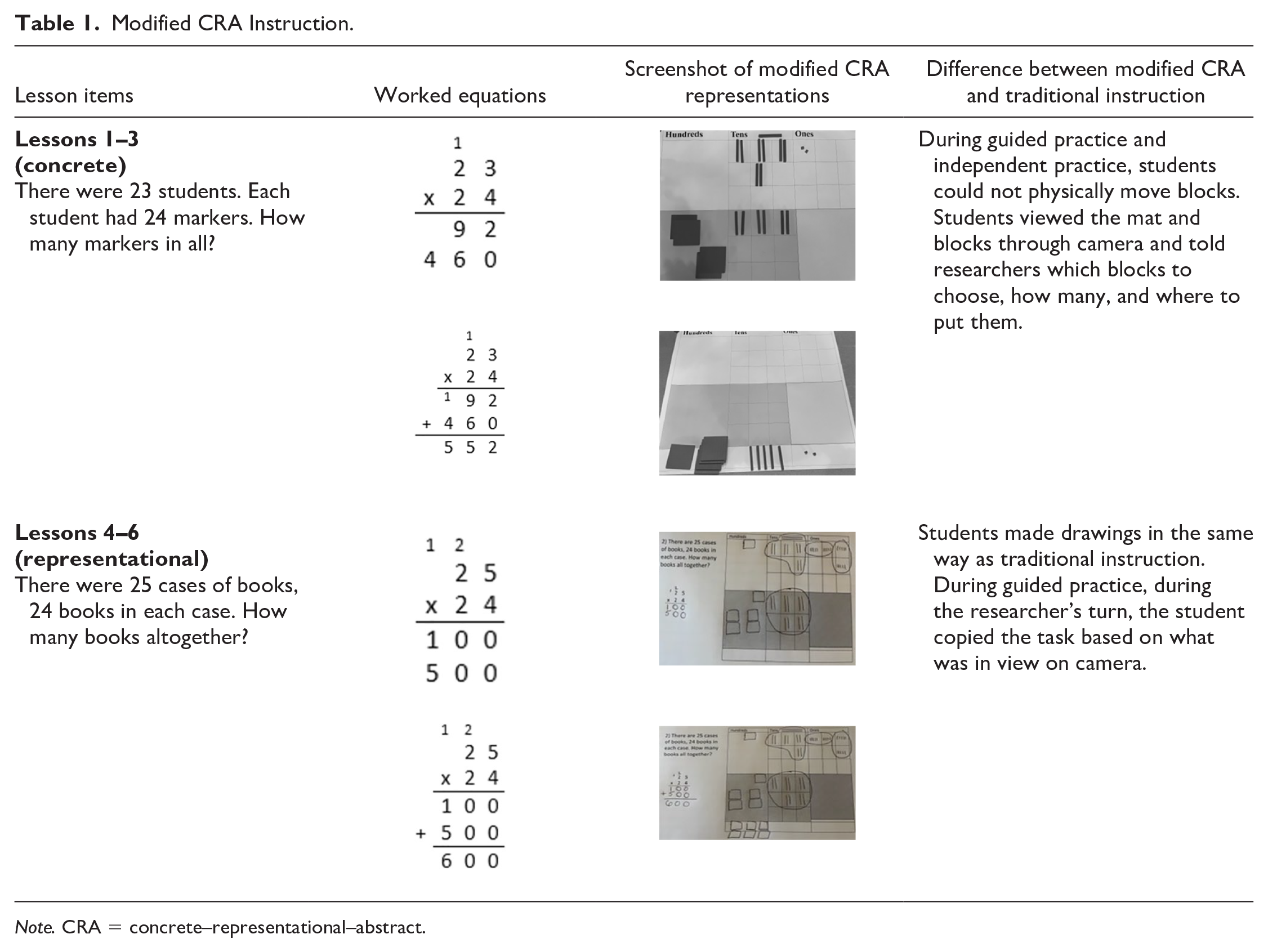
Note. CRA = concrete–representational–abstract.
Modified CRA Instruction
The remote nature of instruction changed features of CRA, especially the concrete level of instruction in which students touch and manipulate base ten blocks to solve abstract equations. To see the manipulation of base ten blocks on a place value mat, a document camera needed magnification adjusted to see the entire field, showing the entire mat and all blocks. However, the learning sheets with word problems and equations had 14-point font. To see the items and written computation, one needed greater magnification on the document camera. Repeatedly adjusting the magnification was problematic; therefore, the researchers needed two document cameras because switching camera views was faster and easier.
Prior to the study, with the assistance of the students’ resource teacher, researchers attempted to test the use of two document cameras on student Chrome Books and the researchers’ laptops. This set-up would have allowed students to use the base ten blocks according to previous research by arranging blocks as they solved equations. However, the students’ teacher had difficulty arranging the materials to be in view of the camera, placing the second camera with appropriate magnification, and switching camera views quickly. Therefore, this arrangement was not feasible for students. The researchers were aware of virtual materials and their efficacy in mathematics (Park et al., 2021) but were concerned about changing an addition variable, changing both the modality and physical materials. Therefore, the researchers designed the study by modifying CRA to include the use of base ten blocks and their arrangement on a place value mat, but only for the researcher to manipulate.
This modification did not change the modeling component of explicit instruction because students do not manipulate materials; they repeat verbal information and answer questions while observing. However, it changed guided practice in which students completed equations with the teacher, touching and moving blocks as they both took turns. It changed independent practice in which students completed equations with blocks by themselves. The modification involved asking the student to “be the researcher’s brain” and tell her exactly what to do with the blocks on her place value mat (e.g., which blocks to pick up, how many, where to put them, and so on).
With this change, students viewed the three-dimensional representations that were different from drawings and used language to demonstrate their understanding of how to use blocks that represented numbers. The modification allowed the researcher to understand the students’ thinking. For example, the researcher understood how students perceived the multipliers and their composition (e.g., 23 made from 20 and 3). The researcher did not offer guidance. However, if students directed her hand incorrectly, she intervened and counted the item as an error. Therefore, items in concrete independent practice had to be completely directed by the student, resulting in correct representation with blocks and a correct product.
At the representational stage, drawings occurred directly on the learning sheet; there was a place value table printed next to each equation on the sheet. During guided practice, both the researcher’s and students’ learning sheets were in view of document cameras. The researcher talked aloud and wrote/drew as the student copied (e.g., used drawings to find the product of the two digits in the ones places of the multipliers). The student continued with the next task (e.g., used drawings to find the product of the bottom multiplier in the ones and the top multiplier in the 10s) and the researcher copied what they wrote so that learning sheets matched.
Lessons 1 to 3
Lessons began with topic overview and explanation about what the students would do (advance organizer). The learning sheets presented two 1-step word problems requiring multiplication for modeling. The researcher read the problem and thought aloud about the question and what was happening (e.g., 23 students each had 24 markers and the question asked about all the markers combined). The researcher determined multiplication as the operation and used the place value mat and base ten blocks to solve the problem. The students participated by counting blocks with her and repeating information. Solving the equation (23 × 24) began in the ones place, making equal sized groups. Addressing the commutative property, they discussed that they could make three groups of four on the mat or four groups of three. With the product of 12, they regrouped by exchanging 10 ones blocks for one 10s block. The researcher emphasized language, calling this regrouping because the students had previous experience with this process as carrying. On the mat, the researcher placed the tens block above the tens column on the mat and oriented it horizontally. This represented the crutch number, a smaller numeral used as shorthand in the algorithm to show regrouping (e.g., a small numeral 1 written above the tens place for this example). The place value mat showed two in the ones place and the tens block representing the crutch number; this directed what to write in the written problem. The researcher wrote the numeral 2 under the equal line in the one’s place of the written problem and a small numeral 1 above the tens place.
Next, the researcher used the place value mat to multiply 20 and four. The researcher emphasized the place value represented by each numeral and the place value mat and blocks provided a visual. They made four groups of 20 on the place value mat (four groups of two 10s blocks). They added 80 and the crutch number (10). With a total of 90 showing on the place value mat, the researcher wrote the numeral 9 in the tens place in the written problem. The remainder of the process is shown in Table 1.
The last step was discussion about reasonableness of this product and how they could use estimation to mentally solve the problem and compare it with their computation as a quick check. The rationale for this step was the students’ baseline assessments included error patterns in which the product of 23 × 24 was 52. By estimating one multiplier (20 × 24) or both multipliers (20 × 20), they mentally found a product that was a three-digit number reasonably close to their computed product based on rounding down.
During guided practice, they completed the same process using blocks and the place value mat. As described above, the student’s turn involved telling the researcher what to pick up, move, and write. During independent practice, the student used the same materials but told the researcher what to pick up, move, and write. If the student asked the researcher to pick up, move, or write anything that was incorrect, the researcher stopped, intervened, and marked the item as incorrect. If the student made any errors within independent practice, the researcher repeated the lesson for the next session. Kelly repeated two lessons. The lesson ended with a summary of what they did during the lesson (post organizer).
Lessons 4 to 6
Lessons 4 to 6 were at the representational stage. The same processes described above occurred using drawings. Squares represented hundreds, long vertical lines represented tens, and short tallies represented ones. When regrouping occurred, they circled 10 of the shapes (e.g. circled 10 of 12 tallies shown place value table in the ones place). Table 1 shows the process.
Lessons 7 to 12
These lessons were abstract without any visual or hands-on support. The researchers taught the RENAME strategy in which each step stated a procedural step in the standard algorithm. They applied RENAME within lessons using explicit instruction. The researchers taught an additional strategy: (a)
Descriptive Data
Materials and procedures associated with descriptive data
The researchers collected descriptive data at two points in time, unrelated to the demonstration of a functional relation. It was not the dependent measure and the researchers administered a version before initiation of baseline and after collection of all dependent measure data when the study ended. The researchers created descriptive materials to measure students’ understanding of numbers, place value, and the commutative property because a standardized measure did not exist. The researchers addressed CCSSI (2010) mathematics standards related to understanding of numbers, place value, and the commutative property: (a) explain that the three digits of a three-digit number represent amounts of hundreds, tens, and ones; (b) round multidigit whole numbers to any place using place value understanding; (c) determine reasonableness of answers using mental computation and estimation strategies including rounding; and (d) understand properties of multiplication (CCSSI, 2010).
The assessment had 24 items in six sections. The first three sections were identification of place value within three-digit numbers in different ways: (a) showing decomposition by writing in expanded notation; (b) describing the value of an underlined digit in a three-digit number; and (c) making drawings to show three-digit numbers. The next sections asked students to use number and place value knowledge to estimate the products of multiplication equations. The last section asked students to complete equations showing the commutative property.
The researchers assessed content validity using the content validity index (Polit & Beck, 2006). Experts scored each item according to its relevance to the mathematics standards listed above using a 4-point scale. A score of one was not relevant and a score of four was highly relevant. The researchers calculated the item-level content validity index (I-CVI) as the number of experts giving a rating of three or four divided by the total number of experts. The experts had 7 to 10 years of experience teaching elementary mathematics and students with disabilities. According to Polit et al. (2007), acceptable I-CVI scores are between 0.78 and 1.0. All items on the pretest and posttest had I-CVI scores of 1.0. The Spearman–Brown reliability coefficient was .96 for the pretest and .92 for the posttest.
The researchers administered the assessment prior to any baseline assessment and after intervention. The procedures for administration involved presentation of the assessment to each student individually using the remote equipment and procedures described previously. The researcher read the directions for each section and they completed it with no time limit.
Treatment Fidelity and Interobserver Agreement
The researchers recorded baseline sessions and all lessons, including administration of probes. A trained observer (graduate student) and the researcher who did not implement the lesson watched 30% the recordings to assess treatment fidelity across concrete, representational, and abstract lessons. Training for the observer (prior to intervention) involved use of a checklist while watching videos with example and nonexample behaviors. They compared their checklists and calculated interobserver agreement (sum of agreements divided by sum of agreements and disagreements). They used a treatment fidelity checklist that was specific to the stage of CRA. Therefore, there were three sets of checklists that had items that addressed the use of base ten blocks, use of drawings, appropriate mathematics language, and implementation of explicit instruction steps (e.g., thinking aloud and engaging student during modeling). For Anna, treatment fidelity was 100% with 100% agreement between observers. For Gabe, one treatment integrity checklist showed 95% fidelity while the others were 100%. The observers did not agree on an item about stating lesson expectations in the advance organizer during a representational stage lesson. Overall fidelity for Gabe was 99% with 99% agreement between observers (75/76). For Kelly, one treatment integrity checklist showed 95% fidelity while the others were 100%. The observers did not agree on an item about stating expectations in the advance organizer during a concrete lesson. Overall fidelity for Kelly was 99% with 99% (94/95) agreement.
Two researchers scored all the assessments. This included the measures of the dependent variable (fluency probes) and descriptive assessments. They added their agreements and divided that sum by the sum of agreements and disagreements. Interrater reliability was 100% for fluency and computation probes and 100% for descriptive assessments.
Social Validity
The researchers assessed social validity after the study. They verbally asked students seven questions using Zoom and recording the session. They asked the following: (a) tell about how easy or hard this was; (b) tell how this was helpful or not for learning multiplication; (c) what did you think about using blocks? (d) what did you think about using drawings? (e) what did you think about using Zoom as compared with having us in the room? and (f) tell about what you would recommend to change for future students.
Results
Anna’s Results
Anna’s baseline level was 12 correct digits and 0% accuracy of products (see Figure 1 for all results). The range of baseline was seven to 26 correct digits. All data points for accuracy were zero. There was an immediate effect with the first fluency data point for and first percentage of accurate products data point above last baseline data points (34% and 100% respectively). The level for intervention data was 32 correct digits and 74% accuracy of final products. The range of intervention was 23 to 50 correct digits and 25% to 100% accuracy of final products. There were three overlapping data points for digits correct, so PND was 64%. There were no overlapping data points for percentage of correct products (PND = 100%).
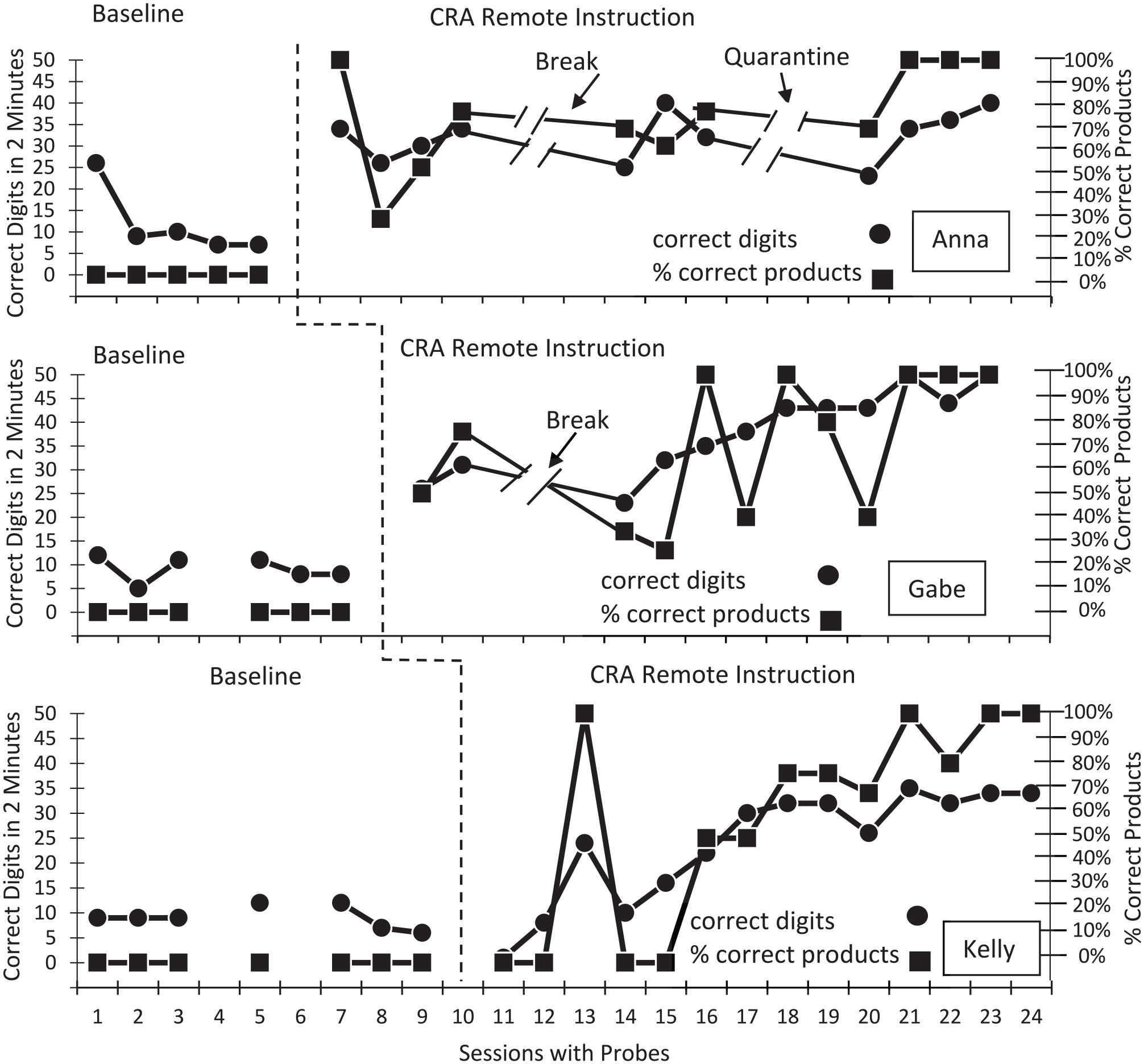
Results for Anna, Gabe, and Kelly.
Regarding descriptive data, Anna’s performance changed before and after the study (five correct of 24 to 18 correct of 24). Prior to the study, Anna decomposed three of the four 3-digit numbers (e.g., 432 = 430 + 2). The incorrect item was incomplete (854 = 840 + 10). After the study, Anna decomposed all numbers in the same way as before without an error. Before the study, all items that required identification of the value of an underlined digit were incorrect (e.g.,
Gabe’s Results
Gabe’s baseline level was nine correct digits and 0% accurate products. The range for correct digits was five to 12. None of the baseline probes had a correct product, so there was no range. There was an immediate change from the last baseline data point to the first intervention data point with 26 correct digits and 50% accuracy of final products. The intervention levels were 38 correct digits and 71% accurate final products. The range for correct digits was 23 to 50. The range for percentage of correct final products was 25% to 100%. There were no overlapping data points for correct digits as well as percentage of accurate final products. The PND for both was 100%.
Regarding descriptive data, Gabe’s scores improved from zero correct to 19 correct of 24 items. Before the study, Gabe decomposed numbers using their numerals (e.g., 432 = 43 + 2). After the study, Gabe decomposed all the numbers using two addends (e.g., 324 = 300 + 24). Before the study, all items that required identification of the value of an underlined digit were incorrect, naming the numeral of each underlined numeral (e.g.,
Kelly’s Results
Kelly’s baseline level was nine correct digits and 0% accurate products. The range for correct digits was six to 12. No baseline probes had a correct product, so there was no range. There was not an immediate change from the last baseline data point to the first intervention data point for either dependent variable. The intervention levels were 24 correct digits and 57% accurate products. The range for correct digits was one to 35. The range for percentage of correct final products was 0% to 100%. The PND for correct digits was 79% and 69% for accurate final products.
Regarding the descriptive data, Kelly had one item correct before the study and 21 of 24 correct after the study. Before the study, she wrote the words associated with given numerals. She wrote the name of the underlined digit in a three-digit number rather than stating its value. She did not attempt the items that asked for drawings and stated that she could not do that. All these items were correct after the study. Before the study, Kelly stated that she could not complete the items related to estimation of multipliers to find a reasonable estimated product. After the study, she completed two of the four multiple-choice items correctly and three of four open-ended items correctly. Before the study, Kelly stated that she could not complete the items related to the commutative property. On the posttest, she completed all items correctly.
Magnitude of Change
Using the baseline-corrected Tau calculator (Tarlow, 2016), the researchers entered all data to test baseline trend and found no trends. Therefore, they calculated Tau (no baseline correction) for each student. The effect for Kelly’s correct digits was moderate (Tau = 0.66, p = .002 [SETau = 0.258]) and the effect for percentage of correct products was also moderate, but higher (Tau = 0.73, p = .002 [SETau = 0.240]). Gabe’s data showed a high moderate effect for correct digits (Tau = 0.70, p = .001 [SETau = 0.238]) as well as the percentage of accurate final products (Tau = 0.75, p = .001 [SETau = 0.219]). The effect for Kelly’s correct digits was barely moderate (Tau = 0.50, p = .010 [SETau = 0.268]) and moderate for percentage correct (Tau = 0.63, p = .003 [SETau = 0.246]).
Social Validity Results
A research question was related to social validity. All students viewed instruction as helpful. Anna and Gabe said that they liked using blocks and drawings. Students perceived materials as equally helpful. Anna and Gabe thought materials were easy to use, but Kelly said that using base ten blocks took too much time, an accurate point of criticism. The students liked the use of Zoom and reported that having the researcher in their classroom would have been better. Gabe was the most enthusiastic in his recommendation for other students. He said that multiplying two 2-digit numbers was terribly confusing to him before the intervention and he could never remember what to do and when. He said that the blocks and the pictures helped him make sense of the numbers and the process. Anna and Kelly also said that they would recommend the intervention to others. No one said the intervention should change.
Discussion
There were multiple purposes of this study, addressing questions regarding (a) effects of remote-modified CRA multiplication instruction on students with LDs’ fluency and accuracy in multiplication of two 2-digit numbers using the standard algorithm; (b) change in concrete instruction as compared with traditional CRA; (c) effect on students’ understanding of place value and its application collected using descriptive data; and (d) extent that students perceived remote-modified CRA multiplication instruction as helpful and easy to use. Pandemic context influenced the study’s design. However, it is necessary to discuss the results and their implications as future conditions or intervention contexts may necessitate the use of remote instruction.
Effect of Modified CRA on Fluency and Accuracy
Visual analysis of the data demonstrated a functional relation between modified CRA multiplication instruction and students’ fluency (correct digits) and accuracy (percentage of accurate final products). After systematic introduction of the intervention, three students, at three different points in time, showed changes in level and range of their correct digits. The PND, a simple measure of the magnitude of change, was strong for Gabe and moderate for Anna and Kelly. The researchers’ calculation of Tau indicated a moderate magnitude of change.
Two students’ accuracy changed immediately; Kelly’s accuracy did not consistently change until representational lessons. The students’ variable data paths for accuracy explain the moderate effect sizes, meaning that accuracy and fluency developed incrementally from concrete through representational and abstract instruction. Students reached mastery with consecutive data points at or above 30 correct digits and accurate products. There was a school-related 2-week interruption for Anna and Gabe after which 1 to 2 data points decreased. Anna was absent for another 2-week period for quarantine, after which the following data point decreased slightly. These interruptions may have extended the number of data points to reach criteria for mastery.
The pattern of change in performance is consistent with previous CRA research (Flores, Hinton, & Schweck, 2014; Flores & Hinton, 2019) and may be attributed to the nature of instruction as well as the dependent measure. The aims of instruction include conceptual understanding. Concrete and representational phases emphasize understanding (Bouck et al., 2018), but the dependent measure completed prior to each lesson was abstract, providing no visual supports. It is logical that performance on this measure would not immediately change. When evaluating CRA as an evidence-based practice, it is important to discuss magnitude of change and practical outcome. The practical outcome was fluency. An intervention composed of repeated practice of procedures may have been more efficient in producing fluency, but not fluency as defined by Kling and Bay-Williams (2014) as knowing how, why, and when to use an algorithm.
Comparing Modified CRA to Traditional CRA Research
The results were consistent with those of researchers who used CRA in face-to-face settings with students with LDs (Flores, Hinton, & Schweck, 2014; Flores et al., 2019) and with students who participated in Tier 3 of MTSS (Flores, Hinton, & Strozier, 2014; Flores & Hinton, 2019). Across all studies, students reached fluency (writing 30 correct digits in 2 min as well as writing accurate products). This is promising evidence and consistent with results regarding virtual manipulatives (Park et al., 2021), another method in which students do not access three-dimensional objects. Direct comparison of traditional and modified CRA instruction is needed to understand the role of hands-on concrete instruction for mastery.
Students’ Application Based on Descriptive Data
Given that the dependent measure could not provide evidence of students’ application of conceptual understanding, the third research question asked whether instruction may change students’ understanding of foundational concepts related to multiplication. Previous research defined conceptual understanding as the ability to articulate the computation process in an interview (Flores et al., 2019) and completion of word problems (Flores & Hinton, 2019). The current students completed a researcher-designed curriculum-based assessment before and after the study, showing improvement. Modified CRA instruction provided visual representation and physical representation with drawings to show action within the computation process. The researchers theorized that the discussion and action associated with multiplying the parts of multipliers as well as the discussion and representation of final products would increase student’s conceptual understanding. All students demonstrated progress in these areas. The area with the least progress was the use of estimation to find a reasonable product. This process was part of each lesson item. The results show that this was not explicit enough and likely failed to teach how and why one would round multipliers. Perhaps demonstration of estimation using blocks and/or number line could be added. Another area of expected student growth was the commutative property. All concrete and representational lessons included discussion of the option using multipliers in two different ways according to this property. This was insufficient for Anna who showed no change. Perhaps going one step further and showing the two equation options using numbers and symbols (4 × 3 or 3 × 4) would have addressed this disconnect.
Students’ language and thinking
The students’ errors within the descriptive data collected prior to the study were consistent with their approach to multidigit multiplication. Their lack of understanding of numbers and place value manifested in their use of mathematical language. Each student referred to numeral names rather than value, consistent with Flores et al. (2019). When multiplying 24 × 35, each student said, 4 times five (correct), 2 times five (instead of 20 times five), 4 times three (instead of 4 times 30), and 2 times three (instead of 20 times 30). In the first lesson, during guided practice, each student asked the researcher to use ones blocks rather than tens blocks. Therefore, modeling and guiding the use of mathematical language was an important component of instruction. Students named the value of the numbers each time that they completed a step in the algorithm from concrete to abstract instruction. Viewing physical representations with base ten blocks and drawing them supported verbal descriptions. This may account for the consistent change across students related to place value in the descriptive data collected after the study. Although not related to descriptive data collection, each student had learned the term, carrying, to describe regrouping. Each time there was an exchange of ones to tens or tens to hundreds, the researcher explained that the processes was called regrouping and each time a student used the term carrying, the researcher provided feedback using the model, lead, and test format. Students’ mathematical language changed over the course of instruction.
A benefit to modified CRA was insight into students’ thinking process and opportunity for immediate feedback. Flores and Hinton (2019) tapped into students’ thinking through interviews while completing an equation before and after the study. In the current study, each remote concrete lesson provided this information. This required the students to verbally articulate the necessary actions with the blocks. Any error led to researcher intervention. During independent practice, any error necessitated repeating the lesson. For example, when multiplying two and 30, Kelly told the researcher to make two groups of three ones. The researcher gathered blocks but stopped Kelly and pointed out the disconnect between the written numeral (3 in the tens place or 30) and the blocks requested. The researcher showed the difference between 3 ones blocks and three 10s blocks or 30 ones blocks as well as the tens place of the mat. Modified CRA allowed for this immediate feedback opportunity with insight into the students’ thought process.
Perceptions of Remote Instruction
The last research question addressed social validity. All the students perceived modified CRA instruction as helpful and would recommend it to others. It important to note Anna’s, Gabe’s, and Kelly’s short time spent remote as well as access to their peers and in-person school activities. This is contrary to the remote experiences earlier in the pandemic that had detrimental effect on students’ emotional well-being (Vaillancourt et al., 2022). Modified remote instruction was interactive, another component researchers described as effective for remote learning (Coy et al., 2014). A benefit of modified CRA is the ability to reach students and use human resources efficiently. For example, a mathematics specialist or special education teacher could work with students across schools for targeted interventions focused on specific skills. With focused and interactive interventions, perhaps similar remote instruction may be beneficial.
Limitations and Future Research
A researcher implemented the intervention rather than a teacher in a natural setting, contributing to the research to practice gap. This limitation is related to technology as well. The researcher had two document cameras that showed both the blocks and the learning sheet. Researchers provided the document camera that the student used with a district-issued Chrome Book. Researchers easily acquired items online, but they are not standard items in a classroom. Future research may use virtual manipulatives and electronic learning sheets and probes to eliminate the need for extra technology devices and extend the line of research.
The study is limited because the design cannot show a functional relation between the intervention and students’ understanding. Future research should include this as a measure that researchers systematically administer across phases to draw definitive conclusions. Another design limitation is the inclusion of only three students, the minimum number to show a functional relation. Future research can address this with more participants to enhance conclusions when compiling multiple single-case studies for purposes of generalization.
Conclusion
Given that the results of this study are like those shown with in-person instruction (Flores, Hinton, & Schweck, 2014; Flores et al., 2019; Flores & Hinton, 2019), one might conclude that modified CRA was successful and further investigation may be warranted. The methods may also be useful for other educators who need to provide brief interventions but cannot meet face-to-face. This is exemplified by the increased need for student intervention due to COVID-19 disruptions (Renaissance Learning, 2021). Interventionists at different schools could collaborate and provide instruction on different targeted concepts with students at their home school and remotely to students at another school, using limited resources efficiently. Conclusions related to changes in students’ conceptual understanding are promising. However, more research and perhaps more rigorous designs should be employed to investigate.
Footnotes
Declaration of Conflicting Interests
The author(s) declared no potential conflicts of interest with respect to the research, authorship, and/or publication of this article.
Funding
The author(s) received no financial support for the research, authorship, and/or publication of this article.
