




Abstract
This qualitative study explored perspectives of college students with learning disabilities (LD) regarding their self-determination and parental influences on student self-determination during students’ transition from high school to postsecondary education. Data were collected from in-depth interviews with 12 college students with LD. Qualitative analyses were conducted to examine students’ participation in secondary transition, self-determination behaviors, and parental influences on students’ self-determination. The findings identified five important self-determination behaviors (i.e., postsecondary education goal setting and attainment, self-advocacy, being autonomous, self-awareness, and decision-making) students demonstrated in secondary transition. Four themes pertain to parental influences on student self-determination, including encouraging students to be advocates, fostering students’ academic competency, showing moral support and high expectations, and providing opportunities for students to make decisions. Recommendations for engaging parents to promote student self-determination are provided.
Keywords
Students with disabilities were 19% of the undergraduate student population in postsecondary education during the 2015–2016 academic year (National Center for Education Statistics, 2019). Among those with disabilities, 67% were categorized as having a learning disability (LD; Newman et al., 2011). Students with LD have lower educational attainment than their peers without disabilities and are often underprepared for the demands of postsecondary education (Wagner et al., 2005). For example, approximately 41% of youth with LD graduated from postsecondary education compared with 52% of their peer counterparts (Cortiella & Horowitz, 2014). To enhance postsecondary education enrollment for students with disabilities, researchers have identified a number of predictors (e.g., student self-determination and parent involvement) associated with positive postschool outcomes for youth with disabilities (Mazzotti et al., 2015, 2021; Test et al., 2009).
Promoting self-determination among students with LD is an evidence-based practice in secondary transition, which contributes to college and career readiness for students with disabilities (Mazzotti et al., 2015, 2021; Test et al., 2009). Being self-determined is defined as “volitional actions that enable one to act as the primary causal agent in one’s life and to maintain or improve one’s quality of life” (Wehmeyer, 2005, p. 117). Self-determination skills include choice making, decision-making, problem-solving, goal setting and attainment, planning, self-monitoring, self-instruction, self-advocacy, an internal locus of control, self-efficacy, self-awareness, and self-knowledge (Wehmeyer, 1996; Wehmeyer et al., 2017).
There are four essential characteristics of self-determination, which are autonomy, self-regulation, self-realization, and psychological empowerment (Wehmeyer, 1996). Autonomy refers to acting according to one’s preferences, interests, and abilities. Self-regulation means an individual can make decisions about what skills are needed to complete a task and enact and evaluate an action plan to complete the task. Self-realization is defined as understanding personal strengths and needs. Psychological empowerment is believing one’s actions are related to outcomes (Wehmeyer et al., 2003).
Previous literature showed that self-determination can be taught to students to improve their secondary transition outcomes and postsecondary education success (Ju et al., 2017). For example, Finn et al. (2008) taught college students with the Self-Determined Learning Model for Instruction (Lee et al., 2015; Shogren et al., 2018) to improve their goal setting and attainment, choice-making, planning, self-regulated learning, and self-monitoring. Self-Advocacy and Conflict Resolution training (Rumrill et al., 1999) was another self-determination curriculum to promote students’ knowledge of disability and legal rights to educational services as well as teach students to request academic accommodation and support (Holzberg et al., 2018; Walker & Test, 2011). Moreover, coaching as a strengths-based approach was used to teach self-determination and learning strategies for college students with LD and attention-deficit/hyperactivity disorder (ADHD) in postsecondary education settings (Farmer et al., 2015; Parker & Boutelle, 2009; Richman et al., 2014; Zwart & Kallemeyn, 2001).
Teaching self-determination skills has been linked to enhanced postsecondary education outcomes (Berry et al., 2012; Petcu et al., 2017; Shogren et al., 2017). Studies found that students with higher levels of autonomy and psychological empowerment were more likely to enroll in 2-year and 4-year institutions (Berry et al., 2012), self-realization predicted students’ postsecondary education completion (Petcu et al., 2017), and overall self-determination continued to affect educational experiences as students are completing their postsecondary education (Ju et al., 2017). Therefore, students with disabilities, who are equipped with self-determination skills in their secondary transition process, were more likely to achieve their postsecondary education goals. They were able to identify their strengths, interests, and preferences; set goals; make decisions about further education and employment; and self-advocate for services and accommodations.
Barriers in developing self-determination skills for students with LD were also identified. Trainor (2005) found that students with LD suggested that parents and schools should put forth more effort to create opportunities for them to develop their self-determination, which in turn could improve their postschool success. Trainor (2007) interviewed adolescent girls with LD who disclosed that they were not provided enough opportunities to practice their self-determination in their transition process. Students shared that they lacked the freedom to make their own choices, had limited resources or information to achieve their goals, and received low support and expectations from adults who were involved in their transition planning. These studies further suggested that parents and schools are key stakeholders who can create opportunities for youth to develop their self-determination skills and provide resources for youth to achieve their postsecondary goals.
Indeed, parent involvement has been identified as one of the evidence-based predictors for secondary transition. Based on Bronfenbrenner’s (1979) ecological theory, schools and parents play an important role in students’ schooling experiences and learning outcomes. In particular, parental influences on self-determination have been examined in previous research. Previous studies investigated the impacts of student, family, and school experiences of youth with disabilities on their self-determination and postschool outcomes (Shogren & Garnier-Villarreal, 2015; Shogren et al., 2016). The family experiences consisted of parent involvement in general school activities, student’s performance of chores at home, parent involvement in special education planning, and parental expectations. Moreover, Zhang et al. (2010) explored parents’ perceptions on their children’s self-determination and how parents fostered their children’s self-determination. Parents reported that they talked to the students about strengths and weaknesses, promoted self-efficacy, as well as taught independent living, goal-setting, problem-solving, and decision-making skills to students in the transition process (Zhang et al., 2010).
In addition, researchers have documented the relationships among student self-determination, parent involvement, and students’ transition to postsecondary education from the perspectives of educators and parents (Fullarton & Duquette, 2015; Morningstar et al., 2010; Zhang et al., 2002, 2010). Students whose families were involved more often in transition planning when they were in secondary schools demonstrated higher self-advocacy in postsecondary education (Morningstar et al., 2010). Fullarton and Duquette (2015) interviewed five families of students with LD to understand the roles of parents, students, and teachers during the transition process from high school. They found that parents’ high expectations and advocacy, student self-determination and self-advocacy, students’ hard work, and teachers support can promote students to achieve their postsecondary goals. They also found self-determination was linked to enrollment in postsecondary education for students with LD.
Despite research focused on examining influences of self-determination and parent involvement on postschool outcomes for youth with disabilities in general, few studies have exclusively discussed the impacts of these two factors on postsecondary education enrollment for students with LD. Little research has been done where researchers interviewed college students with LD who could provide firsthand perspectives and experiences regarding their self-determination and parental influences on self-determination during their transition from secondary to postsecondary education. Previous qualitative research was conducted among adults (e.g., parents and teachers) and high school students to discuss their perceptions regarding student self-determination in their secondary transition (Fullarton & Duquette, 2015; Trainor, 2005, 2007; Zhang et al., 2010). Moreover, there are no studies exploring how parents support self-determination of students with LD in students’ transition from secondary to postsecondary education. Therefore, it is necessary to hear the voices of students with LD who attend postsecondary education programs to make recommendations for parents, special educators, and researchers to promote postsecondary education enrollment and self-determination for students with LD. Eliciting insights from college students with LD can lead to identification of important characteristics of student self-determination and parental influences that promote successful transition to postsecondary education. The purpose of this study is to explore perspectives of college students with LD regarding their self-determination and parental influences on self-determination during the transition from secondary to postsecondary education. We aim to answer the following research questions:
Method
The researchers used the grounded theory method to develop an in-depth understanding of the perspectives and experiences of students with LD during their transition from high school to postsecondary education (Charmaz, 2006; Corbin & Strauss, 2014). This method is appropriate for this study because it can generate understanding of how students demonstrate their self-determination and how parents promote student self-determination in the secondary transition process. Furthermore, it allows the researchers to construct a comprehensive, detailed, and holistic picture of student participation and parent involvement in transition planning (Denzin & Lincoln, 2000).
Participants
The researchers purposefully selected participants who were students with LD and experienced the secondary transition process in high school, succeeded to enroll in postsecondary education programs, and received disability services (Patton, 2002). The participants were students who were diagnosed as LD while in the grades of K–12 and registered with their Disability Services Office (DSO) in their universities. Twelve participants were recruited from two large public universities in the Midwest in the United States. Participants included nine female students and three male students from first-year to postbaccalaureate programs.
After obtaining approval from the institutional review board, the first author sent out recruitment information through her professional network at two local universities. Then, the recruitment advertisement was sent through student listservs by several Academic Affairs and Student Affairs offices, such as Academic Advising Office and DSO. Students who showed interest in participating in the study contacted the first author. Twelve participants who met the inclusion criteria of the study were identified. Table 1 presents a brief demographic information of each participant.
Demographic Information for Participants in Study on Self-Determination in Transition to Postsecondary Education.
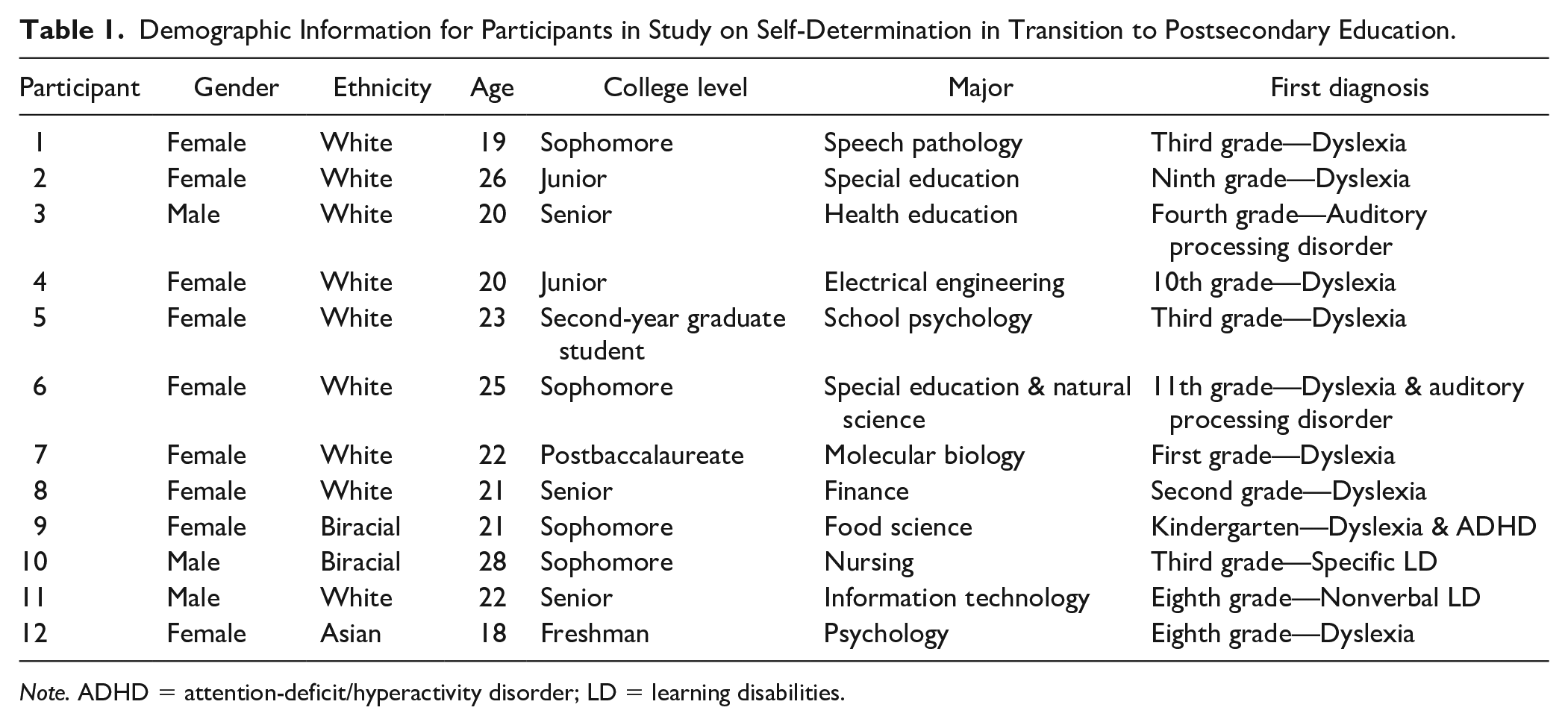
Note. ADHD = attention-deficit/hyperactivity disorder; LD = learning disabilities.
Data Sources
Individual semi-structured interviews were conducted to allow for the discovery of new ideas and themes with each participant. The interview protocol was developed by the research team based on current literature on self-determination, student participation in transition planning, and parent involvement in secondary transition. An external expert, who is a special education professor in the secondary transition research, reviewed all the interview questions and provided constructive feedback to modify the interview protocol. Interview questions were open-ended questions that elicited students’ perspectives about their parent support and personal self-determination on their pathway to postsecondary education. Questions such as “How did you participate in your transition planning?” “What opportunities did you have to make decisions by yourself at home and at school?” and “What did your parents do to influence your self-determination during your high school?” were asked to help students recall their experiences in the transition process and identify how parent involvement supported student self-determination. Participants also shared their opinions on improving the self-determination and transition experiences for students with LD. The first author, who had training and prior experience on qualitative interview research, conducted all the interviews, with each interview lasting approximate 35 to 60 min. All of the interviews were audio recorded with the permission of the participants and transcribed verbatim for the data analysis.
Data Analysis
The coding procedures were implemented based on grounded theory data analysis (Corbin & Strauss, 2014). First, the transcribed interviews were read line-by-line and the researchers conducted open coding. The research team labeled text segments based on key information of the text. The open codes related to practices and actions in secondary transition, such as self-determination behaviors and skills, school programs and services, students’ transition experiences, parent involvement at home and school, parent support, and student-centered transition planning. Second, open codes were connected and combined into groups, which were labeled as axial codes. For example, the research team brought together multiple open codes, such as planning and selecting high school courses, demonstrating career aspirations and interest in postsecondary education, into one group. This group was identified as an axial code related to postsecondary education goals setting and attainment. Third, selective coding was conducted to integrate axial codes into themes to answer the research questions. For example, multiple axial codes (e.g., goal setting and attainment, self-advocacy, being autonomous, self-awareness, and decision-making skills) were common among participants and repeatedly found through all the interviews, which were integrated together to form the main themes around how students demonstrated their self-determination in secondary transition.
Trustworthiness and Credibility
To promote trustworthiness and credibility, a series of procedures was implemented. Member checking was conducted to verify interview transcripts and interpretations of findings with participants (Creswell, 2012). Transcripts were sent to the participants to confirm the accuracy of the account and solicit further clarification as needed. Furthermore, intercoder agreement was conducted by the first two authors (Creswell, 2012). We randomly selected 30% of the data on which to conduct open coding independently and then compare coded data. When 90% of intercoder agreement was reached, the first author independently coded the rest of interviews. The first two authors had debriefing meetings throughout the entire process to discuss issues and come to consensus regarding the core and component concepts and how they were related.
Findings
Analysis of qualitative data revealed five common self-determination skills students demonstrated in their secondary transition, including postsecondary education goal setting and attainment, self-advocacy, being autonomous, self-awareness, and decision-making. Furthermore, four major themes were identified when participants discussed how their parents affected their self-determination. Participants reported that their parents had a positive influence on their self-determination by encouraging them to advocate for themselves, fostering their academic competency, showing moral support and high expectations, and providing opportunities for them to make decisions.
Student Self-Determination in Transition to Postsecondary Education
Participants described their secondary transition experience and elaborated on how they participated in their transition planning. All the participants stated that they had not received any specific curriculum on self-determination during their secondary education. However, they could articulate what activities and events they were involved in that were related to secondary transition planning, such as attending Individualized Education Program (IEP) meetings, setting postsecondary education goals, and planning courses with school counselors or academic advisors. Through reflecting on their participation of secondary transition planning and successful transition from secondary to postsecondary education, students were able to identify behaviors and skills that had positively influenced their transition from secondary to postsecondary education. There were five key self-determination skills in secondary transition that students with LD believed were essential for gaining a successful transition from high school to postsecondary education. These self-determination skills were postsecondary education goal setting and attainment, self-advocacy, being autonomous, self-awareness, and decision-making.
Postsecondary education goal setting and attainment
All participants claimed that they identified goals of attending colleges during high school. Participants described how they made decisions for applying to universities and what they did to attend postsecondary education programs. Most of participants commented that pursuing postsecondary education was their first choice when they discussed their postsecondary goals in their IEP meetings or course planning with their school counselors or academic advisors.
In addition, participants discussed several personal and parental factors affecting their decision on pursuing postsecondary education, which were (a) family educational backgrounds and expectations (e.g., parents or siblings went to college), (b) students’ personal interests in specific subjects or career paths, (c) having job shadowing or volunteering experiences leading to awareness of importance of college degree in those jobs, and (d) attending college tours. One student in the STEM (science, technology, engineering, and math) major said, I love science. I have always been really interested in it. I knew I always wanted to go to college and that was like my goal in my life. To do anything in the science field, you kind of have to have a degree.
Similarly, a student majoring in psychology recalled that she was passionate about helping people, especially children, and wanted to be psychologist. She shared that I know one of the ways to get there is through college. I know I will have to go and get a medical degree. But it is okay, because I am willing to put in the work for it. I wanted to go into clinical psychology by the time I was in eighth grade.
Another student described her process of setting postsecondary education goals, where she engaged her parents and teachers in a lot of conversations. She reported that she discussed with her parents what major she wanted to study. Then, they set a goal based on the major she wanted to be in the future. Meanwhile, she met with her academic adviser in high school to set goals and select the right courses for being an engineering major in the future. This student also stated that she set a lot of small goals along the way to achieve her postsecondary education goal.
In addition, planning is an important step for students to achieve goals. For example, one student commented that “When I plan something, it gets done in that particular time. So, there is no procrastination.” The majority of participants reported that they were involved in several school- and home-based activities with their teachers and parents to make educational plans, such as selecting courses and completing college applications. One participant stated, When we were trying to figure out the different courses, I took courses enabling me to get into the college. My academic advisor helped me figure out a plan for each class. If I knew a certain class was going to be harder for me, I would set aside more time to be able to take that class.
Another student who had similar experience of aligning her high school course with her postsecondary education goals said, It was by my junior year that I decided I wanted to do something in engineering. I started gearing myself towards more of the engineering classes. I took the pre-engineering class and I took Physics, Calculus, and all other courses that I would have needed. This made my first semester at here [current university] a little easier.
Self-advocacy
Self-advocacy was a key theme that emerged from asking participants what skills are important in the transition from secondary to postsecondary education. Participants described how they advocated for themselves and what they advocated for. Several common examples of self-advocacy across participants were speaking up in the school meetings, communicating with teachers, requesting testing accommodations for the SAT or ACT, seeking extra help for coursework, and requesting to take advanced courses (e.g., AP courses and honors courses). Several participants, who were diagnosed as having LD in high school, shared that right after their diagnoses, they had to communicate with their classroom teachers and inform their teachers to be aware of their disabilities. One student said, A lot of them [teachers] did not receive an email at first, saying that you have a student in your class that has an IEP, so I had to go up myself and talk to them and say I have an IEP; I just want to let you know and these are the things [accommodations and support] that come along with it.
All the participants stated that they had experiences of speaking up for themselves, especially discussing what they wanted to do in the future, what supports were helpful, and what courses they wanted to take in the meetings with their IEP teams or school counselors. One student reported that there were some AP courses their school did not offer and if students wanted to take those courses, they had to go to different schools for those courses. This student said, “I advocated myself to take AP chemistry. That was my motivation, my self-determination to get into that class. And I eventually did go into that class.”
Self-awareness
In the interviews, the participants felt comfortable to talk about their disabilities and understood the limitations and obstacles their disabilities brought to them. They all acknowledged their disabilities and never tried to hide it from others. All the participants shared that they were able to demonstrate an understanding of their own strengths and weaknesses, and what support and accommodations worked for them and what did not. For instance, one student stated that he knew what he was good at and not good at in school, which helped him to choose courses and ensure him to have a good grade point average (GPA) to apply for college. Another participant shared that she knew what support and accommodations she was supposed to receive. Moreover, participants commented that they understood how their disabilities affected their learning and were aware of their own strengths and abilities to be successful. One student reported that “I am a slow reader and I have disability. It does not mean I cannot be in a more advanced class.” Another student echoed similar comments, saying she struggled with organization and time management. Also, it took her a longer time to solve problems or process course materials than peers in her same age. But eventually, she was right on track with everyone.
Being autonomous
Participants also demonstrated autonomy, which reflected the students’ desire to take responsibility for learning and achieving goals. Participants considered personal responsibility as the effort and work they put forth by themselves on their pathway to postsecondary education. All the participants agreed that they believed they worked harder and put more effort than their peers without disabilities to achieve their goals. One student stated, “What you put forward and how much effort you put forward will lead to the success you want.” Being responsible for their own education and being accountable for the school-related tasks were discussed by participants. A number of participants echoed similar comments, sharing that “I take my own responsibility to be able to keep up with study plan,” “I am determined to finish school, complete homework and never skip classes,” and one student described how she took responsibility to reach out to teachers to get accommodations: When I was there [at school] it was my job to actually go around and hand forms to each teacher about my accommodations. It was all on me to go to the resource room, but they [my parents] would not hold my hand to do anything.
Several students also highlighted their efforts of applying to college. For example, they took ACT or SAT several times and they wrote college application statements and filled out the application forms by themselves.
Decision-making skills
All the participants had opportunities to make decisions in their secondary transition process. Some students shared that they had experiences in their IEP meetings where they talked about what support and accommodations worked for them and they were able to make decisions to choose what support they wanted to keep as well as what changes they wanted their schools to make. Moreover, participants mentioned that they made their own decisions or set their goals based on their interests and preferences. For example, several students stated that they knew what college majors they wanted to choose during high school because they knew the careers and jobs they would like to have in the future require a college degree. Some students also appreciated that their parents gave them suggestions and advice in the decision-making moment, but the decisions were ultimately made by themselves. One student shared that when he applied to universities, his parents had conversations with him about selecting universities, but ultimately his parents left the decision to him.
Parental Influences on Self-Determination
The participants also discussed how their parents were involved in their transition planning and areas in which parents had an influence on student self-determination. The major themes that emerged from the interviews were (a) parents were role models who encouraged students to be self-advocates; (b) parents fostered students’ academic competency; (c) parents showed moral support and high expectations; and (d) parents provided opportunities for students to make decisions.
Encouraging students to be advocates
Parents served as an important role model for students to learn self-advocacy. Based on the participants’ responses, the most frequent way for their parents to participate in their school activities was to attend school meetings (e.g., IEP meetings and parent–teacher conferences). Participants reported that their parents often “fought for” the best support and services to help them. In addition, the majority of students said that their parents encouraged them to speak up for themselves in those meetings and seek for help in the classrooms. A student remarked, They [my parents] would be in those meetings. They encouraged me to speak up for myself. They mostly would be there for moral support and making sure that my academic advisor understands what I wanted too. Before we went into those meetings, my parents would talk to me and make sure they knew what I wanted to do so that they could encourage me to speak up for myself.
Another student recalled how she was influenced by her parents to advocate for herself: My parents were a huge advocate for my education. It was more myself and the administrator and my parent were there to be kept in the loop, versus, my parent was saying my child needs this, my child needs that. She [my mom] really focused on making sure I knew what I needed and that I was able to advocate for myself. Because she knew when I went into college and later in life, she wouldn’t be able to be there to help me.
Fostering students’ academic competency
Parents also developed student self-determination by providing learning support at home to improve students’ academic competency. All the students claimed that their parents tutored their homework before. Students who had reading and spelling difficulties reported that their parents spent a lot of time practicing reading and spelling. For example, one student said, “I remember so many days that my mother would actually sit at the kitchen table with me and work on assignments. We have pretty good study patterns, like she helps me recall stuff. We always study for vocabulary tests.” Some parents also purchased assistive technology devices and programs to help students to acquire better learning skills. One student commented that her parents wanted her to have “hands-on” support she needed to be successful. Parents also used others’ help to improve their children’s learning at home, such as asking students’ elder siblings to tutor students on their homework before parents came back home from work and hiring private tutors for preparing for tests.
The participants also described constant communication at home as another positive home-based support. A number of students reported that their parents always asked about their school experiences, checked their grades, and asked them whether they needed any help at school. In addition, through communicating with parents at home, participants felt they had very supportive parents and that their parents always kept their focus on them and did not let them fall behind their peers. For instance, one student shared, They [my parents] were always on me, keep me studying, keep me working. They always asked how I did on test. They never let me lose focus or drop my grades or anything. If I was struggling in class, they would help me focus and spend more time on that subject.
Demonstrating moral support and high expectations
A lot of participants reflected that their parents set high expectations for them and always believed they could be successful, which strengthened their self-empowerment. Participants further shared that their parents set high expectations not only on their academic learning but also other extracurricular activities (e.g., sports and public speaking). In terms of academic learning, most of the students discussed that their parents believed they had the ability to pursue postsecondary education and supported their decision on applying to colleges. A student mentioned that her parents believed in her and never thought she would not be able to go to college. The student remarked, She [my mom] just pushed me a lot, I was quite a lazy person because I knew I had a LD and people will excuse you from that. My mom said she knows I can do this [go to college]. She was a lot of tough love. She pushed me every single time I wanted to give up.
Participants also stressed that their parents often provided moral support by giving them positive feedbacks and encouragement. Parents’ moral support reflected parents’ beliefs in students’ abilities to pursue their postsecondary goals and capabilities to complete related tasks to attend college. One participant described the high expectations from her parents challenging her to overcome obstacles on the pathway to postsecondary education. She remarked, They [my parents] were constantly pushing me, for example, I always remember having conversations with my father, where he would tell me I was capable of so much more and would continuously challenge me. Along with my mother, they continue to challenge me to push myself, like, because I’m capable of so much more. That’s the big example of how I think self-determination was applied to home was simply they pushed me to become a better version of myself.
Similar high parental expectations and beliefs were also found when students participated in school or extracurricular activities with their peers without disabilities. Parents expressed their encouragement and believed that their children could do as well as other students. For example, one participant said, My parents encouraged me to do whatever I wanted to do in life. I really wanted to do science. So, they always encouraged me and they allowed me to have a car, so that I could drive to go to a science fair at a different school. They encouraged like, outside activities, so I was a swimmer in high school and college as well. So, they encouraged me to do many things versus just one thing.
Providing opportunities for students to make decisions
Most students noted that their parents were supportive but “hands off” in terms of decision-making. They stressed the importance of their parents and their IEP team providing them with choices in their transition planning. A participant stated, As soon as I hit senior year, my mom was hands off and told me, “you are older, I want you to be a mature adult.” When I was looking at colleges, my mom said it is my choice where I want to go and what I want to do.
A similar experience was also demonstrated by another participant, who said, By the time I was in high school, they will let me decide what I would want to do and be there to help me when I needed it. But they would not make decisions for me. In the meetings, my parents’ attitude was that it was not their decision to make what I want, what my goals would be. They would say “what are your goals. Whatever you say, we support.
Participants also reported that their parents supported the decisions they made. For example, one student shared that she received a lot of support and encouragement from her parents no matter what things she was going to do, saying, “My mom always said I can do anything. She would always have my back no matter what. So, whatever I decided, she would support me.”
Discussion
We used an inductive inquiry approach to explore the perspectives of college students with LD regarding their self-determination and parental influences on self-determination during secondary transition. Although results of this qualitative study demonstrated insights of a small group of students, the findings of this study provided a better understanding of how goal setting and attainment, self-advocacy, autonomy, self-awareness, and decision-making were identified as important self-determination skills to support students with LD to achieve their postsecondary education goals. This study corroborated Bronfenbrenner’s (1979) ecological theory showing that parents serve as important allies in students’ lives to promote their academic competency and self-determination. These findings were extended by the participants’ description of parental influences on self-determination of students with LD during their transition to postsecondary education, which added a new perspective to secondary transition research.
Overall, all the participants had the experiences of being involved in their transition planning process and had opportunities to demonstrate self-determination skills. The participants identified (a) postsecondary education goal setting and attainment, (b) self-advocacy, (c) being autonomous, (d) self-awareness, and (e) decision-making skills as critical self-determination behaviors that supported them to achieve a successful transition from secondary to postsecondary education. This set of self-determination skills has also been identified as effective in the literature (Field et al., 2003; Fullarton & Duquette, 2015; Getzel & Thoma, 2008; Hicks-Coolick & Kurtz, 1997; Ju et al., 2017).
Although the participants stated that there were no instructional efforts on self-determination in their secondary education, they were encouraged to participate in their IEP meetings, transition planning, and communicate with IEP team members at schools, which are important efforts to promote self-determination and significant predictors of positive postschool outcomes (Mazzotti et al., 2015, 2021; Test et al., 2009). Students’ involvement in educational and transition planning enables them to be a causal agent and explore opportunities to develop their self-determination, including learning to set goals, make choices and decisions, and express their opinions in IEP meetings (Wehmeyer & Shogren, 2016). Furthermore, students’ proactive participation in their transition planning, concurrent with the influence of parent involvement, appears related to increased self-determination.
Meanwhile, several participants could not clearly frame the definitions related to transition services and self-determination or were not well informed regarding the terminology of the transition process. For example, students knew who attended their IEP meetings, but did not know these people were considered as their IEP team. Students claimed that they did surveys that helped them to identify their career interests, but they did not know that was a part of their transition assessments. These findings were reminiscent of Trainor’s (2005, 2007) interview studies, in which high school students with LD commented that they did not realize they participated in their IEP meeting until junior year or they did not know what transition planning is, but they actually had an IEP for a long time.
This study also added to a better understanding of the parental role in fostering student self-determination and decision to pursue postsecondary education. A recent literature review found that little research examined parental role in the development of self-determination for students with intellectual and developmental disabilities (Dean et al., 2021). Our findings showed how parents can support student self-determination in home and school contexts. Participants considered parents as moral supporters and advocates for them. Parents advocated for students in transition planning process and encouraged students to demonstrate their opinions and needs regarding their postsecondary goals. Moreover, with parents’ strong moral support and belief in students, students had opportunities to make decisions and choices when discussing their interests, career and college major preferences, and career and education goals.
The findings of this study further confirmed previous research that identifying parent involvement in secondary transition was linked to positive development of student self-determination and achievement of postsecondary education goals (Fullarton & Duquette, 2015; Zhang et al., 2010). We found that, among parents who had fostered self-determination, many of them had many positive conversations with their children, supported learning at home, held high expectations, encouraged their children to challenge themselves, motivated them to set and achieve goals, empowered them to be self-advocates, and provided opportunities for their children to practice goal-setting, problem-solving, self-efficacy, and decision-making skills.
Limitations
Several limitations should be considered when interpreting the results of this study. First, the perspectives of 12 college students with LD cannot be generalized to the larger populations of postsecondary students with LD. However, these perspectives provided valuable insights into the experiences of students with LD who were students in 4-year universities and had made a successful transition from high school to postsecondary education. Second, the results of this study were limited to the perspectives of the participants and qualitative data were self-reported. The research team did not review participants’ disability-related documentation, such as their high school IEPs and college accommodation plans. The experiences related to secondary transition planning and services were described by participants, whereas their parents or special education teachers might have had different opinions regarding student self-determination and participation in their secondary transition planning. Moreover, all participants were enrolled in large 4-year research universities and may have had higher levels of self-determination and parent involvement than students who were not in similar postsecondary education institutions (e.g., community colleges or vocational-technical schools).
Implications for Research
Despite its limitations, this study provided preliminary evidence for the field to understand the secondary transition experience, self-determination knowledge, and parent involvement of students with LD in their transition from secondary to postsecondary education. More investigation is needed to further research this topic. First, more in-depth data with more students, especially those who are from culturally and linguistically diverse backgrounds, need to be collected and analyzed. The majority of participants in this study were White and females. Thus, interviews with more diverse groups of students would be helpful to gather richer information to understand student self-determination and parental influences in their transition planning process. Second, because of the importance of parent involvement in transition process, data from parents’ perspectives also should be collected and investigated. Therefore, future researchers could invite parents of students with LD to be interviewed or to participate in focus groups to discuss their understanding of self-determination and how they fostered their children’s self-determination. Third, a number of participants reported that their mothers put forth more effort in their school and home activities than their fathers. Future research could examine the different roles of parents in developing youths’ self-determination in the transition process and what strategies and opportunities are needed to promote youths’ self-determination. Fourth, large-scale studies with larger samples are needed, which would allow for the generalizability of the findings. By using survey design, future researchers can provide compelling results for policy development and design of interventions to increase parent involvement in secondary transition and student self-determination. Last, there is a demand for learning disability researchers to examine self-determination interventions for students with dyslexia considering they are the largest subgroup of students with LD (Richardson, 2021). The majority of participants in this study had dyslexia, but in-depth inquiry on students with dyslexia was not focus of this study. Therefore, future research is needed to determine whether general self-determination and parent involvement practices can be effective in providing equal opportunities for students with dyslexia to gain postsecondary education success.
Implications for Practice
The findings of this interview study suggested that parents have a direct influence on students’ self-determination. From the perspectives of the participants, we found that parents, who were strong advocates and firm believers of their children, created more opportunities for students to make decisions and act as their primary causal agents in secondary transition. Thus, students with LD who received appropriate encouragement and scaffolding from their parents are likely to have the opportunity to develop their self-determination that would positively affect their academic achievement and better prepare them for challenges in their postsecondary education. The findings of this student suggest that parents should be actively engaged in various school- and home-based activities identified by the National Longitudinal Transition Study-2 (Shogren et al., 2015, 2016). For example, many parents should consider having frequent conversations with children regarding their school life at home, participating and volunteering at school events, and tutoring their children on their homework.
There are also implications for secondary schools and postsecondary education institutions. Schools should create school and parent partnerships facilitating parent involvement in the transition process as well as working to improve parents’ knowledge of how to support students to access postsecondary education and develop self-determination. High schools and postsecondary education institutions could utilize curricula, such as Self-Advocacy and Conflict Resolution training (Rumrill et al., 1999), to teach students legal rights under the IDEA and improve students’ knowledge and skills of requesting transition services and academic accommodation. Another curriculum is the Self-Determined Learning Model of Instruction (Lee et al., 2015; Shogren et al., 2018), which could be adapted to seminars or workshops to support freshmen or transfer students with disabilities to promote their goal attainment and self-directed learning (Finn et al., 2008). Finally, postsecondary education institutions could provide coaching programs that focus on self-determination skills (e.g., goal setting and attainment, planning, and decision-making; Richman et al., 2014), personal strengths (Farmer et al., 2015), executive function (Parker & Boutelle, 2009), and learning strategies (Zwart & Kallemeyn, 2001) to support college students with LD to improve their first-year experiences and postsecondary education success.
Conclusion
The aim of this study was to explore perspectives and experiences of students with LD regarding self-determination and how their self-determination was influenced by their parents when the students transitioned from high school to postsecondary education. Findings from the interviews documented how students demonstrated self-determination behaviors in their secondary transition process and how parent involvement at home and school activities impacted students’ self-determination, which led students to achieve their postsecondary education goals. This study highlights that parents can foster students’ self-determination during secondary transition and the importance of self-determination in contributing to positive postschool outcomes for students with LD. More research is still needed to develop interventions engaging parents to promote student self-determination (Dean et al., 2021) and interventions (e.g., Self-Advocacy and Conflict Resolution training, the Self-Determined Learning Model of Instruction) promoting student self-determination in postsecondary education (Finn et al., 2008; Holzberg et al., 2018; Walker & Test, 2011).
Footnotes
Declaration of Conflicting Interests
The author(s) declared no potential conflicts of interest with respect to the research, authorship, and/or publication of this article.
Funding
This study was conducted by the first author when she was in doctoral program at University of Cincinnati. The study was funded by the Graduate Student and Faculty Research Mentoring Grant from the College of Education, Criminal Justice, and Human Services at University of Cincinnati.