



Abstract
More and more American older adults are relocating to retirement communities, and they experience challenges in adjusting to new surroundings that may increase their depression and mortality. An instrument not previously tested in the United States, the Index of Relocation Adjustment (IRA), may help in early identification of poor relocation adjustment. This study examined the psychometric properties of the IRA using secondary data from a convenience sample of 104 older adults who relocated to 6 retirement communities in Northeast Ohio. Cronbach’s alpha was .86. The IRA was correlated with measures of positive cognitions (r = .48, p < .01) and relocation controllability (r = –.62, p < .01), suggesting construct validity. Results indicated a single factor reflecting relocation adjustment with loadings for all items ranging from .62 to .83. The IRA is potentially useful as a screening measure for early detection of poor adjustment among relocated older adults.
Introduction
The population of older adults in the United States is increasing exponentially and is expected to reach 71 million by 2030 (Centers for Disease Control & Prevention [CDC], 2003). As people age, their chronic illnesses increase (Rice & Fineman, 2004) and these in turn interfere with daily activities and decrease their functioning and independence (Bekhet, Zauszniewski, & Wykle, 2008; Merck Institute of Aging & Health [MIAH], Centers for Disease Control and Prevention [CDC], & Gerontological Society of America [GSA], 2004). As a result, the number of older adults living in retirement communities is increasing; that figure is now approximately 1 million (Chao, Hagsavas, Mollica, & Dwyer, 2003). Thus, relocation to assisted and independent living facilities has emerged as an important concept in health care (Hertz, Rosseti, Koren, & Roberston, 2007; Wilson, 2001). Relocation is a process that includes not only the actual move but also the situations and circumstances surrounding the move, the decision to move, and the adjustment period following the move (Johnson & Hlava, 1994; Keister, 2006). Relocation stress can lead to depression, anxiety, decrease functioning and life satisfaction, and increase mortality (Capezuti, Boltz, Renz, Hoffman, & Norman, 2006; Hodgson, Freedman, Granger, & Emo, 2004; Rossen, 2007; Walker, Curry, & Hogstel, 2007). However, some older adults describe their relocation experience in a positive way in terms of decreasing their feelings of loneliness and increasing their feelings of security, and they view relocation as an opportunity to discover new love and affection (Bekhet et al., 2008; Iwasiw, Goldenberg, MacMaster, McCutcheon, & Bol, 1996; Reed & Payton, 1996). Therefore, the literature has shown that relocation can be either a positive or a negative experience that can lead to positive or poor adjustment depending on many factors. Among the identified factors are positive cognitions and relocation controllability (Bekhet, Fouad, & Zauszniewski, 2011; Bekhet et al., 2008; Laughlin, 2005; Thorson & Davis, 2000).
Positive cognitions refer to specific positive thinking patterns that enhance one’s ability to cope effectively with adversity and to maintain mental health (Bekhet et al., 2011). Research has shown that positive cognitions are positively associated with relocation adjustment (Bekhet et al., 2011, 2008; Smider, Essex, & Ryff, 1996) and adaptive functioning (Lai, 2005), and they decrease the effects of some adverse factors (Zauszniewski, McDonald, Krafcik, & Chung, 2002).
Relocation controllability denotes the degree of personal control over the move or the extent to which older adults decide to move while they are still in control of the decision (Lutgendorf, Vitaliano, Reimer, Harvey, & Lubaroff, 1999). Research has shown that having the personal autonomy to exercise choice and to see relocation as desirable is vital to relocation adjustment (Chentiz, 1983; Johnson & Hlava, 1994; Porter & Clinton, 1992; Rosswurm, 1983; Thomas & Hayley, 1991). Older adults’ perception of having a choice to move has been significantly correlated with biopsychosocial well-being (Rossen & Knafl, 2007) as well as relocation adjustment (Armer, 1993; Bekhet, Zauszniewski, & Nakhla, 2009; Bekhet et al., 2008).
Relocation adjustment refers to the ability of the older adults to deal with the different demands and to stabilize as members of a residential home community (Lee, Woo, & Mackenizie, 2002). It is important to identify poor relocation adjustment early so as to intervene if necessary to improve adjustment. This study tested the reliability and validity of an instrument to measure adjustment, the Index of Relocation Adjustment (IRA), which was not previously tested in the United States (US).
Background
A number of general adaptive functioning instruments have been used in studies of relocation. For example, the PGC Morale Scale (Lawton, 1977) has been used to measure the psychosocial adaptation of those who were intrainstitutionally relocated (Tesch, Nehrke, & Whitbourne, 1989) and to measure relocation adjustment to congregate housing (Armer, 1993). The 17-item PGC Morale Scale is recommended for use especially when there is an interest in the separate dimensions of morale (agitation/tranquility, attitude toward own aging, and lonely dissatisfaction; Lawton, 1977; Morris & Sherwood, 1975). The 17-item PGC is a reliable instrument (r = .47, test–retest = .80), and it has been tested with more than 1,000 participants in both community and institutional settings (Lawton, 1977). Each of the three factors has a high level of internal consistency (Cronbach’s alphas are .85, .81, and .85, respectively). However, a more specific measure of adjustment in the context of relocation is needed for older adults moving to retirement communities. However, although the PGC Morale Scale has been used in studies of relocation (Armer, 1993; Tesch et al., 1989), it does not specifically capture the experience of relocation and the adjustment process that is measured by Prager’s Index of Relocation (1986).
In fact, in this study the researchers are neither interested in measuring the broader dimension of overall well-being (morale) nor interested in the separate dimensions of morale (agitation/tranquility, attitude toward own aging, and lonely dissatisfaction). Rather, a more specific measure of adjustment in the context of relocation (IRA) will be used based on its theoretical fit with the conceptual model. More specifically, the six items of relocation adjustment reflect the specific experience of relocation and the adjustment process. The six items of the IRA reflect the following: physical integration of self, control/independence, psychosocial integration, functionally oriented goal realization, subjective well-being, and need fulfillment. Examples of the scale items are “I have found a ‘Niche’ or place for myself here,” and “I usually feel in control of events and situations that affect my life here” (Prager, 1986, p. 677).
Older adults’ adaptive functioning has also been measured by the Community Living Screening Test (CLSST), which assesses the short-term effects of relocation on the intellectually disabled (Barber, Cooper, & Owen, 1994). The CLSST, a standardized instrument, contains 174 behavioral skills. In addition to ratings of current performance on these skills, the CLSST evaluates opportunities for independence. The behavioral skills are evaluated on a 4-point scale ranging from 1 = does (the skill) independently (i.e., does not need assistance) to 4 = no opportunity, which indicates the older adult did not have the opportunity to demonstrate the skill because of the environmental situation. These behavioral skills are evaluated either by direct observation or by asking staff from the client’s living environment to report on the client. The CLSST has a coefficient alpha of .90, indicating high internal consistency (Cooper & Picton, 2000). However, this measure does not assess aspects of successful relocation such as the experience of psychosocial and cultural belonging, maintenance of control, independence in interactions with situational stimuli, and a sense of continuity with the past.
Other scales such as Activities of Daily Living Scale (ADLs) and the Instrumental Activities of Daily Living Scale (IADLs) measure functional ability and have been used to assess general health and functional status of persons who have relocated (Roberts, 1999). Both have major limitations, however, in that they focus on negative aspects of health and both assess a narrow range of performances (Applegate, Blass, & Williams, 1990; Roberts, 1999); thus, neither is suitable to measure relocation adjustment, which involves much more than ability to perform the activities of daily living. In fact, relocation is neither a purely physical event of residence change nor solely a psychological event. Rather, it is a “transition in which both contextual and psychological factors are important” (Smider et al., 1996).
The Index of Relocation Adjustment (IRA)
The IRA was developed primarily by Prager. In Prager’s study, data were collected from 18 older adults who relocated to Israel from western countries, namely from United States, Canada, England, and South Africa. The 18 relocated older adults shared their relocation experiences. As a result, six components of postrelocation adjustment were identified: the geographic location of self, control and independence, psychosocial integration, goal realization, subjective well-being, and need fulfillment (Prager, 1986). The resulting IRA, based on the six components, was then administered to a sample of 223 older-adult relocators to Israel.
Although the IRA has been reported to be a reliable and a valid measure in Prager’s study (Prager, 1986), a psychometric study was conducted with older adults who relocated to Israel from English-speaking countries. That population is in fact vastly different from the population of older adults in the United States, who relocate to assisted and independent living facilities and who participated in this study. More specifically, in Prager’s study, older adults relocated to Israel from the United States, Canada, England, and South Africa. Although cultural variations in adjustment may exist, during the development of the original IRA, Prager included respondents from the United States as well as from Canada, England, and South Africa. Nevertheless, the experience of relocation in Prager’s study (from one country to another) differs from relocation from one’s home or hospital to a retirement facility, which was the case in the study described here. More specifically, in Prager’s study, older adults relocated from Western countries to Israel to seek a far distant land and culture that would fulfill their personal needs to live with their children; their median age was 70 years (Prager, 1986). However, in this study, American older adults relocated to assisted and independent living facilities either from home (75%), hospitals, or places (Bekhet et al., 2009, 2008); their mean age was 82 years. Their reasons for relocation included their spouse’s failing health, need to reduce daily responsibilities, need for assistance, facility closure, loneliness, better location, familiarity and reputation of the facility, security, and joining friends (Bekhet et al., 2009).
In 1993, The IRA was used to measure adjustment in older adults who relocated to congregate settings; however, no estimates of the reliability or validity for the instrument were reported in that study (Armer, 1993). The IRA is unique among adjustment measures in that it is specific to relocation adjustment and thus may be useful as a screening measure for early detection of poor adjustment. Therefore, this study tested its psychometric properties with older adults who relocated to assisted and independent living facilities in the United States.
The IRA (Prager, 1986), which has no previously reported estimates of reliability or validity in older adults who have relocated to retirement communities or assisted living facilities, consists of six items with responses on a 4-point Likert-type scale from “completely agree” to “completely disagree.”
In older adults who relocated from English-speaking countries to Israel, reliability was demonstrated through adequate estimates of internal consistency; Cronbach’s alpha was .87 (Prager, 1986), which exceeded the minimum criterion of .70 (Nunnally & Bernstein, 1994). In the same study (Prager, 1986), the IRA was found to have construct validity, as evidenced by significant correlations of .79 (p < .01) in the expected direction with an established measure the 25-item General Contentment Scale (GCS; Hudson, 1982). Factor analysis resulted in a single factor, with loadings ranging from .65 to .79 (Prager, 1986).
This scale is unique among adjustment tools in that it is respondent generated and situation specific (Armer, 1993). More specifically, 18 older adults who relocated to Israel from foreign countries shared the experiences and the concerns of their life situations following their relocation. Based on their experiences, the six items of the IRA were identified. In other words, the six items of the IRA Scale was generated by older adults who relocated to Israel from foreign countries and this was very specific to their relocation experience. Furthermore, it consists of only six items and, thus, is not burdensome or time consuming for participants. Finally, it is designed primarily for older adults and has high reliability despite the small number of items (Prager, 1986).
The Study
Aim
The aim of the study was to test the psychometric properties of the IRA in American older adults who have relocated to retirement communities.
Design
This study was a secondary analysis of data collected from relocated older adults. In the parent study, data were collected from six retirement communities in Northeast Ohio (Bekhet et al., 2008). The purpose of the parent study was to test the mediating and the moderating effects of positive cognitions and resourcefulness on the relationship between relocation controllability and relocation adjustment; results are reported elsewhere (Bekhet et al., 2008). The data collection period was between December 2004 and May 2006. The researchers used the available data to establish initial estimates for reliability and validity for this measure of relocation adjustment for relocated older adults.
Sample and Participants
The study was a secondary analysis of data collected from a convenience sample that comprised 104 older adults, aged 65 years and older, who were cognitively intact and had relocated to six retirement communities in Northeast Ohio. Approval for human participants’ research was obtained for the parent study from which these data were obtained. In the parent study, the researcher met with the participants in a conference room and explained the purpose of the study. Those who were interested provided their contact information, including phone and room numbers. The researcher then met with the participants at an agreed upon time and place during which the older adults were interviewed to complete all the study questionnaires. Details on the parent study from which the data used were obtained have been reported elsewhere (Bekhet et al., 2009, 2008). Based on the need for 5 to 10 participants per item of an instrument (Hair, Anderson, Tatham, & Black, 1998; Nunnally & Bernstein, 1994; Stevens, 2002), the sample size of 104 was sufficient to conduct factor analysis of the six-item IRA Scale.
Instruments
A demographic questionnaire developed by the researchers was used to measure individual characteristics, including age, gender, marital status, education in years, and perceived health status. The IRA was used to measure adjustment. To test construct validity of the IRA, the Pressure to Move Scale (PTMS) was used to measure relocation controllability (Smider et al., 1996) and the Depressive Cognition Scale (DCS) was used to measure positive cognitions (Zauszniewski, 1995) .
The PTMS, developed by Smider and colleagues, consists of nine items on a 6-point scale that reflect the extent to which respondents feel that they were pressured or pushed to relocate by others or by circumstances. Scores may range from 9 to 54 after reverse-coding 4 items. Higher scores indicate a greater pressure to move. As a newly developed scale, reliability was adequate (Cronbach’s alpha = .70; Smider et al., 1996) . No evidence of validity has been reported in Smider’s study (Smider et al., 1996) . However, previous research that used the PTMS showed that the scale had construct validity, indicated by a positive correlation in the expected direction with measures of relocation adjustment (Bekhet et al., 2009, 2008). Based on previous research where positive correlations between personal control and relocation adjustment (Armer, 1993; Johnson & Hlava, 1994; Porter & Clinton, 1992; Rosswurm, 1983; Thomas & Hayley, 1991) and older adults’ biopsychosocial well-being (Rossen & Knafl, 2007) were found, relocation controllability was selected for construct validation in this study. Thus, relocation controllability was expected to correlate positively and significantly with relocation adjustment.
The DCS, developed by Zauszniewski (1995), captures positive cognitions when scores are not reversed. The DCS has been used previously to measure positive cognitions, and there is published evidence for its reliability and validity in older adults (Zauszniewski et al., 2002). The DCS consists of 8 items and uses a 6-point Likert-type scale ranging from 5 (strongly agree) to 0 (strongly disagree) to indicate the degree to which a particular statement describes current thoughts (Zauszniewski, 1995). Scores may range from 0 to 40, with higher scores indicating more positive cognitions (Zauszniewski, 1997). The DCS has acceptable internal consistency (Cronbach’s alpha = .78), exceeding the minimum criterion of .70 (Zauszniewski, 1995). Construct validity was supported by significant correlations in the expected directions (p < .001) with measures of depression, resourcefulness, sense of coherence, and quality of life (rs = .54, –.37, –.77, –.70, respectively; Zauszniewski, 1997; Zauszniewski & Suresky, 2010). Based on previous research that shows a positive association between positive cognitions and relocation adjustment (Bekhet et al., 2011, 2008; Smider et al., 1996), as well as adaptive functioning (Lai, 2005), positive cognition was selected for construct validation in this study. Therefore, positive cognitions were expected to correlate positively and significantly with relocation adjustment.
Ethical Consideration
Prior to participant identification and recruitment, approval was obtained from the University Institutional Review Board (IRB) to conduct the parent study from which these data were obtained. In the parent study, the participants signed the informed consent before participating in the study, and they were informed that their participation was voluntary and they could withdraw from the study at any point without penalty.
Statistical Analysis
Descriptive statistics were used to examine the demographics and major study variables.
Cronbach’s alpha coefficient, interitem correlations, and item-to-total correlations were computed to determine the internal consistency and homogeneity of the IRA. Factor analysis was conducted to assess scale dimensionality and construct validity. In addition, the correlations between total scores on the IRA and positive cognitions and relocation controllability scores were examined for construct validity.
Results
Sample Characteristics
The average age of participants was 82 years, with a range of 65 to 95 years; 66% of the sample participants were female and 34% were male. Almost half were widowed (49%), and not quite a fourth were married (23%). The majority of the sample participants lived in an independent living facility (74%), but 26% were in an assisted-living facility.
Descriptive Statistics
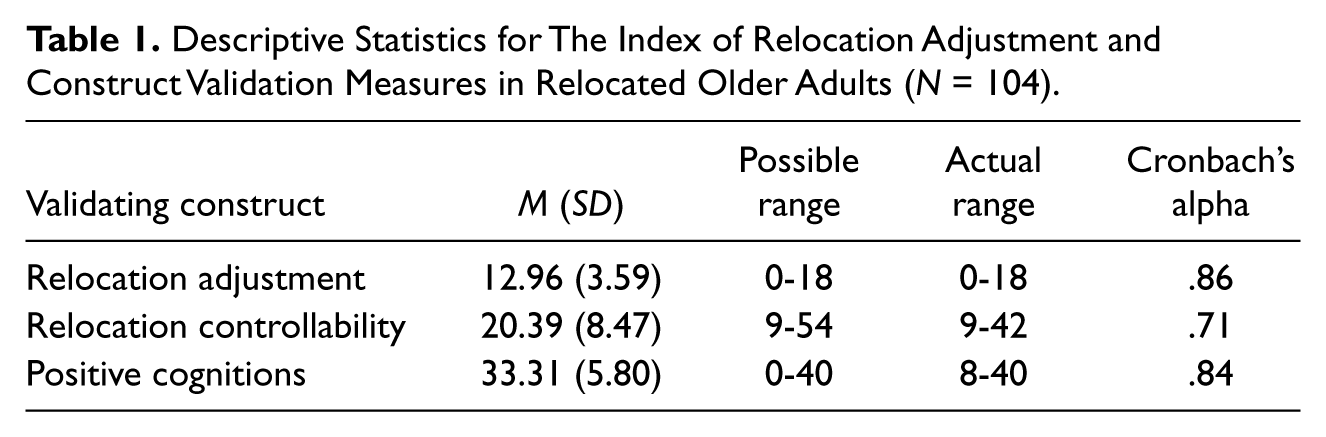
The IRA scores ranged from 0 to 18 (M = 12.96, SD = 3.59). Positive cognitions scores ranged from 8 to 40 (M = 33.31, SD = 5.80). Relocation controllability scores ranged from 9 to 42 (M = 20.39, SD = 8.47; Table 1).
Descriptive Statistics for The Index of Relocation Adjustment and Construct Validation Measures in Relocated Older Adults (N = 104).
Internal Consistency and Homogeneity
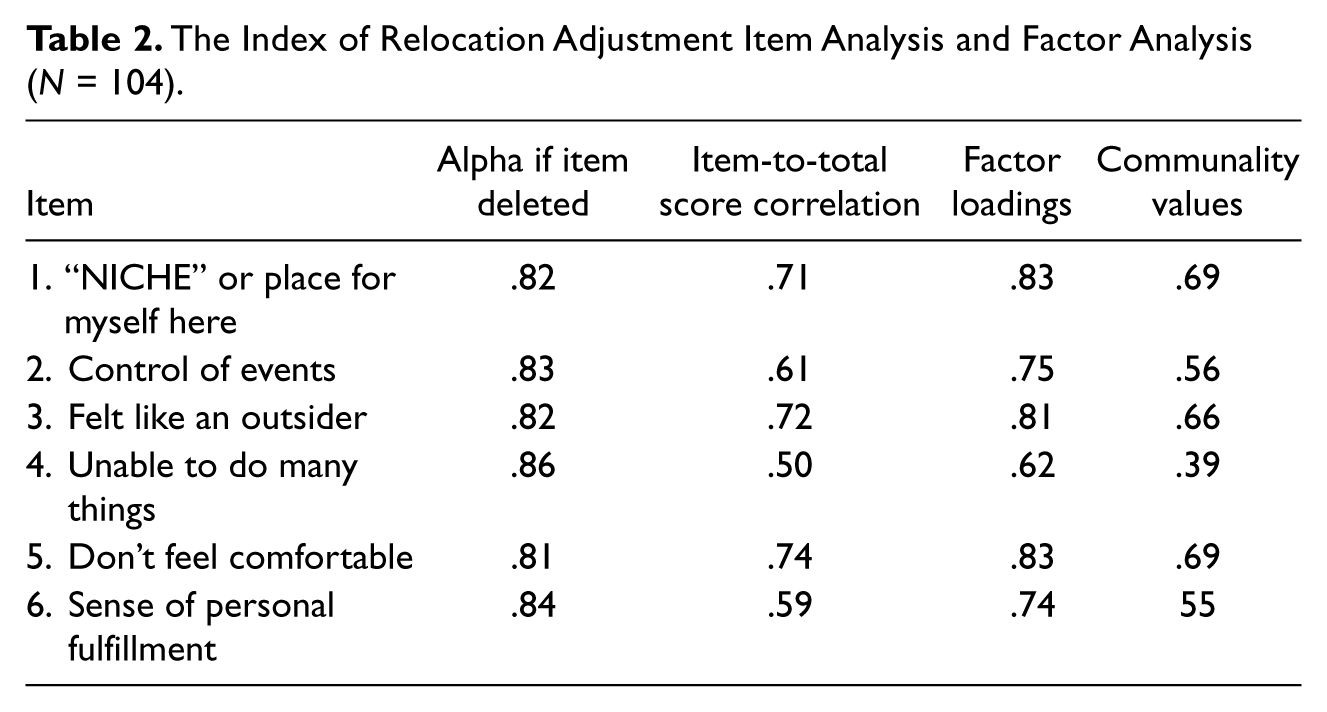
The overall estimate of the reliability of the IRA (Cronbach’s alpha) was .86. This reliability estimate exceeded the recommended criterion for internal consistency of at least .70 (Nunnally & Bernstein, 1994). Deletion of any one of the items did not improve the overall Cronbach’s alpha coefficient for the scale (Table 2). Item-to-total scale correlations were examined to determine the homogeneity of the IRA (Table 2). These item-to-total scale correlations were within or slightly above the recommended range of .30 to .70 (Cronk, 2004).
The Index of Relocation Adjustment Item Analysis and Factor Analysis (N = 104).
Reliability of the IRA was also evaluated by examining interitem correlations. According to Nunnally and Bernstein, these interitem correlations should average between .30 and .70. Values above .70 indicate item redundancy. Applying this criterion, 87% (n = 13) of the 15 possible interitem correlations fell within the desired range. One interitem correlation fell below the minimum criterion of .30 (.24) and one interitem correlation was .71 (Table 3).
The Index or Relocation Adjustment (IRA) Interitem Correlation Matrix (N = 104).
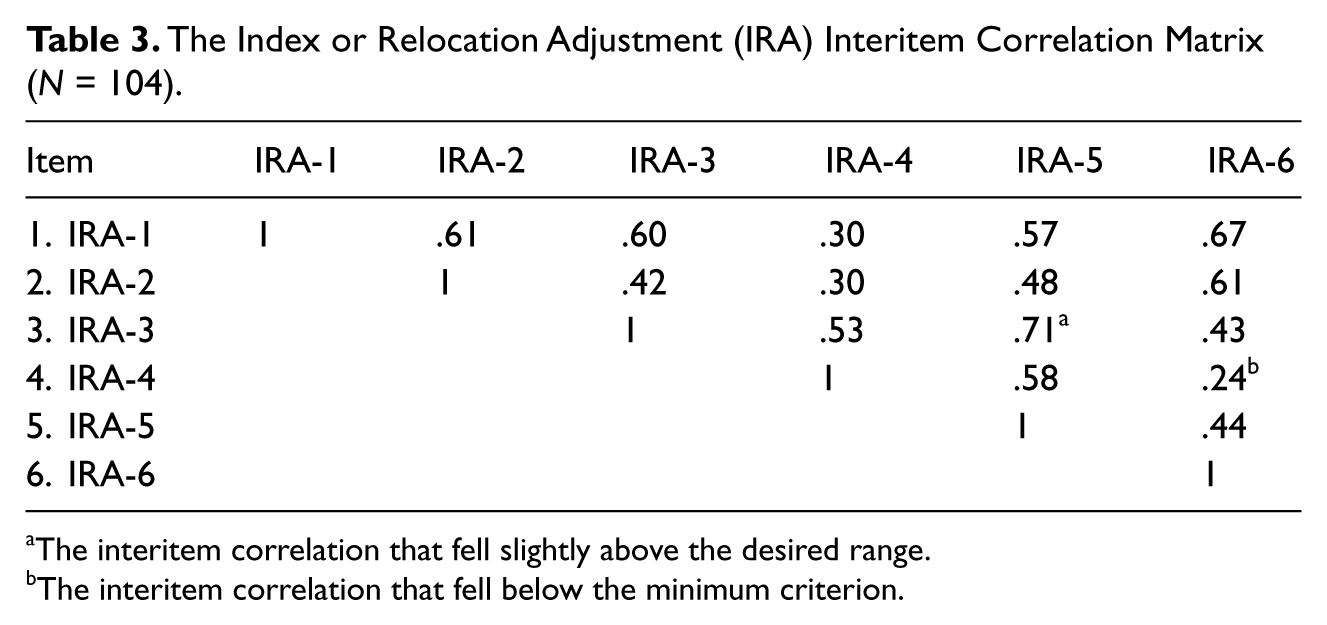
The interitem correlation that fell slightly above the desired range.
The interitem correlation that fell below the minimum criterion.
Dimensionality and Construct Validity
Before conducting factor analysis, several assumptions were tested to ensure the adequacy of the sample and suitability of the correlation matrix. A Kaiser–Meyer–Olkin value of .83 indicated that the sample size was adequate for factor analysis because it exceeded the recommended value of .60 (Tabachnick & Fidell, 2001). Furthermore, the Bartlett test of sphericity (χ2 = 292.02, p < .001; determinant = .054) indicated that the correlation matrix was suitable for conducting the factor analysis (Strickland, 2003).
Principal components factor analysis was conducted on the IRA items to extract the minimum number of factors that explained maximum variance in the items of the scale. In the earlier study by Prager (1986), only one factor emerged from factor analysis. In this study, the eigenvalues were used in combination with the scree plot to determine the number of factors. An inspection of the scree plot and eigenvalues revealed a two-factor structure, with the three negatively phrased items loading on the first factor and the three positively phrased items loading on the second. Forcing the items onto a single factor reflecting relocation adjustment revealed loadings for all items ranging from .62 to .83. As shown in Table 1, the single forced factor explained 58.80% of the variance in the items of the scale. All communality values were above .30, as recommended by Tabachnick and Fidell (2001), and all items had strong factor loadings on the single factor, exceeding the minimum recommended criterion of .30 (Nunnally & Bernstein, 1994; Polit, 1996).
The IRA was strongly correlated with the total positive cognitions score and the PTMS score in the expected direction (r = .48, p < .01; r = –.62, p < .01), suggesting construct validity.
Discussion
The population of older adults is increasing exponentially, and there is an expectation that it would reach 71 million by the year 2030 (CDC, 2003). Therefore, relocation of older adults to retirement communities will continue to rise significantly. Although the data were collected 5 to 8 years ago, the tremendous increase in the population of older adults who relocated to retirement communities and the necessity of having a reliable and valid measure of relocation adjustment makes this data relevant and appropriate to 2012 and beyond. The phenomenon of relocation is becoming more prevalent as society ages. However, changes may have taken place with increasing number or facilities and/or changes in administration of services within facilities since the original data were collected. Future research might consider replication of this study with more recent data to investigate whether the phenomenon of relocation has changed over time.
The results provide solid support for the reliability and validity of the IRA for older adults who relocate to retirement communities. Reliability was demonstrated through adequate estimates of internal consistency; Cronbach’s alpha was .86, which exceeded the minimum criterion of .70 (Nunnally & Bernstein, 1994). This internal consistency estimate is consistent with findings from other studies of the IRA measures, which reported an alpha of .87 in a sample of long-distance older adult movers (Prager, 1986). The corrected item-to-total correlations for all 6 items exceeded the .30 criterion (Cronk, 2004), suggesting that the measure was homogeneous and each item measured a unique construct. The findings are consistent with findings from a previous study of the relocation adjustment measure (Prager, 1986). The population in Prager’s study included older adults who relocated to Israel from English-speaking countries, which differs from the population in the study reported here, who relocated to assisted and independent living facilities. Interestingly, although these two populations might seem very different in terms of their reasons for relocating, the psychometric findings in the current study were very similar, with few exceptions discussed below, in terms of internal consistency and homogeneity.
Eighty-seven percent (n = 13) of the 15 possible interitem correlations (Table 3) fell within the desired range of .30 to .70 (Cronk, 2004). The one interitem correlation that fell below the minimum criterion of .30 might reflect somewhat different sample characteristics (Table 3). More specifically, the two items that reflect the interitem correlation are “I find myself unable to do many of the things which I had hoped to do here,” and “I feel a sense of personal fulfillment in my life here.” In fact, the low interitem correlation indicated a lesser association between an older adult’s inability to do what he or she hoped to do and their sense of personal fulfillment.
These findings may be associated with the difference between relocation to another country and relocation to another community, perhaps for health reasons. There may be a very interesting dynamic here; we have relocation to another country with probable good health versus staying with one’s country and relocation to a facility perhaps due to failing health with inability to maintain one’s home/property because of failing health or functioning. Therefore, further testing with a more diverse population is recommended. However, the items that reflected feeling like an “outsider” and not feeling comfortable were very highly correlated and exceeded the criteria of .70 (Cronk, 2004). Although in his discussion concerning comfort within the context of relocation, Prager (1986) describes feeling comfortable as a “state of mind” that is highly related to one’s perception of satisfaction or contentment regarding whether he or she feels wanted and “fits in.” He does not report whether the two items on the IRA Scale, which reflect these ideas (Items 3 and 5; described in Table 3) were correlated in his study as they were in the study reported here. For these older adults who relocated to retirement facilities, feelings of belonging and comfort were highly associated.
In addition to providing evidence of the reliability of the IRA, the findings demonstrated support for construct validity, as evidenced by significant correlations of .48 and .62 (p < .01) in the expected direction with an established measure of positive cognitions and with the PTMS.
The factor analysis provided further support for the construct validity of the IRA. Exploratory factor analysis resulted in two factors with the three negatively worded items loading together and the three positively worded items loading together. Several researchers have reported a similar two-factor solution with other scales, with positive and negative items loading separately (Carmines & Zeller, 1979; DiStefenao & Motl, 2006; Zauszniewski, Bekhet, & Bonham, 2010). For example, a two-factor solution has been reported for the Rosenberg Self-Esteem Scale, reflecting positive and negative dimensions (Carmines & Zeller, 1979; DiStefenao & Motl, 2006). Similarly, Zauszniewski and colleagues reported a two-factor solution for the Children’s Resourcefulness Scale where positively worded items loaded together on one factor (problem solving) and negatively worded items loaded together on a second factor (delay of gratification; Zauszniewski et al., 2010). However, in the two studies, the two factors were highly correlated, suggesting that the scales reflected a single factor and the two-factor solution was a result of a methodological artifact (Carmines & Zeller, 1979; Zauszniewski et al., 2010). Interestingly, the two-factor solution did not emerge in the previous study conducted by Prager (1986). However, in the current study, the two factors derived from the exploratory factor analysis were moderately correlated (r = .56, p <.01).
Since the previous study conducted by Prager revealed a single-factor solution, the authors in this study investigated further by forcing the items onto a single factor and found that the loadings for all items ranged from .62 to .83, which explained a substantial portion of the variance (58.80%). These findings were consistent with Prager’s factor analysis in which the item loadings ranged from .65 to .79 (Prager, 1986). In fact, the optimal method of determining dimensionality is a confirmatory factor analysis, a technique that requires a large sample size. Therefore, replication of the study with a larger sample and using a more rigorous statistical approach are recommended.
Conclusion
The findings from this analysis of the psychometric properties of the IRA with older adults who relocate to retirement communities yield promising evidence that the six-item IRA has acceptable reliability and validity and is potentially useful for assessing relocation adjustment among relocated older adults. Such assessment will be important for nurses who work with relocated older adults for identification of poor adjustment and early intervention and prevention of depression and mortality. Research showed that poor relocation adjustment can lead to many negative consequences such as depression, anxiety, impaired physical and mental functioning, and increased mortality (Capezuti et al., 2006; Hodgson et al., 2004; Lutgendorf et al., 1999; Walker et al., 2007). In fact, nurses are in a strategic position to intervene in the early phase of poor adjustment. Previous research showed that even the negative consequences of involuntary relocation can be mitigated if the facility provides care of high quality that satisfies the older adults (Capezuti et al., 2006). Many strategies can be used by nurses to facilitate relocation adjustment among relocated older adults in general and recently relocated older adults in particular. First, nurses can do early assessment of relocation adjustment using the IRA that would only take few minutes to complete. Second, as soon as poor adjustment is detected, it is vital for nurses to assess older adults’ attitude toward the move through listening to their concerns and respecting their points of view. Oswald and colleagues (2007) pointed out that relocation should be negotiated with older adults taking into consideration their individual needs and preferences. Third, nurses can help older adults to use strategies that were used successfully in the past to deal with their anxiety and stressful situations. Furthermore, nurses can help relocated older adults to use all their internal resources (use positive self-talk, reframe the situation positively, change from usual reactions, and explore new ideas) as well as their external resources (rely on family and friends, exchange ideas with others, and seek professional help) to adjust to relocation.
What Is Already Known About This Topic
Early identification of poor relocation adjustment can help in decreasing depression and mortality among recently relocated American older adults.
A number of general adaptive functioning instruments have been used in studies of relocation, but they are not designed specifically to measure relocation adjustment.
The IRA Scale has been reported to be a reliable and valid measure with older adults who relocated to Israel from English-speaking countries. That population is in fact vastly different from the population of older adults in the United States who relocate to assisted and independent living facilities who participated in this study.
What This Article Adds
Provides psychometric information about a relocation adjustment scale that is brief and feasible to use in nursing research and practice.
The instrument can be used to determine the level of relocation adjustment and where improvements in intervention can be made to prevent depression and mortality.
Implications for Practice and/or Policy
Periodic administration of this brief six-item scale could help in early identification of poor relocation adjustment among relocated older adults.
Health care managers and nursing staff should pay greater attention to levels of relocation adjustment especially among newly relocated older adults, since enhancing relocation adjustment is expected to decrease depression and mortality and increase life satisfaction.
Nursing staff should focus their nursing intervention on domains of adjustment, which are reflected in the six items of the scale, such as control of events, sense of belonging, and sense of personal fulfillment.
Footnotes
Acknowledgements
The authors acknowledge the editorial assistance of Elizabeth M. Tornquist (University of North Carolina at Chapel Hill).
Declaration of Conflicting Interests
The author(s) declared no potential conflicts of interest with respect to the research, authorship, and/or publication of this article.
Funding
The author(s) received no financial support for the research, authorship, and/or publication of this article.