




Abstract
Independence is highly valued in Western society. The emphasis on independence and consequent fear of dependence may, however, have a downside, potentially leading to social exclusion. Through photovoice methodology, we explored what older adults say about the importance of independence in their lives and how independence may relate to social exclusion. Data consisted of photographs, journals, interviews, and focus group transcripts from 30 participants residing in Manitoba, Canada, collected as part of a larger program of research on “age-friendly” communities. Findings highlighted the importance of resources and supports to help older adults remain independent and feel included and that fear of dependence and being perceived as “old” can lead to social exclusion. Policy initiatives designed to make communities more age-friendly are one way to enhance older adults’ independence and, ultimately, quality of life. It is equally important, however, that such initiatives go hand-in-hand with reimaging aging and old age.
Personal independence is often viewed as a core value in Western societies. According to the literature, independence is a concept that lacks a unifying definition. It can encompass the ability of older adults to maintain autonomy and make choices (Ball et al., 2004; Fine & Glendinning, 2005; Plath, 2008; Smith, Sim, Scharf, & Phillipson, 2004). It can also be the ability to engage in basic activities of daily living and be self-reliant (Cordingley & Webb, 1997; Gustafsson, Andersson, Andersson, Fjellstrom, & Sidenvall, 2003; Lowy, 1989; Plath, 2008; Smith et al., 2004). Others see independence as the ability of older adults to access resources and maintain community ties (Lowy, 1989; Phillipson, 2007; Scharf, Phillipson, Kingston, & Smith, 2001), as well as maintain self-esteem (Ball et al., 2004; Plath, 2008; Smith et al., 2004). Finally, independence can be tied to the ability to reciprocate support received (Ball et al., 2004; Cordingly & Webb, 1997; Lowy, 1989).
Knowing that independence has multiple meanings, how do older adults understand independence and the role it plays in their lives? What factors contribute to or hinder their independence? Furthermore, is there a relationship between the need to maintain independence and becoming socially excluded? We address these questions with data from a participatory “photovoice” study conducted in Manitoba, Canada.
Why are these questions significant? When any of the dimensions of independence are lost, such as through disability or lack of access to resources, concerns about dependency and becoming a burden may arise. Studies have shown that one of the greatest fears of older adults is becoming dependent on others (Baltes, 1996; Clark, 1991; Lustbader & Hooyman, 1994; Portacolone, 2011). Loss of independence and/or growing dependence amongst older adults can lead to low self-esteem and feelings of depression and worthlessness (Ball et al., 2004).Often dependence of older adults is seen as the result of illness or deterioration, thereby linking old age to pathology and abnormality (Ball et al., 2004; Gustafsson et al,. 2003; Lowy, 1989). In light of this, adaptation and compensation can occur, such as reducing an activity to maintain and conserve energy or installing devices that allow older adults to maintain independence (Ball et al., 2004; Litva & Eyles, 1994).
Societal-wide fear of dependency in later life can lead to the marginalization of older adults. In 1969, Butler coined the term “ageism” to describe this marginalization. For Butler ageism encompasses “distaste for growing old, disease, disability; and fear of powerlessness, ‘uselessness’, and death” (1969, p. 243). Negative beliefs surrounding ageing are also reflected in society’s language and how people interact with older adults (Nussbaum, Pitts, Huber, Krieger, & Ohs, 2005). The result is a societal view of old age as a time of dependency, weakness, and a drain on the system. Though ageing is an inevitable process, reliance on others is stereotyped as inherently bad.
Efforts to counteract ageism usually include portraying older adults as “active, productive citizens” (Katz, 2000). “Success” stories are now common in popular media (Rozanova, Northcott, & McDaniel, 2006). For instance, recent media headlines include: “100-year-old runner breaks marathon record in Toronto” (CTV News, 2011); and “Ninety-years-old and still happily working” (Day, 2011). Although these are positive portrayals of older adults, they also reinforce ageist views by their very emphasis on success, marginalizing those who cannot age “successfully” and possibly leading to social exclusion (Holstein & Minkler, 2003; Rozanova et al., 2006; Portacolone, 2011).
Similar to the challenges of defining independence and dependence, there is also no single, universally accepted definition of social exclusion. At its broadest, social exclusion focuses on “relational issues: in other words inadequate social participation, lack of social integration and lack of power. Social exclusion is the process of becoming detached from the organizations and communities of which society is composed and from the rights and obligations that they embody” (Room, 1995, p. 243).
Many overlapping dimensions of exclusion relevant to older adults have been described in the literature. For instance, there can be material and economic deprivation that leads to an inability to participate in social or cultural activities (Jehoel-Gijsbers and Vrooman, 2008; Mikkonen & Raphael, 2010). As well, individuals with particular traits may be spatially segregated. For example, disabled individuals may be excluded from access to particular buildings (Phillipson, 2007; Scharf et al., 2001). Each dimension of exclusion, however, has negative implications for older adults.
Context of the Present Study
In the present study, we examine older adults’ understanding of independence, dependence, and social exclusion/inclusion. The data were collected as part of the Age-Friendly Community University Research Alliance program of research, which created a partnership between university researchers, provincial government, and senior organizations that provide services for older adults. The Age-Friendly Alliance was rooted in the World Health Organization’s (WHO) notion of age-friendly communities (World Health Organization [WHO], 2007). Age-friendly communities, according to the WHO definition, are ones that exhibit policies, services, and structures that optimize “opportunities for health, participation and security in order to enhance quality of life as people age” (WHO, 2007, p. 5).
The aim of the “photovoice” study was to explore older person’s perceptions of what makes communities “age-friendly.” Although definitions of age-friendliness have been proposed in the literature (Alley, Liebig, Pynoos, Banerjee, & Choi, 2007; Feldman & Oberlink, 2003; Hanson & Emlet, 2006; WHO, 2007), we wanted to capture individuals’ perspectives without imposing a particular definition; instead, participants were able to derived their own meaning.
Method
Photovoice Methodology
Photovoice was chosen as a methodology because it is a way for older adults to reflect on their social conditions, engage in dialogue with others in their community, and promote needed changes (Wang & Redwood-Jones, 2001). Wang, Cash, and Powers (2000) define photovoice as “a process by which people can identify, represent, and enhance their community through a specific photographic technique” (p. 82). The method typically involves: (a) participants taking photographs to depict their experience; (b) eliciting information from participants about the photographs they have taken; (c) focus groups discussing the issues under study; and (d) sharing findings with decision makers.
Photovoice methodology arose out of feminist theoretical conceptualizations of “voice,” Freirian notions of praxis (Freire, 1973), and constructivist epistemology (see Hergenrather, Rhodes, & Bardhoshi, 2009). Feminist researchers have argued that the voices of marginalized populations are often silenced or left unheard. Photovoice gives participants an opportunity to let their voices be heard and helps to develop critical dialogue on personal and community issues (Baker & Wang, 2006; Jurkowski & Paul-Ward, 2007).
Drawing from Freirian theory of praxis (Freire, 1973), the sharing of mutual experiences allows participants to become agents of change within their community (Catalani & Minkler, 2010). By engaging in group dialogue, participants share their interpretations of the data with one another, come to a collective understanding of what is important in their lives, and share this information with researchers and policy makers (Wang & Burris, 1997). Participants are also able to, individually and as a group, construct what the photographs mean to them and select for discussion the issues they believe most pertinent. As such, “community members have the power to define the images to shape policy; and photographs can influence policy makers, programs, and society” (Hergenrather et al., 2009, p. 688).
Rather than researchers imposing interpretations of the data onto community participants, interpretations flow from community participants to the researchers (Catalani & Minkler, 2010; Hergenrather et al., 2009). In a photovoice project, researchers typically seek the involvement of community leaders to help engage community participants in the project. While participants do not generally dictate the initial focus of the research, they do influence the direction of the research once the project is underway (Catalani & Minkler, 2010). To illustrate, in a focus group discussion participants are asked to select a set of “photographs that most accurately reflect community needs and assets,” contextualize the photographs by “telling stories about what the photographs mean,” and then codify the “issues, themes, or theories that emerge” (Wang and Burris 1997, p. 380).
Analysis of the visual data produced is frequently difficult. Often, however, researchers use the photographs to stimulate discussions and then analyze textual data that is produced from these discussions (Catalani & Minkler, 2010). As explained by Wang and Pies (2004), photovoice
is not intended to be a methodology in which an entire body of visual data is exhaustively analyzed in the social scientific sense . . . participants drive the analysis—from the selection of their own photographs that they feel are most important, or simply like best, to the “decoding” or descriptive interpretation of the images. (pp. 100-101)
Sample Recruitment and Screening
The participants in the study all resided within Manitoba. Manitoba is a Canadian prairie province, with a population of 1.2 million (Statistics Canada, 2011) and a population density of 2.1 people per square kilometer (Manitoba Government Census, 2006). In 2006, 14% of the population of Manitoba was 65 years or older, with 17.8% living on incomes of less than US$15,000 a year. The majority of older adults in Manitoba are of European ancestry (Statistics Canada, 2006).
Four communities within Manitoba were identified for the study and participants older than 55 were sought to participate. The communities were chosen based on geographical regions in an attempt to get a range of participants and perspectives. Given the geographic diversity within Manitoba, we selected two communities in rural southern (traditionally agricultural) regions of the province, one community in the remote northern region, and one urban center.
To capture diversity among participants (age, socioeconomic status) and to ensure those recruited were sufficiently high-functioning to be active within the community, recruitment was conducted by local facilitators from senior organizations within the chosen communities. Participants were sought by word of mouth and through poster advertisements (Novek, Morris-Oswald & Menec, 2012). It is noteworthy that in recruiting high-functioning older adults we may have biased the sample in favor of seniors already engaged within the community, a common occurrence in research with older persons (Fudge, Wolfe, & McKevitt, 2007).
Participants were screened using a participant information form that solicited basic demographics, such as length of residence in the community and types of impairments (e.g., problems with hearing and motor skills). In addition, participants had to be able to attend group meetings and be able to manipulate a small digital camera. From each community, 6 to 10 participants were recruited—with the final sample size amounting to 30 participants (7 men and 23 women). The age range was 54 to 81 years old with an average age of 69. Most participants were retired, had some college or university education and all rated their health as being fair to excellent (See Table 1).
Participant Characteristics.
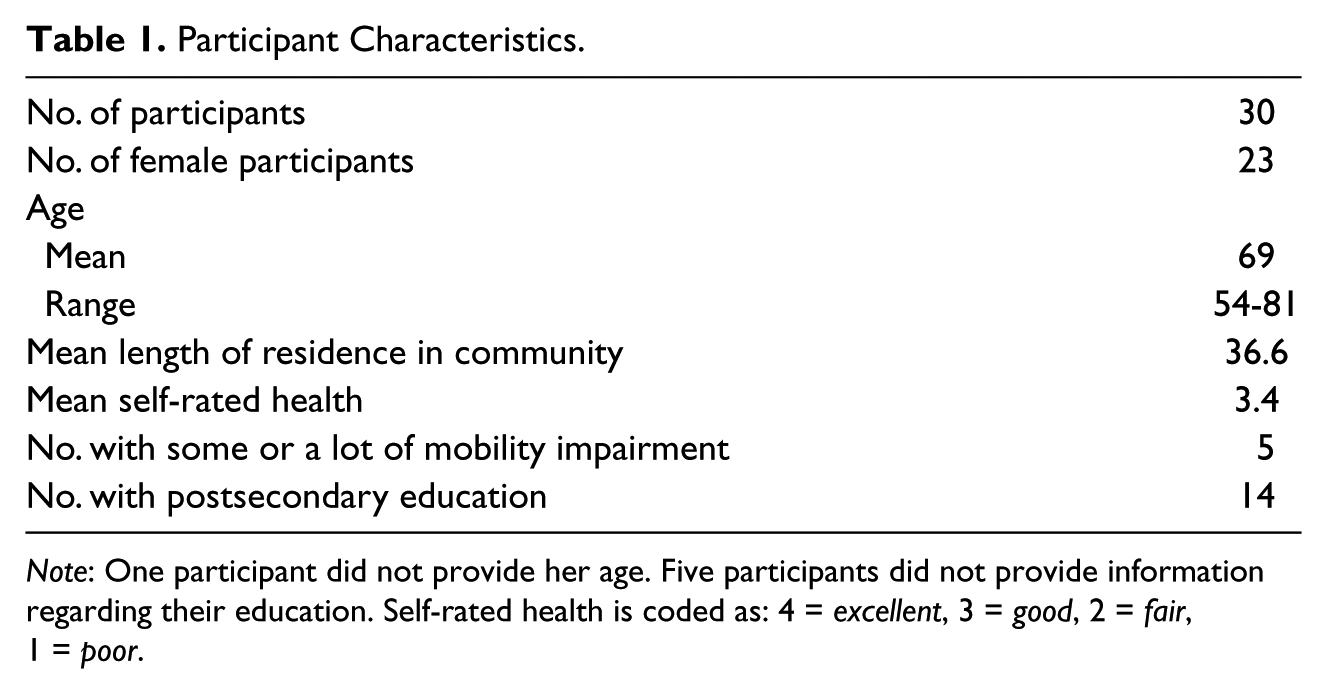
Note: One participant did not provide her age. Five participants did not provide information regarding their education. Self-rated health is coded as: 4 = excellent, 3 = good, 2 = fair, 1 = poor.
Procedures
After recruitment, participants attended an information session where they learned how to operate the cameras. Participants were told that the purpose of the study was to “identify the characteristics that older adults believe make their communities age-friendly or not age-friendly and to raise awareness about these characteristics” (Novek et al., 2012, p. 455). Each participant was instructed to take a maximum of 16 photographs of age-friendly features and barriers. They were further asked to identify up to three priority photographs that indicated key issues to be addressed in the community. The research team followed Wang and Redwood-Jones’ (2001) method of asking open-ended questions to prompt participants to think of tangible and intangible things in their communities that might be captured by photograph. No further instructions were provided as to what “age-friendly” meant, as the intent was to be as open-ended and nondirective as possible.
Participants recorded in a journal what was in the photo, what the photo meant to them, and why it was taken (related to age-friendliness in their community). Following collection of the journals and cameras from the participants, researchers conducted interviews to elaborate on the meanings of the photographs. These interviews allowed the researchers to clarify issues and fill in incomplete journals. The journals were very important for analyzing the photographs. Without the participants’ descriptions and interpretations, researchers would have been unable to infer what the photographs meant. For instance, one participant took a photograph of a town mural. Without the information from the journal we never would have been able to know that, for this participant, the mural represented pride in one’s community.
After individual interviews, focus groups were held in each of the four communities with the participants from those communities. Focus groups were conducted by postdoctoral fellows with extensive experience with facilitating group discussions. Powerpoint presentations depicting the participants’ priority photos and commentary were used to guide the discussions. The discussions provided a collective assessment and prioritization of various items depicted in the priority photographs and associated journal entries. In addition, it allowed participants an opportunity to voice concerns and strategies for enhancing the quality of life of older persons in their community. The focus groups were recorded and transcribed and the data was included in our analysis. (For more information on the methodology of this study, please refer to Novek et al., 2012).
Analyses
The study produced a wealth of data on many different topics in regards to age-friendliness. As such, several stages of coding took place (see Saldana, 2011).
Precoding: In this inductive stage, all of the data (photographs, journals, interview transcripts, and focus group transcripts) were read through several times by the authors, with the pictures and journals examined simultaneously. During these readings, rich and significant quotes that struck us as “codable moments” (Boyatzis, 1998) worthy of attention were highlighted in Nvivo 8.0 software.
Pattern Deduction: In this stage, patterns of quotes and comments that emerged from the precoding stage were combined into major concepts. We became interested in particular phrases relating to independence and exclusion. “Independence,” “stay in community,” “isolation,” “burden,” “need resources,” and “choice” were phrases often found.
Provisional Coding: Based on the pattern that was emerging, we focused our examination on what older adults had to say about the importance of independence in their lives and how this may relate to exclusion. Thus, the pictures, journals, interview transcripts, and focus group transcripts were reexamined using the provisional codes of “independence,” “burden,” “access,” “dependence,” “isolation,” “exclusion,” “choice,” “resources,” and “inclusion”.
Categorization: The underlying results from provisional coding were examined and categorized. This involved a process of coding and recoding, categorizing and recategorizing; moving back and forth through the data and forming code clusters, or tree codes from the provisional codes.
Thematic Coding: Analysis of the categories and codes led to the development of a number of themes that were classified under two major categories: independence/dependence and exclusion/inclusion. It is noteworthy that although we present these as separate themes, they are interrelated, with one informing the other. We must also note that independence and social exclusion were not an explicit focus of the original research project. However, these themes emerged from data, suggesting that they are key issues for older adults.
Findings
Of the 30 study participants, 67% (20) discussed themes of independence/dependence. In addition, 50% (15) of participants discussed themes of exclusion/ inclusion. Themes are illustrated by direct quotations from the participants in their journals, interviews, and focus group discussions, as well as sample photographs taken. Pseudonyms are used to identify participants to ensure confidentiality.
Independence/Dependence
Three major areas emerged as being important to participants when looking at the theme of independence/dependence. First, participants situated the independence imperative in historical and cultural contexts. Second, they described the importance of having control over their lives and ability to make choices. Finally, they stressed how their ability to remain independent is contingent upon the resources and supports available to them.
The independence imperative
According to participants, there has been a change in the importance of independence over time. They explained that there is a greater emphasis now on individual independence and self-reliance than in the past. For instance, one participant put it as follows:
[I]sn’t it also part as a result of how society has changed? Historically when people grew old, the chances would be that their children or some of their children would look after them in their old age, and you’d be living with your children . . . for most seniors today that’s the last thing they would want. They want to remain independent, right? Or go into another setting instead of burdening your children for, with that. What I’m trying to say is that society has changed, right? And as a result of society changed, these needs are becoming more apparent . . . Because I think with my father-in-law, he had the expectation that my wife, who’s the oldest daughter, would look after him. That was an expectation he had, eh? Well, for me, that would be the last expectation I would have from my oldest daughter that she should look after me. I’d want to look, I want to make sure that I could look after myself and I have resources to do that. (Carl, age 78)
In Western societies, adults are expected to be independent, capable, and productive. Those unable to achieve these traits are marginalized, which creates a fear of dependence and anxiety over declining ability (Baltes, 1996; Clark, 1991; Mack, Salmoni, Viverais-Dressler, Porter, & Garg, 1997; Portacolone, 2011). The fear of losing independence is reflected in the following comment:
Well I think everybody has that fear, to lose one’s independence of course is terrible isn’t it? It’s catastrophic. (William, age 78)
Control and choice
Almost half of the participants emphasized the need to remain autonomous and make their own choices. For instance when discussing what older persons need to be independent, Winnie suggested:
A variety of activities for seniors, um, where people can choose rather than having [someone] saying well, you know, “we’re going to play musical chairs today.” You know, rather than tell people what seniors are supposed to be doing, you have a choice. You want to go sky-diving, fine [laughing]. It’s your individual choice. (Winnie, age 59)
Dependence of an older adult has very different underlying connotations than dependence of a child (Gustafsson et al., 2003). The frustrations over not being able to choose for oneself is evident in the following quote:
Independence is important . . . when you are in our age of course you’re dependent on people but, but, it, it doesn’t have to feel like it . . . So, like the resources should be there for you, but you have, you can choose what you want to do with them . . . just having them to use, independently, by yourself, not children telling you “you have to do this, you have to do that. Why are you doing this?” . . . having control over your own life. (Wren, age 56)
The need for resources and supports
Participants recognized that to remain independent into old age there is the need for social resources, such as friendship, care, and support, as well as material resources, such as money and environmental objects.
Sometimes you cannot do lots of things physically and . . . resources are not available for us because people think that we cannot do things . . . Just, like, don’t make old people cripple. That’s what I’m saying because we are not. Like you are 100 and you are still alive and kicking. (Wren, age 56)
Loss of independence among older adults can lead to low self-esteem and feelings of depression and worthlessness (Ball et al., 2004). Conversely, adapting the environment to the needs of older adults allows them to maintain independence and can promote self-esteem. For instance, one participant took a picture of a power-assist lift chair designed for individuals who require assistance in standing or lowering their seating position. During the focus group discussions, Tammy described why having chairs such as this available is important (see Figure 1):
Focus Group: [This chair is important] for the self-esteem of the person managing to maintain their independence as long as possible. (Tammy, age 73)

Photo of a power-assist lift chair taken by Tammy, age 73. Tammy feels that objects such as this help her to remain independent since she does not need to rely on help from others to get up.
The need to adapt the larger community environment was also recognized as important. Improved access to facilities and buildings were indicated as critical to maintaining older adults’ independence. For instance one participant noted the following about a photo she took (see Figure 2):
There is a gradual ramp for access to both the church and attached meeting hall. Anytime seniors can access areas without assistance their independence is affirmed. (Connie, age 68)
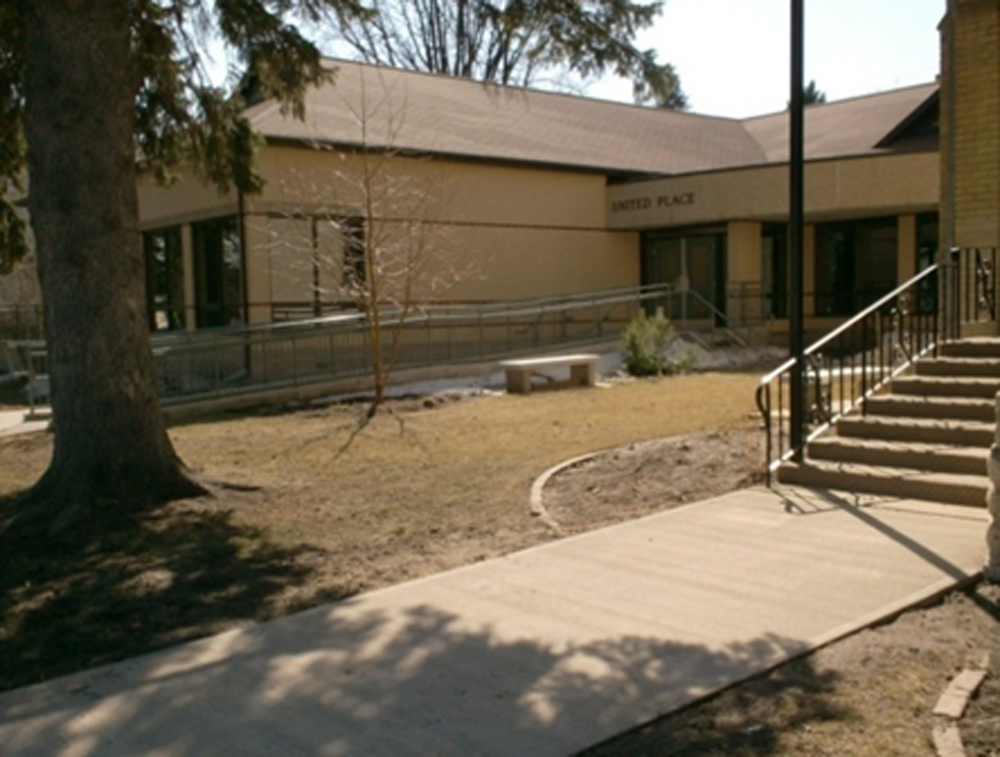
Photo of church stairs and a ramp taken by Connie, age 68. Connie feels that access ramps such as this allows individuals with mobility issues to go to services which would otherwise be impossible to attend.
Exclusion/Inclusion
Participants emphasized three areas of exclusion/inclusion that intersect with the desire for independence. First, participants described their worry about becoming a burden on others and the importance of being able to reciprocate. Second, they commented on their fear of being viewed as old and how this fear can lead to their self-exclusion and isolation. Finally, participants described how a lack of resources results in segregation from family and friends.
Fear of being seen as a burden and reciprocity
The desire for independence led participants to worry that they would be viewed as a burden; a worry that may potentially lead to not asking for help. The following dialogue that arose during one of the focus groups illustrates this dynamic:
Cyndi (age 68): [You] wouldn’t want to bother others or something . . . And independence, you don’t want to ask for the help, you know, you feel it’s . . . Carl (age 63): But the handi-van allows you to be independent, you pay, you don’t feel you’re asking… Connie (age 68): Yeah, you pay something I think . . . Yeah, it’s not like asking for charity. Carl (age 63): That’s right. So you sort of have kind of, you think you have your independence. I phone and told them I want to be picked up, I paid ’em, there.
The discussion illustrates that paying for transportation reduces feelings of being dependent on other’s “charity”; in other words, the fear of being a burden could be alleviated if there was the opportunity to reciprocate. The importance of being able to reciprocate was also reflected by Winnie, a participant who took a photograph of an international exchange student she is hosting. She described how the exchange student provides her with support and how she, in turn, helps the student by providing a place to stay and guidance with living in a new the city. As she noted in her journal:
[He is] a university student from China. I am his host family and he in turn helps me when I need it. (Winnie, age 59)
Fear of being seen as old
Not wanting to be perceived as old was identified by participants as potentially leading to social exclusion since individuals may be reluctant to participate in activities that are for “old” people. To illustrate such self-exclusion, Darlene (age 77) photographed the local senior center and noted in her journal that “It is too bad that the Senior Centre can’t get more people out” (see Figure 3). In the interview, in reflecting on why older adults may not want to go to the center, she commented on people not wanting to admit that they are “old” or a certain age (i.e., in their 80s).
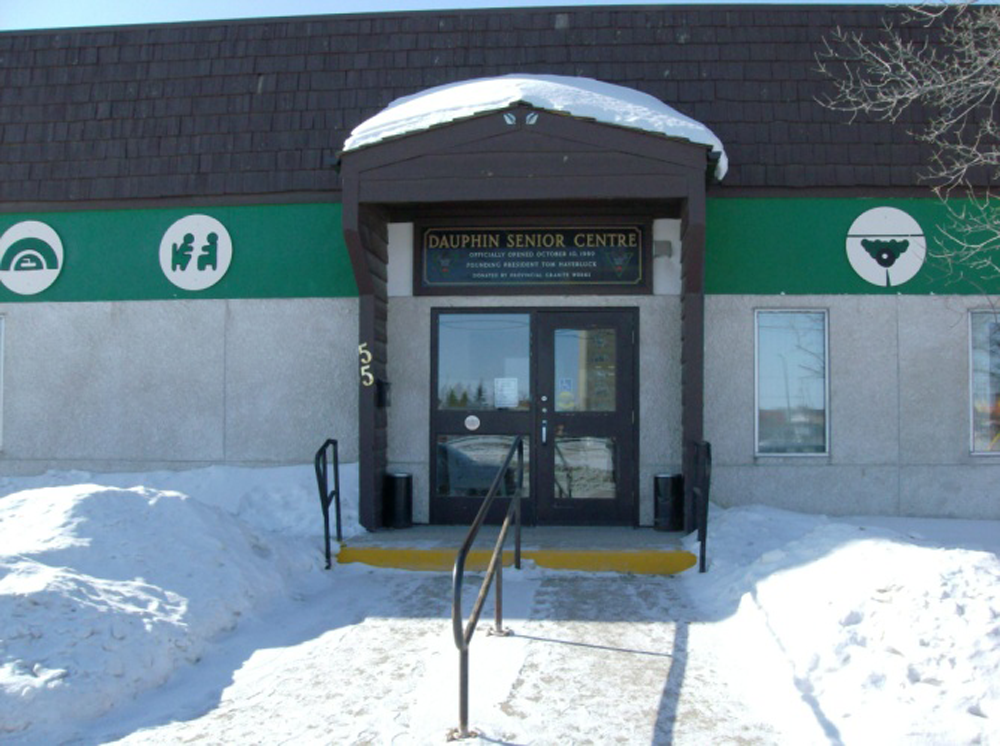
Photo of a senior center taken by Darlene, age 77. Darlene stated that this particular senior center has a lot of services and programs available for older adults.
A similar sentiment about older adults’ fear of growing old was expressed by Doug:
And a lot of seniors . . . have to realize they’re seniors. A lot of seniors that will not associate themselves with this . . . because they’re too damn young . . . Let’s cut to the chase. Somebody 75 years old . . . will not come to the seniors’ centre because they’re not old enough. (Doug, age 63)
Fear of being perceived as lonely or in need can also lead to self-exclusion. For instance, Catherine discussed a visiting service for older adults that her community tried to implement; however, no one would use the service. Catherine went on to relay her conversation with her daughter who told her:
“Mom that would be terrible if you had to admit that you were so lonely that you had to call and ask for a visitor to come to your house; it’s like paying to have a friend come over.” You know . . . I can understand that, why they wouldn’t want it. (Catherine, age 56)
Social exclusion due to lack of resources/supports
As noted above, having resources and supports was identified by participants as critical for independence. The lack of affordable resources and supports was also linked to social exclusion, as it can force older adults to relocate to other areas where supports are available. As Tracey explained:
I have another friend who is a senior, lovely lady, who her apartment block has now been closed because they are going to make it into condos. And she is leaving town. She is leaving behind family and friends and looking at places in [a larger urban centre] that aren’t particularly [nice] . . . Some of these places are putting the rents up to 1,400 dollars a month . . . Well seniors, most seniors I know can’t afford that. (Tracey, age 58)
Similarly, having resources and supports in the community allows older adults to stay socially connected with family and friends. In this respect, one participant took a photograph of the local nursing home and stated:
This new [nursing] home keeps seniors in or nearer their own community, family and friends. This also means that seniors who need care are able to socialize with others. By providing support, seniors can take part in group events, crafts, carpet bowling, sing songs and not [be] isolated. (Terry, age 73)
Discussion
A complex picture emerges about how important independence is to older adults and also how independence is linked to social exclusion. Participants stated that to be independent is to be self-reliant and able to make choices and access resources. This finding is consistent with previous research that documents the multidimensional nature of independence (Ball et al., 2004; Plath, 2008; Portacolone, 2011). Findings also show that the emphasis on independence, and its loss, is associated with fear of growing old and fear of becoming a burden. Participants suggested that this fear can result in reluctance to ask for assistance and reluctance to access resources, such as activities at a senior center. Participants further commented on how a lack of resources and supports in communities can lead to social exclusion. For example, lack of affordable housing may mean that older adults are forced to leave the community, leading to separation between families and friends.
Thus, our findings indicate that social exclusion of older adults happens at the community level and the personal level. At the community level, exclusion of older adults can occur when there is a lack of resources or supports necessary to allow them to remain part of their community and social network. Social exclusion can also arise because of financial issues. These findings are consistent with previous research that has described the multiple ways that older adults experience exclusion (e.g., Scharf et al., 2001; Scharf, Phillipson, & Smith, 2005). At the personal level, exclusion can be self-induced and occur when older adults, not wanting to be seen as old or a burden, choose not to access resources.
These findings suggest two approaches to fostering independence, while minimizing the risk of social exclusion: (a) structural changes with the goal of making communities more “age-friendly”; and (b) cultural changes to modify how dependence and old age are perceived. Structural changes are the usual recommended solution to exclusion of older adults (Jehoels-Gijsbers & Vrooman, 2008; Mikkonen & Raphael, 2010). The belief is that by addressing poverty issues, building new community centers, installing ramps, and implementing new services geared toward the individual and their choices we may alleviate exclusion of this at-risk group.
The notion of age-friendly (or elder-friendly) cities and communities out of which the present project emerged fits well within this structural approach. Building on other initiatives (e.g., Smart Growth and Liveable Communities’ movement), WHO (2007) defines an age-friendly community in terms of a broad range of domains, including housing, transportation, health services and community supports, and so forth. Photographs and comments by our participants corroborate many of the issues identified by WHO (2007), such as the need to make buildings accessible and have affordable housing.
The age-friendly communities movement has been gaining increasing momentum since WHO introduced the concept in 2006 (WHO, 2007), with communities around the world starting to work on becoming more age-friendly. In the province of Manitoba, the setting of the present study, the provincial government launched its Age-Friendly Manitoba Initiative in 2008, with the goal to make communities throughout the province more age-friendly (see http://www.agefriendlymanitoba.ca). Official invitations from government to join the Initiative have gone to all communities in the province. Local government uptake of the Initiative has been excellent, with 85 communities currently a part of the Initiative, representing over 80% of the population of the province. The present study suggests that such policy initiatives are critical in enhancing older adults’ sense of independence and quality of life.
However, our study also suggests that structural changes such as providing more services and supports, while necessary, do not guarantee that older adults will use them in a society where there is a stigmatization of dependency and old age. The study suggests that we must also attend to cultural change. In other words, we need to address the beliefs that have been transferred through socialization that “old” is correlated with being a burden. This change needs to occur throughout the population including among older adults.
One solution to alleviating concerns about being seen as a burden and, consequently, self-exclusion, identified by our participants was being able to reciprocate. The notion of reciprocity is consistent with social exchange theory where exchange relations are guided by cultural norms of reciprocation (e.g., Dowd, 1975; Silverstein et al., 2002). If individuals are unable to reciprocate, as can be the case for older adults who are in a position of dependency and reduced power, disengagement from activities may occur (Dowd, 1975). In our study, participants suggested, for example, that paying for services, such as transportation, is one way that the problem of being perceived as a burden can be overcome. In this way, the company that provides the service “depends” on the money they receive from the older adult just as much as the older adult “depends” on access to the service. Thus, charging a nominal fee for services may strike a balance between allowing older adults to retain a sense of independence, while ensuring that low-income older adults are not disadvantaged. The provision of instrumental supports may be another way for older adults to reciprocate. This was reflected in one participant’s comment about the mutual benefits derived from hosting an international student.
Social exchange theory also suggests the need to reevaluate notions of aging and old age. Recognizing the contributions that older adults have made throughout their lives and continue to make in later life (e.g., by volunteering, civic participation, or care giving) may reduce ageist perceptions of dependence and burden. Just as parents’ “investments” in their children is reciprocated by children supporting their parents in later life (Silverstein, Conroy, Wang, Giarrusso, & Bengtson, 2002), older adults’ contributions need to be valued as a resource to be reciprocated by society through services provided. Communities can demonstrate their appreciation for the contributions of older adults through events and awards that recognize and celebrate older persons.
In sum, photovoice methodology provided a rich understanding of older adults’ lives and priorities. Photographs allowed us to view their lived experience; photographs also shaped the discussion in the focus groups and, as such, ensured that it focused on issues important to our participants, not us researchers. Sharing findings with decisions-makers to make change happen is one important aspect of the methodology, although it is a component that is varyingly implemented in photovoice studies (Hergenrather et al., 2009). In the present research, priorities identified by participants were summarized and mailed to community leaders identified by our participants. All four communities from which participants were recruited subsequently joined the Age-Friendly Manitoba Initiative and are now at varying stages of working toward making their community more age-friendly. As such, the research intersected with this larger policy initiative. This connection was facilitated by the Age-Friendly Communities-University Research Alliance research program (out of which the present study arose) and its partnership with the provincial government.
Limitations
Photovoice methodology requires participants to be able to use a camera and participate in a focus group. Indeed, one of our major concerns was to find a camera that could be used with relative ease by individuals with dexterity and vision issues. This required choosing a simple to use camera that had a larger viewing screen. We also spent considerable time ensuring that participants were comfortable using the camera. As well, research team members accompanied participants who requested that someone to go with them when taking photos. This was particularly necessary for individuals with greater mobility issues. However, this was done under the provision that only participants were to choose the ideas to be captured in the pictures (see Novek et al., 2012). Despite making these accommodations, our participants were still relatively independent. Different perspectives might have emerged if we had included individuals facing more dependency issues (e.g., greater mobility limitations). The findings may therefore not be transferable to other older adults. As well, due to our limited sample size and the uniqueness of our population, our results many not be generalizable to older adults in Manitoba and/or other settings.
Study results may also have been affected by not providing a definition of “age-friendly” for our participants. However, one of the strengths of the photovoice technique is that participants are able to derive their own meanings and not be limited to researcher’s definitions
Another limitation is the difficulty in capturing intangible aspects of social life, such as isolation and exclusion, through a camera’s lens. For instance, barriers such as dangerous sidewalks could be easily photographed by participants whereas an abstract concept like “social isolation” has no singular, concrete representation in the physical environment. There was also a general reluctance among participants to photograph people, as written consent of individuals who were photographed had to be obtained, as required by the University Research Ethics Board. Thus, certain aspects of independence and social exclusion may not have been captured in our study.
The lengthy participant consent form required by the University Research Ethics Board (for more information on the Institutional Research Ethics Board requirements for this project, see Novek et al., 2012, pp. 464-465) also caused some anxiety among potential participants and resulted in a few individuals declining to participate. In addition, when photos with identifiable people were sent to the researchers by the participants without consent forms, we requested consent be obtained retroactively. Failure to obtain retroactive consent led us to either crop the photos or record a description of the photos instead of using the actual pictures. The journals, therefore, became even more important to our analysis. While unavoidable, the need to obtain consent and participant anxiety about the consent process may have influenced our results (Novek et al., 2012).
Conclusion—Is Independence Related to Social Exclusion?
The present project arose from a study designed to examine what an “age-friendly” community means to older adults. Although definitions of age-friendliness exist in the literature (Alley et al., 2007; Feldman & Oberlink, 2003; Hanson & Emlet, 2006; WHO, 2007), our intent was to have older adults describe their own experiences without imposing any preconceived notions of what the concept might mean. Independence emerged as an important theme from the photographs, journals, interviews, and focus group discussions. Our findings highlight the multiple meanings of independence, as well as show that the cultural need to remain independent and be seen as a contributing member of society may lead to self-exclusion. Participants also outlined that there are a wide range of factors that contribute to independence, both within and outside the home.
Policy initiatives designed to make communities more age-friendly, which are currently underway around the world, are one way to enhance older adults’ independence and, ultimately, quality of life. It is equally important, however, that such initiatives go hand-in-hand with a reimaging of aging and old age. Over forty years after Butler (1969) coined the term ageism, our participants’ comments still reflected the negative connotations associated with being “old.” Not wanting to be seen as old, they suggested, could lead to individuals not accessing resources that are available. A new vision for aging would counter notions of dependency and burden and focus on the contributions that older adults have made in the past and continue to make in old age.
Footnotes
Declaration of Conflicting Interests
The author(s) declared no potential conflicts of interest with respect to the research, authorship, and/or publication of this article.
Funding
The author(s) disclosed receipt of the following financial support for the research, authorship, and/or publication of this article: This project was funded by a Social Sciences and Humanities Research Council of Canada (SSHRC) Community University Research Alliance grant (no. 833-2007-1013). V. Menec holds a Canada Research Chair in Healthy Aging.