



Abstract
Using data from a statewide needs assessment survey, this study examines and compares the self-reported future concerns of two age groups in Mississippi: Early wave Baby Boomers (age 55 to 64; n = 383) and the young-old (age 65 to 75; n = 349). Items under analysis focus on issues related to future concerns surrounding financial resources, health, and employment. Results from multivariate analyses of variance (MANOVA) indicate that Early wave Baby Boomers have higher levels of future concern than the young-old group in all three areas. Hierarchical regression analyses showed that the financial and employment concerns of the Baby Boomers were higher than the concerns of the older group even after subjective well-being and income were taken into account. However, age differences in health concerns disappeared after controlling for current health and well-being. These findings suggest that the financial concerns of the Baby Boomers extend to the whole cohort and not just to the most financially stressed.
One of the most significant population problems of the 21st century will be aging or “graying” of the U.S. population. The largest increase in the number of older adults will come in the next few years, as more and more members of the Baby Boomer generation, those individuals born between 1946 and 1964, reach the age of 65. Members of this generation are aging at an inopportune time, one of economic insecurity and political divisions that make planning for the future difficult and uncertain. The purpose of the present study is to compare the concerns of Baby Boomers nearing age 65 about getting older with the concerns of those who have recently reached the age of 65. In addition, the link between concerns about growing older and subjective well-being, and the negative implications of Baby Boomers’ concerns for their psychological and physical well-being in the future are examined, all within a life course perspective.
The coming “boom” in the number of older adults is due to the unusual increase in the fertility of American women that occurred between the end of the second World War and the mid-1960s. Childbearing women during this period recorded fertility rates that were approximately 40% higher than in the decades before and after the “baby boom” period. Greenwood, Seshadri, and Vandenbroucke (2005) suggest that the increase in births per woman was due in part to postwar increases in household income, men returning from war to start families, and technological advances that made housework and raising children easier. Optimism about the future may have also played a role in the high fertility rate.
Over the years, the sheer size of the baby boom generation has given members of this age cohort considerable cultural power and influence (Zeitz, 2005). In comparison to the groups that came before them, Baby Boomers are more educated, include more working women, are more ethnically and racially diverse, and are more likely to hold high-level professional positions (Frey, 2010; Pruchno, 2012). However, they are not necessarily better prepared for retirement and aging, psychologically or financially (e.g., Beinhocker, Farrell, & Greenberg, 2009; Schulz & Binstock, 2006). Beinhocker et al. (2009) suggest that two-thirds of the Baby Boomers will not have saved enough money for a comfortable retirement, unless they retire later than the previous generation, something more than one third of them intend to do (Helman, Copeland, & VanDerhei, 2012).This lack of preparation is especially concerning in light of the recent economic recession, which may lead governments to reduce the services available to older people.
A sizable literature exists on how Baby Boomers are aging differently from the cohorts that came before them. Baby Boomers may be facing financial problems that their predecessors did not face. Hudson and Gonyea (2012) suggest that the pre-Baby Boomer generation entered old age as relatively advantaged; extreme poverty was relatively low due to entitlements such as Social Security and Medicare, the public viewed those entitlements as something that older adults deserved, and older adults had considerable political power. Current trends suggest that the Baby Boom generation will have to fight harder to keep their entitlements in a political climate where those entitlements are seen as examples of “out-of-control” spending.
Another reason why Baby Boomer groups may have higher economic concerns than previous cohorts is due to a change in pension plans. Employers in the United States have moved away from defined benefit pension plans to defined contribution pension plans; members of the baby boom generation are much less likely to receive defined benefit plans than the previous generation. Because defined contribution plans are less predictable in the amount of support they provide, recipients of defined contribution plans have more financial worries about retirement than defined benefit plans (Sundali, Westerman, & Stedham, 2008).
Finally, Baby Boomers may have reason to be more concerned about their health than previous cohorts. Increases in obesity rates may make the current generation less healthy than previous generations (Martin, Freedman, Schoeni, & Andreski, 2009), especially in Mississippi, where obesity rates are high (Zhang, Zhang, Penman, & May, 2011).
According to Elder (1998), the life course perspective examines human development in its historical context. A key premise of the life course perspective is that historical events affect certain cohorts differently. When historical events occur during times of individual transitions, those events may be particularly salient. For example, current members of the baby boom cohort are approaching retirement age, a major life transition, in a time of economic instability. Due to economic and political uncertainties, the future of entitlements such as Medicare and Social Security is threatened, which in turn makes Baby Boomers doubt their ability to live comfortably after retirement (Hudson & Gonyea, 2012). In this context, Baby Boomers may be more anxious about aging than the previous cohort, who are already retired and are coping with the financial reality of retirement. Such greater anxiety could lead to higher levels of depression, greater need for mental health services in the future, and poor financial decisions.
Recent studies on the Baby Boomer generation have asked whether Baby Boomers should be considered a unified group with similar experiences, or if Baby Boomers from different ethnic groups or different regions have different experiences. One common way to divide Baby Boomers is into “early wave Baby Boomers” versus “late wave Baby Boomers.” One difference between the “early wave Baby Boomers” and the “late wave Baby Boomers” is that members of the former group, who were born between 1946 and 1955, came of age during the Vietnam War, while the latter group grew up during a time of relative peace. Early wave Baby Boomers are thought to have been more idealistic and less materialistic than late wave Baby Boomers, at least in early adulthood (Morton, 2001), and research from a few years ago suggested that they retained much of that optimism past the year 2000 (Riggs & Turner, 2000). Biggs, Philipson, Leach, and Money (2007) reported that early wave Baby Boomers tend not to worry much about getting older; seeing themselves as much younger than their parents at the same age. However, a less optimistic political and economic climate may have reduced early wavers’ optimism about the future and increased their future concerns, which could turn into self-fulfilling prophecies. Although middle-aged adults typically show lower concerns about aging than older adults (e.g., Yun & Lachman, 2006), we predict that being near the traditional retirement age in a time of uncertainty will increase Baby Boomers’ concerns about the future.
Comparisons have been made between “early wave” Baby Boomers and the generation that came before them, sometimes called the “greatest generation,” due to their roles in protecting the country during the Second World War (e.g., Eggebeen & Sturgeon, 2006). Time-lag research has compared the physical health and disability levels of early wave Baby Boomers in their 50s with the health of members of the World War II cohort at the same age, with mixed results, suggesting that the early wave Baby Boomers are not significantly healthier than the earlier cohort (e.g., Martin et al., 2009). Due to the size of the “early wave” group, the absence of better health does not bode well for the cost of health care and related social services in the future, as the cost of aging services is expected to rise dramatically in the near future (Browdie, 2010).
In addition to the economic issues that Baby Boomers will face, there are questions about how well they will adjust to later life, and the quality of life they should expect. Quality of life can include both objective and subjective indicators (George & Bearon, 1980). The subjective indicators of quality of life are often called subjective well-being (Keyes & Waterman, 2003) and include both global factors, such as a general sense of satisfaction with one’s life, and experiential factors, including the presence of positive emotions, and the absence of negative ones (Kahneman, Diener, & Schwartz, 1999; McMahan & Estes, 2011a; McMahan & Estes, 2011b). Several studies have found that subjective well-being is higher in adults above the age of 65 than in middle-aged adults (Carstensen et al., 2011; Charles, Reynolds, & Gatz, 2001; Ehrlich & Isaacowitz, 2002; Inder, Lewin, & Kelly, 2012; Riediger, Schmiedek, Wagner, & Lindenberger, 2009). However, despite higher well-being, some studies find that older adults have greater concerns about aging than middle-aged adults (Yun & Lachman, 2006). In sum, past studies tend to find that subjective well-being is lower in late middle age than in early old age, but concerns about future aging are higher in early old age than in middle age, suggesting that current life satisfaction and worries about the future are at least partially separate entities.
The optimism about the future that is typically found in middle-aged samples may be a positive phenomenon, given research suggesting that those who enter old age with negative expectations about the future are at risk for poorer health and well-being than those who enter old age with positive expectations. Repeated studies have found that individuals with negative attitudes toward aging in late middle age are less healthy and satisfied with their lives several years later than those who had positive attitudes toward aging (Levy, Slade, & Gill, 2006; Levy, Slade, Kunkel, & Kasl, 2002; Levy, Zonderman, Slade, & Ferrucci, 2009.) They may even do less to protect their health than their cohorts who believe that old age will be a positive experience (Levy & Myers, 2004), which could become a self-fulfilling prophecy. Yan, Silverstein, and Wilber (2011) suggest that it is important to understand the aging-related concerns of adults approaching old age to predict how well they will adapt to later life. The same researchers also suggest that these concerns may be at least partially separate from current well-being and can include both realistic concerns and those that reflect stereotypical beliefs about aging. Previous studies, however, have not examined the types of concerns that older people have and the link between those concerns and real world issues like personal finances. In the current study, the future concerns of two cohorts will be examined, with an emphasis on the specific concerns experienced and the degree to which those concerns are not simply a function of current well-being.
The current study compares Baby Boomers who are 55 to 64 (1947 to 1956 cohort) with older adults between the ages of 65 and 75 (1936 to 1946 cohort). It was decided to use 1947 to 1956 as the younger cohort, instead of the slightly more typical 1946 to 1955 group to keep the ages tested at above and below age 65, the age of Medicare eligibility. Contrary to previous studies, it was expected that the Baby Boomers would have greater concerns about the near future and lower well-being than the group who have already reached age 65. The Baby Boomer group studied is just approaching the age of eligibility for age-related services. Some of them are working, and others are beginning to retire. As such, they might be said to be in a “transition stage” to later adulthood, where their concerns about losses are increasing, and their hopes for the future are declining (Heckhausen, Dixon, & Baltes, 1989). It is hypothesized that the Baby Boomers will have more negative concerns about the future when compared to their older counterparts, even after subjective well-being, and other predictors, such as health and finances, are taken into account.
Method
Participants were asked to rate their level of concern regarding experiencing age-related problems 5 years in the future. A period of five years was chosen due to the idea that 5 years is long enough for significant changes to occur, but not too far in the future that participants’ predictions could become impractical or unrealistic. The 11 concerns selected for study were related to health, finances, independence, and safety. The items that were selected were chosen because they were related to aspects of quality of life and the need for social services and because they were similar to items in other state-run needs assessments (e.g., Beverly, Mcatee, Costello, Chernoff, & Casteel, 2005; City of Oakland, 2004; Colorado Division of Human Services, 2004; County of Los Angeles, 2004). Factor analysis was used to reduce the number of questions in the survey to a few comprehensive indices. The resulting concerns of the Baby Boomers were compared to those of the adults between 65 and 75 to see if Baby Boomers were more concerned about the near future than the older group, as hypothesized. Finally, the relationship between future concerns and current subjective well-being in the Baby Boomers was examined, while holding income constant, as a way of assessing the relationship between these concerns and feelings of well-being.
Sample and Data
Data were obtained from the state of Mississippi’s 2011 Older Adults Needs Assessment survey, a random sample telephone survey of adults aged 55 and older. The survey covered a wide range of topics including those related to service need and awareness, health, and quality of life issues. Data for this study come from the survey section that focused on the future financial, health, and employment concerns of respondents.
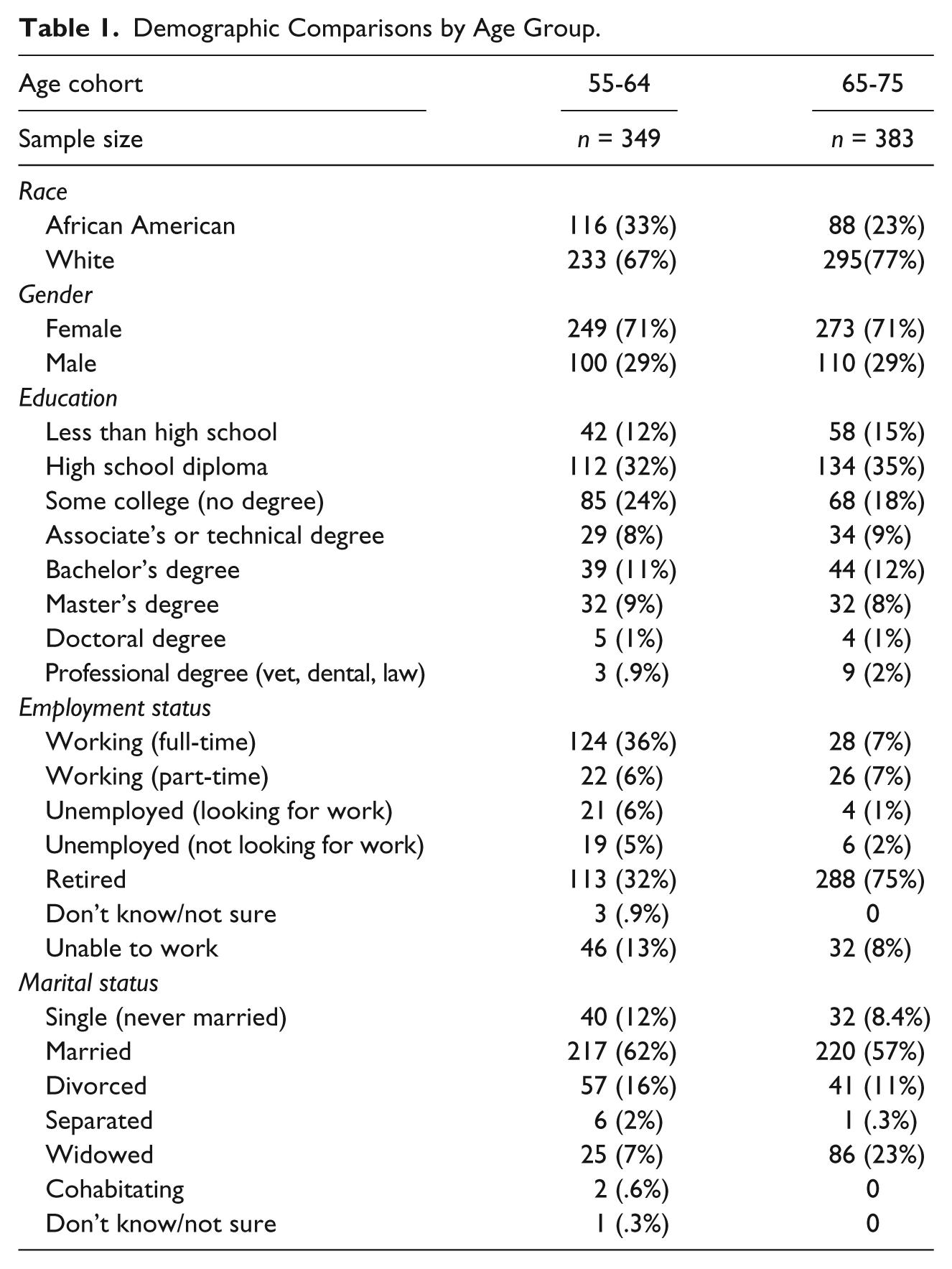
The sample (see Table 1) consisted of 383 older White and African American respondents (age 65-75) and 349 younger White and African American respondents (age 55-64). The majority of older respondents were married (57%), White (77%), females (71%) whose highest level of education was a high school diploma (35%). The majority of younger respondents were also married (62.2%), White (66.8%), females (71%) whose highest level of education was a high school diploma. Baby Boomers from Mississippi differ from their cohorts in other states in several ways: they are typically less affluent, less educated (Jack, 2007), and less likely to have access to computers or the Internet (U.S. Dept. of Commerce, 2009). In addition, like other Baby Boomers, they are approaching old age in a time of uncertainty, when safety nets for older adults, such as Medicare and Social Security, are being threatened.
Demographic Comparisons by Age Group.
Variables
Well-being scale
Prior research has defined well-being as a combination of evaluative and experiential factors, including positive evaluations of one’s life, and a balance between positive emotions and negative emotions (Kahneman et al., 1999; McMahan & Estes, 2011a; McMahan & Estes, 2011b). It would have been ideal if an established measure of subjective well-being had been employed; however, it is not uncommon for researchers to create their own in surveys designed for other uses. There has been some precedent for using a single evaluative item (i.e., how satisfied are you with your life) although such measures tend to have low reliability (Lucas & Donnellan, 2012). To measure both the global and the experienced dimensions of subjective well-being, a four-item index was created for the survey instrument. The index included three questions that ask participants to indicate the degree to which depression, loneliness, and boredom are problems for them. Also included was an item where participants were asked to rate their overall life satisfaction. All four of these items were based on 5-point Likert-type scales, with higher scores indicating a more positive situation for the respondent. Evaluation of Cronbach’s coefficient alpha indicated no problems with the internal consistency of the items used to create the measurement of well-being (α = .715). This level of reliability is consistent with the recommendations of Lucas and Donnellan (2012) with respect to the reliability of measures of well-being. To ensure that the selected questions measured a unified construct (i.e., well-being), a principle components factor analysis was performed. Loading criteria was set at Eigenvalues greater than one and a factor loading coefficient greater than .50. Analysis of the results indicated a single factor solution explaining approximately 55% of the variance among the variables. The results of the analysis indicated that the construct of well-being can adequately be measured with the scale created.
Household income
Household income was indicated on a scale from 1 to 8, with 1 being below US$10,000, and 8 being above US$100,000. One limitation of using this variable was the high rate of respondents (27%) who refused to provide information on their household income. Household income was used as a control variable in the regression analyses, to allow us to remove differences in well-being due to the obvious “wealth” factor, before examining the role of other predictor variables.
Future concerns measures
Respondents were asked a total of 11 questions that focused on older adults’ future concerns related to the service needs of older adults. The questions employed were similar to the ones on current concerns employed in several other elder needs assessments, including assessments from the state of Colorado (Colorado Division of Human Services, 2004), the City of Oakland, CA (2004), and the County of Los Angeles (2004). However, the domains covered were determined empirically, rather than a priori. For example, the LA County survey included the following domains: health needs, activity/employment, legal/safety needs, and transportation needs. Our survey included similar questions, but the factor analysis put them in different categories.
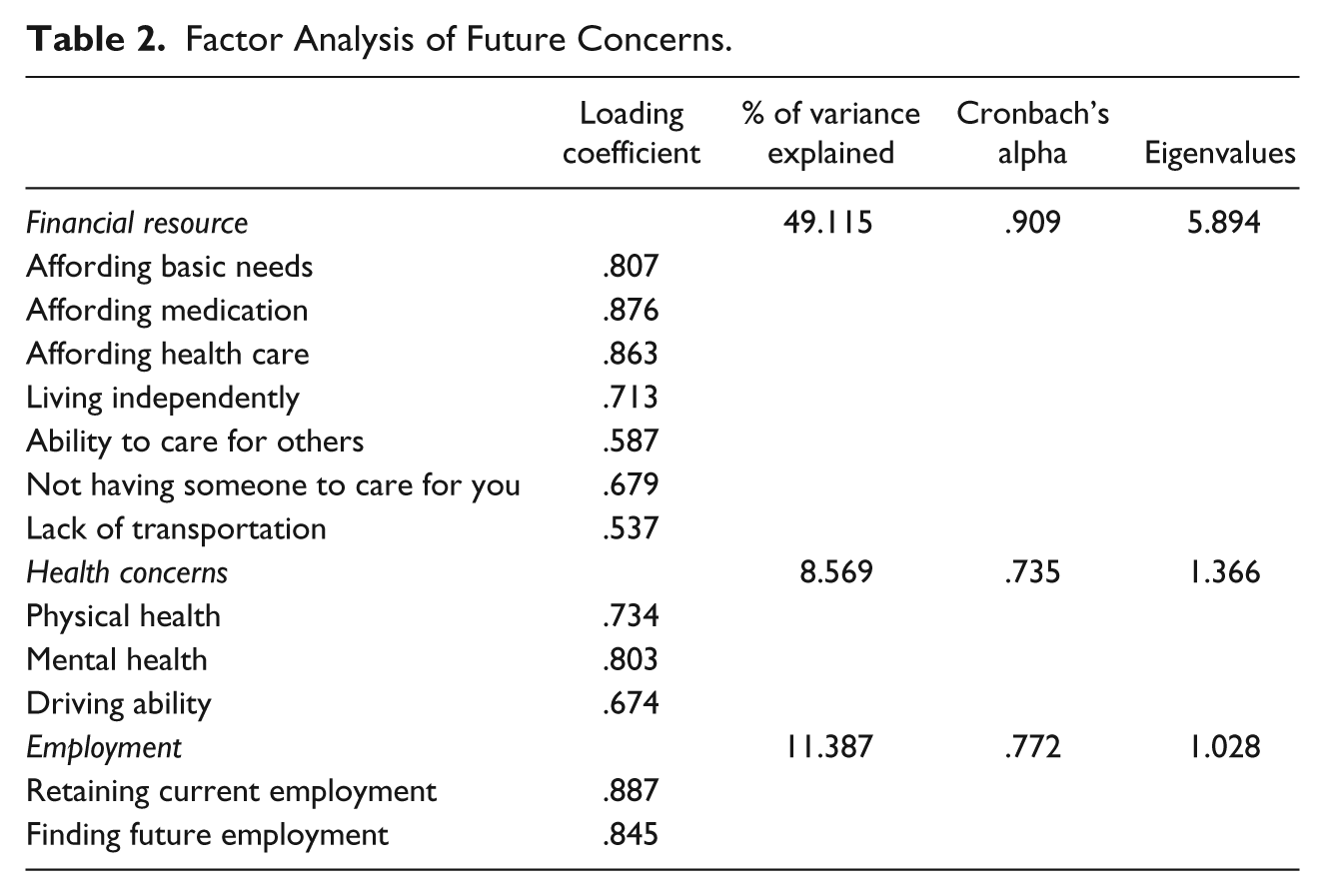
All questions were scored in the same direction, with a score of “1” indicating the lowest level of concern and a score of “5” indicating the highest level of concern. To more effectively analyze the relationship between the future concerns of respondents and their subjective well-being, a principal component factor analysis was utilized. Eigenvalues greater than one and factor loading coefficients equal to or greater than .50 were used as extraction factors. Results of the analysis yielded a three-factor solution explaining 69% of the variance for the series of 11 variables, allowing for the construction of three distinct indices that are described in the following sections.
Financial resources
This index was defined by six indicators: (a) affording basic needs, (b) affording medications, (c) affording health care, (d) living independently, (e) lack of caregiving, and (f) lack of transportation. Results from the factor analysis showed that the six indicators accounted for 49.1% of the variance, with an Eigenvalue of 5.894 (see Table 2). The Cronbach’s alpha for this scale was .909, indicating that the items were highly intercorrelated.
Factor Analysis of Future Concerns.
Health concerns
This index was defined by three indicators: (a) physical health, (b) mental health, and (c) driving ability. Results from the factor analysis showed that the three indicators accounted for 11.4% of the variance, with an Eigenvalue of 1.366 (see Table 2). The Cronbach’s alpha for this scale was .735, indicating a high level of intercorrelation.
Employment concerns
This index was defined by two indicators: (a) retaining current employment and (b) finding future employment. Results from the factor analysis showed that the two indicators accounted for 8.6% of the variance, with an Eigenvalue of 1.028 (see Table 2). The Cronbach’s alpha for this scale was .772, indicating that the items were highly intercorrelated.
Statistical Analysis
To identify whether significant differences in future concerns existed between the two age groups, a series of multivariate analyses of variance (MANOVA) were run, treating age group (Boomers vs. young-old) as the independent variable and the subjective well-being index, household income, and the three future concern indices as dependent variables. Based on the MANOVA findings, which will be further discussed in the Results section, a two-step hierarchical regression model was employed to determine if age differences in concerns continued to be evident after subjective well-being and current income or health were taken into account.
Results
MANOVA
The first MANOVA was performed to identify differences between the younger and older participants in terms of subjective well-being and household income. The results indicated a statistically significant main effect between the younger and older participants, Wilks’s λ.979, F(2, 729) = 7.77, p < .001, partial η2 = .021.
Results of the between-subjects effects showed that the young (Baby Boomer) participants (M = 4.24, SD = .86, n = 349) had statistically significantly lower ratings of subjective well-being than the older participants, M = 4.46, SD = .68, n = 383; F(1, 730) = 14.80, p < .001, partial η2 = .020. No statistically significant differences were found between the groups for household income.
The second MANOVA was performed on the three future concern indices. Statistically significant main effects were found between the older and younger participants, Wilks’s λ = .940, F(3, 728) = 15.52, p < .001, partial η2 = .06.
Results of the between-subjects effects indicated a statistically significant difference between the groups on the financial resources index, F(1, 730) = 10.43, p < .001, partial η2; = .014; the health concern index, F(1, 730) = 5.33, p < .021, partial η2; = .007; and the employment concern index, F(1, 730) = 45.98, p < .001, partial η2 = .059. As with the first series of MANOVA, younger participants reported higher levels of concern on all three future concern indices.
Hierarchical Regression
As stated earlier, it is common for individuals in late middle age to report lower subjective well-being than those in early old age, but it is less common for them to report higher concerns about the near future. The purpose of these analyses was to see if age differences in concerns were caused by lower subjective well-being, by current finances or health, as appropriate for the type of concern, or if the concerns were cohort-specific. Three hierarchical regressions were run, one for each of the three types of concerns.
Financial concerns
A hierarchical regression was run to see if age differences in financial concerns remained after income and subjective well-being were taken into account. In Step 1, income was regressed on financial concerns under the assumption that individuals with lower incomes would automatically have higher financial concerns. Household income was indeed a statistically significant predictor of financial concerns (β = −.275, t = −7.74, p < .001). Step 1 explained 7.6% of the variance.
In Step 2, subjective well-being was added, to determine the degree to which overall feelings of well-being were responsible for financial concerns, as income was taken into account. Household income remained a statistically significant predictor of financial concerns, β = −163, t = −4.776, p < .001. Subjective well-being strongly predicted financial concerns, β = −.399, t = −11.735, p < .001. Step 2 yielded a statistically significant R2 change, ΔR2 = .147, F(1, 729) = 137.718, p < .001. The total explained variance increased to 22.4%.
In Step 3, a dummy variable for cohort (Baby Boomer vs. pre-Baby Boomer cohort) was added. Household income remained a significant predictor of financial concerns, β = −165, t = −4.852, p < .001, as did subjective well-being, β = −.389, t = −11.337, p < .001. Cohort also significantly predicted financial concerns, β = .069, t = 2.104, p = .036. R2 change was significant for Step 3, ΔR2 = .005, F(1, 728) = 4.425, p = .036, The total explained variance increased to 22.7%. These findings suggest that income and overall well-being account for a great deal of the variance in financial concerns, but that the younger cohort had higher concerns even after their income and generally poor subject well-being were taken into account.
Health concerns
It was especially surprising that the Baby Boomer cohort would have higher health concerns than the group a few years older. Thus a hierarchical regression was conducted to see if the difference remained after general health and well-being were taken into account.
In Step 1, the health rating scale was entered as a predictor of future health concerns. As one might expected, self-rated health predicted health concerns, β = −.285, t = −8.030, p < .001. The first step accounted for 8.1% of the explained variance.
In Step 2, subjective well-being was entered. Self-rated health remained a significant predictor, β = −.123, t = −3.336, p = .001. Subjective well-being also significantly predicted health concerns, β = −.371, t = −10.020, p < .001. R2 change was significant, ΔR2 =.111, F(1, 729) = 100.406, p < .001. In Step 2, the amount of explained variance doubled from 8.1% to 19.2%.
In Step 3, the dummy variable for cohort was added to the regression equation. This time, R2 change was not significant, F(1, 728) = 1.076. This suggests that the differences between the two cohorts on health concerns are most likely due to the lower subjective well-being of the Baby Boomer cohort.
Employment concerns
Due to the fact that the Baby Boomer group tends to be working and trying to save for retirement, and the young-old group is predominantly already retired, it was not surprising that the Baby Boomer group would be more concerned about employment possibilities 5 years in the future.
A hierarchical regression was run with employment concerns as the dependent measure. In the first step, employment concerns were regressed on household income. Household income, surprisingly, was not a significant predictor of employment concerns, β = −.071, t = −1.917, p = .056. Only 0.5% of the variance was accounted for in this step.
In Step 2, subjective well-being was added to the regression equation, and it was found to be a significant predictor of employment concerns, β = −.160, t = −4.207, p < .001. Household income was still not a significant predictor, β = −.026, t = −.673, p = .501. Step 2 significantly increased R2, ΔR2 = .024, F(1, 729) = 17.696, p < .001. In Step 2, the percentage of the variance accounted for increased a great deal, to 20.8%.
In Step 3, the dummy variable for cohort was again added. This time, the cohort of birth was a significant predictor, β = .225, t = 6.266, and p < .001. Income was again not significant, β = −.033, t = −.889, p = .374. Well-being remained significant, however, β = −.126, t = −3.368, p = .001. The percentage of the variance accounted for increased to 22.3%. Baby Boomers are concerned about working in the near future, even after income and well-being are taken into account.
A hierarchical regression was run with both the Baby Boomer group and the earlier cohort included. The purpose of these analyses was to determine if the future concerns variables were predictors of well-being for both groups, and if being a member of the Baby Boomer group still predicted low well-being after income and future concerns were taken into account.
In Step 1, subjective well-being was regressed on household income. Household income is an extremely common predictor of well-being (Biswas-Diener, Vitterso, & Diener, 2010); here it was entered in the first step, so that the variance due to household income could be taken into account before the more interesting variables were analyzed. Household income was a statistically significant predictor of subjective well-being (β = .282, t = 7.946, p < .001). Step 1 explained 8% of the total variance in subjective well-being scores.
In Step 2, indices measuring future concerns about financial resources, health, and employment were added. Household income remained a statistically significant predictor of subjective well-being (β = .163, t = 4.820, p < .001). The financial resources index (β = −.266, t = −5.126, p < .001) and the health concerns index (β = −.187, t = −3.747, p < .001) were also statistically significant negative predictors of subjective well-being. Adding these variables in Step 2 yielded a statistically significant R2 change, ΔR2 = .161, F(3, 727) = 51.392, p < .001, as the total explained variance increased from 15% to 24%. Thus financial resources and health concerns predicted well-being even after controlling for household income.
In Step 3, a dummy variable for cohort (Baby Boom cohort vs. pre-Baby Boom cohort) was added. As in the previous steps, household income was a significant predictor of subjective well-being (β = .164, t = 4.891, p < .001). The financial resources index (β = −.261, t = −5.052, p < .001) and the health concerns index (β = −.190, t = −3.813, p < .001) remained as statistically significant negative predictors of subjective well-being. Being a member of the Baby Boomer cohort also was a negative predictor of subjective well-being, (β = −.099, t = −3.000, p < .003). There was a statistically significant change in R2 in Step 3, ΔR2= .009, F(1, 726) = 9.002, p < .003, as the total explained variance increased from 15% to 24%. These findings indicate that being a member of the Baby Boomer cohort was associated with low subjective well-being even after income and concerns about the future were taken into account.
Discussion
The purpose of this study was to compare future concerns of two age groups of Mississippi residents, Baby Boomers (aged 55-64 in 2011) and the young-old (aged 65-75 in 2011), and to examine the degree to which future concerns of the Baby Boomer group are due to the relatively lower subjective well-being of individuals in late middle age. The life course perspective suggests that coping with a major life transition, such as approaching old age, can be stressful, especially in a time of great uncertainty (Elder, 1998; Heckhausen et al., 1989). Consistent with this perspective, it was hypothesized that Baby Boomers would have more concerns about aging in the near future than adults between the ages of 65 and 75, even though previous research has shown lower concerns about aging in this age group (e.g., Yan & Lachman, 2006). It was expected that these concerns would persist even after subjective well-being and health or finances were taken into account.
The concerns examined were drawn from items typically reported in needs assessment surveys of older adults. These items were subjected to factor analysis to reduce the number of dimensions to be assessed. The dimensions that emerged included financial concerns, health concerns, and employment concerns. These dimensions are consistent with research on external factors that people believe affect their quality of life (Bowling, 1995). The results suggested that, on all three types of concerns, Baby Boomers had greater (or more negative) concerns than those in the 65 to 75 age group.
Results also indicated that the Baby Boomer group had lower subjective well-being than the older group. The lower well-being ratings are consistent with a large body of literature, suggesting higher well-being in late life than in middle age (Carstensen et al., 2011; Charles et al., 2001; Ehrlich & Isaacowitz, 2002; Inder et al., 2012; Riediger et al., 2009).
A second purpose of the study was to determine if the higher concerns were determined by objective factors, such as income and health, if they were a function of the low subjective well-being typical of late middle age, or if they were cohort specific. Separate hierarchical regressions were computed for each of the three types of concerns.
Higher concerns on employment were unrelated to income, but were related to low subjective well-being and to being a member of the Baby Boomer group. The higher concerns on employment associated with the Baby Boomer group are not surprising, but the fact that employment concerns were not predicted by income was surprising. The 65 to 75 age group was mostly retired and had little concern with future employment. By contrast, most of the Baby Boomer group was still working or wanting to work. In a context of difficult economic times, poor investment performance, and reduced government spending, the Baby Boomers may feel the need to stay in the workforce longer than previous generations (Beinhocker et al., 2009). A recent survey by the Employee Benefits Research Institute (EBRI) confirms the previous finding (Helman et al., 2012). They found that 37% of workers in 2012 expect to postpone their retirement beyond age 65, up from only 11% in 1991.
Financial concerns were predicted by income, subjective well-being, and membership in the Baby Boomer cohort. The greater financial concerns of the Baby Boomers persisted after income and well-being were taken into account, suggesting that worries about finances are relatively universal for the Baby Boomer group. The 55 to 64 group had on average significantly higher income than the 65 to 75 group, which should reduce their financial concerns. However, the 65 to 75 group was already retired, and had, for the most part, adjusted to their retirement income. It is fair to say that the Baby Boomer group faces more uncertainty about the future; a future where pensions, Social Security payments, and Medicare could be in jeopardy of being cut. Indeed, the EBRI survey indicates that current retirees are more confident that they will have enough money for retirement than those who are approaching retirement (Helman et al., 2012). The data on future health concerns are also intriguing. It is somewhat surprising that the Baby Boomers would be more concerned than the 65 to 75 age group about their health in the near future, given that the younger group is less likely to experience serious illnesses in the near future than is the older group (Anderson, 2010). However, health risks for Baby Boomers may be greater than those of previous cohorts, due to increases in obesity (Martin et al., 2009).
The results of the current study were that Baby Boomers were not more concerned about their future health after current self-rated health and subjective well-being were taken into account. Thus health concerns in the Baby Boomer group may be realistic. In sum, Baby Boomers had higher concerns about their own finances, employment, and health in the next 5 years than did individuals in early old age. The relationship between the three types of future concerns and subjective well-being was assessed after subjective well-being and current income or health concerns were controlled. It was found that future economic and employment concerns were related to subjective well-being even after current income was taken into account and age differences in these two concerns persisted after income and subjective well-being were controlled. This finding suggests that economic worries are high in Baby Boomers even among those who are currently financially stable. They may instead be related to two factors: (a) uncertainty about one’s own ability to live comfortably as a retired person and (b) a climate of uncertainty about the economy and the future of social programs for older adults at the time the survey was taken. In addition, these results suggest that financial fears are driving Baby Boomers’ worry about the future more than health-related fears.
Health concerns were related to subjective well-being even after current health was controlled. However, age differences in health concerns disappeared after health and subjective well-being were controlled. This suggests that the health concerns of Baby Boomers are not different from the concerns of the young-old and may not be predictive of future poorer health.
Limitations
The data used in this study came from a single telephone survey of adults above the age of 55 in Mississippi. Although one of the authors helped to design the original questions, the original assessment was not designed with this particular study in mind. A more focused study of Baby Boomers’ concerns about aging would have included a broader age range of boomers, including individuals born between 1957 (the year where the number of babies born peaked) and 1964.
Some of the limitations of this study are due to the fact that the needs assessment instrument was not specifically designed for the study, but to reflect services provided by the state. As such, the future needs could have been expanded to measure more social needs. For example, one important question would be to examine the relationship between fears of the future and the extent to which Baby Boomers believe they will have someone to care for them, if they need a caregiver. This question becomes especially important, given that Baby Boomers are less likely than previous generations to have been part of traditional families, so the obvious caregivers (children, spouses, and other family members) may be less available to them (Cherlin, 2010).
Another limitation of the study was that only individuals with land-based telephone lines could be included in the sample. Because people are moving away from land-based telephone lines to mobile lines, and mobile lines cannot be accessed using random dialers, survey researchers relying on telephones will have more problems getting representative samples (Blumenthal, 2010; Christian, Keeter, Purcell, & Smith, 2010). However, older adults are much less likely than young adults to have eliminated their landlines, so this may be less of a problem for the current sample (Blumberg & Luke, 2008).
Finally, a drawback is that asking participants to anticipate problems 5 years in the future might not have been ideal for both age groups. Five years seems like a reasonable amount of time for the older group but seems a little short for the younger group, the youngest of whom would not have changed age categories. However, since the younger group still had more concerns, the choice of five as the number of years to imagine in the future, seems vindicated.
Overall, Baby Boomers reported lower subjective well-being than the older group and higher concerns about the future. Findings also indicated that this low quality of life was related to fears about their financial future—fears that were not simply a function of current economic difficulties. Baby Boomers may be right to worry about their economic future: some economists predict that Baby Boomers will have more trouble than the previous cohort maintaining their standard of living postretirement (Butrica, Smith, & Iams, 2012).
This article did not examine differences in future concerns of Baby Boomers from different ethnic groups. Mississippi is very racially diverse, with the highest percentage of African Americans of any state in the United States (U. S. Census Bureau, 2011). We look forward to studying differences between African Americans, Whites, and other ethnic groups in future studies.
In addition, future research needs to look more closely at the anxieties and concerns of adults approaching old age to separate realistic fears from stereotypic fears. It is possible that the fears of Baby Boomers in this sample are due to a time of measurement effect; approaching old age is especially difficult in a time of economic instability.
Policy Implications
Policy makers need to be aware of the heightened levels of anxiety about aging for a variety of reasons. First of all, the anxiety of Baby Boomers is not unrealistic. Entitlements such as Medicare, Medicaid, and Social Security may be cut in the future, due to a changing political climate, and the reality that the size of the Baby Boomer generation and their longevity may make it difficult for the society to maintain these programs at their current levels. The Baby Boomers may need to be more vigilant in their financial planning than the previous generation. Some will expect to work longer than members of the previous cohort, which might affect the availability of jobs for younger people.
One possible consequence of Baby Boomers’ fear about their financial future is that these fears may interfere with such financial planning. Individuals with high financial anxieties may be at risk for making poorer financial decisions, either more conservative or riskier decisions. In addition, anxiety about the future can lead to high levels of depression and learned helplessness. The anxiety could also lead to higher rates of physical illness, as older adults who have negative expectations for the future may not be proactive with their health. Several kinds of interventions might be useful to help the Baby Boomers remain healthy and financially stable in the years to come. Interventions such as counseling and outreach activities are necessary to help Baby Boomers avoid depression and poor health. In addition, programs aimed at encouraging sound financial and health-related decisions would be beneficial. Finally, political efforts to stabilize Medicare, Medicaid, Social Security, and other financial institutions would help ensure that the majority of Baby Boomers age successfully.
Footnotes
Authors’ Note
The research performed in the present study was approved by the IRB at my institution to ensure the protection all participants. IRB protocol No. 10-342.
Declaration of Conflicting Interests
The authors declared no potential conflicts of interest with respect to the research, authorship, and/or publication of this article.
Funding
The authors received no financial support for the research, authorship, and/or publication of this article.