



Abstract
Purpose:
This study describes the development of a self-report survey measure of empathetic care. Empathetic care is defined as caregiving that supports clients’ socioemotional capabilities and addresses their emotional needs. It is distinct from instrumental care, which involves assisting with physical needs such as activities of daily living.
Design and Method:
Based on a literature review, structured interviews, and focus groups, we identify three dimensions of empathetic care: extra-role behavior, emotional support, and relational richness. We then developed a large pool of items that could tap into these dimensions and administered versions of the survey to nearly 300 health care paraprofessionals.
Results:
After performing exploratory factor analyses on a larger survey of 138 paraprofessionals, a 10-item, three-factor measure, the Empathetic Care Scale (ECS), was developed that predicts decisions on consequential allocation scenarios. A second sample of 125 paraprofessionals provided data for a confirmatory factor analysis; results suggested that the ECS has desirable psychometric properties and evidence of convergent and discriminant validity. Further samples demonstrated acceptable levels of test-retest reliability and no social desirability bias.
Implications:
This study provides a short self-report measure that can be used to gauge care workers’ individual levels of empathetic care. Future research can use this measure to explore relationships between ECS responses and previously proposed but untested outcomes such as patient well-being and employee burnout or turnover rates.
Introduction
Paid care work differs from other service work in that it involves interpersonal interactions designed to enhance the intellectual, physical, and/or emotional capabilities of care recipients (England, Budig, & Folbre, 2002; Folbre, 2012). Occupations in this category of work include certified nursing assistants (CNAs), home health aides (HHAs), and personal and home care aides (PCAs). 1 Many such workers specialize in gerontological care of the frail elderly, as these make up their largest client base of care recipients. Such workers assist with meeting elders’ basic physical needs such as bathing and feeding (often called assistance with activities of daily living or “instrumental care”) and also for being responsive to the emotional needs of clients (“empathetic care”). While instrumental care is focused on developing, maintaining, or substituting for frail elders’ functional capabilities, empathetic care involves behaviors that support the development of elders’ socioemotional capabilities and address their emotional needs (Folbre & Nelson, 2000). Our focus in this research is on developing and testing a measure of empathetic care.
Empathic care is thought to be a critical aspect of quality caregiving. As reported by Chung (2012), paid care workers describe their jobs, and the processes and outcomes associated with them, not only in terms of care recipients’ instrumental needs for comfort and cleanliness but also in terms of the peace and happiness that recipients experience in their care. Care recipients similarly report both empathetic and instrumental care as important to overall care quality (Bowers, Fibich, & Jacobson, 2001). To the extent that a focus on socioemotional and relational health supports the recognition and preservation of “personhood,” paid caregivers may be particularly well-suited to its provision (Byrne et al., 2012). Other research has explored empathetic care from the perspective of family members contracting for paid care workers to attend to the needs of a loved one. A growing literature establishes the importance of relationships between paid and family caregivers in providing satisfying care (Hasselkus, 1988; McGilton, Guruge, Librado, Bloch, & Boscart, 2008; Schwartz & Vogel, 1990). Recent work (Funk & Stajduhar, 2013) has also emphasized the importance of understanding relationships between health care professionals (nurses) and family caregivers, noting the importance of frequent and positive interactions between home care nurses and family caregivers as critical to relationship building and satisfaction. Other work specifically notes the importance of empathic support (Bonnel, 1996; Caron et al., 2005) in family caregivers’ perceptions of interactions with late-life caregivers.
Notwithstanding these largely qualitative studies, note that we have a much richer and broader-scale store of knowledge about instrumental aspects of care. Such studies tend to focus on outcome measures such as the incidence of injury, other health problems, and longevity of elderly clients (American Nurses Association, 2000), or on client or family satisfaction with the quality of instrumental care (Lin, 1996; Mahon, 1997; Urden, 2002). Consequently, in large-scale studies of predictors of care quality, the emphasis has largely been on factors like staffing ratios (Castle, 2008; Horn, Buerhaus, Bergstrom, & Smout, 2005) and worker training (Engelman, Altus, Mosier, & Matthews, 2003; Shetterly, Malone, & Poon, 1998), again with a focus on ensuring care recipients’ functional well-being. While such a focus is understandable, it has left us relatively uninformed about the empathetic component of paid elder care.
Empathy, more generally, is defined by psychologists as an “other-oriented emotional response congruent with the perceived welfare of another person” (Batson, Ahmad, Powell, & Stocks, 2008, p. 136). Folbre and Olin Wright (2012) view empathy as an essential part of quality elder care, and so describe it as “activities in which concern for the well-being of the care recipient is likely to affect the quality of the services performed in interaction with that person” (p. 4). They further argue that it is this empathetic component of caregiving that fundamentally distinguishes it from other forms of service work in several respects. First, emotional engagement is consequential to the quality of care provided; thus, clients tend to fare better when they are being cared for by workers who express more concern for their well-being (Bowers et al., 2001). Second, since empathy entails emotional feelings toward another, the empathetic component of care tends to be person-specific and tailored to specific client needs. As such, empathy can be expected to be an integral component of successful “person-centered care” (Henderson & Vesperi, 1995; Kitwood, 1997; Nolan et al., 2001) as higher empathy raises the likelihood of individualized relationships between caregivers and care recipients. Indeed, paid caregivers often describe their elder clients in terms of friendship, kinship, and even love (Mittal, Rosen, & Leana, 2009; Pfefferle & Weinberg, 2008). Third, empathetic care, even when provided for pay, is often intrinsically motivated by feelings of altruism. As England, Folbre, and Leana (2012) note, there is little in the actual job of caregiving that is inherently pleasurable independent of the altruistic aspects of the work, as it often requires physical exertion and unpleasant tasks such as toileting. In the marketplace, such work is typically low-paying and highly monitored, thus providing little in the way of extrinsic rewards. Altruism, then, and the empathetic connections inherent in the work, becomes important not only to the elderly recipients of care but also to the well-being of caregivers.
In summary, there is a growing literature on the quality of paid care, but much of this research has focused on the instrumental aspects of care. The empathetic component of care is thought to be of equal importance in terms of overall quality, but there has been comparatively little research on this aspect of paid caregiving. When research has illuminated the nature and importance of empathetic care for recipients, explorations have primarily been qualitative (e.g., Bowers et al., 2001; Chung, 2012; Stacey, 2011). For example, Bowers et al.’s in-depth interviews suggest that a distinct segment of nursing home residents conceptualize care primarily in terms of friendship and reciprocity with caregivers, goals that can be best achieved through strong empathy. Chung’s (2012) grounded theory approach concluded that client happiness as well as direct care workers’ respect and affection for their clients were central to ideas of “good care.” However, no tool exists to determine if outcomes are objectively or subjectively better if such elements exist. Thus, despite the insights gained from these rich qualitative studies, it is difficult to quantify their levels or integrate them into large-scale studies such that antecedents and effects of empathetic care can be identified. Thus, one barrier to gaining a better understanding of client-centered empathetic care has been the absence of a good measure to capture its presence or absence in the care work population.
Purpose of the Research
It is relatively easy to assess if a client is clean and comfortable on a regular basis—and many performance assessments of paid care workers focus on such factors. Assessing the quality of clients’ socioemotional and relational care is a far more challenging undertaking. Thus, our goal in this study is to develop a measure of empathetic care that is valid, reliable, and easy to administer across large samples. Moreover, while there are several studies of the attitudes and behaviors of CNAs (Cready, Yeatts, Gosdin, & Potts, 2008; Engström, Skytt, & Nilsson, 2011; Franco, Bennett, & Kanfer, 2002), there are relatively few such studies that simultaneously include care workers who perform their work in clients’ homes as well as in facilities such as nursing homes. We wished to develop a measure of empathetic care that could be used for care workers, regardless of whether they work in institutional or home settings.
Before proceeding, we should note that we are not focused here on measuring empathy as a personality trait; rather, our focus is on empathetic care—or the manner in which caregivers attend to clients’ socioemotional and relational needs. Trait empathy is of interest to psychologists and others, and self-report measures of generalized empathy are available in the literature (e.g., Davis, 1983; Hogan, 1969; Mehrabian & Epstein, 1972). Much has been written about the origins of empathy as a cognitive and affective state, and there has been a good deal of research examining the relationship between trait empathy and helping behavior in psychology (see Batson et al., 2008, for a review). Our concern here, however, is not with developing a measure of generalized empathy. Instead, we are concerned with developing a self-report measure of how empathy is enacted by caregivers, particularly those who are paid to attend to the needs of the frail elderly.
Dimensions of Empathetic Care
Empathetic care is clearly a multidimensional construct that involves feelings as well as behaviors. We began our research by reviewing the existing literature in several fields: (a) research in organizational behavior that focuses on generosity and attention to the needs of others at work (e.g., Grant & Ashford, 2008; Grant & Berg, 2011; Rioux & Penner, 2001; Van Dyne & LePine, 1998), (b) research in psychology that examines empathy as a facet of temperament influencing individual action (e.g., Batson et al., 2008; Eisenberg & Miller, 1987; Goetz, Keltner, & Simon-Thomas, 2010; Oveis, Horberg, & Keltner, 2010; Penner, Dovidio, Piliavin, & Schroeder, 2005), (c) research from sociology that is focused on care work as a profession and the unique challenges and rewards it entails (e.g., England et al., 2012; Folbre & Olin Wright, 2012; Stacey, 2011), and (d) research from nursing that describes empathy as an integral part of the day-to-day work (e.g., Bowers et al., 2001; Kunyk & Olson, 2001; Olson, 1995). Despite the use of different labels for describing facets of empathetic care across the various literatures, and the use of different research paradigms, three common themes emerged from our review. These themes allowed us to develop an initial typology of the ways in which empathetic care has been conceptualized and, where empirical studies are available, operationalized in research. We labeled these facets: (a) extra-role behavior—the extent to which the caregiver goes “above and beyond” in the job to make the client feel better, (b) emotional engagement—the extent to which the caregiver tends to the client’s emotional needs, and (c) relational richness—the extent to which the caregiver has an individualized relationship with the client.
Van Dyne and LePine (1998) define extra-role behavior at work as behavior that is not formally specified in the job description or formally rewarded. Thus, it entails activities that are not part of the formal job role but instead are “extra-role.” For care workers, extra-role behavior encompasses performing services for clients that are beyond “the checklist.” Emotional engagement is a facet of empathetic care that has been studied extensively in the nursing literature as well as the research in psychology on stress and burnout. In the nursing literature, Hudson (1993) describes such engagement as focused on “caring rather than curing” the patient. The relational richness facet of empathetic care is concerned with the interpersonal interaction between caregiver and client. This captures the person-oriented nature of caregiving that, as Folbre and Olin Wright (2012) note, distinguishes it from other service jobs. Indeed, Karner (1998) used the term “fictive kin” to describe the role that many caregivers serve in clients’ emotional lives and vice versa.
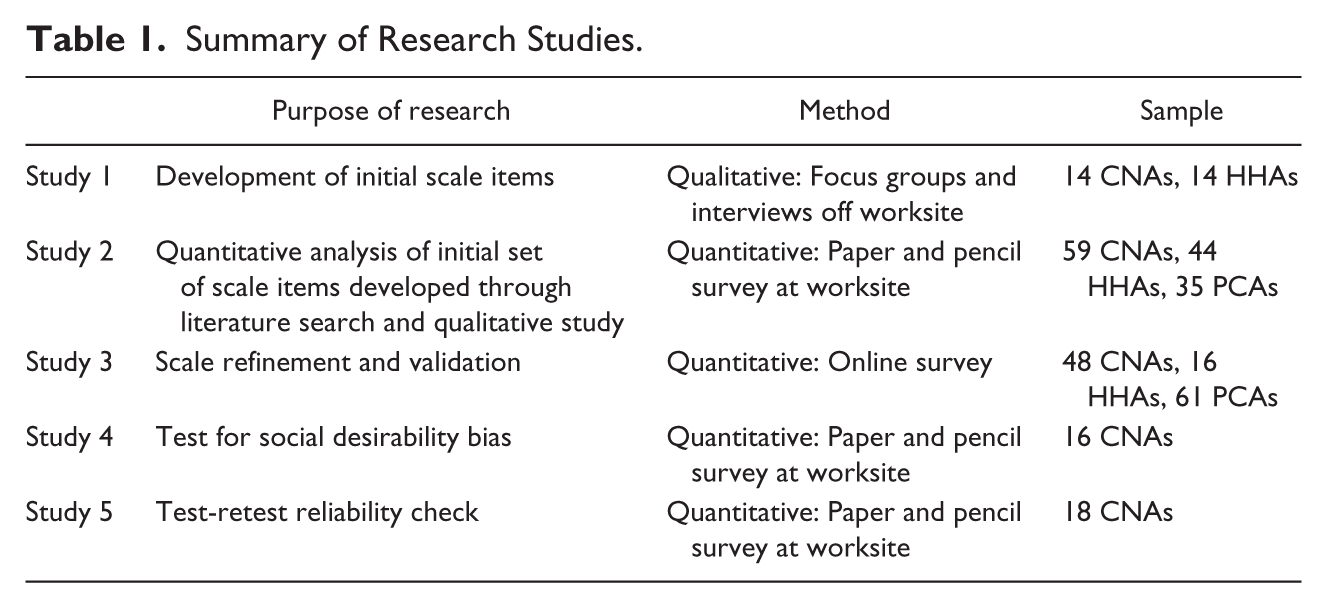
In our research, we developed and tested these three facets of empathetic care using both qualitative and quantitative methods, and with various samples of paid caregivers of the frail elderly. In Table 1, we summarize the various studies and discuss each in turn below.
Summary of Research Studies.
Method and Design
Study 1: Initial Item Development 2
The purpose of the qualitative portion of the research was to develop and refine items for the Empathetic Care Scale (ECS) dimensions that we had identified in our literature review. We were also interested in developing realistic scenarios and tasks that would be expected to correlate with empathetic care, and thus could be used to help validate the scale. We began with a focus group and interviews, where participants acted as “content experts” in helping us to develop measures that were realistic and comprehensive.
Specifically, we conducted two focus groups with 14 CNAs and 14 HHAs, as well as small group interviews with an additional 10 paid caregivers (HHAs and CNAs). All but two of the participants were women, all ranged in age from mid-20s to mid-50s, and all were recruited through posted signs at their worksites (nursing home or home care agency). Our overall purpose was to gain an understanding of how the facets of empathetic care found in the literature are enacted by paid care workers on the job. We were also interested in probing for any facets of empathetic care that may not have been captured in the literature. These focus groups were relatively unscripted and interactive, and were used to assist us in better understanding and refining the construct and its measurement. All participants signed informed consent documents in accordance with procedures approved by the human subjects committee and were paid $20 for approximately 1 hr of their time during the focus group or interview.
In all of our interviews and focus groups, the discussion was oriented toward how the three dimensions of empathetic care found in the literature are enacted in their jobs. We began the first focus group and the interviews by describing empathetic care (and its distinction from instrumental care) and then asked participants to share stories or incidents that demonstrated good or bad empathetic care on the job. This was an unstructured discussion whose primary purpose was to elicit examples that we might use in developing items for the ECS and as an initial set of validation scenarios.
In the context of paid care work, we learned from the first focus group and interviews that extra-role behaviors can range from bringing in extra things from home to make a nursing home resident’s room more cheerful, as one CNA in our focus groups related, to helping with the care and grooming of a client’s pet or interior decorating help, as several home health aides in our focus groups described. As noted by a certified nursing assistant, extra-role behavior is visible in the workplace, “You know when you work together, you see the people that’s . . . always loving on the residents, always going the extra mile showing they care.”
Nearly all the care workers in our first focus group and interviews talked about emotional engagement as fundamental to doing the job. They used terms like “caring,” “affection,” and even “love” when describing how they feel about the clients they care for. They also often described the deep relationships they developed with clients, often referring to them as good friends or members of their families. We describe our relationships as “rich” when we know, and are known, well by another person. In the case of care workers, such richness in relationships with clients included sharing information about one others’ lives and having deep knowledge about each person’s individual preferences and emotional needs. In the focus group and interviews, participants described this type of relational richness most frequently in terms of family: “They become like your family, you know? I treat them like I’d want somebody to treat my mother.”
We also elicited ideas from the first focus group and interviews to develop consequential decision tasks (hereafter referred to as “consequential tasks”) and scenarios (hereafter referred to as “time allocation scenarios”) that might tap empathetic care. The consequential tasks focused on outcomes that would alter participants’ time use or professional advancement. One question asked participants to indicate how they would like to spend a half hour of discretionary time at work. Based on respondents’ input, we anticipated that more empathetic caregivers would be more likely to spend time getting to know their residents better or learning more about their emotional needs, while less empathetic caregivers would allocate this time to more instrumental activities. The second question asked participants to provide items that might be added to their own performance appraisals done by their supervisors. Participants agreed that a more empathetic care worker would be more likely to wish to be evaluated on items related to the emotional or relational care and well-being of residents compared with a less empathetic worker. Finally, we wanted to develop time allocation scenarios that might demonstrate empathetic care at work. We asked participants for examples that might distinguish between care workers who were doing their jobs with more versus less empathy. Here, participants gave us several different examples based on their experiences on the job. 3
We took the transcripts from these sessions, as well as drawing on the previous literature, and developed an initial set of empathetic care items, as well as an initial set of “consequential tasks” and “time allocation scenarios,” which we used as a basis for the second focus group discussion. In the second focus group, we again began the session by describing empathetic care. We then distributed our initial set of empathetic care items developed from our literature review and the first focus group and interviews and asked participants to react to these items in terms of whether they were (a) realistic in terms of their jobs, (b) written in a language they could understand, and (c) would show variance in that different care workers might respond to them differently. We followed the same procedure with the consequential tasks and time allocation scenarios we had developed based on the earlier focus group and interviews. Thus, the second focus group was used to help us refine the ECS items as well as the consequential tasks and time allocation scenarios.
Based on the information from our literature review and focus groups, our initial pool of items measuring the three dimensions of the ECS consisted of 27 items. Extra-role behavior has been studied extensively in the organizational behavior literature and several self-report measures have been developed to assess extra-role behavior and its various dimensions (e.g., altruism, conscientiousness). To measure this facet of empathetic care, we took seven items from validated scales used by Van Dyne and LePine (1998) but adapted them based on our focus group discussions to the context of care work. These included items such as “I do many extra things for my clients, even if my employer doesn’t tell me to.” Several measures have also been developed to try to tap into the emotional engagement facet of empathetic care, including McGilton, Pringle, O’Brien-Pallas, and Streiner’s (2005) Relational Care Scale and Mercer, Maxwell, Heaney, and Watt’s (2004) CARE (Consultation and Relational Empathy) measure. We adapted several items from these scales based on focus group discussion, to compose our initial pool of items for the emotional engagement facet of empathetic care. These included items such as “I help my clients feel better when they are down” and “My clients’ emotional state is just as important as their physical state.” We captured the relational richness facet of empathetic care through items such as “I know what might clients’ lives were like before they became unwell” and “Part of my job is to get to know pretty much everything about the people I care for.” These items were generated largely through the focus groups as no existing scales were available that appears to be directly relevant.
Study 2: Preliminary Item Analysis and Scale Validation
Method
In Study 2, paper and pencil surveys were used to conduct a preliminary quantitative analysis of the 27 items generated through the literature search and focus groups described above. Respondents were 138 health care paraprofessionals (59 CNAs, 44 HHAs, and 35 PCAs; Mage = 46.3 years, 88.6% female, 45% part time) who completed the surveys at their worksite between shifts during winter 2012 and spring 2013. In accordance with human subjects procedures, respondents were recruited via a posted sign in their workplace and public announcements, and the participation was entirely voluntary. All participants signed informed consent forms before beginning the survey. The surveys took approximately 15 min to complete for which participants were paid $5 each. Some respondents did not complete all items in the survey or quit before completing the entire instrument. Where data are available, they are used in the analysis.
Before completing the empathetic care items, participants first provided demographic (age, gender) and work status information (full time, part time). Note that aside from demographic items, all responses were collected on strongly disagree (1) to strongly agree (7) scales. A subset of respondents (n = 62) also completed the consequential tasks developed during our qualitative work (Appendix A). These items were added to the survey approximately halfway through data collection. Responses on these items were used to provide preliminary face validity and convergent validation of the empathetic care measure; based on our qualitative research, we anticipated different patterns among more as opposed to less empathetic respondents. A strong relationship between items that tapped into our three focal factors of empathetic care and respondents’ decisions on these tasks would therefore provide preliminary evidence of the empathetic care measure’s face and predictive validity.
Analysis and results
We first performed an exploratory factor analysis using principal axis approach and a varimax rotation (Sharma, 2006), focusing on the items related to our focal constructs. A principal axis factoring approach was used to accommodate the negative skew in the items; the varimax rotation was used to allow each variable to load highly on one and only one factor, as recommended by Sharma (2006). Using the eigenvalue greater than one rule, we identified three factors in the data that should be retained. After removing two items that either cross-loaded at above .5 on these factors or did not load at above .5 on these three factors (14 items), a clean three-factor solution emerged as shown in Table 2.
Loadings in Exploratory Factor Analysis, Study 1.
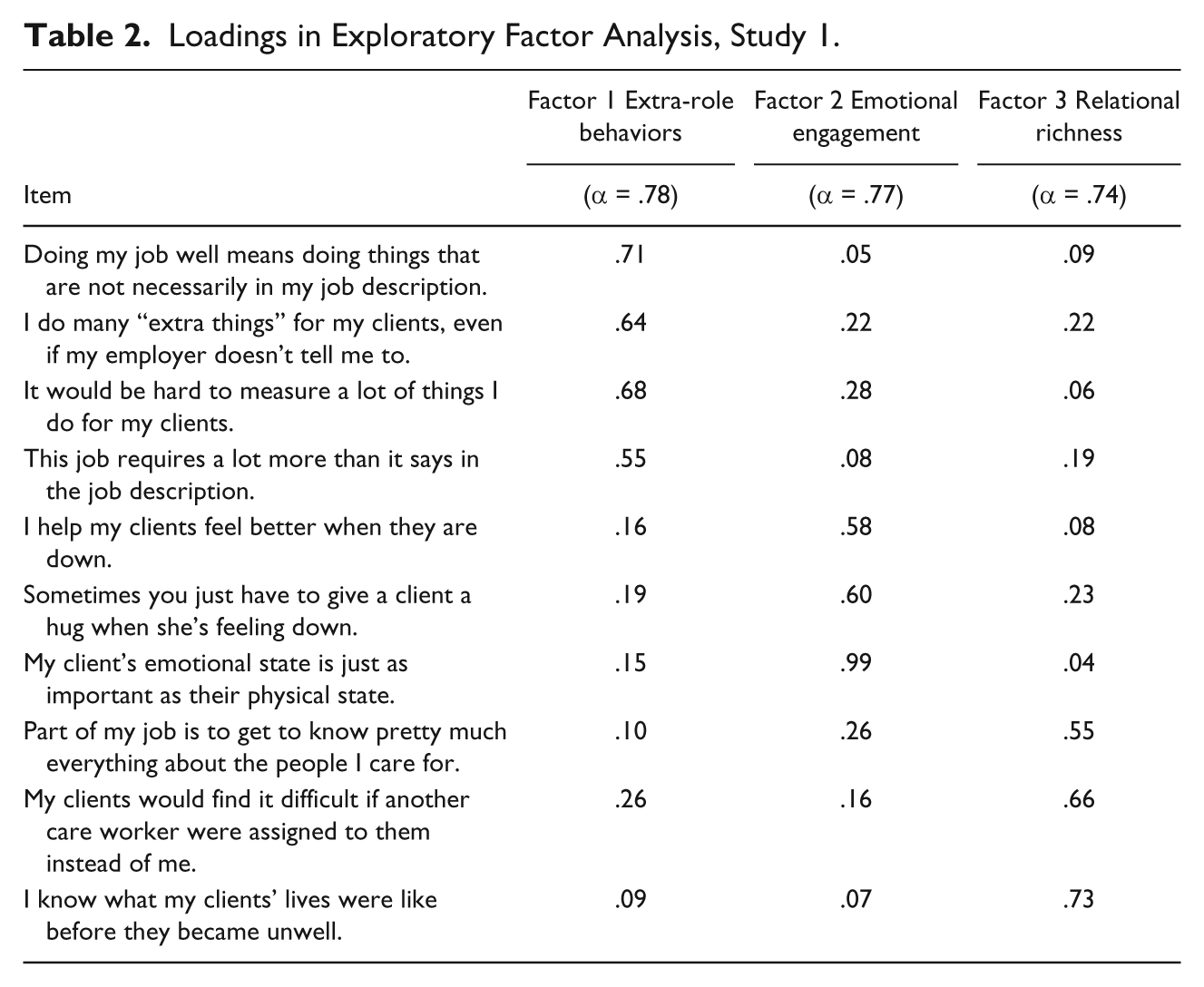
We note that the individual subscales also possess acceptable levels of reliability. Given these results, the preliminary overall ECS was created by averaging the mean of each subscale in the measure (M = 5.31, SD = 1.07, range of 1.81 to 7.00).
Initial tests of scale validity
Tests for differences across groups
We used the preliminary ECS to test for relationships between the empathetic care measure and demographic factors. We also checked to see if the constructed empathetic care measure reliably predicted responses to the consequential task questions developed in the focus groups. The data did not show strong kurtosis or skewness (both < .1), and thus an ANOVA was estimated using job title, age, gender, and work status as simultaneous predictors of empathetic care, using SAS’s general linear model procedure. No significant differences were seen based on any of these factors: job title, MCNA = 5.56, MHHA = 5.01, MPCA = 5.20, F(1, 119) = 2.04, p = .13; age, b = .18, F(1, 119) = .16, p = .70; gender, Mfemale = 5.31, Mmale = 5.27, F(1, 119) = .35, p = .55; or work status, Mpart time = 5.16, Mfull time = 5.43, F(1, 119) = .15, p = .70. Further, a general linear model was also estimated allowing all possible interactions between these factors. No interactions of any of these factors were significant predictors of ECS (all p > .47). However, to ensure that effects of empathetic care are robust, above and beyond these demographic factors, they are entered as covariates in subsequent analysis and reported when significant.
Validation using consequential tasks
We next used mean-centered empathetic care scores and the above-mentioned demographic factors to predict responses on the consequential tasks identified in Study 1. Here, there were two items: (a) Task Importance and (b) Evaluation Items. The Task Importance item asked respondents to indicate how they would like to spend a half hour of discretionary time at work and included empathetic (“Getting to know the clients better”) and nonempathetic (“Training to sharpen my technical skills”) options (the two items are shown in Appendix A). Participants were asked to rank these items from most (1) to least (4) important. To see if more empathetic workers would in fact place a higher importance on the empathetic tasks, we averaged the rankings for the two empathetic care items (learning how to better deal with residents’ emotional needs and getting to know the residents better). Lower averages represent a higher degree of importance. As anticipated, as empathetic care scores increased, the rankings of the two empathetic care items decreased, b = −.24, F(1, 57) = 6.51, p = .01, suggesting that caregivers scoring higher on the ECS were more interested in receiving training in areas that supported the emotional well-being of patients than were lower ECS respondents.
Our second consequential outcome related to evaluation criteria. To test whether higher ECS respondents were likely to emphasize the assessment of more empathetic behaviors in their performance evaluations, we averaged the ratings provided for the four empathetic items and three nonempathetic items provided. We then conducted a repeated-measures analysis, where empathetic care and demographics were treated as between-subjects factors and the type of evaluation item (empathetic, nonempathetic) was treated as a within-subject factor. This analysis revealed only a significant interaction of ECS and the evaluation type under consideration, F(1, 58) = 5.79, p = .02. Further analysis shows that while ECS scores did not predict significant differences in belief that individuals should be assessed on nonempathetic aspects of their work, F(1, 58) = 0.20, p = .65, a higher score on the ECS scale was associated with a stronger belief that empathetic aspects of work should be evaluated, F(1, 65) = 6.49, p = .01. Taken together, responses on these items provide preliminary evidence that the three-factor ECS may be reflected in consequential decisions caregivers make with regard to care recipients’ emotional health.
Study 3: Scale Refinement
A second sample was then used to further refine the ECS measure. Rather than collecting the large item pool used in Study 1, this survey focused on the 10 empathetic care items previously identified. These are shown in Appendix B. Because we now hypothesized a certain underlying factor structure, responses on these items were subjected to a confirmatory factor analysis that directly tested goodness-of-fit for the three-factor structure suggested by the results in Study 2, following the recommendations of Sharma (2006). We also collected responses to the two time allocation tasks generated during our qualitative work, which are shown in Appendix C. Finally, we collected responses regarding constructs from which we wanted our scale to discriminate (i.e., trait empathy) and with which our scale should converge (intrinsic and pro-social motivation). We also collected a measure of extrinsic motivation, to provide evidence that significant differences were due to real underlying relationships rather than the use of common methods.
Method
Respondents were 125 paraprofessional caregivers (16 HHA, 48 CNA, 61 PCA, Mage = 46.7 years). Participants were recruited via the webpage of a direct care worker association and submitted an electronic-informed consent as approved by the Institutional Review Board prior to answering the study questions. Gift cards in the amount of $10 were mailed to participants after completion of the survey, and all identifying information was separated from responses, consistent with Institutional Review Board-approved procedures. Completion of the online survey took 20 to 30 min.
All respondents completed the 10-item measure generated in Study 2. They then read two scenarios (“time allocation scenarios”) intended to capture their propensity to allocate their time in ways that benefited their clients’ emotional well-being, whether by taking time to clean a client’s room so that it might be prepared for visitors or by making time to give an emotionally distressed client a pep talk. They also specified how much time they would spend undertaking each activity, where 1 indicated “very little time” and 7 indicated “a great deal of time.” We expected participants’ responses to these measures to positively covary with their ECS scores, and thus support the convergent validity of the ECS. Finally, participants assessed each scenario for realism (1 = very unrealistic, 7 = very realistic) so that we could rule out the possibility that more empathetic individuals were simply more sensitive to these types of situations and needs. The allocation scenarios and associated response items are shown in Appendix C.
Participants also completed four other scales that were used to show either convergent or discriminant validity of the ECS scale. These constructs and their associated measures were drawn from the prior literature and are shown in Table 3. Trait empathy was assessed—using items from Davis’s (1983) Interpersonal Reactivity Index—to ensure that the ECS was a distinct construct rather than simply reflective of an underlying personality dimension (discriminant validity). We expected both pro-social work motivation (motivation to work based on the desire to help others) and intrinsic work motivation (motivation to work for inherent enjoyment) to positively covary with ECS scores (convergent validity). These constructs and measures, along with extrinsic motivation, were developed and are widely used by researchers in organizational behavior and psychology to assess the underlying motives behind work behavior. Extrinsic motivation, conversely, was not expected to covary with ECS scores since extrinsic motivation taps the extent to which the person is motivated at work by money or other such rewards.
Potentially Related Constructs Included in Study 2 Survey.
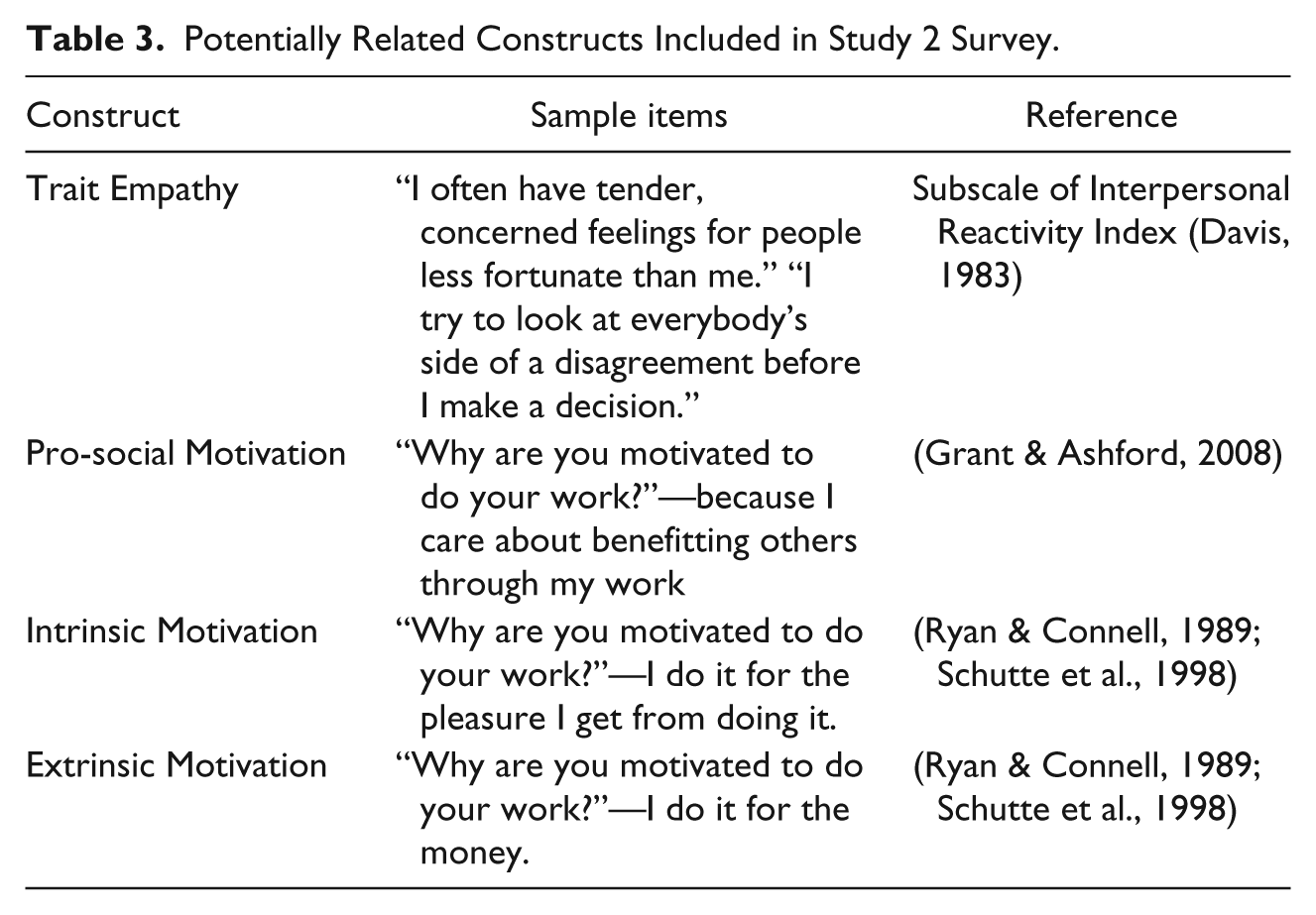
Illustrative items and references to previously validated measures and source descriptions of the constructs are provided in Table 3. To reduce confusion, all response scales for these constructs were modified to match a 1-5 scale, where 1 indicated a low level of agreement or low frequency of occurrence of the noted behavior or experience and 5 indicated high levels of agreement or high frequency of the noted behavior or experience.
Analysis and results
The 10 items comprising the ECS were subjected to a confirmatory factor analysis using PROC CALIS, where each item was specified to load onto the factors identified in Study 1, and the three factors, in turn, were anticipated to load onto the underlying empathetic care construct. We used recommendations from Anderson and Gerbing (1984), Cole (1987), Cuttance and Ecob (1987) and Marsh, Balla, and McDonald (1988) to assess model fit. These recommendations include cutoffs for multiple indices, including GFI (>.85), AGFI (>.80), and RMS (<.10) Based on these criteria, the model had acceptable fit (GFI = .89; AGFI = .81; RMS = .09). We note that model fit when a one-factor structure was imposed on the data was markedly worse than using the three-factor structure, no longer meeting any of the standard goodness-of-fit cutoffs (GFI = .64; AGFI = .43; RMS = .24). Further, we estimated a two-factor structure that collapses emotional engagement and relational richness, the constructs that are logically theoretically connected to one another. Again, fit statistics for this model were not acceptable (GFI = .82; AGFI = .69; RMS = .15). Thus, the expected three-factor structure was supported.
We also note that the internal reliability of the scale is high (α = .89) and that the three factors are all significantly correlated with one another (all r between .49 and .55, p < .0001), suggesting a reflective measure. We therefore again created an ECS score by averaging each respondent’s score for each subscale, and in turn, averaging the responses on the three subscales. The scale showed a fairly high mean (M = 5.63, SD = 1.29), but also a wide range, similar to the first sample (Min = 1.11, Max = 7.00). We observe no differences in ECS scores based on job type, gender, age, hourly wage, amount of time in the caregiving field, or work status (full time or part time; all p > .22).
Validation using allocation scenarios
We began by using ECS scores to predict responses to the allocation scenario measures (Appendix C). We first noted that both scenarios were seen as realistic by participants (Mpeptalk = 5.40 and Mclean = 5.77, both significantly greater than scale midpoint at p < .0001). Table 4 captures the observed relationships between ECS scores, scenario realism, and time allocation. As anticipated, individuals scoring higher on the ECS were also willing to allocate more time to tasks focused on the emotional well-being of their clients.
Empathetic Care and Time Allocation.

To provide evidence of discriminant and convergent validity, we then calculated simple correlations between the ECS score, trait empathy, intrinsic motivation, pro-social motivation, and extrinsic motivation, as shown in Table 5.
Correlations Between Empathetic Care and Related Constructs.
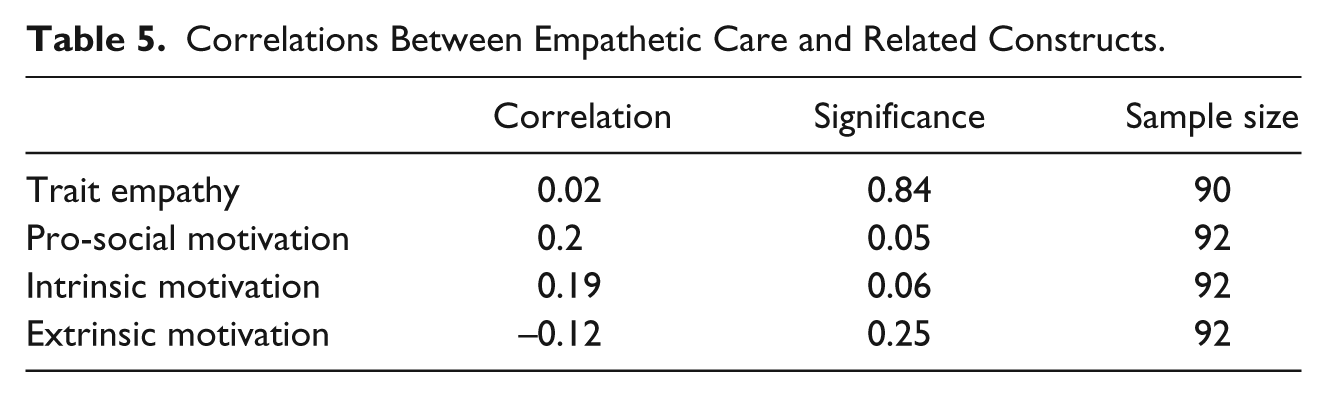
We first note that empathetic care is nearly completely uncorrelated with trait empathy, suggesting that our context-dependent measure captures tendencies that are strongly distinct from a more generalized personality trait. More empathetic caregivers (higher ECS scores) tend to be significantly higher in pro-social motivation and slightly higher in intrinsic motivation, consistent with our conceptualization. We note, however, that this correlation is modest, suggesting that empathetic care is distinct from intrinsic and pro-social motivations. Further, we find a nonsignificant relationship between empathetic care and extrinsic motivation, suggesting that observed significance on other motivational items is due to underlying relationships specific to the measured constructs, not simply driven by common method bias. These findings provide evidence of convergent and discriminant validity for the ECS measure.
Study 4: Test of Social Desirability Bias
Study 4 was conducted to rule out social desirability as a driver of ECS scores. Participants were 16 CNAs working in a long-term care facility for the elderly. These individuals were recruited via announcement in their staff meeting. Surveys were completed on shift breaks. Participants responded to the 10 ECS items and to the balanced inventory of socially desirable responding (Paulhus, 1991) and were paid $10 for their responses. This smaller sample was intended to consider the likelihood that high ECS responses simply reflected a belief that empathetic care was normatively preferred among care workers, thus suggesting that higher ECS scores simply reflect a higher degree of sensitivity to social norms. Across the sample, the correlation between empathetic care and social desirability was nonsignificant (r = .14, p = .60.) Although this sample is small, the low correlation suggests that highly empathetic caregivers may not simply be more sensitive than others to social norms, providing further support for the validity of the ECS.
Study 5: Test–Retest Reliability
Study 5 sought to capture the stability of the empathetic care measure over time. Eighteen CNA were recruited via posting and announcement at their workplace. During shift breaks, they completed the 10-item ECS twice in a paper and pencil form, with approximately 3 months’ time between survey completions. They were paid $5 for each completion. ECS scores were calculated for each respondent at Time 1 and Time 2, and the scores were checked for correlation. Across all the respondents, the correlation between the two measures was .68 (p = .002). Although the standard cutoff for “good” interrater reliability is .70, this level of correlation provides an acceptable consistency over time but may also suggest some day-to-day variability in individuals’ felt levels of empathetic care. We explore this possibility further in the discussion.
Discussion
The extant literature on health care work has presented a rich qualitative description of empathetic care and highlighted its importance to patients, family caregivers, and health care workers. Anecdotally, the “bedside manner” of attending aides has been a driver of patient and family satisfaction with care. However, to date, there has not been a measure of empathetic care that is both theory-based and suitable for large-scale quantitative research. Our goal here was to develop and validate such a measure: the ECS.
The ECS appears to be a valid, robust measure of empathetic care among eldercare workers, whether CNAs, HHAs, or PCAs. We find that the empathetic care construct is composed of three interrelated yet distinct dimensions: extra-role behavior, relational richness, and emotional engagement. Further, the ECS measure exhibited both convergent and divergent validity in several pretests. Supporting its validity, results show that higher scores on the ECS were related to greater time allocation to empathetic care tasks and higher importance placed in personal client relations. Consistent with theory, we find that ECS scores are significantly and positively correlated with pro-social and intrinsic motivation while being distinct from trait empathy. In addition, we find that the ECS measure is not correlated with the level of concern for social desirability.
These findings have important implications for research and for practice. First, and foremost, we see the ECS as a tool that can be incorporated more broadly into studies of the quality of paid eldercare. As noted previously, there are many such large-scale studies that examine instrumental aspects of eldercare. At the same time, studies of the empathetic component of eldercare have tended to be smaller, qualitative studies. All seem to agree, however, that quality care of the frail elderly includes both instrumental and empathetic components. We are hopeful that the availability of a valid and easy-to-administer instrument to measure empathetic care—the ECS described here—will lead to the incorporation of both facets of care into studies of eldercare quality.
Future work may use the ECS in ways that help us learn more about optimizing eldercare work settings. For example, we note that although the correlation between Time 1 and Time 2 measures of empathetic care in Study 5 is significant, the overall test–retest reliability statistic is not extremely high. Given our relatively small sample size, even small deviations from consistency can lower overall correlations substantially. However, given the emotional nature of empathetic care and the relatively long period between survey administrations (3 months), it may also be that a given individual does show some fluctuation in his or her ECS score, depending on changing work conditions. For example, care workers who find themselves under greater time pressure at one time than another may be temporarily less empathetic than is characteristic—extra-role behavior, the ability to emotionally engage with residents, and the maintenance of a rich relationship may become second to the needs of the day. Care workers may gain the ability to be empathetic as their tenure with a given client lengthens, as instrumental care tasks become more routine. Changes in a care worker’s relationship with her colleagues may also change their tendency to be empathetic toward her clients, as she may have more emotional and time resources at her disposal as the cooperation among colleagues grows. Future research may seek to understand better what factors may activate or squelch the expression of empathetic care over time.
It may also be critical that future work more deeply considers the relationship between the three dimensions of empathetic care. We note that although they load on three distinct subscales, all the empathetic care items tended to be highly related to one another. Since we were interested in the combined empathetic care effect, we did not disaggregate these subscales in our work. However, it may be that in some circumstances, the dimensions no longer correlate as highly as in our samples. For example, some workplaces may place strong restrictions on extra-role behavior such that it is not normatively acceptable to “go above and beyond” the job description. It would be interesting to see if in such cases variations in emotional engagement and relational richness still lead to consequential outcomes consistent with high empathetic care. Conversely, in some eldercare situations, it may be very difficult to form rich relationships with clients, for example, in dementia wards. In such contexts, it may be that emotional engagement and extra-role behaviors still lead to actions consistent with empathetic care.
There are other interesting avenues for future research on empathetic care. In particular, the relationship between empathetic care and pro-social and intrinsic work motivation suggests that other-oriented behaviors may be motivated by clusters of attitudes and motives, many of which are distinct yet related. The ECS scale may be further used to explore relationships between motivational tendencies and their outcomes in the workplace. Further, the ability to measure empathetic care lends itself to considering the causality that may underlie these relationships: Does preexisting intrinsic motivation lead to empathetic care, or does empathetic care feed intrinsic motivation? What happens when extrinsic motivators, such as increased pay and benefits, are added to an eldercare system? Will intrinsic motivation and empathetic care rise as well, or will we observe what economists describe as a “crowding out” effect where intrinsic motivation can be dampened by higher extrinsic rewards? (Deci & Ryan, 1985).
Our study also possesses limitations that lend themselves to future exploration. First, the ECS is a self-report measure of behavior rather than observed behavior. We have attempted to provide evidence of both convergent and discriminate validity here, and also test for social desirability bias, but further validation with actual performance is desirable. Second, we do not find systematic differences across job categories (CNAs, HHAs, PCAs). This finding is interesting in light of recent work suggesting that context of care may influence the extent to which care workers tend to develop strong relationships and interdependency with their clients (Loe & Moore, 2011). Thus, it may be that empathetic care varies based on job context factors that were not explored here. For example, factors such as client-staff ratios and training may affect levels of empathetic care.
In addition, future research should test the measures’ relation to other health care outcomes such as patient well-being as well as employee burnout and turnover. The literature on physicians’ behavior has shown that the perception of caring and the strength of doctor–client relationship are related to better outcomes (Ambady et al., 2002; Levinson, Roter, Mullooly, Dull, & Frankel, 1997). Similar findings have been shown in the nursing literature. However, other studies suggest that in some cases, actions taken to preserve the dignity of older patients may not lead to noticeable improvements in their or their families’ daily lives (Ejaz, Rose, & Jones, 1996). A multilevel examination of empathetic care may shed light on the dynamics that affect perceptions of empathetic care in various patient interactions (i.e., doctor, nurse, therapist, paraprofessional, etc.).
Footnotes
Appendix A
Appendix B
Appendix C
Declaration of Conflicting Interests
The authors declared no potential conflicts of interest with respect to the research, authorship, and/or publication of this article.
Funding
The authors disclosed receipt of the following financial support for the research, authorship, and/or publication of this article: This research was supported by the Russell Sage Foundation, Grant #85-11-04. Carrie Leana and Cait Lamberton were coprincipal investigators. Institutional review board approval was granted under University IRB PRO12110345.