



Abstract
Introduction
With human life expectancy constantly increasing, the size of the elderly population with functional impairments and prolonged illnesses is also growing (Crews & Zavotka, 2006). As a result, there is a developing need to expand the scope of services available to this population. One aspect of the “aging in place” concept is around-the-clock care provided by foreign home care workers (FHCWs), which allows functionally impaired older adults to maintain their independence and continue living in their homes and communities. Another aspect is that the integration of FHCWs may lower the level of the family members’ burden of care (Ayalon, 2011).
Like other Western societies, Israel is populated by different groups and characterized by ethno-cultural diversity (Ayalon, 2009a). While references in the literature to the cultural-ethnic-religious aspect of the relationship between FHCWs and the elderly and their families exist (Nielsen, Angus, Howell, Husain, & Gastaldo, 2015), this topic, from the social worker perspective, has not been extensively studied in the context of faith-based communities, in general, and the ultraorthodox Jewish (UOJ) community in Israel, in particular. The social worker’s professional perspective is important to maximize the quality of services provided to address the older adults’ unique needs.
In light of changes undergone by the UOJ community and its segregated attributes (Freund & Band-Winterstein, 2013), the aim of this study is to explore the perspective of social workers involved in integrating FHCWs into aging UOJ families.
Integration of FHCWs: Theoretical Framework
FHCWs tend to arrive in Israel to improve their economic status, as well as the economic status of their families back home. In Israel, FHCWs have become a significant factor in the workforce since the 1980s and are currently employed in several fields, such as agriculture, building construction, and caregiving. An FHCW is defined in the Foreign Workers Act of Israel (1991) as follows: “An employee who is neither an Israeli citizen nor inhabitant.” FHCWs need a defined work permit and a suitable work visa stamped in their passport. The permit to work and live in Israel is conditional: The FHCW must be employed only by the employer who invited him or her to Israel. The FHCW cannot retain his or her legal status, unless he or she is working for the same employer, and he or she is not allowed to work in an additional job. In the event that the FHCW does not adhere to these conditions, his or her legal status will be revoked, and he or she will be forced to leave Israel (Foreign Workers Act—Amendment #15, 2012)
Israeli society relies on foreign workers to care for its elderly population. As this population grows, so too does the number of FHCWs. It is important to note that only impaired older adults are allowed to bring in around-the-clock FHCWs (Ayalon, 2011). As of today, about 65,000 foreign home care nursing workers are employed throughout the country; by 2030, this number is predicted to rise to 114,000. The majority of FHCWs are employed by nursing and manpower firms, subject to governmental regulation (Ayalon, 2009a). These workers arrive for a limited period and are required to leave when either their license expires or when the older adult passes away (Ayalon, 2009a, 2011). Four theoretical frameworks conceptualize the relationship between older adults and their therapeutic arrangement. The substitutes model focuses on demographic shifts: Family members are unable to provide all of the necessary care, as was the case in previous decades, with the foreign caretaker functioning as a substitute (Tennstedt, Crawford, & McKinlay, 1993). The task-specific model relates to certain tasks that cannot be performed by informal caregivers, but only by FHCWs (Silverstein & Litwak, 1993). The hierarchical compensatory model emphasizes the foreign caretaker as the last resource in the hierarchy of care resources given to older adults. This arrangement is preferred only when all other options have been exhausted (Cantor, 1979). Last, the complimentary model asserts that the formal and informal systems share the burden of care (Chappell & Blandford, 1991). These theoretical frameworks have not yet been examined in a religious-cultural context.
The Encounter Between FHCWs, and Older Adults and Their Families
The literature notes the complex relationship between FHCWs and infirm older adults (Nielsen et al., 2015); it also stresses that the interaction can satisfy both parties. However, in some situations, the FHCW might abuse the older adult’s dependency, whereas in other cases, older adults and their families may abuse the FHCW (Ayalon, 2009b). The provision of home nursing care services is considered semiprofessional work (Iecovich, 2013). Providing care for older adults coping with ADL (activities of daily living) requires specific skills. Such services include personal care along with food and home-related tasks (Ayalon, 2009b; Iecovich, 2013). In this context, Israeli families prefer to employ foreign workers, as they are less costly than Israeli home care workers, and may be employed around the clock (Ayalon, 2009a). In addition, the literature refers to the nature of care work, which is perceived as being of low status, and to cultural diversity, as factors that create vulnerability among the FHCWs, who may experience discrimination, racism, and the like (Harper & Zubida, 2010; Martin-Matthews, Sims-Gould, & Naslund, 2010). In the familial context, FHCWs are perceived by older adults and their families as a “sort of family member,” who provides intimate assistance and emotional support (Ayalon, 2009b). This unique working environment creates a blurring of boundaries between the work and the FHCW’s concern for the older adult (Iecovich, 2013). Furthermore, the responsibilities of the FHCWs and their decision-making authority regarding the elderly is not always clear-cut (Ayalon, 2009a).
Old Age in the Ultraorthodox Community
As a “faith-based community,” the UOJ community is a segregated religious group, differentiated within the Jewish community, despite its interaction and complex relationship with the general population. It is characterized by extreme views and community discipline stemming from its subordination to rabbinical authority, which encourages strong loyalty to the community, while dictating strict behavioral codes (Baum, 2007).
According to the Central Bureau of Statistics in Israel (2009), between the years 2002 and 2010, the UOJ population’s growth rate within that of the general population in Israel climbed from 6% to 9%. Assuming that the life expectancy of UOJ older adults is similar to that of the general public in Israel, we predict that the rate of UOJ older adults aged 65+ will increase from 2% today, to 5% in 2030. These changes will necessarily boost the demand for long-term care and supportive community services workers .
Studies show that in the UOJ community, older adults are treated with care and supported by their families, and that their image and status are rather positive. UOJ family members, based on Jewish tradition, believe that the life-experience of the older adult serves as a beneficial asset, raising the value of the elderly in the family and the community as a whole (Iecovich, 2013).
The Encounter Between FHCWs and Older Adults and Their Families: The Ethnic-Cultural Aspect
The literature shows that differences in cultural and ethnic background between caretakers and older adults may lead to conflicts. Therefore, to create a beneficial encounter, both the older adult and the caretaker must acknowledge the other’s culture and participate in their shared reality (Bourgeault, Atanackovic, Rashid, & Parpia, 2010). Alternatively, it was found that cultural similarities—in the context of ethnic origin, religion, and language—improve the quality of care and constitute a basis for a good relationship between the older adult client and the FHCW (Barker, 1994). A significant finding emphasizes that cultural understanding is not the responsibility of only one of the parties, but a consequence of cooperative, mutual interaction. Overcoming the intercultural barriers of this shared reality requires the cultural competency of home care workers. This includes a wide assortment of communication skills, the ability to interpret body language, technical skills related to running a household, and interpersonal skills (Iecovich, 2014). These types of cultural-ethnic and religious differences are sharpened and become even more significant in interactions between FHCWs and older adults and their families in the UOJ community (Ayalon, Halevy-Levin, Ben-Yizhak, & Friedman 2013).
The Role of the Social Worker in Integrating FHCWs
Social work in Israel in the field of gerontology includes five main areas: (a) the elderly, (b) their families, (c) the elderly community, (d) social and health services, and (e) the larger social environment (Hantman, Oz, Gutman & Criden, 2013). The involvement of social workers in these areas is derived from the needs of the elderly population, according to the goals and values of the social work profession. The main goals of social workers working with elderly people are (a) treating the personal and familial difficulties of the elderly, (b) improving the quality of life of the elderly population, and (c) developing formal and informal support systems to address the needs of the elderly population, including integrating FHCWs (Greene, 2011).
A significant change in the practice of social workers working with the elderly in Israel occurred in 1988, after the legislation of the Nursing Act in the Knesset, which includes home care services for frail, elderly people. Since the passing of this Act, the employment of FHCWs in Israel is enabled through a complex procedure that involves receiving the approval of several governmental agencies. Private nursing agencies are in charge of bringing the workers into the country and matching the FHCW to the older adult. Social workers support older adults, family members, and foreign workers by providing these individuals with educational and psychoeducational interventions (Ayalon, Kaniel, & Rosenberg, 2008).
Social workers play a significant role in the placement of foreign workers in the homes of older adults, and in managing care (Ayalon, 2011).
In Israel, like in other countries around the world, some foreign workers care for frail, elderly individuals in their homes. In the United States, Canada, and many European countries, care for the elderly is organized and provided by interprofessional teams, including physicians, nurses, social workers, and so on (Reinhard, Redfoot, & Cleary, 2008). The professional teams manage home care treatment, and the placement of foreign workers. In Israel, social workers are the central professional workers that manage home care treatment, including the placement of foreign workers and ongoing care management. The matching of FHCWs and older adults is supervised by social workers, who pay regular visits to the older adults’ homes (Ayalon, 2009a).
The Role of the Social Worker in Integrating FHCWs Into UOJ Communities
In Israel, most FHCWs have a different religion and culture, and speak a different language from the locally spoken language (Hebrew or Yiddish; Iecovich, 2014). A pioneer study conducted by Ayalon (2011), exploring the social worker perspective regarding integrating FHCWs in Israel and in general, found that social workers identify an innate tension between the foreign worker and the older adult regarding issues such as intimate care, financial management, neglect, linguistic differences, eating habits, and culture. Therefore, the choice to take in a FHCW is usually made as a last resort. In reference to the UOJ community, it was found that it struggles to accept and adapt to FHCWs, due to its inherent conservatism, compared with other communities. Ayalon (2011) recommended either seeking alternative sources of support for the UOJ elderly population or providing meticulous preparation before attempting integration of FHCWs into UOJ households.
In summary, the study of employing FHCWs as caretakers for older adults has gained visibility in recent years. However, there is still scarce research regarding cultural-religious groups (Cohen, Hall, Koenig, & Meador, 2005). Therefore, the aim of this study is to further explore the topic of integrating FHCWs into the ultraorthodox community, from the social worker point of view. Research questions include the following:
Method
Design and Methods
The study was based on the interpretive hermeneutic methodology, aimed at understanding phenomena through the observation of everyday interactions, to better “grasp” social workers’ professional lived experiences when encountering elderly UOJ clients and their families. In the context of FHCWs, the study utilized a qualitative design; this method is suitable for answering questions of meaning, sense making, and subjective experiences (Friesen, Henriksson, & Saevi, 2012). The study was approved by the University of Haifa’s Ethics Committee.
The study was conducted using a purposeful sample (Patton, 2002) focused on selecting participants who best represented their population and reflected the researched phenomenon. The research sample consisted of 18 social workers in daily contact with elderly UOJ clients throughout Israel who employed FHCWs. Participants included three men and 15 women: eight ultraorthodox, five modern orthodox, and five secular individuals with 1.5 to 45 years of social work experience. The social workers in the sample worked with older clients for 1 to 35 years, in private, public, and third-sector institutions, as well as in hospitals, welfare offices, and nonprofit organizations (see Table 1).
Description of Interviewees.
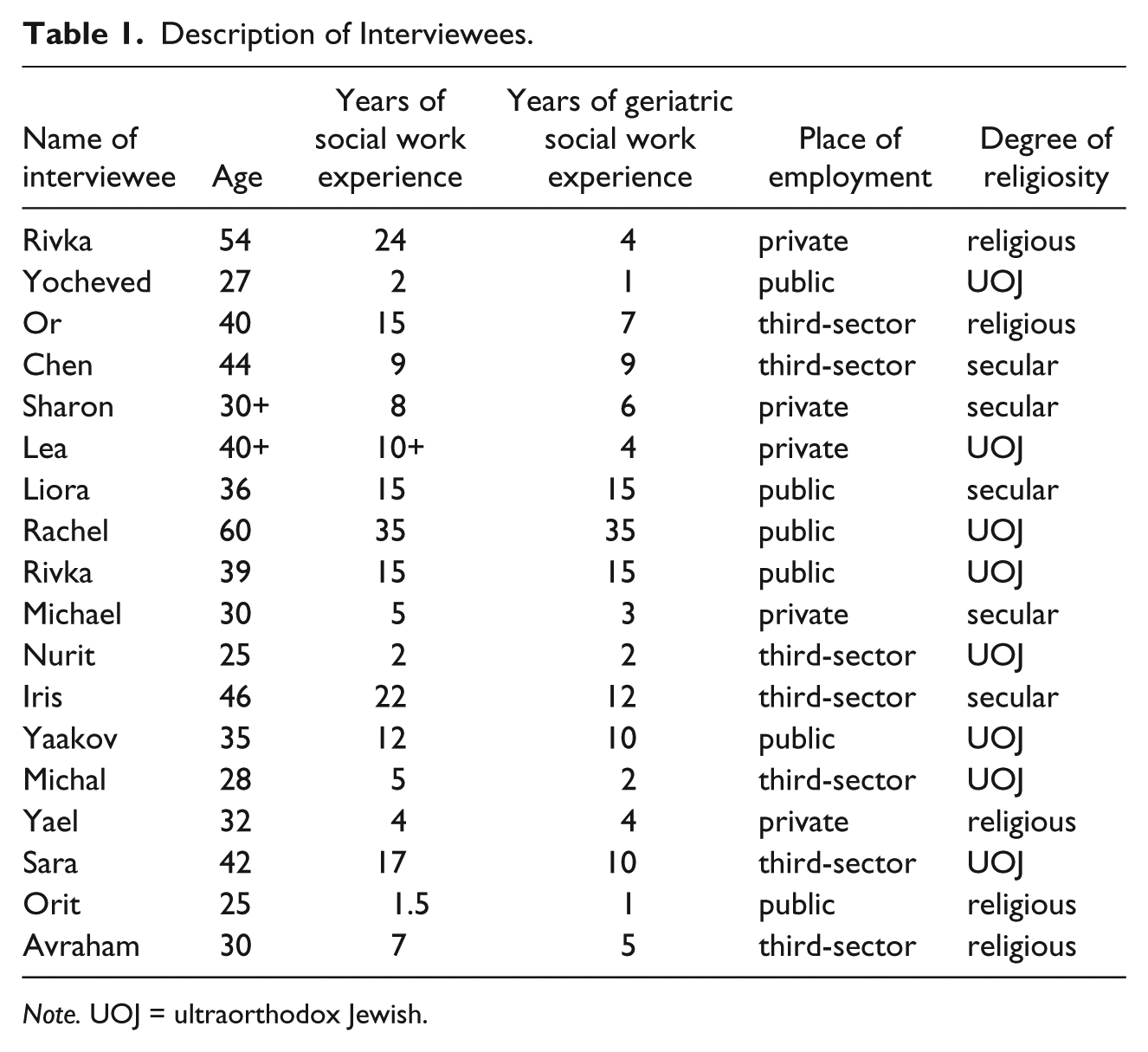
Note. UOJ = ultraorthodox Jewish.
A semistructured, in-depth interview guide was developed to better understand the participants’ experiences and attributed meanings. The interview included three major topics—being a social worker working with older UOJ clients and their families: “What are the most important tools for a social worker working with older UOJ clients?”; dilemmas and sensitive issues in working with older UOJ clients who employ FHCWs: “What are the central needs of older UOJ clients and their families regarding FHCWs?”; being a social worker working with older UOJ clients over time: “What changes do you perceive in the UOJ community regarding treatment in the context of FHCWs?”
The interviews were conducted by UOJ social work students who first underwent a training and reflection process to gain insights about their personal background, attitudes toward and opinions about old age and FHCWs, and how they identify themselves in relation to the participants. As a result of this process, the interviewers gained self-awareness, enabling them to better focus on the participants’ experiences (Finlay & Gough, 2008). Participants were recruited by contacting relevant welfare agencies and organizations. Each interview lasted 60 to 90 min, and was recorded and transcribed verbatim.
Two researchers were involved in analyzing the data, after which they separately conducted thematic content data analysis, prior to a joint comparative examination of the individual analyses. The analysis was performed using a horizontal coding process by finding statements reflecting the participants’ experiences with the phenomenon, for example, identifying perceptions about aging in the UOJ community. The next step involved grouping the statements into units of meaning, including quotes describing the participants’ experiences and perceptions, for example, gathering quotes relating to the different ways in which the elderly perceive FHCWs. The following step involved identifying emerging themes by shifting from descriptive to interpretive levels of analysis, for example, conceptualization of the social workers’ perceptions regarding the unique position of FHCWs in UOJ families. During the content analysis, the researchers discussed disparities and sought agreement regarding theme content and interpretation of meanings. Data were organized based on the agreed-upon themes identified in participants’ narratives (Smith, Flowers, & Larkin, 2009).
Trustworthiness (Lincoln & Guba, 1985) was achieved in several ways. The interview material was first transcribed verbatim, enabling introspection into original narrations, after which the material was further reviewed separately by each of the researchers. A peer cross-examination was then held by working with another experienced colleague, serving as an external expert in qualitative research, who made comments and analyzed the quotes together with the researchers.
Furthermore, both researchers are involved with ultraorthodox students, teaching in a social work education program tailored to the UOJ community. Therefore, we performed ongoing reflection and bracketing processes. In addition, we acquainted ourselves with relevant aspects of this unique community (Finlay & Gough, 2008). Finally, the wide range of participants who narrated similar experiences contributed to the study’s trustworthiness (Patton, 2002).
Findings
The data analysis revealed three central themes—(a) social workers confronting barriers and challenges in integrating FHCWs into the aging UOJ family, (b) “even the rabbi has a FHCW”: social workers’ skills and efforts to collaborate and maintain aging in place in UOJ older adults’ families, and (c) the social worker as mediator and facilitator of a successful relationship in the context of cultural sensitivity.
Social workers confronting barriers and challenges in integrating FHCWs into the aging UOJ family
The essential role of social workers is to develop formal and informal support systems to address the needs of aging UOJ families. This role includes both challenges and barriers when social workers assess services and home care treatment, concerning the unique needs of this population. To integrate the new concept of service, the social workers need to be aware of the UOJ lifestyle. Social workers suggest FHCW services as a solution for UOJ families; however, they are also aware that this new, shared reality elicits the various cultural differences, barriers, and challenges. Social workers indicate the existence of the different basic worldviews, which distinguish between the Jewish orthodox and the FHCWs’ cultural way of life. However, alongside the differences, the social workers also describe the joint mechanisms that bridge the gap, enabling the existence of this shared reality.
Social workers are aware of the Jewish orthodox lifestyle, characterized by a meticulous observance of rules regarding food, physical contact, gender, modesty, and the Sabbath, and the difficulties involved in integrating an outsider into this cultural context.
For the ultraorthodox, FHCWs are, first and foremost, gentiles and they don’t want gentiles hanging around their home. Especially among Holocaust survivors, but actually among all UOJs, just the thought of a foreign worker is absolutely shocking. They don’t want to hear of such a thing . . . Will she touch my dishes? Will she touch my food? Will she bring non-kosher food into my home? (Hen, 9 years experience)
The social worker emphasizes the threat felt by elderly UOJs from the mere encounter with a person from another culture, and all the more so from intimate and daily interaction with a foreign (gentile) culture. The role of social workers as service providers is to understand that a segregated community (the UOJ society) experiences fear and caution regarding foreigners, perceived as individuals who will prevent them from maintaining their accustomed lifestyle, out of unequivocal faith, and therefore from fulfilling the need for proper observance of the Halacha (Jewish law). Furthermore, social workers are sensitive to the cultural gaps that encumber the integration of FHCWs, stemming from issues of modesty and the gender-based cultural separation that characterizes the UOJ community, as is illustrated below:
There is a very serious problem with gender. For example, married elderly couples living together, who want to bring in a male or female foreign home care worker, encounter a modesty problem either way. The man doesn’t want a female FHCW in his home and the woman doesn’t want a male . . . If they live at home with their children, and there are some unwed male children, the parents don’t want a female FHCW to be around. (Or, 15 years experience)
To facilitate adequate home care, social workers describe the challenge resulting from the mere joint stay of the FHCWs with the older adults. This uncomfortable situation relates to the separation between men and women, which is characteristic of the UOJ community. This separation is part of the Halacha (Jewish law) forbidding physical proximity between women and men. This issue is further confirmed in the case of families running a multigenerational household, where the presence of a female FHCW causes difficulties in the household’s daily functioning.
The social worker’s goal is to provide older ultraorthodox adults with a satisfactory solution, including their day-to-day needs and food preparation. This basic function is accompanied by a significant barrier related to kosher dietary laws:
. . . even when a FHCW is brought in, the families often prefer that the daughters will cook the food and bring it to the male or female older adult, so as to avoid kosher-related problems. (Rachel, 45 years experience)
Rachel highlights a challenge, stemming from the meticulous observance of kosher dietary laws in the UOJ community: even when a FHCW is brought in and assigned the cooking role, some families are still concerned about this issue, thereby neutralizing a basic part of the FHCW’s role. It seems that family members perceive the FHCW’s role as task-oriented.
Another aspect that relates to the social worker’s role is managing the communication barrier in integrating FHCWs into UOJ homes. This challenge is significantly important in light of the fact that only a minority of the ultraorthodox speaks English:
The issue of communication is very difficult; most FHCWs are English-speaking Filipinos, and the Israeli UOJ community is largely non-English-speaking. So, the FHCWs speak English, but neither the children nor the grandchildren speak it . . . There are a lot of communication problems . . . The older adult may be very learned in religious studies and want to pass on his knowledge and explain—yet, he cannot communicate . . . (Sara, 17 years experience)
In contrast, despite the vast differences between FHCWs and UOJs, social workers also describe a number of common denominators that may help both parties bridge the gap and enable the promotion of improved quality of life for UOJ older adults. These common denominators are predominantly based on the FHCW’s respect for the Jewish religion, which facilitates a common understanding about life in the shared reality.
Many of the FHCWs are religious, either Hindu (from India) or Christian, so in most cases, they know about religion . . . They first understand on the basic level and then learn the logistics, little by little . . . When the older adult prays, the FHCW may say something along the lines of “he can’t speak on the phone right now, he’s praying.” They internalize these things. They have a lot of respect for this because they are often religiously devout in their own religion, and so they accept this. (Rivka, 24 years experience)
The religious background, and the respect attributed to religion and its associated rituals, which characterize the religious lifestyle, help the social workers integrate the FHCWs into the domestic-cultural UOJ framework. They understand the value of religion in the life of the older adult, which enable learning and the internalization of the daily routine. Social workers perceive this internalization by the FHCW’s attention to the smallest technical details, such as prayer taking precedence over a phone conversation.
Social workers act as care management mediators, who connect elderly UOJs with FHCWs who have similar cultural attributes:
FHCWs find themselves among a segregated group with rigid laws. If they come from a culture that also enforces rigid laws (as is the case regarding all FHCWs), the match can be very fitting. If they come from a very segregated culture, it is easier for them to mimic and adapt themselves to the situation. (Sharon, 8 years experience)
Social workers realize that the chances for compatibility and adaptability to the shared reality increase when the two cultures share similar characteristics, such as defined rules and norms confined within a social context of impenetrable borders.
Often, the Filipinos that come in are Catholic Christians and devout believers. They are familiar with the New Testament, as well as the Old Testament, and come from a culture that appreciates the devoted care of older adults by their children . . . in the Philippines, there are no home care workers and caring for older adults is the responsibility of the family . . . (Orit, 1.5 years experience)
Social workers’ emphasis on FHCWs’ knowledge of Old Testament–based sources serves as a shared resource of both Christian and Jewish traditions. This provides a basis for interpersonal acquaintance. The transformation of the sources to behavioral norms enables social workers to mobilize the family in preparation for providing care for the older adult. In this regard, among both Filipino and Hindu (from India) FHCWs, it is customary for the adult children in the family to dutifully assist their elderly parents. All of the above create a foundation upon which to establish relationships between FHCWs and UOJ families. Thus, despite the diversity, and because of the commonalities, social workers are able to address this unique relationship and construct it by building a sense of closeness and belongingness. A further description to the close caring within the relationship is illustrated by the following quote:
In many cases, the FHCWs stay with them for the Shiva (the seven-day Jewish mourning ritual), as if they are part of the family. This is beautiful to see: the differences; the two worlds, and how they manage to build a bridge between them. The family also greatly appreciates the FHCW’s work with the older adult and the parting of ways is often very difficult . . . I met a FHCW who had learned to speak Yiddish and was treated very kindly by the family; they taught him Yiddish and they were very happy with him. (Rivka, 15 years experience)
What is clear from the social workers’ descriptions of objective difficulties, barriers, and diversity is that they were all found to be manageable. Thus, a warm and humane close relationship is created between the UOJ family and the FHCW who accompanies them, often even after the death of the older adult, when the separation also becomes part of the shared reality. A further illustration of close relationships is the ability to overcome the language barrier when there is a shared desire to learn and teach a unique language, such as Yiddish, which is even more commonly spoken by ultraorthodox older adults than Hebrew, which is considered the holy language. This theme describes a shift—from a task-specific model of care arrangement to a more extend one.
“Even the rabbi has a FHCW”: Social workers’ skills and efforts to collaborate and maintain aging in place in UOJ older adults’ families
Social workers who specialize in gerontology are committed to enabling older adults to remain in their own homes and maintain their independence as much as possible. To facilitate this value, they collaborate with organizations and families using their professional knowledge and skills. Social workers position themselves as a source of knowledge, for the UOJ families in different ways. One of the ways is through their awareness of the UOJ community’s value of honoring one’s parents, perceived as an important mitzvah (a good deed). Nevertheless, although they are aware that the family takes full responsibility for the care of its elderly, the complex reality of home nursing care still requires additional solutions.
The UOJ community copes with very difficult domestic cases . . . They see taking care of older adults and parents as an important mitzvah . . . And finally, when they [the elderly] are in a very critical state—when a 90-year-old no longer has the physical energy to change his wife’s diaper or vice versa, they bring in a FHCW. When there is no choice, they find solutions compatible with Jewish law. For instance, often the female FHCW does not sleep in the house. (Yael, 4 years experience)
Social workers accept and appreciate the willingness of UOJ families to take care of older adults as an important deed, as a part of the social work ideology to enable older adults in the UOJ community to stay home for as long as they can. They understand that families sometimes deviate from the norm of directly caring for parents and bring in a FHCW as a last resort. Families will only consider bringing in a FHCW when the condition of the older adult deteriorates and there is a crucial need for extensive assistance. At this stage, social workers collaborate and find adequate matches to provide pragmatic solutions consistent with Jewish law. Another aspect of the social worker’s role in this context is to be aware of the recent “winds of change” regarding the presence of FHCWs, which are evident:
In the past, they were more embarrassed about bringing in an FHCW, but things change. There is much more acceptance now than in the past . . . they see older adults walking around with FHCWs in their neighborhoods, and it spreads like wildfire . . . These days, when you go to a synagogue you see more FHCWs. Where previously the older adults didn’t want to bring in foreigners and were very averse to gentiles, these days it’s become more legitimate, more prevalent; it’s become more accepted . . . These days it’s rare to have a family that wouldn’t want to bring in a foreign home care worker; today we are surprised if they don’t want to, because it has become acceptable. (Liora, 15 years experience)
Professionals now describe a new sense of openness toward bringing in FHCWs as an acceptable solution. The use of the metaphor “spreads like wildfire” indicates the increased awareness and legitimacy given to bringing FHCWs into UOJ families, also expressed in the rapid expansion of the phenomenon on both the familial and communal levels. Social workers act in accordance with these changes taking place in the UOJ community regarding bringing FHCWs into their homes. They provide a professional platform for the changing behavioral norms, such as walking to the synagogue with the FHCW. To facilitate the integration of FHCWs, social workers encourage UOJ families to adopt an attitude of flexibility:
I’ve occasionally encountered female UOJ older adults who allowed them [FHCWs] to bring a television set or laptop computer into their room . . . In many cases, they allow them to do this and just look the other way, to make the FHCWs happy . . . Families set up an Internet connection, so the workers can have what they need because all their communication with their families is through the computer these days . . . Some families get their FHCWs laptops or buy them tablets . . . (Abraham, 7 years experience)
The social worker’s role is to address the needs of both sides by adapting a flexible approach. While the UOJ community does not generally allow various forms of secular media into their homes, families who have FHCWs understand that this is a vital need for the workers. Social workers support these changes because they understand that keeping in touch with their families and the world means FHCWs can more dutifully perform their work.
Social workers engaged with UOJ culture respect the rabbis, as both religious authority and leadership figures, acting as role models and serving as a personal example to their communities. They embrace the Halachic legitimacy to bring FHCWs into the rabbis’ homes:
The moment you see one with the rabbi, you know the others are saying “well if the rabbi has one that means it’s okay, it’s nothing to be embarrassed about . . . ” (Liora, 15 years experience)
Unlike in the past, when bringing in FHCWs was considered an eccentric phenomenon, the change is accentuated by rabbis themselves taking in FHCWs. This personal example from such a prominent figure in the community is pervasive and provides unequivocal legitimacy to the practice.
The social worker as mediator and facilitator of a successful relationship in the context of cultural sensitivity
Social workers working with the UOJ community, whether they are secular or ultraorthodox themselves, also undergo changes regarding their role definition and perceptions of their clients in the context of the possibility of bringing in FHCWs. As professionals, they listen carefully to these changes and address them by responding to the needs of both sides. They use their professional knowledge regarding bridging the gap between clients’ needs and cultural sensitivity.
In the beginning, I thought it wouldn’t work for various reasons; just as a person, I thought that bringing FHCWs into UOJ families would never work, [but] now I see that it definitely could work—while working with the family and the older adult, this can actually work very well . . . If there is readiness and willingness from both parties, then the gaps can be bridged. (Yocheved, 2 years experience)
Yocheved focuses her attention on the centrality of social work in driving and instilling change processes in the UOJ community. She highlights the social construction and the significance of her role in light of the changes that have occurred in the UOJ community. As a result of the changes that have taken place regarding bringing in FHCWs, she experience herself as a part of the change process.
It is important to note that this reflection and cultural sensitivity is not only directed toward the UOJ older adult but also toward the needs of the FHCW:
I heard that the FHCWs are very averse to the ultraorthodox because of all the rituals and rules . . . They (the FHCWs) enter a home with all kinds of rules, which they don’t understand at all. They are one against many, they don’t have anybody else in the country; they walk into a family where everyone tries to teach them what’s allowed and what’s not allowed . . . And this is where I come in. (Lea, 10 years experience)
The social worker describes the reality of the FHCW’s entry into the UOJ family, from the foreign worker’s perspective. She positions herself as a mediator between both sides, to make this match successful. In a culturally sensitive way, she assesses the difficulties the FHCW might encounter, as part of the shared multicultural reality. Observing the FHCW, on one hand, and the older adult and his or her family, on the other, allows the social worker to facilitate this unique relationship. In this way, she acts for the benefit of both parties, as is expressed more specifically:
I will not send a female FHCW who wears a sleeveless shirt to a UOJ family. Obviously, I will not send someone who won’t fit in. She really needs to comply with their values, so that they feel comfortable talking to her . . . If she arrives immodestly dressed, this will surely not be to their liking. Most people don’t really insist that she wear a skirt . . . And it’s nice to see that the FHCW understands this and can conform, despite all the requirements and sensitive issues. (Michal, 5 years experience)
The social worker understands that to create an optimal shared reality, both parties have to meet in the middle. In this context, the social worker describes the issue of apparel as a central component related to compatibility issues and the possibility of living together. As a professional social worker, she tries to minimize the tension that may arise from an immodest appearance.
Another aspect included in the social worker’s role is the need to adjust to the UOJ lifestyle:
The female FHCWs need to undergo special training when they first come into UOJ homes, in order to learn about the different kosher procedures, about the Sabbath, rules about cooking carried out by gentiles, as well as other, various kinds of idiosyncratic religious laws . . . I think this has been pretty well incorporated, but we still need to do more . . . We have a Halacha book that we sell, which tackles all these FHCW-related issues, down to the finest details. (Iris, 22 years experience)
To facilitate successful relations between UOJ older adults and their families, and the FHCW, social workers take responsibility and make all of the relevant preparations. They indicate that this special training is a necessity, a prerequisite. The integration of a FHCW requires specific learning regarding care for older adults, in general and, in this context, also specifics unique to the UOJ lifestyle, such as observance of the Sabbath and related rules, observing the separation between meat and dairy, and so on.
Another aspect related to the role of social workers is providing defined and structured expectations and guidelines:
It’s important to give excellent guidance to both parties, to draw up a very organized and specific contract including both parties’ roles, rights, and duties, leaving no questions unanswered, with no loopholes . . . [In this way], the FHCWs know exactly what their role is and the family knows they must respect the worker’s culture; [it is] a true interaction between cultures. (Ya’akov, 12 years experience)
As part of the educational process, social workers respond appropriately to the need to bridge the cultural gaps between the two worlds. The social worker recognizes the importance of giving two-way guidance to both the FHCW and the family. The understanding between the two parties is anchored in a contract, written under the instruction of the social workers, which secures the rights and duties of both parties. The contract relies on the importance of being acquainted with and having respect for the different cultures. Making such a contract emphasizes the benefit of both parties and may protect them from the misunderstandings, future conflicts, and negative emotions that may surface during the course of their intensively shared life together. It seems that the way social workers navigate between FHCWs and UOJ families has enabled the shift to the substitutes model.
Discussion
The encounter between FHCWs and the UOJ community produces unique challenges, which can be divided into three central themes—(a) social workers confronting barriers and challenges in integrating FHCWs into the aging UOJ family, (b) “even the rabbi has a FHCW”: social workers’ skills and efforts to collaborate and maintain aging in place in UOJ older adults families, and (c) the social worker as mediator and facilitator of a successful relationship in the context of cultural sensitivity.
According to the study of Ayalon et al. (2008), social workers believe that the choice to take in FHCWs is perceived in the UOJ community as a last resort because of inherent tension between the older adults and their families and the FHCW regarding issues of intimate care, financial management, neglect, linguistic differences, eating habits, and culture. The current study also supports the hierarchical compensatory model. Social workers describe the integration of FHCWs in the UOJ community as a last resort for family members to fulfill the religious commandment to honor older adults. Moreover, although barriers such as language, kosher dietary laws, gender, modesty, and general perceptions regarding foreign cultures have been found to exist, it seems that these differences are reconcilable in a shared life reality between FHCWs and UOJ elderly clients. While Ayalon (2011) recommended seeking out alternative sources of support for UOJ older adults from their community, this study found a much more complex reality. Alongside the barriers, there are also common denominators shared by the two parties, based on familial and religious values, which enable a connection. The majority of FHCWs in Israel arrive from the Far East (the Philippines, India, Nepal)—societies which are also characterized by a strong affinity and respect for religion and related religious ceremony. Thus, FHCWs from a religious background arrive in Israel with expectations to find religious and moral people (Harper & Zubida, 2010). According to the study of Harper and Zubida (2010), FHCWs’ perception of Israel as the Holy Land could serve as a significant source of motivation for FHCWs’ wanting, and even preferring, to work with UOJ families. In addition, FHCWs acknowledge the value of nursing elderly parents, as this role is also part of their intergenerational familial framework. These shared cultural beliefs serve as a foundation, which allows for mutual, respectful acceptance of each group’s religious lifestyle (e.g., learning about the kashrut [dietary laws], prayer, observance of the Sabbath, and dressing modestly). This acceptance and understanding bridges cultural gaps, despite the general apprehension about other religions.
The findings show that there is a shift from the hierarchical compensatory model to the substitutes model (Tennstedt et al., 1993). FHCWs in the UOJ community have proven high learning abilities and a willingness to observe Jewish traditions (Ayalon et al., 2008). Thus, whereas at the beginning of the mutual journey, the foreignness, suspiciousness, fear, and lack of linguistic communication stands out, what emerges over time is actually a shared foundation, making the seemingly impossible possible. Although Ayalon et al. (2008) found that social workers seem to regard the UOJ community as one that has difficulties accepting and adapting to FHCWs, due to its general conservatism and suspicion of foreigners, this study’s findings show that UOJ families respect FHCWs, and occasionally, similar to the secular community, they become part of the family (Ayalon, 2009a). UOJs are willing to adjust and allow openness to and consideration of the FHCWs’ needs. It seems that the integration of FHCWs began as a hierarchical compensatory and task-specific model, that is, an informal caregiving practice (Silverstein & Litwak, 1993), after which the care arrangements then shifted to the substitutes model, which includes almost all necessary care (Tennstedt et al., 1993).
The trends of modernization and social changes also influence traditional communities (Freund & Band-Winterstein, 2015). These processes are expressed in the acknowledgment and legitimization of the need to bring FHCWs into UOJ communities. This study’s seminal finding in this regard is that rabbis, the supreme religious authority in UOJ communities, also make use of FHCWs, thereby leading and legitimizing this process for the whole UOJ community. This finding indicates trends of change in this community and is compatible with other such trends regarding other domains of UOJ community life, such as the willingness to seek out emotional treatment, more open and tolerant attitudes, and an increased awareness of social problems. It seems that attitude changes toward FHCWs in the ultraorthodox community involve a transition process from one state to another, at individual, communal, social, and professional levels. These changes force social workers to become more aware of the unique characteristics of this community, in general, and in relation to UOJs’ attitudes toward integrating FHCWs, in particular (Marshal & Smith, 1995). Moreover, while in other fields of social work change processes take time, this study indicates that regarding the elderly population, the needs seem to be very acute; therefore, the phenomenon of FHCWs has quickly become very common.
In light of these rapid change processes, social workers play a significant role. According to our findings, social workers need to build a “cultural bridge” between older adults, their families, and the FHCWs. The encounter between ultraorthodox clients and social workers is founded on multicultural sensitivity (Baum, 2007). In this shared reality, there is more than one client: the FHCWs, the elderly ultraorthodox, and their families. The present study attempts to address this complex encounter by examining social workers’ need to navigate between the traditional norms, attitudes, stigmas, and stereotypes that characterize segregated communities (Falicov, 1995), and the needs of the older clients for daily assistance, as well as the specific position and needs of the FHCW in such a community (Barker, 1994). In this context, social workers’ challenges are complex; they must relate to all clients to successfully manage this shared reality. Our findings show that the output of being able to create a “cultural bridge” is demonstrated by drawing up a “cultural contract” that involves the key figures and their mutual and individual interests.
In sum, the number of FHCWs is growing exponentially in Israel; however, this issue is not unique to Israel. This issue is gradually becoming more widespread, as greater numbers of ethnic and religious segregated communities within pluralistic societies appear throughout the world. The concept of a “cultural bridge” reflects the need to address both sides in promoting the current, new trend of employing FHCWs as an efficient and modern solution for home-based elderly care while preserving the formal family structure and the community network of caring and supporting the older adult (Ayalon, 2011).
Research Limitations and Further Research
The present study provides an in-depth view of the encounter between social workers and older adults and their families within the UOJ community, in the context of FHCWs. This study is among the first to examine the phenomenon of employing FHCWs in faith-based communities. Therefore, further research may benefit by focusing on the different subgroups within this community. In addition, as this study focused on a specific faith-based community, future research should examine and compare the encounter between professionals and the elderly in other faith-based communities regarding FHCWs.
Practical Implications
The role of social workers and other professionals is to navigate between the modern winds of change and traditional values about old age, by way of cultural sensitivity in intervention. Cultural sensitivity is a starting point when relating to the encounter between UOJ older adult clients, FHCWs, and social workers. Social workers can operate within the community and through mediating factors such as rabbis who, as the communities’ religious leaders, can bridge the gap between cultural and professional aspects. Moreover, social workers can use their professional skills to enhance the mediators’ effectiveness and advance the mediation process. At the same time, social workers can learn from local leadership and FHCWs about how to render culturally appropriate interventions. Social work training programs should recognize the importance of this understanding, while being equally aware of the accompanying complexities. Finally, other therapeutic disciplines, such as psychology, nursing, and gerontology, may also benefit from the findings of this study, both in practice and training.
Footnotes
Declaration of Conflicting Interests
The authors declared no potential conflicts of interest with respect to the research, authorship, and/or publication of this article.
Funding
The authors received no financial support for the research, authorship, and/or publication of this article.