




Abstract
The National Elder Mistreatment Study (NEMS) found that 5.2% of community residing adults age 60 and older experienced financial abuse, and 4.6% experienced emotional mistreatment in the past year (Acierno et al., 2010). Similarly, the National Social Life, Health and Aging Project noted that 3.5% reported financial abuse and 9% reported verbal mistreatment (Laumann, Leitsch, & Waite, 2008), and a large-scale study by Burnes et al. (2015) observed a psychological abuse rate of 1.9%. Clearly, as our aged population grows, the number of older adults experiencing financial and emotional forms of abuse will also grow (Blowers, 2015). However, rates of reporting these episodes of mistreatment to police or other authorities are low (Acierno et al., 2010; Hanningan, Cyphers, & Aravanis, 1998; Teaster, 2003). Indeed, Lachs and Berman (2011) compared prevalences of anonymous survey self-report of abuse versus official prevalences derived from agency (i.e., police or other authorities) queries, and noted that the ratios of non-reported to reported prevalences were 12 to 1 for emotional abuse and 42 to 1 for financial abuse.
Reluctance to report instances of the two most common forms of elder abuse presents a significant barrier both to the criminal justice system’s efforts at prosecuting criminal acts and to victims and their families accessing victim services. As such, identifying and obstacles to reporting abuse is a crucial first step in their resolution. However, obstacles may vary in terms of victim perceptions of the event and criminal justice system, or in terms of their relationship to the perpetrator. For example, a recent study cited “fear of retaliation,” “not wanting to get the perpetrator in trouble,” “believing the police would not do anything to help,” “feeling that the event was a personal matter,” or “thinking that the event was not important enough to justify reporting” as reasons for not informing authorities (Planty, Langton, Krebs, Berzofsky, & Smiley-McDonald, 2013). Whereas another study noted likelihood of reporting varied in terms of the closeness of the relationship between the victim and offender (Gibson & Honn Qualls, 2012). If the quality of the relationship is weaker, or if the offender is a stranger, a victim is more likely to report (Holtfreter, Reisig, Mears, & Wolfe, 2014). In addition, in terms of financial abuse, there is a positive correlation between likelihood of reporting and the greater monetary loss (Holtfreter et al., 2014).
The present study sought to examine differences in non-reporting rates, and reasons for non-reporting, in terms of perpetrator status (known vs. stranger) and across the two most common types of elder mistreatment of community residing older adults: financial and emotional abuse.
Method
All study procedures were approved by the Medical University of South Carolina Institutional Review Board (Pro00040641).
Sampling
See Acierno et al. (2010) for detailed NEMS Wave I methodology which is only summarized here. The original sample of 5,777 adults age 60 and above was collected during 2008 through random digit dialing methodology producing a nationally representative sample corresponding to age, race, and gender distributions of the U.S. population. Interviews were conducted in either English or Spanish, and conducted using Computer Assisted Telephone Interviewing procedures, achieving a cooperation rate of 69%. The follow-up NEMS Wave II was also collected using the same interview technique 8 years later in 2016. An auto-dialing program tested each phone number from the original 5,777 NEMS Wave I participants yielding 3,973 working numbers (note: not all of these numbers still “belonged” to the Wave I participant, of course). These included 752 participant numbers classified as Wave I victims of psychological, physical, or sexual mistreatment since age 60. The mistreated group was smaller in size, thus contact attempts were made for all working numbers of participants reporting Wave I mistreatment (of course, these numbers no longer necessarily belonged to them). A randomly selected sample of working numbers from comparison participants who did not report Wave I mistreatment were also called (N = 2,149). The Wave II cooperation rate (i.e., those reporting mistreatment at Wave I and who were reached and were able to participate) was 66% (N = 183) and the cooperation rate for the group not mistreated at Wave I was 57% (N = 591), producing a total NEMS Wave II sample of 774.
Participants
In total, 774 adults aged 68 and older participated, with an oversample of NEMS Wave I elder abuse victims, 8 years following their participation in Wave I of the NEMS. Overall, 8.5% (n = 66) of NEMS Wave II respondents reported past-year financial mistreatment and 8.4% (n = 65) reported past-year emotional mistreatment.
Variables and Definitions
Past-Year Financial Mistreatment was coded as positive following an affirmative response to any of the following queries, along with the follow-up query “has this happened in the past year?”: Over the past year, has someone spent your money or sold your property without your permission? If someone helps you with your finances, or makes financial decisions for you, do you feel like that person made financial decisions that were for your benefit and not someone else’s benefit? If someone helps you with your finances, or makes financial decisions for you, did you receive the copies of paperwork for the financial decisions they made, or can you get copies if you wanted them? Has a family member, friend, or stranger forged your signature without your permission to sell your property or to get money from your accounts? Has a family member, friend, or stranger forced or tricked you into signing a document so that they would be able to get some of your money or possessions? Has a family member, friend, or stranger stolen your money or taken your things for themselves, their friends, or to sell?
Past-Year Emotional Mistreatment was coded as positive following an affirmative response to any of the following queries along with the follow-up query “has this happened in the past year?”: Has anyone verbally attacked, scolded, or yelled at you so that you felt afraid for your safety, threatened, or intimidated? Has anyone made you feel humiliated or embarrassed by calling you names such as stupid, or telling you that you or your opinion was worthless? Has anyone forcefully or repeatedly asked you to do something so much that you felt harassed or coerced into doing something against your will? Has anyone close to you completely refused to talk to you or ignored you for days at a time, even when you wanted to talk to them?
Perpetrator Status
For those who endorsed any item in the affirmative, perpetrator status was ascertained with the following queries: Thinking about the _____ event (financial, emotional) what is that person or person’s relationship to you, that is, who did this to you? Spouse or partner; an ex-spouse or partner, parent or step parent, brother or sister, son or daughter, another relative, coworker, neighbor, friend stranger or some other non-relative.
These response options were dichotomized into Family/Friend/Acquaintance versus Stranger.
Non-Reporting to Authorities
Non-reporting status was ascertained for each mistreatment type with the following queries: Thinking about any of these types of incidents where a friend, family member, trusted other, or stranger (“misused your finances, emotionally mistreated you”), were any of these incidents reported to police or other authorities.
Reasons for Not Reporting
For non-reported event, reasons for non-reporting were collected, and included the following response options: Did not want family or others to know. Afraid to look foolish or that reporting the event would make it look like I could not get along on my own. Didn’t want the person doing this to get in trouble. Afraid of reprisal or being punished for reporting. Didn’t want family matters to become public. Didn’t know how to report.
Data Analytic Plan
Chi-square analyses were used to compare both rates and reasons for non-reporting Stranger versus Family/Friend/Acquaintance perpetrated mistreatment to police or other authorities.
Results
Data regarding financial mistreatment perpetrator status were available from 60 financial abuse victims. Forty percent (n = 24) indicated that the perpetrator was family/friend/acquaintance versus 60.0% (n = 36) stranger perpetration. Similarly, 65 participants provided data regarding emotional mistreatment perpetrator status, with 86.2% (n = 56) perpetrated by family/friend/acquaintance and 13.8% (n = 9) perpetrated by strangers.
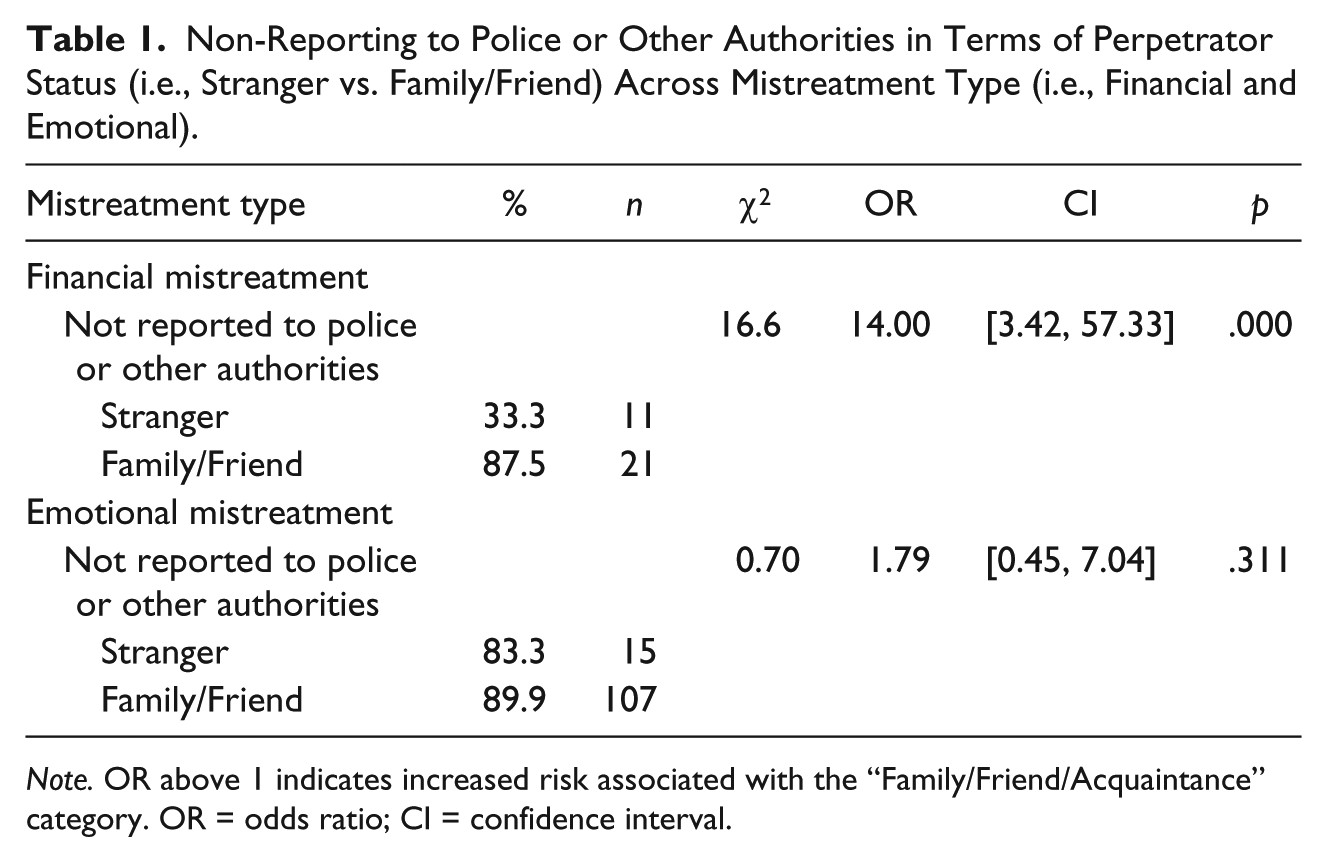
Table 1 presents comparisons of non-reporting rates for each mistreatment type in terms of perpetrator status. Considering financial mistreatment, 87.5% of those indicating that they experienced family/friend perpetrated events failed to report the crime to authorities, compared with 33% of those experiencing financial mistreatment at the hands of strangers. By contrast, no difference was observed in rates of non-reporting emotional mistreatment, with failure to report evident in 89.9% of family/friend perpetrated abuse and 83.3% of stranger-perpetrated mistreatment.
Non-Reporting to Police or Other Authorities in Terms of Perpetrator Status (i.e., Stranger vs. Family/Friend) Across Mistreatment Type (i.e., Financial and Emotional).
Note. OR above 1 indicates increased risk associated with the “Family/Friend/Acquaintance” category. OR = odds ratio; CI = confidence interval.
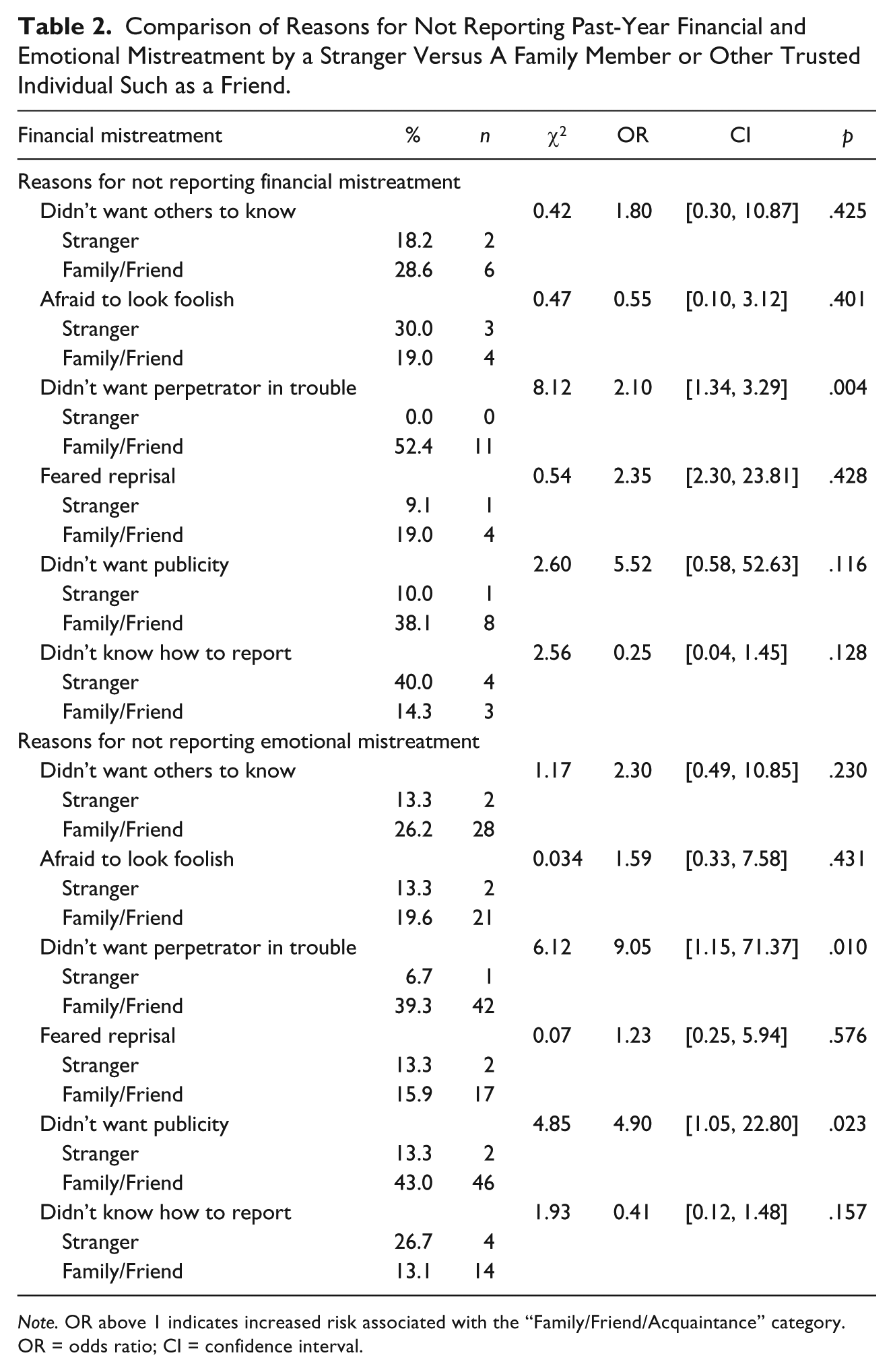
Table 2 outlines the reasons given for not reporting financial mistreatment to police or other authorities, again with chi-square statistical comparisons framed (for each reason) in terms of stranger versus family/friend/acquaintance perpetration. Common reasons for not reporting financial abuse by strangers included fear of looking foolish (30%) and not knowing how to report (40%), whereas relatively common reasons for not reporting financial abuse by family/friend/acquaintance included not wanting to get the perpetrator in trouble (52.4%; the only statistically significant difference between perpetrator types that was observed) and not wanting publicity (38.1%).
Comparison of Reasons for Not Reporting Past-Year Financial and Emotional Mistreatment by a Stranger Versus A Family Member or Other Trusted Individual Such as a Friend.
Note. OR above 1 indicates increased risk associated with the “Family/Friend/Acquaintance” category. OR = odds ratio; CI = confidence interval.
Table 2 also gives the reasons for not reporting emotional mistreatment, in terms of perpetrator type, with associated chi-square statistics. Differences again emerged with respect to not wanting to get the perpetrator in trouble as a reason for non-reporting (39.3% of family/friend/acquaintance vs. 6.7% of stranger-perpetrated emotional mistreatment), and not wanting publicity (43% of family/friend/acquaintance vs. 13.3% stranger emotional mistreatment).
Discussion
Our data indicate that elder financial mistreatment perpetrated by family/friends/acquaintances is far less likely to be reported to police and other authorities than the same behaviors perpetrated by strangers. This is conceptually consistent with the findings of Holtfreter et al. (2014) who noted that reporting likelihood was inversely related to quality or closeness of the relationship. Indeed, almost 90% of financial and emotional forms of elder mistreatment by family, friend, or acquaintance was not reported, versus 33% of that perpetrated by strangers.
Surprisingly, rates of non-reporting of emotional mistreatment at the hands of either strangers or family/friends/acquaintances was also about 85% to 90%. The consistent failure to report emotional mistreatment across both perpetrator types, in the context of a willingness to report financial mistreatment when perpetrated by a stranger, suggests that victims of this form of mistreatment may not be aware that it is a type of abusive, largely verbal behavior. This may speak to a general normative acceptance of psychological violence against older adults, and implies that education is needed across agencies and the general population regarding emotional abuse, its negative effects (Acierno, Hernandez-Tejada, Anetzberger, Loew, & Muzzy, 2017), and methods of reporting to police and other authorities.
One interesting finding within the category of family/friend/acquaintance perpetrated mistreatment is the similarity of non-reporting rates (about 90%) for both types of abuse. This is in contrast to data from the New York State Elder Abuse Prevalence Study (NYSEAPS) by Lachs and Berman (2011), who found financial mistreatment far less likely to be known to authorities than emotional abuse (among “trusted other” perpetrators). However, NYSEAPS results are not based on participants’ designations of whether or not each form of abuse happened and was reported, but rather on comparing prevalence of abuse reported by older adults, versus prevalence of abuse recorded and subsequently reported by police or other authorities (i.e., the NYSEAPS used two entirely independent samples: older adults and agencies). As the methodologies are significantly divergent, differences in observed reporting rates within abuse types are not unexpected.
Even though the rate of not reporting stranger-perpetrated financial mistreatment was better than that observed for family/friend/acquaintance perpetrated crime, it was still unacceptably high at about 33%. We found that reasons offered for not reporting to police and other authorities differed for stranger-perpetrated versus family/friend/acquaintance perpetrated mistreatment. Specifically, “not wanting publicity” and “not wanting to get the perpetrator in trouble” were recurring themes for non-report of abuse by family and friends, while no consistent reason was offered as primary for failure to report stranger-perpetrated mistreatment. However, Schmeidel, Daly, Rosenbaum, Schmuch, and Jogerst (2012) noted a common reason underreporting may also relate to lack of trust in the criminal justice system per se, and in its ability to render justice, and this likely played a role here.
Conclusion
As noted by Lachs and Berman (2011), very few cases of elder mistreatment are reported to police or other authorities, illustrating the very sensitive nature of this topic. Financial and emotional mistreatment leave no marks, and may therefore be taken less seriously by authorities and communities than physical and sexual assault. Indeed, our data indicate that emotional mistreatment may not even be recognized by victims as a form of mistreatment. Consistent with current literature, a victim’s reasons for reporting/non-reporting often relate to the relationship with the perpetrator and the perceived repercussions associated with disclosing abuse. While the scars of emotional or financial abuse may not be apparent, reporting these instances is essential to victims, as it often represents the first and fundamental step in accessing victim services and justice. However, such reporting is unlikely in a society so accepting of violence against older adults, particularly in the form of emotional abuse. Public awareness campaigns highlighting and condemning elder psychological mistreatment, much like those for child abuse and domestic violence, are needed.
Limitations
As with most studies on elder abuse, sample size was a significant limitation of the present investigation and precluded more advanced statistical modeling of study variables across all elder abuse types (i.e., sample size was too small for physical and sexual abuse analyses), and in terms of more specific perpetrator types (e.g., subgroups of family). Moreover, validation of retrospective participant report, outside of any cross checks on event occurrence, necessarily brings into question the accuracy with which one recalls their reasoning for non-reporting. In addition, the original sample was collected in 2008 and both samples were confined to those individuals who had a land line and were cognitively intact, and resided independently in the community. Medical status and disability were not assessed, and as both are associated with elder mistreatment, this represents a significant limitation. Finally, reporting may not only be influenced by perpetrator type but also by past experience with the criminal justice system. This information was not collected in this study, but seems relevant to any investigation of elder abuse reporting rates.
Footnotes
Declaration of Conflicting Interests
The author(s) declared no potential conflicts of interest with respect to the research, authorship, and/or publication of this article.
Funding
The author(s) disclosed receipt of the following financial support for the research, authorship, and/or publication of this article: Funding for this research was provided by the Archstone Foundation (Grant 14-01-05) and the National Institute of Justice (Grant 2014-MU-CX-0003).