



Abstract
This study assesses patterns of caregiving, death, and recovery after incident disability in older adults. We used the Health and Retirement Study to follow of a cohort of adults age ≥65 years in the United States with incident disability in activities of daily living (ADLs) or instrumental activities of daily living (IADLs; n = 8,713). Rates of care and function state were assessed biennially: deceased, nursing home dwelling, at home with paid help, at home with both paid and unpaid help, at home with unpaid help, at home with no assistance and recovered. In the 2 years after incident disability, 22.1% recovered and 46.8% died. Transitions between care and function states occurred frequently, with more than 20% of the cohort living at home with no assistance despite disability at least once. This study demonstrates the high levels of care and function state fluctuation and unmet needs after functional disability.
Background
Over the last decade, health care expenditures in the United States have remained concentrated, with 50% of spending in the top 5% of the population (Mitchell & Agency for 2016) Health Care Research Quality. One segment of high cost older adults is those with functional disability (Aldridge & Kelley, 2014). They are more at risk of persistently high costs as well as potentially burdensome care patterns such as readmissions and hospitalization at the end of life (Depalma et al., 2013; Kelley, Ettner, Morrison, Du, & Sarkisian, 2012). Their functional disability makes them vulnerable to unmet caregiving needs requiring frequent transitions in care (Freedman & Spillman, 2014; Mor, 2014). Transitions, such as from home to an institutional setting, are associated with poor spousal outcomes as well as patient distress (Schulz et al., 2004).
Screening for changes in physical function in older adults is a potential approach to identify high-risk older adults (Fritz & Lusardi, 2009; Wells, Williams, Kennedy, Sawyer, & Brown, 2018). However, this is not routinely done outside of the nursing home setting (Hawes et al., 1995). The importance of function to target interventions has been well-studied (Tak, Kuiper, Chorus, & Hopman-Rock, 2013). We seek to assess the potential role of population-level functional disability screening using a nationally representative survey of aging to assess a population-based approach to identify high-risk older adults earlier in the course of illness.
Method
This study used data from the Health and Retirement Study (HRS), a longitudinal, nationally representative panel survey of U.S. adults aged ≥51 years and their spouses (Sonnega et al., 2014). The HRS conducts in-person or telephone surveys biennially, with initial response rates of 79% and follow-up rates of 85% to 91%. If individuals are unable to respond, proxy reporters are utilized. All participants provided informed consent, and this study was determined by our institutional review board to be exempt from review.
Cohort
We identified a cohort of HRS participants aged ≥65 years reporting incident activities of daily living (ADL) disability, instrumental activities of daily living (IADL) disability or both ADL and IADL disability between 2000 and 2012. Incident disability was defined as the first report of needing assistance or having difficulty with at least one ADL/IADL and a minimum look-back of 1 survey wave. ADLs include bathing, eating, dressing, walking across a room, and getting in/out of bed and toileting. IADLs included making hot meals, grocery shopping, using the telephone, taking medications, and managing money. Although ADLs occur later and are followed by higher mortality rates than IADLs (Lawton & Brody, 1969), we screened for both to identify disability earlier to best follow patterns over time.
We then created a subgroup of individuals with at least 10 years of follow-up to assess how common and transitory different care and function states were for individuals. This subgroup, therefore, included individuals with incident ADL/IADL disability occurring in either 2000 or 2002.
Measurements
The primary outcome measurement was the proportion of participants in each function and care state at follow-up relative to years since incident disability. The participants’ function and care states were determined at each follow-up assessment as: was the individual deceased; if not deceased, did he or she still have a disability; if so, did he or she reside in a nursing home or at home; and if at home, did he or she report assistance for that disability from unpaid (family or friend) or paid caregivers. This was ascertained from separate questions on death, disability, nursing home residence, and assistance with disabilities asked at each 2-year survey wave. Function and care states were thus defined as (1) deceased, (2) disabled in a nursing home, (3) disabled at home with paid caregivers, (4) disabled at home with both paid and unpaid caregivers, (5) disabled at home with unpaid caregivers, (6) disabled at home with no assistance, or (7) recovered. In addition, demographics, self-reported illnesses and household characteristics as assessed by the HRS were included.
Analysis
We described the demographics, self-reported illnesses and household characteristics at baseline for each individual in the incident ADL/IADL disability cohort. We then calculated proportions of individuals in each function and care state relative to years since incident disability.
Next, we assessed patterns of function and care state transitions for individuals, using the subgroup of individuals with 10 years of follow-up. To assess both how common and how transitory each function and care state is, we measured the proportion of individuals ever experiencing each state and the average amount of time spent in it.
All proportions and lengths of time were adjusted for survey weighting and sampling strategy. We applied subjects’ last available survey weights for individuals who were deceased or residing in nursing homes. Analysis was performed using Stata (StataCorp), Version 14.0.
Results
The characteristics of the 8,713 older adults with incident ADL/IADL impairment are shown in Table 1. The cohort’s mean age was 78 years. Notably, 17.8% of the cohort reported themselves to be in poor health and an additional 31.9% described their health as fair. Rates of comorbidities were high, with 71.7% having arthritis, 37.7% reporting that they have heart disease and 53.1% reporting they had three or more comorbidities. A large number (37.4%) lived alone, nearly the same as the proportion that had children living within 10 miles (37.9%).
Baseline Cohort Characteristics of Those With Incident ADL/IADL Impairment (n = 8,713).
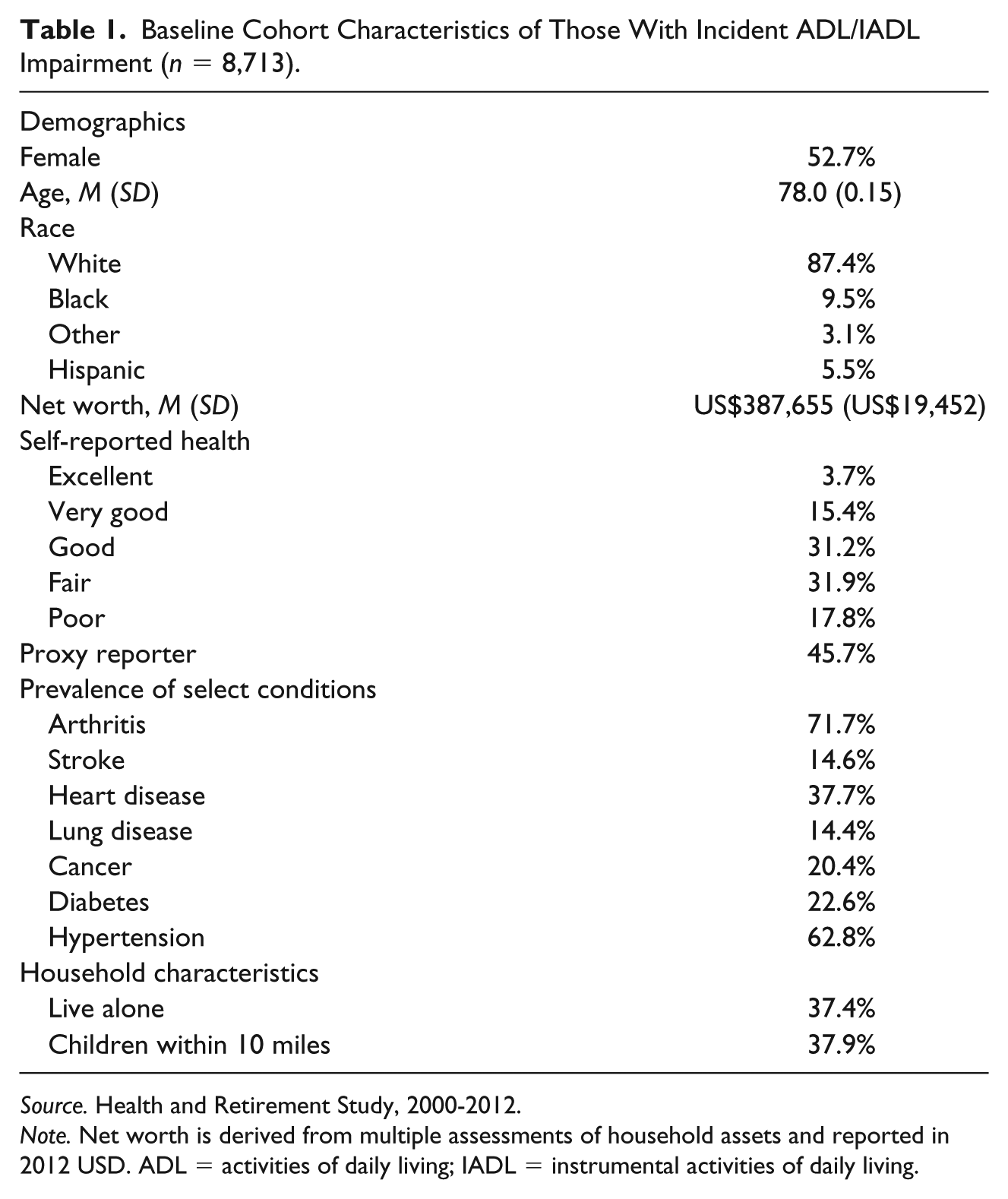
Source. Health and Retirement Study, 2000-2012.
Note. Net worth is derived from multiple assessments of household assets and reported in 2012 USD. ADL = activities of daily living; IADL = instrumental activities of daily living.
Individuals with incident ADL/IADL disability had mean follow-up of 4.2 biennial survey waves, representing 8 years of follow-up on average. Two years after onset of ADL or IADL disability, 46.8% of individuals in the cohort were deceased and by 10 years 79.4% were deceased (Figure 1). Although 22.1% of individuals were recovered 2 years after onset of disability, only 6.43% remained without disability 10 years later.
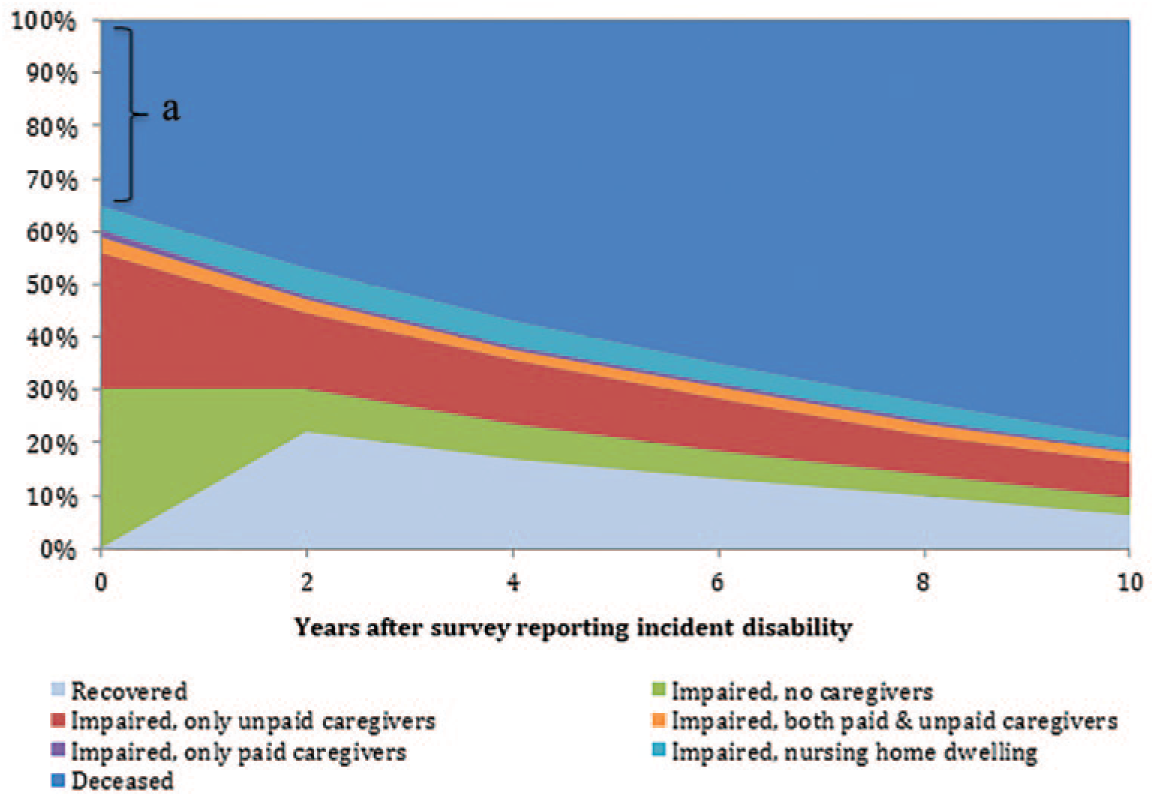
Proportion of older adults with incident disability in each function and care state over 10 years of follow-up (n = 8,713).
Most of the flux in caregiving states occurred in the 2 years after disability. Over these 2 years, the proportion of disabled older adults with no caregivers fell from 46.8% to 26.2%, some of which was due to recovery. At the same time, there was an increase in the proportion reporting unpaid caregiving, from 39.8% to 45.9%. There was also an increase in nursing home care from 7.0% to 16.4%. Over the entire decade, those reporting concurrent paid and unpaid caregiving increased, from 4.3% to 13.2%.
The second stage of the analysis examined the individual patterns of caregiving for ADL/IADL disabilities for those with a potential observation period of at least 10 years. Table 2 demonstrates the proportion of individuals experiencing each function and care state over the next decade, and the mean years spent in each state for those who experienced it. Death was the most common state following disability, with deceased individuals dying a mean of 1.14 years after onset of disability. The next most commonly experienced state was unpaid care (40.1%), with individuals reporting unpaid care for a mean of 3.89 years, followed by no assistance (36.0%), reported on average for 3.37 years. The state that individuals experience for the shortest length of time was receiving both paid and unpaid home-based care, with individuals in this state for a mean of 2.93 years, followed by paid home-based care, with the average individual in this state for a mean of 2.93 years.
Transition Between and Mean Time in Function and Care States During the 10 Years After Incident ADL/IADL Disability.

Note. ADL = activities of daily living; IADL = instrumental activities of daily living.
Mean years in each state was assessed only for those reporting the specific state at least once.
This indicates that deceased individuals died a mean of 1.14 years after the first report of disability.
Discussion
This study demonstrates patterns of recovery, death, and caregiving following incident disability in a nationally representative sample of older adults in the United States. Although recovery was common, especially in the 2 years after onset of disability, death and recurrent or persistent disability were more likely. Caregiving patterns demonstrated significant numbers of transitions among caregiving arrangements over time.
This study suggests people experience significant fluctuations in disability, caregiving, and overall health in the first years after the onset of disability. For individuals following incident ADL/IADL disability, 22.1% have recovered by Year 2 (although fewer than half of these will still be without disability 6 years later) and 46.9% have died. The rate of durable recovery that we find is lower than in other studies (Hardy & Gill, 2004).
This is likely because we are likely missing more transient, minor episodes of disability occurring and resolving between HRS survey waves. The proportion receiving both paid and unpaid care at home as well as nursing home care increases by more than 100% over the first 2 years after incident disability. Most states of care measured are short term with only 20.0% of those receiving paid home based care and 23.1% receiving both paid and unpaid care at home in the same situation 2 years later.
The number of individuals reporting no assistance despite disability is sizable and deserves further study. For those surviving individuals who were disabled, 46.8% reported no assistance although this declined to 26.2% 2 years later. It will be important to understand the factors underlying this lack of assistance and the health outcomes of these individuals. Other literature has demonstrated the health consequences of having unmet caregiving needs. Our population-level estimates of the size of this population indicate unmet care needs is a major public health issue.
This study has several limitations. Although the HRS is advantageous in that it allows following individuals for over a decade, it is conducted biennially; therefore, there may be transitions in care, recovery, and disability occurring between survey waves. In addition, the HRS describes caregiving as assistance with ADL and IADLs while other types of support such as emotional support, companionship, and assisting with medical care are not captured. To define caregiving states as relatively few categories, we do not include the range of variation within each state, such as caregiving hours or number of caregivers. Understanding how caregiving networks change over time is a separate and valuable research area. Although the HRS utilizes proxy respondents for cognitively impaired individuals, there is evidence that this contributes little bias (Weir, Faul, & Langa, 2014). Finally, this study describes the population-level patterns after disability. Further work will determine the individual clinical (comorbidities, dementia), household (caregiver presence and wealth) and regional (health system and wealth) factors that influence outcomes after disability.
Given the high cost of medical and institutional care for disabled older adults, it is critical to understand how caregiving context and patterns change over time. This study demonstrates significant flux in the care patterns of older adults following disability. Future research will be needed to link the observed patterns to patient and caregiver-reported quality of care. Furthermore, a sizable portion of individuals die in the years following report of new ADL or IADL disability and yet disability is not systematically screened for in health care settings or captured consistently in medical records. Although previous work has contextualized functional disability in a context of recovery or rehabilitation, the magnitude of death and caregiver burden indicate that there is need for support and palliation for this population as well. In particular, efforts by health insurers to consider both the caregiving and support as well as health care needs for this population is a promising direction to better address the needs of older adults with functional disability. Future work to explore the benefits and implementation of screening for disability will be a critical step to improve quality of care for all older adults.
Footnotes
Declaration of Conflicting Interests
The author(s) declared no potential conflicts of interest with respect to the research, authorship, and/or publication of this article.
Funding
The author(s) disclosed receipt of the following financial support for the research, authorship, and/or publication of this article: Claire K. Ankuda received funding from the National Palliative Care Research Center. Amy S. Kelley received funding from the National Institutes on Aging, R01AG054540. Katherine A. Ornstein received funding from the National Insitutes on Aging, K01AG047923. Deborah A. Levine is funded by the National Institutes on Aging R01AG051827. The HRS (Health and Retirement Study) is sponsored by the National Institute on Aging (Grant Number NIA U01AG009740) and is conducted by the University of Michigan.
