



Abstract
Limited research has investigated the effect of housing type on older people’s physical activity, and the small amount of work to date has relied on self-reported activity levels. The aim of this study was to assess whether housing type is associated with objectively measured physical activity among community-dwelling older people. In total, 430 Australians aged 60 years and older completed a survey and wore an accelerometer for a week. Controlling for a range of confounding variables (age, gender, physical health, neighborhood walkability, and the density of open spaces in the local area), participants living in separate houses were found to engage in higher levels of activity compared with those living in retirement villages. In addition, those living in separate houses and apartments were significantly more likely to meet the physical activity guideline of 150+ min/week compared with those living in retirement villages.
Introduction
As populations around the world are aging rapidly, it is becoming increasingly important to ensure that physical environments at both macro (e.g., cities) and micro (e.g., homes) levels facilitate healthy aging (Kylén, Schmidt, Iwarsson, Haak, & Ekström, 2017; World Health Organization, 2015b). Promoting healthy aging can assist in ameliorating the substantial health system and economic implications of population aging (Goldman et al., 2013) as well as improving quality of life for a growing proportion of the population (WHO, 2015b).
The role of the environment in healthy aging is recognized in research relating to livable cities (Hwang & Ziebarth, 2015), healthy cities (Ashton, Grey, & Barnard, 1986), and age-friendly cities (Plouffe & Kalache, 2010; WHO, 2007). These bodies of work highlight the importance of planning and constructing environments that feature attributes that are conducive to physical, psychological, and social well-being. Such attributes include access to transport, access to relevant services (e.g., medical and general care services), proximity to destinations of interest (e.g., shops, parks, theaters), and affordable housing options that facilitate the ability to age in place and/or to move to age-friendly premises (Alley, Liebig, Pynoos, Banerjee, & Choi, 2007; Beard & Petitot, 2010; Hwang & Ziebarth, 2015).
Physical activity is a critical element of healthy aging that is affected by the nature of the physical environment (Beard & Petitot, 2010; Kerr, Rosenberg, & Frank, 2012). Recommendations relating to physical activity are typically expressed in terms of “moderate to vigorous physical activity” (MVPA). Moderate activity involves “a moderate amount of effort and noticeably accelerates the heart rate” (e.g., brisk walking, dancing, and household chores) and vigorous activity involves “a large amount of effort and causes rapid breathing and a substantial increase in heart rate” (e.g., running, cycling, and fast swimming) (WHO, 2015a). Older people who engage in regular MVPA have reduced morbidity and mortality relative to their sedentary peers and enjoy higher levels of functionality (Bauman, Merom, Bull, Buchner, & Fiatarone Singh, 2016; Hupin et al., 2015). However, many older people do not meet MVPA guidelines (Hallal et al., 2012). In Australia, the context of the present study, only around a third of those aged 65 years and older reach the minimum target of 150 min of MVPA per week (Australian Bureau of Statistics, 2015).
Although the physical environment represents an important category of physical activity determinants, research to date has generated inconclusive findings (Hawkesworth et al., 2018; Moran et al., 2014; VanCauwenberg, Nathan, Barnett, Barnett, & Cerin, 2018). Of the various environmental characteristics included in physical activity research, housing type has received little attention but appears to be a promising area for research (Haselwandter et al., 2015). The few studies in which this variable has been examined indicated a likely effect, with larger houses being associated with higher levels of activity among older people (e.g., Fisher et al., 2018; McKee, Kearney, & Kenny, 2015; Travers et al., 2018). However, these studies have typically relied on self-reported physical activity data and do not appear to have assessed the relationship between housing type and compliance with physical activity guidelines. A further consideration is the extent to which other individual and environmental factors are likely to confound the relationship between housing type and older people’s activity levels. In particular, age, physical health, neighborhood walkability, and the availability of green/open spaces appear likely to influence the extent to which housing type affects total levels of activity due to their impact on ability to engage in various forms of physical activity and/or their ability to provide alternative opportunities for exercise (Bauman et al., 2012; Carlson et al., 2012; Cole, Dunn, Hunter, Owen, & Sugiyama, 2015; Gong, Gallacher, Palmer, & Fone, 2014; Jongeneel-Grimen, Droomers, van Oers, Stronks, & Kunst, 2014; King et al., 2011; Sun, Norman, & While, 2013; VanCauwenberg et al., 2018). Male gender has also been consistently associated with engagement in physical activity (Bauman et al., 2012; Sun et al., 2013), thereby constituting a further potential confounder.
The aim of the present study was to extend the limited evidence relating to the relationship between housing type and physical activity by using an objective measure of physical activity engagement among a community-dwelling sample of older people aged 60+ years. The primary forms of dwellings for older people in Australia are free-standing houses, townhouses (typically a two-story home sharing a common wall with another home), units/apartments, and retirement village accommodation (most often constituting small units). The relationship between engagement in physical activity and housing type was assessed, taking into account the potential confounders of age, gender, physical health, neighborhood walkability, and the density of open spaces in the local area.
Method
As part of a larger study investigating factors associated with healthy aging (Pettigrew et al., 2015; Rai et al., 2018), community-dwelling (i.e., noninstitutionalized) Western Australians aged 60+ years wore waist accelerometers (GT3X ActiGraph, Pensacola Florida) for 1 week and completed a survey that included items relating to demographics, physical health status (operationalized as number of diagnosed diseases), and housing type. Accelerometers are devices that are worn to measure the acceleration of the body, with the level of acceleration expressed as activity counts (Migueles et al., 2017). The ActiGraph GT3X is an accelerometer that measures acceleration across three axes and produces activity counts as a composite vector magnitude of these three axes (Migueles et al., 2017). It has been shown to be valid and reliable in quantifying physical activity and measuring sedentary behavior (Aadland & Ylvisåker, 2015; Sasaki, John, & Freedson, 2011) and has been used in numerous studies to objectively assess physical activity in older adults (Gorman et al., 2014; Schrack et al., 2016; Wullems, Verschueren, Degens, Morse, & Onambélé, 2016).
Participants were recruited from the Perth metropolitan area using advertisements disseminated via radio, local newspapers, shopping centers, and seniors’ events. Perth is the capital city of Western Australia with a population of just above 2 million (Australian Bureau of Statistics, 2018). It has a temperate climate that is generally conducive to physical activity (Badland, Christian, Giles-Corti, & Knuiman, 2011).
To be eligible for inclusion, in addition to being aged 60+ years, individuals needed to be fully retired and adequately mobile to attend a university campus to receive the accelerometer and instructions for its use. The sample characteristics of those providing complete data who were included in the present study (n = 430) are shown in Table 1. Ethics approval for the study was obtained from a university Human Research Ethics Committee (approval number HR21/2014) and all participants provided written informed consent prior to participation.
Sample Profile (n = 430).
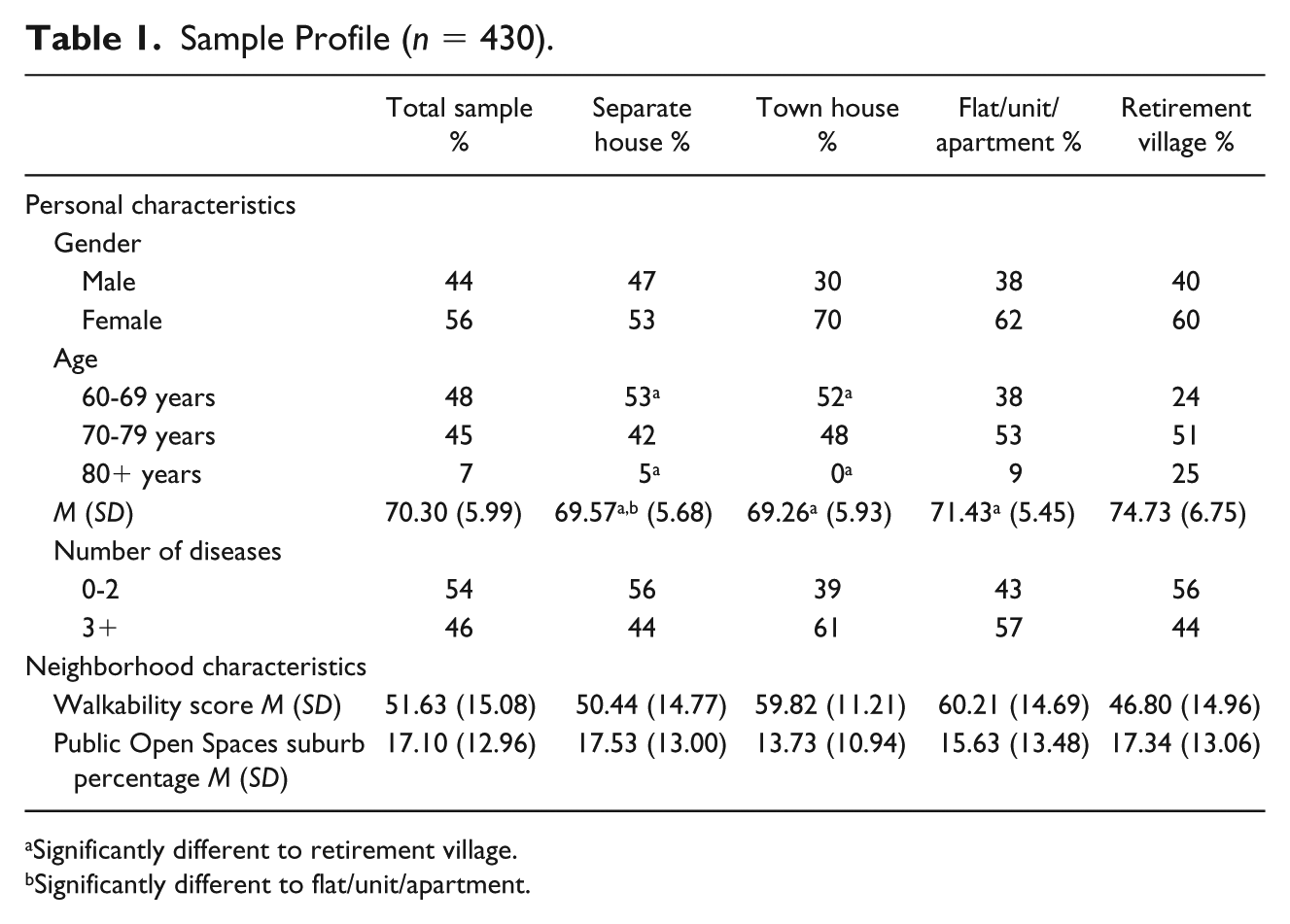
Significantly different to retirement village.
Significantly different to flat/unit/apartment.
Participants’ postcodes were used to derive data relating to neighborhood walkability and density of open spaces. Walkability was assessed via Walk Score®, a freely accessible online tool that applies a distance-decay algorithm to allocate points for a geographic location by calculating the shortest distance to 13 amenities such as parks, schools, shops, restaurants, and entertainment venues (Front Seat Management, 2014). The percentage of open space (defined as parks, bushland, conservation areas, school grounds and playing fields, and areas of residual green space: Bull et al., 2013) within suburbs was assessed using the POS (Public Open Space) Tool (Centre for the Built Environment and Health, 2013). The POS Tool was developed in Australia based on captured aerial images. It is available to researchers, land developers, and the general public to access open space data. Examples of prior application of this tool include investigations of the relationships between recreational walking and access to parks in adults (H. Christian et al., 2017) and independent mobility and distance to urban green spaces in children (H. E. Christian et al., 2015).
Analysis
Prior to analysis, the distribution of the primary dependent variable of total weekly MVPA was examined. This variable was found to be nonnormally distributed so a square root transformation was applied to increase the accuracy of inferential analyses. However, raw (i.e., untransformed) scores are presented in the descriptive statistics to provide an indication of MVPA engagement among older adults residing in different types of housing.
One-way ANOVAs with Tukey’s post hoc tests were conducted to assess the relationship between housing type and total weekly MVPA. Pearson chi-square analyses were conducted to assess the relationship between housing type and compliance with the 150 min/week MVPA guideline. A threshold of accelerometer-derived activity counts found to be relevant to older adults (≥2,752 counts per minute) was used to calculate average minutes of MVPA per week (Santos-Lozano et al., 2013).
Once the presence of an association was confirmed, hierarchical linear (for weekly MVPA) and logistic (for compliance with MVPA guidelines: 0 = no, 1 = yes) regression analyses were conducted. Age, gender, physical health, neighborhood walkability, and the density of open spaces in the local area were entered in Step 1 of both analyses. Housing type was dummy coded with separate house, unit/apartment, and townhouse entered in Step 2 (each coded as 0 = no, 1 = yes). The housing type “retirement village” was used as the reference category.
Results
Descriptive statistics on the sample characteristics by housing type are presented in Table 1. Participants living in retirement homes were significantly older than those living in separate houses, town houses, and flats/units/apartments. Results from the initial univariate analysis are presented in Table 2. The majority of the study participants (73%) reported living in separate houses. Reflecting the eligibility requirement for participants to be adequately fit and healthy to cope with a visit to a university campus, average minutes of MVPA and rates of compliance with the current physical activity guideline (150+ min of MVPA per week) were relatively high compared with population figures (Australian Bureau of Statistics, 2015). On average, those living in retirement villages were the only group that failed to meet the guideline. Those living in separate houses had significantly higher levels of weekly MVPA than those in retirement villages, p = .021, 95% confidence interval (CI) = [8.94, 153.61], and those in separate houses, χ2(1) = 9.76, p = .002, and apartments, χ2(1) = 6.36, p = .012, were more likely to comply with the MVPA guideline than those living in retirement villages.
Association Between Housing Type and MVPA Time and MVPA Guideline Compliance.

Note. Levene’s test of homogeneity of variances was not significant (p = .290). MVPA = moderate to vigorous physical activity.
Significantly different from retirement village at p < .05.
The results of both the linear and logistic regression analyses are presented in Table 3. The pattern of results after controlling for age, gender, health status, neighborhood walkability, and density of open spaces was the same as found in the univariate analysis reported above: those living in separate houses had higher levels of MVPA than those living in retirement villages, and those living in either separate houses or apartments were twice as likely to meet the physical activity guideline as those living in retirement villages.
Regression Results for MVPA Time and MVPA Guideline Compliance.
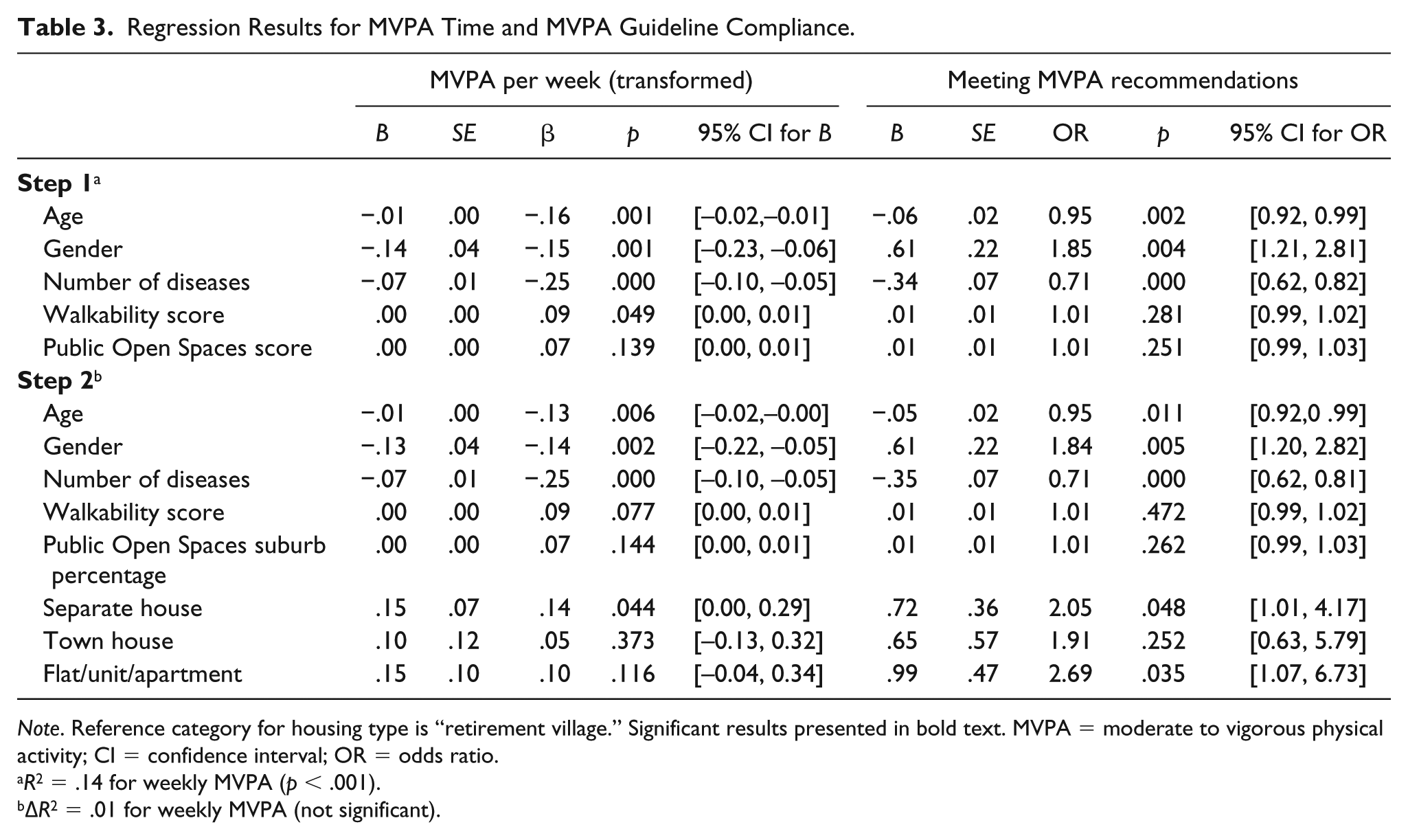
Note. Reference category for housing type is “retirement village.” Significant results presented in bold text. MVPA = moderate to vigorous physical activity; CI = confidence interval; OR = odds ratio.
R2 = .14 for weekly MVPA (p < .001).
∆R2 = .01 for weekly MVPA (not significant).
Discussion
Older people’s decisions to engage in physical activity are complex and involve a large number of potential determinants, including those relating to access, affordability, motivation, social support, and health status (Baert, Gorus, Mets, Geerts, & Bautmans, 2011; Bauman et al., 2012; Franco et al., 2015; Nathan et al., 2012; Pettigrew et al., 2018).
Although many of these determinants have been extensively explored in previous work, the effect of housing type on activity levels in later life requires greater attention as population’s age and housing infrastructure needs to be developed or modified accordingly (Kylén et al., 2017; Oswald et al., 2007).
The aim of the present study was to use an objective measure of physical activity to assess whether different housing types result in varying levels of MVPA and contribute to older people’s compliance with physical activity guidelines. The results show that both total weekly MVPA and compliance with the 150+ min/week physical activity guideline varied significantly by housing type. Seniors residing in separate houses engaged in more physical activity than those in retirement villages, regardless of age, gender, physical health, neighborhood walkability, and the availability of open spaces in the surrounding area. This outcome illustrates how higher density living environments can constrain activity levels, and supports previous research finding lower levels of physical activity among those living in seniors’ housing units relative to those in the general community (Fisher et al., 2018). The results have implications across multiple domains.
First, there is a clear need to ensure housing design optimizes physical activity outcomes for older occupants. This has two facets: (a) the provision of retirement housing that has activity opportunities similar to those of separate houses, within the context of offering compact and affordable dwelling options and (b) the use of universal design principles in all housing to facilitate aging in place, enhance the mobility of those with physical limitations, and reduce the need to modify living spaces in later life (Campbell, 2016; Crews & Zavotka, 2006; WHO, 2015b). For retirement housing planners in particular, the challenge is to develop individual dwellings and the larger complexes in which they are located in a manner that encourages both incremental and planned activity, while accommodating the mobility limitations affecting many residents. An important related aspect is consideration of traffic flows around the local area, with lower speeds more conducive to pedestrian activity (Chaudhury, Campo, Michael, & Mahmood, 2016; Dumbaugh, 2008).
Second, the tendency for older people living in higher density housing to be less physically active points to the need for careful planning to ensure the availability of exercise programs and facilities for those living in smaller dwellings (Fisher et al., 2018). Access to appropriate, affordable, and attractive physical activity options can increase the likelihood of participation by older people (Bethancourt, Rosenberg, Beatty, & Arterburn, 2014; Olanrewaju, Kelly, Cowan, Brayne, & Lafortune, 2016). Third, it is recognized that social factors are an important determinant of older people’s physical activity levels (Hawkesworth et al., 2018). This indicates the potential to encourage social interaction among residents of smaller living units to increase the likelihood of them choosing to be active together (Fisher et al., 2018). More social interaction also serves to increase the “liveliness” of higher density neighborhoods, which in turn can promote higher levels of activity (Forsyth, 2015; Zhou, Grady, & Chen, 2017). Finally, it may be useful to provide guidance to older people moving from free-standing houses to smaller living units about health-promoting attributes to consider in their housing decisions, especially in terms of the number of nearby destinations as this is associated with higher levels of activity (Zhou et al., 2017).
The multisectoral nature of these implications highlights the need for consultation among different policy areas and industry bodies to optimize outcomes for older people (Salvo, Lashewicz, Doyle-Baker, & McCormack, 2018). For example, government departments with responsibility for housing and transport portfolios need to consult with each other and private sector land development organizations to ensure homes and the environments in which they are located meet seniors’ needs. In addition, it is important to include older people themselves in any planning processes to ensure their perspectives are incorporated (Hwang & Ziebarth, 2015).
Study Limitations and Future Research Directions
The primary limitations of this study are the convenience sampling method, the exclusion of seniors with mobility restrictions, and the skew toward individuals living in separate houses. In addition, data were not available on the physical characteristics of participants’ homes (e.g., square footage, presence of stairs, and presence and size of garden areas), and no examination of the nature of the walkable amenities was performed. These aspects of the built environment are likely to be important for older people’s overall activity levels and health (Kerr et al., 2012; Zhou et al., 2017). However, the use of an objective physical activity measure and the large sample for an accelerometer study are key strengths, and the ability to detect significant differences despite the skewed sample suggests the findings are robust. Future research may include more detailed information relating to the nature of the home and the specific forms of MVPA undertaken (e.g., gardening that requires a yard). It would also be useful to assess whether other potential confounders (e.g., differences in functionality and mobility levels, extent of social networks, and living situation such as living alone or with others) differentiate those who choose to live in retirement villages from other older people. Importantly, there may be distinct variations in psychological attributes that predict willingness and desire to live in housing environments with more communal areas and/or options for higher levels of living assistance.
Conclusion
Housing type presents as an important potential determinant of older people’s physical activity levels. This has practical implications for the way in which seniors’ housing is developed and policy implications in terms of area zoning. Further research is needed among more diverse samples to provide greater insights into the forms of housing that optimize older people’s well-being, including their physical activity levels.
Footnotes
Acknowledgements
The authors thank Nicole Biagioni, Zenobia Talati, and Caitlin Worrall and the staff and students at the ECU Vario Health Clinic and the Curtin School of Physiotherapy for their assistance with data collection.
Declaration of Conflicting Interests
The authors declared no potential conflicts of interest with respect to the research, authorship, and/or publication of this article.
Funding
The authors disclosed receipt of the following financial support for the research, authorship, and/or publication of this article: The study was funded by a Discovery Project Grant from the Australian Research Council (grant number DP140100365).
