



Abstract
Introduction
Telomeres are complexes of repeat nucleotide sequences and binding proteins located at the ends of chromosomes that contain TTAGGG tandem repeats and can protect chromosomes from fusion, recombination, and degradation (Ellehoj, Bendix, & Osler, 2016; Rizvi, Raza, & Mahdi, 2014). Telomere length (TL) is greatest at birth and decreases progressively with advancing age, and as a result is considered a biomarker of chronological aging (Rizvi et al., 2014; Zhu, Belcher, & van der Harst, 2011). The decrease in the mean TL is 20 to 50 bp/year (Harley, Futcher, & Greider, 1990; von Zglinicki et al., 2000). TL is determined by several factors, including telomerase activity, rate of cell division, and oxidative stress, which is determined by genetic and environmental factors. The association between TL, cellular aging, and overall longevity has been demonstrated (Maximov et al., 2017; Rizvi et al., 2014). TL can also be affected by health behaviors such as drinking sugar-sweetened beverages, excessive alcohol consumption (Pavanello et al., 2011), smoking (Valdes et al., 2005), mental health (Needham et al., 2015; Phillips et al., 2013; Simon et al., 2006), and a variety of life stressors (Savolainen et al., 2014; Verhoeven et al., 2015).
Genome-wide association studies have found that TL is influenced by genetic polymorphisms (Delgado et al., 2017; Mangino et al., 2015), and more than 150 genes may be involved in telomere regulation (Gatbonton et al.,2006). Apolipoprotein E (ApoE), a plasma protein involved in the metabolism of lipoproteins and cholesterol, is the most important carrier protein in the nervous system (Mahley, 1988). Three alleles (ε2, ε3, and ε4) and six different genotypes (ε2/2, ε3/3, ε4/4, ε2/3, ε2/4, ε3/4) exist for ApoE (Hanlon & Rubinsztein, 1995). Research has shown that Apo E-knockout mice exhibit many aging features, such as loss of hair follicles, fading of hair, degradation of spermatogenic cells and seminiferous tubules, and a shortened lifespan, suggesting that ApoE may play an important role in aging (Chen & Yang, 2010). The ε4 allele carrier is associated with higher oxidative stress and a pro-inflammatory state (Jofre-Monseny, Minihane & Rimbach, 2010), which leads to DNA damage and telomere shortening.
Translocase of the Outer Mitochondrial Membrane-40kD (TOMM40) is a key channel in the mitochondrial outer cell membrane for the passage of various enzymes into the mitochondria, which has a direct effect on mitochondrial function. The TOMM40 gene and ApoE gene are located at same chromosome of 19 in the 45,312,338 to 45,422,606 area (Roses et al., 2013). A G/A polymorphism (rs2075650) in the second intron locus 45,395,619 is associated with longevity (Deelen et al., 2011), and the rs2075650 (allele G) may increase the risk of developing later onset Alzheimer disease (Bagnoli et al., 2013; similar to the Apo ε4 allele).
Religious involvement has been shown to play an important role in public health and has been associated with greater longevity in several studies. Research also indicates that adults who attend religious services, pray regularly, and consider themselves religious tend to exhibit longer telomeres than those who are less religiously involved (Hill, Ellison, Burdette, Taylor, & Friedman, 2016). Koenig, Nelson, Shaw, Saxena, and Cohen (2016) reported a U-shaped relationship between religiosity and TL among female family caregivers, finding a positive relationship between religiosity and TL among those who were not at all religious (10% of the sample), but among those with any level of religiosity (90% of the sample) there was a positive relationship between increasing religiosity and TL. Different aspects of religiosity may help to explain the association with TL, including increased social support (Carroll, Diez Roux, Fitzpatrick, & Seeman, 2013), greater self-control (Desmond, Ulmer, & Bader, 2013), and lower psychological stress due to improved coping (Savolainen et al., 2014). Hill, Vaghela, Ellison, and Rote (2017) found that religious attendance may promote TL indirectly by reducing symptoms of depression and cigarette smoking among Americans aged 50 and older.
An increasing number of studies have focused on the interaction between environmental factors and genes in order to help explain the relationship between religion and health. Religious involvement has been hypothesized to counteract cellular aging by modifying the effect of genes that may promote disease. Research has shown that high religiosity may lower the risk of mild cognitive impairment in those without the protective Apo ε2 allele (Wang, Wang, Koenig, & Alshohaib, 2017). Another study has found that religion may buffer the effect of high-risk alcohol dehydrogenase enzyme polymorphisms on alcohol use disorders (Chartier et al., 2016).
The current study sought to examine the relationship among religiosity on TL and the moderating effect of religiosity on the relationship between high-risk genetic polymorphisms and TL via a gene × environment (G × E) paradigm in a sample of Chinese Muslims. We hypothesized that greater religiosity would be associated with longer TL and would buffer the negative effect of high-risk genetic polymorphisms on TL (see Figure 1).

Theoretical model of the moderating effect of religiosity on the relationship between high-risk genetic polymorphisms and telomere length.
Method
Study Sample
Participants in this study were community residents who engaged in a community public heath examination from 2013 to 2016, one of the public health programs supported by the local Chinese government and carried out once a year. All residents aged 55 years or older are eligible for the program. A total of 2,340 participants completed a questionnaire, and 1,861 received a physical examination and provided blood samples for genetic analysis and TL testing. Of those, TL could not be determined for 126 blood samples, and 27 participants carrying the Apo ε2/4 genotype were excluded for technical reasons (Sun et al., 2011), resulting in 1,692 subjects who were included in the final analysis. Inclusion criteria were (a) having a physical address in the local area, (b) age 55 years or older, and (c) Muslim religious affiliation. Those who were unable to complete the survey due to vision or hearing disabilities or a history of serious physical illness were excluded.
TL Assay
All the participants underwent a physical examination at community health centers by physicians, and venous blood samples were obtained. A face-to-face interview was performed by trained medical students using a structured questionnaire to collect demographic information (age, gender, education level, living status, etc.). TL was measured by a quantitative polymerase chain reaction (qPCR)-based assay (O’Callaghan & Fenech, 2011). Genomic DNA was isolated from peripheral blood leukocytes that were stored at −80°C. The DNA concentration was quantified using a Nanodrop SD-1000 spectrophotometer, and the DNA was subsequently spun down and resuspended to ensure accurate and uniform concentrations. Agarose gel electrophoresis was used to detect the integrity and purity of the DNA. To produce high-purity DNA, the genomic DNA template was highly pure. The ratio of ultraviolet (UV) spectrophotometer readings at wavelengths of 260 and 280 nm were between 1.7 and 2.1.
Purified DNA samples were obtained by dilution of the concentrated DNA samples with PCR grade water (DNase/RNase Free) into 96-well plate with a fixed concentration of 5 ng/µL. This assay compared telomere repeat sequence copy number (T) with a reference single copy gene copy (36B4) number (S) in each sample. Standard curves were derived from serially diluted reference DNA. Ratios in the range specified indicate the presence of nucleic acid with low amounts of contaminating protein. Genomic DNA of this quality is suitable for the next qPCR test. TL was measured by a qPCR-based assay. The qPCR was performed under the following conditions: pre-denature at 95°C for 10 min, denature at 95°C for 15 s, anneal/extend at 60°C for 1 min, with fluorescence data collection for 40 cycles. The designs used the following primer sequences: 5′CGGTTTGTTTGGGTTTGGGTTTGGGTTTGG GTTTGGGTT3′ (forward), 5′GGCTTGCCTTACCCTTACCCTTACCCT TACCCTTACCCT3′ (reverse) for telomere sequence amplification and 5′CAGCAAGTGGGA AGGTGTAATCC3′ (forward), 5′CCCATTCTATCATCAACGGGTACAA 3′ (reverse) for 36B4 sequence amplification.
The assay compared telomere repeat sequence copy number (T) with a reference single copy gene copy number (S) in each sample. Standard curves were derived from serially diluted reference DNA. The T/S ratio was calculated from the average quantity of reference DNA found to match with each experimental sample for the copy number of the targeted template (for T: the number of telomere repeats and for S: the number of 36B4 gene copies; Delgado et al., 2017). All the tests were performed in a lab according to standard procedures.
ApoE and TOMM40 Gene Polymorphism Test
Single-nucleotide polymorphisms (SNPs) of the rs429358, rs7412, and rs2075650 genes were detected by a MassARRAY system (Sequenom, San Diego, CA, USA) using the chip-based matrix-assisted laser desorption ionization time-of-flight mass spectrometry technology performed at a genetic testing company in China (BGI, Shenzhen). To control for accuracy, 460 DNA samples were retested using a high-resolution melting (HRM) curve method (Graham, Liew, Meadows, Lyon, & Wittwer, 2005) at the Biochip Ningxia Center following the manufacturer’s instructions. The results of the two different methods were identical, and the kappa value was equal to 1. The Hardy–Weinberg balance test was conducted by chi-square analysis (rs2075650, χ2 = 0.44, p = .508; ApoE gene, χ2 = 23.24, p = .250).
Religiosity
Religiosity was measured using the Chinese version of the five-item Duke University Religion Index (DUREL) scale, a brief measure of religious involvement widely used in the literature (Koenig & Büssing, 2010). The DUREL consists of five questions: (a) How often do you attend religious events or other religious meetings held in temple, mosque, or church? (b) How often do you spend time in private religious activities, such as meditation, prayer, or studying religious scriptures? (c) In my life, I experience the presence of the Divine; (d) My religious beliefs guide all my other dealings in life; and (e) I try hard to practice my religion in my relationships with people around me. Thus, this measure assesses participation in organized religious activity, personal religious activity, and intrinsic religiosity. The Chinese version has been shown to have solid reliability and validity in the Ningxia population, with Cronbach’s alphas in the range of .86 to .89 (Wang, Rong, & Koenig, 2014). The DUREL score in the current population ranged from 5 to 27, with a higher score indicating higher religiosity.
Statistical Analysis
Analyses were performed using the Statistical Package for the Social Sciences (SPSS) version 24.0 (SPSS Inc., Chicago, IL, USA). Means and standard deviations were used to describe continuous variables; counts and proportions were used to describe categorical variables. Ordinal logistic regression modeling was used to evaluate the association of religiosity and TL and also to examine the interaction between religiosity and the high-risk genetic polymorphisms Apo ε4 allele and rs2075650 gene G carrier on TL. The ordinal dependent variable for the regression model was TL (1 = 0.04-, 2 = 0.79-, 3 = 1.09-, 4 = 1.53-5.04), given the non-normal distribution of TL scores. The independent variables were age group (1 = 55-59 years, 2 = 60-64 years, 3 = 65 years and above), gender (0 = male, 1 = female), education (1 = illiterate, 2 = primary, 3 = junior, 4 = senior and above), living status (0 = alone, 1 = non-alone), ε4 carrier (0 = yes, 1 = no), rs2075650 G carrier (0 = yes, 1 = no), and DUREL score. Statistical significance was set at p < .05 (two-sided test).
Results
Demographic Characteristics
The demographic characteristics of participants are displayed in Table 1. The average age of participants was 63.4 (SD = 4.6) years with a range of 55 to 74 years. Slightly more than half (53.0%) were female, 10.5% lived alone, and more than half (58.5%) were illiterate. The mean TL was 1.26 (SD = 0.73) and the mean DUREL score was 25.6 (SD = 2.4). Approximately one fifth of subjects were ε4 carriers or G carriers of rs2075650.
Demographic Characteristics of the Participants.
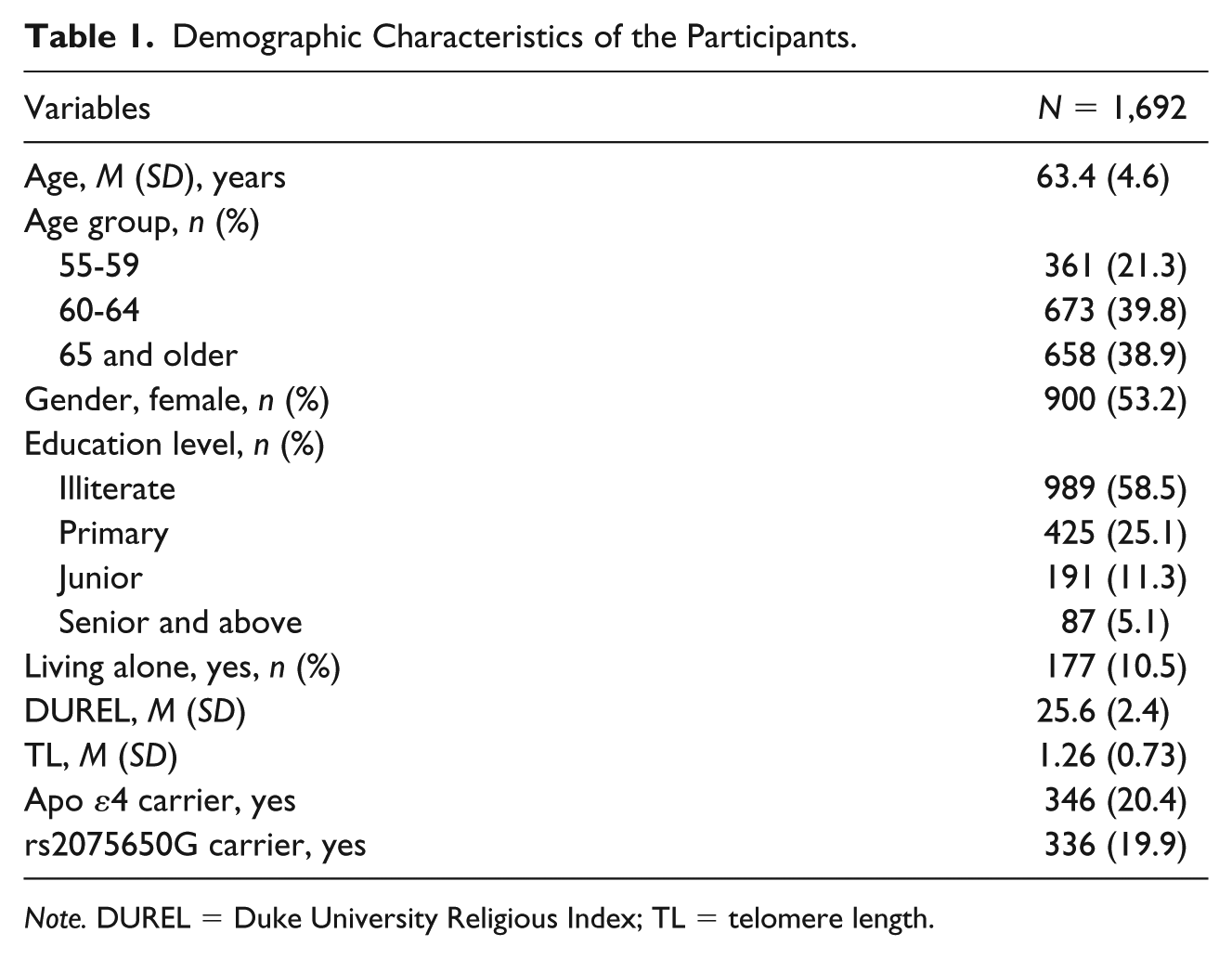
Note. DUREL = Duke University Religious Index; TL = telomere length.
Bivariate Analyses of TL
As shown in Table 2, TL decreased with the increase in age (p<.05), as expected. Higher religiosity was associated with longer TL (β = 0.05, odds ratio [OR] = 1.05; 95% confidence interval [CI] = [1.01, 1.09], p = .005), again as hypothesized. Surprisingly, no association was found between either the Apo ε4 carrier state or the rs2075650 G allele carrier and TL.
Bivariate Analyses With Telomere Length as the Dependent Variable (N = 1,692).
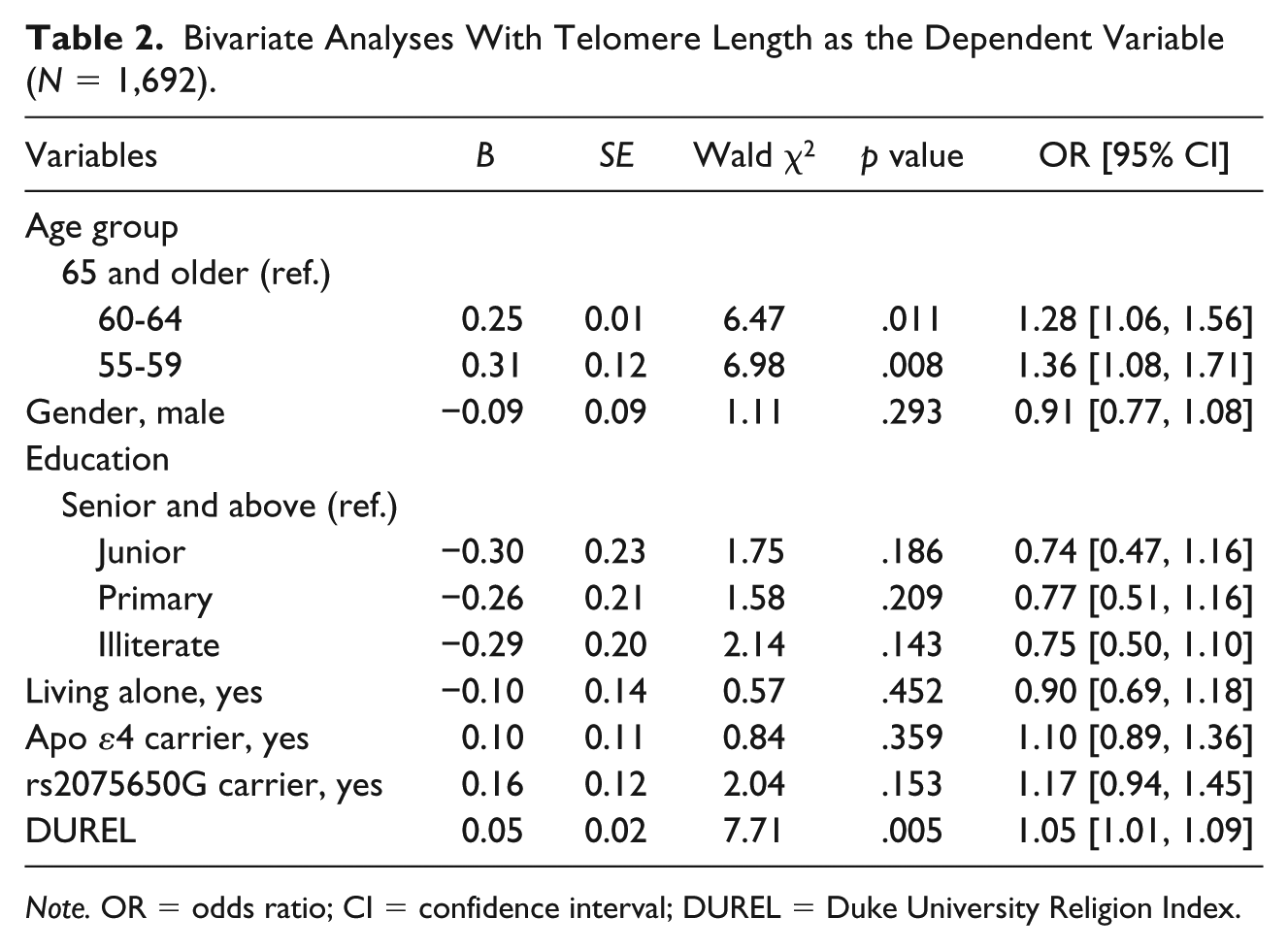
Note. OR = odds ratio; CI = confidence interval; DUREL = Duke University Religion Index.
Interaction With Religiosity in Multivariate Analyses
As shown in Table 3, a significant interaction was found between religiosity and the ε4 carrier state on TL (β = 0.13, OR = 1.13; 95% CI = [1.03, 1.26]; p = .015). There was also a significant interaction between religiosity and the rs2075650 genotype G carrier life on TL (OR = 1.11; 95% CI = [1.01, 1.22]; p = .044). As shown in Table 4, to interpret the meaning of these positive interactions, analyses were stratified by religiosity (DUREL = 27 vs. DUREL < 27). As hypothesized, religiosity moderated the relationship between the rs2075650 polymorphism at the TOMM40 gene and TL, such that the association between the rs2075650 polymorphism and TL was significantly positive among those with high religiosity (OR = 1.35, 95% CI = [1.01, 1.78], p = .040), but no association was found between the rs2075650 polymorphism and TL in those with low religiosity. With regard to the Apo ε4 polymorphism, no significant association was found with TL in either those with high or low religiosity.
Multivariate Analyses (Ordinal Logistic Regression) With Telomere Length as the Dependent Variable (N = 1,692).
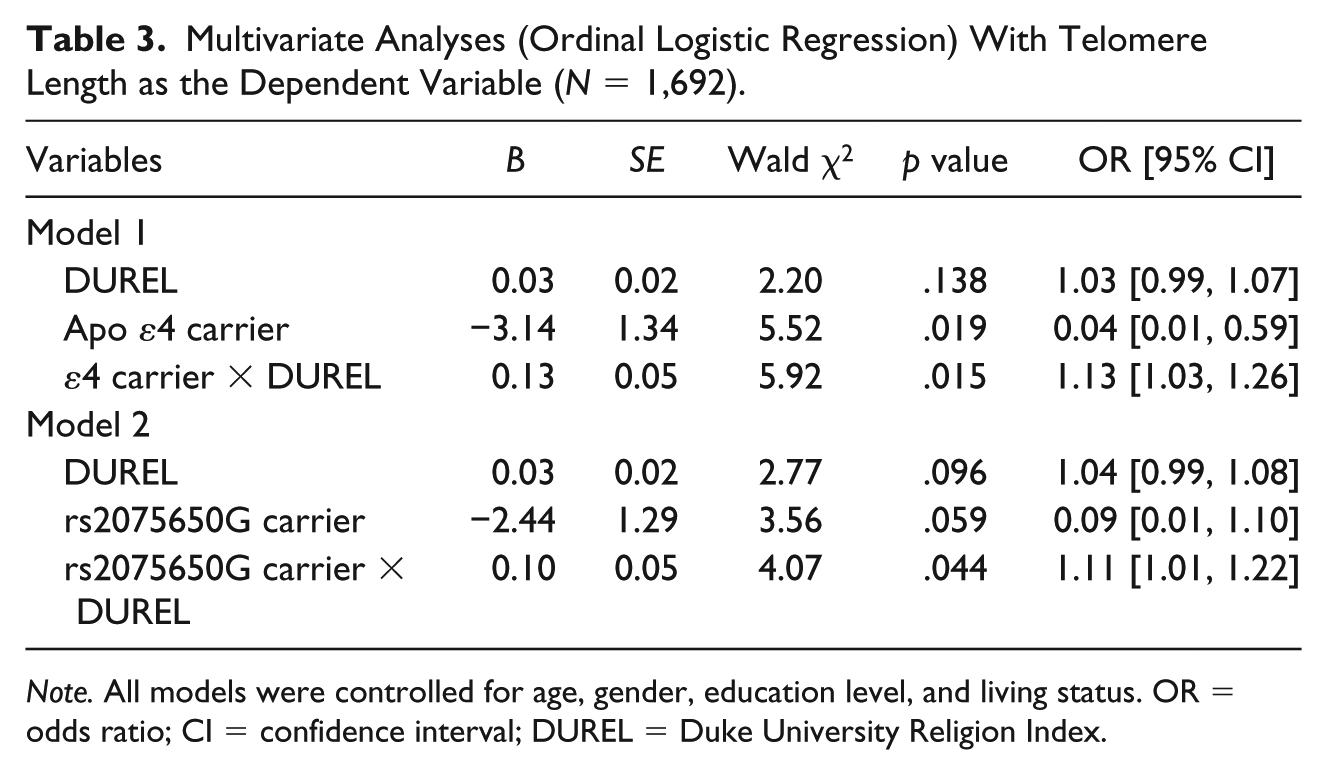
Note. All models were controlled for age, gender, education level, and living status. OR = odds ratio; CI = confidence interval; DUREL = Duke University Religion Index.
Ordinal Regression Analysis of the Relationship Between High-Risk Genetic Polymorphisms and Telomere Length Stratified by Religiosity.
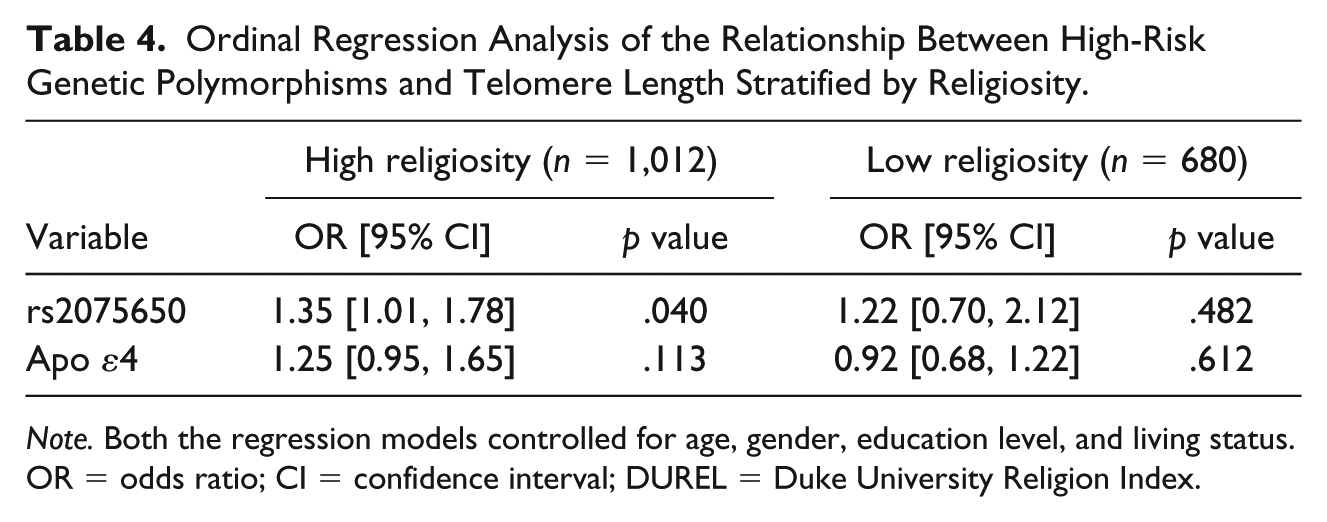
Note. Both the regression models controlled for age, gender, education level, and living status. OR = odds ratio; CI = confidence interval; DUREL = Duke University Religion Index.
Discussion
To our knowledge, this is the first study from China to examine the relationship between religiosity and TL and to determine moderating effects of religiosity on the relationship between high-risk polymorphisms of the ApoE and TOMM40 genes and TL. A Chinese Muslim sample was examined in this study because of the high religiosity of this population group compared with Chinese elders with other religious affiliations, given that previous research had found that the positive association between religiosity and TL was particularly strong at higher levels of religiosity (Koenig et al., 2016).
Bivariate analysis in the present sample revealed a significant positive relationship between religiosity and TL, consistent with previous research in the United States (Hill et al., 2016; Koenig et al., 2016). As expected, age was significantly and inversely correlated with TL, as many previous studies have reported (Delgado et al., 2017; Muzumdar & Atzmon, 2012).
There was also a significant inverse association between ε4 allele carrier state and TL when controlling for demographics (Table 3), a finding consistent with previous research reporting that ε4 carriers are at increased risk of having shorter TL and at greater risk of cognitive decline and more rapid aging (Jacobs et al., 2013). However, the opposite result has also been reported, that is, that ε4 carriers have longer telomeres (Wikgren et al., 2012). Present study also found a trend toward a significant inverse relationship between rs2075650 genotype G and TL (p = .059), after controlling for demographics, which is consistent with prior research that found the G allele of rs2075650 (compared with the A allele) of the TOMM40 gene was associated with shorter longevity (Lu et al., 2014).
When analyses were stratified by high and low religiosity to further identify the nature of these interactions, religiosity was shown to buffer the relationship between the rs2075650 polymorphism of the TOMM40 gene and TL. This relationship was significant and positive only in those with high religiosity, whereas no relationship was found in those with low religiosity. Greater religiosity in Chinese Muslims, then, may be particularly protective in maintaining TL in high-risk polymorphisms of the TOMM40 gene. These findings are supported by a study of alcohol metabolism genes and religious involvement (Chartier et al., 2016), which found that a higher frequency of religious attendance was associated with a weaker relationship between alcohol dehydrogenase enzyme risk genes and alcohol consumption. Furthermore, a previous study also found a modifying effect for religiosity on the relationship between Apo ε4 carrier state and cognitive impairment (Wang et al., 2017).
As noted in the “Introduction” section, there were several aspects of religiosity that may have positive effects on TL (Koenig & Shohaib, 2014). First, the effects of religious belief on TL are likely due to improved coping in the face of increased life stress. Many people turn to religion for comfort when medically ill or stressed, so the effects of religiosity on TL, especially in persons with the high-risk polymorphisms, may be due to the presence of this coping resource, leading to less emotional distress and depression, thereby reducing oxidative stress and inflammation that leads to shorter telomeres.
For example, Yung-ChiehYen et al. (2007) reported that the high-risk polymorphisms may be correlated with severe depression in the elderly, and research has also shown that depressive and anxiety disorders are associated with shorter TL (Révész, Verhoeven, Milaneschi, & Penninx, 2016). Furthermore, religious activities increase social support and social interactions, as shown by Hopkins (2011). Finally, religious belief can limit unhealthy behaviors such as smoking, alcohol abuse, lack of exercise, and other health behaviors known to adversely affect TL (Alomari, Hamed, & Abu, 2014; Headey, Hoehne, & Wagner, 2014; Harley, Futcher & Greider, 1990; Valdes et al., 2005).
There is now a religious awakening occurring in China. The percentage of Chinese adults who indicate they practice religion has increased rapidly during the past several decades (from 7.0% in 2001 to 23.9% in 2007; Stark & Liu, 2011). Given the increasing rate of aging in the Chinese population, the present findings have relevance for understanding the psychosocial-spiritual influences on biological processes through gene–environment interactions involved in aging.
Limitations
The generalizability and interpretation of results from the present study are influenced by several limitations. First, this was a cross-sectional analysis that prevents making causal inferences from the relationships between religiosity and TL reported here. Second, participants in this study were from a region of China where more than 30% of the population is Muslim, and so caution should be exercised when extrapolating these results to Chinese adults living in different regions of the country and those with or without a religious affiliation. Third, the nonrandom nature of the sample may cause a selection bias, thus limiting the external validity of the findings. Finally, potential mediators of the relationship between religiosity and TL, such as social support, stress level, and depression, were not assessed; future studies, particularly those with longitudinal designs, should measure such mediators so that causal mechanisms can be assessed.
Conclusion
This study found a significant positive relationship between religiosity and TL in a large sample of older Chinese Muslims and a positive moderating effect for religiosity on the relationship between high-risk polymorphism of the TOMM40 genes and TL. These findings help explain the biological mechanisms (gene–environment interactions in particular) underlying the positive relationship between religious involvement and longevity now reported in many studies. Future prospective studies are needed to confirm these findings and identify psychosocial factors and indicators of inflammation and oxidative stress that may help to further explain the mechanisms underlying the relationship between religiosity and TL.
Footnotes
Acknowledgements
The authors sincerely thank the staffs at CDC for their assistant in the data collecting.
Declaration of Conflicting Interests
The author(s) declared no potential conflicts of interest with respect to the research, authorship, and/or publication of this article.
Funding
The author(s) disclosed receipt of the following financial support for the research, authorship, and/or publication of this article: This work was supported by the National Natural Science Foundation of China (81860599).
Institutional Review
This study was approved by the Institutional Review Board of the Ningxia Medical University (No. 2015151 and 2018115). All the participants provided written informed consent. Professor Zhizhong Wang from Ningxia Medical University is the principal investigator (PI).
