



Abstract
The benefits of savoring interventions for improving mental health have recently been demonstrated with older adults. Using a randomized controlled design involving N = 63 adults (aged 60-90 years), we explore whether relational savoring, a targeted intervention in which participants savor (intensify and prolong) positive emotions associated with the connection experienced with another person, particularly those involving the provision of safe haven/secure base attachment care, is associated with a state of lower cardiovascular reactivity (lower heart rate) during its enactment, as well as greater agency and lower passivity in a post-savoring advice-giving task. We compare all outcomes to participants randomized to a control condition utilized in prior investigations of relational savoring. Results suggest that relational savoring results in lower reactivity and greater agency and passivity. Although preliminary and obtained within a small sample, these findings provide early evidence of the potential of this approach with this population.
Introduction
Savoring entails focusing attention toward the experiential source of pleasure as well as the enjoyment derived from the experience (Bryant & Veroff, 2007). Savoring can involve a focus on the past, present, or future (Bryant & Veroff, 2007), and is associated with positive outcomes, such as greater life satisfaction, more positive moods, and greater positive affect (Hurley & Kwon, 2012; Jose, Lim, & Bryant, 2012; Livingstone & Srivastava, 2012; McMakin, Siegle, & Shirk, 2011; Ng, 2012).
Older Adulthood and Savoring
Relatively, few studies have examined savoring—either as a trait or as an intervention technique—among older adults, despite the suggestion that older adults may be prime candidates for this type of intervention for a number of reasons. First, they may be particularly adept at savoring given that awareness of mortality might allow for greater appreciation of life overall (Bryant, Chadwick, & Kluwe, 2011; Kurtz, 2008). Indeed, older adults’ self-reported ability to savor the present moment is linked with greater health (Geiger, Morey, & Segerstrom, 2017), and greater reported savoring ability predicts greater life satisfaction and happiness, as well as lower depressive symptoms (Smith & Hollinger-Smith, 2015); likewise, older adults exposed to savoring as part of a larger intervention demonstrate reductions in depression symptomology and greater life satisfaction, happiness, and gratitude (Ho, Yeung, & Kwok, 2014). One recent study tested the efficacy of a savoring intervention, administered across a 1-week period, on older adults’ self-reported depressive symptoms, resilience, and happiness (Smith & Hanni, 2017). This study, which did not involve a control group, provided evidence of pre- and posttemporal improvements in treatment targets linked to fidelity of the savoring intervention. Another recent study examined the immediate effects of a brief savoring intervention administered online (Smith & Bryant, 2019), finding that as compared with a negative reflection task and an untreated control, adults who savored reported greater life satisfaction and more positive perceptions of aging. These promising findings underscore the need for additional studies employing randomized designs, more robust control conditions, and additional outcome measures.
Toward the Relational
Theoretically, any positive experience can be savored; however, recent work (e.g., Borelli et al., 2014) focuses on the impacts of savoring relational experiences (i.e., relational savoring). Researchers assess the impacts of relational savoring within parents (Burkhart, Borelli, Rasmussen, & Sbarra, 2015), spouses of deployed military (Borelli et al., 2014), and couples in long-distance relationships (Borelli, Rasmussen, Burkhart, & Sbarra, 2014). As of this writing, no studies have explored relational savoring among older adults (aged 60-95 years), although there are several characteristics of older adulthood that suggest that relational savoring may be beneficial during this developmental time period. For instance, socioemotional selectivity theory (Carstensen, 1992, 1995; Carstensen, Fung, & Charles, 2003) holds that as adults age, there occurs a normative shifting of goals from instrumental ones (e.g., advancing one’s career) to more emotional ones (e.g., maintenance of relationships); a savoring intervention focusing attention on relational experiences might align more closely with older adults’ goals than savoring interventions aimed at focusing attention on more personal experiences. Relational savoring may assist older adults in regulating physiological distress, which in turn may promote more expansive and generative thinking.
How does relational savoring regulate distress? Relational savoring theoretically regulates distress and promotes exploratory behaviors (Borelli et al., 2019). Relational savoring narrows participants’ focus to attachment-based experiences—moments when an individual felt they served as an attachment figure for others (as in caring for them or supporting them) or when someone else filled that role for them (by taking care of them or supporting them). Activating the attachment system and generating feelings of emotional security may reduce anticipation of threats and increase a sense of felt security (e.g., Gillath, Selcuk, & Shaver, 2008; Mikulincer & Shaver, 2007; Sroufe & Waters, 1977). Secure attachment relationships—like the ones accessed via relational savoring—are thought to serve a biological regulatory function in which attached dyads co-regulate one another, both on an emotional level and on a physiological level (Hofer, 1984; Sbarra & Hazan, 2008).
In this study, we posit that relational savoring primes attachment security and that the physiological regulation associated with this security will reduce heart rate (HR) among those in the relational savoring condition as compared with those in a control, self-focused savoring condition. Although previous work supports the notion that attachment security priming produces psychological benefits (see Gillath et al., 2008, for a review), research on the potential physiological benefits of security priming has been limited and mostly focused on neurological outcomes (e.g., Canterberry & Gillath, 2013).
Here, we measure participants’ HR, a physiological measure of emotional reactivity. Emotional reactivity involves activation of the autonomic nervous system (ANS), divided into the sympathetic (SNS) and parasympathetic (PNS) branches; the former readies the body for engagement with “fight or flight” responses to environmental conditions, whereas the latter regulates SNS responses in times when no environmental threats are present (Bauer, Quas, & Boyce, 2002). Higher HR corresponds to greater reactivity and higher stress (Zanstra & Johnston, 2011). We propose that the induction of attachment security vis-à-vis the relational savoring intervention will regulate individuals’ physiology and reduce SNS activation, evidenced by lower HR. Given that attachment security experienced between individuals allows for physiological co-regulation during times of stress that can theoretically return an individual to a homeostatic baseline (Sbarra & Hazan, 2008), and given that lower HR is one measure of one’s physiological reactivity to stress, we expect that participants completing relational savoring will have lower HR than those completing personal savoring.
We also examine whether, consistent with theory (Bowlby, 1980), regulation of cardiovascular arousal results in an increase in exploratory behaviors. We operationalize exploratory behavior as degree of agency and passivity expressed in participants’ narratives. Previous research indicates that older adults are at risk of age-related normative decline in physical and intellectual capabilities, and there exists therein the potential for loss of perceived primary control over their environment (Heckhausen & Schulz, 1995). This potential for loss of agency is particularly worrisome given the positive role that greater sense of personal control plays in older adults’ conceptualizations of their lives as meaningful (Krause & Shaw, 2003) and in their pursuit of behaviors related to good health (Mirowsky & Ross, 2003). Specifically, lower levels of personal control have been linked with physical decline (Caplan & Schooler, 2003), poorer self-reported health (Ward, 2012), and lower subjective well-being (de Quadros-Wander, McGillivray & Broadbent, 2014). We operationalize agency as a focus on making things happen for oneself, or being an active agent in the world; we also measure passivity as the discussion of themes of helpless acceptance, or going with the flow.
Current Study
We extend our understanding of relational savoring by examining its efficacy within older adults in terms of its impact on their physiological reactivity and agency/passivity, via testing three hypotheses. First, we predict that relational savoring will lower HR more than personal savoring. Second, we predict that relational savoring participants will demonstrate higher agency/lower passivity in the advice-giving task as compared with those in the personal condition. Third, we predict that savoring (relational vs. personal) will exert an indirect effect on participants’ advice-giving agency/passivity mediated by their HR. This study marks the first test of relational savoring with older adults, as well as the first exploration of physiological stress response during the intervention and agency/passivity as an outcome of the intervention.
Method
Participants and Design
In this Institutional Review Board (IRB)-approved study (at Pomona College; 07/28/2016JB-FL), older adults (aged 60-95 years) were invited to participate in 2-hr-long sessions. Participant recruitment involved contacting older adults through university-based community outreach programs, continuing education institutes, and flyers delivered via staff at older adult living facilities. Participants recruited from the three different locations did not differ on any key outcome variables. Participants provided initial consent for a brief assessment of cognitive functioning (Folstein Mini-Mental Status Exam [MMSE]; Folstein, Folstein, & McHugh, 1975); those who met criteria for inclusion were invited to continue participating (N = 63; Mage = 75.74 years, SDage = 8.86), and individuals (n = 4) who did not were thanked for their participation and debriefed. All participants were given a small plant (valued at about US$4) in appreciation for their participation. The resulting sample was homogeneous in terms of race (88.9% Caucasian), socioeconomic status (SES) (15% reported <US$40k), education (82.5% reported attainment of a postsecondary degree), and gender (73% female).
Study sessions took place in the laboratory (for participants recruited from two of our sites) or the participant’s home (for participants recruited from another one of our sites). During the first visit (Time 1), participants provided consent to complete the MMSE to assess for cognitive functioning. The second visit (Time 2) occurred within 1 to 2 weeks of the initial visit; after the savoring task, participants were guided through the life advice task, our measure of agency/passivity.
Savoring interventions
Participants were randomized to one of the two standardized, manualized savoring interventions—personal savoring (n = 24) or relational savoring (n = 39). The interventions were audiorecorded, and administered verbally and in-person using a semi-structured format. There were two interveners (one female undergraduate student and one male graduate student) for this study; they had completed approximately 8 hours of training led by the developer of these savoring interventions (J. Borelli).
Following a brief mindfulness exercise designed to relax participants and promote a reflective state, interveners helped participants select appropriate memories (i.e., personal participants selected memories that did not involve other people; relational participants selected memories involving attachment figures). To assist interveners in the memory selection process, interveners completed rating forms for each memory the participant generated, assessing the degree to which each memory was related to the treatment target (e.g., for the relational savoring condition, interveners rated how connected the participant seemed to feel to the person in the memory, how detailed the person’s memory was for the event, how recent the event was, and how much secure base/safe haven content the memory contained). These numerical ratings were used to inform the interveners memory selection decisions.
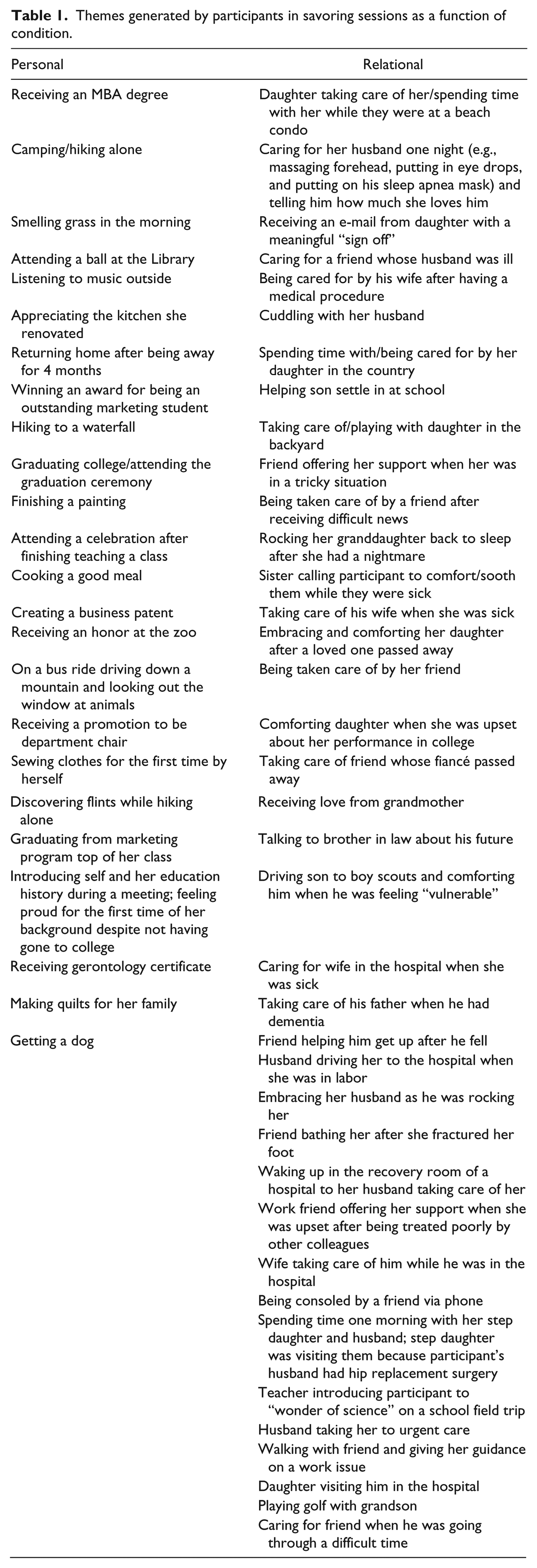
Next, interveners led participants through a standardized series of steps: (a) discussing the sensory details of the memory; (b) the emotions associated with the memory; (c) the thoughts/meaning associated with the memory; (d) what this experience might mean for the participant in the future; and (e) miscellaneous, stream-of-consciousness concluding ideas the participant has about the experience. The entire savoring intervention lasts approximately 30 min inclusive of the mindfulness exercise, memory selection, and memory reflection. Memories selected for savoring by participants in the different groups in this sample are listed in Table 1.
Themes generated by participants in savoring sessions as a function of condition.
Intervention Fidelity Checks
Savoring sessions were transcribed verbatim with the intention of analyzing them through the Linguistic Inquiry and Word Count System (Pennebaker, Booth, Boyd, & Francis, 2015). We intended to test for group differences in frequency of first-person plural pronoun word use (“we,” “us,” and “our,”) and in positive emotion words (such as “happy,” “like,” and “joy”). Higher frequency of first-person plural in text is considered to reflect a more relational, interconnected sense of self. Here, we interpret higher frequency first-person plural pronoun in participants’ narratives as indicative of a greater focus on relationships, which is what we would hope to see occurring within the relational, as compared with the personal, savoring intervention sessions. As a point of comparison, we also assessed the frequency of positive emotion word use, which we did not expect to differ across the two conditions, as both conditions ought to involve the activation and prolonging of positive emotional experience.
Furthermore, we assessed participants’ self-reported positive emotion on the Positive and Negative Affect Schedule (Watson, Clark, & Tellegen, 1988) immediately pre- and postsavoring.
Measures
Covariates
Cognitive functioning
Participants who provided initial consent completed the (MMSE) at Time 1. The MMSE is a 15-question (e.g., “Where are we right now?”) verbal assessment of an individual’s cognitive functioning; scores are summed for a potential total of 30 points, with scores at or below 25 indicating the presence of mild-to-severe impairment. Participants scoring at or below 25 were excluded from further participation in this study due to concerns about their ability to identify and expand upon memories.
Demographics
Participants completed a self-report survey of demographic information at Time 1, reporting on standard demographic variables (e.g., gender). Gender was coded as 1 for male and 2 for female.
In addition to the aforementioned demographics, we also controlled for intervener and for recruitment location in analyses.
Dependent variables
Cardiovascular reactivity
Heart rate was measured using the Empatica E4 Wristband (Empatica Inc., Milano, Italy), a minimally obtrusive research tool that collects several physiological measures using several different sensors and is valid for use in scientific research (Garbarino, Lai, Tognetti, Picard, & Bender, 2014; McCarthy, Pradhan, Redpath, & Adler, 2016). Here, we obtained measures of blood volume pulse (BVP) via the photoplethysmograph sensor, which were then utilized to calculate HR. HR was measured at two timepoints—just before the savoring intervention during a standardized mindfulness task where participants were asked to focus on their breathing for one full minute (baseline measure), and again throughout the savoring intervention. Similar to the neutral or relaxing baseline condition used other investigations (see Taelman, Vandeput, Spaepen, & Van Huffel, 2008), the mindfulness baseline was used to provide a neutral, relaxed, and standardized comparison HR reading for all participants. HR averages were calculated for each of the two assessments (mindfulness baseline and savoring); all subsequent analyses involving savoring HR controlled for baseline HR.
Agency and passivity
After participants completed the savoring intervention, participants completed the advice-giving task, which resembles a life lessons savoring protocol used in another study of older adults (Smith & Bryant, 2019). Participants provided an open-ended response to the following prompt delivered by interveners: For our last few minutes together, I’m wondering if you could finish our time by giving advice—any life advice that you feel is the most meaningful. You can take as much, or as little time as you’d like to think about this before responding. We’re not looking for anything in particular, and there are no right or wrong answers—just answer with whatever comes to mind after some reflection. Most responses are about one or two minutes long, if that helps you to think it through. Take your time, and start whenever you’re ready. If participants’ responses lasted less than 1 min, researchers said, [Other than anything you’ve already mentioned,] I’m wondering if you have any advice with respect to work? . . .with respect to family? . . .with respect to relationships?”
Coding of agency/passivity
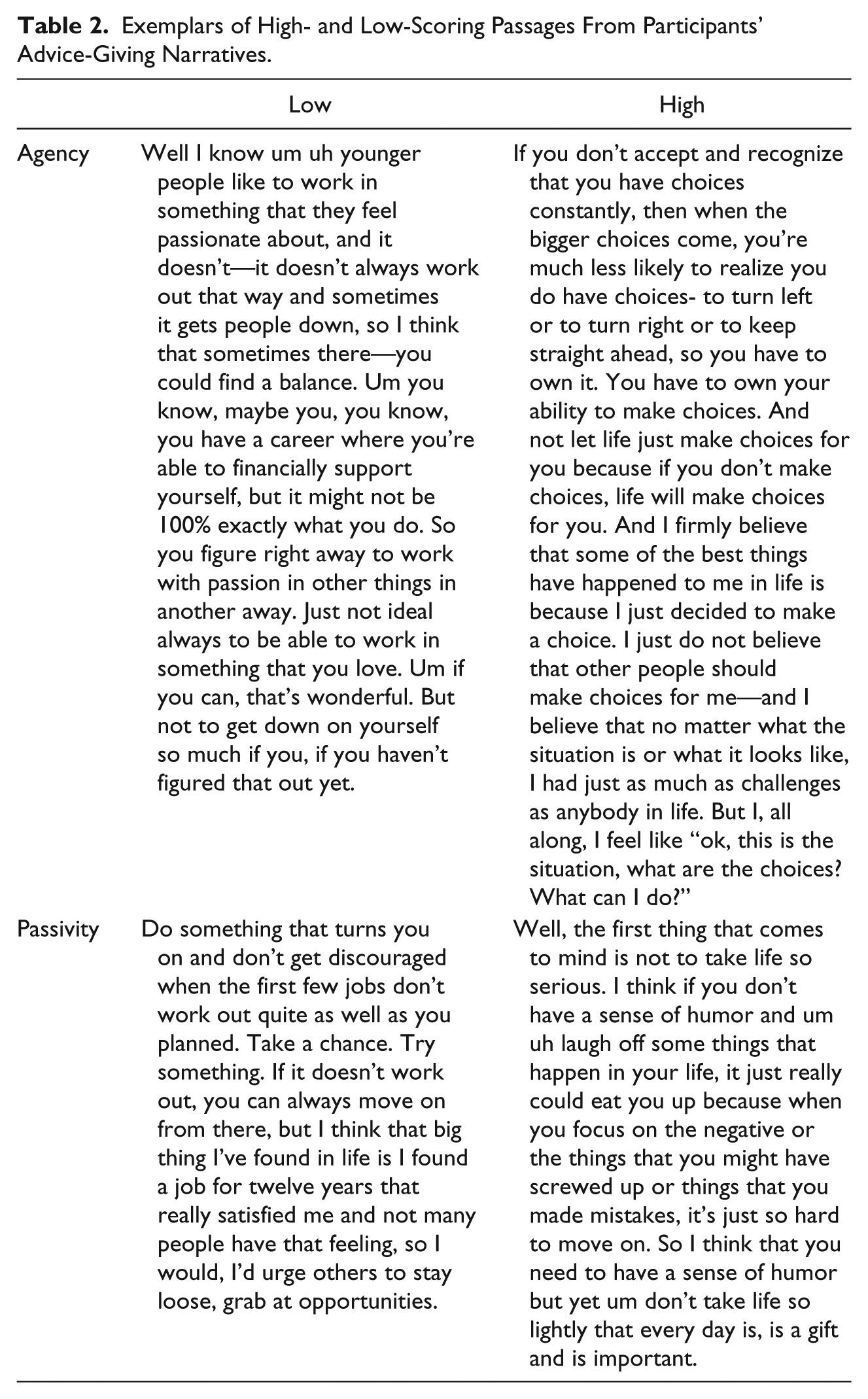
Agency and passivity in the life advice task narratives collected at Time 3 were rated using a coding system specifically designed for this study; agency was defined in this context as a focus on making things happen for oneself, or being an active agent in the world, and passivity was defined by expressed themes of acceptance, or going with the flow. For each transcript, coders assigned a single code for agency, ranging from 1 (low agency; absence of agentic statements) to 5 (high agency; advice related to making things happen for oneself) and a single code for passivity, ranging from 1 (low passivity; absence of passive statements) to 5 (high passivity; advice related to acceptance of things as they are or going with the flow). Table 2 provides excerpts of high- and low-scoring narratives. For the agency scale, a pair of coders double-coded 20% of the transcripts from the sample, achieving high interrater reliability (interclass correlation [ICC]), k(2) = .870. Similarly, a separate team of coders double-coded 20% of the transcripts for passivity, also demonstrating high interrater reliability, ICC, k(2) = .869. All coders were naïve to all information regarding the participants and to study hypotheses.
Exemplars of High- and Low-Scoring Passages From Participants’ Advice-Giving Narratives.
Results
Table 3 provides mean values and standard deviations for all key study variables. Independent samples t-tests revealed that none of the key study variables differed as a function of participant gender. Zero-order correlations revealed that older participants as showing lower agency (see Table 3).
Zero-Order Correlations and Descriptive Statistics for Demographic and Key Study Variables.
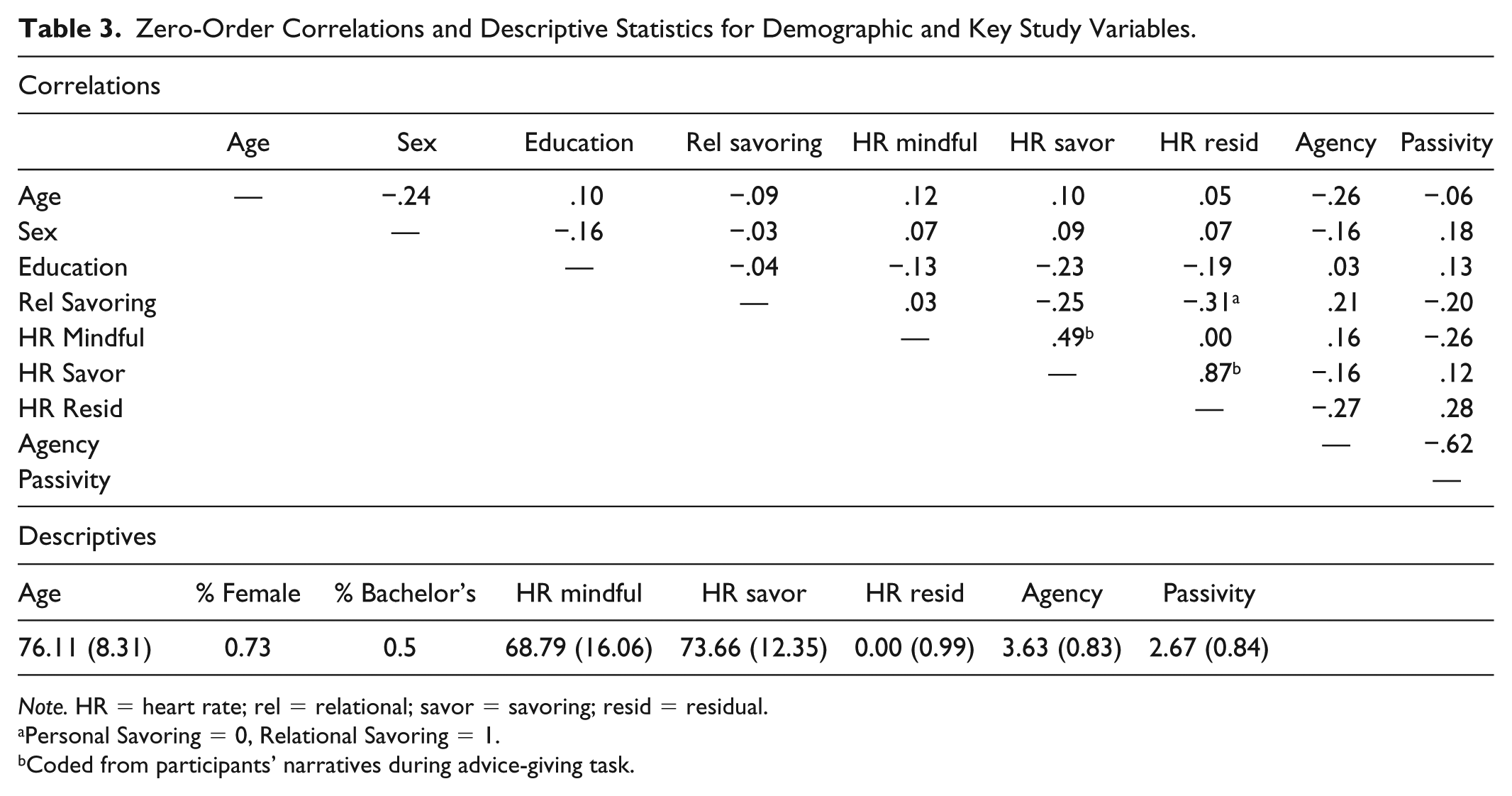
Note. HR = heart rate; rel = relational; savor = savoring; resid = residual.
Personal Savoring = 0, Relational Savoring = 1.
Coded from participants’ narratives during advice-giving task.
Independent samples t-tests did not reveal differences between relational and personal savoring groups in baseline HR, t(62) = −0.27, p = .79; pre-savoring positive affect, t(62) = 0.19, p = .85; age, t(62) = 0.67, p = .50; income, t(62) = 1.29, p = .20; or education, t(62) = 0.34, p = .74.
We also explored whether there were differences in outcomes as a function of the intervener. Independent samples t-tests did not reveal differences between participants receiving interventions from the two different interveners in terms of HR residual, t(60) = 0.01, p = .99, or advice-giving agency, t(62) = 0.77, p = .49, but there was an intervener difference in advice-giving passivity—t(62) = −2.08, p = .04, with participants working with the female intervener providing advice later coded as significantly higher in passivity. To address this difference, we controlled for intervener in subsequent analyses involving passivity as an outcome variable.
Fidelity Check
Participants in the two conditions did not differ in terms of the frequency with which they used positive emotion words, F(62) = 0.33, p = .20, η2 = .01, but participants in the relational condition used significantly more first-person plural pronouns than participants in the personal condition, F(62) = 5.39, p = .02, η2 = .08.
Contrary to our predictions, personal savoring participants’ positive affect from pre- to postintervention did not increase significantly, t(22) = 0.31, p = .76, but consistent with our predictions, relational savoring participants’ did, t(38) = 2.31, p = .02.
Hypothesis Testing
Hypothesis 1: Cardiovascular reactivity and savoring
Controlling for participant age, gender, recruitment location, and HR during the mindfulness task, R2 = .24, p = .001 (HR mindfulness: β = .48, b = 0.37, SE = 0.09, 95% confidence interval [CI] = [0.19, 0.55]), savoring condition contributed significantly to the prediction of savoring HR, ΔR2 = .09, p = .01, β = −.29, b = −7.67, SE = 2.94, 95% CI = [−13.56, −1.78]. Relational savoring participants had significantly lower HR than participants completing personal savoring (see Figure 1).
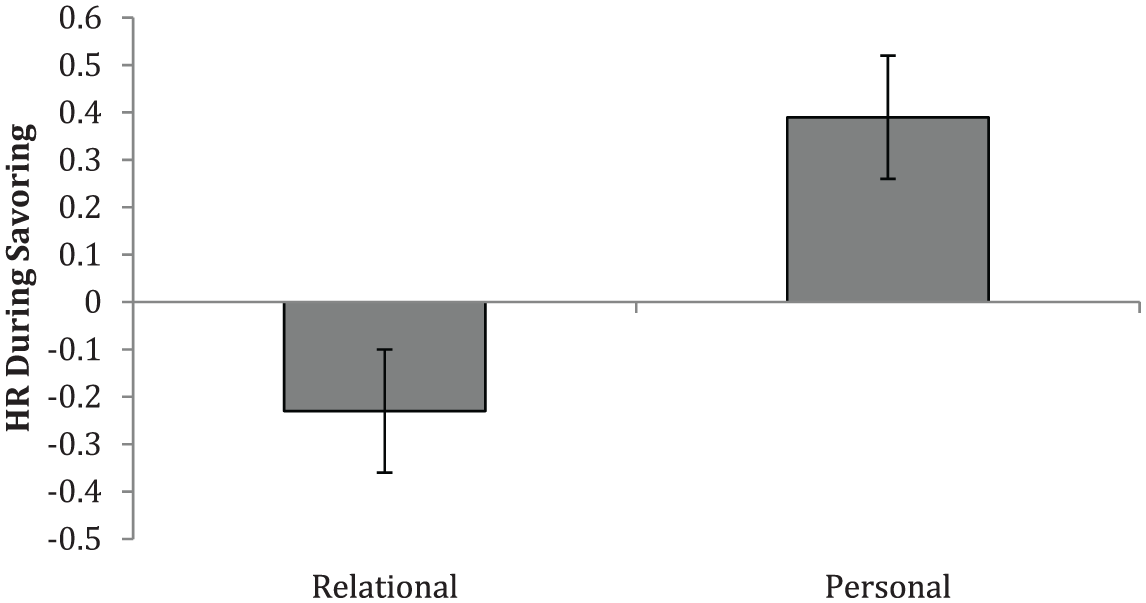
Participants’ cardiovascular reactivity during savoring controlling for their cardiovascular reactivity during the mindfulness control task.
Hypothesis two: Cardiovascular reactivity as a predictor of advice-giving behavior
Controlling for age, gender, recruitment location, and HR during the mindfulness task on an initial step, R2 = .17, p = .01, HR during savoring was a significant predictor of advice task agency, ΔR2 = .07, p = .036, β = −.30, b = −0.02, SE = 0.009, 95% CI = [−0.04, −0.001].
Next, we predicted passivity during advice-giving. After controlling for age, gender, recruitment location, intervener, and HR during the mindfulness task on an initial step, R2 = .17, p = .06, HR during savoring was a significant predictor of advice task passivity, ΔR2 = .07, p = .03, β = .31, b = 0.02, SE = 0.009, 95% CI = [0.002, 0.04].
Hypothesis three: Cardiovascular reactivity as a mediator of the link between savoring condition and advice-giving behavior
To increase the statistical power to detect an effect, we used a standardized residualized change score, in which we controlled for mindfulness HR when predicting HR during savoring. Note that we would have needed a sample of 104 to be adequately powered to test this mediation effect. We used PROCESS Model 4 with 5,000 bootstrapped samples (Hayes, 2013). PROCESS generates estimates and the bias-corrected and accelerated 95% CIs within which they fall. In these regressions, we included participant age/gender, recruitment location, and intervener as covariates, savoring condition as the independent variable, savoring HR (residualized change score controlling for mindfulness HR) as the mediator, and advice-giving task coded variable as the dependent variable.
The first regression revealed that there was an indirect effect of savoring condition on agency mediated by HR, point estimate = .12, SE = 0.08, 95% CI = [0.01, 0.37], with an indirect effect of b = 0.07, SE = 0.05, 95% CI = [0.01, 0.20] (see Figure 2).
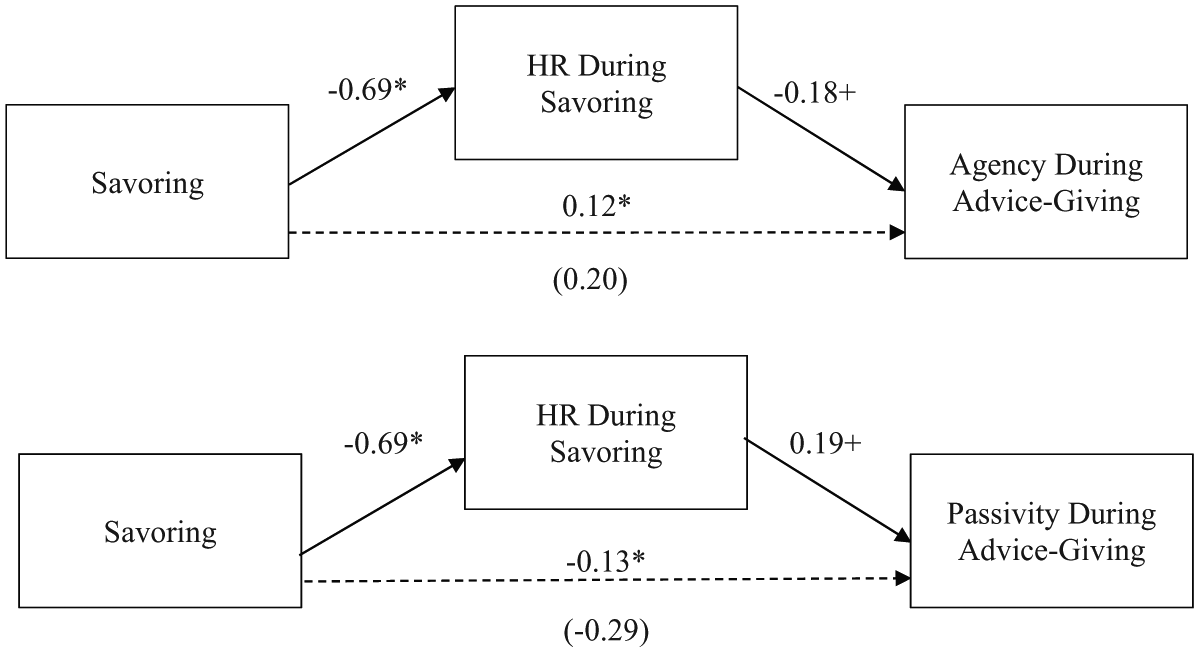
Participants’ cardiovascular reactivity as an indirect effect in the link between participants’ intervention condition and agency and passivity following intervention.
Next, we predicted advice-giving passivity, controlling for age, gender, recruitment location, and intervener. The indirect effect of savoring condition on passivity mediated by cardiovascular reactivity dropped below significance when we included intervener in the model, point estimate = −.13, SE = 0.08, 95% CI = [−0.32, 0.01], with an indirect effect b = −0.08, SE = 0.05, 95% CI = [−0.20, 0.06] but was significant without intervener in the model (see Figure 2), point estimate = −.13, SE = 0.08, 95% CI = [−0.32, −0.01], with this indirect effect: b = −0.07, SE = 0.05, 95% CI = [−0.19, 0.005].
Discussion
The few studies available examining the impact of a savoring intervention among older adults have yielded promising preliminary results (e.g., Ho et al., 2014; Smith & Hanni, 2017), but to our knowledge, this constitutes the first examination of the physiological impact of savoring. In this study, we examined the efficacy of a relational savoring intervention with older adults and assessed its impact on their physiological reactivity, measured by HR, and advice-giving behavior, measured qualitatively.
Relational Savoring and HR
Results indicated that participants in the relational savoring condition demonstrated significantly lower HR than participants in the personal savoring condition, suggesting that the act of savoring attachment-based, relationship-relevant moments resulted in reduced physiological reactivity, or lower SNS activation (Zanstra & Johnston, 2011). This finding is consistent with the argument that feelings of security enable the individual to return to a physiologically homeostatic set point (Bowlby, 1980; Coan, Schaefer, & Davidson, 2006; Hofer, 1987) as well as work suggesting that similar psychological benefits may be present even in the absence of such a figure (e.g., Carnelley, Bejinaru, Otway, Baldwin, & Rowe, 2018).
This finding is also novel in terms of our understanding of older adulthood and physiological stress reduction. Older adults are at greater risk of elevated HR (Steptoe, Moses, & Edwards, 1990) and other physiological symptoms of stress reactivity. Older adulthood is generally a developmental period in which individuals are able to manage emotional distress more functionally than their younger counterparts (e.g., Orgeta, 2009); this study suggests that attachment-based interventions may be helpful for adults in need of physiological stress reduction.
HR and Advice-Giving Behavior
We found that lower HR on the savoring task predicted higher agency and lower passivity on the postsavoring advice-giving task. We interpret this pattern of results through the lens of the broaden-and-build theory of positive emotions, which suggests that positive emotions, when induced, broaden attentional awareness, increase exploratory and approach behaviors, and reduce physiological indicators of stress, like the presence of cortisol (Cacioppo, Gardner, & Berntson, 1999; Fredrickson, 2001; Moskowitz & Epel, 2007). Savoring involves such an induction of positive emotion via its inherent focusing of attention on uniquely positive experiences; to that end, previous research demonstrates that savoring is linked with happier moods (Jose et al., 2012), the reduction of stress (Garland et al., 2017), and—perhaps tellingly—increases in agentic help-seeking behaviors among those presenting with depressive symptoms (Straszewski & Siegel, 2018).
Cardiovascular Reactivity, Relational Savoring, and Advice-Giving Behavior
HR mediated the observed relationships between condition (personal vs. relational) and behavior in the advice-giving task (greater agency and lower passivity). Although the association between relational savoring and other dependent variables of interest has been explored previously (e.g., Borelli, Rasmussen, et al., 2014), this is the first study to examine the physiological impact of relational savoring as a mediator of the psychosocial benefits of relational savoring. The findings raise an intriguing question to be pursued in future studies—Do reductions in cardiovascular reactivity support increases in psychological agency, and is this caused by savoring positive experiences in attachment relationships? We hope that researchers will test this and other putative explanatory factors, such as emotional security and empathy, in future investigations.
Contextualizing the Study
We must situate the contributions of the study in terms of its strengths and weaknesses. The first limitation of the study pertains to the personal savoring condition itself: our linguistic and topics-savored data suggest that although participants in this condition engaged in the task, the Positive and Negative Affect Schedule (PANAS) data suggest that it did not increase their positive affect as intended, suggesting that the “personal savoring” task may constitute more of a neutral control than a nonrelational savoring condition for older adults. In another savoring study conducted by our laboratory, one in which the savoring exercise was conducted over the Internet (and not carefully guided by an intervener), we encountered a different challenge—that participants in our personal condition generated memories that were actually relational (Burkhart et al., 2015). Taken together, these challenges lead us to wonder whether the separation of relational and nonrelational is artificial. Perhaps, a more organic distinction, one that would adhere more readily to experimental manipulation, would be attachment-based relational savoring versus nondirective savoring.
The use of two separate coding teams to code agency and passivity, which provides an extra layer of objectivity and assurance for the observed effects, as well as our use of random assignment to condition is a significant improvement over prior studies that have utilized pre–post designs without controls to examine the impact of savoring on older adults. The use of multiple methods (physiological, narrative coding) offers converging perspectives on complicated psychological phenomena. Furthermore, comparing two very similar and very strong interventions—relational versus personal savoring—sets a high bar, rendering any effects emerging from the study all the more salient.
Among the limitations, we note the interveners were not hypothesis-naïve, which could have biased the intervention and advice task delivery. We attempted to account for this by measuring outcomes that were more objective in nature (i.e., heart rate and ratings made by coders naïve to study hypotheses and participant information), but this does not eliminate the possibility that interveners’ expectations influenced their behavior in delivering the interventions. Furthermore, we only assessed outcomes immediately following the intervention itself, which represents a short time period in which to evaluate change. Long-term investigations of the impact of relational savoring are needed to establish the evidence base for this intervention. Furthermore, the study sample was small and underpowered; future studies that are preregistered and adequately powered should be conducted as follow-ups to this study. The two samples were unbalanced in their size because initially we had hoped to compare participants who savored experiences of receiving versus providing care; however, due to difficulty recruiting a sufficient number of participants within the timeframe allotted for the study, we were not able to compare within these relational savoring subgroups. Finally, this study included a sample that was homogeneous in race and SES, potentially reducing the external validity of the findings. Although our prior research indicates that relational savoring has stronger effects among Latinx as compared with non-Latinx samples [Goldstein et al., 2019], that study was conducted among parents of young children, not among older adults. Perhaps, older adults from certain demographic backgrounds (e.g., higher SES backgrounds) may be more likely to experience reductions in physiological SNS reactivity from relational, as compared with personal savoring, which in turn leads to increases in agency, as compared with a majority non-Caucasian sample. We encourage researchers to conduct follow-up investigations among other cultural and ethnic/racial groups of older adults to investigate these possibilities. In addition, although, in general, we consider the examination of physiological reactivity to be a strength of this investigation, we note that when we conclude that relational savoring is associated with superior outcomes as compared with personal savoring, we are relying on the assumption that lower HR is desirable. Finally, our advice-giving test was novel and has not previously been validated in the literature. We developed the test as a way of providing participants an opportunity to assess what we believed would be an ecologically valid manner of assessing their values, but this may not generalize well to other contexts or other investigations.
Conclusion
In this first assessment of the outcomes of relational savoring among older adults, we find preliminary evidence that as compared with personal savoring, relational savoring results in lower levels of cardiovascular reactivity, which in turn predicts greater agency and lower passivity. Although we only assessed short-term outcomes within a small sample, we believe these findings suggest the promise of this approach within this population.
Footnotes
Declaration of Conflicting Interests
The author(s) declared no potential conflicts of interest with respect to the research, authorship, and/or publication of this article.
Funding
The author(s) received no financial support for the research, authorship, and/or publication of this article.
