



Abstract
Well-being is a complex construct related to sociodemographic and cultural aspects that vary across cultures. Latin America is a region with high social inequalities among population groups, although this varies significantly depending on the country. This article proposes a model that seeks to establish the relationship between psychosocial variables, psychological well-being, and life satisfaction in a sample of Colombian older adults. The model explores associations between resilience, socioeconomic status, life satisfaction, and psychological well-being. A study with a sample of 617 Colombian older adults was conducted. A structural equation modeling technique was performed. The results showed a model in which life satisfaction is positively explained by psychological well-being and resilience, whereas psychological well-being is explained by a higher socio-economic status. The results contribute to the evidence about how well-being is determined by psychosocial and cultural factors. The evidence found represents novel information about older adults in Colombia.
Well-being is a complex construct that has been studied in multiple disciplines. Two approaches have mainly predominated in the study of well-being: one emphasizing hedonism or happiness and the other focusing on eudaemonia or self-realization. The hedonistic view refers to pleasure, whereas eudaemonic well-being is a process of realization, the development of potential, and living as one expects to live (Deci & Ryan, 2008). These two approaches have resulted into two recognized theoretical perspectives of well-being: subjective well-being (SWB), associated with hedonia (Diener, 2012; Diener, 2013), and psychological well-being (PWB), associated with eudaemonia and self-determination (Ryff, 2014). Although both types of well-being are highly correlated, they are different constructs of a positive psychological functioning (Linley, Maltby, Wood, Osborne, & Hurling, 2009). The present study focuses on both types of well-being and how resilience and socioeconomic status (SES) predict them in a sample of Colombian older adults.
SWB refers to people’s overall assessment of themselves and the degree to which they experience a sense of well-being (Deci & Ryan, 2008); it includes emotional responses and global judgments about life satisfaction (LS; Diener, 2012). SWB is a broad concept, composed of cognitive and affective dimensions (Diener, 2012; Diener et al., 2017). The cognitive component is based on beliefs and attitudes about the individual’s own life (Diener, 2013), and it is traditionally called Life Satisfaction. The affective dimension is related to the feelings of pleasure and displeasure the person experiences; it specifically refers to positive and negative affect (Diener, 2012). Diener et al. (2017) emphasized that for fully assessing SWB, it is necessary to measure all its components separately; otherwise, only one of its facets is being evaluated. In the present study, we assessed only the cognitive component of SWB, that is why we are focused on LS.
PWB is conceived as a process leading to the achievement of values that make us feel alive and authentic, give us a sense of life, and seek to develop personal potential (Ryff, 2014), to achieve full functioning (Deci & Ryan, 2008). Ryff (2014) proposed a six-dimensional model of well-being, composed of (a) self-acceptance, (b) autonomy, (c) personal growth, (d) purpose in life, (e) positive relationships with others, and (f) environmental mastery. SWB and PWB are highly related, although they are different constructs of positive psychological functioning (Disabato, Goodman, Kashdan, Short, & Jarden, 2016).
SWB and PWB are determined by sociocultural and internal factors (Diener, 2012), such as personality, cognitions, goals, sociodemographics, efforts to adapt to life’s adversities in each stage of life (Keyes, Shmotkin, & Ryff, 2002), and resilience (Kim & Knight, 2018; Meléndez, Mayordomo, Sancho, & Tomás, 2012). For example, older adults who are resilient report higher levels of LS (Cohn, Fredrickson, Brown, Mikels, & Conway, 2009) and experience more positive emotions (Fredrickson, Tugade, Waugh, & Larkin, 2003). It has been reported that during older adulthood, people who are able to handle difficult problems during their lives and have been resilient tend to be more satisfied with their lives (Beutel, Glaesmer, Decker, Fischbeck, & Bräler, 2009; Keyes et al., 2002). Moreover, resilience has been associated with PWB in older adults (Smith & Hollinger-Smith, 2015; Tomás, Sancho, Meléndez, & Mayordomo, 2012), and it moderates the relationship between stress and negative emotions in older adults (Ong, Edwards, & Bergeman, 2006). Thus, resilience is a protective factor in adulthood, and it contributes to making older people stronger and more satisfied with their lives (Wermelinger, Lucchetti, & Lucchetti, 2017).
Well-being is also related to sociodemographic variables that vary across cultures (Park, Joshanloo, & Scheifinger, 2019). Some of these variables appear to be universal, such as the fulfillment of basic needs, which is especially associated with LS (Diener, 2012; Tay & Diener, 2011), whereas others are more culturally specific such as social support and family values (Helliwell, Huang, & Wang, 2016).
Social factors such as income, SES, equality, and education are considered to have a stronger influence on LS, specifically when it has to do with the satisfaction of basic needs (Diener, 2012). However, conflicting findings have been reported; Ng and Diener (2014) found that financial satisfaction is associated with SWB (specially with LS), and this association was stronger in wealthier nations compared with less developed countries. Nonetheless, having a higher income facilitates access to services and greater opportunities, which can increase autonomy and promote personal development (Biswas-Diener, 2008; Read, Grundy, & Foverskov, 2016). Thus, income is positively associated with the dimensions of PWB, especially with life purpose, self-acceptance, and personal growth (Kaplan, Shema, & Leite, 2008). Early studies on well-being have demonstrated that economic growth influences LS and PWB because it fosters the likelihood of experiencing pleasant activities and facilitates access to services and opportunities for self-realization and autonomy (Biswas-Diener, 2008; Ng & Diener, 2014).
Moreover, socioeconomic conditions such as the person’s surrounding context influence self-realization. Shields and Price (2005) reported that people who lived in deprived urban areas with a low household income were associated with lower PWB, unemployment, and a worse health status. Moreover, Kaplan et al. (2008) conducted a 29-year longitudinal study in Alameda County in the United States to explore the association between SES and PWB. The authors revealed that all the dimensions of PWB were positively associated with higher income in the different waves of data, and they reported a stronger association with purpose in life, self-acceptance, and personal growth. With the exception of autonomy, which was only associated with the measure of annual household income, the other dimensions of PWB increased with higher yearly household income and profit income, whereas as benefit income increased (i.e., unemployment, disability, and welfare benefits), PWB decreased.
Furthermore, Camfield, Guillen-Royo, and Velazco (2010) conducted a study in Thailand and Bangladesh to establish the association between socioeconomic indicators, such as household resources, basic need satisfaction, poverty level, and social resources. The authors found that lower SWB and PWB were associated with higher need deprivation only in Bangladesh. Nevertheless, in both countries, household locations explained hedonic and eudaemonic well-being. In general, the authors reported that SWB is more influenced by basic need satisfaction, whereas PWB is influenced by SES indicators other than need deprivation.
Studying well-being in diverse contexts is fundamental. Latin America is a region with high social inequalities among population groups. Although this situation varies significantly depending on the country, the region shares a context of inequality, institutional weakness, and low social security coverage for the older adults’ population. In most of the countries in the region, the pension coverage for older adults is insufficient. It is estimated that, on average, only 40% receive a pension, although there are large differences (Huenchan, 2013).
The present article focuses on a sample of Colombian older adults. Colombia has increased its population, especially the group of people 60 years and older, which currently makes up close to 12%. Life expectancy is currently 76 years, and it has increased by 7 years since 1990 (Fedesarrollo & Fundación Saldarriaga Concha, 2015). Unfortunately, the living conditions of older adults in Colombia are worrisome because less than 35% receive a pension, and it is estimated that around 40% live in poverty conditions (Fedesarrollo & Fundación Saldarriaga Concha, 2015). The Colombian National Study on Health, Welfare and Aging–SABE (Ministerio de Salud, 2015) revealed that most of the older adults live in urban areas and have an average of 5.5 years of study. Moreover, the study reported that these segments of the Colombian population have the worst SES conditions in comparison with other age groups, and face many daily problems, such as lack of sidewalks and an inadequate infrastructure for people with disabilities, poor public transportation, unsafe surroundings, and other factors that threaten older adults’ well-being. In general, the study reported that older adults had negative perceptions of the physical infrastructure of their neighborhood. The SABE study showed that almost half of the participants perceived that there are no parks or areas for walking near to their houses and a vast majority consider there are no places to sit or rest at bus stops or parks, and considered the public transport does not have the appropriate conditions for people with disabilities (Ministerio de Salud, 2015).
Despite the fact that Colombia is not prepared for this demographic transition, and it lacks policies and programs that respond to the demands of this sector of the population, some public policies have been developed since 1975 (Dulcey-Ruiz, Arrubla, & Sanabria, 2013). The Colombian Government since 2003 developed the social program “Older Colombia,” which, through the delivery of a monthly economic subsidy of approximately US$36, seeks to increase resources to the most vulnerable. It is addressed to older homeless adults, who lack a pension or live either in poverty or extreme poverty (Fondo de Solidaridad Pensional, 2019).
The aim of the current article is to explore the associations between resilience and SES and LS and PWB in a sample of Colombian older adults. As a hypothesis, it is expected that LS will be explained by resilience, higher SES, and PWB. The associations between these variables were predicted to be positive. The study of well-being in aging is presented as a fundamental element in the optimization of development at this stage in the life span, especially in a context where there is an evident lack of research.
Method
Participants
A cross-sectional study was performed with a sample of 617 (61% women, 39% men) Colombian older adults ranging in age between 60 and 92 years (M = 70.15 years, SD = 7.26 years). The participants were recruited in Bogotá, Colombia, and two suburbs near the capital city, through community leaders. Inclusion criteria were as follows: (a) age 60 years and older, (b) not being institutionalized, and (c) no evidence of moderate to severe cognitive impairment. The Mini Mental State Examination (MMSE) Spanish version, validated in Colombia (Rosselli et al., 2000), was used as a screening test for cognitive impairment. The cutoff points used were those proposed by Rosselli et al. (2000): 24/30 for participants with elementary school or more, 21/30 for participants who had not attended school, and 17/28 for illiterate participants.
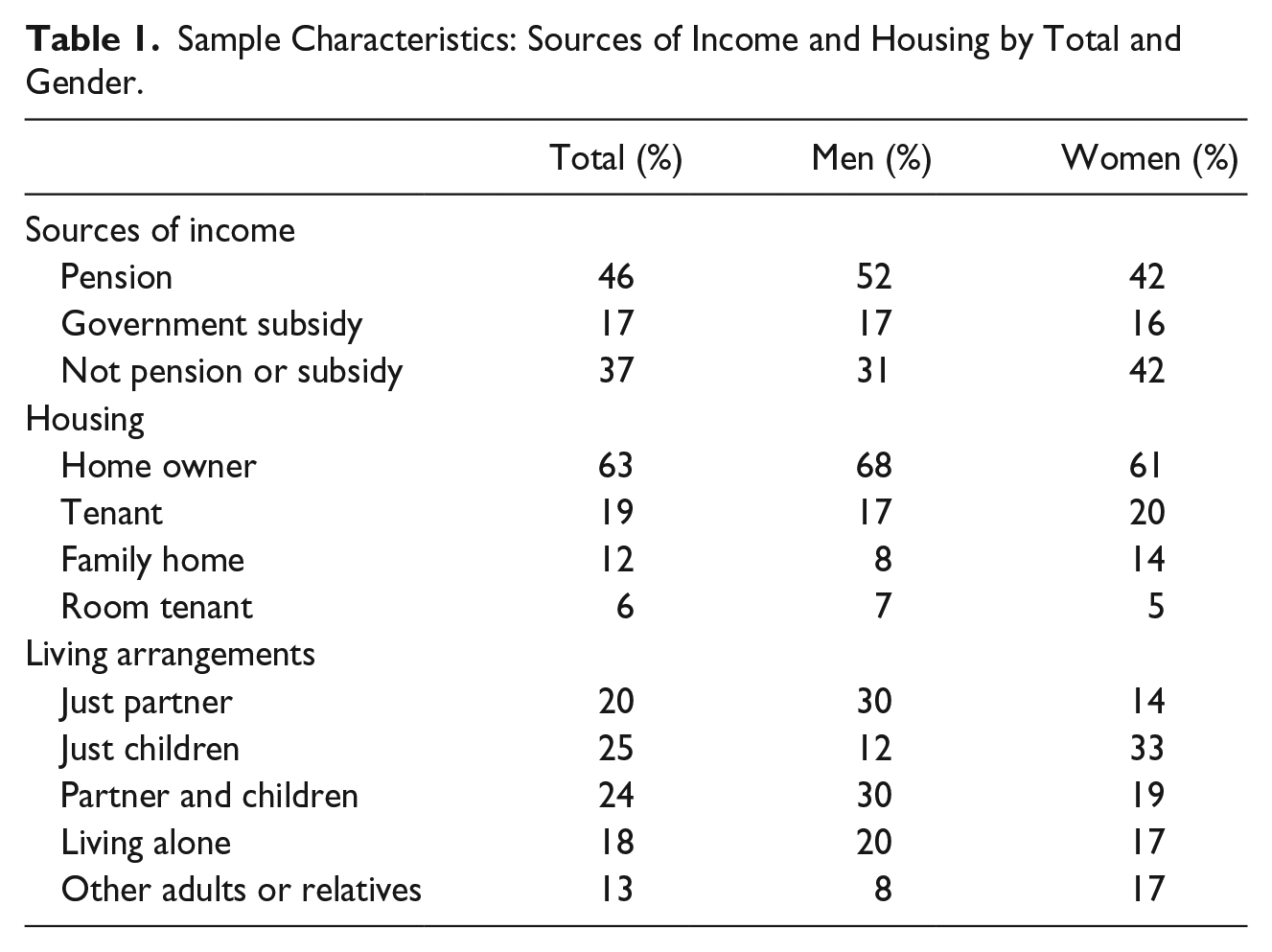
Of the total sample, 45.7% were married, 28.3% widowed, 13.8% single, and 12.2% divorced. Regarding the academic level, the majority of the sample (45%) had attended 3 to 5 years of elementary school, 15% reported having attended only middle school, 10% high school, 21% university, and 9% had never attended any academic institution (of whom, half knew how to read and write, and the other half were illiterate). Regarding the SES, the sample was distributed in three categories, as follows: 42% had a low SES, 35% a medium SES, and 23% a medium–high SES. As is described on Table 1, almost half of the sample were a pensioner, 17% were receiving a government subsidy, and 37% were not receiving a pension or a subsidy. The majority of the participants own a house and were living with a partner, children, or partner and children (see Table 1).
Sample Characteristics: Sources of Income and Housing by Total and Gender.
Instruments
The assessment protocol included sociodemographic data and three scales to assess PWB, LS, and resilience. The measures are described below.
Satisfaction With Life Scale (SWLS)
The SWLS was designed by Diener, Emmons, Larsen, and Griffin (1985) to assess the cognitive dimension of SWB, which is LS; it is not a measure of positive or negative affect. It is a short scale composed of five items that evaluate the overall judgments people make about their satisfaction with their lives as a whole, and the response options lie on a 7-point scale ranging from strongly agree (7) to strongly disagree (1). It includes questions such as “In most ways my life is close to my ideal.” This scale has shown good convergent validity and stability. It has been translated into different languages, including Spanish. The version used was translated into Spanish and validated in Spain by Atienza, Pons, Balaguer, and García-Merita (2000), who indicated the existence of a one-factor structure and good internal consistency. López-Ortega, Torres-Castro, and Rosas-Carrasco (2016) reported adequate psychometrics properties of the scale in a sample of Mexican older adults.
Ryff’s scales of PWB
The scales focus on examining people’s positive perception about existential problems in life (Ryff, 1989). They are related to having a life purpose, optimal functioning, and self-realization. The scales are designed to measure the six-dimensional model of PWB, composed of self-acceptance, environmental mastery, autonomy, positive relations with others, personal growth, and life purpose, using a 6-point Likert-type scale ranging from strongly disagree (1) to strongly agree (6). The six-factor structure has been confirmed. However, consistent research has reevaluated the six factors of Ryff’s scales (Springer & Hauser, 2006; Springer, Pudrovska, & Hauser, 2011) and proposed a four-factor structure composed of self-acceptance, environmental mastery, personal growth, and life purpose. Moreover, these scales have been adapted and validated for older adults in Spain with structural equations models (Tomás, Meléndez, & Navarro, 2008). A recent study confirmed the four-factor model for the Spanish-language version in an older adults’ sample (Delhom, Gutierrez, Lucas-Molina, & Meléndez, 2017). In the present study, the 29-item scale in Spanish, composed of the four aforementioned dimensions, was used.
Brief Resilient Coping Scale (BRCS)
It is a short scale comprised of six items developed by Sinclair and Wallston (2004) to identify tendencies in coping with stress in a highly adaptive manner. The scale uses a 5-point Likert-type scale. High internal consistency of a one-factor structure has been confirmed for older adults in Spain (Tomás, Meléndez, Sancho, & Mayordomo, 2012).
SES
SES was determined using the Colombian social stratification, which is a system used to classify utility rates based on the assessment of housing and surrounding conditions and characteristics (Departamento Nacional de Planeación, 2005). This classification allows high-cost households to subsidize the utilities of citizens who live in low-cost housing. The social stratification consists of classifying housing in six strata. Colombian citizens who live in a house located in Strata 1 or 2 are potential beneficiaries of subsidies, those in Strata 3 are considered to have a medium SES, and Strata 4 (medium–high) and 5 to 6 (high) pay an overcost to public services to subsidize the lower strata.
Procedure
Participants were contacted through community leaders from community centers that offer leisure activities for older adults throughout Bogotá and in two surrounding municipalities. Initially, the older adults were invited to participate and informed about the purpose of the study and potential risks, emphasizing that participation was voluntary and confidential. People who were interested gave their consent. First, the MMSE and an interview were used to determine whether the person met the inclusion criteria described above. Only five people were excluded and referred to a specialist assessment through their health insurance. Those who met the inclusion criteria and wished to continue followed the protocol. In the end, they were informed that if they were interested in the results, they could request them, and contact information was given.
Statistical Analysis
A structural equation modeling technique with an MLR estimator using the MPlus 7.31 (Muthén & Muthén 1998-2012) software was conducted. To assess model fit, incremental fit indices such as comparative fit index (CFI), Tucker–Lewis index (TLI), and root mean square error of approximation (RMSEA) were used. CFI and TLI ≥ 0.90 was used as a satisfactory fit criterion (Byrne, 2012). Regarding the RMSEA, a fit ≥0.08 was considered a poor fit, and ≤0.06 an ideal fit (Byrne, 2012).
Results
Descriptive Statistics
Table 2 shows the means and standard deviations of the scales.
Means and Standard deviations of SEM variables.
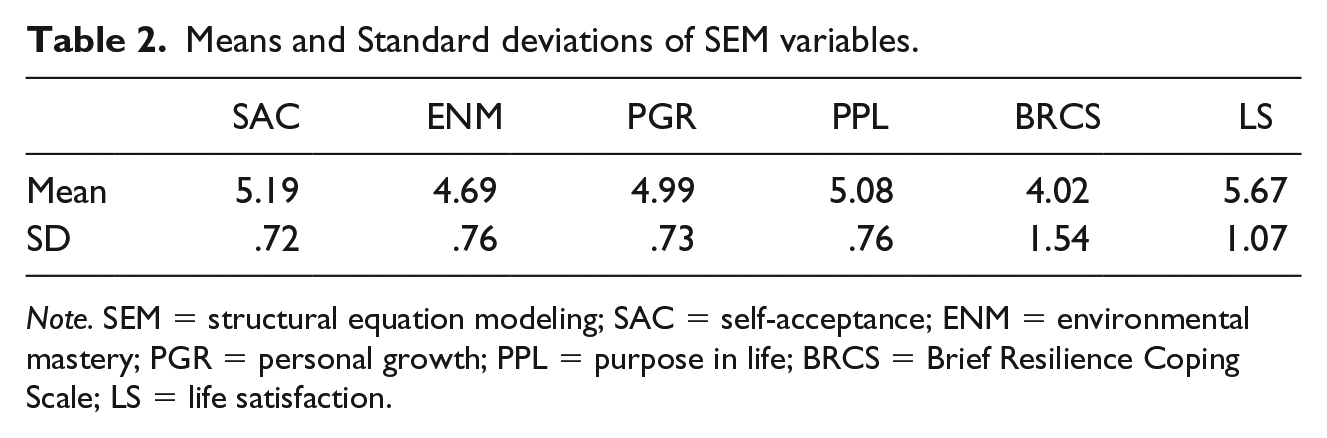
Note. SEM = structural equation modeling; SAC = self-acceptance; ENM = environmental mastery; PGR = personal growth; PPL = purpose in life; BRCS = Brief Resilience Coping Scale; LS = life satisfaction.
Table 3 shows correlations among the study variables; as the table reveals, all the variables were significantly and positively associated.
Correlations Between SEM Variables.
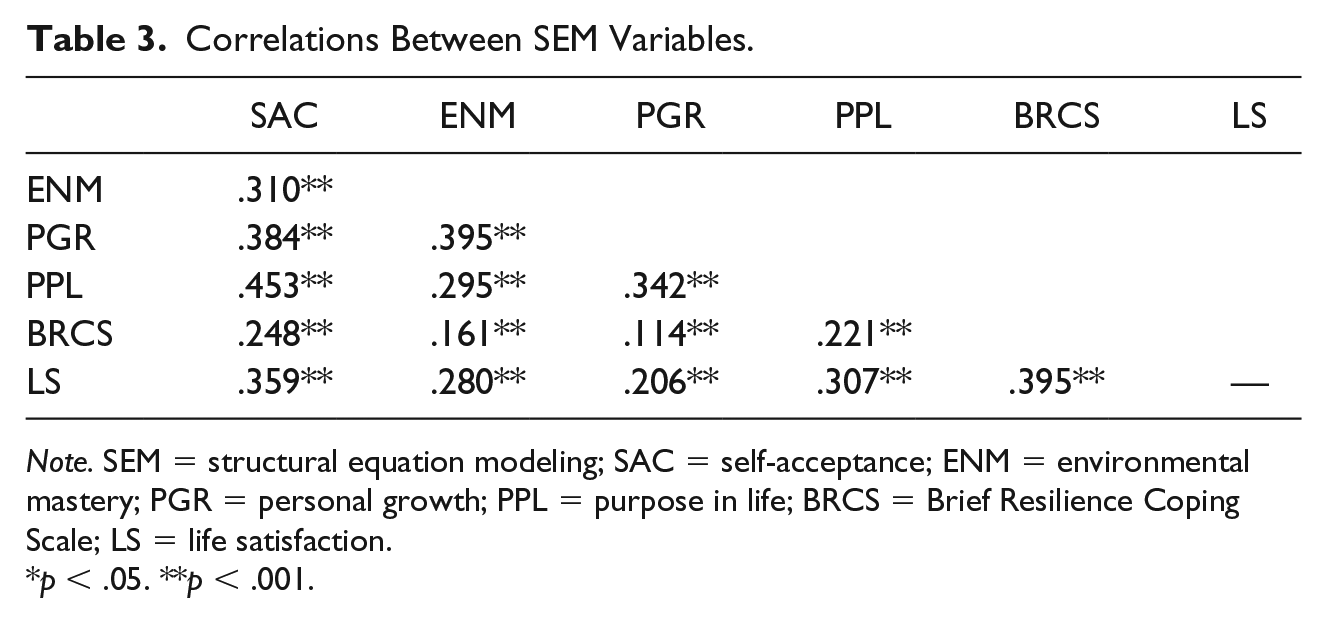
Note. SEM = structural equation modeling; SAC = self-acceptance; ENM = environmental mastery; PGR = personal growth; PPL = purpose in life; BRCS = Brief Resilience Coping Scale; LS = life satisfaction.
p < .05. **p < .001.
Structural Model
A structural equations model approach was used to test the associations between the latent factors of LS and PWB and the latent variable of resilience and the observable variable SES (consisting of a single indicator) in Colombian older adults. As described in the “Method” section, this variable consisted of three categories (low, medium, and medium–high), and a higher number is associated with a higher SES. The model was tested using maximum likelihood with robust chi-square and standard error (MLR) using MPlus 7. MLR is considered a robust estimator of moderate violations of assumptions, and it is capable of handling missing data completely at random (Muthén, 2002).
Hence, the hypothesized model established that PWB, resilience, and SES explained LS. The latter two variables were also associated with PWB (see Figure 1), and all the relationships were expected to be positive. As described in the “Method” section, the factor structure of Ryff’s scales of PWB consisted of four (self-acceptance, environmental mastery, personal growth, and purpose in life) of the six dimensions because they show better construct validity for the scales in Spanish.
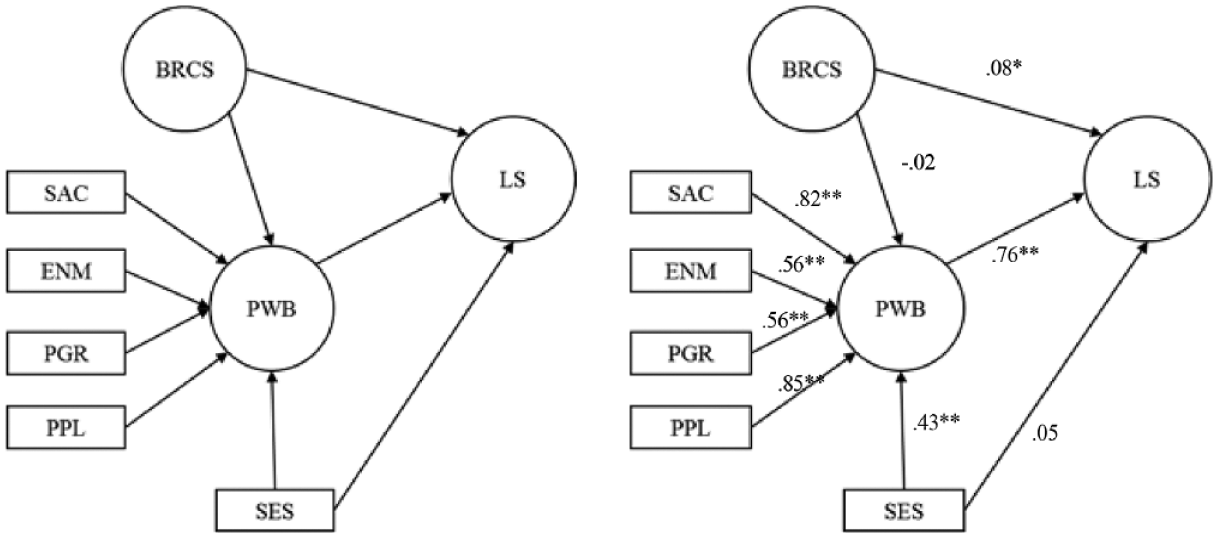
Hypothesized model of coping and emotional well-being and association estimates of the first model.
The results for the hypothesized model showed a satisfactory fit: MLR χ2(39) = 174.452, p < .001, MLR Δχ2/df = 4.473, CFI = 0.929, TLI = 0.902, RMSEA = 0.076, 90% confidence interval (CI) = [0.064, 0.087], although some of the parameters were not significant. The results revealed nonsignificant associations between SES and LS, and between resilience and PWB, whereas parameters between resilience and LS and the association between SES and PWB were significant. Based on these results, the nonsignificant parameters were reviewed, and a modified model was proposed.
In the second model, the nonsignificant associations between SES and LS and between resilience and PWB disappeared, and a covariance between the dimensions of personal growth and environmental mastery of PWB was included. The modified model showed a good fit: MLR χ2(41) = 175.389, p < .001, MLR Δχ2/df = 4.277, CFI = 0.931, TLI = 0.907, RMSEA = 0.073, 90% CI = [0.062, 0.085], and all the parameters for this model were significant (see Figure 2).
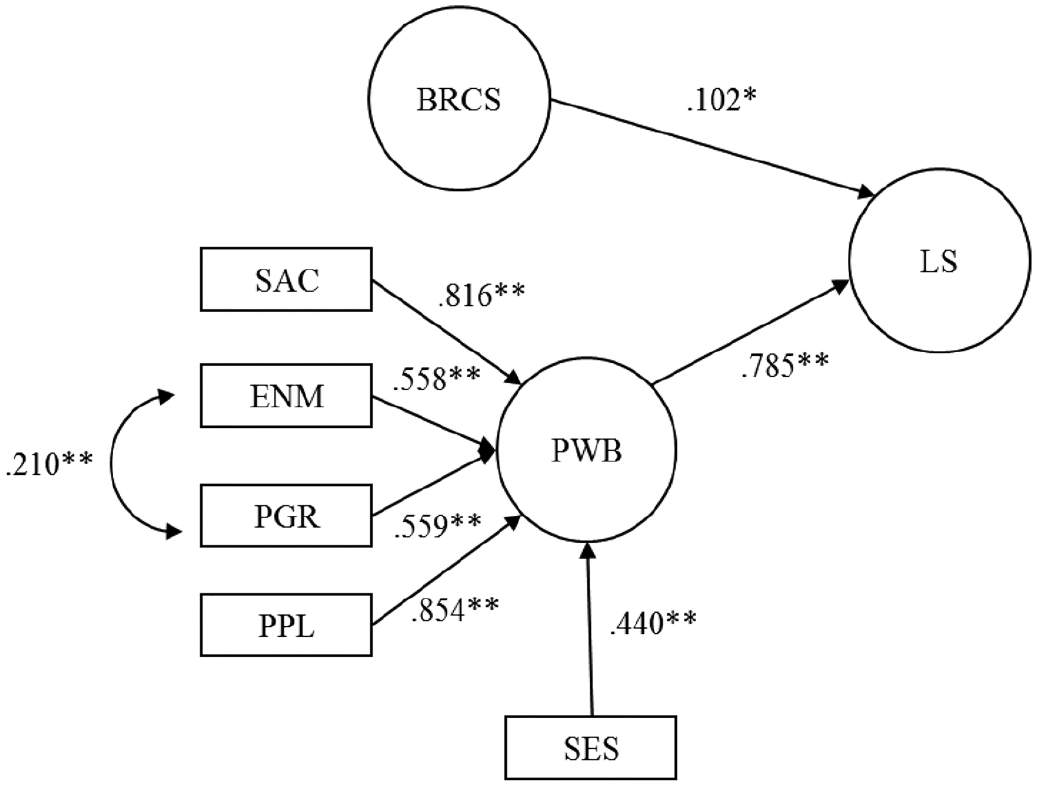
Final structural model of PWB and LS.
Therefore, the resulting model suggests that PWB and resilience positively determined LS, whereas a higher SES explained PWB (see Figure 2), and the association between SES and LS appeared to be mediated by PWB, as full mediation was significantly better than the partial mediation model. This result highlights the strong association found between PWB and LS.
Discussion and Conclusion
This article aimed to study the relationships between resilience, SES, and PWB in predicting LS in Colombian older adults. Although the initial model obtained an adequate fit, some relationships were nonsignificant and, therefore, eliminated from the model. Thus, the results showed that resilience presented a direct relationship with LS, and a higher SES was related to PWB, which, in turn, explains LS.
The results contribute to current evidence showing that well-being is determined by psychosocial and cultural factors, and that these factors are related in different ways to PWB and SWB (Keyes et al., 2002; Ryff, 2014). LS has been shown to be determined by internal and external factors (Diener, 2012). However, it is considered to be highly influenced by social standards and, therefore, is commonly related to SES. Nonetheless, in the present study, a direct association was not significant, but it appeared to be tempered by PWB. LS was found to be directly determined by resilience and PWB. The association between resilience and LS coincides with findings of many researchers (Cohn et al., 2009; Wermelinger et al., 2017). As Cohn et al. (2009) asserted, it is necessary to develop resources such as resilience and positive emotions to improve LS, but this process needs to be continuous. This evidence opens up an opportunity for psychologists and other mental health care providers to focus their interventions on fostering resilience because these psychological strengths improve people’s lives.
The association between LS and PWB was expected because both are indicators of positive psychological functioning (Keyes et al., 2002; Ryff, 2014). These results contribute to visualizing another opportunity for intervention, in that increasing the domains of PWB in older adults is highly associated with a better perception of their lives. From an applied point of view, direct interventions aimed to foster PWB might also have an effect on individuals’ LS.
Higher PWB appears to be directly associated with higher SES. These results can be explained by the fact that living in areas with enriched surroundings facilitates access to services and greater opportunities, which can increase autonomy (Biswas-Diener, 2008; Read et al., 2016) and promote personal development (Kaplan et al., 2008). These results are especially important in the context where the study was conducted, due to the fact that older adults in Colombia are surrounded by inappropriate conditions, only a minority receive a pension, and a large percentage live in poverty (Fedesarrollo & Fundación Saldarriaga Concha, 2015; Ministerio de Salud, 2015). Moreover, the results support evidence that the context provides opportunities for self-realization because PWB is threatened in Colombian older adults with low socioeconomic conditions.
The association between SES and PWB has been reported by studies in different regions (Camfield et al., 2010; Kaplan et al., 2008). The results of our study especially coincide with those reported by Camfield et al. (2010), where the SES indicators had a greater effect on PWB than on LS. Nonetheless, SES appeared to be related to LS mediated by PWB. Therefore, similarly to Camfield et al. (2010), the present study (which uses an SES indicator based on household characteristics) found that older people’s living conditions influenced hedonic and eudaemonic well-being.
The hedonic and eudaemonic well-being of older adults should be of interest to public policy makers, and this is even more important in world regions where there is a lack of evidence, such as Latin America. These results are relevant for the country, although worrisome, considering that Colombia is currently experiencing a demographic transition, and, as reported by the Ministerio de Salud (2015) in Colombia, the older adults represent the demographic group with the worst socioeconomic conditions. Therefore, despite the efforts of the Colombian government in developing programs through the delivery of subsidies for older adults in poverty, these efforts are insufficient; although the subsidies might help fulfill some basic needs, they do not foster opportunities of self-realization and positive aging. The results of the present study showed the necessity to invest in adequate infrastructure and include aging in political agendas.
Deprived conditions are frequently reported to affect LS (e.g., Diener, 2012; Tay & Diener, 2011); however, to develop programs only to try to improve older adults’ living conditions awarding insufficient subsidies may not be improving the well-being of older adults. In conclusion, it is a great challenge for the country’s public policies, government, society, and professionals to direct their efforts to ensuring dignified aging, so that Colombian older adults can have opportunities for self-realization and achieve LS.
The study has some limitations. One is the elimination of two dimensions (positive relations with others and autonomy) from Ryff’s six PWB scales. Nonetheless, the inclusion of only a four-factor model has been done before. In fact, Springer and Hauser (2006) found that a model with only four dimensions achieved the best fit. Other authors such as van Dierendonck (2004) and Abbott et al. (2006) have also proposed different models with less dimensions in their studies, as they have not found a support of good fit for Ryff’s model. An additional limitation is that the study did not include the affective dimension of the SWB; therefore, for future research to asses fully, SWB will be necessary. Another limitation is the cross-sectional nature of the study, which limits its predictive capacity. Nevertheless, the information presented in the current article represents novel information for the country and provides evidence about the importance of developing interventions from a positive psychology approach, promoting personal strengths and protective factors such as resilience. In addition, it provides arguments to convince governments to include the improvement of older adult’s well-being in their political agendas. In conclusion, revenues are not per se generators of well-being (Biswas-Diener, 2008), but they improve living conditions, surroundings, and opportunities for participation that can promote older adults’ well-being.
Footnotes
Declaration of Conflicting Interests
The author(s) declared no potential conflicts of interest with respect to the research, authorship, and/or publication of this article.
Ethical Approval
Ethical approval was given by the Research Ethics Committee of University El Bosque.
Funding
The author(s) disclosed receipt of the following financial support for the research, authorship, and/or publication of this article: The study was supported by University El Bosque (Grant Number PCI – 338- 2012).
