



Abstract
Self-employment allows individuals to extend their working lives instead of accepting forced retirement. This study examines transitions to self-employment after age 50 but before retirement age. The study is based on data from Survey of Health, Ageing and Retirement in Europe (SHARE), in which 16,412 people from 18 countries contributed 24,583 observations. Multilevel analyses were used; the data were pooled into one dataset, in which individuals (first-level variables) were nested within countries (second-level variables). The results reveal that few employees choose to switch to self-employment between age 50 and retirement. Characteristics such as health limitations, marital status, and national unemployment rates affect these employees’ decisions to become self-employed. Given the wage gaps between salaried employees and self-employed and the few employment opportunities available to salaried employees after they reach the official retirement age, the transition to self-employment is a solution for those who need sources of income or wish to remain active after retirement age.
Introduction
When populations age more quickly than do the years of work they are allowed to perform (especially when a mandatory retirement age is in force), concern arises about individuals’ inability to support themselves without paid employment (Axelrad & Mahoney, 2017). Those at risk may opt for self-employment as a strategy with which to cope with this challenge.
The term “self-employment” denotes employment in the capacity of an employer, a worker who works for himself or herself, a member of a producers’ co-operative, and an unpaid family worker (Organisation for Economic Co-operation and Development [OECD], 2019). According to OECD data, as of 2014 the share of self-employed workers in total employment ranged from under 7% in Luxembourg and the United States to more than 30% in Turkey and Greece (OECD, 2016b). In the European Union, although the vast majority of workers are employees, slightly over 14% are self-employed. More than two thirds of members of this group are “own-account” workers. In other words, roughly one in 10 workers (10.3%) are self-employed without employees (Peters, 2017). According to the data, self-employment rates are higher among older adults than among others (Halvorsen & Morrow-Howell, 2016). As most developed countries are facing the reality of population aging (Chambré & Netting, 2018; Choi et al., 2020), later-life self-employment may be a way to promote financial security and job security ahead of retirement (de Bruin & Firkin, 2001). According to the ILO, the low senior unemployment rates observed in numerous countries hint at seniors’ difficulties in job-seeking and their discouragement in this regard. Persons aged 55 and older represent more than one third of all discouraged jobseekers. Thus, although unemployment does not disproportionately affect older persons, those in this age bracket who are unemployed are more likely to remain so (Gammarano, 2018). Therefore, switching to self-employment may be a way to promote job security before retirement.
Additional characteristics of self-employment are the freedom to choose the timing of retirement (Lobley et al., 2016)—the self-employed cannot be pushed out of the labor force by law or collective agreements (Henretta, 2018)—and a tendency to earn higher income than do employees (van Stel & de Vries, 2015). These benefits may explain World Bank data about increasing trends toward transitioning to self-employment after age 50 (Murrugarra, 2011).
The objective of this study is to determine the precipitants of switching to self-employment after age 50. The research question is: What distinguishes between employees who decide to become self-employed and those who remain employees after passing the age of 50 but before reaching the official retirement age? Our goal is to examine both groups in depth in view of sociodemographic characteristics, job characteristics, and macroeconomic indicators that affect the transition to self-employment at a later point in career (see Table 1).
Self-Employment Rates by Age Group and Gender, Selected OECD Countries, 2015.

Source. Organisation for Economic Co-operation and Development (2016c) Secretariat estimates based on Labor Force Surveys.
Among the factors that affect the transition to self-employment, sociodemographic characteristics such as gender, age, education, and marital status are consistently found to be strong determinants of higher chances of self-employment (Lombard, 2001); thus, older workers have higher propensities to self-employment than do others (Hatfield, 2015). As for gender, self-employed men outnumber self-employed women at all ages (Hatfield, 2015) and in all countries (OECD, 2018).
Research has had mixed results in determining the effect of education. Some studies find that the likelihood of becoming self-employed rises with education (Simoes et al., 2016); others find a higher probability of this outcome among men at the lowest levels of education (Mondragón-Vélez & Peña, 2010).
Married persons (Simoes et al., 2016) are more likely to become self-employed than are others (Blanchflower, 2000). As for health, Georgellis et al. (2005b), studying individuals aged 18–60, find that having a health condition that limits the ability to work reduces the probability of entering into self-employment (Georgellis et al., 2005b).
Choosing self-employment has been found to be a function of household net worth as well as net family assets and wealth. Apparently, wealthier people are more likely to become self-employed (Disney & Gathergood, 2009) because they can afford to invest the required capital to meet the costs of a new business or because they can afford to take the risks.
Turning to the variable of satisfaction with life, it seems that individuals who switch from salaried employment to the self-employment experience an increase in life satisfaction (Binder & Coad, 2013). That the self-employed report higher levels of job satisfaction than employees is a robust finding across countries (Blanchflower, 2004). However, no previous studies, to the best of our knowledge, have found a relation between higher satisfaction with life and the decision to become self-employed.
As for job characteristics, more experienced workers are more likely than others to amass greater seniority in one job, allowing them to accumulate more job-specific and firm-specific human capital. As the monetary and nonmonetary returns on such assets are lost if the person switches to self-employment (Georgellis et al., 2005a), such a job situation has a negative impact on the entry into self-employment (Simoes et al., 2016). In other research, seniority on the job is found to affect entry into self-employment in a u-shaped manner: Those who chose self-employment are likely to have spent either very little or a very long time in their pre-transition positions (Bruce, 2000).
Macroeconomic conditions also affect the transition to self-employment. Thus, periods of economic recession and high unemployment rates may cause people to transition to self-employment because they see no other choice (Buchmann et al., 2008). This, however, is not always the case: contrary to the findings for other countries, unemployment rates have no effect on data from Switzerland (Buchmann et al., 2008). Mandelman and Montes-Rojas (2009) find an association between economic recessions and a monotonic increase in the number of individuals who transition to self-employment—a trend that sharply reverts when the economy starts growing again.
Among workers who experience a spell of joblessness, those with longer intervals between jobs are more likely to become self-employed (Moore & Mueller, 2002). In a qualitative study about Canadian women, however, it was found that economic constraints such as lack of job opportunities and job loss affected only a minority of women in their decision to become self-employed (Hughes, 2003).
Despite the existence of extensive research on the transition to self-employment, little attention has been paid to the transition of older workers. The specific focus on older individuals is relevant and important due to the growing share of the aged in the population and the potential economic and social contribution of this group. Statistics on older workers who become self-employed show that self-employment becomes more prevalent with age, partly because it gives older workers additional opportunities such as greater independence and flexibility in hours worked than salary jobs provide (Giandrea et al., 2008). Yet although older people make up a disproportionate share of the self-employed workforce (Zissimopoulos & Karoly, 2007), little is known about self-employment among them and about the motives and characteristics of those who become self-employed after reaching the age of 50. Thus, for example, Zissimopoulos and Karoly (2007) found that among people aged 51–69, self-employment was more common among men than among women and more prevalent among people in poor health or with work-limiting health conditions than among others.
Self-employment also appears to have increased among low- and middle-wage earners during the Recession among those with less financial stability, suggesting that older workers may choose self-employment in response to a recession-induced decrease of opportunities in wage-and-salary employment (Cahill et al., 2013).
This article contributes to the literature by focusing on later-life transitions from employee labor to self-employment and offers an in-depth look at the influence of personal, job, and macroeconomic characteristics on this transition. On the basis of this inquiry, we hypothesize that (a) age is positively associated with the likelihood of becoming self-employed (H1a) and older workers are more likely than younger workers to become self-employed; (b) gender is associated with the likelihood of becoming self-employed, with men more likely than women to switch to self-employment (H1b); and (c) a higher level of education (H1c), being married (H1d), being in poor health (H1e), having higher household income (H1f), and being less satisfied with life (H1g) are positively associated with transitioning to self-employment, with better-educated people more likely than poorly educated people to shift to self-employment. Married people are more likely than unmarried people to make the transition to self-employment. People in poor health are more likely than healthy people to make this transition. Wealthy people are more likely than poor people to move to self-employment, and the transition to self-employment is more probable among people who are dissatisfied with their lives than among satisfied people.
As for job characteristics and based on previous studies, we hypothesize that longer seniority on the job (H2a) and better job security (H2b) are negatively associated with the likelihood of becoming self-employed. Finally, we hypothesize that macroeconomic conditions have an effect and that, therefore, a decline in GDP (H3a) and an increase in unemployment rates (H3b) are positively associated with the likelihood of becoming self-employed.
Method
Sample and Data
Our sample and data are harvested from the Survey of Health, Ageing and Retirement in Europe (SHARE), a nationally representative survey that provides longitudinal as well as cross-sectional information on the social conditions, health, and employment of people aged 50 and older in 27 European countries and Israel 1 (Achdut et al., 2015; Börsch-Supan et al., 2013; Katz et al., 2015; Lowenstein et al., 2019; Tur-Sinai & Litwin, 2015). Study is based on data from Waves 1, 2, 4, 5, and 6 of SHARE. The total sample included 24,583 observations of participants who had enrolled in the study twice in two consecutive waves or, if not enrolled in the consecutive one, in a later wave of surveys in 18 countries as specified in Table 2. We included only individuals who were aged 50 or older but below the official retirement age (as reported in the OECD database) and were employees or civil servants (hereinafter: “employees”) on first contact and were employees or self-employed on second contact. As some of them participated more than twice (e.g., 6,374 participated 3 times and 370 participated 5 times), the 16,412 people in our sample contributed 24,583 contacts.
Number of Participants Who Become Self-Employed and Those Who Remain Employees, by Country.

Respondents were matched with official retirement ages as set forth in the OECD data on the basis of country of residence and gender. We used the 2014 country-level definitions of official retirement ages because the OECD (2015b) database provided data for that year. The matched age may be inaccurate in some cases because there are no specific data about each individual’s retirement age parsed by occupation, profession, pension plan, country, and year (Axelrad & Mcnamara, 2018). Basing ourselves on previous research, however, we can assume that no substantial changes occurred (Axelrad & Mcnamara, 2018).
Measures
Current main job
The participants reported about their current main job. The question “In this job, were you a private-sector employee, a public sector employee, or self-employed?” was used to define whether the participant was an employee (private-sector or public-sector) or self-employed. Our sample included only participants who were employees when they first participated. Within this group, our dependent variable, became self-employed, compared those who were employees and became self-employed (coded 1) with those who remained employees on second contact.
Individual sociodemographic characteristics
All participants self-reported a range of personal characteristics on first contact. SHARE collected information on month and year of interview, age, date of birth, gender, country of residence, and level of education. Based on previous studies, we included several individual-level characteristics in the analysis.
The continuous variable of Age was limited in our sample in that only people over age 50 were included because they are verging on retirement (Ng et al., 2019). As we focused on individuals who had not reached the official retirement age, the age cohort was bounded by 50 and 67 (M = 55.78, SD = 3.54).
Gender was coded 1 for males and 0 for females. The highest level of education was a categorical variable, obtained after dividing the participants into three levels of education (primary or less, secondary, or tertiary) based on the International Standard Classification of Education (ISCED) (OECD, 2015a). Marital status was a categorical variable that was coded and divided into four categories: (a) married or living together with spouse, (b) never married, (c) divorced, and (d) widowed, the first category serving as a reference group.
The continuous health variable Instrumental Activities of Daily Living (IADL) describes the number of limitations in IADL that each individual reported. It was used to assess the respondent’s state of health on a 8-point Likert-type scale with responses ranging from no limitations (0) to seven different limitations (e.g., preparing a hot meal, shopping for groceries, doing work around the house or garden, and managing money).
We also controlled for total household net income as elicited by SHARE. The Satisfaction with Life variable was used to estimate a personal level of subjective well-being on a 10-point Likert-type scale with responses ranging from completely dissatisfied (0) to completely satisfied (10). The wording of the question was “On a scale from 0 to 10, where 0 means completely dissatisfied and 10 means completely satisfied, how satisfied are you with your life?” Finally, the Time variable, which we controlled for, indicated the number of years between the first and the second interviews. Fewer than 7% of the respondents participated in two non-sequential waves, meaning that for these respondents, many more years passed from the date of the first interview to the second.
To examine the effect of job characteristics on the likelihood of becoming self-employed, we included several indicators. Seniority, measured in the first interview, was a continuous variable calculated by subtracting the answer to the question “In which year did you start your job” from the year of the first interview.
The job-security predictor was based on a single Likert-type item in which the respondents were asked whether their job security was poor. Their response options ranged from 1 (strongly agree—poor) to 4 (strongly disagree—poor). The job-satisfaction predictor was based on the answer to the statement “All things considered, I am satisfied with my job.” A physically demanding job was estimated on the basis of the answer to a single Likert-type item in which respondents addressed themselves to the statement “My job is physically demanding.” Finally, to examine the extent of pressure involved in work, we defined the variable “Pressure” on the basis of the item: “I am under constant time pressure due to a heavy workload.” Each response was measured on a 4-point Likert-type scale ranging from strongly disagree (1) to strongly agree (4). All indicators were obtained from data harvested in the first interview.
To test macroeconomic conditions, two indicators were included in the analysis: GDP/C, continuous variable to measure country’s level of development (Axelrad & Mcnamara, 2018) and continuous variable annual unemployment rate as a proxy for economic conditions that may account for short-term business-cycle fluctuations (Wulfgramm & Fervers, 2015), given that high unemployment rates are indicative of an underperforming economy.
OECD (2016a) data on annual per-capita GDP and annual unemployment rates (OECD, 2016d) were assigned to each respondent on the basis of his or her country of residence and year of first interview.
Statistical Analysis
The analysis was carried out in several steps. First, we analyzed the difference between employees who decide to become self-employed and those who remain employees. T is the statistical representation of the t-test, which tests for differences between the two groups. Significant results denote the existence of a significant gap between employees who decide to become self-employed and those who remain employees after passing the age of 50 but before reaching the official retirement age.
To assess the effect of different variables on the likelihood of becoming self-employed, we used multilevel analyses (Hatlevik et al., 2015; van Erkel & van der Meer, 2016). We estimated successive regression models, each adding more predictors, by pooling the data for all 18 countries into one dataset and estimating a model in which individuals (first-level variables) were nested within countries (second-level variables). The analyses allowed us to examine the association between individual sociodemographic characteristics, job characteristics, and macroeconomic indicators, and the likelihood of becoming self-employed. Because multiple people were measured from the same country, their measurements were not independent; the multilevel analysis takes this into account.
The dependent variable was the dichotomous variable Became Self-Employed and the explanatory variables were the individual sociodemographic characteristics (Model 1) as described above.
In the next stage, we added the job-characteristic variables to these explanatory variables (Model 2). Finally, we added the macroeconomic indicators—GDP and annual unemployment rate— to these explanatory variables (Model 3). All the analyses were conducted with the help of Stata/SE 14, using a multilevel logistic regression model.
Results
Figure 1 shows the number of years remaining until retirement age among those who became self-employed and those who remained employees on first contact. On average, those who became self-employed in this sample (N = 720) had 6.66 years to go until retirement age (SD = 4.08) while those who remained employees had 7.50 years remaining (SD = 3.68). The difference was significant (t = 6.03, p=.000); those who became self-employed were closer to retirement age than those who remained employees.
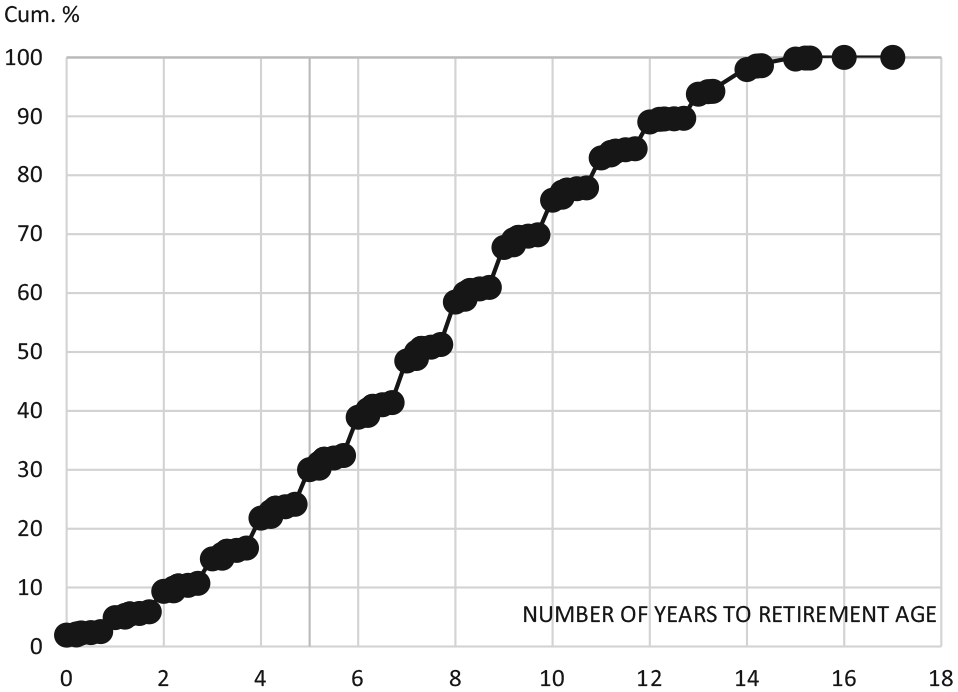
Time to retirement for all employees at time of first interview (years).
Descriptive statistics of the variables were used for the analysis as well, and T and chi-square tests examined the bivariate association between becoming self-employed and each of the independent variables (Table 3).
Participants Who Decide to Become Self-Employed and Those Who Remain Employees: Descriptive Statistics for Variables of Interest, Based on First Interview.

Note. The figures in brackets denote SE. IADL = Instrumental Activities of Daily Living; GDP = gross domestic product.
Frequency in the sample.
p < .1. **p < .05. ***p < .01.
The results of the multilevel analyses are shown in Table 4. Those of Model 1 reveal that being older (B = 0.09, Z = 7.47, p < .01) and being male (B = 0.46, Z = 5.36, p < .01) are both positively associated with the likelihood of becoming self-employed as against younger and female members of our sample, respectively. As for education, those with low education (B = 0.25, Z = 2.04, p < .05) and those with high education (B = 0.31, Z = 3.18, p < .01) are both more likely to become self-employed than those with secondary education. Becoming self-employed was significantly more common among those with more IADL (B = 0.28, Z = 3.69, p < .01) and among participants with a higher level of satisfaction with life (B = 0.06, Z = 2.02, p < .05). Finally, becoming self-employed was significantly more likely to occur when a longer period of time passed between the two interviews (B = 0.25, Z = 7.51, p < .01), as a longer period of time increased the probability that the switch would be made during this time. The household-income variable had no significant effect on the likelihood of becoming self-employed. Notably, when the per-capita income variable was added, the results remained the same. Also, the demographic variable of marital status was not found to have a significant impact on the transition to self-employment.
Multilevel Analysis Predicting Transition to Self-Employment After Age 50 (Coefficients).

Note. IADL = Instrumental Activities of Daily Living; GDP = gross domestic product.
With no job characteristics available for Luxembourg, the number of countries was reduced. The models were estimated using the multilevel analysis for dichotomous variables. Reference group for marital status was married. IADL was estimated on a 0–9 point Likert-type scale. Job security, job satisfaction, physically demanding job, and pressure in job were estimated on a 1–4 point Likert-type scale (reference group for poor job security: “strongly agree”). Job satisfaction was based on answers to the statement “I am satisfied with my job,” with “strongly disagree” as the reference group. The reference group for a physically demanding job was “strongly disagree.” The reference group for pressure on the job was “strongly disagree.”
p < .1. **p < .05. ***p < .01.
In Model 2, with job characteristics added to the model, the number of observations fell sharply because job-characteristic data were not collected for all countries in all waves. Yet only one change occurred in the sociodemographic coefficients: being poorly educated no longer had a significant effect on the likelihood of becoming self-employed. To facilitate the comparison, we added an estimation of Model 1A in Table 4, which includes the same variables as in Model 1 but applies only the observations included in Model 2 (N = 8,537).
As for the job-characteristic variables, only seniority had a significant negative effect (B = −0.01, Z = −2.24, p < .05), that is, the greater one’s seniority on the job, the less is one’s likelihood of becoming self-employed. The sharp drop in the number of observations and the paucity of data on job characteristics affected the results obtained and made the variables insignificant. For example, when we added only the job-security variable to the sociodemographic characteristics (N = 18,915), the results indicated that lower levels of job security are associated with an increased likelihood of becoming self-employed (p < .05, full results available upon request). Yet each additional job-characteristic variable lowered the final number of observations and caused loss of significance.
In Model 3, in which macroeconomic variables were added to the analysis, the results of Model 2 recurred with no difference whatsoever. Nevertheless, by adding the macro-level indictor we found that GDP was negatively associated with the likelihood of becoming self-employed (B = −0.00002, Z = −2.37, p < .05). Thus, when GDP decreased, the likelihood of becoming self-employed grew. The variable of unemployment rates was not found to have a significant impact on the transition to self-employment. Separate analyses by gender and age revealed no significant difference in trends. (Results available upon request.)
Discussion
Rising life expectancy and population aging have become major worldwide phenomena (Garibaldi, 2010) that challenge labor, pension, and social-security systems. Almost all societies worldwide are being affected by changes in their populations’ age distribution (Bengtson et al., 2002).
Using data from SHARE, we analyzed the transition to self-employment among persons aged 50–67 and the effect of sociodemographic characteristics, job characteristics, and macroeconomic indicators on this conduct. The contributions of this study are its focus on later-life transitions from employee labor to self-employment and its in-depth look at the influence of macroeconomic, job, and sociodemographic characteristics on this transition.
Older people and men have a significantly higher probability of becoming self-employed than do others—a very common result, in line with other studies such as Blanchflower (2000) and Lombard (2001)—and one that supports H1a and H1b, respectively. As for level of education, only in Model 1 did we find that low and high levels are positively associated with the transition to self-employment. In Model 2 and Model 3, only a higher level of education is positively associated with transition to self-employment, thus supporting H1c.
The demographic variable of marital status was not found to have a significant impact on the transition to self-employment, thus refuting H1d, and contrasting with other studies that analyze the transition to self-employment at all ages (Özcan, 2011). When all ages were referenced, it was found that being married is an important determinant of self-employment transitions, due to access to marriage-related resources, for example, resource and skill spillovers from their wives as well as tax incentives (Özcan, 2011). This variable has no effect on workers aged 50–67, most of whom are married.
Also contrary to studies that examined the self-employed in general, our study, focusing on older workers, found that more health limitations are associated with a higher probability of becoming self-employed—perhaps because self-employment affords flexibility and allows individuals to adapt the nature of their work to their special needs (Damman & Henkens, 2020; Giandrea et al., 2008), supporting H1e. Household income is another variable that yielded different results, as no association between household income and the transition to self-employment was found. Therefore, hypothesis H1f was not supported, as opposed to previous findings (Noorderhaven et al., 2004).
Contrary to our hypothesis, higher levels of satisfaction with life (H1g) are positively associated with the transition to self-employment. Thus, for older workers, while switching to self-employment cannot be seen as a way to improve satisfaction with life, it may be a proxy for higher levels of optimism and vitality among people who are willing to embark on the new path of self-employment (Lange, 2012). As no previous studies, as far as we know, have found a relation between higher satisfaction with life and the decision to become self-employed, further research focusing on the association among satisfaction with life, levels of optimism, and switching to self-employment may reinforce the findings of this study. As for job characteristics, longer duration on the job (H2a) is negatively associated with the likelihood of becoming self-employed among workers aged 50 and older. A larger study with more job data (e.g., our data lacked job characteristics for Luxembourg) may provide more robust results regarding job security. On the basis of the current sample, H2b was not supported. Even with our limited dataset, however, we can argue that self-employment may serve as a safety net for those who lack job security even though, as mentioned above, the sharp decrease in the number of observations and the paucity of data on job characteristics affected the results obtained and made the variable insignificant.
Finally, the hypothesis about the positive association between decreased GDP (H3a) and the likelihood of becoming self-employed is supported (Noorderhaven et al., 2004). Periods of economic recession cause people to transition to self-employment because they see no other choice (Buchmann et al., 2008). However, unemployment rates were not found to have an effect. Therefore, hypothesis H3b was not supported, probably because our study focused on older workers (aged 50–67), who are often more difficult to dismiss because they are protected by collective labor agreements (Axelrad et al., 2018). Yet our findings are consistent with those of several studies (Buchmann et al., 2008; Moore & Mueller, 2002), which found self-employment decisions to be independent of the health of the labor market as measured by the unemployment rate.
Still, this study must be understood in view of its limitations. One such limitation is the relatively low number of employees who decide to become self-employed. Even though this scarcity reflects the low share of this group in the population (Peters, 2017), it may affect the significance of the variables of interest. Another limitation is the non-inclusion in the study of several interesting job characteristics (e.g., occupation) due to the limited data provided by SHARE. Finally, future studies may take differences between industries and sectors into consideration.
To conclude, older workers’ decision to become self-employed, while not common, is more prevalent among employees who have certain characteristics than among those who lack them. Later-life self-employment may be one way of achieving financial and job security before retirement while contributing to the economy at large (Halvorsen & Morrow-Howell, 2016). As the self-employed tend to stay in the labor force longer than wage-and-salary workers do (Giandrea et al., 2008), self-employment may be one option for additional older workers and can be promoted by policymakers whose goal is to encourage the prolongation of working life and an alternative source of income at older ages for people who are unable to remain in the labor market as employees due to factors such as compulsory retirement age or unsuitability.
As entrepreneurship and self-employment help to create jobs and give unemployed and vulnerable people, such as older workers, an opportunity to fully participate in society and the economy (European Commission, 2019), both entrepreneurship and self-employment may abet smart, sustainable, and inclusive economic growth. To support these employment conditions, policymakers should enhance older workers’ knowledge of entrepreneurship and self-employment and support entrepreneurship financially.
Footnotes
Acknowledgements
This paper uses data from SHARE Waves 1, 2, 4, 5, and 6 (DOIs: https://doi.org/10.6103/SHARE.w1.600, https://doi.org/10.6103/SHARE.w2.600, https://doi.org/10.6103/SHARE.w4.600, https://doi.org/10.6103/SHARE.w5.600, https://doi.org/10.6103/SHARE.w6.600). See Börsch-Supan et al. (2013) for methodological details. SHARE data collection is primarily funded by the European Commission through FP5 (QLK6-CT-2001-00360), FP6 (SHARE-I3: RII-CT-2006-062193, COMPARE: CIT5-CT-2005-028857, SHARELIFE: CIT4-CT-2006-028812), and FP7 (SHARE-PREP: No. 211909, SHARE-LEAP: No. 227822, SHARE M4: No. 261982). Additional funding from the German Ministry of Education and Research, the Max Planck Society for the Advancement of Science, the U.S. National Institute on Aging (U01_AG09740-13S2, P01_AG005842, P01_AG08291, P30_AG12815, R21_AG025169, Y1-AG-4553-01, IAG_BSR06-11, OGHA_04-064, HHSN271201300071C) and from various national funding sources is gratefully acknowledged (see  ).
).
Declaration of Conflicting Interests
The author(s) declared no potential conflicts of interest with respect to the research, authorship, and/or publication of this article.
Funding
The author(s) received no financial support for the research, authorship, and/or publication of this article.