



Abstract
Perceived social support has traditionally been examined as an antecedent of well-being, including job satisfaction. The current study offers a new perspective in which job satisfaction can be both an antecedent and outcome of support in older employees. Two wave data from 910 older employees who participated in the Health and Retirement Study were used to test the hypotheses using a cross-lagged panel model. The results indicate that job satisfaction predicts subsequent perceived support from both supervisors and coworkers. However, perceived support from either supervisors or coworkers does not predict subsequent job satisfaction. The discussion suggests that unsatisfied employees, who likely are in greater need of support from their supervisors and peers, perceive having less support available to them. Practically, interventions aimed at increasing satisfaction might also benefit employees’ perceived support, and organizations could leverage our findings to create more favorable work environments.
The aging of the population in general, and the workforce in particular, makes the understanding of the unique attributions of older employees an important and timely matter (see Zacher et al., 2018). Specifically, understanding older employees’ patterns of work satisfaction could promote successful aging in the workplace and possibly encourage longer employability (Axelrad & McNamara, 2018). In this article, we focus on the reciprocal effects of job satisfaction and support in a sample of older employees (age 50+). We propose that while older employees’ sense of perceived support could lead to greater satisfaction, satisfaction can also result in greater perceived support.
Job satisfaction, defined as employees’ state of content and positive feelings about their job (Judge & Kammeyer-Mueller, 2012), has been the focus of ample research (Connolly & Viswesvaran, 2000) and has implications for both employees and organizations. Job satisfaction is typically conceptualized as an outcome of job-related experiences (see Ng & Sorensen, 2008). One commonly studied antecedent of job satisfaction is perceived social support, defined as the perceived extent to which others at work provide instrumental and emotional assistance (Ng & Sorensen, 2008).
Perceived social support is often examined through the lens of two theoretical mechanisms, the stressor–strain framework (Spector, 1998) and the job demand-resources model (Bakker & Demerouti, 2007; Demerouti et al., 2001). Both theories conceptualize perceived social support as a resource that leads to increased job satisfaction because it is inherently enjoyable and because it helps ameliorate the experience of stressful work situations.
The current study tests the relationship between perceived social support and satisfaction in older employees, as they have unique characteristics that are relevant to job satisfaction (e.g., older employees are generally more satisfied with their jobs; Ng & Feldman, 2010). Furthermore, we challenge the traditional view of a unidirectional relationship whereby perceived social support is a resource affecting job satisfaction. Instead, we offer a new perspective that emphasizes the importance of satisfaction as an antecedent of perceived social support. The main theoretical contribution of the current study is the development and testing of a framework that examines both job satisfaction and perceived social support as resources that have a reciprocal relationship between them, among older employees. This framework can have implications for organizations that employ older employees, because it can promote successful aging in the workplace and prolong employability.
Perceived Social Support and Job Satisfaction of Aging Employees
Successful aging in the workplace is defined as individuals’ ability to preserve resources and maintain health, motivations, and functioning as they age (Kooij, 2015). Accordingly, perceived support in the workplace could be a resource for older employees. Furthermore, positive personal relationships in the workplace were also mentioned as an aspect of successful aging in the workplace (Robson et al., 2006).
The socioemotional selectivity theory (Carstensen, 1992) posits that with aging, people become more aware of their limited remaining time. This awareness results in greater emphasis on positive experiences rather than negative ones, and in investing more in emotionally rewarding social relationships, rather than in social relationships that bear instrumental benefits (Carstensen, 1992). In the context of the workplace, the theory implies that older employees will focus more on the positive aspects of their work-lives, experiencing more positive social interactions, and greater job satisfaction. In addition, with maturation and the increased emphasis on positive experiences, employees might direct themselves to positions that are better suited for their needs. This selection process may also result in greater work satisfaction (Ng & Feldman, 2010).
Meta-analytic evidence suggests that job satisfaction has strong correlations with perceived supervisor support (PSS) and moderate correlations with perceived coworker support (PCS; Ng & Sorensen, 2008). However, the majority of these studies used cross-sectional designs, where causality cannot be determined.
In line with work stress theories, perceived social support reduces stress and increases performance, which then leads to greater satisfaction (e.g., Babin & Boles, 1996). Others suggested that perceived support indicates a pleasurable social environment, and employees are likely satisfied with that environment (e.g., Chiaburu & Harrison, 2008). Some previous longitudinal studies have found a lingering effect of perceived social support on satisfaction using various samples and time lags (e.g., de Jonge et al., 2010; de Lange et al., 2004; Moyle, 1998; ter Doest & De Jonge, 2010). In the current study, we explore the possibility of reverse directionality between perceived support and satisfaction, basing our arguments on the idea of gain spirals of resources.
Gaining Resources: The Contribution of Job Satisfaction
Resources, “those entities that either are centrally valued in their own right . . . or act as a means to obtain centrally valued ends” (Hobfoll, 2002, p. 307), can accumulate over time. This is because gaining resources increases the likelihood of gaining more of the same, or other, resources (Hakanen et al., 2008; Hobfoll, 2002). For example, when focusing on one specific resource, that is, efficacy beliefs, the social cognitive theory suggests that success encourages a positive view of one’s abilities, that results in further efficacy and success (Bandura, 1997; Llorens et al., 2007). Another theory that explains positive gain spirals of resources is the “broaden-and-build” theory, which focuses on upward or positive spirals at the workplace (Fredrickson, 1998). According to the theory, positive aspects of the work environment broaden individuals’ momentary thought–action repertoires thus helping them further build their resources by increasing the attention to positive aspects of the work environment and encouraging cognitive and behavioral creativity. Together, the broader scope of thoughts and actions enables employees to function better and create better support systems for themselves. Applying these theories to the support–satisfaction relationship relies on the premise that the experience of perceived support (a resource) has positive effects on affective and behavioral states, and these, in turn allow for further gains in resources, specifically, perceived support. This could be especially prominent in older employees, as, according to the socioemotional selectivity theory (Carstensen, 1992), they are more inclined to focus on the positive aspects of their work environment, resulting in greater positive gain spirals.
Building on prior work that has extended the resource gain spiral to include other variables (Halbesleben & Wheeler, 2012; Salanova et al., 2006), we argue that the resource gain spiral can be extended to include other work attitudes/motivations such as job satisfaction. Specifically, we argue that resources such as perceived social support would increase job satisfaction, but that this relationship is reciprocal such that satisfied employees will also perceive that more support is available to them.
Job satisfaction is a job attitude with a strong affective component (Judge & Kammeyer-Mueller, 2012) and can be conceptualized as an interpersonal attractiveness variable. This interpersonal attractiveness is likely to engender subsequent perceived social support because it is easier to offer help to a likable individual. Several studies can offer support for this argument. Focusing on positive emotions at work, Staw et al. (1994) suggest that employee’s positive affect/emotions are related to perceived attractiveness, and thus prompt others to offer more social support. A review study (Lyubomirsky et al., 2005) suggests that positive affect is associated with (a) more positive perceptions of others, (b) greater sociability, (c) likability and cooperation, and (d) prosocial behavior, all of which promote subsequent perceived social support from others in the workplace.
From another perspective, job satisfaction is positively associated with providing help to others, that in turn will result in increased self-efficacy and perception of other resources, such as further perceived support (Venkataramani & Dalal, 2007). Principles of reciprocity also suggest that providing others with support would lead to higher levels of perceived support. Indeed, social competence was found to be the strongest predictor of social support at work (Bowling et al., 2004), in line with a reciprocity explanation for the formation of support systems at work. Therefore, satisfied employees are likely to both receive and provide higher levels of support, and providing more support would likely increase the levels of perceived support even further.
Focusing on older employees, studies suggest they tend to be more satisfied, and their satisfaction is attributed to greater job complexity, greater security, and higher salaries (Aristovnik & Jaklič, 2013). In a meta-analysis, age was positively related to overall job satisfaction with work and with pay. Age was also positively associated with satisfaction with supervisor and colleagues, but was uncorrelated with support (Ng & Feldman, 2010). To the best of our knowledge, there are no studies examining the support–satisfaction relationship among older employees.
There are some preliminary empirical findings pointing to a reciprocity between job satisfaction and perceived support (Gelsema et al., 2006), though with only a limited sample of nurses. Overall, it seems there is sufficient theoretical backing to suggest that job satisfaction can be viewed as a personal resource, and likely an antecedent of other resources such as perceived social support.
Finally, we distinguish between two main sources for social support at work: PSS and PCS. PSS and PCS can be defined as employees’ beliefs regarding the extent to which their supervisors and coworkers, respectively, provide them with instrumental and emotional assistance (Thoits, 1985). PSS has a stronger relationship with job satisfaction (Ng & Sorensen, 2008), perhaps because the supervisor’s job includes providing support for subordinates (and therefore they may be more inclined to offer support), or because the supervisors have, on average, higher skills and abilities than subordinates and therefore the support is of greater value. However, support from either the supervisor or coworkers is very valuable (Hobfoll et al., 2003) and is expected to play a similar part in a reciprocal relationship with job satisfaction.
To summarize, these theories form the basis for bidirectional hypotheses leading from perceived social resources (both PSS and PCS) to increased job satisfaction, and vice versa, in line with a support–satisfaction gain spiral perspective:
Method
Participants and Procedure
Data were derived from two waves of the Health and Retirement Study (HRS)—2008 (T1) and 2012 (T2), which are the only available data points that include the study’s variables (the 2016 wave did not include them). The HRS is a nationally representative American longitudinal panel study for older adults, aged 50 and above, and their spouses. The scales used in the current study are part of the self-administered psychosocial questionnaire collected from the same participants every 4 years.
Recently, the HRS was used to examine reciprocal effects between job stressors and well-being (Liu et al., 2018), but it has not been previously used to examine reciprocal relationship between work social support and satisfaction. The inclusion criteria for the current study were employees had to be employed at T1 and remain employed by that same employer at T2. This resulted in a sample size of 910, with a mean age of 60 (SD = 7.6). The sample had 63% women, with an average education of 16.3 years, 37 weekly work hours (SD = 12), and generally in good health (M = 2.4, SD = .9 on a one-item self-rated health question ranging from 1 = excellent to 5 = poor). This is a sample of older working adults, but with the aging of the workforce as a whole, it represents a growing segment of all employees.
Measures
All measures used multiple items that were rated on a scale ranging from 1 (strongly disagree) to 4 (strongly agree). Internal consistency reliability coefficients (α) were all acceptable and are reported in Table 1.
Descriptive Statistics and Intercorrelations Among Study Variables.
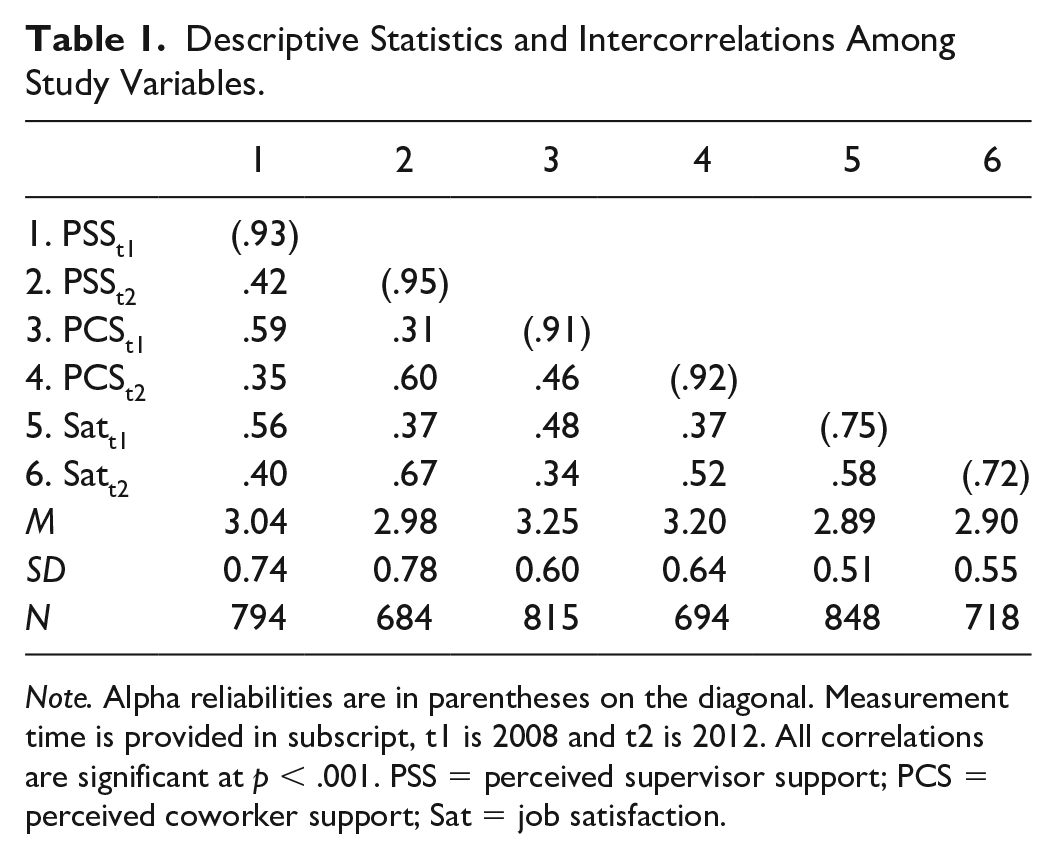
Note. Alpha reliabilities are in parentheses on the diagonal. Measurement time is provided in subscript, t1 is 2008 and t2 is 2012. All correlations are significant at p < .001. PSS = perceived supervisor support; PCS = perceived coworker support; Sat = job satisfaction.
PSS
PSS was measured using the four Eisenberger et al. (2002) items beginning with “My supervisor”: “is helpful to me in getting the job done,” “is willing to extend himself/herself to help me perform my job,” “takes pride in my accomplishments at work,” and “tries to make my job as interesting as possible.”
PCS
PCS was measured with the three items developed by Haynes et al. (1999), being with “My coworker: “listen to me when I want to talk about work-related problems,” “help me with difficult tasks,” and “help me in crisis situations at work.”
Job satisfaction
Job satisfaction was measured with nine items from the 1977 quality of employment survey (Quinn & Staines, 1979). We eliminated the 10th item, “I receive adequate support in difficult situations” because of its overlap with the support constructs. Furthermore, following common practice with latent structural modeling, we parceled the job satisfaction items to reduce random error of the coefficients (e.g., Meier & Spector, 2013). We created four parcels, comprising two randomly chosen items each.
Analytical Strategy
As a first step, a series of confirmatory factor analyses (CFA) is used to verify the construct structure and invariance over time. The CFAs are conducted using robust full-information maximum likelihood estimation (MLR) in Mplus Version 7.0 (Muthén & Muthén, 1998–2012). The disturbances of the factors within each of the two measurement occasions are correlated to account for variance due to measurement occasion. Furthermore, the uniquenesses of the individual items are correlated across the two time points to account for consistency in indicator-specific variance.
First, we test a model in which each indicator loads onto its respective factor in each of the two time points, with a total of six correlated factors (one factor per construct and measurement occasion). This model should demonstrate significantly better fit to the data than a two-factor (one per measurement occasion) model, or a four-factor model (two factors per measurement occasion, whereby social support is one factor and job satisfaction is another factor). The difference between these two nested models is tested using the SB-χ2 scaled difference test.
Next, measurement invariance of the latent variables across time is tested. The previous factor model is statistically compared with a model that is identical except that it constrains the factor loadings of each indicator to be equal across the two time points (metric invariance). The constrained model should not fit the data significantly worse than the unconstrained model to support measurement invariance over time.
Finally, the hypothesized cross-lagged panel models are tested. In these models, each latent variable at Time 2 is predicted by the same variable at Time 1 (autoregression) and by the other latent variable at Time 1 (cross-lagging). These analyses are conducted separately for each source of support. We allow the disturbances of the indicators to correlate across time points (Cole & Maxwell, 2003). If these models demonstrate good fit to the data, then the directionality of effects can be examined.
Further probing includes testing the cross-lagged models with control variables (i.e., simultaneously regressing the satisfaction and support variables on all control variables), and cross-validating the results by randomly splitting our sample into two groups and testing the models again.
Results
Descriptive statistics, reliabilities, and intercorrelations of the study variables are presented in Table 1. The correlations indicate that perceived support from both supervisors (PSS) and coworkers (PCS) and job satisfaction are positively correlated, both within each time point and across the two time points. Furthermore, the results suggest there is greater stability over time in job satisfaction than in perceived support, with a correlation of .58 between the time points for satisfaction, in comparison with only .38 and .44 for PSS and PCS, respectively. Furthermore, both PSS and PCS at Time 1 were correlated with job satisfaction at Time 2, and satisfaction at Time 1 was correlated with PSS and PCS at Time 2 (these correlations ranged from .34 to .40).
Model Testing
As a first step, we conducted a set of CFAs. The unconstrained six-factor model demonstrated good fit to the data and had significantly better fit to the data when compared to alternative measurement models. Results are presented in Table 2. Next, we tested for measurement invariance of the latent variables across time by comparing our previously retained unconstrained six-factor model with a constrained model. The constrained model had good fit, χ2(192) = 490.41, p < .001, root mean square error of approximation (RMSEA) = .04, comparative fit index (CFI) = .96, Tucker–Lewis index (TLI) = .96, standardized root mean square residual (SRMR) = .04, and did not fit the data significantly worse than the unconstrained model, ∆χ2(8) = 7.35, p = .50. We therefore retained the constrained model, indicating there is measurement invariance between the two time points.
CFA Results.
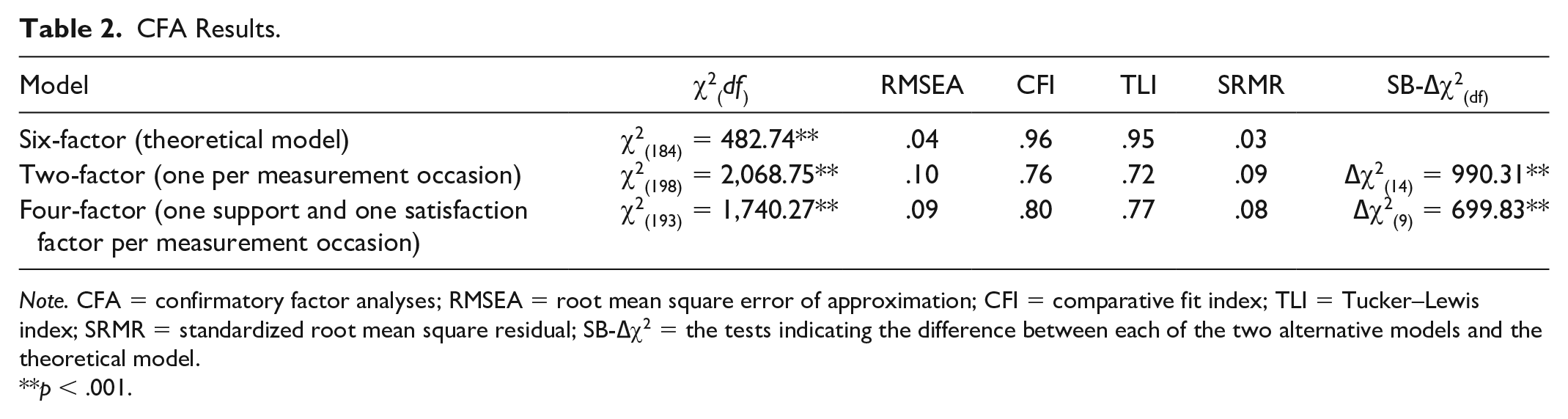
Note. CFA = confirmatory factor analyses; RMSEA = root mean square error of approximation; CFI = comparative fit index; TLI = Tucker–Lewis index; SRMR = standardized root mean square residual; SB-∆χ2 = the tests indicating the difference between each of the two alternative models and the theoretical model.
p < .001.
In the final step, we tested our hypothesized cross-lagged panel models. We conducted these analyses separately for each source of support. Both the PSS model, χ2(96) = 335.92, p < .001, RMSEA = .05, CFI = .96, TLI = .94, SRMR = .04, and PCS model, χ2(69) = 106.81, p < .01, RMSEA = .03, CFI = .99, TLI = .99, SRMR = .03, demonstrated good fit to the data.
Path estimates are shown in Figures 1 and 2. Contrary to Hypothesis 1, results indicated that the relationships between the two support variables and subsequent job satisfaction were not significant (PSS unstandardized coefficient = 0.05, p = .29; PCS unstandardized coefficient = 0.04, p = .50). However, the relationship between job satisfaction and subsequent support was significant (unstandardized coefficient = 0.36, p < .001 for PSS, and unstandardized coefficient = 0.25, p < .001 for PCS). Hypothesis 2 was therefore supported.
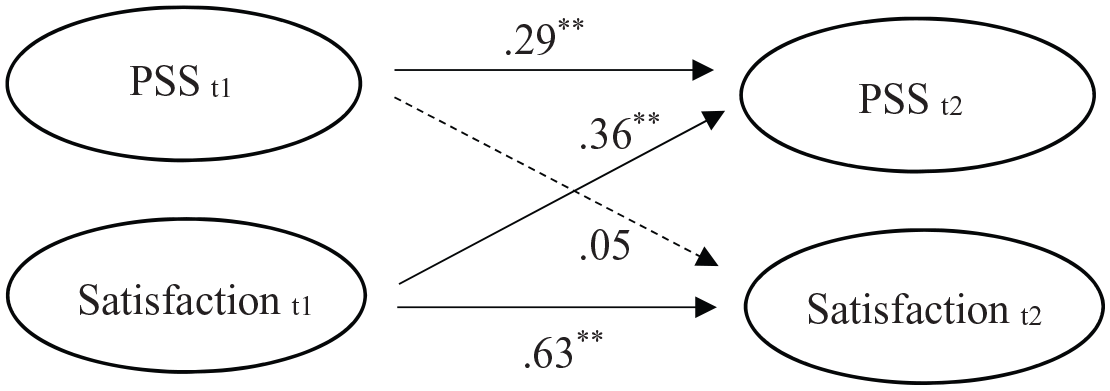
A test of the reciprocal effect of perceived supervisor support and job satisfaction using a time lag of 4 years.
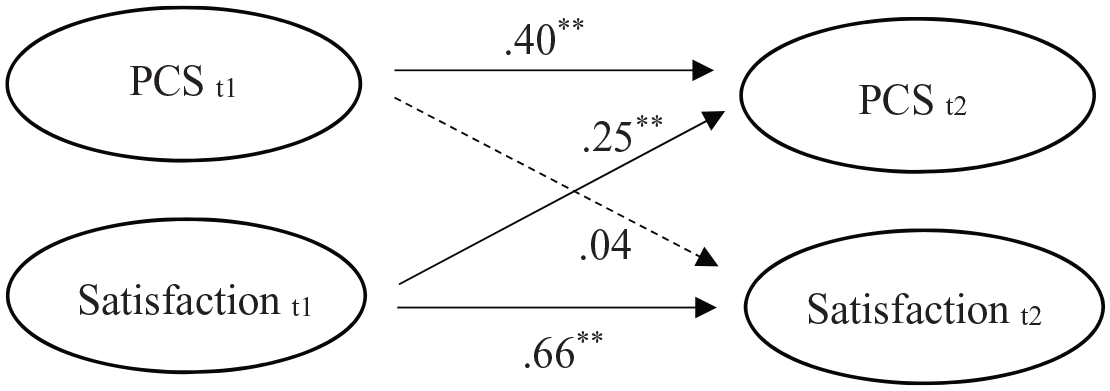
A test of the reciprocal effect of perceived coworker support and job satisfaction using a time lag of 4 years.
Additional Validation Tests
The main analyses were replicated with the use of several control variables that are known to correlate with the focal variables of this study: gender, age, salary, weekly work hours, and self-rated health. The models retained their good fit to the data, and the pattern of significant paths remained the same (in addition, there were significant paths for age, salary, weekly work hours and health, but not for gender. These results can be obtained from the first author).
Furthermore, we cross-validated by randomly splitting our sample into two groups (N = 471 and 439 for Parts 1 and 2 of the data) and repeating the analyses. Both the PSS and the PCS models retained their good fit to both parts of the data, and the pattern of significant paths shown in Figures 1 and 2 remained the same (full results can be obtained from the first author).
Discussion
The current study examined the bidirectional relationship between perceived social support at work and job satisfaction in a sample of older employees. Extant research has focused on the effects that perceived social support (from both supervisors and coworkers) have on employee job satisfaction but have largely neglected the opposite direction, despite a number of theories that can provide a basis for bidirectional effects. In the current study, we proposed that perceived support and satisfaction develop over time in the workplace and argued that while perceived support can promote job satisfaction, the experience of job satisfaction is resource-enhancing and would increase the propensity to gain other resources (i.e., perceived support) in older employees. Our results indicate that while perceived support did not predict job satisfaction (beyond prior levels of job satisfaction), job satisfaction significantly predicted support over time. This directionality challenges previous assumptions regarding the unidirectional role of support as a predictor of satisfaction (e.g., Chiaburu & Harrison, 2008). Rather, it suggests that satisfied older employees might be better able to create a supportive environment for themselves. This suggestion is supported by theories addressing the role of affect in interpersonal relationships. For example, the satisfaction as attractiveness perspective (Lyubomirsky et al., 2005; Staw et al., 1994) suggests that satisfied employees offer more support to others, and initiate reciprocity in support relationships, or that offering support to a happy person elicits more positive emotions in the support provider, hence increasing his or her propensity to offer help. According to the socioemotional selectivity theory, older employees are more inclined to focus on positive aspects of their work and exhibit higher levels of satisfaction. Their ability to focus on the “bright side” could make them desired counterparts and mentors, and foster their perceptions that support is available to them, should they need it. It is also noteworthy that among older employees, 50 or older, there are no substantial age differences when it comes to the role that the job holds in terms of a need for social contact, or a need to feel satisfaction/achievement (Loi & Shultz, 2007). That is, despite the relatively large age range in our sample, older employees are relatively similar with regard to how they value satisfaction and support.
However, we did not find evidence of perceived support as a predictor of satisfaction (beyond initial levels of satisfaction). It is possible that the causal role of support as a major predictor of job satisfaction was exaggerated in previous studies, which mostly used designs that are not suited for the examination of directionality. Our results suggest that the effects of support from both supervisors and coworkers on satisfaction are entirely subsumed within the effects of prior levels of satisfaction on current satisfaction. Alternatively, it could be that the relatively long time lag in the current study (4 years) corresponds with the somewhat stable component of satisfaction (Connolly & Viswesvaran, 2000) and highlights this direction of effects, whereby “happier” employees fair better socially over time, whereas shorter time lags could reveal a more reciprocal pattern in how the relationship between satisfaction and support at work unfolds. This explanation seems reasonable here, because the high correlation between the two measures of satisfaction (r = .58) leaves less variance to be explained by other factors such as perceived support. Therefore, despite our inability to detect the effects of perceived support on subsequent satisfaction, we cannot conclude these effects do not occur. It is also possible that the focus on older employees affected the result. As found by Ng and Feldman (2010), satisfaction level, but not perceived support level, rise with age, implying that perhaps satisfaction is a stronger driving force (rather than consequence) in older employees, resulting is a stronger effect for satisfaction on support. Our results replicated for both supervisor and coworker support, in line with previous findings (Gelsema et al., 2006).
A main contribution of this study is the focus on older employees. Employees today expect to work longer than before to support themselves in retirement and support the retirement system itself (Truxillo et al., 2015). As a result, the workforce is aging, and research that focuses on older employees is relevant for a growing segment of the working population. Job satisfaction predicts retirement intentions (Zacher & Rudolph, 2017), and therefore understanding its predictors and consequences for older employees could have implications for employers and policy makers interested in prolonging employment.
Limitations and Future Directions
Several limitations are noteworthy. First, the study is subjected to mono-method bias, as all of our variables were self-reported. However, this concern should be minimal as data were obtained in two time points separated by 4 years (Podsakoff et al., 2003), and because effects emerged while controlling for a previous measurement which likely partials out any portion of the variance that is attributable to the common method.
Second, although we used a longitudinal design, we are still only able to discuss time precedence or directionality and not causality. It is possible that a common factor, such as organizational climate or extroversion affected both satisfaction and support.
Third, we did not analyze different types of perceived support (i.e., emotional and instrumental support), and our design did not allow us to distinguish between objective/received and perceived levels of support (Kirschenbaum & Weisberg, 2002). These different components of support may exhibit different patterns in their relationships with satisfaction. We also did not test the described mechanisms by which support and job satisfaction likely influence one another. Future studies could examine how different mechanisms map onto different types of support.
Finally, our study only had two time points, measured 4 years apart, resulting in two significant limitations. First, a 4-year lag (that included the 2008 recession) probably resulted in many job changes, particularly for those who were less satisfied with their jobs, thus contributing to range restriction, and a smaller sample. Nevertheless, we were able to detect significant effects despite the range restriction. Second, having only two waves does not allow for directly testing spirals. Future research could use more waves of data with varying lags between them to examine trajectories of support and satisfaction and investigate whether there is a continuing spiral between support and satisfaction, thus going beyond the reciprocal effects tested here. A related issue is that our sample included only older employees, making it impossible to compare older and younger employees, though such differences would not be surprising as changes in cognitive processing occur with age (Shultz et al., 2009). However, including age as a control variable did not alter the results in the current sample. Future research can also look at potential moderators of these reciprocal effects. One example is status within the organization, which, despite being correlated with support, also seems to buffer the relationship between support and other variables (Lee & Jeung, 2018). Furthermore, the effects of the studied variables on workability could also be examined jointly with previously examined workplace factors (Damman & Henkens, 2020), in light of the increase of life expectancy, and the importance of successful aging in the workplace (Zacher & Rudolph, 2017).
Despite these limitations, the current study has several theoretical implications. Theoretically, our study expands the resource gain spiral to include work attitudes by examining job satisfaction using an attractiveness perspective and drawing on the concepts of the socioemotional selectivity theory. When we consider the direction of effects observed in this study, whereby it is not support that generates job satisfaction over time, but rather that satisfied employees perceive more support available to them, we must also recognize that the other side of that coin is that unsatisfied employees, who likely are in greater need of social support from their supervisors and peers, may end up having less support available to them than those employees who are satisfied. Older dissatisfied employees may not be able to age successfully at the workplace (Kooij, 2015; Zacher et al., 2018) and be at greater risk of early retirement (Zacher & Rudolph, 2017).
Practical Implications and Conclusion
In line with socioemotional selectivity theory and results from the current study, older employees tend to focus on positive stimuli, enjoy greater satisfaction, and build better support systems over time. These elements can contribute to a more favorable work environment for all employees. Organizations could therefore benefit from encouraging contact between younger and older employees to leverage those benefits. Furthermore, this implication is becoming increasingly relevant to most workplaces as the workforce is aging. Therefore, interventions that are aimed at improving older employee satisfaction are relevant to a growing segment of the workforce and can promote longer employability.
To conclude, our study found that satisfied older employees seem to build better support systems over time, perceiving more support from both their supervisors and coworkers. The effects of perceived social support on subsequent levels of job satisfaction were less clear and further research is needed using different time lags and designs.
Footnotes
Declaration of Conflicting Interests
The author(s) declared no potential conflicts of interest with respect to the research, authorship, and/or publication of this article.
Ethical Approval
Ethical approval for the HRS was obtained from the University of Michigan Institutional Review Board.
Funding
The author(s) disclosed receipt of the following financial support for the research, authorship, and/or publication of this article: The HRS is supported by the National Institute on Aging (NIA U01AG009740) and the Social Security Administration.
