



Abstract
North Korean (NK) defectors fled their homeland and traveled thousands of miles in search of a better life. This qualitative study explored the experiences of older NK defectors who were part of a serious leisure choral group. In-depth interviews were conducted with eight NK defector members of a South Korean choir group, from which four central themes emerged: (a) conquering adversity and promoting health; (b) making good friends and having great adventures; (c) providing an arena to develop a new identity; and (d) developing proficiency through vigorous efforts. Involvement in choral singing as a serious leisure activity assisted the members in overcoming the various adversities they were facing, promoted their physical and mental health, and helped them develop comradery and new social identities.
Since the end of the Korean War in the 1950s, economic, political, ideological, and religious reasons have forced many North Koreans, who are referred to as North Korean (NK) defectors, to defect to South Korea. The Ministry of Unification (2020) reported that there are more than 33,000 NK defectors in South Korea, a majority of whom are female (72%). While only 7% of NK defectors were female in 1989, the female-to-male NK defector ratio has significantly increased from 42% in 2000 to 72% in 2020. The proportion of female defectors has been fluctuating each year, but it has consistently been over 70% in the last decade (Table 1).
Current Status of North Korean Defectors in South Korea (as of September 2020).

Source. The Ministry of Unification of Korea.
NK defectors generally have to travel thousands of miles before arriving in South Korea, with many risking their lives when crossing the North Korean/Chinese border. Many NK defectors reported having had traumatic experiences before their escape, such as suffering from political violence, poverty, and the death of family members due to illness and starvation (Jeon et al., 2005). Female NK defectors, in particular, reported being vulnerable to other dangers on their journey to South Korea, such as human trafficking, sexual violence, and physical abuse. Consequently, many NK defectors suffer from mental health problems, such as anxiety and depression.
Although North and South Koreans have a shared ethnicity and language, they no longer come from similar cultures because of their contrasting social systems since the mid-1940s. Therefore, because they have had disparate life experiences, NK defectors often experience conflict and culture shock on arrival in South Korea, with many also suffering from stress and depressive symptoms due to their low quality of life in South Korea caused by unemployment, loneliness, an unstable economic status, and identity confusion (J.-K. Kim & Yang, 2011; Oh, 2015). Although NK defectors speak the same language, during the resettlement process, they tend to feel vocationally incompetent and often experience stress due to different value systems and lifestyles. Y. Lee et al. (2017) found that NK defectors generally experienced resettlement stress because of poor sociocultural adaptation, which in turn tended to increase mental health risks. However, it has been found that positive social support can serve as a buffer against traumatic experiences and promote better mental health (J. Kim, Suh, & Heo, 2014).
The South Korean central government, municipalities, and various nonprofit organizations have established NK defector settlement support programs. For example, the “Dream makers for North Korea” is a nonprofit organization that protects the human rights of all North Koreans, including NK defectors. Since 2015, this organization has been running a female NK defector choir group called “Forget-me-not” that has more than 40 singers. When the choir first started, it was intended to be a therapy program for NK defectors; however, consequently, it became an official choir with a South Korean director, accompanist, and NK defector singers. The choir, which has a wide repertoire that includes Korean folk songs, worship songs, and pop songs, annually recruits new members through audition. In general, the director recommends the songs for the practices and performances, which take place regularly both in Korea and in other countries.
This study was guided by the serious leisure theoretical framework, as it was considered that participating in this choir was a serious leisure pursuit for these older NK defectors because serious leisure activities are characterized by high commitment and productive and meaningful engagement. Stebbins (2007) defined the qualities of serious leisure as perseverance, significant effort, career development, personal and social benefits, unique ethos, and identification. As serious leisure involves the acquisition of specialized skills, knowledge, and training, people engaged in serious leisure persevere regardless of the constraints, difficulties, or adverse circumstances. As they become more committed to the leisure activity, they develop leisure careers that tend to be shaped by special contingencies, turning points, and achievement stages. Stebbins (2014) also found that serious leisure participants passed through several sequential stages: beginning, development, establishment, maintenance, and decline. Serious leisure activities have been found to have positive personal and social benefits, such as enjoyment, a sense of achievement, self-actualization, personal growth, happiness, social interactions, and group accomplishments (J. Kim et al., 2016), with the people involved often developing special subcultures because of similar interests, beliefs, norms, values, attitudes, common goals, and unique language expressions. Serious leisure activities often become central to participants’ lives as they provide them with a social identity different from other contexts, such as family or work.
Recent serious leisure research has examined activities such as senior fashion modeling (S. Lee et al., 2019), pickleball (Heo et al., 2018), gardening (Cheng et al., 2017), and volunteering (Curtin & Brown, 2019). For example, Cheng et al. found that forming an identity, developing a social world, and significant effort were salient characteristics of a gardener. The deeper participants in this study became engaged in the gardening, the more likely they were to experience satisfaction with life.
It has also been found that serious leisure contributes to increased well-being in older adults. In a wide-ranging study on choral singing for serious leisure, Liu and Stebbins (2014) found that adult choral singing had physical and mental health benefits and engendered happiness, self-actualization, self-expression, and a sense of group accomplishment. Given the positive impacts of serious leisure, it was surmised that serious leisure could assist older NK defectors cope better with life events and challenges associated with adapting to a new culture.
The purpose of this study, therefore, was to explore the experiences of the older NK defectors engaged in choral singing as a form of serious leisure. As this is an area that has rarely been investigated, the additional knowledge could assist practitioners in establishing baselines to assist NK defectors and other refugee groups more successfully adapt to their new environments. Choral singing could also be an exemplary activity for nonprofit interventions for people in similar circumstances.
Method
A qualitative research design was employed to explore the experiences of the NK defectors, and a grounded theory methodological perspective was used for data collection and analysis (Glaser, 1992). Semi-structured interviews were conducted, wherein several topics were discussed: the journey to South Korea, life experiences in South Korea, the challenges and benefits of being a member of the choir, and the group culture of the choir.
Participants
Using purposive sampling, eight NK female defectors were recruited with the eligibility being at least 50 years of age, being a member of the choir, sufficient cognitive ability, and adequate spoken Korean. The contact information was supplied by the choir manager, after which each participant was contacted via text message.
Data Collection
The study protocols were approved by the Yonsei University Institutional Review Board (IRB No. 7001988-201912-HR-675-04), and written informed consent was obtained from all study participants. The 30- to 90-min face-to-face interviews were held in the Seoul metropolitan area by the researchers. However, to ensure participant comfort, each participant chose the interview location from among their home, a coffee shop, or the practice facility. The interviews all started with the broad question, “Could you tell us about your travel experiences of coming to South Korea?” after which the participants were asked to detail their experiences as a member of the choir, with some of the example questions being “What is the most important thing to you as a member of the choir?” “What does the choir experience mean to you?” “What difficulties do you face as a member of the choir?” and “Why is choral singing important to you?” All interviews were audio-taped and transcribed verbatim. Field notes were also taken during the interviews, and personal observations were made afterward. After each interview, the participants’ demographic information was collected. To ensure privacy, pseudonyms were assigned to the interviewees, and any potentially identifying information was removed from the transcripts. After the eighth interview, it was determined that data saturation had been achieved. No additional interviews were conducted after the eighth interview, as no new information was being obtained.
Data Analysis
The data were analyzed using the constant comparison method (Merriam, 1998). After each interview, the transcripts were coded line by line, with the researchers independently analyzing the transcripts to identify the emerging themes. The initial coding process identified broad categories and emerging themes, which were then further reviewed and discussed for clarity to finalize the key themes. Data review by multiple authors ensured that the study had rigor and reliability.
To ensure the trustworthiness of the study, the coding was independently conducted by two investigators, who held regular meetings to discuss the developments and code definitions. Member checks were also conducted to ensure that the interviews were accurately transcribed, with the transcripts being sent to the study participants for review and to ask for additional information, if required. An expert in qualitative research cross-checked and reviewed the codes and themes to minimize researcher bias.
Results
The average age of the participants was 66 (range = 56–78) years. All but one participant had child(ren) in North Korea, half were widowed, and all had been involved with the choir for between 1 and 4 years (Table 2). It was found that engaging in the choir had been a vital resource for coping with the challenges of living in South Korea. The data analyses identified four major themes related to the choir experiences: (a) conquering adversity and promoting health; (b) making good friends and having great adventures; (c) providing an arena to develop a new identity; and (d) developing proficiency through vigorous effort. The following excerpts from the interviews give examples of the NK defectors’ choir experiences.
Demographic Characteristics of the Study Participants.
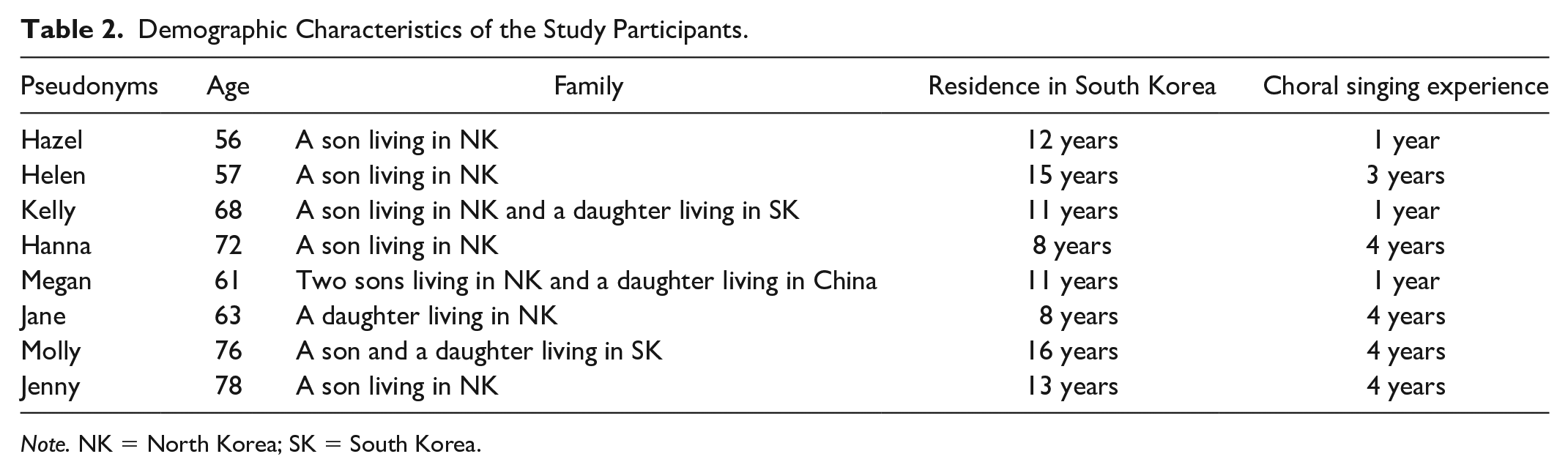
Note. NK = North Korea; SK = South Korea.
Conquering Adversity and Promoting Health
The NK defectors had suffered negative and/or stressful life events. In addition to the adversities they had endured in North Korea, the participants had also suffered various hardships while traveling to South Korea. Most participants had stayed from several months to a number of years in China and then had either come directly to South Korea or moved to different places in Southeast Asia before finally coming to South Korea. All reported having stressful and difficult travel experiences. For example, Kelly described her experiences prior to arriving in South Korea as follows: I was in my mid-50s when I moved to China. I spent four years there. Then, I went to Thailand. It took about a week to get there from China. I think it was in the Mekong River, when a boat in front of us flipped over, and an alligator took one of the guys there. I stayed for about two months in Thailand, and finally came to Korea.
Similarly, Hanna affirmed that the escape and traveling processes were painful, but it was worth taking the risk: I walked about 44 miles to get to the border (North Korea–China border). When wading across the Tumen River, the water was above my waist, and I was really scared. After I settled in China, I lived there for eight years. Then, I decided to take the risky journey of moving to South Korea, so I went through Vietnam and Cambodia and finally arrived in South Korea.
The participants discussed the contextual challenges and struggles they experienced when resettling in South Korea, with all feeling that the choir activities had helped relieve these stressors. Jane was working as a caregiver in South Korea and was under the pressure of financially supporting her daughter in North Korea. Unfortunately, for several years after she had resettled in South Korea, she was scammed, which made her depressed; however, participating in the choir changed her outlook: “I had been depressed for a long time and had thought about taking my own life several times. Ever since becoming involved with ‘Forget-me-not,’ these feelings have vanished; I don’t think of committing suicide anymore.”
The participants generally admitted that they had all struggled with depression and that the choir aided in their transition. For instance, Helen commented on how the choir had provided her with a purpose: It’s been about 10 years since I moved (from North Korea). During my resettlement, I was ripped off a number of times. Lots of tears and pains . . . many defectors remarry once they settle here (South Korea), but I am by myself. I think few defectors are like me. I was extremely depressed. I tried to come with my son, but he got caught (during the escape from North Korea). Whenever I thought of him, I felt like taking my own life. I healed (through the choir activity). I was able sing what I wanted to sing and talk to friends.
It became clear from the analysis that the participants had all experienced relatively high levels of stress during their fateful journeys to South Korea and had also suffered additional settlement stress. All participants claimed that the continued participation in the choir had improved their health by relieving their stress and anxiety and had also enhanced their physical and mental health by allowing them to develop positive emotions and dismiss negative thoughts. For example, Molly spoke about the physical health benefits: When I sing, I feel peaceful. I used to be out of breath when I walked, but now I think I have got healthier after all this practice. There were numerous times that I thought about quitting (choral singing), but such thoughts are now gone. When I am here, I don’t feel any stress. I feel much younger when I sing.
In addition to leaving their child(ren) in North Korea, other stressful experiences such as traumatic events in North Korea and being scammed or ostracized by South Koreans during resettlement and acculturation had aggravated their depressive symptoms. The first theme revealed that the choir had a significantly positive impact on the participants, who were using the activity to escape from stress and feelings of depression.
Making Good Friends and Having Great Adventures
One notable benefit expressed by all participants was the development of positive companionship and friendships. The choir occasionally traveled to perform, which had strengthened the participants’ relationships. While some participants said that it had taken a long time to get along well with the other group members, they were eventually able to develop friendships, and the longer they performed and traveled together, the stronger their group solidarity became. As Molly noted, “We practice (singing) only once a week, but we see each other three to four times a week. We have been together and have been traveling together for many years. It’s so much fun.”
Prior to resettling in South Korea, the participants’ only international travel experiences had been escaping from North Korea and wandering around other countries. After settling in South Korea, traveling overseas to perform had broadened their horizons and affected their lives in many ways. For some participants, overseas travel used to be only a dream; therefore, traveling to perform had opened up a whole new world for them, and doing something new together had brought the participants closer. The participants shared how fulfilling such these experiences were. For example, Helen said, I am so proud that we were able to travel abroad by plane. We are not pros, but I feel like we became something. We flew to Japan and Jeju Island to perform. This is so awesome. Never in my life had I expected to travel like this. I think we are better off than celebrities in North Korea.
When referring to the value of the friendships they had, Jane said, “We are all from North Korea and we have the same cultural background. Nobody picks on our accent because we all have similar accents. We talk about our hometowns a lot.” In a similar vein, Kelly spoke of how they had formed a bond of sympathy and what the group means to her: We meet every week. We share our stories (escaping from North Korea) and news from the North. There were times when we felt like relatives. Now they are like my family. The folks in the group take care of me like my mom. I often feel mom’s touch here.
When the participants traveled to perform, it was always a team effort. Once they set off, the participants felt obligated to perform well and the communal living cultivated their team camaraderie and solidified their subculture. Megan mentioned how traveling together had helped each member: I really enjoy traveling to perform with the members here. We move together, eat together, and do many things together. I feel like we get close to each other. We take care of each other and help each other put on makeup. We have to become one. (After they come back from the trip and meet for regular practice) We have a snack time during the practice, and I often bring things to share. I like the feeling of unity.
The interviews clearly highlighted how traveling together had played an important role in the development of their spirit of comradeship. The unique cultural world the participants had created served to further solidify the positive relationships.
Providing an Arena to Develop a New Identity
Most participants reported that it had been inevitable that they would experience an occupational change on resettling in South Korea; however, the chances to develop new work identities had been slim. All participants reported that the choir was the top priority in their lives, and over their years as members of the choir, they had developed a strong identity. Most participants admitted that they had had no real purpose when they had started with the choir; however, the longer they stayed, the more they became able to form a new social identity, which in turn had motivated their continued participation. This was supported by comments from some participants. For example, Kelly explained what the choir activities meant to her: When I make daily plans, I make sure the choir schedule is not interrupted. It’s my highest priority. I like this above all things. We have this pride as a member of the team. We do large scale performances, and we even perform together with celebrities now.
It was apparent that the choir participants were proud of themselves because of the way they spoke so excitedly about the singing activities, as evidenced in Helen’s comments: We all know that we can’t skip practice. We have to sing in one voice and if any of us don’t show up, it will affect the others in the group. I brag about being in this choir, and I tell my friends to come watch us perform. I also ask other friends to join the choir.
Some participants reported that they had been working as professionals in North Korea but that after moving to South Korea, they found their vocational choices to be limited and ended up working in blue-collar jobs, that is, their work identities were not as salient as they had been in North Korea. For example, Hazel used to be an engineer at a managerial level in North Korea but now works as an activity assistant for people with disabilities. During the interview, Hazel said that she sometimes felt empty at work because she was not making the best use of her occupational specialties and her current work seemed insignificant. Therefore, Hazel had chosen to develop her leisure identity through the choir.
As this group comprised women who had experienced the difficulties of escaping from North Korea and settling in South Korea, the choir had offered a particular lifestyle. Most had felt discomfort about being labeled NK defectors when they started to perform; however, as they began to develop group identity, they gained confidence and enjoyed being in the public eye, as explained by Jane: I always look forward to Tuesday. This is the day we meet to practice. I think it is very unique just to be a member of a choir made up of female NK defectors. I felt uncomfortable with being called a defector initially, but now it doesn’t bother me at all. I am actually proud of what I do and feel much confident.
The analysis indicated that the choir provided the study participants with important new leisure identities, which had become the driving forces behind their continual investment in the singing practice and allowed them to gradually establish sustainable leisure careers.
Developing Proficiency Through Vigorous Efforts
One notable characteristic of serious leisure is the significant time and effort invested in developing the necessary skills and knowledge for the chosen pursuit. All participants devoted substantial effort to practicing and performing; however, most were unable to read a music score although they had been involved with the choir for many years, which meant they had to repeatedly listen to music pieces to familiarize themselves with the melodies and rhythms and then spend a significant amount of time every day memorizing them. Jane had been involved with the choir for 4 years and explained how much she practiced in daily life: We only meet once a week, so I have to practice a lot at home. When we learn a piece, the choir director gives us a music file. I listen to it over and over. I listen to it as I walk or when I am in a bus.
Most participants had no formal music training, with their exposure to music in North Korea being mostly through the singing of revolutionary songs (political songs). However, under the choir director’s leadership, the participants were now experiencing many music genres, each of which required significant singing skills practice. Hazel, who had been with the choir for a year, spoke of her efforts positively, commenting that she was able to make progress because of her commitment and her willingness to continue; “I take private voice lessons in my neighborhood. I think I’ve improved big time. I want to stay in this choir forever and know I need to work harder.” Helen said that the choir went on overnight retreats prior to performances to practice for upcoming performances, remarking that “Before the performance, we went to a retreat for two days. It was lots of practice, but was a memorable travel experience for sure.”
The efforts the participants put into practice indicated that they were all serious about developing their leisure careers. As most study participants had been involved with the choir for many years, they had all started to develop serious leisure singing careers. While most appeared to be in the development and establishment stage, the performance experience had motivated them to become proficient singers, as Jane explained: When I first performed on a stage, I was so nervous that my whole body was shaking and I couldn’t even sing. As I performed more and more, things seemed to become quite natural. I now enjoy every moment on the stage.
All participants stressed that the more they continued to perform, the more confidence they gained.
Discussion
All participants in this study had left North Korea and made perilous and painstaking journeys through China or other Southeast Asian countries to defect to South Korea in the hope of a better life, and all had left North Korea by crossing the North Korea’s northern border into China (Tumen River), which meant they would never be able to return to their hometowns.
Previous studies have found that serious leisure can positively contribute to the well-being of older adults (e.g., Heo et al., 2018); therefore, the findings in the study were in congruence with previous studies that highlighted the importance of serious leisure in giving personal meaning to life for older adults (e.g., Stevens-Ratchford, 2016). The study participants spoke of their feelings of isolation, loneliness, and depression after moving to South Korea, which were associated with challenges due to aging as well as anxiety from leaving their family members behind in North Korea. Some participants noted experiencing chronic illnesses and deteriorating health conditions as a result of the aging process. As people age, they are less likely to seek new leisure pursuits, and there are tendencies to shift to passive leisure activities (Janke et al., 2006). Prior to joining the choir, the study participants reported very limited involvement in leisure activities. It was found that the participants felt more relaxed and energized from their involvement in the choir, which appeared to promote graceful aging and overcoming the various issues they were facing in their new South Korean communities. Engagement in choirs has been found to benefit the physical and mental health of older adults, such as by improving lung function, promoting cognitive function, and increasing their sense of arousal (Clements-Cortés, 2015; Fu et al., 2018).
Although the study participants had had common stressful experiences during their escapes from North Korea and resettlement in South Korea, all felt that the choir had helped them cope with the frustrations of everyday life. Investing time and effort in the singing group had been a significant breakthrough for some participants who had been suffering from depressive symptoms and stress. The choir, therefore, had played a key role in promoting their mental and physical health and relieving the anxiety and depression they were experiencing. This serious leisure choir activity had, thus, provided them with a safe haven from negative events (Chun et al., 2012; Kleiber et al., 2002).
South Korea and North Korea are geographically close and share historical heritage and language. However, as the two Koreas are culturally distinct, many NK defectors struggle during resettlement in South Korea. When the study participants had arrived in South Korea, they had to deal with South Korea’s more materialistic, individualistic culture and consequently faced acculturation challenges, such as social prejudice, financial setbacks, and uncertain futures (Oh, 2015). Therefore, the serious leisure choir activities helped them transition smoothly and adjust to the new culture. In other words, being a member of the choir assisted their sociocultural adjustments and helped them overcome certain obstacles.
Most participants felt that the choir had been instrumental in helping them develop valuable friendships, with emotional support from the other members being an important aspect of their participation. All participants agreed that they had been able to build meaningful relationships with the other members through traveling, as they had been able to share a distinctive social world, and they felt comfortable sharing their unique life stories. Furthermore, because all members of the group had had similar traumatic escape experiences, they felt a connection. While none of the participants had any strong attachments to their hometowns, they all missed the family members and loved ones they had left behind. The participant narratives revealed that some considered their choir peers as “family” or “sisters,” which implied that they were more than friends; therefore, the choir had provided them with a unique context for the formation of family-like relationships. Traveling for choir performances was also an important component, as it provided a platform for strengthened comradery. Consistent with previous studies, the findings also illustrated how serious leisure can create a social space wherein participants are able to construct and maintain meaningful relationships (J. Kim, Kim, & Heo, 2014; S. Lee & Heo, 2019).
It was apparent that the participants’ leisure identities had overtaken their work identities, which was in line with previous research on serious leisure that found that individuals engaging in serious leisure tended to identify strongly with their activities (S. Lee et al., 2019). In general, it has been found that because serious leisure participants are proud and excited about their involvement in the leisure activities, they often structure their lives around and prioritize these activities over other things (Stebbins, 2007). The participants in this study had also developed strong leisure identities as members of the “Forget-me-not” choir, which meant that they were all continually investing significant time and effort into the choir.
When people are engaged in serious leisure, they establish leisure careers and go through a sequence of stages: beginning, development, and establishment (Stebbins, 2007). The frequent travel experiences of the “Forget-me-not” choir appeared to have been instrumental in moving the participants’ leisure careers from a neophyte stage to an enthusiast level. All participants devoted a great deal of time and effort to attaining the skills and knowledge needed to be successful in the choir, which had led to progress in their leisure careers (Figure 1). Because they continued to experience these positive contingencies, their depth of involvement had increased, with the choir becoming their leisure careers (Stebbins, 2014). Therefore, serious leisure had provided the participants with the motivation to overcome various adversities, promoted their physical and mental health, helped them develop comradery, and allowed them to develop a stable social identity.

Experience of choral singing for the North Korean defectors.
There were several limitations to this study. As the participants were recruited using a purposive snowball sampling strategy, the results were based on a small older adult sample from only one choir, which limits the generalizability of the findings. Furthermore, as all the participants were recruited from the same city, future studies could consider recruiting participants from rural areas to gain more valuable insights into the serious leisure engagement of older adults in a rural context. This study also only included female perspectives; therefore, future research should include older male perspectives. Despite these limitations, the findings contribute to existing literature by highlighting the role serious leisure plays in the well-being of older adults and contribute to understanding the consequences of serious leisure on older adult health and well-being. As the number of NK defectors entering South Korea is increasing, it is imperative to encourage them to access various community programs to aid their resettlement process.
To the best of our knowledge, this was the first study to explore the leisure behaviors of older NK defectors. The choir, as a form of serious leisure, was found to have played a key role in assisting the participant NK defectors to adapt to their new postmigration environments in South Korea. These findings could be used to advocate for the increased support for older NK defectors as well as for suitable social and health care program development.
Footnotes
Acknowledgements
The authors would like to thank Ms. Kyounghee Cho for assistance in collecting the data.
Authors’ Note
This research was approved by Yonsei University Institutional Review Board (IRB No. 7001988-201912-HR-675-04).
Declaration of Conflicting Interests
The author(s) declared no potential conflicts of interest with respect to the research, authorship, and/or publication of this article.
Funding
The author(s) disclosed receipt of the following financial support for the research, authorship, and/or publication of this article: This work was supported by the Yonsei University Research Grant of 2020. This investigation was also supported by the Czech Science Foundation (19-11418Y GAČR).
