



Abstract
The current increase in global dementia prevalence deserves public health intervention. While limited access to health care and a shortage of health care workers are significant shortcomings, utilizing community health workers (CHWs) could be a promising way to improve dementia care through cost-effective approaches. This scoping review synthesizes existing research on roles of CHWs in dementia-related services. PubMed, CINAHL, Scopus, CABI Global Health, Web of Science, PsycINFO, and Cochrane Library were searched from inception to October 2, 2019, and yielded 1,594 articles. Five broad areas emerged as potential roles of CHWs from 10 eligible articles: educational and community awareness, screening for dementia, screening for HIV-associated dementia, utilization of health care systems and other dementia-related resources by patients, and services to dementia caregivers. This scoping review sheds light on important contributions of CHWs in addressing dementia among vulnerable communities/groups around the world.
Keywords
Introduction
Dementia is a chronic condition which includes symptoms associated with cognitive decline, specifically in thinking and reasoning, to such a degree that it disrupts a person’s regular activities (Qiu & Fratiglioni, 2018). This neurodegenerative disorder affects mostly older adults and constitutes a major factor in disability among this population (World Health Organization [WHO], 2019). The global prevalence of dementia is 46.80 million which is predicted to double every 20 years (Alzheimer’s Association [AA], 2015). Worldwide, the incidence is estimated to be 9.90 million dementia cases per year, which results in one new case every 3.20 s. There has been an almost 13% increase in global dementia cases in the last 5 years (AA, 2015). Moreover, dementia poses a profound economic burden to countries worldwide with an estimated 1.09% of the global gross domestic product (GDP) which accounts for US$818 billion in direct care costs (AA, 2015). These numbers are even greater as they do not account for informal care costs (Wimo et al., 2017). While early diagnosis is crucial for attenuating the risk of dementia and its consequences, lack of awareness by community members worldwide precipitates a delayed diagnosis (Fox et al., 2013; WHO and Alzheimer’s Disease International, 2012). This is especially a concern across minority communities that are disproportionally affected by dementia. Late diagnosis of dementia in diverse populations exacerbates existing health disparities (Chin et al., 2011). The less-than-optimal utilization of the health care system by the community is a significant shortcoming that inhibits early detection of dementia and care (Warshaw & Bragg, 2014; Phillipson et al., 2014). Dementia is a growing health concern worldwide, and many countries have already declared it as a public health priority (AA, 2015; WHO and Alzheimer’s Disease International, 2012).
The global dementia epidemic requires public health attention and compels health professionals and policy makers to think about how best to address the problem. The concept of task-shifting has emerged as a strategy for bettering dementia awareness and care to ease the burden of caregiving costs. Task-shifting is described as the process of moving tasks assigned from highly trained health professionals to health workers with substantially less formal training (Joshi et al., 2014). Community health workers (CHWs) are identified as lay health workers who have little to no training and are able to establish a link between the community and the health care facility through health education and other support interventions (Olaniran et al., 2017; WHO, 2018). They have been recognized as a defined occupational group (ISCO 3253) and subcategorized as a distinct associate health professional category by the International Labour Organization (ILO, 2012). This occupational group is referred to not only as CHWs but also by other terms such as community health agents, health promoters, lay health workers, and village health workers depending on geographical areas (Bhutta et al., 2010). Adopting the CHW model in wide-ranging health programs has been an effective strategy for task-shifting, explicitly in resource constrained areas experiencing a shortage of health care specialists (Bhutta et al., 2010; Javanparast et al., 2018). These health workers come from the responding community, and thus, have a reasonable understanding of cultural practices and language (Olaniran et al., 2017). Hence, CHWs have the potential to address cultural misbeliefs which is particularly important for dementia diagnosis and treatment through gaining trust in minority communities as there are misconceptions and distrusts toward clinical research, health care professionals, and the health care system (Chin et al., 2011). Therefore, adopting the cost-effective and culturally appropriate roles provided by CHWs might improve dementia care and health inequity related to dementia. Due to limited research in this area, the understanding of CHWs’ contributions toward dementia services is limited. Therefore, this scoping review sought to identify studies which utilized CHWs in different dementia-related services throughout the world and examined their effectiveness.
Method
Nature of Review
A scoping review was conducted according to the Preferred Reporting Items for Systematic Reviews and Meta-Analysis (PRISMA) guidelines (Moher et al., 2009). The scoping review process systematically searches, selects, and synthesizes knowledge in a certain field (Arksey & O’Malley, 2005; Miake-Lye et al., 2016). The nature of the scoping review addresses a broader research question in comparison with more systematic literature reviews and therefore was chosen for this article (Haby et al., 2016). Given the lack of research in this area, the scoping review allowed us to elucidate the scope of utilizing CHWs in a variety of dementia-related services globally and to identify gaps in the literature.
Inclusion and Exclusion Criteria
The study selection criteria were developed using the PICOS (participants, intervention, context, outcome, and study design) framework (O’Connor et al., 2008). Studies were included according to the following criteria: (a) study design: randomized control trial, cross-sectional, pre–post, longitudinal, case-control, qualitative, mixed-method; (b) geographical location: global; (c) participants: CHWs (defined by ILO); (d) intervention and outcome: delivery of any dementia care-related services; (e) article type: peer-reviewed publications; and (g) language: English. Studies were not included if they met any of the following criteria: (a) CHWs delivering services not including dementia care, (b) dementia care interventions conducted by health professionals other than CHWs (e.g., primary care providers, community nurses, allied health professionals), (c) dementia care services provided by dementia caregivers, (d) non-English articles, (e) non-peer-reviewed publications, (f) non-empirical research, and (g) reviews, commentaries, protocols, position papers, case-studies, or editorials.
Search Strategy
A comprehensive search was conducted by a health science librarian in seven electronic bibliographic databases ranging from their inception to October 2, 2019: PubMed, Cumulative Index to Nursing and Allied Health Literature (CINAHL), SCOPUS, CABI Global Health, Web of Science, PsycINFO, and Cochrane Library. The search terms included all possible synonyms and combinations of “Community Health Worker” and “Dementia.” The complete search algorithm for each database is listed in the Supplemental Appendix. Two authors reviewed the articles for title and abstract against the study selection criteria independently and retrieved potential articles for full-text evaluation. Afterward, a cited reference search (e.g., forward reference search) and reference list search (e.g., backward reference search) were conducted and repeated to verify the availability of any additional articles. Two authors jointly determined the articles to be included in the scoping review after full-text reading. Any discordance was settled by face-to-face meeting or with the help of a third reviewer if needed. Cohen’s kappa statistics (κ = 84.71%) was used to measure the level of agreement.
Data Extraction and Synthesis
A standardized form was created for data extraction to record the following information from the included studies: first author, year of publication, objectives, study design, location, demographics (sample size, age, sex, education) of the community individuals served (Table 1), demographics (number, age, sex, education, experience, type of employment) of CHWs, their training procedures (Table 2), roles, instruments used for screening dementia, methods of intervention, and key findings of the program (Table 3). A WHO guideline was adapted as a framework to create the results (WHO, 2018). We used descriptive statistics to classify the common areas and broad roles of CHWs synthesized from the studies (Table 4).
Basic Characteristics of the Included Studies and Their Participants.
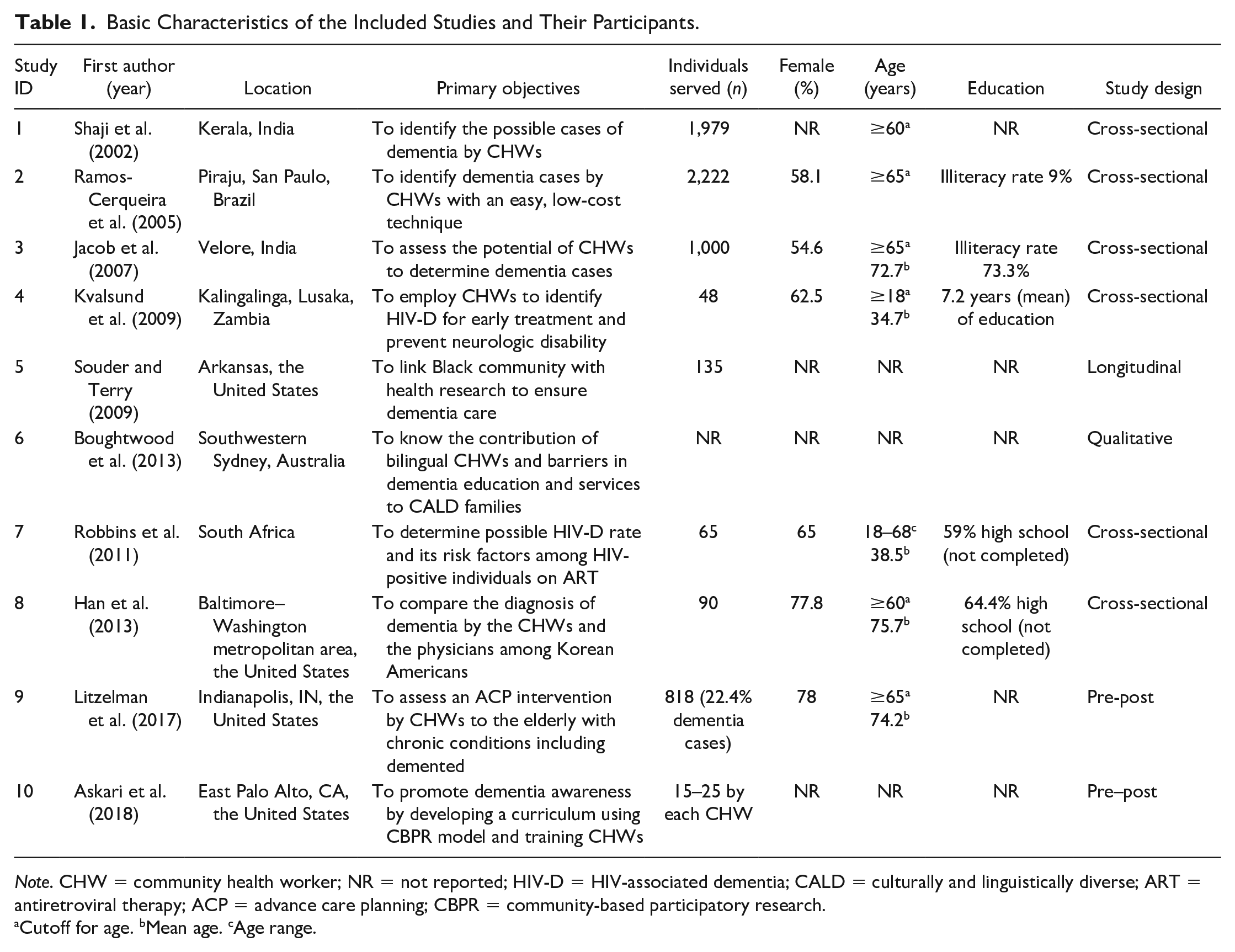
Note. CHW = community health worker; NR = not reported; HIV-D = HIV-associated dementia; CALD = culturally and linguistically diverse; ART = antiretroviral therapy; ACP = advance care planning; CBPR = community-based participatory research.
Cutoff for age. bMean age. cAge range.
Basic Characteristics of CHWs in the Studies Included in the Review.

Note. CHW = community health worker; NR = not reported; ICDS = Integrated Child Development Scheme; IHDS = International HIV Dementia Scale; CDR = Clinical Dementia Rating; ACP = advance care planning; EHR = Electronic Health Record.
Age range. bMean age.
Role of CHWs, Instruments Used by CHWs, Method of Intervention, and Key Findings of the Studies Included in the Review.

Note. CHW = community health worker; DSM-IV = Diagnostic and Statistical Manual of Mental Disorders (4th ed.; DSM-IV; American Psychiatric Association, 1994); PPV = positive predictive value; CDR = Clinical Dementia Rating; NPV = negative predictive value; HIV-D = HIV-associated dementia; PLWAs = persons living with AIDS; MMSE = Mini-Mental State Examination; HDS = HIV Dementia Scale; CT1 = Color Trail 1; CALD = culturally and linguistically diverse; IHDS = International HIV Dementia Scale; ACP = advance care planning; EHR = electronic health record; CDS = clinical decision support tool; ED = Emergency Department; PHQ-9 = Patient Health Questionnaire–9.
Descriptive Statistics of the Five Areas Representing the Roles of CHWs.

Note. CHW = community health worker; HIV-D = HIV-associated dementia; PLWAs = persons living with AIDS; ACP = advance care planning.
Results
Study Selection
A detailed screening process for the eligible studies has been provided as a flowchart in Figure 1. A total of 1,594 articles were identified from the database search and imported to EndNote. After removing duplicates, 919 articles were reviewed by title and abstract; 19 articles were selected for full-text review. After a thorough assessment, eight articles were excluded in accordance with the exclusion criteria and the reasons for exclusion have been listed in Figure 1. One additional article was excluded with the help of third reviewer due to insufficient details about methodology. Finally, 10 articles were selected to be included in this review (Askari et al., 2018; Boughtwood et al., 2013; Han et al., 2013; Jacob et al., 2007; Kvalsund et al., 2009; Litzelman et al., 2017; Ramos-Cerqueira et al., 2005; Robbins et al., 2011; Shaji et al., 2002; Souder & Terry, 2009). No additional articles were found meeting the eligibility criteria in the forward and backward search.

PRISMA 2009 flow diagram for study selection.
Basic Characteristics of Included Studies
Table 1 describes the basic characteristics of the studies and their participants. All the studies were published between 2002 and 2018. Six of them were cross-sectional, two pre–post, one longitudinal, and one qualitative. The studies were conducted in different regions of the world (the United States = 4, India = 2, Australia = 1, South Africa = 1, Brazil = 1, Zambia = 1). The number of community individuals served by the CHWs varied from 48 to 2,222. Three studies set the minimum age for inclusion at 65 years, two studies at 60 years, and two studies at 18 years. Six studies reported the number of female participants with a percentage ranging from 54.60% to 78%. All studies shared a common goal of improving dementia awareness and care by employing CHWs in a variety of ways.
Characteristics of CHWs
Table 2 shows the general attributes of CHWs along with their training. Five studies employed between 19 and 25 CHWs and the other five studies involved less than 10 CHWs for community interventions. The CHWs were predominantly female in the studies that reported sex with percentages of 83.30%, 91.67%, and 95% in Han et al. (2013), Boughtwood et al. (2013), and Askari et al. (2018), respectively, and 100% in Shaji et al. (2002), Ramos-Cerqueira et al. (2005), and Jacob et al. (2007). The majority of the CHWs had secondary school education to college degrees (Han et al., 2013; Jacob et al., 2007; Kvalsund et al., 2009; Ramos-Cerqueira et al., 2005; Robbins et al., 2011). Five studies identified the CHWs as paid employees of public or private agencies or by a particular project (Boughtwood et al., 2013; Litzelman et al., 2017; Ramos-Cerqueira et al., 2005; Shaji et al., 2002; Souder & Terry, 2009). All the CHWs received dementia-related structured training for specific interventions.
Global Perspectives
From an overall contextual viewpoint, nine of the 10 studies (90%) targeted underserved populations. Even though the studies were conducted in different regions of the world, the demographics of CHWs and community individuals did not differ significantly (Tables 1 and 2). However, engagement of male CHWs was evidenced in studies in high-income countries, whereas the interventions in low-income countries were delivered only by female CHWs. Moreover, the roles of CHWs differed with the income categories of the countries. Dementia screening was the only focus of CHWs in India, Brazil, South Africa, and Zambia; in contrast, services of CHWs in the United States and Australia were more diverse.
Role of CHWs
Table 3 displays the role of CHWs in each study and summarizes the results. Overall, nine of the 10 studies (90%) reported positive outcomes associated with the inclusion of CHWs in programs or interventions. The multifaceted roles of CHWs identified in the articles (Table 4) were classified into the following five areas: (a) education and building awareness on dementia, (b) screening for dementia, (c) screening for HIV-associated dementia (HIV-D), (d) assistance to utilize health care facilities and other resources, and (e) services to dementia caregivers.
Education and building awareness on dementia
Three studies focused on disseminating dementia education to minority communities through a variety of approaches with a goal of improving dementia knowledge and care, and eventually to establish a linkage with health care facilities (Askari et al., 2018; Boughtwood et al., 2013; Souder & Terry, 2009). Research by Souder and Terry (2009) describes an educational intervention conducted in the Black community through an Alzheimer’s Disease Center program. The CHWs delivered presentations in community settings and the number of presentations increased from 12% to 30% over 5 years. Boughtwood et al. (2013) interviewed bilingual CHWs about their roles in four culturally and linguistically diverse (CALD) communities: Arabic, Chinese, Italian, and Spanish-speaking communities living in Australia which included educational interventions in non-English languages. The CHWs not only serve the person with dementia but also addressed family issues and challenges. The article also stated that the people often did not reach out to medical facilities due to lack of knowledge, language barriers, and incompatible cultural conceptions (Boughtwood et al., 2013). Another study delivered a dementia awareness campaign through community-based participatory research (CBPR) approach (Wallerstein et al., 2008) for publicizing dementia knowledge among the Latino communities (Askari et al., 2018). The CHWs perceived the dementia training received as a productive opportunity to raise awareness of this important health issue in the community.
Screening for dementia
Four studies reported that CHWs participated in dementia screening to identify possible dementia cases after receiving a comprehensive training on basic and advanced knowledge on dementia (Han et al., 2013; Jacob et al., 2007; Ramos-Cerqueira et al., 2005; Shaji et al., 2002). In the first two studies, CHWs used the Diagnostic and Statistical Manual of Mental Disorders (4th ed.; DSM-IV; American Psychiatric Association, 1994) criteria to screen dementia cases and the results were compared with a highly trained health care worker’s (e.g., psychiatrists) diagnosis using the same instrument (Ramos-Cerqueira et al., 2005; Shaji et al., 2002). The studies reported a positive predictive value (PPV) of 64.70% and 62.50% for the CHWs’ screening, respectively (Ramos-Cerqueira et al., 2005; Shaji et al., 2002). Likewise, in a third study, CHWs administered the Clinical Dementia Rating (CDR) instrument to screen dementia cases (61.10%) which was compared with a physician’s diagnosis using the same scale (56.70%; Han et al., 2013). The sensitivity and specificity of diagnoses were found to be 85.50% and 88.60%, respectively. All three studies suggested that training CHWs for screening dementia cases is a cost-effective approach, especially in communities with limited resources. In contrast, screening procedures in a fourth study turned out to be ineffective with a low agreement of screening results from CHWs when compared with DSM-IV criteria. Sensitivity and specificity were 3.80% and 99.40%, respectively (Jacob et al., 2007).
Screening for HIV-D
Based on the fact that the human HIV-1 infection can act on the nervous system and trigger dementia, the coexistence of these two diseases is described as HIV-D (Kaul et al., 2001). Persons with HIV-D experience more difficulties in everyday life and have poor medication compliance which supports the need for early detection and intervention (Gorman et al., 2009). Therefore, in a combined effort to optimize resources and reach, in Zambia and South Africa, CHWs were trained to administer specific instruments for HIV-D in existing HIV-focused programs (Kvalsund et al., 2009; Robbins et al., 2011). The first study was conducted on persons living with acquired immunodeficiency syndrome (PLWAs) and included three dementia and cognition-related tests assessed by the CHWs (Mini-Mental State Examination [MMSE], HIV Dementia Scale [HDS], Color Trail 1; Kvalsund et al., 2009). The CHWs found that 25 PLWAs (52.10%) had memory loss and 16 (33.30%) had reasoning problems when compared with a control group without PLWA. All the PLWAs scored significantly lower in MMSE and HDS (Kvalsund et al., 2009). In a later study, the CHWs assessed HIV-positive patients on antiretroviral therapy (ART) using the International HIV Dementia Scale (IHDS) and 80% of them were found to be HIV-D positive (Robbins et al., 2011). The study revealed a strong association between cognitive performance and receiving ART.
Assistance to utilize health care facilities and other resources
In a study by Litzelman et al. (2017), CHWs were employed as a part of an interdisciplinary team in an innovative collaborative care model developed by the researchers for providing an Advance Care Planning (ACP) service to older adults having chronic diseases, including dementia. Dementia cases were diagnosed by CHWs using MMSE before the ACP intervention. In the intervention, CHWs introduced palliative care services to patients with mild to moderate dementia and helped them to understand their needs to appropriately seek out health care services. CHWs used an electronic health record tool to enter patients’ information related to topics such as their purpose in life, future care plan, advance health care directive, and referrals. Whereas the dementia cases were found to be associated with increased Emergency Department (ED) visits prior to the intervention (p value = .03), a significant increase in ACP conversations resulted in a 34% decreased rate of hospitalization when controlled for history of hospital and ED admission. Another study employed the bilingual CHWs to acquaint the CALD communities with accessible resources and benefits, thus increasing access to the conventional health care and social services (Boughtwood et al., 2013).
Services to dementia caregivers
Boughtwood et al. (2013) described the work of CHWs with dementia caregivers. Bilingual CHWs in this program directly supported the caregivers access dementia-related information and services, counseling about patient care, and following up their progress via phone calls or home visits. They also encouraged caregivers to seek out opportunities for personal wellness and developed a caregiver-network for socialization and mutual emotional support. The focus on caregivers also included information about pension benefits and other services available to them.
Discussion
This scoping review examined the roles of CHWs in community-based dementia programs and interventions around the world. Findings revealed important contributions of CHWs in dementia programs among vulnerable communities. CHWs have been involved in educational and community awareness programs on the topic of dementia. Some articles have documented the expanded scope of CHWs’ role that combined dementia into existing HIV programs (HIV-D). Another possible role of CHWs is in screening for dementia. CHWs have also assisted both patients and dementia caregivers to locate and utilize health care systems and dementia-related resources. Nevertheless, CHWs were not widely employed in dementia care programs to meet the current increased need for dementia care and this scoping review highlights this as an under researched area.
Educational and community awareness programs seems to be a natural fit for CHWs. In addition to dementia, CHWs have contributed to increased education and community awareness of other programs related to communicable and non-communicable diseases. A systematic review by Norris and colleagues (2006) listed education as a key role of CHWs in diabetic care, with roles similar to those described in this review. Another systematic review found CHWs to be valuable in the promotion of physical activity awareness (Costa et al., 2015). Another important role of CHWs in dementia found in this scoping review is their assistance to the community navigate the health care system and other resources. This is in agreement with studies that examined CHW-led programs across other health issues. For instance, Brownstein and colleagues (2007) published a systematic review on the roles of CHWs in hypertension programs and found benefits in improving self-care, use of health care services, patient adherence, and outcomes. In addition, CHWs successfully contributed to education, awareness, and service utilization of community programs which include topics such as maternal and child care, family planning, cancer screening, prevention of HIV, tuberculosis, malaria, and asthma (WHO, 2018). The studies included in this review support the fact that modestly trained CHWs can make a difference likewise in dementia care.
An area that needs further investigation is related to dementia screening. Although four studies in this scoping review reported that CHWs were successful in identifying dementia cases, one study (Jacob et al., 2007) showed opposite results. Authors in this study described dementia screening by CHWs in communities in India with high illiteracy rates (73.30%). It is possible that educational levels of intervention participants influenced the success of using screening tools (Noroozian et al., 2014). Two studies in this scoping review described successful efforts of CHWs in screening HIV-D in Zambia and South Africa (Kvalsund et al., 2009; Robbins et al., 2011). However, due to higher-than-expected positive cases, researchers expressed concerns about the influence of low education of participants on IHDS scores (Robbins et al., 2011). Nevertheless, while the CHWs serve in many HIV programs in the sub-Saharan Africa region, screening for the early detection of dementia-related problems in HIV-D is relatively new (Baldeweg et al., 1997; Mwai et al., 2013). Establishing a simple low-cost screening tool that can be effectively used by low-trained health care workers (e.g., CHWs) in underserved and low-literacy areas would be beneficial.
Minority populations are an at-risk group with a higher prevalence of dementia. Evidence suggests that U.S. African Americans and Hispanics have a higher likelihood of developing dementia than the non-Hispanic Whites (Tang et al., 2001). Along with some biological basis, additional risk factors have been indicated in the research, such as cultural factors, socio-economic factors, delayed diagnosis, and limited access to clinical research (Chin et al., 2011). CHWs have been employed in targeting ethnic and racial minority populations and achieved success. A notable improvement among African Americans having a family history of coronary heart disease risk has been shown in a CHW-delivered program (Becker et al., 2005). A systematic review describing 12 CHW-led interventions among Latinos with Type 2 diabetes demonstrated significant impact on blood sugar levels in seven interventions (Little et al., 2014). In this scoping review, four studies targeted minority communities with positive outcomes (Askari et al., 2018; Boughtwood et al., 2013; Han et al., 2013; Souder & Terry, 2009). Two studies delivered educational interventions in African American and Latino communities, one delivered educational and other support interventions in CALD families (Arabic, Chinese, Italian, Spanish) and one identified dementia cases among Korean Americans (Askari et al., 2018; Boughtwood et al., 2013). Concepts of culture awareness have been underscored by CHWs while working in the communities (Askari et al., 2018; Boughtwood et al., 2013). Speaking the same language was found crucial to strengthen trust. Boughtwood and colleagues (2013) underscore that CHWs contribute to the delivery of dementia programs that are culturally and linguistically appropriate to minority groups and recommend focusing on important shortcomings, such as recruitment and retention of minority groups in research/programs, utilization of medical facilities, and diagnosis barriers due to lack of knowledge, cultural beliefs, and/or stigma.
Despite being a global problem, the greater proportion (63%) of dementia-affected individuals live in low- and middle-income countries where availability of resources is a challenge (WHO, 2015). Previous CHW-led interventions addressing different health problems in low-income contexts have been impactful (Gilmore & McAuliffe, 2013; Mutamba et al., 2013). Five of the 10 studies in this review were performed in low-income countries and four of them indicated promising outcomes. They particularly focused on screening, which indicates an emphasis on under-detection of dementia cases in low-income contexts (Lang et al., 2017). Studies in this review conducted in high-income countries found that CHWs perform educational, health care utilization, and caregiver-related services among minority populations which indicates the importance of addressing cultural misbeliefs, distrust toward health care providers, and racial disparities.
Another pressing issue in dementia care is the extreme caregiving burden and unique challenges experienced by informal caregivers (AA, 2020). Their responsibilities toward patients include, but are not limited to, health care, emotional support, medical, legal, or financial decision making, and long-term care planning (AA, 2015). The stressful nature of the work manifests itself in vulnerability to different negative health conditions and higher prevalence of mental disorders, particularly depression and anxiety (Kiecolt-Glaser et al., 2002; Sallim et al., 2015). Boughtwood and colleagues reported positive outcomes when it comes to CHWs assisting dementia caregivers. Future CHW-led programs should consider expanding their scope to focus on informal dementia caregivers, especially in the management of behavioral and emotional issues (Logsdon, 2008; Mittelman, 2013). Although this area is important, only one study in this scoping review engaged CHWs in addressing the needs of dementia caregivers (Boughtwood et al., 2013).
This scoping review underscored that CHWs are engaged in a variety of roles in community-based programs/interventions. Disease-specific systematic training is important to ensure effectiveness of these programs (Khetan et al., 2018). A WHO guideline presented a framework in 2018 to synthesize information on CHW-led interventions and effectiveness from the existing systematic reviews (n = 137). It provides a rationalized recommendation on recruitment and training strategies alongside supervision and evaluation, payment, and other important aspects related to CHW-led programs (WHO, 2018).
Limitations
There are some limitations worth noting that point to directions for future research. Due to the limited research in this field and our decision to include only articles published in English, only 10 studies met the selection criteria. However, the publication dates of the studies indicate that this area has drawn increased research attention over the past few years. Six studies were cross-sectional and able to portray the outcome at one point in time. Moreover, barriers experienced by the CHWs are rarely explored in the studies. As a result, we were not able to discuss barriers and challenges of CHWs in dementia programs/interventions. Also, a high percentage of female CHWs limited this scoping review to a predominantly female-oriented view of CHWs in dementia care. We acknowledge that despite the various search terms used to capture the different titles to describe CHWs, our review may have excluded articles describing the work of dementia caregivers and other groups that provide important dementia-related services to communities worldwide. Nonetheless, to the best of our knowledge, this is the first review mapping the scope of CHWs in dementia care and it offers new insights about the role of CHWs in dementia programs/interventions.
Conclusion
This review was able to identify important roles of CHWs in dementia programs/interventions and findings support the integration of CHWs in interdisciplinary teams working on preventing and managing dementia. Important roles identified include educational and community awareness, screening for dementia and HIV-D, as well as, both patients’ and dementia caregivers’ utilization of health care systems and other dementia-related resources. This scoping review sheds light on important perspectives related to CHWs in dementia, and their special contributions in addressing this growing health issue among vulnerable communities/groups around the world.
Supplemental Material
sj-pdf-1-jag-10.1177_07334648211001190 – Supplemental material for Role of Community Health Workers in Addressing Dementia: A Scoping Review and Global Perspective
Supplemental material, sj-pdf-1-jag-10.1177_07334648211001190 for Role of Community Health Workers in Addressing Dementia: A Scoping Review and Global Perspective by Rifat B. Alam, Sadia Anjum Ashrafi, J. J. Pionke and Andiara Schwingel in Journal of Applied Gerontology
Footnotes
Declaration of Conflicting Interests
The author(s) declared no potential conflicts of interest with respect to the research, authorship, and/or publication of this article.
Funding
The author(s) received no financial support for the research, authorship, and/or publication of this article.

Supplemental Material
Supplemental material for this article is available online.
References
Supplementary Material
Please find the following supplemental material available below.
For Open Access articles published under a Creative Commons License, all supplemental material carries the same license as the article it is associated with.
For non-Open Access articles published, all supplemental material carries a non-exclusive license, and permission requests for re-use of supplemental material or any part of supplemental material shall be sent directly to the copyright owner as specified in the copyright notice associated with the article.
