




Abstract
Using data from the Korean Longitudinal Study of Aging (N = 3,356 participants aged 65 or older) and estimating Cox proportional hazard regression models, this study investigated the association between gender composition of children and parents’ mortality risk. This study showed that compared with having both daughters and sons, having exclusively daughters (but not exclusively sons) was associated with higher mortality risk. This association, however, was significant for mothers, but not for fathers. To shed light on source of this association, this study distinguished between mothers with only daughters who receive and do not receive regular financial support from children. Results showed that mothers had elevated mortality risk only if they do not receive regular financial support from their children. Traditional caregiving roles of sons for older parents in Korea may lead to a mortality disadvantage among mothers of daughters vis-à-vis a reduction in financial assistance from children.
Introduction
The influence parents have on children is the usual focus of family research because parents have a significant impact on children in a multitude of ways. However, recent studies provide evidence that adult children also affect their parents as much as they are affected by their parents, suggesting that the parent–child relationship is bidirectional. For example, it is well established that adult children’s socioeconomic status is positively associated with parental longevity (De Neve & Fink, 2018). Interestingly, such “upward spillover” effects are found to be common phenomena in both Western and Eastern countries (Jiang, 2019; Torssander, 2013). Moreover, studies also suggest that the number of children matter for parental health and longevity. Childless adults generally have higher mortality in old ages than adults with children (Modig et al., 2017). Among parents with children, those with fewer children tend to have higher mortality than those with more children (Hurt et al., 2006), although the association between parity and mortality is less clear as the number of children exceeds four (Grundy, 2009). Part of the explanation for these effects may be that children are an important source of social, emotional, and instrumental support (Park et al., 2020).
Gender Composition of Children (GCC) and Parental Longevity
Previous studies have addressed the effect of children’s gender composition on parents’ mortality. The major hypothesis of these studies is that having sons may reduce the longevity of mothers to a larger extent than having daughters due to higher reproductive costs. Although previous studies found some evidence of this, most of them considered preindustrial populations (Cesarini et al., 2009; Helle, 2002). One notable exception is a study by Christiansen (2014), who used data from the Norwegian Central Population Register to document a small yet statistically significant mortality disadvantage associated with having exclusively daughters. The mortality risk of having only daughters is 3% higher than that of having only sons, among mothers with two or more children. No such pattern, however, was found among fathers. The study also found that the mortality disadvantage associated with having exclusively daughters was more pronounced in the earliest decade of the study period (1980–1989), when sons and daughters were believed to have different roles (so that parents might want to have at least one child of each sex).
As previous studies have been conducted in Western countries, it remains unclear how generalizable those findings are to non-Western populations. Given different cultural norms and meanings of having children, particularly sons, between Western and non-Western countries (especially in East Asian countries), the relationship between GCC and parents’ mortality and its underlying mechanisms are likely to differ across contexts. It is thus worth examining whether and how GCC is associated with parents’ mortality in non-Western populations. The present study fills this gap in the literature by using a nationally representative sample of community-dwelling older adults in South Korea—henceforth, Korea. To the author’s best knowledge, this study is the first to examine the link between the GCC and parents’ mortality risk in a non-Western population.
Potential Mechanisms Connecting GCC to Parental Longevity
The effect of GCC on parental longevity may be due to biological or social pathways or a combination of both (Van De Putte et al., 2004). Biological mechanisms, relevant only for women, suggest that mothers of sons may have higher mortality risks due to the increased physiological demand during gestation and early postnatal development (Helle, 2002). In fact, males tend to show faster intrauterine growth rates and heavier birth weight (Van Vliet et al., 2009). In addition, mothers tended to have longer interbirth intervals after bearing sons than daughters (Mace & Sear, 1997). This suggests that bearing sons may be more physiologically demanding on mothers than bearing daughters. Such hormonal and physiological changes associated with bearing sons as elevated maternal testosterone levels (known as an immunosuppressor) may have long-term implications on mothers’ future health and longevity (Spence, 2008). Despite these rationales, studies have found insufficient evidence of the biological mechanisms, especially in modern societies (Grundy, 2009). In addition, the biological explanation was seen as limited by its exclusive focus on maternal health and longevity.
Alternatively, several studies have suggested that GCC may have an impact on parental longevity (both women and men) via other sociocultural pathways (Beise & Oland, 2002; Van De Putte et al., 2004). As sociocultural conditions about gender roles in family settings differ across countries and societies, however, it is crucial to explore culture-specific mechanisms that link GCC to parents’ health and longevity. Given a deep-seated cultural preference for sons over daughters and the tradition of sons caring for their aging parents, Korea’s context presents a unique opportunity to examine how sociocultural factors explain the effect of GCC on parental longevity. In particular, there may be two major nonbiological pathways linking GCC to parental longevity: one is social-psychological and the other is economic.
First, a preference for sons has persisted across many generations in patriarchal Korean society. In traditional Korean society, a son was required to conduct a family’s ancestor worship, a set of elaborate Confucian practices in which the eldest son offers sacrificial foods to the family’s deceased ancestors. Only men could make the offerings, whereas women were required to prepare the food, often several days in advance (Chung & Das Gupta, 2007). In Korea’s patriarchal family system, women were expected to produce sons to secure a family heir. Therefore, among Korean women, the psychological pressure to bear sons was paramount (Tai-hwan, 1984). Such pressure was known to be greater in Korea than other societies in East and South Asia with a strong son preference, such as China and India (Das Gupta et al., 2003). The suffering often involved fear of blame, rejection, and mistreatment by both the husband and in-laws. Feelings of guilt and shame about failing to produce a son was also enormous. These forms of maltreatment had been common until early 2000s, although to a lesser extent than before (Das Gupta et al., 2003). These life experiences are psychosocial stressors that may “get under the skin” to influence levels of inflammation and other aspects of physiological function (Ferraro & Shippee, 2009). The adverse health consequences of psychosocial stressors may cumulate over time and manifest themselves later in life, in the form of premature mortality among women who only have daughters (Pudrovska & Anikputa, 2014).
Second, although Korea has been heading toward gender neutrality more recently, a preference for sons is believed to remain in the form of gender-biased child rearing. Parents invest more in and have higher expectations for sons than daughters (Choi & Hwang, 2015). It may be due to the fact that parents have traditionally relied on their sons, especially the eldest son, for old-age support, and that men continue to earn more than women in the labor market (Takenoshita, 2020). The phrase “a married daughter is no better than a stranger” encapsulates the enduring traditional notion of responsibility of older sons. Although the traditional notion of sons being primary caregivers has somewhat weakened, sons are still more likely to support parents financially and provide a larger amount of financial support than daughters (about US $200 more per month; Kim, 2016). In support of this, women’s lower contributions to household income indicates weaker financial decision-making power among wives (Grindstaff & Trovato, 1990; Lee & Tang, 2015). Indeed, financial support from children plays a critical role in parents’ medical care (Lee & Yeung, 2021), given that about 47% of total medical expenditures among Korean older adult population are supported by their children (Cho et al., 2018). In this regard, GCC may affect parental longevity through disparities in financial support from children between those with and without sons.
To summarize, the former refers to social-psychological pathways, where having only daughters (or not bearing a son) is understood as psychosocial stressors that may have long-term health consequences for parents. The latter refers to economic pathways, where those having only daughters may show poor health outcomes due to fewer and/or less stable later-life financial support from children. Both explanations suggest that the effect of GCC on parents’ longevity might be greater for women than men. Having only daughters is likely to affect mothers to a larger extent than fathers because they are the direct targets of criticism and condemnation for not producing a son according to Korea’s traditional and historical norms (Das Gupta et al., 2003). In addition, mothers who have sons may have a stronger desire than fathers to reap the rewards in old ages of giving birth to and raising a son—that is, gendered expectations of old age support by sons (Bai, 2019). Therefore, a mortality gap between those with and without sons would be greater among mothers than fathers.
The Present Study
Using data from the Korean Longitudinal Study of Aging (KLoSA), this study estimates Cox proportional hazard regression models of all-cause mortality to examine the association between GCC and mortality risk in old ages. This study also attempts to shed further light on how GCC shapes parental mortality. Specifically, to explore the extent to which financial support from children plays a role in this link, this study examines whether GCC is associated with a higher likelihood of receiving regular financial support from children. Then, in Cox proportional hazard regression models, this study distinguishes whether or not those with only daughters receive regular financial support from children. The main purpose of this analysis is to examine whether the association between children gender composition and mortality is driven largely by older parents with only daughters who receive no regular financial support from children. Although this analysis is not a formal test of mediation, it may provide some hints to likely pathways of the effect of GCC.
Data and Methods
Data
This study uses data from the Korean Longitudinal Study of Aging (KLoSA), a nationally representative longitudinal survey, which has been conducted every 2 years since 2006. This survey was designed to investigate the socioeconomic, psychological, and health-related factors relevant to implement policies for middle- and old-aged people of Korea. The sampling frame was based on enumeration districts from the Population and Housing Census of Korea Statistics. Overall, 10,254 participants from 6,171 households were selected via multistage stratification based on geographical area (urban or rural) and housing type (apartment or ordinary housing) at the first wave (2006). Trained surveyors visited selected households and collected informed consent from enrolled participants. The present study used data from Wave 2 (2008) to Wave 7 (2018). Wave 1 data were excluded because some key variables such as receipt of regular financial support from children and household net assets are missing.
Information about the date and cause of death comes from the KLoSA Exit data. The present study relies on Exit data from Wave 3 to Wave 7 because Exit data from Wave 2 include information of deaths that occurred between Wave 1 and Wave 2. In Wave 2, among 3,510 adults aged 65 and older, older adults who have no living children (n = 64) are excluded. After omitting respondents with missing data (2.6%, n = 90), a total of 3,356 participants were included in our analyses (1,941 women and 1,415 men). This study used de-identified, publicly available data; therefore, the Institutional Review Board at Korea University exempted it from review (KUIRB-2020-0194-01).
Measures
Dependent variable
The dependent variable of this study is time to death. The survival period was calculated as either the duration of time between the interview date at baseline and the date of death or the end of the follow-up period. Individuals who lacked follow-up survey data are right-censored.
Independent variable
The main independent variable is gender composition of living children. Using the information on living children, this study distinguishes between parents with both sons and daughters, only sons, and only daughters.
A binary variable is constructed indicating whether a respondent receives regular financial support from children. This measure is drawn from respondents’ report in Wave 2 on whether they or their spouse have received financial support (i.e., a child gave them money and/or paid their bills) from any child regularly in the past year.
Control variables
Covariates include number of living children, gender, age, education (elementary school, middle school, high school, and college or higher), marital status (married vs. widowed, divorced, or separated), home ownership, household income quartile, household net wealth quartile, and place of residence (large city, a small city, and a rural area). Note that all these sociodemographic characteristics are characteristics of parents.
This study also controls for factors that are especially predictive of mortality, including number of chronic conditions, smoking behavior, alcohol consumption, and exercise. The number of doctor-diagnosed chronic diseases is based on whether individuals report having the following: hypertension, diabetes, mellitus, cancer or a malignant tumor, chronic lung disease, cerebrovascular disease, arthritis or rheumatoid arthritis, psychological disease, liver disease, and/or prostatic disease. The smoking variable is a categorical variable with three groups: nonsmoker, former smoker, and current smoker. Alcohol consumption is coded as a categorical variable with three categories: nondrinker, former drinker, and current drinker. Regular exercise is measured by a dichotomous variable; coded as either yes or no. It may be worth noting that the inclusion of these behavioral covariates may lead to overcontrol bias as some of these covariates may be influenced by the GCC.
Statistical Analysis
This study used Cox proportional hazard regression models to examine the association between GCC and mortality risk. These models were estimated separately by gender. The Cox proportional hazard regression model can be written as follows:

where hi(t) is the hazard of event occurrence evaluated at exact age t, h0(t) is the baseline hazard and represents the hazard when all of the predictors are equal to 0, β presents the coefficient of the association between GCC and mortality risk, and
This study sheds further light on source of the associations between GCC and parental mortality risk. First, this study investigates whether GCC is associated with a higher likelihood of receiving regular financial support from children. To reduce potential bias due to unobserved heterogeneity, logistic random effects regression models were also estimated. Random effects models are effective in addressing unobserved heterogeneity under the assumption that the individual unobserved heterogeneity is uncorrelated with the independent variables. A logistic random effects regression model can be written as follows:


where Yij is the dependent variable, representing the receipt of regular financial support from children for the ith wave in the jth subject; xkij represents the covariates; α1 is the intercept; and β k is the kth regression coefficient and represents the coefficient of the association between xkij and the outcome (i.e., changes in the log odds ratio [OR] of receiving financial support from children associated with increasing xkij by one unit). Furthermore, uj is the random effect representing the effect of the jth subject. In this model, uj is assumed to follow a normal distribution with mean 0 and variance σ2. Despite the strength of logistic random effects models, a caveat may be that they rely on the slightly smaller sample (N = 3,011) than the one used in survival analyses (N = 3,356) because individuals who participated only in the initial wave (Wave 2 in this study) are dropped. That said, cross-sectional logistic regression models using the common sample with survival analyses found similar results as logistic random effects models (Table S1 in Online Supplemental Material).
Second, this study estimated the same Cox proportional hazard regression models as described above while distinguishing between (a) those with only daughters who receive regular financial support from children and (b) those with only daughters who receive no regular financial support from children. The main purpose of this analysis is to examine the extent to which the association between gender composition and parental mortality risk differs between two groups. More specifically, this analysis tests whether the association is largely driven by the second group. All statistical analyses were conducted using Stata 16.1 (StataCorp, College Station, TX).
Results
Table 1 indicates the sample characteristics of 3,356 respondents aged 65 and older according to gender. In the analytic sample, there were 1,941 women (58%) and 1,415 men (42%). The mean age was 72.71 (SD = 6.10) years. The distribution of level of education completed by respondents was as follows: elementary school (73%), middle school (10%), high school (12%), and college (5%). Regarding marital status, about 63% of participants were currently married. The majority of respondents owned a house (83%). Approximately 40% of respondents lived in a large city, 28% in a small city, and 32% in a rural area. The mean number of chronic diseases reported by individuals was 1.28 (SD = 1.12). Regarding substance use, 14% of respondents were current smokers, and 26% regularly consumed alcohol. As for regular exercise, about 30% of respondents engaged in weekly exercise. The majority of respondents had both sons and daughters (i.e., a mixed-gender composition of children; 79.7%). About 14.8% reported having only sons and 5.5% reported only daughters. In cultures with a strong preference for sons, it makes sense that there are far fewer families with only daughters. The mean number of children was about 4.02 (SD = 1.59), and only 4.4% of respondents had one child. About 43.4% of respondents reported receiving regular financial support from their children.
Descriptive Statistics, by Gender.

Table 2 presents the estimated association between GCC and all-cause mortality. In Model 1, bivariate results show that compared to those with both sons and daughters, parents who only have daughters have a higher risk of death (hazard ratio [HR] = 1.266). However, there are no significant differences in mortality risk between parents with both sons and daughters and only sons. Controlling for the number of children and sociodemographic covariates yields a similar result (Model 2): Parents who had exclusively daughters had a significantly higher risk of death compared with those with both sons and daughters (HR = 1.328). In Model 3, the inclusion of an extended set of health-related variables (health behaviors and chronic conditions) reinforces rather than attenuates the association (HR = 1.405). Models 4 and 5 present results separately for women and men, respectively. Gender-specific results suggest that the association between gender composition and mortality is largely driven by women (HR = 1.672 for women vs. HR = 1.086 for men).
Cox Hazard Regression Models of All-Cause Mortality on Gender Composition of Children, by Gender.
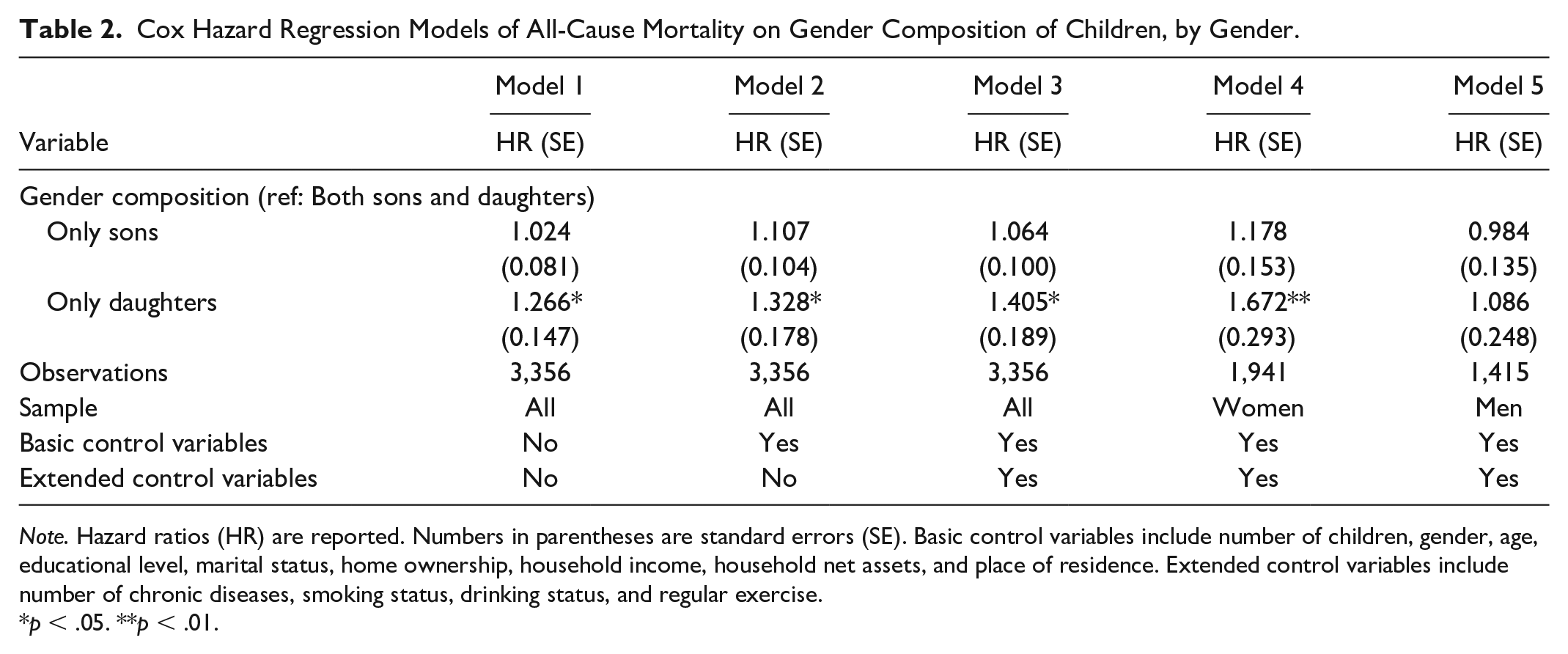
Note. Hazard ratios (HR) are reported. Numbers in parentheses are standard errors (SE). Basic control variables include number of children, gender, age, educational level, marital status, home ownership, household income, household net assets, and place of residence. Extended control variables include number of chronic diseases, smoking status, drinking status, and regular exercise.
p < .05. **p < .01.
Sensitivity analyses are used to assess the robustness of the main findings of this study. This study first tests whether controlling for children’s characteristics attenuates the observed association between GCC and parental mortality. Although it may be informative about the robustness of the observed association, it is worth noting that controlling for children’s characteristics may also lead to overcontrolling bias as GCC likely influences those characteristics and not the other way around. Results of this sensitivity analysis show that despite some attenuation (7% for all and 2% for women), controlling for children’s mean age, percentage of college-educated children, percentage of currently employed children, and percentage of currently marital status does not change the original results of this study (Table S2 in Online Supplemental Material). In addition, supplementary analyses suggest that these results are robust to omitting respondents with only one child (Tables S3 and S4 in Online Supplemental Material).
Table 3 examines whether GCC is associated with receiving regular financial support from children. Model 1 shows that compared to parents with both sons and daughters, those with only daughters are less likely to receive regular financial support from children (OR = 0.623). To interpret, the odds of receiving regular financial support from children among parents with only daughters are about 37.7% (1–0.623) lower than the odds among those with both sons and daughters. Models 2 and 3 present results for women and men, respectively. Similar to findings in Table 2, the association between GCC and receipt of regular financial support from children is statistically significant only among women, but not men. Model 4 suggests that parents with only daughters had almost half the odds of receiving regular financial support from children compared to those with both sons and daughters (OR = 0.538). However, there is no statistically significant association among men (Model 6).
Logistic Random Effects Regression Models of Receipt of Regular Financial Support on Gender Composition of Children, by Gender.

Note. Odds ratios (OR) are reported. Numbers in parentheses are standard errors (SE). Basic control variables include number of children, gender, age, educational level, marital status, home ownership, household income, household net assets, and place of residence. Extended control variables include number of chronic diseases, smoking status, drinking status, and regular exercise.
*p < .05.
In supplementary analyses, ordinary least squares (OLS) regression models are used to examine whether GCC predicts the proportion of children providing regular financial support and (log of) the amount of regular financial support as the outcome (Table S5 in Online Supplemental Material). Results using these outcomes are qualitatively similar as the ones from the models predicting whether or not a respondent receives regular financial support from children (Table 3). It should, however, be noted that there was a high rate of missingness on the amount of financial support (23%).
Table 4 further disaggregates respondents with only daughters into two groups: those with daughters who provide and do not provide regular financial support. Models 1 to 3 present results from multivariate analyses for all, women, and men, respectively. Model 1 shows that having daughters is associated with a mortality disadvantage, relative to parents with a mixed-gender composition of children, only when daughters do not provide financial support on a regular basis (HR = 1.592). By contrast, the mortality risk among parents with only daughters who provide regular financial support is similar to that of parents with both sons and daughters (HR = 1.068). Consistent with results in Table 2, these patterns are found only among women (Model 2). Only mothers who have exclusively daughters who do not provide regular financial support have a higher hazard of death than mothers with both sons and daughters (HR = 1.953). By contrast, among men, the hazard of death is not statistically different across different gender compositions of children.
Cox Hazard Regression Models of All-Cause Mortality on Gender Composition of Children and Receipt of Regular Financial Support, by Gender.
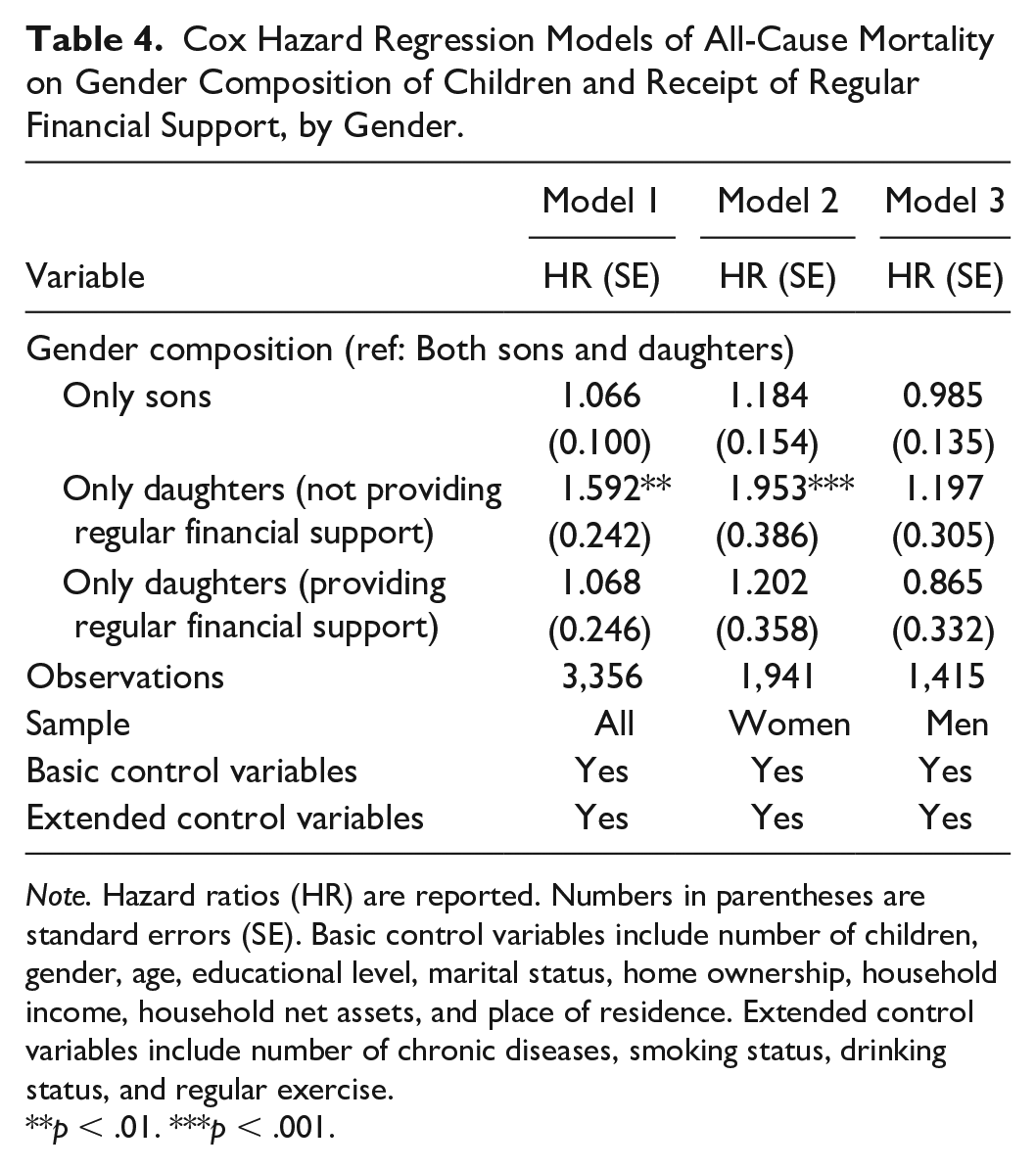
Note. Hazard ratios (HR) are reported. Numbers in parentheses are standard errors (SE). Basic control variables include number of children, gender, age, educational level, marital status, home ownership, household income, household net assets, and place of residence. Extended control variables include number of chronic diseases, smoking status, drinking status, and regular exercise.
p < .01. ***p < .001.
Discussion
Previous studies suggest that the GCC may be consequential for parental longevity. To date, several studies have investigated this relationship, but findings are mixed and the majority of previous studies focus on preindustrial populations in Western societies (Cesarini et al., 2009; Helle, 2002). To fill this gap, the present study examined the link between GCC and parental mortality risk among Korean adults aged 65 and older. This study found that compared with having both sons and daughters, having only daughters increased mortality risk, among mothers and not fathers. The mortality risk between mothers of sons and mothers with a mixed-gender composition of children was similar. This finding is consistent with a recent study about a contemporary Western society (Christiansen, 2014).
To shed light on source of the associations, this study investigated whether the mortality disadvantage among mothers of daughters is due to their lower chance of receiving regular financial support from children. This study first showed that mothers with exclusively daughters are less likely to receive regular financial support from their children than mothers with a mixed-gender composition of children. When disaggregating mothers who only have daughters into those who receive regular financial support and those who do not, the mother mortality disadvantage is found to be driven by mothers with daughters who do not provide their mothers with regular financial support. These results suggest that in a traditional family system in which sons are responsible for old-age support, mothers who only have daughters financially benefit less from their children in old ages, which translates into decreased longevity of mothers. Although son preference is no longer salient in Korea, the social consequences of a once-dominant cultural preference for sons over daughters may still remain in the form of a mortality disadvantage among mothers of daughters.
An interesting result is that the patterns differ so much between mothers and fathers. That is to say, the mortality disadvantage associated with having exclusively daughters was found only among mothers, not fathers. A possible explanation is that mothers who have sons may have a stronger desire than fathers to reap the rewards in old ages of giving birth to and raising a son—that is, gendered expectations of old-age support by sons (Bai, 2019). Alternatively, it is possible that children’s regular financial support may matter more for mothers than fathers because women tend to be more often widowed and experience economic hardship after widowhood. It is difficult to sort out these alternative explanations with observational data, and multiple factors are probably at work for different families. Taken together, however, our empirical evidence suggests that women’s longevity seems to be influenced by the gender composition of their children to a higher degree than that of men.
This study has several limitations. First, the present study did not explore the role of physiological reactivity to psychosocial stress associated with having only daughters in shaping mothers’ mortality. Nevertheless, this study provides suggestive evidence of this possibility. For example, the association between GCC and mortality was large and statistically significant only among mothers. If the mechanism influencing the relationship between GCC and parental longevity is entirely sociocultural in origin, paternal longevity should also be affected by the gender composition of their children. Moreover, there is no mortality disadvantage among mothers of exclusively sons who do not receive regular financial support from their children (Table S6 in Online Supplemental Material). Future researchers may wish to more explicitly investigate mechanisms through which potential blame and guilt for failure to produce a son deteriorate health and longevity among mothers of daughters over the life course. Second, this study did not account for potential confounding factors, such as personalities, previous health status, earlier life crises, and socioeconomic status other than education, which may each affect both gender of children and parents’ mortality.
Despite its limitations, this study makes notable theoretical and empirical contributions to the literature on the effect of children on parental health and longevity. In particular, findings of this study are broadly congruent with a growing body of recent literature on the link between children’s socioeconomic status and parental health suggesting that upward intergenerational wealth transfers may be a central mechanism behind this effect (De Neve & Fink, 2018; Jiang, 2019; Torssander, 2013). This study extends the literature by connecting GCC to parental longevity and offering evidence of the role of sociocultural and economic factors in this relationship. More specifically, this study argues that unique sociocultural contexts in Korea—that is, son preference and traditional caregiving roles of sons—play a role in generating disparities in financial support from children between those with and without sons, which differentially shapes older women’s mortality depending on GCC. Results of this study on the deleterious health consequences of deeply rooted gender discrimination and inequality have also important implications for other Asian countries where son preference is still salient (Ferree, 2010).
This study also contains important implications for scholarly and policy debates on aging. Poverty rate among Korean older persons is notoriously the highest among Organisation for Economic Co-operation and Development (OECD) countries. With the rapidly aging population in Korea (Statistics Korea, 2019), there is a large unmet need for medical services among older-aged persons, which can increase their mortality risk (Zhen et al., 2015). High out-of-pocket expenses for medical services are one of the key reasons for unmet needs. Given the fact that approximately 45.7% of people over the age of 65 live in poverty (living on less than half of the median household income), which is far above the OECD (2017) average (12.5%), adult children’s financial assistance may have a substantial impact on health and longevity of older parents. In this regard, results of this study suggest that mothers who only have daughters who are less likely to be financially supported by their children may suffer more from such unmet needs of medical services. Policymakers must consider policy interventions associated with relieving their financial burdens associated with medical care costs.
As son preference is no longer salient in Korea, one might expect the significance of GCC for parental health and well-being to be transitory. However, given enduring patterns of gender inequality in Korea, such prediction is incorrect. For example, men continue to earn more than women in the labor market (Takenoshita, 2020). Women’s lower contributions to household income in relation to men suggests less financial decision-making power among wives (Grindstaff & Trovato, 1990). This may explain our finding that mothers of daughters are less likely to receive regular financial support from their children. In addition, although the traditional notion of preferring a son to a daughter is no longer strong enough to distort sex ratios at birth in Korea, it seems to persist in the form of gender-biased child care. Gender discrimination in the family may operate in a more subtle way through differential parental investments and expectations by child gender. A recent study revealed that even at young ages, girls spend twice as much time as boys doing housework activities. Parents spend about 23 fewer dollars on girls than on boys for monthly expenditures on private out-of-school education and have lower educational as well as occupational expectations for girls than boys (Choi & Hwang, 2015). Such differential parental treatment of boys and girls suggests that child gender still matters and that stereotypical gender roles remain present in Korean households.
In conclusion, policies that promote gender equality could be particularly relevant and important in Korea and other Asian countries where son preference is deeply rooted in societal norms. By directly utilizing economic incentives and/or by inducing cultural change relating to gender roles and expectations in the workplace and household, such policies would significantly improve the overall status and well-being of women (both mothers and daughters).
Supplemental Material
sj-docx-1-jag-10.1177_07334648211012122 – Supplemental material for The Relationship Between Children’s Gender Composition and Parents’ All-Cause Mortality Among Older Adults in Korea
Supplemental material, sj-docx-1-jag-10.1177_07334648211012122 for The Relationship Between Children’s Gender Composition and Parents’ All-Cause Mortality Among Older Adults in Korea by Jinho Kim in Journal of Applied Gerontology
Footnotes
Declaration of Conflicting Interests
The author(s) declared no potential conflicts of interest with respect to the research, authorship, and/or publication of this article.
Funding
The author(s) received no financial support for the research, authorship, and/or publication of this article.
Ethical Approval
This study used de-identified, publicly available data; therefore, the Institutional Review Board at Korea University exempted it from review (KUIRB-2020-0194-01).

Supplemental Material
Supplemental material for this article is available online.
References
Supplementary Material
Please find the following supplemental material available below.
For Open Access articles published under a Creative Commons License, all supplemental material carries the same license as the article it is associated with.
For non-Open Access articles published, all supplemental material carries a non-exclusive license, and permission requests for re-use of supplemental material or any part of supplemental material shall be sent directly to the copyright owner as specified in the copyright notice associated with the article.
