




Abstract
Mobility and technology can facilitate in-person and virtual social participation to help reduce social isolation, but issues exist regarding older adults’ access, feasibility, and motivation to use various forms of mobility and technology. This qualitative study explores how a diverse group of low-income, urban-living older adults use mobility and technology for social participation. We conducted six focus groups (N = 48), two each in English, Spanish, and Korean at a Los Angeles senior center. Three major themes emerged from thematic analysis: using technology for mobility; links between mobility and social participation; and technology-mediated social participation. Cost, perceived safety, (dis)ability, and support from family and friends were related to mobility and technology use. This study demonstrates the range of mobility and technology uses among older adults and associated barriers. The findings can help establish a pre-COVID-19 baseline on how to make mobility and technology more accessible for older adults at risk of isolation.
Introduction
Although social connectedness is a universal human need, older adults may experience social isolation due to declining physical and mental health, sensory impairment, a lack of supportive relationships, and immigration status, among other factors (National Academies of Sciences, Engineering, and Medicine, 2020). This can result in depression, cognitive decline, decreased quality of life, and mortality (Courtin & Knapp, 2017). Social participation, defined as “a person’s involvement in activities that provide interaction with others in the society or community” (Levasseur et al., 2010, p. 2148), can combat social isolation (Khosravi et al., 2016). Social participation may be attainable through two key factors: mobility and technology. Mobility can increase social participation by enabling older adults to access activities and services in their neighborhood, an increasingly important place for social participation (Buffel et al., 2014). Similarly, communication technologies support social connectedness within and beyond the neighborhood (Baldassar & Wilding, 2020). Thus, walkable communities that also afford access to transportation options increase mobility and help promote in-person interactions. At the same time, access to the internet and digital devices facilitates virtual connections.
Mobility is defined as “the ability to move oneself (e.g., by walking, by using assistive devices, or by using transportation) within community environments that expand from one’s home, to the neighborhood, and to regions beyond” (Webber et al., 2010, p. 443). Individuals with mobility impairment because of a physical disability or lack of transportation may experience lower social participation and higher social isolation (Pristavec, 2018). With changes in mobility, older adults require alternative transportation options to stay connected with their communities (Rosenbloom & Herbel, 2009). Low-income, minority older adults in inner cities face higher mobility challenges compared with more affluent groups because cracked sidewalks, uneven pavements, and fear of crime are often present in inner-city neighborhoods, and represent potential barriers to walking and using public transportation (Loukaitou-Sideris et al., 2019).
Information and communication technology (ICT)–including internet, cell phones, computers, and social media–can facilitate social participation (Kim et al., 2017). Increasing adoption of smartphones, internet, and social media among older adults (Anderson & Perrin, 2017) offers the potential to improve social inclusion and connectivity (Quan-Haase et al., 2017), helping older adults connect with people outside of their home both in-person (i.e., by using ride-sharing apps, scheduling social engagements) and online (i.e., using video chats or social media). Yet, technology and social media adoption lag among certain groups (Hong & Cho, 2017), including those older than 80 years (Hargittai & Dobransky, 2017), those with less than a high school education, and those with low income (Hong & Cho, 2017; Kim et al., 2017).
The purpose of this study was to improve our understanding of possible approaches to enhance social participation by examining the lived experiences of diverse, low-income older adults regarding their mobility and use of technology. The older adults who participated in this study are at risk of experiencing isolation, mobility challenges, and barriers to technology adoption, given their lower income and/or linguistic barriers (Hargittai & Dobransky, 2017; Loukaitou-Sideris et al., 2019; National Academies of Sciences, Engineering, and Medicine, 2020). This study seeks to identify barriers and facilitators that could inform practical approaches to enhance opportunities for social participation.
Method
Study Design
A qualitative study was conducted to gain in-depth information from diverse groups of older adults. Six focus groups were conducted over 1 month in 2017—two each in three languages (English, Spanish, and Korean). Focus groups offer rich insights, allow exploration of topics with a wider scope than one-on-one in-depth interviews, and provide a means to assess and conduct community-based studies (Padgett, 2016). Focus groups allowed exploration of the experiences and insights of marginalized older adults from different racial/ethnic backgrounds regarding their mobility and technology use—alone and in combination—for social participation.
Study Setting
This study took place at a senior center located in an ethnically diverse, low-income, and densely populated area in Los Angeles. The 14,000 older adults who are served annually at the senior center—94% of whom are low-income—reflect that diversity. Several hundred participants attend daily for meals, recreation, services, and classes, including computer training in the cyber café and a mobile technology lab. Study participants represent the three languages most commonly spoken at the senior center and the growing population of older Asians and Latinos in Los Angeles (University of Southern California, 2015). Their involvement in the community center where focus groups took place provided a structure to overcome the challenges that place them at risk of experiencing social isolation, mobility challenges, and barriers to technology adoption.
Sample
We used convenience sampling to recruit focus group participants. Senior center staff posted flyers in the three languages and responded to questions of possible participants. The senior center staff and research team coordinated to schedule a series of focus groups. Participants were eligible if they spoke English, Spanish, or Korean. A total of 48 older adults who spoke English (n = 7; n = 8), Spanish (n = 10; n = 9), or Korean (n = 9; n = 5) participated in the focus groups (Table 1). The sample was about 60% female, 4% non-Hispanic White, 45% Hispanic, 11% African American, and 40% Asian, with an average age of 73.8 years.
Demographics of Focus Group Participants (N = 48).
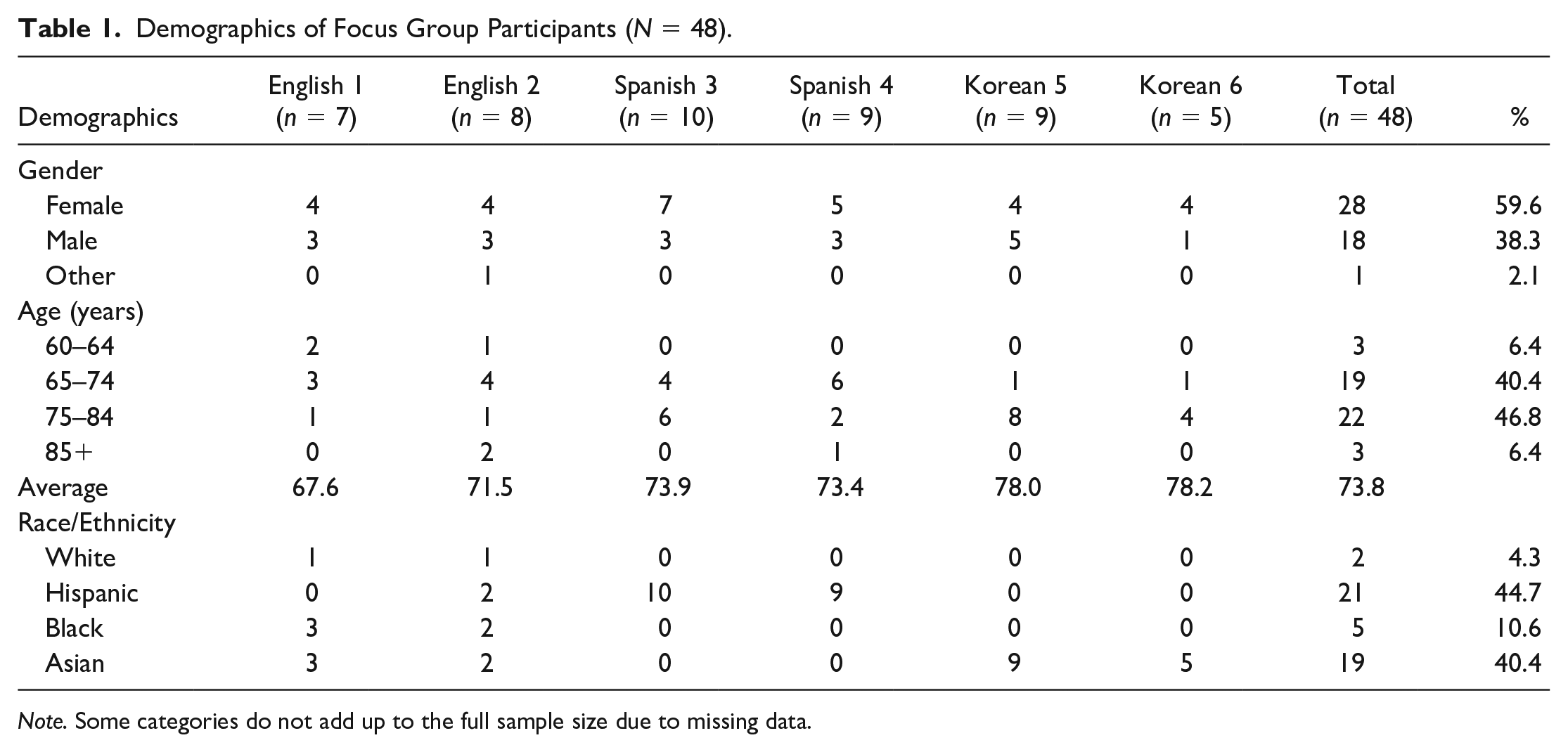
Note. Some categories do not add up to the full sample size due to missing data.
Study Procedures
One graduate student researcher fluent in Korean and another fluent in Spanish translated the English interview guide created by the third and fifth authors into Korean and Spanish (see Online Appendix). Interview questions assessed participants’ needs, preferences, and challenges regarding travel, mobility, and technology, particularly for purposes of engaging with the community and other people. Prior to each focus group, participants completed a questionnaire asking about their demographics, level of mobility, and technology use.
Focus group sessions lasted 1.5 to 2 hr and were led by two graduate research assistants trained in qualitative methods. The second author conducted all focus groups in English, with another researcher providing translation during Spanish- or Korean-speaking focus groups. Each participant received a US$25 gift card at the end of the focus group. Participants provided verbal informed consent. This study was approved by the University of California Los Angeles Institutional Review Board (17-000868).
Data Analysis
The first and second authors transcribed English focus group data verbatim; the focus group translators first transcribed the focus groups in their respective native language and then translated the transcripts into English. Atlas.ti, a qualitative analysis software package, facilitated data analysis. The coders followed the six steps of thematic analysis (Braun & Clarke, 2006): data familiarization, generating initial codes, searching for themes, reviewing themes, defining and naming themes, and producing a report. With guidance from the third author, the first and second authors read the transcripts and wrote “first impression” memos, which allowed them to record what they noticed upon first reading each transcript. Next, coders independently open-coded one transcript per language group line-by-line (Strauss & Corbin, 1998); each coded half the transcripts. Open coding is a means of managing, identifying, and sorting data with descriptive “codes.” The coders discussed similarities and differences in their codes, and then worked with the third author to cluster codes with similar meanings into categories or “families.” The reconciliation of grouped codes into families occurred through iterative discussions among the first three authors. They placed these families into a matrix in Excel and populated the matrix for each family by its corresponding codes. In cells next to the codes, they inserted exemplary data excerpts. The matrix allowed the identification of themes by comparing and contrasting the rich, exemplary data (Bazeley, 2009).
Results
An analysis of the transcripts resulted in the framework shown in Figure 1, depicting barriers and facilitators to mobility and technology use and three themes that demonstrate the intersections among mobility, technology, and social participation. Cost, perceived lack of safety, and (dis)ability (in terms of physical ability and know-how) were three barriers that influenced participants’ mobility decisions and technology use, while support from family and friends facilitated mobility and use of technology. Results illustrate how participants experienced mobility and technology individually and how these domains relate to each other and to social participation. Generally, more variation in transportation and technology use experience emerged within language groups than between groups (Table 2). Computing devices—one technology mode asked about in the questionnaire—were an exception to this trend. Participants from English-speaking focus groups tended to use tablets or e-readers more than other participants, and people from Spanish-speaking groups were less likely to use public computers and more likely to report not using any computing devices.
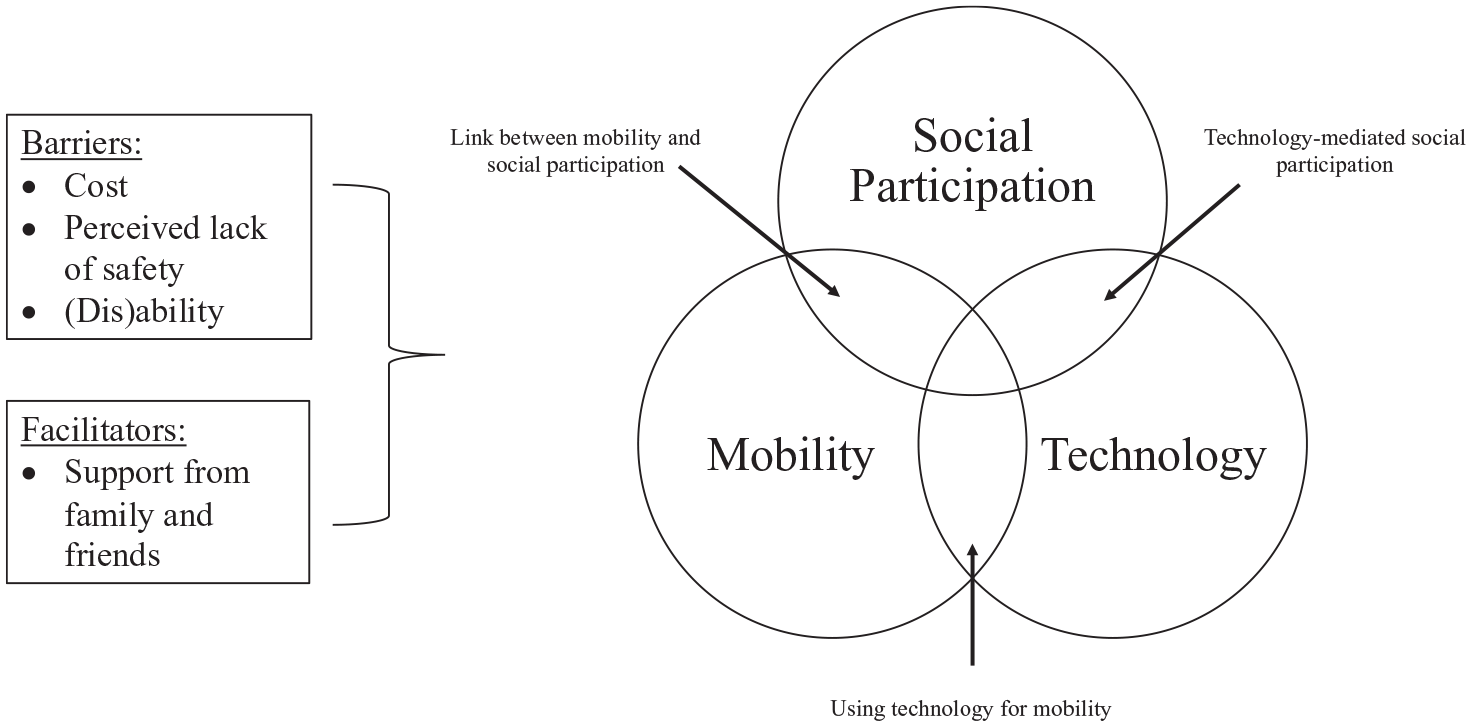
Framework linking mobility, technology, and social participation.
Transportation and Technology Uses by Language Group (N = 48).

Note. Some categories do not add up to the full sample size due to missing data.
Mobility
Participants used a variety of transportation modes, including walking, buses, and trains, and less commonly, personal vehicles and ride-share services (Table 2). Analysis of the questionnaires revealed that only one in five regularly drove themselves (n = 10; 20.8%), and less than one third (n = 14; 29.2%) owned a car. Almost three-fourths reported that their usual transportation modes were solely public transit and/or walking (n = 35; 72.9%). One participant jokingly shared that, Korean people say it’s BMW. Bus, metro, and walking. [Group laughter] BMW is not a luxurious car. (Korean Group 5)
Participants’ mobility decisions were influenced by several factors, including physical ability, perceived safety, and cost. Although participants viewed walking as essential to engaging in physical activity and accessing nearby destinations, they reported problems with the physical environment that impeded their walks. The neighborhood surrounding the senior center has many people experiencing homelessness, which discouraged some older adults from walking for leisure, physical activity, or at all after dark. Participants also discussed how physical barriers such as broken or uneven sidewalks, street vendors, and people sleeping on the sidewalk hindered their ability to walk safely in their neighborhoods. One participant explained, I try to walk fast, but we can’t really run and it’s dangerous to walk too fast due to risks of falling. So, there’s plenty of things to worry about these days. (Korean Group 6)
Participants discussed how their physical conditions, in combination with the built environment, presented mobility challenges. For example, many wished that crosswalk signals were longer to give them more time to cross wide streets. Physical ability also influenced which modes of transportation they used. It was challenging for participants to carry heavy groceries home on the bus; therefore, many would take the bus to the grocery store but take a taxi home, incurring an additional weekly cost. Others reported going to the grocery store daily to avoid carrying many groceries at once: Well every time I come to this center, I stop at the market and buy one thing and then the next day I do the same. (Spanish Group 3)
Participants who used assistive mobility devices such as walkers, canes, and wheelchairs explained that they preferred taking the train rather than the bus. As one reasoned, [On the train] access is easier, because . . . you can easily roll yourself onto the coach as opposed to having someone let down a ramp for you. Or the train moving along without them saying they don’t have any room for you. [The train] has to stop. (English Group 2)
On the bus, drivers often told people with mobility devices that there was not enough room for them and did not encourage young people to give up their seats. Financial and safety factors also emerged in making choices about transportation modes. For example, the cost of ride-hailing combined with a distrust toward Uber/Lyft and taxi drivers made ride-hailing services a last resort.
Technology
Participants displayed a range of comfort levels with technology. Half owned a smartphone (n = 23; 48%), while 11% did not own any cell phone (n = 5). About one in four used a computer (n = 11) or tablet (n = 10) in their home, either with or without internet access. Almost 30% (n = 13) used public computers at the senior center or public library, while almost half (n = 22) did not report using any computer-based technology (Table 2).
Some used the computer multiple times per day to check the news, search for information, look up bus schedules, and learn English. Others had no interest in buying or using a computer. Participants used different devices based on their understanding of and physical ability to use them. Some preferred computers or tablets over smartphones, especially because cell phone “fonts are small and will hurt my eyes” (Korean Group 6). Still, others said they stopped using computers in the senior center’s “Cyber Café” because they now have smartphones. While some participants only felt comfortable answering phone calls, others preferred to send messages using applications on their smartphones. A participant from a Korean focus group summarized the range of experiences with technology: I teach other seniors how to use computers at the center, but those who come to the center, they are selective samples. They’re very smart and up-to-date. But you should remember there’s many people who are not like that. There’s so many seniors who can’t use [the] internet although they have smartphones. (Korean Group 6)
Those who used smartphones did so for checking the news and weather, watching Netflix and YouTube, playing games, and video chatting with their family and friends. Others were happy with their basic cell phones and did not feel the need for a smartphone. One participant said, I have had many opportunities to get a smartphone, but every time I reject it. I am good with the cheap one. (Spanish Group 4)
Like mobility, cost and safety emerged as barriers in the context of technology use. Cost concerns went beyond purchasing the technology: You know why I don’t have a computer? It is because then I have to pay the internet bill. One can’t afford to pay all those things. (Spanish Group 3)
Participants also expressed concerns because they had been victims of scams or computer viruses in the past. However, support from family and friends facilitated participants’ ICT use. Some reported that their children had given them smartphones, computers, and tablets and taught them how to use them; others contended that they had no need to learn because they could rely on others to help them use technology. Still others reported that they did not have children to help them, and they had to learn on their own.
Using Technology for Mobility
Participants had a range of experiences using technology for mobility. Cost, perceived safety, ability to use technology, and support from family and friends were again evident as barriers and facilitators to using technology for mobility. For some, using smartphones to call ride-hailing services was a last resort, as participants did not feel safe riding in a stranger’s car and these services were more expensive than public transportation. One participant explained their reluctance to use app-based ride-shares because they were “hacked already three times” on the computer (English Group 1), which led them to distrust entering credit card information on other devices. Still others did not own the smartphones or credit cards that would enable them to use these services. While some relied on their children or grandchildren to order ride-shares for them, because they were “not in that league yet” (English Group 1), others preferred to use public transportation. Participants who used their smartphones to call ride-share services enjoyed the freedom and flexibility it allowed.
More commonly, participants used public transportation. Among participants who had smartphones, some used Google Maps, while others checked directions on the computer before they left home. Others used their phones to call the Metropolitan Transportation Authority (Metro) for bus routes and schedules: When I need to go to a different place, I just call the Metro and they give me the directions. (Spanish Group 3)
In addition, participants used their cellphones in other ways: For me, I saved the image of the Metro map in my cell phone. So, I can check which stop I can get off to transfer between different lines. It’s all in here. (Korean Group 5)
In many cases, technology supported participants’ mobility, as they used computers to look up directions, smartphone applications to look up bus schedules, and cell phones to ask for directions and keep themselves entertained while traveling. For others, technology was not necessary, as they knew which buses to take and trusted that they would arrive at regular intervals.
Link Between Mobility and Social Participation
Participants walked or took the bus to the senior center to engage in meals and activities. They also reported taking public transportation, paratransit, and ride-share services when they traveled farther distances, including to visit family and friends, go shopping, and attend appointments. This transportation access allowed them to engage in social participation not only once they arrived at their destinations but also as they traveled. Participants who had the ability to drive themselves had the flexibility and freedom to travel when, where, and with whom they wanted. One couple from a Korean focus group, for example, reported driving to go hiking every weekend, and enjoyed offering rides to their grandchildren. Those whose children had asked them not to drive relied on family and friends for rides. One participant explained, They begged me not to drive because it’s a dangerous area to drive around . . . When I want to travel far, I tell them, “You promised. So, come.” And sometimes it’s a daughter, sometimes it’s a son, but they do give me rides. (Korean Group 5)
For the majority who relied on public transportation, buses and trains allowed them to get where they needed to go but these were not always positive experiences. Many felt disrespected by other passengers and bus drivers. When asked about the greatest challenge with transportation, one participant stated: “I would have to say it’s safety” (English Group 2). This concern was primarily due to younger people not offering up seats for older adults, which created fears of falling on the bus.
Participants mostly relied on public transportation and walking to socially participate in the community, go to church, visit family and friends, and run errands. Engaging with others on public transportation and while walking in the neighborhood provided opportunities for social participation with members of the community. Participants appreciated that they were able to be mobile and leave their houses. Many viewed the senior center as a second home. One explained, I pass most of the time here. I go out if I want to. If you are at home, you[‘re] just isolated. (Spanish Group 3)
Participants expressed pride in their ability to be mobile. For a few, this meant owning and driving a vehicle. For most, it meant being able to navigate the streets. As one expressed, If you find it difficult, you should just stay at home. I can still walk. (Korean Group 5)
Technology-Mediated Social Participation
Participants remarked that social media and technology help them communicate with other people, especially those who live far away. Some used cell phones, tablets, and computers to call, message, and video chat their family and friends. Free applications such as KaKaoTalk, Facebook Messenger, WhatsApp, and Viber were particularly important for participants who had loved ones in other countries. Cost was a main barrier to using technology for social participation for many participants. Although cost limited some participants from purchasing the devices required to use these applications, those who had access to smartphones and tablets reported using them rather than expensive long-distance phone calls.
Some participants reported that video chat technology allowed them to interact with people more personally than emails and phone calls: I do mostly KaKaoTalk, especially face time talk feature. I really like it when I can talk with my granddaughter face-to-face like that. (Korean Group 6)
Emailing and messaging family and friends in other countries allowed for convenient communication with people in different time zones, while using video chats enabled them to see their faces. Participants saw technology as a tool to help them connect with family and friends, but they also valued in-person social participation to more personally connect with others.
Discussion
This qualitative study used focus groups to examine the intersection of mobility, technology, and social participation. We found that older adults rely on a range of mobility options and types of technology to support their social participation, with more variation within language groups than between them. Although various modes of transportation and communication technologies may be available, they are not always accessible. Multiple layers of accessibility exist that allow older adults to remain socially connected. Among those who owned a smartphone, for instance, many were not comfortable using ride-hailing apps, and some lacked a credit card that would allow them to use this transportation mode. Discussions about mobility primarily focused on participants’ transportation experiences—especially as it related to access. Certain locations did not seem accessible to participants because they did not feel safe, barriers in the built environment coupled with physical disabilities limited their ability to access the community via walking, and various transportation modes were inaccessible due to either cost or design. A variety of factors influenced decisions about mobility and technology use, including barriers such as cost, perceived lack of safety, and (dis)ability, and facilitators such as support from family and friends.
Barriers
People with lower income face greater mobility and technology challenges than more affluent groups because they have limited access to private cars, point-to-point mobility services (Loukaitou-Sideris et al., 2019), and ICTs (Ihm & Hsieh, 2015). Because of the cost of personal vehicles, ride-share services, smartphones, and internet, many participants relied on public transportation and computers in the senior center—resources that are not available in all communities. Although older adults, especially those with lower incomes, use ICT at relatively low rates (Ihm & Hsieh, 2015), understanding disparities in how older adults use technology remains important.
Perceived safety also influenced mobility and technology use. Safety concerns included fear of tripping over uneven sidewalks, navigating traffic, and being robbed or scammed. Participants did not trust ride-share services because they did not know who would pick them up and they were uncomfortable providing credit card information. These concerns are justified because more than 5% of community-dwelling older adults are victims of financial fraud or scams each year in the United States (Burnes et al., 2017), and many have concerns about privacy and security online (Marston et al., 2019). Safety and accessibility of destinations are essential prerequisites for social participation, particularly for older adults and people with disabilities (Lager et al., 2015; Wahl & Gitlin, 2007).
Disabilities—both physical and in terms of know-how—also created barriers. People with low income and racial/ethnic minorities are more likely to experience mobility limitations (Latham & Clarke, 2013), yet feeling safe in an urban community increases the odds of interpersonal interaction among older adults who have trouble walking (Clarke et al., 2011). In addition, older adults with reduced functional status or disability may have greater difficulty using ICT; adults with visual impairment, for instance, are less likely to use the internet than their peers without visual impairment (N. G. Choi et al., 2020). Ability to use various transportation options and technology not only depends on physical limitations but also entails “know-how” or understanding. Current knowledge of and opportunities to learn technology facilitate technology use (Marston et al., 2019).
Facilitators
Support from family and friends facilitated access to mobility and technology (e.g., giving them rides, teaching them how to use devices). Older adults are more likely to stop driving if they receive transportation support from friends, neighbors, and organizations/agencies (M. Choi et al., 2012), enabling increased social participation (Pristavec, 2018). Social support plays an important role as older adults learn to use technology (Tsai et al., 2017). Adult children can help their older adult parents purchase and use technology, and, for many, interacting with grandchildren is the most important reason to use ICT and social media (Luijkx et al., 2015). Not all older adults are able to obtain support from family and friends, however. Older adults without close kin are more likely to have lower levels of wealth, greater health risks, live alone, and have a disability than their peers with close family ties (Margolis & Verdery, 2017). This makes it essential to target person-specific social participation interventions (e.g., using ICT or transportation) to older adults who are isolated or who lack social support (Chatters et al., 2018; Fakoya et al., 2020).
During focus group discussions, mobility, technology, and social participation were linked. Wahl and Gitlin (2007) argue that socio-physical environments are closely intertwined and dependent on one another. Moving throughout the community causes people to interact with one another, resulting in positive, fulfilling social interactions, as well as interactions that leave older adults feeling disrespected or unsafe. These interactions may then promote or discourage older adults from utilizing certain modes of transportation for their mobility needs.
Several studies have called for a careful examination of the role of technology in both environmental (Wahl & Gitlin, 2007; Wahl & Oswald, 2010) and social gerontology (Hülür & Macdonald, 2020). Indeed, the intersection of the built environment, communication and information, and social participation represent core elements to making communities age-friendly and improving quality of life (Pedell et al., 2021). The ability to keep in touch with distant friends and family may prevent the feelings of loneliness and isolation that result from distance and physical mobility barriers (Hülür & Macdonald, 2020). For participants with family and friends in other countries, technology supports “digital kinning” and allows for social support across distances (Baldassar & Wilding, 2020).
Limitations
Although participants were with low-income and ethnically and linguistically diverse, all were engaged with the senior center, were relatively mobile, and had access to services, despite the challenges they shared. Those with lower levels of mobility and social inclusion, including people in rural communities, likely have differing and more challenging experiences not captured by this study. In addition, focus groups were conducted before the COVID-19 pandemic. The reported mobility and technology experiences of these older adults may no longer be typical, as people may not feel comfortable taking public transportation and may now rely more on technology for social participation. Despite these limitations, this study exploring mobility and technology access among a diverse population of urban dwelling older adults helps illuminate the needs of this growing population. Future research should build on this study to explore how intersectional characteristics (e.g., gender, race/ethnicity, income, (dis)ability) influence mobility and technology access to promote or hinder social participation.
Implications
Although this study supports findings from previous research, it covers new ground in several ways. Research that directly includes diverse groups of older adults is increasingly important to help identify barriers, understand diverse preferences, and ensure that technology serves those who may not be on the frontlines of development and adoption. In this study, focus group participants were socially engaged, mobile, and had some exposure to technology at the senior center. Thus, they could discuss what motivated them as well as what barriers they encountered. Their insights and strategies for connectivity inform efforts to help those who are less engaged. Barriers of cost, safety, and (dis)ability can be addressed from a broad policy perspective, but they should also be addressed at the program level, where preferences can be considered as well. To address the barriers identified in this study, policymakers and practitioners should tailor interventions to support low-income older adults, especially those with limited English proficiency. Policymakers can collaborate with transit agencies to enhance “low tech” community supports in multiple languages (i.e., ability to call public transit authorities for directions rather than using a smartphone application), and help low-income older adults obtain broadband (California Executive Order 73-20). Other improvements can benefit not only marginalized older adults but also the broader community; for example, local governments can retrofit the built environment to facilitate mobility (e.g., repair uneven sidewalks) and create safe opportunities to interact with the community during the COVID-19 pandemic, utilizing public spaces and establishing “Slow Streets” for pedestrians and bicycles.
This study demonstrates the range of mobility and technology uses among older adults, and barriers that accompanied them pre-COVID-19. The pandemic and orders to shelter-at-home have increased their threat of social isolation, as well as the need for instrumental support (Berg-Weger & Morley, 2020). Participants reported that cost was a barrier to their use of technology and the internet; this challenge is especially relevant, given the limited opportunities for in-person social participation during the pandemic and the increase in internet-based activities and virtual meetings. Using ride-share services may provide less exposure to groups of people compared with public transportation, yet participants also reported barriers to using these services. The older participants in this study faced challenges related to mobility and technology before the pandemic; community responses must therefore consider these barriers to social participation in a time of increased risk.
Supplemental Material
sj-pdf-1-jag-10.1177_07334648211012530 – Supplemental material for Voices of Experience: What Do Low-Income Older Adults Tell Us About Mobility, Technology, and Social Participation?
Supplemental material, sj-pdf-1-jag-10.1177_07334648211012530 for Voices of Experience: What Do Low-Income Older Adults Tell Us About Mobility, Technology, and Social Participation? by Haley B. Gallo, Lia W. Marshall, Lené Levy-Storms, Kathleen H. Wilber and Anastasia Loukaitou-Sideris in Journal of Applied Gerontology
Footnotes
Acknowledgements
The authors would like to thank the participants and the staff at the senior center where the focus groups took place, as well as the other members of the project research team: Madeline Brozen, Miriam Pinski, Martin Wachs, Hyunju Shim, and Valeria Cardenas.
Declaration of Conflicting Interests
The author(s) declared no potential conflicts of interest with respect to the research, authorship, and/or publication of this article.
Funding
The author(s) disclosed receipt of the following financial support for the research, authorship, and/or publication of this article: This work was supported by AARP California (grant number 20170363) and the National Institute on Aging (grant number T32 AG000037).
Ethical Approval and Participant Consent
This study was approved by the University of California Los Angeles Institutional Review Board (UCLA IRB), Office of the Human Research Protection Program (17-000868).

Supplemental Material
Supplemental material for this article is available online.
References
Supplementary Material
Please find the following supplemental material available below.
For Open Access articles published under a Creative Commons License, all supplemental material carries the same license as the article it is associated with.
For non-Open Access articles published, all supplemental material carries a non-exclusive license, and permission requests for re-use of supplemental material or any part of supplemental material shall be sent directly to the copyright owner as specified in the copyright notice associated with the article.
