



Abstract
In collaboration with stakeholders, we conducted a systematic review of psychometric evidence for self-report tools measuring the perspective of family caregivers of nursing home residents with dementia. Our rationale for this review was based on evidence that nonpharmacological interventions can ameliorate dementia symptoms in nursing home residents. Such interventions require caregiver participation, which is influenced by perspectives. Yet, no existing tool measures the multidomain caregiver perspective. Our review followed Preferred Reporting Items for Systematic Reviews and Meta-Analyses protocol. The final sample included 42 articles describing 33 tools measuring domains of nursing home dementia care such as behavioral and psychological symptoms of dementia, resident quality of life, dementia-specific knowledge, communication, and medication use. We uncovered evidence gaps for tools measuring dementia-specific knowledge, communication, and medication use, all of which were important to our stakeholders. Future research should focus on development of psychometrically sound tools in alignment with the multidomain caregiver perspective.
Introduction
Over the course of the disease, individuals with dementia are affected by behavioral and psychological symptoms of dementia (BPSD), which negatively influence the quality of life, communication, and burden among formal and informal caregivers (Cerejeira et al., 2012; Feast et al., 2016). BPSD are a particular concern in nursing homes where over 90% of residents with dementia demonstrate at least one behavioral or psychological disturbance (Brodaty et al., 2001). Given the shared history with the resident with dementia, family caregivers (i.e., informal, unpaid), hereafter referred to as caregivers, are crucial partners in person-directed care planning and delivery in nursing homes, including efforts to decrease BPSD (Kales et al., 2015; Scales et al., 2019). As such, nonpharmacological interventions that incorporate the caregiver offer a promising strategy to mitigate BSPD among nursing home residents with dementia.
Caregivers remain active following nursing home placement, engaging in care tasks (e.g., bathing) that may trigger BPSD and resistance to care (Cohen et al., 2014; Fauth et al., 2016). Caregivers also act as a proxy as the disease impairs residents’ communication, particularly for residents whose first language is not English (Harper et al., 2021). Given their continued involvement and unique insight into residents’ preferences, assessing caregivers’ perspectives regarding non-pharmacological interventions to decrease BPSD is crucial. Most nonpharmacological approaches aim to address the multiple triggers (e.g., environmental stimuli, disruptions in routine) that exacerbate BPSD, including environment-based treatments (Abraha et al., 2017; Alzheimer’s Association, 2014; Dyer et al., 2018). These interventions often involve working with the resident, facility staff, and caregivers to address multiple domains of care, including quality of life, communication, and quality of care (Kales et al., 2015). However, there is a paucity of evidence examining caregivers’ perspectives regarding nonpharmacological interventions. Recent policy efforts strive to decrease off-label psychotropic medication use among residents with dementia by augmenting approaches that capitalize on caregiver involvement (Mitka, 2012). Therefore, there is a need to assess caregivers’ perspectives.
Prior efforts exploring caregivers’ perspectives of these interventions have primarily relied on qualitative methods. Although qualitative methods are beneficial in understanding caregivers’ perspectives (Creswell & Creswell, 2018), quantitative methods are needed for measuring them to guide clinical practice and improve our understanding of interventions dependent on caregiver involvement, such as care planning (Oliver et al., 2020). Current tools measure intervention effectiveness for a single domain (e.g., frequency of BPSDs) but do not quantify caregivers’ perspectives of the multiple domains targeted by the intervention (e.g., communication, quality of life).
One strategy to address this measurement gap is to develop a tool using quantitative survey methodology integrated with stakeholder engagement to capture the multidomain perspective of caregivers (Terhorst et al., 2019). However, prior to creating a new tool, a review of existing instruments and assessment of their psychometric evidence is needed (Aday & Cornelius, 2006; Waltz et al., 2010). Recent reviews have examined tools that measure select caregiver concerns, such as quality of life (Hughes et al., 2019) and resident anxiety (Creighton et al., 2018). However, a recent stakeholder-informed review revealed that the caregiver perspective comprises multiple domains related to nursing home dementia care, including but not limited to resident quality of life, medication use to manage BPSD, communication, and dementia-specific knowledge (Harper et al., 2021). To our knowledge, no prior review has integrated the multidomain caregiver perspective when examining measurement tools for evaluating nonpharmacological interventions. Therefore, this systematic review intended to summarize and evaluate psychometric evidence for tools measuring domains reflecting the caregiver perspective as prioritized by stakeholders in nursing home dementia care. Our review combined stakeholder engagement with a traditional Preferred Reporting Items for Systematic Reviews and Meta-Analyses (PRISMA) systematic review protocol (Supplemental Appendix C) to capture the most relevant domains modifiable by non-pharmacological interventions. This is a first step toward measuring the multidomain caregiver perspective regarding nonpharmacological interventions to guide efforts to enhance the quality of nursing home dementia care.
Method
Stakeholder Engagement
Our stakeholders have experience in caregiving for U.S. nursing home residents with dementia. Our engagement efforts involved two stakeholder groups: (a) a panel of five caregivers representing diverse racial and ethnic backgrounds and (b) a 19-member stakeholder Advisory Committee including caregivers, clinicians, and nursing home administrators (Martinez et al., 2019). To ascertain which domains of nursing home dementia care to prioritize for our review, we conducted a ranking discussion and process with our panel of five caregivers (Terhorst et al., 2019). During a virtual meeting, the caregivers independently ranked domains from most important to least important. Panelists then discussed their rationale for their rankings. Next, we used an average ranking method to identify which domains received the highest rankings from the panel. The five highest ranked domains were: management of BPSD, resident quality of life, dementia-specific knowledge, communication, and medication use. We then presented these to our larger Advisory Committee of stakeholders who agreed with the selection. All study activities were approved by the University of Pittsburgh Institutional Review Board (STUDY19090117).
Search Strategy
We searched Ovid Medline (1946–present), EMBASE.com (1974–present), EBSCO CINAHL (1937–present), the Cochrane Library (Wiley), and Ovid PsycINFO (1806–present) to identify relevant studies. A health sciences librarian (R.L.T.) developed the search strategies using subject headings and keywords for each concept: family caregiver, dementia or Alzheimer’s disease, and assessment. The full Ovid search strategy is reported in Supplemental Appendix A. Results were limited to studies published in English. Citations were downloaded from the databases on December 18, 2018, and duplicate citations were removed in EndNote (Clarivate Analytics, Boston, MA) prior to screening. We updated the literature search on July 22, 2020 to capture articles published after December 2018.
Inclusion and Exclusion Criteria
We included peer-reviewed manuscripts, conference abstracts, and measurement and development studies that examined and reported psychometric properties of a self-report instrument published in English. Systematic reviews and meta-analyses were excluded; however, their references were reviewed to identify relevant manuscripts. Study participants had to include caregivers of individuals with dementia or Alzheimer’s disease. The tool had to measure at least one of the five stakeholder-prioritized domains described above.
Expert opinions, case reports, dissertations, and letters to the editor were excluded. We also excluded studies if the sample did not include 100% caregivers of 100% individuals with dementia or Alzheimer’s disease, the assessment tool was not administered in English, or the study solely focused on proxy rater agreement.
Study Selection
We screened records using DistillerSR (Evidence Partners, Ottawa, Canada). Two authors (A.E.H. and L.T.) screened studies at the title level. After this initial screen and following calibration with the first author, three authors (A.E.H., S.R., and L.T.) and two trained research assistants independently reviewed studies for inclusion at the abstract level. Final study selection at the full-text level was completed by two authors (A.E.H. and S.R.). Authors met weekly to discuss discrepancies, and disagreements were settled by an adjudicator (N.E.L.). See PRISMA diagram for details (Figure 1).
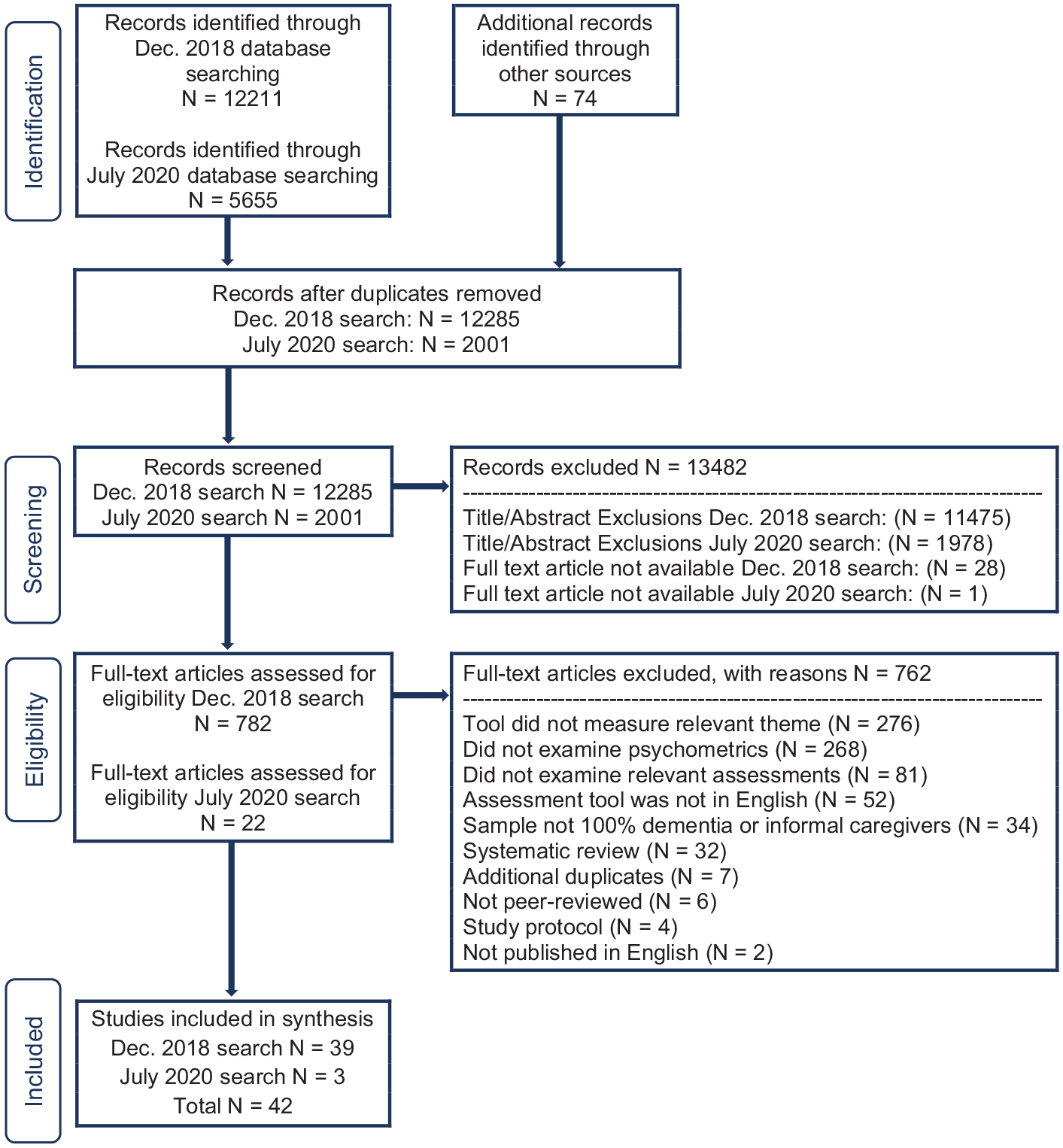
The Preferred Reporting Items for Systematic Review and Meta-Analysis Diagram
Data Extraction
Three authors (A.E.H., S.R., and L.T.) extracted information about the psychometric properties reported within each article and met weekly to discuss congruency of findings. In addition, two authors (A.E.H. and S.R.) extracted statistical coefficients for each psychometric property and recorded data in a standardized form using Microsoft Excel. We extracted the following statistical coefficients: Cronbach’s alpha (α) or omega (Ω) for internal consistency; intraclass correlation coefficient (ICC) or Pearson’s correlation coefficient (r) for other types of reliability (i.e., test–retest); Content Validity Index (CVI) for content validity; number of factors and percentage variance or root mean square of approximation (RMSEA) and comparative fit index (CFI) for structural validity; RMSEA and CFI for cross-cultural validity; area under the curve (AUC) or Pearson’s correlation coefficient (r) for criterion/predictive validity; Pearson’s correlation coefficient (r) for convergent validity; p values and effect sizes for known groups validity; and AUC, effect size, or standardized response mean (SRM) for responsiveness. If relevant statistics were not reported for the respective psychometric property, we rated the field as not sufficient for that study.
Quality Appraisal
We evaluated the methodological quality of each study across the nine psychometric properties collected during data extraction using the COSMIN Risk of Bias Checklist (Mokkink et al., 2018). The COSMIN provides criteria to rate the methodological quality of psychometric evidence using a four-point scale: very good, adequate, doubtful, or poor (Terwee et al., 2012). Each psychometric property was evaluated using a specified list of elements, with a rating assigned to each element and an overall rating based on the lowest assigned rating. For example, if the lowest rating across all elements for convergent validity is “poor,” the overall rating for convergent validity will be “poor” (Terwee et al., 2012; Wesson et al., 2016). We made further specifications to the rating criteria for reliability and criterion validity. Studies had to use an appropriate time interval (i.e., 7–14 days) to achieve a rating of “very good” for test-retest reliability (Streiner et al., 2014). In addition, studies had to compare their tool to a “gold standard” assessment to achieve a rating of “very good” for criterion validity. If studies instead reported correlations with another measure not explicitly identified as a gold standard, the highest possible criterion validity rating was “adequate.” All studies were rated by two authors (A.E.H. and S.R.) with a third author (L.T.) as an adjudicator. Authors met weekly to discuss congruency and achieve consensus on quality ratings.
Results
Our final sample included 42 studies that reported evidence for psychometric properties of 33 tools that assessed the five nursing home dementia care domains prioritized by our stakeholders (Table 1). A summary of these studies is available in Supplemental Appendix B.
Domains and Associated Assessment Tools (N = 42 Studies).
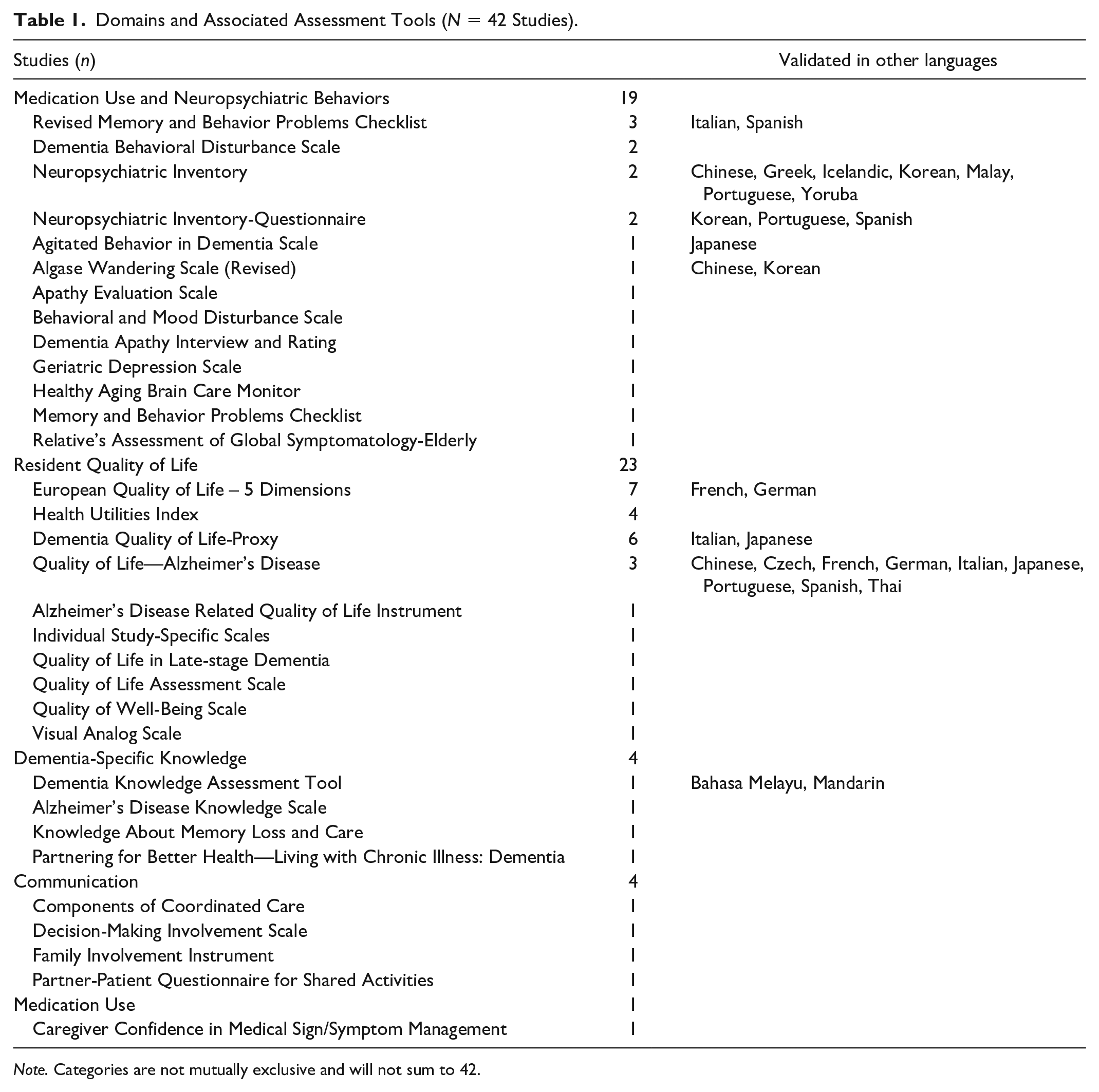
Note. Categories are not mutually exclusive and will not sum to 42.
Behavioral and Psychological Symptoms of Dementia
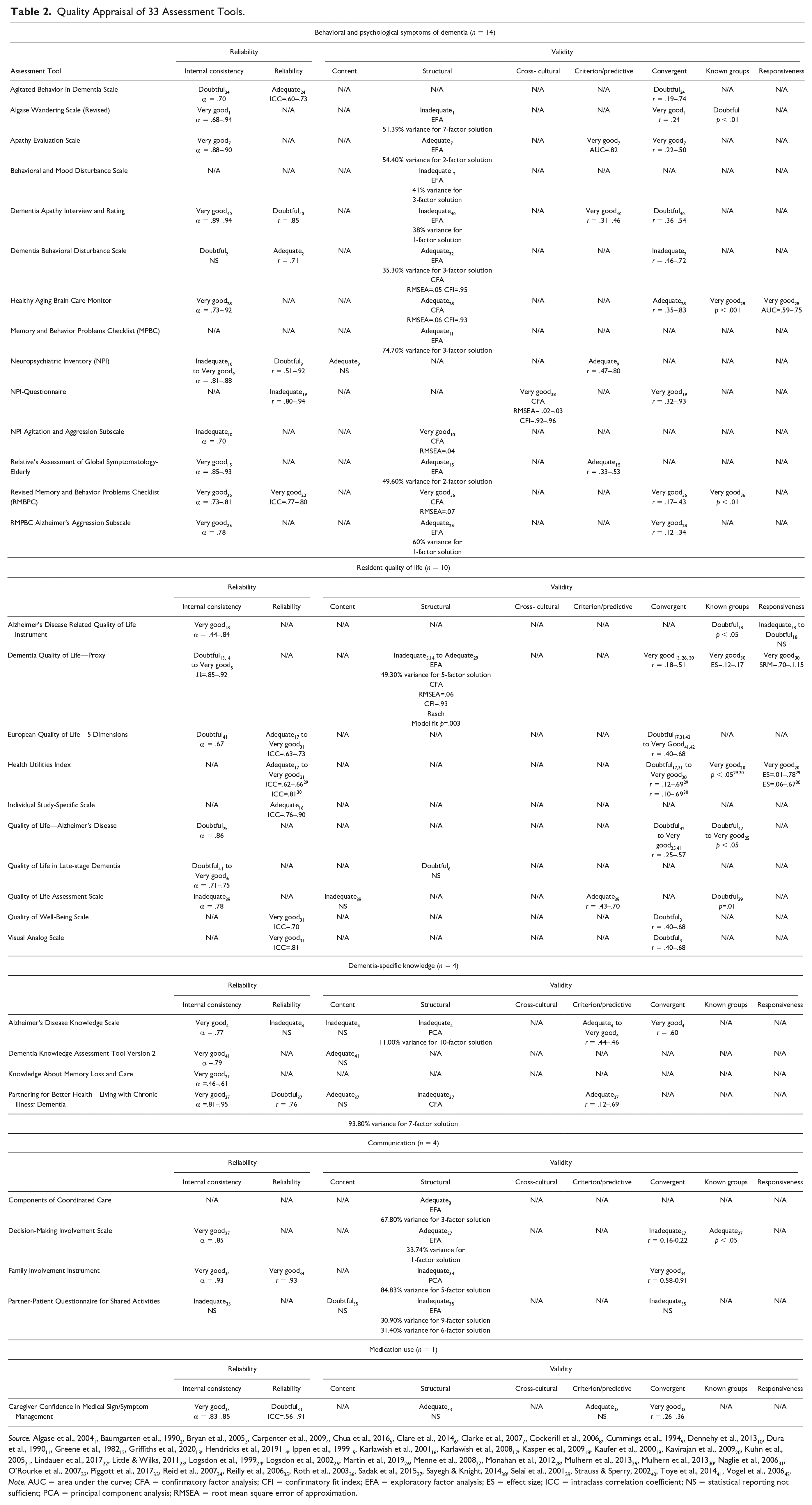
Seventeen studies examined the psychometric properties of 14 tools that quantify BPSD (Table 2). The majority of assessment tools measured an aspect of BPSD (e.g., frequency, severity) and ranged from evaluating a single BPSD (e.g., apathy, depression, wandering) to all aspects of BPSD.
Quality Appraisal of 33 Assessment Tools.
Source. Algase et al., 20041, Baumgarten et al., 19902, Bryan et al., 20053, Carpenter et al., 20094, Chua et al., 20165, Clare et al., 20146, Clarke et al., 20077, Cockerill et al., 20068, Cummings et al., 19949, Dennehy et al., 201310, Dura et al., 199011, Greene et al., 198212, Griffiths et al., 202013, Hendricks et al., 2019114, Ippen et al., 199915, Karlawish et al., 200116, Karlawish et al., 200817, Kasper et al., 200918, Kaufer et al., 200019, Kavirajan et al., 200920, Kuhn et al., 200521, Lindauer et al., 201722, Little & Wilks, 201123, Logsdon et al., 199924, Logsdon et al., 200225, Martin et al., 201926, Menne et al., 200827, Monahan et al., 201228, Mulhern et al., 201329, Mulhern et al., 201330, Naglie et al., 200631, O’Rourke et al., 200732, Piggott et al., 201733, Reid et al., 200734, Reilly et al., 200635, Roth et al., 200336, Sadak et al., 201537, Sayegh & Knight, 201438, Selai et al., 200139, Strauss & Sperry, 200240, Toye et al., 201441, Vogel et al., 200642.
Note. AUC = area under the curve; CFA = confirmatory factor analysis; CFI = confirmatory fit index; EFA = exploratory factor analysis; ES = effect size; ICC = intraclass correlation coefficient; NS = statistical reporting not sufficient; PCA = principal component analysis; RMSEA = root mean square error of approximation.
Internal consistency reliability (n = 11) was reported in more studies than test–retest reliability (n = 6) (Table 2). Cronbach’s alpha for BPSD tools ranged from .68 to .94. Both the ICC and Pearson’s r were reported, with the ICC ranging from .60 to .80 and Pearson’s r ranging from .51 to .94. Our ratings of the methodological quality of reliability evidence for tools measuring BPSD ranged from inadequate to very good, with studies of eight assessment tools rated as adequate or very good.
The type and quality of validity evidence reported in the studies of BPSD tools varied substantially. Most studies (n = 11) evaluated structural validity using either exploratory or confirmatory factor analysis, which ranged from 35.3% variance explained for a 3-factor solution for the Dementia Behavioral Disturbance Scale to 74.7% variance explained for a 3-factor solution for the Memory and Behavior Problems Checklist. Content validity evidence was reported in studies of the Neuropsychiatric Inventory (NPI), but the CVI was not used to measure content validity. Cross-cultural validity was assessed for the NPI-Questionnaire (RMSEA = .02–.03; CFI = .92–.96). Evidence of responsiveness was limited to the Health Aging Brain Care Monitor, which was rated as very good methodological quality, with the AUC ranging from .59 to .75. Overall, the tools measuring BPSD had the most robust evaluation of psychometrics and the highest overall rated quality evidence for both reliability and validity as compared with the other domains (Table 2).
Resident Quality of Life
We identified 16 studies that examined 10 assessment tools measuring caregivers’ perceptions of the quality of life of individuals with dementia (Table 2). All quality of life instruments were previously validated with individuals with dementia, and four were developed specifically for individuals with dementia—Alzheimer’s Disease Related Quality of Life Instrument, Dementia Quality of Life—Proxy (DEMQOL—Proxy), Quality of Life—Alzheimer’s Disease, and the Quality of Life in Late-stage Dementia. One study was implemented within the nursing home setting (Clare et al., 2014), and the rest were conducted with community-dwelling individuals with dementia and their caregivers.
More studies reported internal consistency reliability (n = 7) than test–retest reliability (n = 3). Internal consistency reliability ranged from α = .44 to .86 and Ω = .85 to .92. Test–retest reliability, reported as an ICC, ranged from .62 to .90. The Health Utilities Index was the only quality of life tool in which test–retest reliability was assessed by more than one study, with the ICC ranging between .62 and .81. The methodological quality of eight (80%) studies was rated as adequate or very good to support reliability evidence (Table 2).
Nine studies focused on convergent validity evidence (range of r = .10 to r = .69), six evaluated known groups differences (effect size range of .12–.17), and three reported responsiveness evidence (effect size range of .01–.78; SRM range of 0.70–1.15). Validity evidence for the quality of life assessment tools was assessed for nine instruments, and methodological quality ratings ranged from inadequate to very good.
The DEMQOL—Proxy had the most comprehensive evaluation of psychometric evidence, and methods were rated as very good except for structural validity. Although one study provided adequate methodology to support evidence of structural validity for the DEMQOL—Proxy, structural validity was ultimately rated as inadequate due to limitations in reporting for one article and a lack of model fit in another.
Dementia-Specific Knowledge
Four studies evaluated the psychometric properties of four assessment tools that quantify caregivers’ perceptions of dementia-specific knowledge (Table 2).
Internal consistency reliability was reported in all four studies, with Cronbach’s alpha ranging from .46 to .95. A study of the Partnering for Better Health—Living with Chronic Illness: Dementia reported the highest internal consistency coefficient and reported test–retest reliability, r = .76. The methodological quality of the internal consistency evidence was rated as very good for all four assessment tools, and test–retest reliability estimates were rated as doubtful to inadequate (Table 2).
Three studies reported evidence of content validity without using the CVI, one reported convergent validity, two reported structural validity, and two reported criterion/predictive validity. No studies considered psychometric evidence on responsiveness. Content validity methodology was rated inadequate to adequate, but criterion and convergent validity were rated as adequate to very good. The Alzheimer’s Disease Knowledge Scale had the most psychometric evidence of the four tools (Table 2).
Communication
We identified four studies that examined four tools measuring caregivers’ experiences with or perceptions of communication (Table 2). Tools that measured communication between any one of the following four dyads were included: caregiver-staff, caregiver-physician, caregiver-individual with dementia, individual with dementia-staff. Studies of two tools (i.e., Decision-Making Involvement Scale, Partner-Patient Questionnaire for Shared Activities) focused on the caregiver–individual with dementia dyad. A study of the Components of Coordinated Care tool included communication between both caregiver–staff and caregiver–physician dyads. The study of the Family Involvement Instrument evaluated communication between the caregiver–staff dyad and the caregiver–individual with dementia dyad.
Internal consistency reliability was reported in three studies (α =.85 to α= .93), and test–retest reliability was evaluated in one (r = .93) (Table 2). All four studies assessed structural validity, and three evaluated convergent validity. Studies reported a wide range of factor solutions from one (Menne et al., 2008) to nine (Reilly et al., 2006) for structural validity evidence. No studies of communication tools reported evidence of cross-cultural or criterion/predictive validity or responsiveness.
The methodological quality of internal consistency reliability studies ranged from inadequate to very good (Table 2). The quality ranking of structural validity evidence ranged from inadequate to adequate. The Family Involvement Instrument had the most comprehensive psychometric evaluation. It was rated as having very good quality for reliability and convergent validity evidence; however, the structural validity rating was inadequate based on sample size recommendations.
Medication Use
We identified one study describing a tool that measured caregivers’ perceptions of medication use for individuals with dementia, the Caregiver Confidence in Medical Sign/Symptom Management Scale (Table 2). Internal consistency reliability, test–retest reliability, and structural, criterion, and convergent validity statistics were reported.
We rated the methodological quality of internal consistency reliability evidence to be very good (r = .83–.85) but test–retest reliability to be doubtful (ICC = .56–.91). The quality of validity evidence ranged from adequate to very good. Statistical data were only available for convergent validity, with coefficients ranging from r = .26 to r =.36 (Table 2).
Discussion
Our systematic review synthesized the psychometric evidence for existing caregiver self-report instruments as a first step in measuring the multidomain caregiver perspective regarding nonpharmacological interventions. Capitalizing on the integration of ongoing stakeholder engagement and traditional systematic review methods, we evaluated the psychometric evidence for five stakeholder-prioritized domains of nursing home dementia care. We identified a total of 42 studies that reported psychometric properties of 33 assessment tools across the five domains of BPSD, resident quality of life, dementia-specific knowledge, communication, and medication use. We found heterogenous psychometric evidence among tools, with very little content validity evidence. Although our stakeholders conceptualized BPSD and medication use as a single interrelated construct, no tools assessed BPSD and medication use concurrently. We found a misalignment between the multidomain caregiver perspective and the constructs measured in existing tools.
There was a substantial amount of heterogeneity in the psychometric properties of all tools identified within each domain. As with other systematic reviews of psychometric evidence (Wesson et al., 2016), we identified a paucity of studies that evaluated content validity. As Mokkink et al. (2010) note, determining content validity is necessary to ensure that the content of the instrument reflects the construct(s) being measured. Due to inadequate content validation, it was unsurprising to see variation in structural validity among tools that measure the same construct. For example, among communication tools, structural validity ranged from a one-factor solution to a nine-factor solution. In addition, among quality of life tools, no studies measuredcontent validity, resulting in limited and poor quality of evidence for structural validity. To improve the quality of future assessment tools, researchers can engage stakeholders to establish content validity during the instrument development process (Terhorst et al., 2019).
We also found limited reliability evidence among tools, hindering our ability to recommend any one tool for clinicians to use. Given that reliability should be established prior to validity (Nunnally & Bernstein, 1994), it was surprising to find minimal internal consistency and test–retest reliability evidence for the 33 assessment tools. For clinicians wishing to select one instrument over another as more appropriate, we recommend an evaluation of the reliability evidence at minimum. Reliability evidence supported by rigorous methodology would be the first indicator of a tool’s appropriateness (Nunnally & Bernstein, 1994). In addition, to enhance clinicians’ ability to select appropriate tools, future studies should focus on more comprehensive analysis and reporting of psychometrics.
Although our stakeholders identified medication use and BPSD to be interrelated domains that should be measured concurrently, no tool in our review measured both constructs. This fails to acknowledge stakeholders’ perception of the interrelatedness of medication use and the management of BPSD (Feast et al., 2016; Harper et al., 2021). Although most tools in our review measured BPSD, only one measured medication use. Nonpharmacological interventions address the triggers of BPSD to decrease their frequency and severity as an alternative to psychotropic medication use (Alzheimer’s Association, 2014; de Oliveira et al., 2015). Accordingly, an assessment tool that measures medication use and the occurrence of BPSD together from the perspective of caregivers is warranted.
Tools in our sample only partially captured constructs reflecting the multidomain caregiver perspective. For example, all knowledge instruments (n = 4) considered caregivers’ knowledge of dementia but not their perception of the staff’s knowledge. Yet, our stakeholders and current evidence highlighted the importance of caregivers’ perceptions of staff’s dementia-specific knowledge as it relates to competent dementia care provision (Gaugler et al., 2015; Reid & Chappell, 2017). In addition, our stakeholders highlighted communication between multiple dyads that include the caregiver, individual with dementia, facility staff, and physician (Harper et al., 2021). Caregivers’ perceptions of communication between the individual with dementia and staff were not represented in our sample of studies. To fill this gap, future research may consider measuring caregivers’ perceptions of staff knowledge and the individual with dementia-staff communication dynamic as key components of non-pharmacological intervention effectiveness.
Limitations
Although we were guided by an a priori protocol and the COSMIN Risk of Bias Checklist, our systematic review was not without limitations. We only included studies and tools published in English, which may have biased our Sample. Study authors may have employed good psychometric methodology, but the quality rating of their study may have been lowered due to incomplete reporting of methods or results. In addition, we may not have identified all relevant tools due to our exclusion of studies that considered mild cognitive impairment and dementia together in the analysis. Nonetheless, we deemed these exclusions necessary to ensure an accurate sample of tools specific to caregivers of individuals with dementia.
Conclusion
Caregivers are key partners and advocates for residents with dementia and critical collaborators in successful implementation of nonpharmacological interventions in the nursing home. Thus, there is a need to develop assessment tools with good quality psychometric evidence that examine the multidomain caregiver perspective regarding the effectiveness of non-pharmacological interventions. Most tools in our sample addressed BPSD or resident quality of life, and few addressed dementia-specific knowledge, communication, or medication use. Given efforts to decrease psychotropic medication use, researchers should consider developing tools that measure the multidomain caregiver perspective regarding psychotropic medication use and nonpharmacological interventions. When developing new tools, researchers should strive to conduct comprehensive psychometric studies that encompass reliability, validity, and responsiveness. Undertaking efforts to develop tools that reflect the multidomain caregiver perspective is an important first step in enhancing the quality of dementia care in nursing homes using nonpharmacological interventions.
Supplemental Material
sj-pdf-1-jag-10.1177_07334648211028692 – Supplemental material for A Systematic Review of Tools Assessing the Perspective of Caregivers of Residents With Dementia
Supplemental material, sj-pdf-1-jag-10.1177_07334648211028692 for A Systematic Review of Tools Assessing the Perspective of Caregivers of Residents With Dementia by Alexandra E. Harper, Stephanie Rouch, Natalie E. Leland, Rose L. Turner, William E. Mansbach, Claire E. Day and Lauren Terhorst in Journal of Applied Gerontology
Supplemental Material
sj-pdf-2-jag-10.1177_07334648211028692 – Supplemental material for A Systematic Review of Tools Assessing the Perspective of Caregivers of Residents With Dementia
Supplemental material, sj-pdf-2-jag-10.1177_07334648211028692 for A Systematic Review of Tools Assessing the Perspective of Caregivers of Residents With Dementia by Alexandra E. Harper, Stephanie Rouch, Natalie E. Leland, Rose L. Turner, William E. Mansbach, Claire E. Day and Lauren Terhorst in Journal of Applied Gerontology
Supplemental Material
sj-pdf-3-jag-10.1177_07334648211028692 – Supplemental material for A Systematic Review of Tools Assessing the Perspective of Caregivers of Residents With Dementia
Supplemental material, sj-pdf-3-jag-10.1177_07334648211028692 for A Systematic Review of Tools Assessing the Perspective of Caregivers of Residents With Dementia by Alexandra E. Harper, Stephanie Rouch, Natalie E. Leland, Rose L. Turner, William E. Mansbach, Claire E. Day and Lauren Terhorst in Journal of Applied Gerontology
Footnotes
Acknowledgements
The search strategy was adapted from a strategy previously developed by Barbara M. Folb, MM, MLS, MPH.
Authors’ Note
A.E.H., S.R., and L.T. contributed to the research question, literature search, review of literature, data extraction, data synthesis, and writing/review of the manuscript. N.E.L., C.E.D., and W.E.M. contributed to the research question, interpretation of concepts in the literature review and data extraction, and writing/review of the manuscript. R.L.T. designed and executed the literature search and contributed to the writing/review of the manuscript. All authors have approved the final submitted version.
Declaration of Conflicting Interests
The authors declared no potential conflicts of interest with respect to the research, authorship, and/or publication of this article.
Funding
The authors disclosed receipt of the following financial support for the research, authorship, and/or publication of this article: This work was supported by the Patient-Centered Outcomes Research Institute (PCORI) Award (HIS-1608-35732). The statements in this work are solely the responsibility of its authors and do not necessarily represent the views of the PCORI, its Board of Governors, or Methodology Committee. The funder had no involvement in the design, collection, analysis, or interpretation of data, writing of the report, or decision to submit the article for publication.

Supplemental Material
Supplemental material for this article is available online.
References
Supplementary Material
Please find the following supplemental material available below.
For Open Access articles published under a Creative Commons License, all supplemental material carries the same license as the article it is associated with.
For non-Open Access articles published, all supplemental material carries a non-exclusive license, and permission requests for re-use of supplemental material or any part of supplemental material shall be sent directly to the copyright owner as specified in the copyright notice associated with the article.
