



Abstract
Aim:
The aim of this study is to investigate Māori (Indigenous peoples of Aotearoa New Zealand) understandings of dementia (mate wareware) and develop a framework to inform assessment of cognitive impairment.
Method:
Qualitative, kaupapa Māori (Māori approach) research with 241 older Māori (kaumātua) involving 17 focus groups across Aotearoa New Zealand (NZ) and eight families (whānau) from one region. We thematically analyzed transcribed data from audio-recorded interviews.
Results:
Two overarching themes, namely, connection (Tūhononga) and self (Whaiaro), and eight subthemes in particular mind (hinengaro), spirit (wairua), body (tinana), family (whānau), social connection (whanaungatanga), identity and role (tuakiri), place (wāhi), and ancestors (tūpuna) emerged. Māori language (Te Reo Māori) was important for cognitive health.
Conclusion:
The findings embedded in cultural values improve understanding of dementia (mate wareware) in Māori. These themes can inform the assessment of older Māori with cognitive impairment. For those without cognitive impairment, the Tūhononga Whaiaro framework suggests factors potentially crucial for healthy aging in Māori.
Introduction
Increasingly, culture is recognized as a critical factor in the assessment of cognition (Ardila, 2005). The American Psychiatric Association (2013) acknowledges this in Diagnostic and Statistical Manual of Mental Disorders (5th ed.; DSM-5), stipulating culture as a critical influence on cognitive assessment. In Aotearoa New Zealand (NZ), Dudley et al. (2014) found that overwhelmingly Māori wanted to see Māori content in neuropsychological testing, which they considered would facilitate improved performance on cognitive tasks. In the most recent update to their position statement, “Dementia in Older People,” the Australian and New Zealand Society of Geriatric Medicine noted the importance of choosing an appropriate cognitive assessment tool for a patient, with consideration of their cultural background (Australian & New Zealand Society for Geriatric Medicine, 2019). In a review article examining the influence of language and culture on cognitive assessment tools used in the diagnosis of early cognitive impairment and dementia, Ng and colleagues (2018) noted important variation. This variation can influence the validity and sensitivity of translated cognitive assessment instruments. In particular, the translation of tools from one language and culture to another can introduce “method bias” with differences in administration and scoring. In addition, translation can alter the psychometric properties of items within the tool, which is known as differential item functioning. The review noted variation in multiple domains, including attention and orientation, visuospatial, word recall, and picture naming.
The assessment of a patient’s cognition is more than merely the application of a cognitive assessment tool. Cultural factors also need consideration during a comprehensive assessment and diagnosis of a person’s cognitive health. The New Zealand Framework for Dementia Care (Ministry of Health, 2013) is clear-cut in its guidance that cultural factors are essential in the assessment and management of dementia. In addition to the assessment and management of dementia, the approach and perception of culture to cognitive impairment and dementia may differ (Calia et al., 2019; Elder, 2013; Hillman & Latimer, 2017). Cultural psychologists have found different patterns of thinking and understanding in different societies and cultures (Varnum et al., 2010), some having a more analytic pattern and others more holistic, some interdependent versus independent.
In NZ, various models have been used to describe the domains that contribute to Māori health. Some of the most well known of these are the Whare Tapa Whā model (Durie, 1985), the Te Wheke model (Pere, 1984), and, more recently, the Meihana model (Pitama et al., 2007). A Māori understanding and assessment of healthy cognition and cognitive impairment is an area that has had little research undertaken. Kaumātuatanga O Te Roro—The Aging Brain is a qualitative research study initiated in 2016 that aimed to expand the understanding and knowledge (mātauranga) of dementia in Māori.
We have previously outlined factors that are important in understanding dementia (mate wareware) for Māori. These factors included looking at causes (Ngā Pūtake), protective factors (Ngā Rongoā), acceptance of illness and behavioral change (Aroha and Manaakitanga), caregiving (Kaitiakitanga), and dementia services (Ngā Ratonga) (Dudley et al., 2019). In this article, we outline a framework describing the themes important for assessing cognitive health, and potentially healthy aging in older Māori (kaumātua).
Method
To ensure the rigor of the research, we undertook a multicenter study in both the North and South Island of NZ. Tribal (Iwi) representatives were contacted in different areas of NZ and organized for us to meet with their local older Māori (kaumātua). We requested meeting with older Māori affected by dementia (mate wareware) and their family or caregivers, but we did not exclude older Māori without dementia (mate wareware) if they wished to attend the meeting. We conducted research using a Māori methodology (kaupapa Māori) approach, which is by Māori, for Māori, and with Māori and led by a Māori worldview. The Rangahau website has more information on Kaupapa Māori research (http://www.rangahau.co.nz).
Our research used a purposive sample of 241 older Māori and eight different families (whānau) who participated in 17 face-to-face focus groups across seven study locations throughout NZ, from November 2016 to August 2017. Interviews were generally conducted on local tribal meeting places (Marae), and older Māori were sometimes accompanied by family (whānau) or carers. The average age of participants was 76 years with a range from 50 to 87 years old, and 73% female. We provided data collectors with training and instituted standardization protocols because we used multiple interviewers to collect the data. Table 1 shows some of the interview questions used.
Sample Interview Questions Asked Regarding Dementia (Mate Wareware).

Most of the interviewers were Māori health researchers or clinicians. Furthermore, to help capture the depth and richness of Māori language (te reo Māori) in interviews, they could be undertaken in either Māori or English. Of all participants, 59% reported speaking the Māori language “very well,” “well,” or “fairly well.” Approximately one third of the interviews were conducted in the Māori language, but when interviews were conducted in English, participants almost always used some Māori language during the interview. Written informed consent was obtained at the time of the interviews. We interviewed and took audio recording of individuals and small groups and discussed factors that were important in the causation, assessment, and management of cognitive impairment in the Māori world (te ao Māori). Contact duration (greeting, information giving, consent, and interview) at each site was 3 to 4 hr, split up by meal breaks, in a 1-day session.
We transcribed the audio interview data and checked it for accuracy. Following initial coding, we identified themes within the data and refined this within our research group using a group work (mahi-a-rōpū) approach, which is a collective Indigenous approach to data analysis (Gifford et al., 2014; Wilson et al., 2019). The research team came together following individual members undertaking a preliminary analysis across the manuscripts to generate open and focused codes. The team then met and discussed the coding and sorted these into themes and subthemes (Wilson et al., 2019). Upon consensus, the conceptualization of the themes and subthemes identified occurred. Data saturation in regard to theme development was reached approximately two thirds of the way through analyzing the data, but we continued to ensure representation of data from around all of NZ. Six of the study team were involved in the coding and thematic analysis.
This analytic process enhanced rigor by using multiple coders and reaching an agreement about the themes generated by all those participating. Further verification occurred with representatives of the participant groups. We continued to develop these findings into a model, He Tūhononga Whaiaro, for understanding and evaluating cognitive impairment in Māori. As Māori health researchers, while we used an inductive process (theme development emerging from the data), we were cognizant that our prior experiences may have influenced the analysis. However, using a group work (mahi-a-rōpū) approach for the data analysis and interpretation, we believe, decreased the potential effect of bias.
Results
This study contributes the He Tūhononga Whaiaro (connection and self) model comprising two overarching themes, namely, connection (tūhononga) and self (whaiaro), that reflect wellness of the brain (hauora o te roro). These two themes have related subthemes: place (wāhi), ancestors (tūpuna), family (whānau), and social connection (whanaungatanga); and the spirit and spiritual realm (wairua and wāhi ngaro), mind (hinengaro), body (tinana), and identity and role (tuakiri), respectively (Figure 1). Evident within these two themes and the subthemes is the vital role of Māori language.
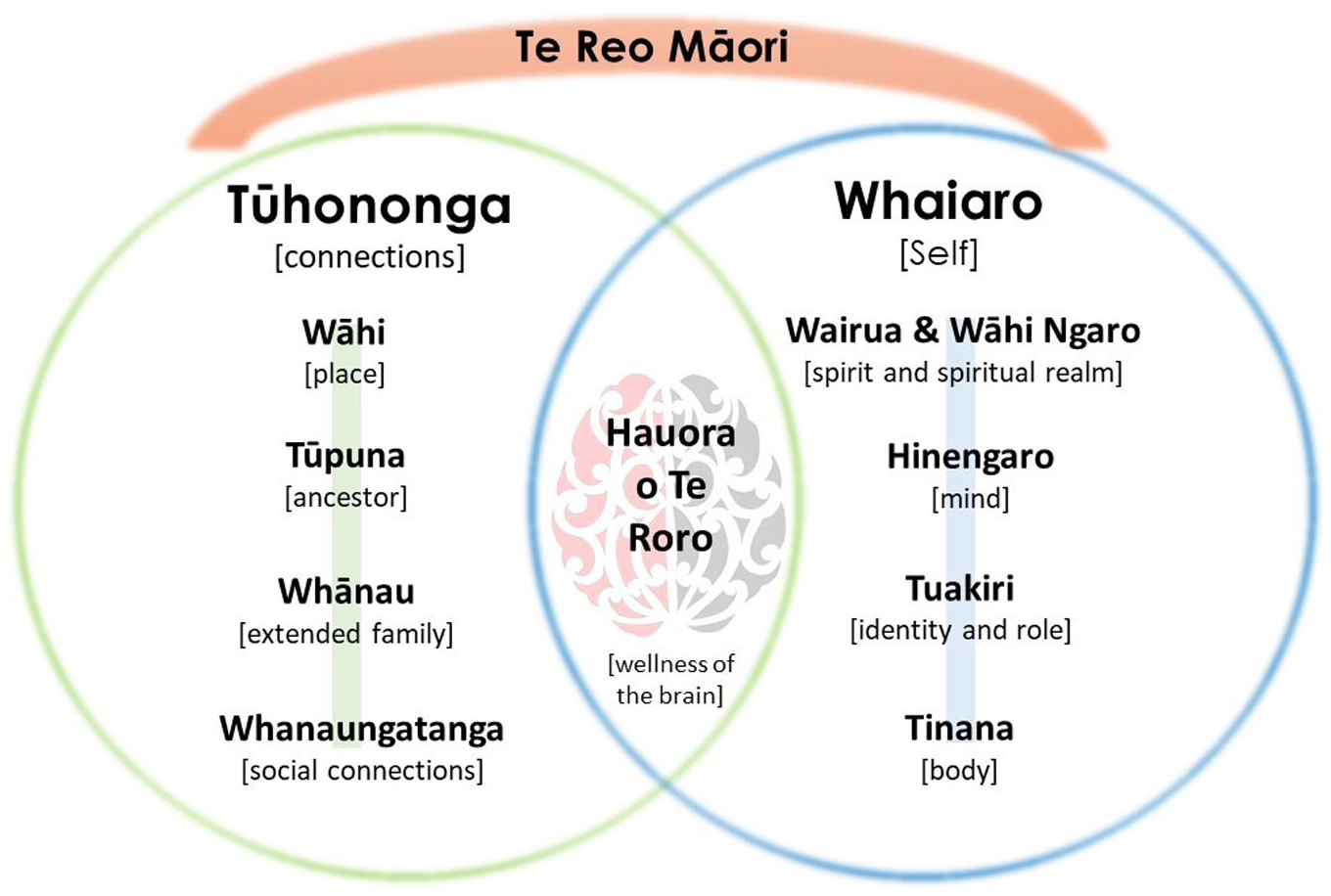
He Tūhononga Whaiaro (connection and self) model: Themes and subthemes.
Some participants viewed Māori language as essential for the well-being of the brain—Hauora o te Roro. We have previously discussed some of the words used to describe thinking and memory impairment and the importance of Māori language in dementia (mate wareware); (Dudley et al., 2019). We found various levels of proficiency in Māori language, with some participants indicating the therapeutic benefits of Māori language for their thinking while others had less proficiency. On occasion, some family (whānau) observed a decrease in their older relative’s use of Māori language as their cognitive impairment progressed. In contrast, others used Māori language more often as the following participants recounted: Reo Māori (Māori language) is a gift. It is medicine. It is health for our thoughts. (Wellington) I found my dad speaking the Reo (Māori language) more often when he was going through dementia. (Whakatane)
Moreover, wellness of the brain (hauora o te roro) relies on the dynamic interconnectedness of the themes, connection (tūhononga) and self (whaiaro), and their respective subthemes.
Connection (Tūhononga)
Connection (Tūhononga) reflects the importance of connection and the collective to Māori and is grounded in the integral importance of the relationships Māori individuals have to place (wāhi), ancestors (tupuna), family (whānau), and social connection (whanaungatanga). Genealogy/ancestry (whakapapa) exemplifies connection from which many Māori can establish and maintain these connections, as the following participant observed: The strength that Māori have are the things we know—like our whakapapa (genealogy). (Christchurch)
Whanaungatanga represents the social connections Māori develop. These connections are maintained through relationships to place, which also extends to identification with ancestors and those around them. One participant highlighted the importance of social connection for their older person with dementia (mate wareware): As we were growing up, everybody had someone to look after them, and we didn’t have these homes where you put people into. They stayed at home with the whānau (family), and they were always part of the whānau, always part of the discussions, and they were always involved in things. (Taranaki)
The subthemes, place, ancestors, family, and social connection singularly and collectively interconnect and are crucial components for the wellness (hauora) of the Māori brain (roro) and cognitive functioning.
Wāhi (place)
For Māori, connection with land and place is almost always a significant factor. A person’s genealogy (whakapapa) will indicate their relationship to place. However, some people may have become disconnected from their land and be living remote to their tribal region. It was important for some participants to have he taunga o te mauri (a comfort zone or familiar environment) as indicated by the following participant: It’s like I’m home when I go back there . . . it’s the spirit of the ancestors, welcoming back . . . and they play a big part in this dementia. (Christchurch)
Residing in a familiar environment or creating a warm and welcoming atmosphere, in the absence of being able to connect directly to their tribal region, can support cognition as the following participant explained: When we get uplifted and put in another environment, it affects our āhua (character), our hinengaro (mind). (Waitakere)
Tūpuna (ancestors)
The influence of ancestors remains throughout the lives of Māori, tangibly melding the past (by metaphorically walking on the shoulders of other Māori), present, and future. The transmission of experiences, socioeconomic, and genetic heritage from ancestors is a determinant of cognitive health. Ancestors provide role modeling and leadership that guide a person’s choices and can influence the cognitive health of many Māori. The following participants briefly explained the influence of ancestors: It is our ancestors that can truly answer our questions. (Christchurch) Here they are in the walls of this whare (house); they are speaking to us here in the post that holds up this whare. (Wellington)
Whānau (family)
The degree of strength of the family connection and support can influence the presentation of cognitive impairment. Family who function cohesively can pull together and put plans in place to optimally support and care for the older person with dementia (mate wareware). For instance, participants shared, When we found out she had dementia, it was a big whānau (family) gathering because she’s such a taonga (treasure) to us, you know to help her to remember. (Christchurch) They kept surrounding her, and because they were all around her, she never lost any more of her brainpower. (Waitakere)
Participants frequently talked about the benefits of providing support for older family members. However, while this collective obligation and responsibility to care for others and the collective family is a cultural strength, other participants talked about the associated burdens for carers. The load associated with caring was especially apparent when family lacked a cohesive approach for how to care for their older family member with increasing cognitive impairment. Family also mentioned sometimes feeling guilty about not being able to provide more care and sadness about the change in the relationship when a family member develops cognitive impairment: Sharing it with my whānau (family). I wish we were closer in some aspects so that she [whānau member with cognitive impairment] could be shared around a little bit more. You know, even if it was for a couple of hours a day, with each of them. (Whānau 1) So culturally as Māori people I think that there must be a lot out there they just feel terrible that they’re unable to look after their elders. (Whānau 2)
Culturally, the collectivity of family holds the potential to be an effective, caring system. However, we found that this cannot always be assumed to be present for all Māori with dementia (mate wareware). Nevertheless, one participant expressed this potential using the following proverb (whakataukī): Koe ko tātou; tātou ko koe (You are us, and we are you). You belong to us . . . and whether you’re off-beat or straight, you’re still ours. (Waitakere)
Whanaungatanga (social connection)
In addition to family (whānau), participants valued their connections with the broader community. Relationships might therefore include connecting with friends or health workers. Other social links might be at a tribal meeting place (marae) or attending a meeting. Partaking in group activities such as singing (waiata) and performing groups (kapa haka) was felt to be a protective cognitive factor by study participants. Participants observed Māori were generally understanding and accepting of those with cognitive impairment: Importance of whakawhanaungatanga (establishing relationships) and the support—you know, protective factors of the ageing process. (Wellington) It was around 2006 when all train of thought was lost. Which was when it was suggested to come here to the marae (meeting place). Perhaps being here will help you. (Wellington)
Besides connection (tūhononga) being necessary for the wellness of a person’s brain, the holistic nature of individuals, overviewed in the theme of self (whaiaro) and its component subthemes, also contributes to the wellness of the brain.
Whaiaro (Self)
Whaiaro focuses on the person, within the collective context of their family, and is the complex interplay between the subthemes, spirit and the spiritual realm (wairua and wāhi ngaro), mind (hinengaro), identity and role (tuakiri), and body (tinana). The self occurs within the holistic milieu and interaction of its subthemes and is about optimally preserving the personhood of someone with dementia (mate wareware). The connection to family, place, ancestors, and socially is highly important for a person’s spiritual life, which in turns affirms their identity and roles as Māori within their family and community. The following is a description of each subtheme.
Wairua and te wāhi ngaro (the spirit and spiritual realm)
Participants identified this area as a crucial aspect of self and which plays a “big part” in the cognitive health of Māori. As one participant shared: I think wairua (the spirit) plays a big part in the treatment and the looking after of any of our whānau (family) who have dementia. (Waitakere)
Spiritual practices occurred through activities such as prayer (karakia) and formal or ceremonial welcome calls (karanga) and were identified as being “powerful,” “uplifting,” and beneficial. One participant also mentioned their belief of a spiritually related cause of cognitive impairment—curse (mākutu). What was clear is that participants felt mainstream medicine tended to overlook these two essential components of a person’s well-being: [In mainstream medicine] the spiritual aspect and the mauri (life force) aspect of a person is put aside. (Taranaki) The essence of Māori is you look at the wairua (the spirit) to protect [against] this dementia. (Taranaki)
Participants made it abundantly clear regarding the importance of the spirit in the well-being of older Māori and their cognitive functioning. The mind and spirit are understood to surround the body and brain (Dame N. Glavish, personal communication, 10 May 2018).
Hinengaro (mind)
Participants described various indicators of cognitive impairment. These indicators included repetition related to forgetting or needing to be reminded of things; struggles to remember people and names; misplacing and losing items; loss of time; being disoriented in multiple ways; changes in behaviors; and possessing a lack of insight. Participants shared examples such as the following: Hinengaro (mind) is sort of wandering off. (Waitakere) Her memory, she doesn’t remember certain whānau (family). Oh, even me. I mean, I drove up, and she goes, “Who are you?” (Whānau 4)
Participants believed the cognitive impairment their family member was displaying related to deterioration in the person’s mind, closely linked to their spirit. One participant contrasted the decline in the mind of older Māori with dementia (mate wareware) compared with those who retain their capacity to remember genealogy (whakapapa), for example: Well, you think about our old people back then everything was oral. The whakapapa (genealogy) was all there not written down, their minds were active all the time, and then you get someone that’s a hundred and something and going whakapapa all around the motu. (Taranaki)
Tuakiri (identity & role)
Older Māori (kaumātua) can hold various roles in the tribe and are respected for their knowledge and wisdom, and activities they undertake. These roles may include, for example, being a speaker for the tribe or song leader. Participants indicated that continuing an older person’s role might help to minimize their forgetfulness and that giving up such roles may make the mind “sleepy.” A relative recounted the poignant moment that her mother had to hand over her duties as singing (waiata) leader due to cognitive impairment. Māori society has a long history of the passing of knowledge in oral form and treasuring older people as being custodians of that knowledge: Within the marae (tribal meeting place), she was treated exactly the same as like she never had the dementia. (Christchurch) Do they have a role? Yes, they do, they are still our teachers. (Waikato)
Often tied to a person’s role is their sense of identity and losing such positions may affect their cognitive health and prestige (mana), and we found a connection between this and their ability to continue functioning in the Māori World (te ao Māori). Any diminishment of prestige may affect a person’s willingness to engage in building social connection due to becoming shy or embarrassed (whakamā). However, we found tolerance for declines in older people’s performance, with participants voicing the importance of continuing these roles for as long as possible. One participant explained how, as their cognitive impairment progressed, their involvement too changed: Despite that my mind was “slipping” . . . I never forgot how to open meetings; I could support people when someone else would open meetings. (Wellington)
Tinana (body)
Participants believed things that affect the body such as physical activity, medicine, food, change in food compared with pre-European times, medical issues or diagnoses, and environmental toxins can influence cognitive function. We noted the influence of high alcohol use, smoking, and cardiovascular disease on dementia (mate wareware), all of which are more common in Māori compared with non-Māori (Ministry of Health, 2015). One participant highlighted simply the relationship of the body to the mind: Keep the body active, and so will the mind. (Whakatane) She loved her gardens. She was out in the gardens weeding and just mowing lawns, just keeping the place really nice. She’d even do that up at the marae (tribal meeting place). Go tutu (tinker about) up there, tidy up the flaxes and you know, in the meeting-house, making sure everything is all clean, and you know. (Whānau 6)
Discussion
In this qualitative study with older Māori (kaumātua) and family (whānau) about the Māori aging brain and dementia (mate wareware), we found themes similar to but not the same as existing models of Māori health. The Whare Tapa Whā model (Durie, 1985) was outlined by Professor Sir Mason Durie in 1982 and is a well-known and accepted model in Māori health. Another popular model for family is Te Wheke, described in 1984 by Rose Pere (1984). More recently, in 2007, the Meihana model (Pitama et al., 2007) provided a guide for clinical assessment and intervention with Māori clients and family accessing mental health services. There are some parallels in these models, all having a core of four similar themes.
The core components of mind (hinengaro), spirit (wairua), body (tinana), and family (whānau) were re-affirmed in our study, which suggests these core Whare Tapa Whā components remain as germane as they were in 1982, emphasizing its strength and relevance as a model of health. Our study identified other themes that are useful in the assessment of older Māori. Some of these are similar to previous models, and Table 2 shows the similarities and differences between the models. It is useful to note that the development of each of these models occurred with distinct purpose, which possibly accounts for their differences.
Comparison to Other Models of Health in Te Ao Māori (the Māori World).

The existing literature provides support for the themes we identified. Professor Sir Mason Durie, in his book Whaiora, outlines the history of Māori health in NZ and provides essential Māori values and concepts that inform the daily lives of Māori (Durie, 1998). For instance, more than some other cultures, Māori may live intergenerationally in one residence (Kerse & LiLACS NZ, 2014). Tūrangawaewae (a place to stand) is a well-known and influential concept for Māori (Te Ahukaramū Charles Royal, 2020), and so it is of little surprise that place was an identified theme in our study. Førsund et al. (2018) have previously identified that place and “lived space” are essential factors in person-centered care and the preservation of continuity and identity for people with dementia. They defined lived space as the “. . . space and its geographies and it is also related to the feeling of being home or the conceptualization of ‘being in place’” (p. 2).
Longitudinal studies suggest that social contact might prevent or delay dementia, and social isolation is a risk factor for dementia. Still, there is currently an absence of evidence from intervention studies that social activity prevents cognitive decline or dementia (Livingston et al., 2017). The importance of the mind, spirit, family, and body in dementia assessment and management is well established in the published literature (Livingston et al., 2017). In a study in NZ about spirituality in the hospice setting, 69% said they wanted spiritual care (Egan et al., 2017). MacKinlay and Trevitt (2007) have suggested that “. . . the search for meaning, connectedness and hope becomes more significant as older people are faced with the possibilities of frailty, disability and dementia” (p. S74). A small study in NZ by Perkins et al. (2015) showed identity and relationships to be the most critical aspects of the life of people with moderate to advanced dementia. Similarly, in the United States, Cohen-Mansfield et al. (2006) interviewed 104 people with dementia, and the roles they currently participated in were regarded as important by them (rated up to 4.4 out of 5 in importance).
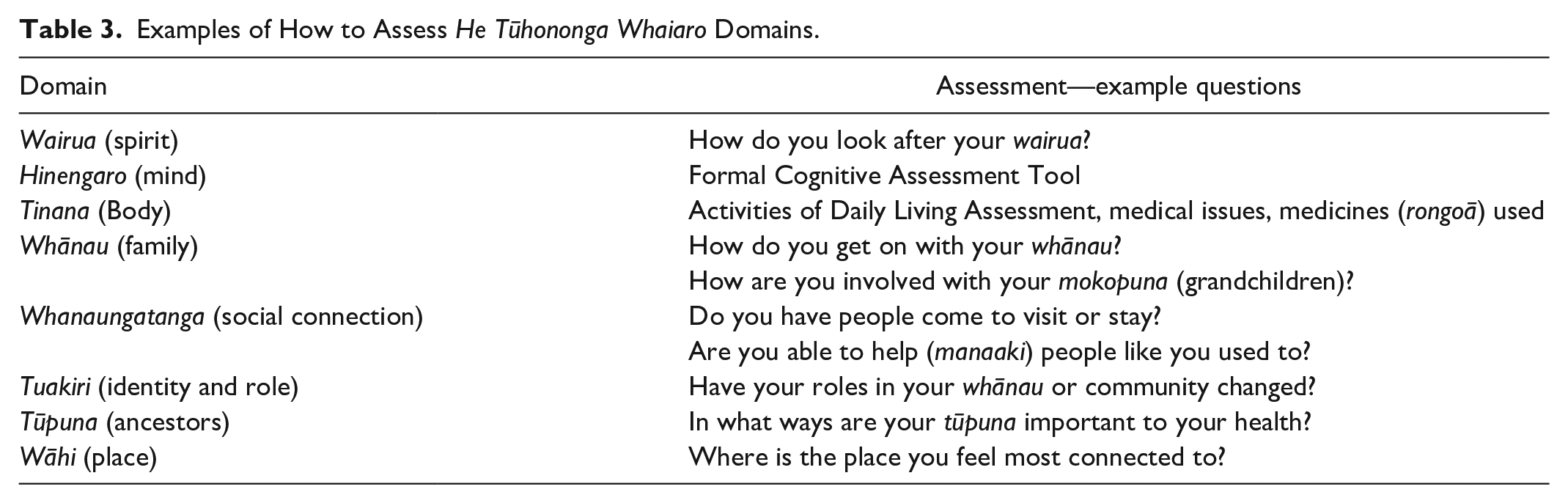
Through the course of the research, participants highlighted the importance of culturally competent assessors who can undertake holistic assessments of older Māori and engage family throughout the process. The themes Tūhononga and Whaiaro (connection and self) can assist and guide those undertaking assessments with older Māori. Table 3 provides some examples of how to assess the areas identified in the subthemes. We are currently developing several assessment tools to improve the review of these domains for Māori.
Examples of How to Assess He Tūhononga Whaiaro Domains.
The results may be useful to other population groups such as other indigenous and minority peoples, although we caution readers of this qualitative research using the findings outside of the context of older Māori. Having offered this caution, this was a study carried out across NZ, capturing diversity within older Māori. The findings were affirmed by representatives of the participant groups at follow-up meetings, at tribal meeting places (marae), community groups, and with other health professionals working with older adults with dementia (mate wareware).
In conclusion, from this research, two overarching themes, Tūhononga (connection) and Whaiaro (self) and their respective subthemes are offered as a culturally embedded approach for working with older Māori with dementia (mate wareware). These themes have the potential to enhance the assessment of older Māori with cognitive impairment. However, further research is needed to identify if He Tūhononga Whaiaro could also be useful in the assessment of older Māori without cognitive impairment.
Supplemental Material
Supplemental Material - He Tūhononga Whaiaro: A Kaupapa Māori Approach to Mate Wareware (Dementia) and Cognitive Assessment of Older Māori
Supplemental Material for He Tūhononga Whaiaro: A Kaupapa Māori Approach to Mate Wareware (Dementia) and Cognitive Assessment of Older Māori by Oliver Menzies, Margaret Dudley, Nick Garrett, Hinemoa Elder, Piripi Daniels and Denise Wilson in Journal of Applied Gerontology.
Footnotes
Acknowledgements
He mihi ki ngā kaumātua. We sincerely thank the kaumātua and kuia and their whānau who participated in our study. We are humbled by their generosity, their honesty, and their willingness to participate to improve our understanding of mate wareware. E mihi. We also want to acknowledge the valuable knowledge and guidance of one of our authors Piripi Daniels, who contributed to the study, who sadly passed away during the writing of this article.
Declaration of Conflicting Interests
The authors declared no potential conflicts of interest with respect to the research, authorship, and/or publication of this article.
Funding
The authors disclosed receipt of the following financial support for the research, authorship, and/or publication of this article: This work was supported by the Health Research Council (Grant No. HRC 16/089).
IRB Protocol/Human Subjects Approval Numbers
This study was approved by Health and Disabilities Ethics Committees of New Zealand (Ethics Approval No. 16/STH/154).

References
Supplementary Material
Please find the following supplemental material available below.
For Open Access articles published under a Creative Commons License, all supplemental material carries the same license as the article it is associated with.
For non-Open Access articles published, all supplemental material carries a non-exclusive license, and permission requests for re-use of supplemental material or any part of supplemental material shall be sent directly to the copyright owner as specified in the copyright notice associated with the article.
