



Abstract
Mistreatment of nursing home residents is prevalent and leads to harmful consequences. The Centers for Medicare & Medicaid Services’s (CMS) mission to protect residents’ right to be free from mistreatment is implemented partially through state survey agencies’ (SSAs) issuance of deficiency citations. The goal of this study was to compare SSA standard surveys and SSA complaint investigations with regard to the seriousness (scope and severity) of the mistreatment citations issued. A cumulative link mixed model was built to estimate the differences between standard surveys and complaint investigations in the seriousness of four core and two secondary mistreatment citations nationwide from 2014 to 2017. In all of the six mistreatment deficiency citations, complaint investigations were more likely to be determined as more serious compared with standard surveys. The findings reinforce the importance of strengthening nursing homes’ and CMS/SSA response to consumers’ concerns and grievances before they escalate into more harmful mistreatment.
Keywords
Introduction
Although federal regulations in the United States set the standards of nursing home care through extensive requirements aimed at protecting residents, evidence of widespread mistreatment is well documented (Castle et al., 2015; Harrington et al., 2020). For example, a recent systematic review and meta-analysis (Yon et al., 2019) has shown that more than half of staff admitted to committing acts of mistreatment: psychological abuse, 33%; physical abuse, 14%; neglect, 12%; and sexual abuse, 2%. Low staffing levels have been found to contribute to various forms of neglect (Harrington et al., 2020). This is a source of concern because half of the nursing homes have been found to have low staffing levels, while at least one-quarter have been found to have dangerous staffing levels (Harrington et al., 2016)—a disturbing situation that has been exacerbated during the coronavirus disease 2019 (COVID-19) pandemic.
Nursing Home Certification Process and Mistreatment Deficiency Citations
Certification is a requirement for nursing homes to receive reimbursement for residents’ care under Medicare and/or Medicaid programs, and one of the strategies to assure the quality of care and safety of residents. The vast majority of nursing homes are certified, because nearly all have one or more residents with care provided that is reimbursed by Medicaid or Medicare (Centers for Medicare & Medicaid Services [CMS], 2020c). After initial certification, CMS requires that nursing homes receive standard recertification surveys every 9 to 15 months, with a statewide average that must not exceed 12 months. Surveys consist of an on-site inspection by a team of surveyors (CMS, 2020b) who generally come from state survey agencies (SSAs). These surveyors monitor the quality of care and assess whether the nursing home meets federal standards for certification.
When nursing homes fail to meet minimum standards for certification, a deficiency citation (also called F-Tag) is issued for the noncompliance (CMS, 2020a). The Code of Federal Regulations (CFR) contains an extensive definition for each deficiency citation. The scope and severity of the violation identified during the on-site visit are labeled using 12 letters from “A” (lowest scope and severity) through “L” (highest scope and severity) (CMS, 2017). The severity represents the extent of harm to the resident, whereas the scope represents the number of residents affected.
Residents living in long-term care settings are vulnerable to mistreatment due to cognitive impairment, physical frailty, and chronic illnesses (Castle, 2011; Wood & Stephens, 2003). The core deficiency citations for mistreatment used in CMS’s former F-Tags coding system (the ones used by CMS until November 27, 2017) were F-223, F-224, F-225, and F-226 (see Table 1 for definitions). A study reviewing these four deficiency citations as they were issued between 2000 and 2007 found that, annually, 20% of nursing homes nationwide received at least one of these mistreatment citations, while 10% of nursing homes caused actual harm to at least one resident (Castle, 2011). In a recent report from the U.S. Government Accountability Office (GAO, 2019), mistreatment F-Tags more than doubled between 2013 and 2017 with increased serious cases, whereas the total number of all citations decreased. Physical and mental/verbal abuse, followed by sexual abuse, were found to be the most common types of deficiencies. In addition, compared with emotional/verbal abuse, physical and sexual abuse had a higher level of seriousness.
Elder Mistreatment Citations Selected for the Study.

Note. Regulatory groups 483.13: resident behavior and facility practices; regulatory groups 483.25: quality of care. CFR = Code of Federal Regulations.
Two other violations of federal nursing home regulations are commonly considered in the practice and research literature as forms of mistreatment. The first is untreated pressure sores (F-314) and the other is inappropriate physical restraints (F-221). These violations are described hereafter as secondary mistreatment F-Tags. With regard to the violation to provide treatment or services to prevent or heal pressure ulcers (F-314), a substantial portion of pressure sores are considered to be a form of neglect (Pemberton, 2011). When basic prevention measures are not implemented and when pressure ulcers are left untreated, these wounds can worsen to cause emotional and physical suffering, severe injury, and death (Di Maio & Di Maio, 2002; Thompson, 2001). It is important to recognize that not only could pressure sore formation to be prevented or minimized with appropriate identification and risk mitigation (Edsberg et al., 2014), almost all pressure sores can be effectively treated (Lindbloom et al., 2007). With regard to the violation of the right to be free from physical restraints (F-221), the Omnibus Budget Reconciliation Act (1987) states that applying physical restraints is not acceptable for the purposes of discipline or convenience. Improper use of physical restraints can cause depression, reduced social engagement, and cognitive decline (Castle, 2006). Serious injuries resulting from inappropriate physical restraints can be fatal due to the lack of adequate supervision, especially among residents with advanced dementia and poor mobility (Berzlanovich et al., 2012; Miles & Irvine, 1992).
Standard Survey Versus Complaint Investigation
Under federal regulations, CMS oversees all SSAs’ 10 regional offices, which conduct complaint investigations and standard surveys. Although the standard survey approach can be helpful in identifying care-related problems and improving nursing home quality of care and safety, the process consists of significant limitations. For example, a U.S. GAO (2009) study identified weaknesses in the survey methodology and guidance to surveyors in identifying deficiencies. These weaknesses contribute to failures to cite serious deficiencies or citing them at seriousness levels lower than warranted—a problem known as understatement. Other related limitations in the survey process include the fact that on-site standard surveys, taking place approximately annually, may not reflect nursing home care practices throughout the year but rather during a narrow time period prior to the survey. Although standard surveys are intended to be unannounced, U.S. General Accounting Office (2003) stated that one third of them are predictable in their timing. The predictability allowed nursing homes to add extra staffing or conceal issues that may be problematic during other times of the year (Williams et al., 2016).
In contrast to standard surveys, complaint investigations are largely based on complaints filed by residents and families, and in some cases, nursing home employees or visitors. The Office of the Long-Term Care Ombudsman (LTCO) can assist residents and families in knowing how to file complaints with SSA or independently file complaints with a resident and/or family’s permission (Troyer & Sause, 2011), including allegations of abuse and neglect (Bloemen et al., 2015). Therefore, complaints represent the voice of the residents, families, or other concerned parties. The nursing home complaint process is considered “the front-line system for addressing consumer concerns” (Office of Inspector General [OIG], 2006, p. 1) and “a critical safeguard to protect vulnerable residents” (OIG, 2017, p. 1). An OIG (2019a) study found that nursing homes failed to report many incidents of potential abuse and neglect to their SSA in accordance with federal requirements, highlighting the importance of complaints and their timely investigations.
In general, investigations prompted by complaints are timelier. Compared with standard surveys, complaints are more likely to be held in a closer proximity to the time in which the mistreatment occurs. Timeliness of investigations, or the lack of thereof, has significant implications on surveyors’ ability to collect sufficient evidence necessary to substantiate the allegation and issue a citation (U.S. General Accounting Office, 1999). The actual timing of on-site complaint investigations varies in part depending on the priority level assigned to each complaint by the SSA during triage. Such determination is based on the alleged conduct’s nature and the level of harm alleged in the complaint. In general, allegations triaged at the highest priority levels—“immediate jeopardy” and “non-immediate jeopardy but high priority” are required to be investigated on-site by SSA within 2 and 10 working days, respectively (OIG, 2017). That said, complaint-initiated investigations may be delayed, such as when SSA triages mistreatment allegations at a lower priority level. Given that a portion of residents’ and families’ complaints are likely filed with SSA without the knowledge of the nursing home, the timing of on-site investigations is often unpredictable. This contrasts with standard surveys whereby nursing homes can often anticipate the general time frame during which the survey will take place.
An OIG (2017) study pointed to the seriousness of consumer complaints, with nearly 60% of consumer complaints categorized as “immediate jeopardy” or “non-immediate jeopardy but high priority” at the triage stage. Also, nearly 60% of more serious deficiencies overall were identified through complaints (OIG, 2019b). Another study found that nearly one fourth of complaints were related to mistreatment and over one third of the allegations were substantiated (Hansen et al., 2019). Furthermore, other research found that the number of complaints predicted the number of citations issued by surveyors, as well as serious deficiency citations (Stevenson, 2005, 2006).
Gap in the Literature and Current Study
Despite the widely recognized importance of SSA complaint investigations and the relationship between complaints and quality of care, only a small number of studies examined nursing home complaint data nationwide (Hansen et al., 2019; Peterson et al., 2020; Troyer & Sause, 2011). In addition, to our knowledge, no study to date has utilized a national nursing home mistreatment citation data set to compare standard surveys and complaint investigations with a primary focus on citations’ scope and severity determinations. A call for such comparison was made recently by Hansen and colleagues (2019) who stated, “complaint-related deficiencies should be compared to deficiencies received on recent annual surveys to gain a better understanding of the effect of complaints on quality” (p. 754).
The current study takes a first step toward bridging this gap in knowledge by comparing the scope and severity of mistreatment citations issued during standard surveys versus complaint investigations in nursing homes nationwide. The limitations inherent in standard surveys and advantages of complaint investigations as identified in our aforementioned review of studies and government reports served as the basis for our hypothesis, such that at the national level, SSA’s mistreatment investigations prompted by complaints are more likely to be issued a deficiency citation at higher scope and severity levels compared with standard surveys.
Method
Data Source
Through their Freedom of Information Act request to CMS, the second author obtained a state survey deficiency citations data set for all CMS-certified nursing homes in 50 states. The data spanned from Fall 2014 to 2017, up until the last day of the former CMS’s F-Tag system on November 27, 2017. The following data elements were included in the CMS data set obtained and used in this study: (a) Each F-Tag issued in 50 states occupied a row in Excel, and the six mistreatment F-Tags (detailed in Table 1) were filtered out of the 175 types of F-Tags to create the data subset used in the study. (b) Each F-Tag was assigned a scope-severity level between B to L (no F-Tags at scope-severity A level were received in the CMS data set). (c) If the F-Tag issued was based on a standard survey, it was assigned the value 1 for the standard survey column, otherwise it received a zero. (d) Similarly, if the F-Tag issued was based on a complaint investigation, it was assigned the value 1 for the complaint investigation column, otherwise it received a zero. The data also included (e) the date of the standard survey or complaint investigation and (f) the state in which the standard survey or complaint investigation was conducted. All data elements were received at the individual nursing home level. The entire CMS data set received and its subset used in the study are considered by CMS as public records, so no informed consent was obtained for the study. The Institutional Review Boards (IRB) of University of Minnesota and Purdue University determined that the study is exempt from IRB review and approved the study.
Mistreatment Deficiency Citations: Seriousness Levels and Sources
The subset of six mistreatment F-Tags was selected by the research team based on their direct relevance to various forms of mistreatment (i.e., abuse, neglect, and/or financial exploitation) or because they represent violations of federal standards of care that are commonly considered as forms of mistreatment (i.e., physical restraints and pressure ulcers). Out of the 15,045 nursing homes, 10,240 (68%) had at least one mistreatment F-Tag across the 3-year study period.
For each citation, CMS uses the following four levels to determine the seriousness of a deficiency: Level 1 (scope and severity A–C) is “no actual harm with potential for minimal harm.” This level of deficiency has the potential for causing no more than a minor negative impact on the residents. Level 2 (scope and severity D–F) is “no actual harm with potential for more than minimal harm that is not immediate jeopardy.” Level 3 (scope and severity G–I) is “actual harm that is not immediate jeopardy.” Level 4 (scope and severity J–L) is “immediate jeopardy to resident health or safety.”
The initial inspection of the data revealed that the sample sizes for Level 1 are small across the F-Tags: 4 (0.2%) in F-223, 4 (0.3%) in F-224, 114 (1.4%) in F-225, 505 (6.5%) in F-226, and none in F-221, 3 (0.04%) in F-314, with the total of 630 (2.2%) for all the six F-Tags. Following the classification approach used in a recent U.S. GAO (2019) report, we decided to combine Level 1 and Level 2 into one level entitled hereafter as “no actual harm.” However, this does not suggest that no harm was caused to a resident as explained under Table 2. The three seriousness levels used in the study are described in Table 2.
Elder Mistreatment Deficiency Citations’ Scope and Severity Level Used in the Study.
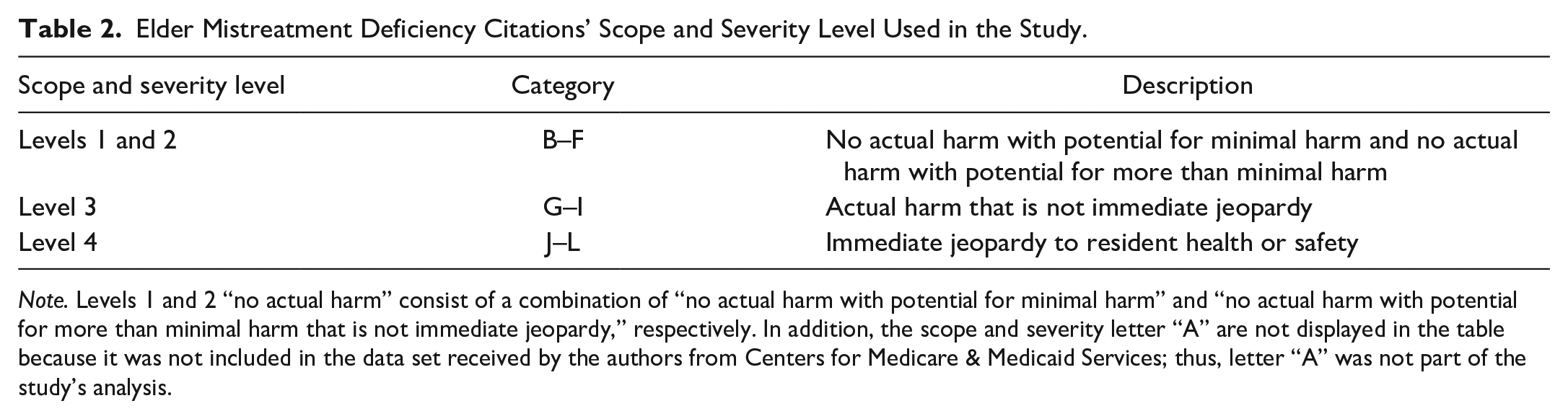
Note. Levels 1 and 2 “no actual harm” consist of a combination of “no actual harm with potential for minimal harm” and “no actual harm with potential for more than minimal harm that is not immediate jeopardy,” respectively. In addition, the scope and severity letter “A” are not displayed in the table because it was not included in the data set received by the authors from Centers for Medicare & Medicaid Services; thus, letter “A” was not part of the study’s analysis.
The CMS data set distinguishes each F-Tag with regard to whether the deficiency citation was issued as a result of a standard survey or complaint investigation. This distinction between standard surveys and complaint investigations as a data element in the data set allowed us to conduct the comparative analysis at the core of the study. Sample size distribution is presented in Table 3. However, in a small number of F-Tags, the deficiency citation was issued as a result of both standard survey and complaint investigation. A total of 2,731 citations (9% out of 28,390) were excluded from the data subset, including 223 (12.1%) in F-223, 196 (12.4%) in F-224, 864 (10.9%) in F-225, 659 (8.5%) in F-226, 75 (4.3%) in F-221, and 714 (9.5%) in F-314. We excluded these F-Tags from the analysis because they cannot be exclusively categorized as either standard survey or complaint investigation.
Sample Size of Mistreatment Deficiency Citations by Citation Type and Scope and Severity Level.
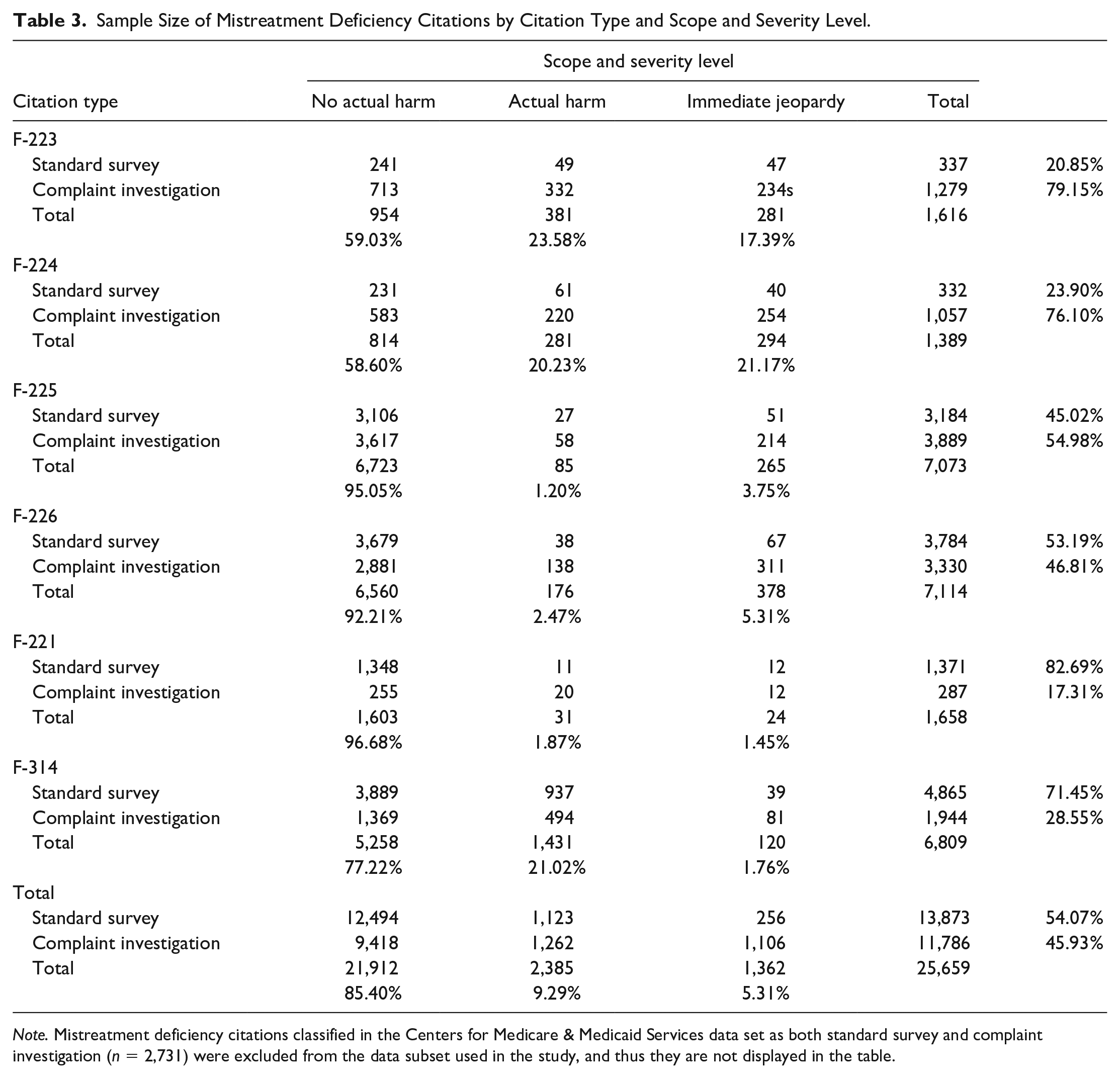
Note. Mistreatment deficiency citations classified in the Centers for Medicare & Medicaid Services data set as both standard survey and complaint investigation (n = 2,731) were excluded from the data subset used in the study, and thus they are not displayed in the table.
Statistical Analysis
Cumulative link mixed models (CLMMs; Christensen, 2015), a novel statistical modeling framework appropriate for studies with ordinal response variables and clustered observations, were adopted with the logit link function to investigate how the citation types correlate with the scope and severity levels. For the “cumulative link” part of the analysis, we adopted the negative binomial regression framework because it has the least constraints on the data distribution and therefore provides the most flexibility (Agresti, 2010). The “mixed model” part of the analysis allows us to have a more accurate inference on the effect of citation types, which is taken as the sole fixed effect, with the grouped correlation structure accounted for (Snijders & Bosker, 2011). Considering the variation in the use of nursing home deficiency citations (Castle et al., 2007), besides the citation type (standard survey, complaint investigation) as the sole fixed effect, the state and the inspection year were taken as random effects to account for the correlations between observations. Data analysis was carried out using R 3.6.1, and statistical significance was set at p < .05.
Results
Among the core mistreatment deficiency citations (see Table 3), abuse/involuntary seclusion (F-223) and neglect/misappropriation (F-224) had more complaint investigations (79% and 76%) than standard surveys (21% and 24%), and close to 60% of all F-Tags were issued at the scope and severity level 1 or 2. Investigate/report allegations (F-225) and develop/implement abuse/neglect policies (F-226) were split equally between complaint investigations (55% and 47%) and standard survey (45% and 53%), and the majority of all the deficiency citations were found to be at the scope and severity level 1 or 2 (over 90%). Among the secondary mistreatment deficiency citations, more were investigated during standard survey (83% for physical restraints [F-221] and 71% for pressure ulcers [F-314]), and the majority of the deficiency citations were found to be at the scope and severity level 1 or 2 (97% and 77%).
For all six F-Tags, complaint investigations were more likely to result in higher scope and severity level compared with standard surveys (p < .001). The comparison of scope and severity level between standard survey and complaint investigation is reported in Table 4.
Cumulative Link Mixed Models Parameters.

Discussion
The study findings improve our understanding of the seriousness (i.e., scope and severity) of mistreatment deficiency citations issued by SSAs during complaint investigations in comparison with the same deficiency citations when issued during standard surveys. The analysis of this CMS national data set revealed that in all of the six mistreatment deficiency citations examined, complaint investigations were more likely to result in a higher scope and severity level citation than standard surveys. In addition, a higher number of F-223 (abuse/involuntary seclusion) and F-224 (neglect/misappropriation) deficiency citations were the result of complaint investigations, whereas a higher number of F-221 (physical restraints) and F-314 (pressure ulcers) were issued during standard survey. Although our data do not allow us to examine it, one possibility is that physical restraints and pressure sores are more easily discovered during standard surveys, but evidence of mistreatment is more readily detected during complaint investigations when reported directly to SSA.
We believe that the findings from our study are important in terms of residents’ and families’ potential ability to hold nursing homes accountable for mistreatment. As mentioned earlier, investigations of complaints are generally conducted closer to the occurrence of the alleged mistreatment and more likely to be truly unannounced. When an investigation is conducted in a timely manner, evidence is more likely to be available to investigators to support issuing a citation at a higher scope and severity level (U.S. General Accounting Office, 1999; U.S. GAO, 2011). This is important because close to two thirds of nursing home residents are estimated to have cognitive impairment (Gaugler et al., 2014) and delayed investigation limits their ability to recall details from mistreatment incidents. Moreover, during a complaint investigation, surveyors focus on gathering information directly related to specific information included in a complaint. This is different from a standard survey, where a standardized protocol instructs surveyors to interview a sample of residents on a broad range of care-related problems. The U.S. GAO (2019) and other researchers (e.g., Stevenson, 2005, 2006) have recognized that residents and families might be embarrassed or afraid to report mistreatment. Many frail residents, who are physically dependent on staff for daily personal care, may fear being perceived as troublemakers if they report abuse or neglect. Therefore, when a complaint is filed with SSA, it is reasonable to assume that in many cases the resident and/or their family may have reached a “breaking point,” where the mistreatment situation has become intolerable and more severe in nature.
Implications for CMS and SSA Oversight
Knowing that complaint investigations of mistreatment allegations generally tend to result in citations with higher seriousness compared with standard surveys warrants closer attention by CMS to the complaint investigation process and citations. Government reports suggest that when substantiated mistreatment determined to have lower seriousness is not adequately addressed, it may escalate to more serious harm (OIG, 2019c; Office of the Legislative Auditor, 2005). Specific to complaint investigations, CMS’s guidance to state surveyors on Complaint Procedures (described in the agency’s State Operations Manual, July 19, 2019) states that one of the primary objectives of the federal complaint process is prevention. It highlights the importance of identification and correction of less serious complaints “to prevent the escalation of these problems into more serious situations that would threaten the health, safety, and welfare of the individuals receiving the service.”
CMS should also work with SSAs’ Regional Offices to strengthen SSAs’ ability to investigate and detect more serious mistreatment during standard surveys. This could be achieved, for example, through increase in SSAs’ staffing levels, unannounced on-site surveys, strengthening surveyors’ specialized training in detection of serious mistreatment, and supervisory reviews of surveys. Other areas in which SSAs could strengthen their ability to detect serious mistreatment during standard surveys are based on areas of weakness identified previously as contributing to understatement. These include, among others, a large number of inexperienced surveyors (U.S. General Accounting Office, 2003), surveyors with weak investigative skills (U.S. GAO, 2008), poor investigations and documentation of deficiencies, limited quality assurance systems, and inadequate audit of surveyors (U.S. General Accounting Office, 2003; OIG, 2019a). Furthermore, SSA workforce shortages (U.S. GAO, 2009) and staff turnover (OIG, 2019a) need to be addressed, such as through increased funding and guidance to SSAs, as these factors have been identified as contributing to inadequate oversight of nursing homes.
In addition, due to the fact that many residents are afraid of retaliation when considering whether to file a mistreatment complaint against the nursing home (Robison et al., 2007), CMS should increase SSAs’ efforts to educate consumers about their right to be free from staff retaliation (CMS, 2017) and strengthen SSAs’ enforcement of this right (i.e., through the issuance of F-585 “right to voice grievances without reprisal” and F-600 “right to be free from abuse and neglect” in the new federal regulations; the latter F-Tag is applicable because CMS considers retaliation by staff as abuse). In addition to filing a complaint, concerns related to staff retaliation can be made to LTCO office, which can engage in advocacy aimed at protecting the resident against staff retaliation. This, in turn, may increase the number of consumers who will be less afraid to report mistreatment allegations with surveyors during standard surveys. Another important but largely overlooked means to strengthen surveyors’ ability to detect more serious mistreatment during standard surveys is through the use of pertinent information from resident and family satisfaction surveys. When crafted and administered by independent contractors, such information could alert surveyors to potential mistreatment otherwise not on SSA’s radar during standard surveys (Ejaz et al., 2003; U.S. GAO, 2016; Williams et al., 2016).
Bridging a Gap in Care Compare’s Five-Star Quality Rating System
Although citations issued as a result of SSA’s complaint investigations are factored into CMS’s Care Compare’s (U.S. GAO, 2016; called Nursing Home Compare prior to September 3, 2020) Five-Star Quality Rating System, the rating itself, when calculated, does not distinguish citations as arising from standard surveys versus complaint investigations. As a result, the public, researchers, and policymakers remain limited in their ability to discern the extent to which the five-star ratings of nursing homes (i.e., both the rating under health inspections component and under the overall rating) consist of mistreatment citations resulting from reports made by residents and their families through complaints, as opposed to those identified by state surveyors during standard surveys. Strengthening CMS’s transparency pertaining to this issue is important because significant differences may exist in the scope, severity, and nature of mistreatment violations identified by SSA when captured during the two distinct oversight strategies (Peterson et al., 2020).
Implications for the Office of LTCO
As described in Title VII of the Older Americans Act, our findings reinforce the critical role of LTCO in fulfilling its varied duties pertaining to residents and families’ concerns related to mistreatment in nursing homes. Previous studies found that the presence of the LTCO at the nursing home predicted more complaints and better quality of care (Allen et al., 2003; Cherry, 1991; Nelson, 1995), while abuse reports and their substantiation also increased (Nelson et al., 1995). Ombudsman staff often learn about consumers’ concerns, investigate and help resolve them, and assist consumers in filing a complaint with the SSA (Bloemen et al., 2015). However, many LTCO programs are chronically underfunded and have very low ombudsman-to-LTC bed ratios (Cooney, 2019; National Ombudsman Reporting System, 2019). Therefore, our study findings indirectly support the need for increased state and federal funding to LTCO programs so that a larger number of nursing home residents will have a well-trained ombudsman advocate when they need them and thus have stronger protections of their right to be free from mistreatment (Office of the New York City Comptroller, 2020).
Limitations and Future Research
The CMS deficiency citation data used in the study have limitations. First, nursing home characteristics potentially affecting the study results, such as size, staffing levels, hospital-based, ownership status, and Medicare/Medicaid-reimbursed rates, were not included in the data set. Future studies could examine these and other characteristics as well as identify complaints filed with the assistance of ombudsmen to detect potential differences in mistreatment seriousness in further detail. In addition, the data set did not include F-Tags of scope and severity level A, and we also excluded the 9% deficiency citations issued as a result of both standard survey and complaint investigation. Nonetheless, the study findings did not change when additional analyses were conducted, no matter whether the 9% F-Tags were categorized as part of standard survey or complaint investigation.
Furthermore, the data set did not allow us to identify who filed the mistreatment complaint, nor did we know who the perpetrators were. Researchers and government reports have repeatedly recommended distinguishing staff abuse of residents from harmful resident-to-resident incidents in CMS deficiency citation and tracking systems (Caspi, 2017; Castle, 2011; Lachs et al., 2016; U.S. GAO, 2019, 2021), but CMS has not yet to bridge this major gap. Finally, it was not possible to distinguish certain subtypes of mistreatment from others within certain F-tags. For example, it was not possible to disentangle deficiency citations pertaining to financial exploitation alone from other forms of mistreatment under F-224, F-225, and F-226. In the new CMS federal regulations and oversight process, which went into effect on November 28, 2017, financial exploitation is separated from other types of abuse. Future research should use data from the new F-Tag (F-602 Free from misappropriation/exploitation) to shed light on the number of financial exploitation citations and their scope and severity levels by standard survey versus complaint investigations.
Conclusion
Mistreatment complaints are an important barometer of the quality of care and safety in nursing homes. The study findings should reinforce federal agencies’ recognition of the critical role of consumers’ complaints in CMS and SSA oversight process (OIG, 2017). The higher scope-severity level determinations in citations issued during complaint investigations at the national level suggest that state investigators were able to establish sufficient evidence to determine that more serious harm was experienced by the resident due to the nursing homes’ violation of federal regulation. The study findings identified the need for CMS and SSAs to develop strategies to improve state surveyors’ ability to detect mistreatment, especially during standard surveys. As importantly, stronger and more proactive measures should be implemented by nursing homes to listen to the voice of residents to promptly and adequately respond to their and their families’ care-related concerns while protecting them from retaliation. This, in turn, could ultimately enable residents to realize their federal right to live in safe nursing homes.
Footnotes
Acknowledgements
We would like to thank Dr. Greg Arling at Purdue Nursing for reviewing the manuscript and providing extensive suggested edits for improvement. We would also like to thank the School of Nursing, University of Minnesota for their support of this study, as well as Lori Smetanka, executive director, the National Consumer Voice for Quality Long-Term Care, and Richard Mollot, executive director, Long Term Care Community Coalition, for their assistance in the interpretation of the main findings.
Declaration of Conflicting Interests
The authors declared no potential conflicts of interest with respect to the research, authorship, and/or publication of this article.
Funding
The authors disclosed receipt of the following financial support for research, authorship and/or publication of the article: This research is funded by institutional review board of University of Minnesota and purdue University.
Ethics Committee or Institutional Review Board Approval
Institutional Review Board (IRB) of University of Minnesota (IRB protocol number 00002737) Purdue University (IRB protocol number 1902021794) determined that the study is exempt from IRB review and approved the study.

Data Availability Statement
The data that support the findings of this study are available from the authors.