




Abstract
In this study, the relationship between life changes in family members and engagement in economic activities among female older adults was explored in two East Asian countries: China and South Korea. Using panel data from wave 2 (2008) to wave 6 (2016) of the Korean Longitudinal Study of Aging and wave 1 (2011) to wave 3 (2015) of the China Health and Retirement Longitudinal Study, a correlated random effects probit model was estimated. The sample included 4,412 observations from South Korea and 1,972 observations from China. The results demonstrate that life changes in family affect engagement in economic activity among female older adults in both countries. However, the influence of family members on economic activity differed between the countries. These results suggest that participation in economic activities among female older adults needs to be understood in different macro-social contexts.
• This paper adds to the gaps in related literature on the productive engagement by examining East Asian countries, which have been relatively neglected in productive aging-related studies. • This paper investigates participation in economic activity among female older adults based on life changes of various family members according to the life course perspective.
• To understand macro-social contexts related to labor market participation among female older adults, comparative studies between countries are necessary. • Policy efforts would be needed to ensure stable retirement income for female older adults in South Korea, as well as to ensure that they can enable participation in good jobs.What this paper adds
Applications of study findings
Background and Objectives
The importance of the productive roles and social contribution of older adults has been recognized with an increasingly aging global population. Productive aging refers to “any activity by an older individual that produces goods or services, or develops the capacity to produce them, whether they are to be paid for or not” (Caro et al., 1993: 6). According to this definition, productive activities could include paid employment, volunteer work, child care, help to family and friends, and training or skills to enhance individual capacity. The productive aging perspective suggests a new alternative way to recognize the productivity of older adults by going beyond a restrictive economic meaning.
The newly emerging productive aging perspective recognizes the productivity and contribution of older adults by broadening existing definitions of productivity. The concept of “productive aging” was introduced by Butler and Gleason (1985). More recently, the term has included various values and areas of activity defined by other scholars. In earlier studies, productive aging was defined as “anything that produces goods and services… It should reduce demand on goods and services produced by others” (Morgan, 1986). The definition of the concept was extended further to “any activity by an older individual that produces goods or services, or develops the capacity to produce them, whether they are to be paid for or not” (Caro et al., 1993). While the concept is defined slightly differently by these scholars, they emphasize the productive and social roles of older adults within family, community, and society.
Existing studies have mainly addressed family care, informal help, and volunteering as productive activities that involve female older adults. In particular, in East Asian countries, family care (such as caring for children or grandchildren) tends to be considered a female role (Jun, 2003; Kim, 2006). Previous research has shown that female older adults spend a lot of time on unpaid activities, including housework, child and other care, and volunteer work in Korean society (Joung, 2005). Also, the antecedents and consequences of engagement in productive activities have been investigated (Baker et al., 2005; Dosman et al., 2006; McNamara & Gonzales, 2011; Shen, 2017; Thoits & Hewitt, 2001; Wilson, 2000; Wilson & Musick, 1997). The antecedents mainly focused on individual human capital variables (McNamara & Gonzales, 2011; Wilson, 2000; Wilson & Musick, 1997), and consequences included physical and mental health (Baker et al., 2005; Thoits & Hewitt, 2001).
Despite the contributions of previous studies, some limitations still persist. First, little is known about the productive activities of older adults in non-Western countries as most existing studies are focused on Western societies. In particular, the productive engagement of female older adults in East Asian countries has been underexplored. Existing studies dealing with East Asian countries have tended to focus mainly on the family care of female older adults, with the result that studies have not fully investigated the participation in economic activities of female older adults.
Also, although existing studies have explored the effect of individual characteristics on engagement in productive activities, little attention has been paid to the relationship between life changes in family members and participation in economic activity. According to the life course perspective, individual lives may be deeply influenced by life changes among family members (Elder, 1998, 2001). The life transitions of family members could cause changes in various roles and obligations for older women rather than older men (Bucx et al., 2012; Lumsdaine & Vermeer, 2015; Van Bavel & De Winter, 2013). Therefore, family life changes might affect older women’s participation in economic activities. Furthermore, although the lives of individuals and families are embedded within broader social institutions and environments (Elder, 1998), differences in the determinants of economic activity across contexts have not been examined.
The purpose of this study is to explore how the life changes of family members influence engagement in economic activities of female older adults in China and South Korea. In this paper, life changes related to family members include changes in spousal status; separation, employment, and marriage of children; and birth of grandchildren. The focus is on spouses, children, and grandchildren, who are the most intimate and important family members for older adults.
Moreover, a comparative study between China and South Korea can be interesting and important. In particular, based on various objective indicators such as GNI per capita and Human Development Index, South Korea might be evaluated to have a higher quality of life than China. Nevertheless, it was found that the quality of life of the older adults in China was higher than that of the older adults in South Korea (HelpAge International, 2015). These results could support that a comparative study between Korea and China is necessary in relation to the lives of the older adults.
The older population is increasing at an alarming rate in both China and South Korea. Both have shared Confucian cultural heritage and familism, which is regarded to be a representative cultural commonality among East Asian countries. However, there are significant differences between China and South Korea in terms of pensions and labor market systems. By indirectly examining contextual variation in the relationships between life changes in family and older women’s participation in economic activities, this paper is expected to make a meaningful contribution.
The Macro-Institutional Context of China and South Korea
Given that individual and family lives are embedded in a given society, the relationship between family members and economic activities among older adults is not only affected by the individual and the family but also by social contexts. China and South Korea provide an interesting comparison because these two countries have shared East Asian cultures and traditions but differ in retirement, pension systems, and labor market environments.
China and South Korea belong to the East Asian countries that share a Confucian cultural heritage. One of the representative characteristics of Confucian values is familism. East Asian countries have emphasized the importance of family under the influence of Confucianism (Kim, 2003). Since the mid-20th century, China and South Korea have divided into two different systems, and traditional values in the two countries have undergone changes. However, many studies have suggested that familism still appears in China and South Korea (Chen, 2005; Chen et al., 2011; Logan & Bian, 1999).
Meanwhile, while Korean women’s participation in economic activities shows an M-shaped pattern, women’s exit from the labor market due to childbirth and childcare is not clear in China (Shin, 2013). The employment rate of women has been high although the employment rate of women has recently shown on the decline. In 1997, the employment rate of women aged 20–44 was 90% (National Bureau of Statistics of China, 1998).
Urban residents working in the public sector, including in government departments, public institutions, and state-owned enterprises, are generally forced to retire when they reach the retirement age (Giles et al., 2021; Li et al., 20166). In general, as the retirement age for women in white-collar jobs is 55 and in blue-collar 50, they enter the retirement process at a relatively young age. However, participation in economic activities enables women to receive their pension qualification and secure their income in old age. Even though the pension income replacement rate is decreasing compared to the past, it is relatively high in urban areas. In particular, the average income replacement rate of public officials and public institution workers is 80–90% of the pre-retirement wage (Feng & Zhang, 2018).
Economic activities tend to stop because the opportunity to participate in the labor market is limited after retirement. However, it is not entirely impossible to continue participating in the labor market (Giles et al., 2021). In urban areas, high demand for professional or technical older workers often occurs (Hayward & Wang, 1993; Giles et al., 2011).
In the case of South Korea, the employment rate of women has shown an M-shaped pattern. Women’s participation in economic activities is still affected by childbirth and childcare. As a result, Korean female older adults generally have a relatively low rate of pension or retirement benefits, and their income sources in old age are not stable. As of 2019, the average retirement age from one’s main job is 49.3 years in Korea (Statistics Korea, 2019). On the other hand, the participation rate in the labor market over the age of 60 is 44.8% (Statistics Korea, 2020). The age at which women actually exit the labor market is 70.6, which is higher than it is in OECD countries (OECD, 2015). Structural characteristics, such as the older adult’s labor participation in rural areas, high proportion of self-employment, and relative flexibility of the labor market for the older adults, enable many older adults to participate in economic activity in Korea (Chang, 2003). Participation in economic activities among older Korean adults is largely due to economic reasons (Phang & Shin, 2011).
In summary, in China, due to institutional environments such as mandatory retirement, limited participation in the labor market among older adults, and guaranteed pension, the relationship between life changes of family members and participation in economic activities among female older people might not be closely related. On the other hand, under structural environments including high proportion of self-employment, relative flexibility of the labor market for the older adults, and the immaturity of the pension system, individual conditions and family life changes might be related to the participation in economic activities among Korean older women.
Engagement in Economic Activity
Earlier literature on economic activity participation or retirement decisions among older adults has mainly concentrated on individual characteristics such as education, health, and economic status (Burr et al., 2007; Hayward & Grady, 1990; Ozawa & Lum, 2005; Shattuck, 2010). Health is a recognized and well-known important resource for older adults (Shen, 2017; Wilson, 2000; Wilson & Musick, 1997). Furthermore, according to existing studies, older adults with a higher education level have tended to participate in the labor market longer or have reentered after retirement than older adults with a lower-level education (Hayward & Grady, 1990; Ozawa & Lum, 2005; Palmore et al., 1985; Shattuck, 2010). While individual or household income had a positive effect on labor force participation (Burr et al., 2007; Ling & Chi, 2008), pensions have been revealed to have a negative effect (Ozawa & Lum, 2005).
These previous studies did not systemically consider life changes in family strongly linked to the lives and roles of older adults. The life course perspective has shown that fateful decisions and changes in the life of family members could influence individual lives (Elder, 1998, 2001). According to the life course perspective, “linked lives” refer to the interdependence of human lives throughout the life course. The interconnected nature of family with bonds of kinship across the generations is a representative example of linked lives (Bengtson & Allen, 2009; Elder, 1987; Hagestad, 2003; Marshall & Mueller, 2003).
In particular, of all the social relationships experienced by older adults, the family is the most intimate and important relationship group (Park, 2000). Life changes related to children’s lives (especially graduation, employment, marriage, and childbirth) are part of the process of gaining independence from parents (Hogan & Astone, 1986), which may also create new obligations or roles for parents (Crimmins & Ingegneri, 1990; Patterson & Mccubbin, 1983; Ward et al., 1992). Accordingly, engagement in economic activity among older adults may be affected by life changes among other family members.
Some empirical studies have shown that life transitions among family members have an impact on the labor market participation and retirement of older adults. In particular, existing research on the retirement decisions of women has suggested that having a new grandchild increases the likelihood of retirement (Lumsdaine & Vermeer, 2015). Moreover, data from 22 European countries show that the birth of a grandchild increases the likelihood of women’s retirement but not significantly of men. Thus, the demand for care of a newly born grandchild influences the decision to leave the labor market for older women (Van Bavel & De Winter, 2013). Past research has also shown that the life changes in adult children are more strongly related to help from mothers rather than of fathers (Bucx et al., 2012).
There are few empirical studies analyzing the relationship between various characteristics of family and economic activity participation that focus on older adults in South Korea and China. A few studies in both countries have examined the effect of factors related to spousal status, household type, children, and grandchildren on participation in economic activities among older adults (Chou, 2010; Giles et al., 2021; Lee & Lee, 2014; Ling & Chi, 2008; Park, 2003; Son, 2010). However, these studies presented somewhat contradictory results, with little attention given to the participation in economic activity of female older adults in South Korea and China.
Research Design and Methods
Data
Using data from the Korean Longitudinal Study of Aging (KLoSA) and the China Health and Retirement Longitudinal Study (CHARLS), the present study examined the effect of life changes in family on engagement in economic activities among female older adults in China and South Korea. Both datasets are nationally representative samples and a longitudinal study of individuals aged 45 and above. These two surveys were similarly designed to enable international comparative research.
Because South Korea has no distinctive retirement patterns for women unlike China and the age that the public pension is received is 65, female older adults aged 65–74 years were the focus of this study. Conversely, in China, the retirement age for women is generally 55 years for white-collar workers and 50 years for blue-collar workers according to the mandatory retirement system. Therefore, the study was based on female respondents aged 65–74 in Korea and 55–74 in China.
Furthermore, in relation to the lives of the older adult and their family, significant differences between the older adults living in cities and those living in rural areas have been identified both in South Korea and China. In particular, the institutional separation between urban and rural residents is remarkable. This characteristic is more pronounced in retirement. Therefore, the present study included older respondents who live in the city with at least one child. This paper presents an examination of those included in wave 2 (2008) to wave 6 (2016) of the KLoSA and wave 1 (2011) to wave 3 (2015) of the CHARLS. KLoSA wave 1 (2006) was excluded because the questionnaire was slightly different. The original KLoSA sample from wave 2 to wave 6 and CHARLS sample from wave 1 to wave 3 included 22,046 and 26,297 female samples, respectively. However, this study used only Korean female older adults aged 65–74 who live in the city and have children for analysis. And, in China, female older adults aged 55–74 who live in the city and have children were used for analysis. The final sample included 4,412 observations from the KLoSA and 1,972 observations from the CHARLS.
Variables
In this study, employment status among female older adults was the dependent variable. In the Chinese survey, this was measured by asking respondents: “Did you work for at least one hour last week? We consider any of the following activities to be work: earn a wage, run your own business, and work unpaid for a family business.” In the Korean survey, the question was “Are you currently working for the purpose of income? Activities include earn a wage, run your own business, or work unpaid for a family business.” Because the dependent variable is a dichotomous variable, the answer was coded as 1 = yes and 0 = no.
Life changes in family members were included as key independent variables. Life changes related to spouse, children, and grandchildren were examined. The variable related to spouse was labeled “spouse status,” which was defined as either the presence or absence of a spouse: where 1 = the presence of a spouse (married) and 0 = the absence of a spouse (single/divorced/widowed/separated).” The variables related to children were identified as living arrangement, employment status, and marital status. Living arrangement of children was coded as 1 = has coresident children and 0 = none. Employment status of children was coded as 1 = all children working and 0 = not, while marital status of children was coded as 1 = all children married and 0 = not. The number of grandchildren was measured using a question that asked how many grandchildren they currently have and was coded.
Individual characteristics were included as control variables. Education, pension, and health status were assessed as individual human capital variables. In the KLoSA and CHARLS, the educational level measured as an ordinal variable was converted to the year of schooling as follows: illiterate = 0, elementary school = 6, middle school = 9, high school = 12, junior college = 14, college = 16, graduate school = 18, and doctoral degree = 20. Pension was also coded as follows: in the case of Korea, 1 = “received at least one of the national pension, the special occupational pension, or the retirement allowance and 0 = no pension; and in the case of China, 1 = receiving pension from government or work unit and 0 = not. Health status was measured using a 5-point scale (1 = excellent, 2 = good, 3 = fair, 4 = poor, and 5 = very poor). The responses were recoded from 1 = very poor to 5 = excellent in order to analyze the data. Also, respondents’ age (years) and number of living children were included.
Statistical Analysis
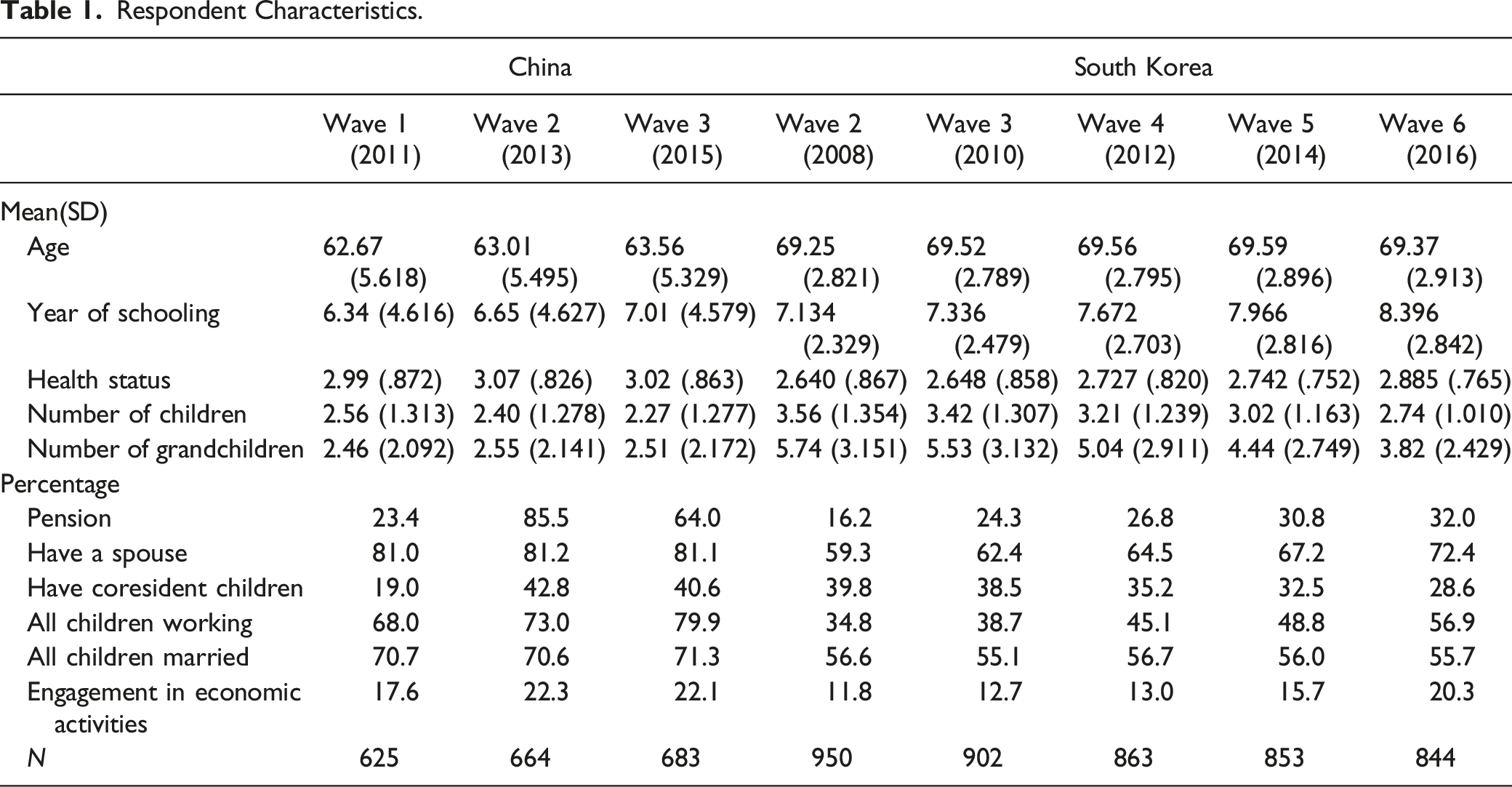
Respondent Characteristics.
A correlated random-effects probit model allows us to identify both intra-individual changes and inter-individual differences. Here, the dependent variable was a dichotomous variable with a value of 1 = engaged in economic activity or 0 = not. Although nonlinear models such as logit or probit are generally used in such cases, the use of a fixed-effect logit model to solve the endogenous problem could entail problems related to convergence or incidental parameters (Lancaster, 2000; Wooldridge, 2010). Therefore, a correlated random-effects probit model, proposed by Mundlak (1978) and Chamberlain (1984), was used to solve endogenous problems more easily.
Moreover, since the dependent variable of this study is a binary variable, there is a limit to explaining the result only with the coefficients. Therefore, both coefficients and the average marginal effects were estimated and presented in the result tables. To indirectly examine contextual variation in the relationships between life changes in family and older women’s participation in economic activities, we would identify the average marginal effects and significance in results between models. Stata 17 was used to analyze data.
Results
Table 1 presents the descriptive statistics of the variables used in the analysis from the KLoSA and CHARLS. Due to the age range, the mean age of Korean respondents is higher than that of Chinese respondents. The mean years of schooling are about a year more for Korean respondents than for Chinese respondents. Overall, the subjective health status of the older women in Korea is shown to be worse than that of the older women in China. Furthermore, female older adults in South Korea have more children and grandchildren than their Chinese counterparts.
The proportion of pensioners is higher in China than in South Korea, as is the percentage of respondents with a spouse. In addition, the percentage of respondents living together with children is higher in China than in South Korea. Furthermore, the percentage of respondents who have all children employed or have all children married is also higher in China. The percentage of participation in economic activities is similar.
Determinants of Engagement in Economic Activities Among Korean Female Older Adults.
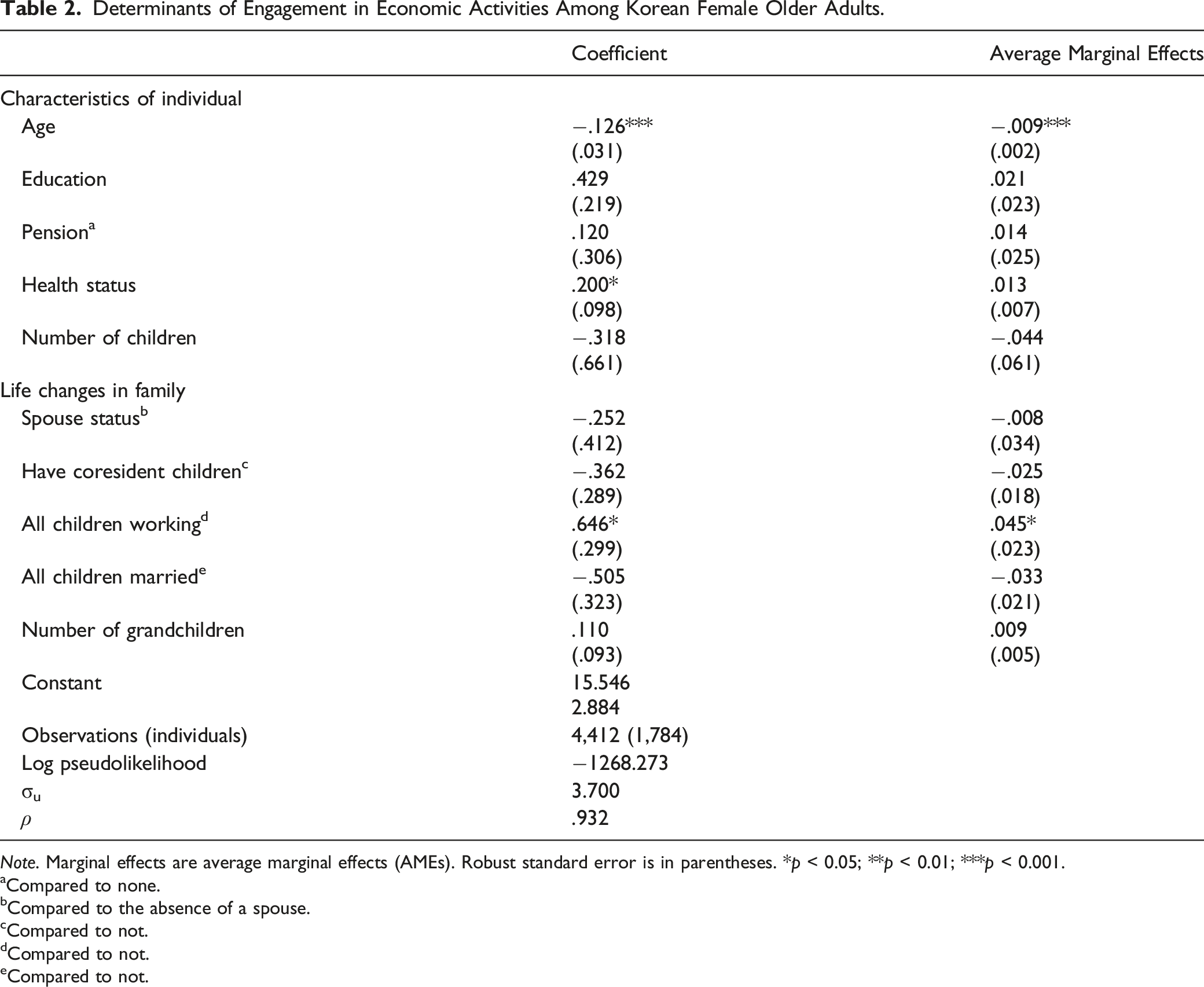
Note. Marginal effects are average marginal effects (AMEs). Robust standard error is in parentheses. *p < 0.05; **p < 0.01; ***p < 0.001.
aCompared to none.
bCompared to the absence of a spouse.
cCompared to not.
dCompared to not.
eCompared to not.
Determinants of Engagement in Economic Activities Among Chinese Female Older Adults.
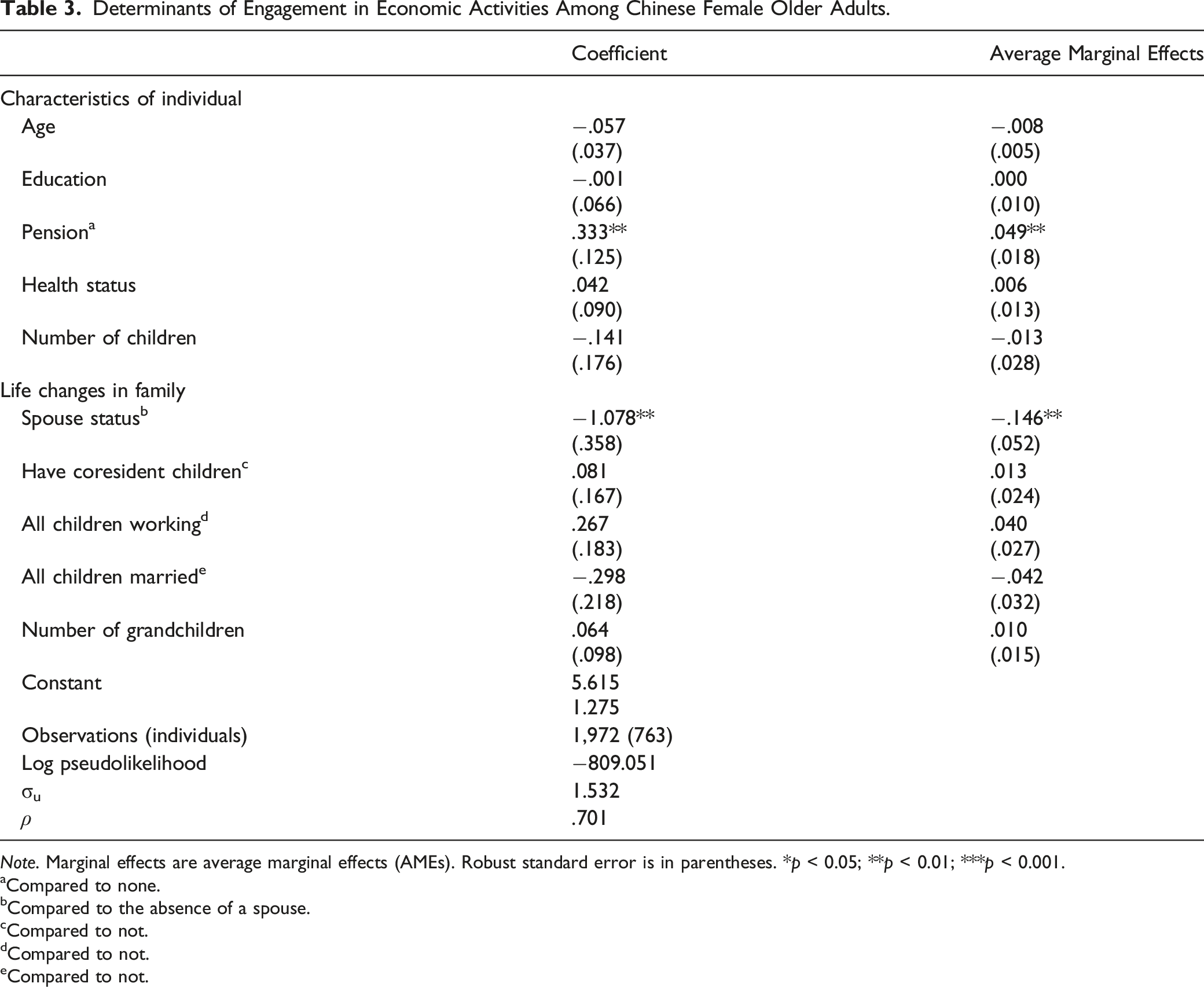
Note. Marginal effects are average marginal effects (AMEs). Robust standard error is in parentheses. *p < 0.05; **p < 0.01; ***p < 0.001.
aCompared to none.
bCompared to the absence of a spouse.
cCompared to not.
dCompared to not.
eCompared to not.
The results of the model predicting participation in economic activities among female older adults in China are presented in Table 3. Unlike in South Korea, only the variable related to the spouse showed statistically significant results. In China, when the spousal status changes (from having a spouse to not having a spouse), the probability of participation in economic activities among female older adults increased by approximately 14.6% point at the p < 0.01 level. Neither children nor grandchildren significantly affected the participation of older Chinese women in the labor market. In addition, pension had an influence on economic activities of older women in China, as receiving a pension increases the likelihood of participation in economic activities.
Discussion and Conclusions
The productive aging perspective has emerged as a new way to recognize the productivity and contribution of older adults in family, community, and social contexts. Although a large number of studies on productive aging have emerged, existing studies have focused particularly on Western societies. Little attention has been given to engagement in economic activities among female older adults in East Asian countries such as China and South Korea. In addition, previous studies failed to sufficiently consider life changes in family; instead, participation in economic activities was explained by focusing only on individual characteristics. To fill these particular gaps, the effects of life changes in family members on engagement in economic activities among female older adults in China and South Korea were analyzed. In particular, by comparing South Korea and China, the relationship between life changes in family and participation in economic activities among female older adults was indirectly examined in different macro-social contexts.
Some interesting findings emerged from this study. The relationship between life changes in family and participation in economic activities among female older adults seems to be quite different in the two countries. First, it was found that life changes in family affect engagement in economic activities among female older adults in the two countries. However, the influence of family members on older women’s participation in economic activities was different in South Korea and China. In South Korea, a change in children’s employment status affected their participation in economic activities. Meanwhile, in China, a change in spousal status had a significant effect on older women’s participation in economic activities.
Korean female older adults generally have a relatively low rate of pension or retirement benefits, and their income sources in old age are not stable. Therefore, when all children participate in economic activities, the demands and roles of the female older adult in the family decrease, and they seem to be more likely to participate in economic activities for income in old age. It can be assumed that even if children participate in the labor force, female older adults do not rely on the private transfer income from their children; instead they want to participate in economic activities independently. However, in China, similar to the results of previous studies (Chou, 2010), child-related variables did not have a significant effect. However, the transition to no longer having a spouse increases the possibility of participating in economic activities among Chinese female older adults. A likely explanation is that they might participate in economic activities to cover the loss of income due to the absence of a spouse.
Next, individual characteristics had no significant effect on economic activities among Korean female older adults. By contrast, female older adults with a pension in China were more likely to engage in economic activities. Currently, female older adults in South Korea generally have a low level of education and less experience in participating in economic activities. Accordingly, there are few female older adults who have a personal pension based on participation in economic activities (Seok & Lim, 2007). However, for Chinese women, the overall participation rate in economic activities is high, and participation in economic activities enables women to receive their pension qualification. Female older adults who are eligible for pensions through previous participation in economic activities seem to be likely to participate in the labor market longer based on their career and expertise than older women who do not have pensions.
In South Korea, the results of increasing the probability of participation in economic activities if age allows for work and if children become economically independent, regardless of individual characteristics such as education and pension, might need to be noted. Policy efforts would be needed to ensure stable retirement income for female older adults in South Korea, as well as to ensure that they can enable participation in good jobs.
This paper makes several contributions to the relevant literature, by examining East Asian countries, which have been relatively neglected in productive aging-related studies. In addition, existing studies have identified the need for comparative studies between countries to understand macro-social contexts related to the productive activities of older adults (Morrow-Howell & Wang, 2013). The contribution of this study is that through comparison of South Korea and China, the social and institutional context surrounding the participation of older women in economic activities was considered together. Finally, this study is meaningful in that it attempts to investigate participation in economic activities among female older adults based on life changes of various family members according to the life course perspective.
Despite these contributions, this study has some limitations. First, since our study indirectly analyzed the effects of the macro-social context of the two countries, it will be necessary to directly examine it through multi-level analysis in future research. Second, the binary variables for children when “all children” and “not” are the options might limit the meaning of these variables in the context of employment and marital status. Future research can consider these variables as a count of number of children married and employed, respectively. Third, variables to account for the wealth of the individual and family or variables that measure poverty or others for financial need can be considered as control variables in further research. Last, the parents of the respondent were not considered in the family life changes in this study. However, parents might be an important part of the family unit. Future research would also need to consider parents as family members.
Footnotes
Acknowledgments
We thank all the participants, investigators, and all relevant staff in the China Health and Retirement Longitudinal Study (CHARLS) and the Korean Longitudinal Study of Aging (KLoSA).
Author Contributions
Supervision: Myoung-Jin Lee. Conceptualization, formal analysis, and writing—original draft preparation: Ji-Young Choi.
Declaration of Conflicting Interests
The author(s) declared no potential conflicts of interest with respect to the research, authorship, and/or publication of this article.
Funding
The author(s) received no financial support for the research, authorship, and/or publication of this article.
Data Availability
Data are available at Korean Longitudinal Study of Ageing (KLoSA). Korea Employment Information Service [distributors], https://survey.keis.or.kr/index.jsp and China Health and Retirement Longitudinal Study (CHARLS). Peking University [distributors],  .
.