



Abstract
The number of adults aged 60 years and over who work is growing. However, there has been relatively limited research assessing the determinants of wellbeing in this cohort. Given the known relationship between loneliness and socioeconomic disadvantage, the present analysis assessed the role of working conditions and food security on loneliness among employed Indians aged 60 years and over (N = 9035), using data from wave 1 of the Longitudinal Ageing Study in India. Just over 11% of participants reported being lonely most or all of the time. Food insecurity and work that involved exposure to unpleasant conditions was associated with increased loneliness, while work requiring more mental effort was associated with lower loneliness. Policies that ensure skills training to support job transitions for older adults working in unpleasant conditions, and greater food security in later life are important to ensure wellbeing in this group.
• Levels of loneliness are high among older adults in employment • Work conditions have a significant impact on loneliness • Food insecurity is associated with greater loneliness
• Job-training or skills training needs to be made available to older adults • Food diversity needs to be emphasized in policies aimed at older adults who are food-insecureWhat this paper adds
Applications of study findings
Introduction
Adults aged 60 years and over currently comprise around 10% of India’s population, and this is projected to increase to 19% by 2050 (Chanda & Mishra, 2019; NSO, 2021). Around 47% of adults aged 60 years and over in India are completely economically dependent on others, with a further 25% in rural areas and 20% in urban areas partially dependent on others. The numbers also reveal a marked gender divide, with around two-thirds of women lacking economic independence when compared with around a quarter of men (NSO, 2021). Findings from the first wave of the Longitudinal Ageing Study in India (2017–18) indicate that over a third of individuals aged 60 years and over in India are working (International Institute for Population Sciences (IIPS) et al., 2020). While individuals over the age of retirement might wish to continue working, this may vary considerably by factors such as the profession the individual is currently in, education, and health status. Indeed, research by the Centre for Equity Studies on older adults aged 55 years and over in Rajasthan who lacked income security found that nearly half would work less or stop working completely if they had access to an adequate pension (Sampat & Dey, 2017). A recent review on extending working lives suggests poor outcomes for individuals in demanding or poorly paid jobs, and the widening of health inequalities for those who need to continue working when compared with those who are able to retire (Baxter et al., 2021). The state of older adults in India who continue to work and their well-being has received limited attention in the literature.
Loneliness or “perceived social isolation” refers to the discrepancy between an individual’s actual and desired social connections, leading to feelings of dissatisfaction with one’s social network (Peplau & Perlman, 1982). Feelings of loneliness can be useful as they may prompt an individual to establish social relationships (Qualter et al., 2015). However, there is considerable research indicating that sustained loneliness is associated with poor physical and mental health as well as an increased risk of mortality (Leigh-Hunt et al., 2017). Being employed is typically associated with lower levels of loneliness, with studies suggesting a potential bi-directional relationship, particularly in working-age samples (Morrish & Medina-Lara, 2021). Given that older adults may work for different reasons when compared with younger groups, we need to better understand factors that affect wellbeing in older workers. Indeed, there is some evidence to suggest no significant benefits to wellbeing or depression associated with continued employment among over-65s in Sweden (Anxo et al., 2019).
Financial insecurity in later life, including post-retirement, has been associated with greater feelings of loneliness (Cruwys et al., 2019; Loibl et al., 2022). There is strong evidence to indicate a marked socioeconomic gradient in loneliness with levels of loneliness higher among those who are more disadvantaged (Madani et al., 2022). One such indicator of disadvantage may be food security. The World Bank (1996) defines food security as “when all people, at all times, have physical and economic access to sufficient safe and nutritious food that meets their dietary needs and food preferences for an active and healthy life.” While a significant issue in low- and middle-income countries such as India (George & McKay, 2019), food security is also a problem for many high-income countries (Loopstra, 2018). Loneliness has also been related to food insecurity at different ages (Guzman et al., 2022; Howe-Burris et al., 2022), with home food delivery programs such as Meals on Wheels in the US being associated with decreases in loneliness among older adults (Ross et al., 2022; Thomas et al., 2016; Wright et al., 2015). Poverty among those who work is high in several parts of Asia, including India and this is likely to be heightened in the case of older adults (Economic and Social Commission for Asia and the Pacific, 2022). Our analysis uses food security as a marker of disadvantage among individuals who are working in later life, and assesses its role as a predictor of loneliness.
Occupational characteristics may also play an important role in determining loneliness. Psychosocial stressors such as job demands, autonomy, and bullying have been found to be associated with poor mental health, but there has been relatively little consideration of the role of physical working conditions in mental health (Theorell et al., 2015). The limited evidence available also shows mixed findings. For instance, in a study on a working-age French cohort, working conditions that included exposure to noise, vibrations, chemicals, etc. were not associated with depressive symptoms (Niedhammer et al., 2020). However, such conditions were associated with greater depressive symptoms in a Korean sample (Stahl et al., 2016). Work from the US indicates that older workers prefer jobs that allow for more autonomy, greater flexibility, lower physical demands, and lower levels of stress (Acemoglu et al., 2022). Such work may not, however, always be available to this group. When considering the Indian context, workers aged over 60 years are mainly based in rural areas, and are predominantly involved in agricultural and allied activities (International Institute for Population Sciences (IIPS) et al., 2020). Many of these jobs are part of the informal economy, lacking adequate regulation and characterized by high levels of precarity (Agarwala, 2009; Government of India, 2015). Hence, it is important that the role of working conditions is assessed in the Indian context. The role of working conditions, including types of effort required or exposure to unpleasant conditions, has also received little attention in the literature on loneliness. Given that loneliness is closely related to depression and indeed may predict depressive symptoms (Cacioppo et al., 2010; Erzen & Çikrikci, 2018), and that the nature of work in later life may be different for older adults in India, it is important that we address this gap in the literature.
Thus, the present analysis examined the role of work-related factors and food security on loneliness among employed Indians aged 60 years and over, using data from a nationally representative cohort study. We hypothesized that poorer working conditions and greater food insecurity will be associated with higher levels of loneliness in this group.
Methods
Participants
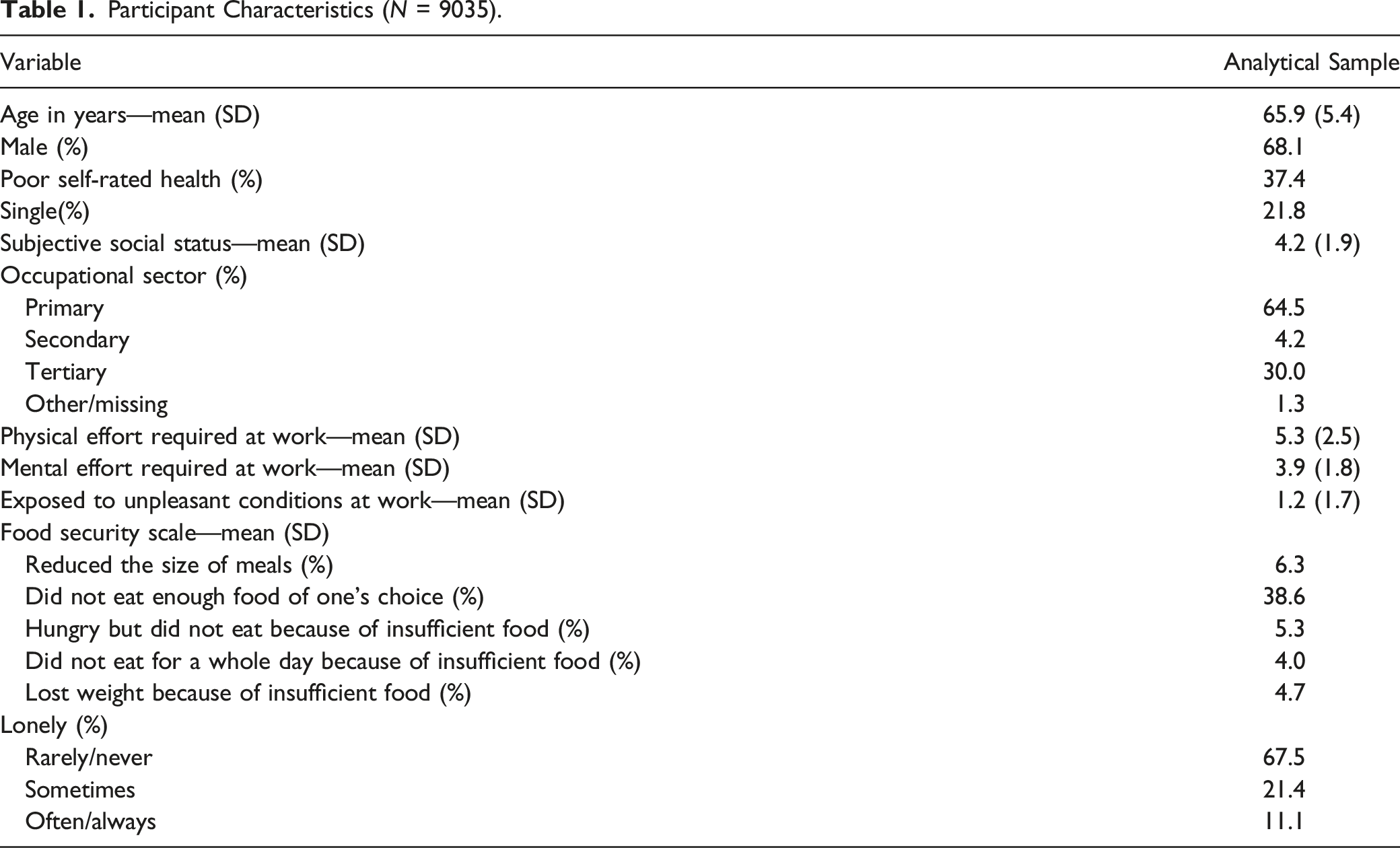
The present analysis included data from the wave 1 of the Longitudinal Ageing Study in India (LASI) which was carried out in 2017–18. LASI is a multidisciplinary study aimed at understanding aging in India. At wave 1, LASI included 72,262 participants aged 45 years and older as well as their partners, sampled from 35 of the 36 states and all union territories in India. The study is harmonized with other longitudinal ageing studies across the world, such as the Health and Retirement Study and the English Longitudinal Study of Ageing. Further details regarding LASI methods, sample, and measures are available elsewhere (International Institute for Population Sciences (IIPS) et al., 2020; Perianayagam et al., 2022). Our analysis focused on LASI participants aged 60 years or over (N = 31477) who were currently working (N = 9309). The definition of work used in the LASI study is adopted from the Indian Census 2011, and includes participation in any economically productive activity, whether or not the individual receives financial remuneration; one’s own housework is not included (International Institute for Population Sciences (IIPS), 2021). Excluding participants with missing data on any of the variables of interest, the final analytical sample included 9035 participants (12.5% of the baseline wave 1 sample). When compared with those who were excluded due to missing data, participants included in the analysis were younger (65.9 years vs. 66.7 years, p = .02) and in occupations with less exposure to unpleasant conditions (mean score 1.19 vs. 1.45, p = .04). There were no other significant differences between the two groups on variables included in these analyses.
Ethical approval for the LASI study was provided by the Indian Council of Medical Research as well as the collaborating organizations involved in the study (Perianayagam et al., 2022). Anonymized LASI data, including datasets harmonized with other aging studies, are made available through the Gateway to Aging portal (www.g2aging.com).
Measures
Loneliness
Loneliness was assessed using a single item from the Centre for Epidemiologic Studies Depression Scale (CESD) with participants required to answer how often in the past week they felt alone, with response options rarely or never (less than 1 day), sometimes (1 or 2 days), often (3 or 4 days), and most or all of the time (5–7 days). Such single item-measures have been found to show good agreement with other measures of loneliness (Mund et al., 2022).
Working Conditions
Participants who were working were asked about the extent to which their job required the following of them—a lot of physical effort, lifting heavy loads, stooping, kneeling or crouching, intense concentration or attention, skill in dealing with other people, to be around burning material, exhaust, or smoke (excluding car exhaust), to be close to chemicals/pesticides/herbicides, and to be close to noxious odor—with response options none of the time or almost never, sometimes, most of the time, and all or almost all of the time. Items were grouped together to indicate working conditions that included a high level of physical effort (a lot of physical effort, lifting heavy loads, and stooping, kneeling, or crouching), mental effort (intense concentration or attention, skill in dealing with other people) and exposure to unpleasant conditions (to be around burning material, exhaust, or smoke, to be close to chemicals/pesticides/herbicides, to be close to noxious odor). Scores ranged from 0 to 9 on the physical effort and unpleasant conditions scales, and from 0 to 6 on the mental effort scale, such that higher scores indicated working conditions that required more physical effort, more mental effort and a greater exposure to unpleasant conditions.
Food Security
Participants were asked questions regarding food availability, variety, and quantity over the past 12 months. Questions included if (a) they had to reduce the amount of food they ate, (b) if they were unable to eat food of their choice, (c) they were hungry but did not eat due to a lack of availability of food, (d) they had to go without food for a whole day, and (e) they had lost weight due to insufficient food in the house. Response options were yes and no, coded such that yes indicated a lack of food. These items are adapted from the US Household Food Security Module, with validity and reliability established in Indian settings (Sethi et al., 2017). As the scale was not included in its entirety in the LASI study, individual items were analyzed here (e.g., Muhammad et al., 2022b; Srivastava & Muhammad, 2022). A simple summed score was also calculated, where a response of yes was given a score of 1 while no was given a score of 0. The total score ranged from 0 to 5, with higher scores indicating greater food insecurity.
Covariates
All analyses were adjusted for participant age in years, sex, marital status (coded as married or in a live-in relationship or never married/divorced/widowed/separated/deserted), and self-rated health classified as good (corresponding to responses of excellent, very good, or good) and poor (corresponding to responses of fair or poor). Analyses were also adjusted for quintiles of total household wealth computed for the analytical sample. Total wealth includes the value of rental security deposits paid, primary residence, other real estate, land, agricultural equipment, livestock, businesses, personal loans, household durables and valuables, and financial assets. The values of a household’s other security deposits received, debt, and rental security deposits received are subtracted from the above. Subjective social status was assessed using the MacArthur Scale of Subjective Social Status (Adler et al., 2000). Participants are given the following instructions: “Think of this ladder as representing where people stand in our society. At the top of the ladder are the people who are the best off—those who have the most money, most education, and best jobs. At the bottom are the people who are the worst off—who have the least money, least education, and the worst jobs or no jobs. The higher up you are on this ladder, the closer you are to the people at the very top and the lower you are, the closer you are to the people at the very bottom of your society. Please indicate the number given on the rung on the ladder where you would place yourself.” Reponses ranged from 1 to 10, with a higher score indicating a better subjective social status. Lastly, the analyses adjusted for occupational sector, classified as primary (e.g., agriculture and mining), secondary (e.g., manufacturing), tertiary (e.g., services), and unclassified/missing.
Statistical Analysis
Responses of most of the time or all/almost all of the time on the loneliness scale were grouped together. As summed scores on the food security scale were skewed, these were grouped into three categories corresponding to those with a score of 0, those with a score of 1 and those with a score of 2 or higher. Descriptive statistics (means and standard deviations for continuous variables and frequencies for categorical variables) were computed. An ordinal regression was carried out with scores on the loneliness scale as the outcome, and measures of working conditions and individual items on the food security as the predictors. A separate analysis was also carried out using the summed score for the food security scale. Participants who reported never or rarely being lonely were considered the reference group. All analyses were adjusted for age, sex, marital status, self-rated health, occupational sector, subjective social status, and quintiles of total household wealth. Results of the analysis are presented using odds ratios (OR) and 95% confidence intervals. All analyses were carried out using SPSS v.29 (IBM SPSS Statistics).
Results
Participant Characteristics (N = 9035).
Ordinal Regression of Loneliness Categories (N = 9035).

The pattern of results remained identical when the analysis was repeated using the summed score for food security. Using participants with no food insecurity as the reference good, those with mild food insecurity (score of 1) reported an increase in the odds of loneliness (OR: 1.38, 95% CI: 1.25–1.51), while those with higher levels of food insecurity (scores of 2 or higher on the summed score) had over a two-fold increase in the odds of reporting loneliness (OR: 2.38, 95% CI: 2.03–2.80).
Discussion
The present analyses aimed to assess the role of work-related factors and food security on older adults’ levels of loneliness. While there is a growing body of research focusing on the prevalence, correlates, and effects of loneliness, much of the research has focused on the Global North (Surkalim et al., 2022). Given marked social, economic, and demographic differences, more needs to be done to better understand loneliness in countries like India. Over 11% of participants in our analysis reported being lonely most or all of the time, which is slightly lower than in the total LASI sample where over 13% reported severe loneliness (Pengpid & Peltzer, 2021). We found that while work that exposed participants to unpleasant conditions was associated with higher levels of loneliness, work that required more mental effort such as high levels of concentration or skills in dealing with others was associated with lower levels of loneliness. Multiple aspects of food security were associated with increased levels of loneliness.
Our findings align with previous research indicating higher levels of loneliness among those who are more deprived (Madani et al., 2022) and those who perceive themselves as being less well-off when compared with others (Ayalon, 2019). Our analysis also demonstrated that food security persists as an issue among older Indians who work, with proportions of those reporting food insecurity comparable to those in all over-60s (Muhammad et al., 2022b). Previous research using the LASI data has indicated that measures of food security are associated with measures of depression (Muhammad et al., 2022b; Patel et al., 2022), cognitive function (Kumar et al., 2021), and frailty (Muhammad et al., 2022a) in later life. In our analysis, we find that a lack of food choice and a lack of food availability, including weight loss due to inadequate food consumption are associated with greater feelings of loneliness among those who work. While related to measures of socioeconomic position such income or education (Foley et al., 2009), food security may reflect certain aspects of social networks. Previous research has indicated that strong social bonds including greater community and social cohesion in more deprived groups may actually help in reducing food insecurity through sharing of resources including food (DiFiore et al., 2022; Nagata et al., 2015). Individuals who are food-insecure may lack these bonds, and hence experience higher levels of loneliness. Some items on the food security scale were not associated with loneliness in the multivariable analyses; however, when analyzed independently (adjusted for other variables in the model) each item measuring food security was associated with the outcome (all p’s < .001; data not presented here). When analyzed jointly, it may be that items indicating greater severity are more closely associated with loneliness.
India’s two existing national policies dealing with older adults are the National Policy on Older Persons 1999 (Government of India, 1999) and the more recent National Policy for Senior Citizens 2011 (Government of India, 2011). The National Policy on Older Persons, dealing with people above the age of 60, mentions the word loneliness once in the entire policy document and that too in the context of volunteers being encouraged to assist older adults who are confined to their homes, with particular reference to older women who may be frail and lonely. While financial security and food-related recommendations are individually recognized as factors necessary for the wellbeing of older adults, they are not understood as having any direct implications for loneliness. Similarly, the National Policy for Senior Citizens 2011 (Government of India, 2011) also mentions loneliness only once in the context of loneliness being higher among older women when compared with men. Again, while financial insecurity and the two-thirds of the older adults being below the poverty line are cited as reasons for a “major intervention,” the policy does not adequately reckon with food insecurity except for promising assistance through the public distribution system for those below the poverty line. Consequently, it does not take a holistic view of the implications of such insecurity for levels of loneliness. Our findings on the increase in levels of loneliness for food-insecure older adults may have implications in terms of expansion of the scope of policies beyond the “below poverty line” cohort to a broader cohort of those who are working but still food-insecure. This expansion in policy scope may in turn have implications for the formulation and implementation of schemes with increased budgetary allocations and expanded scope of food security (free foodgrains, highly subsidized rations, etc.). The paper’s findings on the connection between lack of food diversity and increase in levels of loneliness may also have implications for the programmatic design of these schemes to allow for greater diversity in allocated rations.
Working conditions have received limited attention as a correlate of loneliness. Work that requires concentration or skills places significant cognitive demands on an individual. The association between better cognitive functioning and lower levels of loneliness in later life is well-established (Cohen-Mansfield et al., 2016). Our findings offer additional support for these associations. Indeed, work that is challenging and offers the opportunity to maintain social contacts has been identified as a reason why people may choose not to retire (Proper et al., 2009). However, adverse working conditions such as exposure to noxious substances or odors were associated with higher levels of loneliness. Continued exposure to such conditions in later life may contribute to increased feelings of stress which in turn lead to feelings of loneliness (Laustsen et al., 2023). The correlation between working conditions and loneliness also has implications for policy that is not sufficiently recognized by current Indian policies. The National Policy for Older Persons recognizes older adults above 60 as a “huge untapped resource” (p. 8) and broadly commits to support organizations which provide training, career guidance, and orientation. However, the policy does not commit to specific job-training programs that can transition working older adults from arduous and adverse job environments to more convenient, stimulating ones (Government of India, 1999). The National Policy for Senior Citizens (Government of India, 2011) commits to provide “employment in income-generating activities after superannuation” (p. 5) and the setting up of a Directorate of Employment to help adults aged over 60 find re-employment opportunities. However, it too does not focus on orienting job-training programs in a manner that helps in transitioning this group from labor-intensive and physically demanding occupations to ones that are more cognitively demanding and stimulating, but physically convenient.
Strengths and Limitations
Our analysis was able to assess the role of food security and working conditions on loneliness in older Indians who work, using data from a nationally representative study. The large sample size, use of validated measures, and ability to adjust for important covariates represent strengths of this work. Further we were able to focus on the role of working conditions on loneliness, a determinant that has received relatively little attention in relation to wellbeing. However, it is important to acknowledge some limitations of this work. Only data from a single wave were available, as a result we can present only cross-sectional analyses. Further, while considering aspects of work, our study was unable to assess other factors such as the relationships with colleagues or superiors and quality of interaction with others, which could potentially have a significant impact on levels of loneliness. Further research could usefully address some of these limitations. Due to missing data, our analysis also excluded older workers and those exposed to more unpleasant working conditions. Our findings may have hence, underestimated the impact of these conditions, particularly on those who are older.
Conclusions
This study identified the role of poor working conditions and food insecurity in predicting loneliness among older adults who work. The analysis also identified how work that allows a greater degree of mental and social engagement may be protective against loneliness. Our findings highlight the need for skills training in later life as well as policies that ensure food availability in this group. Future research could consider additional variables such as the role of psychosocial demands, autonomy, and the experience of ageism.
Footnotes
Declaration of Conflicting Interests
The author(s) declared no potential conflicts of interest with respect to the research, authorship, and/or publication of this article.
Funding
The author(s) disclosed receipt of the following financial support for the research, authorship, and/or publication of this article: This work was supported by the FLAME University.
