



Abstract
This paper examines how older adults who participated in an online photovoice-based group intervention program reported their experience. In a qualitative-phenomenological study, in which 13 older-adult people participated, data were collected through semi-structured in-depth interviews and analyzed through content analysis. The findings point to three central themes: a) Challenges—technical difficulties, difficulties in finding a subject for photography, investing time in photography, and an emotional-intellectual effort to put their experience into photography; b) Growth: New knowledge and skills—acquiring new knowledge, acquiring skills, experiencing skills regardless of age, and empowerment; c) Meaning—reflexivity, the ability to project feelings onto images, connection to the outside world, mindfulness, ability to choose, creativity, and critical consciousness. The findings share the way in which the use of creative visual engagement with photography contributed to coping with various challenges and enabled various gains within the process among the older-adult participants.
• Understanding the positive impact of photovoice on older adults during COVID-19 pandemic. • Photovoice methodology is a relevant and empowering group intervention method with older adults in the context of a global crisis. • Understanding how older adults approach photography is crucial for meeting their distinct requirements and providing better service.
• Expanding the use of art-based creative methods among older adults. • Expanding studies dealing with the phenomenological aspects of technological challenges faced by older adults. • Encouraging the creation of creative ways of communication with older adults in times of global crisis.What this paper adds
Applications of study findings
Introduction
Photovoice is a critical methodology under the principles of community-based participatory research (Wang & Burris, 1994, 1997). The principles of the methodology rely on critical theory such as Paulo Freire’s critical pedagogy (Freire, 2000); Feminism, as a social theory of human rights; and art-based documentary photography (e.g., Spence & Solomon, 1995). Photovoice adopts the idea of social art: it gives people from a variety of backgrounds, especially marginalized communities and vulnerable population groups, the opportunity to express their voice through photography. The act of photography allows people to document reality, interpret it, and participate in negotiations on various social interpretations of social phenomena. The photovoice method is implemented through the medium of group intervention under which members of the group share common experiences they have documented through photography and through a written narrative that is paired with the photography (Wang & Burris, 1997). During the group sessions, they participate in group dialogue, becoming part of a space that gives an echo and expression to their otherwise hollow experiences as part of a community, or collective with shared characteristics (Wang & Burris, 1997). This methodology also serves as a basis for social change processes, based on the knowledge produced by the participants, which may serve as an opportunity for a better understanding of their expressions, and the basis for formulating policy change to benefit the community in question (Wang & Burris, 1997).
Thus, the use of different implementation forms of the photovoice methodology among the older-adult is not new (Bryanton et al., 2019; Ferlatte et al., 2022; Fitzpatrick et al., 2012; Heinz et al., 2023; Miller et al., 2019; Mysyuk & Huisman, 2020; Novek et al., 2012; Salma et al., 2023). Considering the philosophical and theoretical principles of methodology as a critical research form (Wang & Burris, 1997), photovoice can be a valuable method to explore and understand the perspectives and experiences of the older-adult, who are often regarded as a vulnerable and/or marginal population. This approach allows the older-adults to share their voice and contribute to a broader understanding of their lives, both for themselves and for others.
For example, the technique has been used to investigate how the older-adults cope with chronic pain (Baker & Wang, 2006). Furthermore, photovoice has been employed to examine the health needs of rural older-adult women (Leipert & Smith, 2009), as well as their food consumption patterns (Neill et al., 2011). Additionally, studies have used photovoice to understand the attitudes of the older-adult in relation to accessible and age-friendly communities (Novek & Menec, 2014). It has also been employed to explore the perceptions of the older-adult regarding respect and social inclusion within cities (Ronzi et al., 2016). Other areas of research include the needs of recovering addicted older-adult individuals who use methadone (Rosen et al., 2011), older-adult cardiovascular awareness (Fitzpatrick et al., 2012), the older-adult perspectives on dependence and independence (Bellhe & Menec, 2015), and their coping strategies during the COVID-19 pandemic (Chen, 2023; Ferlatte et al., 2022). However, the therapeutic and psychosocial benefits of photovoice with the older-adults have been less explored.
Contrary to work with younger populations, the utilization of photovoice among older-adults in this comprehensive psychoeducational and empowerment context is less prevalent. Instead, it has predominantly been applied as a research tool to explore issues related to physical and mental health (Baker & Wang, 2006; Fitzpatrick et al., 2012; Yankeelov et al., 2015). While most studies investigating the use of the photovoice methodology among the older-adult relied heavily on meta-analyses of recommendations from previous research or the reflective insights of researchers, there is a scarcity of studies that directly explore the perspective of the older-adult regarding their firsthand experience with photovoice. Furthermore, these studies primarily focus on discussing the technical challenges associated with the photography task (Bell & Menec, 2015; Fitzpatrick et al., 2012) and the subjective interpretation that the older-adult attribute to their photography assignment remains relatively unexplored in the existing literature. Thus, the primary aim of this study was to conduct an examination of the phenomenological experience of a group comprising 13 older-adult participants who actively engaged in a photovoice-based group intervention program during the period of the coronavirus (COVID-19) pandemic.
Against this background, the study aims to answer three central questions: (1) what are the challenges and barriers that older-adults face, with reference to participation in a photovoice group intervention program; (2) what learning and growth process was possible for older-adults as a result of their participation in a photovoice group intervention program; (3) what meanings do older-adults give to their participation in a photovoice group intervention program and to the process they went through during and following their participation in the photovoice group intervention program.
Literature Survey
Technology Communication With the Older-Adult in Times of Social Crises
The older-adult population is particularly susceptible to loneliness, isolation, and health issues (Abeliansky et al., 2021). During times of multiple health and social crises, this vulnerability might intensify (Zaninotto et al., 2022). The COVID-19 pandemic, with its physical distancing policies, has significantly challenged the protective role of social support among older adults (Fingerman et al., 2020). Social isolation, a consequence of these policies, has had detrimental effects on the mental health, resilience, and quality of life of older adults (Koivunen et al., 2022). Studies have found a positive correlation between social isolation and anxiety and depression among this population (Robb et al., 2020).
Technology-based communication and interactions increase in times of social and health stress such as the COVID-19 pandemic. Despite the diversity among older adults regarding technology usage and literacy, several specific technology-related barriers are common among the older-adult population such as fearful attitudes toward new technologies (Abdelrahman et al., 2020), limited technology access (McCabe et al., 2021), and limited technology-related experience or skills. During periods of social isolation like the COVID-19 pandemic, online platforms became essential for older adults in order to maintain contact safely. These platforms have been widely embraced as both a challenge and a solution in times when social interactions were limited, often due to health issues and lack of mobility (Wilson et al., 2023).
Photovoice as Creative Expression for the Older-Adult
Creative methods as embodied within groups and social contexts, creating relational interactions, can counteract loneliness, help to stimulate autobiographical memory, engage the senses, and foster fresh perspectives (Huss and Havs teen-Franklin, 2023). These are important goals for the older-adult (Heinz et al., 2023; Salma et al., 2023). Within shared reality group work, the arts can move participants to action, intensify and concretize strengths and coping, enhance meaning, and bridge cultural differences (Shefi et al., 2022). Arts are effective in providing a space for containment and sharing of difficult and traumatic experiences, and as an alternative form of communication for the hard-to-reach clients, as well as for those who have difficulty with verbal communication (Mysyuk & Huisman, 2020). Through their embodied aesthetic positive interaction with the self, world, and others, the arts can contribute to well-being and become a buffer from stress. From a psychoeducational perspective, the arts possess the capacity to enhance the lives of older individuals who may face growing limitations, by imparting fresh knowledge and skills (Leavy, 2020).
Using photovoice within group workshops can be a way to document life experiences and create a coherent narrative as well as to advance interaction and dialogue between individuals (Annang et al., 2016; Wang & Burris, 1997; Woda et al., 2018). The act of engaging in photographic expression, followed by subsequent conversations regarding the photographs and their interpretations, serves as a mediating mechanism that facilitates our immersion into each other’s realities. This process not only allows us to delve into diverse perspectives but also aids in the establishment of a communal social encounter, defined by the collective understanding derived from these varied viewpoints (Malka, 2022; Wang & Burris, 1997). In addition, this method encourages disadvantaged populations to self-define issues meaningful for them, and thus to create a “voice” for their experience mediated by aesthetic distance. It transfers the interpretive power to the participants, and thus helps to raise awareness concerning topics that are important to the individuals and the community (Woda et al., 2018). At a therapeutic level, photovoice may facilitate a profound sense of purpose, capability, and consequently, agency among the participants (Salma et al., 2023). Utilizing the camera enhances various skills and fosters aesthetic pleasure, mastery, and an outward focus beyond the self. Simultaneously, it serves as both a reflective and projective instrument, enabling exploration of one’s inner self (Malka et al., 2018).
After the first stage of the meeting in which the participants share their feelings and thoughts upon arriving at the meeting, the second stage is sharing “voice” in the group regarding the photographs involves explaining the subjects captured, engendering social interaction, and an opportunity to cultivate empathy while actively listening to others. It also offers a chance to experience solidarity and alleviate stigma, as participants find commonality in shared experiences. Photographs serve a dual purpose, acting as documentation of the collective reality experienced by participants and as a projective tool capturing their phenomenological encounters. This projective aspect allows a secure emotional distance from difficult feelings and grants a sense of self-disclosure control (Segal-Engelchin et al., 2020).
Materials and Methods
This study was conducted using the qualitative-phenomenological method, aimed at exploring two phenomena: first, the meaning of the lived experience of the participants, in this case, the way in which older-adult people experienced the use of photography to document their day-to-day experiences during the COVID-19 pandemic crisis (Van Manen, et al., 2016); second, the way in which they experienced the use of photography within the photovoice-based group meetings, during the COVID-19 crisis (Van Manen et al., 2016).
Participants and Procedure
Thirteen older-adult people, nine of whom were women, participated in the current study. The participants of the groups were functional older-adults, without dementia, mobile, with the basic intellectual and technical ability to deal with the challenges of using Zoom, and to benefit from the learning and the group process. Their ages ranged from 68 to 81 years. Participants were recruited by the PI Israeli organization. Following the outbreak of the COVID-19 pandemic, PI initiated the “Photographic Connection” project of PHOTO IS:RAEL organization. This initiative aimed to engage older-adult individuals, confined to their homes, through Zoom-guided photovoice sessions. Thus, regarding the Israeli context, it is important to note that the participants were allowed to take photographs outside their homes because according to the closure and social isolation laws established in Israel, the participants were permitted to move within a range of several kilometers from their homes, without gathering in groups and while maintaining social distance even in the street, and while wearing a mask.
A call was made for participants aged 65 and above to join these groups. To promote participation in this project, the organization utilized social media platforms and also collaborated with government ministries and aid organizations dedicated to working with the older-adult, which helped to publicize the project among seniors across Israel. Ultimately, 22 older-adult individuals agreed to participate in two groups conducted in 2020, 10 participated in one group, and 12 in the second.
Regarding the sample of this study, after we formulated a call for participation in the study, out of 22 older people who took part in the groups, 13 participants expressed interest and consent to participate in the study. Since part of the inclusion rules in our research program was voluntary consent, we were careful not to put pressure on those who did not express interest in participating in the study. Thus, the other nine chose not to participate in the study, for personal reasons beyond our control.
The Intervention Program Model
Subject to the recommendations of the psycho-educational intervention group (e.g., Furr, 2000), the number of participants varies between 10 and 12 in each group. The group was guided by a facilitator well-versed in the photovoice-based group intervention, subject to a photovoice group intervention working model (e.g., Malka, 2022; Malka & Lotan, 2023), in three main phases, as follows:
Orientation Phase
The orientation phase spans two sessions and includes three parts as follows:
The Conceptual-Philosophical Dimension
The participants were presented with background about the photovoice methodology, the concept of social art, and the meaning of community and collective members who share common characteristics and face similar challenges (e.g., the challenge of loneliness during a crisis and social isolation).
The Practical Dimension
Participants received basic training related to technological aspects and photography. Among other things, training on the use of zoom, computer, and WhatsApp, use of the cellphone camera, and photo editing. Also, they received training on how to write accompanying text for photography as a way to sharpen their voice as individuals and as a community/collective that shares common characteristics. Thus, regarding photography, the most accessible and cost-effective tool possible is the use of cellphone cameras, which in light of technological developments enable high-quality photography.
In addition to this, it is important to note briefly that there is a difference between an online group and a face-to-face group. For example, while in an online group the photos are projected on a computer, and each of the participants is in their own private environment and is less physically exposed, in a face-to-face meeting the conditions of the room and the environment must be observed. It is recommended to choose a suitable room that will allow the projection of the photographs, control over turning off and on the light, and work with a Power Point presentation that will allow the presentation of the participants’ works as a basis for a group dialogue that develops later.
The Ethical Dimension
Participants received a brief background on ethical principles of photography (Hannes & Parylo, 2014), while preserving the privacy and rights of those photographed.
Implementation Phase
The implementation phase was divided into two main phases, as follows:
Photovoice Preparation
The participants were requested to take a photo once a week and to learn to write an accompanying narrative, subject to the following steps: a) First preparation: Participants were instructed to take a photo about their experience, in this case, as an older-adult, during the time of COVID-19 and social distancing. Participants were instructed to capture images representing aspects of their lived experiences and their perspectives on everyday life. While a general guideline was provided, it remained open-ended to grant participants the freedom to choose topics they wanted to share within the group. b) 2) Presentation: The participants were instructed to present the photograph in the group meeting, in order to practice building an accompanying narrative. c) 3) Second preparation: The participants were guided to prepare a complete photovoice independently for the next meeting, that is, a photograph and an accompanying narrative. d) 4) Group work routine: The participants implemented the group work contract, within which, prior to each meeting, they would send the facilitators a complete image and voice, so that these could be projected in front of the group during the meeting.
The Group Work Sessions
Based on psycho-educational group supervision (Furr, 2000), an online-guided group meeting was held for an hour and a half. Thus, the group Zoom meetings followed a structured format consisting of four steps: a) Sharing: Participants shared their feelings and thoughts upon joining at the Zoom meeting. b) Presentation: Each participant presented the photovoice they had prepared beforehand and sent them to the group facilitator in advance. Participants were instructed to capture images representing aspects of their lived experiences and their perspectives on everyday life. While a general guideline was provided, it remained open-ended to grant participants the freedom to choose topics they wanted to share within the group. c) Group dialogue: The group engaged in a dialogue centered around the materials which were presented to the participants through the use of a PowerPoint presentation that was prepared in advance and projected in the Zoom meeting on the computer screen of each participant. d) Conclusion: The meeting concluded with a summary, during which participants shared thoughts and ideas for photographs to be taken for the subsequent session.
Exhibition
At the end of the group’s ten meetings, two additional meetings were dedicated to setting up an exhibition, where selected works of the participants were displayed. The exhibition may be frontal, or online; online was necessary during the COVID-19 crisis and times of social closure. In order to prepare the exhibition and set it up, the participants were guided to choose central ideas that reflected both the individual and group voice, a name for the exhibition, and as mentioned, selected works to be displayed in it. In addition to this, participants were invited, according to their choice, to write an essay describing the process they went through both as individuals and as a group, in order to provide an introduction to the exhibition to help understand the context within which it was created.
Data Collection and Analysis
Data was collected using semi-structured in-depth interviews using an interview guide (Patton, 2014). The interviews commenced with an introductory statement, outlining the study’s objective of exploring the experience of participating in the photovoice group during the COVID-19 crisis. Subsequently, in accordance with the interview guide, participants were asked various questions such as: “In what way have you experienced the assignment of documenting your everyday life through photography?” “What was your experience of meeting others using Zoom?” and an opportunity to describe their experience of photovoice. Thus, the interviews were conducted and transcribed in Hebrew, and for the preparation of the article they were translated into English. During the translation, efforts have been made to prepare a version that is as close as possible to the point of view of the interviewees.
Thirteen interviews were analyzed through content analysis, according to a three-step model (Elo & Kyngäs, 2008). The steps were as follows: (1) Preparation: the interviews were transcribed, and a holistic reading of each of them was carried out, extracting initial impressions; (2) Open coding: the data were organized, in an inductive approach, by the research assistants/authors of the article and openly coded for repeated words, ideas, and sub-themes; (3) Reporting: The coded data were collected into three themes, and a comparison was made by the research team members until an agreement was reached between them.
Ethical Considerations
The study was approved by the Ethics Committee of the Social Work Department at Ben-Gurion University, Israel. The interviewees signed informed consent forms; their names, as well as those of the people mentioned during the interviews, have been changed to protect their privacy. Participants volunteered to be interviewed, and the interviews were undertaken after the group intervention ended. Thus, it is important to note that, unlike the intervention program itself where it is acceptable for the participants to openly present their works and their names, the research was based on guaranteeing anonymity and confidentiality. In other words, since the research also included a reference to the experience of the participants, and subject to the research rules and ethical limitations, our goal was to allow them the confidence to share the experience without being exposed.
Results
Themes & Sub-themes
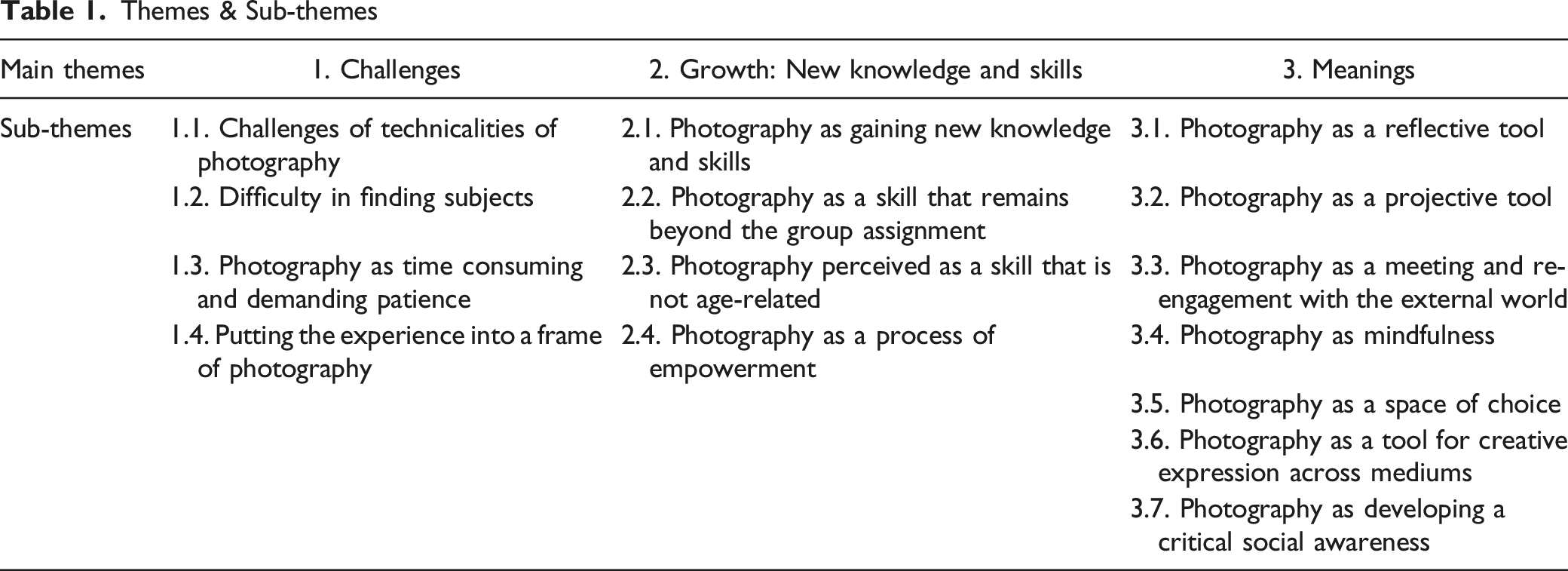
Challenges
The participants reported problems related to photography, encompassing technical, emotional, and intellectual aspects. We used participant number to protect privacy of participants. These challenges will be clarified in the subsequent sub-themes:
Challenges of Technicalities of Photography
The first challenge pointed out by the participants revolved around the technological complexities associated with capturing a photograph. P3: I know how to identify pictures, but?? I didn’t enjoy there…the technology is number one, as an obstacle. P7: Ummm, for me the biggest difficulty was getting along with the photos, adjusting them to the various functions of the cell phone and sending them by email, this is a form of communication I'm less used to…
Difficulty in Finding Subjects
The second challenge highlighted by the participants primarily concerned the integration of their lived experiences during the COVID-19 crisis into the realm of photography: P2: There was once a task that she (the group facilitator) gave, I don’t remember anymore what it was- but I didn’t know what to photograph, I really didn’t have a thing. I arrived at the meeting and said I didn’t have anything to photograph. P4: It happens that they give a photography assignment and you find yourself with nothing to photograph.
Photography as Time Consuming and Demanding Patience
The third challenge emphasized by the participants revolved around the struggle to establish a habit of documenting their daily lives through photography and allocating sufficient time to this task: P3: It also happened that people said in honesty that they didn’t have time, or patience, and that the technicalities took so long to master, that developed into an interesting conversation… P11
Putting the Experience into a Frame of Photography
The fourth challenge identified by the participants predominantly centered on translating their lived experiences of coping with the COVID-19 crisis into the context of photography: P13: Now the tasks also formed a new sort of connection with the environment, because we’re going out to photograph something, according to someone’s instructions, we were guided … P2: I go out for a walk in the community to search for a certain color and I photograph it and here I’m doing something else completely, this was also important… this element, to do something other than what I am accustomed to.
Simultaneously, these directives presented a challenge rather than serving as a restrictive framework. P3: Every task was a challenge, because you wanted to break the rules to make something special, to go beyond the rules. P9: I learned first of all that really everything is point of view and everything is subjective.
Growth: New Knowledge and Skills
Along with facing difficulties, the participants explained how the challenges in photography facilitated a platform for their learning and acquisition of diverse knowledge and skills, as described below:
Photography as Gaining New Knowledge and Skills
Photography was primarily perceived as a newly acquired skill, engendering a sense of accomplishment: P7: The first aspect was the photography, and I really received the foundations of photography, I received understanding of photography. P10: Photographs - I continue and they stand up to all the criteria of the course. The level we achieved despite that it wasn’t the goal. The photography was social photography but yes, I feel that I improved my level of photography and that stayed.
Photography as a Skill that Remains Beyond the Group Assignment
The skills acquired in photography were perceived as a novel skill or language that would persist beyond the group, serving as a valuable resource for the participants. P9: Since I’ve been into photovoice, since the course I’ve learned all kinds of things and I photograph more. Once I didn’t take photographs. Once at the most, I would photograph grandchildren [...] We drove on a trip and I photographed plants, the view, all kinds of things. P12: It continues with me, and I don’t think it’s going anywhere anytime soon, it’s like painting, it’s something I’ve become connected to. It’s not as intensive as during the course but it’s still present.
Photography Perceived as a Skill That is Not Age-Related
The participants addressed the topic of age and their capability to transcend the stereotype linking technology usage with age: P5: Some of us said that we (the older-adult) don’t know how to photograph well. But it didn’t fall on this. Even if some said I don’t know, they always offered help, cut here, download an application to sharpen here and there and that kind of thing. P11: Today I take a lot of photographs with my telephone and it doesn’t matter what age you are…
Photography as a Process of Empowerment
The participants indicated that the experience of engaging with photography-related challenges facilitated the recognition and identification of internal strengths and resources. P8: Every task was a challenge, because you wanted to bring out the good and the interesting and to bring yourself, and this is a challenge… I’m happy that I became brave - I stopped being scared and I photographed what I wanted. P1: I discovered that I was able to handle the challenges of photography, at first I planned to ask my grandchildren to help, but as time passed I was able to complete the tasks myself…
Meanings
Along with dealing with the challenges and difficulties that were described earlier, the participants indicated diverse interpretations they assigned to both the process and the product of photography. The following exemplifies some of these meanings:
Photography as a Reflective Tool
For some participants, the act of photography was akin to encountering oneself: P3: Photography is a very personal tuning in to one’s feelings; it helps to extract stories that are relevant to me at that moment, to define my feelings. P12: I learned more about myself through our activity...
Photography as a Projective Tool
The reflective aspect of photography was characterized as the process of projecting aspects of oneself onto the subjects photographed, which facilitated a profound connection with one’s own emotions. Furthermore, it served as a means of externalizing and expressing these emotions outwardly. P11: A picture tells a story, that’s what it is for me. I don’t generally get involved with photography. As itself, but I used it more as a way of expressing…of projecting and of comfortably expressing what is inside. P3: For example, it searches for your something, to break the rules, what’s the light and the shadow in your life. What makes light and shadow for you. We could bring, let’s say, a picture of Mother, when she was alive this was light and now that she’s not here, it’s shadow. You can take this to many places. So, from the moment they told me about the subject that occupied my thoughts, I was engaged.
Photography as a Meeting and Re-Engagement With the External World
Some of the participants demonstrated an interplay between the internal and external realms not only directed inward but also extended outward, fostering active engagement with the world: P4: I also understood that you photograph and decide on the text according to your specific mood and specific space at that specific moment - it leads you into that moment. P7: This was in the period that there were quarantines, and the photography first of all pushed me to get out of the house and to go out to the Yarkon Park, which I live very close to but hardly ever go there. P12: It’s not something that you go and do all day long, sometimes it is, but you woke up and went to photograph... To look through a different eye when you walk down the street to try to find things…there was a focus on light and shadow, people, all kinds of ideas. It broadened my vision, and I also saw more of the general and entered more into the details.
This is further accentuated during times of home confinement, such as the COVID-19 pandemic, or following a health condition that restricts mobility: P5: I see in photography really phototherapy really. During the period of Corona and also because I live in Nahariya everything I photographed was mainly in the immediate environment. I love to photograph the sea and people and I saw happy people by the sea and suddenly I said “what quarantine? my world continues.” There are people that in the same period became addicted to Zoom and didn’t leave the house, ………
Photography as an Act of Mindfulness
Some participants highlighted the meditative effects of photography: P11: It’s to look at the world with different eyes, sharper ones, it’s the attention to small details. P3: There are people who pass over things and don’t see it. In my opinion suddenly vision becomes sharper and different…through the pictures each told things that are different than what happens in her daily life, slowly you’re exposed to additional things.
Photography as a Domain of Choice
Some participants perceived photography as a domain of conscious decisions and empowerment: P7: …maybe you get a subject, you always choose - what to photograph… it’s your choice… P10: I learned first off that really everything is perspective and everything is subjective, that really we can express ourselves through photography and especially when we add text to the photograph, and to focus on something that turns into being everything… it’s the interpretation that you make on the topic and that’s what’s nice about it…The little moments when you take a photograph and think how it connects.
Photography as a Tool for Creative Expression Across Mediums
Photography was experienced as an enriching and creative medium that significantly bolstered overall creativity: P2: Let’s just say that this is a huge tool, an excellent tool to work on images and this connects to my love for poetry let’s suppose…in short the world of images is really a great tool. P9: Emotionally and intellectually I’ve been enriched, it’s enriching… P4: You photograph with thought as to what goes into the frame, you don’t just capture a moment you think more on different levels, on the aesthetic level, on the innovative level, what you are renewing in this image…
Photography as Developing a Critical Social Awareness
The photography assignment provided an opportunity for the participants to engage in critical observation of social reality. P13: These places that within them the art turns into something communal, wider and larger than just a photography course. P3: In short it was a period in which I could look at the social sides and I live in Beer Sheva and there’s an abundance of it, so it was interesting. Everywhere there’s an abundance of it, but it was interesting to all of a sudden walk around Beer Sheva and to see.
Discussion
While the literature has described the importance of combating loneliness of the older-adult through social engagement and combating cognitive decline through new skills (Fernández et al., 2023; Krueger et al., 2009), the usefulness of photovoice for these aims, rather than for gathering data, has not been explored in the literature. The findings of the current study, which specifically dealt with the photography task, have facilitated the dissection of the distinct impacts made by photography and photovoice groups on the well-being of the older-adult. On the level of cognitive stimulation, the themes show that the participants encountered various challenges and, concurrently, developed new proficiencies that extended beyond the confines of the group environment. This learning encompassed the cultivation of an outward and inward perspective, enabling them to make informed decisions pertaining to aesthetics, content, and psychological dimensions.
On the level of sense of mastery and psychological well-being, it could be argued that the concurrent interplay of projective-reflective attributes, encompassing both internal and external social awareness, within the medium of photography, constitutes a vital factor responsible for fostering a sense of empowerment and creative involvement, both internally, in relation to self, and externally, concerning the world at large (Chui et al., 2020). In conjunction with the technical and creative challenges, the process fostered the development of creative flexibility. Participants were compelled to make compositional decisions that generated novel representations of the familiar. Such cognitive engagement has the potential to stimulate brain plasticity and cultivate adaptable, innovative perspectives, which are frequently compromised by constraints associated with advanced age (Galassi et al., 2022; Safar & Press, 2011; Yan et al., 2021). The orientation towards an external locus facilitated a profound interlinkage with creativity, coping mechanisms, and a sense of trust in the world, even under the extraordinary circumstances of stringent COVID-19 lockdowns. This convergence epitomizes the amalgamation of scholarly work pertaining to photovoice as a potent instrument of personal development and voice, as well as social critique. It connects to the body of literature exploring the utilization of creativity in the domain of arts in health to enhance subjective and imaginative spheres (Biglin, 2022; Huss, 2018; Malka, 2022; Pera et al., 2020).
In the context of old age, it becomes evident that both introspection, characterized by self-reflection, and extrospection, manifested through re-engagement with the external world, assume paramount significance as formidable facets. Likewise, the amalgamation of fresh proficiencies, encompassing technical elements akin to those found in an art class, along with creative autonomy and latitude, confined within the framework of art therapy, facilitated a comprehensive and all-encompassing encounter of challenges and expressions, entailing a journey of introspection and an outreach to the external realm (Huss and Havs teen-Franklin, 2023; Vaartio-Rajalin et al., 2021). This heightened focus translated into a state of mindfulness and profound attentiveness. Furthermore, it created a reflective milieu, wherein internal emotions found expression in external symbols, thereby fostering an immersive space for profound self-encounter (Chen, 2023). These benefits can extend beyond crises times, encompassing all older individuals grappling with reduced brain plasticity, limited social interactions, and a narrowing scope of their worlds. We can redefine solitude and physical constraints as opportunities to explore the world and self in a gratifying and empowering manner.
On the level of social contact, photography afforded the opportunity both to reflect inwards and also to share that reflection with others. This helps to transcend self-absorption and re-engage with the world, the self, and others, all encapsulated within the confines of aesthetic embodied involvement. The emphasis lies not on illness but on well-being, while simultaneously offering a means to address loneliness and suffering through impactful verbal expressions with others in a shared reality group, who can identify with the content (Huss, 2018; Segal-Engelchin et al., 2020).
This study highlights the valuable lessons we can glean from the liminal framework that bridges the realms of a support group and a skills group, as well as the convergence of photography as an art form and a means of communication with others. This fusion strikingly achieved the ideal equilibrium between providing challenges and ensuring a sense of safety for the participants—space to reflect, and space to meet others, mediated through art. Thus, photography catered to the reflective and social requirements that are essential for older individuals, as described earlier (Medroso & Ramos, 2022). As stated, interventions that address the challenges of social isolation, health concerns, limited mobility, and feelings of purposelessness hold immense relevance in enhancing quality of life for older adults (Heinz et al., 2023).
Photovoice does not demand complicated equipment, expensive training, or group leadership and is thus an accessible cost-effective way to reach these goals. Amidst the current climate of uncertainty characterized by political upheaval, climate change, and health crises such as the COVID-19 pandemic, these interventions become even more significant. The elements of this model for older people, as evidenced by this research, highlight the importance of providing ample support with technical photography matters, offering directives that structure the photography process and encourage engagement with the physical world. Additionally, a non-critical facilitated group environment is emphasized, where focus is placed on both technique and self-expression, fostering a sense of efficacy and mastery. Strong relational support and encouragement are also crucial components of this model.
Footnotes
Acknowledgment
The authors thank the PHOTO IS:RAEL organization and the Older Adults who participated in the project, for the opportunity to learn from their knowledge and experience.
Declaration of Conflicting Interests
The author(s) declared no potential conflicts of interest with respect to the research, authorship, and/or publication of this article.
Funding
The author(s) received no financial support for the research, authorship, and/or publication of this article.
