



Abstract
There are 200+ tested interventions for care partners (family, friends, and fictive kin) of people living with dementia (PLWD). But these interventions do not systematically cover relevant settings. Nor do these interventions affect all relevant outcomes that matter to people and healthcare systems. We present an evidence map of settings and outcomes from translated interventions to identify gaps. Of 190 studies identified, 31 unique interventions were retained in the evidence map. Identified setting gaps included studies set solely in hospitals/medical centers or set in multiple settings. Identified outcome gaps included interventions that improved care partner beliefs about providing care, care partner negative coping strategies, PLWD resources (e.g., social support), and PLWD coping strategies. Armed with an understanding of present gaps, we call on researchers to fill the identified gaps to ensure systematic coverage of settings and evaluation of outcomes that matter to people and healthcare systems.
• 31 evidence-based dementia caregiver interventions have associated implementation efforts. • Few implemented dementia caregiver interventions are set in hospitals/medical centers or combinations of settings. • Few implemented dementia caregiver interventions have improved care partner beliefs about providing care, care partner negative coping strategies, PLWD resources (e.g., social support), and PLWD coping strategies.
• Additional intervention development can target understudied settings and outcomes, but these gaps may also be filled by increasing implementation efforts for efficacious interventions that have not yet been implemented broadly. • The rapid iteration and improvement in behavioral interventions that is required to implement effective interventions in real world settings may be achieved, in part, by supplementing traditional systematic review methods to synthesize research in implementation through a wide range of sources that extend beyond traditional academic literature. • While these outcomes and settings are worthy of future intervention/implementation efforts, not all interventions should try to fill every gap. Instead, we encourage interventionists to consider these gaps and explore whether filling them using their particular intervention could better serve PLWD and their carepartners.What this paper adds
Applications of study findings
Introduction
The dementia care literature includes many individual psychosocial interventions that improve outcomes for care partners (family, friends, fictive kin; CP) of persons living with dementia (PLWD; Butler et al., 2021; Gitlin, Jutkowitz, et al., 2020; Larson & Stroud, 2021; Livingston et al., 2020). Notably many of these interventions also affect outcomes for PLWD directly. There is some disagreement about the preparedness of these interventions for implementation on a large scale (Butler et al., 2021; Gaugler et al., 2021; National Academies of Sciences, Engineering, and Medicine, 2016), but the vast majority of efficacious trials have not been implemented in real world settings. When implementation does happen, it takes an exceptionally long time and sustainability is questionable (Gitlin et al., 2015; Hodgson & Gitlin, 2021). To this end, considerable effort and investments are underway to facilitate the implementation of efficacious trials in real world dementia care contexts (Mitchell et al., 2020).
The present paper examines the outcome measures used in existing intervention studies and the sites in which they were tested. The goal is to derive outcome and setting recommendations for future dementia care interventions to be implemented in real world settings. We present an evidence map that provides a visual display of key characteristics of existing interventions. Rather than following the format of a traditional systematic review, the present work extracts data from a wider range of sources to identify gaps and opportunities for translating interventions for delivery in real world settings. Systematic reviews typically include interventions tested in randomized trials and exclude translational efforts. In contrast, evidence maps entail “search of a broad field to identify gaps in knowledge and/or future research needs that presents results in a user-friendly format, often a visual figure or graph, or a searchable database” (Miake-Lye et al., 2016, p. 18).
The present study includes data sources that follow more traditional review methods (e.g., scoping review) as well as those that are less traditional, but more likely to capture appropriate interventions (e.g., targeted efforts to compare dementia care programs that are being implemented). These sources are augmented by expert review by a core of researchers brought together by the National Institute on Aging’s Imbedded Pragmatic Alzheimer’s and AD-Related Dementias Clinical Trials (IMPACT) Collaboratory to explicitly focus on implementation of dementia care interventions. An evidence map of settings and outcomes of existing intervention efforts will facilitate an understanding of gaps in dementia care interventions that are in an implementation phase. This understanding can, in turn, inform the next generation of implementation research in dementia care. Moving evidence to practice is a world-wide imperative in dementia care (Baker et al., 2022) to improve the quality of life of individuals and their family members.
Method
Search Strategy
Evidence Map Data Sources.
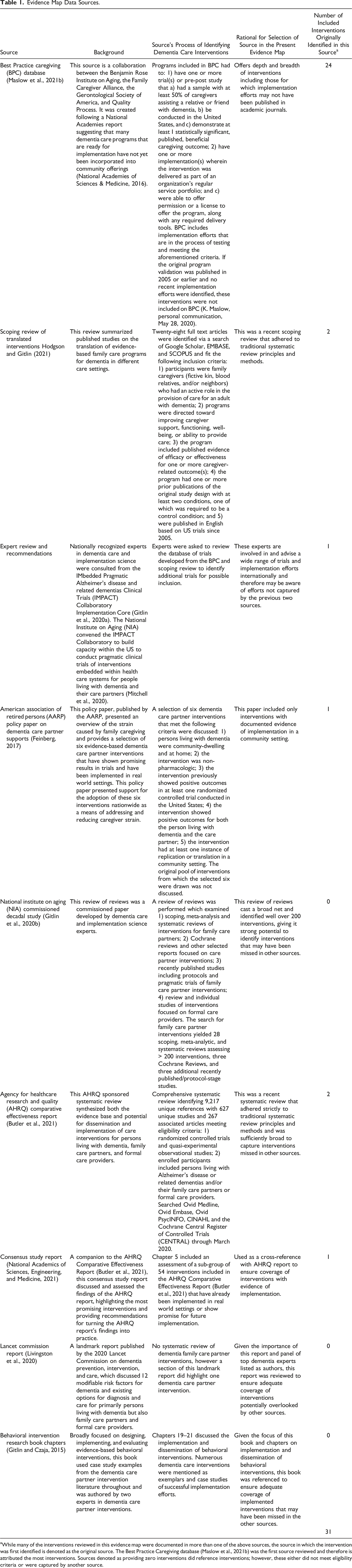
aWhile many of the interventions reviewed in this evidence map were documented in more than one of the above sources, the source in which the intervention was first identified is denoted as the original source. The Best Practice Caregiving database (Maslow et al., 2021b) was the first source reviewed and therefore is attributed the most interventions. Sources denoted as providing zero interventions did reference interventions; however, these either did not meet eligibility criteria or were captured by another source.
Procedure
Inclusion Criteria
Included interventions (1) were tested in a randomized controlled trial; (2) demonstrated a statistically significant benefit for one or more CP outcomes; (3) reported in an English-language, peer reviewed journal; (4) were tested in the US; (5) were non-pharmacologic; (6) had not been substantially modified from the original version of the intervention (Intervention translations or modifications that were separately published were excluded from this evidence map); and (7) had evidence of intervention implementation (whether or not that implementation evidence was published).
Information Extracted
From each included intervention, we extracted the following intervention characteristics: (1) dose and intensity (i.e., number of sessions, duration of intervention, and length of each session); (2) modality (in-person, online, and/or telephone), (3) provider-client ratio (1:1 intervention-CP, 1:2 interventionist-dyad, self-guided, group setting); (4) setting(s) (home, hospital/medical center, community space, and/or telephone/web-based); (5) outcomes for the PLWD, and for the CP. Information on interventions, outcomes, and associated publications were stored in the online database management system, Airtable (Airtable, n.d.).
After the above information was extracted, a list of measures used to evaluate outcomes in the trials was also compiled in Airtable. The use of each measure across trials was examined and the following characteristics determined: (1) if measure targeted CP or PLWD; and (2) if measure had previously been psychometrically tested or was newly investigator-developed within that trial. 2
Categorizing Settings
Delivery settings included: (a) either Community spaces, Home, remote via Telephone/Web, or Hospitals/Medical Centers; (b) one of six combinations of two settings (e.g., Home + Telephone/Web); (c) one of four combinations of three settings (e.g., Community + Home + Telephone/Web); or (d) the combination of all four settings (i.e., Community Space + Home + Hospital/Medical Center + Telephone/Web). This rendered a total of 15 possible settings or combinations of settings, and each intervention was categorized into just one of those setting or combination categories.
Categorizing Outcome Domains
Three authors, representing a broad range of disciplines (i.e., nursing science, psychological science, and rehabilitation science), were blinded to which intervention used each measure (JS, ZB, AG). These three independently examined all intervention measures and categorized them by conceptual domains using an emergent (i.e., inductive) approach (Creswell & Poth, 2016). Each author examined the measures that fell broadly within their area of expertise: a fourth author (MD) then sorted measures into the categories used in the Dementia Caregiving Model (Liu et al., 2012). The Dementia Caregiving Model is derived from both stress and coping (Lazarus & Folkman, 1984) and two-factor (Lawton et al., 1991) models and was chosen for the present categorization because of its classification of a wide range of variables that describe and affect the CP experience. For measures that did not fit into the model, additional categories were developed and agreed upon by consensus across these four authors. Following this first stage of categorization, JS, ZB, and AG (who were blinded to MD’s categorization) repeated the process and categorized the measures into the established categories. Categorization inconsistencies were resolved through discussion until consensus was achieved.
Results
Study Characteristics
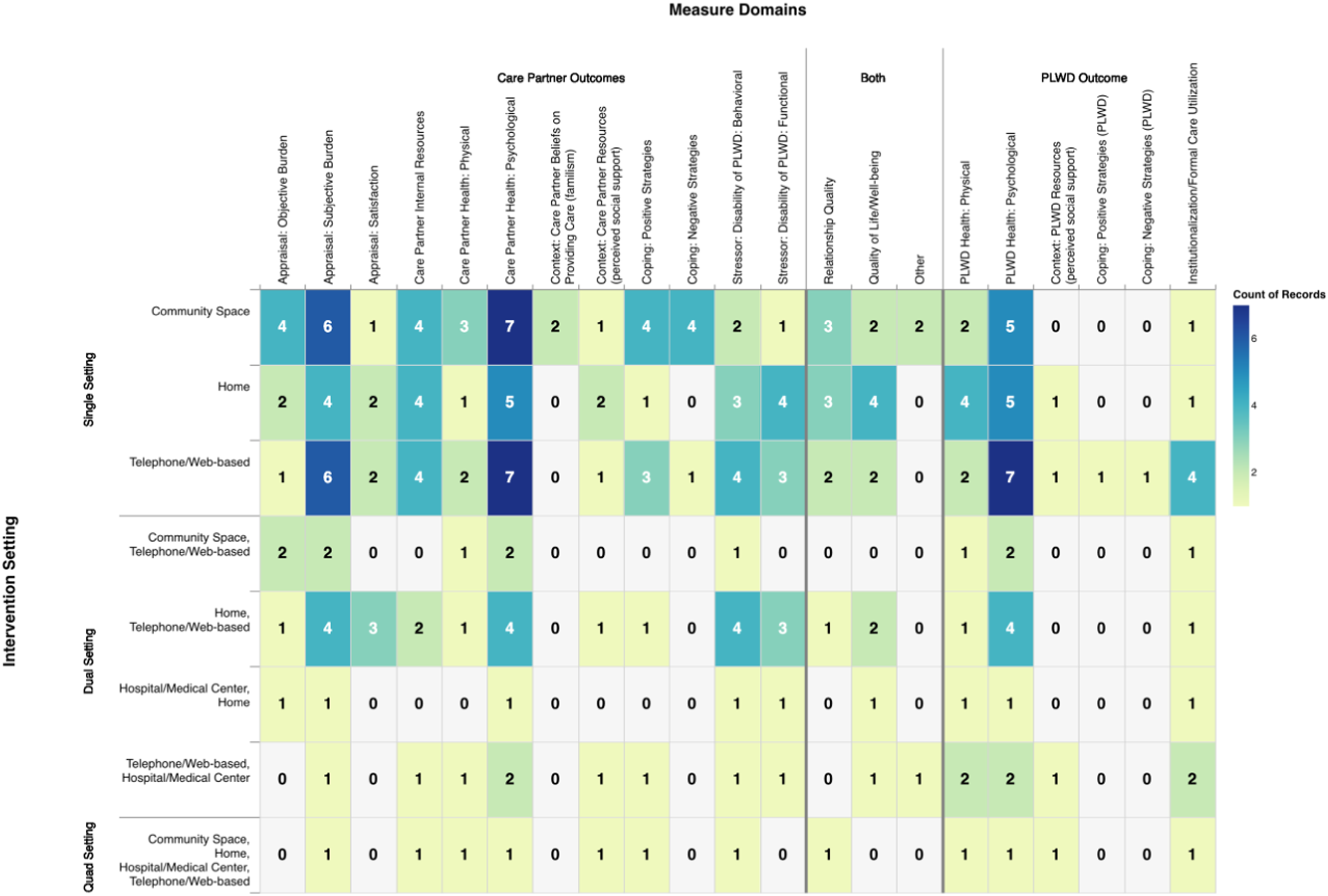
We identified 190 interventions (Figure 1). Eighty-two were excluded for testing outside the US, 22 were excluded for not employing a randomized controlled trial, 6 were excluded for lacking a statistically significant CP outcome, 39 were excluded for lacking evidence of implementation, and 10 were excluded as translations of included interventions not representative of the original efficacy trial and sample. This resulted in a final sample of 31 unique interventions that are included in the present evidence map (Figure 2). Prisma diagram of inclusion/exclusion of interventions. Many interventions tested and reported outcomes in multiple domains and used measures that were inherently multidimensional.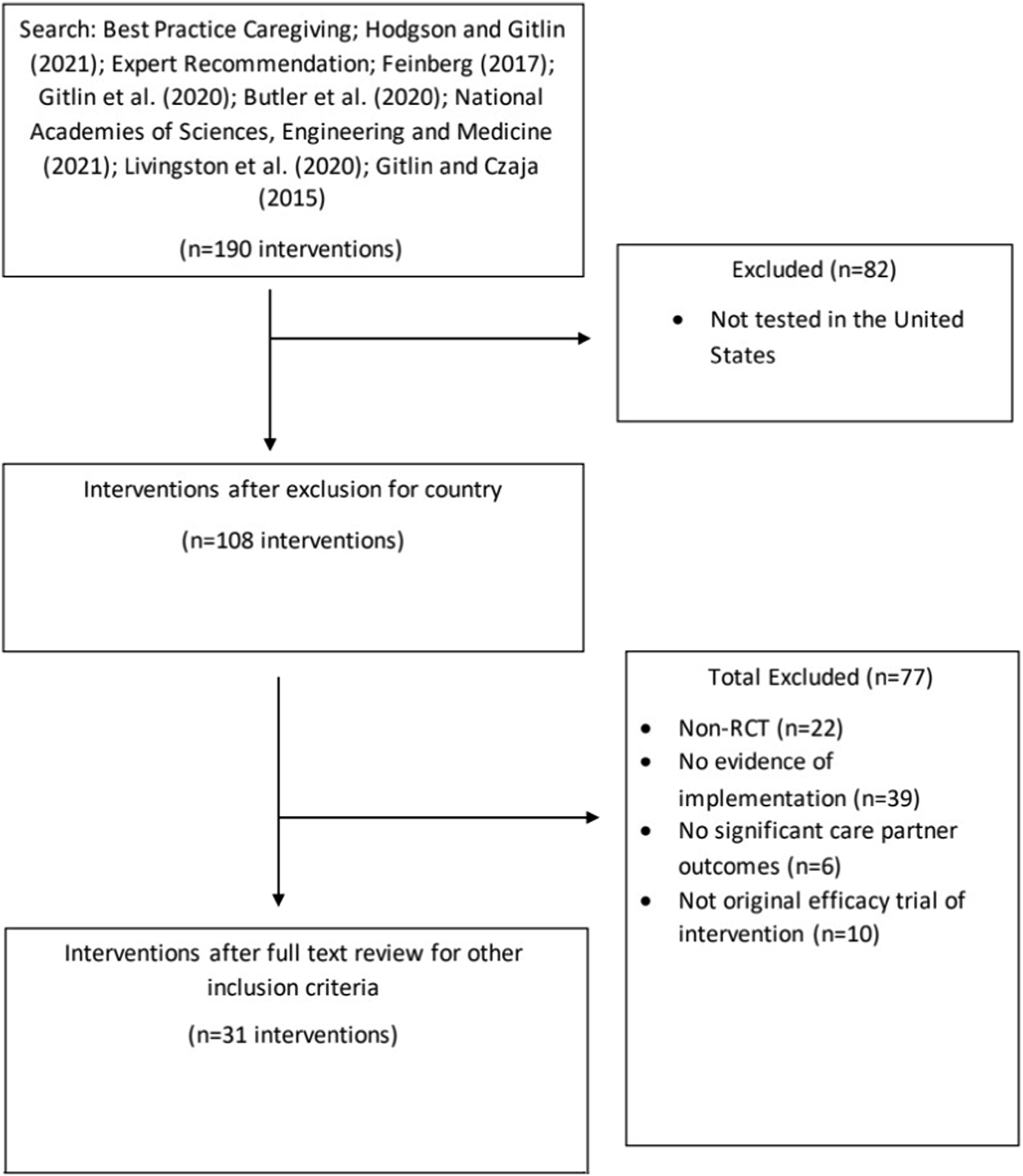
Evidence Map Database
The database of included interventions and coded variables can be found at https://airtable.com/shrGVBN2mEB49zzXd and is offered for open use.
Intervention Characteristics: There was considerable variation in the format of interventions. Twenty-two interventions (70.97%) had a fixed number of sessions ranging from three to 56 sessions. Nine interventions (29.03%) did not have a fixed number of sessions, with some interventions instead having a set minimum or maximum. Session length was similarly variable with 14 interventions (45.16%) reporting varying lengths and the remaining 17 interventions (54.84%) reporting lengths ranging from 15 minutes to two and a half hours. Similarly, intervention duration was variable ranging from two weeks to over one year, with seven interventions (22.58%) reporting no fixed duration. Finally, the ratio of interventionist to client varied with eight (25.81%) interventions having a 1:1 ratio of interventionist to CP, seven (22.58%) having a 1:2 ratio of interventionist to dyad (i.e., CP and PLWD), and seven (22.58%) having a 1:many ratio of interventionist to a group of CP. The remaining 9 (29.03%) interventions were predominantly combinations of the aforementioned ratios or were self-guided.
Findings by Setting
Of the 31 unique interventions, 21 (67.74%) were confined to a single setting (eight Community, six Home, seven Telephone/Web). No interventions were conducted solely in a Hospital/Medical Center setting. Nine interventions (29.03%) were delivered in dual settings with one combining Home + Hospital/Medical Center and the remaining eight combining Telephone/Web administration with another setting (four Home, two Hospital/Medical Center, two Community). The sole remaining intervention combined all four settings. Collapsing across combinations, most settings were well represented with 11, 12, and 16 interventions making at least partial use of community space (35.48%), home (38.71%), and telephone/web (51.61%), respectively. Hospital/medical centers were comparatively much more poorly represented, being used in just four interventions (12.90%).
Findings by Outcome Domain
Outcome Categories.

The frequency of measures across domains differed vastly. For instance, less commonly assessed outcomes included CP beliefs about providing care (6.45%), CP negative coping strategies (16.13%), PLWD social support (6.45%), PLWD positive coping strategies (3.23%), and PLWD negative coping strategies (3.23%). In contrast, more commonly assessed outcomes included CP objective burden (35.48%), CP internal resources (51.61%), CP physical health (32.26%), CP positive coping strategies (35.48%), CP behavioral (54.84%) and functional stressors (41.94%), PLWD physical health (45.16%), and institutionalization/formal care utilization (38.71). Three outcome domains were assessed in most of the trials: CP subjective burden (80.65%), CP psychological health (93.55%), and PLWD psychological health (87.10%).
The frequency of measures assessing outcomes dyadically also varied. Some measures inherently included both members of the CP-PLWD dyad together (i.e., relationship quality, quality of life). Other measures could be assessed for either member of the dyad, but evaluation of these outcomes showed that some outcomes were assessed more frequently for one party than another. Among those outcomes were those in the domains of psychological health, physical health, resources (e.g., social support), positive coping strategies, and negative coping strategies.
The most studied outcomes fell within the domain of psychological health, which was examined in 30/31 (96.77%) interventions (cf. Stern et al., 2008). In 26/31 interventions (83.87%), psychological health was assessed for both the CP and the PLWD. In 3/31 interventions (9.68%), psychological health was only assessed for the CP, and in 1/31 interventions (3.23%), psychological health was only assessed for the PLWD.
Findings for physical health contrasted markedly from psychological health, being studied in far fewer interventions (18/31; 58.06%). Interventions that assessed physical health (n = 18) 3 did so in both parties in 6/18 interventions (33.33%), in CPs only in 4/18 interventions (22.22%), and in PLWD only in 8/18 interventions (44.44%).
Outcomes in the remaining domains were substantially more skewed toward being assessed only in CPs. Within interventions that measured internal resources (e.g., self-efficacy) (n = 16/31 interventions; 51.61%), social support resources, (n = 8/31 interventions, 25.80%), positive coping strategies (n = 12/31 interventions; 38.71%), and negative coping strategies (n = 6/31 interventions; 19.35%), only CPs were assessed in 16/16 (100%), 4/8 (50%), 11/12 (91.67%), and 5/6 (83.33%) of interventions, respectively. Interventions that measured effects on social support resources, assessed both PLWD and CPs in 3 interventions (3/8; 37.50%), but no interventions assessed positive (0/12; 0%) or negative coping strategies (0/6; 0%) for both PLWD and CPs. The remaining interventions assessed social support resources (1/8; 12.50%), positive coping strategies (1/12; 8.33%), and negative coping strategies (1/6; 16.67%) for only the PLWD.
Discussion
In the context of the 200+ evidence-based dementia care interventions that have been developed and tested, the present evidence map found 31 that have been or are currently being implemented in real world contexts and have evidence of benefit for CPs. Supporting the value of this evidence map methodology relative to traditional review methodologies, for the present goals, no past reviews (Butler et al., 2021; Gitlin et al., 2020b; Livingston et al., 2020), contained all relevant interventions, to our knowledge. The present evidence map reveals interesting gaps and opportunities in measurement of focal outcomes of interventions that have been implemented. Trials for interventions that were implemented tended to (1) be delivered in single settings or single settings augmented by telephone/web; (2) assess CP subjective burden, CP psychological health, or PLWD psychological health; and (3) assess outcomes in CPs more often than in PLWD. Trials that were implemented tended not to: (1) take place in hospitals/medical centers; (2) take place in multiple settings (other than those combined with telephone/web); or (3) assess CP beliefs about providing care, CP negative coping strategies, PLWD social support resources, or PLWD coping strategies.
These gaps may be driven by multiple factors. For instance, it is possible that the present understudied outcomes and settings are understudied because creating interventions that operate in those settings or that affect those outcomes are not beneficial to CPs and PLWD. It is also possible that there are immovable structural challenges that are making intervention in these settings or with these outcomes impossible. A third possibility is that researchers are not creating and implementing interventions that operate in these settings or affect these outcomes. We discuss below why these settings and outcomes may matter and how researchers may benefit by giving them consideration when designing, adapting, and implementing interventions.
Implemented Intervention Gaps and Recommendations
Understudied Settings
Future interventions designed to benefit CPs and PLWD might target settings that received relatively less attention in the reviewed interventions like hospitals/medical centers and combinations of settings (other than through telephone/web-based settings).
Hospitals/Medical Centers
Relatively few interventions included in the evidence map had been implemented in hospitals/medical centers. One possible issue with solely setting interventions in hospitals/medical centers is that CPs are often not the patients of those settings thus knowing how their outcomes have been affected by hospital/medical center-based interventions may be challenging. One explanation for this may be the medical model’s focus on the PLWD (i.e., the patient) and not the CP (for whom reimbursement for services is not available unless the CP is being treated separately). An alternative medical model might take a more holistic, person and family centric approach (Cohen et al., 2022). The medical model could do this by incorporating the role and impact of the CP’s well-being on the health of the patient (i.e., PLWD). The health of the PLWD would then, in-turn, impact outcomes important to hospitals/medical centers, like healthcare utilization or quality or life. Still, such substantial changes to the medical model, while offering benefits, represent large undertakings requiring systemic change and increased efforts by staff who work in these settings.
Notably each of the interventions from the evidence map that did incorporate hospitals/medical centers also incorporated telephone/web settings. Given that incorporating telephone/web may be a one way to improve access, interventionists may consider doing likewise. Increased feasibility for this may result from recent trends associated with the COVID-19 pandemic: telehealth has rapidly become more frequently used, more acceptable, and there are more emerging payment models. Relatedly, we found a narrow band of outcome measures repeatedly used in these trials and while they may be of interest to CPs, they may not fully align with what the health system believes matters (e.g., decline in health care utilization, cost analyses). To better incorporate these settings, it will be important for interventions to assess and show benefit for the outcomes that matter most to stakeholders in those settings.
Multiple Settings
Far more interventions took place in individual settings (e.g., solely in Community or Home settings), rather than a combination of settings (e.g., in both Community and Home settings). One explanation is that multiple settings can increase the complexity of delivering an intervention. At the same time, many CPs of PLWD access multiple settings on a regular basis, thus employing multiple settings in an intervention may be more likely to (1) reach CPs and (2) improve the capacity of the intervention to improve outcomes of interest.
A greater capacity of interventions to improve outcomes of interest when using multiple settings may arise from the ability of an intervention to touch CPs and PLWD in many domains of life. For instance, an intervention that takes place solely in the home may have less impact following institutionalization. Likewise, the effects of an intervention taking place solely in community settings may become more difficult to maintain if CPs and PLWD move to a new community or if their condition advances to a point when they have trouble entering community settings. By interfacing with CPs and PLWD across settings, the impact of an intervention may be more likely to continue having positive impacts through care and disease severity transitions. Still, these potential benefits come with costs (e.g., interventionist, CP, and PLWD time; training and maintenance of fidelity across heterogenous providers in a range of settings). Therefore, researchers creating interventions will have to carefully weigh costs and benefits when making intervention setting design decisions.
As recommended above, telephone/web may be one simple way to employ multiple settings, but we encourage researchers and healthcare systems to also think creatively about how their interventions might be applied across multiple settings. Adaptations of interventions and implementation strategies may be needed to deploy across different settings simultaneously. This may also speak to the need for stronger cross-sector collaborations (and incentives to form them). But we do want to be clear that identifying this gap should not be taken to mean that all interventions should apply in all settings. Instead, we encourage researchers to give increased consideration to whether their interventions might benefit from administration across multiple settings.
Understudied Outcomes
Future interventions designed to benefit CPs and PLWD might target outcomes that received relatively less attention in the reviewed interventions like CP beliefs about providing care, CP negative coping strategies, PLWD social support resources, and PLWD positive and negative coping strategies.
PLWD Outcomes
Because one criterion of interventions for the present evidence map was that there be a statistically significant impact on a CP outcome, it is possible that interventions to improve PLWD resources and coping strategies may be underrepresented. If this is the case, it seems like a missed opportunity, given that several interventions assessed these outcomes in CPs. Decades of foundational relationship theory demonstrate that the experience of a family or friend affects the experience of another family member or friend (Van Lange & Balliet, 2015). Accordingly recent work demonstrates that CP interventions improve outcomes for PLWD (Cheng et al., 2022) and researchers should consider inclusion of PLWD outcomes in CP interventions. It seems likely that many interventionists intuited this point given that 81% of included interventions did evaluate PLWD outcomes. Moreover, PLWD social support and positive/negative coping align quite well with the core outcome set as agreed upon by PLWD, care partners, health and social care professionals, researchers, and policymakers (Reilly et al., 2020). For instance, social support has obvious alignment with the single most endorsed outcome of importance by PLWD: the importance of relationships. Similarly, coping strategies might help PLWD to feel more fulfilled in each of the other categories when inevitable setbacks or challenges arise, allowing for a greater resilience to those setbacks/challenges.
CP Outcomes
Lacking from reviewed interventions were the outcomes of CP beliefs about providing care and CP negative coping strategies. One important reason to develop interventions that improve beliefs and relieve or resolve negative coping strategies is that those with negative beliefs and negative strategies may do significant harm to both the PLWD and themselves. For instance, those with unhealthy beliefs about caregiving may be most at risk of providing poor-quality care (Phillips et al., 1989). Likewise CPs with more negative coping strategies may experience more impairments in mental health and work than those with fewer negative coping strategies (Bond et al., 2011). One might argue that these outcomes are distal and that efforts are better targeted toward directly improving outcomes like quality care. We agree that in some scenarios those strategies may be beneficial, but they are unlikely to be a panacea. For instance, if care improves temporarily, it may be challenging to sustain those improvements in the face of harmful beliefs or negative coping strategies. Moreover, even if those care improvements were sustained, harmful beliefs and negative coping strategies mean, by definition, that the caregiver continues to suffer.
Limitations and Future Directions
Some limitations directly result from inclusion criteria selected for the present evidence map. While we feel these criteria were appropriately chosen to raise confidence in conclusions, they do limit generalizability. For instance, all interventions were tested in the US. While this increases intervention homogeneity and comparability, dementia is a global problem, warranting similar investigations on a global scale and more attention needs to be paid to low- and middle-income countries where most PLWD reside (Baker et al., 2022). Likewise, because of the focus on interventions that affect CP outcomes, the results concerning PLWD outcomes may be underrepresented (cf. the widespread measurement of PLWD psychological health across interventions). Another implication of the inclusion criteria (i.e., focusing on original iterations of interventions) means that adaptations were not included. Adaptations are an important aspect of disseminating and implementing interventions in real world settings (Cabassa & Baumann, 2013; Hodgson & Gitlin, 2021), so this limitation is not taken lightly. While this criterion seems appropriate for the focus of the present evidence map, it should not be taken to discount the value of rigorously adapting interventions. Relatedly there are several interventions which are well accepted as providing significant benefits in the community despite a lack of evidence base that would allow them to be included in the present study (e.g., the “Dealing with Dementia” intervention from the Rosalynn Carter Institute).
The present evidence map also did not evaluate the strength of evidence for any given outcome. This is noteworthy in the context of debate about how ready dementia care interventions are for implementation (Butler et al., 2021; National Academies of Sciences, Engineering, and Medicine, 2016). While this is a debate we are attentive to (Gaugler et al., 2021), it is outside the scope of the present focus on gaps and opportunities for impact within interventions that are currently being implemented. Still, to aid future researchers in weighing strength of evidence, we have incorporated strength of evidence of included interventions provided by Butler et al. (2021) into the airtable database. We believe this is part of a broader criticism (and also an opportunity) that is applicable to this evidence map: there are many ways to explore these data. For instance, interventions could be stratified in myriad ways (e.g., whether the intervention was implemented as tested, treating outcomes like social support or coping strategies as structure or process rather than outcomes in and of themselves, exploring how telephone/Internet settings were used instead of whether they were used). We are hopeful that many researchers find new and interesting ways to slice these data, indeed that is one major motivation for the airtable database of our interventions: to make it easier for them to do so.
While there is reason to believe the present review method may capture more interventions than traditional review methods, this is challenging to verify, and we are not aware of other efforts that have validated the method. This method was not cross-checked with a more traditional database search, which fails to erase the possibility that relevant studies were missed in the sources used. One suggestive (though not definitive) piece of evidence that the present method did seem well suited to the present aims is that no prior reviews captured all of the interventions included here. Despite this there appeared to be considerable saturation with most interventions being identified in multiple sources.
Finally, just because there is a gap in settings or outcomes does not inherently mean that that gap needs to be filled. We believe evidence presented above suggests that there is good reason to fill gaps in the outcomes found to be understudied. But the evidence that interventions should increasingly be employed in a wider variety of settings is reliant on somewhat less intuitive. Still, it does seem likely that there are hospital/medical center personnel who have seen first-hand the challenges that CPs face and want to do something to benefit them. While they may be able to select from interventions that have, as yet, no efforts toward implementation, this is a considerable undertaking. Filling this gap may have knock-on effects wherein hospitals/medical centers with fewer resources (whether in time, personnel, or money) are able to adapt and implement efficacious interventions in their own settings after the initial implementation work has been undertaken by hospitals/medical centers with greater resources.
Conclusion
This evidence map presents several gaps among dementia CP interventions that are being implemented. Among the largest gaps are a lack of interventions implemented in real world situations that span multiple settings (e.g., combining Home, Hospital, and Community in a single intervention) or take place in hospitals/medical centers. Perhaps more immediately impactful, though, is the undermeasurement of beliefs, coping strategies, and resources, which are intuitively important directly, indirectly, and have been identified as some elements of core outcomes agreed upon as of considerable importance by PLWD, care partners, health and social care professionals, researchers, and policymakers. Finally, this evidence map suggests that a gap remains in assessment of outcomes for both PLWD and their CPs, despite decades of theory and evidence that outcomes for one member of the dyad are likely to impact outcomes of the other.
Supplemental Material
Supplemental Material - Evidence Map of Non-Pharmacological Dementia Care Partner Interventions Implemented in the US: Gaps and Impact Opportunities
Supplemental Material for Evidence Map of Non-Pharmacological Dementia Care Partner Interventions Implemented in the US: Gaps and Impact Opportunities by Zachary G. Baker, Maria Dellapina, Allison M. Gustavson, Justine S. Sefcik, Sokha Koeuth, Joseph E. Gaugler, Kimberly Van Haitsma, and Laura N. Gitlin in Journal of Applied Gerontology
Footnotes
Acknowledgments
In addition to the listed authors, who are members of the NIA IMPACT Collaboratory Implementation Core (IC), we wish to acknowledge IC members who critically reviewed the manuscript and provided feedback on interventions that had not previously been identified. We would also like to thank Katie Maslow for her consultation regarding the Best Practice Caregiving Website. We also want to thank Joahana Segundo for her contributions in deriving estimates of quality from included interventions. Portions of these findings were presented at the annual meeting of the NIA IMPACT Collaboratory by the first, second, and senior authors. All authors contributed to the ideas behind this manuscript, have reviewed and edited text, and have engaged in discussions of interpretation for the findings. ZGB and MD held primary responsibility for drafting the manuscript. MD held primary responsibility for data capture, storage, and organization. Researchers using our publicly available Airtable database ( ) are welcome to consult with us but are not required to offer co-authorship for any usage of this information. We request that they cite the present manuscript in resulting publications.
Declaration of Conflicting Interests
The author(s) declared no potential conflicts of interest with respect to the research, authorship, and/or publication of this article.
Funding
The author(s) disclosed receipt of the following financial support for the research, authorship, and/or publication of this article: This work was funded by the National Institute on Aging (NIA) of the National Institutes of Health (NIH) under Award Number U54AG063546, which funds NIA Imbedded Pragmatic Alzheimer’s and AD-Related Dementias Clinical Trials Collaboratory (NIA IMPACT Collaboratory). This work was also supported by the NIA of the National Institutes of Health under award number K99/R00 AG073463, R00AG073463; the National Institute of Nursing Research of the National Institutes of Health under award number [K23 NR018673]; the Robert L. Kane Endowed Chair in Long-Term Care and Aging; the Veterans Health Administration Office of Academic Affiliations Advanced Fellowship in Clinical and Health Services Research (TPH 67-000) [AMG]; the Agency for Healthcare Research and Quality (AHRQ) and Patient-Centered Outcomes Research Institute (PCORI), grant K12HS026379 and the NIH’s National Center for Advancing Translational Sciences, grant KL2TR002492; and the Minneapolis Center of Innovation, Center for Care Delivery and Outcomes Research (CIN 13–406) [AMG]. The content is solely the responsibility of the authors and does not necessarily represent the official views of the National Institutes of Health, Department of Veterans Affairs, or the United States Government, AHRQ, PCORI, or Minnesota Learning Health System Mentored Career Development Program (MN-LHS).
Supplemental Material
Supplemental material for this article is available online.
Notes
References
Supplementary Material
Please find the following supplemental material available below.
For Open Access articles published under a Creative Commons License, all supplemental material carries the same license as the article it is associated with.
For non-Open Access articles published, all supplemental material carries a non-exclusive license, and permission requests for re-use of supplemental material or any part of supplemental material shall be sent directly to the copyright owner as specified in the copyright notice associated with the article.
