



Abstract
• This paper enriches the literature by focusing on cognitive functions in high-risk groups like those with hypertension, offering novel preventive strategies for cognitive decline.
• Our predictive model informs early interventions for at-risk individuals, aiding in delaying cognitive impairment. • Recommendations are made for community and hospital settings to assess cognitive risk in hypertensive patients, particularly the elderly.What this paper adds
Applications of study findings
Introduction
Dementia is a syndrome characterized by the progressive and irreversible loss of cognitive functions: attention, memory, executive function, visuospatial skills, and language (Hainsworth et al., 2017; Mone, Martinelli, et al., 2023a). Dementia is a severe public health concern due to its impact on the patient’s lifestyle and significant alteration of the lives of family members (Y. Zhao et al., 2014). Mild cognitive impairment (MCI) is a state that lies between normal aging and dementia and is considered a precursor to dementia (Y. Zhao et al., 2014). Currently, more than 360,000 Chinese people are diagnosed with cognitive impairment each year, and it is predicted that by 2060, there will be 48.68 million cognitively impaired persons in China as a whole (Jia et al., 2020; Zheng, 2020).
The Wilde et al. study reveals a link and even a causal relationship between hypertension and cognitive impairment (Folstein et al., 1975). Recent research conducted by the Framingham Heart Study suggests that the decrease in the incidence of dementia observed over three decades is partially attributed to better control of vascular risk factors, such as high blood pressure (Prince et al., 2011). The effects of hypertension on cognitive function may be related to a variety of mechanisms (Ungvari et al., 2021), including atherosclerosis, brain atrophy, white matter damage, and degenerative neuronal changes (Pansini et al., 2022). In recent years, the prevalence of hypertension has been increasing in China (“Encyclopedia of Quality of Life and Well-Being Research,” 2015; Lewinsohn et al., 1997). According to the current study, there is a clear connection between cognitive impairment and high blood pressure. At the same time, the rapid increase in the global prevalence of dementia has led to widespread interest in hypertension as a treatable condition that can be controlled to delay the onset of cognitive impairment (Rouch et al., 2019). Hypertension persists as a significant public health challenge in China. Data from four comprehensive surveys indicate an increasing prevalence of hypertension among community-dwelling individuals (Lu et al., 2017; Z. Wang et al., 2014). The low awareness and control of hypertension among Chinese adults leads to substantial income allocation toward expenses related to hypertension and its complications, thereby imposing a significant financial burden on patients for healthcare costs (Berek et al., 2021; Z. Wang et al., 2018). Identifying MCI in hypertensive individuals through early risk assessment is especially crucial to minimize their likelihood of developing dementia (Mone, De Gennaro, et al., 2023b).
Predictive models may be an effective way to identify individuals at high risk for cognitive impairment (Qin et al., 2017). Numerous predictive models exist that utilize big data to identify risk factors associated with cognitive impairment, including those predicting late-life dementia in middle-aged adults and identifying individuals at high risk for cognitive impairment (Hu et al., 2021; Kivipelto et al., 2006; Na, 2019; Pu et al., 2023). Various variables, including age, education, hypertension, and obesity, are incorporated to construct a predictive model for cognitive impairment (Ansart et al., 2021; Dimache et al., 2021). By constructing predictive models, some findings aim to offer insights into accurate diagnostic and prognostic methods for clinical treatment. This macro-to-micro correlation will yield novel information, facilitating the further exploration of cognitive disorders (Huang et al., 2020; Petersen et al., 2019; Skolariki et al., 2021). To our knowledge, there are no other risk prediction models to assess the risk of MCI in specific populations.
Therefore, the aim of this study was to develop a predictive model to identify individuals at risk of MCI among hypertensive patients including those who have diagnosis of HTN but whose HTN is well managed with medication or otherwise. This model is expected to provide a scientific basis for timely intervention and risk reduction of cognitive impairment in these individuals as they age.
Methods
Study Population and Data Source
The data for this study were obtained from two sources: the China Health and Retirement Longitudinal Study (CHARLS) conducted by the National Development Institute of Peking University and the Chinese Longitudinal Healthy Longevity Survey (CLHLS) conducted by the Center for Healthy Aging and Development Research of Peking University. The CHARLS project is based on stratified random sampling and other sampling methods, which enable the selection of residents aged ≥45 years from 150 counties and 450 communities (villages) across China’s 28 provinces (autonomous regions and municipalities) directly under the central government as survey respondents (Y. Zhao et al., 2014). The CLHLS project, initiated in 1998 to study older adults in China, has conducted 8 surveys in 23 provinces, cities, and autonomous regions, providing extensive information on family structure, marital status, health, and socioeconomic characteristics of a significant number of older adults. The CLHLS project utilized a multi-stage disproportionate and targeted random sampling method in its sampling design (Zheng, 2020).
This study focused on the hypertensive population in the dataset and collected information on their gender, age, place of residence, and marital status. Participants who did not pass the criteria-based cognitive impairment screening or those whose shortened CSI-D and MMSE assessment findings were insufficient or incomplete were removed from the research team. Participants who lacked information on crucial factors such as gender, age, place of residence, degree of education, and marital status did not participate in the study.
The 2018 CHARLS dataset included 19,703 valid samples, of which 2030 were hypertensive patients. A total of 909 cases with missing data for cigarettes, age, residence, and alcohol were excluded, yielding a final sample size of 1121 for model development. To ensure the robustness of the model, we randomly selected 30% of the dataset for internal cross-validation. The 2018 CLHLS dataset consisted of an entire of 15,874 valid samples, and 6261 hypertensive patients were screened out. A total of 2245 cases with missing data for education, insurance, pension, work, alcoholic, cigarette, and marital status were excluded, yielding a final sample size of 4016 for external validation. Figure 1 shows the data processing details. Study flowchart. A total of 21 factors were screened for associations with cognitive function in hypertensive patients, based on a comprehensive and authoritative literature review. Additionally, the CHARLS 2018 and CLHLS 2018 datasets, which contain all the required variables, were downloaded. Hypertensive patients were subsequently selected from the entire respondent dataset (self-reported high blood pressure [HBP] was determined by a physical examination indicating a diastolic blood pressure of ≥90 mmHg or a systolic blood pressure of ≥140 mmHg, either criterion being sufficient for an HBP diagnosis.). Data cleansing with R software eliminated all entries with incomplete information, ensuring consistency and appropriateness of the screening criteria, and ultimately retaining only those objects amenable to statistical analysis.
Research Instrument
Minimum Mental State Examination (MMSE)
The MMSE assesses patients across seven areas, including time orientation, place orientation, immediate memory, delayed memory, calculation and attention, language skills, and visuospatial skills, for a total of 30 items. Respondents were asked to provide the year, month, day, season, and day of the week of the interview date, earning one point for each correct response. In terms of numeracy, respondents were required to perform five calculations, sequentially subtracting 7 from 100 and then from each subsequent result four times. Each correct calculation was awarded one point. In terms of drawing skills, respondents were instructed to draw two overlapping five-pointed stars shown by the interviewer, scoring one point for accurate drawing. Situational memory strength is assessed through word recall. The interviewer reads ten words to the respondent, who is then asked to recall as many words as possible. Each correctly recalled word is recorded and assigned a score of one out of ten. The score range was 0–30 points. A score of ≤17 for illiteracy, ≤20 for elementary school literacy, and ≤24 for junior high school and above can be considered positive for cognitive impairment screening (Folstein et al., 1975).
Community Screening Instrument for Dementia (CSI-D)
The CSI-D score is derived from the difference between the subject questionnaire score and the informant questionnaire score. It ranges from −6 to 9, with a score of ≤4 indicating a positive result for dementia screening.
Definition of Hypertension
Blood pressure was measured three times with at least 45-s intervals using a digital sphygmomanometer (Omron TM HEM-7200 Monitor, Co., LTD, Dalian, China) (Y. Zhao et al., 2014). Hypertension was defined as self-report of physician-diagnosed hypertension, and/or mean systolic blood pressure (SBP) ≥140 mmHg, and/or mean diastolic blood pressure (DBP) ≥90 mmHg, and/or on anti-hypertensive drugs (Chobanian et al., 2003).
Other Measures
Marital status was categorized into three categories: married and living together, married and separated, and divorced/widowed. Residence type was divided into urban or rural areas according to the classification of the villages or neighborhood communities by the National Bureau of Statistics of China (Yearbook, 2020). Educational level completed was divided into three groups, namely, education levels of 1–6 years, 7–12 years, and over 12 years. Smoking and drinking status were categorized as either present or absent based on self-report.
Predictors
The demographic characteristics included age, gender, place of residence, ethnicity, religion, education level, and marital status. Health conditions and behaviors include smoking, drinking, and dyslipidemia. Socioeconomic activities include work, health insurance, and pensions.
Statistical Analysis
R 4.0.4 and StataMP 17 were used to conduct statistical analyses and visualizations. Categorical variables were presented as numbers and percentages, whereas continuous variables were reported as mean (M) ± standard deviation (SD). A total of 1121 participants from CHARLS were randomly allocated into a training set and a validation set, following a 70:30 ratio. Meanwhile, an additional 4016 participants from CLHLS were employed for external model validation. The least absolute shrinkage and selection operator (LASSO) method was applied to choose essential predictors, and the area under the curve (AUC) was used to assess the model’s discriminative power. The calibration curve was constructed to delineate the relationship between predicted and observed outcomes within the dataset. The nomogram was established for practical use as a result of logistic regression. Additionally, the “zero” level of the findings was modeled, and the “one” level served as a reference when applying logistic regression. A p-value <.05 was defined as statistical significance.
Results
Basic Information
Basic Information of the Training and Validation Sets.

Note. N1 = cognitively normal group from the CHARLS 2018; M1 = cognitively impaired group from the CHARLS 2018; N2 = cognitively normal group from the CLHLS 2018; M2 = cognitively impaired group from the CLHLS 2018.
The selection of predictors through LASSO regression based on the 2018 CLHLS dataset is illustrated in Figure 2. Specifically, the optimal log (λ) corresponding to the minimum mean squared error (MSE) is denoted by the left-dashed line in Figure 2a. The occurrence of MCI was used as the dependent variable (0 = no cognitive impairment, 1 = cognitive impairment). Seven predictor variables were included in the final model: sex, age, residence, education, drinking, depression, work, and health insurance. Table 2 shows the generalized linear regression analysis based on the 2018 CLHLS dataset. The final formula is obtained: Z = 0.022 × age +0.138×sex (female)
Generalized Linear Regression Analysis of Factors Influencing Mild Cognitive Impairment in a Hypertensive Population Using the 2018 CHARLS Dataset.
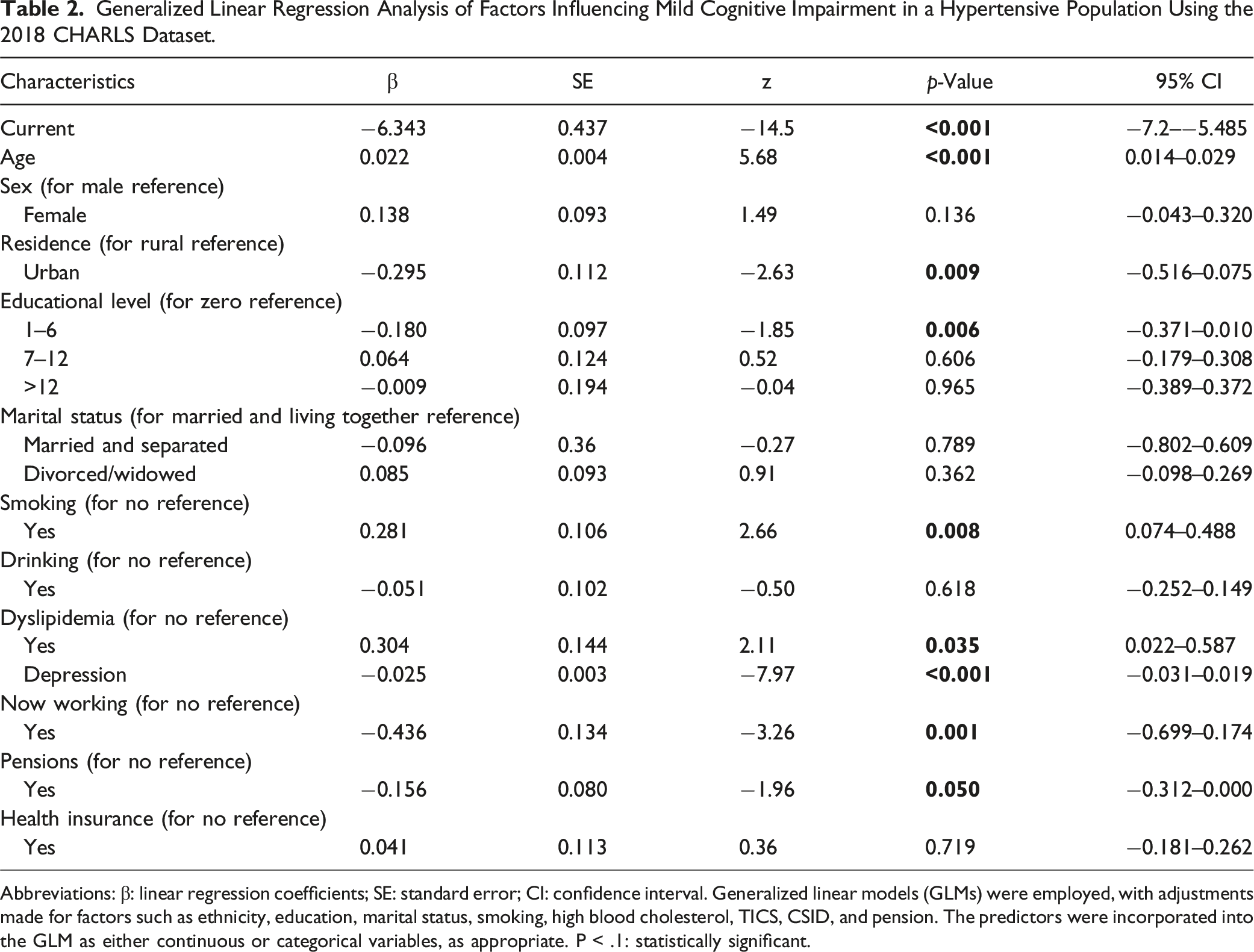
Abbreviations: β: linear regression coefficients; SE: standard error; CI: confidence interval. Generalized linear models (GLMs) were employed, with adjustments made for factors such as ethnicity, education, marital status, smoking, high blood cholesterol, TICS, CSID, and pension. The predictors were incorporated into the GLM as either continuous or categorical variables, as appropriate. P < .1: statistically significant.

Selection of influences associated with cognitive function. Figure 2 presents the outcomes of the LASSO regression analysis, featuring both the Coefficient Path Plot (a) and the Cross-Validation Error Plot (b). The Coefficient Path Plot delineates variations in the coefficients of diverse independent variables, which include 21 risk factors and covariates, as the regularization strength (log λ) increases. Variables with non-zero coefficients serve as key predictors, while those with zero coefficients exert minimal influence. Different independent variables are represented by colored lines within the plot. The Cross-Validation Error Plot provides insights into the cross-validation error across a range of log lambda values, assisting in the identification of an optimal regularization parameter for enhanced model generalization. Factors such as ethnicity, education, marital status, smoking, high blood cholesterol, TICS, CSID, and pension were incorporated into the LASSO regression model without incurring penalization.

Nomogram for predicting mild cognitive impairment. The discriminative and calibrative capabilities of a risk prediction model are essential metrics for evaluating its predictive accuracy. Discrimination assesses the model’s ability to accurately forecast whether a patient will develop a specific illness in the future. This evaluation commonly employs the area under the receiver operating characteristic (ROC) curve as a metric. An AUC value between 0.5 and 0.7 signifies low predictive accuracy, whereas a value between 0.7 and 0.9 suggests high predictive accuracy. For the development, internal validation, and external validation datasets, the AUC values were 0.777, 0.785, and 0.782, respectively. These results indicate a high degree of accuracy in predicting MCI among community-dwelling hypertensive patients, as illustrated in Figure 4. The model’s precision in risk prediction is further confirmed by calibration plots and the Hosmer–Lemeshow goodness-of-fit test, with Figure 5 showing p > .05, indicating a good model fit. Specifically, the model demonstrated excellent fit in both.

Analysis of ROC curve for the predictors. AUC, the area under the curve. (a) The development model, (b) the internal validation model, and (c) the external validation model.

Calibration curves of the nomogram. The actual outcome rate is plotted on the y-axis; the nomogram-predicted probability of the outcome is plotted on the x-axis. (a) Calibration plot for the training dataset (mean absolute error = 0.01 n = 1121). (b) Calibration plot for the validation dataset (mean absolute error = 0.08 n = 4016). The Hosmer–Lemeshow test is an indicator of model fit, which is based on the principle of determining the gap between the predicted value and the true value. p > .05: the predicted value is in a good agreement with the true value.
Discussion
Cognitive impairment is intricately linked with hypertension. The China 2018 Cardiovascular Center reports a 27.5% prevalence of hypertension among adults (Z. Wang et al., 2018). Approximately one-quarter of individuals with hypertension experience varying levels of cognitive impairment, including executive dysfunction, and learning and memory challenges. Notably, older hypertensive individuals exhibit a higher prevalence of cognitive dysfunction, with the resultant organic brain damage often being irreversible. Gottesman et al. noted in a longitudinal study over two decades that midlife hypertensive patients were significantly more prone to developing cognitive dysfunction in later life than non-hypertensive controls (Gottesman et al., 2014). Furthermore, hypertension is increasingly prevalent among the youth, with a reported 5.2% incidence among young individuals in the China Hypertension Survey (Sun et al., 2020). This underscores the critical importance of early hypertension detection and management, highlighting its implications not only for cognitive health but also for overall well-being and social engagement.
In the analysis of the CHARLS 2018 database, Lasso regression was employed to pinpoint eight principal factors affecting cognitive function in hypertensive individuals: age, sex, residence, education, drinking, depression, working, and health insurance. Notably, education emerged as a significant predictor, with higher levels correlating with better cognitive function scores. Additionally, research indicates that hypertensive patients with 1–6 and 7–12 years of education outperform illiterate counterparts in cognitive tests. This disparity suggests that education fosters cognitive reserve, potentially counteracting hypertension’s neuropathological impacts (Mungas et al., 2018; Stern et al., 1994; Y. Wang et al., 2023). Moreover, increased cognitive activity is linked to a deceleration in cognitive decline (Prince et al., 2014). Therefore, enhancing educational investments, particularly for economically disadvantaged groups, is essential for improving cognitive health in hypertensive populations.
Compared to rural areas, urban populations with hypertension exhibited a regression coefficient of −0.295, indicating a reduced risk of cognitive impairment. Individuals with elevated cognition levels often encounter enhanced opportunities in urban settings, potentially contributing to geographic disparities in the prevalence of Alzheimer’s disease (Jokela, 2014). Furthermore, studies have demonstrated that the incidence of cognitive impairment is notably higher in individuals aged 55 to 79 living in rural Portugal than in those residing in urban areas (Nunes et al., 2010).
Our predictive modeling revealed that sex is a significant predictor of cognitive impairment risk, with women generally achieving higher composite cognitive scores than men (Lipnicki et al., 2019). Furthermore, in older age groups, women consistently outperform men in verbal memory tests, a difference that may be attributed to estrogen’s potential protective effect on cognitive function (Sundermann et al., 2016). Additionally, sociocultural factors contribute to sex differences in cognitive performance, with women exhibiting superior memory performance at comparable education levels (Lei et al., 2012; Zhang et al., 2017). In the context of China, traditional cultural practices significantly influence these sex disparities, affecting roles, opportunities, and obligations differently across sexes (D. Zhao et al., 2023).
In the study population, both occupation and pension were identified as predictors of cognitive impairment risk. Research indicates that retired individuals often exhibit higher education rates and a decreased likelihood of developing MCI (Rentería et al., 2022). This observation was corroborated within cohort, where retirees displayed superior cognitive performance. The finding suggests that retirees benefiting from elevated education and favorable socioeconomic conditions are less prone to MCI. Conversely, engagement in manual labor is associated with an increased MCI risk (Alvarado et al., 2002; Dartigues et al., 1992), while employment in cognitively demanding roles, necessitating complex thought and problem-solving, correlates with a diminished dementia risk later in life (Kivimäki et al., 2021).
A systematic investigation into health insurance coverage for individuals with hypertension revealed that uninsured hypertensive patients are at an increased risk of cognitive impairment (Halpern et al., 2006). Our results corroborate these findings, illustrating that continuous medication is essential for maintaining stable blood pressure in hypertensive individuals. Moreover, those with health insurance demonstrate greater adherence to medication regimes, especially in economically advanced regions (Elliott, 2008; Shin et al., 2011; Vannier-Nitenberg et al., 2013). Additionally, research has identified a reduction in mild cognitive impairment prevalence among urban Mexican health insurance beneficiaries, further substantiating the positive effect of health insurance on cognitive health (Juarez-Cedillo et al., 2012).
Our study identified age as a significant predictor of cognitive impairment risk, with hypertension being a key factor in age-related cognitive decline. Recent research has indicated that young adults with newly diagnosed hypertension can suffer adverse effects on cognitive function (Rouch et al., 2019). Moreover, the Framingham Offspring Cohort revealed that elevated blood pressure during midlife significantly increases the risk of cognitive dysfunction, with individuals in the pre-hypertensive stage facing a 40% increased risk of developing MCI (Goldstein et al., 2013). Consequently, the prevention of cognitive decline in midlife emerges as a crucial objective (Lisko et al., 2021).
Using this prediction model to evaluate the risk of cognitive impairment within a community-based hypertensive population, consider the example of a 73-year-old woman residing in a rural area with hypertension. She is illiterate, engages in habitual alcohol consumption, shows no signs of depression, is currently unemployed, and possesses health insurance. According to the model, her estimated risk of cognitive impairment is approximately 71.2% (95% CI: 0.548–0.834). Furthermore, the model relies on eight readily accessible predictive factors, rendering it suitable for utilization by community healthcare practitioners. Additionally, it can aid in the early diagnosis of cognitive impairment, offering a swift reference point for clinical assessments. It is important to note that the prediction model was developed and validated using demographic data sourced from extensive Chinese databases. While validation encompassed both databases, further testing within the community and adjustments to account for local conditions are imperative. To enhance the external validity of our findings, we aim to collect additional empirical data for further validation across diverse groups and regions through practical application and community feedback. Moreover, given the specificity of the database to China, it becomes essential to conduct external validation using datasets from other racial groups when extending these findings to diverse populations. It’s also crucial that the findings might not be universally applicable to all older adults, especially considering the diversity within China and globally.
Conclusions
Sex, age, residence, education, drinking, and depression were utilized in developing predictive models to estimate the likelihood of cognitive impairment in hypertension patients and the tendency for cognitive impairment to deteriorate in older hypertensive patients. The results of the assessment can guide early intervention in the preclinical stage of disease prevention for individuals who are at risk, including early diagnosis, early treatment, and early detection. In order to regulate the progression and deterioration of the condition, which can help stop or slow the start and advancement of cognitive impairment, early diagnosis of cognitive deterioration in hypertensive patients can be achieved through screening, census, and routine checks.
Footnotes
Acknowledgments
The authors wish to thank the CHARLS and CLHLS for providing real and reliable data for academic research.
Author Contributions
Y.L.: data analysis and drafted the manuscript. S.F., Y.J., and J.X.: data collection and quality control. L.W. and F.W.: conceived the idea and designed the study. All the authors read and approved the final manuscript.
Declaration of Conflicting Interests
The author(s) declared no potential conflicts of interest with respect to the research, authorship, and/or publication of this article.
Funding
The author(s) disclosed receipt of the following financial support for the research, authorship, and/or publication of this article: The authors declare that the research, authorship, and publication of this paper were supported by the Natural Science Foundation of Shanxi Province (Grant No. 202203021211068).
