



Abstract
Utilizing a randomized control design, this mixed method study aimed to assess the impact of a personalized music intervention on mood, agitation level, and psychotropic drug use in individuals with moderate to advanced dementia residing in long-term care facilities. The sample comprised of 261 participants, with 148 in the intervention group and 113 in the control group. Data were collected from three sources: quantitative data from the Minimum Data Set and the Cohen-Mansfield Agitation Inventory, observational data of music-listening sessions, and an administrator survey regarding the lead staff person’s perceptions of the intervention. Findings, based on Mixed Effect Models and content analyses, revealed positive impacts of the personalized music intervention on residents living with dementia. This low-cost, easily implementable intervention, requiring no special licensure for administration, can significantly enhance the quality of life for nursing facility residents.
• Quantitative data based on the randomized design and qualitative data from the sub population and nursing facility staff all indicated positive impacts of a personalized music intervention on individuals living with dementia. • One crucial discovery derived from the MDS data suggests that the personalized music intervention is effective in the reduction of antipsychotic and anxiety medication use.
• This study provides evidence that the personalized music intervention can be used to manage distressing behavioral and psychological symptoms associated with dementia. • These findings can provide valuable insights for guiding the implementation of the personalized music intervention in nursing facilities.What this paper adds
Applications of study findings
Introduction
Psychotropic medications have been widely prescribed for people living with dementia in nursing facilities to treat their distressing behavioral and psychological symptoms despite limited efficacy and serious side effects (Grimm, 2022). In response to the high prevalence of psychotropic drug use and its adverse effects, the Centers for Medicare & Medicaid Services (CMS) started the Partnership to Improve Dementia Care in Nursing Homes in 2012 to improve quality of care and promote therapeutic interventions for nursing home residents with dementia-related symptoms (CMS, 2017). Although this effort has partially contributed to the reduction of antipsychotic medications, such medications are still overprescribed in nursing facilities (HHS, 2022). Within this current climate, non-pharmacological interventions to manage distressing behavioral and psychological symptoms associated with dementia are expected to play important roles in improving care in nursing facilities (Bessey & Walaszek, 2019). The purpose of this study was to examine the impact of a person-centered non-pharmacological intervention, personalized music, on mood and behaviors of nursing home residents living with dementia.
Impact of Dementia
Prevalence rates for Alzheimer’s disease and related dementias (ADRD) are expected to grow from the estimated 6.7 million people aged 65 and older living with ADRD in the U.S. in 2023 to 7.2 million in 2025, 13.8 million in 2060, and over 100 million worldwide by 2050 (Alzheimer’s Association, 2023; Hebert et al., 2013; Prince et al., 2015). In Virginia, an estimated 150,000 individuals aged 65 and older were living with ADRD in 2020, with an expected increase to 190,000 Virginians by 2025 (Alzheimer’s Association, 2023). Medicaid costs for Virginians aged 65 or older living with ADRD are estimated to increase by 26.6% between 2020 and 2025, from $1 billion to $1.27 billion (Alzheimer’s Association, 2023). Considering this increase, nursing facilities need to be prepared to provide high-quality care for individuals living with dementia. However, as noted in a 2018 Human Rights Watch report, antipsychotic medications are often overprescribed in nursing facilities (Human Rights Watch, 2018). The National Partnership to Improve Dementia Care in Nursing Homes is a public-private coalition designed to address the high use of antipsychotic medication for individuals living with dementia in these facilities. The work of the National Partnership has been relatively successful. In Virginia, the prevalence of antipsychotic medications in nursing facilities decreased from 23% in 2011 and hovered between 13.1 and 13.6% in 2020 and 2021 (National Partnership to Improve Dementia Care in Nursing Homes, n. d). While encouraging that rates did not rise during the height of the COVID-19 pandemic, long-term care organizations can continue to adopt various non-pharmacological approaches and person-centered dementia care practices (National Partnership to Improve Dementia Care in Nursing Homes, n. d). Non-pharmacological, person-centered approaches that manage distressing behavioral and psychological symptoms in dementia (BPSD) can improve the quality of care for residents (Gitlin et al., 2012; Kim & Park, 2017; Li & Porock, 2014; Livingston et al., 2014).
Caregivers may become frustrated with BPSD, which may be expressed as non-cognitive behaviors such as wandering, pacing, repetitive speech, agitation, aggression, depression, sleep disturbances, and apathy (Cerejeira et al., 2012). BPSD are estimated to affect 91–96% of individuals in institutionalized settings (Cerejeira et al., 2012). A systematic review of 19 intervention studies showed that person-centered activities were effective in reducing BPSD and improving quality of life for individuals living with dementia (Kim & Park, 2017). Non-pharmacological approaches can reduce behavioral challenges and psychotropic medication use for individuals living with dementia and prevent harm to the individual (Bird et al., 2009; Gitlin et al., 2012; Kim & Park, 2017; Li & Porock, 2014; Livingston et al., 2014).
Person-Centered Music-Listening
A robust body of evidence demonstrated that person-centered music-listening interventions are a promising non-pharmacological approach for individuals living with dementia and provide positive outcomes including a change in mood and behavior and the elicitation of positive memories (Gerdner, 2010, 2012; Ihara et al., 2019; Janata, 2012; Ragneskog et al., 2001; Sakamoto et al., 2013; Sung et al., 2010; Vasionytė & Madison, 2013). Gerdner’s (2010) evidence-based guidelines for individualized music interventions in the management of agitation in persons with ADRD indicate that individualized music interventions reduce agitation, reduce antipsychotic medication, and connect with people “awakening.” Personalized music also lowers anxiety for the individual living with dementia while receiving care (Sung et al., 2010). A study of different types of individualized music interventions for persons with severe dementia also demonstrates a reduction in stress and relaxation promotion (Sakamoto et al., 2013). In a small study, Ragneskog and colleagues (2001) specifically examined the effect of personalized music on agitation with four individuals diagnosed with dementia and residing in four nursing homes by analyzing video-recorded sessions of four points in time (control period, prerecorded music, and then two individualized sessions). With the added nuance of both an observation tool and video recordings, these researchers were able to examine discrete behavior changes (Ragneskog et al., 2001). Music-listening interventions using playback methods or personal devices provide opportunities for participants to listen to the music when staff or caregivers are otherwise occupied (Janata, 2012) and have widespread appeal because of the low cost and ease of implementation.
While there are previous studies demonstrating the positive impacts of music-listening interventions on individuals living with dementia, the generalizability of their findings was often limited due to methodological constraints, such as a small sample size, lack of randomization, and absence of representativeness. Therefore, this mixed method study employed a randomized control design to determine whether a personalized music intervention impacted mood, agitation level, and psychotropic drug use in people with moderate to advanced dementia living in long-term care facilities with Medicaid beds in Virginia.
Methods
Personalized Music Intervention
Personalized playlists were developed and loaded onto a MP3 player by a member of the research team for participants based on family member suggestions regarding what songs, artists, and/or genres the participant listened to when they were around 15 – 25 years old. This age range corresponds to the reminiscence bump of long-term autobiographical memory indicating that older adults (over 40 years old) have more memories available for potential recollection during the age of adolescence and early adulthood (Rubin et al., 1986). Researchers suggest that this disproportionate increase in recall corresponds to a greater availability of nostalgic life events that occurred during that time. Research by Jakubowski et al. (2020) indicated a pattern between the reminiscence bump for autobiographical memories and a reminiscence bump of memories for music with popular songs during participants’ adolescence rated as most familiar and associated with the most vivid autobiographical memories. This music-related reminiscence bump peaked around age 14 with music preferences for the younger participants in particular reaching into their parents’ reminiscence bump periods, referred to as a cascading reminiscence bump (Krumhansl & Zupnick, 2013). The goal with personalized music from this period was to use the music as a trigger to access positive long-term autobiographical memories that were still available, even in later stage dementia.
Facility staff were asked to use personalized music with residents in an intervention group twice a week, aiming for at least 30 minutes each session, for four weeks. There was no maximum amount of time to administer the music and the lead facility staff provided the music on a schedule that worked best for them and their residents’ schedules. In rare occurrences, if a participant showed discomfort with the music or the equipment, staff tried a different song on the playlist or switched from headphones to speakers or vice versa or discontinued providing the personalized music for that session. The participants in the control group continued their usual schedule during these four weeks.
Facility Recruitment
By using a random selection method to achieve the representativeness of the findings, the study initially aimed to recruit 50% of Medicaid-funded licensed nursing facilities (n = 114) in Virginia as listed in the directory of long-term care facilities published by Virginia Department of Health Office of Licensure and Certification in 2019. These facilities were invited to participate in the study via phone and/or email, but some declined to participate, and others never responded to recruitment efforts. The recruitment strategy then shifted from a random selection to an attempt to contact all 228 Medicaid-funded facilities in Virginia for recruitment. While 65 facilities agreed to participate in our study, 29 of those facilities successfully implemented the music intervention with their residents, and only 26 of those facilities were able to provide the post-intervention data and fully completed the study. Therefore, our analysis is based on these 26 facilities.
Participants
Participant inclusion in the study was determined by a score of 0–7 or 99 on the Brief Interview for Mental Status (BIMS) on the Minimum Data Set (MDS), indicating an advanced level of dementia. The lead facility staff person on this study obtained a list of potential participants based on the BIMS cutoff score criteria. The research team randomly selected 10 participants from the list, and then randomly assigned 5 participants to the intervention group and 5 participants to the control group. In instances where facilities had only 10 or fewer participants qualify, these participants were still randomly assigned with half into the intervention group and half into the control group. Participants were not offered monetary compensation; however, they retained the music device with their preferred music loaded following the intervention. Those who were in the control group received the music device with their preferred music after the study period. This study was approved by the university’s Institutional Review Board, and we obtained consent from participants’ family members prior to the intervention implementation.
Facility Staff And/or Direct Care Worker Training
Nursing facility staff and/or direct care workers involved with implementing and facilitating the study within their nursing facility completed two types of training. Both training courses served to educate individuals on the importance of the personalized music intervention, the effective implementation of the intervention, and the methods for sustaining the intervention. The first training was required of at least the lead facility staff person and involved an extensive live or recorded online webinar-based training through MUSIC & MEMORY®, a non-profit organization that helps individuals with a wide range of cognitive and physical conditions to engage with the world, ease pain, and reclaim their humanity using personalized music. This training certified a facility to be nationally and globally recognized as a MUSIC & MEMORY® Certified Care Organization and provided access to numerous resources including but not limited to free music, organizational resources, advertising materials, and an unlimited number of facility staff to access the training for one year.
The second training was required for at least 10 direct care and/or staff members who used music with their residents at the facility and was a shortened version of the previously discussed training to cover key information. This training program was developed by our research team and covered (1) an overview of dementia, (2) person-centered care, (3) using personalized music with residents, (4) sustaining the personalized music intervention.
Data
Data were collected from three different sources: quantitative data from the Minimum Data Set (MDS) and the Cohen-Mansfield Agitation Inventory (CMAI), observational data of music-listening sessions, and an administrator survey regarding the lead staff person’s perceptions of the intervention. We also collected residents’ demographic information including their age, gender, race, and scores on the BIMS.
Quantitative Data and Analysis
Before and after the four-week intervention period, using MDS and the Cohen-Mansfield Agitation Inventory, data on residents’ mood, behavior, medication use, and agitation were collected. Depressive symptoms were extracted from the MDS and assessed with the Patient Health Questionnaire-9 (PHQ-9), problematic behaviors including physical, verbal, and other types of symptoms, as well as rejection of care. The standard PHQ-9 is self-reported, and the score range is 0–27. For those who are unable to self-report, PHQ-9-OV, which is based on staff observation, was used. PHQ-9-OV has an additional question asking if the resident is short-tempered/easily annoyed, so its score ranges from 0-30. Each type of problematic symptom and rejection of care was assessed based on its presence and frequency, with coding ranging from zero for absence of such behavior to 3 for daily occurrence. We also assessed the use of antipsychotic, antianxiety, antidepressant, and hypnotic medications with a 7-day retrospective period based on the MDS. Information of residents’ agitation status was obtained using the CMAI-short form, which consists of 14 questions, such as frequency of cursing or verbal aggression, frequency of grabbing onto people, throwing things, tearing things or destroying property, and frequency of pace, aimless wandering, trying to get to a different place. The possible score range for the CMAI was 14–70.
For statistical analysis, we used Mixed Effect Models to account for both intervention and time (i.e., repeated measures) effects and controlled for potential confounding factors such as the resident’s sex, age, race, BIMS score, and facility. Our final sample included 261 participants, with 148 in the intervention group and 113 in the control group. However, analyzing the effect of personalized music interventions posed a major challenge due to the COVID-19 pandemic. Recruitment for our intervention study began in 2019 and ended in 2022, during which several social distancing measures were implemented to mitigate the spread of COVID-19, including limiting facility visits. Therefore, we split the data into three groups to examine the robustness of the estimation across pre-, during-, and post-COVID-19 periods. The pre-COVID-19 period included data collected prior to March 2020 and involved 10 facilities. To account for changes resulting from COVID-19, we limited the second group to participants who completed both pre- and post-surveys between March 2020 and November 12, 2021, before CMS lifted the facility visitor regulation. The second group involved seven facilities. The remaining participants were assigned to the post-COVID-19 group, which involved 12 facilities. This division allowed us to examine whether the estimation results were robust across pre-, during, and post-COVID-19 periods. While we acknowledge that we could not rule out all the effects of COVID-19, we believe that this approach helps to mitigate its influence on our results. Therefore, we took two approaches: analyzing the entire participant data to assess the impact of the personalized music intervention on a set of MDS questions and CMAI and analyzing the divided data of pre-, during and post-COVID-19 periods based on the COVID-19 impact and facility visit restrictions. Considering the potential consequences of missing true effects in our study with a small sample size, we have chosen a significance level of 0.1 to reduce the likelihood of Type II errors, ensuring that we capture meaningful associations even if they do not reach the traditional 0.05 threshold.
Observational Data of Music-Listening Session and Analysis
Past research has demonstrated that behavioral observational data provides more nuanced information about reactions to music-listening (Ihara et al., 2019). However, collecting behavioral observational data is time intensive. As part of this project, we selected a subsample to conduct an in-depth look at the behavioral observation data collection by sending members of our research team to two facilities close to the university to observe participants for 20 minutes prior, during, and after the personalized music intervention (or regular activity for the control group). Each participant had 8 or 9 in-person observations completed using a Behavior Observation Checklist developed by the research team and adapted for this specific study (see Appendix). The checklist assessed the presence or absence of behavior on three domains: mood, social engagement, and music recognition with specific definitions for each variable. Researchers were asked to use the behavioral observation form to note any behaviors and take very detailed notes about the participant, the environment, and other activities. For the intervention group, the researchers listened to the music with the participant through splitters and an extra pair of headphones. Researchers were asked to be as unobtrusive as possible so that the participants would not feel self-conscious about the observations. Most participants were observed nine times over a four-week period.
Three researchers not involved with the data collection analyzed the observation data through a directed content analysis to ascertain whether the observation form was capturing the true meaning behind the categories. The goal of the directed content analysis of the field notes was to identify patterns and themes noted by the researchers to ensure that the behavioral observation form was accurately capturing the behaviors and were not missing other behaviors. The data were separated into pre-, during, and post-condition, using the domains identified on the behavioral observation sheet (mood, music recognition, and social engagement). The analysis was completed manually using an Excel spreadsheet for each observation and pivot tables to see the overall patterns. Each researcher analyzed the data separately, examined any discrepancies, and final codes were agreed upon by the larger research team.
Administrator Survey and Analysis
After the intervention period, we asked the lead staff person from each facility to complete a survey asking the following questions: (1) What are the barriers and challenges in implementing and sustaining the personalized intervention in nursing home facilities? (2) What is the value of the personalized intervention? (3) What are the best ways to foster effective implementation and ongoing sustainability of the personalized intervention in nursing home facilities? To analyze the responses, we employed conventional content analysis, a method often chosen when there is limited existing theory or knowledge in the area of inquiry (Hsieh & Shannon, 2005). Three researchers read through the written responses for each question and identified the words and phrases that embody the concepts by making notes about the field researchers’ observations. The researchers assigned codes independently and later compared, discussed, and refined these codes. After identifying codes, the researchers organized the codes into categories based on how they are related to each other. Eventually, meaningful clusters emerged as themes.
Results
Quantitative Data
Mixed Effect Analysis With all Participants.

areference: control.
breference: pre-survey.
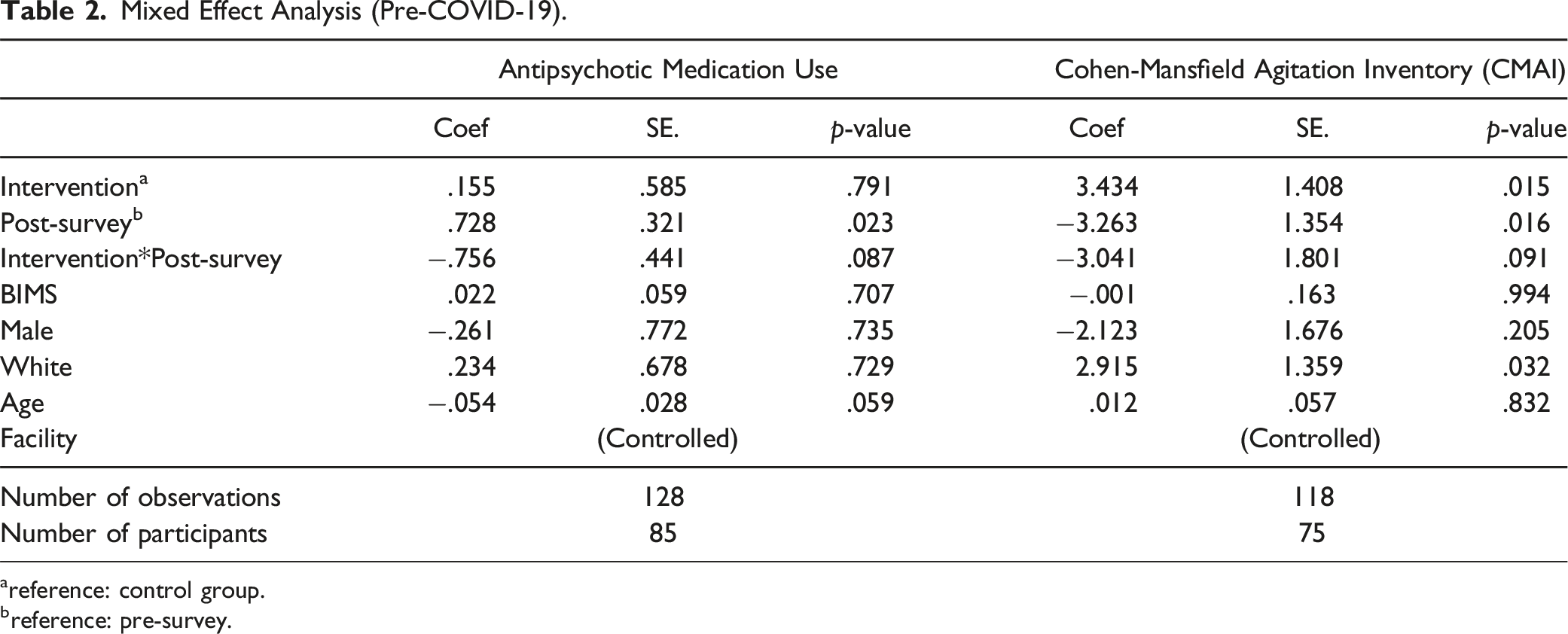
Mixed Effect Analysis (Pre-COVID-19).
areference: control group.
breference: pre-survey.
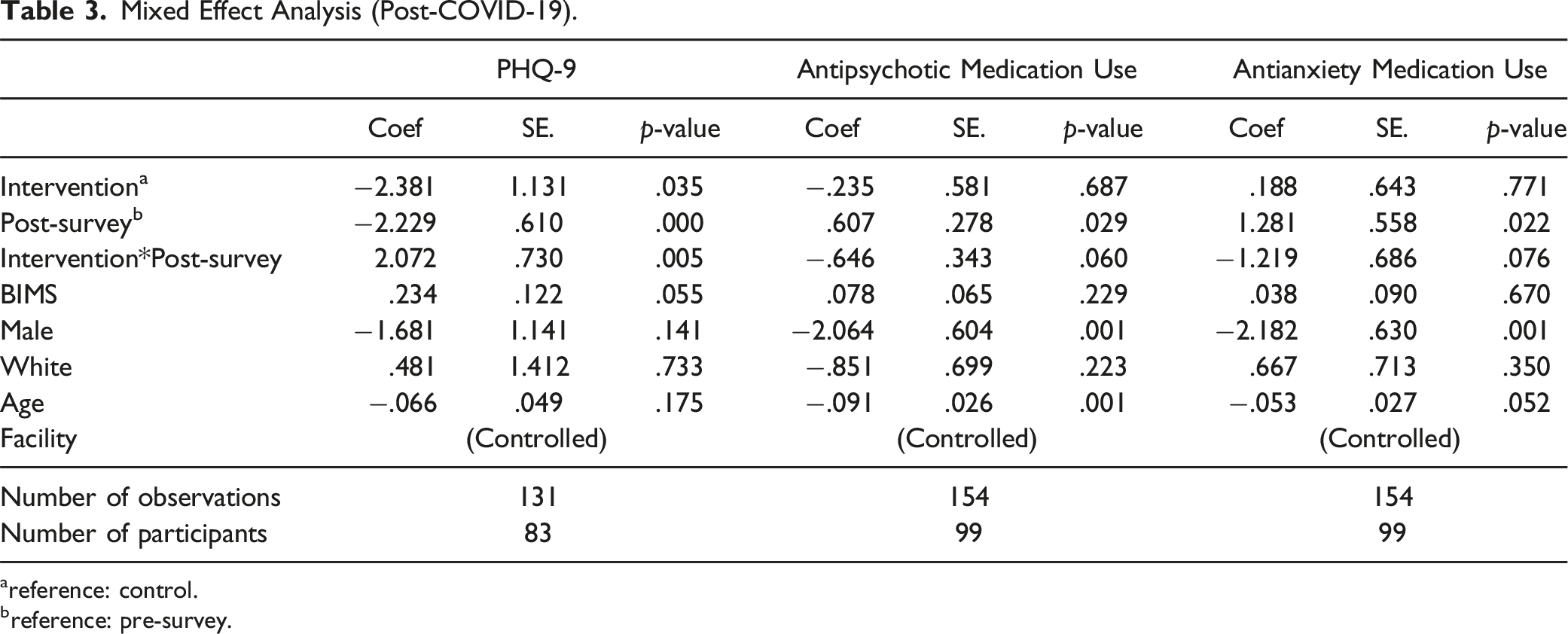
Mixed Effect Analysis (Post-COVID-19).
areference: control.
breference: pre-survey.
During the pre-COVID-19 period, the control group had an increase in average antipsychotic medication use from 1.32 days/week (sd = 2.78) before the intervention to 1.81 days/week (sd = 3.06) after the intervention. In contrast, the intervention group experienced a decrease from 1.38 days/week (sd = 2.78) before the intervention to 1 day/week (sd = 2.24) after the intervention. Furthermore, both the control and intervention groups experienced a reduction in CMAI scores after the intervention. The control group’s average CMAI decreased from 21.48 (sd = 8.5) to 19.76 (sd = 8), and the intervention group’s average CMAI decreased from 23.41 (sd = 9.11) to 19.24 (sd = 6.96). In the mixed effect models (Table 2), the results indicated that participants in the personalized music intervention group took fewer antipsychotic medications (p < .1), and the CMAI scores of the intervention group also improved significantly (p < .1).
During the post-COVID-19 period, both the control and intervention groups exhibited an increase in the use of antipsychotic and antianxiety medications in the post-survey. The control group’s average use of antipsychotic medication rose from 1.65 days/week (sd = 3.01) to 1.75 days/week (sd = 3.09) after the intervention. Their use of antianxiety medication also increased from 1.14 days/week (sd = 2.87) to 2.75 days/week (sd = 3.48). Likewise, the intervention group experienced an increase in the average use of antipsychotic medication from 1.1 days/week (sd = 2.55) to 1.21 days/week (sd = 2.59) after the intervention. Also, their use of antianxiety medication rose from 1.16 days/week (sd = 2.61) to 1.6 days/week (sd = 2.93). Nevertheless, we observed that the intervention group’s PHQ-9 mean score increased from 1.96 (sd = 5.6) to 2.10 (sd = 4.6) compared to the control group whose score decreased from 7.89 (sd = 8) to 3.32 (sd = 5.39). In the mixed effect models, the results showed that the intervention group took fewer antipsychotic (p < .1) and antianxiety (p < .1) medications compared to the control group. However, the intervention group had higher total PHQ-9 scores than the control group (p < .01).
Observational Data of Music-Listening Sessions
Initially, there were 18 participants selected for the observational data collection part of this study, with nine each in the intervention and control groups. Complete information was only captured for six participants in the intervention group and eight participants in the control group, yielding 14 participants for this portion of the study. Two participants died during the study, and we did not have an opportunity to observe two other participants due to their unavailability when the researchers were at the facility.
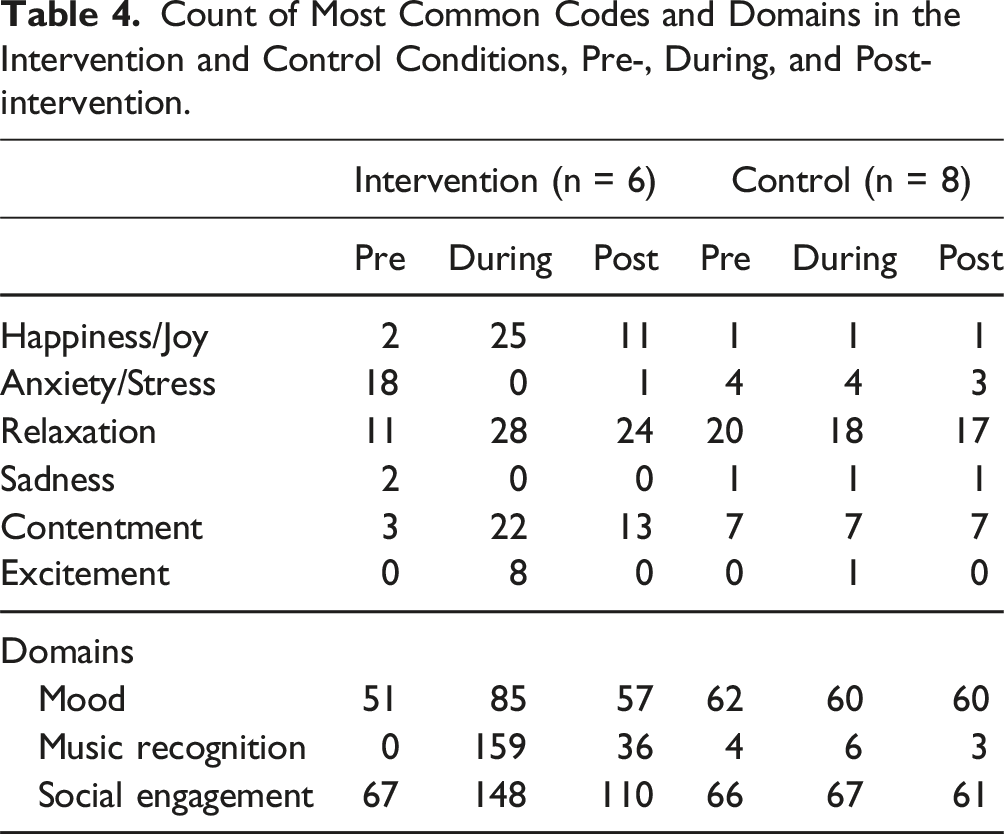
Count of Most Common Codes and Domains in the Intervention and Control Conditions, Pre-, During, and Post-intervention.
Administrator Survey
Twenty-eight nursing facility administrators responded to the survey questions regarding barriers/challenges, values, and suggestions for the intervention. The results for each question were summarized. Some themes have subcategories, and the counts for each theme or subcategories are presented in parentheses.
Barriers and Challenges
Three themes were identified for barriers and challenges for the implementation of a personalized music intervention: staff engagement, music management, and resident engagement.
Staff Engagement
Insufficient staff engagement was attributed to a lack of understanding of the importance of the personalized music intervention, low prioritization, or resource constraints. This theme includes two categories: lacking staff buy-in (3) and lacking resources (14). Three respondents pointed out the lack of staff buy-in. The staff members showed little interest or commitment to this intervention. Some interrupted the intervention when residents were listening to music or were not as involved in the intervention as would be ideal. Fourteen respondents reported difficulty obtaining resources, including training, financial support, manpower/service work, or finding time within residents’ daily schedules to implement the intervention.
Music Management
The main concerns regarding music management were both related to having difficulty with technology and accessibility, as well as identifying residents’ music preferences. Two categories were identified under this theme: making device accessible (6) and identifying preferred music (6). Six respondents mentioned that the music devices were intermittently uncharged and unprepared for use, and they were sometimes misplaced. Additionally, some residents disliked wearing headphones, and speakers were not readily available. Six respondents noted that identifying the preferred music for residents was challenging due to the communication difficulties that they face.
Resident Engagement
Residents either did not show any interest in listening to music or lost interest in listening to music quickly. This theme includes two categories: lacking interest (3) and sustaining resident engagement (7). Three respondents indicated that residents either appeared uninterested in listening to music entirely, or it was challenging to gauge their level of interest due to the lack of response. Seven respondents expressed that although some residents were interested in the music initially, they progressively lost interest and sometimes grew restless.
Values of the Personalized Music Intervention
Three themes emerged for the values of the personalized music intervention: observable positive reactions, reminiscing through music, and caregiver connection.
Observable Positive Reactions
Observable positive reactions are characterized by improved mood and behaviors. This theme has two categories: increasing positive behaviors (11) and enhancing mood (27). Eleven respondents pointed out an increase in positive behavior, indicating that the participants were calmer and less agitated or disruptive than before listening to the music. This suggests that the music helped soothe and relax them, resulting in a generally positive effect on the participants’ behaviors. Twenty-seven respondents mentioned that participants displayed visible signs of upliftment, such as smiling, tapping their feet, and becoming more open to conversation. Staff members reported that participants appeared noticeably more joyful after listening to the music.
Reminiscing Through Music (5)
Listening to music helped the participants to recall their memories and reconnect with their previous emotional experiences. Five staff members reported that although sometimes people will forget certain events they will not forget how something made them feel, and the music helps them to reminisce about that.
Caregiver Connection (2)
Two respondents expressed that this intervention could provide an opportunity for meaningful, one-on-one interactions between individuals living with dementia and their caregivers.
Suggestions
Three themes were identified for suggestions: establishing routine, device maintenance and accessibility, and resource enhancement.
Establishing Routine (5)
Five respondents pointed out the necessity of consistently incorporating this activity into the daily schedules of the residents, as it would be useful in creating continuity and routine for the participants. An activity director mentioned that we could foster effective implementation and ongoing sustainability “by implementing it into the care plan and daily schedule.”
Device Maintenance and Accessibility (8)
Eight respondents emphasized the importance of managing the devices, which includes keeping them updated with residents’ preferences, ensuring staff have easy access to them, and confirming they are charged and ready for use for each session. A household coordinator suggested a strategy of “having MP3 players stored in easy-to-see locations and make them easy to access. Make it a part of the team’s daily routine to have them charged.”
Resource Enhancement
Resources refer to both staff and physical equipment. While sufficient resources have been allocated for this project, there is room for improvement in terms of hiring additional staff and providing comprehensive training to staff so that they can sustain the project independently. This theme includes two categories: developing staff competency (10) and adding personnel (3). Because some staff lacked training and engagement, ten respondents emphasized the crucial nature of educating staff about the value of this intervention. This would help foster team building and personal engagement, which can be achieved through training sessions, meetings, and organizational support. Three respondents recommended hiring new personnel and involving family members and students to ensure the sustainability of the intervention.
Discussion
This study examined the impact of a personalized music intervention on nursing facility residents living with dementia using triangulated data from three sources. One of the key findings from the MDS data indicates that the personalized music intervention is effective in the reduction of antipsychotic and antianxiety medication use. The reduction of the antipsychotic medication was observed in the pre- and post-pandemic participants as well as in the analysis including all participants from the entire study period. The reduction of the antianxiety medication was found among the post-pandemic participants. The level of agitation also decreased among residents in the intervention group during the pre-pandemic period. These are the notable findings considering that the aim of non-pharmacological interventions is to help people living with dementia improve or maintain their quality of life by managing psychological and behavioral symptoms associated with the disease (Berg-Weger & Stewart, 2017). Medications to treat symptoms of dementia, specifically antipsychotic medications, have many serious side effects, such as inactivity, slowness of movement, muscle rigidity, jitteriness, and tremor (Ohno et al., 2019). Therefore, it is important to reduce unnecessary, avoidable medication use, and the personalized music intervention has a potential to contribute to this matter.
The observational data provided us with a good understanding of the immediate impact of personalized music on residents. Observed positive effects of personalized music indicate that this intervention can improve the mood of residents living with dementia and help them connect with others. These encouraging impacts became evident upon the introduction of music.
The survey from administrative staff and activity directors informed us of their positive views on the personalized music intervention, as well as challenges that they faced when implementing the intervention. Providing education and training to all care workers who directly work with residents may address some challenges that many administrative staff members and activity directors expressed. Such challenges included determining music for a playlist, getting facility staff on board, and having enough time and support to provide the music. Education and training can help all facility staff members, including direct care workers, understand the value of the intervention and potentially spread positive impact on the entire facility.
If personalized music helps reduce residents’ challenging symptoms, they will become easier to work with for direct care workers. In addition, the reduction of medications to treat residents’ psychological and behavioral symptoms will contribute to creating an overall safer facility environment because such medications have sedating effects that can cause falls. Using the personalized music intervention may be perceived as extra work by some staff members, but ultimately, it can ease their work processes as its positive effects have indirect impacts on their work and facility environment. It is important to ensure the availability and accessibility of the training to all staff members and to confirm that everyone completes it and shares a mutual understanding of the value of the personalized music intervention.
Limitations
While the study has made a significant contribution to knowledge by producing evidence on the personalized music intervention’s impact on mood, agitation level, and psychotropic drug use among nursing facility residents living with dementia, several limitations should be noted. First, we took the impact of the COVID-19 pandemic into account by analyzing quantitative data separately, pre-, during, and post-pandemic periods; however, we do not know how exactly the pandemic affected our study process, particularly the recruitment and implementation processes. Second, MDS data were based on each facility’s quarterly assessments that they were required to conduct by CMS. Because we took MDS data that are collected sometime before and after the intervention period by choosing the closest data point, the length of time between the MDS data collection date and intervention period is not consistent among facilities. This might have affected the findings. Third, the findings are based on the facilities in VA that voluntarily participated in the study, which limits the generalizability of the findings. Those facilities that agreed to participate became part of the study, perpetuating self-selection bias (Inoue et al., 2022).
Implications
The study findings affirm the impact of the personalized music intervention in reducing the use of antipsychotic and antianxiety medication, alleviating agitation levels, and enhancing mood and social engagement among residents. Consequently, the personalized music intervention has the potential to enhance the quality of life of nursing facility residents living with dementia. Notably, this intervention is low-cost, easy to implement, and does not require special licensure to administer. Furthermore, the use of individualized playlists tailored to each resident’s preferences aligns with the principles of person-centered care. Therefore, it is recommended that nursing facility staff use this intervention with their residents living with dementia as part of their residents’ daily activities.
Supplemental Material
Supplemental Material - A Personalized Music Intervention in Nursing Home Residents Living With Dementia: Findings From a Randomized Study
Supplemental Material for A Personalized Music Intervention in Nursing Home Residents Living With Dementia: Findings From a Randomized Study by Megumi Inoue, Emily S. Ihara, Shannon Layman, Meng-Hao Li, Sarah Nosrat, Samreen Mehak, Kendall Barrett, Catherine Magee, Kimberly A. McNally, Morgan Moore, and Catherine J. Tompkins in Journal of Applied Gerontology
Footnotes
Declaration of Conflicting Interests
The author(s) declared no potential conflicts of interest with respect to the research, authorship, and/or publication of this article.
Funding
The author(s) disclosed receipt of the following financial support for the research, authorship, and/or publication of this article: This work was supported by the George Mason University’s Institutional Review Board (1360973-16) and Virginia Department of Medical Assistance Services (DMAS) (223374P).

Supplemental Material
Supplemental material for this article is available online.
References
Supplementary Material
Please find the following supplemental material available below.
For Open Access articles published under a Creative Commons License, all supplemental material carries the same license as the article it is associated with.
For non-Open Access articles published, all supplemental material carries a non-exclusive license, and permission requests for re-use of supplemental material or any part of supplemental material shall be sent directly to the copyright owner as specified in the copyright notice associated with the article.
