



Abstract
The established sentencing scholarship focusing on race/ethnicity and sentencing disparity indicates that the effect of race/ethnicity on sentencing severity varies across offense types. However, it is not clear whether this argument holds true when race/ethnicity is replaced with offender citizenship status as the primary variable of interest. In light of the research gap, this study extends beyond the existing literature exclusively on race/ethnicity by investigating the nexus between citizenship status, offense types, and sentencing outcomes through the normal crime hypothesis and the liberation hypothesis. Using the Monitoring of Federal Criminal Sentences data that include information on all offenders sentenced in 17 federal district courts for fiscal years 2006–2008, the present study assesses the independent and interactive effects of citizenship status and offense types on the judicial sentence length decision. Findings reveal that although models fail to support the normal crime hypothesis, there is robust support for the liberation hypothesis.
It has been more than four decades since the normal crime and liberation hypotheses drew the attention of scholars in criminal courts and sentencing. According to the normal crime hypothesis, the regular characteristics of offenses and offenders lead courtroom actors to develop norms of processing a case effectively; as a result, cases may be handled differently, depending on whether a particular offense is considered typical of the specific group to which the offender belongs (see Hawkins, 1987; Sudnow, 1965). The liberation hypothesis suggests that courtroom decision makers are liberated from legal restrictions and have greater discretion in deciding a case when there is a high degree of ambiguity about a case or when the seriousness of an offense is low (see Kalven & Zeisel, 1966; Spohn & Cederblom, 1991). The two hypotheses have been used to examine unwarranted disparity in recent sentencing scholarship.
Early researchers applied the two hypotheses to decision making by public defenders (e.g., Sudnow, 1965) and juries (e.g., Barnett, 1985; Kalven & Zeisel, 1966; Reskin & Visher, 1986; Sorensen & Marquart, 1990-1991; but see Devine, Buddenbaum, Houp, Studebaker, & Stolle, 2009), as well as presentencing decision making (Swigert & Farrell, 1977). Researchers have extended their interest to decision making by judges (e.g., Auerhahn, 2007; Hawkins, 1987; Smith & Damphousse, 1998; Spohn & Cederblom, 1991; Steen, Engen, & Gainey, 2005), prosecutors (e.g., Ball, 2006; Chen, 2008; Sorensen & Wallace, 1995; Tellis & Spohn, 2008), and police (Tellis & Spohn, 2008) over the last 20 years. The extensive literature on the normal crime and liberation hypotheses has been limited to the extent to which an offender’s race/ethnicity affects court dispositions. In other words, these studies primarily investigate the interactions between race/ethnicity and offense types.
Researchers, however, have not turned their focus beyond the boundaries of the race/ethnicity effect. To bridge the research gap, this study seeks to examine whether and how citizenship status and offense types interact to affect criminal sentencing outcomes through the test for the normal crime and liberation hypotheses. 1 Researchers exploring the relationship between race/ethnicity and sentencing disparity argue that the effect of race/ethnicity on sentencing severity varies across offense types (Hawkins, 1987; Johnson & Betsinger, 2009; Spohn & Cederblom, 1991). We extend this proposition to argue that there is variation across offense types in other offender characteristics, such as citizenship status. We believe that it is theoretically and empirically important to advance our understanding of the relationship between citizenship status, offense types, and sentencing outcomes.
Theoretical Framework and Prior Research
Focal Concerns Perspective
Over the past decade, sentencing researchers have used the focal concerns perspective extensively to explain warranted and unwarranted disparities in criminal courts. This perspective suggests that judicial decision making is built primarily on three focal concerns—blameworthiness, offender dangerousness, and practical considerations (Steffensmeier, Ulmer, & Kramer, 1998). Approximately 88% of noncitizen federal offenders are convicted of either immigration or drug offenses annually (e.g., U.S. Sentencing Commission [USSC], 2008). Based on these federal statistics and the traditional sentiment of violent street crime, there is no convincing evidence that noncitizen offenders are more culpable, violence-prone, likely to recidivate, and dangerous to the community than citizen offenders. Therefore, it is not clear whether blameworthiness and offender dangerousness can well explain unwarranted disparity as a result of citizenship status. Judicial sentencing decisions, however, may rely on practical consequences. For example, removal proceedings, being designed uniquely for noncitizens and often following criminal sentencing outcomes shortly, may result in judges’ unwillingness to sentence noncitizen offenders to probation with a much lower level of supervision than incarceration. By contrast, judges may believe that due to the existence of removal proceedings, it is unnecessary for noncitizen offenders to receive a lengthy prison term.
Very few studies have focused exclusively on citizenship status and used the focal concerns perspective to explain its effect on sentencing outcomes (but see Hartley & Armendariz, 2011). Most studies simply treated citizenship status as a control variable. Findings of these studies are inconclusive, due largely to variations in methodology (e.g., national data vs. regional data) and research purposes (e.g., a specific type of offense vs. all offenses). Sentencing researchers found no significant effect of citizenship status on the likelihood of incarceration (Spohn, 2005) and sentence length (Demuth, 2002; Everett & Wojtkiewicz, 2002; Kautt & Spohn, 2002; Pasko, 2002). For findings with significant citizenship effects, evidence reveals that, compared to citizens, noncitizens faced a greater likelihood of incarceration (Albonetti, 1997, 1998; Demuth, 2002; Johnson & Betsinger, 2009; Kautt & DeLone, 2006; Ulmer, 2005), received longer sentences (Albonetti, 2002; Johnson & Betsinger, 2009; Kautt & DeLone, 2006; Mustard, 2001; Schanzenbach, 2005; Ulmer, 2005), had the lower odds of receiving a substantial assistance departure (Johnson & Betsinger, 2009; Johnson, Ulmer, & Kramer, 2008; Wu & Spohn, 2010), were less likely to be granted all types of departures combined (Schanzenbach, 2005), and received a shorter length of sentence discounts (Johnson et al., 2008). Other scholars found evidence in regard to the shorter length of the sentence (Katzenelson, Conley, & Martin, 1996; Wolfe, Pyrooz, & Spohn, 2011; Wu & Spohn, 2010), the greater likelihood of a downward departure (Johnson & Betsinger, 2009; Maxfield & Burchfield, 2002), and the greater likelihood of a government-sponsored departure (Hartley & Armendariz, 2011) for noncitizens than for citizens.
Normal Crime Hypothesis
David Sudnow in his 1965 seminal work proposed that, to process criminal cases effectively and efficiently, courtroom decision makers categorized offenders in terms of whether cases fell within normal crime types. Sudnow (1965) contrasted the “revisionist” perspective, which argues for differential case processing for offenders of different crimes, with the “labeling” perspective, which argues for similarities among offenders and a patterned activity engaged by courtroom players (p. 256). The labeling perspective coincides with the normal crime hypothesis. Cases within the normal crime category help reduce the use of courtroom resources, whereas cases outside the normal crime category are atypical, needing additional time and financial resources for courtroom players to process them with prudence (Farrell & Holmes, 1991). Associated with the concepts of attribution (Albonetti, 1991; Bridges and Steen, 1998; Fontaine & Emily, 1978; Hawkins, 1981; Steffensmeier et al., 1998), stereotypes (Albonetti, 1991; Farrell & Holms, 1991; Welch 2007), patterned response (Albonetti, 1991; March & Simon, 1958), and typification (Chiricos, Welch, & Gertz, 2004; Welch, 2007), the labeling perspective as applied to normal crimes reflects the combination of offender characteristics and offense types in court decision making. Normal crime categories are formed via a stereotyping process by which courtroom decision makers take into account offender characteristics (e.g., race/ethnicity, gender, and age) and offense characteristics (e.g., violent, property, and victimless crimes). Sudnow’s (1965) qualitative analysis of public defenders concluded that they developed local courtroom standards to determine who would be classified into normal crime categories and how offenders were processed in the plea bargaining process. The use of routinized practices for criminal offenders promotes the courtroom’s effectiveness and efficiency in the disposition of cases.
Drawing on Sudnow (1965), Hawkins (1987) proposed a revised conflict theory by arguing that racial disparity in sentencing outcomes may vary across offense types. In oppressing threats of crime from the powerless to achieve social control, criminal justice agencies tend to focus on high-profile crime types or those seen as “racially inappropriate” (Hawkins, 1987, p. 728). The determination of what crime is racially inappropriate involves the process of stereotyping, attribution, and typification based on the experiences of courtroom actors. An offender convicted of a crime that is considered racially inappropriate (e.g., white-collar crime for Blacks and Hispanics or street violent crime for Asians and Whites) will receive particularly severe punishment. Such classification helps courtroom members promote the going rate, processing particular types of cases and offenders swiftly. Hawkins (1987), however, did not conduct any empirical analysis.
Swigert and Farrell (1977) attempted to examine the effect of normal primitives on three court-related outcomes—receipt of bail, the right to jury trial, and convictions. They defined normal primitives as individuals associated with the lower class, the lack of education, immigration, minority status (particularly Black men), and tendency toward violence (see also Swigert, Farrell, & Yoels, 1976). Swigert and Farrell in their path analysis found that those who were classified as normal primitives were less likely than other offenders to receive bail and choose a jury trial. With an extremely small standardized coefficient, however, they failed to find the relationship between characteristics of normal primitives and final convictions.
Steen, Engen, and Gainey (2005) examined the normal crime hypothesis by creating the category of a “dangerous drug offender”—that is, a male drug dealer with prior criminal convictions (p. 435). As they predicted, the sentencing differential between White dangerous drug offenders and other White offenders should be greater than that between Black dangerous drug offenders and other Black offenders because the White group was generally atypical of the label of dangerous drug offenders. By contrast, they predicted that the sentencing differential between White dangerous drug offenders and other White offenders would become smaller than that between Black dangerous drug offenders and other Black offenders when some of these offenders were perceived as partially fitting the label of dangerous drug offenders. Steen et al. (2005) found great support for the first prediction in both the incarceration and the sentence length decisions, but their findings revealed little to no support for the second prediction.
Using the integrated sociopsychological and organizational perspectives grounded in such concepts as attribution, routinization, normalization, and organization constraints (see also Albonetti, 1991; Steffensmeier et al., 1998), Auerhahn (2007) posited that offenders classified outside the normal criminal group would prefer a trial (i.e., a formal proceeding) to a plea bargain (i.e., an informal proceeding; see also Farrell & Holmes, 1991). These offenders, in turn, would be sentenced more harshly than those who accepted plea bargaining (Ulmer & Bradley, 2006; Ulmer, Eisenstein, & Johnson, 2010). However, she found only the bench trial disadvantage but not the jury trial disadvantage. Furthermore, Auerhahn (2007) implicitly argued that the normal crime hypothesis as applied to homicide or high-status cases had lacked empirical support. As her findings revealed, there were no sentencing differentials between Black and White offenders or between Hispanic and White offenders in homicide cases.
Despite the aforementioned research on the normal crime hypothesis, sentencing scholarship has not examined how courtroom decision makers associate citizenship status with normal crime types. 2 Members of the general public have often linked violent street crimes to Blacks (Mayas, 1977; Rome, 2006; Russel, 1998), particularly those who are U.S. citizens. Black crime has been used to depict the phenomenon that Black Americans disproportionately commit such violent offenses as robbery, rape, and murder (Walker, Spohn, & DeLone, 2007). In the federal system, Black arrestees accounted for 41% of violence offenses in 2003–2004, and 92.1% of violent arrestees were U.S. citizens in the same fiscal year (Bureau of Justice Statistics [BJS], 2006). By contrast, noncitizen offenders have been prosecuted in federal courts predominantly for immigration offenses over the years, and less than 2% of their offenses were associated with violent offenses (BJS, 1996). Stated differently, approximately 67% of noncitizen federal offenders were arrested for immigration offenses (BJS, 2006). According to Hawkins’s (1987) normal crime hypothesis, immigration-related offenses, based on a dichotomous classification, should be perceived as appropriate for noncitizens. In addition, sentencing differentials may occur in violent offenses as well. The above statistical data suggest that violent offenses are abnormal and inappropriate crimes for noncitizens. Still, applying Hawkins’s version of normal crime in regard to white-collar offenses suggests that such offenses are unusual incidents, and therefore are perceived as inappropriate crimes, for noncitizens. Finally, Hawkins’s reasoning suggests the greater noncitizen/citizen differential for violent or white-collar offenses (i.e., atypical offenses for noncitizens) than for immigration offenses (i.e., typical offenses for noncitizens).
Liberation Hypothesis
Kalven and Zeisel (1966) proposed the liberation hypothesis by arguing that the strength of evidence led the jury to make a sentencing decision based on varying factors. According to Kalven and Zeisel’s hypothesis, juries are bound to favor one of the parties based only on crime facts and legal requirements when strong or unambiguous evidence is present. With weak or ambiguous evidence before them, however, juries are liberated from evidence requirements, and their decision making is more likely to be dominated by personal beliefs or other extralegal factors. Their findings suggested that jurors’ sentiments were more likely to be liberated from the pressure of statutory requirements (i.e., legal factors) in simple rapes than in aggravated rapes as well as in weak cases than in strong cases.
Other studies examining the liberation hypothesis are generally classified into jury decision making (Barnett, 1985; Devine et al., 2009; Kalven & Zeisel, 1966; Reskin & Visher, 1986; Sorensen & Marquart, 1990-1991), prosecutorial decision making (e.g., Ball, 2006; Chen, 2008; Sorensen & Wallace, 1995; Tellis & Spohn, 2008), judicial decision making (Smith & Damphousse, 1998; Spohn & Cederblom, 1991), and the combination (Leiber & Blowers, 2003). Findings as to testing this hypothesis have been mixed. Research also has advanced this hypothesis by arguing that decision makers have been liberated from the consideration of legal factors when cases fall within a gray area, generally around the middle of a continuum (Ball, 2006; Chen, 2008; Devine et al., 2009; Unnever & Hembroff, 1988).
Barnett (1985) employed three criteria to determine the severity of a capital case: “The Certainty the Defendant is a Deliberate Killer,” “The ‘Status’ of the Victim,” and “The ‘Heinousness’ of the Killing” (p. 1339). He found that the race effect of the defendant and the victim on the likelihood of receiving capital punishment increased when the jury’s uncertainty increased. Barnett’s findings were evidenced by Reskin and Visher (1986) who examined Kalven and Zeisel’s (1966) original liberation hypothesis based on the strength of evidence in forcible sexual assault cases. According to Reskin and Visher’s (1986) findings, all of the five extralegal factors significantly predicted the defendant’s conviction for weak cases, whereas only one of them was significant for strong cases. Their findings lent great support for the liberation hypothesis in which jurors had greater freedom in cases with weak evidence than in those with strong evidence to use extralegal variables for their determination of a defendant’s guilt. Furthermore, Devine, Buddenbaum, Houp, Studebaker, and Stolle, (2009) extended Reskin and Visher’s (1986) research to include individual characteristics of jurors and defendants. Using survey questionnaires completed by judges, attorneys, and jurors, Devine et al.’s (2009) findings revealed only limited support for the liberation hypothesis. Specifically, although the effects of extraevidentiary variables (i.e., charge severity, pretrial publicity, and trial complexity) agreed with the hypothesis, participant characteristics failed to produce effects that met the expectation of the theory. Similarly, Sorensen and Marquart (1990–1991) concluded that their findings failed to find support for the liberation hypothesis. It is worth noting that the examination of the liberation hypothesis by Devine et al. (2009) and Sorensen and Marquart (1990–1991) did not use a multivariate analysis.
Chen (2008) tested the liberation hypothesis by investigating the California three-strikes law. Although she argued that there was little room for unwarranted disparity to play a role under the three-strikes scheme, racial/ethnic disparity would take place when an offense could be classified ambiguously as either a misdemeanor or a felony (i.e., a wobbler case). Chen found that the effect of race and ethnicity was stronger for wobblers (i.e., charged with either misdemeanors or felonies) than for nonwobblers (i.e., charged with felonies only). Furthermore, Chen’s findings revealed a greater racial gap (e.g., Blacks vs. Whites and Asians vs. Whites) for property and drug offenses than for violent offenses. Her findings have provided robust support for the liberation hypothesis. Other support appeared in prosecutorial capital decisions, where the death sentence was more likely to be sought, and cases were more likely to advance to a penalty trial, for convicted Black offenders who killed Whites than those who killed Blacks when cases were the least aggravated (Sorensen & Wallace, 1995). However, Ball’s (2006) investigation of prosecutorial count bargaining decisions failed to find a similar conclusion that offender characteristics affecting the receipt of a reduction in count bargaining is more salient in the borderline serious cases than in either the most serious or the least serious cases (but see Spohn, Gruhl, & Welch 1981–1982). Tellis and Spohn (2008) also did not find any difference in the effects of offender–victim racial/ethnic dyads on the prosecutor’s decision to charge a defendant between simple rape and aggravated rape.
Spohn and Cederblom (1991) extended Kalven and Zeisel’s (1966) liberation concept to examine the race effect on sentencing disparity. As they posited, the Black–White difference in sentencing outcomes took place in less serious cases rather than in more serious cases because the former had low publicity that would give judges a freer hand to exercise their discretion. For the incarceration decision, their findings revealed that the unwarranted race effect was significantly evident for less serious cases (e.g., no prior felony history, acquaintance offenses, no use of guns, and assault rather than murder/ robbery/sex offenses), providing strong support for the liberation hypothesis. By contrast, Spohn and Cederblom (1991) failed to find support for the liberation hypothesis in the sentence length decision. Among five categories that distinguished more serious cases from less serious cases, only use of guns had an effect consistent with the prediction of the liberation hypothesis. On the other hand, Smith and Damphousse (1998) developed a typology to explore the extent to which the political environment, offense severity, and other legal variables interacted to affect the judge’s criminal sentencing of terrorists. Their typology predicted an increase in the effect of legal variables for both nonterrorist and terrorist cases, following an increase in offense severity. Smith and Damphousse found robust support for this hypothesis, with an increase in the effect of guilty pleas (as a legal variable) on sentence length for both nonterrorists and terrorists when offense severity increased. In addition, their findings revealed a 20% increase in the variance explained by all legal factors when the level of offense severity for terrorists changed from low to high.
Leiber and Blowers (2003) attempted to reconcile the liberation hypothesis with the focal concerns perspective by examining misdemeanors at different stages of case processing. Their statistical analysis of the liberation hypothesis, however, did not follow the traditional approach that investigated the race effect across levels of case severity (e.g., Chen, 2008; Spohn & Cederblom, 1991). In other words, they did not make a direct comparison between more serious and less serious cases to see whether race played a critical role. Leiber and Blowers (2003) nonetheless concluded that prosecutors and judges did not exercise their discretion to make the race effect salient in the sentencing process of misdemeanor cases.
The U.S. Supreme Court in United States v. Booker (2005) ruled that federal judges were no longer bound to apply the Federal Guidelines to the determination of an offender’s sentence. The Booker decision gave federal judges more leeway to be liberated from the statutory mandate. With prior research and in connection with the current study’s interest, the liberation hypothesis suggests that sentencing differentials between noncitizens and citizens will increase when the severity of the offense decreases. In other words, sentencing differentials between noncitizens and citizens will be greater for victimless offenses than for offenses with victims. Similarly, the liberation hypothesis suggests that sentencing differentials between noncitizens and citizens will be greater for offenses that do not carry mandatory minimum sentences than for offenses that carry mandatory minimum sentences. 3
Hypotheses of This Study
In sum, this study seeks to examine several hypotheses outlined below. This study first examines whether, as the main variable of interest, citizenship stratus affects sentencing outcomes. Drawing from practical constraints and consequences (e.g., the later proceedings of deportation for noncitizens) under the focal concerns perspective, we argue that non-U.S. citizens are not necessarily sentenced more harshly than U.S. citizens at every stage of the sentencing process. Thus, the following hypothesis for the main effect of citizenship status on sentence length is predicted.
Hypothesis 1: Non-U.S. citizens will receive prison terms that are shorter than those given to U.S. citizens.
This study then examines normal crime and liberation with varying hypotheses. Building on Hawkins’s (1987) proposed hypothesis for normal crime that an offender will be punished more harshly for the offense considered inappropriate for the specific group with which he or she is associated (e.g., racial minorities or noncitizens). Furthermore, Hawkins posits that the sentencing differential will be greater for offenses considered atypical of, and will be smaller for offenses considered typical of, the specific group. Thus, Hypotheses 2–5 investigate interactive effects between citizenship status and type of offense for the normal crime hypothesis.
Hypothesis 2: Non-U.S. citizens will be sentenced more leniently than U.S. citizens for immigration offenses.
Hypothesis 3: Non-U.S. citizens will be sentenced more harshly than U.S. citizens for violent offenses.
Hypothesis 4: Non-U.S. citizens will be sentenced more harshly than U.S. citizens for white-collar offenses.
Hypothesis 5: The sentencing differential between non-U.S. and U.S. citizens will be greater for violent or white-collar offenses than for immigration offenses.
According to Spohn and Cederblom (1991), judges have great opportunity to exercise discretion when faced with less severe offenses; by contrast, their discretion will be largely constrained when faced with more severe offenses. Based on this rationale, Hypotheses 6 and 7 investigate interactive effects between citizenship status and type of offense for the liberation hypothesis.
Hypothesis 6: Non-U.S. citizens will be sentenced more harshly than U.S. citizens for victimless offenses.
Hypothesis 7: Non-U.S. citizens will be sentenced more harshly than U.S. citizens for offenses that do not carry mandatory minimums.
Methodology
Data
The data for this study come from the Monitoring of Federal Criminal Sentences (MFCS) created by the U.S. Sentencing Commission (USSC). The data for analysis include three fiscal years (FY2006–FY2008), covering offenders sentenced during a period from October 1, 2005 to September 30, 2008 (ICPSR 20120, 22623, and 25424). Because citizenship status is of the main interest, this study uses only cases handled in 17 federal district courts in the states of Arizona, California, Florida, New Mexico, New York, and Texas that have a large population of noncitizens, as well as noncitizen offenders. 4 The 2006–2008 MFCS data sets for the six states originally included 107,154 cases, but only 98,057 cases involved a prison sentence. 5 Variables with missing values or insufficient information were excluded, including 2,715 cases (2.8%) for the two key variables (i.e., citizenship status and offense types) and 11,144 cases (11.3%) for the remaining variables. Therefore, the effective number of cases for analysis was reduced to 84,198 (85.9% of the cases that resulted in a prison sentence). 6
Dependent Variables
The dependent variable examined in this study is sentence length (see Table 1). 7 Sentence length refers to the months imposed on offenders who received prison sentences. 8 A preliminary assessment revealed that the skewness value for this variable was more than 1,300 times its standard error (criterion = two times, see Statistical Package for the Social Sciences [SPSS], 2002), suggesting that the sentence length variable was highly skewed. Consistent with prior research using federal data, this study transforms the highly skewed dependent variable through a natural log function for the models of sentence length (Feldmeyer & Ulmer, 2011; Johnson & Betsinger, 2009; Ulmer et al., 2010).
Descriptive Statistics for Dependent and Independent Variables

Note. N = 98,057 (cases that resulted in a prison sentence). Any variables that do not add to total are the result of missing cases. Eleven cases that involved sentences without specified terms were excluded from prison sentence length analyses and were not included in the calculation of the mean for continuous variables.
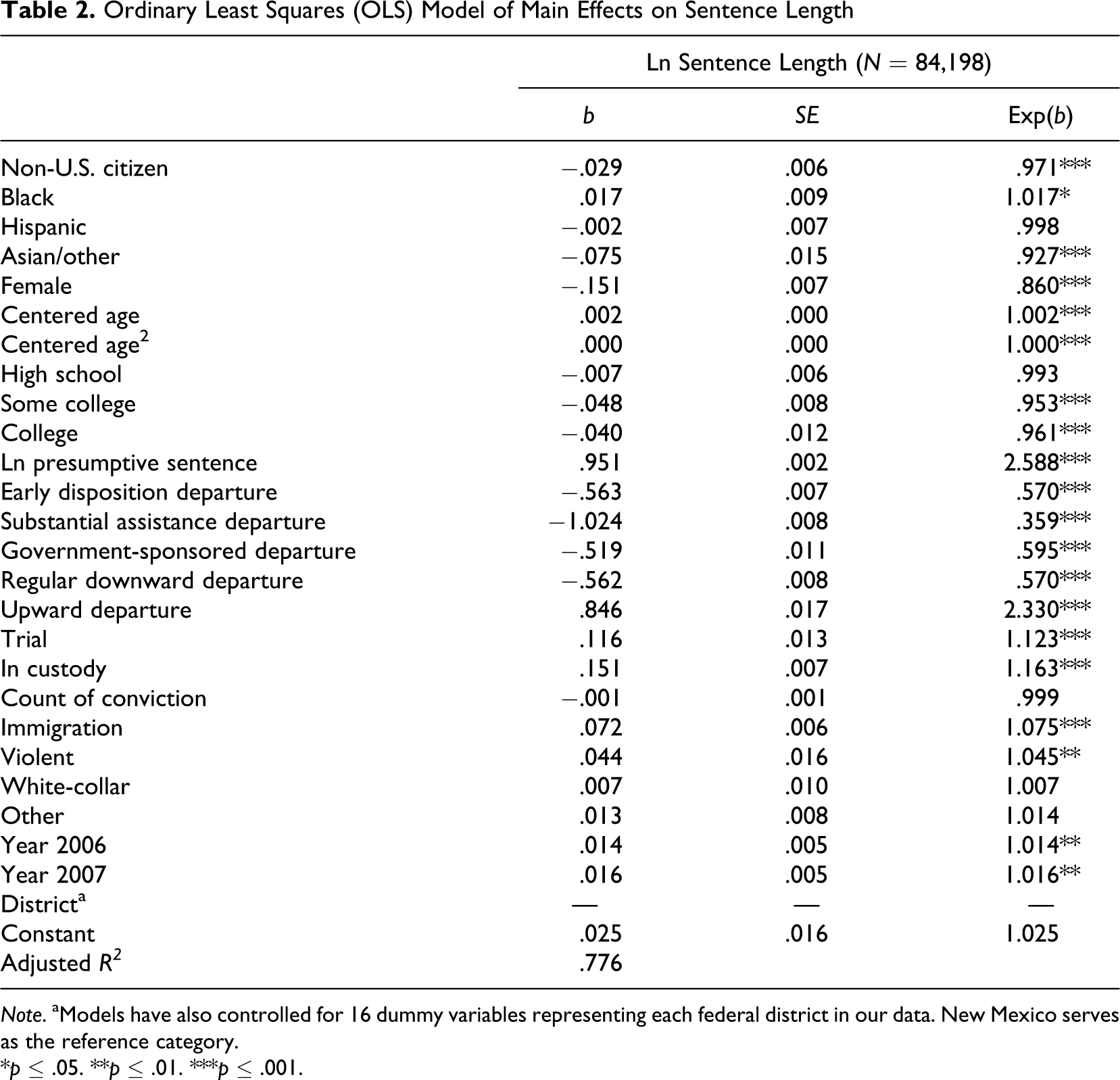
Ordinary Least Squares (OLS) Model of Main Effects on Sentence Length
Note. aModels have also controlled for 16 dummy variables representing each federal district in our data. New Mexico serves as the reference category.
*p ≤ .05. **p ≤ .01. ***p ≤ .001.
Independent Variables
The two key independent variables examined in this study are citizenship status and offense types (see Table 1). Citizenship status is measured as a dummy variable with noncitizens coded 1 and citizens coded 0. To test for main effects, along with interactive effects for the normal crime hypothesis, dummy variables that contain drug (as the reference category), violent, immigration, white-collar, and other offenses are created to capture the most serious conviction charge. 9 To test for interactive effects for the liberation hypothesis, two additional dummy variables are created to capture victimless crime and crime that carries mandatory minimums. 10
Models in this study also control for a number of legal and extralegal factors (see Table 1). The presumptive sentence (instead of offense severity and prior criminal records separately) is modeled as the minimum sentence imposed without departing from the Guidelines unless a longer mandatory minimum is triggered in the absence of a safety valve (Kramer & Ulmer, 1996; Ulmer et al., 2010; Wu & Spohn, 2010). 11 Because the presumptive sentence has also been found to be highly skewed, we log this variable to be consistent with the use of logged sentence length as the dependent variable. Departures are categorized into six dummy variables (no departure, early disposition, substantial assistance, other government-sponsored, regular downward, and upward departures); the category of no departure serves as the reference category. The models further control for the offender’s pretrial status (detained = 1; released = 0) and the mode of conviction (trial = 1; guilty plea = 0). Conviction counts are measured as the number of counts an offender faced at the time of conviction. Using 17 dummy variables with the District of New Mexico as the reference category, this study controls for U.S. District Courts in all models to remove potential interjurisdictional variation (Johnson & Betsinger, 2009). Finally, the models control for variation across data years through three dummy variables, with Fiscal Year 2008 as the reference category.
We further control for such offender characteristics as race/ethnicity, gender, age, and education (see Table 1). Race/ethnicity comprises White, Black, Hispanic, and Asian/other offenders, with White offenders as the reference category. The gender variable differentiates between female offenders (coded 1) and male offenders (coded 0). The offender’s age is a continuous variable, measured by year at the time of offending. In addition to incorporating the age-squared variable into all models to capture the curvilinear effect (Helms & Jacobs, 2002; Mustard, 2001; Steffensmeier & Demuth, 2000), the current study conducts a centering procedure to tackle the high level of collinearity between age and its square form (see Cohen, Cohen, West, & Aiken, 2003). Education is measured with four dummy categories (no high school diploma, high school diploma only, some college, and college/graduate degree); the category in which offenders do not have a high school diploma serves as the reference category.
Finally, whether the Heckman hazard rate as a correction to sample selection bias should be included in sentence length models is considered (Berk & Ray, 1982). We follow Smits’s (2003) solution to estimate the Heckman hazard rate and Belsley, Kuh, and Welsch’s (1980) approach to compute the condition number. 12 Two reasons suggest excluding the Heckman hazard rate from the sentence length analysis. First, the calculated condition number by dividing the maximum eigenvalue by the minimum eigenvalue in a regression analysis produced an index of 23 (Belsley, Kuh, & Welsch’s, 1980; Bushway, Johnson, & Slocum, 2007), which exceeded the suggested criterion of 20 and revealed the high level of collinearity between the hazard rate and other independent variables (Leung & Yu, 2000). Second, the influence of the censored federal sentencing data is, at most, minimal when a substantial number of offenders were sentenced to incarceration (Ulmer et al., 2010), as in the current data that approximately 92% of the convicted federal offenders received prison sentences. The decision to remove the correction factor from sentence length models has been consistent with recent studies using federal data (e.g., Johnson & Betsinger, 2009; Johnson et al., 2008).
Statistical Analyses
This study employs the ordinary least squares regression technique to examine the sentence length decision. Given the logged nature of the sentence length decision, we interpret findings based on the antilog (or exponentiation) of the estimated regression coefficient. We use the z test to examine Hypothesis 5 concerning the noncitizen/citizen sentencing differential across offense types (see Paternoster, Brame, Mazerolle, & Piquero, 1998). The z test formula is as follows:
Findings
Table 1 presents descriptive statistics for the independent and dependent variables. For offenders who received a prison sentence in 17 federal district courts, the adjusted average length of the term (capped at 470 months) was 42.2 months (SD = 57.0), approximately 7.5 months shorter than the adjusted presumptive sentence. Noncitizens comprised 60.6% of the offenders who were sentenced to prison. The typical offender was a 34-year-old Hispanic man without a high school diploma. The typical offender also received no departure (59.5%), pled guilty (97%), was detained in prison prior to trial (86.2%), had one to two counts of conviction, committed immigration (44.8%), or drug-related (33.5%) offenses, and was sentenced in the Southern District of Texas (17.8%) or the Western District of Texas (17.4%).
Bivariate statistics were examined to ensure no issue with collinearity between any two independent variables (not shown). Although there were some moderate relationships among independent variables, collinearity did not appear to pose any threat because none of Pearson’s correlation coefficients exceeded .80 (see Knoke, Bohrnstedt, & Mee, 2002; Studenmund, 1997; Weisburd & Britt, 2007). Noncitizens were positively associated with immigration offenses (r = .53; p = .00), and they were more likely to be Hispanics (r = .54; p = .00). Bivariate statistics also displayed that Hispanic offenders were positively associated immigration offenses (r = .40; p = .00). We further performed a collinearity analysis with the Variance Inflation Factor (VIF). All VIF values in regression models were smaller than 4, suggesting that collinearity was not an issue (Studenmund, 1997).
Findings with respect to the main effects on sentence length are shown in Table 2. 13 Compared to citizen offenders, noncitizen offenders received significantly shorter prison sentences. Specifically, noncitizen offenders received prison sentences that were 97.1% of those given to citizen offenders. Hypothesis 1 was therefore supported. Regarding the other key variable of interest—type of offense, offenders convicted of immigration, and violent offenses received longer prison terms than those convicted of drug offenses (7.5% and 4.5%, respectively). However, white-collar and other offenders received prison sentences that were neither longer nor shorter than those given to drug offenders. With very few exceptions, other legal and extralegal factors generally predicted sentence length in the expected direction. Asian/other, female, and educated offenders were given shorter sentences, whereas Black offenders received sentences that were longer than those given to White offenders. The presumptive sentence was positively associated with the length of the sentence. All types of downward departures reduced sentence length; by contrast, upward departures increased sentence length. Prison sentences increased for offenders who refused to plead guilty and for those who were detained before trial. Regarding unexpected findings, Hispanic offenders did not receive longer or shorter prison terms than those given to White offenders. Shorter sentences were imposed on younger offenders rather than on older offenders.
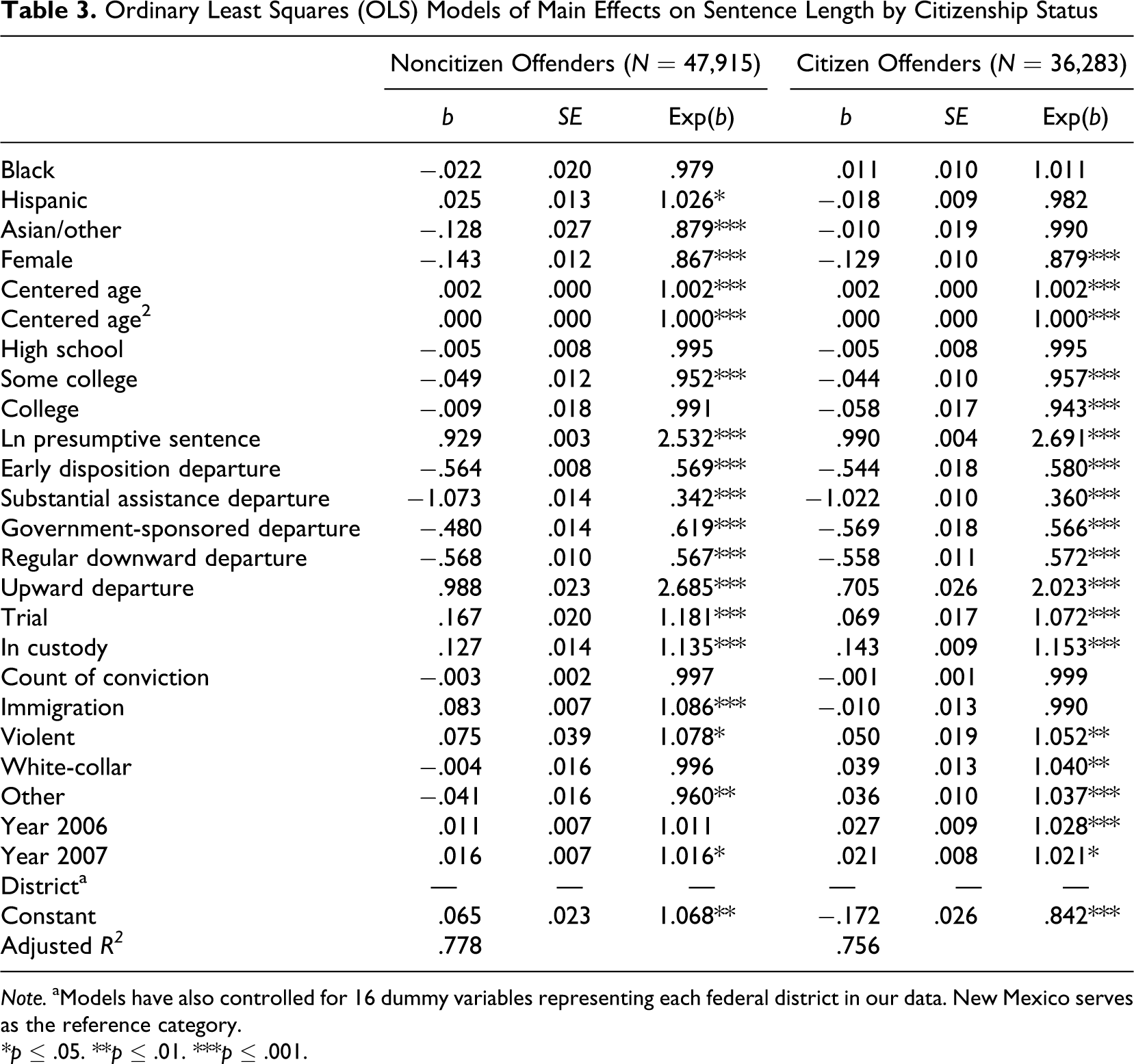
Table 3 reports the findings of regression analysis with data partitioned by citizenship status. Differences between noncitizen and citizen offenders lie primarily in the effects of race/ethnicity and offense types. The disadvantage of receiving longer prison terms was only for noncitizen Hispanics, and the advantage of receiving shorter prison terms was only for noncitizen Asians. Immigration offenders received prison terms that were longer than those given to drug offenders among noncitizens, but the immigration-drug differential in sentence length did not exist for citizens. White-collar offenders received prison terms that were longer than those given to drug offenders among citizens, but the sentencing differential between white-collar and drug offenses did not exist for noncitizens. Compared to drug offenders, noncitizens who were convicted of other offenses received shorter sentences, but citizens who were convicted of other offenses received longer sentences.
Ordinary Least Squares (OLS) Models of Main Effects on Sentence Length by Citizenship Status
Note. aModels have also controlled for 16 dummy variables representing each federal district in our data. New Mexico serves as the reference category.
*p ≤ .05. **p ≤ .01. ***p ≤ .001.
It is worth noting that all types of downward departures significantly reduced sentence length for both noncitizen and citizen offenders. The effect of each type of downward departure was relatively consistent across the two groups. Substantial assistance departures had the strongest effect on sentence reductions for both groups. In addition, upward departures, as expected, significantly predicted an increase in sentence length for both groups.
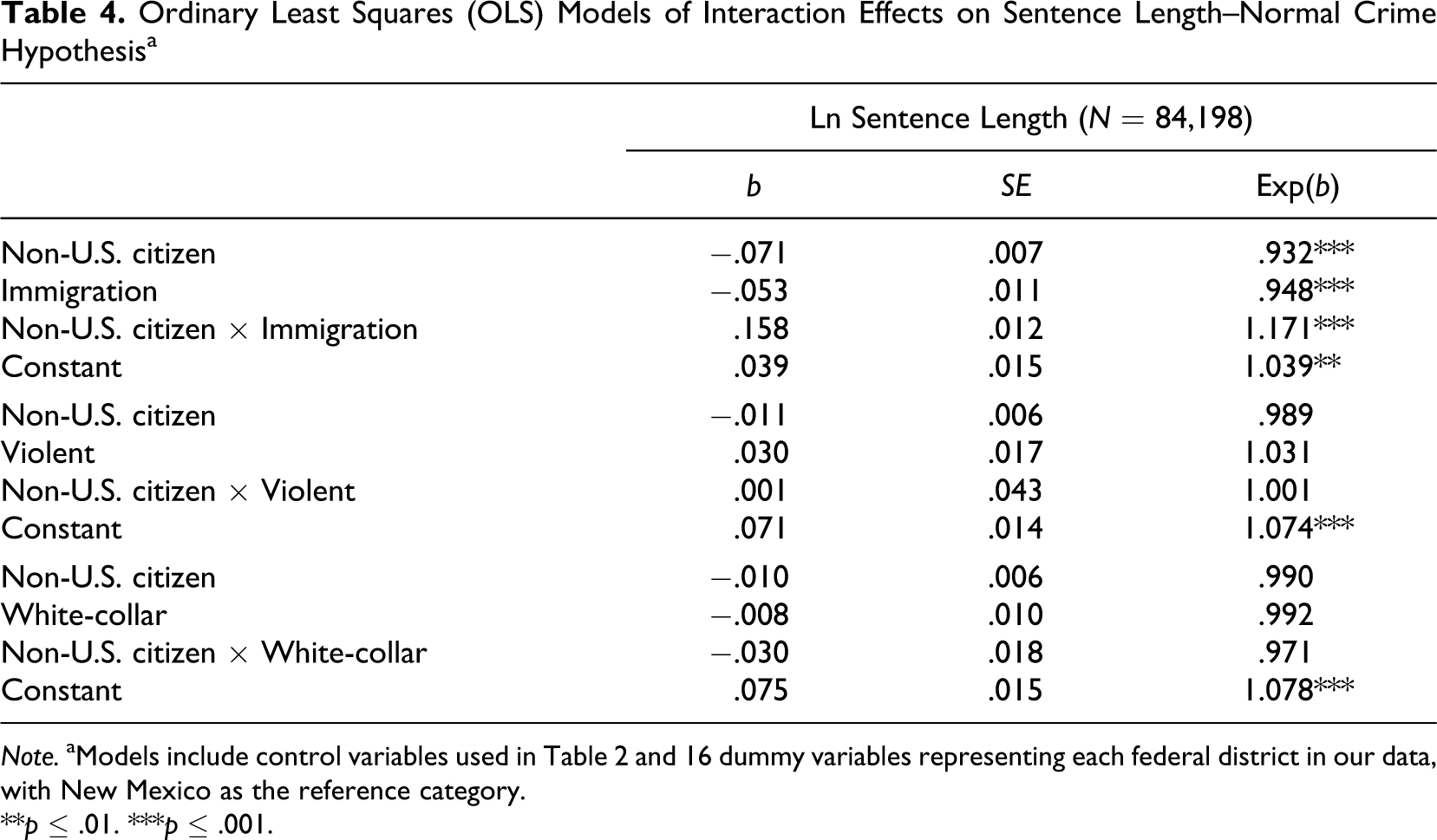
Turning to the test for the normal crime hypothesis with regard to interactions between citizenship status and offense types, we hypothesized that noncitizen offenders would be treated more leniently than citizen offenders for immigration offenses, but that the former would be sentenced more harshly than the latter for violent and white-collar offenses. Table 4 reveals that each unit increase in immigration offenses lengthened the prison term for noncitizen offenders by 17.1%. Furthermore, each unit increase in violent or white-collar offenses did not affect the prison term for noncitizen offenders. All these findings were contrary to the predictions of Hypotheses 2–4.
Ordinary Least Squares (OLS) Models of Interaction Effects on Sentence Length–Normal Crime Hypothesis a
Note. aModels include control variables used in Table 2 and 16 dummy variables representing each federal district in our data, with New Mexico as the reference category.
**p ≤ .01. ***p ≤ .001.
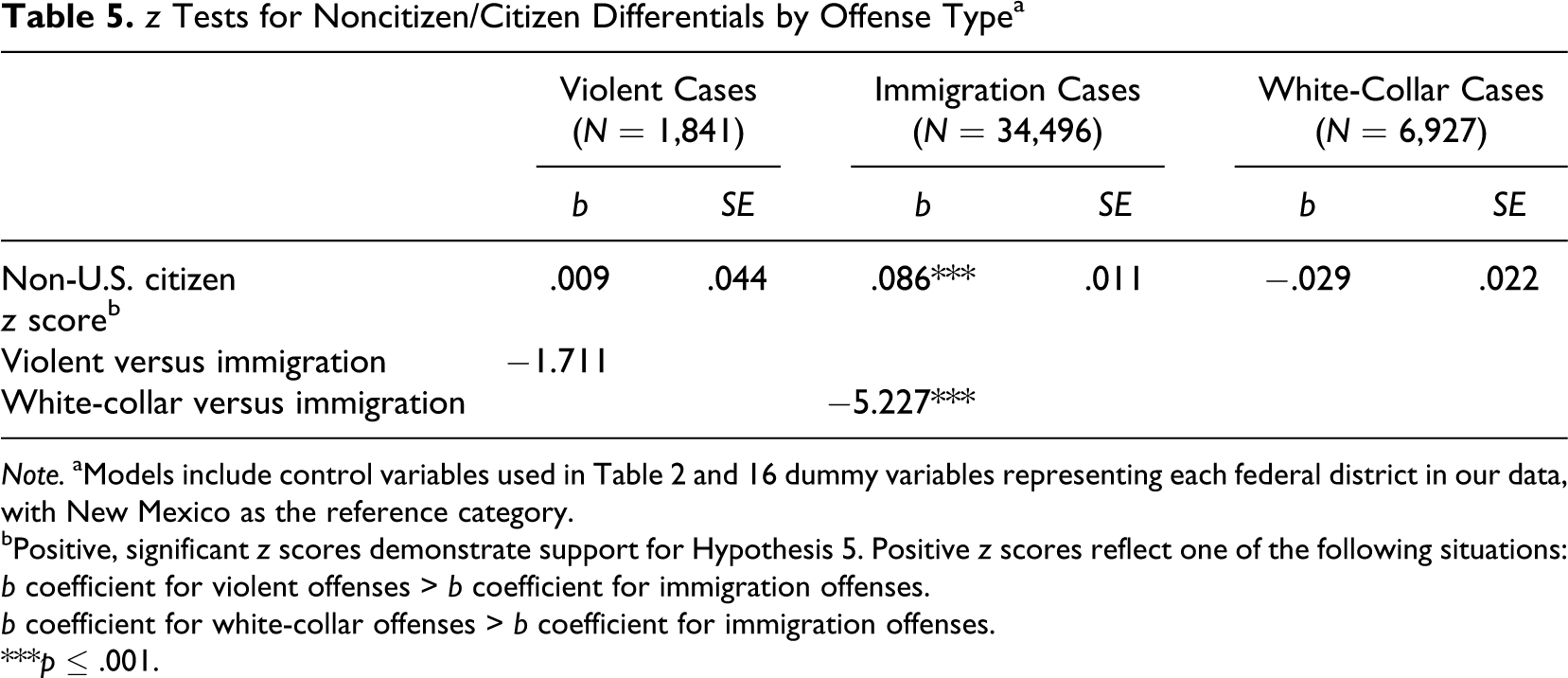
To further test the normal crime hypothesis, we posited that the noncitizen/citizen differential should be more pronounced for violent or white-collar offenses than for immigration offenses due to the atypical role of the former and the typical role of the latter for noncitizen offenders (cf. Hawkins, 1987). As shown in Table 5, the smaller unstandardized coefficient for violent cases than that for immigration cases, together with the insignificant difference between the two coefficients (z = −1.711), suggested that findings were inconsistent with the aforementioned prediction. Further analysis of the comparison between white-collar and immigration cases in Table 5 reveals that despite the significant difference between the unstandardized coefficients (z = −5.227; p ≤ .001), the noncitizen/citizen differential, contrary to our prediction, was virtually a greater effect for immigration cases than for white-collar cases. Overall, our findings failed to support Hypothesis 5.
z Tests for Noncitizen/Citizen Differentials by Offense Type a
Note. aModels include control variables used in Table 2 and 16 dummy variables representing each federal district in our data, with New Mexico as the reference category.
bPositive, significant z scores demonstrate support for Hypothesis 5. Positive z scores reflect one of the following situations:
b coefficient for violent offenses > b coefficient for immigration offenses.
b coefficient for white-collar offenses > b coefficient for immigration offenses.
***p ≤ .001.
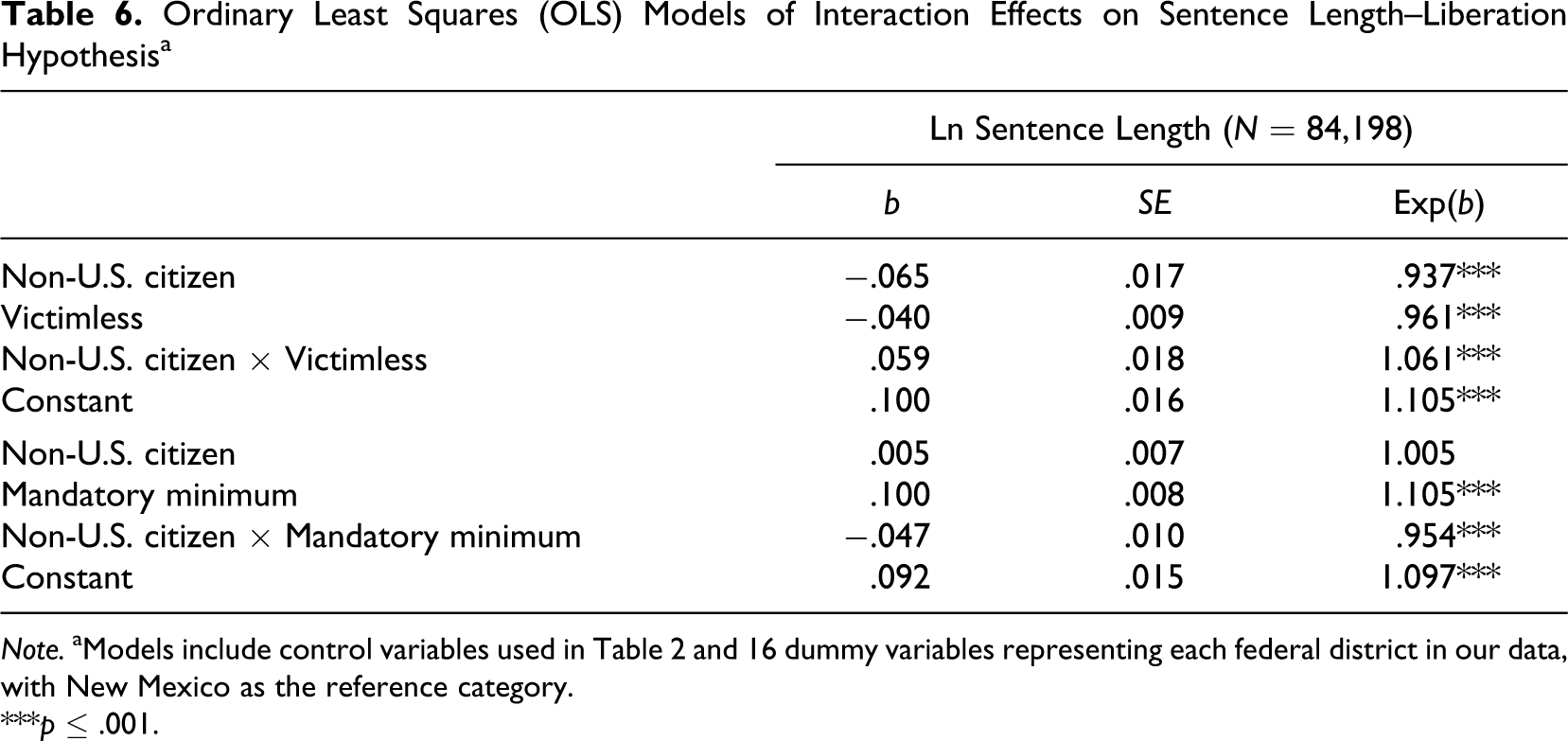
Table 6 presents findings for the test of the liberation hypothesis that examines interactions between citizenship status and offense types. We expected to find greater sentencing disparity for victimless offenses versus nonvictimless offenses but smaller sentencing disparity for offenses with mandatory minimums versus those without mandatory minimums. Consistent with our hypothesis, the first finding shows that each unit increase in victimless offenses lengthened the prison term for noncitizen offenders by 6.1%. Similarly, as expected, each unit increase in mandatory minimum offenses shortened the prison term for noncitizen offenders by 4.6%. These findings revealed support for Hypotheses 6 and 7.
Ordinary Least Squares (OLS) Models of Interaction Effects on Sentence Length–Liberation Hypothesis a
Note. aModels include control variables used in Table 2 and 16 dummy variables representing each federal district in our data, with New Mexico as the reference category.
***p ≤ .001.
Although the major focus of this study was not on race/ethnicity, we performed a robustness check by further examining whether the normal crime and liberation hypotheses were supported by the effect of being Black or Hispanic with the same offense classifications. Findings (not shown) demonstrated no support for the normal crime hypothesis. These results were consistent with those for citizenship status that failed to confirm this hypothesis. Regarding the liberation hypothesis, partial support was found for offenses with mandatory minimums committed by Hispanic offenders. Overall, 79% of the findings from race/ethnicity models were consistent with the findings from citizenship status models.
Discussion and Conclusion
The purpose of this study was to explore whether the unwarranted exercise of judicial discretion is pronounced when offenses are deemed typical to certain offenders and when offenses are less serious. The sentencing literature has focused considerably on how race and ethnicity play a crucial role in explaining differential treatment, and the effects of race and ethnicity have been found to vary across offense types (e.g., Curry, 2010; Demuth & Steffensmeier, 2004; Spohn & Cederblom, 1991; Spohn & Fornango, 2009). It is unclear, however, whether citizenship status and offense types interact to impact sentencing outcomes. The current study sought to bridge the empirical gap by examining whether noncitizen offenders would be deemed less desirable for certain offenses in a judge’s sentence length decision. Our particular interest was in the normal crime hypothesis (Sudnow, 1965) and the liberation hypothesis (Kalven & Zeisel, 1966).
The disadvantageous treatment of noncitizen offenders in judicial sentencing was not found in the sentence length decision. Contrary to the findings of several investigations of sentence length (Albonetti, 2002; Kautt & DeLone, 2006; Mustard, 2001; Schanzenbach, 2005; Ulmer, 2005), we found a significantly shorter prison term for noncitizen offenders than for their counterparts. The shorter prison sentences for noncitizen offenders may reflect a judges’ consideration of removal proceedings that are unique to this group of offenders. Noncitizen offenders face two types of judicial decisions in federal courts: one is criminal sentencing proceedings and the other is immigration proceedings that involve a removal under the Immigration and Nationality Act (INA) of 1952 (INA §237[a][2], §238, & §240, 1952; 8 U.S.C. §1227, §1228, & §1229a). Removal proceedings for noncitizen offenders, in general, begin soon after criminal sentencing is completed. To ensure that noncitizen offenders appear before federal immigration judges and are deported back to their home countries in compliance with U.S. immigration statutes, sentencing judges tend to not sentence noncitizen offenders to probation (more than 97% of noncitizen offenders sentenced to prison during FY2006–FY2008, compared to 85% of citizen offenders). Furthermore, to avoid unnecessary social costs (e.g., prison overcrowding) and administrative resources (e.g., costs of incarceration), judges may see no need to impose a lengthy prison term on noncitizen offenders, who will eventually be removed from the U.S. Judges may be concerned about a noncitizen offender’s ability to do time in a relatively complex prison environment (Steffensmeier et al., 1998). Cultural and language diversity and heterogeneity often make noncitizen offenders vulnerable to the mainstream prison subculture formed through racially organized gang groups, causing conflicts between noncitizen and citizen prisoners. These considerations are in fact consistent with Steffensmeier, Ulmer, and Kramer (1998) organizational and offender concerns.
Contrary to research findings based on national federal data (e.g., Feldmeyer & Ulmer, 2011; Johnson & Betsinger, 2009), this study found the harshest punishments for immigration offenders in the sentence length decision. As our data came from federal jurisdictions in bordering states or those with a large percentage of noncitizen offenders, such findings suggest that federal judges in these areas might view immigration offenses as most concerned. Considering the Federal Sentencing Guidelines §2L1.2 (illegal entering and remaining in the United States) as the primary source of approximately 70% of immigration offenses each year (see USSC, 2007, 2008), it is not surprising to see that federal judges in our data have been harsher toward immigration offenders, compared to offenders convicted of other offenses. These judges might perceive illegal immigrants as a type of social or group threat and in turn might use severe penalties in an attempt to deter immigration offenses.
Regarding the normal crime hypothesis, the theoretical expectation was that noncitizen offenders would be sentenced more leniently than U.S. citizens for immigration offenses but would be sentenced more harshly for violent offenses and for white-collar offenses. The theoretical framework also predicted the significant noncitizen/citizen differential more salient for violent or white-collar offenses than for immigration offenses. Contrary to our predictions, all models failed to support the normal crime hypothesis. Compared to citizen offenders, noncitizen offenders faced a longer prison term for the offense that had been deemed typical of this group of offenders (e.g., immigration offenses). In contrast, noncitizen offenders received the same punishment as citizen offenders for offenses that had been considered atypical of this group (e.g., violent and white-collar offenses). Because our data came from several states with a relatively large noncitizen population, the above findings suggest that federal judges in these areas might feel a growing threat from offenses committed by noncitizens, particularly in respect to immigration offenses. Judges tended to be concerned about offenses committed by noncitizens at a more frequent rate than those committed at a less frequent rate. Consequently, judges’ sentencing style for noncitizen cases did not follow the normal crime prediction that offenses typical of offenders would make them free from a severe criminal punishment. Findings of this research as to the normal crime hypothesis were generally consistent with those of prior research that suggested no effect (see Auerhahn, 2007; Steen et al., 2005; Swigert & Farrell, 1977).
The interactive effect between citizenship status and immigration offenses does appear to deviate from the purpose of early dispositions as a legitimate reason for downward departures. Early disposition (or fast-track) programs under the Federal Sentencing Guidelines §5K3.1 have been designed to remedy the problem with constrained prosecutorial resources and operations to handle a considerable number of cases (e.g., immigration or drug trafficking cases) in certain federal districts (USSC, 2006). 14 Defendants’ participation in early disposition programs via plea agreement, waiver of rights to pretrial motions/appeal/deportation hearings, and savings to the government may support a government’s motion for a downward departure. As such, noncitizen defendants convicted of immigration offenses, for example, are expected to receive a reduced sentence in early disposition programs. The goal of such programs, in fact, is consistent with the expectation of the normal crime hypothesis. As displayed in Table 4 and contrary to the prediction of early disposition programs, each unit increase in immigration offenses was associated with a 17.1% increase in the prison term for noncitizen offenders. Findings (in Table 3) also revealed that compared to other types of downward departures, early disposition departures did not exercise a particularly strong effect on the prediction of the reduced length of the sentence for noncitizen offenders. Reduced sentences for noncitizen offenders were associated primarily with substantial assistance and regular downward departures. The fact that early dispositions were applied only to 24.9% of immigration offenses (10,941 of the 43,990) might explain why a shorter prison term was not found for noncitizen immigration offenders and in turn there was no support for the normal crime hypothesis.
On the other hand, there was robust support for the liberation hypothesis. Findings from two models examining the sentence length decision were consistent with the hypothesis that the disadvantage of noncitizen offenders in the sentencing process increased when the severity of offenses decreased. The interactive effects were particularly salient for victimless crime versus victim crime. Victimless offenses have a low level of publicity, a low pressure of case processing from victims, and few legal constraints on judicial decision making, leaving a great deal of leeway for judges to exercise their discretion. Without pre-Booker data to be compared with, we can only speculate that the advisory Guidelines after United States v. Booker (2005) might also reinforce the liberated role of federal judges for less serious offenses, such as victimless crime. Furthermore, the mandatory minimums policy essentially shifts discretion from judges back to prosecutors, notably for a purpose of curbing unbridled judicial power (Ulmer, Kurlychek, & Kramer, 2007). Sentences carrying no mandatory minimums make the discretionary power remain in judges’ hands. Judges nonetheless may not have any discretion to decide whether a defendant, regardless of citizenship status, should be incarcerated, simply because the sentence is a mandatory imprisonment. Judges do have discretion to determine the length of the sentence above mandatory minimums, and this is reflected in our findings when such individual characteristic as citizenship status is taken into account. Thus, findings of this research (i.e., the investigation of victimless offenses and offenses carrying mandatory minimums) were consistent with those of prior research that presented support for the liberation hypothesis (Barnett, 1985; Chen, 2008; Kalven & Zeisel, 1966; Reskin & Visher, 1986; Smith & Damphousse, 1998; Sorensen & Wallace, 1995; Spohn & Cederblom, 1991).
There are research caveats in our study that should be noted. The first caveat involves the classification of some offense types, which is inevitably discretionary due to definitional disagreement. Particularly evident are white-collar (Friedrichs, 2009; Nelken, 2002) and victimless offenses (Bedau, 1974; Schur, 1965, 1974). Most of the criminological literature tends to identify white-collar crime with several core elements, including offenders with high socioeconomic status, the context of legitimate occupation, nonviolent methods for individual or organizational economic gain or success, and the violation of a trust relationship (Friedrichs, 2009; Shapiro, 1990; Sutherland, 1983). The USSC has its own classification for the purpose of statistical analysis (USSC, 2006), but the coverage is not as broad as the conventional definition of white-collar offenses. For instance, the USSC does not include insider trading in this category (USSC, 2006). The Federal Bureau of Investigation (FBI) has defined white-collar offenses as “those illegal acts which are characterized by deceit, concealment, or violation of trust and which are not dependent upon the application or threat of physical force or violence” (Federal Bureau of Investigation [FBI], 1989, p. 3). The FBI’s National Incident-Based Reporting System (NIBRS) provides a list of offenses that fall within the survey of white-collar crime (Barnett, n.d.). White-collar offenses, which can be committed by both individuals and organizations, may also include corporate crime (Clinard & Yeager, 2006; FBI, 1989; Friedrichs, 2009; Simpson, 2002). Despite the narrow FBI’s definition that focuses only on offense types rather than on offender characteristics (Barnett, n.d.), our determination of white-collar offenses has followed the FBI’s approach and the NIBRS’s classification because federal sentencing data do not include offender socioeconomic status and employment information for a possibility to examine these offenses based on offender or corporate characteristics (see Barnett, n.d.). We also have made reference to the USSC’s white-collar categories.
Likewise, the definition of victimless offenses is controversial. This type of crime generally refers to defined offenses by criminal law that involve no identifiable victims (see USSC §3D1.2, comment, n. 2, 2007) or public order offenses (Miethe, McCorkle, & Listwan, 2006). Schur (1974) provides conceptual guidance about crimes without victims by stating that “The ‘offense’ in such a situation, then, consists of a consensual transaction—one person gives or sells another person something he or she wants” (p. 6). In addition, Hardaway (2003) suggests that defining victimless crime should center on “the nature of the consensual activity proscribed” by taking into consideration “the issue of harm to others” (p. 21). According to Hardaway’s definition, threat to harming others likely occurs and is predictable, but the identity of the victim is currently unknown. In other words, crime with victims suggests the presence of victims who can be identified immediately or in a timely fashion, and a legally consensual activity by no means has any person victimized at the time of action and predicts any potential victim. Hardaway’s definition is consistent with the explanation by the Federal Sentencing Guidelines, stating that the Guidelines do not refer to victims as “indirect or secondary victims” (USSC §3D1.2, comment, n. 2, 2007). Our classification of victimless offenses, to a broad extent, has encompassed the elements of the aforementioned definitions.
The second caveat is concerning our dichotomous classification of citizenship status as either U.S. citizens or non-U.S. citizens. We were nonetheless unable to determine the background of a citizen offender. That is, some citizen offenders who obtained U.S. citizenship immediately or a few years before criminal offenses were categorized into the citizen group, but it is likely that their growing backgrounds and cultural heritage were associated more strongly with emigrating countries than with immigrating countries (e.g., United States). Our findings were unable to capture the process of immigration but were only able to focus on the status of citizenship. However, this limitation may not be harmful, as citizen offenders will by no means face removal proceedings, regardless of their growing and cultural backgrounds. Such distinction may virtually lead sentencing judges to make different decisions between noncitizen offenders and citizen offenders with an immigration background. This is also the reason why we did not differentiate between legal and illegal aliens, both of whom are subject to removal proceedings. 15 Furthermore, sentencing research on race and ethnicity also has the same issue, but sentencing scholars seldom differentiate racial/ethnic offenders who are native from those who are naturalized. Therefore, despite our interest in dichotomous citizenship status as the primary independent variable, the current findings have provided new insights into our understanding of the normal crime and liberation hypotheses.
Footnotes
Acknowledgments
The authors thank the anonymous reviewers for their valuable comments. They would also like to thank John Song for his thoughtful comments during the process of revision.
The authors declared no potential conflicts of interest with respect to the research, authorship, and/or publication of this article.
The authors received no financial support for the research, authorship, and/or publication of this article.