



Abstract
Evidence of a corrections agency scandal involving corruption can be expected to diminish public perceptions of agency effectiveness, especially in an era in which government accountability has featured prominently in national and state criminal justice policy discourse. However, relatively little scholarly attention has studied this idea. Using 2006 public opinion survey data collected prior to and after the highly publicized resignation of a corrections department director who was investigated for and subsequently convicted of graft and mismanagement, this study examines whether a prominent corrections agency scandal exerted an appreciable effect on how the public viewed the agency’s performance. Study findings suggest that the scandal had no effect on the public’s perception of the department’s performance. Implications of the study for research and policy are discussed.
Introduction
The increasingly prominent emphasis on government accountability in policy making discourse, not least in discussions of the correctional system, suggests that the public is attentive to how government agencies operate (Flanagan & Longmire, 1996; Hatry, 2006; Mears, 2010; Perelman & Clements, 2009; Welsh & Harris, 2008). From this perspective, public views about such agencies should be greatly affected by evidence that the agencies perform poorly or are poorly managed. The dramatic growth in the correctional system in recent decades would seem likely to fuel such a relationship, especially given the considerable media attention to crime and justice issues (Kniest, 1998; Roberts, 2007; Stinchcomb, 2006; Surette, 2007). To date, however, there exist few studies that investigate the factors that affect public views about correctional system performance.
The goal of this article is to examine one critical factor—agency scandal—that may affect public views about the correctional system. To this end, it capitalizes on an unforeseen event: the highly publicized resignation, and subsequently the conviction, of James Crosby, the Secretary, Department of Corrections (DOC), in 2006 for accepting bribes and kickbacks from prison vendors in exchange for service contracts. In the months immediately preceding and following Crosby’s resignation, a statewide poll was conducted of Florida citizens, asking them about their views concerning the State’s correctional system and, in particular, its performance.
The data collection began before the news of the corruption surfaced, then continued in the months after. In the end, approximately half the sample participated in the survey prior to the reports of the Crosby scandal (February 10, 2006) and the other half participated after the reports of the scandal. A unique opportunity thus arose to investigate whether a high-level scandal involving a state corrections director affected public opinion. In particular, the resulting public opinion data allow for investigation of the impact of a corruption scandal involving a high-ranking administrator on public perceptions of agency performance. Arguments can be made, for example, that public views should be sensitive to evidence of agency graft (Fox, Van Sickel, & Steiger, 2007). At the same time, arguments can be made that their views may be impervious to scandals (Cullen, Fisher, & Applegate, 2000; Iyengar & Kinder, 1987; Sherman, 2002). Notably, however, no empirical tests of these arguments, as they apply to the correctional system, exist to date.
To investigate whether public views of corrections are responsive to evidence of agency scandal, the article proceeds as follows. First, we review prior work on public views about government performance, as well as research on the effect of government scandal on such views. Second, we discuss the role of the media in shaping public opinion and, in particular, views about criminal justice and correctional systems. Third, we discuss our hypothesis about how the public can be expected to respond to high-level agency scandal. We then discuss the data and methodology and present the findings. The analyses suggest that public views about the Florida correctional system were unaffected by the agency scandal involving the resignation of the DOC director. We conclude by discussing the study’s implications for research and policy.
Scandals, Public Perceptions, Media, and the Criminal Justice System
Government Accountability
Since the 1990s, there have been increased calls for greater government accountability; indeed, the mantra of government accountability has pervaded nearly all levels of government (Hatry, 2006). The criminal justice system, in particular, has embraced this terminology and emphasis (Gaes, Camp, Nelson, & Saylor, 2004). For example, as Stenning (1995, p. 4) has highlighted, among government agencies, “the institutions of criminal justice are the ones that most explicitly and self-consciously affect people’s freedom and privacy, and this generates heightened expectations with respect to accountability.”
The federal government and states have responded to the call by developing and implementing a wide and varied array of crime-focused policies in the last three decades (Mears, 2010). Many of these policies have prioritized incapacitation strategies and, in particular, the incarceration of offenders for longer periods of time. Notably, however, increased incarceration appears to have done little to improve public opinion about the correctional system. For example, public perception of correctional system performance, compared to other branches of the justice system, is relatively negative (American Bar Association, 1999; Greene & Doble, 2000; Pepper, Lovbakke, & Upson, 2004). Most Americans do not believe that the correctional system effectively deters crime (Flanagan, 1996b), rehabilitates inmates (Roberts & Hough, 2005), or sufficiently punishes offenders (Lenz, 2002). Put differently, during the same time in which government accountability has been emphasized in social policy debates, large swaths of the public appear uncertain that our nation’s prisons and jails can effectively and efficiently perform their duties. That does not mean that the public disagrees with such goals as retribution and rehabilitation or that they think that rehabilitation cannot be effective (Cullen et al., 2000; Mears, 2010; Roberts, 1992). It does mean, though, that the public questions the effectiveness of the justice system in achieving them.
Given the pronounced emphasis on accountability and the public’s relative skepticism toward the correctional system, it follows that Americans might be especially sensitive to reports of scandal involving corrections officials and express discontent with this system if they learned of corruption. If they do, that would suggest that a potentially important check against correctional system corruption exists. If they do not, however, it would suggest that such corruption may occur largely unchecked, in turn undermining efforts to enhance the evidence-based foundation of the correctional system (Gaes et al., 2004; Welsh & Harris, 2008). To our knowledge, no studies to date have directly investigated this issue. The question thus remains do high-level agency scandals involving correctional systems affect public views about performance? Before examining this question, we discuss prior work on how prominent scandals have affected public perceptions about government agencies other than those involving the criminal justice system.
Scandals and Public Opinion of Government
According to several national polls conducted in the United States, Americans’ perceptions of government performance in most social institutions have become steadily more negative since the 1960s (Dalton, 2005). Among the many factors thought to be related to this trend is the emergence of increased reports of scandals involving political leaders. Although it is frequently assumed that these scandals affect public views, in reality “very few researchers have examined whether scandalous behavior on the part of politicians and government officials influences how citizens view government and institutions” (Bowler & Karp, 2004, p. 272). Nonetheless, extant research has shown that political corruption and scandal can strongly and negatively affect attitudes toward policy makers (Funk, 1996; Lanoue & Headrick, 1994), governments (Miller & Listhaug, 1990; Seligson, 2008), and social and political institutions (Bowler & Karp, 2004; Chanley, Rudolph, & Rahn, 2000). For example, Bowler and Karp (2004) investigated the perceptions of the U.S. Congress shortly after the 1992 House Bank scandal, in which several representatives were accused of exploiting their position to obtain interest-free loans. Respondents who reported hearing about the incident, compared to those who did not, were more likely to disapprove of Congress’ performance (p. 280).
Juxtaposed against such work are studies that suggest scandal may exert little if any influence on public views. For example, several studies have found no effect of scandals on public views about the performance of the U.S. Presidency or overall confidence in American government (Lawrence & Bennett, 2001; Shah, Watts, Domke, & Fan, 2002). To illustrate, Miller (1999, p. 727) examined survey data collected during President Clinton’s impeachment trial and found that “throughout the year of the Clinton-Lewinsky scandal and a subsequent impeachment, a large majority of the American public, while not condoning his behavior, remained firmly fixed in their support of President Clinton.” In addition, a study exploring the effects of various political scandals (e.g., the Iran-Contra and Whitewater scandals) on Americans’ trust in government revealed no significant impact of these events on measures of public opinion (Keele, 2007).
Against this backdrop, scholars have questioned whether scandals and other negative events may affect public perceptions about the performance of various social institutions (Weatherford, 1992). Anderson and Tverdova (2003), for example, have argued that “the idea that corruption has a negative impact on people’s views of their government is open to both theoretical and empirical challenge” primarily because “researchers have paid little systematic attention to the effects corruption might have on the attitudes of ordinary people toward political institutions in their country” (p. 93). In a related vein, Chanley et al. (2000) have claimed that media coverage of scandals affects public opinions only in the short term (see also Jones, 2004).
The studies to date have focused almost exclusively on public views about the presidency or congress. As emphasized earlier, we know of no research that has explored how scandals that occur within the correctional system affect public views about that system. However, a significant body of research does exist that has examined the effect of the media on opinions about the justice system. This work is particularly relevant for explaining how citizens might learn about and perceive scandals involving the correctional system.
Media, Crime and Justice, and the Correctional System
Prior studies indicate that the public relies on media reports to learn about the criminal justice system (Ruva, Guenther, & Yarbrough, 2011; Weitzer & Kubrin, 2004). As Roberts, Stalans, Indermaur, and Hough (2003, p. 76) have observed, “it is not only information about crime that is transmitted by the media but also suggestions about how to understand, view, and respond to crime.” Put differently, the media serve as a conduit that not only provides information but that also shapes public views about offenders, crime, and sanctioning policies.
However, despite a large body of work on public opinion and crime and criminal justice (see, e.g., Applegate, Cullen, & Fisher, 2002; Cullen et al., 2000; Flanagan & Longmire, 1996; Hurwitz & Peffley, 2008; Mears, 2010; Nagin, Piquero, Scott, & Steinberg, 2006; Roberts, 2007; Warr, 1995), few studies have examined factors associated with perceptions about correctional system performance. Instead, scholars have primarily focused on a range of other questions, such as whether media exposure affects fear of crime (e.g., Chiricos, Padgett, & Gertz, 2000), support for three strikes’ laws (e.g., Callanan, 2005), and punitive attitudes (e.g., O’Connell & Whelan, 1996). Substantially less is known about questions related directly to how well the correctional system fulfills its responsibilities.
One notable exception is a study undertaken by Fox et al. (2007) who measured the relationship between public views about criminal justice system performance and views about high-profile cases reported in the media, such as the O. J. Simpson criminal trial and the Senate impeachment trial of Bill Clinton. They found that “negative reactions to each of the cases [were] correlated with lower levels of confidence in the criminal justice system as a whole” (p. 150). The study is notable for having drawn attention to how such cases may influence public views toward the correctional system. At the same time, it focused only on public satisfaction and so left open the question of whether these types of cases, and agency corruption and scandal in general, may affect how the public views different dimensions of agency performance, such as managing staff misconduct, providing programs and services, and preventing escapes.
There is reason to believe that the public should be highly responsive to publicized accounts of agency scandals. Prior work establishes that Americans expect the correctional system to protect society from convicted offenders (Roberts et al., 2003). They expect correctional authorities to monitor incarcerated inmates and offenders on probation and parole (Flanagan, 1996a). They expect correctional institutions to mete out sufficient punishment—“prison life should be hard” (Doble, 1987, p. 28). And, as Flanagan (1996b, p. 91) has reported, the public also insists that services—educational, training, and counseling—be made available to offenders to “reduce the deficits that are associated with involvement in crime.” Not least, the public expects correctional staff and administrators to exhibit personal integrity while performing their professional obligations (Roberts & Hough, 2005). Such expectations suggest that evidence of high-level scandals should decrease public perceptions of correctional system effectiveness.
Even so, and as prior work on public opinion about congress, the presidency, and noncorrectional system government agencies indicates (see, e.g., Anderson & Tverdova, 2003; Keele, 2007), corruption may not “register” among the public as an issue of special concern. More precisely, individual instances of corruption may not affect the public’s attitudes or expectations about correctional system mismanagement. Put differently, the public may either not care about such corruption or view it as typical and thus not noteworthy. Under that logic, it may be that public views of correctional system performance remain relatively the same even after reports appear documenting agency scandal and widespread corruption.
The Current Study
Prior research has mainly focused on how the media sensationalize certain events in criminal justice. Our focus here is on the extent to which correctional system scandal affects public views about agency performance. The importance of this focus derives in part from the fact that public views are central to claims by agencies that they are accountable to the public. In this regard, Sherman’s critique, made in 2002 but still applicable today, is especially relevant: “What is known about public trust and confidence in the criminal justice system is both limited and sobering” (p. 6). That situation reflects many factors related to public opinion research (Roberts et al., 2003; Roberts, 2007), but one of them is the fact that although some studies have examined public perceptions about the justice system and crime policy, “few have attempted to measure what the public really thinks about corrections” (Bryant & Morris, 1998, p. 26; emphasis added).
Against that backdrop, the focus of this study is on the following question: Are public views about different dimensions of correctional system performance affected by a high-level agency scandal? To examine this question, we rely on responses from a public opinion poll conducted in Florida. Specifically, we use 2006 survey data collected before and after the resignation of the former Florida DOC Secretary, James Crosby, due to allegations of corruption and mismanagement. On February 10, 2006, reports surfaced implicating Secretary Crosby (the highest ranking correctional official in Florida) and several of his subordinates of committing a host of crimes—embezzlement of state funds, misuse of prison labor, illegal drug use among correctional officers, and even assault and intimidation of potential witnesses who allegedly witnessed the offenses (Associated Press, 2006c). The scandal garnered considerable media coverage. Over 50 news accounts from around the state described it as “high profile” and “massive”; this decidedly negative and intense media coverage was not limited to Florida (see Appendices A and B). For example, the L.A. Times published a multipage exposé soon after the allegations became public, “Web of scandal ensnares the Florida prison system,” that reported on the events occurring within the Florida correctional system (Dahlburg, 2006). Given these accounts, the Crosby scandal appears to be one of the most prominent agency-level scandals to have occurred in the Florida correctional system in recent years.
Our central hypothesis is that the scandal will negatively affect public views about the effectiveness of correctional system performance. This hypothesis stems in part from prior observations about media effects on public perceptions. Research indicates that the news media serve as “the most important source of information about criminal justice” for a majority of Americans (Roberts, 1992, p. 116). Moreover, as scholars have emphasized, media reports tend to emphasize particularly negative aspects of the criminal justice system (Roberts et al., 2003). It may also be the case that the function and size of the agency attracts public attention. The Florida correctional system is the third largest department in the country, with annual expenditures of more than $2 billion (Florida DOC, 2010; West & Sabol, 2010). Given its cost, it follows that Floridians may be especially attentive to how its state correctional system operates.
For these reasons, we anticipate that the public, after learning about corruption undertaken by the leader of its correctional system, should be substantially less likely to view the Florida DOC as being effective. We also anticipate that the effect will be generalized—that is, after reports of the scandal, the public should express less positive assessments not only of overall performance (see Fox et al., 2007) but also of specific dimensions of performance (e.g., the effectiveness of the DOC in preventing escapes, rehabilitating inmates, providing drug and alcohol treatment to offenders, and, not least, addressing employee misconduct). The underpinnings for this argument derive in part from prior media consumption research, which indicates that Americans typically hold views about individual actors that they use to generalize about the larger organizations within which these individuals operate. Hibbing and Theiss-Morse (1998), for example, discuss how Americans generalize views about the leaders of Congress to all members of Congress (for similar discussions, see also, Keele, 2007; Van de Walle, Kampen, & Bouckaert, 2005). A related logic suggests warrant for the generalized effect. Specifically, the public may have little basis for assessing a wide range of dimensions of performance. Thus, when asked to comment on these dimensions, they may generalize based on their perceptions about what they know or perceive about the credibility of the correctional system and its administration.
The null hypothesis is, of course, that the scandal will have no effect on public perceptions about correctional system performance. Although some scholars have theorized that negatively publicized events affect views about agency performance, several studies have found little to no effect of highly publicized scandals, even those involving prominent federal officials (Lawrence & Bennett, 2001; Miller, 1999; Shah et al., 2002), on opinions about the performance of various governmental institutions. Indeed, some scholars have argued that even widely publicized incidents may not appreciably affect public perceptions about these institutions (Anderson & Tverdova, 2003; Iyengar & Kinder, 1987). One reason may be because the public expects frequent mismanagement of public agencies, including those in the correctional system (Sherman, 2002), or because the public views such events as aberrant occurrences and not indicative of overall agency mismanagement. Under this line of reasoning, one can anticipate that reports of scandal involving corruption by a high-ranking official may exert relatively little to no influence on public perceptions of correctional system performance.
Data and Method
Agency Scandal
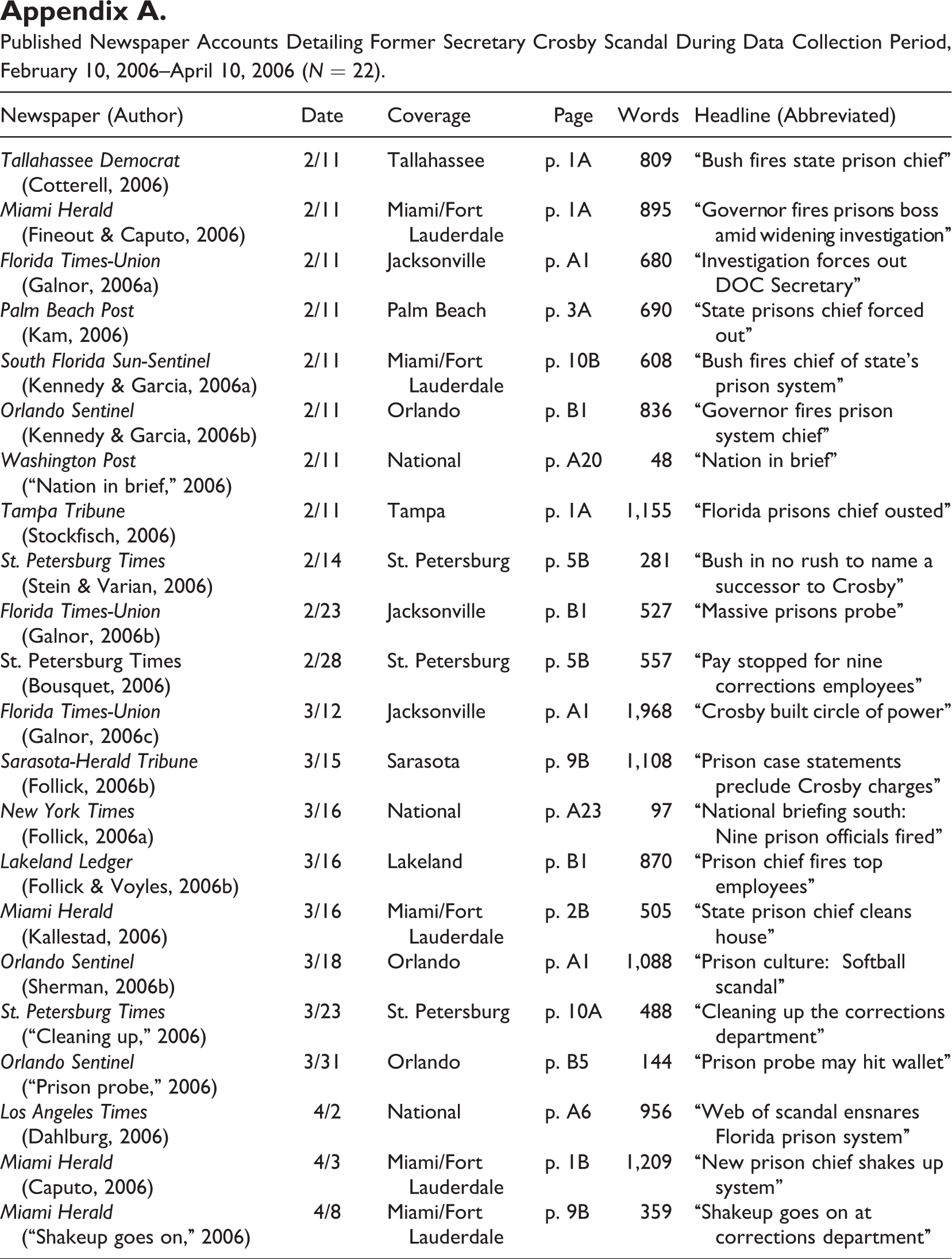
The resignation of Florida’s DOC Secretary, James Crosby, on February 10, 2006, due to allegations of corruption and mismanagement of one of the nation’s largest correctional departments, provides a unique opportunity to assess the impact of scandal on public perceptions about the justice system. As discussed earlier, the event garnered considerable media attention throughout Florida. In the days after Crosby’s resignation, major newspapers from across the state reported on the scandal and the ensuing investigation of widespread corruption in Florida’s prison system. For example, in South Florida, leading newspapers—the Miami Herald (Fineout & Caputo, 2006; Kallestad, 2006), the South Florida Sun-Sentinel (Kennedy & Garcia, 2006a), and the Palm Beach Post (Kam, 2006) reported on the scandal. Central Florida coverage included the Orlando Sentinel (Kennedy & Garcia, 2006b; “Prison probe,” 2006; Sherman, 2006b), the St. Petersburg Times (Bousquet, 2006; Stein & Varian, 2006), and the Tampa Tribune (Stockfisch, 2006). North Florida coverage was also extensive with the Florida Times-Union (Galnor, 2006a, 2006b, 2006c) and the Tallahassee Democrat (Cotterell, 2006) providing reports on the scandal and the DOC investigation. Media coverage of the event went well beyond accounts in state newspapers. National media outlets, such as the New York Times (Follick, 2006a), the Los Angeles Times (Dahlburg, 2006), and the Washington Post (“Nation in brief,” 2006) also covered the story. A number of reports also appeared on news websites (see e.g., Associated Press, 2006a, 2006b, 2006c; Follick & Voyles, 2006a; Sherman, 2006a). At the same time, several Florida television news stations, such as WJXX (Jacksonville), WTVJ (Miami), WESH (Orlando), and WTVT (Tampa) provided regular updates about the scandal in the days and weeks following the Crosby resignation. (Greater detail about the in-depth coverage of the scandal is provided in Appendices A and B.)
Data
The data for this study come from a public opinion poll of Florida residents (N = 1,308) conducted from January to April 2006. The survey was designed to tap into public views about the state correctional system. Accordingly, it included a number of measures related to satisfaction with the Florida DOC, including residents’ perceptions about the Department’s performance. When the survey was undertaken, there was no indication that the DOC director was under investigation or would resign on February 10, 2006. When news of the investigation and resignation emerged, it became evident that an opportunity existed to investigate whether the event might influence views about high-level agency scandal, especially because news accounts implicated not only the director but also several members of his staff (see “Cleaning up,” 2006; Follick, 2006b; Kallestad, 2006; Kam, 2006; “Shakeup goes on,” 2006; Sherman, 2006a).
The study sample was created using a two-stage modified Mitofsky–Waksberg random digit dialing (RDD) method designed to yield responses from a representative sample of the state (Brick & Tucker, 2007). Using the American Association for Public Opinion Research (AAPOR, 2004) calculation, we estimated the survey response rate to be 48.6%. As advised by the AAPOR, we excluded from this calculation cases of unknown eligibility (e.g., answering machines, busy signals, no answer) and known ineligibility (e.g., disconnected numbers, businesses, and fax numbers). Interviewers used computer-assisted telephone interviewing (CATI) software (Ci3; Sawtooth, Sequim, WA) which has been designed to ensure accuracy in the recording of responses. Of those who initially responded to the survey, the overwhelming majority of respondents completed the interview (91%). These estimates are similar to (or exceed) comparable estimates from other research involving public opinion surveys (Nagin et al., 2006; Vogel & Vogel, 2003).
Below, we discuss the variables and analyses used in this study. Table 1 provides additional information about the variables.
Descriptive Statistics.
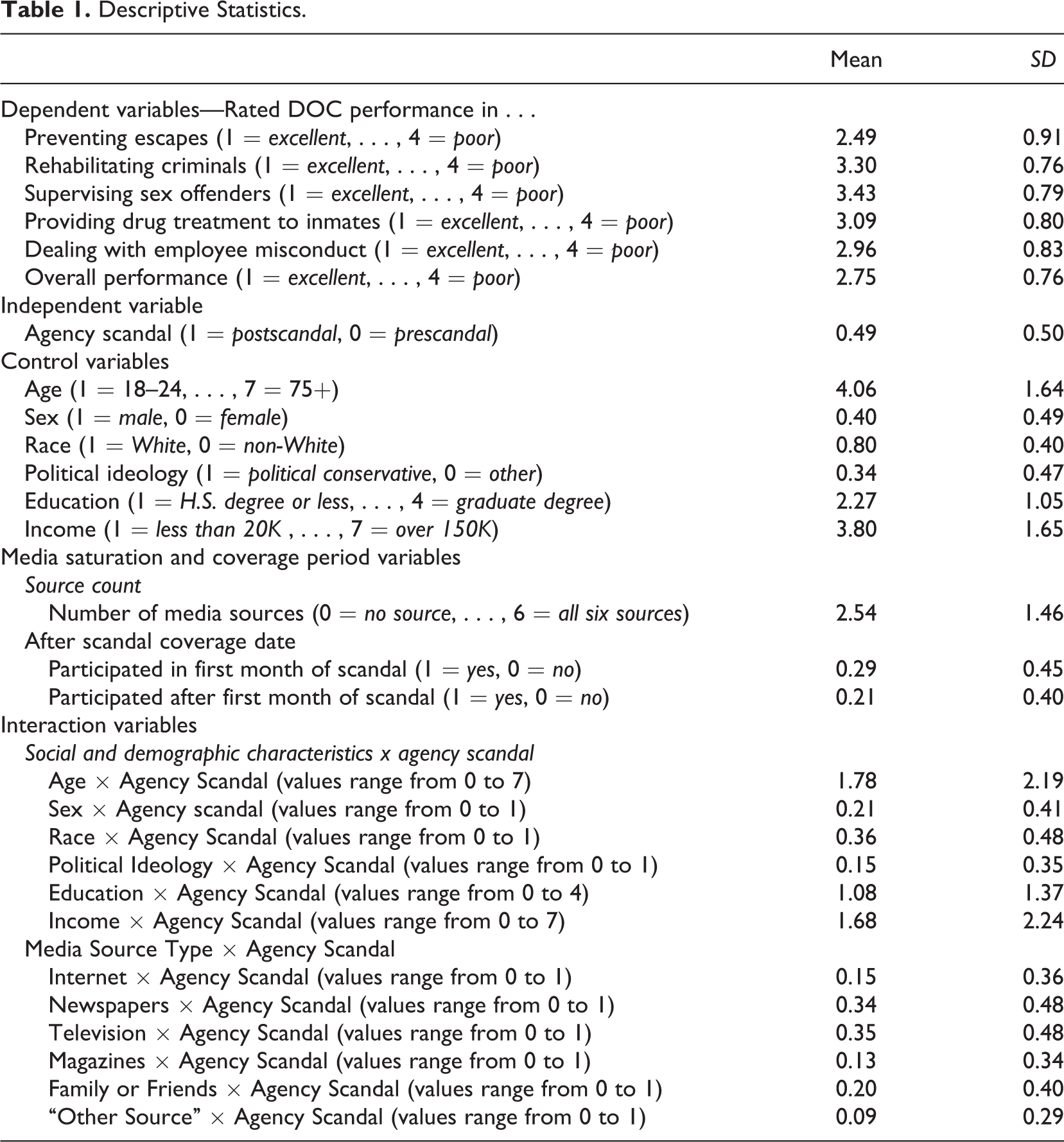
Dependent Variables
Views about the effectiveness of the DOC performance along five dimensions
Given that correctional systems are charged with multiple responsibilities (e.g., ensuring inmate and staff security, supervising offenders on probation), the poll included several questions that asked about the public’s views about the effectiveness of the DOC’s performance along five dimensions. In particular, respondents were asked, “How would you say the Florida DOC is doing when it comes to preventing escapes?” “Rehabilitating criminals so that they will become productive members of society?” “Supervising sex offenders on probation?” “Providing drug and alcohol treatment to inmates?” “Dealing with employee misconduct?” Response options were 1 = excellent, 2 = good, 3 = fair, and 4 = poor job.
Views about overall DOC performance
As part of the general survey, respondents were also asked to rate the DOC’s overall performance in managing the correctional system. The justification for including this measure is twofold. First, a scandal may affect views about overall performance but perhaps not specific dimensions of performance. We view that possibility as being of interest in its own right. However, including a measure of overall performance is relevant from a policy perspective—if an agency fails to maintain a positive image with the public, then specific areas of exceptional performance may go unappreciated. In this case, for example, the public might well have responded to media accounts by feeling less positive about the effectiveness of the correctional system in managing employee misconduct (given that employees were involved in the alleged corruption), but they might not have felt differently about the system’s efforts to reduce escapes. The question was, “Overall, would you say the Florida correctional system is doing an excellent, good, fair, or poor job?” Response options were 1 = excellent, 2 = good, 3 = fair, and 4 = poor job.
Independent and Control Variables
To gauge whether the respondent participated in the survey before or after February 10, 2006—the date of Director Crosby’s resignation—we created a dummy variable as the main independent predictor of public views about the effectiveness of the DOC. Scandal was coded as 1 = respondent participated after scandal and 0 = respondent participated before scandal. 1
Because naturally occurring quasi-experiments are rare in studies of crime and justice (see e.g., Murray, Farrington, & Eisner, 2009), in creating this measure, we drew on prior research that has assumed postgroup event exposure in similar types of investigations. For example, in a study of Rochester, New York college students, Stretesky and Hogan (2001) took advantage of a naturally occurring quasi-experiment involving student perceptions of campus safety before and after the Columbine High School shooting by analyzing data collected between April 15, 1999, and May 5, 1999 (notably, the Columbine shooting occurred on April 20, 1999). Although the researchers lacked a direct measure of whether students in the posttest group in fact had heard about the Columbine incident (the data were not collected with the purpose of measuring the impact of Columbine on student perceptions), they theorized that “the myriad of reports [that] appeared in various media detailing the events that had taken place” (p. 429) provided postgroup respondents with sufficient exposure to the event. This approach is consistent with the literature on media consumption, which indicates that for highly publicized incidents (e.g., scandals involving congress and other political leaders), it may not be necessary to directly assess whether the public actually hears about or reads specific accounts of the event (Besley & Shanahan, 2004; Eshbaugh-Soha & Peake, 2011; Hibbing & Theiss-Morse, 1998). Put differently, for some situations—such as those in which events are widely publicized—it is reasonable to assume that the public has heard something about the event, whether through media reports or through conversations with family members, friends, or acquaintances.
Drawing on this line of work and reasoning, we anticipate that respondents who participated in the postscandal period can reasonably be assumed to have learned about the scandal directly or indirectly. As noted above, the scandal appeared in a diverse range of media, including newspapers in all the major regions of the state and also in and national newspapers (e.g., Cotterell, 2006; Fineout & Caputo, 2006; Galnor, 2006a; Kam, 2006; Kennedy & Garcia, 2006a; Sherman, 2006a, 2006b; Stein & Varian, 2006; Stockfisch, 2006), the Internet (e.g., Associated Press, 2006a, 2006b, 2006c), and television (e.g., WJXX, WTVJ, WESH, WTVT). Echoing this assessment, one media account observed that the scandal constituted “one of the biggest shakeups of any state agency in recent history” (Follick & Voyles, 2006b, p. B1; Appendices A and B provide a complete listing of these accounts.)
In addition to testing the main effect of agency scandal, we conducted a series of interaction analyses to determine whether the effect of the scandal might vary across certain groups or by source of information. First, we created interaction terms (Scandal × Age, Scandal × Sex, Scandal × Race, Scandal × Political Ideology, Scandal × Education, and Scandal × Income) that were used in analyses designed to test whether certain Floridians were more critical in their assessment of corrections after learning about the scandal. For each measure of correctional system performance, we then ran a series of regression models, each with a separate interaction term included.
Second, we theorized, given prior work (see e.g., Weitzer & Kubrin, 2004), that media source reliance might affect assessments of the DOC. Here, we estimated regression models that examined whether there might be a differential effect of the scandal depending on the media source. The interaction terms consisted of Scandal × Internet, Scandal × Newspapers, Scandal × Television, Scandal × Magazines, Scandal × Family or Friends, and Scandal × Other Source.
It may be that the type of media source does not affect views about the prison system so much as the volume of media that respondents consume. Accordingly, we created a media saturation or source count variable (which ranged from 0 = no source, 1 = one source, 2 = two sources, 3 = three sources, 4 = four sources, 5 = five sources, and 6 = all six sources) to investigate whether the number of media sources one relies on affects the perceptions of correctional system performance. In addition, given that media coverage continued in the weeks and months after news of the scandal surfaced, we explored the timing effects. To illustrate, respondents who participated in the survey immediately after the reports of the Crosby scandal emerged had less time to learn about it. On the other hand, those Floridians who completed the survey months after the scandal occurred had greater opportunities to absorb information about it. Thus, we designed ancillary analyses that tapped into this effect by creating two dichotomous variables—“participated in first month of scandal” and “participated after first month of scandal.”
In line with other studies of public opinion, we also controlled for the effects of social and demographic variables, including age, sex, race, political orientation, education, and income, that might potentially bias the estimated effect of the agency scandal measure. Respondents were asked, “Which of the following categories best describes your age?” Age was coded as 1 = 18–24, 2 = 25–34, 3 = 35–44, 4 = 45–54, 5 = 55–64, 6 = 65–74, and 7 = 75 and over.
Prior work has found that men and women may differ in their opinions about crime and justice (Applegate et al., 2002). Sex thus was included as a control (1 = male and 0 = female). A number of studies have found racial variation in perceptions about the justice system (Messner, Baumer, & Rosenfeld, 2006). Since race has been found to influence views about crime and justice in prior research, we controlled for it as well. In the Florida poll, respondents were asked, “What race do you consider yourself?” To have a measure that more closely corresponds with other studies of public opinion, the coding was 1 = White and 0 = non-White.
Political ideology has also been theorized to influence views about the criminal justice system (Unnever, Cullen, & Fisher, 2007). We therefore included a measure of political orientation that accords with those used in prior studies (1 = political conservative and 0 = all others). Studies of public opinion typically include the socioeconomic status of respondents (Cullen et al., 2000). We therefore controlled for both education and income. To measure the educational achievement of respondents, the poll asked, “What is the highest grade of school or year in college you yourself completed?” Categories were coded as 1 = high school degree or less, 2 = some college, 3 = college graduate, and 4 = attended and/or completed graduate school. In addition, the survey inquired about respondents’ annual family income. They were asked, “Now consider your family’s household income from all sources. As I read a list, please stop me when I get to the income level that best describes your household income in 2005.” This variable was coded as 1 = less than $20,000, 2 = $20,000–$34,999, 3 = $35,000–$49,999, 4 = $50,000–$74,999, 5 = $75,000–$99,999, 6 = $100,000–$150,000, and 7 = over $150,000.
Analyses
The analyses examine the question were Florida citizens more likely to view the DOC as ineffective after news of the Department’s scandal surfaced? To this end, we present a series of ordinary least squares (OLS) regression analyses that assess whether, net of the controls, individuals who responded after the director’s resignation—as compared with individuals who responded prior to the resignation—were less likely to view the agency as effective.
To supplement this assessment, we examine several ancillary questions aimed at systematically investigating the possibility of a scandal effect. First, does the effect of the scandal vary across different social and demographic groups? It may be that some groups’ views are more susceptible to media influence or to negative accounts about correctional system scandals. To illustrate, many public opinion studies report that African Americans view the correctional system with more skepticism, tending to believe, more so than Whites, that it operates unfairly (Henderson, Cullen, Cao, Browning, & Kopache, 1997; Hurwitz & Peffley, 2008). Accordingly, they may react more strongly, and unfavorably, to accounts of agency scandals. We investigate this idea as well as the possibility that the effects of agency scandal may vary with respect to the age, sex, political orientation, education, and income of respondents. To this end, and as noted above, we estimated multiplicative models to test whether the Crosby resignation had a differential effect among these social and demographic groups on views about the state correctional system.
Second, does the source of information on which individuals rely or to which they were exposed influence respondents’ views about correctional system performance? This question derives in part from a study by Robinson (1976) who reported that individuals expressed greater cynicism about the government when they relied on television news accounts rather than on other media coverage of similar stories. Other studies have found that while television news viewing appears to lower public trust in government institutions, newspaper reading has positive effects on levels of public confidence (Hetherington, 1998; Moy & Pfau, 2000). It thus may be the case that individuals who received information from certain sources (e.g., television) were more likely to report that the correctional system is ineffective after news of the Florida DOC scandal emerged. In the survey, individuals were asked, “Where do you get information about Florida prisons?” Response options were “the Internet,” “newspapers,” “television,” “magazine articles,” “family or friends,” and “some other source” (respondents could report all the sources that applied). We investigated whether each of these measures were associated with respondents’ views about correctional system performance.
Third, we investigated the question of whether individuals who were more “media saturated”—that is, those who obtained information from multiple news sources—were more likely to express negative views about the correctional system. Using the media measures described above, we created an information variable that provided a summed measure of the total number of sources of information to which respondents were exposed or that they used. The idea here is that those who are more exposed to the media should have stronger views. Accordingly, in the post-Crosby scandal period, individuals who were more media saturated should have held more negative views about the correctional system’s performance.
In a related vein, we also examined the possibility that individuals who had more time to learn about the scandal would have more negative views about the correctional system. Media coverage of the event was intense in the days and weeks following the announcement of the scandal; however, media coverage also continued in the subsequent months. Accordingly, respondents who were interviewed later in the survey period had more opportunities to learn about the scandal and change their views. For these analyses, we compared the responses of individuals who responded to the survey in the month immediately after the scandal (February 10 to March 10) with respondents who responded in the month after that (March 11 to April 11).
Findings
We begin first with describing the public’s rating of DOC performance on six dimensions, including overall performance, where 1 = excellent, 2 = good, 3 = fair, and 4 = poor job. As inspection of Table 1 shows, the public gave their most favorable rating of the DOC in preventing inmate escapes (mean = 2.49). The next most dimensions-specific favorable ranking was for the DOC’s management of employee misconduct (mean = 2.96). Florida residents were slightly less likely to view the DOC’s drug treatment programs as being effective (mean = 3.09). By far, the public was least satisfied with performance along the last two dimensions—DOC performance in rehabilitating offenders (mean = 3.30) and correctional system performance in managing and supervising sex offenders on probation (mean = 3.43). Despite these appraisals, the public’s assessment of overall performance was relatively high (mean = 2.75).
We turn our focus now to the main question. Does agency scandal affect perceptions of specific indicators of performance? By and large, the findings from this study suggest that the answer is, no. As examination of Table 2 shows, regardless of whether the focus is on preventing escapes, rehabilitating criminals, supervising sex offenders on probation, providing drug treatment to inmates, dealing with employee misconduct, or overall performance, there was no statistically significant effect of the agency scandal on public views about the DOC. 2 In every model, for example, the coefficient for the scandal measure is close to 0, with the coefficients ranging from −.05 to. 03, indicating that even if a statistically significant effect emerged, it essentially differed from 0 by a trivial amount. In short, we find no support for the hypothesis that high-level agency scandal exerts an effect on public views toward the correctional system and its performance. 3
Ordinary Least Squares Regression of Public Opinion of Correctional System Performance on Agency Scandal.
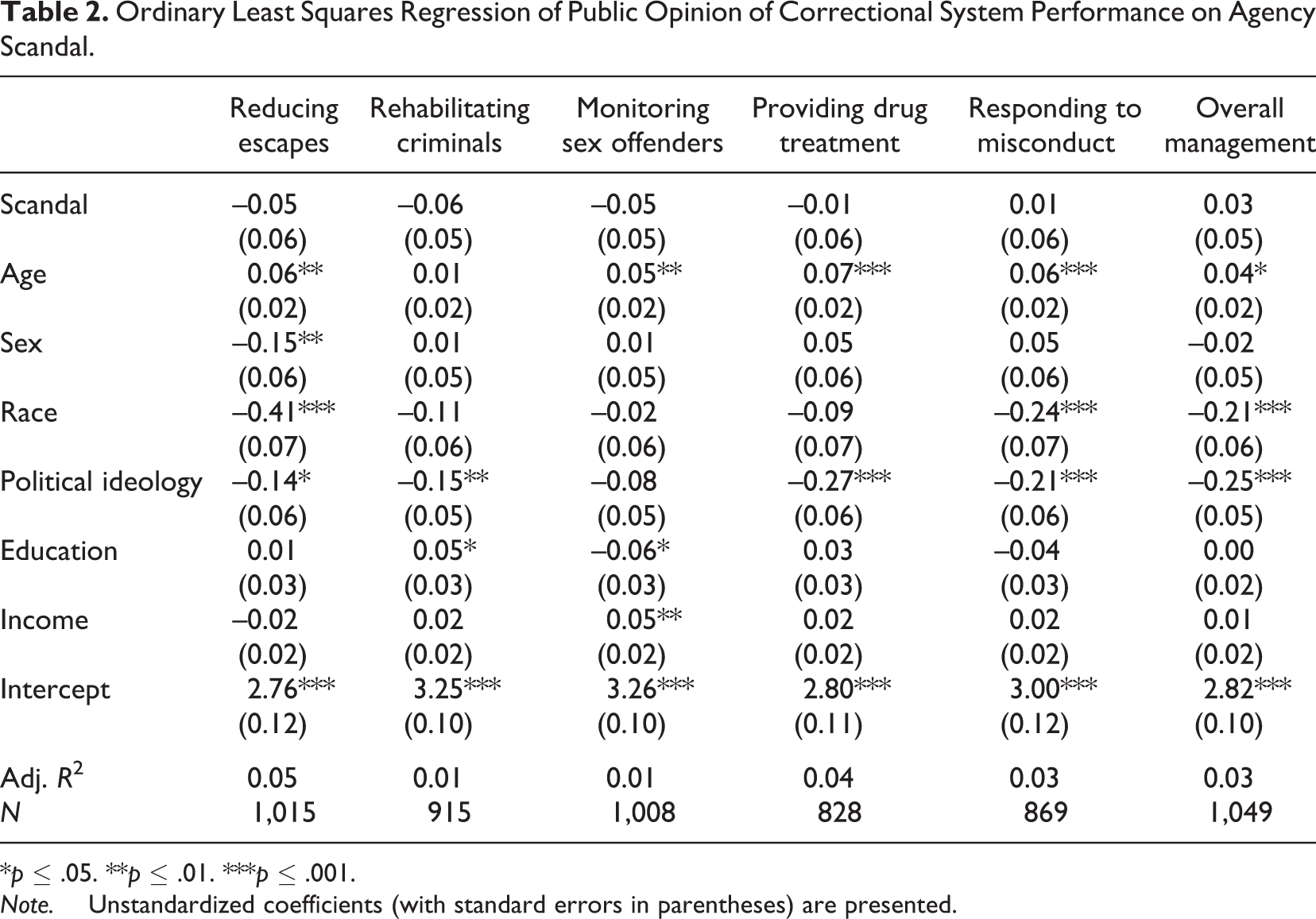
*p ≤ .05. **p ≤ .01. ***p ≤ .001.
Note. Unstandardized coefficients (with standard errors in parentheses) are presented.
Although not the focus of the study, the effects of the statistically significant control variables—age, sex, race, political ideology, education, and income—bear mention. Inspection of Table 2 indicates that older Floridians were less likely to view the DOC as effective in all but one area of responsibility (rehabilitating criminals). Females were less likely to view the DOC as effective in preventing escapes. In line with prior research, minorities were less likely than Whites to view the prison system as being effective. Specifically, non-Whites were less likely to view the DOC as proficient in preventing escapes, addressing employee misconduct, and managing the correctional system. The analyses also revealed that political conservatives were more favorable in their assessment of system performance than political moderates or liberals. That effect was present for all but one performance measure (management of sex offenders on probation). Socioeconomic status also had an effect: better educated respondents were more likely to view the DOC as effective in rehabilitating offenders, but they were less likely to view the DOC as effective in monitoring sex offenders. Not least, we found that higher income respondents were less likely to view the DOC as effective in supervising released sex offenders.
Although the analyses show that the scandal did not influence public opinion, it is possible that accounts of agency level scandal might matter more to different populations. For instance, prior work has revealed that negative reports about the criminal justice system are “variably interpreted by persons with distinctive social characteristics” (Weitzer & Kubrin, 2004, p. 499). Interaction analyses, however, provided no support for this argument. Specifically, analyses that included interaction terms between the Scandal Measure and Age, Sex, Race, Political Ideology, Education, and Income, respectively (see Table 1)—with each analysis examining a separate interaction (Scandal × Age in one model, Scandal × Sex in a second model, etc.)—identified no statistically significant interactions. Put differently, the lack of a scandal effect was consistent across different social and demographic groups in Florida. (Results available upon request.)
Another possibility is that the sources of information respondents use to learn about the correctional system matters. It may be, for example, that individuals who learned about the corruption scandal from the Internet might be more likely to view the DOC as ineffective. We tested this hypothesis by disaggregating the sample by the type of source that respondents reported using to learn about the DOC (e.g., newspapers, the Internet, television, magazine articles, friends or family, and other sources). Here, again, the separate regression analyses for each group revealed no statistically or substantively significant effect of the scandal measure on public views about correctional system performance. (Results available upon request.)
The basic premise underlying these analyses is that media accounts of correctional system scandals influence what the public may know, and ultimately, thinks about agency effectiveness. To investigate this assumption further, we conducted two final supplementary analyses. First, we examined whether individuals who are “media saturated” may be more exposed to negative accounts of the DOC, including the agency scandal, and so would be more likely to view the DOC as ineffective. We tested this idea by creating an information count variable that measured the number of sources respondents used to learn about the DOC. We found no evidence of a “dosage” effect. That is, individuals who were more media saturated were no different in their appraisal of the DOC’s effectiveness in either the prescandal period or the postscandal period. Second, we compared individuals who participated in the survey during the month after the Crosby scandal with individuals who participated a month later. The logic is that the latter individuals had more time, and thus opportunities, to learn about the scandal. Here, again, null effects surfaced. That is, there were no differences between the two groups in their views. 4
Conclusion
Although scholars have assumed that well-publicized scandals involving high-ranking officials negatively affect perceptions about public agencies, little research has explored the actual effect of such events on public views about the correctional system. This research gap is important because the increased emphasis in recent years on government accountability is premised in part on the notion that public understanding of and views toward government constitutes a critical part of what it means to have accountability. It is also important because, as many scholars have emphasized (e.g., Mears, 2010; Roberts et al., 2003; Sherman, 2002; Weitzer & Kubrin, 2004), little is known about public views toward the correctional system.
In this study, we capitalized on a naturally occurring quasi-experiment, one in which a public opinion survey was administered immediately prior to and after the forced resignation in February 2006 of former Florida DOC Secretary, James Crosby, who was investigated and later convicted of several crimes, including accepting bribes from potential prison contractors. Using these data, we found no evidence that the scandal changed the Florida public’s perception about the department’s performance on several dimensions. Even after the emergence of a high-profile corruption scandal involving the head of the DOC, Florida residents did not change their views about the DOC’s performance in preventing escapes, rehabilitating offenders, supervising sex offenders in the community, providing drug treatment to inmates, dealing with employee misconduct, or the Department’s overall performance. Moreover, there was no evidence that different social and demographic groups were differentially affected by the scandal. That is, the agency scandal did not appear to affect some groups more than others. In addition, individuals who were more “media saturated” were not more likely to hold different views about the State’s correctional system after the scandal. For example, individuals who reported relying on a greater variety of media sources or who participated later in the survey and who thus had more opportunities to learn about the scandal expressed similar views about the correctional system, as compared to their less “media saturated” counterparts.
We turn now to several explanations that might account for why the scandal did not affect public views about the effectiveness of the state’s correctional system. First, public views about corrections may be relatively intransigent or impervious to scandals as well as to media accounts of them. That possibility might seem unlikely, but it may be that the public expects that criminal justice systems typically suffer from graft and mismanagement (see, e.g., Roberts & Hough, 2005; Surette, 2007). As a result, their views may not be appreciably affected by news accounts depicting instances of such events. The public also may discount news stories out of a generalized distrust toward the media (Jones, 2004) or perhaps out of a felt necessity to believe that the criminal justice system operates efficiently and keeps them safe (see Cullen et al., 2000).
In contrast to this argument, it could be that when the public hears about scandals that have occurred in the criminal justice system, it may take a significant period of time—more than a few months, for example—for them to absorb the information and to change their views. Much remains unknown about how long it can take news accounts to influence the public. Indeed, as Kosicki (1993, p. 107) has emphasized, the issue has been “insufficiently theorized and underspecified.” Even so, some studies have found that news reports about social issues can take as little as a few weeks to as long as 6 months to affect opinions about public policy (Kiousis, Bantimaroudis, & Ban, 1999). Perhaps a longer lag effect was operative in the case involving the Florida correctional system scandal. If that is indeed the case, this development would support a “smoldering” effect view of how scandals shape public opinion. Specifically, the Crosby resignation may have affected opinions about correctional system performance, but the impact might only have taken effect after many months of coverage and news analysis of the scandal.
Research Implications
A central premise of this study is that the media coverage of the Crosby scandal was sufficient to ensure that, for all intents and purposes, most members of the public knew about the scandal. That logic accords with what prior research has suggested about widespread coverage of prominent scandals by government agencies or their leaders. However, whether the media coverage was sufficient to ensure that most or all respondents learned about the scandal is an empirical question, one that may limit the generalizability of the study. With that limitation noted, we turn now to several directions for future research.
First, the timing effects of media exposure merits empirical attention. Several scholars have noted the “agenda-setting” function of the media—namely, its ability to affect public judgments about particular social issues and controversies (see generally, Entman, 1989; Weaver, 2007). Although a substantial body of research has indicated, according to Kim, Scheufele, and Shanahan (2002, p. 21), that “the media play a key role in indirectly shaping public opinions for a wide variety of issues on a day-to-day basis,” exactly how long it takes for such exposure to affect perceptions remains an open question. As Scheufele (2000, p. 305) has observed, theoretical arguments are typically “not the driving force” behind which research designs are chosen to study the agenda-setting effects of the media—instead, “time lags are tested in numerous ways until an optimal one is found” (Kosicki, 1993, p. 107). Prior work, in fact, indicates a wide range of time, from a few weeks (see Winter & Eyal, 1981) to several months (up to 6 months, for instance; see Stone & McCombs, 1981) in which media reports can affect public opinion about policy and government (see also, Kiousis et al., 1999). The current study used data that were collected from January until April 2006, providing approximately 2 months of postscandal time to detect changes in residents’ perceptions of the DOC’s performance. Certainly, this time span fits squarely within the lag estimates (a few weeks up to 6 months) observed in prior studies. However, a longer time frame might better capture a possible “smoldering effect” (if in fact one exists) with respect to public perceptions about the correctional system.
Ideally, future work should consider placing greater emphasis on the types of scandals that are most likely to influence public views. Prior studies have found conflicting results of the effect of scandals on public perceptions about government performance. Some studies have found that public attitudes toward government agencies are negatively affected by publicized accounts of official misconduct (Chanley et al., 2000; Seligson, 2008). However, Miller (1999) reported that the impeachment trial of President Bill Clinton in 1999 did not significantly change public views about his performance while in office (see also Lawrence & Bennett, 2001; Shah et al., 2002). Indeed, despite the numerous media reports that included detailed information about his affair, researchers found no substantive decline in Americans’ perceptions of his performance as President. The study here focused on a single high-profile corruption scandal involving the director of a state correctional system. Perhaps certain types of scandals (e.g., those involving sexual or violent acts) are more likely to affect public views or have a more immediate impact on public opinion about correctional system performance than others.
In addition, the media coverage of certain types of scandals might matter. In the current study, we found little support for the notion that the types of news sources respondents reported using to learn about the DOC (e.g., the Internet, television) were related to views about the correctional system. Even so, it could be the case that certain types of media reporting (perhaps newspaper editorials or theme-focused television broadcasts) that cover other types of scandal (e.g., scandals involving the mistreatment of incarcerated offenders) may in fact affect public opinion about the correctional system.
Policy Implications
Research centered on perceptions about crime and punishment has found that the public expresses the least amount of confidence in the penal system, compared to the other branches of the justice system. To explain the public’s lack of faith in the correctional system, Roberts and Hough (2005, p. 294) have pithily observed that “insufficient punishment with not much rehabilitation—little wonder then that prisons fail to inspire public confidence.” Following this logic, it would appear that public views about corrections departments would worsen after evidence of agency scandals. In particular, the moral and ethical failings of high-level officials and corresponding negative press presumably might contribute to an image of the correctional system as corrupt, inefficient, and mismanaged.
However, the findings from this study suggest a potentially different response by the public. More precisely, the public appeared not to respond at all to what was described in many accounts as one of the most prominent agency-level scandals to have occurred in Florida (see e.g., Follick & Voyles, 2006b). That is, the public’s views about the correctional system’s effectiveness remained unchanged. It is possible, however, that views might have changed over a longer time period—this possibility can only be assessed with the collection of new data.
That caveat made, if indeed the scandal had no short-term or long lasting effect on public views about the DOC’s effectiveness, it indicates potential cause for concern. In particular, it suggests that corrections agencies can operate with relative impunity, especially in the absence of regularly collected, valid performance monitoring data (see, e.g., Gaes et al., 2004; Mears, 2010) and in light of the possibility that the public expects mismanagement (Sherman, 2002). That, of course, does not mean that the agencies in fact act with impunity and in ways that are unethical, illegal, or ineffective. It simply means that they may operate with the ability to do so and with few checks and balances, including the views of the public, to prevent corruption.
The study’s results suggest additional cause for concern—it may be that the public knows little about correctional systems. Indeed, some studies suggest that the public holds highly inaccurate views about the numbers of prisoners in their state prison systems, the length of time served in prison among different groups of inmates, the amount of rehabilitative programming, and other such dimensions of prison operations (see, generally, Cullen et al., 2000; Flanagan & Longmire, 1996; Roberts et al., 2003). To the extent that the public is uninformed about the correctional system, there exists considerable room for graft or corruption to occur and, more generally, for policy makers to allow agencies to operate with little accountability.
Although there exists no single best way to address these problems, several solutions may merit consideration. One is to increase the funding for research that monitors, using objective measures, the performance of correctional systems (Gaes et al., 2004). Another is to publicize annually the performance of correctional systems along a range of dimensions and to do so in a manner that identifies trends in performance. Still another is for states to conduct ongoing public opinion polls that help identify trends in public views about their correctional systems and their performance. Such information in turn can be used to identify when clear disjunctures between public views and objective measures do not align. Corrections agencies then would have information that they could use to identify when their efforts to operate in an accountable manner perhaps have been insufficiently noticed. At the same time, government officials and the public would have a more objective basis for putting particular events, including scandals, into context.
Footnotes
Appendix A.
Published Newspaper Accounts Detailing Former Secretary Crosby Scandal During Data Collection Period, February 10, 2006–April 10, 2006 (N = 22).
Newspaper (Author)
Date
Coverage
Page
Words
Headline (Abbreviated)
Tallahassee Democrat (Cotterell, 2006)
2/11
Tallahassee
p. 1A
809
“Bush fires state prison chief”
Miami Herald (Fineout & Caputo, 2006)
2/11
Miami/Fort Lauderdale
p. 1A
895
“Governor fires prisons boss amid widening investigation”
Florida Times-Union (Galnor, 2006a)
2/11
Jacksonville
p. A1
680
“Investigation forces out DOC Secretary”
Palm Beach Post (Kam, 2006)
2/11
Palm Beach
p. 3A
690
“State prisons chief forced out”
South Florida Sun-Sentinel (Kennedy & Garcia, 2006a)
2/11
Miami/Fort Lauderdale
p. 10B
608
“Bush fires chief of state’s prison system”
Orlando Sentinel (Kennedy & Garcia, 2006b)
2/11
Orlando
p. B1
836
“Governor fires prison system chief”
Washington Post (“Nation in brief,” 2006)
2/11
National
p. A20
48
“Nation in brief”
Tampa Tribune (Stockfisch, 2006)
2/11
Tampa
p. 1A
1,155
“Florida prisons chief ousted”
St. Petersburg Times (Stein & Varian, 2006)
2/14
St. Petersburg
p. 5B
281
“Bush in no rush to name a successor to Crosby”
Florida Times-Union (Galnor, 2006b)
2/23
Jacksonville
p. B1
527
“Massive prisons probe”
St. Petersburg Times (Bousquet, 2006)
2/28
St. Petersburg
p. 5B
557
“Pay stopped for nine corrections employees”
Florida Times-Union (Galnor, 2006c)
3/12
Jacksonville
p. A1
1,968
“Crosby built circle of power”
Sarasota-Herald Tribune (Follick, 2006b)
3/15
Sarasota
p. 9B
1,108
“Prison case statements preclude Crosby charges”
New York Times (Follick, 2006a)
3/16
National
p. A23
97
“National briefing south: Nine prison officials fired”
Lakeland Ledger (Follick & Voyles, 2006b)
3/16
Lakeland
p. B1
870
“Prison chief fires top employees”
Miami Herald (Kallestad, 2006)
3/16
Miami/Fort Lauderdale
p. 2B
505
“State prison chief cleans house”
Orlando Sentinel (Sherman, 2006b)
3/18
Orlando
p. A1
1,088
“Prison culture: Softball scandal”
St. Petersburg Times (“Cleaning up,” 2006)
3/23
St. Petersburg
p. 10A
488
“Cleaning up the corrections department”
Orlando Sentinel (“Prison probe,” 2006)
3/31
Orlando
p. B5
144
“Prison probe may hit wallet”
Los Angeles Times (Dahlburg, 2006)
4/2
National
p. A6
956
“Web of scandal ensnares Florida prison system”
Miami Herald (Caputo, 2006)
4/3
Miami/Fort Lauderdale
p. 1B
1,209
“New prison chief shakes up system”
Miami Herald (“Shakeup goes on,” 2006)
4/8
Miami/Fort Lauderdale
p. 9B
359
“Shakeup goes on at corrections department”
Appendix B.
“Other” Media (Television News and Online Articles) Detailing Former Secretary Crosby Scandal During Data Collection Period, February 10, 2006–April 10, 2006 (N = 30). *Note: Online articles refer to original content still currently available on the Internet that did not appear to be duplication of the print articles presented in appendix 1. Given that web page links are subject to removal the accounts presented here likely reflect a conservative estimate of the amount of online news coverage that actually occurred during the study period.
Type of Account
Date
Title
Coverage (Media Agency)
Television News
2/10
“Channel 2 News at 5:00 PM”
Orlando (WESH, 2006)
Television News
2/10
“Channel 8 News at 5:00 PM”
Tampa (WFLA, 2006)
Television News
2/10
“Channel 9 News at 5:30 PM”
Orlando (WFTV, 2006a)
Television News
2/10
“News at 5:30 PM”
Fort Myers (WINK, 2006a)
Television News
2/10
“Channel 25 News at 5:30 PM”
Jacksonville (WJXX, 2006a)
Television News
2/10
“Channel 12 News at 5:00 PM”
West Palm Beach (WPEC, 2006)
Television News
2/10
“Channel 25 News at 5:00 PM”
West Palm Beach (WPBF, 2006)
Television News
2/10
“Channel 47 News at 5:30 PM”
Jacksonville (WTEV, 2006)
Television News
2/10
“Channel 12 News at 5:30 PM”
Jacksonville (WTLV, 2006a)
Television News
2/10
“Channel 13 News at 5:00 PM”
Tampa (WTVT, 2006a)
Television News
2/10
“Channel 13 News at 6:00 PM”
Tampa (WTVT, 2006b)
Television News
2/10
“News at 6:00 PM”
Fort Myers (WZVN, 2006)
Television News
2/11
“Channel 6 News at 6:00 AM”
Miami/Fort Lauderdale (WTVJ, 2006a)
Television News
2/11
“Channel 6 News at 6:30 AM”
Miami/Fort Lauderdale (WTVJ, 2006b)
Television News
2/11
“Channel 13 News at 8:00 AM”
Tampa (WTVT, 2006c)
Television News
2/13
“News at 5:30 PM”
Fort Myers (WBBH, 2006)
Television News
2/13
“Channel 12 News at 6:00 PM”
Jacksonville (WTLV, 2006b)
Television News
2/13
“Channel 25 News at 6:00 PM”
Jacksonville (WJXX, 2006b)
Television News
2/13
“Channel 25 News at 11:00 PM”
Jacksonville (WJXX, 2006c)
Television News
2/14
“Channel 25 News at 6:30 AM”
Jacksonville (WJXX, 2006d)
Television News
2/14
“Channel 12 News at 6:30 AM”
Jacksonville (WTLV, 2006c)
Television News
2/27
“Channel 25 News at 11:00 PM”
Jacksonville (WJXX, 2006e)
Television News
2/27
“Channel 12 News at 11:00 PM”
Jacksonville (WTLV, 2006d)
Television News
3/15
“News at 5:30 PM”
Fort Myers (WINK, 2006b)
Television News
3/16
“Channel 9 News at 12:00 PM”
Orlando (WFTV, 2006b)
Online Article* (Follick & Voyles, 2006a)
2/11
“Corrections head Crosby forced out”
Gainesville (Gainesville Sun)
Online Article* (Associated Press, 2006b)
2/19
“New head of prisons to restore ethics code”
Gainesville (Gainesville Sun)
Online Article* (Associated Press, 2006a)
3/4
“Five prison employees fired over banquet brawl”
St. Augustine (St. Augustine Times)
Online Article* (Associated Press, 2006c)
3/15
“Crosby tried to get FDLE head’s son to stop prisons probe”
Jacksonville (First Coast News)
Online Article* (Sherman, 2006a)
3/18
“New prison chief vows to beat ‘good ol’ boys’”
Miami/Fort Lauderdale (South Florida Sun Sentinel)

Authors’ Note
The authors thank the Research Network, including the staff and students who assisted in the study and the Florida Department of Corrections officials who provided partial funding for the study and assistance in developing the survey questionnaire. The views expressed here are not those of the Florida Department of Corrections but are those of the authors’ alone. We thank the anonymous reviewers for their helpful comments and suggestions and the Editor for guidance in strengthening the article.
Declaration of Conflicting Interests
The authors declared no potential conflicts of interest with respect to the research, authorship, and/or publication of this article.
Funding
The authors received no financial support for the research, authorship, and/or publication of this article.