



Abstract
As the prison population in the United States has ballooned over the past 30 years, people entering prison for parole revocation have come to constitute an increasingly large percentage of all prison admissions (35% in 2006). As a result, researchers have begun to turn their attention toward this criminal justice decision-making point to examine the factors that relate to why an individual is returned to prison. Notably, this developing body of research focuses almost entirely on one decision maker: the parole board who ultimately determines whether or not an individual on parole stays in the community, receives alternative sanctions, or returns to prison. Notably, this ignores the fact that parole revocation is a process beginning with the parolee who commits a violation behavior, turning next to the parole officer who uses his or her discretionary power to determine whether or not to file a complaint, and ending with the decision of the parole board. In this article, we examine each stage of this revocation process using structured qualitative interviews with 35 parole officers as well as quantitative data on 300 individuals on parole in Colorado between 2006 and 2007, who we followed for an 18-month period. We find that parolees with mental health needs commit significantly more technical violations; that race, gender, age, and measures of parolee effort affect whether a parole officer files a complaint; and that the decision made by the parole board is either largely random or driven by variables unspecified in our models.
Although numerous jurisdictions have experimented with the routinization of release discretion, efforts to comprehend or impose structure on parole revocations are still in their infancy. We have much evidence that reincarcerations in some jurisdictions occur in large numbers for technical violations of parole that would, on their own merits, never justify a term of confinement. What is clearer still is that we simply do not know enough about parole revocations from state to state to build sound policy. This knowledge vacuum must sooner or later be addressed. (Reitz, 2004, p. 209)
Introduction
The prison population in the United States has ballooned over the past few decades, increasing from 135 per 100,000 U.S. residents in 1978 to 445 by 2008. Although new court commitments contribute substantially to this increase, parole revocation is squarely implicated in this growth. While in 1980, parole violators represented 17% (27,000) of prison admissions nationwide, by 2008 they represented 35% (203,000) of admissions (Sabol, West, & Cooper, 2009). In Colorado, the site of this research, the Department of Corrections returned 24% of its parole population to prison or jail in 2006. Only three states (Arizona, Utah, and California) had a higher return rate, while many states had return rates lower than 10% (Glaze & Bonczar, 2006).
The state determines when and whether to revoke the parole of an individual who violates their parole agreement. An individual on parole can violate this agreement by committing a new offense or by not following a technical condition (e.g., failing a drug test or missing a meeting with their parole officer). In Colorado in 2007, 25% of all revocations were for new offenses, while 75% were for technical (noncriminal) violations (almost 3,000 people in a state with a prison population of approximately 23,000; Harrison, 2008). There is general consensus among the policy community that, because of their less serious nature and the presence of significant parole officer discretion, technical violation revocations are more troubling and a better target for reform than revocations for new criminal behavior. Indeed, a number of states have made policy changes in recent years in efforts to reduce their revocation rates, particularly for technical violations (Greene, 2003; King, 2007).
Parole board members are the criminal justice actors who ultimately determine whether or not to revoke the parole of an individual who violates their parole agreement. Hence, recent scholarship (Grattett, Petersilia, & Lin, 2008; Steen & Opsal, 2007; Van Stelle & Goodrich, 2009) focuses on the parole board and on potential factors that increase the probability of revocation. Who and what remains unexamined, however, are the parole officers and how they make decisions about noncompliant parolees. Specifically, it is parole officers who, while supervising their clients in the community, determine when it is time to file a complaint and bring their client in front of the parole board. In some ways, the decision is analogous to the arrest decision; unless parole officers file a complaint, the parolee’s behavior goes unpunished. In Colorado, almost no guidelines exist to guide parole officers who make these decisions. In other words, parole officers have access to significant discretion and, as a result, are major “back end” (Knapp, 1993) gatekeepers.
This article is an effort to address the lack of research and knowledge on the parole revocation process. To accomplish this, we structure our analysis in three stages examining not only the revocation decision made by the parole board but also the behavior of the individuals on parole as well as the parole officer who decides when to file a complaint against a parolee and send them in front of the parole board. We begin by summarizing the existing research on parole revocation. Then, we consider how we might use existing theoretical models on discretion in the criminal justice system to examine parole officers’ decisions to file a complaint. Additionally, we draw on interviews we conducted with Colorado parole officers to develop hypotheses about their decisions. Our results illuminate the complex processes at work at a decision-making point in the criminal justice system that, although bringing individuals directly back into prison, often escapes scrutiny (Steen & Opsal, 2007; Travis, 2007).
Prior Research on Parole Revocation
Existing research on the parole revocation process is sparse, though a growing number of researchers are beginning to examine this understudied decision-making point. Most recently, Grattett, Petersilia, and Lin (2008, 2010) conducted an ambitious study of the California parole system. This study tracked every adult on parole in the state in 2003 and 2004 (N = 254,468) to identify factors that increase the probability of revocation. Regarding parolee behavior, these researchers found that individuals who are younger, male, and have documented mental health issues are more likely to commit technical violations than their counterparts. Consistent with other studies on recidivism (Langan & Levin, 2002), Grattett et al. (2008) found that time on the outside decreases the likelihood that an individual will commit any kind of violation (new offense or technical). This study also identified a number of variables that increase the likelihood that the parole board will revoke an individual back to custody. Legal factors were significant predictors of revocation. Criminal history was highly predictive of a board’s decision to return a parolee to custody, and individuals incarcerated for sex or violent offenses were significantly more likely to be returned to prison than drug or property offenders. The seriousness of the new criminal charges or technical violations as well as the number of new charges or violations were also relatively strong predictors of revocation. Demographic characteristics had limited impact on the likelihood of revocation. No relationship existed between age and revocation. Gender had some predictive value, with boards more likely to revoke women for absconding from supervision than men. The significance of race varied across different kinds of decisions, with parole boards more likely to revoke Hispanics, Blacks, and individuals of “other” races in new criminal violation cases but no more likely to revoke members of these racial and ethnic groups for technical violations or absconding.
Van Stelle and Goodrich (2009) looked at a sample of 200 individuals who had their parole revoked in Wisconsin to examine whether or not there was evidence of racial disparities. Because this study design looks only at cases that were already revoked it is not possible to examine potential differences between those who were revoked and those who remained in the community. However, the findings do show that there were no significant differences between Black and White offenders in the type or frequency of technical violations committed, or in the way agents used graduated responses to individual-level behavior prior to filing a complaint for revocation.
Kassebaum and colleagues examined factors related to failure on parolee in Hawaii (Kassebaum, 1999; Kassebaum & Davidson-Corondo, 2001). Following over 600 individuals on parole, Kassebaum (1999) found that those individuals who had been on parole previously were regular drug users, unemployed prior to incarceration, and identified by parole officers as “unwilling to change” were more likely to be revoked than their counterparts. In a follow-up study Kassebaum and Davison-Corondo (2001) found only two factors with significant effects on revocation: the parolee’s criminal history and whether he or she had a “conventional” lifestyle.
These studies drew on individual-level data in their examination of parole revocation. Several other studies examine this phenomenon using aggregate-level data. Wilson (2005) looked at revocation rates across time and place in Tennessee. He found that increased revocation rates were tied closely to increased parole release rates, suggesting that revocation is used in part as a form of case management responding to increased and more dangerous caseloads. Other significant predictors of revocation at the aggregate level include being Black, young, and male. Wilson also finds significant differences in violation rates by region, suggesting that violation criteria may be applied differently by parole officers across the state.
Finally, in an article analyzing parole release data from the National Corrections Reporting Program, Steen and Opsal (2007) identify predictors of parole success in four states (Kentucky, Michigan, New York, and Utah), focusing on the relative impact of demographic and legal factors on different offender groups by race. They find that Black offenders are significantly more likely than White offenders to have their parole revoked for both a new offense and a technical violation, with the effect of race being significantly larger for technical violations than for new offenses. Variables that behaved differently for Black and White offenders included gender (the difference between Black and White males was much larger than the difference between females), time on parole (which significantly decreased the likelihood of revocation, more for Whites than for Blacks), and prior criminal history (which significantly increased the likelihood of revocation, more for Whites than for Blacks). These results, in particular, suggest the importance of separating new offense and technical violation decisions, perhaps even thinking of them as fundamentally different decisions, and also of considering the possibility that different factors will be important for different offender groups.
The current study extends the existing body of research on parole revocation in three ways. Most importantly, as stated at the outset of this article, our analysis takes into account that several important decisions exist in the revocation process. Prior research described here focuses on the parole board as the major decision-making agent. However, before an individual on parole faces the parole board, the parole officer must make the decision to file a complaint. In Colorado, as in many states, few rules guide this decision, making it particularly important in understanding how discretion operates in back end decisions. In addition to looking at different stages in the revocation decision process, we use interviews with parole officers to develop a better understanding of how they make decisions to file complaints. Finally, because we have access to each parolee’s case file, we have significant individual-level data on a variety of needs measures and are able to control for violation behavior while on parole. Our hope is that this article will provide a more complete picture of parole revocation than has been provided to date, will illuminate discretionary processes related to the complaint decision made by the parole officer, and, in particular, will challenge researchers to collect and analyze reliable and valid data on the complaint decision in particular.
Parole and Parole Revocation in Colorado
In 2009, there were approximately 23,000 people in prison and over 11,000 people on parole in Colorado. In 2008, 40% of all prison admissions in Colorado were parole violators (totaling about 4,000 offenders). Of these, 25% were returns for new offenses and 75% were for technical violations (Harrison, 2008). Individuals in Colorado can be released from prison under mandatory or discretionary parole. Most offenders become eligible for parole after serving at least half of their sentence. Individuals who are released on parole between their parole eligibility date and their mandatory release date are described as “discretionary” releases. Those released on their mandatory release date are described as “mandatory” releases; in 2007, 65% of releases were mandatory (CO State Auditor, 2008).
While on parole, parolees are under the supervision of a community parole officer. The major responsibility of the parolee is to follow a number of conditions including—but not limited to—obeying state and federal laws, reporting to their parole officer, and submitting to regular drug and alcohol testing. The major responsibility of the parole officer in Colorado is to ensure public safety by making sure parolees on their caseload follow mandated conditions. Parole officers meet with their parolees at regular intervals (varying from biweekly to monthly based on their risk level), visit them at home and at their workplace, and monitor their compliance with parole conditions. Parole officers document all contact as well as all violations of the parole agreement in computerized chronological records.
For a revocation to occur, the parolee’s supervising officer first has to file a complaint with the parole board. In Colorado, as in a number of other states, a parole officer must file a complaint in the case of a new (nontraffic) offense but has significant discretion when violations are technical in nature. In recent years, a number of states—for example, California, Minnesota, and Ohio—have instituted revocation guidelines that restrict the discretion of the parole officer and guide or mandate particular responses to technical violations (Steiner, Travis, & Makarios, 2011). Colorado has an administrative regulation (AR 250-41) that includes a complaint guideline matrix establishing responses parole officers must take for a limited number of criminal behaviors and technical violations. However, none of the line parole officers we interviewed identified this AR specifically when asked whether there were policies guiding the complaint process; several knew about the policy when we described it, while many were not aware that such a regulation existed. Most officers, however, agreed that deciding whether or not to file a complaint for technical violations was “pretty much up to the officer.” Although we only interviewed three parole supervisors, they agreed with this assessment but tempered it slightly explaining that before the officer filed the complaint it was “staffed” with their immediate supervisor. In other words, the parole officer had to “build a case” explaining why they wanted to file. During this process, one supervisor explained that very occasionally he dissuaded a complaint and, instead, encouraged the parole officer to intensify supervision. Overall, it is clear that parole officers in Colorado have significant discretion.
Once a parole officer makes the decision to file a complaint against a parolee, the complaint goes to the parole board, which then issues either a summon (for parolees with very low-level technical violations) or an arrest warrant (for all parolees with new offenses and many of those with technical violations). Most parolees are arrested and held in jail prior to their hearing; the majority of revocation hearings are therefore held in jails or in courthouses attached to jails. The decision of whether or not to revoke lies with the parole board, which in Colorado is a seven-member panel appointed by the Governor and approved by the Senate. Revocation hearings are heard by individual board members or by an administrative hearing officer (AHO) contracted by the board. In Colorado, 80% of revocation hearings are heard by AHOs.
There are at least three reasons to expect wide discretion at the stage of parole revocation (Steen & Opsal, 2007). First, offenders have fewer legal rights at this decision point than they do at earlier points. In most states (including Colorado), parolees have a limited right to appointed counsel in revocation hearings, with the right extended only in unusually complicated cases. Further, revocation hearings are normally held as administrative hearings which are “far less protective of defendants than the adjudicatory route” (Caplow & Simon, 1999, p. 104). Second, administrative hearings leave the process of revocation largely invisible to the public. These hearings do not take place in court rooms with the full spread of judiciary actors and accountability procedures. Rather, decision makers often make decisions away from the scrutiny of the general public, legislators, and researchers. Finally, as parole has come to be seen as a management tool rather than a program for reintegration, parole officers have to make discretionary decisions about the risk posed to the community by any particular parolee. Risk assessment, or the prediction of who puts the community at the largest risk, “has been embraced in the field . . . as part of deciding how to respond to a [parole] violation” (Burke, 1997, p. 13). Notions of who is dangerous and why are necessarily subjective (though there have been numerous attempts to objectify risk assessment), and are therefore likely to vary both between agents and also between agencies. We turn now to a review of research that might help us theorize discretion through the parole revocation process.
Discretion and Decision Making in the Criminal Justice System
Although there is a paucity of research on parole and revocation, issues regarding discretion in decision making have dominated criminal justice research and policy for decades. While most attention has been focused on judicial discretion, police, and prosecutorial discretion have also been part of research and policy conversations. In this section, we briefly describe theoretical ideas that drive most research on discretion in criminal justice decision making before turning to a discussion of how these ideas might help us make sense of the parole revocation process.
Criminal justice actors make decisions in the context of overwhelming caseloads. Additionally, these decision makers operate under conditions of uncertainty—there is much about any given case and any given offender that they do not know. Hence considerable research focuses on the organizational and social psychological processes of criminal justice decision makers that influence how they efficiently sort offenders in the context of significant ambiguity and limited resources.
In early work situating sentencing decisions within the organizational setting of the courtroom, Eisenstein and Jacob (1977) introduced the idea of the courtroom work group. The fundamental argument is that, rather than acting as self-contained and self-interested units, prosecution, defense, and the judiciary often work together to develop group norms about appropriate responses to offending behavior. These norms are often captured in what discretion researchers call the “going rate,” an agreed-upon response to particular offense/offender combinations (e.g., Nardulli & Einstein, 1985). Because parole revocation decisions are made in relative isolation (both the decision to file a complaint and the revocation decision itself), rather than in work groups, we suspect that decision making will be more individualized than it is at sentencing. That is, because parole officers and board members do not have to compromise with people who may have opposing interests, they may be more able to develop their own individual norms about how to respond to parolees, which may lead to more variability across decision makers.
The organizational perspective is complemented by more recent social psychological work. Drawing on research on judges, Albonetti (1991) argues that criminal justice actors rely on a variety of cues to make sense of cases and reduce (or, in her terms, avoid) uncertainty. Building on this work, Steffensmeier and colleagues (e.g., 1998) argue that these cues can be understood as “focal concerns” whereby decision makers operating within the practical constraints of limited resources look for indicators of blameworthiness and potential threat to public safety as they make decisions. This perspective, which is widely used to understand discretion in the criminal justice system (e.g., Huebner & Bynum, 2006; Steffensmeier & Demuth, 2006; Ulmer & Bradley, 2006; Ulmer & Johnson, 2004), suggests that court actors develop patterned responses to cases based on these focal concerns. While the general idea underlying focal concerns undoubtedly applies to parole revocation, we argue that the particular concerns are somewhat different at this later decision point.
While the structure of our analyses is similar to sentencing research, we suspect that the decision-making process will be different for several reasons. First and foremost, revocation is an administrative decision rather than a judicial decision. It may be more fruitful to think about it as a decision that is, at its core, more about managerial than moral concerns (Simon, 1993). The process of judging is a process of weighing evidence, of considering different perspectives, and of determining a proportionate and effective social response. The process of administering, in contrast, is about the ongoing management and operation of a system. While the moralistic overtones of the criminal justice system undoubtedly filter into the parole revocation process, we suspect that both the parole officer’s decision to file a complaint and the parole board’s decision to revoke parole are less about moral judgment and more about management.
The decision to file a complaint is in some ways more analogous to a charging decision than a sentencing decision (the underlying question being whether the violation behavior is serious enough to warrant a response from the system), though it also differs from charging in important ways. For example, in charging decisions, if the prosecutor decides not to file, they are done with that offender. If a parole officer decides not to file, they have to figure out what else to do with the person to try to ensure compliance as they continue to be actively involved in managing that offender. Another difference lies in the fact that prosecutors are focused largely on evidentiary requirements, while parole officers may be focused more on management issues (the question is not as much whether the evidence supports a response but rather whether offender management will be more effective with system intervention).
Overlaying the contemporary managerial tone of parole work, there is also a clinical history. While parole today is largely about surveillance and supervision (Simon, 1993), it was historically a clinical institution (Travis & Lawrence, 2002) providing offenders with tools needed for reintegration. While there has clearly been a philosophical shift since the 1970s, our interviews with parole officers suggest that many of them continue to view their work as somewhat clinical in nature. They talk about parolees as “clients,” and regularly describe their work as developing individualized responses based on client needs. Steiner and colleagues (2011) agree that parole officer decision making is qualitatively different from the decisions made by courtroom actors. Specifically, they suggest that parole officers are able to rely on “substantively rational factors” related to a successful reintegration as they make decisions because they interact with their clients in more substantial ways than other actors in the criminal justice system.
Hence, because of the ways that parole revocation may differ from other criminal justice decisions, we are hesitant to rely exclusively on the theoretical ideas underlying existing research to predict the decisions involved in the revocation process. Our qualitative data allow us to go directly to the decision makers to describe the way they think about parole revocation decisions and identify the factors that are important to them in making these decisions. To develop hypotheses about how discretion operates in the complaint filing decision specifically, we therefore augment the research described above with interviews we conducted with parole officers. We interviewed 35 parole officers and three parole supervisors between 2006 and 2008 (full details in method section), asking about what happens when parolees violate parole conditions, which violations the officers consider more and less serious, and how they decide whether or not to file a complaint. We examined their responses for common structures, what Stroshine, Alpert, and Dunham (2008) would call working rules, a term that neatly reflects our view that, rather than developing a theory, we are working to identify a conceptual framework to understand complaint decisions.
The five issues that parole officers focused on most consistently in interviews included parole officers’ discretion, public safety risk of parolees, parolees’ likelihood of success, parolee effort, and parolees returning to criminal patterns. We develop hypotheses around each of these issues as well as general attributions hypotheses about the expected effects of race, gender, and age (based on consistent effects of these variables in criminal justice research).
Discretion
While we are looking for structure in decision making, it is important to note at the outset that many of the respondents view the filing decision as highly discretionary. When asked how officers decided to file complaints, we were told that “we would get as many different answers to that question as officers that you talk to” (PO1), and that “you just go with your gut” (PO6). Based on these responses, we begin with the following hypothesis:
Discretion hypothesis: Filing decisions will be made differently by different parole officers, such that none of the variables included in the analysis increase or decrease the likelihood of a complaint being filed.
Public safety risk
One of the first and most consistent working rules that we uncovered was based on the principle of precaution. Interviewees said they consider whether the offender would pose a risk to public safety if they do not file a complaint. Many officers recounted stories of a parolee being left in the community after violating parole and then committing a serious offense. This placed the parole officer in a position of partial responsibility by virtue of having not filed a complaint. The one characteristic that interviewees clearly tied to future risk is prior offense type. Many officers said that they look back at the original offense and are more likely to file complaints for violent offenders. “If they’re a violent offender, then that’s a major public safety issue” (PO8). Other measures of risk suggested in existing literature include being a sex offender (Lin, Grattet, & Petersilia, 2010), having numerous prior offenses (Steen and Opsal, 2007), and being out on mandatory rather than discretionary release (Ireland & Prause, 2005; this is a measure of whether the parole board decided a parolee was low enough risk to be released early—discretionary release or the parolee was held as long as possible—mandatory release).
Public safety hypothesis: Offenders originally convicted for a violent offense, who have significant sex offender needs, who have lengthy prior offense records, or who are out on mandatory release are more likely to have a complaint filed against them than their counterparts.
Likelihood of success
The institution of parole is designed to monitor offenders as they test the waters of freedom. The complaint decision is in part the parole officer’s assessment of the likelihood of successful completion of parole. One officer said that he makes “a value judgment on where I think the degree of success will lie” (PO7) and if the likelihood of success is relatively high, he will continue working with the parolee rather than filing a complaint. Several officers talked about this, referring to the degree of support parolees have in the community, and whether they have a job and stable housing. These additional resources supported officers’ decisions to leave parolees in the community. While we do not have direct measures of these things, the needs measures provide indirect measures. For example, the vocational needs scale ranges from “established vocation” (low score) to “unskilled, needs training” (medium score) and “special needs, such as medical restriction” (high score). Parolees scoring high on vocational needs, then, do not have (and may not be eligible for) employment, and are thus less likely to be successful on parole. Parolees with significant academic needs are less likely to be able to obtain and keep a job, and those with significant mental health needs face significant challenges to success.
Success hypothesis: Parolees with significant academic, vocational, or mental health needs will be more likely to have a complaint filed against them than those without such needs.
Parolee effort
A lot of officers said that they base complaint decisions on their assessment of whether the parolee is making a good-faith effort at parole. They explained that revocation happens “when you can’t work with them any more” (PO11) and when “they are not attempting to help themselves” (PO). While clearly subjective and therefore difficult to quantify, officers talked specifically about missing drug tests (urinary analyses [UAs]) and office visits as indicators of a lack of effort: “If they are missing UAs, that means they’re not gonna work with the program, so it’s kind of hard to work with them” (PO).
Effort hypothesis: As missed appointments (both office and urinalyses) increase, the likelihood of a complaint increases.
Return to previous criminal patterns
Several interviewees talked about the relationship between violation behaviors and prior criminal behaviors. They said that they look at the type of violation in combination with the type of originating offense and if it looks like the parolee is falling back into his or her old patterns, then the PO will file a complaint. The examples they gave included alcohol violations being nonserious unless you are looking at someone whose originating offense was driving under the influence (DUI) and positive UAs being much more serious if you are looking at someone whose originating offense was a drug offense. They talked about parolees “going back to patterns that they had before” ().
Prior patterns hypothesis: If a parolee commits a violation that is consistent with the original offense, the likelihood of complaint increases.
Attributions
Previous research clearly shows that decision makers make attributions about offenders based on demographic characteristics including race, gender, and age. Albonetti’s “patterned response” perspective (1991) is one example. She argues that decision makers link individual characteristics such as race, gender, and age to expectations about rehabilitative potential and likelihood of recidivism. When these characteristics are consistent with stereotyped expectations of danger (minority, male, young), and especially when multiple indicators of danger and increased likelihood of recidivism are present, decision makers are likely to impose harsher consequences than in similar cases absent these indicators.
Attributions hypotheses: Minority, male, and younger offenders are more likely to have complaints filed against them and to have their parole revoked than their counterparts.
Data and Method
In this article, we draw on a number of data sources to examine the parole revocation process in Colorado. We draw on data from the Department of Corrections (hereafter DOC), chronological records kept by parole officers, and parole board files to follow a cohort of 300 individuals released on parole between June 2005 and December 2006 for their first 18 months on parole (drawn from a total of 3,680 parolees released during this time period). To be included in the sample, individuals needed to be exiting prison or community corrections and entering parole for the first time on that offense in the Denver metropolitan region. We limited our sample to this geographic area because most parolees in Colorado are released here and because the qualitative portion of the study focused on parole officers and parole revocation hearings in the Denver metro area. Notably, parolees who met these study criteria were asked by their parole officers at their initial intake meetings whether we could use their case files in this study. In other words, inclusion in the sample required both that parole officers asked the parolee to participate and that the parolee consented. In this section, we first briefly describe the four different data sources we drew on for this study before moving into a detailed description of our independent and dependent variables.
Data Sources
Demographic and offense history data
For all parolees released during our study period (N = 3,680), we received DOC data that includes demographic information, present offense characteristics, prior criminal history, and scores for five risk/needs measures. Information on supervision level also came from DOC. These data provide us with many of our control variables and also allow us to examine the extent to which our sample is representative of the broader population from which they are drawn.
Chronological records
We obtained chronological records for each of our 300 parolees as separate electronic files from DOC. Supervisors instruct parole officers to record any and all interactions with their clients in these records. Although parole officers varied in their commitment to this end, they did consistently report recording behaviors that qualified as technical violations. We coded information about the parolee’s parole start date, residence, employment status, and violation behaviors. We were unable to use employment and housing information in our analyses due to inconsistent recording practices between officers.
Complaints and revocation data
DOC also provided monthly lists of offenders who had complaints filed against them, for whom we subsequently collected data from the parole board. For parolees who had complaints filed against them, we gathered data from physical parole board files (housed in southern Colorado), which included the complaints with descriptions of alleged violations (analogous to a “charging” document), and the forms completed by the parole board members describing revocation decisions.
Parole officer interviews
As part of our data collection, we interviewed 35 parole officers and three parole supervisors between 2006 and 2008. 1 Both groups represent about one third of the total population and individuals were selected on the basis of willingness to talk with us. Lengthy negotiations with the Division of Adult Parole resulted in a process where we solicited interviews in the parole offices themselves: the interviewer was given a room and the supervisor told officers to stop in for an interview as time allowed. Because interviews occurred within the parole office (albeit behind closed doors), it is possible that officers felt somewhat restricted in their ability to respond to our questions fully and honestly. Interviews lasted between 20 and 90 min and were tape recorded and transcribed. The difference in length is indicative of the variation in cooperation we had among officers. Some talked to us only because they were asked to, and responded to our questions by-the-book (seemingly answering in ways that they thought they were supposed to), while others were eager to discuss what they viewed as central contradictions in their work between policing their parolees and trying to help them successfully reenter society.
We used interview data to develop the research hypotheses described earlier. We identified a number of criteria the parole officers identified as important to their decision to file a complaint against a parolee. These themes were identified through a process of staged coding, whereby we first coded for “complaint criteria” generally, then grouped quotations to develop categories of complaint criteria. After we developed the five categories of complaint criteria that are described earlier as our hypotheses, we recoded the interviews to determine how well these five categories covered our parole officer responses. Throughout this process, two of the coauthors worked on coding in tandem to increase the reliability of our codes. For each “working rule” a parole officer identified as pertinent to their decision, we then either identified an appropriate preexisting variable or constructed a variable using data provided to us by the DOC to test the parole officers’ claims against the quantitative data. While imperfect, we hope that this mixed-methods approach shines some light on a previously hidden decision point.
Independent Variables
The demographic variables we include are race, gender, and age—standard variables to include in analyses of criminal justice decisions (see Mitchell, 2005 for an overview). Colorado DOC racial categories include White, Black, Hispanic, Native American, and Asian (Hispanic is a separate category, rather than an ethnicity overlapping with other categories). Gender is coded as male or female. Age at release is a calculated variable showing the parolee's age upon release from prison in years.
Within the legalistic culture of punishment agencies, all actors are expected to base decisions in part on present offense characteristics and prior criminal history; recent studies of parole decision making show that this decision point is no exception (Grattet et al. 2008; Kassebaum and Davidson-Corondo, 2001). Offense seriousness indicates the felony level of the most serious offense for which they were most recently imprisoned, with 1 being most serious and 6 being least serious offenses. Based on our interviews, we also include two measures of offense type; if the parolee’s current conviction was for one or more violent offenses, they scored a 1 on the dichotomous violent offense variable, 2 and the presence of a drug offense was scored as 1 for drug offense. Criminal history is measured as prior felony convictions.
Measures of offender risk are increasingly central to criminal justice decisions (Huebner & Bynum, 2006; Lin et al., 2010). In this study, we measure risk using offenders’ scores on five needs scales used by the DOC. Much has been written on the collapse of risk and needs when it comes to offenders (see, e.g., Hannah-Moffat, 2005), and our decision to use scores derived from “needs scales” as measures of “risk” is not intended to take a position in this debate but rather to describe the way that the needs scores are interpreted and enacted by supervising parole officers. In Colorado, offenders undergo scoring based on the Level of Service Inventory–Revised when they enter the prison system through a combination of testing, interviews, and information about their history, and receive needs scores in different categories. These scores are used to place offenders in facilities that house the appropriate risk level and that include necessary services. The same tool is used when offenders are released on parole; at this stage, however, the scores do not seem to be used to connect parolees to programs based on assessed needs (perhaps because of a lack of available services) but rather seem to be interpreted by parole officers primarily as measures of offender risk. Thus, while the measures are officially entitled “needs,” we describe them here as measures of “risk,” understanding the complicated relationship between the two terms. The needs scales we include in this analysis are: Mental Health, Academic, Vocational, Substance Use, and Sexual Offender needs. The needs measures in our analyses are dichotomous (which is how they are used by the DOC), with 1 indicating significant needs (scores of 3–5) and 0 indicating nonsignificant needs (scores of 1–2).
The mandatory release variable indicates those parolees released on mandatory, rather than discretionary, parole. Individuals who are released on parole between their parole eligibility date and their mandatory release date are described as “discretionary” releases. Those released on their mandatory release date are described as “mandatory” releases.
Finally, from the complaints filed with the parole board, we documented the number and types of violations that parole officers included on the complaints. Violations are divided into two main categories: new offense violations and technical violations. Within new offense violations, we further distinguish between nontraffic violations and traffic violations, because parole officers are required to file complaints for new offenses, but traffic violations are excluded from that requirement. Within technical violations, we distinguish between non-intensive supervision parole (ISP) violations and ISP violations. Parolees who are on ISP are subject to additional conditions of parole (e.g., curfews, driving restrictions). We created the non-ISP violations measure to separate these kinds of violations from the more typical technical violations examined in parole revocation research (e.g., missed office visits, missed or positive drug tests).
In addition to descriptive information about each individual violation type (see Table 2), we constructed several variables to test the hypotheses derived from interviews with parole officers. To measure effort, we created a measure of missed office visits plus missed drug tests, which is a simple count of these violation types. To measure prior patterns (the extent to which violation behavior is consistent with the behavior that got the offender in trouble in the first place), we created two interaction terms. Substance use needs and hot UA is an interaction term created for offenders who both had significant substance use needs and also technical violations involving drug use; drug offense and hot UA is an interaction term created for offenders who were originally incarcerated for a drug offense and had violations for using drugs while on parole. We also created a variable for number of nonscenario technical violations, which is simply a count of the technical violations that offender had committed minus the missed office visits and drug tests.
Sample and Population Characteristics.

Note. ISP = intensive supervision parole.
* indicates a significant difference between the sample and population means. **p < .05. ***p < .01.
Violation Counts, by Frequency.

a For those parolees with this violation.
Dependent Variables
To examine the full parole revocation process, we conduct our analysis in three stages and thus have three different dependent variables of interest.
Parolee violation behavior
Our first dependent variable is parolee violation behavior as documented in the chronological records kept by parole officers. To distinguish violations listed in the chronological records from violations listed in the complaints, we refer to information from the chronological records as violation behaviors rather than violations, which would be those behaviors parole officers choose to submit to the parole board in complaints. We first consider violation behaviors as a dependent variable; when we move to examining complaint and revocation decisions, violations are only those behaviors included in complaints and are included as independent variables in our models.
Parole officer decision to file a complaint
Our second dependent variable is whether the parolee had a complaint filed at any time during the first 18 months of parole. While we coded information on all complaints filed throughout the study period, in this article we look only at the first complaint filed.
Parole board decision to revoke parole
Within the sample of parolees with complaints filed against them, we looked at whether parolees were continued on parole or revoked.
Findings
As indicated throughout this article, one of our major objectives is to closely examine the discretion that operates at the level of the parole officer and to examine the factors they use to decide when to file a complaint. Although this is the primary purpose, we structure our analysis to follow the path of the entire revocation process. Thus, we begin by offering general information about our sample of individuals on parole and then provide our first set of analyses that focuses on predictors of their violation behaviors. Next, we examine the parole officer’s decision to file a complaint. Using the quantitative data from our sample of parolees, we test the parole officer’s “working rules” (Stroshine, Alpert, & Dunham, 2008) to examine predictors of their decision to file a complaint. Finally, we conclude our findings with analyses that examine the predictors of the parole board’s decision to revoke parole.
It is important to note, given the sample size available, the number of variables included throughout our analyses, and the low amount of variance explained by our upcoming multivariate models, that statistical power might be limited. This means that there is an increased likelihood of a Type II error being committed in our multivariate models. Our findings should be interpreted with this in mind, recognizing that there is a higher probability than we would like that an association that does exist is not found to have statistical significance in the analyses presented. To reduce the chances of statistical power being an issue when the sample size is at its most reduced in our analyses (in the revocation analysis presented in Table 6), we limit our presentation to bivariate regression analyses.
Sample Descriptives
With data provided by DOC, we are able to compare our sample to the wider population of parolees released during our study period on a number of measures.
Table 1 shows that the sample differs significantly from the broader population in a few important respects. First, the racial makeup of the sample is different, with Whites overrepresented (56% of the sample compared to 48% of the population), and Hispanics underrepresented (16% of the sample compared to 26% of the population). Second, females are overrepresented in our sample (24% of the sample compared to 15% of the population). Third, we have slightly fewer violent offenders in our sample (23% compared to 28% of the population), and many fewer drug offenders (23% of the sample compared to 37% of the population). Fourth, we have fewer parolees in our sample with significant sexual offender needs (3% of the sample compared to 11% of the population). Finally, parolees in our sample were significantly more likely to be “successful” in terms of not having a complaint filed (45% of the sample compared to 37% of the population). These differences suggest that our sample may be composed of individuals who might be considered “less serious” offenders. Discretion may operate in less uniform or systematic ways among this “less serious” group of offenders because it may be less clear to both the parole officer and parole board the risk they pose to the community.
For the remaining variables, we do not have population data. Looking at the needs scores, we see that while relatively few offenders, we see that while relatively few offenders have mental health needs (20%) or academic needs (27%), the vast majority of our sample has vocational (87%) and/or substance use (83%) needs. Without significant variation within the sample on those measures, we do not expect to see significant effects of those needs on our outcome variables.
With just over half of our sample on mandatory (and just under half on discretionary) release, we are able to explore the impact of release type on revocation. A third of our parolees had new offense violations listed in the chronological records, and the average number of technical violation behaviors listed in the chronological records was over seven. Just over half of the parolees in our sample (55%) had complaints filed against them, with revocations occurring for 73% of those with complaints filed. Of those with complaints filed, 47% involved new offenses and 53% were for technical violations only. Revocation occurred in 81% of the new offense cases and 66% of the technical violation cases. Because of the way data were collected for this study (by hand directly from parole board files), we are not able to compare our sample to the population for many of the central variables of interest. For example, we cannot say whether the number of violation behaviors in our sample is representative of the population, nor whether the types of violations that are most common in our sample are most common in the population.
Examining the Violation Behavior of the Parolee
In this section, we describe the prevalence and nature of violation behaviors before turning to analyses predicting violation behaviors. Table 2 shows the distribution of types of technical violation behaviors in our sample, with violation types listed in the order of frequency. The second column reflects the percentage of cases in which there were any violation behaviors of a particular type and the fourth column shows the average number of violations.
Two technical violation behaviors showed up in just about half of all the study cases: missed drug tests (UAs) and drug use. In over a third of study cases, parolees had missed office visits (36%) or treatment (34%). Twenty-eight percent of the sample committed new (nontraffic) offenses and almost a quarter of our sample (23%) had absconded supervision. Fifteen percent used alcohol (typically measured by a positive breathalyzer, but sometimes reported by the parolee). Finally, less than 10% of our sample engaged in violation behaviors including association, employment, driving on parole, or other (nonabscond) residence violations. Table 2 also shows the mean number of each violation type for those parolees who committed those violations. Parolees who missed drug tests, missed treatment, or had dirty drug tests did so an average of 3 times during the study period. Parolees who missed office visits missed an average of 1.6 visits, while alcohol use violations occurred an average of 1.73 times per violating parolee.
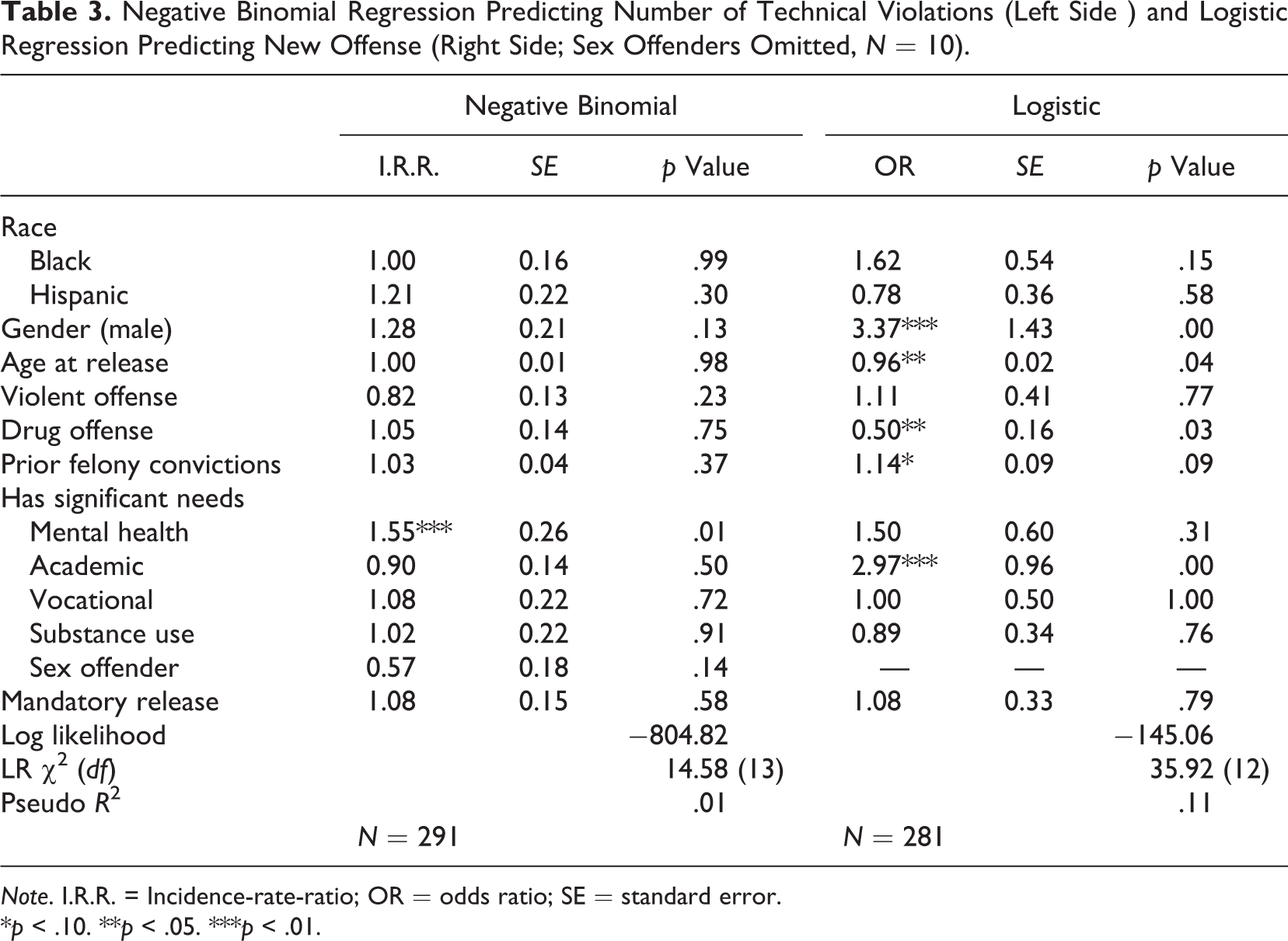
To better understand who is engaging in different types of violation behaviors, we conducted two regression analyses. In Table 3, we use demographic, offense history, and needs variables to predict the number of technical violation behaviors parolees commit and whether a parolee committed a new offense. Because the outcome is zero inflated (as opposed to normally distributed), we use a negative binomial regression. 3
Negative Binomial Regression Predicting Number of Technical Violations (Left Side ) and Logistic Regression Predicting New Offense (Right Side; Sex Offenders Omitted, N = 10).
Note. I.R.R. = Incidence-rate-ratio; OR = odds ratio; SE = standard error.
*p < .10. **p < .05. ***p < .01.
Table 3 shows that almost none of the variables had a significant effect on technical violation behaviors. The only strong effect is whether a parolee had significant mental health needs. The coefficient tells us that having significant mental health needs (scoring 3 or higher on the mental health needs scale) increases the average number of technical violation behaviors by a factor of 1.6. The pseudo r 2 for the model is also miniscule (.01), suggesting that almost none of the variation in technical violation behaviors is explained by this model.
Turning to new offense behavior, the right side of Table 3 shows that being male, being younger, committing a drug offense, and having significant academic needs all increase the likelihood of committing a new offense violation behavior. Males are 3.4 times as likely as females, and parolees with significant academic needs are almost 3 times as likely as those without such needs to commit a new offense violation behavior. The age coefficient tells us that, for every year older a parolee is, they are approximately 4% less likely to commit a new offense violation behavior. Drug offenders are 50% less likely than non-drug offenders to commit new offenses. Looking at the weaker results (p < .10), each additional prior offense increases the likelihood of a new offense by 14%. Sexual offender needs were removed from the new offense violation regression because there was no variation (none of the parolees in our sample with significant sexual offender needs had a new offense listed). The pseudo r 2 for this regression (.11) is larger than the previous model but still quite small.
Logistic Regression Predicting Filing of Complaint for Technical Violations.

Note. OR = odds ratio; SE = standard error. N = 211 for all models.
*p < .10. **p < .05. ***p < .01.
a Total number of association, employment, missed treatment, alcohol, driving, residence, and absconding violations.
Examining Parole Officer Decision Making: Filing a Complaint
In the next section, we test the working rule hypotheses outlined earlier. Notably, we do not include in our analysis two predictors identified as significant in existing literature: level of supervision and organizational culture. For level of supervision, researchers argue that parolees who are more closely supervised are more likely to have complaints filed against them (researchers typically look at the effect of IPS). In California, it is clear that parolees who are on ISP are much more likely to have complaints filed against them than parolees on regular parole (Lin, Grattet, & Petersilia, 2010). We ran a number of models including ISP but had to make a decision about including ISP or the variable indicating violent offenders because of the high collinearity (r = 2.27, p < .001). To make the decision, we relied on our interviewees who told us very clearly that they focus on the type of previous offense. None of the officers mentioned IPS as a target population. For organizational culture, researchers typically compare jurisdictions (e.g., Northern and Southern California), arguing that cultural norms vary across jurisdictions (Grattet, Petersilia, & Lin, 2008). Because we are focusing on one jurisdiction, the parole offices in the metro Denver region, we do not have the jurisdictional variation to explore organizational effects.
In our analysis of the complaint decision, we focus exclusively on parolees who did not commit a new offense (N = 211) because when a parolee commits a new offense, parole officers are required to file a complaint. The results are presented in Table 4 in a stepwise regression, beginning with demographic variables, adding offense-related characteristics and needs variables, and concluding with the addition of violation behaviors. Because the effects stay largely the same across models, we focus here on the findings from Model 3. The explanatory value of the models increases from Model 1 (pseudo r 2 = .03) to Model 3 (pseudo r 2 = .24).
Table 4 illustrates that the variables that are significant predictors of having a technical violation complaint filed include gender, age, sex offender needs, and the number of missed office visits and urinalyses. Males are two and a half times as likely as females to have a complaint filed for technical violations, and older offenders are slightly less likely than younger offenders to have complaints filed against them (for every year increase, parolees are 5% less likely to have a complaint filed). For each additional missed office visit or missed UA, parolees are 12% more likely to have complaint filed against them. Parolees with significant sex offender needs are 20 times as likely as other offenders to have complaints filed against them for technical violations. Two additional variables are significant at p ≤ .10: parolee race and “other” technical violations. For each additional technical violation not included in one of the theorized scenarios (other includes employment, association, missed treatment, alcohol, driving, residence, and abscond), a parolee is 14% more likely to have a complaint filed. Finally, controlling for all of our variables, Black offenders are more than twice as likely as White offenders to have complaints filed against them (odds ratio = 2.27, p = .07).
In Table 5, we summarize these findings as they relate to the working rules derived from parole officer interviews and show that parolee effort matters, as do attributions based on demographic characteristics of parolees. One of the three public safety indicators also had a significant effect on complaint decisions. All significant relationships are in the predicted direction (increasing the likelihood of complaints being filed).
Summary of Complaint Findings.

Bivariate Regressions Predicting Revocation for Technical Violations.

Note. N = 73. Sex offenders omitted because of 100% revocation.
*p < .10.
Examining Parole Board Decision Making: Revocation of Parole
Finally, we turn our attention to revocation outcomes for those parolees who had complaints filed against them. While 153 parolees in our sample had complaints filed against them, we have complete outcome information for only 133 of these cases. We conducted a regression including our basic demographic, legal, needs/risks, and behavior variables, and the only variable that was significant was whether the parolee had a new offense violation (having a new offense made a parolee 3 times as likely to be revoked, with a total R 2 of .17 for the model). Because having a new offense violation led to revocation in every case (except for a handful where charges were dismissed), we chose to present instead a table including only those cases with complaints for technical violations (N = 73), showing bivariate relationships between a number of independent variables and the dependent variable of interest: whether the parole board revoked the parole because of the technical violation (as described earlier in our methods discussion, we do not show a regression because of the small number of cases).
Interestingly, in Table 6, there are no statistically significant predictors of revocation by the parole board because of a technical violation. The only marginally significant effect (p = .06) is that for each additional missed office visit or missed drug test, parolees are 12% less likely to be revoked. Indeed, the most striking finding from Table 6 is that, in our admittedly small sample, revocation decisions for technical violations do not appear to be related to demographic factors, offending behaviors, parolee risks/needs, or violation behaviors.
Discussion and Conclusions
The decision to revoke someone’s parole and send them back to prison has serious implications both for the parolees themselves, who are often reincarcerated for months or even years following revocation, and for states as they struggle to get their prison populations under control. Given the impact of parole revocations on prison populations around the country, it is remarkable that so little is known about who is returned to prison, for what, and for how long. We have previously pointed out that the lack of quality data on parole and parole revocation, in particular, is troubling (Steen & Opsal, 2007). Primarily as a result of the gap in existing data at that time, we designed the current study and collected extensive qualitative and quantitative data. Our experience in Colorado suggests that one of the reasons for the lack of research on this process is that the data needed to answer basic social scientific questions such as those that have been asked about sentencing for decades are inaccessible. In particular, the decision making of the parole officer—who is the actor responsible for initiating the parole revocation process—is hidden and difficult to systematically track.
Hence, the primary objective of this study is to shine a light on the back end of the criminal justice system by examining postsentencing decisions that have enormous impacts on individuals’ lives. More specifically, we hope to highlight that earlier research that focuses on the parole board to understand revocation ignores a major player and decision-making point in the parole revocation process: the parole officer and their decision to file a complaint.
In looking at the factors that predict parolee technical violation behavior, the only significant effect is whether a parolee had significant mental health needs. Parolees with significant mental health needs have an average of 60% (factor of 1.6) more technical violation behaviors than those without such needs. This suggests that the 20% of parolees who have significant mental health issues really struggle to manage their parole obligations. Providing these parolees with extra support may go a long way toward reducing violation behaviors. New offense violations are affected by gender and age in ways consistent with recidivism literature (males and younger offenders are more likely to commit new offense violations). Drug offenders are half as likely as other offenders to commit new offenses, a result that may be explained in part by the tendency of parole officers to file a positive drug test as a technical violation rather than a new offense (i.e., possession). If parolees engage in patterned offending (committing similar offenses over time), this filing decision may explain the difference in violation rates. Finally, it is interesting to note that parolees on mandatory release are no more likely than those on discretionary release to violate parole conditions. This is contrary to accepted wisdom that parolees on mandatory release are less prepared and less able to abide by the requirements of parole.
The core of our analysis focuses on the question of how parole officers decide that a parolee has violated their parole enough to warrant filing a complaint with the parole board. This decision is highly discretionary, and research that looks only at revocation overlooks this important decision (analogous to charging decisions, if a parole officer does not file a complaint, there is no revocation decision to be made, placing a lot of power in the hands of the parole officer). We used interviews with parole officers to identify working rules that they use in making the complaint decision. Because it is a decision point with wide discretion, we suspect that the specifics of the working rules may differ across time and place, which is why we are hesitant to make any claims toward general theorizing. While our quantitative analyses provided little support for these hypotheses, we will use them to structure our review of findings and will conclude with some thoughts about why there was not greater consistency between what the parole officers told us about their decision process and what the numbers told us about it.
Perhaps the most consistent story from our interview data is related to public safety risk—parole officers report filing complaints against parolees when their behavior represents a risk to public safety. The one measure of risk that had a strong positive effect on complaints was having significant sex offender needs. It is clear throughout our analyses that the very small group of parolees with significant sex offender needs in our sample (N = 10) was treated as a category unto themselves. It does appear that parole officers watch them especially carefully and are particularly hesitant about leaving them in the community following violations. Returning to the notion of patterned offending, it may be that parole officers are especially concerned about a repeat sex offense happening on their watch.
Parole officers also told us that they thought about the parolee’s likelihood of succeeding on parole when deciding to file a complaint, a claim that our empirical data do not support. We suspect that the lack of findings in this category may be related to how one operationalizes such assessments. We relied on the needs scores provided by DOC, but these scores are static (representing an individual’s needs at one point in time, often a month or two prior to release) and thus do not capture changes over time in things like employment, substance use, or support systems. It also seems likely that this idea of a parolee’s likelihood of succeeding, more than others, is largely subjective and may be significantly affected by the parole officer’s general feelings about a parolee (whether he or she is likable, responsible, pleasant). Another set of hypotheses ran into similar measurement issues. Parole officers talked about the importance of parolees returning to criminal behaviors, which we measured very crudely by creating interactions for parolees whose initial charge was either a drug offense or a DUI, and who subsequently had drug use violations, measures that did not significantly affect the likelihood of complaints. We did see some indirect evidence of concerns about parolees returning to criminal behaviors, described above in the section on public safety, but our findings do not provide any direct evidence in support of this hypothesis.
Parolee effort does seem to matter, although the effect is not large. Parole officers told us that parolees who missed regular office visits or drug tests were demonstrating an unwillingness to put effort into succeeding on parole, and our regression results showed that, for each additional missed appointment (office or drug), parolees were 12% more likely to have a complaint filed against them. Finally, we would argue that the hypothesis that was most strongly supported by our findings was the discretion hypothesis, the argument that complaint decisions are largely subjective, and are made differently by different parole officers. While there are a few significant effects in our complaint model, they are just that—few—and the effects that do appear are relatively small. Finally, even with the significant effects, only 24% of the variance in the decision is explained by our model.
The last hypothesis about the complaint decision, the attributions hypothesis, was suggested not by the parole officers but by the broader discretion literature. Previous research on parole revocation (Gray, Maxwell, & Fields, 2001; Steen & Opsal, 2007; Wilson, 2005) has shown that African American offenders are more susceptible to negative outcomes than White offenders. While significant only at p = .07 in our final model, we also found that Black parolees are more than twice as likely as White parolees to have complaints filed against them. Because we can control for the violation behaviors of individual parolees, we are able to make a considerably stronger argument that race matters in the revocation process than studies without behavioral controls.
After complaints are filed, it appears that the actual revocation decision made by the parole board is largely driven by factors not included in our models. Within our models, the only significant effect is whether or not a parolee had a new offense (making him or her 3 times as likely to be revoked). Going a step further to look exclusively at cases involving only technical violations, we failed to find any significant predictors of revocation. Hence, drawing on this data, it remains unclear exactly how discretion is operating at the level of the parole board.
One of our goals in this article is to develop an argument that parole revocation decisions, and the complaint decision in particular, operate according to different working rules than other decisions such as charging and sentencing. The working rules identified by the parole officers in our sample support this claim. While one of the working rules maps closely onto the focal concerns model (the parole officer’s assessment of public safety risk), confirming broader claims that the criminal justice system increasingly revolves around risk management (Feeley & Simon, 1991), for the most part parole officers described concerns different than the usual focal concerns as guiding their decisions. Parole officers do not talk about either practical constraints or offender blameworthiness as relevant to the complaint decision (see Steiner et al., 2011). Instead, they talk about the parolee’s likelihood of success outside of prison and about the effort he or she is putting into succeeding, both factors that require more intimate knowledge of the individuals and introduce broader social context into decision making. For example, when we asked parole officers how they understood parolee success, they talked about employment, education and training, and family—factors that, while historically important to criminal justice decisions, have in recent decades been removed from consideration by policy shifts that reduce discretion. Based on our conversations, we would strongly argue for a reconsideration of the typical use of focal concerns (to take the three original focal concerns and apply them across the board), going back to the decision makers themselves to ask them what their particular focal concerns may be.
Given the consistency of responses from parole officers in terms of working rules, we were surprised to find that few of our hypotheses were supported by the data. We can, however, think of several possible explanations. First, we are working with a relatively small sample, and statistical significance is thus more difficult to achieve. Second, we suspect that the problem is partly one of operationalization and partly of imperfect data. The data we used to code responses were taken from chronological records, which, as described earlier, vary in quality. Some officers keep careful and detailed notes of each meeting, while others take cursory notes, including detail only when there is a dramatic change in circumstances. Because of this, we were unable to create meaningful measures of some of the things parole officers told us were most important—for example, employment status, efforts to obtain employment, educational, and training achievements. Because the data were consistent, we relied on “needs scores” to measure parolee success and effort, scores that are static measures of things that clearly change over time. Finally, contrary to what Steiner and colleagues (2011) argue, in part due to overwhelming caseloads, the relationship between parolees and parole officers is not one that really allows officers to get to know their parolees in the way that we suspect they would like to, as suggested by their working rules. Interactions are limited to short periodic office and field visits, and officers often know much less about their parolees than they would like. This is further complicated by parolees shifting among officers while on parole, due to geographic location (moves), parole officers retiring or moving to different officers, or parolees changing supervision levels. We conclude that parole officers describe working rules that are consistent with how they would like to be doing their job, while at the same time acknowledging that their overwhelming caseloads require them to focus narrowly on risk.
Within our sample there do appear to be significant discretionary actions happening at the stage of the complaint decision. Though not surprising, this is troubling, given that complaint decisions are both largely invisible and that negative decisions (decisions not to file complaints) are undocumented (i.e., to identify such decisions, one would have to go into the parolees’ case files and document violation behaviors as we did—an inordinately tedious and time-consuming project). Hence, the general story told here is that there are clearly extralegal variables that impact the parole officer’s decision to file a complaint. If states are interested in understanding revocation decision making, they would be wise to look at this earlier decision point.
We would argue that the main lesson to be learned from our study is that revocation decisions are, to a large extent, unpredictable. While our data do not allow us to test this hypothesis, we suspect that the lack of consistent predictors of revocation decisions comes at least in part from the absence of a clear institutional philosophy of parole. Without being clear about the broader function of the institution (specifically, whether it is primarily about law enforcement or social work), it is unsurprising that individual parole officers understand the purpose of parole revocation differently and use different criteria for their filing decisions. Because this is a study of one state, we caution readers about generalizing our findings too broadly, but we suspect that the cultural confusion about the institution of parole is fairly widespread and that the confusion that seems to characterize revocation decisions in Colorado may be the logical result.
Footnotes
Acknowledgments
We would also like to acknowledge Serena Sebring, currently a doctoral candidate at Duke University, for asking the question that prompted this project in the first place. Finally, thanks to Dr. Rod Engen for reviewing the manuscript prior to submission. His input was, as it always is, invaluable.
Declaration of Conflicting Interests
The authors declared no potential conflicts of interest with respect to the research, authorship, and/or publication of this article.
Funding
The authors disclosed receipt of the following financial support for the research, authorship, and/or publication of this article: This project received funding support from numerous funding organizations at the University of Colorado, funding that has enabled the involvement of 5 graduate students and 10 undergraduate students over the course of the project, to whom the authors are indebted for their hard work. The principal investigator is grateful to the following funders, without whom the project would not have been possible: Undergraduate Research Opportunities Program (UROP), Center for the Advance of Research and Teaching in the Social Sciences (CARTSS), Center for Research and Creative Work (CRCW), Department of Sociology, Dean’s Fund for Excellence, and the Continuing Education Outreach Program.