




Abstract
Following a noticeable absence, studies of gang desistance have begun to appear in the literature. Spurred by results from panel studies that gang membership is a transitory stage for the majority of gang-involved youth, researchers have begun to examine motivations, methods, and consequences associated with leaving the gang. Relatively absent from these recent publications is attention to the operationalization of gang desistance, an issue of particular importance in survey research. As with concerns about how to define gang membership, it is essential that we explore conceptual and methodological issues associated with defining gang desistance. In this article, we introduce three operationalizations of gang desistance and then examine how the characteristics of “desisters” and the expressed motivations, methods, and consequences for leaving the gang vary across the three different operational definitions.
Introduction
The criminal career debate (e.g., Blumstein, Cohen, Roth, & Visher, 1986; Gottfredson & Hirschi, 1990; Horney, Osgood, & Marshall, 1995; Piquero, Farrington, & Blumstein, 2003; Shover, 1996) brought renewed attention to the various stages of the criminal career, albeit initiation, escalation, and maintenance continued to receive the bulk of criminological interest. Theoretical and empirical interest in the processes of desistance or termination was slow to develop. Maruna’s (2001) authoritative work on the process of “making good” (i.e., desisting from crime), in conjunction with increased interest in restorative justice and issues associated with reentry, coincided with findings from panel studies of youth, some of whom had been gang involved, to shift attention to processes of gang desistance. The broader literature on desistance from crime focuses on the cessation of behavior, whereas gang desistance attempts to understand and explain the leaving of a status. Of concern and interest in the general discussion of desistance is, similar to the discussion of deterrence, whether one defines desistance in absolute or relative terms. With respect to criminal activity, for example, is a reduction in the severity or frequency of offending grounds for invoking the term desistance or must there be a total cessation of the behavior? When discussing gang desistance, must all gang ties be cut or can the ex-member continue to associate with other gang members while claiming not to be a current gang member? Just as there is confusion about how to classify desistance, there is also confusion about how it is or should be measured. While we discuss the definitional debate, our main focus is on the operational definition (OD) of gang desistance. So regardless of how desistance is defined, how does one actually measure that definition, and what implications does measurement have?
Clearly, the topic of gang desistance is not without questions of conceptualization, definition, and measurement. A body of research has tackled the motives, methods, and consequences of gang joining (e.g., Battin, Hill, Abbott, Catalano, & Hawkins, 1998; Esbensen, Peterson, Taylor, & Freng, 2010; Esbensen & Winfree, 2013; Howell & Egley, 2005; Krohn & Thornberry, 2008; Thornberry, Krohn, Lizotte, Smith, & Tobin, 2003), and many of the definitional and measurement issues have been discussed at length (e.g., Aldridge, Medina-Ariz, & Ralphs, 2012; Ball & Curry, 1995; Bjerregaard, 2002; Curry & Decker, 1997; Esbensen, Winfree, He, & Taylor, 2001; Matsuda, Esbensen, & Carson, 2012; Medina, Aldridge, Shute, & Ross, 2013; Smithson, Monchuk, & Armitage, 2012; Winfree, Fuller, Vigil, & Mays, 1992); the same cannot be said for the topic of gang desistance. While some authors (see, e.g. Decker & Lauritsen, 2002; Pyrooz & Decker, 2011) have grappled with the question of “when is an ex-gang member an ex-gang member?” questions of operationalization and measurement remain. Little is also known about desistance (or disengagement) from gangs for different demographic subgroupings (e.g., are the processes the same for males and females, Blacks, Whites, Latinos, and others), for different types of gang members (e.g., core vs. peripheral), or in terms of offending and victimization.
As the literature on gang desistance evolves, we believe it is important to examine ODs of gang desistance and basic descriptive characteristics of gang desisters. That is, how should researchers define desistance? Can a self-report measure of gang desistance be used similar to that relied upon in much of the gang initiation literature? As with the process of gang joining, qualitative interviews or observations of desistance processes may produce different responses to these questions than quantitative survey research. Can the quantitative researcher rely upon responses to a question such as “are you no longer a gang member?” While such an approach would be appealing, it may not be suitable in the type of research described in this article. Most of the respondents in the current study were neither current nor former gang members, although a sizable portion of the sample was or had been gang members. How to operationalize these “desisters” is one of the topics of this article. A second objective is to determine what effect, if any, the measurement of desistance has on the motivations, methods, and consequences of gang leaving and on the characteristics of desisters (e.g., demographic characteristics, gang embeddedness, and offending and victimization).
Gang Desistance
Publications on youth gangs have increased dramatically during the past two decades (since the early 1990s), and a number of reviews have summarized the current state of gang research (e.g., Decker, Melde, & Pyrooz, 2013; Howell, 2012; Hughes, 2005; Klein & Maxson, 2006; Peterson, 2009). A review of this literature is beyond the scope of the current article; however, we want to acknowledge the considerable body of research assessing reasons and risk factors associated with gang affiliation (e.g., Esbensen et al., 2010; Esbensen & Winfree, 2013; Hill, Howell, Hawkins, & Battin-Pearson, 1999; Howell & Egley, 2005; Klein & Maxson, 2006; Thornberry et al., 2003); the relationship between gang membership and offending and victimization (e.g., Esbensen & Huizinga, 1993; Melde, Taylor, & Esbensen, 2009; Peterson, Taylor, & Esbensen, 2004; Taylor, Freng, Esbensen, & Peterson, 2008; Taylor, Peterson, Esbensen, & Freng, 2007; Thornberry et al., 2003); and, more limitedly, the influence of gang characteristics on the gang experience (e.g., Bouchard & Spindler, 2010; Decker, Katz, & Webb, 2008; Joe-Laidler & Hunt, 1997; Miller, 2001; Peterson & Carson, 2012; Peterson, Miller, & Esbensen, 2001). A much smaller, but growing, body of literature has begun to examine factors associated with gang desistance and challenges the stereotypical media-driven notion that “once in a gang, in a gang for life,” or alternatively, “blood in, blood out” (e.g., Bolden, 2012; Brenneman, 2012; Decker, 1996; Ward, 2013). Such gang lore is in part responsible for the delay in researchers examining the process of gang leaving. The myth that once individuals became gang involved, they were destined to remain in the gang meant that the issue of gang desistance was irrelevant. It is, after all, impossible to study something that does not exist. While ethnographic research suggested that some gang members became ex-gang members, it was the emergence of longitudinal research (especially research from the Denver Youth Survey and the Rochester Youth Development Study) that fueled the interest in gang leaving.
This expanding area of research has indicated that while the gang may serve a variety of functions for youth at particular points in their lives, for most, the situation is temporary (Brotherton & Salazar-Atias, 2003; Campbell, 1984; Esbensen & Huizinga, 1993; Hagedorn, 1998; Nurge, 2003; Thornberry et al., 2003). While there are individuals who maintain their gang involvement for extended periods or for life (see e.g. Decker & Van Winkle, 1996; Hagedorn, 1998; Horowitz, 1983; Moore, 1991), there are also many for whom gang membership is a transitory status. In one multisite study of adolescents, for example, the researchers reported that the majority (69%) of adolescent gang members were members for 1 year or less; 22% were members for 2 consecutive years; only 7% were gang involved for more than 2 years; and just one respondent reported membership in all 5 years of the study (Peterson et al., 2004). Similar figures are reported by Thornberry, Krohn, Lizotte, Smith, and Tobin (2003) in their Rochester-based study (55% were gang involved for 1 year or less, with another 28% involved for 2 years); by Esbensen and Huizinga (1993) in the Denver Youth Survey (67% 1 year only and another 24% for 2 years); by Hill, Lui, and Hawkins (2001) in the Seattle Social Development Study (69% for 1 year; 17% for 2 years), and by Pyrooz, Sweeten, and Piquero (2013) in the Pathways to Desistance study (50%–62% for 1 year; 11%–13% for 2, though a larger proportion—over one quarter—were members for 4 or more years). This prior research suggests that the probability of leaving the gang is similar across different racial and ethnic groups (Thornberry et al., 2003) but that females appear to belong to gangs for shorter periods of time and to leave at younger ages (Esbensen & Huizinga, 1993; Hagedorn & Devitt, 1999; Moore, 1991; Thornberry et al., 2003). In this nascent area of research, a number of important questions remain: Why and how do youth leave gangs and with what consequences? Are there variations by characteristics such as sex, race/ethnicity, gang embeddedness, and levels of offending and victimization? And, how should we measure former gang members in order to study these important questions? Before describing our approach to these questions, we review the prior work that informs our study.
Motivations for Leaving Gangs
Motivations for leaving the gang cover a wide spectrum, including relatively passive reasons that can be conceptualized as pulls out of the gang. These pulls include changes in family responsibilities and/or pressures from family, changes in friendship groups, employment, religious conversion, or other maturational processes (Brenneman, 2012; Chin, 1996; Decker & Pyrooz, 2011; Fleisher & Krienert, 2004; Hagedorn & Devitt, 1999; Huizinga, Cunningham, Elliott, Johnson, & Henry, 2005; Moloney, Hunt, Joe-Laidler, & MacKenzie, 2010; Moloney, MacKenzie, Hunt, & Joe-Laidler, 2009; Pyrooz & Decker, 2011; Vigil, 1988). In addition to these innocuous reasons for gang leaving, a number of commentators have identified pushes out of gangs, with a primary motivation being exposure to violence, both direct and vicarious. Other pushes include disinterest and/or disillusionment with gang life, pressures from law enforcement, and involvement with the justice system (e.g., Brenneman, 2012; Chin, 1996; Decker & Lauritsen, 2002; Decker & Van Winkle, 1996; Padilla, 1992; Pyrooz & Decker, 2011; Quicker, 1999; Vigil, 1988). Further, most youth express multiple reasons, both pushes and pulls, for having left their gangs.
Methods for Leaving Gangs
In addition to motivations for leaving, scholars are also interested in the methods of leaving, that is, how do gang members leave the gang? As with other aspects of gang life, there are media-generated beliefs, perpetuated by gang lore, which depict the role of violence in gang leaving, including a requirement that the member commits a crime, kills his or her mother, or engages in some other such offense in order to leave the gang. As stated previously, the general belief is that gang membership is a stable and enduring status, thereby supporting the notion that gang leaving is a relatively rare event requiring some sort of dramatic rite of passage. The empirical reality, however, is that gang membership for most youth is fleeting and, therefore, leaving the gang is the norm rather than the exception. Accordingly, it is not surprising to learn that, similar to gang joining, many former gang members describe the desistance process as informal and passive. For example, leaving the gang occurs through such means as simply walking away (i.e., ceasing to associate with gang members), moving away, aging out, or through the gang’s dissolution (Bolden, 2012; Chin, 1996; Decker & Lauritsen, 2002; Pyrooz & Decker, 2011; Quicker, 1999). Indeed, 91% of the former gang members in Decker and Pyrooz’s (2011) study reported that they just left. Some former members, however, describe more active measures that were required to leave the gang—being jumped or sexed out, committing a crime, or being subject to extortion (see Chin, 1996; Decker & Lauritsen, 2002; Decker & Van Winkle, 1996; Fleisher, 1998; Miller, 2001; Padilla, 1992; Peterson, 2012; Quicker, 1999; Vigil, 1988).
Consequences for Leaving Gangs
Yet another aspect of gang lore is that individuals who leave the gang will suffer serious repercussions, such as harm to themselves or to friends or family members. While many individuals experience no consequences for leaving (Chin, 1996; Peterson, 2012), some former gang members report consequences such as harassment from law enforcement or victimization from rival gang members, in part because others may still perceive them as holding that identity (Decker & Pyrooz, 2011; Horowitz, 1983; Padilla, 1992; Peterson, 2012). Less often, it is the case that ex-gang members are harassed or victimized by their former gang peers (Decker & Pyrooz, 2011; Peterson, 2012). Additionally, ex-gang members may face other types of consequences, such as the dissolution of important relationships, namely, losing their gang friends (Horowitz, 1983; Peterson, 2012).
Variations in Reasons, Methods, and Consequences
Examined less commonly in these gang desistance studies are potential variations in reasons, methods, and consequences by gang members’ characteristics, such as sex, race/ethnicity, gang embeddedness, and levels of offending and victimization. Comparison of results from studies of males (e.g., Decker & Lauritsen, 2002; Padilla, 1992) with studies of females (e.g., Harris, 1994; Quicker, 1999) reveals similar reasons for gang desistance. A study by Peterson (2012), in which adolescent females’ and males’ reasons, methods, and consequences were explicitly compared, found no significant sex differences, but other research by Hagedorn and Devitt (1999) suggests that reasons and methods may differ somewhat by sex, with males indicating leaving for maturational reasons or a change in attitude due to jail time or vicarious victimization and females indicating just leaving, moving, or becoming pregnant. It is difficult to draw conclusions about variations across race/ethnic groups, since most research has not been comparative, but findings across studies suggest there may be little difference. Violence and maturation are common reasons reported, for example, by Hispanic/Latino (Hagedorn & Devitt, 1999; Horowitz, 1983; Moore, 1991; Quicker, 1999; Vigil, 1988), Chinese (Chin, 1996) and Black/African American (Decker & Lauritsen, 2002; Hagedorn & Devitt, 1999) former gang members. Further, while Vigil’s (1988) work suggests that entry and exit rituals (i.e., jump-ins and -outs) are commonplace among Chicano youth, other research (e.g., Hagedorn & Devitt, 1999; Moore, 1991; Quicker, 1999) on similar populations supports other, less hostile, methods of desistance, as does research with African American respondents (e.g., Decker & Lauritsen, 2002).
Gang leaving may differ depending upon how entrenched members are in the gang culture and gang identity. Those on the periphery may be more likely than core or highly embedded members to just drift away (see Harris, 1994; Horowitz, 1983; Vigil, 1988, as well as Bolden’s 2012 findings that peripheral, but not core, members were likely to join a different gang) and/or to do so more quickly (Pyrooz, Sweeten, & Piquero, 2013). Further, youth’s reasons for leaving the gang appear to be related to the type of departure; youth who leave for pull reasons such as maturation or family responsibilities typically do not experience violent departures, while those leaving for push reasons are more prone to report departure rituals such as being jumped out or having to commit a crime (Bolden, 2012; Pyrooz & Decker, 2011).
It is also possible that the motives, methods, and consequences of desistance may be related to other characteristics such as level of involvement in offending and victimization. It may be, for example, that those who are more highly involved in these activities are more likely to be exposed to the violence associated with gang life and to report this as a reason for leaving; and/or it may be that youth who report leaving due to violence report higher levels of offending and victimization after leaving. For instance, compared to youth who leave due to disillusionment with gang life, youth who wish to distance themselves from the violence but are still drawn to gang life may retain ties to the gang and, therefore, experience higher levels of victimization (Pyrooz, Decker, & Webb, 2010). This issue remains an open question; however, Pyrooz and Decker (2011) report that equal proportions of youth who cited push motivations (33%) and pull motivations (31%) and who cited hostile (33%) and nonhostile (32%) methods of desistance were involved in serious offending. And, a greater proportion of youth who reported pull motives (42%) and nonhostile methods (38%) were violently victimized compared to those reporting push motives (34%) and hostile methods (22%).
Conceptual and Measurement Issues
A number of studies have compared different self-reported definitions of “gang membership,” either examining less restrictive to more restrictive definitions (e.g., low to high levels of gang organization; Bjerregaard, 2002; Esbensen et al., 2001; Winfree et al., 1992) or comparing different definitions or ways to measure gang membership (e.g., self-nomination, respondents’ identification of their group of friends as a gang, or a funneling method by which affirmative responses to certain questions about the peer group allows for identification of the peer group as a gang; Matsuda et al., 2012). The former set of studies has generally concluded that while demographic characteristics of members may not vary across definitions, other characteristics such as attitudes and behaviors do vary, with gang members becoming more antisocial as the definition becomes more restrictive. In addition, the three definitions employed by Matsuda, Esbensen, and Carson (2012) each identified a different group of youth, with little overlap in youth classified as gang members according to the three different definitions; their study revealed that although these differently identified gang members varied in their prevalence and demographic characteristics, they did not differ attitudinally or behaviorally. Despite these variations, these studies revealed that no matter how gang membership is defined and measured, gang youth differ from nongang youth on demographic, attitudinal, and behavioral characteristics. This prior work, therefore, suggests that (1) measurement does matter but (2) the ways in which it matters, or whether it matters in ways that are important, vary by the purposes of the research in question.
Other scholars have explored conceptual issues related to gang desistance (e.g., Decker & Lauritsen, 2002; Decker & Van Winkle, 1996; Pyrooz & Decker, 2011; Pyrooz, Decker, & Webb, 2010). That is, they examine the question of who can be considered an ex-gang member or when an individual can be considered a former gang member (e.g., must all emotional, social, physical, and criminal ties be severed). As part of this conceptualization of former membership, distinctions are made between de-identification (no longer identifying oneself as a gang member) and disengagement (severing of ties), and questions remain for both researchers and practitioners if both are necessary. In a study by Deane, Bracken, and Morrissette (2007), for example, gang members expressed their desire to refrain from criminal activity but also to maintain ties with their gang (in effect, disengaging, but not de-identifying; see Sweeten, Pyrooz, & Piquero, 2013); and, in fact, the program in which respondents were participating did not require individuals to leave their gangs, focusing on desistance from crime rather than from gangs. Similarly, gang intervention workers in three boys and girls clubs voiced that they did not expect young people to leave their gangs; rather, they would measure program success by reductions in criminal activity and increases in prosocial activities such as school attendance and performance and positive relationships with family (Arberton & McClanahan, 2005). Other research by Pyrooz and colleagues (Pyrooz & Decker, 2011; Pyrooz et al., 2010) indicates that stronger ties to the gang (i.e., de-identification without disengagement) resulted in more negative consequences, such as higher levels of victimization and greater likelihood of arrest.
While these are important issues for continued exploration, in the current article, our focus is on measurement rather than on conceptual issues. That is, we examine the question of whether how we measure who is an ex-gang member matters. Key questions in the current study, therefore, are whether reasons, methods, and consequences associated with gang leaving and whether certain characteristics (demographics, embeddedness, delinquency and victimization) of former gang members differ by how former gang membership is measured in our survey.
Summary and Present Study
In spite of several recent publications examining issues associated with gang desistance (e.g., Bolden, 2012; Deane, Bracken, & Morrissette, 2007; Pyrooz & Decker, 2011; Pyrooz et al., 2010, 2013; Sweeten et al., 2013), there remains a general lack of systematic knowledge about desistance from street gangs, including consideration of the importance of conceptual, definitional, and methodological issues, that should be part of this discussion. Consensus appears to be emerging regarding the examination of motivations, methods, and consequences of leaving the gang, but how does one operationalize gang desistance? Measurement error is an unfortunate part of all research. Inconsistencies in responses are inevitable in self-administered survey research. For instance, if a youth indicates that she or he belonged to a gang at some point in the past, one could reasonably expect that this same respondent would answer questions inquiring why she or he is no longer a gang member. One could reasonably also expect that this prior gang member would not answer the question about why she or he left the gang with the response category of “I was never in a gang.” The reality of research, however, is that such inconsistencies are not as uncommon as one might prefer.
Given this type of measurement error, how can or should a researcher operationalize and measure gang desistance? Our goal in this article is to propose three increasingly restrictive ODs of gang desistance or former gang membership and to examine the effect these different definitions exert on our analyses of motivations, methods, and consequences associated with leaving the gang. Importantly, our large and relatively diverse sample of ex-gang members allows for comparisons across the three ODs by sex, race/ethnicity as well as gang embeddedness (i.e., core or peripheral members), age, offending, and victimization in reasons, methods, and consequences for gang leaving.
Method
The data used in this study are drawn from the National Evaluation of Gang Resistance Education and Training ( G.R.E.A.T.), a longitudinal panel study conducted from 2006 to 2012 to evaluate a school-based gang prevention program (see Esbensen, Peterson, Taylor, & Osgood, 2012, for more detail about the evaluation design). A rigorous screening process, based on three main criteria (existence of the G.R.E.A.T. program, geographic and demographic diversity, and evidence of gang activity), led to the purposive selection of seven diverse cities for inclusion in the evaluation: Albuquerque, New Mexico; Chicago, Illinois; Greeley, Colorado; Nashville, Tennessee; Philadelphia, Pennsylvania; Portland, Oregon; and a Dallas-Fort-Worth (DFW), Texas area location. Within each site, four to six public middle schools were selected, with the intent to include schools that, taken as a whole, would be representative of the school districts. 1
Within each school, classrooms in the G.R.E.A.T. grade level (sixth or seventh) were randomly assigned to receive or not receive the program. All students (4,905) in the 195 selected classrooms in the 31 participating schools were eligible to participate in the evaluation. Sixth-grade students were included from 26 schools; seventh-grade students comprised the sample from the remaining five schools. 2 Active parental consent procedures were implemented in all sites (see Esbensen, Melde, Taylor, & Peterson, 2008, for a detailed description). Overall, 89% of youth (N = 4,372) returned a completed consent form, with 78% 3 of parents/guardians (N = 3,820) allowing their child’s participation. As with all public school-based surveys, this sample is limited by exclusion of students in other types of schools and potential exclusion of students who were not present (e.g., due to tardiness, truancy, suspension, expulsion, dropping out) on survey days, despite multiple visits to schools. In 2006, students completed pretest and posttest surveys with completion rates of 98% and 95%, respectively, with annual follow-up completion rates of 87%, 83%, 75%, and 72%.
The overall sample at Wave 1 was evenly split between males and females; most (55%) youth resided with both biological parents; and the majority (88%) was born in the United States. The sample is also racially/ethnically diverse, with Hispanic (37%), White (27%), and African American (17%) youth accounting for the majority (81%) of the sample. Approximately two thirds of the youth (61%) were aged 11 or younger at the pretest, representing the fact that 26 of the 31 schools delivered the G.R.E.A.T. program in sixth grade.
For the current study, longitudinal data were restructured to create pooled cross-sectional data. In pooled cross-sectional data, each of the six waves of data essentially becomes one unique data point. 4 In other words, the data file is increased sixfold, leading to a pooled sample size of 22,920 cases. Pooling the longitudinal data serves to increase the sample size of desisted youth, allows us to include youth who may have reported multiple reasons for gang desistance across waves, and includes youth who may have desisted from more than one gang or from a single gang more than once. The questions regarding the motivations, methods, and consequences of desistance were not added until Wave 3; therefore, our analysis file excludes Wave 1 and Wave 2. This results in a final sample of 15,298 observations. 5
Measures
The self-administered questionnaires that were completed by study participants consisted of more than 250 questions tapping a wide array of attitudinal and behavioral indicators. Of particular importance in the current study is the gang section of the questionnaire. The gang section (located toward the end of the instrument) begins with innocuous questions asking the respondents to select what good and bad things they think would happen to them if they were a gang member. These two questions are followed by two self-report questions: “Have you ever been a gang member?” and “Are you now in a gang?” Next is a series of questions that focus on motivations for gang joining, gang organizational characteristics, and gang activities, and the gang section concludes with questions associated with gang desistance. The three questions addressing motivations, methods, and consequences for leaving the gang are “If you were a gang member at some point in your life, but are not now a gang member, why did you leave the gang; how did you leave the gang; were there any consequences that resulted from you leaving the gang?” Importantly, the first response category for each of the desistance-related questions is “Never in a gang.” 6
Motivations for Leaving the Gang
Respondents were provided with 13 possible reasons for gang leaving, drawn from prior research, and were instructed to “circle all that apply.” The first two response options (“Never in a gang” and “Now in a gang”) allow for identification of youth who had not desisted, either because they had never been in a gang or because they were still in a gang. Of the remaining 11 reasons for desistance, 10 were grouped into four categories: violence (a friend was hurt or killed; a family member was hurt or killed; I was hurt); disillusionment (I just felt like it; it wasn’t what I thought it was going to be); adult intervention (I got in trouble with the police; an adult encouraged me to get out; my parents made me leave the gang); and life transitions (I made new friends; I moved to a new home or school). The final response option is “other” that allowed the students to provide reasons not captured in the response options provided. A total of 58 youth provided valid “other” motivations for leaving the gang. However, 53 of these responses fit into the categories described earlier. The remaining five youth reported gang dissolution as a motive for desistance but due to the infrequency of this response, it was excluded from the analyses.
Methods of Desistance
Next, youth were asked, “If you were a gang member at some point in your life, but you are not now a gang member, how did you leave the gang?” Respondents were instructed to circle all that apply, and they could once again indicate that they were never in a gang or that they were currently in a gang. Five methods for leaving the gang were included in the response categories and these were classified into two categories: active (I had to fight other members of the gang; I had to commit a crime) and passive (I just left; I moved away; I was allowed out by gang leaders). A final response option of “other” introduced a few idiosyncratic responses while others were recoded as either active or passive (n = 11). 7
Immediate Consequences of Desistance
Finally, respondents were asked, “If you were a gang member at some point in your life, but you are not now a gang member, were there any consequences that resulted from you leaving the gang?” They were instructed to circle one of four responses: “Never in gang,” “Now in gang,” “No,” or “Yes.” For those who circled “Yes,” a follow-up question asked, “If yes, what were those consequences?” Those who responded “yes” were instructed to “select all that apply” from a list of eight consequences, including a catchall “other” category that allowed students to write in their own response. These consequences were collapsed into three categories: violence (I was beaten up by members of my former gang; I was beaten up by members of another gang; a family member was hurt or killed; a friend was hurt or killed); threats (I was threatened; my friends or family were threatened), and peer group transitions (I lost my gang friends). Nine of the “other” responses were recoded into one of these preexisting categories, while others remained idiosyncratic and left as “other.”
Operationalization of Former Gang Members
In the current study, we compare across three ODs of gang desistance ranging from most to least inclusive. The first and most inclusive OD (referred to as OD1) includes any youth who provided an affirmative response to any of the three desistance questions (“why did you leave the gang?”; “how did you leave the gang?”; or “were there any consequences for leaving the gang?”), regardless of whether they had previously indicated prior gang membership in another part of the survey. This method resulted in a desistance sample of 1,096 youth.
In a more restrictive definition (OD2), respondents were classified as gang desisters based on responses to the self-reported gang membership questions. Specifically, respondents had to indicate prior gang membership (i.e., answering “Yes” to the question “Have you ever been a gang member?”) while also stating that they were not currently in a gang (i.e., answering “No” to the question “Are you now in a gang?”). This approach does not require the respondent to have answered any of the desistance questions to be classified as a desister. Furthermore, youth with missing data on the current gang member question were treated as negative responses. Of the 15,298 youth, 637 youth fit these two criteria and were included in this operationalization of gang desistance.
Finally, in the most restrictive definition (OD3), we expanded on the second definition and further excluded youth who, despite answering the above two gang membership questions in ways that suggested former gang membership, indicated that they were “Never in a Gang” or “Now in a Gang” when responding to the three main desistance questions. Adding these additional criteria to the operationalization of gang desistance resulted in a desistance sample of 473 youth.
These three different approaches to operationalizing gang desistance provide three different estimates of the number of gang desisters, ranging from 1,096 in the least restrictive definition to 473 using the most restrictive. As the Venn diagram in Figure 1 reveals, these operational approaches capture different individuals, although 48% were included in at least two of the definitional categories. Over half of the desistance sample was classified according to just one OD (OD1 only = 46.2%; OD2 only = 6.1%); 9% fit two of the three definitions (OD1 and OD2 = 7.8%; OD2 and OD3 = 1.4%); and 39% could be classified as “desisters” under all three ODs. Including youth who meet one or more of our ODs, we find a total of 1,185 youth who could be categorized as gang desisters.
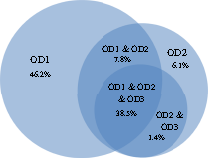
Venn diagram of definitional overlap.
Demographic Characteristics
Self-reported demographic characteristics (sex, race/ethnicity, and age) of youth were compared across ODs as well as the motives, methods, and consequences of gang desistance. Race/ethnicity was coded as White, Black/African American, Hispanic/Latino, or other race, the latter of which encompassed Native American, Asian/Pacific Islander, biracial youth as well as youth of other races.
Gang Embeddedness
In order to determine respondents’ level of embeddedness in their gang, they were asked the following question: “Imagine a bull’s eye target represents your gang with a 1 in the middle circle and a 5 in the outside ring. How far from the center of the gang are you? Circle the number that best describes your place in your gang.” Youth who circled 1 or 2 were considered core members in their gang, while those indicating 3, 4, or 5 were classified as peripheral or fringe members.
Offending and Victimization
Two indices of offending and one index of victimization were created to compare across the ODs of gang desistance. Self-reported property crime was measured by asking youth to indicate (by circling a number from 0 to 10 or “more than ten”) how many times in the prior 6 months they had (1) purposefully damaged or destroyed property, (2) illegally spray painted a wall or a building, (3) stolen something worth less than US$50, (4) stolen something worth more than US$50, and (5) gone into or tried to go into a building to steal something. Similarly, violent crime consisted of 5 items: (1) carried a hidden weapon for protection, (2) hit someone with the idea of hurting him or her, (3) attacked someone with a weapon, (4) used a weapon or force to get money or things from people, and (5) been involved in gang fights. 8 Youth were asked how many times in the past 6 months they had participated in these activities. The summative indices for both property and violent offending ranged from 0 to 55 offenses.
Experiences of youth with victimization were measured by asking how many times in the prior 6 months they had (1) been hit by someone trying to hurt them, (2) had someone use a weapon or force to get money or things from them, (3) been attacked by someone with a weapon or by someone trying to seriously hurt or kill them, and (4) had some of their things stolen from them. The index ranged from 0 to 44 victimizations.
Analyses
The research questions framing the current study are twofold: first, do different operationalizations of gang desistance produce differences in motivations, methods, and consequences associated with leaving the gang and second, do patterns of motivations, methods, and consequences for gang leaving vary by desisters’ characteristics (sex, race/ethnicity, age, gang embeddedness, and offending and victimization) across the different ODs? Our analyses of these questions are descriptive in nature and because the motivations, methods, and consequences categories are not mutually exclusive, significance tests were not conducted. Rather, percentages and means are presented and compared for general patterns.
Findings
Definitional Comparisons
A total of 1,185 youth were classified as gang desisters by one or more OD. In the full sample of desisters, 62% were males (n = 734) and the average age of desisters was 12.5 years (these findings are not reported in table). Hispanic and Black youth were overrepresented in the sample, with 54% (n = 642) of desisters being Hispanic and 23% being Black (n = 271). In terms of the level of embeddedness within the gang, 53% of the youth who had left their gang reported being fringe members (n = 198) and 47% reported holding a core position in their gang. Desisted youth reported being involved in an average of seven property and eight violent crimes in the prior 6 months. Unsurprisingly, these youth also experienced high levels of victimization (M = 4.4).
Comparisons across the different ODs of gang desistance are presented for the individual motives, methods, and consequences in Table 1. Across all ODs, the majority of respondents selected at least one response to the question “Why did you leave the gang?” Of the youth that fit both the first and second OD (OD1 and OD2), 79% (n = 866 and n = 506, respectively) selected a response while 94% (n = 446) of OD3 youth identified a motivation for leaving the gang (these findings are not reported in table). Youth who failed to provide any response to this question were included in the denominator so as not to artificially inflate findings. The most frequently selected motivation for leaving the gang across all definitions is “I just felt like it.” As the OD of gang desistance becomes increasingly restrictive, a higher percentage of youth indicate this motivation (32%, 35%, and 42%, respectively). Experiencing the death or injury of a friend is the second most common motivation for leaving the gang, with 29.5% of OD1 youth, 27% of OD2, and 31% of OD3 reporting this motivation for leaving the gang. A substantial number of respondents also selected having made new friends as a motivation for leaving (25% of OD1 and OD2 youth and 30% of OD3 youth). The least common response, regardless of OD, was parent intervention (i.e., “My parents made me leave the gang”; OD1 = 10%; OD2/OD3 = 8%).
Distribution of Individual Motives, Methods, and Consequences of Leaving the Gang Across Operational Definitions (ODs).a
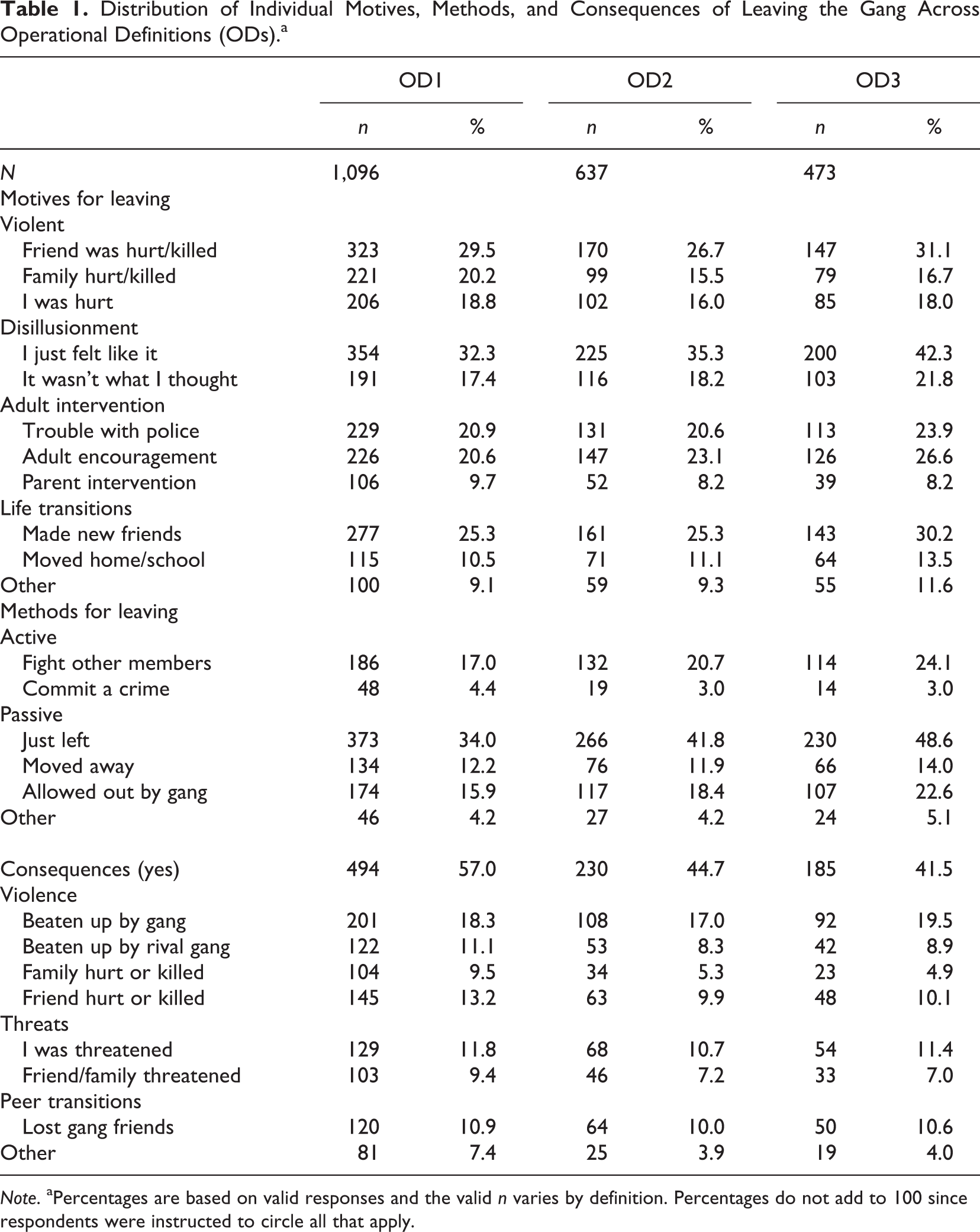
Note. aPercentages are based on valid responses and the valid n varies by definition. Percentages do not add to 100 since respondents were instructed to circle all that apply.
A second question allowed us to explore the validity of common perceptions about how youth leave gangs (e.g., that they are required to kill their mothers). Similar to motivations for leaving the gang, the majority of desisters selected at least one response to the question, “How did you leave your gang?” Approximately 67% (n = 733) of desisters meeting the OD1 definition, 79% (n = 502) meeting OD2, and 93% (n = 442) meeting OD3 selected at least one desistance method (results not shown in table). Regardless of definition, the most frequently chosen method was “I just left.” This is, perhaps, not surprising, given that the most frequently chosen reason for leaving is “I just felt like it.” As the definition becomes more restrictive, a higher percentage of youth selected this passive method for leaving the gang (34%, 42%, and 49%). The next most frequently chosen method for desistance across all definitions involves fighting other gang members (i.e., being jumped out). Similarly, as the definition of desistance becomes more restrictive, more youth chose this active method of gang leaving (17%, 21%, and 24%). Having to commit a crime was reported by only a small proportion of desisters (4% of OD1 youth and 3% of OD2 and OD3).
Finally, youth were asked whether they experienced any consequences after leaving the gang. The majority of desisters defined by OD1 (the least restrictive) reported experiencing some consequence (57%). However, as shown in Table 1, only 45% of desisters defined by OD2 and 41.5% of those defined by OD3 reported consequences of leaving the gang. Youth who indicated that they experienced consequences were then asked what those consequences were, although not all youth who responded affirmatively identified a consequence. Across all definitions, the most frequent consequence to leaving the gang was being beaten up by members of their former gang, but it is important to highlight that fewer than 25% of youth in all three definitional categories indicated that they were jumped out.
To facilitate the examination of the motivations, methods, and consequences for leaving the gang, the individual response items can be grouped into broader categories reflecting general themes. The reasons for leaving the gang were categorized as violence, disillusionment, adult interventions, and life transitions. Methods for leaving were classified as passive and active. Finally, consequences for leaving the gang were grouped into three categories: violence, threats, and peer group transitions. When answering the questions about desistance, respondents were instructed to circle all of the response options that were applicable. As such, the broader classifications are not mutually exclusive. For example, a respondent could circle multiple items in response to the “reasons for leaving” question and those different responses might be classified as adult intervention as well as items representative of disillusionment.
When comparing the categorized motives, methods, and consequences across ODs, the patterns are similar (see Table 2). Regardless of definition, youth are most frequently motivated to leave the gang for reasons associated with disillusionment of gang life, followed by violence motivations. As the definitions become more restrictive, however, more youth report disillusionment than violence as reasons for leaving. Among OD1 youth, the percentage who selected violence and disillusionment motivations is approximately equal (41% vs. 42%). For OD2 and OD3 youth, however, 10% to 15% more youth left for reasons associated with disillusionment rather than violence. In fact, for youth fitting OD2 and OD3, motivations associated with violence, adult interventions, and life transitions were all selected in approximately equal percentages.
Comparing Motives, Methods, and Consequences of Desistance, Demographic Characteristics, Gang Embeddedness, and Offending and Victimization Across Operational Definitions (ODs).a
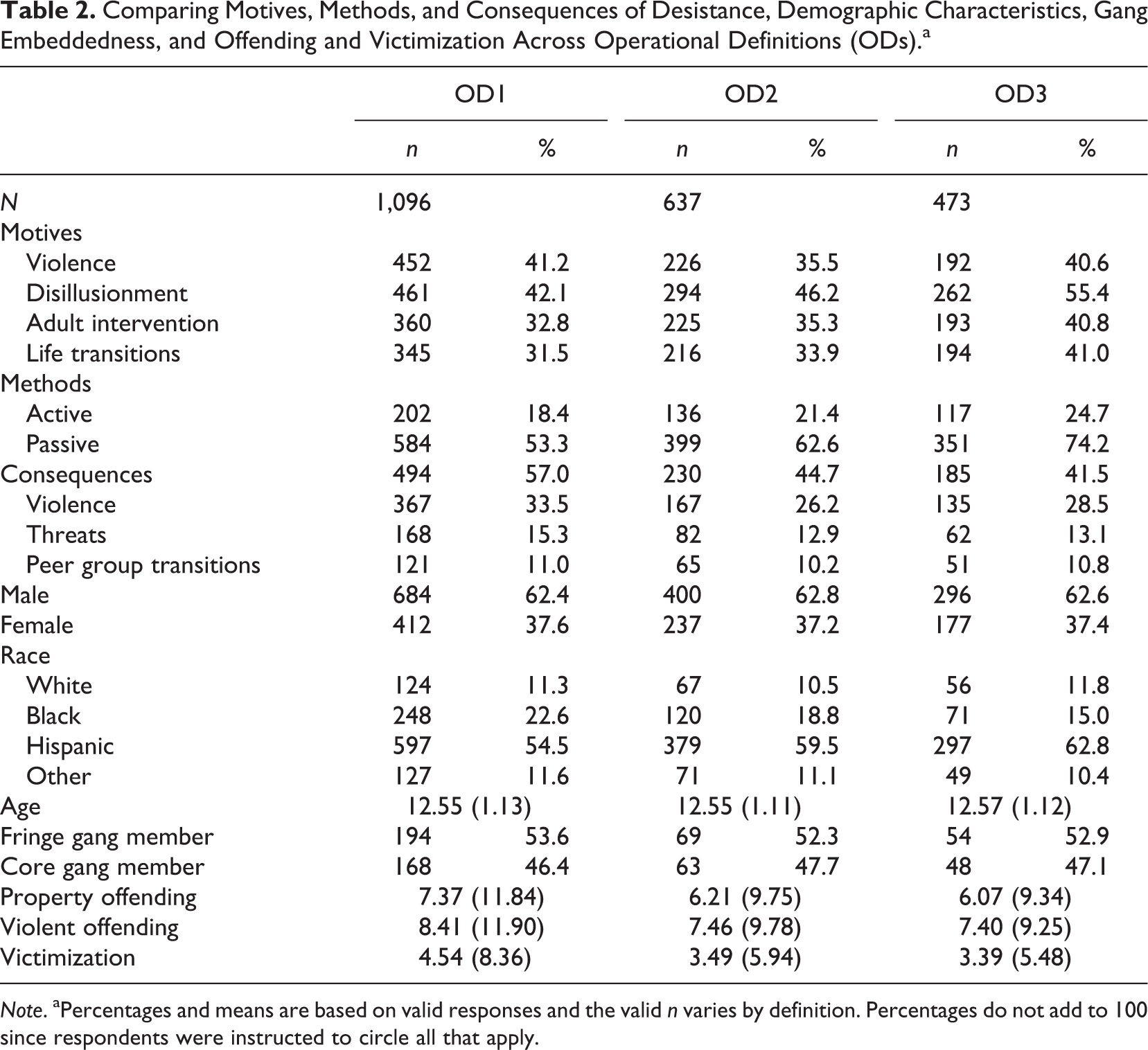
Note. aPercentages and means are based on valid responses and the valid n varies by definition. Percentages do not add to 100 since respondents were instructed to circle all that apply.
The methods for leaving the gang were classified as active or passive, but these groups are not mutually exclusive. That is, some desisted youth selected both active and passive methods of leaving the gang (n = 70). Methods for leaving the gang were frequently passive in nature across the three ODs (53%, 63%, and 74%), with much lower proportions of youth in each OD reporting active methods. For both motives and methods, as the OD of gang desistance becomes more restrictive, there is an increase in the percentage of youth reporting each category of response.
When examining consequences for leaving the gang, however, the pattern differs: youth fitting the least restrictive OD (OD1) were the most likely to report experiencing consequences and had the highest proportion of respondents selecting each of the consequences categories, followed by youth fitting OD3 (most restrictive) and then OD2. The ordering of importance of each of the consequences was the same across definitions, however, with violence selected most often, followed by threats, and peer group transitions.
Table 2 also presents respondents’ demographic characteristics, gang embeddedness, and offending and victimization across ODs. Similar to research examining gang member characteristics associated with different definitional criteria, the demographic characteristics of gang desisters remain relatively stable across the three ODs. They are disproportionately male (62% of OD1 desisters and 63% among OD2 and OD3), and racial and ethnic minority youth tend to be overrepresented with only some variation by definition: approximately 11% of desisters are White or of other race/ethnic background; 15% to 23% are African American, with the proportion decreasing as the definition becomes more restrictive; and 55% to 63% are Hispanic, with the proportion increasing as the definition becomes more restrictive. The age of youth classified as desisted is similar across all ODs as is the proportion of desisters who were core and fringe members. Offending and victimization frequencies vary slightly, with desisted youth who fit OD1 reporting more property and violent offending and more frequent victimization in the prior 6 months. Although we have noted some minor variations associated with the three ODs for the full sample, it is important to highlight the general stability of the response patterns regardless of definition. We now turn our attention to examination of the motives, methods, and consequences of gang leaving disaggregated by sex, race/ethnicity, age, gang embeddedness, and offending and victimization.
Motivations for Leaving the Gang
An examination of the motivations for leaving the gang presents a number of interesting comparisons across demographic characteristics, gang embeddedness as well as offending and victimization both within and across desistance definitions (see Table 3). First, male desisters classified under OD1 chose violence (42%) and disillusionment (41%) as the most common reasons for desistance. For OD2 and OD3 male desisters, disillusionment is the most frequently cited motivation for gang leaving (47% and 54%, respectively). Female desisters consistently selected disillusionment as the most common motivation for gang desistance across all three operationalizations.
Motivations for Leaving the Gang.
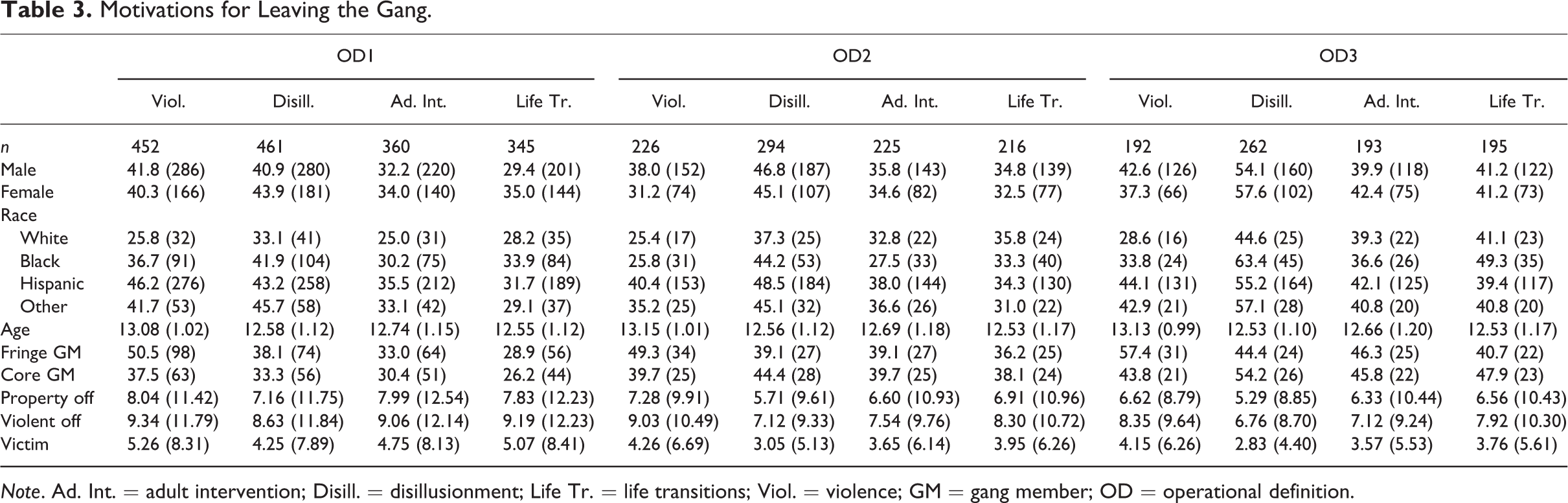
Note. Ad. Int. = adult intervention; Disill. = disillusionment; Life Tr. = life transitions; Viol. = violence; GM = gang member; OD = operational definition.
Next, motivations for gang desistance by race/ethnicity were mostly similar across all three ODs. White youth, Black youth, and youth of other races were most likely to report leaving due to disillusionment. Hispanic desisters who fit OD1 most frequently chose violence as a motivation for gang desistance. Hispanic youth classified under OD2 and OD3, however, most frequently selected disillusionment as a reason for leaving the gang. Finally, across all three ODs, older youth tended to report violence motivations for gang desistance.
Youth identified as fringe members of their gang were most likely to report violence motivations for leaving the gang across all ODs. Core gang members meeting the least restrictive desistance definition (OD1) were also motivated to leave their gang because of violence. However, core desisters classified by OD2 and OD3 reported that they decided to leave the gang due to disillusionment with gang life. Focusing on property and violent offending, across all ODs, youth who reported violence motivations for gang desistence participated in more offending in the prior 6 months. These youth experienced more victimization as well.
Methods of Desistance
Self-reported methods for leaving the gang are largely consistent across all three ODs of gang desistance (see Table 4). Among both sexes and youth of all races/ethnicities, passive exit strategies were the most commonly cited method of leaving the gang. Youth who left their gangs via active means were only slightly older than those who left via passive means. Regardless of gang embeddedness, desisted youth most frequently reported passive means of gang desistance. When examining offending and victimization, youth who reported active gang exit strategies reported higher frequencies of property and violent offending as well as higher levels of victimization.
Methods for Leaving the Gang.
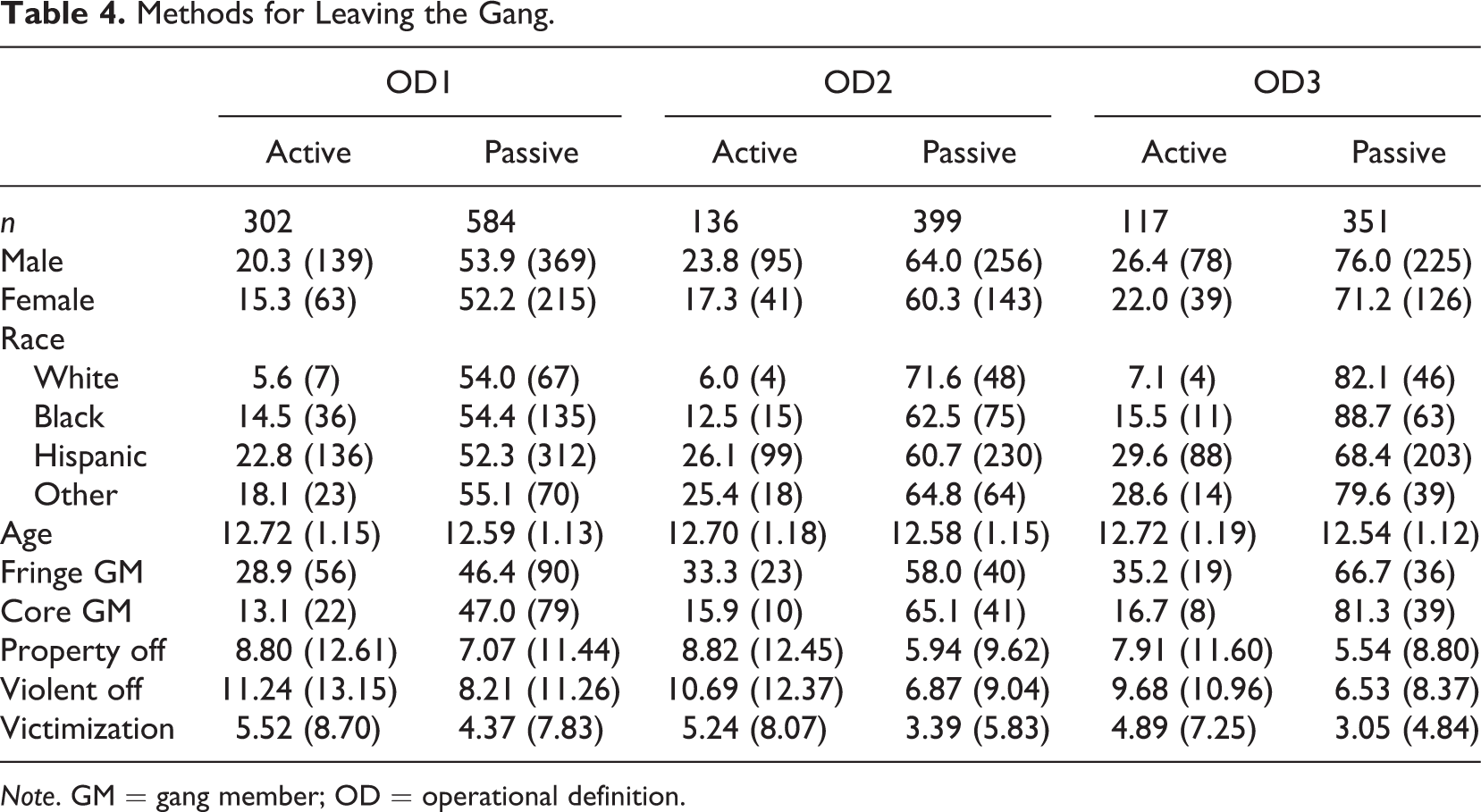
Note. GM = gang member; OD = operational definition.
Consequences of Desistance
Finally, respondents were asked, “Were there any consequences that resulted from you leaving the gang?” and “If yes, what were those consequences?” As discussed earlier, the majority of desisters defined by OD1 reported experiencing consequences of gang desistance. Conversely, the majority of desisters defined by OD2 and OD3 did not experience consequences (see Table 5). Regardless of the OD, youth who reported consequences to gang desistance most commonly reported violent consequences. This finding was true across sex and race/ethnicity. There was little variation in consequences of gang desistance by age across all three definitions. Regardless of OD, violence was the most common consequence for both core and fringe gang members.
Focusing on offending and victimization, the highest frequency of property offending was found for youth who reported receiving threats as a consequence of gang desistance for youth who fit OD1 and OD2. For OD3, youth who reported violence and threats had equal levels of participation in property offending. For violent offending, the highest frequencies were found among youth who experienced violent consequences for OD2 and OD3. For OD1, however, youth who reported receiving threats participated in the highest levels of violent crime. Across all ODs, desisters with the highest rates of victimization were most likely to report receiving threats as a consequence of leaving the gang.
Consequences for Leaving the Gang.
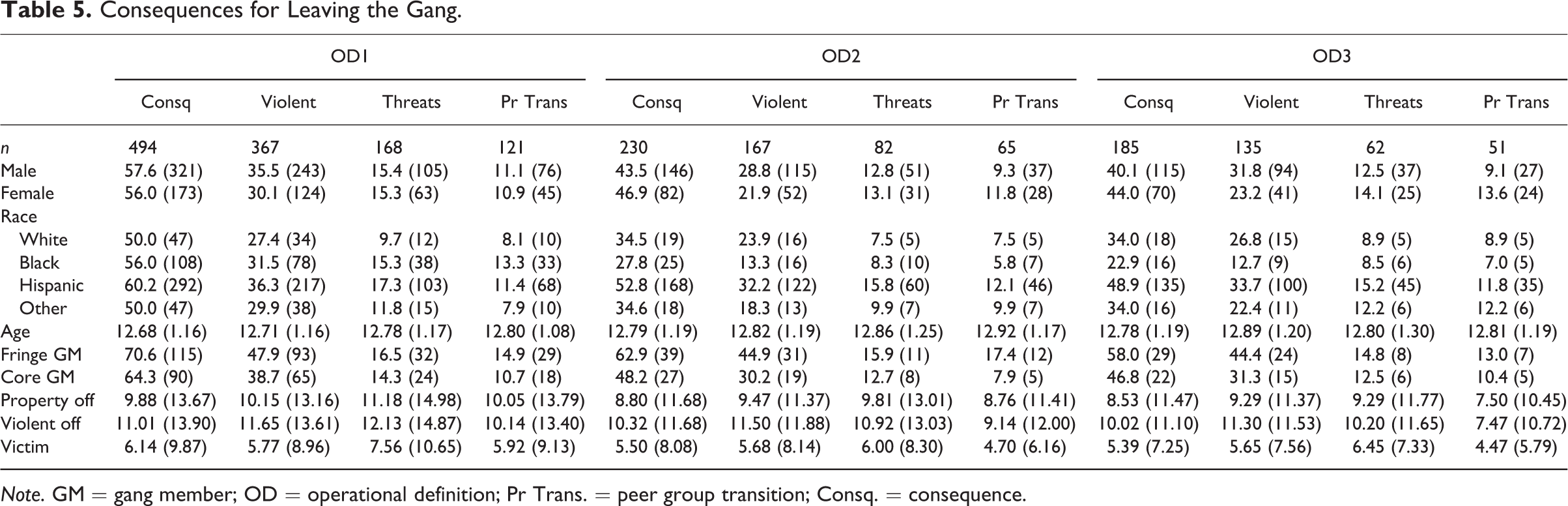
Note. GM = gang member; OD = operational definition; Pr Trans. = peer group transition; Consq. = consequence.
Discussion and Conclusion
Contrary to media portrayals and gang lore that gang membership is a lifetime commitment, research typically shows that gang membership is transitory, with many youth cycling in and out of their gangs within 1 year (Esbensen & Huizinga, 1993; Hill, Lui, & Hawkins, 2001; Peterson et al., 2004; Pyrooz et al., 2013; Thornberry et al., 2003). Despite this transitory nature of gang affiliation, research on desistance from gangs remains in its nascent stage, although there have been some explorations (both qualitative and quantitative) of why and how individuals leave their gangs. Some researchers have also examined consequences associated with leaving the gang and, less often, whether patterns differ by characteristics such as sex, race/ethnicity, age, and gang embeddedness (e.g., Brenneman, 2012; Chin, 1996; Decker & Lauritsen, 2002; Decker & Pyrooz, 2011; Decker, Pyrooz, & Moule, in press; Hagedorn & Devitt, 1999; Huizinga et al., 2005; Moloney et al., 2009, 2010; Pyrooz & Decker, 2011; Vigil, 1988; Ward, 2013).
With the recent interest and increase in gang desistance research, we suggest it is a good time to step back and give consideration to methodological issues such as the measurement of desistance. Just as gang researchers have debated conceptual definitions and empirically examined the effects of different operationalizations of gang membership on the characteristics, attitudes, and activities of gang members (e.g., Aldridge et al., 2012; Ball & Curry, 1995; Bjerregaard, 2002; Curry & Decker, 1997; Esbensen et al., 2001; Matsuda et al., 2012; Medina et al., 2013; Smithson et al., 2012; Winfree et al., 1992), we argue that similar examinations should be undertaken with regard to conceptualization and operationalization of former gang membership. Some of this work, especially the conceptual (e.g., Decker & Lauritsen, 2002; Pyrooz & Decker, 2011), has begun, and the current study contributes by focusing on the OD.
Our quantitative self-report survey allows respondents to indicate former gang membership in various ways in different parts of the survey. While such methods can help validate responses, they can also introduce the potential for inconsistencies. If these different methods of measuring desistance identified the same respondents regardless of OD, we would have confidence in the validity of the information provided. If, however, different respondents are identified depending on the OD used, results may be biased. Using youth’s responses to questions of past and current gang membership and to three desistance questions, we created three definitions of former gang membership, from least restrictive (OD1) to most restrictive (OD3).
The Venn diagram (Figure 1) of desistance samples according to our three ODs of desistance reveals that, similar to Matsuda et al.’s (2012) study of gang member definitions, a minority of youth (39%) meet all three ODs and just over half are identified by just one of the definitions (46% for OD1 and 6% for OD2). That is, the three ODs represent different subsets of youth in our sample. What this means, practically, is that some youth who answered the desistance questions did not previously indicate former gang membership in the survey; some youth who indicated former membership failed to answer the desistance questions; and, some youth who indicated former membership and answered the desistance questions simultaneously circled that they were either “never in a gang” or “now in a gang.” Clearly, respondents were not consistent in their responses, for any number of potential reasons, including intentional deception, carelessness, or survey fatigue. Although this may be cause for concern, one must also question whether these inconsistencies matter. Accordingly, we compared the three different ODs of gang desistance on the motives, methods, and consequences of leaving the gang as well as variations across former gang members’ demographic characteristics (sex, race/ethnicity, and age), gang embeddedness, and offending and victimization (see Table 6 for an overview of the key findings).
Summary of Findings Across Operational Definitions.
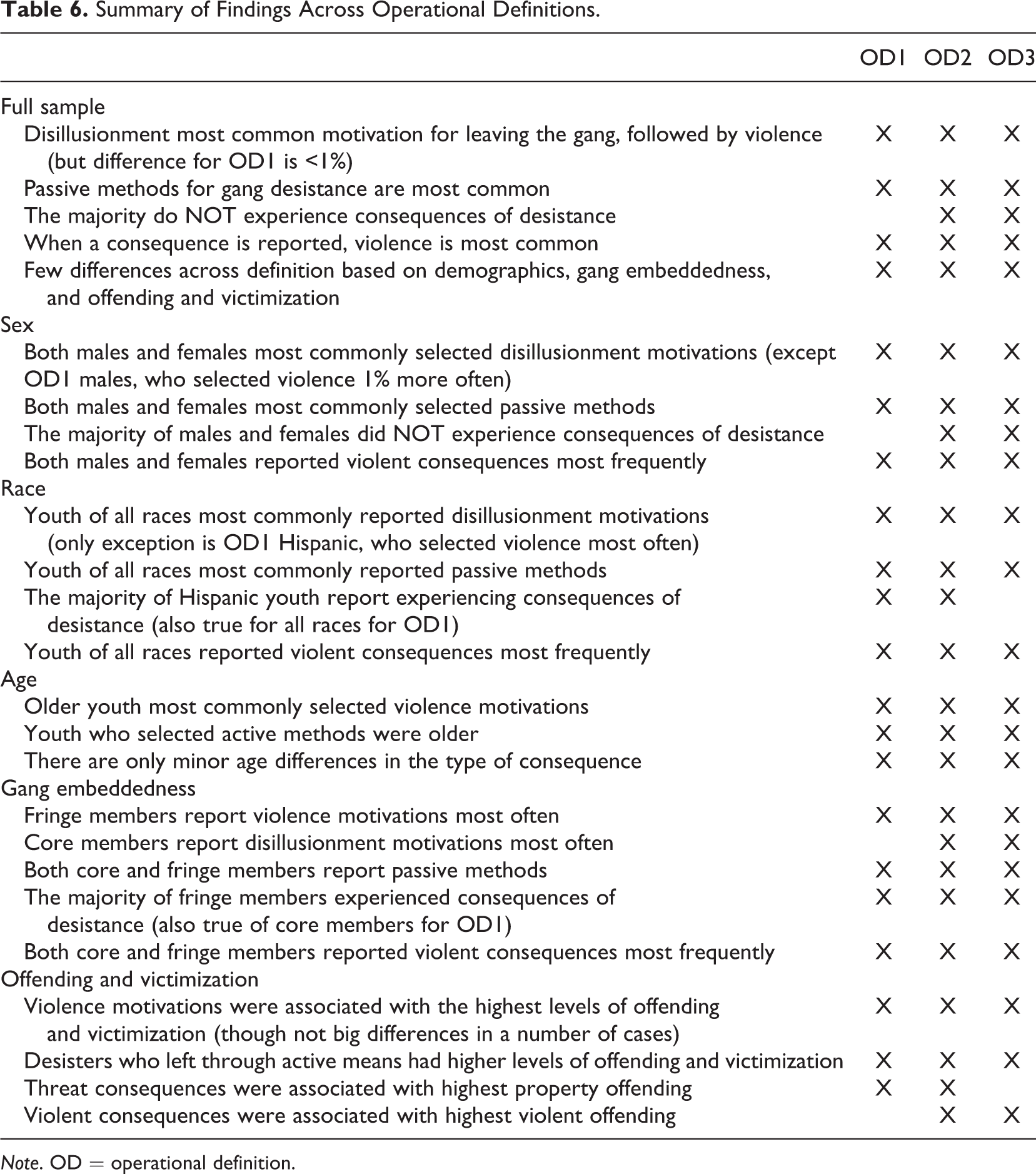
Note. OD = operational definition.
While there are some interesting and potentially important differences across ODs, discussed subsequently, our comparisons show that the overall patterns of findings are similar regardless of definition (see Table 6). The most common motivation for gang leaving was associated with disillusionment (I just left, it wasn’t what I thought it was going to be), followed by or coupled with violence 9 ; the most common method was passive (just left, moved away, I was allowed out by gang leaders); and there were typically no consequences associated with leaving the gang (but when there were consequences, experiencing some form of violence was most common for youth in each OD).
That said, OD does matter, at least somewhat, when comparing the motives, methods, and consequences of gang desistance. For motives and methods of gang desistance, the use of more restrictive definitions results in a greater proportion of desisters reporting each individual response or category (i.e., OD3 having the highest proportion, OD1 having the lowest, with OD2 representing a middle range). When focusing on the presence of consequences of gang desistance, however, the pattern is different: OD1 seems to be overly inclusive, with the majority of desisters reporting consequences. The majority of those who meet OD2 and OD3 are less likely to experience consequences of leaving the gang. Further, of those who report consequences, the largest proportion reporting each type is found in OD1, followed by OD3 and the lowest proportion in OD2. The proportion of desisters who were Hispanic increased slightly from OD1 to OD3, and the proportion who were African American decreased slightly as the definition became more restrictive, but as demonstrated previously, the differences across definitions were minimal and there was virtually no difference with regard to being White or of another race or with regard to sex, age, or gang embeddedness. While all three definitions seem to encompass similar youth in terms of demographics and gang embeddedness, youth who fit OD1 had the highest frequencies of offending and victimization (OD3 youth had the lowest but only slightly lower than OD2).
Another purpose of the current study was to examine differences in motives, methods, and consequences of gang desistance across demographic characteristics, gang embeddedness, and offending and victimization. Consistent with some prior research (e.g., Peterson, 2012), the general findings indicate that both males and females leave their gangs due to motivations associated with disillusionment, that they leave via a passive method, and typically experience no subsequent consequences. A somewhat greater proportion of males than females, however, report violence motivations for gang desistance, active methods of exiting the gang, and violent consequences. This was consistent regardless of OD, although the pattern of experiencing any consequences differed, with more OD1 males than females, but more OD2 and OD3 females experiencing any consequences than their male counterparts.
There are few differences by race/ethnicity, with the majority of all race/ethnic groups, regardless of definition, reporting passive exit strategies and disillusionment as a motivation for leaving the gang; the exception is that OD1 Hispanics selected violence motivations most often. However, a larger proportion of Hispanic youth in each definition reported some sort of consequences associated with gang desistance. Under each definition, youth who report violent motivations and active methods of leaving the gang tend to be slightly older than youth who report motivations associated with disillusionment and passive exits.
Peripheral members across all three definitions most commonly report leaving the gang for reasons associated with violence, while core members (except those in OD1) most commonly cite motivations surrounding disillusionment. In each OD, both core and peripheral members most frequently reported passive methods of leaving the gang, but peripheral members reported active methods more commonly than core members. While this may seem inconsistent with some prior work (e.g., Horowitz, 1983) that suggests peripheral members are likely to drift away, other work such as Vigil’s (1988) reveals distinctions between peripheral members, with some of them subject to active exit rituals.
Finally, for each OD, desisted youth who cited violent motivations for leaving the gang, reported active methods, and identified consequences of violence or threats of violence had the highest frequencies of offending and victimization. Alternatively, those who reported consequences of losing their gang friends or who left due to disillusionment or through passive methods, had the lowest offending and victimization levels. Overall, our findings indicate that, while there may be slight variations by ex-gang members’ characteristics, these variations are relatively consistent across definitions; that is, the pattern of any differences is largely the same no matter what definition is used.
What do our substantive findings add to the small body of desistance research, and what recommendations (if only tentative at this point) can be made? Regardless of demographics or gang embeddedness, young adolescents typically become disillusioned with gang life and then decide to simply drift away from gang membership. This is typically done without fanfare or consequences. From this, it may seem that policy makers should simply “let nature takes its course” and allow youth to mature out of gangs. On the contrary, given the vast research on the injurious behaviors and experiences of youth during periods (even if relatively brief) of gang membership (e.g., Battin et al., 1998; Esbensen & Huizinga, 1993; Melde & Esbensen, 2011, 2013; Peterson et al., 2004; Thornberry et al., 2003), we argue that researchers and policy makers should make use of knowledge on gang desistance to minimize the time spent in the gang and help youth chose alternatives to gang life. Debunking media and gang myths that glorify gang life and ensuring that youth have access to positive peers, activities, and adult role models, for example, can encourage them to avoid or shorten gang membership. Desisted youth, particularly those who engage in high levels of offending, commonly reported violence as a motivation for leaving the gang. Therefore, it may also be helpful to intervene when violent incidents occur, to provide an opportunity for desistance (Decker & Lauritsen, 2002).
Finally, what do our findings mean methodologically, and what recommendations might we make regarding future survey research with adolescent samples? First, we recommend that researchers exercise some care when operationalizing gang desistance using self-report samples. In comparing three different ODs, our results demonstrate that the most inclusive definition (OD1) produced some variations in sex, gang embeddedness, levels of offending and victimization, and the presence of consequences for desistance that were not replicated in the other two ODs (OD2 and OD3). That being said, however, since the overall patterns are largely similar across ODs, results would generally be the same (even if absolute proportions or levels may be higher or lower) no matter what definition is used. Therefore, none of the ODs is inherently “incorrect” or “wrong.”
Apart from the OD, questions still remain surrounding the conceptual definition of gang desistance. For instance, it is difficult to make a clear distinction between current and ex-gang members (see Decker & Lauritsen, 2002, for a discussion). Even after de-identifying as a gang member, youth may still associate, fight, or do business with their former gang peers who may be their childhood friends, neighbors, classmates, or even family members. Our study does not examine variations in these enduring gang ties, but future researchers may wish to consider how different conceptions of ex-gang membership vary with measurement of ex-gang membership.
Although the topic of gang desistance has gained momentum in recent years, it remains an important avenue for future research and there is much yet to learn. As we move forward, it is particularly important for researchers to carefully consider how gang desistance is defined and operationalized when examining the motives and processes surrounding gang desistance.
Footnotes
Authors’ Note
The opinions, findings, and conclusions or recommendations expressed in this manuscript are those of the authors and do not necessarily reflect the views of the Department of Justice or of the seven participating school districts.
Declaration of Conflicting Interests
The author(s) declared no potential conflicts of interest with respect to the research, authorship, and/or publication of this article.
Funding
The author(s) disclosed receipt of the following financial support for the research, authorship, and/or publication of this article: This research was made possible, in part, by the support and participation of seven school districts, including the School District of Philadelphia. This project was supported by Award No. 2006-JV-FX-0011and Award No. 2011-JP-FX-0101 from the National Institute of Justice, Office of Justice Programs, U.S. Department of Justice.