




Abstract
Despite increasing evidence of greatly differentiated illicit drug markets, common depictions and conceptualizations of “the” drug market remain subject to overhomogenization. As regards drug market-related violence, the conceptualization of drug supply milieu as generally violent has often (sometimes unintentionally) been apparently supported by case study research reporting from particularly violent supply milieu and/or on specific groups of suppliers. Little research has focused on the relative absence of violence in supply milieu. Although some prior research has pointed toward ways in which levels of drug market violence can differ, few examples have shown this empirically by reference to comparative case studies and none have attempted to relate this to differentiation as opposed to market emergence, maturity, and decline. This article reports on two case studies of established heroin/crack markets in two separate coastal cities in England that share many characteristics but differ meaningfully in regard to drug market violence. Meaningful historical and extant differences in supply-related violence is reported and reflected upon and it is concluded that drug-related violence, rather than conforming to conventional notions privileging structural or systemic similarity, is contingent on a mix of local supply cultures, supplier rationality, local supply structures as well as supplier characteristics and that each and any supply locale is likely, if studied closely, to differ in meaningful respects across time and practice to another.
Keywords
Even without the protection of the state and courts, illegal drug markets are generally peaceable.
Introduction and Background
The difficulty with much that has been commonly conceptualized and perpetrated about drugs, drug users, and drug markets is that it is too often confounded by detailed empirical research and broader conceptual understanding that is aware of intracultural and cross-cultural difference. This article— with a focus on how violence manifests differentially within drug markets—will further counter some of the intentional (i.e., widely accepted) as well as unintentional stereotyping on drug market violence by outlining the ways in which drug market-related violence does or does not manifest in two distinct city heroin/crack markets in England. The aim of the article is to first show how two quite similar drug markets manifest violence differently, not for reasons of relative maturity or lack of, as is the explanatory inclination of much drug market commentary on differences in levels of violence but because they are different in other respects. A second aim, following a range of recent research evidence showing how drug markets are highly differentiated, is to suggest that such differentiation in terms of violence is the result of a mix of structural and cultural differences rather than just structural conditions understood as “systemic” or inherent to drug markets. Overall this leads to a third aim which is to argue that a research approach that starts from expecting difference rather than attempting consolidation will bear more analytical fruit in the long term. By way of background context, an initial brief foray into how drug violence has and continues to be understood both popularly and academically will be provided. Slightly more focus will then be provided around the increasingly compelling evidence for viewing differentiation as a key aspect of drug markets and drug market-related violence before considering how violence was perceived to manifest in the case study areas.
The Popular or Conventional View of Drug Market Related Violence
Gossop (2007, p. 10) has previously bemoaned that most of what we learn of drugs, drug use, and drug users is through the media, that much of this “information” is characterized by “inaccuracy, exaggeration, and sensationalism,” and that “if drugs could sue for misrepresentation, defamation, and libel, they would have done so,” a position broadly echoed by many other drug field researchers over the years (cf. Berridge 1987; Coomber, 1998; Musto, 1985; Courtwright, 2001; Krivanek, 1988; Reinarman & Levine, 1997; Boyd, 2004). By extension, when it comes to representations of drug dealers and their practices in the illicit drug market similar misrepresentation, inaccuracy, exaggeration, and thus sensationalism has been argued to buttress various myths relating to individual health and wider cultural risks and to effectively distort how the “drug problem” itself is widely conceptualized (Coomber, 2006, 2011). Hough and Natarajan (2000, pp. 6–7) have related how traditionally the view of drug markets has been “pyramidical, with large scale importers and traffickers operating at the apex, filtering down to street dealers’ operating at the lowest level and how this has been reflected in “Many popular films [that] have portrayed drug-trafficking organizations as large highly disciplined, hierarchical organizations.” Academics concerned with “dark marketing,” that is, those (not necessarily illegal) markets and marketing practices considered “ostensibly reprehensible” have depicted drug dealing as “Night Dark” (the darkest of dark) and one of those areas that is “dark from top to toe” (Brown, McDonagh, & Schultz, 2012, p. 208), while others have provided descriptions of particularly violent milieu and individuals (e.g., Dembo, Hughes, Jackson, & Mieczkowski, 1993; Dunlap, Johnson, and Rath, 1996; Goldstein, 1985; Goldstein, Brownstein, Ryan, & Bellucci, 1989; Jacobs, 2000; Jacques, Wright, & Allen, 2014; Jacques & Wright, 2011; Johnson, Golub, & Dunlap, 2000). Popular imagery/common conception and broad research evidence often do not correspond however and research evidence over the last 20–30 years has increasingly pointed to how drug markets vary in important ways over time and space depending on a multitude of factors but also that some of the key assumed characteristics such as those seen as typical are often in fact not (Coomber, 1997, 2006, 2011; Dorn et al., 1992; Hough & Natarajan, 2000; Lewis, 1994; Murphy et al., 1990).
One aspect of the drug market, and by extension of drug dealers, widely considered to be inherent to drug markets, is that of a predilection towards violence. Following on from the noted traditional view of drug markets popular representations of those that supply drugs within it are of unscrupulous, often violent, and fearsome individuals seeking to make profit from the misery of others. Drug-related violence, of which drug market-related violence is a significant element (Goldstein, 1985), rears its head high for various reasons. The traditional and intuitive link is that related to biopharmacology—a drug user (which often includes “street” or lower level dealers) is made violent by the psychoactive changes produced by the drugs in question. From the earliest media reporting on drug-related violence through to the present day either direct causal effect are reported or the inference is so strong that it is obvious:
Marihuana makes fiends of boys in 30 days: Hasheesh goads users to blood-lust (San Francisco Examiner, January 31, 1923). And Miami man shot dead eating a man’s face may have been on LSD-like drug: Witness describes incident as ‘really, really horrific’ as police and doctors suggest attacker was on drug called bath salts (The Guardian, May 29, 2012).
Conceptualizations such as this are important to acknowledge as Erickson (2001) has stated that this biopharmacological view has provided much of the rationale for historic and extant policy on illicit drugs. There is no room here to discuss this position in detail but suffice it to say that the evidence for a simple biochemical interaction that causes violence is limited and confounded by a range of cross-cultural and case study evidence (Chaiken & Chaiken, 1990; Collins, 1990; Goldstein, 1997; Heath, 2004; MacAndrew & Edgerton, 1969; Reinarman & Levine, 1989). Further, and as regards the above-mentioned headlines, the reader will be aware that nearly 100 years later cannabis now has a reputation for producing a generally “mellowing,” rather than violent, effect and the man shot dead eating another’s face was not found to have LSD or other similar substances in his system at postmortem. Sensationalism and simple assumption goes hand in hand with views on drug-related violence.
As has been known for some time (at least within the academic community), more convincing evidence is found outside biochemical interactions within individuals. This was clearly related by Goldstein (1985) in his seminal article “The Drugs/Violence Nexus: A Tripartite Conceptual Framework.” This article provided an “ideal-types” analytical framework for a better understanding of drug-related violence that was more nuanced and conceptually directive than much that had gone before it. In this framework, Goldstein quickly, and rightly in this author’s opinion, gives short shrift to the idea of direct pharmacologically induced violence but perhaps overplays that of “irritability” induced by withdrawal symptoms as contributing to occasional violent outcomes (Bean, 2014; Coomber & Pyle, 2014; Fagan, 1990; Hammersley & Morrison, 1987). Goldstein’s second leg of his tripartite framework for understanding drug-related violence is that relating to “economically compulsive” needs. In this part of his model, Goldstein argues that some dependent drug users engage in violent crime to gain money to buy drugs to satisfy their craving for those drugs. Although Goldstein is correct in emphasizing that economically compulsive violence manifests itself only in some users, that even this violence tends to be situational (i.e., often results from the context and circumstance it occurs in rather than simply premeditated), and that “most heroin users avoid violent acquisitive crime if viable non-violent alternatives exist” (p. 147), he does perhaps underplay the extent to which those committing such crimes even in situational contexts tend to have preexisting/predrug use violent histories (Chaiken & Chaiken, 1990; Fagan, 1990; Falk, 1994) and thus that of biography and culture (cf. Bourgois, 1995; Moyle & Coomber, 2015). This last issue is not overly problematic however because the key point, as with the psychopharmacological model, is that drug-related violence explained by these aspects manifests far less than common sense views would suppose and effectively pale in comparison to his third conceptual vehicle that of “Systemic violence” (Goldstein, 1997).
It is now broadly accepted within the “drugs field” that systemic violence, violence that comes about due to the nature and structure of “black” (or more recently “dark”—cf. Brown et al., 2012) drug market transactions in a context of prohibition, predominates. Indicative examples of systemic violence are provided by Goldstein (1985, p. 148) as:
1. disputes over territory between rival drugdealers. 2. assaults and homicides committed within dealing hierarchies as a means of enforcing normative codes. 3. robberies of drug dealers and the usually violent retaliation by the dealer or his/her bosses. 4. elimination of informers. 5. punishment for selling adulterated or phony drugs. 6. punishment for failing to pay one’s debts. 7. disputes over drugs or drug paraphernalia 8. robbery violence related to the social ecology of copping areas. Substantial numbers of users of any drug become involved in drug distribution as their drug-using careers progress and, hence, increase their risk of becoming a victim or perpetrator of systemic violence.
Goldstein (1985, pp. 147–148) further argued that “In the systemic model, violence is intrinsic [my emphasis] to involvement with any illicit substance. Systemic violence refers to the traditionally aggressive patterns of interaction within the system of drug distribution and use. Goldstein then, as with much published research on drug market related violence, provides varied accounts and descriptions of how and why violent events have and may occur. Over a decade later, Goldstein (1997) reiterated his framework and, drawing on a range of (then) recent work (Brownstein, 1996; Brownstein et al., 1992; Goldstein et al., 1992) added in further structural conditions such as when markets emerge, mature, and decline intermingled with socioeconomic conditions as important factors in the varied and complex conditions that produce drug market violence. The framework was, in general, a positive one moving analysis and thus policy (if policymakers were to listen) away from simple conceptions of drug-related violence to ones that pointed toward understanding the contexts in which violence occurred. Following this, Brownstein, Crimmins, and Spunt (2000) also usefully emphasized interactional dynamics between individuals and groups as being as important as structural conditions in inflecting upon situational conditions that can produce either stability or violence. Although it may be apposite to take an epistemological position that refuses to privilege structure over agency or vice versa theoretically and “to find that some approach is wholly deterministic, entirely objectivistic, or exclusively microscopic, is ground enough for ceasing to consider it a serious claim” (Archer, 1988, p. x), it is also paying unwarranted lip service to apply this relative equity in all empirical circumstances. To ignore that sometimes structure can be overbearing and play a stronger role, reducing (at times) the opportunities of agency to inflect on behavior as forcefully as other times, is equally problematic. It is the specific empirical circumstances that have to be explained not abstract generalizations.
We have already seen that the media have a tendency to present a picture of drug market-related violence that is overly simple and typified as essentially violent in character (cf. Brownstein, 1996; Reinarman & Levine, 1989, for good discussions on how this has been applied to crack). Although it’s not the explicit focus of this article, it is an adjunct contention that even academic work that does not start from this position, nor intend to promulgate it, can unintentionally do so by researching, focusing, and evidencing violent drug market milieu’s and violent drug suppliers and/or the roots of violent transactions. As Schneider (2013, p. 125) has not too dissimilarly opined, it is contestable that how drug market violence is conceptualized is related to a heady mix of “perceptions generated from the saturated reporting of drug-related violence by the media, government reports, and scholarly research.” In this vein, Goldstein’s research itself and his reflections were mostly the result of observations of the particularly violent New York drug markets of the 1980s and 1990s; many others with an interest in drug market dynamics have also focused on violent milieu and reported the activities of individuals and their rationales for violent actions (see below). And yet a smaller number of research publications has pointed to the relative absence of everyday violence, intimidation, and fear in local drug markets (Coomber & Turnbull, 2007; Few, Turnbull, Duffy, & Hough, 2004; Hammersvik, 2014; Jacques & Wright, 2008). On occasion, this has even been reported on those markets with a fearsome reputation (Coomber & Maher, 2006). These works provide the opportunity for a broader more rounded view of structural/systemic and other conditions that contribute to drug market-related violence. It is only with a broader focus that we can understand how Reuter (2009, p. 275) is able to state (once we take out the relatively small number of outlier milieus where violence is high), that “Even without the protection of the state and courts, illegal drug markets are generally peaceable.” By way of analogy, this has parallels with controlled heroin (and other drug) use and/or “hidden” heroin use. Conceptualizations of addiction and addicted behavior has focused on the visible, that which we are confronted with. We do not know about, notice, or (mostly) even research those whose addiction is hidden from those they live with, work with, and travel with on a daily basis and yet we know (and I have met many over the years in my research) socially integrated and functioning heroin addicts that are “invisible.” Their existence turns upside down what is thought about the nature of addiction and causes a seismic shift in thinking for those whose only preconception prior to this was to overly homogenize what a heroin addict is and looks like. Once we realize that heroin addicts differ enormously (some have large habits, some contained, some make ongoing choices others are chaotic, and so on), we realize that focusing on the most visible is unhelpful. Reuter (2009, p. 283) relates that there remains a dearth of “both data and well developed analytic frames for analyzing violence in drug markets.” This is even more the case for data and analyses that focus not on why violence does occur but on why it doesn’t. The two analyses are not mutually exclusive but an emphasis on the former means that in practice too little attention has been given to the latter.
Differentiated Markets
As stated earlier, research over the last 20–30 years (e.g., Coomber, 2006, 2010; Coomber & Turnbull, 2007; Dorn et al., 1992; Hough & Natarajan, 2000; Lewis, 1994; Murphy et al., 1994; Reuter, 2009) has indicated that drug markets are highly differentiated. Cannabis markets, for example (mostly), differ in character and levels of violence from heroin/crack markets (Reuter, 2009; Hammersvik, 2014), but then most crack markets have also never resembled the (supposedly) archetypal crack market of 1980s New York. Any one “drug market” is in fact a nest of intersecting and sometimes interconnecting drug markets with differing dynamics dependent on a range of variables. Coomber and Turnbull (2007), for example, have argued that some drug markets (such youth cannabis supply) in many areas may barely “touch” the drug market proper and that for most of those involved nominally, moderately but also regularly, drug market-related violence will be almost nonexistent. Coomber (2010) specifically bemoans that a lack of recognition that drug markets are highly differentiated, not just in terms of time and space but also in terms of who populates them and their predilections, limits both how markets are perceived—as too similar, and as the drug market as opposed to drug markets. Emphasis is placed on the fact that many drug market transactions involve middle-class dealers, women dealers, user dealers, adult and young social suppliers of recreational drugs to name just a few of the demographics for whom systemic violence will likely impact or apply differently to how the literature suggests. Reuter has pointed out how genuinely “local” markets can produce less violence but in the United Kingdom at least it appears that this can be especially true for small town rural markets (Few et al., 2004). It is argued (Coomber, 2010) that intersecting markets can easily have differing levels of violence going on in each and that, importantly, violence is less intrinsic to some than others. If we transpose the logic of that we might conclude that we can also expect to see important variation in individual (e.g., heroin/crack) markets in different places.
This research focuses on the heroin/crack markets of two English cities with many typical attributes supposedly familiar to such markets and aims to outline how difference in structural and cultural conditions impact on systemic aspects of the market and contribute to greater or lesser degrees of drug market violence.
Methods
One English coastal city (Plymouth) and one English coastal city/town 1 (Southend-on-Sea) on opposite west/east sides of the country, both sharing a number of similar characteristics, were the focus of studies to understand the nature of the local problem (heroin/crack) and recreational drug markets. This article will report on the local heroin/crack markets only.
Environment/City Contexts and Similarities
Both cities are coastal urban areas surrounded by countryside and are not immediately contiguous with other conurbations. Both have high indices of relative deprivation and specific suburbs where this is highly concentrated. As is common to many cities, it is within these areas of concentrated deprivation that we find most of the heroin and crack using populations and, (broadly), the concentrations of supply (although “hot-spots” in the conventional sense do not exist as the markets are mostly “closed” rather than “open”—see below), are also concentrated within these suburbs. Both areas, as is common in previously flourishing U.K. coastal resorts or naval towns/cities, have seen “better days,” are a little run down, and are in need of regeneration generally. At 1.34 miles, Southend-on-Sea also has the world’s longest pleasure pier! Both cities have a meaningful heroin using population with around 1,800 heroin and/or crack users reported to be present in Plymouth in 2008 (Lapthorne, 2012) and 11,040 in Southend-on-Sea in 2010 (Monitoring Unit for Substance in the East [MUSE], 2011). The existence of the heroin/crack market was/is seen as problematic by the police in both locations and numerous “operations” (e.g., house raids or entrapment “Test Purchase” operations using undercover police to buy drugs) seeking to make proactive arrests in order to assuage public concerns and (at the very least) to be “seen to be doing something” take place on a regular basis albeit more so in Southend. By way of immediate imagery for the reader, neither of these heroin/crack cocaine markets would be seen as dominating the areas they were located in or having visible spillover violence of the kind so stereotypically represented in various media (e.g., such as The Wire). Rather they each have a less than salubrious feel, an edginess, and both have pockets of “unengaged” and partially excluded populations involved in crime and/or drug use who “hang around town.” There are no “no go” areas.
A Focus on (the) Heroin (and) Crack Markets
In Southend-on-Sea, the heroin and crack market is more or less one and the same with sellers of heroin also selling crack cocaine and large numbers of heroin users who are also crack users. In Southend-on-Sea, numerous users use both heroin and crack (generally not together, i.e., “speedballing”) all the time, while others “treat” themselves with crack when they can. In Plymouth, crack is far less prevalent but the market is mostly serviced by the same individuals. In this sense the focus is really on the key “problem” drug market in each city and how it manifests itself. For the sake of this article, I have thus chosen to refer to this (essentially single) market as the heroin/crack market.
A Key Contextual Difference
Although both cities are surrounded by countryside and coast and are some distance from the next major conurbation an important geographical difference between the two cities relates to the fact that Plymouth’s primary drug trafficking “hub” (Liverpool) that supplies the city is approximately 300 miles and a 5-hr plus car or train journey away, while Southend-on-Sea is just (approximately) 40 miles, a 45 minute direct train, or 1 hour car journey from its supply hub, London. This key difference means that there are clear opportunities for daily commuting to Southend-on-Sea for entrepreneurial London-based drug suppliers, whereas a daily commute to Plymouth from any major supply hub is prohibitive.
Rationale for the Research
Local drug and alcohol service commissioners in both areas were keen to know what kind of barriers the local drug market (especially around violent and predatory practices) was creating to the introduction or optimization of positive harm reduction/evidence-based interventions for those in need. In both cases a need for rapid but credible evidence was requested.
Given the time-constrained needs of the commissioning group the multi-method approach employed in both cases was that of rapid appraisal (cf. Rhodes et al., 1999, 2000). Rapid appraisal (RA), sometimes referred to as rapid assessment, is a form of research that aims to quickly gather information regarding a particular (often local) issue in order to make an assessment on how the issue might be addressed in an evidenced based manner. In the “drugs field,” it has had strong associations with harm reduction approaches, to governance, and policy responses and this was also true for this research. In 1998, the World Health Organization published its guidelines on RA in the field of injecting drug use, where RA was both commended and recommended on the grounds that it was rapid; investigative, draws upon extant data and can be applied to a multiplicity of concerns in both developed and developing countries (Stimson et al., 1998). Rhodes, Stimson, Fitch, Ball, and Renton (2000) further defined the merits of RA methods as an inductive exercise where the researcher is enabled to make hypotheses and develop ideas during the course of fieldwork, while others (McKeganey, 2000; Murray et al., 1994; Rhodes et al., 2000; Stimson et al., 1998) have commended the multi-method approach of data collection in its use of and triangulation (Quine & Taylor, 1998) of a range of data sources.
The RA approach utilized here involved direct ethnographic observation, examination of extant and bespoke data sets (arrest records; forensic analysis of seizures) provided by national and local enforcement agencies/police; key person interviews (local drug and alcohol service providers and commissioners; local law enforcement personnel ranging from those responsible for intelligence and data collection as well as those commanding local policing “down” to those directly policing the neighborhoods concerned); semistructured interviews with local problem drug users and recreational drug users a number of whom had also been involved in various aspects of supply, and additional drug market research data collected on heroin user-dealers by a project, also carried out by the author, that had just preceded this one [Plymouth only]).
RA methods were applied in Southend-on-Sea between May 2011 and June 2011 and a recapture exercise in February 2012 and in the city of Plymouth between November 2012 and March 2013. 2 In Southend-on-Sea and Plymouth, respectively, 36 and 30 “problem drug users” (i.e., dependent/ recovering heroin/crack users—many of whom had also been involved in supply at some level) were recruited and interviewed to provide first-hand insight into the nature of the local problem drug market. Drug using/recovering respondents were nearly all recruited through a variety of trusted (i.e., by the drug users/sellers) local agencies providing substance use treatment and/or support (e.g., walk-in respite facilities, training, education, complex needs advice, etc.) to the groups in question. The element of explicit trust toward these agencies was important for both encouraging confidence in the trustworthiness of the researcher and the research aims and in the perceived credence that the researchers attributed to the respondents answers/dialogue. Some snowball access, via word-of-mouth and other respondents, complimented this strategy. As is common with this type of research, respondents were offered a reciprocity payment (£10) for their contribution to the research. A further 30 interviews were carried out with local (professional) key respondents from a range of agencies and included youth workers, police officers, treatment providers, local and national police intelligence/data providers, service commissioners, emergency service operatives, public health officials and youth service safeguarding providers. In Southend-on-Sea, the focus was almost entirely on the “problem” heroin/crack market, whereas in Plymouth there was also a focus on the recreational drug markets and the specific burgeoning “Legal-High”/New or Novel Psychoactive Drug (NPS) market. Because of this a further two populations, a university student recreational drug user population (n30) and a younger (under 18) recreational drug user population (n29), were also interviewed. This article focuses only on the problem (heroin/crack) drug market in both areas but this is for indicative reasons—both studies indicated that further fragmentation and differentiation (from the heroin/crack market) was manifest in the cities around cannabis supply, that of various “pills” and powders as well as the markets in NPS including “Legal Highs.”
“Knowing” and Researching Drug Markets
It is too often uncritically assumed (by the drug market literature) that researching drug markets is relatively straightforward as long as the “right” (key respondents) people are sourced. It is the contention (and experience) of this researcher however that this is far from the case and that there is a trend in drug use and drug market research that uncritically accepts key respondent reporting as more reliable (even when they are reporting “truthfully”—see below) than it may be. Although some assessment or judgment of respondent veracity is commonly indicated there is a general absence of similar assessment of the status and worth of the knowledge key persons provide. Because illicit drug markets are “hidden”—they are clandestine due to the illegal nature of drug supply; drug sellers are wary of those they do not know and drug users are careful from whom they purchase drugs and to whom they relate drug purchase information and the penalties for supplying drugs can be comparatively severe—researchers have little option other than to question those “close” to the market itself. This may mean interviewing those imprisoned for supplying drugs, interviewing “retired” drug suppliers; interviewing current active suppliers, undertaking ethnographic work in the drugs market or interviewing key respondents such as the police, local drug users, and local service professionals and so on.
The problem (and one that is too often unacknowledged—(cf. Coomber, 2012) is that key persons often know far less than it is assumed they do about drug markets. This especially applies to drug field workers, health field workers, and law enforcement personnel but it also applies to users and even those buying/selling in the drug markets. By way of illustration in previous research in relation to the dangerous cutting of drugs such as heroin, Coomber (1997) found that even drug dealers knew very little about the drug market generally and dangerous cutting specifically beyond their own limited experience and tended to believe and assume much about the drug market (via the media, anecdote, and hearsay) and what happens within it rather than really know about it. Key respondents such as the injecting drug users/purchasers and/or ex and current sellers interviewed for the research reported here can of course be invaluable for describing their experiences in the local drug market but certain aspects of what they “know” and believe and report need separating from what they have first-hand and direct experience of. All respondents interviewed for these studies, for example, strongly believed in the cutting of heroin with dangerous substances as part and parcel of normal drug market activity—many quoted (consistent with common belief and media reporting over time) “rat poison” as a likely ingredient. Forensic evidence does not find rat poison 3 or the numerous other commonly assumed dangerous substances of street “folk-lore” (Cole et al., 2011; Coomber, 2006), but for those interviewed, this was for them a key characteristic of the drug market as it would be for many other key respondents such as police officers and drug service professionals.
A critical understanding of the drug market is therefore both perspectival, that is, reliant on varying views and perspectives from different sources (Alvesson& Sköldberg, 2009), and informed by researcher practice and interpretation of those perspectives rather than uncritical acceptance of them (cf. Coomber, 2004). A critically informed perspectival approach was also deemed as a particularly helpful method to ascertaining the broad nature of drug market violence in the areas studied due to the difficulties posed by simpler and largely inadequate monitoring and incidence capture methods.
Measuring Drug-Related Violence
Measuring incidences of drug-related violence is difficult. Much violence is hidden and unreported, and even when attempts are made at monitoring/recording “visible” drug-related violence, interpretations of what counts as drug market violence can be subject to variation in a number of important ways (Goldstein, 1997). Incidence reporting can also never capture the extent to which intimidation and fear is present in day-to-day practice. In addition, in this instance, there were no historical data measuring incidences of drug market-related violence for either Plymouth or Southend-on-Sea to draw on. Given these difficulties, rather than trying to enumerate incidences of drug market violence, emphasis was placed in each study on the experience (and thus also the awareness) of violence by those involved in the markets being explored. This was similar to how Coomber and Maher (2006) explored the heroin market in Cabramatta, Australia, in the early 2000s, a market space that had a widely publicized reputation as an especially violent milieu but where an important disjuncture between assumed and reported levels of violence and that reported on the streets by heroin sellers was found. The spread of key persons interviewed/consulted on the nature of the respective markets was, as stated above fairly wide, as regards the nature of drug market violence; however, the key persons with direct knowledge and experience were considered to be heroin/crack users, heroin/ crack sellers, and local “drug squad” and other enforcement personnel. Clearly, it is the case that different people experiencing similar phenomena can portray that phenomena differently (a victim or perpetrator of violence for example may perceive the incidence and risk from violence in a particular milieu to be greater than those that have no/lesser experience of it). With this in mind, although there were some differences in the reporting, it is nonetheless the case that the picture of drug market-related violence that emerged in both locations had good data triangulation that was supportive of the narrative emergent from the users/sellers, a narrative itself that had strong internal saturation and congruence.
Data Saturation and Triangulation
Data saturation in qualitative research “whereby no new or relevant insights seem to be emerging from the data being collected” (Bryman, 2001) due to similar data emerging time and time again is much misunderstood. It has been oft cited as a “gold standard” approach to “ensuring that adequate and quality data are collected to support the study” (Walker, 2012, p. 37) but used casually and outside of the grounded theory model from which it initially emerged the validation merits of saturation can be overstated and should not be uncritically assumed (Fielding, 2010; O’Reilly & Parker, 2013). For this study, and not drawing on a grounded theory method, it is none-the-less the case that convincing and high levels of data saturation across most themes were found in each location and across data sets. Strong agreement between drug user respondents, key persons, and available criminal justice data was also found.
Ethics
The Drug Market Rapid Appraisal Service (DMRAS) research was ethically approved by the University of Plymouth, Faculty of Health, Education and Society Research Ethics Committee. The ethics of the DMRAS were informed by the guidance provided by the British Sociological Association.
Findings
Context of Two Drug Markets
General transactional context
Although much publicity and stereotype depicts heroin and crack drug markets as relatively “open” and visible such markets have been on the decline in “Western” and/or “developed” nations for some time. In the United Kingdom, so-called open markets are now rare with “closed” markets predominating as was the case in the two cities focused on here. Briefly, open markets are generally understood as “street” markets where sellers are reasonably visible to those seeking drugs, or in the most obvious of examples, where sellers openly offer drugs to most passersby (May & Hough, 2004). Selling in open markets is much riskier than in a closed market because visibility to law enforcement increases the possibility of arrest as well as increased exposure to violent episodes (Coomber & Moyle, 2012; Dorn et al., 1992; Edmunds et al., 1996; Jacques, Wright, & Allen, 2014; May & Hough, 2004). The growth of cheap and ubiquitous mobile communications technology means that sellers and buyers no longer have to expose themselves to these increased risks (Barendregt et al., 2006; Coomber & Moyle, 2012; Hough & Natarajan, 2000). In closed markets, as was the case in the two cities being reported on, drug transactions are restricted to those “known” to the seller or otherwise vouched for by known associates (Hough & Natarajan, 2000; McSweeney et al., 2008) and are arranged to take place either in “safe” places such as a prearranged outside location that is varied, another relatively less visible space found from which to sell from (e.g., a user’s home that is “rented” as a space to make sales from—see Coomber & Moyle, 2012) or even the sellers own home at arranged times. In addition, (in many but not all cases) because of the requirement to be “known” and thus (relatively) trusted, sales in closed markets are often seen as a relationship valued by many of those involved, as it can improve stability of supply and is sometimes believed to also ensure a level of quality in regard to the substances sold (Coomber & Moyle, 2012; May & Hough, 2004). It was the case that most of the respondents in both sites had a long list of sellers they could call on with a favored/preferred seller at the top which then descended, through judgment of perceived trustworthiness (relating to the quality of drug they would receive and the way they would be treated) to those least preferred/trusted. Thus, in closed drug markets, transactions and the spaces in which they take place are effectively restricted or closed providing both seller and buyer some added protection from both law enforcement and other market-level conflicts.
Primary transactional approaches
Transactional approaches were largely similar in both sites with prearranged “meets” in public spaces involving sellers carrying limited amounts on their person and secreting the drugs (often in small rubber “balloons”) about their person. This was commonly under the tongue (easily swallowed if necessary) whereupon on completion of a deal the drugs were “spat” out and given to the buyer. Others secreted the drugs in (popular confectionary) Kinder Eggs, while others simply had wraps of drug in their pockets. Meetings were arranged by text and phone call. In Southend-on-Sea, commuting sellers (see below) traveling to the city for the day would commonly text buyers on their mobile phone’s contacts list letting them know that they were “on their way,” that they had quality drugs, and inviting them to request a meet/sale. Commuting sellers either traveled up by car and used the car to drive to/from designated sales points or hired a car once in the city or used their car to organize a small group of “runners” to undertake actual transactions. It was common for a seller to arrange to meet a number of buyers together at a prearranged space/time, but local buyers often complained that commuting sellers would keep them waiting and display a general disregard for their (withdrawal) needs. In Plymouth, there was an absence of commuting sellers and relatively less dissatisfaction in this regard among buyers. Cuckooing sellers (see below) housed locally would either send out runners or be visited wherever they had set up short-term selling spaces—again all prearranged by mobile phone.
Respondent demographics
In each context, our heroin and/or crack user respondents were made up of long-term current, or recent, users with an average of 13 years (Southend-on-Sea) and 12 years (Plymouth) buying/accessing drugs in the respective cities. In a number of cases, but particularly in Plymouth, the users had also been involved in supply at varying levels. As stated previously the level of issue saturation overall was high. In relation to the specific issue of drug market related violence however, achieved from these mostly non-connected individuals in each location, agreement was very high and concurred with other key person data providing a level of confidence that the ‘picture’ produced has a good accuracy. As we can see from Table 1, the demographics for heroin/crack users interviewed in the two cities are broadly similar and each cohort is also broadly representative of the heroin/crack using populations found in the each area (Lapthorne, 2012; MUSE, 2011).
Respondent Demographics for Both Cities.
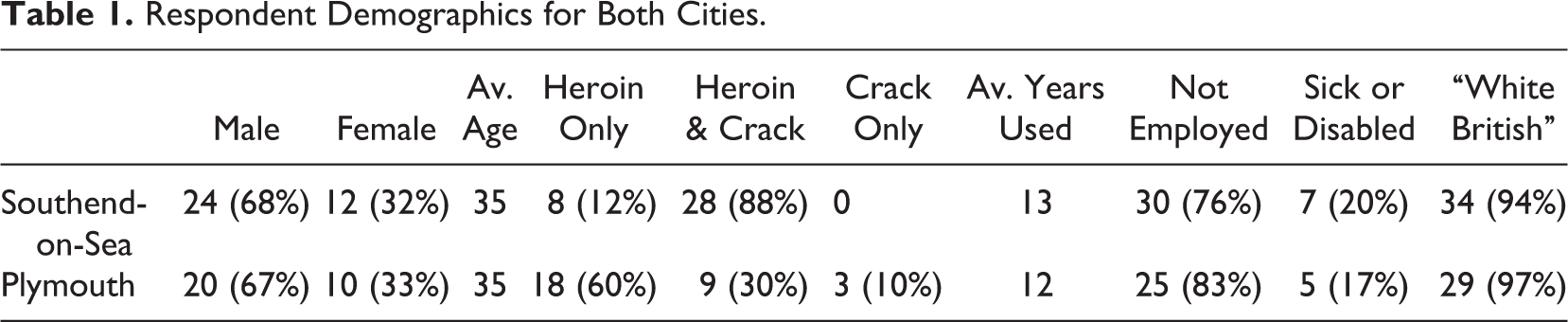
Both populations are similar in terms of ethnicity, essentially constituting “White British” cohorts who are in turn largely representative of the wider populations of each city. Gender splits are again representative of both city and U.K. heroin/crack using demographics (Lapthorne, 2012; MUSE, 2011), and each sample is constituted by experienced, long-term users who are nearly all unemployed, sick, or disabled and with an average age of 35 years.
The only obvious difference between the two is reflective of a slight variance in drug using culture in the two regions. In Southend-on-Sea, it is common/normal for problem drug users to use both heroin and crack cocaine, whereas in Plymouth, heroin alone (as drug of addiction) predominates. At no point in the research did the relative prevalence, or not, of crack cocaine get pinpointed as a reason for greater or lesser levels of drug market or other related violence in either location.
Broad drug market supplier demographics
Although there is much about the broad local contexts, including the local heroin/crack cocaine using populations that are similar, when it comes to the shape of the local heroin and crack drug markets there are key differences and some of these emanate from the demographics of those involved in the supply of heroin and crack in the two areas.
Table 2 shows similar gender involvement and similar average ages (which we will come back to), but it shows huge differences in terms of where those arrested for supply offences lived. In Plymouth, just about all (94%) of those arrested for supply offences were indigenous by residence to the city or its immediate region. By contrast, in Southend-on-Sea, a third of those arrested were from London. There is good reason to believe that undercover test purchase operations in Southend-on-Sea would have disproportionately scooped up local indigenous “runners”/user dealers (or even users inveigled into an opportunistic sale) and as such that the proportion of London-based dealers put at “nearly all” by most respondents and police (“runners” were thus not widely perceived as actual dealers) is thus significantly underrepresented.
Heroin and Cocaine (i.e., Mostly Crack) Seller Arrest Demographics.
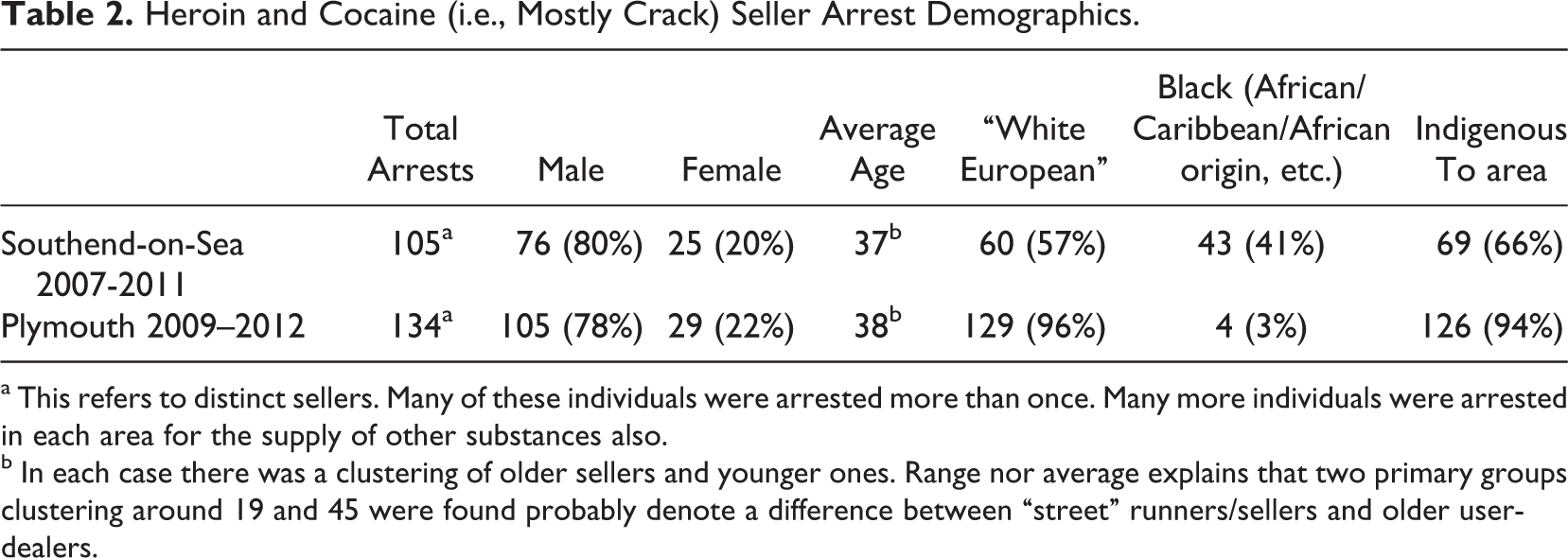
a This refers to distinct sellers. Many of these individuals were arrested more than once. Many more individuals were arrested in each area for the supply of other substances also.
b In each case there was a clustering of older sellers and younger ones. Range nor average explains that two primary groups clustering around 19 and 45 were found probably denote a difference between “street” runners/sellers and older userdealers.
Although proportions of indigenous to nonindigenous sellers cannot be pinned down with any accuracy, the arrest record did concur with one very experienced local user’s perception (given that the indigenous population was almost all “white”):
A prominent picture being painted by others is that the London dealers stand out for various reasons. If you were to give a proportion of the ones coming up from London compared to those from Southend, would it be 50/50, or would it be 60/40, I’m getting mixed messages about that. I would say it’s about 70/30. And when they get here, then, do they use local runners? Yeah, they use a lot of local runners, and for some reason, I don’t know how they do it, but a lot of the black guys that are dealing, like the Somalians, whatever, and the ones that come down from London, whatever, they don’t use themselves. But it seems to be like the old school white people, whether they’re in the area, or they come down from somewhere else, Westcliffe, London, wherever, they’re sort of users, trying to support their own habit, and make a few quid on the side. But the black ones (from London) seem to be just doing it for the money.
A high proportion of those selling heroin and crack cocaine in Southend-on-Sea, according to arrest data and user/buyers perception, were thus distinct because they were often non-White, non-heroin/crack users and nonindigenous, traveling up either daily or to stay for just a few days.
In Plymouth, most sellers were runners/user dealers essentially supplying to support their own habits and—regardless of the level of sales making very little profit once their own drug use was accounted for—what Coomber and Moyle (2013) have recently categorized as Minimally Commercial Supply (MCS). It will be contended later that the relative presence of commercial and MCS can impact meaningfully on drug market-related violence and levels of intimidation.
Violence Perceptions
Local media coverage
It was deemed useful to get an understanding of how the respective drug markets were being generally seen and represented to the local population and how this appeared to square with the experience of those inhabiting them.
Representations in local media, the use of intimidation, the reported threat of violence, and perceptions of actual drug market-related violence within the heroin/crack drug market milieu overall differed between each location meaningfully. The Southend-on-Sea drug market was perceived as a moderately violent milieu (when compared to areas such as Liverpool, Manchester and London or the [often perceived to be] archetypal New York markets of the 1980s), whereas, by and large, the Plymouth heroin and crack cocaine market was seen by many as “not at all” violent.
In Southend-on-Sea, headlines such as these (given below) encapsulate and provide an overall impression of Southend as having a fairly extensive drug problem with violence in regard to supply with both Somali 5 gangs and the high rise tower blocks just north of the town center being the predominant focus of supply activity and the problems therein:
“Killer ‘under pressure from dealer’” (Echo, Monday 26 May 2014) “We will act to end high-rise hell for Southend tenants” (Echo, Monday 2nd January 2012) “Police raid on Southend estate” (Echo, Thursday 2nd February 2012) “Southend police: We have driven out Somali drugs gang” (Echo, Tuesday 29th November 2011) “Somali gangs bring back terror to the tower block” (Echo, Wednesday 16th November 2011) “Town drugs ring run by Somalis” (Echo, Monday 25th January 2010) “Southend police allay residents’ drug fears” (Echo, Tuesday 16th March 2010)
In Plymouth, media coverage over the 4 years prior to the research tended to focus on the occasional “smashing” of a drug ring, of the arrest or prosecution of dealers based in Liverpool or Manchester that “flood” the city with heroin. Violence was rarely mentioned other than perhaps if someone arrested for supply was found to own a weapon (usually found in the home not on their person). In this sense, there was a different prevailing mood attributed to the nature of the drug market in each location. In Southend-on-Sea, the impression given by the media and the police was one of a market riven with violence, yet, as we shall now see, the experience of those inhabiting it was of something much more moderate and contained.
Buyers’ and Sellers’ Perceptions of Drug-Related Violence
General perceptions of violence
In general, Southend-on-Sea was considered a relatively violent milieu as testified by Byron:
‘… it is a violent scene here yes… and you make it trouble. Got to be careful… I’ve been stabbed in the leg. Yes. I’ve been cut down the leg with a Stanley’ [short bladed work person’s knife] (Byron, 36-year-old male heroin and crack user LM03).
And,
Well, it depends, because it depends who you’re going to and what you’re doing. I mean quite a lot of the … well, the foreigners; they tend to hang around in threes and fours on the stairwells in the tower blocks. Well, then again, you’ve got some of the English ones that are doing it that are only on the road. And if somebody is off their head, and they want what they want, they’re going to smash whoever over the head with a hammer, or a machete, and kill you, just to get a couple of balls or a couple of rucks. And they will do that, I’ve seen them. I see somebody, like not even a month ago, got hit in the face with a meat cleaver, and now he’s one eye down, and that was just over the other side of the high street.
But even here some moderation was often held up to caution:
Okay, so there’s enough room for everybody pretty much… ? Yeah I mean you don’t really hear of a lot of… apart from the Somalians… you don’t really hear a lot of beatings anymore and the fights and ….’coz it’s such a big market for it. (Grant, 51-year-old heroin and crack user)
In Plymouth, typically, respondents related that gangs of any kind were not part of the milieu, reflecting the fact that independent user dealers and runner user dealers were the frontline sellers with organized criminals more likely to provide the wholesale supply route from the North East of England. Geography clearly played a protective role in this but so did the long-standing culture of supply within the city (relatively non-commercially motivated user-dealing) which meant that the wholesalers were content to use existing suppliers rather than infiltrate the city with their own (who would be a long way from home) in contrast to those traveling to Southend-on-Sea. For the most part, drug market violence was considered to be comparatively rare within Plymouth, especially compared to other cities:
Have you ever heard that Plymouth is a particularly violent scene? No. Not compared to other? (Laughing) No. What about the Scousers controlling the people that work for them down here, any problems? No. It seems to be a lot lighter here than in other cities that I’ve been here. So we don’t get much violence, here? No. (Barry, 33-year-old heroin user)
And:
… and in your opinion is the Plymouth drug market a particularly violent drug market or can a user pretty much not have to worry about violence against themselves most of the time? I think that it’s pretty safe compared to other parts of the country in my experience. Okay. Do you have other experiences where you can compare it to? Yeah I’ve experiences from Liverpool and Bristol. And just briefly what’s the kind of… When you were in Liverpool and Bristol what would have been maybe an experience that you… I came across a lot more street violence around both crack, but particularly crack and heroin users are likely to cause street sort of mugging and using street violence in order to … (tapers off). (Jack, 43-year-old heroin user)
This relative absence of violence in the Plymouth drug market was also acknowledged by two well-placed intelligence sources. Violence was not seen as absent per se and a number of respondents did see Plymouth as having a violent drug-related aspect to it. Overall, it was considered moderate however. Where violence was cited it was often related to those from beyond Plymouth (mostly the “Scousers” and the “Mancs”) coming into conflict, albeit rarely, with “Plymouth boys.”
“Gangs”
In Southend-on-Sea, although those interviewed did refer to a number of drug gangs 6 operating drug sales in the city and most did single out “Somali” gangs as more intimidating, as more willing to engage in violence than the non-”Somali” dealers, and as a “last resort” to buy from (mainly because they had a reputation for lower quality drugs), perceptions of the “Somali” suppliers were far more constrained than might be expected.
There has been a fair bit of media coverage saying that Somali gangs are controlling parts of Southend and Westcliff. What do you think of these rumours? And do you think they’re exaggerated? I don’t think they’re exaggerated. But I don’t think they’re causing much of a problem in Southend. They did for a little while, but … How were they causing a problem, like before? Just being like … they’d got no consideration, like where they’d come from, the culture and they have no respect for anything. And they were like they were doing you a favour. It is a business transaction, kind of thing, you know. (Jody, 38-year-old heroin and crack user)
And,
When I came here I was black, I stood out, so it’s not the Somalians running nothing at all, it’s just every face stands out more than…. Southend is a very white town, so if you’re black and you’re doing anything wrong, it looks worse than… Like everyone I get drugs from is from Southend, [and therefore “white”] and people have always got drugs on them from Southend (Bendan, 49-year-old heroin user).
Specific forms of violence
Violence, threat, and intimidation in both sites (both real and imagined) also tended to manifest itself in very specific ways with vulnerable groups being most at risk/exploited.
Cuckooing and reciprocal renting
In both areas, it was fairly common for commercially oriented dealers/suppliers to stay in drug users’ houses or flats (apartments) as a short-term base for either selling from or to base themselves while in the area. Depending on the levels of intimidation, violence and/or reciprocity involved, however, the practice tends to manifest as exploitative, oppressive, and riven with violent intimidation and threat where the legitimate resident is ejected from his or her “nest” (cuckooing) and a much more reciprocal arrangement where the visiting wholesaler/dealer agrees terms (usually to provide the resident with their drugs for the duration of the stay), stays a short period, and then moves on to another reciprocal arrangement nearby or goes back to their home in, for example, Liverpool or London (reciprocal renting).
In Southend-on-Sea there was a mixed economy. A fair amount of cuckooing was described with a few of the respondents having either been cuckooed themselves or having first-hand knowledge of it happening to a friend or acquaintance, while others reported this happening with little consequence:
… but most of them are people that have come down from London, they come down and they use people, they give someone a turn on, to use their flat or their house, to deal from, and they’ll say, like: “Depending on how much we sell today, we’ll give you two balls of crack and one ball of heroin, or two and two,’ or whatever, depending on how much they’ve sold, how much business they’ve done, whether you let them stay overnight, or whether you go out and just leave them your keys. Like that sort of thing. So they’re sort of almost paying rental fees, in drugs” (Jack, 29-year-old heroin and crack user).
In Southend-on-Sea, it was again the “Somalian” dealers who were pinpointed as being more likely to choose the more vulnerable of users, to then embed themselves in the accommodation, to eject the user either forcefully/literally removing them or by effectively forcing them out through intimidation and/or poor treatment. This group also had a more prominent reputation than other groups for grooming young girls in/around these appropriated residences, often forcing them to “run” drugs for them and thus had also caught the attention of safeguarding authorities in the municipality. They also had a more prominent reputation for requesting/expecting sexual services for drugs from female drug users. In Plymouth, the arrangement was reported almost by all respondents as less predatory, more reciprocal, and on occasional as even quite respectful.
Robbing runners
A common manifestation of violence in some drug markets is that where drug dealers are a particular target for robbery from drug users (Jacobs, 2000; Toapalli, Wright, & Fornango, 2002). In Southend-on-Sea, in contrast to media speculation and police concern, this was reported as the most common of violent events and it applied almost exclusively to low level “runners.” So, by far, the most cited aspect of drug market violence was not seller inflicted, as much market stereotype would lead us to expect, but instead it was associated with robberies and assaults on younger drugs runners or “shotters” who were targeted by heroin/crack users. The quotes below are indicative of the violent events known to have taken place:
…. and there is a lot of violence, there’s a lot of robbery from drug dealers, from the shotters, the young lads, because a lot of it is youngsters; they go out with … say, like people will phone up to say, “I want five of each.” So they’ll come out with ten shots, and the person that’s scoring off them, they’ll hold a knife to them, or just blatantly rob them. Or they’ll find out where they’re serving up from, because they move from people to people’s flats, and they’ll just go in, balaclava, in there, with a hammer, do the young lad, or young girl, whoever it may be, and just rob them of their drugs. It goes on all the time; every week you hear about one person being robbed (Layla, 36-year-old heroin user).
And,
Yeah, people phone them up and they’ll say, ‘I want two white [crack] and two brown [heroin].’ And then when the runner comes out with whatever, he’s usually got a few more, usually in his mouth, and then next thing, the person will pull a knife out, or a cosh, or something, and just: ‘Give me all your fucking money and all your gear. If you don’t, you’re getting this.’ And they’ll just go: ‘Take it,’ because it’s not their gear (Jack, 51-year-old heroin and crack user).
It seems that the vulnerable demographic of runners—who are often young adults—puts them at higher risk for theft or robbery from users who recognize the certain level of detachment from the drugs they carry. Although some of the robberies described seemed more opportunistic, others were preplanned and sometimes involved a group of users/robbers arranging a robbery with the intention of going on to share the drugs they obtained. Unlike the sample reported on by Topalli, Wright, and Fornango (2002), “retaliation” was not the most likely or most desired outcome, rather, as in Coomber and Maher (2006) the alternative rational response was usually to “let it go” and thus an escalation of conflict was largely avoided.
These above-mentioned quotes provide insight into the way that most respondents related the nature of violence in Southend-on-Sea. By comparison, typical responses from the users and user dealers and/or “runners” in Plymouth, as related earlier, were of a comparatively peaceful milieu that had persisted over time.
In what ways and why these difference manifested will now be considered more closely by looking at who (what kind of sellers) populated the market, how they operated (what they did by way of market practices), and what structural/operational/cultural constraints permeated and inflected these supply contexts.
Explaining Difference
User Dealers and Minimally Commercial Supply
User dealers “proper” are dependent users who sell primarily to secure money or drugs to satisfy their own habit, who are essentially non-commercial in their motivation and who are usually unsuccessful in securing much by way of profit (regardless of sales) beyond an income needed to do this (Coomber & Moyle, 2013). The organizational form they take (e.g., a “runner” or “dealers apprentice” who is “fronted” 10 bags and has to sell 8 bags to “earn” 2, or someone who buys “weight”; divides into smaller “bags” and then sells independently) is the minimally commercial aspect of their involvement in drug sales that really defines them (Coomber & Moyle, 2013). In Coomber and Moyle (2013), Coomber, Moyle, Hatton, and Gavin (2014), Moyle and Coomber (2015), and Coomber and Pyle (2015) user dealers have been argued to be less culpable in criminal justice terms than “drug dealers proper” and have been found to be a supplier demographic (in the United Kingdom) far less prone to committing and/or experiencing drug market-related violence. Moreover, where user dealers predominate in a supply scene (as in Plymouth) for that milieu to have a comparatively muted level of drug-related violence generally, something also acknowledged and somewhat begrudgingly admitted by local police who hesitate to admit (in a time of scarce resources) that some drug dealers/markets may be “better” than others and might be worth preserving if eradication is not feasible/practicable. This is an acknowledgment that some types of market structures may be preferable to others (like closed markets) at least when the culture of that market and those populating it over time are comparatively muted in terms of violent expression. In Moyle and Coomber (2015), for example, the user dealers all reported dealing to be preferable from a moralistic or humanist perspective to other forms of acquisitive crime—burglary/robbery, in particular—and to be an expression of criminality they felt more comfortable with. They were not predisposed individually (nor was the market they inhabited culturally) to violent expression and many professed user dealing (for them) to be a morally more acceptable form of criminality, as it was perceived as little more than an extension of their use and that they only sold as much as they needed to supply their own habit. User dealing in Plymouth was thus often undertaken by men and women who were users first and had little interest or desire to expand their selling, or protect their reputation, etc., in ways that a commercially motivated seller would or that commercially motivated “enterprises” or “systems” provide more “encouragement” toward. The systemic aspect of this context is thus muted compared to contexts where either weapons were more frequently carried and/or where the milieu contained strong presence of commercially motivated (male) sellers as in Southend-on-Sea. Similar to Coomber and Maher (2006), almost none of the Plymouth user dealers reported experiencing much by way of violence nor engaging themselves in retaliation events. Being indebted to their wholesaler was the biggest concern for the less capable user dealers but excessive violent outcomes were not reported as likely or common. User dealers in a similar area to Plymouth, operating in a similar “system” some 40 miles away generally, described violent events related to “debt” or the market per se there as “once or twice a year happenings” in the area and even then to not be as serious (when carried out) as would be seen elsewhere (Coomber & Pyle, 2015).
In Plymouth, the preponderate user dealer population provided most “ground”-level sales to other users and were themselves supplied at the wholesale level either direct from outlying hub cities (mostly Liverpool but also Manchester and sometimes London and Bristol). The wholesale suppliers tended to let the direct “sales work” be handled by the indigenous user dealer population and retain a “light-touch” level of control over rival wholesalers. The structural/systemic outcome was of a supply context of users to users, “friends,” and acquaintances to “friends” and acquaintances. Few related that other addicts could be “true” friends nor be fully trusted but at the same time the transaction process was rarely described in adversarial or problematic terms and some empathy (for the addicted/withdrawing condition) was expressed. By contrast in Southend-on-Sea, the commuting and cuckooing drug dealers were less likely to also be heroin/crack users (if at all), were commercially motivated, predatory in practice (e.g., would obtain the numbers of users they didn’t know from other users and phone them, offering them heroin/crack), had moderate levels of conflict with other like sellers and treated some local vulnerable users with relative contempt (e.g., in how cuckooing was practiced but also keeping users/buyers waiting and talking “down” to them). Violence, while not endemic or of the levels experienced in the drug markets generally described in the literature was nonetheless a local concern and manifested sufficiently for local users to feel that they were in a relatively violent drug market milieu.
It may be the case that culturally/systemically less violent and geographically contained milieu that are too far from hubs for “commuting” (like Plymouth) and that display low levels of conflict and violence inflect upon the normative violence/intimidation practices of those from the hub. Rather than seeking to “run” or control Plymouth and similar areas with the heightened levels violence and intimidation common to their home (hub) milieu, they appear content to mostly permit the “system” there and the culture that inflects it to persist with little overall interference.
Culture and Structure
Behavior is complex. We saw earlier that drug user and drug seller violence is not induced simply from pharmacological consumption, and Goldstein (1985, 1997) has adequately shown that most drug market related violence is in fact “systemic,” the result of tensions produced by various common drug market activities and characteristics. System alone though can be overplayed and we know that systemic conditions intertwine with cultural, historical, spatial, social, economic, and political context and are thus complexly inflected with each to varying degrees depending on circumstance. Without seeking to determine which theoretical positions most completely capture how this complex web of system/structure and individual agency combine (e.g., via concepts derived from Bourdieu, such as habitus, cultural capital, field, and doxa, or Giddens’ theory of structuration to name just a couple), we can reflect on some of the key aspects found in the drug markets outlined here to consider the variation in drug market violence in Southend-on-Sea and Plymouth and how it was experienced by those within them.
One of the key structural features to both areas was that the drug market was closed. There was also a general absence of any locally situated organized crime controlling, up close, the drug market. As a consequence there were few “turf” related conflicts. Both markets were “serviced” by outside suppliers who either provided drugs to sellers to sell locally (Plymouth) or who commuted daily or visited short term to sell themselves (Southend-on-Sea). In Plymouth, most selling of heroin/crack was by user dealers whose primary motivation was to ensure their own supply, whereas in Southend-on-Sea sellers were commercially motivated and (cannabis apart) were seen as nonusers. The culturally entrepreneurial and commercially motivated sellers of Southend-on-Sea were widely seen as treating heroin and crack users/buyers with a certain level of disdain but, on the whole, to not be particularly violent. Elevated levels of violence in Southend-on-Sea (compared to Plymouth) were in part deemed to result from differences in the approach to transactional practice and also a level of cultural disjunct from, for example, the “Somali” sellers; the broad expectation/acceptance of the practice of robbing vulnerable runners, and in the (very) occasional turf war resulting from “gang” conflict. “Somali” sellers were perceived as offering poor quality drugs, as doing so with intimidatory attitude, and being much more likely to be the source of particularly violent episodes. They were also attributed with predatory (largely non-drug connected) sexual activity toward vulnerable women and girls and to predate on vulnerable drug users to use their homes from which to base themselves and sell drugs. This specific and culturally definable group from London operated distinctly to the various other “London dealers” and as Bourgois has previously shown in regard to patriarchal practice (Bourgois, Prince, & Moss, 2004) and other street culture (1995) how sellers are situated vis-à-vis life chances, cultural mores, and preferences for resolving conflict will inflect on the prevalence and degree of violence that occurs as a response to any given situation. The (more) violent dispositions of the “Somali” drug sellers were in many ways typical of the kind of systemic “pushes” toward violence found in the drugs literature but it was not itself indicative of wider practice or conflict resolution—even from the other (non-”Somali”) London sellers.
In Plymouth, there was an absence of a culture of violence among heroin and crack sellers and in the market more generally (except for when the outside suppliers occasionally got involved—a relatively rare occurrence). Nearly all were local and had resided in the area for many years or grown up there. The predominant motivation for selling was to reproduce their own supply and few reported making enough money to do much more than this. In addition to a relatively nonpredatory or nonexpansionist (different system) approach to selling, many of the user dealers reported being user dealers in preference to other—in their view—more harmful crimes, harmful either in terms of not wanting to engage in interpersonal violence (e.g., robbery) or violence against themselves (sex work) or morally (such as shoplifting). There was a general absence of using violence as a means to conflict resolution in the drug market, but there was also a general absence of cultural mores that saw this is a normal way to resolve conflict in everyday life. Many of the user dealers in fact displayed levels of empathy toward other addicted drug users that respondents in Southend-on-Sea reported to be essentially missing from the commercially orientated London dealers they had to deal with. Fewer runners were used in Plymouth and a much lower level of opportunistic or predatory robbing of sellers by users was reported compared to Southend-on-Sea.
Temporality, Structural Change, and Violence
Although each of the markets had seen structural shifts over the years, these had not for the most part (reportedly) significantly affected the levels of violence present in each area. In Southend-on-Sea and in Plymouth older respondents referred to “names” (well-known criminals) that used to effectively control these geographically bounded conurbations. Such individuals were likely to be closer Dorn et al.’s (1992) criminal entrepreneurs who were involved in a diversity of crime. In each case, there was an inference that these criminals used to somewhat manage or control the local area but had either now been imprisoned and or had diminished in their influence (Southend-on-Sea) and were now merely supplying wholesale to a broad base of local low level suppliers who were for the most part unconnected to them. Although crack cocaine had been introduced into the market place in both areas and more recently other substances (e.g., mephedrone) and the number of local sellers of all substances had simply increased there were no reports of ebbs and flows of violence related to these changes. In this sense, structural changes appear, in general, to only moderately elevate preexisting levels of violence, perhaps changing its perceived shape (e.g., Somali culture was perceived as more ruthless and thus some elevated fearfulness existed for some around these individuals) rather than its incidence. It may also be that some small to medium-sized markets are essentially insulated from seismic structural change in ways that larger city markets are not.
Conclusion
This article has attempted to situate drug market-related violence in a number of ways to suggest that how it is broadly understood by the media (extreme and prevalent) is unhelpful, to suggest that a range of drug market-related literature has often unintentionally reinforced these conceptualizations by focusing on the visible (ignoring less “interesting” market places) and asking about some dynamics (why engage in violence) in preference to others (why do not), to acknowledge that while structure and systemic conditions are important along with interactions between individuals, so are the demographics of who populates any one market and to what extent they may negate, to varying degrees, the levels of violence that emanate from it and that understanding differentiation in drug markets is as important as understanding ideal systemic conditions. The latter helps provide analytical coherence but (arguably) an overreliance on relatively homogenized understandings, while the former provides in-built nuance and an analytical mind-set to better understand markets as being complexly constituted and (in relation to drug market violence) on a spectrum determined by something greater more than just market maturation, situation and individual rationality.
Reuter (2009), for example, has referred to “importer” markets where dealers come from outside to deal with local populations and produce open “public markets” that have a tendency to greater levels of conflict, but the importer market in Southend-on-Sea didn’t produce a public-market but a closed market serviced by outsiders. Conflict caused by the model was minimal compared to public markets because buyers and sellers were “known” to each other and there was no direct/visible/tangible “turf” involved. The elevated level of violence that existed came from four primary sources, namely: debt “management;” intimidatory/different cultural practice/interaction from some selling groups; some moderate but fairly rare inter-gang conflict, and the robbing of young “runners” by local users. In Plymouth, the heroin/crack “importer” market was hands length. Wholesalers from hub supplier cities elsewhere brought the drugs to Plymouth and maintained some moderate, light-touch enforcement very occasionally but for the most part this was a local market with the added characteristic of being heavily user dealer populated. The user dealers were selling primarily to reproduce their own supply but often, for those involved, also as a way to avoid what for them were crimes of lesser moral standing (burglary, robbery, sex work and even shoplifting). They had different cultural mores to those predominating in Southend-on-Sea.
Neither of the two heroin/crack cocaine markets studied thus resembled the kind of market synonymous with representations on programs such as The Wire or as depicted by research focusing on especially violent individuals or groups except in relatively rare circumstances. Neither locations, as is mostly the case in England, were open market and neither had levels of violence even remotely corresponding to such representations or of the oft-cited/referred to markets of New York in the mid to late 1980s and they had never done so over time even during periods of structural change. Space/ place, history, drug market dynamics (systemic attributes) all matter but clearly so does the market structure and cultural context, and individual predisposition—whether that be the crack sellers studied by Bourgois (1995) the “Somalians” in Southend-on-Sea or the user dealers in Plymouth. We are dealing here with intersecting spectrums. For example, the demographics of user dealers in Baltimore may be more inclined to use violence related to the kind of rationality outlined in Jaques, Wright, and Allen (2014) while those in Plymouth are less inclined to for contrasting reasons. We can thus see how a similar market structure inflected with different culture and ethos may produce different milieu in relation to drug market violence. In this sense it is, arguably, overstating the case to say that drug market-related violence is intrinsic as this presupposes a level of homogeneity to the drug market that in many areas is insufficiently nuanced and thus analytically misleading.
Although it is de rigueur when reporting qualitative research to point out that because of sample limitations that the findings cannot be considered directly transferable or generalizable to other contexts, following Pearson, Parkin, and Coomber (2011) I would like to suggest that representational generalization, the extent to which judiciously assessed findings might be inferred to the wider population from which the sample was drawn (Ritchie & Lewis, 2003) carries strong merit and should encourage further investigation. Moreover, as regards one of the key points of this particular article that any context, looked at closely, would display meaningful difference and in fact undermine overly homogenous notions of what are normatively understood characteristics of drug markets, I will hesitate to accede to that methodological reporting norm. It is not a specific aim of this article to provide a transferable perspective on drug market violence but to put forward a methodological principle that looks for differentials within structural contexts that initially appear to conform to stereotype. While it may well be the case that user dealers are generally less likely to engage in violence and intimidation as a means to manage drug supply transactions and that geographical location to/from a supply hub such as London or Liverpool can impact on the extent to which “satellite” markets are inflected by the enforcement tentacles of the hub it is by no means guaranteed and the nature of the broader local context and the mix of engaged populations will impact on the degree to which this is the case.
Footnotes
Declaration of Conflicting Interests
The author declared no potential conflicts of interest with respect to the research, authorship, and/or publication of this article.
Funding
The author disclosed receipt of the following financial support for the research, authorship, and/or publication of this article: The research was funded in both cases by the respective Drug and Alcohol Action Teams (DAATs) for the areas in question.4