



Abstract
Recently, a number of state legislatures in the United States have sought to loosen restrictions on the carrying of concealed firearms on university campuses. Often these legislative initiatives are driven by the argument that concealed firearms on campuses will deter crime. Unfortunately, little attention has been paid to variation in employee support for the carrying of concealed firearms. Moreover, little is known about the intersection between fear of crime, trust in the police, and support for concealed firearms on campus. Given that, this study draws on a survey administered to a random sample of faculty and staff at one large rural university in the Western United States (n = 1,170). More specifically, this study examines whether fear of workplace violence and/or trust in police and local government predict/predicts support for concealed firearms on campus, even after controlling for other potential factors such as prior victimization, political orientation, and demographic background. Results indicate that fear of violence and distrust in the police/government are strongly related to support for concealed carry, though a number of other factors matter, including political orientation, social capital, and respondent demographic characteristics.
While many college and universities in the United States prohibit the carrying of concealed firearms on their grounds, a growing number of state legislatures have considered or passed bills allowing private citizens to carry concealed firearms on campus (Thompson, Price, Dake, & Teeple, 2013; Thompson, Price, Dake, Teeple, Bassler, et al., 2013). As of 2014, at least 14 state legislatures considered legislation relating to concealed firearms on campus (National Conference of State Legislatures, 2015), and eight states currently require public colleges and universities to allow concealed firearms on their campuses. Although it is becoming increasingly common for states to allow concealed firearms on campuses, the debates accompanying these policy initiatives have been highly polarizing. The supporters of these laws routinely argue that faculty, staff, and students cannot rely on the police to prevent violent crimes and allowing concealed firearms on campus will deter criminals and allow armed citizens to quickly deploy lethal force when necessary (Spitzer, 2015). Opponents, on the other hand, have observed that serious crime is extremely rare on college campuses and allowing more guns on campus may increase the number of student suicides, accidental shootings, and student–student and student–faculty homicides (Thompson, Price, Dake, & Teeple, 2013; Thompson, Price, Dake, Teeple, Bassler, et al., 2013).
Even though a great deal of media attention has been devoted to the spread of concealed carry law and its accompanying rhetoric, we know far less about how university employees perceive these laws. While the existing research on public attitudes toward concealed carry on campuses seems to suggest a majority of Americans oppose allowing concealed firearms on campus, there are a number of unanswered questions relating to patterns in support for concealed carry on campus. Most research on attitudes toward guns on campus has focused on large urban universities located in highly populated states. Far less attention has been devoted to attitudes toward concealed carry in smaller, rural states, which are presumably more likely to hold more favorable attitudes toward firearms. Perhaps more importantly, most research in this area focus on faculty and student attitudes and neglected the attitudes of other key frontline university employees, such as classified and administrative staff. To help fill that gap in the literature, this study draws on an electronic survey distributed to a random sample of faculty, classified staff, and administrators at one large Western university and examines the predictors of employee attitudes toward concealed carry on campus. More specifically, this study has several goals. First, it seeks to explore the impact that fear of crime has on support for concealed carry. Second, the study examines the extent to which trust in the police and/or the government to maintain collective security influences support for concealed firearms on campus.
Concealed Carry Movement and College Campuses
Over the last several decades, there has been a movement toward the liberalization of gun control policy in the United States. This trend is particularly noteworthy, given that gun ownership has declined slightly in the United States since the 1980s (Hepburn, Miller, Azrael, & Hemenway, 2007; Patten, Thomas, & Wada, 2013; True & Utter, 2002), while the number of firearms per household has increased (Saad, 2012; True & Utter, 2002). Nonetheless, a large number of state legislatures have sought to relax the legal requirements governing the carrying of concealed firearms in public settings. While more research is needed regarding whether allowing concealed carry impacts the risk of mass murder and/or violent crime, some research has been conducted on the issue. John Lott, a leading proponent of the “more guns, less crime” perspective, has suggested that the passage of right-to-carry laws and increased gun carrying will help prevent violent crime (see Lott, 1998; Lott & Mustard, 1997). More recent research on the issue has demonstrated that this work suffers from serious methodological flaws and should not be used to make policy recommendations (see Ayers & Donohue, 2003; Black & Nagin, 1998; Durlauf, Navarro, & Rivers, 2016; Duwe, Kovandzic, & Moody, 2002; Webster et al., 2016). For example, Duwe, Kovandzic, and Moody (2002) examined the impact of right-to-carry laws on mass public shootings from 1977 to 1999 and concluded that these laws do not encourage or discourage mass shootings. Further, Black and Nagin (1998) reported that right to carry had no measurable impact on year-to-year patterns in violent crime.
Despite questions about the “more guns, less crime” argument, the trend toward the relaxation of gun-carrying laws has continued at the state level, with a significant push toward a reduction in gun-free zones, particularly on college campuses. The campus carry movement, in particular, gained traction after the Virginia Tech shooting in which a student shot and killed 32 students and faculty (Bartula & Bowen, 2015; Bennett, Kraft, & Grubb, 2012; Birnbaum, 2013; Cavanaugh, Bouffard, Nobles, & Wells, 2012; Patten et al., 2013). In June 2015, Texas became the eighth U.S. state to allow concealed firearms on public university and college campuses (with Idaho, Colorado, Kansas, Mississippi, Oregon, Utah, and Wisconsin). The remaining states are split on the issue, with 19 instituting complete firearm bans and 23 leaving the decision to allow concealed firearms on campus up to the individual university or college (National Conference of State Legislatures, 2015).
It is critical to note that even though there has been a strong movement in some states to loosen restrictions on the carrying of firearms, college, and university campuses have remained very safe public spaces with extremely low violent crime rates (Spitzer, 2015). One recent study found that campus homicide rates were 0.11 per 100,000, which is far lower than U.S. national rate of 4.8 homicide per 100,000 of the population (Birnbaum, 2013). Lewis (2011) conducted a comprehensive review of concealed carry ban practices used by institutions of higher education and concluded that allowing concealed firearms to be carried as protection against potential assailants is a vast overreaction to a very small and misrepresented problem. In other words, a person is far less likely to be the victim of a homicide while on a U.S. college campus than off of one. Nonetheless, campus carry laws are increasingly being considered by various states, a trend Arrigo and Acheson (2016) attribute to media misrepresentations, a culture of fear, the politics of risk management, and pressures from political lobbying groups rather than an actual increase in violent crime.
While significant media attention has been devoted to exploring the arguments offered by both the supporters and opponents of concealed carry laws, relatively little social science research has examined the attitudes of social groups that are directly affected by the presence of firearms on college campuses. At least two recent studies have explored the attitudes of faculty members and found that they tend to overwhelmingly oppose the presence of concealed firearms on campus. Bennett, Kraft, and Grubb (2012) administered a mailed survey to 287 faculty at one university in Georgia. They reported that 70% of faculty opposed a Georgia law allowing licensed gun owners to carry concealed firearms in churches and college campuses. Thompson, Price, Dake, and Teeple (2013) examined the attitudes of 1,125 faculty working at 15 universities toward concealed firearms on campus. Like earlier research, they found 94% of their faculty respondents opposed allowing concealed handguns on campus.
Even though a limited body of research exists in relation to employee attitudes toward campus carry, a small but related body of research has examined whether allowing concealed firearms in public settings, such as schools, restaurants, or movie theaters, makes the public feel more or less safe. The results from this work indicate a majority of the public tends to feel less safe when they know concealed firearms are being carried in public settings. For example, the Gallup Organization (2004) surveyed U.S. adults and asked them whether they would feel more safe or less safe if they were in a public place (such as a restaurant or movie theater) and knew concealed firearms were allowed. Altogether, 65% of the respondents indicated they would feel less safe, while only 25% of the respondents reported they would feel safer. A year later, Gallup (2005) asked a representative sample of U.S. adults whether “…schools would be more dangerous places if school administrators were armed with guns” and found that 73% of the respondents reported schools would be more dangerous while only 22% responded schools would be safer if school officials were armed with guns.
Predictors of Attitudes Toward Concealed Carry
In thinking about concealed carry, one fundamental issue that needs to be addressed is the extent to which different factors influence support for campus carry. Even though most of the research in this area indicates a majority of students and faculty oppose allowing guns on campus, a not inconsequential proportion of respondents seems to support the idea of allowing private individuals to carry concealed firearms on college campuses. To date, the existing research in this area demonstrates a range of individual and group-level factors may be related to support for concealed carry.
Trust in government and the police
One of the most promising theoretical frameworks for explaining patterns in attitudes toward concealed carry focuses on the impact feelings of personal security have on support for the carrying of firearms. We see this in the proliferation of campus carry laws that capitalize on this fear. Often referred to as the collective security hypothesis of gun ownership, this perspective begins with the idea the state will handle all justice concerns of the people and take responsibility for ensuring public safety in exchange for citizen forfeiture of their right to exact vengeance upon those that hurt them (McDowall & Loftin, 1983). Unfortunately, an individual’s subjective sense of security can be endangered when the state, as represented by local law enforcement, is perceived by the public as illegitimate and inept. Once community members begin to believe they cannot rely on local law enforcement to keep them safe, then they may begin to look for alternative avenues for self-protection, including the carrying of firearms (Feagin, 1970; Kleck & Kovandzic, 2009; Lizotte & Bordua, 1980; McDowall & Loftin, 1983; Young, McDowall, & Loftin, 1987). Support for campus carry laws then is in many ways a legal expression of the collective security theoretical framework.
In relation to concealed carry, researchers have observed mixed support for the collective security hypothesis. Thompson, Price, Dake, and Teeple (2013) found university faculty who lack confidence in the ability of local police to prevent violent crime on campus are more likely to report support for concealed carry on campus (p. 371). However, other research exploring student attitudes found no statistically significant relationship between student’s confidence in the police and support for concealed carry on campus (Cavanaugh et al., 2012, p. 2247). So, taken as a whole, it is generally unclear whether trust in government and police is related to support for concealed carry on campus.
Political orientation
A great deal of research on general attitudes toward firearms has indicated that support for concealed carry may be strongly tied to party affiliation (Tau, 2013; Wozniak, 2014, 2015) as well as self-reported political conservatism (Celinska, 2007; Dowler, 2002; Holbert, Shah, & Kwak, 2004; Kahan & Braman, 2003; Kleck, 1996; Robbers, 2005; Semet & Ansolabehere, 2011; Wozniak, 2015). In looking at the empirical literature relating to guns on campus, some prior research has found that support for concealed carry may be influenced by political ideology and party affiliation. Bennett et al. (2012) found a faculty member’s self-reported party affiliation was the strongest predictor of faculty attitudes toward concealed carry, with Republicans being significantly more likely to support laws allowing concealed firearms on college campuses and in churches. Similarly, Cavanaugh, Bouffard, Nobles, and Wells (2012) reported that students who indicated Democratic Party affiliation were less comfortable with concealed handguns on campus. Thus, we can predict that support for concealed carry will be higher among those respondents who identify as conservatives than those who report a liberal political orientation.
Fear of crime
A large number of social scientists have explored the link between fear of crime and attitudes toward firearms, generally. From this perspective, an individual’s fear of crime, independent of trust in police, may influence support for concealed carrying, though studies bearing out this relationship remain inconclusive (Kleck & Kovandzic, 2009; Daly, Rossi, & Wright, 1983). Some of the empirical research in this area has found a link between fear of crime and support for concealed carry while other research studies have found fear of crime actually increases individual support for gun control (Dowler, 2002; Heath, Weeks, & Murphy, 1997; Kahan & Braman, 2003; Robbers, 2005; Wozniak, 2015).
Research on attitudes toward concealed carry on campus found students who were concerned about violence on campus were less likely to support concealed carry on campus (Cavanaugh et al., 2012). Patten, Thomas, and Wada (2013) also found allowing concealed firearms on campus may serve to lower perceptions of safety among faculty, staff, and students. One notable exception is that this pattern does not necessarily extend to individuals who have been victimized by crime (as opposed to those who simply fear crime), with victims of off-campus crime being more likely to support concealed carry on campus (Cavanaugh at al., 2012; Thompson, Price, Dake, Teeple, Bassler, et al., 2013). Based on the fear of crime and victimization literatures, we would predict that respondents who report higher levels of fear will be less likely to support concealed carry on campus. In contrast, we can also predict that individuals who have been the victims of crime will be more likely to support concealed carry on campus.
Employment and background characteristics
To our knowledge, no systematic research has examined variation in support for concealed carry across different categories of university workers. However, some research has examined the relationship between background characteristics and support for concealed carry. It has been repeatedly demonstrated that female faculty and students are less likely to support the carrying of concealed firearms on campus than male respondents (Bennett et al., 2012; Cavanaugh et al., 2012; Patten et al., 2013). Brinker (2008) also observed clear gender pattern in support for concealed carry, with female students (80%) being far more likely to oppose allowing concealed firearms on campus than male students (65%). Geographic location has also been demonstrated to be an important factor in predicting attitudes toward guns. Respondents from urban areas tend to report higher levels of support restrictive gun control measures than respondents from rural areas (Kleck, 1996).
Research Questions
Drawing from the literatures described above, this study examines two research questions.
Method
The data for this study were drawn from an anonymous electronic survey administered to a simple random sample of faculty and staff at one large university in a rural part of the Western United States. The overall goal of the survey was to examine the attitudes of key campus stakeholders regarding the carrying of concealed firearms on campus. The issue had particular salience for this university because the state in which the university resides recently passed legislation allowing individuals with an enhanced concealed carry permit to carry concealed firearms on campus. For residents to receive an enhanced concealed carry permit in this state, they must complete a firearms training course and fire 98 rounds of ammunition. They must also participate in a training class covering the legal issues relating to the carrying of concealed firearms. The survey was administered 1 year after the passage of the legislation and 6 months after the university implemented new policy guidelines for carrying concealed firearms on campus for faculty, staff, and students.
The survey instrument, which was administered through Qualtrics™, was composed of 47 items and included six sections. The first page of the survey provided a description of the project, a time estimate, explained that their responses would be anonymous and voluntary, and included contact information for the primary investigators and university institutional review board staff. The first substantive section of the survey examined the respondents experience with crime and their perceptions of community safety. The second section asked respondents about their level of civic engagement and their levels of trust in other people and social institutions (such as the police). The third section asked about gun ownership and the respondents’ beliefs about gun carrying, in general. The fourth section asked respondents to report their views on the advantages and disadvantages of the new state law allowing concealed firearms on campus. The fifth section included questions targeting the background and demographic features of the respondents. The final section of the survey included a series of open-ended questions designed to elicit more emergent ideas not captured by the closed questions in the first five sections of the survey.
Survey recipients were identified by the university’s Office of Institutional Research and selected based on an electronically generated simple random sample of 75% of the university’s faculty, staff, and administrators. Selection was based on the employees’ institutional ID number. Invitations to participate in the research were delivered electronically to the employees’ university e-mail accounts and the employees were contacted up to 5 times. The first survey solicitation was sent in early spring 2015 and included a description of the survey project, time estimate, explained that their responses would be anonymous and voluntary, given contact information for the primary investigators and university institutional review board staff, and provided with a link to opt out of future survey solicitations. Four e-mail reminders were sent to employees, excluding those who completed the survey or opted out. The first reminder was sent 14 days after the initial solicitations were delivered, and three additional reminders were delivered roughly 1 week apart. To prevent multiple responses, each employee received a unique link that could only be used once to complete a survey. Overall, 1,907 university employees received the survey and 1,170 employees responded to the survey (for a total response rate of 61%).
Dependent Variable
The dependent variable in this study was created as a summed index from 3 items measuring support for concealed carry on campus (α = .931). The questions asked respondents to rate their agreement with the statements: (1) “Individuals should be allowed to carry concealed firearms on college campuses,” (2) “I would feel safe if faculty/staff carried permitted concealed firearms on campus,” and (3) “I would feel safe if students carried permitted concealed firearms on campus.” The items had five response categories ranging from strongly disagree to strongly agree, and the values on the final summed index ranged from 3 to 15.
Independent Variables
A number of key independent variables were included in the study, including several multi-item summed indices designed to capture respondent attitudes found to be associated with support for concealed carry in other research, including employee perceptions of safety, fear of crime/violence, crime victimization, and trust in police/government. Each of the indices was initially created based on theoretical considerations, the existing literature, and then evaluated through the use of principal components factor analysis with varimax rotation. The study also included several variables composed of single items, including those that measured job classification, political orientation, media consumption, and other background/demographic factors.
Two variables were included in the study capturing the impact of respondent trust in government on support for concealed carry. The first variable, distrust police, was constructed to capture trust in the police. Composed of a 2-item summed index (α = .802), the items asked respondents to rate their agreement with the statements: (1) My local police can keep me safe from harm and (2) the local police can prevent violent crime on campus (five response categories for each item; 1 = strongly agree to 5 = strongly disagree; Cavanaugh et al., 2012; Thompson, Price, Dake, Teeple, Bassler, et al., 2013). The second variable, distrust federal government, is a broader measure (α = .879), capturing general distrust in government and asked respondents to report whether (1) the federal government can usually be trusted to do what is right and (2) the federal government is generally effective in accomplishing its goals (five response categories for each item; 1 = strongly agree to 5 = strongly disagree; see Kleck, 1996).
Some research has found that perceptions of crime and safety are strongly related to support for concealed carry on campus (Smith & Uchida, 1988). As a result, the study included three separate variables measuring respondent attitudes toward crime and safety, several of which were adapted from questions used by the National Research Center in their National Citizen Survey TM (see National Research Center and International City/County Management Association, 2011). The variable, feel unsafe, was a summed index composed of 5 items (α = .831), capturing how unsafe the respondent felt in their neighborhood/workplace. The items that composed this index asked respondents how unsafe they felt (1) in their neighborhood, (2) in the workplace, (3) from violent crime, (4) from property crime (e.g., burglary, theft), and (5) from mass shootings in the workplace. Each item had Likert-type response categories (1 = very safe, 2 = safe,3 = neither safe nor unsafe, 4 = unsafe, and 5 = very unsafe). A second summed index, violence increasing, was composed of 2 items (α = .851) which asked respondents to indicate whether they believed violence was increasing (1) in the workplace and (2) on college campuses (five response categories for each item; 1 = strongly disagree to 5 = strongly agree). Finally, a single binary variable measuring whether the respondent or someone in their family had been the victim of a crime in the previous 12 months (1 = yes; National Research Center and International City/County Management Association, 2011).
Control Variables
This study also included a number of control variables. A single item capturing self-reported political orientation asked respondents to report how they would describe themselves politically (1 = very liberal, 2 = liberal, 3 = middle of the road, 4 = conservative, and 5 = very conservative; Patten et al., 2013). This item was included because political conservatism has been found be a strong predictor of attitudes toward campus carry (Patten et al., 2013). Two variables were created to control for respondent social capital (see Taylor & Lawton, 2012). The variable, trust other people, was composed of 4 items (α = .865) and measures general trust in others: (1) most people can be trusted, (2) most people will try to take advantage of you (reverse coded), (3) most people are honest, and (4) most people will try to be fair (five response categories for each item; ranging from 1 = strongly disagree to 5 = strongly agree). A second control for social capital that measures the frequency of a respondent’s church attendance was also included (1 item; 1 = never, 2 = a few times per year, 3 = monthly, 4 = weekly, and 5 = daily).
The study also included a number of controls for other background and demographic factors. For example, the study included a variable measuring the average number of hours of TV watched per week, since some research has found that patterns in media consumption are related to support for concealed carry (Holbert et al., 2004; Smith & Uchida, 1988). Additional measures were included to control for the effect of age (1 = 18–24 years, 2 = 25–34 years, 3 = 35–44 years, 4 = 45–54 years, 5 = 55–64 years, and 6 = 65+ years), gender (1 = female), income (1 = <$24,999, 2 = $25,000–$49,999, 3 = $50,000–$99,999, 4 = $100,000–$149,999, 5 = $150,000–$199,999, 6 = $200,000–$249,999, and 7 = $250,000 or more), and years working at the university (1 = 0–5 years, 2 = 6–10 years, 3 = 11–15 years, 4 = 16–20 years, and 5 = 21 years or more).
Finally, a series of dummy variables (classified employee, faculty, nonfaculty professional, and other employee) were introduced to capture the respondents’ job type. “Classified staffs” were defined as hourly workers who performed a variety of job functions, including clerical/secretarial, technical/paraprofessional, and service/maintenance work. “Faculties” were defined as teaching-focused employees who served as professors, instructors, or lecturers. “Nonfaculty professional” employees were defined as workers in salaried positions involving academic administration or other professional work. “Other employees” included a range of residual employment categories, including temporary and student workers.
Plan of Analysis
This study employed several different techniques in order to examine its research questions. We first examined patterns in the univariate descriptive for our key dependent and independent variables. We then explored the patterns in bivariate relationships among all of our variables. Finally, we used ordinary least squares (OLS) regression to examine the predictors of support for concealed carry among all employees. After choosing this analytical approach, we conducted a number of diagnostic tests to ensure that we met the key assumptions for OLS regression. First, we assessed the normality of the error distribution by visually examining kernel density, standardized normality (P-P), and quantile plots. The errors were very close to a normal distribution across each of these plots. Second, we examined scatterplots of the dependent variable against each of the independent variables and observed no apparent problems with outliers. Third, a review of a plot of the model residuals versus predicted values resulted in no evidence of issues with the assumption of linearity. However, inspection of that plot did indicated the potential presence of heteroscedasticity. We also calculated White’s test for homoscedasticity, which also suggested the presence of heteroscedasticity (χ2 = 304.89, df = 162, p < .000). In order assess, the impact of the nonconstant variation in the residuals, we reestimated the original OLS model in three additional ways using (1) a log transformed dependent variable, (2) robust regression, and (3) robust standard errors (Huber/White estimators). There were no substantive differences in the test statistics across any of the models, leading us to conclude that the heteroscedasticity was not severe enough to lead to serious bias in the standard errors (Allison, 1999, p. 128). Since there were no meaningful differences between the models, we report the OLS model with the nontransformed dependent variable and regular standard errors. Finally, since several independent variables were correlated, tests were conducted to evaluate whether there was evidence of multicollinearity. No evidence of multicollinearity was found since the condition index and the variance inflation factors were well below the rule of thumb standard of <10 [conditional index (cond. index) = 3.10; mean variance inflation factor (VIF) = 1.4; Hair, Anderson, Tatham, & Black, 1995; Neter, Wasserman, & Kutner, 1989].
Findings
If we first look to the descriptive statistics relating to our dependent variable, support for concealed carry, we can see that average respondent was slightly more likely to indicate she or he did not support allowing concealed firearms on campus (see Table 1). The mean response for all respondents on the dependent variable was 6.29 (range = 3–15, SD = 3.53), where a value of 3 indicates a lack of support for allowing concealed firearms on campus and a value of 15 indicates strong support for the idea of allowing concealed firearms on campus.
Descriptive Statistics for Key Variables.
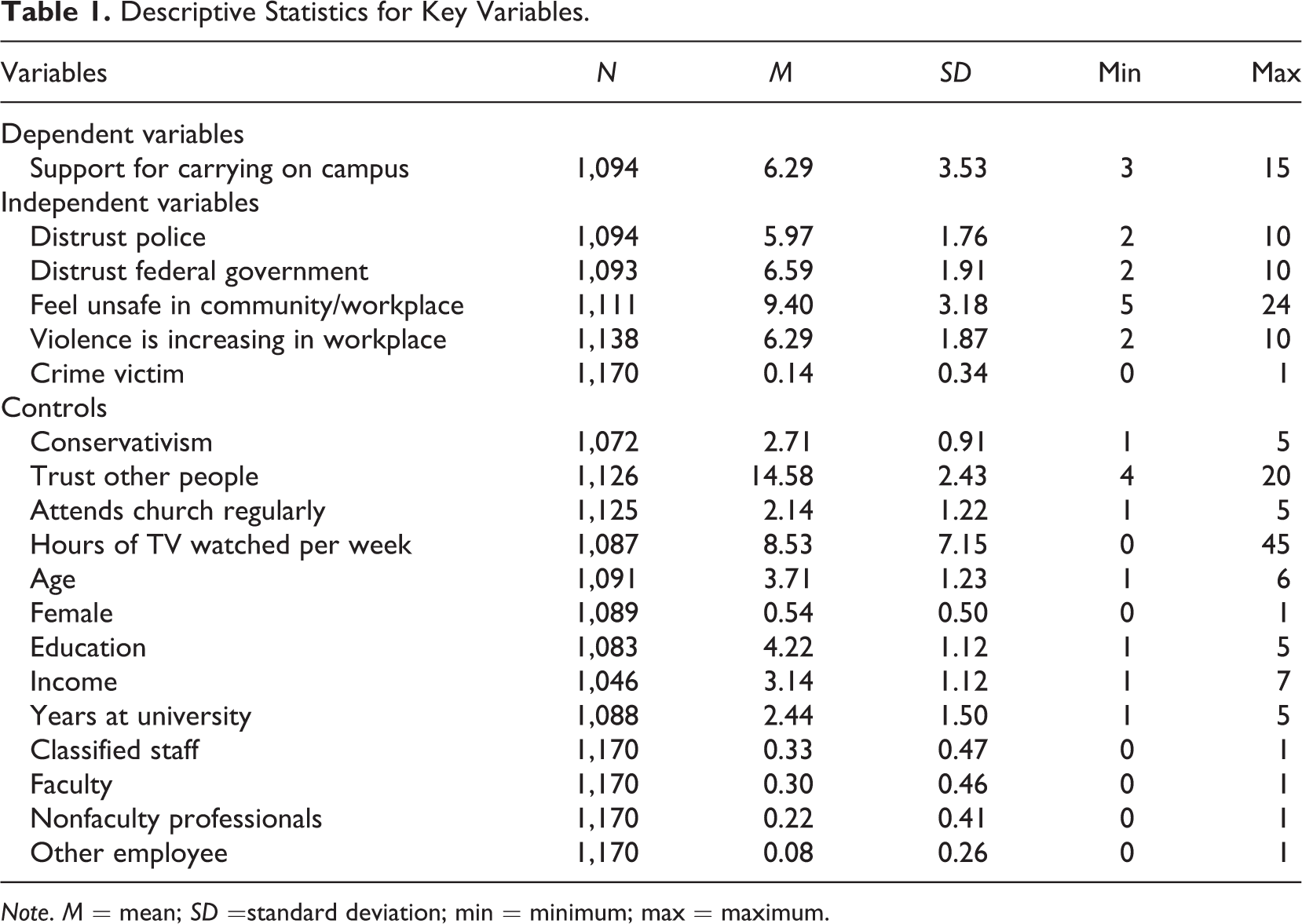
Note. M = mean; SD =standard deviation; min = minimum; max = maximum.
If we examine the study’s zero-order correlations (see Table 2), a number of variables were significantly related to support for concealed carry at the bivariate level. Those employees who reported higher levels of distrust in the police (r = .34, p < .001) and the federal government (r = .40, p < .001) were more likely to support concealed carry, as were respondents who attended church religious services regularly (r = .26, p < .001). Among the crime and violence variables, feeling unsafe in the community/workplace was not significantly related to support for concealed carry on campus. However, respondents who indicated they had been a crime victim were more likely to report support (r = .08, p < .05). Respondents who indicated they held a conservative political outlook were much more likely to indicate support for concealed firearms on campus (r = .52, p < .001), while those who reported trust in other people less likely to support concealed carry (r = −.13, p < .001). Finally, several of the background variables were also related to support for concealed carry at the bivariate level. Respondents who were older (r = −.13, p < .001), female (r = −.07, p < .05), had higher levels of education (r = −.27, p < .001), had higher incomes (r = −.24, p < .001), and had been at the university longer (r = −.10, p < .001), were less likely to support concealed carry. Job classification was also associated with support for concealed carry, with classified staff more likely to support concealed carry (r = .21, p < .001) and faculty less likely to indicate support (r = −.21, p < .001).
Correlation Coefficients for Variables Included in Multivariate Model.

*p < .05. **p < .01. ***p < .001 (significance levels).
Given the pattern of findings reported above, it is reasonable to ask whether those relationships persist once each of the independent variables and controls are entered simultaneously into a multivariate predictive model. Table 3 reports the unstandardized coefficients, standard errors, and standardized coefficients for an OLS model predicting support for the carrying of concealed firearms on college campuses (R 2 = .425). The results from the multivariate findings were similar to the pattern of findings observed at the bivariate level. Those reporting distrust in the police (β = .19) and federal government (β = .15) were more likely to support concealed carry, net of other factors. However, respondents who believed violence is increasing in the workplace/college campuses were less likely to support concealed carry on campus (β = −.07). Feeling unsafe in the community/workplace and being a crime victim were not significantly related to support for concealed carry on campus.
Predicting Support for Carrying Concealed Firearms on Campus.
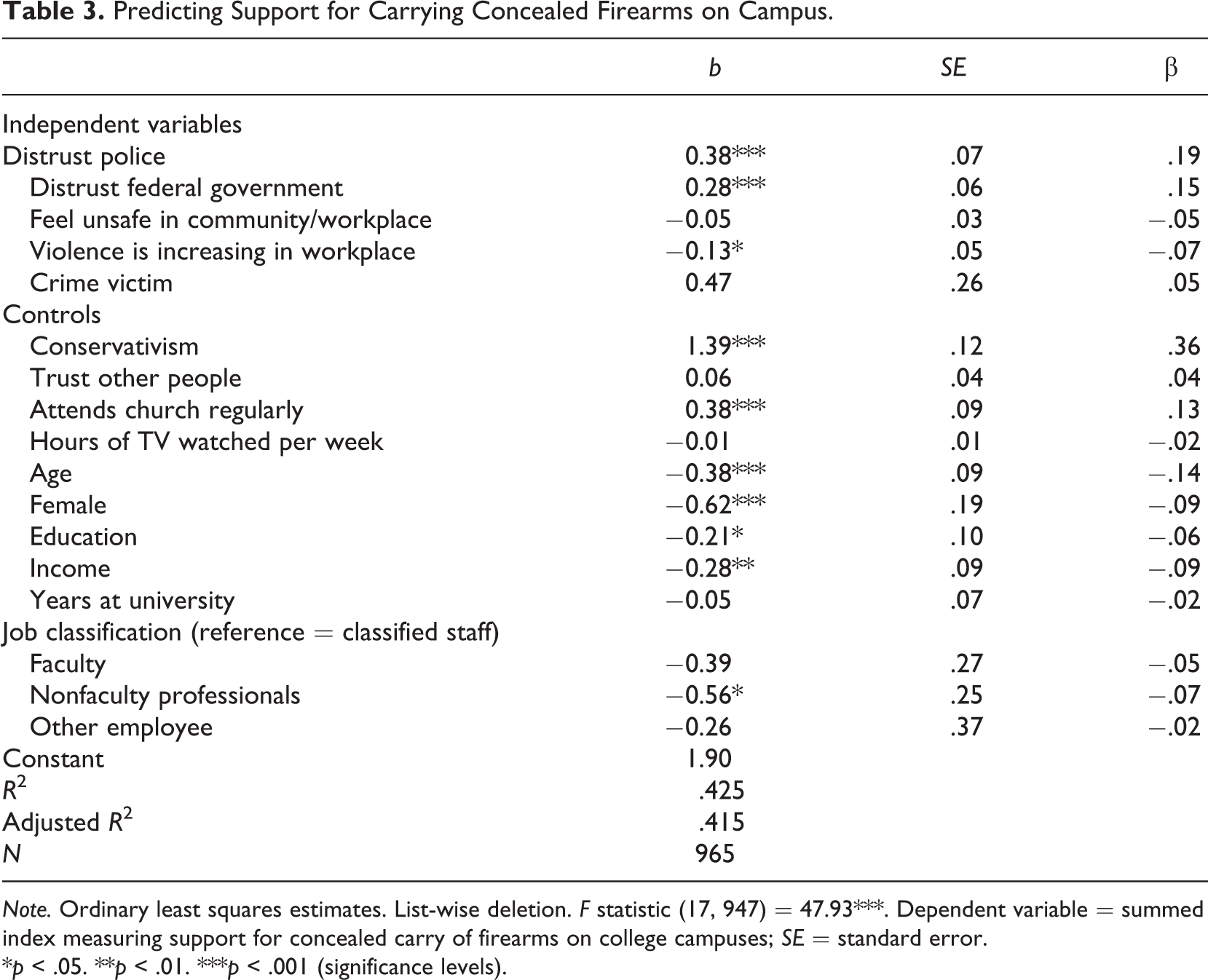
Note. Ordinary least squares estimates. List-wise deletion. F statistic (17, 947) = 47.93***. Dependent variable = summed index measuring support for concealed carry of firearms on college campuses; SE = standard error.
*p < .05. **p < .01. ***p < .001 (significance levels).
The patterns in association between the control variables and support for concealed carry were also similar across the bivariate and multivariate levels. Respondents who reported a conservative political outlook (β = .36) were much more likely to indicate support for concealed carry, as did with those who attended church regularly (β = .13). Individuals who were older, female, and had higher incomes were less likely to indicate support for concealed carry on campus, even after controlling for other important factors. The variables measuring hours of TV watched and trust in other people were not significantly related to attitudes toward conceal carry on campus in this model. In looking at the impact of job classification on support, nonfaculty professional staffs were less likely to support concealed carry than classified staffs (β = −.07). However, there was no statistically significant difference in attitudes between classified staff and faculty.
Discussion
The purpose of this research study was to explore the predictors of university employee attitudes toward the carrying of concealed firearms on campus, and especially whether the perceptions of collective security and fear of crime were related to support for campus carry. While a small body of research has explored the attitudes of university faculty (Bennett et al., 2012; Thompson, Price, Dake, & Teeple, 2013) and students (Brinker, 2008; Cavanaugh et al., 2012; Jang, Dierenfeldt, & Lee, 2014; Miller, Hemenway, & Wechsler, 1999, 2002; Thompson, Price, Dake, Teeple, Bassler, et al., 2013), we still know relatively little about the attitudes of university employees toward concealed carry on campus (Patten et al., 2013). This study attempts to bridge that gap and explores the predictors of attitudes toward campus carry among a sample of employees at one large rural Western university in the United States. Ultimately, the study addresses two key issues. First, does distrust in the police and/or the government to maintain collective security influence support for concealed firearms on campus? Second, does fear of crime influence support for concealed carry on campus, even after controlling for trust in the police and government?
In relation to our first research question, it is clear that respondent attitudes toward the police and government were strongly related to their support for allowing concealed firearms on campus. If respondents who reported believing the police could not be relied upon to keep them safe, then the respondents were more likely to indicate support for concealed carry on campus. Similarly, respondents who reported low levels of trust in the federal government were also more likely to report they supported allowing concealed firearms to be carried on campus. Overall, this finding is consistent with other research on attitudes toward firearms. Jiobu and Curry (2001) found that individuals who lacked confidence in the ability of government to ensure collective security were more likely to own firearms than individuals who reported higher levels of confidence in government. Similarly, Smith and Uchida (1988) found that individuals were more likely to purchase firearm or other weapons for self-defense when they believed local police services were ineffective. So, overall, this study provides some support for the collective security hypothesis and the argument that people may favor the adoption of self-protection strategies, such as carrying concealed firearms on campus, when they believe the police cannot protect them or their coworkers.
Our second research question focused on the potential relationship between crime victimization, reported fear of crime, and support for campus carry. In particular, some research has suggested that fear of crime, independent of trust in the police, may influence attitudes toward firearms (Kleck & Kovandzic, 2009; Daly, Rossi, & Wright, 1983). While the research in this area is mixed, people may be more likely to support concealed carry partly out of instrumental concerns regarding their safety and the safety of close family members. It is possible that people who fear mass shootings in their workplace or other kinds of criminal activity may favor concealed firearm carrying as a defensive strategy (Kleck, 1997; Kleck & Kovandzic, 2009). Our results, however, move in the opposite direction of what we might expect based on Kleck’s earlier research regarding fear of crime and attitudes toward concealed carrying. Employees who reported higher levels of fear of crime were less likely to indicate support for concealed carry on campus, even after controlling for perceived collective security (i.e., the perceived effectiveness of police and government for ensuring safety). Taken as a whole, this may indicate a number of things. First, the finding suggests fear of crime is not one of the central reasons individuals support concealed carry on campus, once you control for the other factors that may influence attitudes toward gun carrying. Put another way, these data seem to suggest fear of crime is not a strong motivator for those who support campus carry. Second, this finding also suggests that allowing concealed firearms to be carried on campus may actually cause employees who are already afraid of crime on campus to feel less safe. This finding is similar to the results of a several earlier studies of attitudes toward gun control which found that fear of crime tends to increase support for gun control (Dowler, 2002; Heath et al., 1997; Kahan & Braman, 2003; Robbers, 2005; Wozniak, 2015). Patten and his colleagues (2013) also found that allowing concealed firearms on campus tended to decrease perceptions of campus safety among faculty, staff, and students at two universities. This study’s results provide some support for the argument that allowing concealed firearms on campus may lower perceptions of campus safety among certain segments of the employee population. Of course, since these data are cross sectional, these data do not allow us to fully measure the impact campus carry may have on attitudes over time. So future research should seek to generate time-series data allowing for a deeper exploration of temporal associations between concealed carry and fear of crime on campus.
In addition, it is important to note these types of quantitative surveys may provide insufficient information to fully understand the contextual basis of people’s assessments of concealed carry and their relative safety from crime. It is likely that assessment of victimization risk and the relative benefits/drawbacks of increasing the number of guns on campus is more nuanced and contingent than is represented by these types of closed questions. For example, would employees who are fearful of crime be more likely to support increasing the number of guns on campus if individuals were required to undergo more extensive and rigorous training before they are granted a concealed carry permit? As a result, more research is needed before we can fully understand attitudes toward concealed carry and the impact that increasing the number of firearms on campus may have on employee fears relating to criminal violence.
In addition, a number of other background factors were strongly related to support for concealed carry. Specifically, a person’s self-reported church attendance and political orientation were also strongly related to support for campus carry. Respondents who reported holding a “conservative” political orientation were far more likely to indicate support for concealed carry than respondents who indicated a “liberal” political orientation. In fact, this relationship was one of the strongest in the multivariate model. Individuals who reported going to church frequently were also more likely to support campus carry. This finding is similar to the results observed in some early studies (Patten et al., 2013). Cavanaugh et al. (2012) observed students who indicated an affiliation with the Democratic Party were less comfortable with concealed handguns on campus than those who identified as Republicans. Bennett et al. (2012) also found a faculty member’s self-reported party affiliation was the strongest predictor of faculty attitudes toward concealed carry, with Republicans being significantly more likely to support laws allowing concealed firearms on college campuses and in churches. So while fear of crime and perceived collective security are important factors, this study’s results and the prior literature suggest support for campus carry is more strongly driven by broader ideological concerns. Put another way, respondents who support campus carry appear to be motivated more by political concerns and the symbolism that accompanies guns on campus rather than by any perceived risk of crime or violent victimization on campus.
While these findings are tentative, they do carry with them some potential policy implications for colleges/universities and local law enforcement, though the legislative environment in rural states may place important limits on the policy options open to campus leaders and police. Even though a limited body of research suggests that a majority of college and university officials, including presidents and police officers, oppose allowing firearms to be carried on campus (Bartula & Bowen, 2015; Price et al., 2014), there is little that officials can do to prevent the movement of more guns on to campus in the near term, particularly in rural Western states. Nonetheless, there are still a number of local policy options open to college/university leaders and police in relation to concealed carry on campus. First, campus administrators and local police in states that allow concealed carry on campus can work together to address some of the anxiety experienced by campus stakeholders by implementing or expanding outreach and training efforts around the legal and administrative rules governing concealed carry on college campuses. For example, additional training could be implemented that explores the laws governing the carrying of concealed carrying on colleges, identifies the differences between open and concealed carry, and offers strategies for how to respond when individuals are seen openly carrying a firearm on campus.
In addition, it is generally within the authority of college/university officials and campus police to develop local initiatives that may mitigate some of the common stakeholder fears relating to campus carry and potentially improve the campus community’s confidence and trust in competence of local law enforcement. For example, campus administrators and local law enforcement could enhance or expand a variety of existing campus safety measures and ensure that the additional safety steps are being effectively communicated to campus employees. Campus administrators might work with local law enforcement and security personnel to increase the visibility of foot patrols on campus. Additional steps could be taken to improve employee confidence in police and security personnel by conducting outreach around local law enforcement’s preparation and training for incidents involving active shooters on campus. Moreover, colleges and universities could also expand active shooter training to include faculty, staff, and students. Indeed, Price and colleagues (2014) recently reported that fewer than half of the college/university campuses in their study trained faculty or students on how to respond to an active shooter on campus. Finally, campus officials could seek to improve confidence by expanding and publicizing policy efforts that may facilitate early intervention by the police in firearm-related crimes on campus, such as the installation or expansion of closed-circuit television systems and the streamlining of processes for identifying and responding to potentially violent students, particularly when the carrying of a firearm might be involved.
A third area of policy development may focus on helping to ensure that concealed carry permit holders have the appropriate skills and training to safely carry and handle a firearm. For example, local law enforcement and/or campus security could work closely with university administration to develop and offer optional firearms safety classes for employees and students who hold permits to carry concealed firearms on campus. Recent research on the attitudes of university presidents found that a majority wanted concealed carry permits holders to receive more training than generally required by law (Price et al., 2014). It is likely that at least some of the opposition to concealed carry on campus results from employee skepticism regarding the firearm-related skills, experience, and accuracy of permit holders. While university officials may not be able to require individuals with a state issued concealed carry permit to take additional safety classes, offering optional firearm safety classes might improve the individual skills of permit holders, reduce the likelihood of accidental shootings, and deepen their understanding of the civil liability that may accompany the discharge of a firearm on campus (e.g., an accidental discharge or attempted shooting of an armed suspect that injures a bystander). Encouraging permit holders to undergo additional training may also serve to improve the confidence that noncarrying employees have in the firearm-related skills of permit holders. It may also serve to demonstrate that campus leaders and local law enforcement are doing everything within their power to mitigate the potential risks associated with increasing the number of firearms on college and university campuses.
Limitations and Conclusion
It is important to note that while this research makes an important contribution to the literature on concealed firearms on campus, it does have a number of limitations. First, the survey data reported here only measure attitudes at one point in time, which creates several difficulties when it comes to drawing conclusions. Since the data are cross-sectional, we are prevented from drawing conclusions about the causal order among the variables. Second, the survey data were collected not long after a state-level legislative change was enacted which expanded the ability of individuals to carry concealed firearms on campus. It is possible that the implementation of the law influenced community attitudes toward concealed carry, though our data do not allow us to account for that potential influence since it lacks a pre–post design. Third, these survey data were collected in relation to an issue of public controversy, which raises the possibility of nonresponse bias (Dillman, Smythe, & Christian, 2008; Fowler, 2013; Wells, Cavanaugh, Bouffard, & Noble, 2012). Employees who chose to respond to the survey may have felt more strongly about the issue of guns on campus (either for or against) than employees who chose not to respond. For example, Wells, Cavanaugh, Bouffard, and Noble (2012) found that students who responded to a web-based survey about guns on campus tended to report more extreme views than students who completed in-class surveys on the same subject. The distributions in employee responses to the survey items for this study did not definitively suggest a problem with nonresponse bias. However, this type of bias can be difficult to detect. Thus, some caution should be used when drawing inferences about the representativeness of the sample. Finally, this study was administered at one university in a rural Western state. It is unclear whether the pattern in attitudes observed in this study reflects the attitudes of employees at other universities. Future studies should explore patterns in respondent attitudes across multiple states.
Even though this study has several limitations, it raises a number of important issues which should be addressed through future research. It is unclear whether the predictors of support for concealed carry we observed in this study are useful for understanding broader patterns in support for concealed carry in relation to other public locations. Do members of the public actively distinguish between the value of having concealed firearms on campus versus concealed firearms in parks, churches, and other government building? Moreover, do the public and university employees think about concealed carry in the same way they do about the open carrying of firearms? While college campuses are unique social environments, it is still an open question as to whether university employees, as well as the broader public, think that the concealed carrying of firearms should be restricted at higher levels on college campuses (as compared to other public places) or just restricted more generally. Perhaps more importantly, more work needs to be done to explore the discrete impact liberalized gun-carrying laws are having on the work lives of university employees. Campus stakeholders are often not consulted in a meaningful way by legislators when they weigh whether to allow concealed firearms on campus. However, university employees often have to deal with both the intended and unintended consequences of legislative policy-making around concealed firearms. As a result, more research is needed to understand how university employees are adapting to the changing policy environment around guns and higher education in the United States.
An early version of this article was presented at the Annual Meeting of the American Society of Criminology (Washington, DC, November 21, 2015).
Footnotes
Acknowledgment
The authors would like to thank Dr. Jackie Schildkraut for her helpful research assistance in the early stages of this project.
Declaration of Conflicting Interests
The authors declared no potential conflicts of interest with respect to the research, authorship, and/or publication of this article.
Funding
The authors received no financial support for the research, authorship, and/or publication of this article.