



Abstract
This exploratory, qualitative research study examined the attitudes and barriers police officers identified in successful implementation of the lethality assessment protocol (LAP), a collaborative intervention between police departments and domestic violence advocacy agencies in the state of Connecticut. Focus groups were conducted at three police departments to ascertain officers’ perceptions of the LAP. Officers (N = 22) were recruited through an individual contact at each department. Responses to focus group questions indicated both system-wide and individual police department barriers. Results showed officers generally support the protocol and believe it has beneficial intent and purpose. Obstructions identified include timing of the implementation, lack of victim cooperation, and agency culture. Implementation barriers and officers’ attitudes are discussed.
Domestic violence (DV) and intimate partner violence (IPV) remain a serious problem in the United States and abroad despite increasing public awareness and criminal justice response. The most recent data, from the 2011 National Intimate Partner and Sexual Violence Survey, indicate that over 10 million women and men in the United States experience physical violence each year by a current or former intimate partner (Breiding et al., 2014).
DV is a pervasive social issue requiring a comprehensive response from agencies across various sectors (Hines & Malley-Morrison, 2005; Messing, Campbell, Wilson, Brown, & Patchell, 2015). Professionals are recognizing that how communities respond to DV directly impacts each victim’s safety and well-being. Approximately four decades of research on DV has captured the knowledge and experience of victims, practitioners, advocates, and academic researchers, in order to create policy initiatives, guide legislative activities, develop standards and protocols, and enhance protection and intervention strategies for victims (Sheehan, Murphy, Moynihan, Dudley-Fennessey, & Stapleton, 2014).
The current study examined police officers’ attitudes and perceptions of the lethality assessment protocol (LAP), a new intervention utilized by law enforcement officers when responding to DV calls. While several different interventions have been implemented throughout the last two decades, LAP is the newest addition being utilized by police at the scene of the incident. Although previous risk assessments have been designed for use with first responders, the LAP is the first risk assessment created for first responders that asks questions only of the victim of violence, is designed to predict severe violence/homicide risk, and is intended to maximize sensitivity when responding to these types of calls (Messings et al., 2015). Many states have experienced great success with LAP implementation. The success of LAP has been evidenced by decreased rates of intimate partner homicide, increased rates of victims seeking and participating in DV services, and stronger collaborative efforts between law enforcement and local DV agencies (Klein, 2012).
Maryland has had a high success rate in employing this LAP model. In 2014, Maryland law enforcement officers identified 5,599 high-danger victims through the LAP. Of these, 2,841 (51%) immediately spoke with a DV advocate. Of those, 1,391 (49%) took part in additional program services provided through the agency (Maryland Network Against Domestic Violence [MNADV], 2015). Other law enforcement agencies throughout the United States have also experienced success in employing the LAP: Kansas City, Missouri; Anoka County, Minnesota; and New York City, to name just a few.
Police officers are tasked with the responsibility of intervening in DV incidents, providing the victim with safety and resources, keeping the peace, and enforcing the law. And it is apparent that general police attitudes and beliefs about DV are likely to influence their response to these calls. Only recently have there been studies focusing on law enforcements’ perceptions and attitudes regarding DV (Gover, Paul, & Dodge, 2011; Ruff, 2012). The successful implementation of LAP is truly dependent upon how the victims respond to the police officer’s initial contact, how officers’ introduce LAP to victims, and how effectively officers’ work in collaboration with the DV agency within their jurisdiction. This study specifically looks at the responding officers’ attitudes and perceptions regarding LAP and what factors, if any, have contributed to their viewpoints.
Literature Review
Law Enforcement and DV
The extensive literature on the subject of DV has created a context for social policy initiatives as they attempt to tackle this pervasive societal issue (Messing et al., 2016). Moreover, while it is obvious DV needs to be addressed at all levels of society, none may be more important than the role of the responding police officer (Klein, 2012). The early trends of the 1980s showed that the arrest of an abuser significantly reduced repeated incidents of abuse, compared to interventions using medication and counseling (Radatz & Wright, 2016). However, this method was only found to be successful when the victim made reports of the abuse to law enforcement (Eke, Hilton, Harris, Rice, & Houghton, 2011). Mandatory arrest policies resulted in dual arrests, where both victims and perpetrators were arrested even though the victims were simply trying to protect themselves. Dual arrests became the norm in many jurisdictions, and poor training and the inability of the responding officers to identify the primary aggressors emerged as target problems with this intervention (Ruff, 2012).
The 1990s heralded interventions, such as dedicated DV law enforcement units within the criminal justice system, becoming the standard protocol. Dedicated law enforcement units worked directly with specialized court dockets to provide a more comprehensive approach to keep victims safe and offenders accountable resulting in a 50% decrease in subsequent offenses (Messing, Ward-Lasher, Thaller, & Bagwell-Gray, 2015).
It is important to examine officers’ attitudes about DV and DV interventions for several reasons. Researchers have noted that law enforcement officers view their work as being stressful and report frustration, especially when responding to DV calls. These feelings may lead to officers not giving the needed attention to new protocols and, thereby, hindering implementation. Also, scholars have noted that there is a void in the literature in terms of studies that document law enforcement officer perceptions of DV in general (Grover, Paul, Dodge, 2011; Logan, Shannon, & Walker, 2006; Ruff, 2012). This study aims for a comprehensive examination of our first responder’s thoughts and feelings related to the LAP.
Besides training police to foster more helpful attitudes toward DV calls, and therefore improve interactions with the victims, lethality assessments also have a key role to play in assisting victims to understand the risks associated with their relationships. This intervention tool may then contribute to a long-term reduction of repeat DV calls and to DV incidents overall.
LAP
The LAP model developed by the MNADV in 2005 was employed to provide victims with more timely intervention and connection to services. LAP is an innovative model designed to assist trained law enforcement officers on the scene of a DV incident to identify victims at the greatest risk of being seriously injured or killed by their intimate partners and to more effectively link them with a local DV agency to receive services. The process is straightforward and begins when an officer arrives at the scene of a DV incident. Officers are trained to use the LAP near the end of an investigation involving a past or current intimate relationship and when there is a manifestation of danger defined by the presence of at least one of the following criteria: (a) the officer believes an assault or other violent act has occurred, whether or not probable cause exists for arrest, (b) the officer is concerned for the safety and well-being of the victim once they leave the scene of the incident, (c) the officer is responding to a repeat call from a victim or location where DV has occurred in the past, or (d) the officer has a “gut feeling” that the victim is in danger (Campbell, Webster, & Glass, 2009). If the victim’s responses put him or her in the high-risk category, the officer places a call to the local DV 24-hr hotline and encourages the victim to speak with the advocate. The advocate can then provide the victim with service information, education, and emergency shelter if needed.
Adoption of lethality assessment programs is on the rise in police departments (as of 2015, jurisdictions in 34 states are implementing the LAP), requiring police officers responding to an incident of IPV to work with the victims to determine their risk for death (Klein, 2012). The program implemented in the state of Connecticut is a result of a collaboration between the Connecticut Coalition Against Domestic Violence [CCADV] and the Connecticut Police Officer Standards and Training Council (POSTC). The program was piloted through 8 CCADV member DV service agencies with 14 municipal law enforcement agencies. As of December 2015, the program has been expanded to include 17 CCADV member programs and 72 police departments, including the Connecticut State Police.
The LAP emerged through pioneering research conducted by Jacquelyn Campbell in 1986 and the development of what is known as the danger assessment (DA; Campbell, 2005). The initial 20 items on the DA were developed from the authors’ and others’ retrospective research studies of intimate partner homicide or serious injury from IPV (Berk, Berk, Loseke, & Rauma, 1983; Browne, 1987; Campbell, 1981) and from input provided by abused women in shelters (Stuart & Campbell, 1989). Then, the original 20-item questionnaire was revised as a result of a case–control study in 12 cities (Campbell et al., 2003). Through the interpretation of data, the LAP was then reduced to 11 items and divided into two parts. In this revised version, if the victims respond yes to the first three questions, they are considered to be at high risk for lethality. However, if the victims answer no to the first three questions, but answer positively to four or more of the remaining eight questions, they are also considered high risk.
Researchers found that only 4% of DV victims who were killed by their partners accessed services through DV agencies prior to their deaths. Research also shows that a little over half of women who survived serious murder attempts by their abusers did not realize the lethal jeopardy they were facing before such attempts occurred (Klein, 2012). Many victims of DV, especially those who have been severely abused, are acutely aware of the possibility of homicide but have difficulty assessing their degree of risk (Salari & Sillito, 2016; Sharps, Campbell, Campbell, Gary, & Webster, 2001; Stuart & Campbell, 1989). Explanations for this include possibly attempting to maintain a “normal” life and/or the cumulative effects of trauma on memory or the ability to discern danger (Campbell, 1995; Dutton, 1996).
Diffusion of Innovations Theory
Diffusion research centers on the conditions that increase or decrease the likelihood that a new idea, or practice will be adopted by members of a given culture or context. Diffusion of innovation theory predicts that interpersonal contacts provide information that can influence opinion and judgment. Studying how innovation occurs, Rogers (2003) argued that it consists of four stages: (1) invention, (2) diffusion (or communication) through the social system, (3) time, and (4) consequences. The nature of networks and the roles opinion leaders play determines the likelihood that the innovation will be adopted.
In the case of the LAP as the innovation, diffusion, or communication from higher ranking officers to the lower ranking officers sets the tone of importance and precedence of the protocol. In other words, those officers who are on the front lines will take their cues regarding the intervention from the leadership. If these cues or diffusion is not positive, officers may not see the importance of the innovation and limit its success. Consequences of poor diffusion can include a lack of desire to implement the protocol or incorrect implementation of the protocol and can ultimately impact victim safety.
Furthermore, diffusion can spread from one jurisdiction to another or in the case of LAP, from one police department to another. This type of diffusion can aid in (or hinder) the implementation of the LAP on a state-wide level. Departments that value the intervention can result in each officer successfully intervening with victims on DV calls. Poor diffusion, or devaluing the innovation, can negatively impact how officers view the level of importance of the LAP thereby eroding a successful implementation of the protocol. Diffusion of innovations theory addresses organizational readiness as well as organizational fit, advocacy and supports for adoption of the innovation (Greenhalgh et al., 2005). In this context, the strong connection can be witnessed between police department culture/climate and officer buy in, or support, for the adoption of and implementation of LAP.
The Current Study
The purpose of the study was to explore the attitudes and perceptions of law enforcement officers with regard to their utilization of LAP. The researchers sought to document police officers’ thoughts on the protocol and how they responded to the introduction of LAP in their departments and did this introduction include proper training and emphasis on the importance of the protocol. The researchers hypothesized that law enforcement officers would appreciate the benefit of LAP utilization and, therefore, be invested in LAP implementation.
The current exploratory study aims to answer the following research questions: What barriers, if any, impact the successful implementation of LAP and coordination of DV services for victims of DV? What are the perceptions and attitudes of law enforcement officers utilizing LAP on their DV calls?
Method
This research study, part of a larger study being conducted in Connecticut, focuses on police officers’ attitudes and perceived barriers regarding implementation of the LAP adopted by their departments. Qualitative inquiry provides the method for exploring a new trend in law enforcement efforts combating DV homicides.
Sample
Convenience sampling was employed in this study. The researchers sent out e-mails to a variety of police departments throughout the state. The first three departments to contact the researcher became the first group studied in phase one of this larger research study. Due to time constraints and the lengthy approval process with the police departments, the first three police departments to respond were used in this study. The specific participants from within the departments were recruited via LAP liaisons. The researchers and liaisons coordinated dates and times for focus groups to be conducted. On these days, available officers were recruited by the LAP liaisons to participate in the study. According to research protocol, the researchers were unaware of who was participating in the focus groups until the day of the meeting.
Although a convenience sampling method limits the transferability or the ability to generalize to the larger population regarding police attitudes and perceived barriers regarding LAP implementation, it does offer initial findings at this exploratory stage. Issues for consideration in evaluating threats to validity would include self-selection bias especially for those police officers who have particularly strong views either for or against LAP.
Grounded theory served as the catalyst to derive an abstract theory of the LAP process through the eyes of the participants. This process involves utilizing multiple stages of data collection and the refinement and interrelationship of categories of information (Straus & Corbin, 1998). In this explorative study, several themes emerged: (1) barriers to implementation, (2) training, (3) department culture/climate, and (4) length of service.
The first phase of the study consisted of a total of 22 officers participating in focus groups at three different police departments. Table 1 provides demographics of the three towns participating in this phase of the study, number of police officers in each town, demographics on the participating officers, and statistics on each department’s lethality assessment screens.
Demographics and Lethality Assessment Protocol Statistics for 2015.
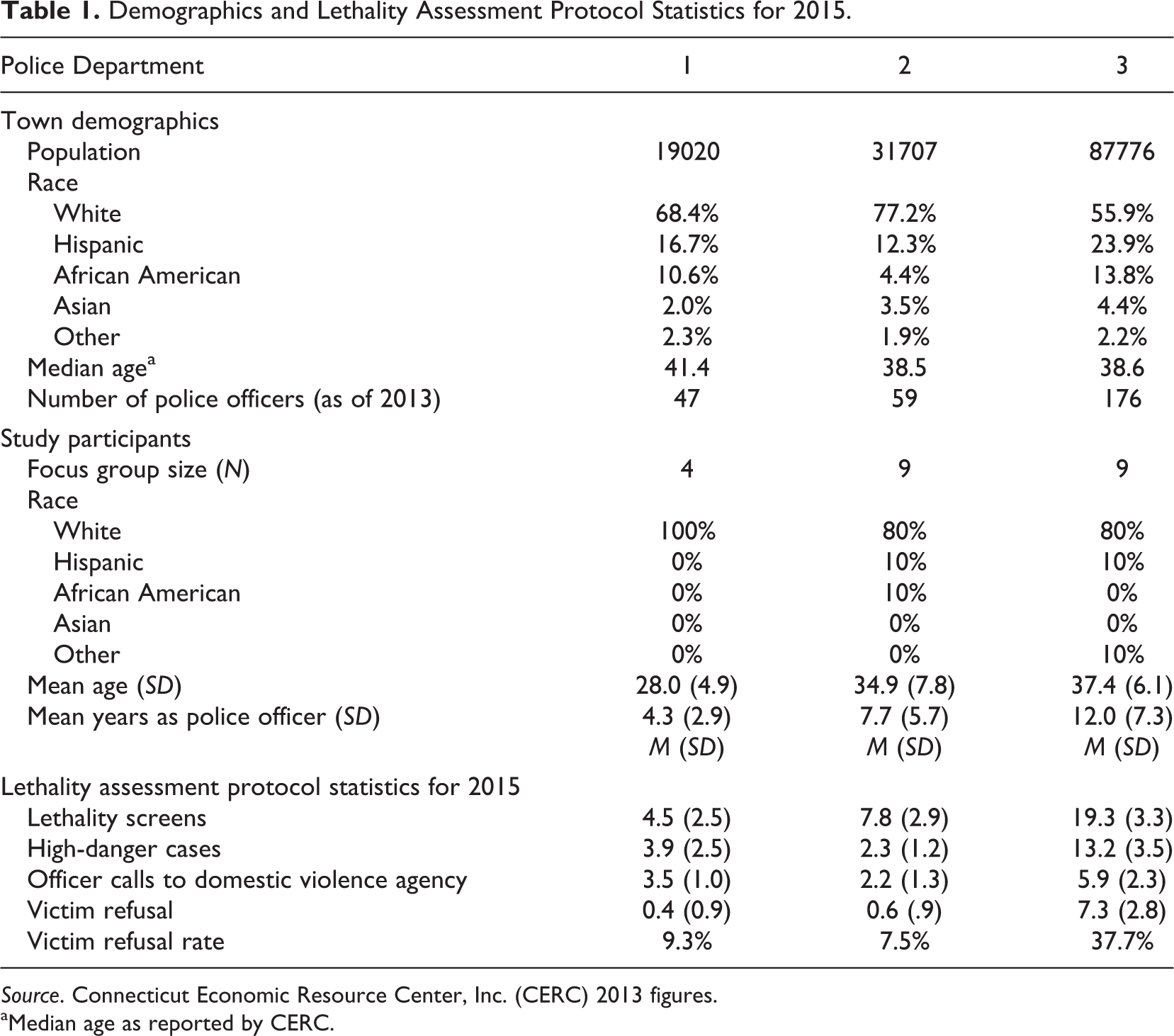
Source. Connecticut Economic Resource Center, Inc. (CERC) 2013 figures.
aMedian age as reported by CERC.
Data Collection
The informed consent document was presented in written form and its purpose was discussed orally with each participant prior to the facilitation of each focus group. It was important to let the participants know that their participation was voluntary and they were free to leave or not answer any of the questions being presented. Focus groups lasted approximately 30–90 min. In addition, the participants were informed that with their permission the interviews would be audio recorded, allowing dialogue to be analyzed verbatim. The researchers stressed the study’s commitment to confidentiality and to safety within the group and informed the subjects multiple times that all information shared would not be specifically identifiable to them or their department.
The focus groups were an interactive platform for obtaining information necessary to explore the officers’ experiences during the time of the LAP implementation, as well as their thoughts regarding LAP in general. Focus groups were conducted during a 4-month period of time between September and December 2015.
Data Analysis
The data analysis was completed through a course of steps applying the van Kaam’s method of analysis by Moustakas (1994). Each step represents part of the journey taken to gain a better understanding of the lived experiences of police officers and the work they do with DV victims.
The first step in the analysis process included manually transcribing the audio-recorded focus groups. Next, the demographic information obtained through the questionnaire was compiled and highlighted in Table 1. Step 3 was manual analysis of the data. Horizonalization permitted the researchers to identify every horizon or statement that is relevant to the topic of question as having equal value (Moustakas, 1994). This process of highlighting horizons in the interview transcripts allows connections to the specific research questions under study. As themes emerged during the data collection and ultimately data analysis, it was determined that saturation had been met. Finally, throughout the last stage of the analysis process, the individual textural and structural descriptions were integrated into a narrative. The narrative included a synthesis of the meaning and essence of the experiences within the phenomenon.
Participant Coding
The protection of participants’ anonymity, privacy, and security was accomplished through the use of coded designators, which were assigned to each department and each participant for the duration of the research study. Each department was given one of the following codes: PD1, PD2, or PD3. Each participant was then designated a code which included their police department (i.e., PD1, PD2, or PD3) and a number (i.e., PD1-1 for police department 1 participant 1). The assigned coded designators remained static for each subject throughout the data collection and analysis process. None of the actual participants expressed concerns about the security of their personal identifying information, nor did they decline any interview questions or terminate participation at any time.
Findings
Provided in the summary below are textual descriptions supporting the themes. To capture the essence of each focus group, the topics resulting from the open-ended questions are detailed below. Table 1 highlights the number of LAP screens conducted by each department in 2015, the number of victims who screened-in as high danger, and, of those high-danger victims, how many calls were made by officers to the DV hotline, as well as the number of victims who refused to respond to the LAP questionnaire. Table 2 presents the emergent themes derived from the participants involved in the focus groups, as well as the thematic definitions.
Themes and Definitions.
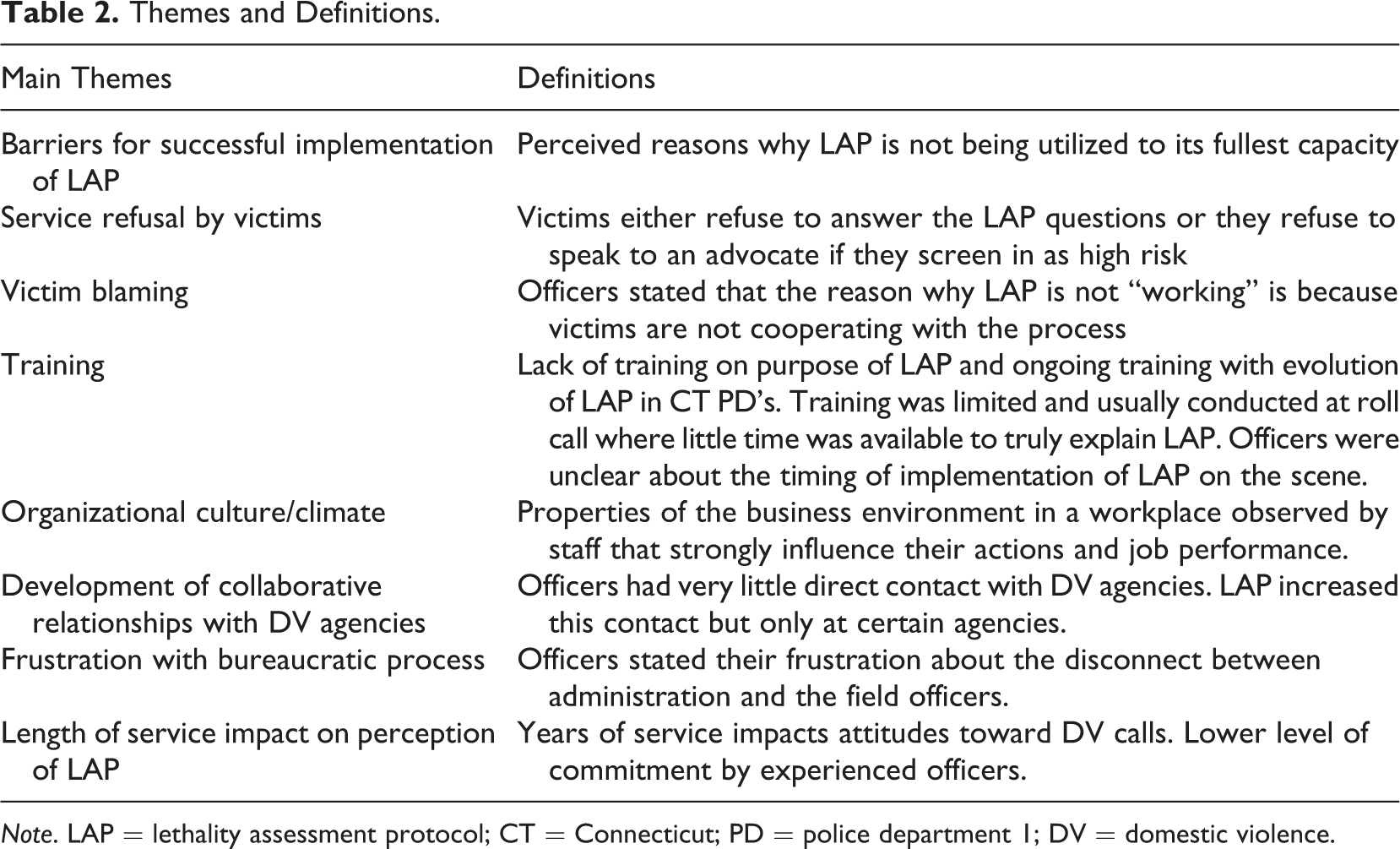
Note. LAP = lethality assessment protocol; CT = Connecticut; PD = police department 1; DV = domestic violence.
Themes Shared Between Police Officers
Theme 1: Barriers to successful implementation of the LAP
Police officers shared their perceptions of why they believe LAP is not being used effectively. From this discussion, two subthemes emerged: (1) service refusal by victims and (2) victim blaming. Both subthemes demonstrated the same amount of expressed officer frustration. All three of the participating police agencies mentioned this theme and its subthemes. Throughout the focus groups, the discussion centered a total of 80 times on the perceived barriers officers identified as reasons for their struggle with successful implementation of the LAP. PD1 participants commented 24 times (12 times in each subtheme), PD2 participants only mentioned this theme 11 times (7 times for Subtheme 1 and 4 times in Subtheme 2), and PD3 referenced it an impressive 49 times throughout the discussion (24 times for Subtheme 1 and 25 times for Subtheme 2).
Subtheme 1: Service refusal by victims
Officers expressed their frustrations regarding the number of victims who either took part in the LAP screen but refused to speak with an advocate or would not even participate in the screening from the onset. Many officers found the concept of the LAP to be beneficial; however, some did not believe there to be any actual benefit due to lack of victim cooperation.
A participant at PD2 expressed extreme aggravation regarding repeat victims who refuse to undergo the screening. Well, I think it’s frustrating when you’re going to the same house for a legitimate victim, you know we’re going to make an arrest. It becomes frustrating that the victim is in there refusing to screen in, refusing to talk to someone, refusing to get help, that is what becomes most frustrating because you’re just going back to the same thing over and over again. With DV you still have the quintessential relationship where, “I don’t want him arrested, it was my fault” and that is a clear-cut case for the form, then you have the other ones where wives don’t think this is abnormal, they think being beaten and controlled is totally normal and that is also quintessential for the form. So using it in the first instance sometimes I give the disclaimer and I get two or three questions, then they realize that this is probably going to screw over their husband and so they don’t want to answer any more questions.
Subtheme 2: Victim blaming
As PD3 continued their conversation regarding service refusal by victims, Subtheme 2 emerged—specifically, how officers often blame the victims for not wanting help and refusing to complete the LAP. Several participants had issues with how the victims often responded to the officers when they arrived at the scene of the call. Frequently, they felt the victim was truly a barrier to utilizing the LAP. A PD3 officer supported this notion, stating: It’s pointless to ask the questions on the LAP if they [victims] don’t want to speak with an advocate because you’re just letting us know what’s what, and you’re not getting the help you need. LAP is only useful if the victim wants to take the help. If they [victims] don’t want to take the help, there’s really nothing much else we can do, unless they want the help.
Theme 2: Training
With any new initiative, training is critical for successful implementation. Emphasis on proper implementation and understanding the purpose of the LAP may help provide officers with a better appreciation for the tool and how beneficial the use of it can be. Furthermore, the researchers examined the officers’ comprehension of the dynamics associated with DV victims and offender characteristics as well as the officers’ own role regarding the LAP implementation.
Officers interviewed in this study stated that they all received adequate training, primarily during roll call. A small number of officers stated that they were instructed at an outside agency in a train-the-trainer type program. These officers were then responsible to bring that material back to their departments and educate their fellow officers, which usually occurred during roll call. Training was mentioned a total of 24 times in the three focus groups. PD1 discussed it 7 times, while PD2 only one time. However, PD3 had significant issues with training, discussing the topic 16 times throughout the focus group.
A PD3 contributor spoke about the quick roll call training and feeling forced into utilizing the tool without any real notice. A lot of our training usually takes place in roll call before we go out on the road. My training came when I did my recertification class, and we were doing domestic violence and they talked about the lethality assessment there. That’s where most of my training came from about this. Up until then, the sergeant would just read through the form and described what was on it and he would just tell us that we had to do it. I never really knew much about it until I went to recert training.
Further examination of this topic was illustrated by a participant from PD3 who described the difficulties of initially presenting oneself as a police officer and then transitioning to the functions of a social worker: That’s what I mean, what we’re there for in our situation, making an arrest and putting our hands on people sometimes during a fight, those types of situations, and then all of a sudden you have to turn around and put a different mask on and change the aspect. I don’t think they [victims] are ready for that at that time. They see us as coming in as the cops making the arrest and doing the criminal stuff and all of a sudden you’re asking personal questions and most of the time they’re like ‘I don’t want to do that, just leave me alone’; they’re distraught in these situations. We’re coming from a different aspect of it; those kinds of questions a person more like a social worker could talk to the person about it and get more information. You’re talking about heartstring kind of things where you got to sit down and get involved with that type of stuff. They see us as just coming to make an arrest and that’s kind of what you’re dealing with when you first walk into a hot situation or somebody is getting hurt. They don’t want to get personal with us.
Theme 3: Organizational climate/culture
The third theme that emerged through the focus group data was organizational climate. Throughout the discussions at the three police departments, organizational climate or culture was mentioned at PD1 13 times, PD2 only 4 times, and PD3 17 times, for a total frequency throughout the study of 35 times. This issue was then broken down into two subthemes: (1) frustration with bureaucratic processes, which was mentioned by PD1 3 times, PD2 1 time, and PD3 8 times and (2) development of collaborative relationships with DV agencies, which was mentioned by PD1 and PD3 each 10 times and PD2 3 times.
Subtheme 1: Frustration with bureaucratic process
While the components of culture are difficult to measure and even harder for people to articulate, they are real and have to be managed as part of the process of changing the organization. Climate can be measured with relative precision, and a variety of factors determine the climate of the organization. Participants in this study provided textural descriptions of their experience with both components of the theme. The aspect of officers feeling forced into employing the tool was prevalent in this theme.
One of the PD3 participants stated there was a feeling of detachment: There is a disconnect from upper management to patrol officers. I think the way things are fed to us gives officers a bad taste in their mouth. There was no ‘hey guys, what do you think of this?’ It was more like ‘Ok, you guys are going to be doing this from now on,’ you know, and there’s a sense of resentment, like my input is not valued. There’s a complete disconnect! I’ve personally experienced it, the word around is there is a complete disconnect but it was the same at another department I worked at. It’s the way it is, nobody’s ever happy, if you’re not complaining then something’s really wrong! Everyone thinks they have it so much harder than those who came before so they’re always going to be like, ‘oh well if they were a cop in my day…’ they don’t really know man, just come to work, take your calls and go home!
Subtheme 2: Development of collaborative relationships with DV agencies
Furthermore, the LAP was designed to enhance an officer’s relationship with their local DV agency. While some officers professed a good relationship with their agency, others had very little interaction, some had negative interactions, and still others had no more relations than they had prior to the implementation of the LAP.
Describing a specific incident where no one answered the DV agency hotline, this PD3 participant said: It was during a weekend on a Sunday and I kept calling the hotline number and no one answered. I tried several times and I then gave the victim the number as well, along with my card and a victim services card in case they felt as though they were in danger. That was my first dealings with the agency, so it wasn’t a very pleasant one. I don’t have a contact person or someone I can go to when I have a victim who needs something other than the hotline number, which at times no one answers. Honestly, I haven’t really dealt with them [advocates] that much. Unless the victim or any party talks to them, I don’t really deal with them, ya know? But the few experiences I have had, it seems like we are on a slightly different page than them [agency]. No one seems to want to put the effort into taking the time on the phone to speak with the victims. They go through the questions again, but maybe if they seemed caring, they would reach a victim better.
Theme 4: Length of officer service on the job and the impact on perception of the LAP
There seems to be a strong connection between officers who have been in the field for a significant period of time (10+ years) and their negative perception of the LAP. Twelve total times this theme was referenced during the focus groups. PD1 only spoke about this theme 1 time, PD2 mentioned it 3 times, and PD3 brought it up 8 times.
Several studies (Daley, 1979; Sowers-Hoag & Thyer, 1987; Zastrwo, 1984) have indicated that workers in a protective service, in particular, are susceptible to emotional burnout. This theme demonstrated tremendous textural descriptions of burnout which paralleled themselves to the officer’s length of service and their perception of a new concept, the LAP.
PD3 participants addressed this topic the most during their focus group. One contributor opened up the dialogue with the following: As for the newer guys coming in, like when I came on, things that were new for the newer guys we accepted it because it’s part of it. But for the older guys who have been on the job for a while, it’s [LAP] kind of cumbersome, it’s like more for them to do. Overwhelmed with paperwork! We hear about it all of the time! I think the negative attitude in general is developed over the years. They probably become a little more jaded or just miserable, that could be a portion of it. Ummm, I think the older guys have more issues with LAP because years of service we are doing this, then you change it to this, it’s kinda like just another thing pushed on us to complete.
Limitations
This research has several methodological limitations—the first being the use of convenience sampling. The sample was not random, nor representative. Utilizing a larger random sample could provide greater generalizability. Secondly, the use of focus groups may have impeded participant honesty while responding to the posed questions. Conducting individual interviews can provide a more confidential environment which would be more conducive for such personal discussions. Furthermore, while this study is part of a multiphase study, department demographics and location were not taken into consideration as well as any biases held by participants regarding LAP. Location is a key factor as it directly correlates to the DV agency that works with each police department. The analysis may have presented different themes if all departments with similar descriptors and locations were compared.
Given these limitations, more extensive research needs to be conducted to get an accurate and comprehensive depiction of officers’ perceived barriers and attitudes regarding the LAP. Validity procedures that include triangulation and prolonged engagement and observation would offer rigor in terms of the findings (Guba & Lincoln, 1981; Lub, 2015).
Discussion
Police officers work in a dangerous, intensive environment where research is not a priority. Yet, when police departments partner with the research community, the highly beneficial outcomes can include the development of areas of further investigation and better resources and best practice sharing across disciplines (Ruff, 2012). The current study revealed that officers were concerned about DV and the LAP and felt both need to be investigated further beyond the statistical data already being collected. While these statistics (e.g., number of LAP screens, calls to DV agencies, and number of victims who speak to an advocate) are very important, hearing from the individuals who are actually implementing this tool can prove even more valuable to the future success of the LAP.
The findings of this study highlight several areas of concern including (1) more training is necessary to provide officers with a better understanding of the LAP, as well as DV itself, and (2) it is imperative to build stronger relationships between law enforcement and the local DV agencies. Findings also indicate that department culture/climate needs to be addressed. The disconnect between managerial and officer acceptance of the need and purpose of the LAP leads to an adverse work environment, frustrations, and negative attitudes. Subsequently, these attitudes impact the officers’ successful service delivery with DV victims.
Training
Although the officers have been instructed on the use of the LAP via department protocol for responding to DV calls, this study found that further, more thorough, training is needed. Many officers could identify the general purpose of the LAP: providing victims with direct contact to an advocate and future services: decreasing the victims’ risk of being seriously physically hurt or killed by their intimate partner. However, most did not understand the magnitude of their role providing the bridge between the victim and the DV agency.
The majority of the training conducted by the departments (and reviewed in this phase of the study) were quick, roll call situations. These “trainings,” also known as briefings, are a maximum of 15 min long. Besides the obvious brevity of these trainings, the environment is often very chaotic. Only a few officers and the LAP coordinator at each department took part in a full LAP training. This roll call method of training sends the message that the LAP may not be very significant. Many officers explained how a sergeant simply handed out the LAP form and told the officers how to complete it, why it was being required (i.e., the chief mandated it), and who their LAP coordinator would be. Although the purpose of the LAP might have been discussed, only a brief rationale was provided leaving officers with inconsistent information. Without a reasonable dialogue about the importance and prior success of the LAP (the Maryland model), most officers do not consider the LAP an essential or, possibly even, useful tool.
The findings show that more training on the basic tenants of DV is needed. If officers understood the dynamics of DV, perhaps they would appreciate the function and purpose of the LAP. Most officers receive the majority of their DV focused instruction when first hired, subsequent training only occurs during recertification once every 3 years (and this training does not require DV content; POSTC, 2016). Perhaps implementing a mandatory DV training module for recertified officers would help them focus on the importance of safety, proper execution of protocols, and aiding victims with resource options.
Collaboration
Domestic violence coordinated response teams (DVCRT) are an important entity in combating the DV epidemic. Several studies have highlighted the success of DV response teams (Corcoran, Stephenson, Perryman, & Allen, 2001; Lookwood & Prohaska, 2015). The DVCRT was developed to coordinate information and support services and to assist victims in their pursuit of prosecution. Evidence supports the notion that victims of DV who have been killed or seriously physically assaulted by their partners never sought services from a DV provider (Campbell, 2004).
While most officers did not have many negative things to say about their local DV agency, many did not report a strong working relationship with them either. Incorporating advocates in the training on a consistent basis, or perhaps even integrating an advocate within the police department, could expose the officers to available resources on a more regular basis rather than simply during a high-risk LAP screening, thereby improving the potential outcome of some DV situations. This sentiment was mentioned throughout the focus groups by the participants; utilization of a social worker (or advocate) would be beneficial for the LAP implementation. Some departments throughout the state have paired up with their local DV agency and advocates are assigned to work in the police department; however, decreases in funding have eliminated most of those positions.
Department Culture/Climate
Various literature emphasizes the relationship between an officer’s occupational attitudes and their personal preferences and explores how this impacts their job performance (Broderick, 1977; Brown, 1988). Moreover, additional studies found that officer attitudes are significant predictors of their work behaviors and that this behavior can directly impact their service delivery (Johnson, 2011). Although this research documented positive attitudes from the officers related to their relationships with and opinions of the LAP liaisons, discourse related to management support was primarily negative.
Some participants discussed various problems related to their feelings of disconnect within the organization and lack of harmony among officers and upper management. Data showed that this particular agency also had the most victim refusals to complete the LAP screening and the most officers who saw the victims as the primary barrier to successful execution of the LAP.
Climate is often the word used to depict the dimensions of the ecological influences within an organization. All departments have a historical realm related to the culture and climate within their organization. Historical forces strongly impact the culture and climate that develop over time. If the leaders within the department have powerful influences on the expectations and behaviors of everyone in the organization, then they are the single most important determinant of organizational climate. Therefore, the individuals in these positions need to strategize as much about any changes that must be implemented as well as the long-term effects their leadership, or lack thereof, will have on the department long after their tenure comes to an end. Many officers expressed feeling overlooked for the work they do on a day-to-day basis. Compounding these feelings of disregard with a new protocol that felt “forced” upon them, the potential success of the LAP was stunted from its inception.
Besides climate, departmental culture was discussed extensively throughout the focus groups. Providing highly effective services is often a core value of organizations. Department norms were expressed with such high levels of frustration and disbelief; many officers spoke about the toxic structure and simply chalked their attitudes up to the phrase, “it’s just the way things are” or “I’m counting my days down ‘til retirement.” With such strong sentiments of animosity and hostility, service delivery most certainly has been negatively impacted. Not until officers are working in a more productive environment where they feel valued and important will the culture and climate of that organization shift.
The officers’ general attitudes about DV and DV calls can play a significant role in the department’s culture regarding this societal issue. Attitudinal studies conducted show that officers often struggle to understand victims’ actions (Toon & Hart, 2005; Trujillo & Ross, 2008). When an officer continues to place blame on the victim’s behavior, this can lead to a high level of aggravation for the officers and, in turn, results in ineffective responses to DV calls. Officers in all focus groups conducted during this phase of research, expressed frustrations regarding the amount of time it takes to respond to DV calls and the occurrence of repeat calls. While personal beliefs about DV often affect an officer’s response to a victim, department culture, and climate appear to play an even greater role in this dynamic.
Officers in positions of authority need to set an example for supervised officers. Developing a culture of empathy, investing in the community in which they serve, and respecting everyone within the organization may lead to stronger departmental bonds, a more productive working environment, and more effective responses to community needs.
Conclusion
Through this current study, the findings indicate areas where improvements to the LAP can facilitate a more effective response to DV situations encountered by police officers as first responders. With more training provided to law enforcement, the LAP has potential to be effective as has been shown by the implementation in Maryland. As the LAP evolves in Connecticut, and with more training and emphasis on the importance of the officers’ understanding and ownership of the protocol, it will save lives and become part of the fabric of our pursuit to end DV.
Footnotes
Declaration of Conflicting Interests
The authors declared no potential conflicts of interest with respect to the research, authorship, and/or publication of this article.
Funding
The authors received no financial support for the research, authorship, and/or publication of this article.