



Abstract
Policies such as America’s Missing: Broadcast Emergency Response Alerts, safe haven laws, Megan’s law, and three-strikes laws have provided the public with a feeling of safety and security. However, research has provided evidence that disputes their effectiveness. These types of laws and policies have become known as “crime control theater” (CCT) because they appear to be effective, serve the public’s best interests, and provide a crime control purpose but are largely ineffective and have unintended negative consequences. Using self-affirmation and emotion theory, this study examines potential explanations as to why individuals might support CCT policies. It also investigates whether support differs based on relevant characteristics (e.g., gender, sample type, and preexisting beliefs about policy effectiveness). Results suggest that females and Amazon Mechanical Turk (MTurk) workers tend to support CCT policies more than males and college students. Further, the relationship between gender and support was mediated by anticipatory guilt, and this effect was stronger for individuals who did not believe in the effectiveness of the policy. Results suggest that individuals who believe the policy is effective will support it more than those who do not, regardless of their anticipated guilt. In contrast, those who doubt the policy only support it if they anticipate feeling guilty; this effect is stronger for women. Results can help explain why people support policies that are largely ineffective and suggest that relevance to the issue can help explain why some groups are more supportive than others.
Over the past two decades, disproportionate media focus on cases of murder, sexual assault by strangers, and child abduction has instilled a pervasive sense of fear and moral panic in American society, culminating in intense legislative pressure to address public concerns over violent crime (Zgoba, 2004a, 2004b). In response, lawmakers hastily enacted a number of policies (e.g., three-strikes-and-you’re-out laws, the America’s Missing: Broadcast Emergency Response [AMBER] Alert child abduction system, Megan’s Law sex offender requirements, and safe haven laws) offering simple solutions to complex social problems. Although these policies vary in strategy and scope, they share striking similarities. Most notably, such reactive crime control policies enjoy widespread public support in spite of empirical failure and unintended negative outcomes (Armstrong, Miller, & Griffin, 2015; Griffin & Miller, 2008; Hammond, Miller, & Griffin, 2010; Levenson & D’Amora, 2007; Miller, Griffin, Clinkenbeard, & Thomas, 2009; Sicafuse & Miller, 2010, 2012; Turner, Sundt, & Applegate, 1995). Because hasty policy responses to rare or heinous crimes create the illusion of crime control despite their ineffectiveness, Griffin and Miller (2008) argue that they are merely a form of “crime control theater” (CCT). These types of hypervigilant responses and symbolic crime control rhetoric also appear in homeland security policy and presidential addresses, which can lead to symbolic representations of security and patrol (Costanza & Kilburn, 2005; Kilburn, Costanza, Metchik, & Borgeson, 2011; Marion & Oliver, 2013). CCT policies might persist despite changes in public sentiment because of the initial affective appeal at the time the policies were enacted.
Griffin and Miller (2008) conceptualize policies and responses representative of CCT as “a public response or set of responses to crime which generate the appearance, but not the fact, of crime control” (p. 160). In essence, CCT allows government officials and law enforcement to visibly demonstrate their commitment to public safety at the expense of practical utility. There are four main aspects of responses that exemplify CCT (Griffin & Miller, 2008; Hammond et al., 2010). First, such policies are hastily enacted in response to societal moral panic over horrifying crimes that are often perpetuated by media sensationalism. Second, these policies are overwhelmingly supported and promoted by government and law enforcement officials. Third, these responses resonate with cultural perceptions of the antecedents and solutions to crime. They focus on the mythic nature of innocent victims and civilians and instill a sense of empowerment within the community. Finally, these policies are often met with empirical failure and sometimes unintended negative consequences. Yet, they receive broad support from the public (Griffin & Miller, 2008; Hammond et al., 2010).
Outcomes of CCT
Numerous researchers have noted that intense media focus on rare and heinous crimes often catalyzes the development and implementation of questionable crime control policies (e.g., Hammond et al., 2010; Skolnick, 1994; Surrette, 2007; Zgoba, 2004a). Indeed, both Megan’s Law and the AMBER Alert system originated from highly publicized cases involving child abduction, sexual assault, and murder (Pennsylvania State Police, 2008; U.S. Department of Justice, 2009).
Research exploring the outcomes of responses characteristic of CCT reveals that these well-intended measures are often inadequate means of addressing crime (e.g., Griffin, Miller, Hoppe, Rebideaux, & Hammack, 2008). Policymakers might not discover the true effects of a policy until after it has been implemented for a set amount of time. Moreover, CCT policies, though largely ineffective, might be implemented effectively in some jurisdictions or populations, whether by chance or learning from past failures (see Berman & Fox, 2016). Even if these successes are few, public support might persist when failures are apparent in the hopes that the policy becomes generally effective or has the potential to be effective. The public might see such successes as examples of what could really occur if the policy is implemented correctly rather than rare results dependent upon specific contexts.
A recent National Institute of Justice study determined that Megan’s Law, developed to protect children from convicted pedophiles residing in their community, failed to reduce sex offender recidivism rates (Zgoba, Witt, Dalessandro, & Veysey, 2008). Similarly, statewide analyzes of three-strikes laws indicate that these policies have a minimal impact on the rates of violent crime (Krovandzic, Sloan, & Vieratis, 2004). Such failed policies may also be costly and place a significant burden on taxpayers, government resources, and law enforcement (e.g., Armstrong et al., 2015; Cehn, 2008; Zgoba, 2004b).
Additionally, laws exemplifying CCT may have serious unintended consequences, some of which might be antithetical to the intent of these policies. For example, three-strikes laws can unfairly impact ethnic minorities and result in the early release of potentially violent offenders due to prison overcrowding and budget constraints (Chen, 2008). Further, Megan’s Law might lead to increased recidivism rates because it isolates sex offenders, resulting in their exclusion within the community and undermining reintegration efforts (Levenson & D’Amora, 2007). However, some increases in recidivism might simply be the result of a higher likelihood of getting caught due to registration requirements and increased supervision of registered sex offenders. Also, the AMBER Alert system might lead to a false sense of community security and public backlash when the system fails to deliver (Griffin & Miller, 2008). The system might also lead children to have an exaggerated fear of strangers, which could affect relationship development (Jessup & Miller, 2015). Moreover, issuing an Alert may cause an abductor to panic and murder the child (or murder the child earlier than intended) to avoid getting caught (Miller et al., 2009). Despite these risks, these policies are met with initial public acceptance (Hammond et al., 2010), and support for these laws persevere despite evidence of their ineffectiveness (see Applegate, Cullen, Turner, & Sundt, 1996; Livio, 2009).
Given the potential deleterious outcomes associated with CCT policies, it is important to study the factors underlying their popularity. Public support is critical in the development and maintenance of public policy (Finkel, 1995; Sorenson, Manz, & Berk, 1999), and researchers have only begun to consider the motivations underlying public support for CCT policies. Several scholars have cited social and media influences as likely contributors to the popularity of misguided crime control policies (see Skolnick, 1994; Turner et al., 1995; Zgoba, 2004a, 2004b). Less attention, however, has been paid to the personal functions served by affective reactions and favorable beliefs and attitudes regarding these measures. Because of the emotional nature of moral panic and the “we need to do something” attitude that characterizes CCT, several authors have proposed a number of psychological constructs that might influence CCT support (Armstrong et al., 2015; Sicafuse & Miller, 2010). Yet, the current study is among the first to test such notions.
Recognizing that support for public policy is influenced by both internal and external factors, this study aims to enhance the understanding of public support for CCT policies. Certain populations might be more or less accepting of these policies and influenced by attitudinal and motivational aspects related to their support. In the current research, public attitudes and support are examined as they pertain to a fictitious CCT policy developed to encompass features common in CCT polices, such as AMBER Alerts, three-strikes laws, and Megan’s law.
Factors Affecting Support for Policy
Authors have noted that a number of psychological factors might relate to support for CCT policies (Armstrong et al., 2015; Sicafuse & Miller, 2010, 2012), yet little research has examined these relationships. The current study investigates whether personal relevance, emotions, and preexisting beliefs about the policy’s effectiveness relate to CCT policy support.
Personal Relevance
Whether an issue is relevant to the self is likely related to someone’s support for laws related to that issue. Past studies have suggested that relevance to a particular issue is an important consideration (Reichert, Miller, Bornstein, & Shelton, 2011; S. L. Taylor, 2004). For example, a study investigating the differences in perceptions of music piracy found differences between music business majors and business majors. Specifically, among those who had downloaded music, the music business majors believed more strongly that music piracy was unfair to the music industry, compared to the business majors, and this was true whether they had taken an ethics course or not (S. L. Taylor, 2004). Assuming that the music business majors saw the issue of music piracy as more relevant than did the business majors, this finding suggests that individuals will react differently depending on how relevant the topic is to them. Similarly, in a study on political participation, individuals who perceived community disorder were more likely to participate in ways to address this issue (Michener, 2013). Thus, individuals who considered the problem to be relevant were more likely to take action regarding improving the problem.
Community versus student sample
One participant characteristic that might be relevant to policy support in the current study is whether the participant is a student or a community member. While previous research has pointed to personal relevance as an explanation for differences between community member and student samples (see Reichert et al., 2011), this study aims to add to this literature by directly examining differences between students and a more diverse sample regarding support for CCT policy, which could affect college students. 1
Gender
It is possible that there will be gender differences in the current study, as the policy 2 focuses on a crime (abduction and sexual assault) that generally disproportionately affects female victims (Fitzgerald & People, 2006; Gallagher, Bradford, & Pease, 2008; Warren et al., 2016). For example, in 2011, 81% of the victims in stereotypical child kidnappings were female (Wolak, Finkelhor, & Sedlak, 2016). Similarly, media reports of child abductions tend to dedicate more coverage to female victims compared to male victims in nonfamilial abductions, which can indirectly lead to beliefs that females are at a heightened risk of abduction or assault (J. Taylor, Boisvert, Siums, & Garver, 2013). Moreover, in 2010, 18% of females reported being victims of rape, compared to 1.4% of males (Black et al., 2011). As such, the policy is likely more relevant to females, garnering more support (see Sicafuse & Miller, 2012).
In virtually all facets of crime, females report more fear than males, and females also tend to be more supportive of conservative and preventative crime control policies and actions (Applegate, Cullen, & Fisher, 2002; Chui, Cheng, & Wong, 2013; Cops & Pleysier, 2011; Dodge, Bosick, & Antwerp, 2013; Garey, Prince, & Carey, 2011; Hurwitz & Smithey, 1998; Sironi & Bonazzi, 2016). This fear response to abductions and sexual assault is understandable and rational given the statistics showing higher female victimization rates. Additionally, females might perceive victims of abduction and sexual violence more similar to themselves. Thus, females would be more likely to support policies that protect these victims (and themselves) and policies that are more punitive toward perpetrators (Rogers & Davies, 2007; Shaver, 1970).
Another possible explanation for females’ support for CCT policies is that females are generally more sympathetic and empathetic toward child and adult victims of abduction, sexual assault/rape, and violence/abuse cases, compared to males (Anderson & Quinn, 2009; Bottoms et al., 2014; Locke & Richman, 1999; Nagel, Matsuo, McIntyre, & Morrison, 2005). Thus, females are likely more supportive of crime policies protecting these perceived victims. This might be linked to females’ protector and caretaker roles. For example, parents are more supportive of punitiveness toward offenders compared to nonparents, potentially implying perceptions of care toward victims; however, females are less punitive than men toward juvenile offenders (Welch, 2011). This might be explained by mothers viewing juvenile offenders as victims as well; however, the author in this research did not test this directly. There might be a link between caretaker roles and sympathy toward the victim, but research has not thoroughly examined this relationship.
Although it is understandable to assume that gender differences do, indeed, exist in CCT policy support, there is a lack of empirical evidence in this regard. While providing evidence for gender differences in support for policies is important and key to this research, this study aims to explicate mechanisms that can better account for these differences by examining specific individual motivational and attitudinal aspects of the decision-making process. Because the policy used in the current study targets sexual offenders—something more relevant to females—females could be more supportive of the policy than males. Specifically, females might support CCT policies because they support the appeal of crime prevention and the crime control response to a personally relevant problem.
Self-Affirmation and Self-Esteem
CCT policies are described as “feel good” policies (see Griffin & Miller, 2008), in that supporting them allows individuals to feel good about themselves. By supporting AMBER Alerts, people might feel as though they are protecting children. Because this experience is self-enhancing, it is possible that support for CCT policies is related, in part, to self-conception and self-esteem.
Self-affirmation theory suggests that when individuals experience dissonance (e.g., a contradiction between one’s behavior, beliefs, and/or attitudes), they are able to attenuate it through any thought or action that affirms any positive aspect of the self (Steele, 1988; Steele & Liu, 1983). For example, parents who missed their child’s sports game or recital might temporarily perceive their behavior as bad parenting despite wanting to be a good parent (i.e., creating dissonance). To reaffirm the good parenting aspect of their self-concept, they might treat their child to ice cream or the child’s favorite food after the event. In the same way, individuals experiencing dissonance might also support various child protection policies to restore the positive aspects of their self-concept, given the opportunity.
Individuals who have a threatened self-concept, as a result of behavior that causes dissonance, might use the act of supporting CCT theories to self-affirm (and feel good), even if the act is unrelated to the threat. Individuals who do not have a threatened self-concept have no need to self-affirm and should not experience the need to support CCT policies. As such, those who are given the chance to self-affirm in other ways might be less supportive of CCT policies compared to those not given a chance to self-affirm. Moreover, self-esteem might act as a buffer between one’s threatened self-concept and need to self-affirm (Nail, Misak, & Davis, 2004; Steele, Spencer, & Lynch, 1993). Individuals with high self-esteem might be able to resolve dissonance by bolstering their self-conceptions, whereas those with low self-esteem might rely upon external opportunities to attenuate dissonance through self-affirmation. Using the previous example of parents who miss their children’s events, parents with high self-esteem might have increased confidence in their parenting ability, reducing their need to self-affirm. Regarding gender and policy support, individuals with low self-esteem might be more likely to support CCT policies in order to self-affirm. Because females tend to report lower self-esteem than males (i.e., Kling, Hyde, Showers, & Buswell, 1999), females might be more motivated to self-affirm and more willing to support CCT policies. Similarly, MTurk workers report lower levels of self-esteem (Goodman, Cryder, & Cheema, 2013), compared to student and community samples, which might also partially explain policy support.
Anticipatory Guilt
Although CCT policies might target specific aspects of one’s self-concept, they might also evoke specific emotional reactions. Several researchers have argued that public support for CCT policies is motivated by the desire to minimize fear (e.g., Griffin & Miller, 2008; Turner et al., 1995; Zgoba, 2004a, 2004b). Sensationalistic media stories about danger to children might exaggerate the extent to which children are at risk, instilling fear in parents and motivating their support for CCT policies. However, other emotions might also motivate CCT policy support.
Instead of fear, this study proposes anticipatory guilt as a motivation to support CCT policies (see Theotokis & Manganari, 2015). According to the appraisal tendency theory of emotion, feelings of personal responsibility for transgressions that occur to others elicit guilt (Horberg, Oveis, & Keltner, 2011). Similarly, anticipatory guilt is characterized by thoughts of responsibility for potential moral or ethical transgressions against others (Lindsey, 2005). These feelings of guilt can then evoke agency, motivating individuals to engage in behaviors that correct for the negative outcome or ameliorate the feeling of guilt (Keltner, Horberg, & Oveis, 2007; Lindsey, Yun, & Hill, 2009; Rozin, Lowery, Imada, & Haidt, 1999; Smits & De Boeck, 2010). Because supporting CCT policies is thought to make people feel better about themselves, it is possible that the “feeling better” aspect is simply the alleviation of guilt. By not supporting CCT policies, people might feel as if they are responsible for victims who could have been helped by those policies if they would have supported them (e.g., Alvarez & Miller, 2016). Further, females might be more supportive than males because females tend to experience more guilt and predict experiencing more guilt than males (Benetti-McQuoid & Bursik, 2005; Else-Quest, Higgins, Allison, & Morton, 2012). Thus, guilt should be investigated in relation to gender.
Beliefs About Policy Effectiveness
Anticipatory guilt might influence CCT policy support and supportive behaviors; however, this relationship might be qualified by the individual’s preexisting beliefs about the policy (see Sicafuse & Miller, 2010; Sorenson et al., 1999). For instance, anticipatory guilt might only influence policy support for individuals who doubt that the CCT policy is effective. Individuals who believe that CCT policies work will most likely support them because of these specific beliefs, regardless of their anticipatory guilt. Individuals who doubt that they work might still support the policies because they anticipate feeling guilty if an individual is victimized who could have been helped by the policy. The relationship between beliefs about policy effectiveness, emotions, and policy support has been largely untested prior to this study.
Overview
The current study explores the relationship between personal characteristics that might be relevant to the policy (e.g., gender), emotions (e.g., guilt), factors related to the self (e.g., self-esteem, self-affirmation), beliefs (e.g., about the policy’s effectiveness), and support for CCT. In a 2 × 2 between-subjects experimental design, participants were randomly assigned to a guilt (or control) condition and a self-affirmation (or control) condition. Participants read a description of a policy representative of CCT. Participants then completed a number of measures described in detail below. The following hypotheses are offered: Manipulated guilt will be associated with support for the CCT policy such that participants made to feel guilty will be more supportive than those who were not made to feel guilty. Manipulated self-affirmation will be associated with support for the CCT policy such that participants who are not given the chance to self-affirm will be more supportive of the CCT policy than those not given the chance to self-affirm. However, this will only occur for those participants who are low in self-esteem. Females will be more supportive of the CCT policy than males. The effect of gender on CCT policy support and supportive behavior will be mediated by self-esteem, such that females will report lower self-esteem, compared to males, and self-esteem will be negatively related to CCT policy support and supportive behaviors. The relationship between self-esteem and policy support will be moderated by ability to self-affirm. Those who were able to self-affirm, compared to those who were not, will be less likely to support CCT policy and engage in supportive behaviors. The effect of gender on CCT policy support will be mediated by anticipatory guilt, such that females will report higher anticipatory guilt compared to males, and anticipatory guilt will be positively related to CCT policy support and supportive behaviors. The relationship between measured anticipatory guilt and policy support will be moderated by belief in policy effectiveness; however, there are no specific hypotheses about the directionality of this relationship.
Also, it was of interest to better understand how individuals’ perspectives related to their support for the CCT policy. Although the literature was not particularly clear on whether university or community status would relate to CCT policy support, the following research question was of interest: Would university students or MTurk workers be more supportive of CCT policies related to abduction of a university student?
Method
Sample
There were a total of 340 participants: 142 undergraduate students from the University of Nevada, Reno (UNR) and 198 workers from Amazon Mechanical Turk (MTurk). Student participants were recruited through the university’s online research recruitment system and given class credit. Amazon’s MTurk website is a survey facilitation service for the development or dissemination of online surveys. Amazon MTurk workers were adult U.S. citizens, required to have a U.S. Internet Protocol address in this study, who signed up on Amazon’s Mechanical Turk website and completed the survey for monetary compensation (i.e., US$2.00). The study took about 30 minutes on average to complete, which equates to US$4.00/hr. 3 Data were collected during the 2013–2014 academic school year, approval was obtained from the UNR Institutional Review Board prior to data collection, and participants gave consent by agreeing to participate after reading a brief description of the study. All participants were debriefed regarding the purpose and nature of the study after completing their participation.
Total sample
The average age of participants was 29 years (Mdn = 24, SD = 10.67) for the total sample. The minimum age was 18 years and the maximum age was 67 years. Participants were 51.6% 4 female, 75.9% White Caucasian (9.3% Hispanic/Latino, 7.5% Black/African American, 6.0% Asian/Pacific Islander, 1.0% Native American), and 43.6% had only some college (30.1% college degree, 9.9% high school [HS] degree, 9.9% associates degree, 6.4% graduate degree).
Student sample
The average age of student sample participants was 22 years (Mdn = 21, SD = 3.99). The minimum age was 18 years and the maximum age was 43 years. Participants were 55.9% female, 73.5% White Caucasian (15.4% Hispanic/Latino, 5.1% Black/African American, 3.7% Asian/Pacific Islander, 2.2% Native American), and 63.6% had only some college (15.4% college degree, 8.4% HS degree, 11.9% associate’s degree, 0.7% graduate degree).
MTurk sample
The average age of MTurk sample participants was 33.5 (Mdn = 30, SD = 11.39). The minimum age was 18 years of age and the maximum was and 67 years of age. MTurk participants were 48.5% female, 77.6% White/Caucasian (9.2% Black/African American, 7.7% Asian/Pacific Islander, 5.1% Hispanic/Latino, .5% Native American), and 40.7% had completed their college degree (29.1% had some college, 10.6% had a graduate degree, 11.5% had only a HS degree, and 8.5% had an associate’s degree). 5 Overall, the current sample appears to be White and educated, despite student or MTurk status.
Although MTurk samples are not necessarily representative of the general population, they provide a more diverse sample than college student samples (Casler, Bickel, & Hacket, 2013), increasing power and generalizability (though limitations still exist). Prior research on MTurk participants suggest that they do not differ substantially in various demographic categories from other national online data sources (Huff & Tingley, 2015). Similarly, predicted outcomes in certain behavioral tasks are consistent across MTurk participants, online student participants, and in-person student participants (Casler et al., 2013; Goodman et al., 2013). Regarding data validity concerns, problematic behaviors among MTurk workers do not differ from those among student participants or representative community samples (Necka, Cacioppo, Norman, & Cacioppo, 2016). Some researchers suggest that MTurk participants’ attentiveness is concerning (Goodman et al., 2013); however, other researchers suggest that MTurk participants’ attentiveness is of higher quality than students, especially when using participants with higher reputation ratings (Hauser & Schwarz, 2016; Paolacci & Chandler, 2014; Peer, Vosgerau, & Acquisti, 2014). Therefore, to ensure high-quality data, we used reputation restrictions for MTurk workers requiring them to have completed 500 or more approved Human Intelligence Tasks (HITs) 6 and have a 95% HIT approval rating (Peer et al., 2014).
Power analysis
Using the G*Power statistical power analysis tool, an a priori power analysis of an F test, R 2 deviation from zero, indicated that at least 300 participants were required to detect a small to medium-sized effect (.06) for a model with 12 independent variables (IVs), with a power of β = .80 and α = .05. Because the study included 340 participants, the sample had adequate power.
Procedure
Participants first completed the Rosenberg Self-Esteem measure (Rosenberg, 1965). Participants were then randomly assigned to the self-affirmation condition, in which participants were either able to self-affirm or not. Participants then read a narrative about a fictitious crime control policy that exemplified CCT. Participants were also randomly assigned to either a guilt condition or a control condition related to the policy description. Participants then completed measures of their support, beliefs toward the policy, and their “willingness to act.” Finally, they completed a mood state and anticipatory guilt measure.
Materials
Fictional CCT policy
The stimuli was an approximately 720 word prompt, which described a policy (Achieving Campus Safety Today [ACT]!) proposing that global positioning system (GPS) tracking devices be issued to college students to help protect them from sexual predators on and around University campuses (see Appendix A). This proposed policy is based on a policy that was passed in 2012 in a school district in Texas, which required students to use GPS ID cards to help with safety issues (Miller, 2012). Although participants were not blatantly informed of the policy’s limitations, the policy met the required criteria to be considered CCT proposed by Griffin and Miller (2008). Specifically, the fictional CCT policy appears to have the capacity to reduce abductions and rapes, but it is unlikely effective at controlling crime (e.g., abductors remove the ID cards, students do not carry them, or cards are broken or lost). Moreover, using cell phones to track students might be a more effective way of accomplishing the same goal proposed in the CCT policy because students are more likely to have their cell phones than an ID card. This fictitious policy was applicable to the current research and representative of current crime control policies because it implies the resolution of harm and sexual abuse (similar to the purpose of Megan’s Law) and abduction (similar to the purpose of AMBER Alerts).
Guilt manipulation
Participants in the guilt condition read the same policy description as those in the control condition, but they also read an additional paragraph stating: Campus violence could be avoided if more people like you supported the implementation of the policy. Without your support, students will remain targets of sexual predators on and around University campuses. You have the opportunity to take a stand against violent and sexual crimes against females. Your support may save a life!
Self-affirmation manipulation
The self-affirmation manipulation was a version of the Allport, Vernon, & Lindzey (1960) values measure (used in Steele & Liu, 1983). Participants rated 11 values and qualities in order of importance. Participants ranked these characteristics on a measure from 1 to 11 (1 = most important item, 11 = least important item). Participants then typed the value they identified as most important in the available space. Then, in a few paragraphs, participants explained why the characteristic they rated as “1” in the previous exercise is important to them and how they use that characteristic in everyday life. Participants then indicated a specific occasion when this characteristic determined what they did or described a time in their life when this characteristic proved meaningful. The control condition participants completed the same task but they used the characteristic they ranked as ninth most important. Then, in a few paragraphs, they explained why the ninth characteristic might be important to another college student and how that student might use this characteristic in everyday life. Thus, the control group participants chose a characteristic that was not self-relevant and did not apply it to the self.
Self-esteem measurement
Self-esteem was measured by the Rosenberg (1965) scale, and it consisted of 8 items, such as “I feel that I am a person of worth, at least on an equal playing field with others,” rated on a Likert-type scale from 1 (strongly disagree) to 4 (strongly agree). All items were averaged for a single representative score, α = .88.
Mood state
Participants’ mood state was assessed by 2 items, including “How do you feel about yourself right now?” and “How would you describe your mood right now?,” on a Likert-type scale from 1 (extremely negative) to 9 (extremely positive). These 2 items were averaged into a single representative score, α = .81. This measure was used to evaluate the participant’s mood when asked about support for the policy. This was used as a control variable to account for any variance related to the participant’s current mood.
Anticipatory guilt measurement
To measure anticipatory guilt, the authors created 3 items related to the policy and scenario, such as “I would feel remorseful if I did not express my support for the ACT! Program and the program was not adopted due to low levels of […] support.” Items were rated on a Likert-type scale from 1 (strongly disagree) to 7 (strongly agree), and all items were averaged into a single representative score, α = .76.
Belief in policy effectiveness
The belief measure was developed by the authors (adapted from Sicafuse & Miller, 2012) and consisted of 3 items such as “I believe that implementing the ACT! Policy at a University in my state will help save lives.” Each item was measured on a Likert-type scale from 1 (extremely strong disagreement) to 7 (extremely strong agreement). All items were averaged into a single representative score, α = .86.
Support
Policy support was measured using a 3-item scale developed by Sicafuse and Miller (2012). This scale consisted of bipolar items asking the participants the extent to which the policy was harmful—beneficial, wise—foolish, and negative—positive, rated on a 7-point semantic differential scale. Items were coded, so that higher numbers represented the positive words in each pair. All items were averaged into a single score, α = .93.
Willingness to act
The 5-item willingness to act measure was developed by the authors and assessed the degree to which participants would support the implementation of the ACT! Program at a large University in their state, if they had to pay US$10, US$30, or US$50; if the University had to cut funding elsewhere; and if state taxes would be raised to help pay for the act. Participants answered these 5 questions on a Likert-type scale from 1 (absolute lowest level of support) to 7 (absolute highest level of support). All items were averaged into a single representative score, α = .79. 7
Results
All data were screened for normality and collinearity. No distributions were significantly skewed or kurtosis (cutoffs at +1 and −1), and there was no evidence of collinearity. All variables were transformed to a 100-point scale, for consistency and comparison, and mean centered. Mood state was included as a control variable to separate out the variance between anticipatory guilt and general mood.
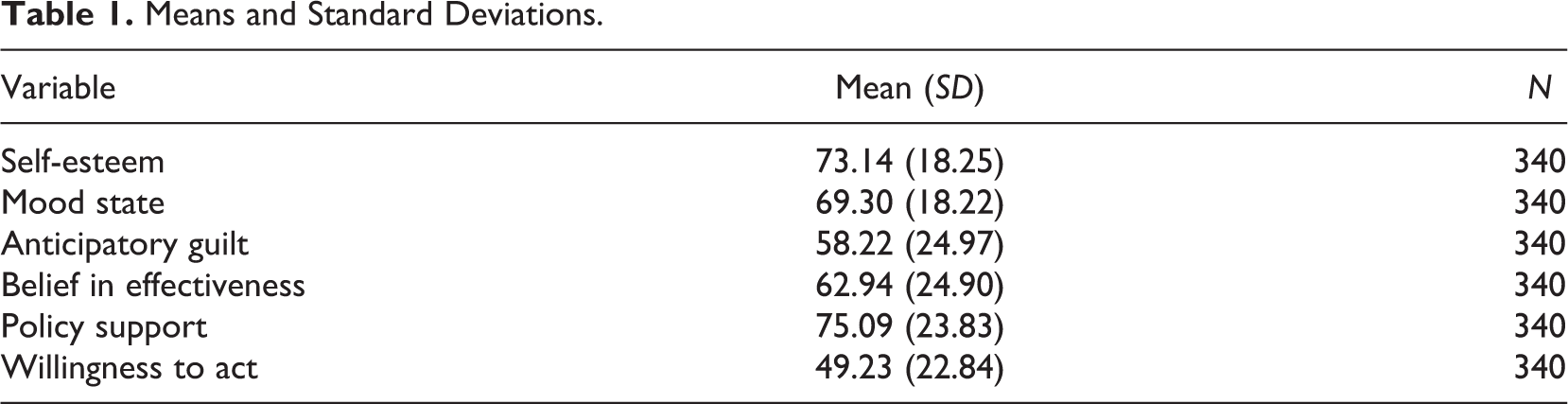
Using multiple linear regression, and Andrew Hayes’s PROCESS v2.11 moderated mediation statistical analysis (Hayes, 2013), 8 we tested the relationships between the IVs, gender, guilt condition (manipulated), self-esteem, self-affirmation, anticipatory guilt (measured), belief in policy effectiveness, and participant type, and the dependent variables (DVs), support for the policy and willingness to act (see Table 1 for means and standard deviations and Table 2 for correlations). In the first model, we tested the relationships between the IVs, gender, guilt condition, participant type, anticipatory guilt, and beliefs in policy effectiveness, and the DVs, policy support/willingness to act, mediated by self-esteem and moderated by self-affirmation. In the second model, we tested the relationship between the IVs, gender, guilt condition, participant type, self-esteem, and self-affirmation, and the DVs, policy support/willingness to act, mediated by anticipatory guilt and moderated by belief in the effectiveness of the policy.
Means and Standard Deviations.
Correlation Coefficients for All Independent and Outcome Variables.

*p < .05. **p < .01. ***p < .001.
For both models, two steps assessed these relationships. In Step 1, IVs were associated with the mediating variable (self-esteem measure or measured anticipatory guilt). In Step 2, all variables and interactions were associated with the outcome variable (policy support or willingness to act). Also, in Step 2, the moderating variable (self-affirmation or belief in policy effectiveness) and the interaction between the moderating and mediating variables were added. Subsequently, moderated mediation analysis tested the conditional relationships between the IVs and DVs.
Relationship Between IVs and Policy Support and Willingness to Act Mediated by Self-Esteem and Moderated by Self-Affirmation
In this model, gender, guilt condition, participant type, anticipatory guilt, and beliefs in policy effectiveness were tested as being related to policy support/willingness to act, mediated by self-esteem and moderated by self-affirmation. Based on these analyses, moderated mediation tested the conditional indirect effects of these relationships.
Policy support
In Step 1, in which self-esteem was the outcome variable, the overall model was significant, R 2 = .280, F(8, 331) = 16.083, p < .001. Mood state was positively associated with self-esteem, b(1, 339) = 0.477, SE = 0.05, p < .001, 95% CI [0.38, 0.57]. Also, participant type was associated with self-esteem b(1, 339) = −9.062, SE = 1.78, p < .001, 95% CI [−12.57, −5.55], such that MTurk workers had lower self-esteem than college students.
In Step 2, in which policy support was the outcome variable, the overall model was significant, R 2 = .55, F(11, 328) = 36.609, p < .001. Gender was significantly associated with policy support, b(1, 339) = −4.750, SE = 1.87, p < .05, 95% CI [−8.44, −1.06], such that males were less supportive than females. Also, participant type was significantly associated with policy support, b(1, 339) = 7.317, SE = 1.93, p < .001, 95% CI [3.51, 11.12], such that MTurk workers were more supportive than students. Further, the interaction between anticipatory guilt and belief in policy effectiveness was significantly associated with policy support, b(1, 339) = −0.0069, SE = 0.0012, p < .001, 95% CI [−0.0093, −0.0045], such that anticipatory guilt was only related to policy support for individuals who also reported average or low belief in policy effectiveness. Self-esteem did not significantly predict policy support and the indirect effects of gender on policy support, mediated by self-esteem, were not significant (see Table 3 for all βs and standard errors). 9 Therefore, moderated mediation was not analyzed.
Regression Coefficients for Moderated Mediation Involving Self-Esteem and Self-Affirmation.

Note. CI = confidence interval. Confidence intervals that do not include zero indicate statistical significance.
*p < .05. **p < .01. ***p < .001.
These results suggest that females and MTurk workers reported more support for the GPS policy than males and college students. However, females increased support for the GPS policy was not explained by aspects of their self-concept. Also, individuals with higher anticipatory guilt who did not believe the GPS policy would effectively reduce abductions reported more support than those with lower anticipatory guilt.
Willingness to act
In Step 1, in which self-esteem was the outcome variable, the overall model and the relationships between variables were the same as in Step 1 described in the last analysis. In Step 2, in which willingness to act was the outcome variable, the overall model was significant, R 2 = .49, F(11, 328) = 29.25, p < .001. Participant type, b(1, 339) = 3.866, SE = 1.96, p < .05, 95% CI [0.003, 7.73], was positively associated with willingness to act. Further, the interaction between anticipatory guilt and belief in policy effectiveness was significantly associated with willingness to act, coefficient (1, 339) = −.0025, SE = 0.0012, p < .001, 95% CI [−0.0050, −0.0001], such that anticipatory guilt was more strongly related to willingness to act for individuals who reported lower endorsement of belief in policy effectiveness. Self-esteem did not significantly predict willingness to act and the indirect effects of gender on policy support, mediated by self-esteem, were not significant (see Table 3 for all βs and standard errors).
These results suggest that MTurk workers were more willing to donate money to support the GPS policy than college students. Also, individuals with higher anticipatory guilt who did not think the GPS policy would effectively reduce abductions were more willing to donate money to support the policy than those with lower anticipatory guilt.
Relationship Between IVs and Policy Support and Willingness to Act Mediated by Anticipatory Guilt and Moderated by Belief in Effectiveness
In this model, gender, guilt condition, participant type, self-esteem, and self-affirmation were tested as being associated with policy support/willingness to act, mediated by measured anticipatory guilt and moderated by beliefs in policy effectiveness. Then based on these analyzes, moderated mediation tested the conditional indirect effects of these relationships.
Policy support
In Step 1, with anticipatory guilt as the outcome variable, the overall model was significant, R 2 = .11, F(8, 331) = 5.134, p < .001. Gender was significantly associated with anticipatory guilt, b(1, 339) = −13.845, SE = 2.60, p < .001, 95% CI [−18.96, −8.73], such that females reported higher anticipatory guilt.
In Step 2, in which policy support was the outcome variable, the overall model was significant, R 2 = .55, F(11, 328) = 36.609, p < .001. Gender was significantly associated with policy support, b(1, 339) = −4.750, SE = 1.87, p < .05, 95% CI [−8.44, −1.06], such that males were less supportive of the policy than females. Also, participant type was significantly associated with policy support, b(1, 339) = 7.317, SE = 1.93, p < .001, 95% CI [3.51, 11.12], such that MTurk workers were more supportive than students. Further, the interaction between anticipatory guilt and belief in policy effectiveness was significantly associated with policy support, b(1, 339) = −0.0069, SE = 0.0012, p < .001, 95% CI [−0.009, −0.004], such that anticipatory guilt was only related to policy support for individuals who also reported average or low belief (−1 SD) in policy effectiveness (see Figure 1; see Table 4 for all βs and standard errors).
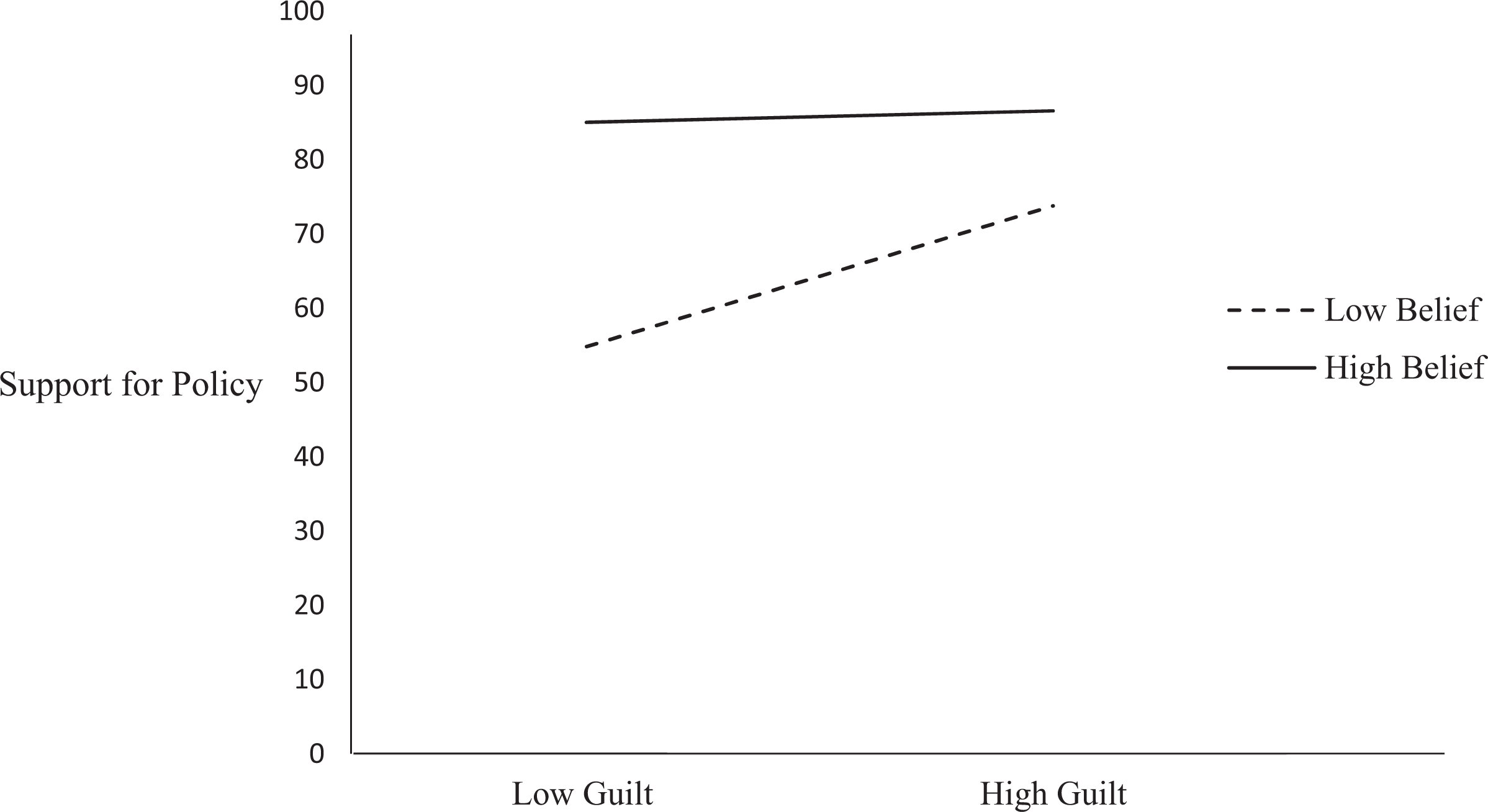
Interaction between belief and guilt on support for policy.
Regression Coefficients for Moderated Mediation Involving Anticipatory Guilt and Belief.

Note. CI = confidence interval. Confidence intervals that do not include zero indicate statistical significance.
*p < .05. **p < .01. ***p < .001.
Moderated mediation analysis tested whether measured anticipatory guilt mediated the relationship between gender and support for the policy. This analysis also tested whether the overall indirect effect was significantly different based on the moderating effect of belief in policy effectiveness on the relationship between anticipatory guilt and support for the policy. The overall index of moderated mediation was significant, coefficient = 0.09, SE = 0.02, 95% CI [0.06, 0.15]. The indirect effect of gender on policy support, mediated by anticipatory guilt, was significant for individuals who reported an average endorsement of beliefs in policy effectiveness, coefficient = −2.84, SE = 0.78, 95% CI [−4.69, −1.53], and low (−1 SD) endorsement of beliefs in policy effectiveness, coefficient = −5.21, SE = 1.20, 95% CI [−7.92, −3.14], but not for individuals who reported high (+1 SD) endorsement of beliefs in policy effectiveness, coefficient = −0.47, SE = 0.67, 95% CI [−1.88, 0.76]; see Figure 2.

Moderated mediation model for support for policy. Control variables included self-affirmation condition, guilt condition, self-affirmation by guilt interaction, self-esteem, self-esteem by self-affirmation condition interaction, and participant type. IE = indirect effect; CI = confidence interval. Confidence intervals that do not include zero indicate statistical significance. *p < .05. **p < .01. ***p < .001.
These results suggest that females were more supportive of the GPS policy, and this can be explained, at least in part, by differences between males’ and females’ anticipatory guilt related to the thought of not supporting the policy. However, the role of anticipatory guilt was only true for those who did not believe that the GPS policy would effectively reduce abductions. Anticipatory guilt did not play a role for those who did believe that the GPS policy would be effective in reducing abductions.
Willingness to act
In Step 1, in which self-esteem was the outcome variable, the overall model and the relationships between variables were the same as in Step 1 described in the last analysis. In Step 2, in which willingness to act was the outcome variable, the overall model was significant, R 2 = .49, F(11, 328) = 29.25, p < .001. Participant type, b(1, 339) = 3.866, SE = 1.96, p < .05, 95% CI [0.003, 7.73], was positively associated with willingness to act. Further, the interaction between anticipatory guilt and belief in policy effectiveness was significantly associated with willingness to act, coefficient = −0.0025, SE = 0.0012, p < .05, 95% CI [−0.0050, −0.0001], such that anticipatory guilt was more strongly related to willingness to act for individuals who reported lower endorsement of belief in policy effectiveness (see Figure 3; see Table 4 for all βs and standard errors).
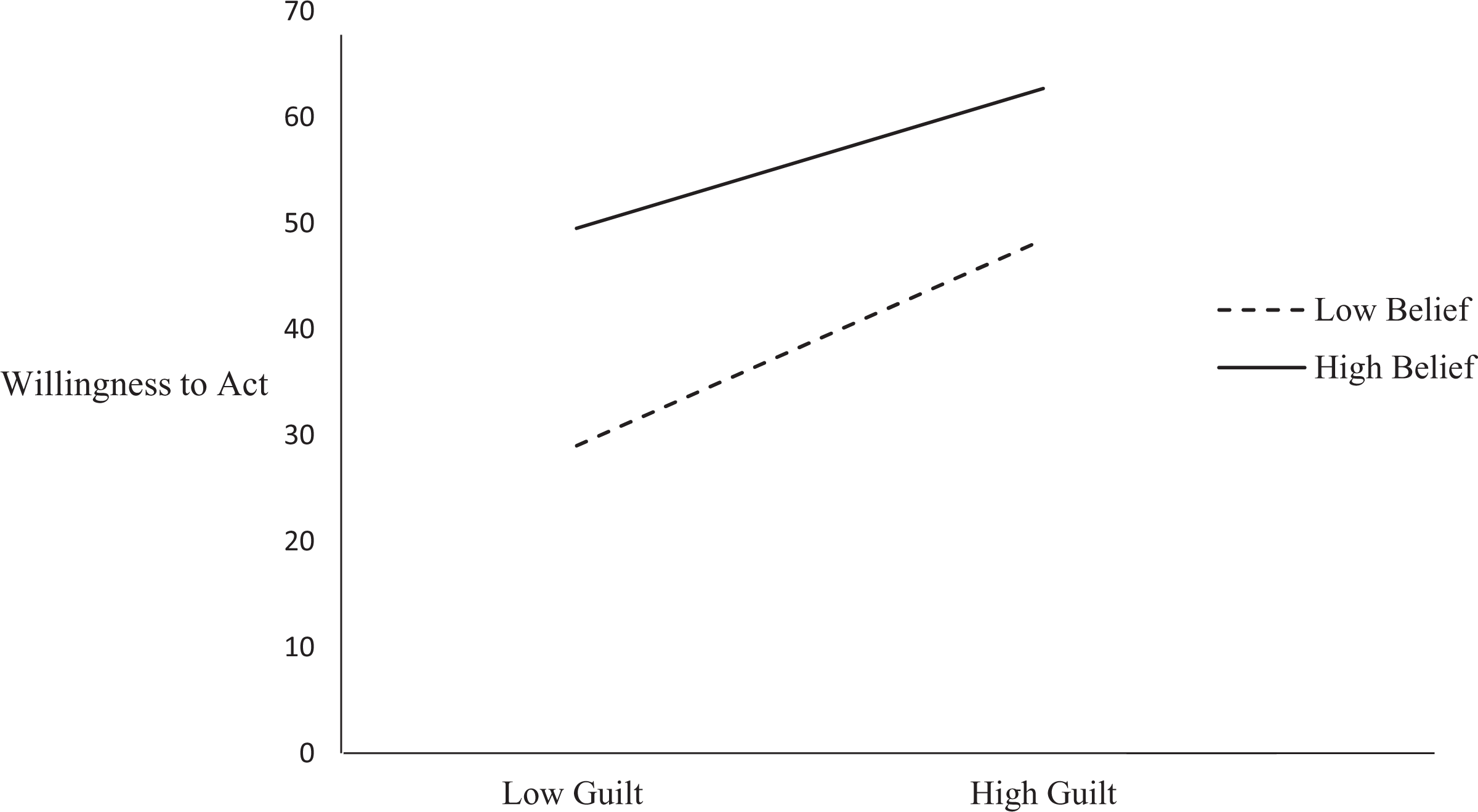
Interaction between belief and guilt on willingness to act.
Moderated mediation analysis tested whether measured anticipatory guilt mediated the relationship between gender and willingness to act. This analysis also tested whether the overall indirect effect was different based on the moderating effect of belief in policy effectiveness on the relationship between anticipatory guilt and willingness to act (see Figure 4). The overall index of moderated mediation was significant, coefficient = 0.035, SE = 0.02, 95% CI [0.0004, 0.0768]. The indirect effect of gender on willingness to act, mediated by anticipatory guilt, was significant for individuals who reported a low (−1 SD) endorsement of beliefs in policy effectiveness, coefficient = −5.39, SE = 1.29, 95% CI [−8.11, −3.05]; an average endorsement of beliefs in policy effectiveness, coefficient = −4.52, SE = 1.03, 95% CI [−6.79, −2.67]; and high (+1 SD) endorsement of beliefs in policy effectiveness, coefficient = −3.65, SE = 0.97, 95% CI [−5.83, −1.98]. The overall indirect effect increased as beliefs in policy effectiveness decreased (see Figure 4).
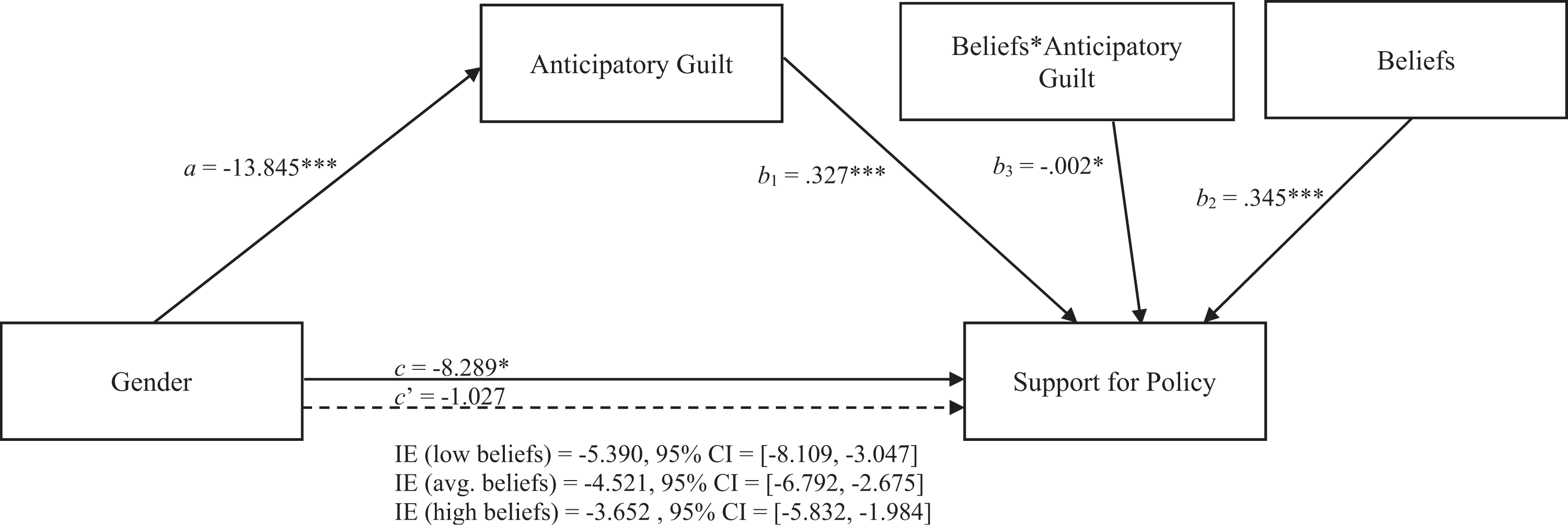
Moderated mediation model for willingness to act. Control variables included self-affirmation condition, guilt condition, self-affirmation by guilt interaction, self-esteem, self-esteem by self-affirmation condition interaction, and participant type. IE = indirect effect; CI = confidence interval. Confidence intervals that do not include zero indicate statistical significance. *p < .05. **p < .01. ***p < .001.
These results suggest that females were more willing to donate money in support of the GPS policy, and this can be explained, at least in part, by differences between males’ and females’ anticipatory guilt related to the thought of not supporting the policy. However, the role of anticipatory guilt was stronger for those who did not believe that the GPS policy would effectively reduce abductions compared to those who did believe in the GPS policy’s effectiveness.
Discussion
The current study had multiple purposes. Primarily, the study examined whether emotions (e.g., anticipatory guilt) and aspects of the self (e.g., self-esteem and self-affirmation) are related to support for CCT policies. It also investigated whether support differs based on relevant characteristics (e.g., gender and sample type) and beliefs about policy effectiveness. While the manipulated variables (guilt and the opportunity to self-affirm) had no effect on policy support measures (Hypotheses 1 and 2 not supported), measured anticipatory guilt and other individual differences were associated with policy support.
Based on the results of this research, one can conclude that there are several aspects that relate to support for CCT policies. First, to address our research questions, MTurk workers were more supportive of the policy compared to college students. MTurk workers might have been more supportive of the policy because it had less of a direct and immediate impact on their lives, and thus was less relevant. Therefore, MTurk workers might not be able to understand some of the more negative consequences of implementing such a policy. Moreover, MTurk workers might view the act as preventing crimes against college students, a vulnerable population in need of protection. In this case, MTurk workers might take on a “protector” role and support general crime control and prevention policies. Because crime control policies promote a “safer community” type of a message, MTurk workers might support these policies in hopes that their community actually becomes safer, even if the policy does not directly address their immediate situation.
Students, on the other hand, might perceive the policy as more directly relevant and examine it with more scrutiny. In doing so, students might find the policy to be invasive and interfering with their freedom. The policy required students to carry ID cards with a GPS chip in it, which would allow the university to locate them in case of abduction. The college student sample might perceive that the school is tracking their locations and trying to control them or spy on them, infringing on their privacy rights. Because of their unique position as the target of the policy (i.e., they are the ones who experience the changes made by the policy), students are potentially prompted to carefully consider the advantages (e.g., protection from abduction) and disadvantages (e.g., increase in tuition to support policy) of the policy.
This study extends the research informing the debate as to whether student samples are comparable to other samples such as MTurk workers and community samples (e.g., McCabe, Krauss, & Lieberman, 2010; M. Miller, Wood, & Chomos, 2014; Wiener, Krauss, & Lieberman, 2011). Because students and MTurk workers differed in the extent to which they supported the fictitious crime control policy, this suggests that there are key differences between these two groups; however, this might be contextually dependent. Specifically, differences between student and community samples might only exist when an issue is relevant (or more relevant) to one group compared to the other. However, it is possible that differences between the two groups might not exist when issues are equally relevant or equally irrelevant. Differences between student, MTurk, and community samples should continue to be studied to better understand how and why they might differ.
Second, females were more supportive of the policy than males (Hypothesis 3 supported). Understanding the extent of females’ support and what factors might relate to such support were important to assess because the fictional CCT policy was designed to protect females. Results suggest that anticipatory guilt better explains gender differences than self-affirmation. Self-esteem did not mediate the relationship between gender and policy support, and self-affirmation did not moderate this relationship (Hypotheses 4 and 5 not supported). However, measured anticipatory guilt was positively associated with policy support but only for individuals with weaker beliefs in its effectiveness. Similarly, anticipatory guilt was associated with willingness to act, and this relationship was stronger for those with weaker beliefs in policy effectiveness (Hypotheses 6 and 7 supported). This particular finding provides substantial insight into the reasons some people support CCT policies. Individuals who believe that CCT policies work might support them because of their prevailing belief of the policy’s effectiveness rather than as a result of how they feel at the time of the decision or predict feeling afterward. However, those who do not strongly believe that CCT policies work (an accurate perception according to Griffin & Miller, 2008) will still support the policy and be willing to act—if they anticipate feeling guilty for not supporting the policies.
Implications
Findings reveal that emotions likely play a role in support for CCT policies, as suggested by other authors (Armstrong et al., 2015; Sicafuse & Miller, 2010; see also Zgoba, 2004a). In this research, support for CCT policies essentially capitalizes on two major phenomena: (1) the illusion of effectiveness and (2) the elicitation of anticipatory guilt as a result of not supporting the policy. This study provides supporting evidence that both of these phenomena lead to increased support for CCT policies. Further, these results identify a two pronged approach that potentially explains why CCT policies are largely supported by the public. First, policymakers portray their policies as believably effective. This captures support from a portion of the population who endorse the policy based solely on the thought that it actually works. Second, policymakers might then target skeptics and provide messages that elicit guilt for not supporting the policy (e.g., “if you do not support AMBER alerts, you are not helping children”). These phenomena might ensure that most of the population will support the policy, despite any evidence contrary to the policy’s effectiveness.
It is possible that CCT policies are widely supported despite a lack of valid supporting evidence because supporting them makes people feel good. Although this is possible, based on the findings from this study, a better explanation might be that supporting CCT policies helps prevent people from feeling bad. Although still an aspect of emotion regulation, the former implies that policy support is a way to achieve an emotional reward, but the latter implies that policy support is an obligation and if not fulfilled will result in an emotional punishment. Results indicated that this might occur more for women than men. Moreover, the symbolic nature of CCT policies might elicit similar affective reactions across individuals (at least while the threat is imminent), unifying their responses independent of self-esteem or the need to self-affirm. It is also possible that all individuals consider kidnapping and sexual assault to be an act they want to combat, anticipating feeling guilty if they do not align with this view despite their current self-concept.
One of the major findings in this research was the gender differences in policy support. Females are likely more supportive of CCT policies, and this might be explained by increased anticipatory guilt. The significance of this finding is premised on two ideas. First, women are potentially the most targeted group for supporting CCT policies. This is because many CCT policies are conservative in nature and are associated with punitive responses to issues related to children or vulnerable populations (i.e., AMBER Alerts, Megan’s law, three-strikes laws, etc.). Therefore, using emotional appeals might allow policymakers to increase their support from women voters who might otherwise think the policy will be ineffective. This potentially increases the overall support from the target group who will be most impacted by the policy. Second, it is important to understand this relationship in the context of political involvement. Over the past several decades, women have been more active voters than men (Dittmar, 2014). Thus, if CCT policymakers can effectively increase policy support among women and if women are more involved in CCT policy campaigns, this can have a profound effect on voting outcomes because women are a majority group.
It is also possible that equating policy support to the fulfillment of its intended outcomes might portray an inaccurate account of reality. Policymakers might believe that public support for a certain policy translates into public belief in the policy’s effectiveness. Because anticipatory emotion is associated with CCT policy support for those who do not believe in the policy’s effectiveness, much of the public support might be based on avoiding negative emotions rather than confidence in the ability of the policy to achieve its goals. Although the percentage of the population who support CCT policies for this reason is undetermined, policymakers, analysts, and legislators might interpret this widespread support as the public belief that these policies work (and potentially even acknowledgement that these policies are working based on the public’s personal experiences). Understanding these misguided perceptions might help policymakers and analysts be more skeptical of general widespread CCT policy support and instead examine the roots of this support.
Another implication of the results of this study relates to the financial support for CCT policies. As this study found, anticipated emotion is associated with financial support for CCT policies (i.e., willingness to act), despite beliefs of ineffectiveness. Similar to general support, policies might garner financial support based on instilling guilt in the public rather than eliciting safety and security through these policies. This potentially undermines the appropriation of funds for effective crime control and prevention policies. By assuming that public support is based on beliefs in policy effectiveness, government funding might be allocated to policies that are ineffective. Instead, other more effective policies might be better served by these funds.
To avoid funding policies that receive substantial support, despite evidence to the contrary, policymakers and legislators could take several measures to effectively communicate the specifics of the policies, enabling the public to make more informed decisions regarding support. First, policymakers and legislators could consult scientific evidence relevant to such policies and use an empirical approach to understand outcomes of implementing crime control policies. Second, based on analyzing empirical evidence, policymakers and legislators could provide constituents with understandable and comprehendible evidence and facts related to the outcomes of the policy efforts. Sicafuse and Miller (2012) suggest that presenting the public with concrete information (i.e., positive outcomes or the potential negative consequences of implementing a specific policy) about policies can influence public support and encourage the public to make better informed decisions. Third, policymakers and legislators could propose a redirection of funding as a way to dissolve ineffective policies. By proposing new ways to use funds, the public might agree with this type of redirection and support other crime control policies or amendments to ineffective policies. This might also act as a way for individuals to still feel as if they are contributing to a beneficial cause, alleviating anticipatory guilt for not acting at all.
Lastly, the interaction between anticipatory guilt and beliefs in the effectiveness of policy also provides support for the interplay between thought and emotion. Specifically, emotion (anticipatory guilt) was only associated with policy support when thought (belief in effectiveness) appeared to be insufficient in explaining support. This gives credence to the literature suggesting that individuals’ decision-making is an outcome of both rational thought and emotion (e.g., Epstein, 2008; Slovic & Peters, 2006). In this case, when rationality failed to provide a reason for an individual to support the policy, emotion became an adequate resource to use in the same decision-making process. It is also possible that when individuals are uncertain about whether or not a policy would work, emotional reactions might become more intense, thus increasing the effect of emotion on behavior and in this case policy support (i.e., Bar-Anan, Wilson, & Gilbert, 2009).
Policies that have both an informative and emotional appeal might be able to garner more support than policies that rely on one or the other. Thus, policymakers might capitalize on this and develop policies that are both believable and emotionally appealing. In this research, policy support was related to anticipatory emotion for not supporting the policy. Future policies might benefit from emphasizing both the positive outcomes for supporting the policy along with the potential negative outcomes of not supporting the policy. Some effective policies might be complicated and difficult for the public to comprehend. This might cause support to waver due to uncertainty or frustration. Instead, presenting the public with outcomes for both supporting and not supporting a policy might elicit emotion-driven support and potentially motivate the public to make more informed decisions.
Limitations and Future Directions
The purpose of this study was to assess factors that affect CCT policy support and examine potential explanations for this relationship. Although several substantial findings emerged, there are some limitations to the current study.
First, the experimental manipulations were ineffective in eliciting the desired outcomes. Methods used to elicit guilt and self-affirmation might have been flawed or just not strong enough. For instance, it was assumed that people were under a threat and would need to self-affirm (by supporting the policy). The self-affirmation manipulation might not have worked if there was no need to affirm. The guilt manipulation might not have been strong enough to elicit guilt—perhaps because the policy was not a real-life policy.
Second, no causal claims can be made. Because controlled experimental manipulations did not lead to the outcomes, claims that one variable caused another cannot be supported. Even so, the measured guilt variable (anticipatory guilt) was a significant factor, and most of the hypotheses related to guilt were supported.
Third, this study only used one policy as a stimulus. Future research should improve methodology and include other experimental manipulations along with other CCT and non-CCT policies. Also, future research should examine additional potential explanations as to why there were differences in policy support between students and MTurk workers.
Fourth, the use of MTurk workers, and certainly students, might not fully grasp the representativeness of community members. Instead, these subpopulations might only represent students and online community members. Also, there were likely college students in the MTurk sample which might have reduced the effect size between the two groups. Future research should include nonstudent Mturk and community samples to assess the generalizability of the current findings.
Lastly, victimization experiences or perceptions of victimization were not controlled for in this study. It is possible that victimization might increase emotional responses and thus policy support. Future research should explore these possible relationships.
Conclusions
The purpose of the current research was to better understand factors related to support for CCT policies. While self-affirmation and self-esteem were not related to support, other personal and motivational variables were. MTurk workers were more supportive of the CCT policy than college students, perhaps because they viewed the policy as less relevant to their lives and were less able to appreciate the potential negative effects. Gender was also relevant to the policy described in the stimuli material, and thus it is no surprise that gender also related to support. This relationship was much more complicated, however, and involved emotions and beliefs about the policy. Findings indicate that women are more supportive of CCT policies because they anticipate feeling more guilty if they did not support the measure and a negative outcome occurred. This is especially true for those who do not believe that CCT policies are very effective. In this regard, guilt appeals might affect only a subset of the public.
This study is among the first to test specific explanations as to why certain individuals support CCT policies and how personal and motivational aspects of individuals relate to policy support. Overall, CCT policies are attractive to specific members of the public, namely women. This might explain why several of the successful CCT policies focus on preventing crimes against children, an aspect strongly embedded in the traditional female gender role. The reasons underlying this support lie in beliefs, emotions, and personal relevance. Research in crime control policy and CCT should continue to pursue a better understanding of who supports these types of policies, for what reasons, and in what contexts. It appears individual characteristics, beliefs, and emotions are important in this regard.
Footnotes
Appendix A
Declaration of Conflicting Interests
The authors declared no potential conflicts of interest with respect to the research, authorship, and/or publication of this article.
Funding
The authors received no financial support for the research, authorship, and/or publication of this article.