



Abstract
Justice-involved veterans face increased behavioral health (e.g., mental health and substance abuse) issues and are more likely to be incarcerated for a violent offense compared to nonveterans. Despite the large number of veterans involved in the justice system, there is a paucity of research examining public opinion of sanctioning approaches for justice-involved veterans. The current study seeks to fill this gap by sampling 575 undergraduate students at a large university in the south to examine support for sanctioning approaches for nonviolent and violent justice–involved veterans. Multinomial logistic regression was conducted to examine whether beliefs regarding the treatment of justice-involved veterans (e.g., whether veterans deserve access to rehabilitation programs, the ability of veterans to be rehabilitated, whether veterans are willing to work toward rehabilitation, and the effectiveness of treatment programs for veterans) relate to support for balanced justice. Findings suggest support for a balanced justice approach to sanctioning violent justice–involved veterans, while support for a rehabilitation-oriented approach to sanctioning nonviolent justice–involved veterans. Policy implications and directions for future research are discussed.
According to the U.S. Department of Veterans Affairs (2016b), there are over 19.4 million veterans living in the United States. Of these veterans, approximately 2.6 million served in the wars in Afghanistan and Iraq (“post–9/11 wars”; Department of Veterans Affairs, 2016a). While military experience undeniably has positive benefits, such as increased resilience, comradery, and socioeconomic status (Elder, 1998; MacLean & Elder, 2007), a large number of veterans report difficulty readjusting to civilian life and many believe the public cannot relate to the post-deployment struggles veterans encounter (Pew Research Center, 2011). Readjusting to civilian life is even more difficult for veterans who experienced a traumatic event while enlisted, were engaged in combat, were injured, or knew someone who was injured or killed (Morin, 2011).
A growing body of research examines the potential adverse, long-lasting effects of military service on veterans (e.g., Adams, Corrigan, & Larson, 2012; Institute of Medicine, 2013; Spiro & Settersten, 2012). Of concern in this literature are the high rates of substance use disorders, mental illness, post-traumatic stress disorder (PTSD), and traumatic brain injury (TBI) veterans experience. Studies have found, for instance, that approximately 30% of army soldiers and marines returning from combat in Iraq and Afghanistan met the criteria for alcohol misuse (Hoge et al., 2004), and almost 12% were diagnosed with a substance use disorder (Seal et al., 2011). Veterans incarcerated in prison are significantly more likely, compared to nonveteran prisoners, to have a mental health disorder (48% vs. 36%, respectively) and be diagnosed with PTSD (23% vs. 11%, respectively). Just as concerning as the rate of behavioral and mental health issues experienced by veterans is the number of justice-involved veterans. According to the most recent statistics, in 2011–2012, an estimated 181,500 veterans were incarcerated in jails and state and federal prison facilities across the United States (Bronson, Carson, Noonan, & Berzofsky, 2015). Moreover, veterans are more likely to serve time for a violent offense (64%) compared to nonveterans (48%).
Despite the high rates of substance abuse, mental illness, and criminal justice system involvement, there is a lack of research on public opinion toward punishment and rehabilitation of veterans who violate the law. It is well-known that the public tends to hold punitive sentiments toward law violators, which has been growing in recent years (Cullen, Fisher, & Applegate, 2000; Enns, 2014). Research also finds the public to simultaneously support rehabilitation of offenders (Applegate, Cullen, & Fisher, 1997; Cullen et al., 2000; Nagin, Piquero, Scott, & Steinberg, 2006; Thielo, Cullen, Cohen, & Chouhy, 2015). In a recent attempt to accurately assess public opinion regarding punishment and rehabilitation, Mears, Pickett, and Mancini (2015) examined public support for balanced justice—a sanctioning approach that emphasizes punishment and rehabilitation simultaneously—for violent youthful offenders. Results suggested that the majority of respondents preferred a balanced justice approach to sanctioning violent youthful offenders. While the public opinion literature has examined attitudes toward various types of offenders (e.g., youthful offenders, sex offenders, violent offenders, and property offenders), there is no research specifically examining punitive (or nonpunitive) sentiments toward justice-involved veterans, which is interesting, given the widespread adoption of sanctions specific to veterans (e.g., veterans’ treatment courts [VTCs]).
The current study seeks to enhance the public opinion and limited balanced justice literature by building upon the work of Mears and colleagues (2015). Utilizing a sample of 575 criminology and criminal justice (CCJ) students at a large southern university, this study examines public opinion for sanctioning nonviolent and violent justice–involved veterans. Further, we examine how beliefs related to treatment and reform of justice-involved veterans relates to support for punishment, rehabilitation, and balanced justice. By understanding, in more detail, support for sanctioning approaches for justice-involved veterans, the results have the potential to add to the body of literature on public opinion toward punishment and rehabilitation. Moreover, the results can further inform policy and practice, as public support for sanctioning approaches can shape policy-making—directly through ballot initiatives or indirectly through electoral incentives for politicians (Enns, 2014)—and give rise to an increase or decrease in funding for balanced justice approaches to sanctioning justice-involved veterans.
Literature Review
Public Opinion Toward Punishment and Rehabilitation
The extant literature has documented a growing public sentiment toward more punitive criminal justice outcomes following the “nothing works” movement of the 1970s (Enns, 2014; Martinson, 1974). Coinciding with the increase in punitive attitudes, legislators and policy makers implemented a wide array of “get tough on crime” policies. Many of these policies are still in operation today and include harsh drug laws, mandatory minimum sentences, three-strike laws, increased use of solitary confinement, and reintroduction of capital punishment, boot camps, and scared straight programs for youthful offenders (Andrews & Bonta, 2010; Byrne, Lurigio, & Petersilia, 1992; Cullen, Clark, & Wozniak, 1985). The aforementioned policy changes exponentially increased the U.S. correctional population between 1972 and 2010, from under 200,000 prisoners incarcerated in state and federal correctional facilities in 1972 to over 1.6 million prisoners in 2010 (Blumstein & Beck, 1999; Bureau of Justice Statistics, 1982; Carson & Golinelli, 2013; Guerino, Harrison, & Sabol, 2011). Despite the increase in the correctional population and punitive sentiments of the get tough on crime era (Enns, 2014), research suggests that the public continuously supports rehabilitation for law violators (Applegate et al., 1997; Cullen et al., 2000; Nagin et al., 2006; Thielo et al., 2015). In one of the most comprehensive reviews of public opinion toward punishment, Cullen and colleagues (2000) found that, while the public is punitive toward crime, rehabilitation is still largely endorsed by citizens. More specifically, they concluded that “the central tendency in public opinion is to be punitive and progressive—to endorse the use of a balanced response to lawbreakers” (Cullen et al., 2000, p. 9). Indeed, scholars argue that the American public is pragmatic in its response to crime control policies such that public sentiment tends to support punishment while simultaneously supporting rehabilitation (Cullen et al., 2000; Mascini & Houtman, 2006; Mears et al., 2015; Pickett, Mancini, & Mears, 2013; Sloas & Atkin-Plunk, 2018; Unnever, Cochran, Cullen, & Applegate, 2010).
In line with public attitudes toward punishment and rehabilitation, substantial and sustained changes have been made to the American criminal justice system in the way it sanctions offenders who should be held accountable for their actions but are also viewed as necessitating rehabilitation (MacKenzie, 2006). VTCs are one such example. VTCs are one of the newest varieties of problem-solving courts and differ from traditional courts in that they do not simply adjudicate and sentence justice-involved veterans. They also seek to change future behavior and increase community safety through addressing the individualized needs of veterans stemming from deployment to a combat or war zone (e.g., PTSD, TBI, and alcohol/drug misuse; Baldwin, 2015; Russell, 2009). Simply, VTCs emphasize punishment and rehabilitation simultaneously by providing a “balanced justice” approach to sanctioning justice-involved veterans (Mears et al., 2015, p. 460). Research suggests that public attitudes influence criminal justice policy (see, e.g., Enns, 2014; Jacobs & Carmichael, 2001; Nicholson-Crotty, Peterson, & Ramirez, 2009). Therefore, it is unlikely that the development and widespread expansion of such courts across the United States would have occurred without public support (Baldwin, 2015). The research, however, has yet to examine public opinion on sanctioning justice-involved veterans.
A Balanced Justice Approach to Sanctioning Offenders
While the existing research lends support to the presence of a pragmatic public regarding crime control measures, some contend that caution should be taken when interpreting these results (Pickett & Baker, 2014). Researchers suggest, for example, that acquiescence bias—when respondents answer survey questions in the affirmative regardless of question content—may potentially confound previous findings. Pickett and Baker (2014), specifically, assert that “the failure in prior studies to account for acquiescent responding makes it difficult to determine whether extant research findings present an accurate picture of popular sentiments” of crime control measures (p. 214). Support for sanctioning approaches can shape policy-making, either indirectly through electoral incentives of politicians or directly through ballot initiatives (Enns, 2014). Thus, accurately gauging the public’s views regarding such policies is essential.
In an effort to reduce the effects of acquiescence bias and to accurately assess public views regarding punishment and rehabilitation, Mears and colleagues (2015) examined support for balanced justice for youthful offenders. According to Mears et al. (2015), balanced justice can be considered a “sanctioning approach that emphasizes both punishment and rehabilitation” (p. 460), such that respondents are required to “choose among sanctioning approaches that differentially weight the emphasis given to punishment and rehabilitation” (p. 460). Results suggested that when forced to choose between punishment, rehabilitation, or a balanced approach, the majority of the public preferred a balanced justice approach to sanctioning violent youthful offenders.
In another study aimed at assessing views toward sanctioning drug offenders, a plurality (46%) of respondents supported a balanced justice approach to sanctioning violent drug offenders, while 42% favored punishment and 12% favored rehabilitation (Sloas & Atkin-Plunk, 2018). Thus, evidence is beginning to emerge that indicates the public can simultaneously support punishment and rehabilitation (Mears et al., 2015; Sloas & Atkin-Plunk, 2018). More importantly, this research highlights the salience of researchers obtaining a more nuanced view of public perceptions regarding punishment and rehabilitation of offenders.
Sanctioning Justice-Involved Veterans
In an effort to understand the complex nature of public opinions, the existing literature has examined punitive and rehabilitative sentiments toward various offender typologies. Specifically, researchers have examined attitudes toward sanctioning burglars (McCorkle, 1993; Turner, Cullen, Sundt, & Applegate, 1997), drug offenders (McCorkle, 1993; Sloas & Atkin-Plunk, 2018), sex offenders (Brown, 1999; King & Roberts, 2017), street criminals (Zimmerman, Van Alstyne, & Dunn, 1988), violent offenders (Jacoby & Cullen, 1998; Michel, 2016), white-collar criminals (Michel, 2016; Rossi, Berk, & Campbell, 1997), and youthful offenders (Mears et al., 2015; Miller & Applegate, 2015). Researchers, however, have yet to examine public attitudes toward sanctioning justice-involved veterans. Although the public tends to hold favorable attitudes toward members of the military and veterans (MacLean & Kleykamp, 2014; Pew Research Center, 2011; Roper Center, 2014), it is unknown whether they also hold rehabilitative views toward veterans who violate the law. To date, limited research exists which examines criminal justice actors’ attitudes toward sanctioning justice-involved veterans. In a study of prosecutors’ attitudes toward veterans with PTSD, Wilson, Brodsky, Neal, and Cramer (2011) found prosecutors were more likely to empathize with veterans, see them as less culpable, and recommend treatment-based diversion program compared to nonveterans.
While examining prosecutors’ attitudes is worthwhile, as they are the gatekeepers of the criminal justice system, prosecutors are arguably different from the general public. Additionally, it is well-established that public opinion can have direct and indirect effects on the allocation of resources (Enns, 2014; Jacobs & Carmichael, 2001; Nicholson-Crotty et al., 2009). Despite a lack of knowledge regarding public views toward sanctioning approaches for justice-involved veterans, sanctioning approaches specific to justice-involved veterans continue to be implemented across the United States. Specifically, the first effort to establish a VTC occurred in Anchorage, Alaska, in 2004 (Hawkins, 2010), and their widespread adoption ensued following the implementation of a similar court in Buffalo, New York, in 2008 (Baldwin, 2015; Johnson et al., 2016; Russell, 2009). The number of VTCs operating throughout the United States has grown tremendously in recent years, from 24 operating in 2010 to over 300 in operation at year-end 2015 (Justice for Vets, 2017), and even more in the planning stages (Ahlin & Douds, 2016).
Although the current study does not address public opinions specific to VTCs, it does provide an empirical examination of underlying beliefs regarding treatment and reform of justice-involved veterans. Moreover, the current study seeks to reduce the effects of acquiescence bias by following Mears and colleagues’ (2015) approach and querying respondents regarding their support for a punishment, rehabilitation, or balanced justice-oriented approach to sanctioning nonviolent and violent justice–involved veterans. Results can have implications for veteran-specific sanctioning policies (e.g., VTCs), as the results can potentially give rise to an increase (or decrease) in funding for balanced justice approaches to sanctioning justice-involved veterans (Pickett & Baker, 2014).
Current Study
Focusing specifically on support for sanctioning approaches for nonviolent and violent justice–involved veterans, this study builds upon the work of Mears and colleagues (2015) who examined support for a balanced justice approach to sanctioning violent juvenile offenders. We follow their work by examining support for either a rehabilitative approach to sanctioning, a punishment-oriented approach to sanctioning, or a combination of the two—balanced justice—for justice-involved veterans. Furthermore, this study seeks not only to examine support for sanctioning approaches for a different typology of offender, but also to further explore the arguments of Mears et al. (2015), who suggest that beliefs toward treatment and reform can be related to a respondent’s sanctioning approach preference. Due to the lack of research surrounding perceptions of sanctioning for justice-involved veterans, we do not pose specific hypotheses. Instead, the current study seeks to answer the following research questions:
Data and Method
This study uses survey data from 575 students enrolled at a large university in a Southern State. In the fall 2016 semester, researchers administered surveys in 24 undergraduate CCJ classes. This represented all but four face-to-face undergraduate CCJ courses offered during the semester data were collected. 1 Prior to handing out the survey, the researchers described the purpose of the study, explained the voluntary nature of participation, and communicated the anonymity of the survey. 2 To maintain student anonymity, the researchers and instructor stepped out of the classroom while trained graduate research assistants delivered the survey. The survey took approximately 15–20 min to complete. Upon finishing, respondents submitted their surveys into manila envelopes at the front of the classroom. 3
We requested participation from a total of 677 individual students. Because many students take multiple CCJ classes each semester, if a student had completed the survey in a previous class, we asked that they need not complete the survey again. A total of 575 students completed the survey for an overall response rate of approximately 85%. As indicated in Table 1, the respondents represented the diverse nature of the student body at the university, where 40% of respondents were White, 22% were Hispanic, and the remaining 38% were Black or multiracial. The majority of respondents were female (55%), over one third were seniors, and the average age was 23 years old. 4
Descriptive Statistics for Survey Respondents.
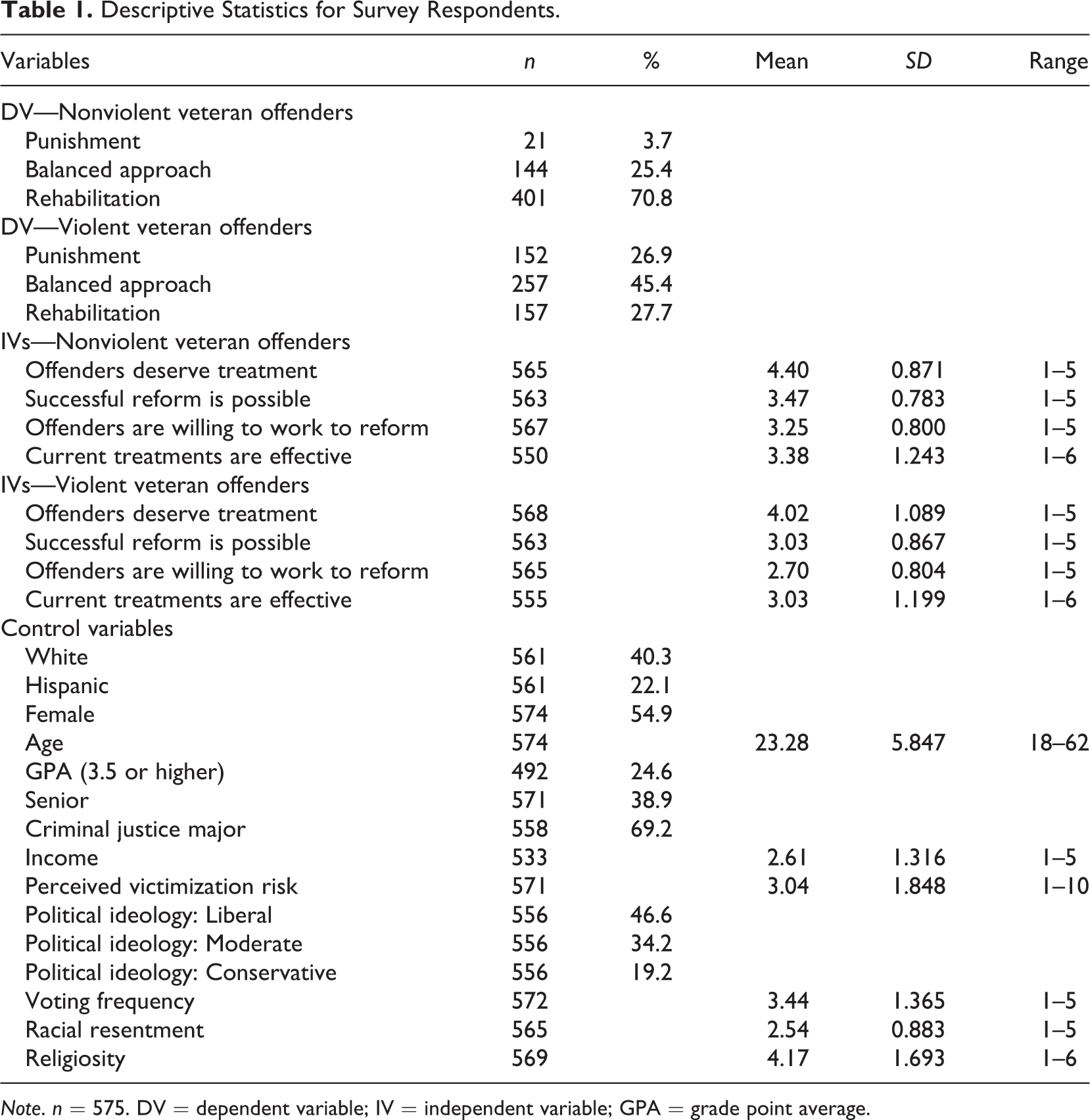
Note. n = 575. DV = dependent variable; IV = independent variable; GPA = grade point average.
Dependent Variables
Two dependent variables are of interest for this study: (1) support for balanced justice for nonviolent justice–involved veterans and (2) support for balanced justice for violent justice–involved veterans. Researchers examining public opinion for sanctions have noted that views are nuanced and the public might not support solely punishment or rehabilitation for offenders (Cullen et al., 2000; Pickett & Baker, 2014) and, instead, might support a sanctioning approach that emphasizes punishment and rehabilitation equally—balanced justice (Mears et al., 2015). In line with Mears et al. (2015), we asked participants “Should punishment or rehabilitation be the goal of sentences for nonviolent veteran offenders?” and “Should punishment or rehabilitation be the goal of sentences for violent veteran offenders?” Response options were based on a 5-point Likert-type scale, where 1 = only punishment, 2 = mostly punishment, 3 = both equally, 4 = mostly rehabilitation, and 5 = only rehabilitation. For the analyses, we combined the response options into the following: 1 = only or mostly punishment (a combination of Response Options 1 and 2 from the survey), 2 = balanced justice (Response Option 3 from the survey), 3 = only or mostly rehabilitation (a combination of Response Options 4 and 5 from the survey). This allows us to examine support for punishment and rehabilitation as compared to balanced justice.
Independent Variables
Four main independent variables in this study were adapted from Mears and colleagues (2015) and examine respondents’ underlying beliefs regarding treatment and reform of justice-involved veterans. These variables examine respondents’ perceptions of (1) whether justice-involved veterans deserve access to rehabilitation programs, (2) the ability of justice-involved veterans to be rehabilitated, (3) whether justice-involved veterans are willing to work toward rehabilitation, and (4) the effectiveness of current treatment programs for justice-involved veterans. For each key predictor, we asked respondents to indicate their views regarding nonviolent and violent justice–involved veterans separately.
Veterans deserve access to rehabilitation programs
We queried respondents regarding whether they believe justice-involved veterans deserve access to rehabilitation programs. The question stated: “Do (nonviolent/violent) veteran offenders deserve to be provided access to rehabilitation programs?” Response options ranged from definitely not (coded as 1) to definitely (coded as 5). Higher scores indicate a greater belief that justice-involved veterans deserve access to rehabilitation programs.
Ability of veterans to be rehabilitated
We also asked respondents, “How often is it possible to rehabilitate (nonviolent/violent) veteran offenders?” Response options ranged from never (coded as 1) to all of the time (coded as 5). Higher scores here also indicate a greater perception of the ability of justice-involved veterans to be rehabilitated.
Veterans’ willingness to work toward rehabilitation
To understand respondents’ perceptions of veterans’ willingness to work toward rehabilitation, we asked respondents, “Now thinking in terms of cooperation with treatment professionals, how often are (nonviolent/violent) veteran offenders willing to work toward being rehabilitated?” Response options ranged from never (coded as 1) to all of the time (coded as 5), with higher scores indicating a greater perception of the willingness of justice-involved veterans to work toward their own rehabilitation.
Effectiveness of current rehabilitation programs for veterans
Finally, we asked respondents, “How ineffective or effective do you think current rehabilitation programs are at rehabilitating (nonviolent/violent) veteran offenders?” Response options were based on a 6-point Likert-type scale ranging from very ineffective (coded as 1) to very effective (coded as 6), with higher scores indicating a greater perception that treatment programs for justice-involved veterans are effective.
Control Variables
Previous research suggests that a number of demographic characteristics are related to punitive attitudes toward offenders (see, e.g., Unnever & Cullen, 2010). In an attempt to reduce bias, we controlled for the following self-reported demographics: race (1 = White, 0 = Other); ethnicity (1 = Hispanic, 0 = Other); sex (1 = female, 0 = male); age in years; college grade point average (1 = 3.5 or higher, 0 = less than 3.5); college senior (1 = yes, 0 = no); criminal justice major (1 = yes, 0 = no), annual household income (1 = less than US$25,000, 2 = US$25,000–US$49,999, 3 = US$50,000–US$74,999, 4 = US$75,000–US$99,999, 5 = US$100,000 or more); political ideology categorized as liberal, moderate, and conservative (1 = yes, 0 = no), 5 with liberal serving as the reference category; and voting frequency (1 = never, 2 = rarely, 3 = sometimes, 4 = almost always, 5 = all the time).
In addition to the above listed demographic characteristics, we control for respondents’ beliefs that have been identified in the literature as relating to punitive attitudes, including perceived victimization risk, racial resentment, and religiosity (see, e.g., Applegate, Cullen, Fisher, & Ven, 2000). Perceived victimization risk is the average of a 5-item scale (α = .90), where we asked respondents, “On a scale of 1–10, how likely do you think it is that you or a family member will become a victim of the following crimes in the next year?” The crimes include auto theft, burglary, assault, robbery, sexual assault, and murder. Response options ranged from not at all likely (coded as 1) to very likely (coded as 10). Consistent with Mears et al. (2015), racial resentment is measured using the average of 5 items (α = .74) from Henry and Sears’s (2002) Symbolic Racism 2000 Scale. 6 Response options ranged from strongly disagree (coded as 1) to strongly agree (coded as 5), with higher scores indicating greater resentment toward Blacks. Finally, for religiosity we asked respondents “How important would you say religion is in your life?” Response options ranged from very unimportant (coded as 1) to very important (coded as 6).
Analytic Plan
All survey data were coded and entered into IBM Statistical Package for the Social Sciences (SPSS) Version 24. The analytic plan is based on the following. First, descriptive statistics are presented for the two dependent variables of interest (i.e., support for balanced justice for nonviolent and violent justice–involved veterans) as well as for all independent and control variables. This allows us to examine and compare the sanctioning preferences of respondents for violent and nonviolent justice–involved veterans. Second, we conduct multinomial logistic regression models to examine the effects of respondents’ beliefs regarding treatment and reform for justice-involved veterans on the dependent variables net of all control variables. Multinomial logistic regression is utilized because the dependent variable is a nonordered categorical outcome (Menard, 2010). Collinearity diagnostics indicated that multicollinearity did not exist between independent variables (all correlations were below 0.5, all tolerance statistics were above 0.1, and all variance inflation factor statistics were below 2).
Results
We begin by examining the descriptive statistics for the various sanctioning approaches for nonviolent and violent justice–involved veterans. This seeks to answer the first research question—To what extent does the public support a balanced justice approach to sanctioning nonviolent and violent justice–involved veterans? As indicated in Table 1, the overwhelming majority of respondents (70.8%) supported rehabilitation-oriented sanctions for nonviolent justice–involved veterans, while less than 4 % supported punishment-oriented sanctions for nonviolent justice–involved veterans. The remaining 25% of respondents expressed support for a balanced justice approach to sanctioning nonviolent justice–involved veterans. A different story emerges, however, regarding violent justice–involved veterans: Forty-five percent of respondents expressed support for a balanced justice approach to sanctioning violent justice–involved veterans and approximately one quarter of respondents supported punishment-oriented or rehabilitation-oriented sanctions for violent justice–involved veterans (27% and 28%, respectively). Although less supportive of a primarily rehabilitation-oriented approach to sanctioning violent justice–involved veterans, the majority of respondents (73%) still supported either a balanced justice or primarily rehabilitation-oriented approach to sanctioning violent justice–involved veterans. Thus, while this sample tends to support a balanced justice approach to sanctioning violent justice–involved veterans, they support a primarily rehabilitation-oriented approach to sanctioning nonviolent justice–involved veterans. These findings are interesting, given the public opinion research that suggests people hold punitive attitudes toward law violators (Cullen et al., 2000; Enns, 2014). Moreover, some VTCs, which arguably promote a balanced justice approach to sanctioning justice-involved veterans, restrict the eligibility criteria to nonviolent offenders (Baldwin, 2015; Douds, Ahlin, Howard, & Stigerwalt, 2015; Holbrook & Anderson, 2011; Johnson et al., 2016). We discuss this finding in more depth in the Discussion and Implications sections.
Next, we turn to the independent variables, which examine respondents’ beliefs regarding treatment and reform of justice-involved veterans. As shown in Table 1, respondents tend to support treatment for nonviolent justice–involved veterans. Specifically, respondents are highly likely to believe that nonviolent justice–involved veterans deserve access to rehabilitation programs (
Table 2 seeks to answer the second research question and presents the multinomial logistic regression results for the dependent variables examining support for a balanced justice or rehabilitative approach versus a punishment-oriented approach to sanctioning nonviolent and violent justice–involved veterans. Model 1 includes all independent and control variables of interest to examine their combined effect on support for balanced justice for nonviolent justice–involved veterans. 7 Results suggest that belief that nonviolent justice–involved veterans deserve access to treatment is the only independent variable significantly related to support for rehabilitation over punishment-oriented sanctions (odds ratio = 2.218). 8 No significant relationships exist between the measures and support for balanced justice.
Multinomial Logistic Regression of Public Support for a Balanced Approach or a Rehabilitation Approach Versus a Punishment Approach to Sanctioning Justice-Involved Veterans.
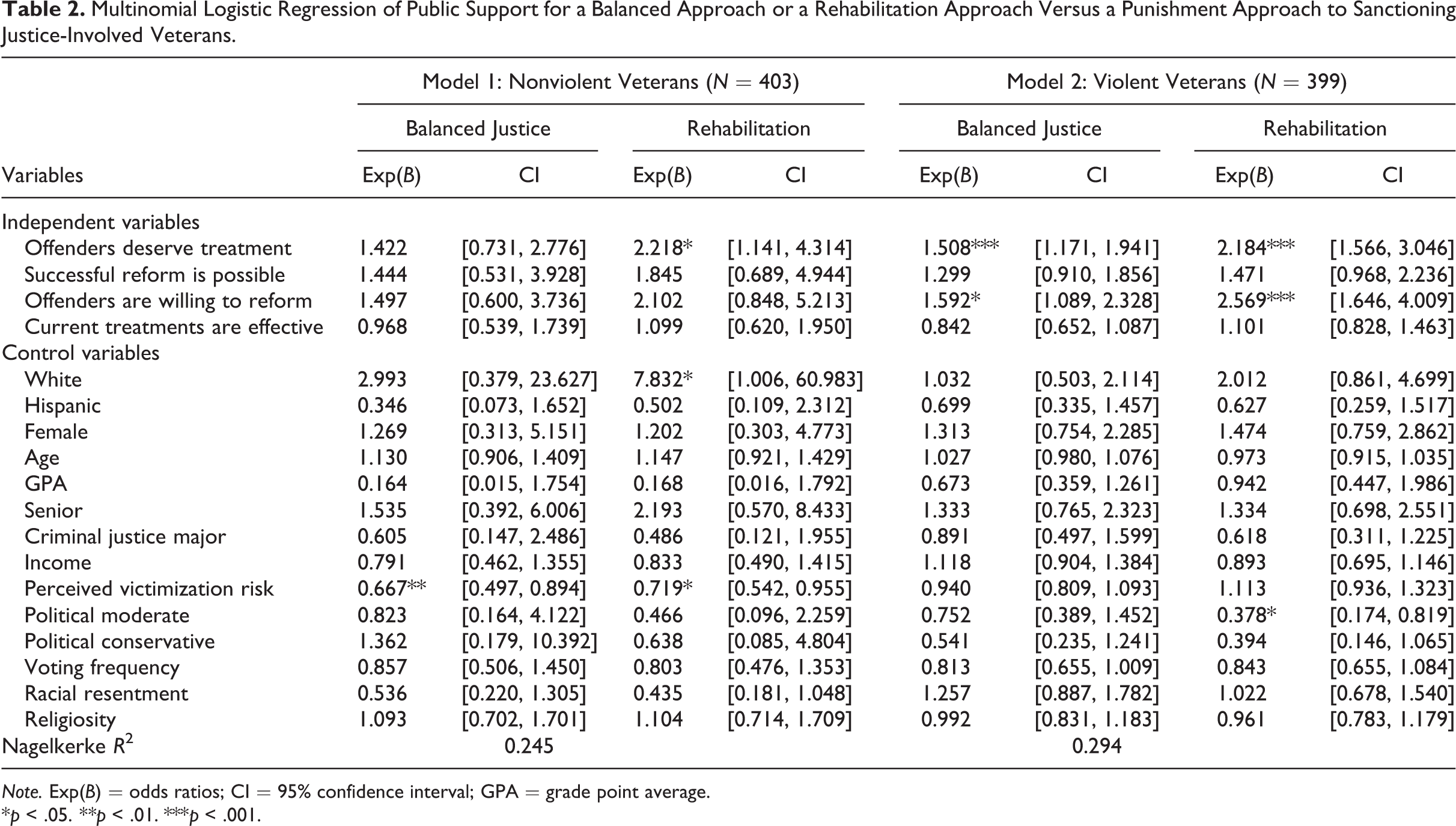
Note. Exp(B) = odds ratios; CI = 95% confidence interval; GPA = grade point average.
*p < .05. **p < .01. ***p < .001.
Various control measures were also significant. Perceived victimization risk, for example, was significant, where respondents who perceived a higher victimization risk were significantly more likely to support a punishment-oriented sanctioning approach compared to a balanced justice (odds ratio = 0.667) or rehabilitation-oriented (odds ratio = 0.719) sanctioning approach for nonviolent justice–involved veterans. Additionally, Whites were significantly more likely than other races to support a rehabilitation-oriented approach to sanctioning nonviolent justice–involved veterans compared to a punishment-oriented approach (odds ratio = 7.832). 9
As seen in Model 2, distinct findings emerge when examining support for balanced justice for violent justice–involved veterans. Specifically, respondents who indicate a greater belief that violent justice–involved veterans deserve access to treatment and who indicate a greater belief that violent justice–involved veterans are willing to reform are significantly more likely to support a balanced justice approach to sanctioning compared to a punishment-oriented approach to sanctioning violent justice–involved veterans (odds ratios = 1.508 and 1.592, respectively). Similarly, respondents who indicated a greater belief that violent justice–involved veterans deserve access to treatment and who indicate a greater belief that violent justice–involved veterans are willing to reform are significantly more likely to support a rehabilitation-oriented approach to sanctioning compared to a punishment-oriented approach to sanctioning violent justice–involved veterans (odds ratios = 2.184 and 2.659, respectively). Regarding control variables, respondents who self-reported as politically moderate were significantly more likely than those who self-reported as politically liberal to support punishment-oriented sanctioning approaches compared to rehabilitation-oriented approaches for violent justice–involved veterans (odds ratio = 0.378).
Discussion
The widespread implementation of sanctioning approaches specifically targeting justice-involved veterans (e.g., VTCs) began in the United States in 2008 (Russell, 2009). Despite recent research examining the operation (Baldwin, 2015, 2017; Baldwin & Rukus, 2015; Cartwright, 2011; Douds et al., 2015; Holbrook & Anderson, 2011; Johnson et al., 2016) and effectiveness of VTCs (Knudsen & Wingenfeld, 2016; Slattery, Dugger, Lamb, & Williams, 2013), no research has examined public support for sanctioning justice-involved veterans. Given the salience of justice reinvestment initiatives (see, e.g., Austin et al., 2013; LaVigne et al., 2014), it is important to examine public opinion toward sanctioning justice-involved veterans through punishment, rehabilitation, or a balanced justice approach, as public opinion can have direct and indirect effects on the allocation of scarce resources (Enns, 2014; Jacobs & Carmichael, 2001; Nicholson-Crotty et al., 2009), such as through electoral incentives of politicians or ballot initiatives (Enns, 2014). Although not the purpose of this article, one could suggest that the basis of balanced justice—a sanctioning approach emphasizing punishment and rehabilitation—aligns with the goals of VTCs. In a national survey of VTCs, Baldwin (2015), for example, found that VTCs seek to reduce recidivism of clients and maintain public safety, while also helping justice-involved veterans successfully reintegrate into society and overcome their behavioral health issues.
As the number of VTCs continues to grow across the United States and other veteran-specific sanctions are implemented, examining public opinion toward punishment and rehabilitation of veterans is valuable. Indeed, this article drew on the work of Mears and colleagues (2015) by exploring support for a balanced justice approach to sanctioning nonviolent and violent justice–involved veterans. Further, we examined whether beliefs regarding treatment and reform of justice-involved veterans were related to support for balanced justice. The major contribution of this article examines support for sanctioning approaches for justice-involved veterans. Although punitive attitudes have increased over time (Enns, 2014), results from the current study indicate that the overwhelming majority of respondents support a primarily rehabilitation-oriented approach to sanctioning nonviolent justice–involved veterans (71%), while supporting a primarily balanced approach to sanctioning violent justice–involved veterans (45%). The findings regarding violent justice–involved veterans are similar to Mears et al. (2015), who found that 54% of their respondents supported a balanced justice approach to sanctioning violent juvenile offenders, and to Sloas and Atkin-Plunk (2018), who found 46% of their respondents supported a balanced justice approach to sanctioning violent drug offenders.
One notable difference, however, between the findings regarding justice-involved veterans and drug offenders (Sloas & Atkin-Plunk, 2018) can be seen when examining support for rehabilitation-oriented sanctions for violent offenders. Specifically, 28% of respondents in the current study expressed support for rehabilitation for violent justice–involved veterans, while in the study by Sloas and Atkin-Plunk (2018), only 12% of respondents supported rehabilitation for violent drug offenders. This finding is interesting, given that the vast majority of VTC clients have substance abuse issues (Baldwin, 2017), while at the same time is not surprising, given the high esteem in which the public holds veterans (Pew Research Center, 2011; Roper Center, 2014).
Furthermore, while a plurality of our respondents supported balanced justice for violent justice–involved veterans, almost three quarters of respondents support either balanced justice or primarily rehabilitation-oriented sanctioning for violent justice–involved veterans. This, combined with the fact that all but 4% of respondents support a balanced justice or rehabilitation-oriented sanctioning approach for nonviolent justice–involved veterans, underscores the necessity of a nuanced examination of public attitudes that avoids the limitations (e.g., acquiescence bias) of previous public attitudes measures (see Pickett & Baker, 2014). Overall, our findings provide further support that views regarding sanctioning offenders do not fall into a purely punishment–rehabilitation dichotomy, but instead the public can simultaneously support punishment and rehabilitation for certain types of offenders (see also Cullen et al., 2000; Mascini & Houtman, 2006; Mears et al., 2015; Sloas & Atkin-Plunk, 2018).
Another contribution of this article is the examination of respondents’ beliefs regarding treatment and reform of justice-involved veterans. To date, no research has examined such beliefs. With few exceptions, respondents favored these beliefs as they relate to justice-involved veterans. Indeed, respondents were highly likely to believe that nonviolent and violent justice–involved veterans deserve access to rehabilitation programs (
Implications
While prior decades saw an increase in the passage of punitive criminal justice policies, such as mandatory sentencing, truth in sentencing, and three strikes statutes (Clear & Frost, 2014), some states, such as Arkansas and Louisiana, have recently begun to reform such policies (Subramanian & Delaney, 2014). Additionally, approximately half of states currently have justice reinvestment initiatives in place, where policy reforms are implemented to reduce spending on corrections and reinvest in other public safety improvement strategies (Clear & Frost, 2014). Some scholars propose that the changes in criminal justice policy are due to a loss in political saliency of the get tough on crime movement (Mauer, 2002). Others, however, assert that state-level policy makers are still unwilling to take risks and promote radical policy changes, as this may result in politicians appearing soft on crime (Clear & Frost, 2014). Although the stability of current criminal justice reforms is unclear at this time, given the recent political administration change, the support found in this study for balanced justice, and rehabilitation for justice-involved veterans speaks to the public’s preference for rehabilitative policy initiatives for justice-involved veterans, which might, at a minimum, include VTCs. These findings also highlight the necessity of examining the public’s attitudes toward other offender typologies and criminal justice policies.
Furthermore, results from this study suggest that the public overwhelmingly supports rehabilitation-oriented sanctions for nonviolent justice–involved veterans and a balanced justice approach to sanctioning violent justice–involved veterans. As such, policy makers should consider the suitability of punishment-only sanctions for nonviolent justice–involved veterans with little to no criminal history. The most recent statistics suggest that over one third of incarcerated veterans are serving time for a nonviolent offense (Bronson et al., 2015). As part of the justice reinvestment initiatives, policy makers should consider reallocating resources from more punitive crime control measures to increase rehabilitation programs for nonviolent justice–involved veterans.
Moreover, VTCs are a sanctioning option for justice-involved veterans that closely embrace the balanced justice ideal. VTCs, as with other problem-solving courts, seek to change future behavior and increase community safety through addressing the individualized needs of veterans stemming from deployment to a combat or war zone (e.g., PTSD, TBI, and alcohol/drug misuse; Baldwin, 2015; Baldwin & Rukus, 2015; Cartwright, 2011; Russell, 2009). The results presented herein also lend credence to a call for a discussion regarding the eligibility criteria for VTCs based on offense type. Juvenile courts were developed, among other reasons, to address the needs of violent youthful offenders (Emerson, 1969; Mears et al., 2015). Conversely, with limited exceptions, VTCs (as with many other problem-solving courts) tend to restrict the eligibility criteria to individuals charged with nonviolent crimes (Baldwin, 2015; Cartwright, 2011; Douds et al., 2015; Holbrook & Anderson, 2011; Johnson et al., 2016; Russell, 2009). However, given the purpose of VTCs—particularly to emphasize both punishment and rehabilitation by holding veteran offenders accountable and addressing their individualized needs through effective treatment—we argue that VTCs are a prime example of a balanced justice approach to sanctioning justice-involved veterans. As such, VTC staff, in collaboration with policy makers, could consider admitting veterans charged with certain violent offenses into their VTCs.
Limitations
To contextualize the merits of the results presented, it is necessary to discuss the limitations of the data collected for this study. Specifically, data for our study were based on a convenience sample of undergraduate CCJ students at one university in a Southern State. Although the study benefited from a reasonably high response rate and seemingly representative university sample, the sample is not necessarily representative of undergraduate students outside the university or of the general public. For convenience, cost, and to increase response rates, CCJ students are frequently used to test theoretical hypotheses (Mancini, Mears, Stewart, Beaver, & Pickett, 2015; Mears et al., 2015; Sullivan & McGloin, 2014). Some scholars have even noted the similarities between student attitudes and those of the general public (Piquero & Bouffard, 2007; Wiecko, 2010). Regardless, the sampling frame should be taken into consideration when interpreting these results.
Additionally, we used a convenience sample where individuals voluntarily agreed to participate, which could have biased the response set. Those who possess more positive feelings about rehabilitation, for example, could have been more likely to participate in the research compared to those who had neutral feelings or those who support punishment-oriented approaches. If this is the case, nonresponse bias could be a concern where those with neutral or punishment-oriented views were not included, thus skewing the results and limiting the generalizability of the findings.
These findings could also be due to the environment in which the survey was administered. Survey administration occurred in college classrooms after the instructor and researchers left the room. Participants were explicitly informed that their responses were anonymous and could not be traced back to them, and all efforts were made to reinforce these statements. Yet, the feelings of the participants, due to the location of survey administration (i.e., in a classroom surrounded by their peers), could have impacted results (Atkin-Plunk & Armstrong, 2016). For instance, participants may have felt compelled, given the liberal nature of college classrooms, to report more rehabilitation-oriented views than they would have had the survey been administered outside of the college classroom.
Finally, omitted variable bias is always a factor that can produce spurious results. Unfortunately, we did not ask respondents to indicate whether they served in the military and are themselves a veteran or whether they have a family member who is currently serving or previously served in the military. However, we did closely follow the public opinion literature in ensuring that we captured other demographic and attitudinal beliefs that are associated with punitive beliefs (Applegate et al., 2000; Cullen et al., 2000).
Directions for Future Research
The results found in this study open lines for future research on the topic of balanced justice for various offender typologies. In addition to the present study, researchers have only examined support for balanced justice for violent juvenile offenders and drug offenders (Mears et al., 2015; Sloas & Atkin-Plunk, 2018). While Mears and colleagues (2015) and Sloas and Atkin-Plunk (2018) found that the public favors a balanced justice sanctioning approach for violent juvenile offenders and violent drug offenders, respectively, and we found similar results for violent veteran offenders, the public’s sentiments surrounding other types of offenders, such as those with mental illness, domestic violence offenders, and property offenders, are unknown at this time. As legislatures and policy makers’ funding priorities shift over time, it is imperative to have a robust understanding of the views of citizens when it comes to sanctioning approaches for offenders. In line with this, future research should move beyond college samples and seek to survey the general public regarding their sanctioning orientations. Results from such studies can provide a more accurate and holistic insight into the views of citizens.
Conclusion
This study built upon the balanced justice work of Mears and colleagues (2015) to examine the nuanced views of sanctioning approaches for nonviolent and violent veteran offenders. Further, we examined how perceptions of treatment and reform of justice-involved veterans related to support for either a rehabilitation, punishment, or balanced justice approach to sanctioning. Results suggested that not only do respondents believe veterans deserve access to treatment, but they also overwhelmingly support a rehabilitation-oriented approach to sanctioning nonviolent justice–involved veterans and a balanced justice approach to sanctioning violent justice–involved veterans. Indeed, sanctioning preferences are nuanced and move beyond a rehabilitation–punishment dichotomy.
Footnotes
Declaration of Conflicting Interests
The authors declared no potential conflicts of interest with respect to the research, authorship, and/or publication of this article.
Funding
The authors received no financial support for the research, authorship, and/or publication of this article.