




Abstract
This study examined the effectiveness of Students Talking it Over with Police (STOP) to improve youths’ perceptions of the police, willingness to cooperate with police, and perceptions of procedural justice. It utilized an experimental design in 36 schools in Milwaukee, WI. Pretest and posttest were administered to assess the outcomes before and after the STOP program. The results indicated that STOP was effective in improving youths’ perceptions of the police, youths’ willingness to cooperate with the police, and youths’ perceptions of procedural justice. Additional analysis suggested that STOP was able to reverse some of the negative effects these encounters had on youths’ perceptions, as those with prior negative interactions of police experienced significantly greater rates of change in their perceptions of procedural justice than those who did not have a negative encounter.
Media reports regarding police’s role in recent high-profile tragedies (e.g., the deaths of Michael Brown in Ferguson, MO, Donte Hamilton in Milwaukee, WI, and Freddie Gray in Baltimore, MD) and social media posts of local police incidences have exacerbated public concern about police behavior. Regardless of the veracity of reports, negative public perceptions alone can impede police effectiveness. National awareness of this potential is indicated in the Report of the 2015 President’s Task Force on 21st Century Policing, which identified police legitimacy as its “first pillar.” This report highlighted the essential role that the public’s views of the police play in policing effectiveness. Furthermore, a specific action item urged police departments to engage youth in nonenforcement interactions at schools (President’s Task Force on 21st Century Policing, 2015, p. 15, Action Item 1.5.3).
Prior research has indicated that positive public perceptions of the police are vital to the effectiveness and quality of the police (e.g., Fagan & Tyler, 2005; Hurst & Frank, 2000; Worden & McLean, 2017). Furthermore, despite a great deal of the research examining police perceptions centering on adults (e.g., Aspler, Cummins, & Carl, 2003; Callanan & Rosenberg, 2011; Payne & Gainey, 2007), youths are more likely to have contact with the police and are more likely to be stopped and frisked by the police (Freiburger & Jordan, 2016; Leiber, Nalla, & Farnworth, 1998; Snyder & Sickmund, 1996). This is especially true in urban areas, where police conduct more field stops of youths (Hurst, 2007; Taylor, Turner, Esbensen, & Winfree, 2001). These more frequent stops also might explain why urban youths have the most negative views of the police (Hurst, 2007; Taylor et al., 2001), as research has found that officer-initiated police contact tends to lower people’s perceptions of the police (Brown & Benedict, 2002; Hurst, 2007; Ren, Cao, Lovrich, & Gaffney, 2005).
Research has further found that youths’ perceptions of the police vary by race and ethnicity. Specifically, Black youths are typically found to hold more negative views of the police (Brown & Benedict, 2002; Hurst, Frank & Browning, 2000) and report more negative experiences with police than White youth (Hagan, Shedd & Payne, 2005; Taylor et al., 2001). Black youths also are more likely to be stopped by the police than White youths (Black & Reiss, 1970; Leiber et al., 1998), which could explain the disparity in attitudes. In addition, Hispanic youths have been found to have less positive perceptions of the police than White youths; Hispanic youths’ perceptions of police, however, tend to be more positive than the perceptions of Black youths (Brick, Taylor, & Esbensen, 2009).
Whether police interactions are positive or negative not only impacts the likelihood that a juvenile will be arrested but can also impact a juvenile’s perceptions of the police going forward (Friedman, Lurigio, Greenleaf, & Albertson, 2004). In addition, youths with more positive views of the police are more likely to obey the law and to cooperate with policing efforts (Fagan & Tyler, 2005; Hurst & Frank, 2000; Piquero, Fagan, Mulvey, Steinberg, & Odgers, 2005; Sunshine & Tyler, 2003; Tyler, 1990, 2006; Worden & McLean, 2017). As discussed by Bottoms and Tankebe (2012), legitimacy should be established through cooperative social interactions between citizens and police, resulting in both groups perceiving the police officer (i.e., power-holder) as the appropriate authority deserving of the “right to rule.” Similarly, research by Pickett and Ryan (2017) found that citizens’ behaviors can shape police officers’ attitudes of due process and the manner in which they handle encounters with citizens. They specifically stress the importance of youths’ interactions with the police and how improving these interactions through informal youth–police interactions can create more positive citizen–police interactions. Given these findings, it is important that youths’ perceptions of the police receive attention, especially the perceptions of urban and minority youths.
Considering the relationship between perceptions of the police and the tendency to violate or obey the law, it is advantageous to improve youths’ perceptions of the police. Although several police departments have created programs to engage youth (e.g., Youth–Police Academies, Police Athletic Leagues, Youth Service Officers, and Youth–Police Initiative 1 ), few have been rigorously evaluated to determine whether they are successful. This study utilizes an experimental design to examine the effectiveness of the Students Talking it Over with Police (STOP) program, developed and implemented to improve police relationships with youths in Milwaukee, WI.
Conceptual Framework
Intergroup contact theory stipulates that intergroup contact can decrease prejudice, improve social relations, and reduce conflict between groups (Allport, 1954). When groups are kept separate, on the other hand, prejudice and conflict can increase (Watson, 1946). According to this perspective, conditions are optimal for better relationships and reduced conflict when (1) the groups share equal status, (2) the groups work toward a common goal, (3) both groups cooperate, and (4) there is institutional support for the initiative (Allport, 1954). Many of the early studies of intergroup contact theory demonstrated how closer and more frequent interactions between Black and White individuals can decrease racial tensions, with the best results being produced from programs that adhere to Allport’s (1954) conditions (see Pettigrew & Tropp, 2006). More recently, Barlow et al. (2012) found that, for White Americans, having a greater quantity of negative interactions with Black Americans increased their expressed racism and avoidance of racial topics and interactions with Black Americans, while having a greater quantity of positive interactions with Black Americans decreased their expressed racism and avoidance of racial topics and interactions with Black Americans. The impact of negative interactions, however, was stronger than the impact of positive interactions.
Recently, Broaddus et al. (2013) applied this intergroup contact perspective to the Outward Bound Police Insight Program, a youth–police program in Baltimore, MD, that was designed to fit the criteria outlined by Allport (1954). Results from their qualitative interviews revealed that after participating in the program, many of the youths expressed positive attitudes of the police, an increased humanistic view of police and an expressed view that there were “good” and “bad” police. Importantly, in addition to Allport’s optimal conditions criteria, they found that successful youth–police programs should be held in a neutral location; should encourage an informal, fun, and light environment; and should foster discussions of stereotypes.
Further, the intergroup contact model shares many similarities with the “experience with police” model for explaining individuals’ perceptions of the police (Reisig & Parks, 2000). Similar to the intergroup conflict perspective, this model asserts that police perceptions are largely shaped by individuals’ experiences with the police. Early research on this perspective has examined the type of contact people have with the police and have found that people who are stopped and searched more often by the police hold more negative perceptions of the police (Bordua & Tift, 1971). People had better perceptions of the police, however, if police took the time to explain their actions during a police–citizen encounter (Furstenberg & Wellford, 1973). Another study by Mazerolle, Antrobus, Bennett, and Tyler (2013) similarly found that individuals who were stopped at roadblocks and read a script that included procedural justice and community engagement elements reported more positive perceptions of the encounter and of police in general than those who were not read the script.
Other research on this model has examined public survey data to allow for the comparison of those who have had police contact with those who have not had police contact. This research found that when individuals initiated contact with the police, it did not lead to reduced police perceptions (Webb & Marshall, 1995). Furthermore, only police contacts that were reviewed as negative led to reduced perceptions (Brandl, Frank, Worden, & Bynum, 1994). Positive interactions with the police, on the other hand, actually improved citizens’ perceptions of the police (Friedman et al., 2004; Reisig & Parks, 2000).
Review of the Existing Literature
Few evaluations have been conducted that examined the effectiveness of programs to improve youths’ perceptions of the police. The programs that have been evaluated have mainly focused on increasing the number of positive interactions between the police and youths in an effort to improve youths’ views of the police. These programs are based on the experience with police conceptual model and on research that finds that more positive interactions with the police can improve perceptions (Skogan, 2006).
One such program, Police-Schools Liaison (PSL), was developed to improve youths’ images and understanding of the police by allowing youths to interact with police in a setting other than the streets (i.e., in schools). As part of the program, PSL officers engaged in activities such as patrols, helped with disciplinary issues, aided in investigations of crimes that occurred at school, and supervised special classes and activities. Although not all youths had direct exposure to the police, the program aimed to improve these students’ perceptions of the police indirectly by allowing them to hear about the officers’ engagement activities in the school. An evaluation of the program, however, found that youths in schools with PSLs did not hold significantly different attitudes of the police than those in schools without PSLs (Hopkins, Hewston, & Hantzi, 1992).
Schuck (2013) conducted another study to determine whether the Drug and Alcohol Resistance Education (DARE) program had an effect on youths’ perceptions of the police. Her study examined data from 24 schools in Illinois, 12 of which received DARE and 12 of which did not receive DARE. Data were collected on youths’ perceptions of the police at seven different times, beginning when the youths were in 5th or 6th grade and ending when they were in 11th or 12th grade. Comparisons of the youths’ perceptions who received DARE with those who did not receive DARE indicated that immediately after DARE, participants had slightly, but not significantly, more positive perceptions of the police than nonparticipations. As the youths got older, however, those who did not receive DARE experienced a significant decline in their perceptions of the police. Those who were in DARE did not experience the decline. Therefore, it appears that DARE was able to effectively prevent the decline in perceptions of the police that is normally seen as youths get older (Schuck, 2013).
Goodrich, Anderson, and Lamotte (2015) evaluated another program implemented in seven counties in Connecticut which involved the engagement of police and youths in community activities. The program varied across the seven communities but all versions shared six qualities. They all (1) involved juvenile and police engagement in nonlaw enforcement activities, (2) had a team-building component, (3) included leadership opportunities, (4) involved a community service project, (5) served some at-risks youths, and (6) did not used existing programs in which police served a teaching role (e.g., DARE).
Pre- and posttest of 119 youths who participated in the program indicated that the youths’ attitudes toward the police were significantly more positive after the program. The youths also reported that they enjoyed the program. Despite the success of this program, the youths did not match the demographics of those youths who hold the most negative views of the police. Most of the youths were White (75%), did not receive reduced or free lunch at school (91%), received mostly As and Bs in school (93%), and had already been involved with a police–youth program (76%). This is problematic as Black (Browning, Cullen, Cao, Kopache, & Stevenson, 1994; Hurst, DcDermott, & Thomas, 2005; Hurst et al., 2000) and Hispanic youths (Taylor et al., 2001) have been found to hold more negative perceptions of the police than White youths, and those living in urban areas tend to view police more negatively than those living in suburban areas (Taylor et al., 2001). It is unknown, therefore, whether the initiative would have been as successful with youths who held more negative views of the police (Goodrich, Anderson, & LaMotte, 2015). In addition, the programs were not consistent across the counties, making replication difficult.
In accordance with the intergroup contact theory, more positive relationships will develop when contact between the two groups is more frequent and when the groups are in a setting which encourages intimate interactions. This can explain the mixed results of these evaluations as these programs involved youth–police contacts of varying quality. Consistent with interpersonal contact theory, programs in which youth had closer and more consistent and intimate contact produced better outcomes. The program evaluated by Goodrich et al. (2015) focused on team-building activities and lots of one-on-one contact with youths. Similarly, DARE involved consistent contact between police officers and students, lasting several weeks. The PSL program, on the other hand, involved little intimate contact with youths and also encouraged a power differential between the youths and police as the PSLs also were tasks with rule enforcement. Given these findings, it is expected that programs designed to foster higher quality contact between youths and police will be more successful in improving youths’ perceptions of the police.
STOP
STOP was developed by the Milwaukee Police Department (MPD) as an in-school program meeting 1 hr a week for 7 weeks. The program utilizes a standardized curriculum written by faculty in the Department of Education at Alverno College and was designed to be facilitated by two uniformed officers to a group of about 12 youths. When STOP was designed, it was intended to target youths who lived in the inner city and who were considered “leaders” in their communities and among their peers. The conceptualization of “leader” was defined loosely to include youth who might not be considered leaders by adults but who have influence over their peers. For example, a youth who is a poor student but is popular would be an appropriate participant in the STOP program. MPD’s logic in targeting these youths was that they could influence other youths and share the information they learned in STOP with their peers and families. This population also was considered important because, although they might not be involved in delinquency activities, they lived in areas where the frequency of police contacts was high. Therefore, they have a greater likelihood of being stopped by a police officer.
The overall intent of STOP was to improve transparency of the police and of police decision-making to improve police and juvenile relations by increasing positive interactions with the police. To do this, several basic concepts were explained to develop an understanding of the impact that crime has on the community and on the police. Furthermore, the program was intended to explain appropriate police and citizen behavior during encounters. The main goals of the program were (1) to improve youths’ perceptions of the police, (2) to improve youths’ willingness to cooperate with the police, and (3) to improve youths’ perceptions of procedural justice.
Seven major topics were covered during the 7 weeks. Each topic contained additional minor themes, with the officers presenting the information to the youths through interactive lectures and games. The first major topic was introductions and relationship building. Officers and students first introduced themselves, then students were asked to write responses to four questions on large pieces of paper taped to each wall of the room. The questions were as follows: (1) What are some negative experiences you have had with the police? (2) What are some positive experiences you have had with the police? (3) What are some rumors you have heard about the police? and (4) What are some questions you have about the police? The police officers then discussed each of the questions with the class.
The second lesson involved how to identify a police officer and a police car. Students were presented with pictures of uniformed officers and given the opportunity to handle the facilitating officers’ handcuffs, vests, badges, identification badges, and radios. During this lesson, the officers also explained the seven police districts in Milwaukee and played a game in which the youths tried to identify the location of each district on a map.
In the third lesson, the police explained crime mapping, showed Milwaukee crime maps to the youths, and explained how crime maps determine daily resource allocation in the police department. The curriculum then discussed the differences between violent and property crime and misdemeanors and felonies. Next, the youths learned which districts had the highest rates of violent felony crime. Lastly, they discussed how violent crimes affected community members and the police in those communities.
For the fourth lesson, the instructors explained ordinance violations to the youths. During this session, youths played a game to identify real city ordinances from fake city ordinances. The game educated the youths on many city ordinances that pertained to them (e.g., spitting on a sidewalk and riding a bike with only one hand on the handlebars) and discussed police discretion. Officers also showed youths a dispatch report for an actual call they received in their squads. The officers then played two audio dispatch calls for service to the youths. During the calls, the officers instructed the youths to write down a description of the perpetrator and the physical address to which the officer would need to respond. The officers used this information to explain to the youths how vague perpetrators’ descriptions can be from dispatch and how these vague descriptions often lead to officers stopping many individuals who meet the description. From this portion of the presentation, youths developed an understanding of why police officers stop youths in their neighborhoods when youths are not engaged in crime.
During the fifth lesson, students were taught about their Fourth Amendment rights and reasonable suspicion. This portion was taught by a community prosecutor from the District Attorney’s Office, when he was available. For sessions when he was not available, the officers taught this portion of the lesson. Next, the officers explained MPD’s code of conduct and how officers should act during an encounter with a citizen. Lastly, officers explained the process to file a complaint against an officer who violates the code of conduct.
The sixth lesson contained an explanation of conflict and provided students with dispute resolution strategies for dealing with conflict. These strategies were presented as Leaders Excel and Acquire DisputE Resolution Skills, instructing participations to (1) watch for emotional triggers, (2) remain aware of your body language, (3) listen actively, (4) demonstrate courtesy, (5) recognize different perspectives, (6) ask questions, and (7) take action to control the situation. Appropriate citizen behavior during a field stop and a traffic stop was also demonstrated.
In the last session, participants engaged in role-playing in which a student volunteer played the part of a police officer conducting a field stop of a youth, played by one of the police officers. In the first role-play, the officer (pretending to be a youth) was courteous and cooperative; in the second role-play, the officer was rude and disrespectful. After role-play, participants received a certificate of completion and a STOP identification card. The card resembled a driver’s license and listed the youth’s name, address, and the name of the youth’s guardian. The card could also be used at local McDonald’s restaurants in Milwaukee to receive a free six-piece order of chicken nuggets with the purchase of one six-piece order of chicken nuggets.
Study Location
Milwaukee is the most populated city in the state of Wisconsin and the 39th most populous city in the United States. According to the 2010 Census, the city’s population is 44.8% non-Hispanic White, 40% non-Hispanic Black or African American, and 17.3% Hispanic, Latino, or Spanish (U.S. Census Bureau, 2010, April 1). Milwaukee is consistently ranked as one of the most segregated cities in the United States and often ranked as the most segregated (Denvir, 2011, March 29). Milwaukee is overseen by the MPD with approximately 2,000 sworn officers who cover seven police districts in the city.
Milwaukee and the MPD made national news in 2014 after a White police officer shot and killed Donte Hamilton, an unarmed Black man with a history of mental illness. Donte Hamilton was shot and killed by Officer Christopher Manny after Officer Manny approached Hamilton in a park where Hamilton was sleeping on a bench. After Officer Manny tried to conduct a pat down of Hamilton, the two engaged in a struggle in which Hamilton took Manny’s baton from him. After being struck with his own baton, Officer Hamilton shot and killed Hamilton with his service weapon. The MPD terminated Officer Manny after the incident for failing to follow proper protocol (Sater, 2014, October 16); however, the Milwaukee County District Attorney failed to pursue criminal charges (Rhodan, 2014, December 22). This sparked outrage in the city and led to weeks of peaceful protests (Hess, 2015, February 25). Milwaukee, therefore, is not unlike other major cities where relations between the police and the public are strained.
Method
Participants
MPD elicited participation from high schools and middle schools across Milwaukee for the STOP program during the 2014–2015 school year. In total, 36 schools agreed to participate. Of the 36 schools, 27 were public, 1 was private, and 8 were charter schools. Each of the 36 schools was instructed to choose approximately 24 students to be participants in the evaluation.
Procedure
Once the students were chosen, the researcher administered the paper-and-pencil pretest to all 24 students during school hours. After the pretest, the researcher randomly assigned each of the 24 students to either the STOP group or the control group using IBM SPSS Statistics software version 21.0. Over the course of the next 7 weeks, the STOP group received the STOP program during school hours; the control group attended their regularly scheduled school activities during this time (i.e., did not receive STOP or any programming during this time). After the STOP sessions concluded, the researcher administered the paper-and-pencil posttest to the participants in both groups (STOP group and control group). The pre- and posttest were identical in their measures of the three quantitative outcomes (perceptions of the police, willingness to cooperate, and perceptions of procedural justice). The pretest, however, contained demographic questions that would not be expected to change during the course of the study (e.g., race, ethnicity, and age) and the posttest contained some additional questions regarding the STOP participants’ experience in the program, if they would recommend STOP to their friends and family and why they would or would not recommend it (these questions were not included on the posttests for the control group).
Eight hundred and thirty-two youths completed the STOP pretest. Participation in the survey and the STOP program was voluntary, and 25 students refused to complete the posttest. An additional 50 dropped out of the STOP program or did not graduate due to having more than two absences from STOP Attempts were made to collect posttest from these youths; however, only two agreed to complete it. These two were included in the analysis. An additional 42 students were unavailable to complete the posttest because they had changed schools or were expelled from school. This left a total of 717 study participants. Of this number, 356 were in the STOP group and 361 were in the control group. Statistical comparisons of the outcome measures for completers and noncompleters were conducted and revealed no significant differences. 2
Program Fidelity
To ensure fidelity of the STOP program, facilitators attended a 40-hr training which spanned 1 week at the MPD Training Academy. The training consisted of lessons taught by educational experts from Alverno College on teaching techniques and on instructing young people. The remainder of the training consisted of a detailed overview of the STOP curriculum, a review of videos of STOP sessions being instructed by the officers who instructed the training and originally developed the STOP program, an explanation of the research component of the STOP program, and practice instruction in which the officers taught STOP in front of their follow trainees and received feedback from the STOP trainers.
As part of the evaluation, student research assistants attended a sample of 42 STOP sessions. Each team of two officers facilitating sessions was observed. The three research assistants reviewed the STOP curriculum and met with the primary investigator to review the 7-week curriculum and coding sheet in detail. The coding sheet identified a total of 25 activities across the seven sessions. During observations, students indicated on the coding sheet whether all parts of the activity were completed. Prior to conducting the observations, all three students also viewed videos of the STOP sessions being conducted by the officers who had developed the STOP program. To ensure consistency in coding, the research team met every 2 weeks to discuss coding decisions, specific factors that influenced each member’s coding decisions and questions that arose during observations. Each observer also attended another observer’s session to ensure consistency in coding. The results of the observations revealed a 1.4% deviation rate from the curriculum across all 33 activities during the 42 sessions. Only one deviation resulted in the entire activity not being delivered by the officers; the remaining deviations were more minor involving missing a component of the activity. Therefore, it was concluded that STOP was delivered with fidelity across the sessions.
Measures
The analysis centered on the following three dependent variables: (1) general perceptions of the police, (2) willingness to cooperate with the police, and (3) perceptions of procedural justice of the police. The first dependent variable determined the impact of STOP on the participants’ perceptions of the police, using a 10-question scale to assess perceptions adapted from Hurst, DcDermott, and Thomas (2005). Question items included things such as “In general, I trust the police” and “In general, I am satisfied with the police in my neighborhood.” The Cronbach’s αs of .877 on the pretest and .904 on the posttest provide evidence to indicate that the scale was highly reliable.
Willingness to cooperate with the police, the second dependent variable, was measured with a six-question scale similar to that developed by Tyler and Fagan (2008). This scale included items such as “I would call the police to report a crime occurring in my neighborhood” and “I would help the police find someone suspected of committing a crime.” The Cronbach’s αs of .800 on the pretest and .822 on the posttest provide evidence to indicate that the scale was highly reliable.
For the third dependent variable, perceptions of procedural justice were measured with a 10-item scale adapted from Sunshine and Tyler (2003). This scale included items such as “The police should have the right to stop and question people on the street” and “People should do what the police tell them even when they do not understand the reasons for police officers’ decisions.” The Cronbach’s αs of .863 on the pretest and .888 on the posttest provide evidence to indicate that the scale was highly reliable. 3
For all items across the three scales, participants indicated their level of agreement with each statement on a 4-point Likert-type scale, ranging from strongly agree to strongly disagree. Strongly agree was coded as 4 and strongly disagree was coded as 1; therefore, a higher score on the scale indicated more positive perceptions of the police on the first scale, a greater willingness to cooperate with the police on the second scale, and more favorable attitudes regarding procedural justice of the police on the third scale. For each dependent variable, an average score of pretest responses and an average score of posttest responses were calculated for each participant.
Analytic Plan
Data were analyzed in two stages. The first examines the descriptive statistics of the study participants and utilized significance test to determine whether the groups were equivalent. Next three multivariate regression models were analyzed to determine whether the groups differed in their posttest scores on the three outcome measures. These models included pretest scores as an independent variable as well as a variable distinguishing between those in the control group (=0) and those in the STOP group (=1).
Lastly, multilevel models were analyzed to determine whether certain youth characteristics (e.g., race, ethnicity, and prior police contact) affected posttest scores on the three outcome measures when pretest scores and participation in STOP were controlled. To control for clustering of youths within schools, three-level hierarchical linear models (HLM) were estimated in the HLM 7.0 software. For each model, the pretest and posttest were treated as Level 1 variables (Time 1 and Time 2), group membership and youth characteristics were treated as Level 2 variables, and possible variation across schools was control in Level 3. The Level 2 variables included a dichotomous variable for membership in the control group (=0) and membership in the STOP group (=1) for Black, Hispanic, Multiracial, and Other were created and analyzed as Level 2 variables with White treated as the reference category. Police contact was entered as three dichotomous variables: (1) had police contact in the last year and was satisfied with the police contact, (2) had police contact in the last year but was not satisfied with the police contact, and (3) no police contact in the last year treated as the reference variable. Sex was also included as a control variable (male = 1).
HLM are appropriate for assessing individual growth trajectories in experimental designs as they account for measurement error as well as the effect a participant’s starting point might have on the ability to change, unlike change score models (Bryk & Raudenbush, 1987; Raudenbush & Bryk, 2002), and have been utilized in other experimental designs (e.g., Groff et al., 2015; Sorg, Wood, Groff, & Ratcliff, 2016). Furthermore, unlike single-level regression models, HLM controls for possible clustering within groups that could bias estimates; this is especially important in this model as students were clustered in schools violating the assumption of independence. Because HLM requires a minimum of three data points, the parallel split scale technique (see Lyons, Zarit, Sayer, & Whitlatch, 2002) was used to fit a regression line at Level 1 using the pretest and posttest scores for all three outcomes. 4
Results
Table 1 displays the descriptive statistics, delineated by group, for all the participants who completed a pretest and posttest (N = 717); those who did not complete the posttest are not included in the table. Of the participants, 51.5% identified as male and 48.5% identified as female. Of the participants, approximately 56% self-identified as Black, 20% as Hispanic, 13% as multiracial, fewer than 6% as White, 1% as Native American, and 4% as “Other.” Thirty-five percent of the participants self-reported that they had some sort of contact with the police within the previous 6 months. Approximately 52% of those who had contact with the police reported being satisfied with the police service they received during this interaction; 43% were not satisfied with the police service they received (some participants left this question blank). Participants were in 5th–12th grade, with the majority being in 8th grade. The average participant age was about 14 years old, with a range from 9 to 18 years of age. Besides two of the race variables, statistical test of the pretest responses found no significant differences in any of the demographics between those who completed and those who did not complete the posttest. Statistical comparisons of the control and STOP groups indicated that there were slightly more youth who identified as White (χ2 = 4.18, p = .041) in the control group and slightly more youth identifying as multiracial (χ2 = 4.26, p = .039) in the STOP group.
Descriptive Statistics for STOP and Control Group Participants.
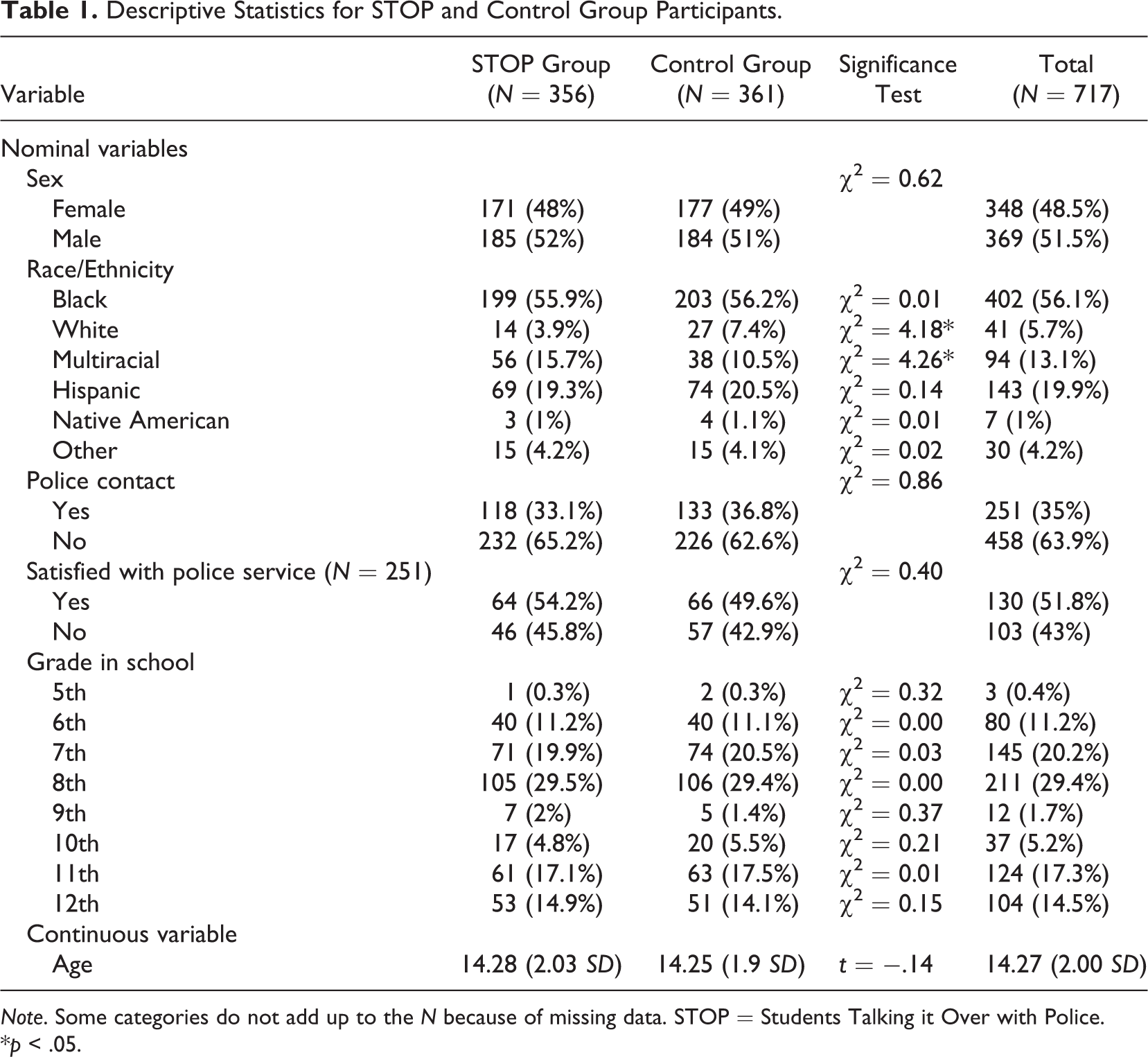
Note. Some categories do not add up to the N because of missing data. STOP = Students Talking it Over with Police.
*p < .05.
As displayed in Table 2, statistical test of the pretest responses for the STOP and control group also were conducted. These analyses found no significant differences in the pretest scores of the three scales (perceptions of the police, willingness to cooperate with the police, and perceptions of procedural justice) for the two groups.
Pretest Scores for STOP and Control Groups.
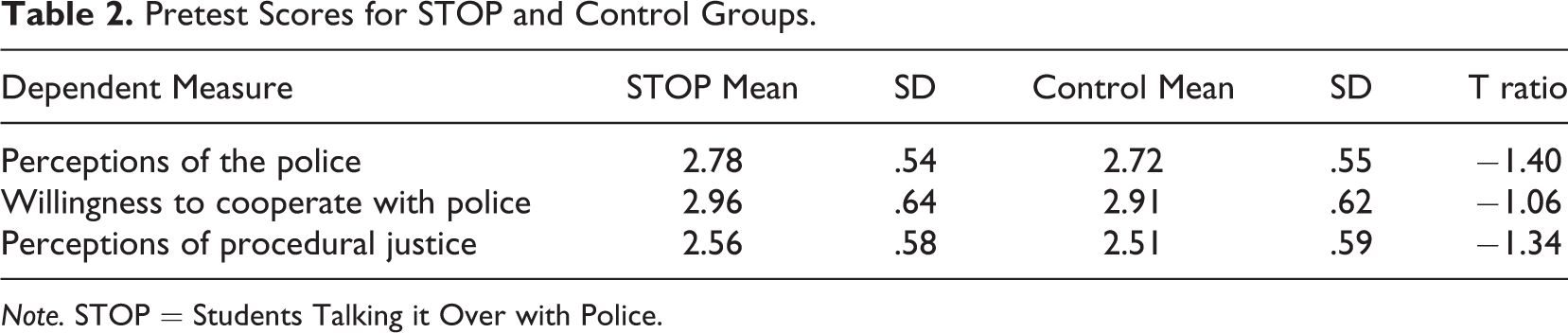
Note. STOP = Students Talking it Over with Police.
Table 3 presents the coefficients for perceptions of the police, willingness to cooperate with the police, and perceptions of procedural justice. For all models, participants’ pretest scores were significant predictors of their posttest scores. Examination of the coefficient for participating in the STOP group resulted in significantly more positive perceptions of police, an increased willingness to cooperate with the police, and more positive perceptions of procedural justice. Because multiple tests were conducted on the same data, the Bonferroni correction also was applied (see Kirk, 2013). With the Bonferroni correction, a critical p value of .0167 for significance was established by dividing the critical p value by the number of tests conducted (.05/3 = .0167). With this correction, all coefficients in the models remain significant.
Multivariate Regression for Outcome Measures.
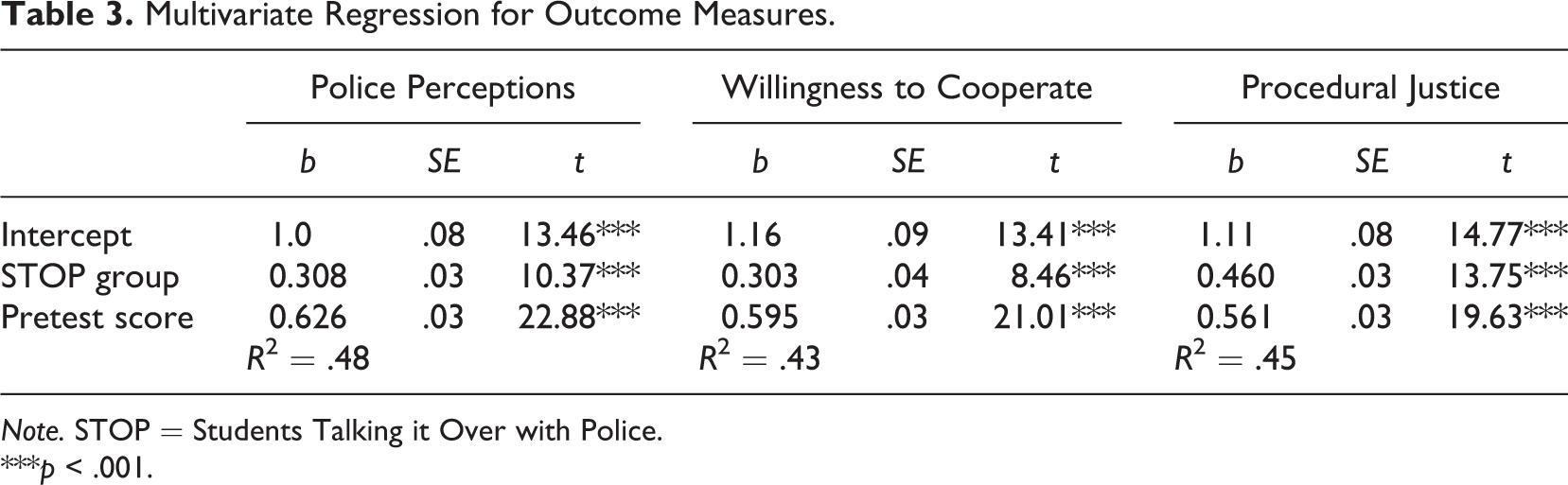
Note. STOP = Students Talking it Over with Police.
***p < .001.
Given the research that has found that minorities and those who have negative encounters with the police have lower perceptions of the police, additional analysis was conducted to determine whether race and police contact had an effect on the rate of change in posttest scores. These data were collected on the pretest. For these analyses, variables for Black, Hispanic, Multiracial, and Other were included as independent variables with White treated as the reference category. Police contact was entered as three dichotomous variables: (1) had police contact in the last year and was satisfied with the police contact, (2) had police contact in the last year but was not satisfied with the police contact, and (3) no police contact in the last year treated as the reference variable. Sex was also included as a control variable (male = 1). Twenty-six cases were eliminated due to missing data. The results are presented in Table 4.
Effects of Race, Sex, and Police Contact.

Note. STOP = Students Talking it Over with Police.
*p < .05. **p < .01. ***p ≤ .001.
For all multivariate models examining race, ethnicity, gender, and police contact, time was entered with Time 1 (pretest) centered at 0; therefore, the intercept for each coefficient represents the average score of participants on the pretest scores. Examination of the intercepts indicate that, consistent with prior research, Black youths had a significantly lower pretest score than White youths for perceptions of police, willingness to cooperate with the police, and perceptions of procedural justice. Those who had a prior unsatisfactory contact with the police also had lower pretest scores than those who did not have police contact in the last year. Males also indicated a lower willingness to cooperate with the police than females on the pretest. Examination of the slopes indicates that none of the race and ethnicity variables nor the police contact variables were significant in the rate of change for police perceptions or for willingness to cooperate. For procedural justice, however, the results indicate that those who were not satisfied with the police service they received actually experienced a higher rate of increase in their perceptions of procedural justice than those who did not have police contact in the previous year.
Responses to Program Questions
Participants also provided responses to a series of questions on the posttest that indicated positive attitudes about the program. When asked whether the STOP program made them feel better about the police, almost 98% of youths indicated that it did. Of the STOP participants, a little more than 97% indicated that the STOP presentation was easy to understand; over 98% indicated that they felt comfortable during STOP Over 87% of the participants indicated that they learned “a lot” during STOP and 12% indicated that they learned “some.” Of the STOP participants, 88% said that their concerns about police were addressed during the STOP session.
Of the STOP participants, 93% stated that they would recommend the program to their families and 97% would recommend the program to their friends. In response to why they would tell family members about what they learned at STOP, one participant wrote, “because even adults need to know what police really do.” Others wrote, “I would recommend STOP to my family because they don’t know how to act” and “the majority of my family dislikes the police.” When asked why she or he would recommend the program to friends, one participant wrote, “because a lot of my friends are ignorant to know that the law is and they just disrespect the title.” Another wrote, “would recommend it because I learned a lot and I trust police now also I know my rights.” Although it is beyond the scope of this project to empirically examine the possibility that STOP produced vicarious benefits, these comments suggest it is possible.
Discussion
Overall, the results indicate that STOP was effective in improving youths’ perceptions of the police, youths’ willingness to cooperate with the police, and youths’ perceptions of procedural justice. Additional questions on the posttest also suggested that participants enjoyed the STOP program and felt that they learned more about the police during the program. These results are consistent with the intergroup contact perspective which theorizes that increased contact among groups will improve each group’s attitudes about the other group. The STOP program was mostly consistent with Allport’s recommended conditions to achieve optimal success. First, many activities encouraged a shared equal status. Despite the officers wearing their uniforms during the sessions, youths were encouraged to actively engage in the discussions and lessons, with many lessons being led by the youths. Youths also were provided the opportunity to wear or handle the officers’ equipment (with the exception of weapons). During the sessions, officers and youths also worked toward common goals. When students worked through activities, the officers would sit with the youths and help them with the activities; officers also participated in all the role-play activities. Officers would join the other youths in cheering on a youth who volunteered to complete an exercise in front of the class. These activities encouraged intergroup cooperation. The STOP program also enjoyed support from the authoritative institutions. The schools that sponsored STOP allowed the youths to attend each session during the regular school day, and MPD supported officers’ time being spend facilitating the STOP sessions.
STOP further contained two of the additional conditions discussed by Broaddus et al. (2013). The atmosphere in which STOP was facilitated was fun and engaging. Officers and students engaged in lots of informal conversations and shared jokes at each session. In fact, sessions usually began with officers asking students about their weekends and discussing their weekends with the youths. During several sessions, open discussions regarding stereotypes occurred. Youths were encouraged to ask questions about profiling, different policing practices in different neighborhoods, high-profile incidences in the news, existing beliefs of police officers, and how they believed police officers viewed them. These conversations were so commonplace that a portion of the 40-hr training to be a STOP instructor was focused on preparing officers to engage in these discussions.
The results also indicate that Black youths and youths who have had a negative experience with the police in the last year held lower perceptions of the police, were less willing to cooperate with the police, and held lower perceptions of the police on the pretest than White youths and youths who did not have contact with the police in the last year. This is consistent with prior research that has found that Black youths tend to hold more negative attitudes about the police (Hurst et al., 2000) and that negative encounters with police lead to more negative views of the police (Friedman et al., 2004). These factors did not affect the rate of change, however, except for those who had negative experiences with the police. Those individuals experienced a higher rate of change for procedural justice. This is especially important as procedural justice has been found to affect individuals’ likeliness to engage in criminal behaviors (see Tyler, 1990, 2006). Furthermore, negative interactions with police lower perceptions of procedural justice (see Tyler, 1990, 2006), yet it appears from these finding that the STOP program was able to reverse some of the negative effects these encounters had on youths’ perceptions.
Given these findings, the STOP program appears to be a promising step in addressing issues with inner-city youths’ perceptions of the police. In addition, it is possible that by improving youths’ perceptions of the police and their behaviors when interacting with the police, police behaviors could change. Pickett and Ryon (2017) found that police officers were more likely to support a due process model as opposed to a crime control model if they experienced more encounters with citizens who cooperated and exhibited procedural justice in their encounters with the police. In turn, this could have the potential to reduce discrimination and cases of the mistreatment of citizens by the police.
Although other programs have focused on youths and police interactions, the STOP program has some unique elements that make it innovative. First, STOP is focused on youth leaders instead of youths who are considered high risk (it is important to note that certain demographics of the STOP participants, such as residing in the inner city, being economically disadvantaged, and residing in high crime areas, could lead one to classify them as high risk). Second, the focus on informal leaders in these neighborhoods has the potential to extend the positive effects that STOP can have on youths’ perceptions of the police.
Limitations and Future Research
Attrition posed a limitation to the study. About 85% of the STOP group and 88% of the control group were retained. It is possible, however, that those who were not retained were different than those who were retained and the program would have differently affected them, especially the 12% who did not graduate the STOP program. While the similar rate of attrition experienced in both groups reduces this concern, it is possible that those who did not graduate were negatively affected by the content of STOP and this type of programing would not be beneficial to them and their inclusion in the analysis might have mitigated the positive impacts of STOP Although every effort was put into receiving posttest from those who did not complete the survey, only two were obtained.
Furthermore, it is possible that the stable unit treatment value assumption was violated in this experiment. Control group and STOP group members attended the same schools and possibly had contact with each other. During this contact, it is possible that the STOP participants shared some of the information they learned with control group participants. If this occurred, it is possible that the results might underestimate the true effect of STOP (see Berk, 2005).
In addition, STOP was designed to be a program for informal youth leaders. This caused some concerns in the school, as many believed the resources devoted to the program would be better utilized with a population of youth who were involved in illegal activities. The school was also given the task of selecting students; random selection was not utilized. Therefore, generalizability of the results to other youths should be done cautiously.
Future evaluations of the STOP program should include follow-ups. In addition to providing an assessment of the long-term impact of STOP on police perceptions, additional follow-ups can assess whether STOP participants used their STOP card (i.e., showed it to a police officer during an encounter). Furthermore, additional follow-ups could assess whether STOP had a vicarious effect on others by asking youths whether and with whom they shared the STOP information.
Because STOP is facilitated from a standardized curriculum, it could be implemented in other cities. Replication efforts should also be evaluated to ensure the program is implemented with fidelity and to determine whether STOP is effective in improving youths’ perceptions of the police in other areas. This is especially important, given the impact that perceptions have on police effectiveness and the struggles that other cities are experiencing with public trust.
Similar to other major cities, Milwaukee struggles with poor police and juvenile relations. These issues arise not only from the perceptions that youths have of police but also the perceptions that police have of youths. Prior research has indeed indicated that police also view youths negatively (Gaines, Kappler, & Vaughn, 1994; Guarino-Ghezzi, 1994). Although STOP is aimed at changing the perceptions that youths have of the police, it is possible that the officers who are involved with STOP also benefit from the program. Future research should explore this possibility and assess whether police officers’ perceptions of youths also are affected.
Conclusions
This study adds to the limited body of research examining the effectiveness of programs focused on improving youths’ attitudes about the police. Utilizing an experimental design, the study found that the STOP program significantly improved youths’ perceptions of the police, willingness to cooperate with the police, and perceptions of procedural justice. Despite these promising findings, current issues with community and police relations are complex and heavily impacted by historical events that must be addressed. It would be unrealistic to expect the STOP program (or any single program) to solve the problem with youth and police relations. However, it is important to consider the advantages of programs such as STOP that increase the positive interactions that youth and police share. These programs can be an important part of working toward improving community and police relationships, especially among those who view the police most negatively.
Footnotes
Declaration of Conflicting Interests
The author declared no potential conflicts of interest with respect to the research, authorship, and/or publication of this article.
Funding
The author disclosed receipt of the following financial support for the research, authorship, and/or publication of this article: This research was funded by a grant from the U.S. Department of Justice Office of Community Oriented Policing Services (#2013-CK-WX-K031).