



Abstract
In the context of mass incarceration, more and more prisoners grow old in U.S. prisons, and with recent changes in legislation more and more are being released. These individuals are often ill-prepared to function in a society that has changed significantly during their incarceration. This qualitative study examines the psychosocial needs of these releasees. Nineteen semistructured interviews took place with adults ages 55-82 who were released from parole and professionals who worked with this population. A grounded theory methods approach was used for data collection, coding, and analyses. Using saturation as a consensus, several themes emerged related to the specific needs and challenges older adults face postincarceration: challenges of parole, challenges of parole specific to older adults, reentry initiative (RI) program success, and quality of life/mental health. The needs of formerly incarcerated adults are complex, and many find themselves in an environment that does not help them with the required adjustments. Many lack ties to the community, having lost contact with friends and family who might assist them at this crucial time. As a result, many older adults released from parole seriously consider reoffending as an option. This article concludes with a discussion of best practice suggestions such as formal RI programs to assist older adults postincarceration in successfully transitioning back into society and policy changes to address the needs of this vulnerable population.
Background
According to the National Association for the Advancement of Colored People, the United States has the largest incarcerated population in the world (NAACP, 2016), and much like its society overall (Ortman et al., 2014) its prison population is aging (Carson & Sabol, 2014). Between a trend in new legislation in states and territories nationwide that provides for compassionate release (Maschi et al., 2016) and increasing numbers of older adult prisoners nearing the end of their long-term sentences (Kerbs & Jolley, 2009), the population of recently released formerly incarcerated older adults is ballooning. In 2009, more than 70,000 offenders were released from state and federal institutions and into the community, and aging prisoners represent an increasing share of this population (Wyse, 2017). This group has needs that affect neither their older adult peers nor their younger parolee counterparts, facing elevated risks of mental health problems, substance misuse, and poor social reintegration postrelease (Bryson et al., 2017). Many have been in prison a long time, and they face a society that mostly does not value older people and that has strong negative sentiments about former prisoners. Programs to address their specific needs are scant.
While there is a somewhat robust literature on prisoners’ mental health and other needs, few studies focus on the mental health and psychosocial needs of the postrelease functioning of formerly incarcerated older adults. Understanding their psychosocial and mental health needs is crucial to helping them successfully integrate back into society, which will benefit both this vulnerable population and society at large.
Aging in the United States
The aging population in the United States is becoming more diverse in terms of rural or urban residency, racial identity, sexual orientation, ability, socioeconomic status, culture, religion, and other factors (Mehrotra & Wagner, 2018). As of 2013, approximately 44.7 million of the total U.S. population, or roughly 14% of the overall population, was aged 65 or older, and this is estimated to increase to 21% of the total population by the year 2040 (U.S. Department of Health and Human Services, 2014). The graying of the nation will coincide with the diversification of the nation, as the United States is anticipated to become minority–majority by the year 2050 (McBride, 2012).
Minorities also make up the majority in prisons and jails (Bonner et al., 2016). Together, African American and Hispanics comprised 58% of all prisoners in 2008, even though they make up only one quarter of the U.S. population (Hartney & Vuong, 2009). The racial component of mass incarceration must not be overlooked in general, but the intersection of aging and incarceration adds to this complex issue. As increasing numbers of older adults are being released to society, the field of ethnogeriatrics needs to include this growing group in their focus.
Social Integration Postrelease and Recidivism
At the end of 2016, an estimated 4.5 million adults in the United States were under community supervision (Kaeble et al., 2016). A plethora of social challenges face formerly incarcerated people as they seek to socially integrate and meet the demands of their parole or probation requirements. Such conditions might be general, such as refraining from breaking the law, reporting to probation officers as required, and not leaving the state without permission, or special, tailored to the circumstances of each case (e.g., drug testing and treatment, curfews, restraining orders; Corbett, 2015). Postrelease requirements may include finding and maintaining regular employment, participating in intensive supervision programs, not changing residence or employment without permission, and paying supervision fees. These requirements can complicate successful reintegration for older adults, who may be particularly lacking in knowledge about available resources, skills to execute technological processes, and social connections for support. Older offenders’ connections to family may be frayed due to years of criminal involvement, drug abuse, or lengthy prison sentences (Wyse, 2017).
Many researchers have indicated that insufficient preparation for discharge can lead to high rates of recidivism, and lowering recidivism rates is a policy goal in most jurisdictions (Durose et al., 2014). While little data exist parsing out the recidivism rates for older adult former prisoners, overall data for recent releasees are concerning. For instance, a 5-year Bureau of Justice Statistics study (Palermo, 2015) regarding prisoner postrelease found that more than two thirds (67.8%) had some form of interaction with the justice system within 3 years and nearly half (49.7%) had returned to jail or prison, either for violation of parole or a new crime. It has been established that older offenders recidivate at lower rates than younger offenders; it remains mostly unknown how older offenders fare in the process of social integration (Wyse, 2017).
Social inequality theory, with its tenets of social location, inequality, and the interconnectedness between the individual and the institution can help frame a perspective and understanding of the social problem of reintegrating older releasees from prisons and jails into society. According to this theory, a plethora of preconceived social notions attend individuals’ social location, such as being an older adult on parole, and may indicate that a person’s quality of life is not of value to society, as the stigmatized term “ex-convict” suggests. Arguing the ethical and moral issues that attend a prisoner’s identity is beyond the scope of this study. However, it is important to mention the social inequalities that lead many to aging behind bars. The U.S. judicial system incarcerates minorities at a much higher rate (Wildeman & Wang, 2017) than nonminorities, and many researchers document how social inequalities and racial disparities put some groups at greater risk of incarceration (Travis et al., 2014; Western & Pettit, 2010). As an exiled group, these men and women have no access to what little social mobility the United States offers (Western & Pettit, 2010), and formerly incarcerated older adults may have had the least such access. The prison systems are largely comprised of minorities, who have often been victims of social inequalities and racial disparities that may have predestined them to a life of crime and incarceration (Brewer & Heitzeg, 2008). The institutional silhouettes of American social inequality have been transformed by the rapid growth in the prison and jail population. America’s prisons and jails have produced a new social group, a group of social outcasts who are joined by the shared experience of incarceration, crime, poverty, racial minority, and low education (Western & Pettit, 2010).
Older adults who are incarcerated will likely respond more constructively when their needs are taken into consideration and they feel a sense of security once released. They may also be less likely to re-offend if they are given the means necessary to survive and complete their parole sentence. Analyzing the issue of aging behind bars with a more comprehensive lens may help our understanding of the complex needs of formerly incarcerated older adults to help live after prison with a sense of dignity and avoid recidivism. Little is known about the postrelease experiences of older adults, a gap in the literature is addressed here.
Method
Sampling and Recruitment
We recruited older English-speaking men aged 55+ who were released from parole (N = 14). This study included only males aged 55+. Due to sample availability, only men were included; the reentry center that was used for sample access did not have any females who had formerly received their services and are no longer on parole. This occurrence aligns with older prisoner demographics being that only 6% of older adult prisoners are female (Chettiar et al., 2012). We also spoke with five professionals who work with parole clients, using a combination of convenience and snowball sampling strategies, from a reentry initiative (RI) program in Southern California. The professionals included the director of the reentry center, the financial manager, a member of the security staff, a caseworker, and an intake coordinator. Together this group of 19 people comprised our key informants (KIs). Triangulation was used to seek diversity by prison sentence, age, and time elapsed since release. In the community, older adults are defined as 65 years and older. In prison, the age at which an inmate is deemed “geriatric” varies from state to state (Lemieux et al., 2002). In some states, inmates as young as 50 are defined as geriatric; in other states, inmates are not considered geriatric until they reach age 55 or 60 (Anno, 2004; Lemieux et al., 2002). Despite these differing definitions, there is consensus that inmates undergo a process of accelerated aging compared to their age-matched counterparts outside of prison (Aday, 2006). Outside of prison, people often encounter new physical, psychological, and social challenges as they age. In prison, an environment designed for younger inhabitants, aging introduces additional challenges in safety, functional ability, and health (Williams & Abraldes, 2007). The purpose of the study and participants’ rights were verbally explained to each participant, and they all signed informed consents. The Loma Linda University Institutional Review Board approved the study procedures.
Interview Procedures
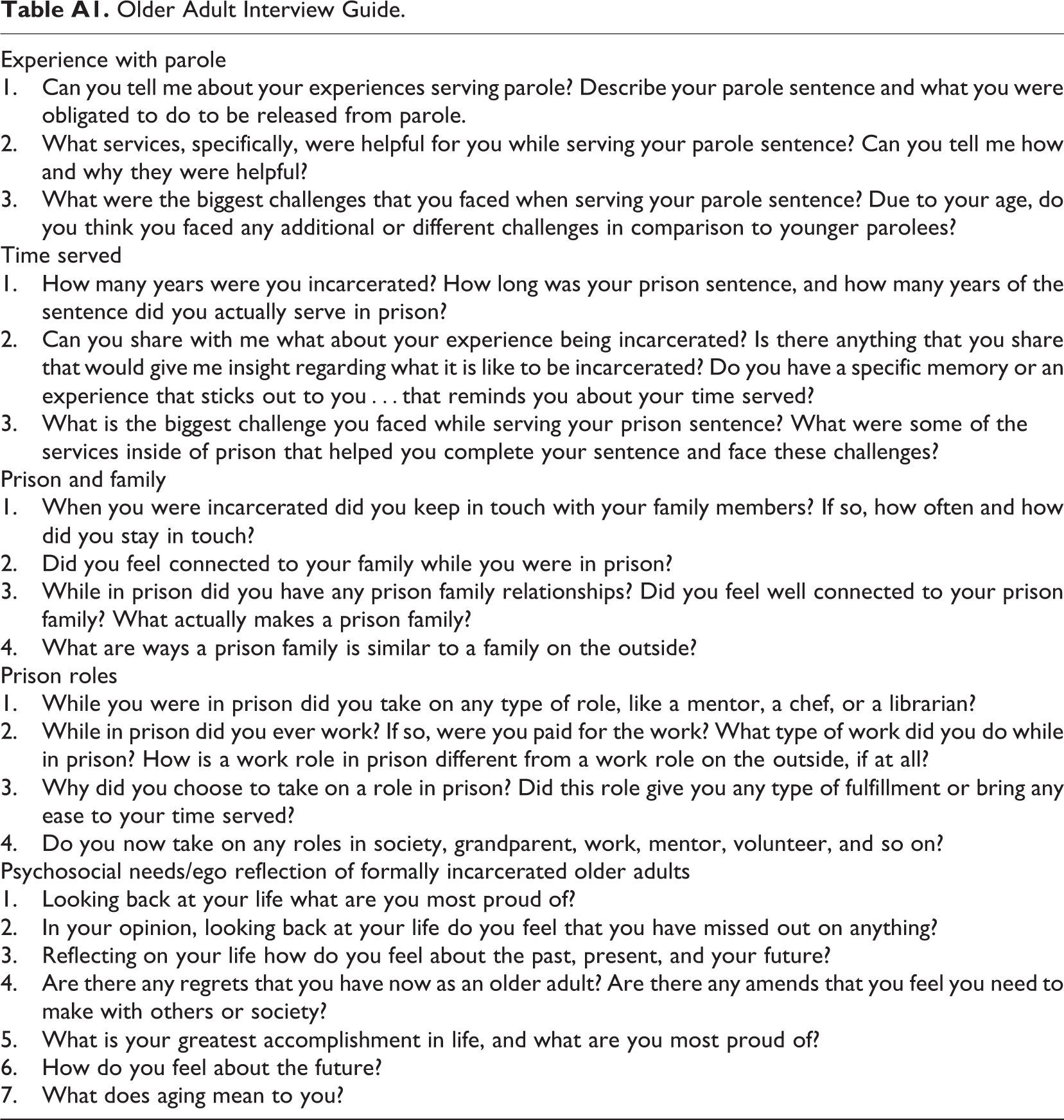
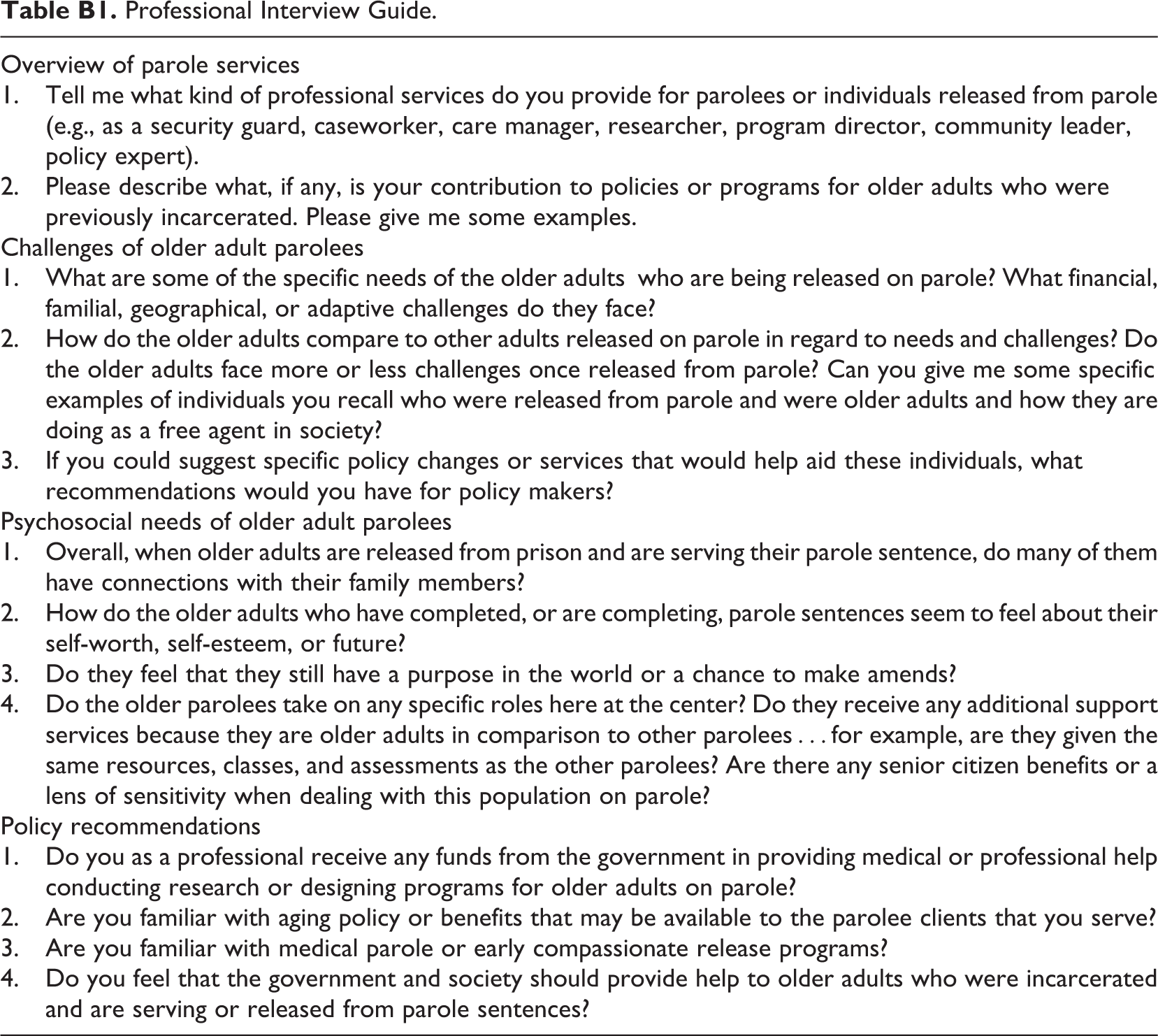
To ensure consistency across interviews, data were collected through semistructured, audiotaped, face-to-face interviews by a qualitatively trained researcher between July 2017 and December 2017. Interview guides were used to ask the releasees (Appendix A) and professionals (Appendix B) about the experiences and challenges of formerly incarcerated older adults who have served parole. The interview questions for releasees covered the following topics: (1) experiences during parole; (2) prison experiences related to family, work roles, social roles, and mental health; and (3) current state of mental health and reintegration success/failure. The interview questions for professionals related to their perspective on former prisoners’ postrelease needs and experiences as well as their policy and resource recommendations. Participants were also asked to complete a brief paper–pencil form assessing their sociodemographic characteristics.
Qualitative Data Analysis
Six analytic strategies proposed, and Miles et al. (1994) were used to guide our qualitative content analysis: (1) coding of data from interviews; (2) recording insights and reflections on data; (3) sorting through the data to identify similar phrases, patterns, themes, sequences, and important features; (4) looking for commonalities and differences across data and extracting them for further consideration and analysis; (5) deciding on generalizations that hold true for the data; and (6) examining these generalizations in light of existing knowledge. In addition, a grounded theory approach as defined by Charmaz (2014) was implemented for qualitative analysis to apply the theoretical lens of social inequality theory (Western & Pettit, 2010). Thus, data analysis involved three stages of coding: open coding, axial coding, and selective coding. This technique organized the data into similar categories, allowing us to examine the phenomenon of interest. These categories yielded themes that allowed for the coherent understanding of the phenomenon in relation to the theoretical lens of social inequality theory.
The transcribed data were read in depth for context and then coded using emerging line-by-line coding to create a list of emerging codes. The list was then organized into groups that aligned as axial emerging main codes, and additional subcodes under each main code, which then constructed the structure of the analyses to aid in systematically theming responses from participants. Once a finalized codebook was created, it was applied to all transcribed interview transcripts included in this analysis. A constant comparison method was used to ensure that analyses were truly based on participant responses.
Establishing Trustworthiness and Rigor
In order to ensure trustworthiness and rigor, the authors used the following strategies, which Patton (2002) recommended: (1) ensuring participants’ confidentiality; (2) data triangulation, by recruiting a diverse array of stakeholders who have different roles within the community; (3) member checking by discussing new data with participants who had been interviewed earlier; (4) research reflexivity by debriefing with coauthors to identify our own biases during the data collection process; and (5) incorporating verbatim statements that were linked to descriptions of data.
Results
Sample Characteristics
The average age of releasees in the study was 66, and their average length of incarceration was 19 years. Seven were White, including two who identify as Hispanic, and seven were African American. More than half were not married, and more than half had obtained some high school education. Most were unemployed when we spoke and had an annual household income of less than US$12,000. Among the five service providers, all were earning at least US$36,000 annually. Their average age was 44, and the average number of years they had worked with the population of interest was 13.4 years (Table 1).
Sociodemographic Table.
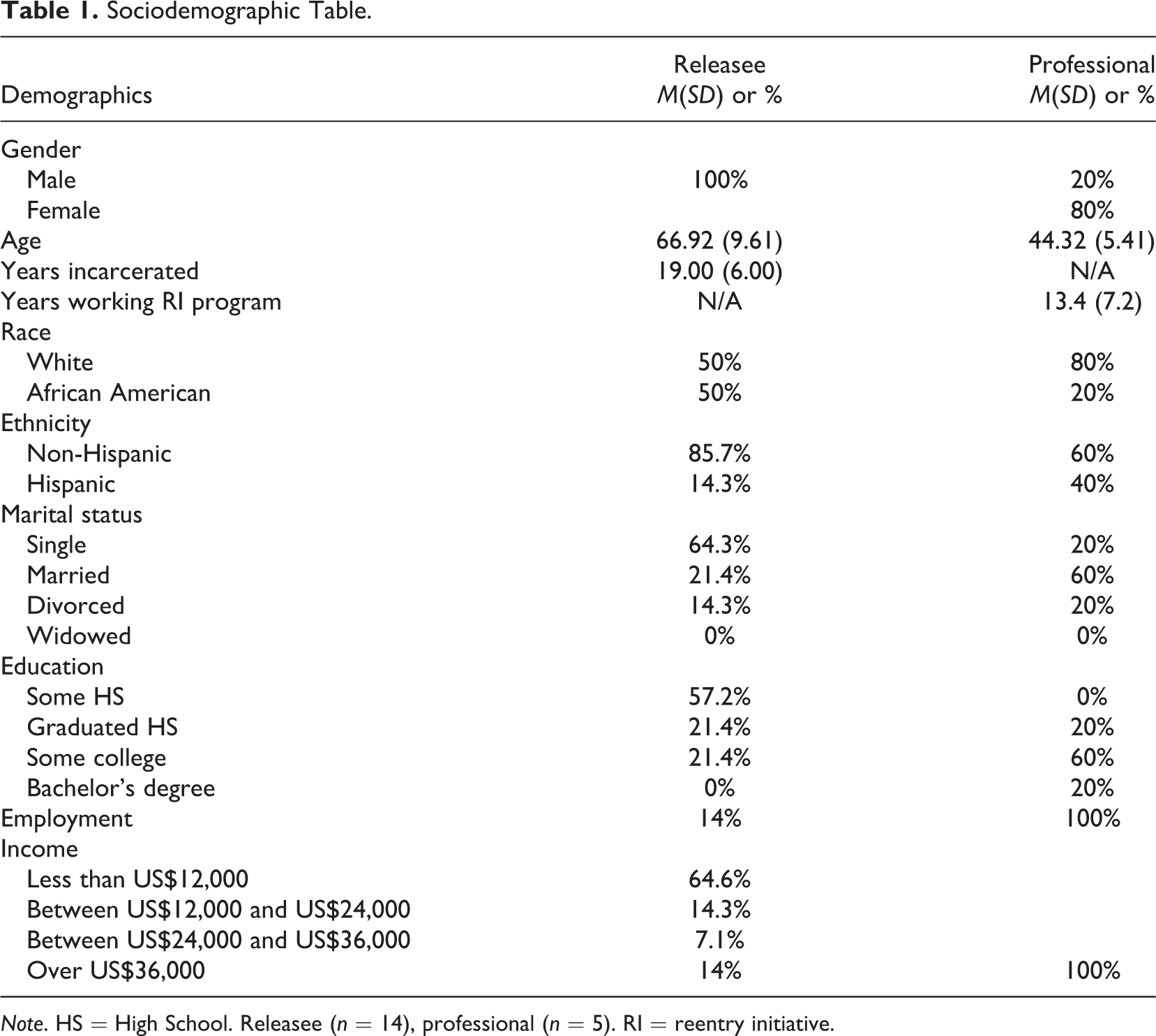
Note. HS = High School. Releasee (n = 14), professional (n = 5). RI = reentry initiative.
The qualitative analysis conveyed several emerging themes, each with three to four subthemes: challenges of parole, challenges of parole specific to older adults, RI program success, and quality of life/mental health (Table 2).
Axial Codes and Themes Older Adult KI.
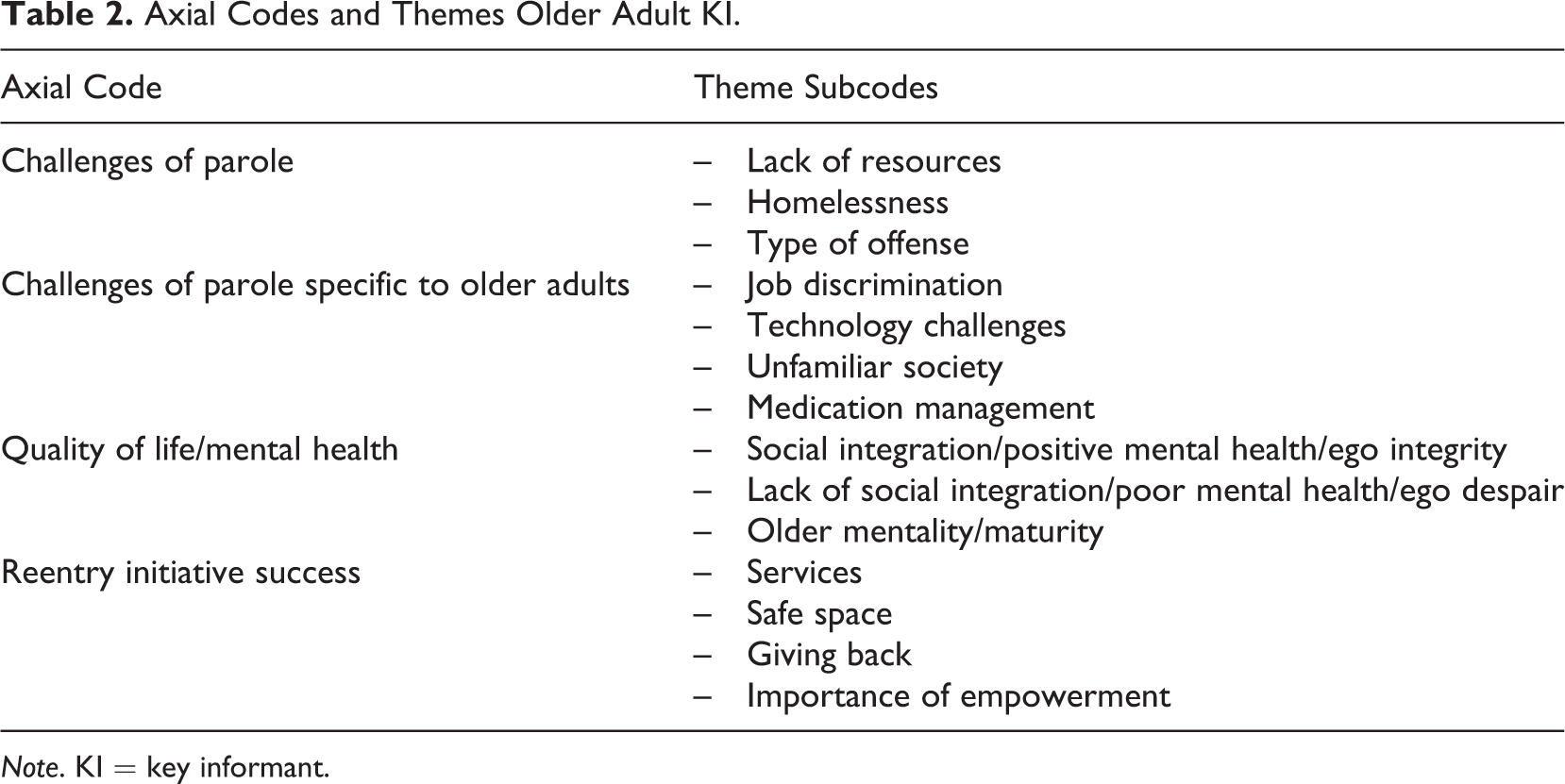
Note. KI = key informant.
Theme 1: Challenges of Parole
Subtheme: Lack of resources
Most individuals postrelease are mandated to complete parole. Releasees emphasized the lack of resources available to assist them in successfully completing their parole requirements. They cited lack of transportation in communities with poor infrastructure; lack of referrals for many types of needed services, including housing, food, jobs, health care, and if referrals are identified, the delay in receiving general relief aid; and lack of funding or clear guidance for completion of mandatory requirements such as obtaining state-issued ID. A 72-year-old releasee explained how these problems might lead to recidivism: They expect us to go to all these places and they are not close and do all these things. They don’t even give us a bus pass and you cannot walk in [this metropolitan area, which generally lacks sidewalks]. We need to get an ID, but that costs money, and it’s hard to try and fill out all the paperwork to try and get food stamps or cash aid to help us eat or with the costs. Sometimes it’s just easier to do something to go back in [to prison]. You get hungry being on the streets, and lots of us old timers, we don’t have family anymore that will take us in. I know it sounds crazy but the stress of all the things you got to do, and being hungry, sometimes makes prison look greener [i.e., like the greener grass on the other side of the fence]. When I go off my meds I go crazy and they tellin’ me to fill this out and I got to go get referrals and stuff and I ain’t got time for all that. I knew off my meds I might commit another crime and be right back in. I know myself, it’s sad.
Subtheme: Homelessness
All KIs in the study mentioned homelessness as being a key barrier to successfully integrating and meeting the demands of parole. Indeed, many releasees said that homelessness was the greatest challenge they faced during their parole sentence. A professional explained that the state provides releasees 120 days of housing at the most and that this was far from sufficient for older releasees: There is no way an older adult is going to be able to get on their feet in 120 days. One hundred and twenty days is not enough to find employment and a place to live. Older adults cannot survive on the streets! Some of these individuals are close to death due to their chronic conditions. It breaks my heart when I have to tell a 70-year-old, “sorry, there is no housing for you.” You know, trying to do this and trying to do that, you got all this stress of doing right so you don’t get penned up again, but that’s hard, you know. When you ain’t got nowhere to lay your head or take a hot shower. I asked my parole agent, where am I supposed to go. He said, “You see that field over there? Go stay in that field for 2 years (time to complete parole sentence.) So I was like, man, at least inside I had a shower and a bed.” Because there was nothing that your parole agent could do or tell you where you were gonna stay, or if there were any funds for you to be housed—and, you know, I was like, “Well, before I live in the streets, I guess we’ll turn around and, and go back and, you know. There’s no hope. Turn around and go back. I can do homeless when I was in my 30s. I can’t do homeless in my 70s. It—it’s just too hard.” If you ain’t ever been in the streets you don’t know that pain, the cold you can’t escape, the heat you can’t escape, there is nowhere to go. [I couldn’t go to] a park or a bench, they [police] will come kick you out. You forget about all of your classes [on how to behave] and sh** that you have to do. You first start to only think survival, and that’s why you are probably going to catch another case [re-offend].
Subtheme: Type of offense
As releasees explained, some types of offense made it particularly difficult to reintegrate into society. For example, a 79-year-old releasee explained how the fact that he was a registered sex offender made him homeless: Uhh, because I had a, before this case [the most recent crime that led to imprisonment], I had a case. Well not quite a case. It was 20 years ago, and it was a sexual case. Umm, so I had to become a [registered] sex offender. When I got this case I had ended up having to do new registration stuff and all this other stuff. So, being that my wife and my grandchildren were in the home, I couldn’t go home. I’m boxed in. I can’t do this, I can’t do that, I can’t go here, I can’t go there. I can’t go this distance, I can’t look for a job there, I can’t look for a job here. It just—umm, yeah. If I use certain public transportation routes and they pass by a school I am in violation. I was so paranoid once I spent like three extra hours walking in the sun to be sure [I would not commit] no GPS violation. Also I had to be homeless on parole because my family, they got a house close to a school. So, yeah. It’s hard to even find housing for [sex] offenders [for the 120 days the state will provide]; we can’t guarantee their safety in the housing units that we have. Of course, their information is always kept confidential, but word gets out. These types of criminal acts are even demonized by other criminals. I had an individual almost get beat to death the first night on parole in a housing unit because [the attacker felt] you don’t mess with women or children.
Theme 2: Challenges of Parole Specific to Older Adults
Subtheme: Job discrimination
One of the many requirements of parole and probation sentences is to obtain employment within a short period. Older releasees face the same agism that all older adults face as well as discrimination in hiring against people with a criminal record and the fact that most jobs recent prison releasees can obtain are manual labor jobs that they may be physically unable to perform. A 66-year-old releasee explained: Here are some challenges you face in the work world as an older person: you may go for an interview they can obviously tell that you’re older and most of the time they’re looking for, let’s say the only job that you’re really able to get is through a temporary service and working in a warehousing district. It’s hard work, it’s labor intensive, you are 60 years old. You do not have the stamina that a 30-year-old, 20-year-old has, even a 40-year-old—you don’t have that stamina. What am I gonna do? I don’t know how to do most of what is out there. I went in so long ago. Now even in the warehouses and constructions they got fancy new ways of doing it all. I never got much skill or training before I went to prison, none on the inside. And now here I am, and I got nothing to offer.
Subtheme: Technology challenges
For many releasees who had been incarcerated at least 20 years, the changing face of technology was a barrier to reintegration. Some of the basic requirements of parole, like getting an identification card/social security card, applying for a job, or registering for mandatory classes, require them to go online. There are many older adults who do not even understand the concept of the internet, let alone know how to operate a computer or smartphone. A 78-year-old releasee explained: Well it was, it was kinda, it was kinda hard because I’m still learning because, uh, everything’s—social security, [inaudible] bank, um, whatever you had to do you had to do it online almost, now. And that’s, that’s been hard for me trying to get that. I need somebody to sit down with me two, three hours, uh seven days a week and learn and learn computers. I don’t understand [the move to online communication]. Why can’t I just give you my information on an application? Why must they make it harder for me? And everyone is using a cell phone! I don’t even know how to use it for much except call. I asked my PO [parole officer] how do I get to the social security office and he said to navigate it [use a navigation app]. What the hell do you mean? Just give me the damn directions. I just feel lost with all this.
Subtheme: Unfamiliar society
All of the releasees mentioned how much society had changed since they had been incarcerated. They spoke of not recognizing the society to which they returned. Beyond technological barriers to applying for a job or benefits, they found the increased cost of living a shock that complicated their adjustment to the contemporary society. A 75-year-old releasee said: It’s a whole new world out here, and it ain’t pretty. Before life was much easier. If I wanted a job I would look in the ads in da paper and then go in for an interview. Now they got it all online—I don’t even know what that means, what’s online? Got to submit an application online. And you call me the criminal? Sh** you all is the criminal. I came out and went and order a pastrami sandwich and Coke and they tried to charge me ten dollars. Now you trying to rob me! Ten dollars for a sandwich and Coke. It hit me hard that day. I knew I wasn’t going to be able to survive. It is hard to keep up with the needs of older adults; they are very different needs than younger parolees have, and no one is really trained or versed with working with them. Helping them apply for social security, potentially access old retirement funds, helping them apply for Medicaid, etc—it’s too much. To add to all of these challenges, I can’t say, get help from a family member, many of them have no family at all, they have been locked up for too long. And teaching an older adult how to use the computers is also a challenge.
Theme 3: Quality of Life/Mental Health Postrelease
Subtheme: Social integration
Despite their many challenges, some releasees were able to successfully socially integrate back into society. Two men expressed a strong sense of self, existing social connections, and good mental health, without exuding anger over time lost. A 77-year-old releasee said: I am a supervisor for Pepsi now, I love my job and love being a leader there. They gave me a second chance and I took it. I would say life right now is good. I have a lot to be thankful for. My family have accepted me back, my job is good and good pay. I still volunteer around here and now I am a grandpa, so I am real busy. I wasn’t able to be there for my kids—but my grandkids, they are gonna’ get sick of me because I ain’t going nowhere. It has been a long hard road traveled but life is good and I am blessed. The future to me is bright. I am hopeful. I still have a lot of life left in me and I am doing alright out here. I got a good job, my own little place, and I keep real busy down at the church helping other people like me. I ain’t scared to die. I know I have made some terrible mistakes but I know God forgives me and my family still loves me. As long as I have that, no matter what comes up in the future I will be just fine. I can’t get a job because they won’t hire someone like me and it’s [meaning the prison system] just a business anyway. My parole officer told me it’s a business, they want us back—we are their paychecks. So everyone [is] out to get me and I am barely surviving, always having to look over my shoulder. You never know who is trying to do what. I just try and stick to myself. No, I don’t even know where my family is, someone told me out of state. It doesn’t matter anyway, we haven’t been family for a long time. They wanted them to lock me up and throw away the key. So, yeah, it’s just me and I don’t give a sh** anyway. The future is scary, and I don’t know what’s going to happen. You see, all my problems and troubles is because of my past. I can’t get a job, or if I get one I can’t keep it. I am a convict for life—there ain’t no changin’ that. My family, that’s how they see me too and that’s what it is. If I could only go back and start over, everything would be different. And it’s not like I have much time left, you know. I am old and could die any day and I don’t have time to go back and get things right. It’s done, so that’s the hand I got dealt.
Subtheme: Older adult maturation
In spite of the fact that some releasees spoke of recidivism, many said they had no interest in continuing the presentencing mistakes. The professionals also said that older adults have a different attitude toward life than younger releasees and agreed that they are too old for criminality. As they described, this group truly wants to “make it” and function outside of the prison, and intentional effort and support would likely make that possible. As one said: The older adults, once they are released, they are much easier to work with in the sense [that] they have a different mindset. It’s not like working with a young 20-something year old who think they are all hard and can’t be told what to do. My older guys that come through, they pretty much say, look I don’t have much time left, I need to get set up and I am too old to be running the streets. They are easier to work with in the sense that I am not worried too much about them reoffending. I am more worried about their health. You get to a point in your life when you are just too old for all the nonsense; you are not trying to prove nothing anymore. You just want to get on with yourself and make the best of what you got left. I tell these younger cats that come through here, “Don’t be stupid and waste your whole life like I did. It’s not worth it, you will lose everything that counts and matters most.” I’m too old to be a criminal now; I have paid my debt to society and now I am just trying to do what is best for me and my family.
Theme 4: RI Program Success
Subtheme: Services
Releasees all described the RI program in a positive way. They said that the services that were offered through the program were critical to any successes they had and that the program had helped them to comply with their parole requirements and given them whatever ease or confidence they had in the process. A 62-year-old releasee said: Without this program I would be back inside. This place made it possible for me to do everything on my requirement list—they offered everything I needed in one place. I don’t have to go here and then take a bus and go somewhere else and then miss my deadlines. And whatever they don’t have here that you need, they help you find a way to get it or do what is needed to not get locked up. No one ever cared that much about me before on the outside. For once, you know, someone was on my team. They let me take all the classes here, even if I didn’t need them. It kept me busy—distracted. And I learned things I need to try and you know, get back into society. This place taught me how to use a smartphone and make a résumé. When I went away [meaning into prison], none of this was here, and this place [the RI program] not only gave me a hot meal and somewhere to come in off the streets. I was here learning and keeping my mind and hands out of trouble. This is a win-win for someone like me.
Subtheme: Safe place
In addition to the services they received at the RI program, releasees said it was important that it provided them a safe place, a haven from the streets where they could focus on their reintegration process. Releasees said that the RI program provided them with a sense of mental health stability, as it was one of the few places where they were treated well, and where they were seen as human, not as a criminal, and given choices. A 66-year-old releasee explained: This is the only place I was treated like a human being since a long time. In prison, you are not treated like a human, [and when] you get out your family only sees you as a criminal. But not here, not here. They [the people at the RI program] were the first ones who made me realize I was a man again, not just a criminal. They don’t refer to you by your crime or parole number. They give you choices and ask for my opinions on things. Hell, they even put me in a suit and some nice shoes for a job interview, I was a new man. And this place gave me that. I wasn’t worried about being judged or someone rooting against me to get locked up. It was nice. They helped me find myself because I was lost for a long long time. Sh**. Too long. You know, when you ain’t got nowhere to go—that’s when you get in trouble. This place is somewhere you can go and just rest, like, rest in your mind. Don’t have to be lookin’ over your shoulder all day. I come in here and get something to eat and focus on my classes or requirements. Or sometimes I just come and hang out and play cards or I talk to the other parolees, we find each other in the struggle and it helps to have the support. When I come in here, they ain’t like, what do you want? They ask me how I am doing and offer me a place to come in from the outside. That is hard to find for men like me. Not even your own family look at you like that sometimes.
Subtheme: The importance of giving back
Many of the older adults felt a sense of obligation to give back to the RI program through volunteering or mentoring other parolees. They felt that the program was effective and wanted to help contribute in any way possible. The RI program does not require parolees to perform this service; they took on this responsibility freely and felt that it helped them in their own journey. For example, a 62-year-old releasee said: Even though I have been done and off of parole, I come back here all the time. To visit and tell them I am still doing good, but also to help out and, you know, do my duty of giving to them. I’ll come and help them clean up after lunch or help move stuff or whatever, just trying to pay them back for what they gave me. [One of the staff members] knows she can call me anytime of the day or night and I’ll be here for whatever she needs, because she was always there for me like that. So yeah, I spend a lot of my free time here. I believe in this place and if others who come through here see that, then maybe they can make it through and make it out.
Subtheme: The importance of empowerment
The professionals emphasized the importance of empowerment and choices. Many said that informing releasees of choices instead of choosing for them or ordering them was critical, and giving releasees choices and making them feel they had a voice at the RI program made them more willing to comply with program requirements. They also feel that the range of classes the RI program offers helps to empower individuals to make the right choices, as does the staff’s policy of encouraging and reinforcing growth and even small successes. One explained: I tell them right when the walk through the door, if you are not ready to be here you don’t have to be here. There is the door. Many of them look so surprised that they are given a choice, a choice to change. We allow them to vote on things here at the center that are important to them; we make a suggestion box available to them. We let them know, we are here to help you, that is our job, and ask them what they need. They have lived most of their lives being ordered what to do and we don’t do that here.
Discussion
The purpose of this qualitative study was to explore the psychosocial needs of older adults postincarceration. Both the older adult former parolees and the professionals who worked with them spoke of the tough challenges releasees face as they transition back into society, challenges arising from a combination of their age, lack of resources, and length and type of incarceration. Most had not overcome these challenges, which wreck their mental health and wear them out. However, all spoke of the RI program as playing a critical role in successful reintegration postrelease, as it was designed to tap into their resilience and move them toward being self-sufficient, many found in giving back to others like themselves. Another premise of this study was that while all releasees from prison have significant needs for help with reintegration, the challenges older adults face postrelease are very different from their younger counterparts.
Both releasees and professionals discussed the prevalent agism in our society, and how it contributes to the challenges that older adults face to meet their parole requirements. Older adults on parole have a very difficult time obtaining employment due to the type of employment available to formerly incarcerated people. Most of the jobs available to this population are manual, heavy labor jobs that are often not manageable for the older adults on parole. However, obtaining employment is not just an important parole requirement, it also is known to reduce the risk of recidivism. Skardhamar and Telle (2009) found that employment lowers the hazard of reincarceration by 63%. While individual circumstances account for some of the association between employment and reincarceration, having employment by itself resulted in lower odds of reoffending. Moreover, older adults are not offered the same opportunities as their younger prisoner counterparts to prepare for release. Institutional programs are not geared for older inmates; educational, vocational, and recreational programs all are geared to the 20- to 40-year-olds (Skardhamar & Telle, 2009). Older adults have little opportunity for reintegration employment as they cannot work strenuous manual labor jobs and face age discrimination and criminal stigmatization which puts them at high risk of not meeting parole requirements and of extreme poverty, as releasees who reference hunger suggest. Not only does lack of employment lead to material hardship and parole violations, it also impacts older adults’ mental health. As Wyse (2017) found in her study of formerly incarcerated people, and the releasee who works at Pepsi conveyed, a job can signify to a man that he still has a place in society and personal significance that is lacking without it.
Bryson et al. (2017) discussed the importance of developing multidisciplinary and case management–based parole and probation programs to help identify, prioritize, and address the complex needs of older adults who were formerly incarcerated. Multidisciplinary parole and probation services should include collaborations with community organizations to work with older adults who are involved in the justice system. Policy makers should consider investing in such strategies as reincarceration is far more expensive. Locating such programs in the community where they can be sustainable could result in a much more robust support system for referrals, education and information, and resource exchange. In addition, community health care practitioners need to be involved with older adults who have had correctional involvement and must be conscious that they are likely to have complex psychosocial needs (Bryson et al., 2017). Research has also noted that the complexity of formerly incarcerated older adults’ needs requires greater collaboration among a diverse group of local stakeholders, including professionals from health care delivery, public health, and criminal justice and the directly affected individuals, their families, and advocates (Metzger et al., 2017).
Many older adults in this study attributed their successful integration to the RI program. The program takes a comprehensive approach to serving individuals on parole and assesses their needs individually. It could serve as a model framework of how to aid these individuals with reintegration postrelease.
Moreover, older adult releasees have a very difficult time navigating technology that had changed so much while they were incarcerated. Many do not understand how to access services online or use smartphone devices, which have become a way of living in our society. With the advent of technology and institutions digitalizing operations, older adults who were incarcerated during this societal shift experience frustration and anxiety related to navigating these processes. It is noteworthy to emphasize that older adults in this study were not trying to utilize technology for recreational purposes, yet they needed to master technology to meet some of the basic parole sentence requirements: applying for employment, creating a résumé, and applying for government aid, a social security card, and a government-issued identification card.
Both groups of KIs emphasized the importance of housing postrelease. Physical vulnerabilities and chronic ailments made it nearly impossible for releasees to survive on the streets. These findings align with Western et al. (2015), who convey that material insecurity combined with the adjustment to social life outside prison creates a stress of transition that burdens social relationships in high-incarceration communities. Their study revealed that material hardship and lack of housing postrelease create extreme feelings of anxiety and isolation. Wyse (2017) found that older offenders are the most materially disadvantaged of any group of releasees. They are insecurely housed and less likely to be employed and more likely to be socially disconnected. Providing housing for older adults may be the first step that is crucial to their reintegration process. While some housing may be available for parolees, both funding and availability are limitations, and in the jurisdiction of focus they cannot stay more than 120 days. This gives the parolees 4 months to obtain steady employment, save for a down payment on an apartment, and have enough money left for rent and to pay for mandated classes to complete their parole requirements. This task may be insurmountable for older adult parolees, who have trouble obtaining employment and searching for possible living locations. Policy makers should consider extending the housing allowances for releasees over 55 before turning them out on the streets when the allotted time has expired. Wyse (2017) suggests that this period be at least 6 months, preferably a year.
Postrelease experiences may be influenced by prison experiences. Older adults in prison have more complex health and social care needs than both younger prisoners and their age-matched peers living in the community (Forsyth et al., 2014). Aday (2006) discussed the concept of accelerated aging that inmates undergo due to a harsh prison environment and stressors. Outside of prison, people often encounter new physical, psychological, and social challenges as they age. In prison, an environment intended for younger inhabitants, aging introduces added challenges in safety, functional ability, and health. Coupled with past prison experiences influencing mental and physical health, older adults postrelease may also face social and environmental challenges. As older ex-prisoners reenter their communities, they may face further challenges such as being frail in an unsafe neighborhood, having numerous medical conditions with limited access to medical care, and leaving the familiarity of the place they have lived in for decades (Williams & Abraldes, 2007). Noteworthy, older adults in this study who took on active roles in prison such as a volunteer, mentor, or had a prison job seemed to transition postrelease more successfully.
A contributing factor to older adults’ poor transition postrelease is the lack of postrelease planning. Older adults in this study described the lack of resources and postrelease planning as detrimental to their integration process. Many older adults shared that they did not receive any sort of postrelease guidance or planning. Many felt the transition from prison to society was abrupt and beyond being ill-prepared to meet their parole requirements, they were unable to survive outside of the prison walls. These findings are similar to Forsyth et al. (2017), who conveyed that older prisoners in their study perceived release planning to be nonexistent. They reported lack of formal communication and continuity of care, which caused them high levels of anxiety.
Society is not meeting the psychosocial needs of older adults postrelease. Given the current prison and aging demographics, the impact of this will increase in the coming years. Older adults who have spent many years in prison have complex disparities. Policy makers, institutions, health care providers, and other stakeholders need to take a collaborative approach in aiding older releasees with successful social integration postrelease. The idea of compassionate release is not very “compassionate” if we do not take the needs of older adults into consideration. Older adults have different challenges and needs compared to their younger parolee counterparts and older adult peers. Older adults postrelease are the least socially integrated of any releasee group and have the weakest family ties, the most unstable housing, and lowest level of employment (Western et al., 2015). Better addressing the needs of this vulnerable population may lower the risk of recidivism for older adults and help them successfully integrate postrelease.
Strengths and Limitations
The use of a theoretical sample was a limitation in this study. Therefore, the results of the current study need to be interpreted with the understanding of the impact of self-selection bias on the study sample. However, given the sensitivity of the topic, recruiting a sample of KIs seemed a logical first step to gaining further insight on how to investigate the needs of this sensitive population. While the sample was small, we found data saturation across the themes, which for the most part was supported by the limited existing literature, therefore lending further credence to the validity of our findings. While the sample is too small to make generalizations of the national older adult population, the study’s findings suggest that further investigation is needed to expand on the complexities of understanding the psychosocial needs of older adults postrelease. Older adults postrelease may be deterred to seek services and resources that will aid them in their postrelease integration process if professionals are not sensitive to their unique geriatric needs that are different from their younger counterparts. In addition, another limitation of this study was that older adults’ needs were not assessed using valid and reliable instruments that would allow for better interpretation of their psychosocial needs postrelease.
Another limitation of the study is the relative limited number of professional participants who worked with the population of interest. However, our study focus was on formerly incarcerated older adults, and the inclusion of professionals was done for triangulation purposes. Interestingly, while many of our findings were confirmed by the professionals we interviewed, we also found that most were not very aware of the specific day-to-day struggles older adults postincarceration faced in comparison to their younger counterparts. For instance, many noted that they were not able to offer guidance regarding social security payments, geriatric medical issues, or senior resources available in the area. They felt that they lacked the knowledge and gerontological awareness to optimally help older adults with their unique psychosocial needs. Given the increasing numbers of older adults and their special challenges, it would be beneficial to have an individual present at every RI program who specialized in the needs and care for older adults.
The researchers choose to collect demographic data via paper forms due to the sensitivity of the questions being asked such as income, marital status, and sexual orientation. Due to the inherit nature of collecting data via interviews, some advantages and disadvantages are assumed. One of the advantages of face-to-face interviews is that the interviewer can pick up on nonverbal cues, keep the interviewee on track, and probe for more information when necessary. There are also noteworthy disadvantages related to interviewer effects. The participants may be reluctant to tell the truth due to the nature and sensitivity of the questions regarding criminality. In addition, qualitative research is based on the interpretation of the author. While measures were exercised to eliminate author biases or false interpretation, the interview is constructed between the interviewer and the respondent. During analysis, the researcher interprets the meaning.
Summary of Findings and Future Research Recommendations
Older releasees from prison face many barriers to successful integration. Some of these general barriers are lack of resources such as referrals, transportation, and guidance for completion of mandatory requirements. Other challenges of parole that are specific to older adults include job discrimination attending both being an older adult and having been in prison. This discrimination ignores the fact that older adults are very unlikely to commit a crime and typically have an increased investment in conventional roles and ties that can make for a trustworthy employee (Wyse, 2017). In addition, older releasees have difficulty using technology to navigate societal life tasks. Many older adults had trouble adapting to an unfamiliar society due to being incarcerated for most of their adulthoods. Older adults postincarceration may have a time gap in health care access postrelease, which impacts medication management. In addition, older adults in the study varied regarding mental health and quality of life. Some older adults in the study exhibited good mental health and were hopeful for their future, but most were struggling with mental health issues such as paranoia, hopelessness, and depression. At the same time, all of the participants had positive feelings toward the RI program. They described the services they received through the program as critical to any successes they had, as they helped them not only to comply with their parole requirements but also to navigate the challenges of parole with a better sense of ease and confidence.
In addition to confirming prior findings, we were able to identify issues that point to the need for further research, especially regarding how prison experience may impact social integration and mental health postrelease. Older adults not only experience challenges while serving their parole sentence, they also have recently experienced many challenges in prison. It is important to try and understand the specific challenges of prison life and how they may persist postrelease. The aggregated long-term exposure to chronic challenges may affect prisoners’ ability to successfully integrate postrelease.
Future research should also focus on the differences in needs regarding older adults and their younger peer counterparts postrelease. Many of the professionals in this study expressed that they were unaware of how to aid older adults postrelease due to their lack of understanding of specific geriatric needs and recourse available to older adults. The criminal justice system is infamous for using a “one-size-fits-all approach.” Future researchers need to highlight the differences in psychosocial needs for someone who has aged in prison in comparison to someone who has only spent a fraction of their adulthood years behind bars. It is imperative that researchers understand how long-term exposure to high-stress environments may impact a successful transition postrelease. Furthermore, future research needs to explore how long-term incarceration may also cause individuals to perceive prison as a place of security providing the basic needs for survival, as opposed to trying to find food, shelter, and clothing postrelease.
Finally, some participants in the study successfully integrated postrelease, while others continuously struggled and some recidivated. Studying successful integration postrelease can help professionals, service providers, and policy makers better serve this vulnerable population. Future research should explore if prison experiences, postrelease services and resources, social support networks, or individual agency impacts successful integration postrelease.
Footnotes
Appendix A
Older Adult Interview Guide.
| Experience with parole |
|
Can you tell me about your experiences serving parole? Describe your parole sentence and what you were obligated to do to be released from parole. What services, specifically, were helpful for you while serving your parole sentence? Can you tell me how and why they were helpful? What were the biggest challenges that you faced when serving your parole sentence? Due to your age, do you think you faced any additional or different challenges in comparison to younger parolees? |
| Time served |
|
How many years were you incarcerated? How long was your prison sentence, and how many years of the sentence did you actually serve in prison? Can you share with me what about your experience being incarcerated? Is there anything that you share that would give me insight regarding what it is like to be incarcerated? Do you have a specific memory or an experience that sticks out to you…that reminds you about your time served? What is the biggest challenge you faced while serving your prison sentence? What were some of the services inside of prison that helped you complete your sentence and face these challenges? |
| Prison and family |
|
When you were incarcerated did you keep in touch with your family members? If so, how often and how did you stay in touch? Did you feel connected to your family while you were in prison? While in prison did you have any prison family relationships? Did you feel well connected to your prison family? What actually makes a prison family? What are ways a prison family is similar to a family on the outside? |
| Prison roles |
|
While you were in prison did you take on any type of role, like a mentor, a chef, or a librarian? While in prison did you ever work? If so, were you paid for the work? What type of work did you do while in prison? How is a work role in prison different from a work role on the outside, if at all? Why did you choose to take on a role in prison? Did this role give you any type of fulfillment or bring any ease to your time served? Do you now take on any roles in society, grandparent, work, mentor, volunteer, and so on? |
| Psychosocial needs/ego reflection of formally incarcerated older adults |
|
Looking back at your life what are you most proud of? In your opinion, looking back at your life do you feel that you have missed out on anything? Reflecting on your life how do you feel about the past, present, and your future? Are there any regrets that you have now as an older adult? Are there any amends that you feel you need to make with others or society? What is your greatest accomplishment in life, and what are you most proud of? How do you feel about the future? What does aging mean to you? |
Appendix B
Professional Interview Guide.
| Overview of parole services |
|
Tell me what kind of professional services do you provide for parolees or individuals released from parole (e.g., as a security guard, caseworker, care manager, researcher, program director, community leader, policy expert). Please describe what, if any, is your contribution to policies or programs for older adults who were previously incarcerated. Please give me some examples. |
| Challenges of older adult parolees |
|
What are some of the specific needs of the older adults who are being released on parole? What financial, familial, geographical, or adaptive challenges do they face? How do the older adults compare to other adults released on parole in regard to needs and challenges? Do the older adults face more or less challenges once released from parole? Can you give me some specific examples of individuals you recall who were released from parole and were older adults and how they are doing as a free agent in society? If you could suggest specific policy changes or services that would help aid these individuals, what recommendations would you have for policy makers? |
| Psychosocial needs of older adult parolees |
|
Overall, when older adults are released from prison and are serving their parole sentence, do many of them have connections with their family members? How do the older adults who have completed, or are completing, parole sentences seem to feel about their self-worth, self-esteem, or future? Do they feel that they still have a purpose in the world or a chance to make amends? Do the older parolees take on any specific roles here at the center? Do they receive any additional support services because they are older adults in comparison to other parolees…for example, are they given the same resources, classes, and assessments as the other parolees? Are there any senior citizen benefits or a lens of sensitivity when dealing with this population on parole? |
| Policy recommendations |
|
Do you as a professional receive any funds from the government in providing medical or professional help conducting research or designing programs for older adults on parole? Are you familiar with aging policy or benefits that may be available to the parolee clients that you serve? Are you familiar with medical parole or early compassionate release programs? Do you feel that the government and society should provide help to older adults who were incarcerated and are serving or released from parole sentences? |
Declaration of Conflicting Interests
The authors declared no potential conflicts of interest with respect to the research, authorship, and/or publication of this article.
Funding
The authors received no financial support for the research, authorship, and/or publication of this article.
