



Abstract
Past research as indicated the relevance of the dual systems model for understanding offending. However, there is a dearth of research focused on how deviant peer influence may condition the relationships between dual systems constructs (impulsivity and sensation seeking) and offending. The present study utilized data from 248 undergraduate students to better understand these relationships. A series of logistic regression models first examined the direct effects of these three constructs and then predicted interactions. Deviant peer influence interacted significantly with both dual systems constructs, indicating that the greatest risk of offending was observed among participants reporting high levels of all of these constructs. Sensitivity analyses indicated that the impulsivity interaction may be more relevant. This indicates the importance of screening college students in psychosocial domains upon entrance into college and providing opportunities for mentorship among those who may be at high risk of offending.
Keywords
The dual systems model has risen to prominence as an important explanatory framework for understanding engagement in risky behavior among adolescents (Ellingson et al., 2019; Rhyner et al., 2018; Steinberg et al., 2008; Steinberg, 2010; Wasserman et al., 2017). This model delineates sensation seeking and impulsivity as major constructs of interest for understanding why it is that engagement in numerous risky behaviors peaks in adolescence. Offending is one of these behaviors which past research has found that the dual systems model may help to explain (Burt et al., 2014; Forrest et al., 2019). While this existing research has provided a general understanding of the relationships and processes involved, there remain numerous gaps in knowledge in this area. Another construct that past research has identified as a relevant risk factor for offending is one’s degree of deviant influence stemming from peers. Research has indicated that greater involvement with peers who offend is associated with increased risk of one’s own offending (Cutrín et al., 2018; Hinnant et al., 2016; Wojciechowski, 2018). One area where research on duals systems constructs has remained understudied is the relevance of deviant peer influence for conditioning the relationships between sensation seeking and impulsivity. It may be that the effects of both of these constructs on offending are exacerbated at elevated levels of deviant peer influence. The present study sought to address this gap in the literature by examining the effects of impulsivity and risk-seeking on offending risk and the relevance of deviant peer influence for moderating these relationships among a sample of undergraduate students.
The Dual Systems Model of Adolescent Risk-Taking
The dual systems model has demonstrated a great deal of relevance for the field of criminology in recent years. In the past, the major model for explaining offending in this area of the discipline was self-control theory (Gottfredson & Hirschi, 1990). This framework made several important assumptions about risk-taking behavior. First, it was assumed that offending could be explained by the unidimensional construct of self-control. Second, it was assumed that self-control was generally established early in life and demonstrated little to no development following childhood. While a great deal of research provided support for self-control theory (Pratt & Cullen, 2000; Rocque & Piquero, 2019; Vazsonyi et al., 2017), the dual systems model challenges both of these assumptions and has also found support since its inception. Essentially, the dual systems model delineates this concept of self-control into the two dimensions of sensation seeking and impulsivity. Sensation seeking refers to the degree to which an individual desires and seeks out novel and thrilling experiences. Impulsivity refers to the degree to which an individual is able to control engagement in behaviors despite knowing the potential risk involved. If someone has a low degree of impulse control, they will simply disregard consequences of actions or will engage in said actions without thinking. Past research has indicated that both constructs demonstrate the relevance for predicting offending independently (Burt et al., 2014; Forrest et al., 2019), providing criterion validity for delineation of self-control into a bidimensional construct. In the highlighted ways, the dual systems model presents an extension beyond the assumptions of self-control theory. While this was not the explicit intent of the framework, the dual systems model is gaining traction in the field of criminology as an updated understanding of how self-control impacts offending risk. Evidence presented by the theory favors the developmental approach to understanding these concepts compared to the assumptions of self-control theory regarding stability in self-control. Further, while self-control theory posits self-control as being mostly consistent with the concept of impulse control, the addition of sensation seeking provides additional nuance for understanding engagement in risky behavior.
The dual systems model also challenges the assumption that these constructs remain invariant across time following childhood. Rather, both constructs demonstrate differential development through adolescence and adulthood. This is because different areas of the brain govern each construct, and these brain regions develop at different rates and times. The socioemotional network is comprised of the dopaminergic system. This system develops rapidly relatively early in adolescence, and youth experience a high flow of dopamine when engaging in thrilling and fun experiences (Walsh, 2009). This results in a rewarding feeling that reinforces the behavior, resulting in an increased likelihood of repeat engagement. This is clearly related to sensation seeking, as these individuals develop the desire to seek out these thrilling experiences. Research has indicated that typical development peaks in mid-to-late adolescence and plateaus thereafter (Steinberg, 2010; Steinberg et al., 2008). In contrast, the prefrontal cortex governs the cognitive control network. This brain region is related to impulse control, as it is responsible for communicating and coordinating the complex processes involved with restricting and stopping oneself from engaging in behaviors despite immediate rewards or reinforcement. However, unlike the socioemotional network, the prefrontal cortex is one of the final brain regions to fully develop (Spencer-Smith & Anderson, 2009), often not reaching this point until adulthood. Because of this, adolescents do not really develop the cognitive tools to control their desires related to reinforcement provided by the dopaminergic system. As such, it is unsurprising that engagement in numerous risky behaviors, including offending, generally peaks during adolescence and declines thereafter (Kim & Bushway, 2018; Matthews & Minton, 2018; Moffitt, 1993).
This framework helps to understand these developmental processes related to offending, and there is a burgeoning research base that is making the dual systems model a relevant point of inquiry in the field of criminology. Despite this, there remain gaps in the literature on this topic. One area that is understudied is how these constructs continue to influence offending risk as individuals reach adulthood. While there is a great deal of importance in studying these processes as they develop through adolescence, it also remains relevant to understand how variation in these constructs influences offending risk during a set point in the life course. This study bridges this gap by studying these processes among college students. Another area that remains understudied in the field of criminology is the relevance of deviant peer influence for understanding how each of these constructs predicts offending.
Deviant Peer Influence as a Moderator of the Dual Systems Model-Offending Relationship
The concept of deviant peer influence refers to the degree to which an individual’s social environment is characterized by peers/friends who pressure an individual to engage in antisocial behavior and has been established as a robust risk factor predicting elevated offending risk (Chan, 2019; Nodeland & Morris, 2020; Wojciechowski, 2018). Akers (1973) discussed the role of deviant peers for increasing offending risk with social learning theory. Deviant peers may attempt to influence individuals to engage in offending behaviors through providing definitions favorable to offending, and the promise of reinforcement of the behavior either through direct gain or through praise should result in an individual to be at increased risk of offending. As such, deviance contagion may occur through high-frequency association with deviant others. In the criminological literature, there has been some research that has investigated the relationships between peer affiliation, self-control, and antisocial behavior (Boman & Mowen, 2020; Burruss et al., 2019; Nodeland & Morris, 2020; Zhu et al., 2016). For example, Mobarake et al. (2014) found that the effects of deviant peer influence on antisocial behavior were greater among individuals reporting lower levels of self-control. Consistent with this finding, Holt et al. (2012) found that deviant peer association exacerbated the impact of low self-control on cyberdeviance. It should also be noted that research has suggested that the protective effect of high self-control on delinquency is mitigated at high levels of peer delinquency (Meldrum et al., 2009). Peer self-control may also influence one’s own risk of engagement in deviant behavior (Boman & Mowen, 2020). While these studies provide evidence of an interactive relationship between self-control and deviant peer association, there is a dearth of research that has sought to understand these relationships utilizing the bidimensional conceptualization of self-control described by the dual systems model.
There is reason to believe that having more deviant peers may exacerbate the effects of high levels of sensation seeking and low impulse control on offending risk. Individuals low in impulse control may take less peer pressure to push them to engage in offending. Past research has indicated that highly impulsive individuals may be more easily persuaded (Gibbons et al., 2016). Having deviant peers present to influence an impulsive individual to offend may provide a slight nudge that can lead the individual to value the coming reinforcement over any potential consequences of the action. While the manner in which this interactive relationship should occur is straightforward, it must be noted that prior research has also found the opposite of this relationship. Thomas and McGloin (2013) found that individuals with low impulsivity demonstrated the greatest reaction to deviant peer influence that manifested in increased offending risk. Vitulano et al. (2010) had similar findings when examining delinquency as an outcome. However, it must be noted that other research has found support for the proposed hypothesis for related outcomes also (Knyazev et al., 2004; Zhu et al., 2016). This provides indication of the need for further study of this interaction and for concurrent examination of sensation seeking and its interaction with deviant peer association.
In terms of sensation seeking, individuals reporting high levels of this construct may find themselves seeking out thrilling situations with legal liability when in the presence of deviant peers. For example, an individual high in sensation seeking who generally keeps the company of peers who enjoy thrilling experiences (like skydiving or rock climbing), but are generally prosocial, the individual themselves may also engage in these legal thrilling activities to satiate their own drive toward thrilling experiences. However, if the individual is associated with peers who generally engage in offending behaviors, they may be pushed to engage in offending behaviors to address their cravings. This is because some criminal behaviors may indeed provide novel or thrilling experiences. For example, drug use certainly produces psychoactive effects that could be deemed fun or thrilling. However, other types of offending may produce thrilling feelings as well. For example, Goldsmith and Wall (2019) found that some hackers report the thrill of the behavior as being one motivation for engagement. This is echoed in findings from Bernhardt and Topalli (2016) focused on the secondary motivation of the thrill of using violence in the process of committing predatory street crimes. Also, one of the main assumptions of self-control theory is that crime presents a thrilling or fun experience that individuals with low self-control cannot resist (Gottfredson & Hirschi, 1990). Prior research has also indicated that sensation seeking and peer influence operate in the predicted direction to predict increased risk of substance use (Marschall-Lévesque et al., 2014).
Barnes et al. (2020) provide the discussion of biopsychological interactions with environmental factors that may be at play for both of the dual systems constructs in the context of peer influence. They highlight four separate models explaining the ways in which biopsychological constructs may interact with the environment: diathesis-stress model, social compensation model, social push model, and differential susceptibility model. Perhaps the most relevant to these mechanisms is the diathesis-stress model. This model essentially assumes that deviant peer influence will exacerbate the impact of dual systems constructs on offending risk but that their effects on offending will be null in the absence of any deviant peers. As noted above, in the absence of deviant peers, individuals with high levels of impulsivity and/or sensation seeking may engage in other prosocial activities that are associated with high levels of these constructs (e.g., skydiving or rock climbing). It would be predicted that deviant peers are the channel through which they are exposed to criminal means for channeling their behavior and in their absence crime risk would be null.
College Students as a Population of Interest
College students may present a particularly useful population for understanding these relationships. This may also have implications for the specific field of study for college students. Past research has indicated that individuals high in sensation seeking may be drawn to fields associated with stimulating job activities, like crisis intervention (Roberti, 2004); whereas prior research has indicated that individuals high in impulsivity may be more drawn to majors like business (Kipnis et al., 1969). The present sample was comprised mainly of criminal justice majors, so while this major choice may be associated with diminished offending risk simply because of the nature of the field, this would also seem to indicate that these individuals may be higher in sensation seeking if the main career choice is as a police officer. This indicates the particular relevance of studying these processes among this sample specifically. Understanding how dual systems model concepts and deviant peer influence provide greater understanding of offending among college students may be highly relevant for policy and programming for addressing campus safety. If college administrators are able to leverage findings from studies like these to identify students who may be at risk of offending, then measures may be implemented that allow for preventative programming/interventions to be provided to students as they step onto campus as freshmen. Screening students to determine whether they have relatively low levels of impulsivity and/or sensation seeking may aid in placing students in residential locations that place them away from deviant peers. If deviant peer influence moderates the relationships between these concepts and offending, then housing at-risk students with prosocial models, rather than in areas that have been identified as having more students who engage in criminal behavior, may help to reduce the risk that those students will offend. More direct interventions may also be provided. Mentorship programs are one example of directly providing prosocial models for students who have been identified as potentially being at risk of offending due to exposure to deviant models. In these ways, these findings may help to increase safety on and around college campuses.
All of the reasons highlighted above indicate that the presence/absence of deviant peers may condition the effects of dual systems model constructs on offending risk. Despite these potential relationships, there is a dearth of research focused on how these constructs relate to one another to predict offending. The present study sought to address these gaps in the extant dual systems model literature by testing the following hypotheses:
Method
Data
The present study utilized data obtained from 248 undergraduate students at attending a large public university in the midwestern United States. Students were offered a nominal amount of extra credit in a lower division course for their completion of a survey asking them to report on offending behaviors, correlated risk/protective factors, and demographic characteristics. Participants first completed an informed consent document and then were provided with the pen-and-paper survey. Participants were asked to place their completed surveys in a lockbox on the office door of the principal investigator. All survey responses were anonymous and confidential. This data collection was provided ethical approval by the university institutional review board.
Measures
Offending
The main dependent variable examined in analyses was offending. Participants were asked to report on their engagement in a series of criminal behaviors during the previous 3 months. 1 Participants were asked to indicate whether they engaged in each of the behaviors by checking a box next to the behavior in a listed format. A binary variable was coded from their responses. If participants responded that they engaged in any of the criminal acts, they were assigned to the “1” category and if not, then they were assigned to the “0” category. 2
Impulsivity
One of the main dependent variables examined in analyses was impulsivity. This construct was measured using the Youth Psychopathic Traits Inventory. This scale was comprised of a series of ordinal items asking participants to report their level of agreement with a set of 5 individual items. A 4-point ordinal scale was used to assess the degree to which participants agreed with each statement as being true of themselves (0 = does not apply at all; 1 = does not apply well; 2 = applies fairly well; 3 = applies very well). A mean score was computed from these individual items. Adequate reliability was observed for the items used in analyses (Cronbach’s α = .763). 3
Sensation seeking
The other dual systems independent variable included in analyses was sensation seeking. This variable was also measured using 5 items from the Youth Psychopathic Traits Inventory. A 4-point ordinal scale was used to measure the degree to which participants agreed with each statement being true of themselves (0 = does not apply at all; 1 = does not apply well; 2 = applies fairly well; 3 = applies very well). A mean score was also computed from these individual items. Adequate reliability was observed for these items used in analyses (Cronbach’s α = .766). 4
Deviant peer influence
The final independent variable included in analyses was deviant peer influence. This variable as measured using seven ordinal items assessing the general number of peers who participants reported attempted to influence them to engage in various antisocial behaviors. A 5-point ordinal scale was used for each item (0 = none of them; 1 = very few of them; 2 = some of them; 3 = most of them; 4 = all of them). A mean score was computed from these individual items so that each participant was provided with a single deviant peer influence score. Reliability for the items used in this scale was just around the necessary mark for being adequate (Cronbach’s α = .695). 5
Control variables
A series of control variables were also included in analyses in order to mitigate the risk of bias in estimation. The first of these variables was gender, as research indicates that males present greater offending risk than females (Loeber, Jennings, Ahonen, Piquero, & Farrington, 2017). Participants were asked to self-report their gender as either male, female, or other (please specify). Only one participant answered “other.” Because of this, this participant was excluded from analyses, and a binary variable delineating male and female participants remained (0 = male; 1 = female).
Race was also included in analyses as a control variable, as research indicates that there exist significant disparities in offending outcomes by race (Piquero, 2015). Race was originally operationalized as a nine-category nominal variable. However, small N’s for all but the White category restricted utility of this original coding (Black N = 23; Arab N = 1; Asian N = 13; Native American N = 2; Hawaiian/Pacific Islander N = 0; Latinx/Hispanic N = 7; Two or More Races = 12). This resulted in the necessity to collapse all Non-White participants into a single category, resulting in a binary variable used in analyses (0 = White; 1 = non-White).
Another control variable included in analyses was participants’ mothers’ level of education as a proxy for socioeconomic status. This is because past research has indicated that offending risk may be stratified by social class (Craig, Piquero, & Farrington, 2017). Mother’s education was measured using an ordinal variable, delineating participants whose mothers reported educational attainment levels of less than high school, high school degree, associate’s degree, bachelor’s degree, and master’s degree or higher; with higher scores indicating higher levels of educational attainment. This measure was used because of the likely homogenous nature of college student household income and occupational prestige and because other data have indicated that maternal education is more likely to be available than paternal education (Mulvey, 2000–2010).
Adverse childhood experience (ACE) scores were also controlled for in analyses, as past research indicates that individuals exposed to ACEs demonstrate elevated risk of offending (Craig, Piquero, Farrington, & Ttofi, 2017). This was measured using the ACE scale, as participants were asked to report on their experience of 10 separate ACEs prior to turning 18 years old. Their total ACE score consisted of a count of the number of different types of ACEs that participants reported experiencing prior to age 18. Internal consistency for all of these items was adequate (Cronbach’s α = .730). 6
Negative affect refers to emotional traits or states that individuals report that may be related to increased offending risk (Agnew, 1992). Anger was operationalized as the negative affective stats of interest in this study and included as a control variable. Anger was measured using the Dimensions of Anger 5 scale. This was comprised of 7 ordinal items asking participants how often they experienced a specific anger symptom. Participants responded using a 4-point ordinal scale (1 = a little of the time; 2 = some of the time; 3 = most of the time; 4 = all or almost all of the time). A mean score was computed so that each participant was provided with a single anger score. Good reliability was observed for the items used in this measure (Cronbach’s α = .843). 7
Routine activities refer to a general set of concepts in criminology defined by the degree of involvement that individuals have in unstructured socializing, and elevated levels of this construct have been identified as a risk factor for offending (Miller, 2013). A scale adapted from the Monitoring the Future study was used in analyses, comprised of 5 ordinal items asking participants how often they engaged in a series of unstructured social activities (e.g., How often did you get together with friends informally?). A 5-point ordinal scale was used to assess each individual item (0 = never; 1 = a few times total; 2 = once or twice a month; 3 = at least once a week; 4 = almost every day). A mean score was computed from these items and used in analyses. Reliability for these items was suboptimum (Cronbach’s α = .614). 8
The final variable included in analyses as a control on bias in estimation was age, as research indicates that offending risk may diminish as individuals age through adulthood. This was operationalized with single-digit intervals of years.
Analytic Strategy
A series of logistic regression models were utilized to understand the relevant of direct and interaction effects of concepts of interest for predicting offending. This modeling strategy was chosen because of the binary nature of the outcome variable of interest. Coefficients were described in the form of odds ratios (OR) indicating the impact that a one-unit increase in a covariate of interest had on the odds of offending versus not offending. Model 1 examined the direct effects of dual systems constructs and deviant peer influence on offending risk, net of all control covariates. Model 2 examined these same effects but included an interaction term modeling the moderation effects of deviant peer influence for impulsivity. Model 3 included an interaction term for deviant peer association and sensation seeking and removed the interaction term pertaining to impulsivity. These interactions were modeled separately because of the significant and relatively strong correlation between the dual systems model constructs (r = .499). Interaction terms were computed by multiplying deviant peer influence by each of the dual systems model construct variables separately, resulting in two interaction terms (Impulsivity × Deviant Peer Influence; Sensation Seeking × Deviant Peer Influence). Unaltered forms of each variable were used to compute these interaction terms included in Models 2 and 3.
Results
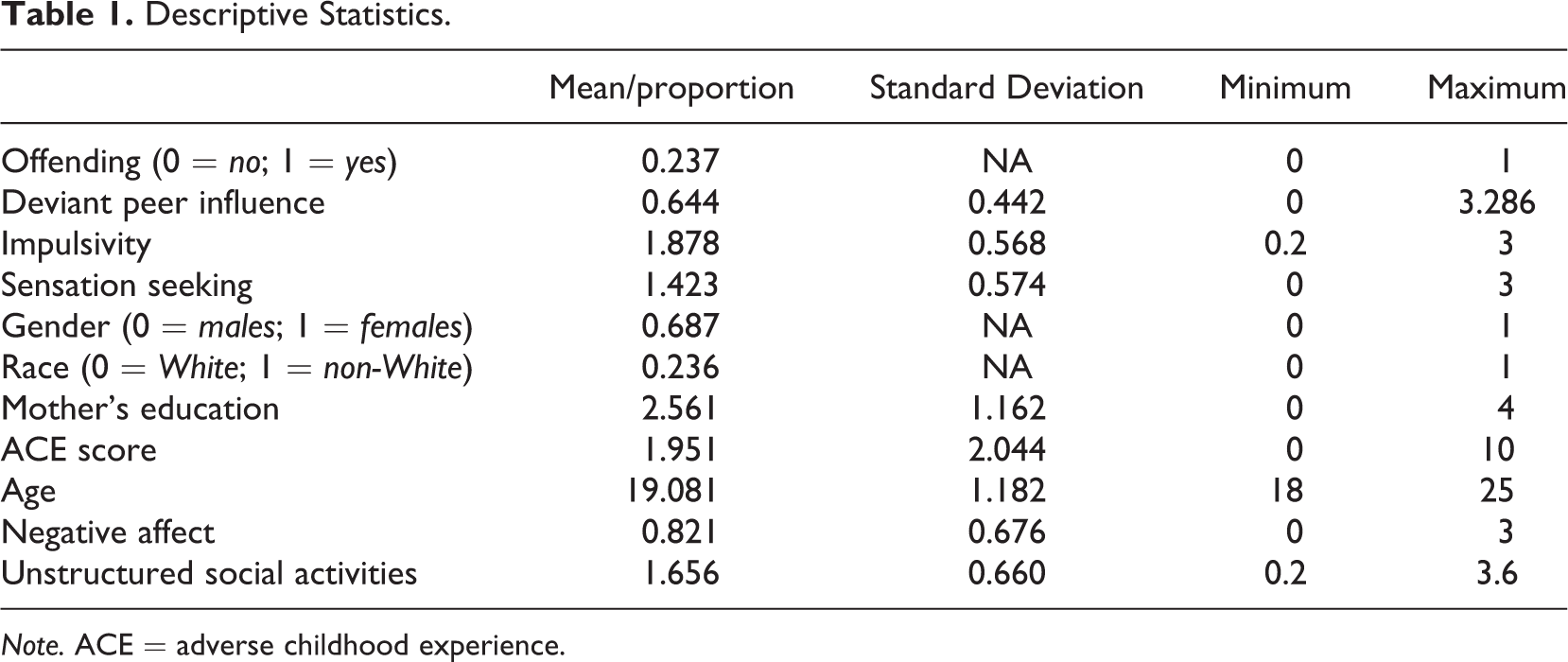
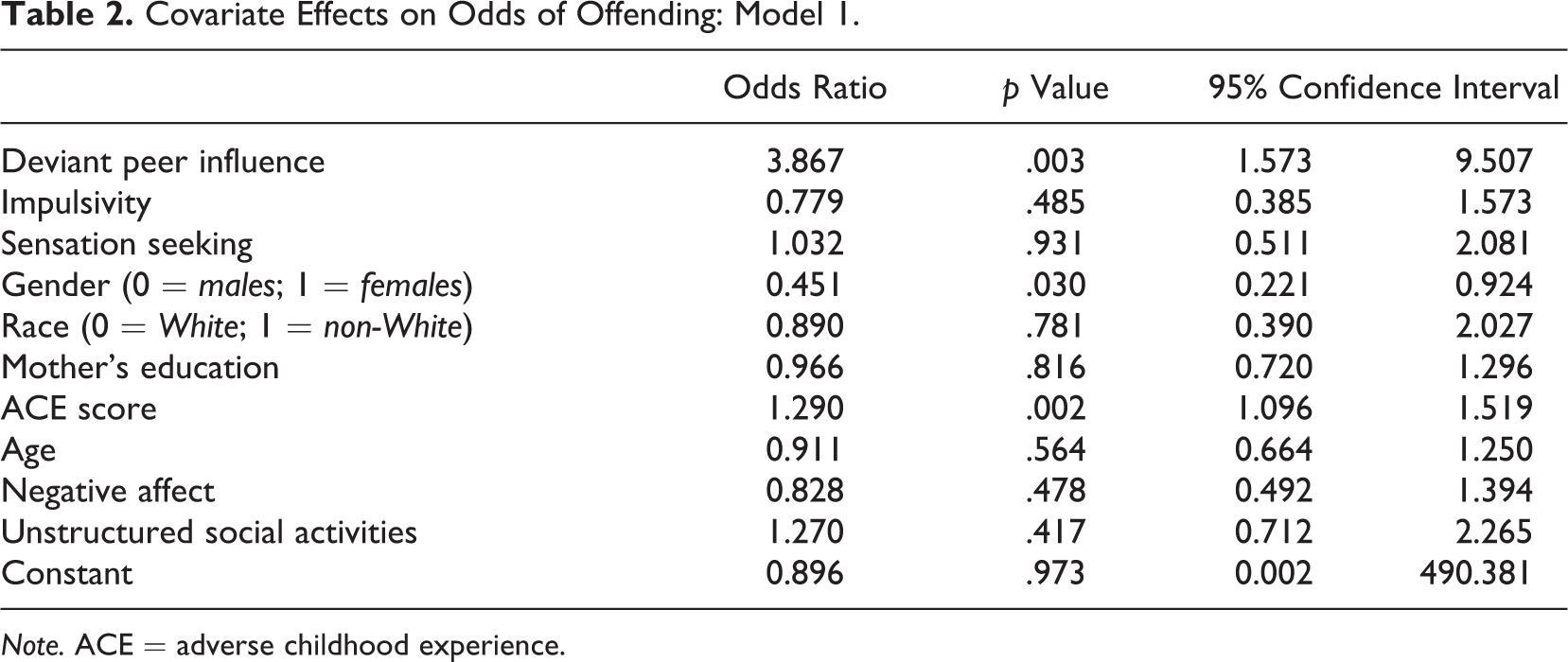
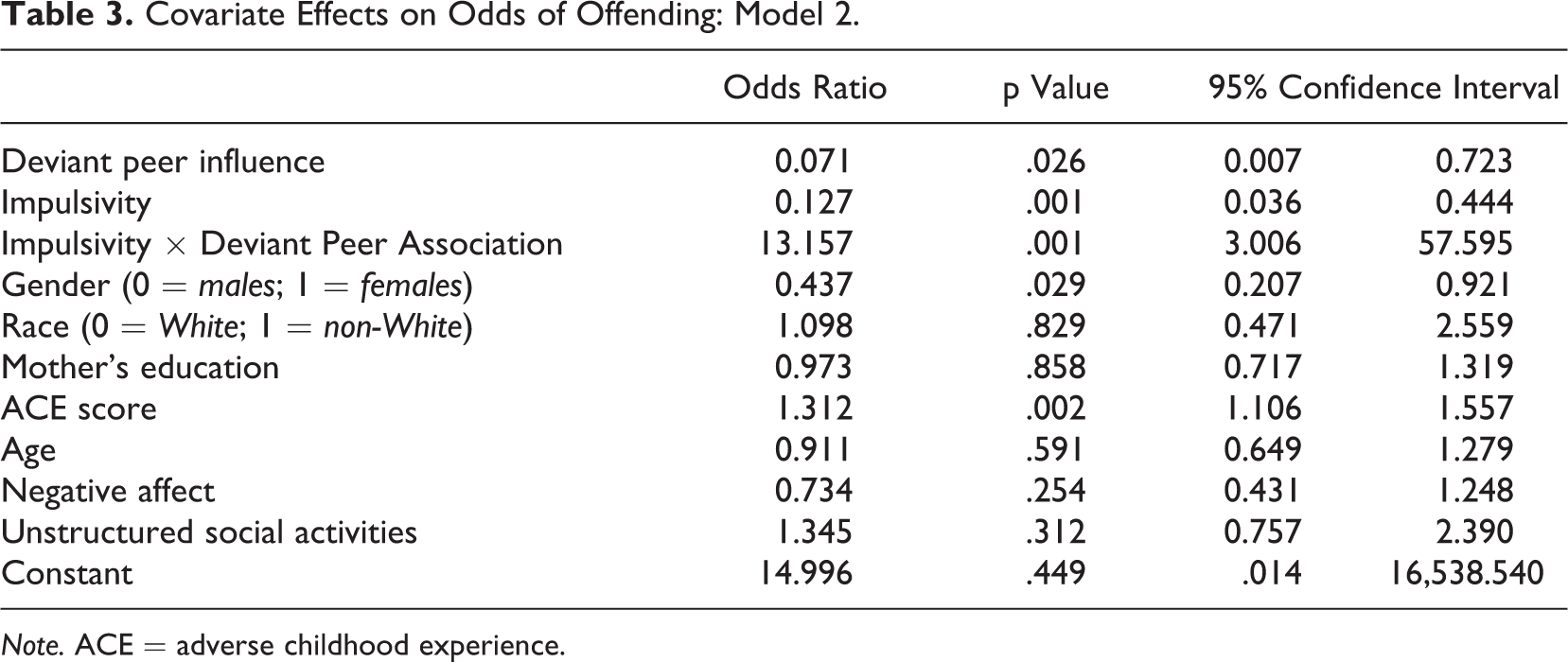
Table 1 provides descriptive statistics for variables included in analyses. Model 1 results are described in Table 2, whereas Model 2 results are described in Table 3. Model 3 results are described in Table 4. Results from Model 1 indicated that greater deviant peer influence was associated with greater odds of offending (OR = 3.867). Neither sensation seeking nor impulsivity was significantly associated with offending in this model. Being male and having higher ACE scores were also associated with increased odds of offending in this model. Inclusion of interaction terms in Model 2 results indicated that deviant peer influence was still a significant predictor of offending, but the direction of this relationship was reversed, indicating that greater deviant peer influence was associated with diminished odds of offending in this model when impulsivity was equal to zero (OR = 0.366). The coefficient pertaining to impulsivity was significant in Model 2 (OR = 0.127), indicating lower impulsivity was associated with greater odds of offending when deviant peer influence was equal to zero. The interaction between impulsivity and deviant peer influence was also significant, indicating a positive interaction between the two constructs (OR = 13.157). Being male and having higher ACE scores were also both associated with elevated odds of offending in this model. Model 3 results indicated that sensation seeking was a significant predictor of offending in this model, with lower levels of sensation seeking predicting greater odds of offending (OR = 0.297). Deviant peer association was not a significant predictor of offending in this model. The interaction between deviant peer association and sensation seeking also was significant, indicating a positive interaction (OR = 0.479). Being male and higher ACE scores were also predicted increased odds of offending in this model.
Descriptive Statistics.
Note. ACE = adverse childhood experience.
Covariate Effects on Odds of Offending: Model 1.
Note. ACE = adverse childhood experience.
Covariate Effects on Odds of Offending: Model 2.
Note. ACE = adverse childhood experience.
Covariate Effects on Odds of Offending: Model 3.

Note. ACE = adverse childhood experience.
Sensitivity analyses were conducted to probe these relationships further. A model was estimated that included both sensation seeking and impulsivity and their associated interaction terms. Findings indicated that only the interaction between impulsivity and deviant peer association was significant. The interaction between sensation seeking and deviant peer association was not significant. The direct effects of deviant peer association and impulsivity were also significant in this model, indicating that lower levels of each construct predicted greater offending risk. Sensation seeking was not a significant predictor of offending in this model. A three-way interaction between all three constructs was also modeled, which indicated findings analogous to the main analyses, indicating further relevance for the two-way interaction between impulsivity and deviant peer influence.
Because main and sensitivity analyses seemed to indicate that the interaction between impulsivity and deviant peer association was both stronger in magnitude and also remained significant net of sensation-seeking variables, additional analyses and discussion focus mainly on this interaction. Further investigation of this significant moderation effect yielded relevant information about the nature of the impulsivity–deviant peer influence interaction. Figure 1 provides a contour plot of these two constructs as they pertain to offending. The top right corner of this figure provides indication that the largest proportion of overall offending among participants was located within the group of participants who reported both high levels of impulsivity and deviant peer influence.

Contour plot of Deviant Peer Influence × Impulsivity interaction effect on odds of offending.
Discussion
Findings from the present study indicate the relevance of deviant peer influence and dual systems model constructs for predicting offending among college students. Consistent with hypotheses, deviant peer influence significantly moderated the impulsivity–offending relationship, indicating that high levels of both of these constructs predicted a strong risk of offending. Greater impulsivity and greater deviant peer influence were found to predict lower offending risk when the hypothesized interaction terms were entered into the model. This provides some limited support for the diathesis-stress model and indicates that both biopsychological and environmental mechanisms were conditional on one another for predicting offending. While a similar interaction was observed between sensation seeking and deviant peer association, sensitivity analyses provided indication of the robustness of the impulsivity interaction, whereas this robustness was not observed for sensation seeking. Sensation seeking was not found to exert a direct effect on offending risk in sensitivity analyses either. For these reasons, it would appear prudent to consider the impulsivity interaction as being the most relevant here, thus, the discussion will focus mainly on this interaction. There are numerous relevant implications of these findings for higher education administrators and criminologists alike. Impulsivity interacted significantly with deviant peer influence to demonstrate a strong influence with offending risk. This provides evidence that elevated impulsivity generally only produced greater offending risk when they reported a greater number of deviant peer relationships. This provides some indication that programming focused on peer relationships may have some utility for reducing offending risk among college students. Some research has demonstrated that mentorship programs are effective for reducing offending outcomes among adolescents (Rollin et al., 2003; Tolan et al., 2014). While there is a dearth of research focused on mentorship programs focused on reducing offending risk among college students specifically, there is a great deal of research demonstrating the effectiveness of such programs for impacting education-related outcomes among this population (Meza et al., 2018; Sharpe et al., 2018). Considering the widespread use of such programs in higher education is already well-established, slight curriculum modification may also allow such programs to have an impact on offending risk by addressing peer relationships. These programs could also be specifically targeted at students identified upon admission to have diminished impulse control. While surveying incoming students regarding their impulsivity distinctly is not an established practice, intake surveys regarding psychosocial variables are not entirely uncommon. Adding a short-form instrument on impulsivity may aid in identifying students who may be at risk of offending should they established deviant peer ties. Considering that greater impulsivity was associated with lower offending risk when accounting for this hypothesized interaction, the offending risk presented by these students may actually be highly amenable to interventions like these. Taking measures like this may be effective for reducing crime rates on and around campuses. However, a major caveat should be highlighted here. While some studies have indicated mentoring programs’ effectiveness for impacting academic outcomes, there are many methodological issues that must be acknowledged. Many of these program evaluations depend solely on qualitative testimony as evidence of effectiveness, and many also do not employ rigorous designs for quantitatively evaluating effectiveness. For this reason, there should be some concern about the expansion of their scope, but their highly embedded nature continues to make them a potentially attractive target for affecting criminological outcomes of interest.
Another way in which the findings of this study may be leveraged is through selective placement of students on campus as they enter as freshmen. As noted earlier, this could involve screening of students who demonstrate high levels of impulsivity during the time prior to entering campus may facilitate placement of students in special areas that may insulate them from deviant peers. While it is likely impossible for full isolation from deviant peers, certainly there may be ways in which particular housing complexes in and around campus may be identified as be particularly criminogenic for these identified students. The effectiveness and feasibility of such measures remain speculative though. Future research should seek to better understand these relationships and determine what would be necessary for the implementation at an efficacy trial level.
The findings from the main analyses must also be noted. It appears that sensation seeking may still be relevant in the hypothesized manner and that the interaction may have been lost due to correlation between impulsivity and sensation seeking. This provides some evidence that the policy and programming implications discussed for impulsivity may also be relevant for sensation seeking. If screening for one of these constructs is possible, then it would seem that concurrent screening for the other may also be possible and may have relevance for informing housing and/or mentoring decisions that may aid in reducing crime risk in and around campus. This indicates that future research should be conducted on these constructs in order to better understand the nuances of these relationships that may inform college administrators seeking to implement measures that will improve campus safety.
While the present study provides a unique examination of dual systems model and deviant peer effects on offending, there are several limitations that must be acknowledged as well. The first limitation relates to the potential limited generalizability of these findings. This sample was gathered purposively, which may potentially lead to bias in the estimation of these relationships. Testing these relationships using a random sample would provide a more valid approximation of dual systems model and deviant peer influence processes as they relate to offending. Further contributing to this issue was an inability to determine how representative the sample was of the classes that it was drawn from. These data were collected just prior to the COVID-19 pandemic. As such, determination of representativeness was not possible with in-person instruction interrupted and the classes long since concluded. For these reasons, results should be interpreted with caution. Future research should seek to provide robustness tests using random samples. Another limitation of the present study relates to the cross-sectional nature of the data. While these results have some utility for understanding offending, true causal inference is restricted because temporal ordering cannot be established. In addition to future research testing the robustness of these results using a random sample, it is equally important that this sample be composed of panel data. Having multiple data points for each participant across time would allow for the potential of causality to be inferred, as temporal ordering of independent variables and the dependent variable could be established. A final limitation pertains to the interpretation of the interaction effect. Because the relationship was nonlinear, there are some issues related to directionality and standard errors when calculating interaction effects in a logistic regression context that must be acknowledged (Ai & Norton, 2003). For this reason, this interaction should be interpreted cautiously. However, it should be noted that additional sensitivity analyses were carried out that utilized linear regression to examine this interaction also and results were analogous to those of the main analyses. This provides some additional robustness for these findings.
While the limitations highlighted above temper the findings of the present study, there remain relevant contributions of note. The hypothesized interaction between impulsivity and deviant peer influence produced a significant effect indicating that offending risk was much greater among participants demonstrating high levels of both of these constructs. This indicates the importance of intervention efforts focused on interrupting deviant peer relationship establishment among college students reporting high levels of impulsivity. This could potentially be done through mentorship programs. The potential that socially isolated offenders exist within this population is another potential area for future research to explore, as these individuals may necessitate alternative programming options.
Footnotes
Declaration of Conflicting Interests
The author declared no potential conflicts of interest with respect to the research, authorship, and/or publication of this article.
Funding
The author received no financial support for the research, authorship, and/or publication of this article.
