



Abstract
There is limited research which has examined the developmental nature of friendships and their relevance for offending. This study examined heterogeneity in the development of justice system-involved friendship proportionality and its relevance for predicting offending continuity in emerging adulthood. Having a greater proportion of such peers within a friendship collective as individuals exit adolescence may lead to continued risk of offending in adulthood. The Pathways to Desistance data were used in analyses. Group-based trajectory modeling was used to identify developmental patterns of justice system-involved friendship proportionality during adolescence and emerging adulthood. Logistic regression was used to assess the relevance of trajectory group assignment for predicting offending risk in emerging adulthood. Findings indicated that a six-group trajectory model best fit the data. All other trajectory groups in the model indicated a lower risk of offending in emerging adulthood than the High Chronic justice system-involved friendship proportionality group. Sensitivity analyses indicated that separation from criminal peers following adolescence may be a more conservative predictor of offending risk in emerging adulthood.
Introduction
Association with deviant peers has been identified as a robust risk factor predicting offending and the concept is a major cornerstone of numerous prominent criminological theories (Akers, 1973; Chan, 2019; Nodeland & Morris, 2020; Sutherland & Cressey, 1960; Walters, 2020). While coverage of this relationship has been relatively comprehensive, there remain areas where further study is necessary. Perhaps the most relevant area where this latter point is true is in understanding life-course processes involved with this relationship. This involves an understanding of how friendships with deviant peers change and develop across the life-course and how these friendships may influence offending. Considering that past research has indicated that involvement in offending generally declines following adolescence (Lussier et al., 2015; Massoglia & Uggen, 2010), more work is necessary for understanding how continued engagement with deviant friends in adulthood may lead to continuity of offending risk in adulthood. While some research has examined developmental patterns of deviant peer association in the manner described (Wojciechowski, 2018a), there remains the need for a more systematic examination of these relationships. One aspect of the peers-offending relationship that has yet to be examined from a developmental perspective is justice system-involved friendship proportionality (JSIFP). This JSIFP here refers to the structure of close friendship ties as a whole and the proportion of those close friendships that are comprised of peers who have ever been arrested vs. peers who had never been arrested. Examining peer proportion in this manner as a predictor of offending would yield a more complete understanding of how friendship ties with individuals who have had justice-system contact and those who hadn’t impact offending risk net of each other. This is a major omission because a considerable amount of research has indicated that peer networks may both change across the life-course in terms of exposure and salience (Alwin et al., 2018). The present study sought to examine these processes by examining heterogeneity in developmental patterns of JSIFP across adolescence and early adulthood in order to better understand change and continuity in this social development. This heterogeneity in JSIFP development was then modeled as a set of predictors of offending risk in emerging adulthood in order to determine how maintaining high levels of JSIFP predicts continued risk of offending into this period of the life-course.
Social Learning, Deviant Friends, and the Life-Course
As noted above, deviant peer association has been identified as a relevant construct for numerous prominent criminological theories. Differential association theory is the earliest of these prominent theories (Sutherland & Cressey, 1960). Differential association theory posits that increased propensity for offending results in situations where exposures to definitions favorable toward offending outweigh exposure to prosocial norms and definitions. These definitions refer to techniques, motivations, rationalizations, and attitudes that are conducive to offending. This generally occurs when individuals spend more time socializing with criminal and/or deviant peers who provide such definitions. While the focus of differential association theory rested mainly on these differences in exposures to prosocial and antisocial norms, values, and attitudes; Akers’ (1973) social learning theory extends an understanding of the relevance of peers to also include processes related to reinforcement and punishment. These processes involve actions/reactions or potential actions/reactions that increase or decrease the likelihood that an individual will engage in criminal/deviant behavior in the future. In relation to deviant peers, reinforcement is most relevant here, as these peers may encourage individuals to engage in deviant/criminal through praise, encouragement, or other forms of peer pressure. Association with more deviant peers then should result in increased exposure to reinforcement or potential reinforcement like this and function to increase the risk of offending. Association with prosocial peers should result in the opposite effect, as these individuals may engage in threats of or actual punishment if their friend offends (ex: threatening to no longer spend time with them).
While the mechanisms by which one’s social circle may influence their offending risk are clear in both of these theories, not all sources of definitions, reinforcement, and punishment are posited to have the same impact on offending risk. These processes are expected to vary in their intensity, duration, priority, and frequency. Duration refers to the amount of time that an individual spends with a source, frequency refers to how often that source expresses these social processes, intensity refers to the importance or salience of the source to the individual, and priority refers to how when in time associations with sources began, with earlier associations holding greater importance. A primary focus of this study is on intensity, as the deviant peer associations in question are with close friendship ties nominated by participants. These close friendships are the peer ties that should be of greatest intensity and thus have the greatest salience for predicting an individual’s behavior. Past research has examined the relevance of these close friend ties as they pertain to offending relative to weaker social ties. For example, Patacchini and Zenou (2008) found that while weak ties with criminals impacted one’s own criminal propensity, this effect was weaker for individuals who had more close friends who were criminals. This indicates the relevance of close friend ties for predicting criminality net of less intimate social relationships. Calvó-Armengol et al. (2007) provide an additional theoretical analysis supplemented by numerical simulations which are indicative that criminal opportunities are likely to come mainly from strong social ties and that the influence of weaker social ties on criminality mainly operate through strong social ties; providing further indication of the potential that close friends hold more relevance for influencing offending risk. While it seems clear that individuals who share intimate interpersonal relationships may influence one another’s behaviors, less attention has been paid to the life-course implications of these relationships and particularly how these relationships may change and develop across time.
While neither differential association theory nor social learning theory had explicit foci on the life-course, there remain important aspects of the processes involved with these theories that have developmental considerations of interest. First and foremost, it is important to note the differential relevance of peer influence based on life-course stage. Past research has indicated that the salience of peers as an influence on behavior increases as individuals enter adolescence (Warr, 1993, 2002). This change occurs as adolescents generally begin to establish a degree of autonomy and begin to distance themselves from familial relationships as peers take on the most important type of social relationship in their lives. Generally, it has been posited that adolescence is the peak period in the life-course for the importance of these social ties, however, salience of these peer ties may continue into emerging adulthood also (Wojciechowski, 2018a, 2018b). Emerging adulthood represents a highly relevant period of the life-course as it pertains to offending behaviors. This period of the life-course is a relatively newly defined stage situated between adolescence and full adulthood wherein individuals in contemporary times find themselves stuck between the transition to fully adult roles like family formation and stable employment and may find themselves in flux both in identity and in social roles (Arnett, 2000, 2007). This life-course stage is relatively new because of shifts in the ways in which individuals exit adolescence in the present day compared to previous decades when the transition to adulthood from adolescence omitted this transitional period. This shift away from adolescence is so important here because, again, offending risk has generally been shown by past research to decline following adolescence as they enter this transitional period (Le Blanc, 2020; Matthews & Minton, 2018). If individuals continue to associate with criminal peers during this period of the life-course, then it may be expected that they may present an increased risk of criminal behavior as they enter adulthood.
Moffitt (1993) provides one of the more prominent criminological frameworks for understanding how the salience of peer influence on behavior may change across the life-course. This dual taxonomy outlines two types of offenders: life-course persistent (LCP) and adolescence limited (AL). The names of these groups describe the periods of the life-course when they generally engage in offending behavior. These LCP offenders are predicted to initiate engagement in antisocial behavior early in the life-course and generally be ostracized for this behavior during childhood. However, this social exclusion often ends as individuals begin to enter adolescence. It is here that AL offenders begin experimenting with delinquency and other low seriousness forms of antisocial behavior. This is conceptualized as a means of adolescent rebellion and bridging the maturity gap, as adolescents begin to physically develop into mature adults, but still lack the social privileges of adulthood. It is here that LCP individuals begin to gain more popularity, as these individuals have engaged in antisocial behavior for some time so they may facilitate social learning processes that lead to deviance contagion among AL peers. While these previously ostracized youth gain in popularity during adolescence, it is not predicted that they will remain so enmeshed in social networks throughout the life-course. As these AL youth begin to enter adulthood, priorities were predicted to shift to prioritizing establishment of stable romantic relationships and families. This leads to a distancing and from peer relationships in general. This is consistent with seminal work on “turning points” in the life-course and related empirical work indicating evidence that individuals may be at lower risk of offending following adolescence (Laub & Sampson, 1993; Sampson & Laub, 1995). Individuals gain the social privileges of adult life and the maturity gap naturally dissolves, resulting in lower offending risk among adults compared to adolescents. LCP individuals are less likely to make these normative transitions though, as longer periods of time enmeshed in deviant lifestyles may restrict change and they may be engaged in more serious forms of offending behaviors. These more serious forms of offending may also lead to a greater risk of identification and formal labeling by the criminal justice system which may further snare these individuals into the continuity of deviant lifestyles. While past research has provided an indication that these developmental patterns of offending across the life-course are generally more complex than a simple dual taxonomy (Cihan et al., 2017; Testa & Semenza, 2020; Wojciechowski, 2020), this framework provides a useful heuristic for understanding why engagement in offending peaks during adolescence and how peers act as a driving force behind change and continuity of offending behaviors. A full understanding of the peers-offending relationship necessitates examination of peer engagement as a developmental process also though. This would allow for greater understanding of how change or continuity in exposure to deviant peers results in offending in adulthood.
If individuals demonstrate chronic involvement in association with criminal peers, then this may be indicative of an LCP criminal career tract. Given that these are predicted to be the higher risk class of offenders that may put greater strain on the justice system, this may be indicative of the need to prioritize these individuals for programming. However, more recent theoretical development of the dual taxonomy discusses the potential for other criminal trajectories also. Krohn et al. (2013) discuss late bloomers, individuals who only begin to offend following adolescence. While this article discusses this phenomenon mainly in terms of diminishing protective effects of family as individuals exit adolescence and venture into the world on their own, it may be that peers play a role here too. It may be that an acceleration in involvement with criminal peers during the transition to adulthood may also facilitate acceleration in offending risk. However, again, this area is in need of greater study to better understand the nuance behind these developmental processes as they pertain to offending risk. Identifying which JSIFP developmental patterns predict offending risk in adulthood may help to prioritize the direction of justice system resources for addressing these issues.
There has been little research that has examined the developmental nature of deviant peer association across the life-course. Wojciechowski (2018a) provides the rare example examination of these processes during adolescence and early adulthood. Findings indicated that juvenile offenders were generally split into three groups: Low, Moderate, and High. These three groups followed parallel paths of decline in deviant peer association across adolescence and emerging adulthood, maintaining rank stability in deviant peer association across time. Results also indicated that participants assigned to the Moderate and High groups reported greater offending frequency and odds of offending in emerging adulthood relative to the Low group. This provides an indication of the continued relevance of deviant peer ties into emerging adulthood. However, there is a dearth of research that examines patterns of deviant peer association beyond this study. Yoon et al. (2019) provide the only other examination of the developmental nature of this construct, though this study focused on early to middle adolescence. Consistent with the notion that peers play an important role in adolescence, this study found that the vast majority of individuals increased in deviant peer association from ages 12–16 and only 4.2% demonstrated a slight decline in deviant peer association from a high intercept during this time. While this study provides another useful examination of these processes, there remains a dearth of research in this area focused on adolescence and early adulthood and both studies suffer from measurement limitations. This indicates the need for this study to examine JSIFP as it pertains to offending in a more valid manner in order to best understand how JSIFP develops heterogeneously between participants across time and how this heterogeneity may influence offending in emerging adulthood.
Relevance of Justice System-Involved Friendship Proportion for Understanding Offending
While deviant peer association has been identified as a robust risk factor related to offending (Cutrín et al. 2018; Mowen & Boman IV, 2018), there is much less research that has focused on JSIFP specifically. In discussing the nature of “proportion” here, it is important to define exactly what is meant. “Proportion” here refers to the number of close friendship ties that an individual has to individuals who have ever been arrested divided by one’s total number close friendship ties. The deviant peer association measure used in these studies have several limitations that may be addressed by the proposed JSIFP measure. Wojciechowski (2018a) measures deviant peer association by asking participants to generally rate about how many of their peers influence them to engage in a series of antisocial behaviors and compute a mean score. While JSIFP is not a perfect measure of deviant peer association, it does present some improvements over prior operationalizations of the construct. First, this measure did not ask about close friendship ties, which should theoretically be greatest in intensity and the most relevant for predicting offending risk. Further, while this was somewhat of a proportion measure, it lacked accuracy in terms of anchoring participants’ responses to a specific number of peers/friends. As such, this may lead some participants to include/exclude varying degrees of friendship closeness and lead to variance in how participants perceived measurement. Further, because this was an influence measure, it did not tap participants’ peers’ own deviant behavior. A final consideration that must be made here pertains to the participant’s report of their peer’s behavior. Past research has indicated that individuals may have a tendency to overrate how similar their friends’ deviant behaviors/attitudes are to their own (Henry et al., 2011; Prinstein & Wang, 2005; Young et al., 2014). For example, Young and Weerman (2013) found that delinquent youth tended to exaggerate the levels of delinquency among their peers. For this reason, measures like this then have the potential to overestimate the relationship between peers’ behaviors on one’s own. Related phenomena of “false consensus” and “projection” may be at play here and they indicate the necessity for valid measures that are able to better address these issues of bias in perception. These issues present a substantial methodological issue that is not easily overcome (Rebellon & Modecki, 2014). The proposed JSIFP measure attempts to overcome these identified limitations by examining the proportion of friends who participants report have ever been arrested. Reconciliation of this self-report issue is beyond the scope of this study, but this JSIFP measure should provide a peer delinquency measure that is not as liable to bias, as an arrest represents a discrete event that participants can anchor to when providing data about their friends, particularly close friends who they should be able to provide an accurate accounting of arrest history for. Formal contact with the criminal justice system also may represent a snare in the life-course that may restrict transition to a more normative lifestyle (Moffitt, 1993). Past research has supported this type of formal processing as a snare (Kirk & Sampson, 2013; Petkovsek et al., 2016). As such, continued friendships with individuals who had been arrested previously may be indicative of one’s own continued entanglement in a criminal lifestyle. While JSIFP is not a perfect measure of deviant peer association in the traditional definition of the concept, it does provide a means of measuring close friends’ contact with the justice-system and individuals who have had such contact seem highly likely to be involved in criminal behaviors (barring acquittal).
This JSIFP measure also provides an improvement over other forms of assessment of deviant peer association. Raw counts of how many deviant friends an individual has is one type of measure that has been used by past research (Higgins & Makin, 2004; Toro et al., 2004). This measurement is not ideal because it does not assess the potential presence of prosocial ties that may provide a buffer against the effects of antisocial peers within the totality of friendship ties for an individual. The proposed JSIFP measure also accounts not only for the criminal peers within an individual’s friendship collective, but also accounts for those prosocial relationships as well. Ordinal measures assessing the general number of deviant peers have also been used by prior research (e.g., 0 = None of them; 1 = Some of them; 2 = Most of them; 4 = All of them) (Thornberry et al., 1994; Yim, 2020). These measures are also not ideal, as they lack sensitivity and accuracy afforded by JSIFP measures. For example, if a participant responded that “most” of their peers engaged in drug use, does this mean 51% of them engage in drug use or 60% or 80%? Such an approach seems to have the potential for a great deal of measurement error. Wojciechowski (2018a) and Yoon et al. (2019) both used ordinal assessments of deviant peer association like this in the one examination of heterogeneity of developmental patterns in this construct, indicating the relevance of reexamination of these processes. A final set of considerations here are the theoretical implications of JSIFP measures. JSIFP should provide a valid measure that balances the existence of prosocial and antisocial views where they coincide. Differential association theory would contend that collective friendship ties where the balance of definitions are skewed towards those that favor offending should be those that increase one’s own offending risk. Consistent with this, social learning theory would contend the same in regards to reinforcement for offending behavior. For these reasons, collective friendship ties higher in JSIFP would be associated with higher proportions of peers that would increase one’s own offending risk via these processes. A distinct proportion score addresses all of these issues highlighted here and this rationale is why it is necessary to use the JSIFP scores. This is of particular relevance considering that past research has indicated that proportion scores are important predictors of offending risk.
Examinations of proportion measures as predictors of offending risk have been conducted in prior criminological research. Haynie (2002) found that the ratio of deviant peers in one’s social network was a preferable measure compared to the average levels of delinquency among an individual’s peers, the absolute levels of delinquency committed by an individual’s peers, and a raw count of the number of delinquent peers that an individual had in their social network. These findings were interpreted as being supportive of differential association theory in the sense that social environments in which definitions favorable towards crime are not challenged by prosocial views are where criminality will generally flourish. McGloin et al. (2014) examined these processes in relation to substance use and found that both close peers and larger social network characteristics mattered for predicting substance sue outcomes, as dissimilarity between close ties and the broader network diminished the influence of close friendships on outcomes of interested. Despite these studies indicating the relevance of JSIFP for predicting engagement in deviant behavior, there remain numerous noteworthy gaps in our understanding of this concept and the concept remains understudied overall. Perhaps, the most relevant gap to highlight here is the lack of a developmental approach to understanding JSIFP. There has yet to be any study that has sought to identify how JSIFP develops across the life-course and what heterogeneity exists in this development. Further, the highlighted studies examine outcomes in adolescence alone, the period of the life-course when engagement in such behaviors generally peaks and thus may not be totally unexpected (Fabio et al., 2011; Kim & Bushway, 2018). As such, there has been a lack of interrogation of how JSIFP development may be relevant for understanding offending in emerging adulthood. This is problematic, as these individuals who persist in offending into emerging adulthood continue to present a potentially chronic issue that stressed criminal justice and social systems must consider.
This review has highlighted numerous gaps in the extant literature focused on deviant peers and risk of offending in emerging adulthood. First, while having a greater proportion of one’s friendship collective comprised of antisocial peers has been identified as a risk factor predicting offending (Haynie, 2002; McGloin et al., 2014), there is a dearth of research that has examined heterogeneity in longitudinal patterns of this aspect of deviant peer association. Relatedly, the relationship between differential development of JSIFP and its relevance for predicting risk of continued offending into emerging adulthood remains uninterrogated. Because of the dearth of research focused on identifying heterogeneity in deviant peer processes, there is little to go off of in terms of predicting findings. Wojciechowski (2018a) provides the only examination of the development proposed during adolescence and emerging adulthood, but these results would seem to suggest that chronic high JSIFP during adolescence and emerging adulthood would likely predict persistence in offending. As such, the following hypothesis is tested:
Hypothesis: JSIFP developmental patterns that are high and chronic will predict increased odds of offending in emerging adulthood.
Methods
Data
This study utilized data from the Pathways to Desistance study. At baseline, this study collected data from 1,354 juvenile offenders recently adjudicated for a serious offense. On whole, the entire study followed these juvenile offenders across the next seven years after these measurements, resulting in 11 data points for each participant. Participants were recruited from study sites located in Maricopa County, Arizona and Philadelphia, Pennsylvania. Serious offenses which qualified participants for the study consisted of any and all felony offenses and also misdemeanor weapons-related charges and sexual assault. Of all of the qualified juvenile offenders approached regarding their interest in the study, 20% declined the opportunity. Attrition reached its peak at the final wave of data collection, with 16.2% of the original sample no longer providing data to the research team. A cap was also applied to the proportion of the sample who were male drug offenders. This cap was applied at 15% of the total sample and was implemented to ensure heterogeneity in these baseline characteristics.
Self-report data were collected from participants via interviews held in locations that were convenient for participants (participants’ homes, libraries, criminal justice facilities, etc.). Participants were provided with laptop computers during interview sessions that they used to manually input responses to verbal prompts that were administered by the research team. Collecting data in this manner increased confidentiality in reporting, which was a particular concern in relation to questions on sensitive topics.
Measures
Proportion of Close Friendships With Previously Arrested Individuals
One of the key variables examined in analyses pertained to friendship nominations made by participants at each wave. Participants were asked to identify their closest friends, with a maximum of four friends that could be identified. Participants were then asked to provide information about each individual friend that was nominated. The data used in this study pertains to friends who participants indicated had ever been arrested. At each wave, a proportion variable was then computed that divided the number of their close friends who had ever been arrested that were nominated by their total number of close friends that were nominated. This number was then multiplied by 100 in order to provide a scaled variable ranging between 1–100 that Stata could analyze without issue (ex: 1 close friend who has ever been arrested/3 total close friends nominated = .33*100 = 33 = 33% JSIFP). This provided a measure of JSIFP of their close friendships with previously arrested peers at each wave.
Offending
Another key dependent variable examined in analyses pertained to offending risk during the wave 11 observation period, the final wave in analyses. Wave 11 was chosen for a number of reasons. First, this provides the final wave of data. As such, participants were all either exiting adolescence or had exited adolescence at this point and provides the latest data in the life-course. Second, the mean age at this wave was 23.026. The trajectory analyses conducted for this study followed participants to age 23, making this a logical point at which to examine offending risk. This was a binary variable that delineated all participants who reported any engagement in offending during the prior observation period from those who did not (0 = No; 1 = Yes).
Control Variables
Several control variables were also included in analyses in order to mitigate bias in estimation of effects. The first of these was gender, as past research has indicated that men present a greater risk of offending than women (Broidy et al., 2015). Gender was coded as a binary variable that delineated male and female participants at baseline (0 = Male; 1 = Female).
Another control variable was race, as past research has indicated this to be a relevant characteristic for understanding criminal justice-related outcomes (Lauritsen, 2005). The race was measured at baseline as a four-category nominal variable. The four race categories included Black, Hispanic, White, and Other Race. A series of four dummy variables were then computed, with each dummy variable delineating participants assigned to a different race category from all other participants (e.g., 1 = Hispanic; 0 = All other participants). The dummy variable corresponding to White participants was then excluded from analyses in order to provide a reference group to understand model coefficients in comparison with.
Socioeconomic status (SES) was another variable included in analyses, as past research has indicated that offending risk may be stratified by social class (Aaltonen et al., 2012). SES was measured at baseline using Hollingshead’s two-factor index of social position (Hollingshead, 1957). This instrument measured participants’ parents’ occupational prestige and educational attainment and produced a score comprising the weighted sum of these two aspects of SES. If both parents were able to provide data for the study, then a mean score was computed so that each participant was provided with a single SES score for analyses.
Another of the control variables examined in analyses was impulse control at wave 10, as past research has indicated that low impulse control is a risk factor for offending (Petrich & Sullivan, 2020). This construct was assessed using the Weinberger Adjustment Inventory (Weinberger et al., 1987). This instrument utilized a series of ordinal items to assess the degree to which participants indicated that a set of statements related to impulse control were true of their own behavior (e.g., I say the first thing that comes into my mind without thinking enough about it). A mean score was then computed from these individual scores so that each participant had a single impulse control score at wave 10. The wave 10 measure was chosen in order to ensure temporal ordering of independent and dependent variables in analyses.
Exposure to violence has also been identified as a risk factor for offending (Baskin-Sommers & Baskin, 2016), necessitating its inclusion as a control variable. The Exposure to Violence Inventory was used to measure this construct at wave 10 (Selner-Ohagan et al., 1998). This instrument assessed the presence of two different forms of exposure to violence: witnessed violence and direct victimization. A binary variable was then coded that delineated participants who reported experiencing either form of exposure to violence during the wave 10 observation period from those who did not (0 = No; 1 = Yes). Again, wave 10 was chosen in order to ensure temporal ordering.
Age at wave 11 was also included as a control variable, as past research has indicated that risk of offending tends to decline as individuals get older following adolescence (Moffitt, 1993). Age was measured in single-year intervals.
It was also necessary to control for the wave 11 observation period length, as longer observation periods would necessarily mean greater time during which participants could have offended. While the wave 11 observation period was generally 12 months in length for all participants, there was some between-participant variance in the exact number of days. As such, a variable that provided a count of the number of days in each participant’s wave 11 observation period was included in analyses.
Another control variable included in analyses was the proportion of time that each participant spent in secured facilities with no community access during the wave 11 observation period (jail, prison, psychiatric hospitals, etc.). This was included because a lack of community access may impact the opportunities that individuals would have had to engage in some offending behaviors. This variable was operationalized as a proportion ranging from 0–1, with higher scores indicating more of the wave 11 observation period spent in a secured facility with no community access (e.g., .55 = 55% of the observation period spent in a secured facility).
The final control variable included in the analyses was offending at baseline. This was added to ensure control of the potential issue that baseline offending propensity may lead to continuity of offending risk in adulthood. This variable was a binary indicator of whether or not participants reported any offending during the six months prior to baseline (0 = No; 1 = Yes). 1
Analytic Strategy
The present study utilized several methods for analyzing the data. The first phase of analyses utilized group-based trajectory modeling (GBTM) to identify heterogeneity in developmental patterns of JSIFP. This method entails the iterative process of fixing polynomial functions of varying forms and numbers to a set of longitudinal response data and examining nested model fit to determine which combination provides the optimum fit to the data. Bayesian information criteria (BIC) was the metric used to determine nested model fit. Participants are assigned membership to the trajectory group to which they have the highest probability of assignment based on their individual response trajectory. Nagin (2005) also defines several other criteria that a model should meet if it is to be selected as the best fitting model. Posterior probabilities of assignment represent the average probability of assignment for individual participants actually assigned to a given trajectory group. These probabilities should exceed .7 for every group in the model, indicating a relatively high probability of assignment to the group that they were actually assigned to and low probability of assignment to all other groups. Average odds of correct classification represent the improvement in odds of correctly assigning a given participant to the trajectory group that they were actually assigned over random assignment. These odds should exceed 5 for each group, indicating a 500% improvement in odds. A final criterion is that the 95% confidence intervals surrounding each trajectory group should be relatively tightly bound around each group. This method utilizes full-information maximum likelihood estimation to manage missing data. Because GBTM assumes no within-group variance in JSIFP scores at each time-point for each participant, any missing data is essentially assumed as matching that of the trajectory group to which an individual is assigned, thus, these data are essentially imputed.
The second phase of analyses entailed examining the relevance of trajectory group assignment for predicting risk of offending in adulthood. Logistic regression was used to estimate these relationships of interest. This model was chosen because of the binary nature of the dependent variable. Trajectory groups identified in the chosen model were coded into a series of dummy variables that delineated participants assigned to a given group from all other participants. One dummy variable was then excluded from the model in order to provide a reference group for understanding coefficient values in relation to. Coefficients indicate the predicted log odds of offending at wave 10 given a one-unit increase in a given independent variable of interest, net of all covariates. Multiple imputation was used to manage missing data. Missing data were observed for all variables in the regression model other than the trajectory group variables and gender and race variables. Gender and race were found to predict missingness on the dependent offending variable and these variables lacked any missingness themselves. As such, the gender and race indicators were used as predictors of missing values to impute the missing data on all other variables. A total of 30 imputations were carried out, a number was chosen based on prior research on the topic and the highest levels of missingness of variables in the model observed on the offending dependent variable (∼17%) and potential power loss, as this many imputations goes above what would be the recommended amount and more imputations will provide a more accurate estimate overall (Graham et al., 2007). 2
Results
Preliminary analyses examined the degree of overlap of individuals who reported scores of zero for JSIFP and individuals who reported zero close friendships overall, as these two different groups would necessarily both be coded as “0.” The proportion of individuals who reported having zero close friends overall increased steadily throughout the study period from 3.69% at baseline to 28.95% at wave 11. This worked out to 13.52% of responses pooled across the entire study period. This indicates that a not-insignificant proportion of individual declines in JSIFP across time were likely attributable to declines in having any close friendships overall.
The iterative process of fixing polynomial functions to the longitudinal response data using the GBTM method resulted in the identification of a six-group model that provided the best fit to the data. The six-group model indicated a better fit than two, three, four, five, and seven group models based on BIC statistics. This chosen model also met all additional criteria outlined by Nagin (2005) that were necessary for being chosen as the best fitting model. Table 1 provides posterior probabilities of assignment for all groups in the model.
Posterior Probabilities of Assignment for Trajectory Groups.
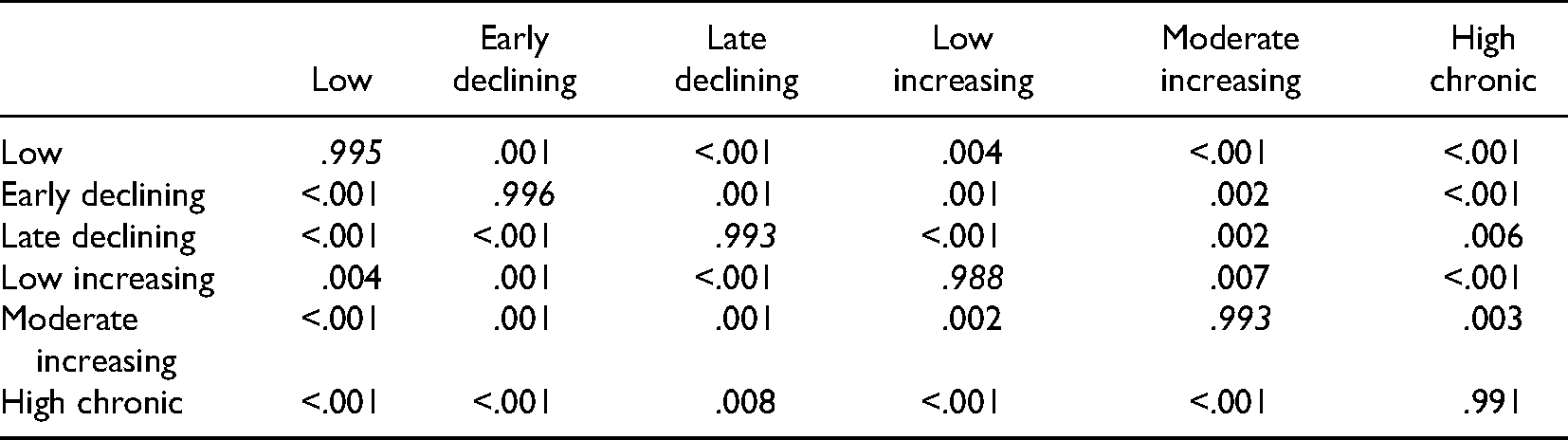
Figure 1 provides a visual depiction of the six-group model that provided the best fit to the data. The first group in the model was characterized by reporting a JSIFP of zero across the entire study period. Because of this developmental tract, this group was described as the “Low” JSIFP group. A total of 9.90% of the sample was assigned membership to this group and this group is characterized by an intercept-only polynomial function. The second group in the model was characterized by a steady decline in JSIFP across the study period, reaching near-zero levels around age 20. This group was characterized by a quadratic polynomial function and 16.25% of the sample was assigned membership to this group. This group is described as the “Early Declining” group. The third group in the model was characterized by relatively high JSIFP during adolescence, followed by steady declines in JSIFP beginning around age 19, reaching near-zero JSIFP around age 23. This group is described as the “Late Declining” group. This group had 19.13% of the sample assigned membership to it and it was characterized by a quadratic polynomial function. The fourth group in the model was characterized by relatively low JSIFP at age 16, followed by steady increases in JSIFP across the study period. This group is described as the “Low Increasing” group and had 12.48% of the sample assigned membership to it. This group was characterized by a linear polynomial function. The fifth group in the model was characterized by a moderate level of JSIFP at age 16, followed by a steady increase in JSIFP across the study period. This group is described as the “Moderate Increasing” group and 21.57% of the sample was assigned membership to it. This group was characterized by a linear polynomial function. The final group in the model was characterized by high and stable levels of JSIFP across the entire study period. This group is described as the “High Chronic” group and had 20.68% of the sample assigned membership to it. This group was characterized by a linear polynomial function.

Close Friendships With Justice System-Involved Friends Proportion (JSIFP) Trajectory Model.
Additional analyses were conducted to examine the potential that individuals reporting zero close friends overall accounted for declines in JSIFP and scores of zero JSIFP among trajectory groups. These analyses did indicate that the Low group did indicate very low JSIFP across the entire study period with only 12.76% of the group composition accounted for by participants with zero close friends overall at its peak levels. Examination of the Early Declining and Late Declining groups indicated that participants with zero overall close friends did being to account for more and more of the participants assigned to these groups, reaching around 30% at their peak levels. That said, a post-hoc ANOVA also was conducted using an alternatively coded JSIFP variable that coded participants with zero close friends as missing data. The ANOVA analyses indicated that patterns of decline in JSIFP consistent with the patterns of the Early Declining and Late Declining groups were still observed when the participants with zero close friends were omitted, providing additional validity for these groups. This may actually provide indication that friends who have ever been arrested stick around longer than friends who have not. This may provide some evidence of Warr’s (1993) concept of “sticky friends” as it pertains to criminal friendships.
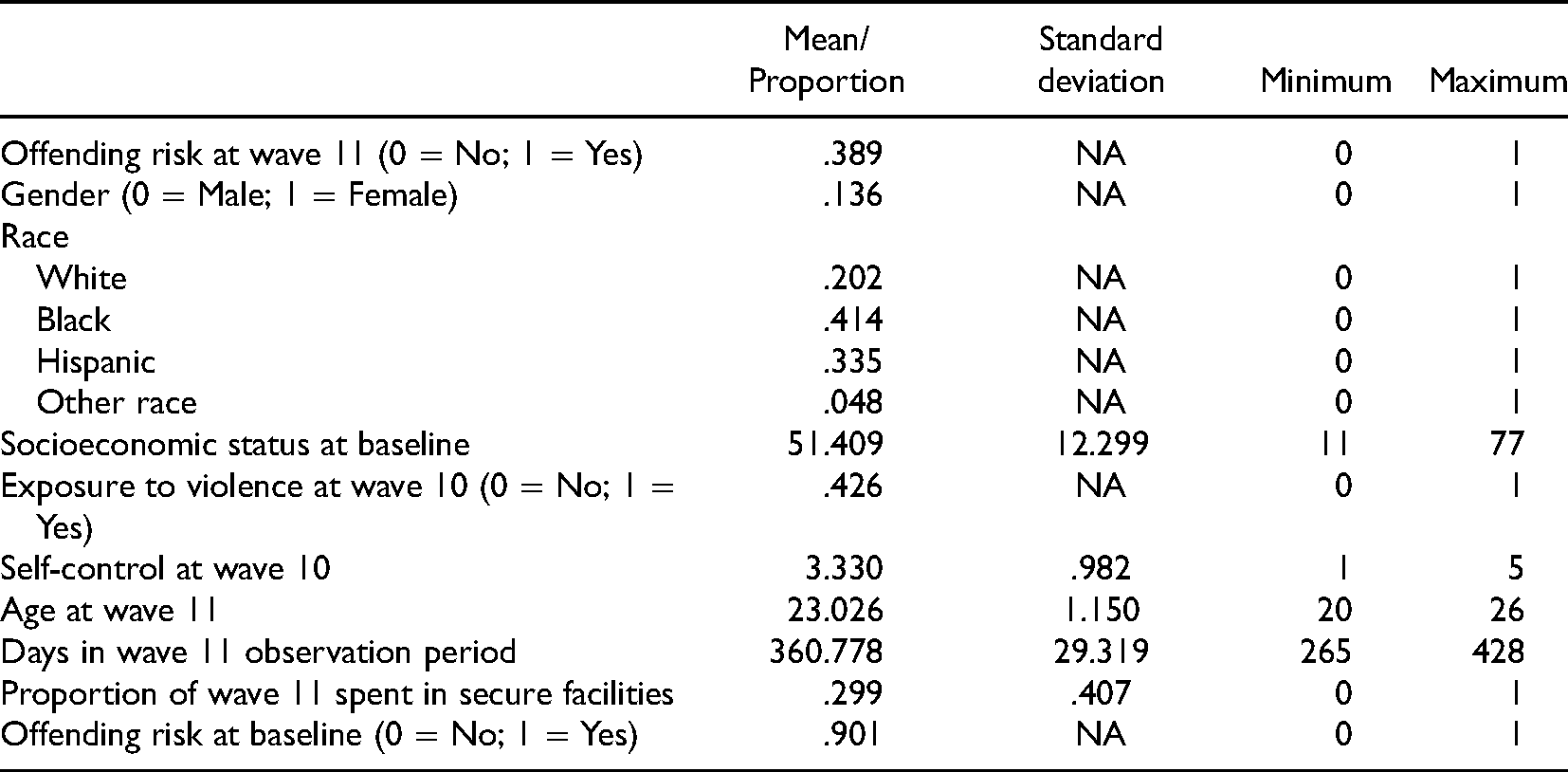
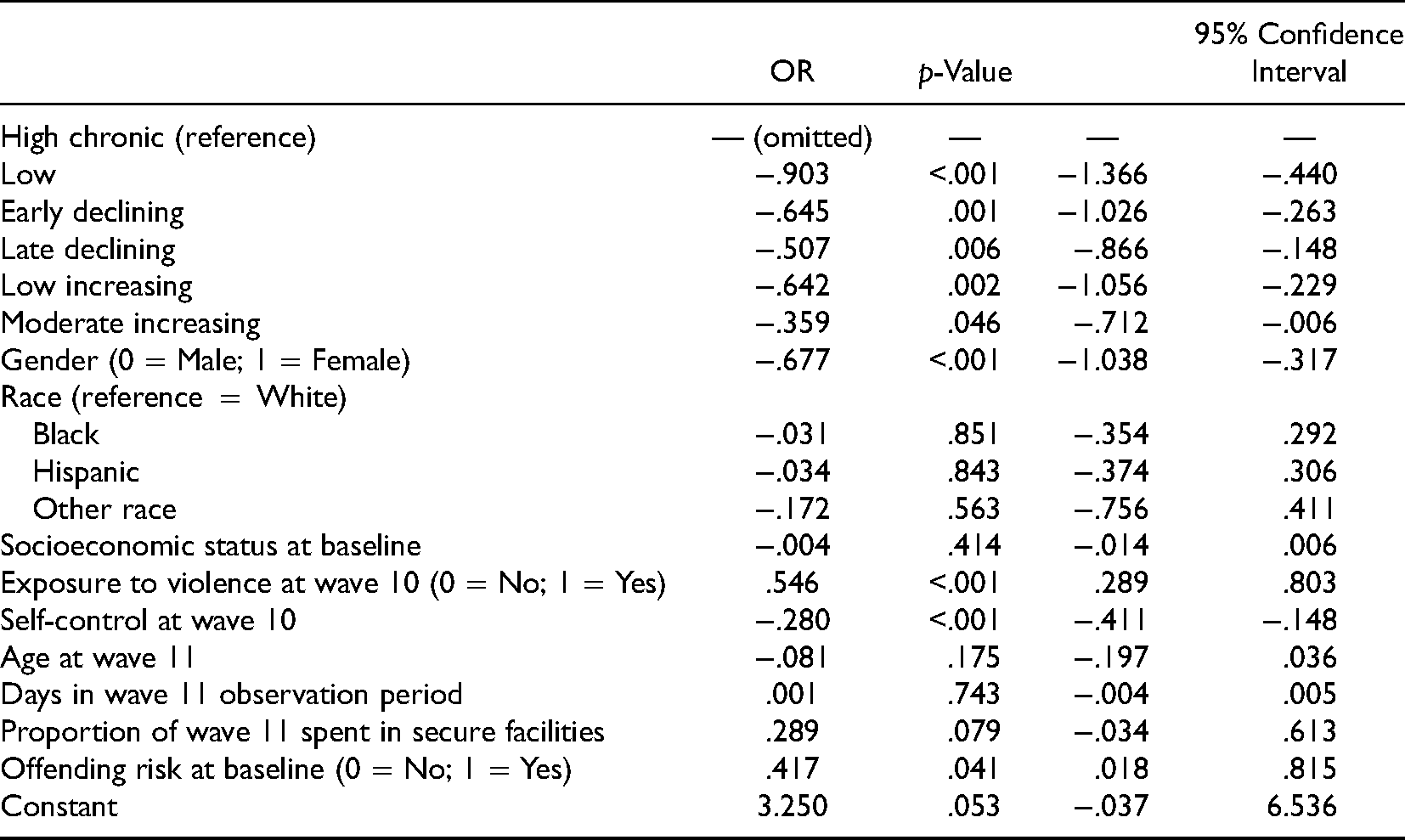
Table 2 provides descriptive statistics for all variables included in analyses. Table 3 provides results from regression analyses. The dummy variable corresponding to the High Chronic group was omitted from analyses in order to provide a reference group to understand trajectory group coefficients in relation to. Results indicated that assignment to any and all other trajectory groups in the model was associated with decreased odds of offending relative to assignment to the High Chronic group (Low Coefficient = .-.903; Early Declining Coefficient = -.645; Late Declining Coefficient = .-.507; Low Increasing Coefficient = -.642 High Increasing Coefficient = -.359). It should be noted that the difference in offending risk between the High Chronic and Moderate Increasing groups was much less statistically significant than all of the other groups, barely reaching significance; p < .046). Being male, lower impulse control, experiencing exposure to violence, offending at baseline, and spending more time in a secured facility were also all associated with increased odds of offending at wave 11.
Descriptive Statistics.
Logistic Regression of Covariate Effects on Odds of Offending at Wave 11 in Odds Ratios (OR) Following Multiple Imputation (N = 1,354).
Additional sensitivity analyses were conducted to determine the robustness of results during the observation period prior to the one examined in the main analyses. Results indicated that differences in offending risk compared to the High Chronic group were only observed for the Low and Early Declining groups, indicating that a more conservative approach to interpreting findings may be necessary. The mean age at wave 10 was 22.026.
Another ancillary logistic regression model was estimated that omitted the dummy variable corresponding to the Low trajectory group in order to provide greater understanding of differences in offending risk by trajectory group assignment relative to this group. Findings indicated that only the Moderate Increasing and High Chronic groups significantly differed in wave 11 offending risk from the Low group. A final set of sensitivity analyses examined wave 10 offending risk analogous to the steps described above, but with the Low group as the omitted group. These findings indicated that all trajectory groups other than the Early Declining group significantly differed in offending risk from the Low group at wave 10.
A final concern was related to whether or not the JSIFP trajectory group assignments actually presented a novel means of predicting offending apart from other deviant peer measures used to predict offending in prior research. Wojciechowski (2018a) utilized a deviant peer association scale adapted from the Rochester Youth Development Study to identify deviant peer association trajectory groups and examine their relevance for predicting offending in emerging adulthood (Thornberry et al., 1994). These sensitivity analyses included this measure in the regression models estimated for the main analyses in order to determine whether or not assignment to the JFISP trajectory groups continued to predict offending when the more traditional measure was included. Findings were almost completely analogous to those observed in the main analyses and for the sensitivity analyses examining Wave 10 offending as the outcome. The only difference observed compared to any analyses was that the difference in offending risk of the High Increasing group compared to the High Chronic group was nonsignificant for model estimated in the main analyses. However, this difference was very close to the p < .05 significance threshold in the main analyses anyway (p = .046). The more traditional deviant peer association measure significantly predicted offending in all analyses also. This provides both indication of the robustness of the findings of this study and the fact that differential development of JSIFP and other traditional measures of deviant peer association may both be relevant for predicting offending in emerging adulthood.
Discussion
This study provided unique insight into the relevance of continued engagement with deviant peers in close social circles for continuity of offending risk into emerging adulthood. A six-group developmental model was identified that indicated variance in the stability, decline, and increase in JSIFP during adolescence and emerging adulthood. Assignment to these identified groups was also associated with offending risk later in life. In a general sense, participants reporting that their close friend group was chronically composed of a greater ratio of individuals who had ever been arrested were at increased offending risk in emerging adulthood. Assignment to the High Chronic group was associated with an elevated risk of offending compared to assignment to any other group. These relationships were highly statistically significant for all groups other than the High Increasing group. Interestingly, this High Increasing group was most similar to the High Chronic group in JSIFP in the trajectory model at age 23 also. Sensitivity analyses also indicated that the patterns of development of JSIFP were relevant for predicting offending even when a more traditional measure of deviant peer association was accounted for in the model. This indicates that JSIFP may present a distinctly relevant concept in this regard. These findings, along with ancillary sensitivity analyses, indicate a great need for continued study of these processes in order to better understand how JSIFP develops across time and impacts offending risk.
In terms of implications, most specific to the main argument of this paper, it appears that the proportion of friendship ties with individuals who have been arrested matters for offending. These results seem to indicate that the entirety of the composition of a close friendship collective matters in this regard and that relationships with normative friends may help to buffer against those with deviant friends within these close friendship collectives. These findings are consistent with past research on this topic (Boman IV & Mowen, 2018; Haynie, 2002). However, where this study expands on these prior findings is the establishment of the relevance of development. JSIFP, specifically consistently high JSIFP throughout adolescence and emerging adulthood, predicted offending risk in emerging adulthood. These findings seem to indicate that permeating deviant friendship collectives with prosocial peers may aid in reducing offending risk in adulthood. However, it should also be understood that there should be concerns regarding the integration of prosocial peers into deviant friendship collectives due to the potential for deviance contagion, so such approaches and ideas should be considered with great caution. This idea should be further couched in an understanding of specific mechanisms facilitating declines in JSIFP.
The six-group model that was identified indicated that individuals who declined in JSIFP during adolescence and emerging adulthood did so at varying rates. Participants assigned to the Early Declining group demonstrated quicker declines in JSIFP to zero right around the end of adolescence, whereas participants assigned to the Late Declining group demonstrated a slower decline in JSIFP that did not reach zero until well into emerging adulthood. In both the main analyses and sensitivity analyses, assignment to the Early Declining group was strong associated with lower offending risk in emerging adulthood compared to the High Chronic group. This relationship was less clear for the Late Declining group, as statistical significance was not reached in either the main analyses or the sensitivity analyses, though the relationship barely missed the threshold in the main analyses. The divergence in these findings for declining participants is particularly interesting because the Early Declining and Late Declining groups indicated relatively similar age-16 JSIFP around ∼60%. This similarity in engagement with deviant friends in adolescence would seem to suggest that the timing and pattern of decline in JSIFP may matter a great deal for offending in adulthood. If this is the case, then these findings would be consistent with Moffitt’s (1993) propositions regarding the shedding of deviant peer relations following adolescence leading to lower offending risk in adulthood. Individuals whose close friendship ties continued to be comprised of more deviant peers into emerging adulthood would continue to be at elevated offending risk, even if they eventually demonstrated decline. This later decline may present issues, as continued involvement in offending for longer duration may increase the risk of encountering snares that may further restrict transition to normative lifestyles. This, however, remains speculative and further research is necessary to better understand the potential nuances that may exist in the relevance of timing of decline in JSIFP for offending in emerging adulthood.
One final point related to the difference in timing of decline described above relates to the potential that these declines may be due to individuals who begin to report having no close friends (deviant nor normative) and thus report JSIFP of zero. As noted in footnote 3, while post-hoc analyses indicated that the declines exhibited by the Early Declining and Late Declining groups did appear to be due to reductions in JSIFP, there also was a not-insignificant portion of the declines exhibited by these groups that was likely attributable individuals beginning to not report having any close friends at all. This is somewhat unsurprising, as entrance into adulthood is often marked by declining salience of peer relationships and a shift toward family life and/or other roles like full-time employment (Laub & Sampson, 1993; Sampson & Laub, 1995). It seems that a portion of the sample demonstrated lower offending risk in adulthood through the alternative path of dropping away from social life altogether, rather than diminishing engagement with deviant friends and increasing engagement with prosocial friends. This is interesting that a potential alternative exists, but unfortunate that probing further is beyond the scope of the present study. Future research should seek to better understand similarities and differences in the ways in which formerly adjudicated youth demonstrate diminished offending risk in emerging adulthood through these varying pathways of decline in engagement with deviant friends.
Another point that must be considered is the ancillary analyses indicating that only the High Chronic and Moderate Increasing groups differed from the Low group in offending risk at the final wave of data collection. For the Early Declining and Late Declining groups, this makes some sense because both of these groups reported near-zero levels of JSIFP at the terminus of the trajectories, placing them at the same level as the Low group. The Low Increasing group also did not significantly differ and this is also consistent with this pattern being low in JSIFP throughout the study period, relative to the groups that did significantly differ in offending risk from the Low group at the final data point. These ancillary findings highlight the fact that only relatively high JSIFP may be associated with significantly higher offending risk in emerging adulthood among this population. The JSIFP of the Moderate Increasing group was the lowest of these differing groups and this proportion ended between 50% and 60% at the terminus of the trajectory. This indicates that the permeation of prosocial peers at even 50% proportion of friendship ties among this high-risk population may be enough to significantly reduce continued offending risk in emerging adulthood. If this is the case, then this may provide a useful benchmark for the diffusion of prosocial peers into friendship collectives of individuals who may be at risk of offending in adulthood. While program stakeholders and staff may have a desire to design and implement programming focused on cutting deviant peers from social circles completely, there may be the potential that individuals have concerns about socially feeling isolated with such an approach. An “all or nothing” approach like this may seem unrealistic for some and may increase the odds of failure. If simply reducing JSIFP is effective, as these results suggest, then this may provide a more realistic goal that feels accomplishable. While 50% may not be a magic number, these results suggest that it may not be that far off the mark and it may provide a useful heuristic for program staff and/or individuals trying to abstain from offending in emerging adulthood. This, however, remains speculative and in need of further investigation before pressing forward. Further, there are additional considerations regarding the findings of this study before broader claims of potential utility can be considered truly actionable.
While the above points regarding reducing JSIFP may have utility for impacting offending risk in emerging adulthood, it must also be noted that these relationships were not as clear-cut when measurements from 12-months earlier were substituted, both for the main and ancillary analyses (see footnotes 4 and 5). The variance in both sets of analyses is consistent with the continued change in JSIFP that may have occurred across this period of time that led to greater differences in offending risk a year later. If this is the case, then these findings would indeed provide relevant evidence of the importance of development and the life-course for understanding the importance of JSIFP for understanding offending. Alternatively, it cannot be ignored that these differences in findings between the two time-points may simply reflect a lack of robustness. If the latter is the case, then results certainly should be interpreted with a great deal more caution. Unfortunately, a full investigation of this point is beyond the scope of this study. Future research should seek to clarify the degree to which the former or latter point better summarizes this variance in findings in order to better understand the relevance of JSIFP for offending in emerging adulthood.
While this study provided a unique examination of the relevance of development for understanding deviant friendships and offending, there remain several noteworthy limitations. The first of these limitations pertains to the high-risk nature of the Pathways to Desistance sample. All participants included in the sample were youth who were adjudicated for a serious offense just prior to baseline. This likely restricts generalizing these findings to the general population. While understanding these processes among a group like this that may be at high-risk of continued offending into adulthood is highly relevant, it is also important to understand these processes among the broader population of youth. As such, future research should seek to test the robustness of these findings using a general population sample. Another limitation of these findings pertains to the fact that analyses were restricted to close social circles. These analyses do not examine broader social network composition with less intimate friendships and acquaintances. While it may be safe to assume that one’s closest friends may have the largest degree of influence on behavior, it is not as though the assumption can be made that less intimate relationships have zero influence. This indicates the need for further examination of these processes using data that is able to account for more casual friendships and acquaintanceships. Future research should seek to examine these processes using longitudinal social network data that is able to capture these more distal network ties and also spans a lengthy period of time that allows for proper examination of change in continuity in these processes. There is also a related consideration that participants may have reported more than four total close friends and a ceiling effect than may have been imposed by limiting participants to four nominations. Despite this, the data does provide a measure of how many close friends participants report having overall without a cap. Post-hoc analyses indicated that summing the number of close friends that participants reported across each wave and dividing by 11 (for 11 total waves) indicated that the mean number of close friends that participants reported was 2.926. Further, this mean was 1.929 for wave 11 measures. Including these total counts as control variables did not change findings in any substantive manner. 3 This should provide additional confidence in these findings despite the cap on the number of nominations that participants could make. A related issue pertains to variation in the raw number of close friends that an individual may have as it pertains to the JFISP measure. For example, individuals with four close friends who have been arrested and four total close friends those with one close friend who had been arrested and a total of one close friend would all receive the same JFISP score of “1.” It is clear that the raw count of friends ma matter here in terms of influence on behavior. However, simply operationalizing raw close friend count at one time point (as was done with other control variables for regression analyses) may be problematic due to the way in which the longitudinal friendship data was used in analyses. Relatedly, some individuals reported a raw count of zero close friends and were operationalized as having JFISP scores of “0.” While sensitivity analyses appear to assuage some concerns in this regard, this is still an issue that must be acknowledged here. As such, these are also limitations of the study. Future research should seek to examine how the raw count of friends (including zero counts) influences offending risk in the context of proportionality also. Another limitation of this study pertains to the imperfect nature of the measurement of JSIFP. This variable assesses lifetime arrest history of nominated friends, rather than measuring whether or not any arrest was in the recent past. Nominated friends may have been arrested years prior and since desisted and still be counted as a “deviant” friend. It is unclear just how much measurement error was introduced by using this variable, though there do not exist more valid means of assessing JSIFP using these data. This limitation highlights the need to reexamine these relationships using data that allows for more proximal assessment of deviance in order to better understand how JSIFP influences offending risk in emerging adulthood. A related limitation pertains to the fact that peers may have been engaged in delinquency/criminality without actually being arrested. Not accounting for friendships with these individuals likely leads to some measurement error in trying to understand how peer values, attitudes, and behaviors influence one’s own behavior. The JSIFP measure employed here then likely underestimates how many close friends that participants had who were involved in delinquent/criminal behavior and also may have influenced participants’ behaviors toward criminality themselves. However, it should be noted that countless studies operationalize arrest as a dependent variable when assessing the criminal behavior of a target individual. These studies then do not measure all criminal behavior by individuals that is not detected by police, yet we still view them as valid measurements of criminality by the target individual. Could the same not be said for measurement of friends’ behaviors in this regard then? Further, as noted in the literature review, friends’ arrest histories do potentially provide a great deal of utility for addressing issues of projection and/or false consensus pertaining to peer behaviors. Arrest provides a discrete event that participants may anchor to when reporting on their friends’ history of behavior. That said, it does remain a limitation of this study. Future research should seek to examine these processes with peer reports of actual behavior for predicting how that behavior may evolve and influence target individuals’ criminality across the life-course.
The Pathways to Desistance data are publicly available via ICPSR.
No funding information to report.
No conflicts of interest to report.
The Pathways to Desistance data collection received Institutional Review Board (IRB) approval.
No material from other sources requiring permissions.
Footnotes
Declaration of Conflicting Interests
The authors declared no potential conflicts of interest with respect to the research, authorship, and/or publication of this article.
Funding
The authors received no financial support for the research, authorship, and/or publication of this article.
