




Abstract
Following a school shooting, the public and media search to understand what factors led to such tragedy. Faced with grief, fear, and confusion, people often seek to make sense of traumatic events. As such, this study uses a 2020 Amazon Mechanical Turk survey (N = 739) to examine the impact of generational cohort on the blameworthiness of various perceived causes of school shootings. Findings support some generational differences. Baby Boomers were more likely to believe in societal-related causes of school shootings compared to Millennials and Generation Z. Conversely, Millennials and Generation Z were more likely than Baby Boomers to attribute the cause of school shootings to bullying, mental health, and school security. These findings suggest that future school shooting policies will seek to address bullying, mental health, and school security, while policies surrounding societal factors may be phased out.
Immediately after the April 1999 shooting at Columbine High School, which left 12 students and a teacher dead, politicians and the public were quick to blame the two perpetrators’ parents, violent media, and bullying (Baldwin, 1999; Cullen, 2009, 2019a; Fox & DeLateur, 2014; Mears et al., 2017). After 20 elementary school students and six adults were killed in the 2012 Sandy Hook Elementary School shooting, the public lasered in on the shooter's mental health and relationship with his mother (Long, 2012; Schildkraut & Muschert, 2013; Shriver, 2012). Six years later, after the 2018 shooting at Marjory Stoneman Douglas High School (MSD), where three staff/faculty members and 14 students lost their lives, not only was there immense attention on gun control, but also questions were raised about the security of the school, particularly around armed security (including teachers) and the inadequate responses of law enforcement (Marjory Stoneman Douglas High School Public Safety Commission, 2019).
Underlying the need to blame something as the cause of these school shootings is the desire to prevent this from occurring somewhere else (Jonson, 2017; Schildkraut & Hernandez, 2014). And, this blame game not only exists in the towns and cities victimized by these tragedies but also occurs across the country as the reverberations of these incidents extend well beyond the communities in which they took place (Lowe & Galea, 2015; Peterson & Densley, 2020). Despite enduring a raging coronavirus pandemic, massive social justice movements, financial disruptions, and the political turmoil of the election cycle, more than 6 in 10 American adults indicated mass shootings were a significant source of stress in 2020 (American Psychological Association [APA], 2020). Importantly, stress about school shootings has not been limited solely to adults, with more than half of Generation Z (Gen Z) indicating they are worried and stressed about a shooting occurring in their own school (APA, 2018; Graf, 2018).
This ensuing stress and worry can be a driving factor to take action to prevent the next tragedy (Burton et al., 2020; Jonson et al., 2021; Lee et al., 2020). As a result, what the public views as the root causes of such incidents has the ability to shape gun and school policies across the nation (see Jonson et al., 2021). Using a nationwide sample of 739 individuals, we examine five categories of school shooting causes: gun-related, security-related, societal-related, mental health-related, and bullying. With younger generations living in an “age of school shootings,” their time within the schoolhouse has been markedly different than their parents’ and grandparents,’ with active shooter and lockdown drills, metal detectors, access control measures, and armed security becoming the norm (Interlandi, 2018; Jonson, 2017; Jonson et al., 2021). Thus, it is quite possible these differing educational experiences could influence their beliefs about the causes of school shootings. As younger generations become a larger voting bloc and more involved in legislative processes in the near future, this generational analysis provides insight into future policy debates on how the public will protect students and educators from school shootings (Fry, 2020; Lee, 2020; Rubin, 2018).
The Blame Game: The Public's Explanations of School Shootings 1
Inevitably after a school shooting occurs, one of the first collective questions is “Why?” As indicated above, answering this question becomes an urgent need for individuals to make sense of the unimaginable and to take action to prevent future tragedies from occurring. Below we briefly review five of the most common factors the public holds culpable for enabling or encouraging a school shooting.
Gun-Related Causes
Within hours of the MSD shooting, the nation's attention squarely focused on gun control. MSD students and parents were confronting politicians to enact gun control legislation, a national #NeverAgain movement was born, and public support for stricter laws on gun sales soared to a 25-year high (Blake, 2018; Haner et al., 2019; Jones, 2018). Just as in the aftermath of the Columbine and Sandy Hook shootings, a flood of legislative action commenced to control access to firearms, ranging from requiring background checks to raising the minimum age for purchase, limits on high-capacity magazines, and increasing waiting periods (Burton et al., 2020; Schildkraut & Hernandez, 2014; Stockler, 2019).
Discussions about gun-related causes of school shootings are thrust into the national dialog for three main reasons. First, as the name suggests, a school “shooting” involves the use of a firearm in order for the event to occur. As a result, it is logical that attention becomes focused on the weapon used to carry out such an attack and how it was obtained.
Second, due to the highly political nature of guns in America, school shootings bring about a situation where politicians can leverage their supporters (Conley, 2019; Schutten et al., 2022). Gun supporting politicians, along with influential lobbying organizations like the NRA, take to the airwaves suggesting the shooting could have been stopped with a “good person with a gun,” and that gun control advocates are going to begin to strip away the Second Amendment in the name of public safety (Schildkraut & Muschert, 2013). Conversely, gun-control-oriented politicians’ plea to the country that the death of schoolchildren should serve as an impetus to pass stricter gun legislation, including the limiting of firearm access (Cullen, 2019b; Schildkraut & Muschert, 2013). Consequently, politicians on both sides of the aisle seek to make political gains in the aftermath of a school shooting, stating their opposition to or support for gun control.
Third, when examining media coverage of school shootings, research has found that the news media most commonly frame their stories with a gun control/gun access lens (Schildkraut & Muschert, 2013; Silva, 2020). Like clockwork, each high-profile school shooting results in media outlets from across the country (and, at times, around the world) descending on the location to report the news. This coverage becomes a salient source of information for the public in understanding how such a tragedy could happen (Silva, 2020; Silva & Capellan, 2019). With the vast majority of this content centered on the role of gun control/gun access, Americans become most exposed to this potential cause of school shootings (Schildkraut & Muschert, 2013; Silva, 2020).
Although there is debate if gun control can prevent future shootings (Fox & DeLateur, 2014; Kleck, 2009; Schildkraut & Hernandez, 2014), the public still emphatically blames the availability of guns. For example, less than three weeks after the shooting at Columbine, more than 70% of Americans believed the easy availability of guns was a “very important” cause in the shooting (Newport, 1999). Similarly, within months of the MSD shooting, 63% of the public believed banning the sale of assault and semi-automatic guns could be effective at reducing shootings at schools, and more than 60% of a nationwide sample believed easy access to weapons caused school shootings (Lee et al., 2020; Newport, 2018), with another 52% blaming poor enforcement of gun laws and about half pointing the finger at weak gun control laws (Lee et al., 2020; see also AP/NORC, 2019). As a result, gun control is often pointed to not only as a “usual suspect” in the cause of these tragic events but also as a potential reform to limit another future school shooting (Schildkraut & Muschert, 2013).
Security-Related Causes
After the Columbine shooting, the U.S. embarked on a “school securitization movement” that resulted in the fortification of schools (King & Bracy, 2019, p. 275). Alongside the motivational posters and school mascots that lined the hallways, schoolhouses began to be outfitted with metal detectors, armed school resource officers (SROs), locked school entrances, and security cameras (Addington, 2009, 2014; Madfis, 2014, 2020; Rocque, 2012). This movement is best illustrated by “America's Safest School” in Shelbyville, Indiana—a high school with school-wide alarms, bullet-proof doors, smoke cannons to distract intruders, panic buttons, hardened exterior glass, military-grade cameras, and a price tag of $400,000 (Fittes, 2018).
However, the fortification of schools has not prevented all school shootings. Although increased security measures have been credited with averting some school shootings (Silva, 2021; Silva & Greene-Colozzi, 2021), there also have been instances where access control measures have been breached (e.g., Sandy Hook Elementary), metal detectors bypassed (Red Lake High School), and shootings occurred despite having an SRO (MSD) (Jonson, 2017; Madfis, 2016; Peterson et al., 2021). Adding to the challenge of securing the school, the increased presence of surveillance measures within our nation's schoolhouses has had the unintended consequence of some students feeling more fearful and greater numbers of students, particularly students of color, being arrested and/or punished with exclusionary discipline (Hirschfield, 2008; Homer & Fisher, 2020; Payne & Welch, 2015). Thus, schools are in the uncomfortable position where they have to “find a healthy middle ground between hypervigilance and excessive caution” (Lankford, 2013, p 267).
Furthermore, in the aftermath of school shootings, there is often a flurry of lawsuits claiming negligence of the school to keep students, staff, and faculty safe (Schildkraut & Elsass, 2016). Under this intense public scrutiny, schools quickly increase security measures to lessen liability and prevent future ligation concerning negligence (Gialopsos et al., In press). For example, in the aftermath of the MSD, Florida has nearly doubled the number of police officers in their schools (Curran, 2020). Relatedly, in the aftermath of the 2021 Oxford High School shooting in Michigan, discussions of metal detectors, additional SROs, and locking mechanisms have been abundant (Pasche, 2022). As all this plays out in the public eye, it garners much media attention, exposing the public to security (or perceived lack of security)-related causes of school shootings.
Security-related causes of school shootings are still prominent in the minds of many Americans. Despite inconsistent effectiveness and the potentially iatrogenic effects of securing schools, the public has not been deterred from pointing to a lack of security as contributing to school shootings. In a recent study, Lee et al. (2020) uncovered that a substantial minority (40%) believe subpar security was responsible for school shootings occurring in the United States.
Societal-Related Causes
Beginning with the shooting at Columbine, a war was declared on prevailing societal influences (Birkland & Lawrence, 2009; Markey & Ferguson, 2017). Then-Senator Jeff Sessions pointed his finger at the shooters’ parents, lack of religion, violent video games, and music with “violent and nihilistic” lyrics (Cherkis, 2017). This scapegoating of the “breakdown of society” continued in 2012, with Mike Huckabee boldly claiming that schools have become “places of carnage” because “we have systematically removed God from our schools” (Lavender, 2012). And, the war on violent media was still going strong in 2018 when then-President Trump blamed the shooting at MSD on violent video games and grisly movies (Ducharme, 2018; see also Markey & Ferguson, 2017).
Not only do politicians single out societal causes of school shootings, but violent media also are touted in the news media as contributing to America's school shooting problem (Schildkraut & Muschert, 2013; Silva, 2020). News coverage often zeroes in on the music the perpetrator listened to, movies and television shows they watched, and the video games they played to understand the motives for the shooting. Although this frame is not as prominent as gun control/gun access or mental illness and is generally declining, it still remains one way in which news media explain school shootings to the public (Silva, 2020).
Nearly 20 years after the Columbine shooting, Lee et al. (2020) revealed that this blaming of societal factors was still prevalent, with more than half of their respondents believing that poor parenting, the deterioration of family values, and a culture glorifying violence are to blame (see also Newport, 1999). Furthermore, more than one third considered violent entertainment media and a removal of religion in schools to be contributing factors. However, none of these “causes” have definitive empirical support. The link between violent media and mass violence is so limited that the Society for Media Psychology and Technology—Division 46 of the APA—asked the media and policymakers to “not attribute or insinuate blame for acts of violence on video games or other fictional media” (Ferguson et al., 2017; see also Ferguson et al., 2020; Markey & Ferguson, 2017; Markey et al., 2020). Similarly, there appears to be no evidence suggesting a direct connection between a lack of religion and school shootings (Zuckerman, 2019). Yet, despite little to no empirical backing, these societal “causes” have continued to be suspected by the public as factors pushing people to perpetrate a school shooting.
Mental Health-Related Causes
After the shooting at Sandy Hook, the public began to laser in on mental health as a cause. Political pundits claimed, “guns don't kill people, the mentally ill do” (Coulter, 2013), a blog was published sympathizing with the perpetrator's mother about raising a son with mental illness (Long, 2012), and the NRA blamed “people…so possessed by voices and driven by demons, that no sane person can every [sic] possibly comprehend them” (The Washington Post, 2012). As the public began to narrow its focus to specifically blame Asperger's syndrome—an autism spectrum disorder—parents of children with the disorder feared for the safety of their own kids facing comments like “this is a killers’ disease, now” (Pawlowski, 2012).
Contributing to the public's blaming of mental illness as a cause of school shootings is the news media coverage surrounding these events (Schildkraut & Muschert, 2013; Silva, 2020). Although not as common as gun control/gun access frames, news media often emphasize mental illness as a way to frame their story, highlighting the shooter's mental health diagnoses and treatment and mental illness more broadly in society (see Silva, 2020). As a result, mental health has become viewed as a prominent cause of school shootings among the public (Schildkraut & Muschert, 2013; Silva, 2020).
This distortion of the role of mental health as a cause of school shootings has serious ramifications. Although 40% of school attackers from 2008 to 2017 had a mental health diagnosis and 63% exhibited mental health symptoms prior to the shooting (National Threat Assessment Center, 2019), psychologists and health professionals caution against painting the school shooting problem as a mental health problem (Fox & DeLateur, 2014; Rocque & Duwe, 2018). As the vast majority of people with mental illness are not violent, the public embracement of mental illness as a major cause of school shootings may stigmatize and discourage individuals from seeking treatment (Rocque & Duwe, 2018). Regardless of the pushback from health professionals, mental health is still viewed as a main contributor to shootings. Polls have consistently found that over 60% of Americans blame mental illness or a lack of easily accessible mental illness treatment as a main reason for school shootings (Lee et al., 2020).
Bullying as a Cause
One of the public's most persistent beliefs is that there is a causal link between bullying and school shootings (Langman et al., 2018; Mears et al., 2107). It is easy to understand how this notion has been able to etch itself into the mind of the American public. Looking back over our school years, we can all recall witnessing kids picked on, teased, and harassed. And, it does not take much of a cognitive leap to believe that this experience could push someone to take revenge on their bullies (Mears et al., 2017).
The public's perception of bullying as a cause of school shootings harkens back to the news media coverage of the Columbine High School shooting. In the immediate hours following the tragedy, with the nation “desperate for an explanation,” bullying as a motive of the killers became a dominant storyline, despite being “hopelessly wrong” (Cullen, 2009a). Although the media eventually published corrections retracting statements about bullying as a motive for the killings, millions of Americans had already seen the coverage, solidifying bullying as a cause of such tragedies (Cullen, 2009a).
Despite bullying often being seen as a cause of school shootings, the research surrounding the bullying-school shooting connection is complicated. When examining the motives of previous school shooters, bullying seems to play a factor in some cases but not in others (Dumutriu, 2013). In a recent review of targeted school violence (not necessarily school shootings) from 2008 to 2017, 8 in 10 perpetrators were bullied by fellow classmates, with 46% indicating their attacks were retaliation against such bullying (National Threat Assessment Center, 2019; see also Klein, 2012; Levin & Madfis, 2009; Madfis & Levin, 2013). However, this finding alone does not mean bullying causes school shootings. Although bullying is a common characteristic among school shooters, roughly 20% of students in 8th through 12th grade, corresponding to over 11 million teens, experience bullying nationwide (stopbullying.gov, 2021). As a result, the vast majority of students bullied will never engage in a rampage killing, making the causal relationship between bullying and school shootings tenuous (Mears et al., 2017). Still, the public firmly implicates bullying, with a recent poll finding 88% of people place blame on students bullying other students (AP-NORC, 2019).
Why Would We Expect Generational Differences?
As reviewed above, there are five popular causes attributed to explain school shootings. Yet, a relatively uncharted inquiry is whether generational membership is associated with the type of causes of school shootings that an individual endorses. Have younger generations who have grown up in an era of school shootings (i.e., Millennials, Gen Z) formed different beliefs than older generations (i.e., Baby Boomers, Gen X) who grew up without the fear and worry of school shootings? If generational differences exist, what causes are most widely accepted among younger generations such as Millennials and Gen Z as opposed to older generations (i.e., Baby Boomers, Gen X)?
Definition of a Generation
Before exploring these questions, what constitutes a generation must be defined. A generation refers to “a group of individuals born and living contemporaneously” (“Generation,” n.d.). The concept of a generation has been appealing to both academics and non-academics for centuries, as indicated by the following quote from Socrates (469-399 B.C.): The children now love luxury; they have bad manners, contempt for authority; they show disrespect for elders and love chatter in place of exercise. Children are now tyrants, not the servants of their households. They no longer rise when elders enter the room. They contradict their parents, chatter before company, gobble up dainties at the table, cross their legs, and tyrannize their teachers.
Advancing the perception of generational differences, several academics developed theories to explain why generations might exhibit unique personalities, behaviors, and attitudes.
Generational Theories
Major efforts to advance the conceptual development of generation have been made in sociology. In 1928, the German sociologist Karl Mannheim published an essay titled “The Problem of Generations,” which is considered “the seminal theoretical treatment of generations as a sociological phenomenon” (Pilcher, 1994, p. 481). Central to his theory are three focal concepts: generation location, generation as actuality, and generation unit. First, individuals of the same generation share a generation location, which is the socio-historical location determined by the biological rhythm of birth and death. Because of a similar generation location, as Mannheim argues (1928/1970), generational cohorts experience “the same event and data, etc.” and formulate “a similarly ‘stratified’ consciousness” (p. 176). Second, individuals of the same age are united as an actual generation (or generation as actuality) “in so far as they participate in the characteristic social and intellectual currents of their society and period, and in so far as they have an active or passive experience of the interactions of forces, which made up the new situation” (Mannheim, 1928/1970, p. 183). Third, there can exist separate generation units within the same actual generation because individuals may experience the same historical problems differently. And dominant generation units have a stronger influence on the historical process, while opposed units exert countering forces (Simirenko, 1966).
Mannheim (1928/1970) claims that a generation is likely to develop “collective impulses and formative principles original to itself,” depending on “the tempo of social change” (p. 189), to adapt swiftly in response to major social events. And he contends that an individual's experiences during late adolescence and early adulthood (between ages 17 and 25) are critical in shaping lasting perspectives throughout the rest of life. The inventory of experiences absorbed in early youth, states Mannheim (1928/1970), becomes “the historically oldest stratum of consciousness” that stabilizes as the natural view of the world and influence the meanings of later experiences (p. 179). Subsequent scholars tested this idea empirically and coined the term “generational imprinting” (Schuman & Scott, 1989, p. 378; see also Fine & Eisenberg, 2002; Jacobson, 2016; Jennings, 1987; Marwell, Aiken, & Demerath, 1987; Pilcher, 1994; Whittier, 1997; but see Barnes, 1972; Holsti & Rosenau, 1980; Weil, 1987).
Mannheim's theory was succeeded and further expanded by other scholars, such as Norman Ryder (1965), who presented a cohort perspective. Ryder (1965) suggests comparing birth cohorts as a way to study social change because a cohort is “a structural category with the same kind of analytical utility as a variable like social class” and a surrogate index for “the common experiences of many persons in each category” (p. 847). He considers a generation as a demographic cohort who “experience the same event within the same time interval” (p. 845), and their commonalities can be measured by mean scores on attitudinal and behavioral variables. Ryder's perspective departs from Mannheim's in that it seeks to parcel out the “separate” effects of age, period, and cohort, whereas Mannheim's theory theorizes that a generation exerts an inseparable “gestalt” effect of biological, social, and historical processes—an important distinction that relates to critiques against generational research. Nevertheless, Ryder's work influenced subsequent generational research—notably the work by Jean Twenge and her colleagues, who conducted a thorough examination of generational differences in various psychological traits (see, e.g., Twenge, 1997a, 1997b, 2000a, 2000b, 2001a, 2001b, 2010, 2006, 2017; Twenge et al., 2010; Twenge & Campbell, 2001, 2008; Twenge et al., 1966 Twenge & Foster, 2010; Twenge & Im, 2007; Twenge et al., 2008; Twenge et al., 2004).
Generational Divides in the Causes of School Shootings
In sum, according to generation theorists, individuals in the same generation develop similar behaviors, feelings, and thoughts because they are exposed to common historical events and sociocultural influences (Mannheim, 1928/1970; Ryder, 1965; Strauss & Howe, 1991). For example, Baby Boomer's formative experiences center on the Vietnam War, Woodstock, and economic prosperity, whereas Gen X experienced the Gulf War, the end of the Cold War, and the computer revolution. For Millennials, their formative experience comes from the 9/11 attacks, the explosion of the internet, and the legalization of gay marriage. Finally, for Gen Z, this group, albeit still young, has shared the experiences of the election of Donald Trump, the rise of social media, and a highly technological environment (Fietkiewicz et al., 2016; Hayes et al., 2015). Given the impact of these unique experiences, generational differences have been examined extensively across various fields—spanning the areas of political science, business, psychology, sociology, and education (for an extensive review, see Lee, 2020).
Given these considerations, it is plausible that generational differences exist in the accounts of why school shootings occur. And these potential generational differences are important not only for descriptive purposes but also for their potential policy ramifications, as public opinion has been found to influence criminal justice policymaking, particularly when the topic is highly salient (Burnstein, 2006; Lax & Phillips, 2012; Pickett, 2019). Additionally, the 2020 election brought record-breaking voter participation, with a 7-percentage point jump from the 2016 election. However, among young voters, this increase was 11-percentage points (McAndrew & Symton, 2021). This has led some to define the 2020 election as a “generational change” election (Alter, 2021).
Beyond the record turnout, older generations are beginning to lose their “iron grip on American political power” (Alter, 2021). Despite Baby Boomers remaining the largest bloc of voters, their numbers are declining simultaneously as the number of Gen Z and Millennial voters is increasing (Alter, 2021). Furthermore, small shifts are beginning to be seen in elections, with more Millennials elected to office, while the number of Baby Boomers remains stable or in decline (Schaeffer, 2021). As many responses to school shootings are dependent on elected officials, ranging from local school boards to U.S. Congressional Representatives and Senators, generational divides in the causes of school shootings may impact decisions on how schools and communities address these tragic events.
Thus, the current study examines the relationship between generational membership and the blameworthiness of various perceived causes of school shootings. Given the media framing explanations and portrayals of various school shootings, which may have differentially impacted these generations, we anticipate that Baby Boomers will fixate on older causes about school shootings (e.g., breakdown of family values, religion, violent videogames, bullying), whereas, Gen Z and Millennials, who have grown up experiencing these changes in schools as well as being consumers of violent media, will attribute them to newer causes about school shootings (e.g., mental health). As guns are immediately and consistently blamed after each shooting, we expect no generational differences concerning gun-related causes of school shootings.
Methods
Sample
Data for this study come from a large nationwide opt-in survey fielded between March 20th and 21st, 2020, using Amazon's Mechanical Turk (MTurk). MTurk “workers” opt-in to complete tasks for small incentives—in this case, $3.90—based on their qualifications. In this survey, to increase the quality of respondents, respondents were restricted to those who had completed over 500 HITs (human intelligence tasks), had a 95% or higher successful completion rate, were 18 or older in age, and were residing in the U.S. (Peer et al., 2014). The use of online opt-in samples, such as these, helps to reduce satisficing, speeding, and social desirability bias as well as eliminate interviewer bias (Anson, 2018; Chang & Krosnick, 2009; Weinberg et al., 2014). In addition, MTurk samples have been found to produce generalizable inferences about the nature of relationships in criminal justice research, especially when that relationship is statistically significant, but the magnitude of these relationships is less precise (Thompson & Pickett, 2020). Thus, such samples are useful for exploratory research, such as done here.
From the original 845 respondents, the analytic sample was reduced to 739 due to missing responses on key constructs in this study (<5%). Table 1 presents the characteristics of the final sample (for comparison, estimates of the 2018 American Community Survey are included in parentheses). The sample was, on average, 37.69 years old (SD = 10.56; 46.92 years old), 42.8% female (50.8%), 76.5% White (72.2%), and 43.4% married (47.8%). Additionally, 22.5% of this sample identified as Republicans, which is comparable to estimates of Pew Research Center (2018) (26%).
Descriptive Statistics (N = 739).
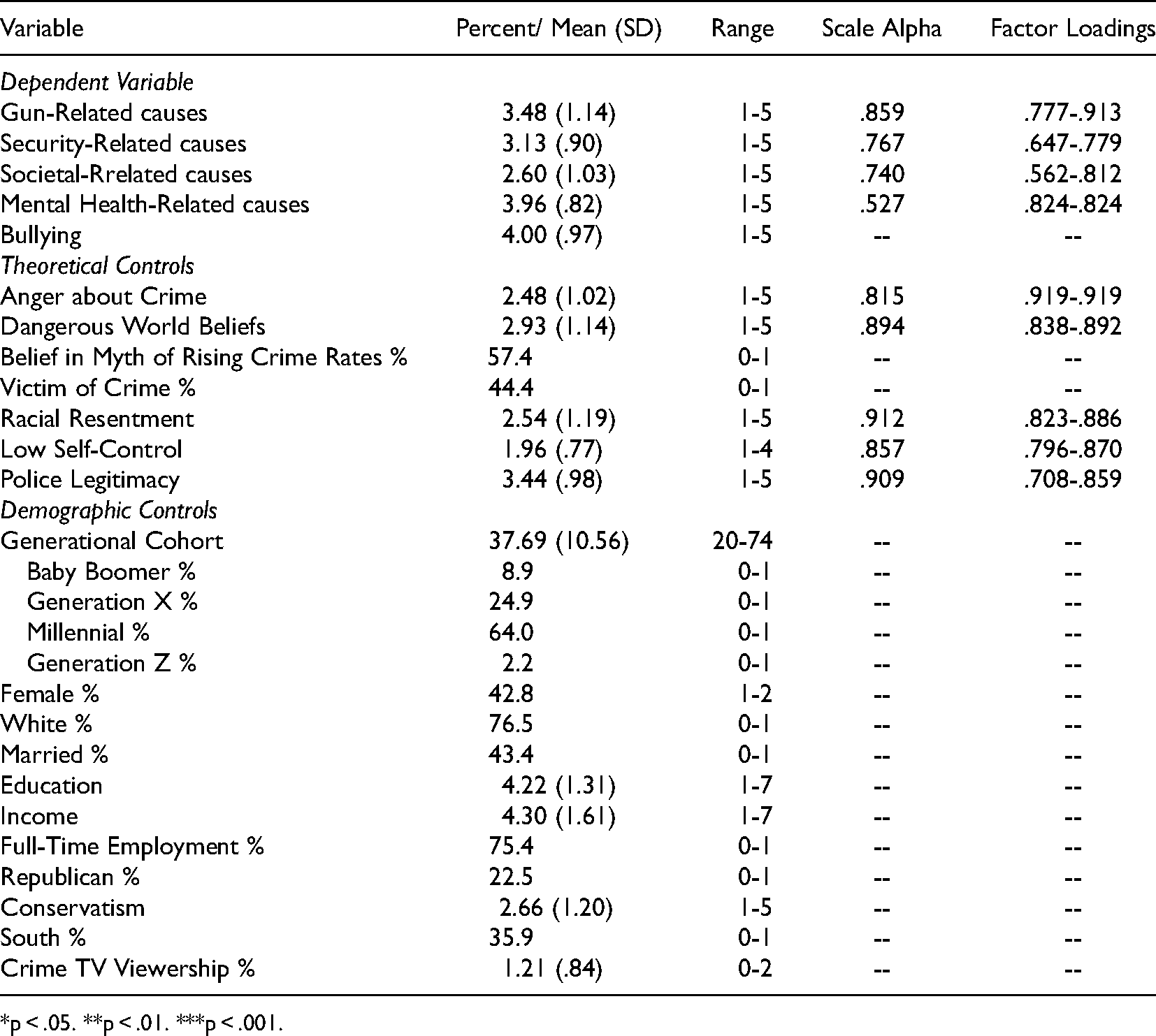
*p < .05. **p < .01. ***p < .001.
Dependent Variables
To assess support for the perceived causes of school shootings, respondents were asked to report their level of agreement ranging from 1 = “Strongly disagree” to 5 = “Strongly agree” to the 16 items seen in Table 2. These items were derived by the researchers to explore this topic (Lee et al., 2020). Responses were assessed using exploratory factor analysis, which resulted in the production of five key domains: Gun-Related Causes; Security-Related Causes; Societal-Related Causes; Mental Health-Related Causes; and Bullying. Responses to the respective items in each domain were averaged to produce scales in which higher values indicate greater support for the respective domain being the source of school shootings (See Table 1 for each scale's alphas and factor loadings).
Perceived Causes of School Shootings Responses: Percentages (N = 739).
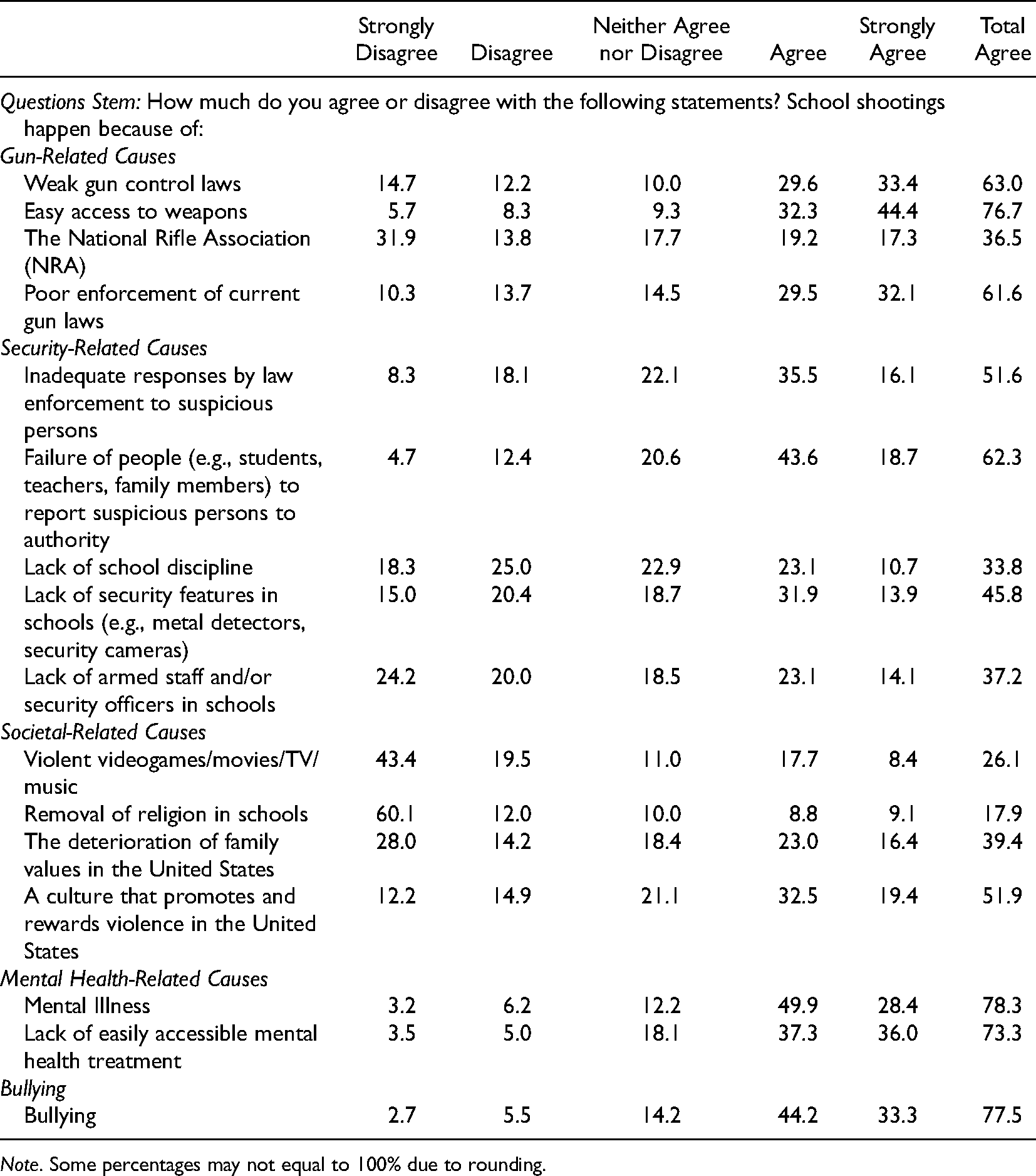
Note. Some percentages may not equal to 100% due to rounding.
Key Independent Variable
In this study, Generational Cohort was established using the year cutoffs set forth by the Pew Research Center and self-reported year of birth (Dimock, 2019). Those born between 1946 and 1964 were identified as “Baby Boomers,” between 1965 and 1980 as “Generation X,” between 1981 and 1996 as “Millennials,” and those between 1997 and 2012 as “Generation Z.” 2
Theoretical Control Variables
Based on previous research, several factors aside from generational cohort may influence beliefs related to perceived causes of school shootings. Thus, we include seven constructs as controls (for more detail on these measures, see Appendix A). First, anger about crime was measured by asking respondents about their level of anger about crime in (1) their community and (2) the country. Responses to these items were averaged to produce a scale in which higher values indicate a greater Anger about Crime (α = .815; factor loadings between .919 and .919).
Second, respondents were asked to report their level of agreement with four statements pertaining to the belief that the world is a dangerous place (e.g., “Any day now chaos and anarchy could erupt around us. All signs are pointing to it”), which were averaged to produce a scale in which higher values indicate a greater belief in a Dangerous World (α = .894; factor loadings between.838 and .892) (Stroebe et al., 2017).
Third, to assess general knowledge about crime rates, respondents were asked to report if, since the 1990s, they felt that crime in the United States was increasing or decreasing. This variable, Belief in Rising Crime Rates, was coded to indicate those believing crime was increasing ( = 1) as opposed to decreasing ( = 0). Fourth, respondents were also asked to indicate (1 = Yes, 0 = No) if they had ever been the Victim of a Crime, which may influence views about the effectiveness of security-related efforts.
Fifth, to control for the known relationship between Racial Resentment and gun control preferences (Filindra & Kaplan, 2016, 2017), respondents were asked to report their level of agreement with five statements (e.g., “It is really a matter of some people not trying hard enough; if Blacks would only try harder, they could be just as well off as Whites”; Kinder & Sanders, 1996). Responses were averaged to produce a scale in which higher values indicate greater Racial Resentment (α = .912; factor loadings between .823 and .886).
Sixth, to account for Low Self-Control (Pratt & Cullen, 2000), respondents were asked to report their level of agreement with four items (e.g., “I often act on the spur of the moment without stopping to think”; Grasmick et al., 1993). Responses to these items were averaged to produce a scale in which higher values indicate lower self-control (α = .857; factor loadings between .708 and .859).
Views about the legitimacy of the police may shape perceived causes endorsed for school shootings (especially security-related beliefs). Therefore, respondents were asked to report their level of agreement with seven items (e.g., “You should support the decision made by police officers even when you disagree with them”; Trinker et al., 2018), which were averaged to produce a scale in which higher values indicated greater Police Legitimacy (α = .909; factor loadings between .708 and .859).
Demographic Controls
Additionally, nine sociodemographic characteristics were controlled for as follows: Sex (2 = Female, 1 = Male), Race (1 = White, 0 = All others), Married (1 = Married, 0 = All others), Education (ranging from 1 = less than high school degree to 7 = Doctoral degree), Income (ranging from 1 = 0-$9,999 to 7 = $100,000 + ), Employment (1 = Full-time, 0 = All others), Republican (1 = Republican, 0 = All others), Conservatism (ranging from 1 = Very liberal to 5 = Very conservative), and Southerner (1 = residing in a southern state by the U.S. Census based on self-identified postal (ZIP) code, 0 = All others). Respondents were also asked to report if (Yes/No) they had regularly watched either fictional crime shows or true crime shows/documentaries. Affirmative responses to these two items were summed to create a Crime TV Viewership index.
Analytic Plan
Analyzes for this study started with describing the responses to the perceived causes of school shootings (Table 2). Next, multivariate analyzes using ordinary least squares (OLS) regression estimated the impact of generational cohort on these causes while accounting for theoretical and sociodemographic controls. These analyzes use Baby Boomers as the reference group under the first listing of “Generational Cohort” and Gen X as the reference group under the second listing of “Generational Cohort” to help further understand the differences between cohort groups. In addition, due to the smaller group sizes of the Baby Boomer and Gen Z groups, additional analyzes were completed, combining these birth cohorts into two groups (1) Baby Boomer and Gen X and (2) Millennial and Gen Z. Results of these analyzes were substantively similar and available upon request. Across all analyzes, the variance inflation factors (VIF) did not exceed 4, suggesting no concern for multicollinearity in these analyzes (Weisburd & Britt, 2014).
Results
As seen in Table 2, beliefs about the perceived causes of school shootings varied widely, with the removal of religion least frequently endorsed (17.9% total agree) and bullying endorsed most frequently (77.5% total agree). With the exception of the NRA, gun-related causes were endorsed by nearly two-thirds of respondents, and mental health-related causes endorsed by roughly three in four respondents. In regard to security-related causes, only inadequate responses by law enforcement to suspicious persons (51.6%) and failure of people to report suspicious people (62.3%) were endorsed (agree and strongly agree) by at least half of respondents. Likewise, just over half of respondents (51.9%) endorsed the societal-related cause of a culture that promotes and rewards violence in the United States; all other causes were endorsed (agree and strongly agree) by less than half of respondents.
Given this widespread variation, multivariate models were estimated to understand the unique influence of generational cohort in these responses while also controlling for theoretical and sociodemographic variables. As seen in Table 3, five models are presented, using each of the five domains as dependent variables. When examining Model 1 relating to gun-related causes, there are no significant generational differences in the endorsement of these causes, regardless of the reference group. In Model 2, security-related causes saw significant increases in endorsements by Gen Z respondents (β = .085) compared to Baby Boomers. When Gen X is used as the reference group, significant differences in endorsements persist between Gen Z and Gen X (β = .087), whereas Millennials and Baby Boomers are not significantly different in their endorsement of security-related causes.
Regression Models for Perceived Causes of School Shootings (N = 739).
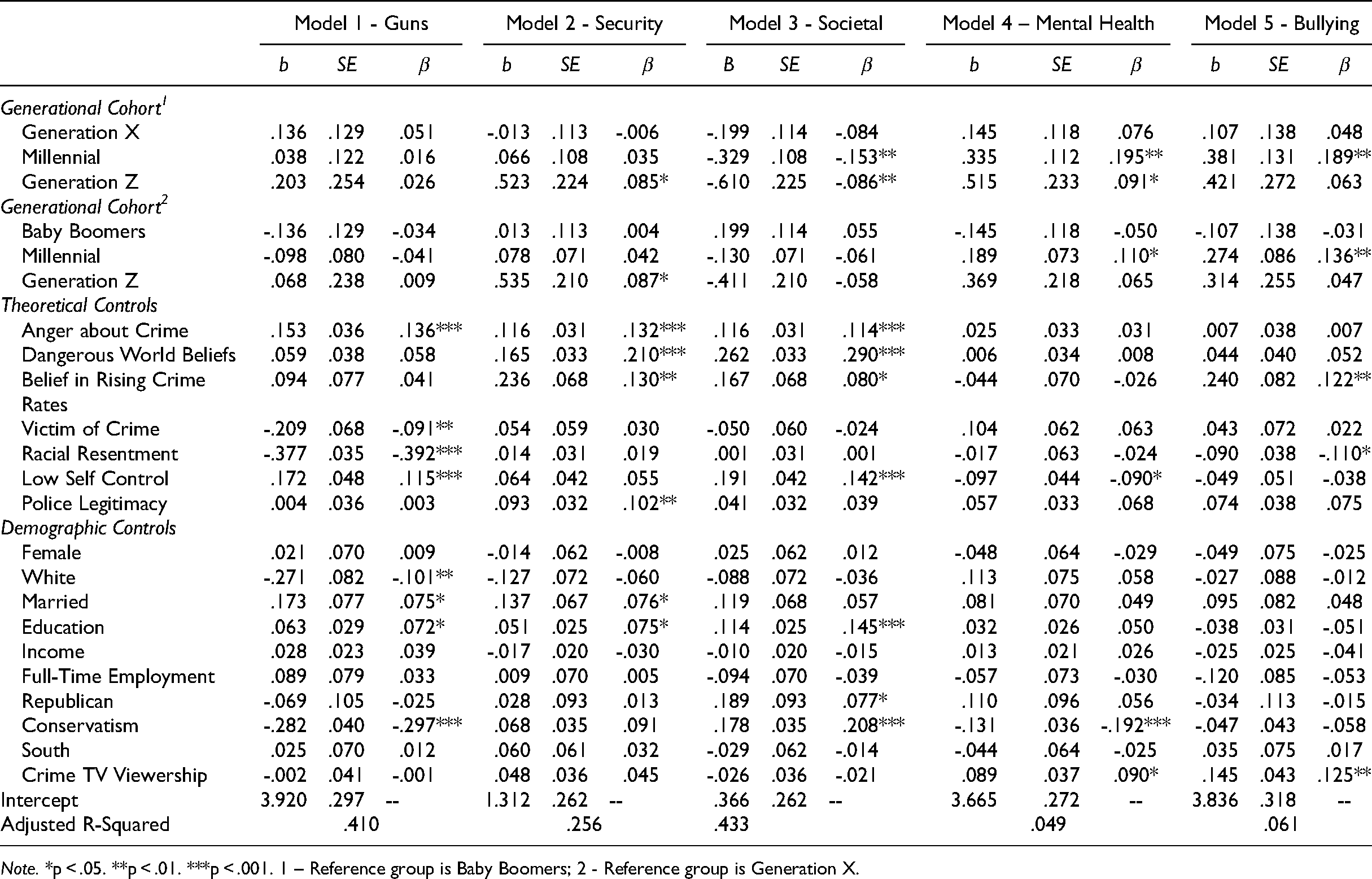
Note. *p < .05. **p < .01. ***p < .001. 1 – Reference group is Baby Boomers; 2 - Reference group is Generation X.
In the third model, which explores societal-related causes, compared to Baby Boomers, Millennials (β = −.153) and Gen Z respondents (β = −.086) saw significant decreases in agreement with societal-related causes of school shootings. However, none of these birth cohorts were significantly different from Gen X.
In contrast, in Model 5, compared to Baby Boomers, Millennials (β = .195) and Gen Z (β = .091) saw significantly increased agreement with mental health-related causes for school shootings. Gen X did not significantly differ in endorsements from Baby Boomers. When Gen X was used as the reference category, Millennials held significantly different views (β = .110) from Gen X, but Gen Z did not significantly differ from Gen X.
Finally, Model 4 reports Millennials (β = .189) significantly perceived bullying as a cause of school shootings compared to Baby Boomers. However, there were no significant differences between perceptions for Baby Boomers, Gen X, and Gen Z. When used as the reference group, Gen X and Millennials held significantly different views of bullying as the cause of school shootings, with Millennials more inclined to endorse this item (β = .136). Again, no significant differences existed between Baby Boomers, Gen X, and Gen Z.
Discussion
“High School Massacre”—the headline from The Denver Post seems like it could be ripped from a headline in 2022, but rather, it stems from the 1999 Columbine High School shooting (Obmascik, 1999). In the more than 20 years since tragedy struck Columbine High School, school shootings have continued to be a source of concern not only for those in the communities in which they occur but also for individuals across the country (APA, 2020). In the hopes to prevent future shootings, law enforcement, politicians, academics and researchers, school officials, parents, and countless others, search for answers to why and how such violence occurs. Although we can identify some commonalities among school shooters (Peterson & Densley, 2020), there is no definitive profile of a school shooter nor a single cause of these tragedies (National Association of School Psychologists, 2015). Nevertheless, media sources are filled with exposés and dramatizations about what may have led the shooter to engage in such violence and what should be done to prevent the next one, which are readily devoured by their consumers.
In the aftermath of these tragedies, administrators, school boards, and local, state, and federal legislators feel immense pressure from the public to ensure the safety of students, educators, and staff. Understanding how the public perceives various causes of school shootings provides some insight into the subsequent policies that may be implemented in response to the events (Burnstein, 2006; Lax & Philips, 2012; Pickett, 2019). Thus, this study attempts to determine if there are generational differences in the perceived causes of school shootings. As Millennials and Gen Z become larger voting blocs and Baby Boomers continue to age, it is possible that understanding generational differences in the causes of school shootings may provide a glimpse into policies that will be both adopted and abandoned in the future (Alter, 2021; Schaeffer, 2021). Below is a summary of our key findings.
First, no generational differences were found for support related to gun-related causes of school shootings. Reflecting on any shooting event that has risen to national attention, this finding is not surprising. Given the political frenzy surrounding gun rights and gun control in the aftermath of a school shooting and news coverage that commonly frames these incidents through a gun control/gun access lens, gun-related causes are most likely to be seen by the American public, regardless of their generational cohort (Kleck, 2009; Schildkraut & Hernandez, 2014; Schildkraut & Muschert, 2013; Schutten et al., 2021; Silva, 2020). As such, we argue that this debate surrounding gun control and Second Amendment rights will continue to persist for school shootings as it does with mass shootings more broadly, seeking to balance the “Price of Liberty or Never Again” (Haner et al., 2019).
Second, only Gen Z significantly differed from Baby Boomers and Gen X, more fervently supporting security-related causes for school shootings. This finding is somewhat unexpected given that Millennials grew up in the era of increased securing of schools, Gen Z experienced similar levels of fortification, and schools being the safest in the most recent decades (Fox & Friedel, 2018). Still, these results indicate a search for increased physical security at school by Gen Z, which is reflected in their levels of stress about school shootings (APA, 2018). However, this effect in our study is statistically small and does not persist with Millennials, which provides a rocky future for further security-related policies.
One potential explanation for Millennials’ not supporting security-related causes is that their educational experience was interrupted with the 1999 shooting at Columbine High School. Similar to older generations acutely aware of airport practices pre- and post-9/11 (Kujawinski, 2021), Millennials are able to remember a time when schools were not outfitted with metal detectors, SROs, and access control measures. Thus, unlike the generations before them who did not experience the dramatic rise in security measures and Gen Z, who have only gone to school in a time marked by increased fortifications, Millennials are uniquely situated to understand fully the impact of the “school securitization movement” (King & Bracy, 2019, p. 275). With Columbine occurring prior to and other prominent shootings occurring after the hardening of the schools, it is possible Millennials may not hold much stock in security-related causes of school shootings. Furthermore, it is possible that the price tag associated with such security measures (e.g., $400,000 for the country's “safest school,” Fittes, 2018; $80,000 per SRO, Hill, 2013) may lead Millennials, who are already-debt-burdened and socially-conscious, with preferences for more holistic and less costly solutions (Lee, 2020). However, future research should explore this potential explanation further.
Third, compared to Baby Boomers, Millennials and Gen Z were significantly less likely to perceive societal factors as a cause of school shootings. Furthermore, Millennials and Gen Z were no different from Gen X in these perceptions. Given the initial reporting from the media about the Columbine shooters’ fascination with violent media (Baldwin, 1999; Frymer, 2009), it is not surprising that Baby Boomers may have seized and continue to focus on it as a cause, while Millennials and Gen Z, due to their age, likely were not exposed to this potential cause and thus do not fixate on it. Moreover, Millennials and Gen Z members are avid consumers of violent video games and movies, with 7 of the top 10 rated video games of the last decade requiring a rating of “M” for mature audiences (Dietz, 2020) and 9 of the top 10 rated films of the last decade requiring a rating of “PG-13” or higher (Filmsite, 2021). Having consumed such content themselves, they may recognize its lack of translation from screen to actual violent behavior. Additionally, research on religion finds a rapid decline in religious participation in the U.S. (Pew Research Center, 2019) and that “disbelievers share many of the same moral values endorsed by believers” (Ståhl, 2021, p. 20). Thus, our results are not surprising, with Millennials and Gen Z respondents’ beliefs about the relationship between religion and school shootings. As a result, we argue that the belief in societal factors as a cause of school shootings will be phased out along with calls for policies related to this belief, such as the reinstallation of God in schools (Lavender, 2012) and doing “something” about video games and movies (Ducharme, 2018).
Fourth, Gen Z and Millennials, when compared to Baby Boomers, viewed mental health as a cause of school shootings, with Millennials more likely to blame mental health than Gen X. One explanation for this finding is that younger generations are living in a time where there are conscious efforts to remove the stigma around seeking help for mental health-related issues (Avera, 2017). Additionally, younger generations are more acutely aware of the suffering associated with mental health-related issues, as they are more likely to report poorer mental health and to have received treatment for therapy than Gen X or Baby Boomers (APA, 2018). As community mental health programs and school-based adolescent mental health programs stemming from recommendations from the President’s New Freedom Commission on Mental Health (2003) are more commonplace in schools, it is possible this increased awareness may lead to more people to attribute school shootings to mental health related-causes, and more policies focused on recognizing and providing treatment will be more common in the future.
Fifth, Millennials, compared to Baby Boomers and Gen X, increasingly perceived bullying as a cause of school shootings. Beyond bullying being presented in the news and popular entertainment media (Schildkraut et al., 2018; Silva, 2020; Walsh, 2018), this birth cohort may be especially primed to fixate this explanation based on a cultural shift to address bullying (Tunde & Ramona, 2019). Such efforts have prompted programs, such as Rachel’s Challenge (2021), National Bullying Awareness Month (started in October 2006; PACER, 2021), and Melania Trump's “Be Best” campaign (Trump White House, n.d.). As such, given the increased political participation of Millennials compared to their predecessors (Cilluffo & Fry, 2019; Fry, 2017), we expect that future policies surrounding school shootings will likely be driven by bullying as a cause of school shootings by up-and-coming voters and policymakers.
Our Need to Know Why: The Need for Cognitive Closure
Still, left unexplored in this study is “why” these respondents believed in these causes of school shootings. One potential explanation is that humans have a natural desire to make sense of tragedy (Kagan, 1972). In an attempt to address these feelings of worry and ambiguity, individuals search for explanations for how such an event was able to occur—or, have a need for cognitive closure (Kruglanski & Webster, 1996; Webster & Kruglanski, 1994). In seeking this cognitive closure, individuals often “seize” on the first available information, often without verifying its truth (Konnikova, 2013; Roets et al., 2015). People then seek to make this closure as permanent as possible by “freezing” on that explanation, discounting anything that challenges their frozen beliefs (Konnikova, 2013; Roets et al., 2015).
This process of “seizing” and “freezing” information is critical when examining the public opinion on the causes of school shootings. Due to the vast media coverage (Chyi & McCombs, 2004; Schildkraut & Muschert, 2013; Silva, 2020), people are inundated with information when a shooting occurs. Initial reports—often plagued with false information (Elsass et al., 2014; Robinson, 2011)—can have powerful impacts, as the public can “seize” and “freeze” on the information, refusing to consider other relevant factors contributing to the shooting or to disavow false information. As a result, it is possible each generation—with their unique exposure to historical events—may “seize” and “freeze” on different causes of school shootings (Mannheim, 1928/1970; Ryder, 1965; Strauss & Howe, 1991). This study is the first to assess these potential generational differences.
In this context, older generations, such as Baby Boomers and Gen X, are theorized to have “seized” on the media's initial reporting from older instances such as Columbine (i.e., societal factors, bullying, guns) and “froze” on these perceived causes. In contrast, younger generations, such as Millennials and Gen Z, “seize” and “freeze” on causes that are more currently represented in the media (i.e., mental health, security, guns). As we found generational differences that align with the media framing literature (except for bullying), future research should examine why these differences emerge using a cognitive closure framework.
Limitations
No study is without its limitations, and the current study is not unique in this regard. First, future studies would benefit from the use of a more generalizable sample; opt-in samples such as this are capable of adequately detecting significant relationships, but they are less certain about the magnitude (Thompson & Pickett, 2019). Second, in this sample, Gen Z was limited to those who were 18 and over, which precludes the investigation and analyzes of a large portion of this generation. Still, when examining the magnitude of the regression coefficients relative to their standard errors, it seems that a larger subgroup of Gen Z respondents would help elucidate any differences between this birth cohort compared to the others. As such, results pertaining to this group should be viewed as preliminary. Thus, future research should seek to include the entirety of this generation to reach more conclusive evidence.
Third, there may be some question about the factor loadings and reliability of the scales used for the dependent variables. However, the construction of these scales was derived from exploratory factor analysis based on an understanding of the previous research in this area, and each item indicated a minimum acceptable score (Costello & Osborne, 2005). As such, we attempted to retain as many items as possible to (1) avoid p-hacking and (2) present the fullest picture of causes that were endorsed. Still, analyses were run removing the poorest performing item from the security-related causes scale—failure to report suspicious activity—and the societal-related causes scale—a culture that promotes and rewards violence, with substantially similar results obtained between the full scales and the reduced scales. 3
Finally, there are some individuals who criticize generational research on both theoretical and methodological grounds (e.g., Costanza et al., 2017; Rudolph et al., 2019; Rudolph & Zacher, 2017; Terracciano, 2010; Trzesniewski & Donnellan, 2010). For example, Rudolph et al. (2019) suggest that “the separation of period and cohort effects is an intractable problem even in the population” [emphasis in original] because each of these three factors is entirely determined by the other two. Although not a perfect remedy, studies have employed statistical techniques using longitudinal data (e.g., cross-temporal meta-analysis, cross-classified hierarchical linear modeling) to mitigate the concerns (for a review, see Lee, 2020). As a result, this current study indicates there may be generational differences in the causes of school shootings; however, future research should explore this finding longitudinally.
Conclusion
Fear, worry, and stress about school shootings are a reality in America (APA, 2018, 2020; Graf, 2018) and will likely remain a source of concern for the foreseeable future. As such, there will be continual demands on various stakeholders (e.g., school administrators, legislators) to do something to prevent or reduce these incidents. Using a generational framework, this study sought to provide insight into the policies that may be implemented, retained, or abandoned to address this issue in the coming years. Based on the findings, we predict that future policies to reduce school shootings will likely address gun control, bullying, and mental health. Additionally, policies around security-related measures will likely continue to be debated, while efforts to address societal-related causes (e.g., violent media, religion, family values) will most likely fall out of the public's favor. Although the future is uncertain, these findings provide a glimpse into the probable policies that Millennials and Gen Z will support as they become the largest voting bloc in the United States.
Footnotes
Appendix A: Survey Items
______________________________________________________________________
Appendix B. Perceived Causes of School Shootings Responses by Cohort: Percentages (N = 739)
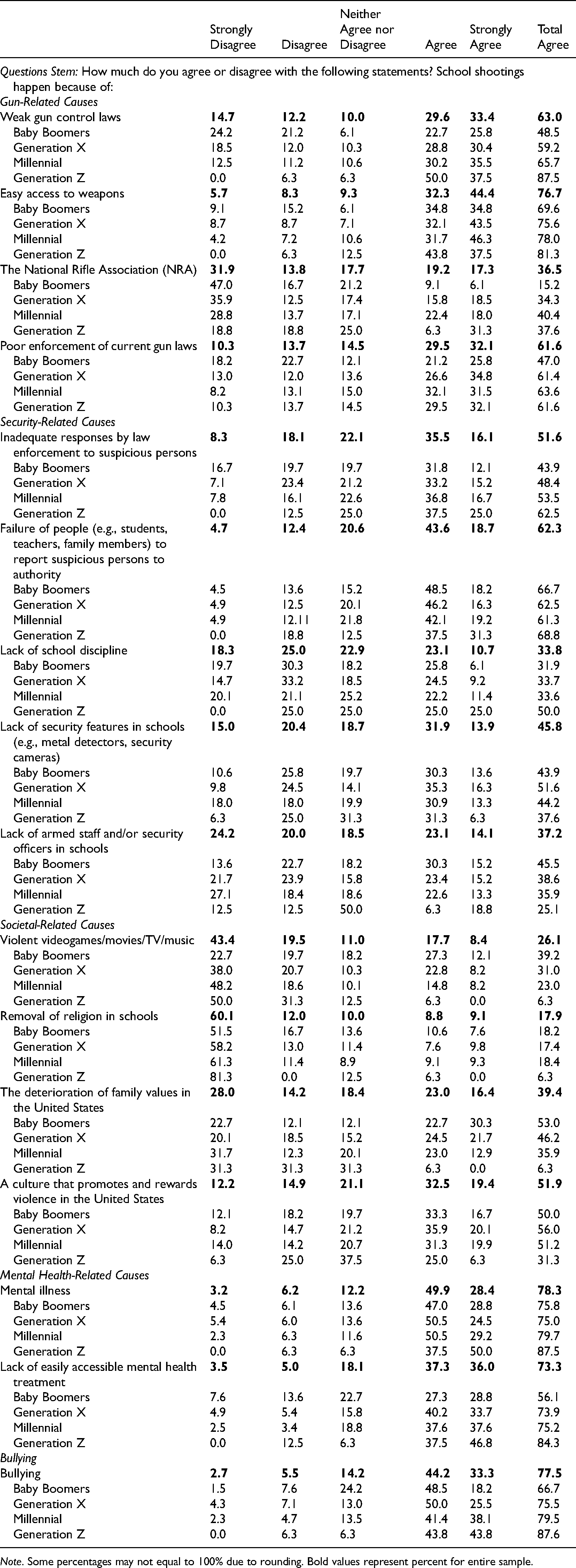
| Strongly Disagree | Disagree | Neither Agree nor Disagree | Agree | Strongly Agree | Total Agree | |
|---|---|---|---|---|---|---|
| Questions Stem: How much do you agree or disagree with the following statements? School shootings happen because of: | ||||||
| Gun-Related Causes | ||||||
| Weak gun control laws |
|
|
|
|
|
|
| Baby Boomers | 24.2 | 21.2 | 6.1 | 22.7 | 25.8 | 48.5 |
| Generation X | 18.5 | 12.0 | 10.3 | 28.8 | 30.4 | 59.2 |
| Millennial | 12.5 | 11.2 | 10.6 | 30.2 | 35.5 | 65.7 |
| Generation Z | 0.0 | 6.3 | 6.3 | 50.0 | 37.5 | 87.5 |
| Easy access to weapons |
|
|
|
|
|
|
| Baby Boomers | 9.1 | 15.2 | 6.1 | 34.8 | 34.8 | 69.6 |
| Generation X | 8.7 | 8.7 | 7.1 | 32.1 | 43.5 | 75.6 |
| Millennial | 4.2 | 7.2 | 10.6 | 31.7 | 46.3 | 78.0 |
| Generation Z | 0.0 | 6.3 | 12.5 | 43.8 | 37.5 | 81.3 |
| The National Rifle Association (NRA) |
|
|
|
|
|
|
| Baby Boomers | 47.0 | 16.7 | 21.2 | 9.1 | 6.1 | 15.2 |
| Generation X | 35.9 | 12.5 | 17.4 | 15.8 | 18.5 | 34.3 |
| Millennial | 28.8 | 13.7 | 17.1 | 22.4 | 18.0 | 40.4 |
| Generation Z | 18.8 | 18.8 | 25.0 | 6.3 | 31.3 | 37.6 |
| Poor enforcement of current gun laws |
|
|
|
|
|
|
| Baby Boomers | 18.2 | 22.7 | 12.1 | 21.2 | 25.8 | 47.0 |
| Generation X | 13.0 | 12.0 | 13.6 | 26.6 | 34.8 | 61.4 |
| Millennial | 8.2 | 13.1 | 15.0 | 32.1 | 31.5 | 63.6 |
| Generation Z | 10.3 | 13.7 | 14.5 | 29.5 | 32.1 | 61.6 |
| Security-Related Causes | ||||||
| Inadequate responses by law enforcement to suspicious persons |
|
|
|
|
|
|
| Baby Boomers | 16.7 | 19.7 | 19.7 | 31.8 | 12.1 | 43.9 |
| Generation X | 7.1 | 23.4 | 21.2 | 33.2 | 15.2 | 48.4 |
| Millennial | 7.8 | 16.1 | 22.6 | 36.8 | 16.7 | 53.5 |
| Generation Z | 0.0 | 12.5 | 25.0 | 37.5 | 25.0 | 62.5 |
| Failure of people (e.g., students, teachers, family members) to report suspicious persons to authority |
|
|
|
|
|
|
| Baby Boomers | 4.5 | 13.6 | 15.2 | 48.5 | 18.2 | 66.7 |
| Generation X | 4.9 | 12.5 | 20.1 | 46.2 | 16.3 | 62.5 |
| Millennial | 4.9 | 12.11 | 21.8 | 42.1 | 19.2 | 61.3 |
| Generation Z | 0.0 | 18.8 | 12.5 | 37.5 | 31.3 | 68.8 |
| Lack of school discipline |
|
|
|
|
|
|
| Baby Boomers | 19.7 | 30.3 | 18.2 | 25.8 | 6.1 | 31.9 |
| Generation X | 14.7 | 33.2 | 18.5 | 24.5 | 9.2 | 33.7 |
| Millennial | 20.1 | 21.1 | 25.2 | 22.2 | 11.4 | 33.6 |
| Generation Z | 0.0 | 25.0 | 25.0 | 25.0 | 25.0 | 50.0 |
| Lack of security features in schools (e.g., metal detectors, security cameras) |
|
|
|
|
|
|
| Baby Boomers | 10.6 | 25.8 | 19.7 | 30.3 | 13.6 | 43.9 |
| Generation X | 9.8 | 24.5 | 14.1 | 35.3 | 16.3 | 51.6 |
| Millennial | 18.0 | 18.0 | 19.9 | 30.9 | 13.3 | 44.2 |
| Generation Z | 6.3 | 25.0 | 31.3 | 31.3 | 6.3 | 37.6 |
| Lack of armed staff and/or security officers in schools |
|
|
|
|
|
|
| Baby Boomers | 13.6 | 22.7 | 18.2 | 30.3 | 15.2 | 45.5 |
| Generation X | 21.7 | 23.9 | 15.8 | 23.4 | 15.2 | 38.6 |
| Millennial | 27.1 | 18.4 | 18.6 | 22.6 | 13.3 | 35.9 |
| Generation Z | 12.5 | 12.5 | 50.0 | 6.3 | 18.8 | 25.1 |
| Societal-Related Causes | ||||||
| Violent videogames/movies/TV/music |
|
|
|
|
|
|
| Baby Boomers | 22.7 | 19.7 | 18.2 | 27.3 | 12.1 | 39.2 |
| Generation X | 38.0 | 20.7 | 10.3 | 22.8 | 8.2 | 31.0 |
| Millennial | 48.2 | 18.6 | 10.1 | 14.8 | 8.2 | 23.0 |
| Generation Z | 50.0 | 31.3 | 12.5 | 6.3 | 0.0 | 6.3 |
| Removal of religion in schools |
|
|
|
|
|
|
| Baby Boomers | 51.5 | 16.7 | 13.6 | 10.6 | 7.6 | 18.2 |
| Generation X | 58.2 | 13.0 | 11.4 | 7.6 | 9.8 | 17.4 |
| Millennial | 61.3 | 11.4 | 8.9 | 9.1 | 9.3 | 18.4 |
| Generation Z | 81.3 | 0.0 | 12.5 | 6.3 | 0.0 | 6.3 |
| The deterioration of family values in the United States |
|
|
|
|
|
|
| Baby Boomers | 22.7 | 12.1 | 12.1 | 22.7 | 30.3 | 53.0 |
| Generation X | 20.1 | 18.5 | 15.2 | 24.5 | 21.7 | 46.2 |
| Millennial | 31.7 | 12.3 | 20.1 | 23.0 | 12.9 | 35.9 |
| Generation Z | 31.3 | 31.3 | 31.3 | 6.3 | 0.0 | 6.3 |
| A culture that promotes and rewards violence in the United States |
|
|
|
|
|
|
| Baby Boomers | 12.1 | 18.2 | 19.7 | 33.3 | 16.7 | 50.0 |
| Generation X | 8.2 | 14.7 | 21.2 | 35.9 | 20.1 | 56.0 |
| Millennial | 14.0 | 14.2 | 20.7 | 31.3 | 19.9 | 51.2 |
| Generation Z | 6.3 | 25.0 | 37.5 | 25.0 | 6.3 | 31.3 |
| Mental Health-Related Causes | ||||||
| Mental illness |
|
|
|
|
|
|
| Baby Boomers | 4.5 | 6.1 | 13.6 | 47.0 | 28.8 | 75.8 |
| Generation X | 5.4 | 6.0 | 13.6 | 50.5 | 24.5 | 75.0 |
| Millennial | 2.3 | 6.3 | 11.6 | 50.5 | 29.2 | 79.7 |
| Generation Z | 0.0 | 6.3 | 6.3 | 37.5 | 50.0 | 87.5 |
| Lack of easily accessible mental health treatment |
|
|
|
|
|
|
| Baby Boomers | 7.6 | 13.6 | 22.7 | 27.3 | 28.8 | 56.1 |
| Generation X | 4.9 | 5.4 | 15.8 | 40.2 | 33.7 | 73.9 |
| Millennial | 2.5 | 3.4 | 18.8 | 37.6 | 37.6 | 75.2 |
| Generation Z | 0.0 | 12.5 | 6.3 | 37.5 | 46.8 | 84.3 |
| Bullying | ||||||
| Bullying |
|
|
|
|
|
|
| Baby Boomers | 1.5 | 7.6 | 24.2 | 48.5 | 18.2 | 66.7 |
| Generation X | 4.3 | 7.1 | 13.0 | 50.0 | 25.5 | 75.5 |
| Millennial | 2.3 | 4.7 | 13.5 | 41.4 | 38.1 | 79.5 |
| Generation Z | 0.0 | 6.3 | 6.3 | 43.8 | 43.8 | 87.6 |
Note. Some percentages may not equal to 100% due to rounding. Bold values represent percent for entire sample.
Declaration of Conflicting Interests
The authors declared no potential conflicts of interest with respect to the research, authorship, and/or publication of this article.
Funding
The authors received no financial support for the research, authorship, and/or publication of this article.
