




Abstract
Since the early 1990s, 27 states passed statutes known as “stand your ground laws” to give legal protection to citizens who use lethal force in self-defense, and 8 states have acted as de facto stand your ground states due to court rulings. Proponents of these laws believe they act as a criminal deterrent while opponents say they legitimize vigilantism. The aim of this paper is to determine whether there is a relationship between stand your ground laws and crime. Data from fixed effects and negative binomial regression models from 1980–2018 find no strong relationship between stand your ground laws and crime in either direction. Policy implications are discussed, namely, the primary costs and benefits of these laws are not likely to stem from increases or decreases in crime but rather the legal and ethical consequences of increasing protections for civilians who act in self-defense.
Introduction
Scholars have long debated what causes the United States’ uniquely high violent crime rates. In 2018 alone, the FBI estimated there were 16,214 murders in the United States, and of those murders, 72.7% were committed with a firearm (FBI, 2018). Given the propensity of American criminals to use firearms in the commission of violent crime, researchers have taken a keen interest in America's lax gun laws as a potential explanation for high levels of violence in the United States.
A notable example of America's loose gun laws has been the rapid proliferation of what are known as “stand your ground” (SYG) laws across dozens of U.S. states. SYG laws stand in contrast to the long-held common law principle that, when faced with an assailant, an individual must retreat before engaging in lethal force in self-defense, except when one is in their home (their “castle”). SYG laws are statues which extend the common law “castle doctrine” to all public places where an individual has a right to be and eliminate the traditional duty to retreat requirement. While SYG laws are not limited to firearms—they also would apply to individuals who defend themselves with any other weapon or no weapon at all—defensive gun use in the United States, according to some surveys, is relatively common, and most SYG cases involve the use of a firearm (English, 2021; Tampa Bay Times, 2013). SYG laws are not a carte blanche to use deadly force; defendants often demonstrate a reasonable person would have felt threatened in their situation. In some states, such as Florida, the burden of proof is on the prosecution, but nonetheless stand your ground laws in theory only permit lawful use of force. Further, individuals involved in criminal activities, in most cases, cannot invoke a SYG statute in their defense. Despite the restrictions written into SYG statutes, there have been many high-profile instances where defendants have, according to some, gone too far.
The objective of this paper is to analyze one of the key reasons legislators across the country have been persuaded to adopt such legislation: the alleged deterrent effect these laws have on crime. Major gun advocacy groups, such as the NRA, have supported SYG laws under the pretense that these laws will reduce crime and save lives (McClellan and Tekin, 2017). Likewise, state legislator Dennis Baxley, one of the authors of Florida's stand your ground law, has cited falling crime rates after Florida's SYG law was passed as proof the law saved lives (Holan, 2012). The deterrent effect of these laws is not the only motivation behind these laws, of course. Proponents also argue these laws are necessary to protect citizens from civil and criminal liability in self-defense cases. Former Florida Governor Jeb Bush in a 2015 speech at an annual NRA meeting forcibly argued that individuals “shouldn’t have to choose between being attacked and going to jail,” and said Florida's SYG law, which he signed in 2005, is a model for the rest of the country because it protects “people's rights to protect themselves” (NRA, 2015).
On the other hand, major gun control groups have consistently opposed the proliferation of SYG legislation across the United States on the grounds that it will increase lawlessness and impinge upon public safety efforts. The American gun control organization Everytown for Gun Safety claims these laws promote “armed vigilantism” and “[t]hey encourage the escalation of violence in avoidable situations” (Everytown for Gun Safety, 2019). The Southern Poverty Law Center (SLPC), in a joint report with the Giffords Law Center to Prevent Gun Violence, argues these laws “justify murderous vigilantism” because these laws “remove the traditional obligation to de-escalate a confrontation and avoid using lethal force in public by stepping away (or “retreating”) when it is safe to do so” (SPLC, 2020).
Gun rights and gun control groups are not the only groups who have been involved in the stand your ground debate. Organizations such as the American Bar Association have released comprehensive reports which critique these laws on legal, ethical, racial, and criminological grounds. The 2015 Bar report commented directly on the impact of SYG laws on crime and argued that “empirical evidence shows that states with statutory Stand Your Ground laws have increased homicide rates” (American Bar Association, 2015). The American Psychological Association has the same stance, concurring with the Bar's judgment that these laws “result in deadly crime” (Voelker, 2015).
There are good prima facie reasons to accept both the NRA's deterrence hypothesis and the other groups’ aggression hypothesis, making the impact SYG laws have on violent crime are theoretically ambiguous. On the one hand, these laws may increase rates of homicide, murder, and assault by escalating what otherwise would have been a minor dispute into a deadly (or near deadly) encounter. On the other hand, it is possible that making it easier for citizens to defend themselves would deter criminals from attacking citizens who might be armed, as the risks of committing a crime increase when citizens are able to defend themselves—also known as the deterrence hypothesis (Lott, 2010). If SYG laws did deter crime, the deterrence effect would apply to all crimes where a perpetrator is likely to encounter an armed victim. Because of this, it is important to study multiple violent crime categories rather than focusing on one single metric, such as murder or homicide. By studying a large swath of crimes, this paper is part of the long-standing literature on criminal deterrence which has arisen since at least the 1960s (Becker, 1968; Ehrlich, 1975; Lott and Mustard, 1997).
Empirical research on the impact of SYG laws has primarily focused on homicide. The research which does exist has come to conflicting conclusions. This paper aims to contribute to the literature on the impact SYG laws have on violence using state-level panel data between 1980–2018, one of the longest time periods studied in the stand your ground literature. Overall, this paper finds little evidence either for or against the aggression and deterrence hypothesis.
Literature Review
There exists a voluminous and variegated literature studying the impact gun control has on violent crime spanning multiple academic disciplines and journals (Ayres and Donohue, 2003; 2009; Durlauf et al., 2016; Gius, 2014; Helland and Tabarrok, 2004; Kleck, 1997; Kleck and Hogan, 1999; Kovandzic and Marvell, 2003; Lott, 2010; Lott and Mustard, 1997; Morral et al., 2018; Plassmann and Whitley, 2003; Resnick et al., 2017; Webster et al., 2016). SYG laws are not an exception to the widespread scholarly interest in gun control in the fields of economics, criminology, and public health and have been researched extensively over the past decade.
Humphreys et al. (2017a) used monthly dataset between 1999–2014 to study the impact of Florida's SYG law on homicide and suicide. Using an interrupted time series design to compare monthly rates of homicide in Florida before and after the stand your ground law came into effect, the authors discovered an increase in both homicide and firearm homicide after the passage of Florida's 2005 SYG law. To rule out factors which may have influenced Florida's homicide rate after the passage of its SYG law, the authors chose four comparison states which did not have SYG laws during the period studied. No evidence of the change in homicide rates experienced in Florida was found in the four comparison states. The authors also used suicide rates, as they believed suicide rates would be correlated with economic and social trends and could act as a proxy for such variables. A second study by Humphreys et al. (2017b) disaggregated between justifiable and unlawful homicides and found that both increased following the passage of SYG laws.
Despite the authors’ intriguing study design, the paper has some shortcomings. For example, the paper does not control for key variables such as poverty rates, unemployment rates, incarceration rates, and demographic variables. The study's focus on Florida is its strength as much as it is its weakness. While Florida was one of the first states to implement a SYG law, by the time the authors published their paper, at least 23 states had implemented similar laws. Because of the decision to focus on only one case—Florida—rather than looking at every state, the applicability of their analysis to other states debating the passage of these laws is questionable.
Other scholars have attempted to determine the impact SYG laws have on violent crime as well. Schell et al. (2020) assessed the impact SYG laws, child access prevention laws, and right to carry laws have on firearm mortality from 1970 to 2016 using state level data. They concluded SYG laws increase firearm mortality. Gius (2016) used state-level data between 1980–2011 and 1995–2011. Between 1995–2011, SYG laws had no statistically significant impact on crime except for rape, and the coefficient was positive and statistically significant. For the 1980–2011 period, SYG laws were positive and statistically significant for all crimes except gun-related murder, one of the crime categories we would expect SYG laws to have the largest potential positive effect. Overall, Gius’ findings suggest SYG laws do not reduce crime and may increase it.
Gius (2016) ought to be lauded for his use of a large dataset and his focus on a large set of potentially deterrable violent crimes, rather than focusing only on homicide. However, Schell et al. (2018) have argued the fixed effects models used in Gius (2016) fail to properly estimate standard errors, have high Type I error rates, and often have issues with statistical power within their simulations. The authors argue a negative binomial model with year (but not state) fixed effects best overcomes the issues faced in the gun control literature.
McClellan and Tekin (2017) used state-level data from the U.S. Vital Statistics between 2000 and 2010 and tested whether SYG laws were associated with increased homicide. The authors found SYG laws increased homicide rates among white males but not blacks; they argue between 28 and 33 extra white males were killed each month due to SYG laws. Cheng and Hoekstra (2013) looked at a broader slate of crimes than did McClellan and Tekin (2017). Their state-level panel between 2000 and 2010 included data on burglary, robbery, aggravated assault, and homicide. The results suggested SYG laws do not deter burglary, robbery, or aggravated assault, and may increase homicide by 8% by lowering the cost of using lethal force. Both papers analyze a relatively brief period (2000–2010), and there are strong reasons which will be further discussed below to dispute their choice of homicide rates as their dependent variable rather than studying murder rates.
Guettabi and Munasib (2017) use a multiple case study approach and an increasingly popular synthetic control method (SCM), explained in depth by Abadie et al. (2010). The SCM method employed by Guettabi and Munasib (2017) used panel data across states and years and a matching algorithm to generate a weighted average of the dependent variable (gun deaths and murder) from placebo states which have not passed SYG laws. The weighted averages from these placebo states act as a counterfactual: they tell what would have happened if SYG states never passed such laws. Put simply, the method allows the authors to construct a synthetic control group, hence the name. If the difference between the generated counterfactual from placebo states and treatment states is positive, it suggests the outcome is greater in the treatment state; if the difference is negative, it suggests the outcome is lesser than the control state. Guettabi and Munasib (2017) find the outcomes of SYG across states are not uniform. In three states—Florida, Alabama, and Michigan—SYG laws were associated with increased non-suicide gun deaths, and only in Florida was an effect on murder and non-negligent murder found. In other states, no impact on murder or non-suicide gun deaths were observed. The authors argue Florida, Alabama, and Michigan, states oversaw a more significant change in their self-defense law with the passage of SYG laws than other states studied, which explains why states such as Louisiana, Georgia, and Indiana, did not experience an increase in gun deaths following the passage of SYG laws.
While the SCM approach is a sophisticated way to study the impact of gun policy, and in many ways can be superior to traditional panel data analysis (especially in cases where the data is limited to only a few experiments), it suffers from a serious drawback: it fails to control for unobserved heterogeneity during the treatment period. During the treatment period, the “gap” in the dependent variable between treatment and control states is determined by the difference of the dependent variable in the treatment state and the control states, making the gap a cross section. Cross-sectional analyses almost always suffer from unobserved heterogeneity. Unobserved permanent factors may be correlated with the dependent variable and the treatment, potentially leading to omitted variable bias. There are large differences in culture, climate, demography, and history between states, and the placebo states could potentially have higher or lower crime rates than the treatment states, calling the analysis into question (Moody and Marvell, 2019). Changes in endogenous variables during the treatment period may also explain gaps which form after the treatment goes into effect. The best way to control for these issues is a fixed effects model, as used in Gius (2016).
One recent literature review by Yakubovich et al. (2021) systemically reviewed the SYG literature and identified 25 studies which meet their criteria for testing the population-level impact of SYG laws. The authors of the review argue that SYG laws do not reduce crime, and that the overall evidence suggests these laws are associated with small increases in total and firearm homicide, aggravated assault, and robbery.
Not all scholars have found a positive association between SYG laws and violence; some authors have concluded SYG laws reduce violence. Lott (2010) was one of the first to study the impact of self-defense laws on crime, and he found a negative association between liberal self-defense laws and violent crime. The findings showed expanded castle doctrine legislation reduced murder rates by 9%, rape rates by 18%, aggravated assault rates by 14.1%, and property crime rates by 6%. Robbery rates were found to be 6.7% lower, but it was only significant at the 10% level. States with expanded castle doctrine laws had no significant reduction in burglary rates in the analysis. Despite the statistical significance of these findings, too few years had passed since most states had implemented SYG laws to draw any strong conclusions from the data. Further, SYG laws and castle doctrine laws are not the same despite both broadly being in the category of self-defense law. Castle doctrine only applies to incidents within the home; SYG laws apply to any area where a law-abiding citizen may legally carry a firearm. Yu (2014), using county-level data in the Eastern United States, found SYG laws were associated with a 3.5% decrease in violent crime, providing some evidence for the deterrence hypothesis. However, using overall violent crime levels introduces problems of aggregation and does not allow us to understand which crimes changed in response to these laws.
This paper differs from the prior research in a few different ways. First, this paper is the first to apply count analysis to the topic of SYG laws and multiple types of violent crime. Schell et al. (2020) applied count analysis to firearm mortality, but as will be explained later, firearm mortality is not the only relevant policy variable, especially to those who worked to pass these laws in the first place. Second, past research has almost universally ignored the fact court rulings across eight states have instituted stand your ground case law in the absence of direct legislative action.
1
In this paper, these states are coded as stand your ground states and not as control states. Third, like Gius (2016) and Cheng and Hoekstra (2013), this paper looks at many different deterrable crimes, including murder, rape, assault, and robbery. SYG laws should, in theory, deter any crime where a criminal is likely to encounter a victim or armed bystander, so studying a large swath of crimes is appropriate. Burglary, larceny, and auto theft are tested in this paper as placebos where we ought to expect no effect in either direction. The FBI classifies these crimes as property crimes, which it defines as “theft-type offenses is the taking of money or property, but
Methodology
Data and Sources
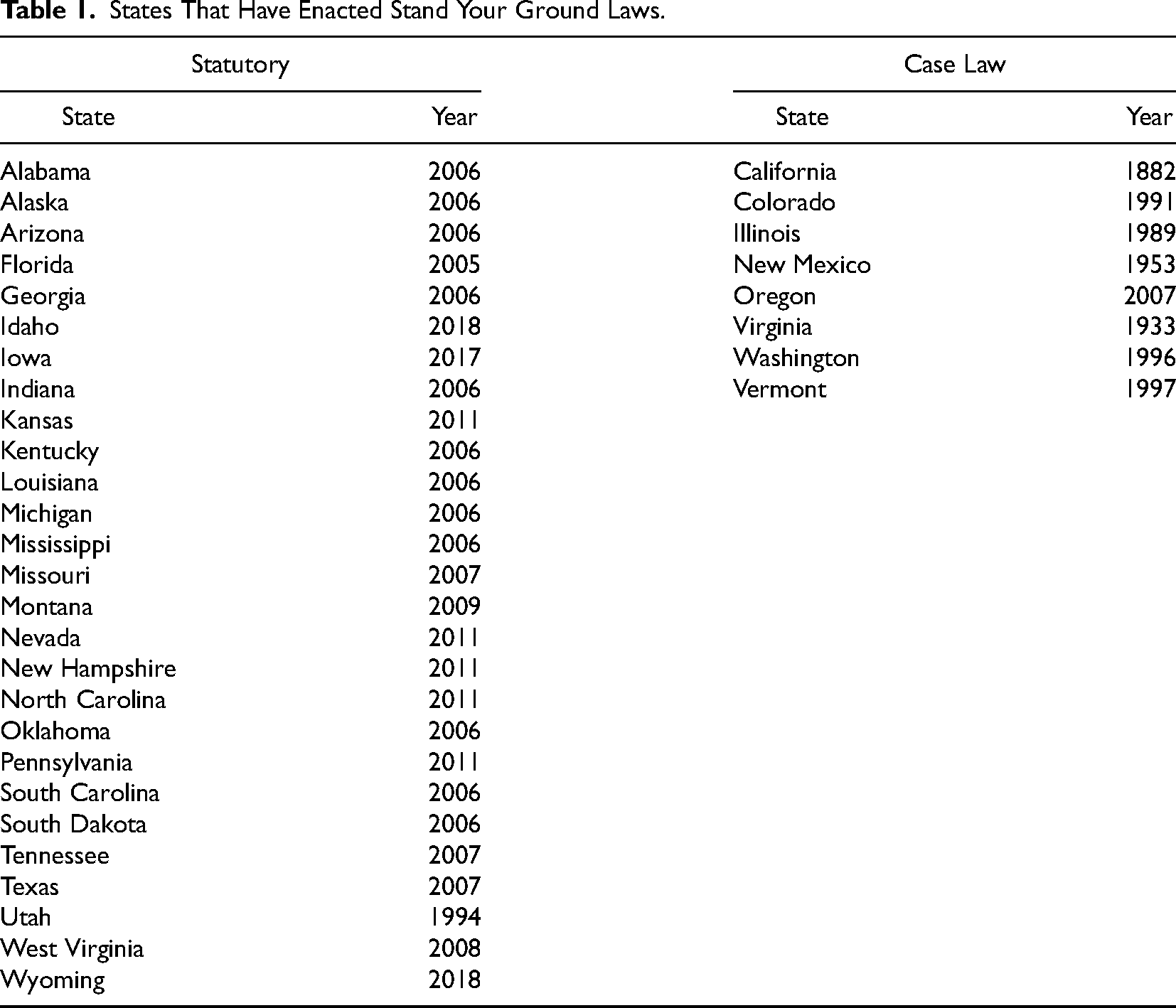
Dependent Variables. The state level crime data for this study are taken from the FBI's UCR crime reports between 1980–2018. This lengthy panel dataset gives us access to more data than scholars who select to begin their studies in the late 1990s and gives us more pre-treatment data for the many states which implemented SYG in the 1990s via legislative or court order: Utah (1994), Colorado (1991), Illinois (1989), Washington (1996), and Vermont (1997). A few other researchers have also begun their research in the 1980s (e.g. Gius 2016).
While past research has largely focused on homicide, typically taken from the CDC and NCHS, we believe this is a mistake for two reasons. First, if these laws do have a deterrent effect, they have the potential to reduce any crime where a victim encounters the perpetrator. Thus, a socially positive impact may not be detected if the focus is exclusively on homicide. Conversely, if these laws lead to increased aggression, outcomes other than homicide—such as assault—may increase as well, meaning a socially negative impact may also be missed if the focus is entirely on homicide. Second, the definition of homicide used by the NCHS includes justifiable homicides (which are socially beneficial). It would therefore be wrong to conclude an increase in homicide after the adoption of an SYG law to be necessarily socially detrimental when it may stem from an increase in justifiable homicides.
It may be argued justifiable homicide is too rare to influence any result. While it is true that the FBI lists only 353 justifiable homicide incidents in the United States in 2018—much smaller than the gap between the CDC's homicide numbers and the FBI's murder numbers—there are reasons to believe justifiable homicide is underreported and may make up a larger fraction of the gap than commonly believed. For example, according to the FBI UCR's handbook, the following incident would not be considered justifiable: While playing cards, two men got into an argument. The first man attacked the second with a broken bottle. The second man pulled a gun and killed his attacker. The police arrested the shooter; he claimed self-defense. (FBI, 2004)
This is not to say the FBI's UCR murder data does not have problems of its own. Since reporting to the FBI is optional, it is possible murder itself is underreported in the UCR data. Further, Guettabi and Munasib (2017) argue using the FBI's murder data to study SYG laws is problematic as some homicides which would have been considered criminal homicides prior to the law are not treated as such after it. While we feel the FBI's murder data are better suited to studying SYG laws, the objections to it by Guettabi and Munasib (2017) and others are not without merit. Because of this, models using homicide data from the CDC's WONDER portal rather than murder data were also estimated (but not reported). In every specification, the homicide vs. murder distinction do not alter the key conclusions of this paper.
Independent Variables. Twenty-six states adopted SYG laws legislatively between 1999–2006, with one state, Utah, implementing the law in 1994. The date for the implementation of SYG laws was taken from the RAND Corporation using version 3.0 of their firearms law database (Cherney et al. 2020). The database spans from 1979 through January of 2020, which includes the entire time period of this study. Following the procedure in Lott and Mustard (1997), the year of implementation is lagged by one year to ensure the law was in effect for the entire year.
This paper codes states which operate under SYG procedures due to case law as SYG states; previous researchers almost universally coded these states as non-SYG, which we feel is incorrect. Eight states act have enacted these laws due to case law: California, Colorado, Virginia, New Mexico, Illinois, Oregon, Vermont, and Washington. The data for states which have implemented SYG laws through case law and the courts was taken from the Giffords Law Center to Prevent Gun Violence, which cites the specific legal cases which established SYG as a precedent for the eight states listed (Giffords Law Center to Prevent Gun Violence, 2020). Table 1
States That Have Enacted Stand Your Ground Laws.
As SYG laws are not the only factor which may potentially influence crime, it was assumed violent crime rates were also dependent on various demographic, social, and economic factors. Most of the control variables for this study have been included in past research (Gius, 2014; Lott, 2010; Lott and Mustard, 1997; Lott and Whitley, 2001; McClellan and Tekin, 2017; Olson and Maltz, 2001). These variables include the percentage of the state population that is black, the percentage of the state population that is white, population density, per capita alcohol consumption (in gallons), state unemployment rates, state poverty rates, real income per capita, real welfare per capita spending, construction and military employment per capita, police per capita, the percentage of the state adult population that is college educated, state incarceration rates, a lagged dependent variable to control for time variant factors, the Fryer Crack-cocaine Index, execution rates (when the model was testing murder or homicide), and age (in 5-year groups from ages 15 to 65 + ).
Poverty and unemployment data were taken from the University of Kentucky's Center for Poverty Research, which has collected state-level national welfare data for the years 1980–2018. Data on population and education were taken from the Bureau of the Census. The Fryer crack-cocaine index, military and construction employment was provided by the Crime Prevention Research Center. Per capita income and welfare payment data was provided by Carl Moody and Thomas Marvell. Per capita alcohol consumption was taken from Jacob Kaplan's compilation of National Institute on Alcohol Abuse and Alcoholism data (Kaplan, 2020). Execution data used to construct an execution rate control variable for the murder and homicide regressions was taken from the Death Penalty Information Center. The fixed effects models presented include linear state trends to control for slow-moving factors—such as the advent of the internet, the proliferation of cell phones, improved forensic methods. The theoretical reasons to include state trends are strong, and the F-tests of these trends were significant, which suggests models without state-trends are susceptible to omitted variable bias.
All models underwent the general-to-specific (GETS) procedure proposed by Moody and Marvell (2010). While the inclusion of many control variables reduces the risk of omitted variable bias, it increases the risk of model overfitting. The key benefit of the GETS approach is it removes the arbitrary nature of control variable selection. The GETS process is relatively straightforward: all regressions are estimated as a “full” model with all of the control variables listed above. Subsequently, every control variable with a t-ratio below one is dropped, and the dropped variables undergo an F-test for group significance to ensure the dropped variables are not significant. Lastly, a final model is estimated without the insignificant control variables.
Empirical Models
Fixed Effects Model. A fixed effects model with state and time fixed effects, as well as controls for other variables typically controlled for in the firearms literature, is estimated. This model is the same one used in Gius (2016) and other research. To deal with the issue of heteroskedasticity and serial correlation common in panel data sets, standard errors are clustered by state, as suggested by Bertrand et al. (2004). The following regression equation is used:
Count Analysis. Despite some advantages of fixed effects models, Schell et al. (2018) have argued the fixed effects models used in this literature suffer from issues of statistical power, miscalculated standard errors, and high Type 1 error rates. To correct for this, they argue in favor of a negative binomial model on state-level count data with year fixed effects. Negative binomial regressions have also been preferred by other authors due to rate data not being normally distributed (Siegel et al. 2017). The final model is as follows:

Results
The Simple Dummy Variable Model
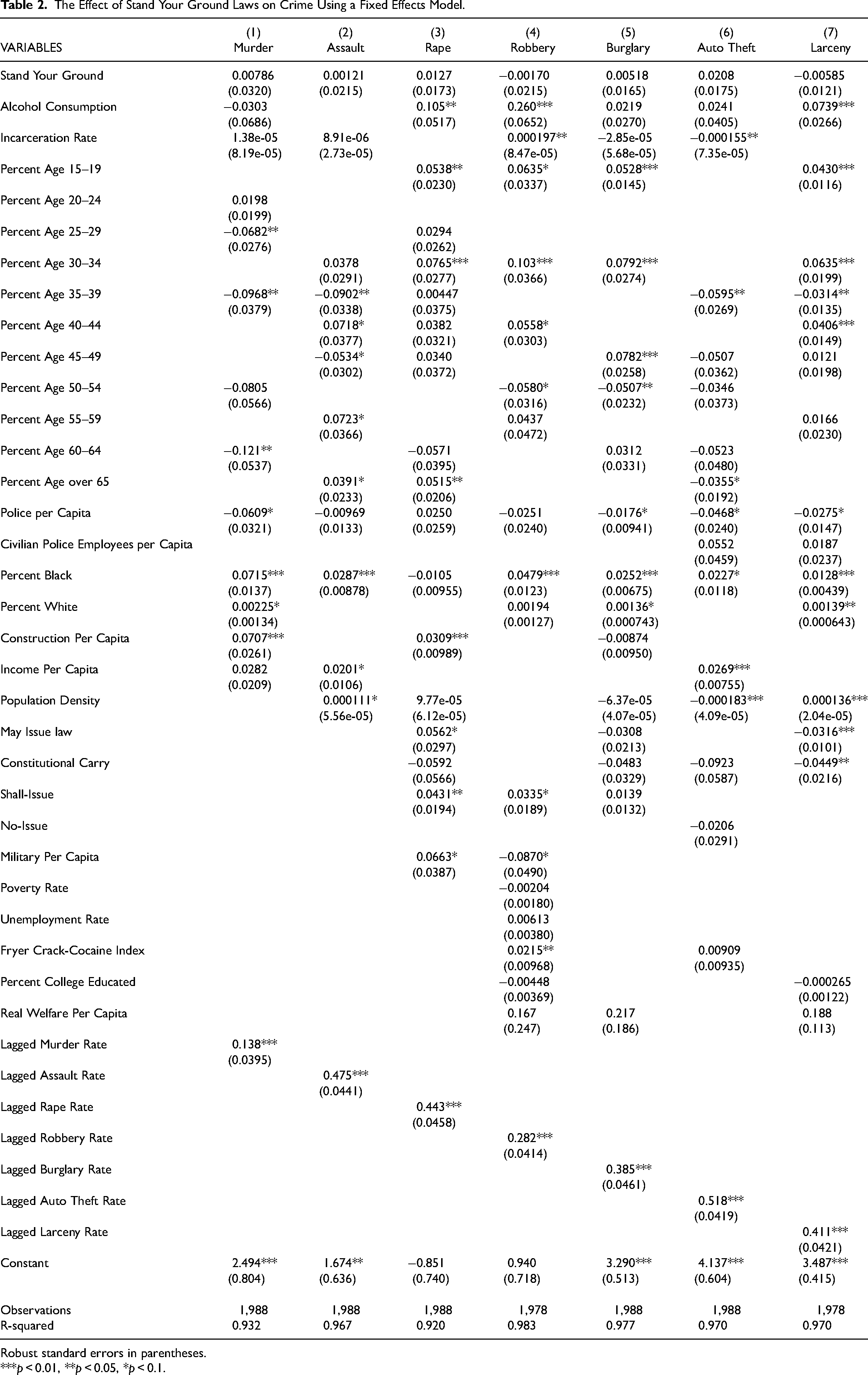
Fixed effect regressions with standard errors clustered at the state level and state and time fixed effects are presented in Table 2. Overall, none of the results using our GETS reduced fixed effects model were statistically significant. SYG laws are associated with 0.789% higher murder rates, but the result is not significant at the 1%, 5%, or even more generous 10% level (95% [CI] = -5.484%, 7.748%). Even if SYG laws do not increase deadly confrontations, it is conceivable that they may still increase the rate of violence overall by increasing aggravated assault. However, the result for assault is likewise insignificant: SYG laws are associated with 0.12% higher assault rates, but the results fail to meet traditional levels of statistical significance (95% [CI] = -4.102%, 4.531%). Rape rates were found to be 1.27% higher in SYG states, but the result was not significant at any of the thresholds identified above (95% [CI] = -2.18%, 4.859%).
The Effect of Stand Your Ground Laws on Crime Using a Fixed Effects Model.
Robust standard errors in parentheses.
***p < 0.01, **p < 0.05, *p < 0.1.
The fixed effects model fails to confirm either the deterrent or the aggression hypothesis. The results for property crimes where victims and perpetrators rarely meet one another—such as larceny, auto theft, and burglary—all show null results, as expected. Table 2
Count Analysis
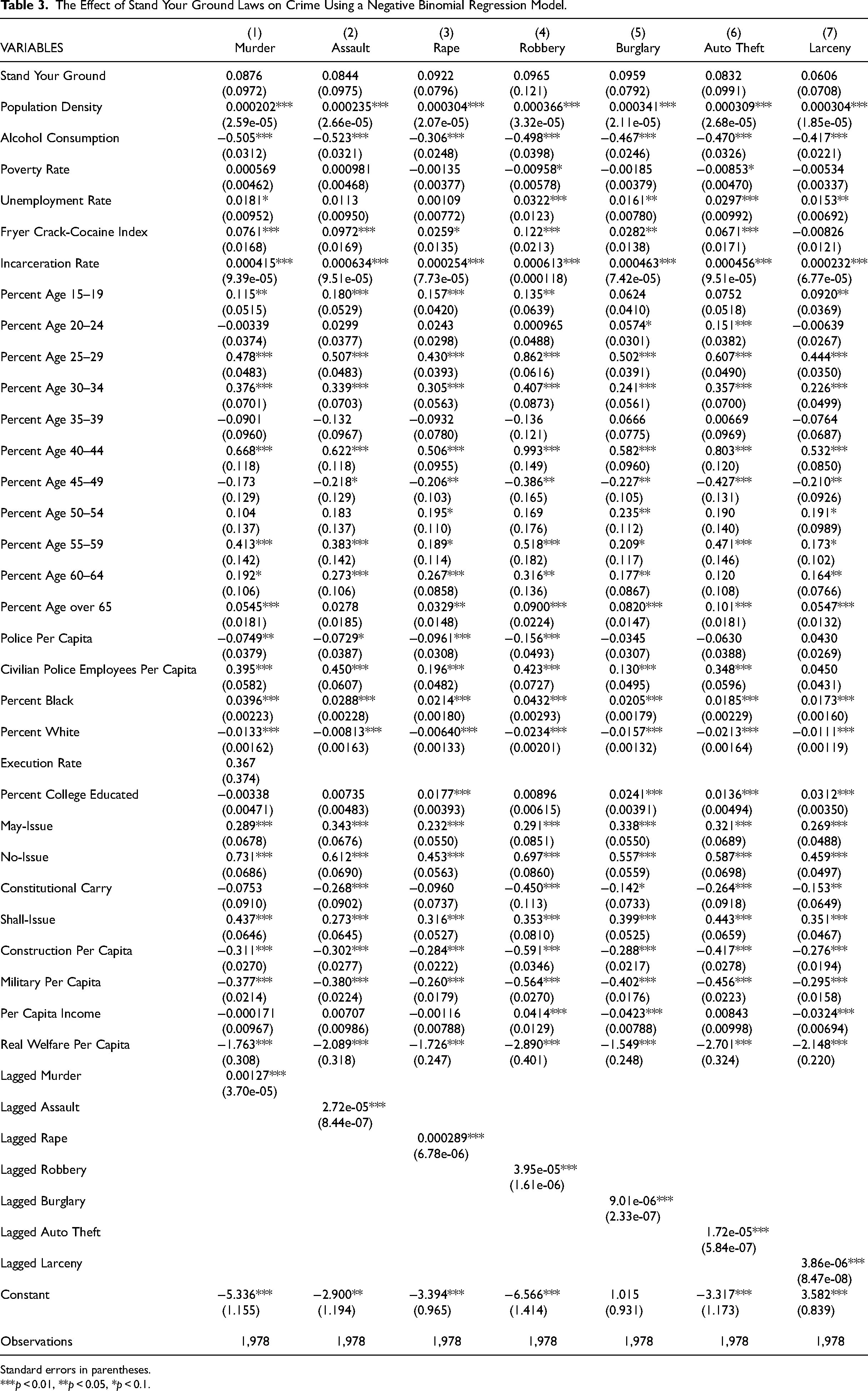
The negative binomial regressions are presented in Table 3. The negative binomial model tended to generate larger effect sizes than the fixed effects model, but like the fixed effects model, none of the results were statistically significant at the traditional 1%, 5%, or 10% levels. SYG states are associated with 8.95% higher murder rates, but the confidence intervals overlap zero (95% [CI] = -9.876%, 31.702%). Assault rates are also 8.4% higher in SYG states, but the result is likewise insignificant (95% [CI] = -10.44%, 31.221%). None of the results suggest these laws deter or reduce crime. Property crime rates, used as placebo tests, generated no significant relationship between SYG laws and property crime.
The Effect of Stand Your Ground Laws on Crime Using a Negative Binomial Regression Model.
Standard errors in parentheses.
***p < 0.01, **p < 0.05, *p < 0.1.
Robustness Checks
Multiple variations of the models presented above were tested to check the robustness of these findings. Fixed effects models without linear state trends, without state fixed effects, without year fixed effects, and models without control variables were tested, all coming to the same conclusion as the models presented above. Of the fixed effects regressions tested, none showed a positive relationship between SYG laws and crime significant at the 5% level. Negative binomial regressions with state fixed effects, clustered standard error adjustments, and with state linear trends likewise come to the same finding: SYG laws neither increase nor decrease crime. When using homicide rather than murder as the dependent variable, the results are not affected: these laws do not lead to a statistically significant increase homicide in any of the models tested here. Overall, the results here are robust.
Discussion
In the United States, there exists a widespread belief among the general population that crime rates are rising and that policies must be implemented to ameliorate the problem. Despite the fact crime rates have generally fallen over the past three decades, concern about America's high rate of violent crime remains. Thousands of Americans still die yearly from murder, and, at least in the short-term, there have been recent blips of increasing crime in some cities which may increase the political and public policy salience of criminological research (Mac Donald, 2020).
The view that widespread firearm ownership reduces crime has led to SYG laws being adopted extremely rapidly by states in at the beginning of the century, especially after Florida's law was passed in 2005. Gun advocates also noted such laws strengthened gun rights and gave responsible gun owners a shield in court if they were ever put in the unfortunate circumstance of having to defend themselves. Opponents of these laws regularly responded by claiming these laws legalize vigilantism and will increase violence by escalating tense situations into deadly encounters. While political pundits on both sides have spent a lot of time and effort pushing the public to either believe or disbelieve in the deterrence or aggression hypothesis, the research on SYG laws and violence has been inconclusive.
The existing research has largely sided with the “aggression hypothesis,” insofar as homicide goes, noting increases in homicides after SYG laws were passed. Opponents of gun rights have often publicly lauded these results (Everytown for Gun Safety, 2019). A handful of other papers argue more liberal self-defense laws may reduce violent crime. But data limitations, as well as debates over definitions, have hobbled past research.
This paper builds upon the previous research in several ways. First, it is one of the first to code states which are functionally SYG states due to jury instructions and case law as SYG rather than as control states, an error almost universal in previous papers. Lott (2010) included case law as treatment states, but his work was focused on the castle doctrine laws rather than SYG laws. Second, it is the first to use count analysis to test the effect of these statutes on violent outcomes such as murder, assault, rape, and robbery. Third, it builds upon the models used in this literature by authors such as Gius (2016) by applying Moody and Marvell’s (2010) GETS methodology to the selection of appropriate control variables. Finally, it is one of the first to use change coding for SYG laws.
Despite the strengths of this paper, there are distinct limitations. While county-level data has been justifiably criticized for high levels of measurement error (Lott and Whitley, 2003; Maltz and Targonski, 2002), state-level data comes with its own drawbacks. Namely, using geographies as large as states may introduce aggregation bias and pave over the possible heterogeneous impacts of these laws within states. There are also inherent limitations to using UCR crime data because it only includes crimes reported to police. It is potentially possible crime non-reporting is not random and may be associated with the community and political characteristics related to the passage and adoption of SYG laws. While the use of homicide data in our robustness checks ameliorates this problem somewhat, murder is already one of the more consistently reported crimes, and underreporting issues for other violent crimes, such as assault and rape (Gove et al., 1985), remain a cause for concern. Thus, while the results of this study consistently find no effect from these laws on crime, it is impossible to discount the deterrence or aggression hypothesis entirely.
While the results of this study show these laws have no impact on crime, the null results have important policy implications. If neither the deterrence nor aggression hypothesis can be conclusively confirmed, it means the primary benefits and costs of SYG laws are limited to the legal protections they give gun owners in self-defense cases. If these laws have no effect on crime, it would be easy to argue the benefits of these laws are clear on its face as citizens have an inherent right to self-defense which ought to be upheld and defended. It may also be noted that increasing the ability of citizens to defend themselves may give them “peace of mind” (Lott, 2010). On the other hand, if one holds reservations about individuals legally carrying firearms in public, as many Americans do (Wolfson et al. 2017), extending the castle doctrine principle to public spaces may be seen as unjust by individuals who believe no one ought not to have a firearm in public. Further, in the same way that SYG laws may give “peace of mind” to gun owners, it may have the opposite effect for those skeptical of carrying guns in public. On the legal side, it can be argued the legal system ought to promote behavior which de-escalates situations and requires citizens retreat whenever feasible. There are also key debates over the potential racial bias in the enforcement of SYG laws (Lawson, 2012). Overall, the results in this paper suggest that while these laws may have complex ethical, legal, racial, and psychological impacts in both directions, the claims of clear criminological benefits or costs from SYG laws are not well supported.
Conclusion
Stand your ground laws are still a relatively recent phenomenon, and as more states continue to adopt and perhaps even repeal them over time, and as more data becomes accessible, more research is warranted before the debate over the effect of SYG laws and the issues surrounding them are fully settled. Further academic inquiry into the adscititious issues listed above may fruitful results as well. Overall, the evidence presented herein does not suggest these laws meaningfully increase or reduce crime.
Footnotes
Acknowledgements
I would like to thank Youngsung Kim, Susan Opp, Mike Hogan, and Carl Moody for comments on this paper.
Declaration of Conflicting Interests
The author(s) declared no potential conflicts of interest with respect to the research, authorship, and/or publication of this article.
Funding
The author(s) received no financial support for the research, authorship, and/or publication of this article.
