



Abstract
This study evaluated the psychometric properties of the Learning-Related Boredom Scale (LRBS) from the Academic Emotions Questionnaire (AEQ; Pekrun, Goetz, & Perry, 2005; Pekrun, Goetz, Titz, & Perry, 2002) in a sample of 405 university students from Canada and China. Multigroup confirmatory factor analysis was used to test the factor structure and measurement invariance of the LRBS across cultural settings, after which the relationships between the LRBS, boredom frequency in class, intrinsic motivation, and self-efficacy for self-regulated learning (SESRL) were examined. Results showed evidence of reliability and measurement invariance of the LRBS, and the relationships between the LRBS, boredom frequency, and SESRL were similar across settings. The study thus provided evidence that learning-related boredom is a valid construct across culturally diverse school settings and supported the use of the LRBS in both Canadian and Chinese student populations.
Boredom is commonly regarded as an unpleasant emotion characterized by a lack of stimulation or of value in an activity (e.g., Harris, 2000). Although the well-publicized demands of student learning have led to investigations of positive and negative emotions such as enjoyment and frustration, researchers are also interested in how deactivating emotions—experiences of emotion that result in reductions of motivation and physiological activity (Pekrun, Goetz, Daniels, Stupnisky, & Perry, 2010), such as boredom—function in diverse school settings. Previous studies have shown that boredom negatively predicts students’ behaviors (e.g., Mann & Robinson, 2009). For example, in Mann and Robinson’s study, about 58% of college students perceived more than half of their lectures as boring. The authors also found that when students felt bored, they were more likely to daydream in classes and skip future lectures.
Given the prevalence and negative effects of boredom, it is important for researchers and educators to systematically investigate this emotion. However, in examining studies in academic boredom, the most frequently used scale is the Boredom Proneness Scale (BPS; Farmer & Sundberg, 1986; Mann & Robinson, 2009). The BPS was developed to assess individual differences in boredom generally (e.g., “Having to look at someone’s home movies or travel slides bores me tremendously,” p. 6) instead of boredom specific to academic circumstances; therefore, the use of the BPS to assess students’ boredom in academic activities may not be appropriate. In order to avoid conceptual and measurement problems, it is important to use instruments that are congruent with the construct to be measured. In addition, previous studies conducted measured boredom as a unidimensional construct (e.g., BPS; Leisure Boredom Scale, Iso-Ahola & Weissinger, 1990). Recent advances in boredom research have uncovered the multidimensional structures of boredom (Vodanovich, Wallance, & Kass, 2005). For example, Ragheb and Merydith (2001) developed a Free Time Boredom Scale and validated it as being best described by a multidimensional structure.
With these concerns in mind, Pekrun, Goetz, Tiz, and Perry (2002), and Pekrun et al. (2005) developed the Academic Emotions Questionnaire (AEQ) specific to school settings. The Learning-Related Boredom Scale (LRBS) included in the AEQ specifically targets students’ levels of habitual boredom during studying (e.g., “Studying is dull and monotonous”) instead of boredom due to general situational experiences. The development of the LRBS is also consistent with the framework of emotion components (Scherer, 2009), and with prior studies in the measurement of boredom (e.g., Vodanovich et al., 2005) whereby learning-related boredom is a multidimensional emotion involving four interrelated psychological components (i.e., affective, cognitive, motivational, and physiological; Pekrun et al., 2005). This four-factor structure is supported by the control-value theory of emotion (Pekrun, 2006), which views each achievement emotion, including boredom, as comprised of the aforementioned interrelated components.
To provide some context, one might consider the different components that have been shown to give rise to test anxiety, a much more commonly researched emotion. Test anxiety has been show to consist of intense feelings of uneasiness (affective), constant worries (cognitive), inclination to escape anxiety-provoking situations (motivational), and intense peripheral responses (physiological; for example, Lowe & Ang, 2012; Spielberger & Vagg, 1995). For learning-related boredom, the affective factor taps into the negative and unsettling feelings associated with being bored, the cognitive factor assesses lack of one’s mental inertia, the motivational factor evaluates the inclination not to work on a given activity, and the physiological factor assesses the level of physical arousal, which for boredom is low. In a recent validation of the AEQ using a Canadian sample (Pekrun, Goetz, Frenzel, Barchfeld, & Perry, 2011), the LRBS was shown to fit better with a four-factor model (i.e., affective, cognitive, motivational, and physiological) than a unidimensional model.
In Pekrun et al. (2010), learning-related boredom has been shown to explain a large proportion of variance (almost 60%) in German university students’ attention problems. Likewise, learning-related boredom has moderate inverse effects on effort put in to learning (26.01% and 23.04% of variance) and intrinsic motivation (18.49% and 6.76%) in German and Canadian students, respectively. Not only is learning-related boredom negatively associated with students’ effort and motivation, it also negatively correlates with academic achievement. Specifically, even after controlling for prior academic attainment, learning-related boredom continues to explain 10.24% and 5.76% of the variance in German and Canadian university students’ achievement, respectively. Pekrun and his colleagues’ findings are of direct interest to educators for two reasons. First, students who are less bored with learning are more likely to have higher academic achievement. Second, lower levels of learning-related boredom are related to higher levels of effort and self-regulated learning. These outcomes are appealing to educators; thus, understanding students’ learning-related boredom provides insight into ways to enhance their learning and achievement. Furthermore, investigating boredom in diverse cultural settings will provide additional insight into the universality of academic boredom.
Pekrun et al.’s (2011) validation of the AEQ was conducted in only one country (Canada), leaving open the possibility that the LRBS is not valid in other contexts. Thus, a cross-cultural validation of the scale is necessary to begin to explore whether or not the scale operates similarly in non-Western academic settings.
This article, therefore, examined the psychometric properties of the LRBS in a cross-cultural sample of Canadian and Chinese college students and evaluated the criterion-related evidence of the LRBS with frequency of boredom, intrinsic motivation, and self-efficacy for self-regulated learning (SESRL). Given that the multidimensional model has gained the most support in recent studies in boredom (e.g., Pekrun et al., 2011; Vodanovich et al., 2005) and aligns with the control-value theoretical framework of emotions (Pekrun, 2006), we hypothesized that the four-factor model would be a better representation of the LRBS than the one-factor model across the two culturally contrasting settings.
Method
Participants and Procedure
Participants were 405 university students from Canada (n = 151) and China (n = 254) at urban public universities. Students recruited from both settings were attending 4-year university education programs after 12-year formal education. Participants from Canada were 82% female, with a mean age of 23.29 (SD = 4.55) years; those from China were 90% female, with a mean age of 21.03 (SD = 0.77) years.
Participants were recruited from undergraduate education classes. In the Canadian sample, the recruitment was made through announcements in lectures, and students who were interested in the project completed a questionnaire in class. In the Chinese sample, students were originally recruited by announcements of a separate study on learning (Zhang, 2011). Having established relationships with these students, we returned to them and invited them to participate in the present study by filling out the questionnaire during class. Thus, both groups of participants represented convenient samples of university student populations.
Translation
The LRBS was part of the AEQ developed in Germany. The original German scale was translated into the English by three experts, two of whom were bilingual (Pekrun et al., 2005). Back translation was used to ensure content equivalence in the translated items. The English version has recently been validated using a sample of university students in Canada (Pekrun et al., 2011). Therefore, the present study adopted the validated English version of the LRBS.
The translation from English into Chinese was guided by a meaning-based approach in which changes in sentence structure were allowed in the Chinese version in order to reflect differences in thought patterns and syntax between the English and translated version of the measures (Larson, 1998). First, the questionnaire was translated into the Chinese version by the first author. Next a certified Chinese teacher, who is bilingual in Chinese and English, reviewed the translation to check for linguistic and cultural validity (van de Vijver & Hambleton, 1996). Some of the written instructions were then changed to enhance clarity (Peña, 2007). Second, we used bilingual translators to ensure that the translations were both linguistically accurate and valid in meaning (van de Vijver & Leung, 1997). Finally, two bilingual researchers back-translated the questionnaire, after which it was examined by a native-speaking researcher. This process aimed to ensure that the back-translated Chinese items reflected the same meanings as the English items.
Measures
Learning-related boredom
The 11-item LRBS1 (AEQ; Pekrun et al., 2005, 2002) was used to measure students’ levels of learning-related boredom. Items primarily measuring individual’s feelings (e.g., studying and/or materials are boring) without assessing other psychological processes were categorized into an affective factor, items assessing thoughts (e.g., daydreaming) about boring situations and/or tasks were grouped into a cognitive factor, items asking respondent’s intentions to learn (e.g., no desire to learn) in boring situations were grouped into a motivational factor, and items measuring individual’s bodily deactivation (e.g., getting tired) were classified under a physiological factor. Three items were used to measure each of the affective, cognitive, and physiological factors, and two items were included in the motivational factor. Participants responded on a 5-point scale (1 = strongly disagree to 5 = strongly agree). In previous research the scale has shown acceptable reliability and validity (e.g., Pekrun et al., 2011).
Frequency of boredom in class
Frequency of boredom was measured by two items (e.g., “I am often bored in my classes”; Nett, Goetz, & Daniels, 2010) on a 5-point scale (1 = strongly disagree to 5 = strongly agree). The scale displayed good reliability and validity in previous studies (e.g., Nett et al., 2010).
Intrinsic motivation
Previous studies have shown that learning-related boredom is negatively associated with motivation (e.g., Pekrun et al., 2010). To establish criterion-related evidence, academic motivation (i.e., intrinsic motivation toward accomplishment) was measured using a reliable and validated 7-point scale (1 = does not correspond at all to 7 = corresponds exactly) with four items from Vallerand et al.’s (1992) Academic Motivation Scale, e.g., “Why do you go to college?”—“for the pleasure I experience while surpassing myself in my studies.”
Self-efficacy for self-regulated learning
SESRL has been shown to be negatively related to deactivating motivation (Klassen, Krawchuk, & Rajani, 2008). Given that learning-related boredom was found to be associated with reduced motivation and less frequent use of self-regulated strategies (Pekrun et al., 2010), SESRL was chosen to establish criterion-related evidence. Specifically, SESRL was measured using a 6-point scale (1 = not well at all to 6 = very well) with seven items from Usher and Pajares’s (2008) study (e.g., “How well can you finish your homework on time?”). The SESRL scale has shown adequate reliability and validity in previous cross-cultural research (e.g., Klassen et al., 2010).
Plan of Analysis
Multigroup confirmatory analysis (AMOS 18.0; Arbuckle, 2009) was used to test whether the factor structure, item loadings, and variances of the LRBS were equivalent across cultural groups. Baseline models were established for the two groups to evaluate the basic factor structure of the scale, with error covariances allowed to differ across group. Three commonly used goodness-of-fit measures (i.e., χ2/df ratio, comparative fit index [CFI], and root mean square error of approximation [RMSEA]) were included (Jackson, Arthur, & Purc-Stephenson, 2009). A χ2/df ratio less than 3.0, a CFI index larger than 0.90, and a RMSEA index less than 0.10 indicate a good fit (e.g., Arbuckle, 2009).
To test invariance, we examined the change in χ2 (Δχ2) to evaluate hierarchical goodness of fit, whereby a nonsignificant Δχ2 after imposing constraints indicates invariance. The Δχ2 index, however, can be affected by sample size, and, therefore, we also looked at the change in the CFI (ΔCFI), which does not have such a constraint, and is considered a better index to evaluate invariance (Cheung & Rensvold, 2002). If constraints are imposed and result in ΔCFI less than or equal to 0.01, invariance is suggested. We repeated these analyses to test for gender differences across settings, given large female-to-male ratio in our samples. Finally, we used bivariate correlations to consider additional criterion-related evidence of the LRBS with frequency of boredom, intrinsic motivation, and SESRL.
Results
Descriptive Statistics
Table 1 shows the means and standard deviations (SDs) of study variables in both Canadian and Chinese samples. The reliabilities of the LRBS across the two settings were consistent with those reported in the AEQ (α = .92 in AEQ, α = .90 for Canada, α = .89 for China). Results suggested that the LRBS is an internally consistent measure across settings.
Descriptive Statistics

Psychometric Properties
Factor structure
Boredom can be conceptualized as a unidemensional construct (Farmer & Sundberg, 1986), or as a multidimensional structure, which includes interrelated sets of psychological processing (Vodanovich et al., 2005). Hence, based on the previous findings of emotions (e.g., Vodanovich et al., 2005) and the theoretical framework of learning-related boredom (Pekrun et al., 2005), we tested one-factor and four-factor models separately in the Canadian and Chinese samples and in a combined sample. The one-factor model aligns with prior studies in boredom (e.g., Farmer & Sundberg), which suggest that all items are intended to measure a singular latent construct. By contrast, the four-factor model is consistent with Scherer’s (2009) multidimensional processing of emotion. Specifically, the four-factor model of the LRBS assesses affective (e.g., “Studying is dull and monotonous”), cognitive (e.g., “I find my mind wandering while I study”), motivational (e.g., “Because I’m bored I have no desire to learn”), and physiological (e.g., “Because I’m bored I get tired sitting at my desk”) components of boredom.
Table 2 presents the goodness-of-fit indices. The one-factor model showed a poor fit (χ2/df = 4.81, CFI = 0.812, RMSEA = 0.11), whereas the four-factor model demonstrated a good fit (χ2/df = 2.28, CFI = 0.946, RMSEA = 0.06). Given that the four-factor model provided the strongest fit with the data and was supported by the theoretical framework (Pekrun et al., 2011; Scherer, 2009), subsequent analysis was based on the four-factor model.
CFA Models of the LRBS Across Canadian and Chinese Samples

Note: CFA = confirmatory factor analysis; CFI = comparative fit index; LRBS = Learning-Related Boredom Scale; RMSEA= root mean square error of approximation.
p < .05. **p < .01.
Tests of invariance
In order to test invariance, an unconstrained four-factor baseline model was established. A good fitting unconstrained model indicated a common factor structure across the Canadian and Chinese settings (see Table 2). The model was then constrained by the factor loadings, resulting in a drop in fit, Δχ2of 31.19 (Δdf = 7), p < .01, within an acceptable change of CFI (ΔCFI = .01). Factor variances were then constrained in addition to factor loadings. This resulted in a significant drop in the fit index, Δχ2 of 11.29 (Δdf = 4), p = .02, again associated with only a minimal change in CFI (ΔCFI = .004). Constraining the factor covariances resulted in a further drop in the fit index, Δχ2 of 13.61 (Δdf = 6), p = .03, but within an acceptable change of CFI (ΔCFI = .004). These results suggested that the LRBS showed strong measurement invariance across Canadian and Chinese groups, with invariance of factor structure, factor loadings, factor variances, and factor covariances.
We followed the same procedures to test invariance between males and females. Despite significant drops in the fit index, Δχ2 of 43.80 (Δdf = 21) after constraining the factor loadings, Δχ2 of 62.33 (Δdf = 33) after imposing constraints on the factor variances, and Δχ2 of 80.84 (Δdf = 48) after further constraining the factor covariances, ps = .002, the changes of CFI were within an acceptable range, ΔCFI = .01 (factor loadings), ΔCFI = .004 (factor variances), and ΔCFI = .001 (factor covariances). Results, therefore, suggested measurement invariance of the LRBS across genders, despite a relatively large female-to-male ratio in our samples.
Item loading
Table 3 shows standardized factor pattern coefficients (λs) and the interfactor correlation coefficients. All pattern coefficients displayed moderate to high factor loadings (λs for Canada: .53 to .89, λs for China: .62 to .90; ps < .001). All interfactor correlations were significant (ps < .001), suggesting significant associations among the four boredom factors.
Standardized Factor Pattern Coefficients and Interfactor Correlations for the LRBS

Note: All coefficients were significant at p < .001.
Criterion-Related Evidence
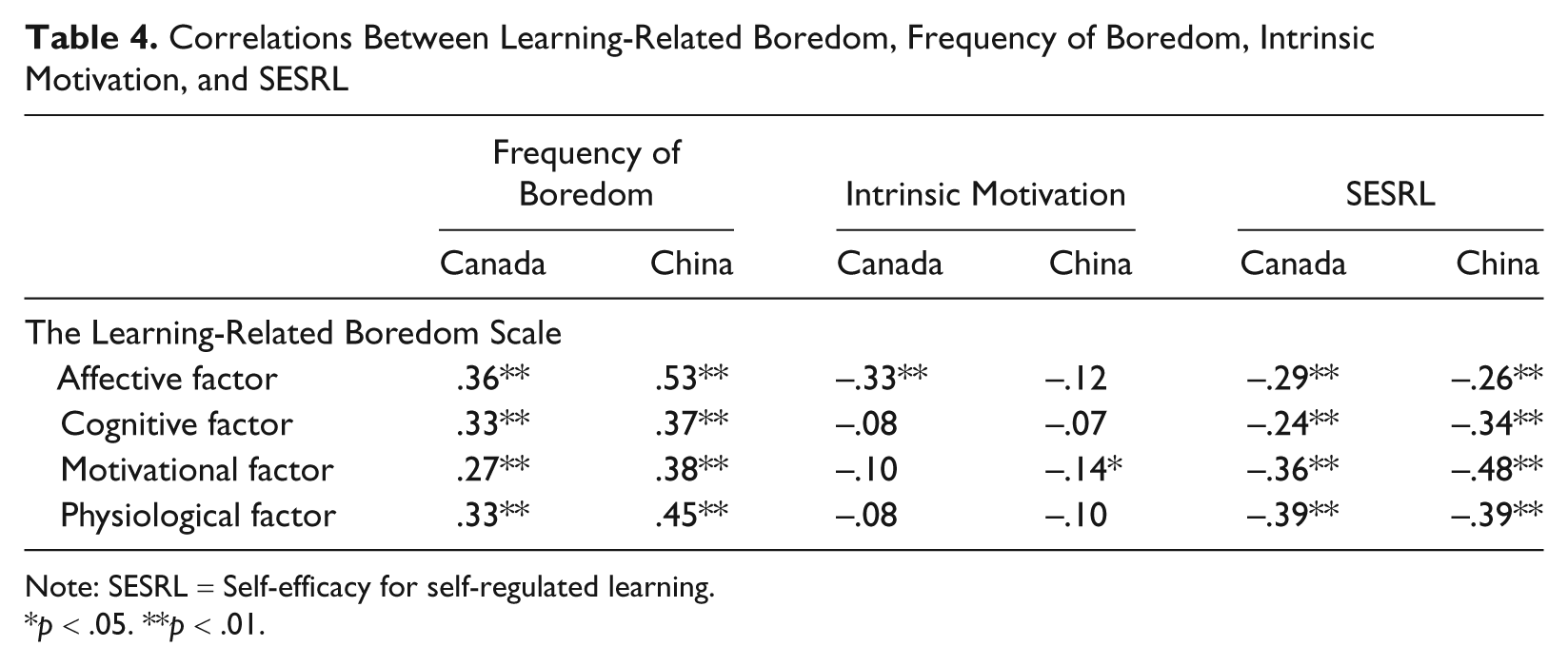
Although the invariance between countries and genders provides an excellent indicator of the validity of the LRBS, we sought additional criterion-related evidence by evaluating its relationship with frequency of boredom, intrinsic motivation, and SESRL using Pearson correlations (see Table 4). Significant positive relationships between the four factors of the LRBS and frequency of boredom were found. The component factors were also negatively related to SESRL across settings. According to Cohen’s (1987) descriptors, the effect sizes for the four factors of the LRBS on frequency of boredom and SESRL were mostly in a small to medium range, suggesting that boredom does not fully explain the aforementioned factors. In addition, the motivational factor showed a significant negative relationship with intrinsic motivation in the Chinese sample, and the affective factor showed a significant negative relationship with intrinsic motivation in the Canadian sample. Although the latter explained a small proportion of variance of intrinsic motivation (1.96%) according to Cohen’s guidelines, as Coe (2002) argues, effect sizes as small as 0.1 are important in education because effects accumulate over time. In general, we interpreted the entirety of our findings to suggest the LRBS is valid between countries, genders, and shows a trend of convergent validity with frequency of boredom and divergent validity with SESRL.
Correlations Between Learning-Related Boredom, Frequency of Boredom, Intrinsic Motivation, and SESRL
Note: SESRL = Self-efficacy for self-regulated learning.
p < .05. **p < .01.
Discussion
Studying academic boredom is important because students who are less bored are more likely to engage in learning activities and achieve at higher levels; reciprocally, those who are actively engaged in learning and highly achieving are also more likely to report lower levels of boredom (e.g., Pekrun et al., 2010). Furthermore, investigating learning-related boredom across cultures allows researchers to examine academic boredom in different contexts, providing a further understanding of how boredom can be measured and evaluated.
Our study was conducted in order to examine the validity of the LRBS with samples of college students from Canada and China. The contributions of the study were twofold: (1) The study is the first to test the LRBS across samples from Western and non-Western settings, and (2) the study examines the relationships between the LRBS, frequency of boredom and intrinsic motivation, and SESRL. Results from this study provide evidence about the validity and practical utility of the measure for use in cross-cultural studies.
The LRBS showed good internal consistency and a stable factor structure when the scale was conceptualized with four factors rather than one factor, consistent with the theoretical framework of academic boredom (Pekrun, 2006) and contemporary conceptualization of emotion components (Scherer, 2009). Our results showed evidence of invariance in factor structure, loadings, variances, and covariances across groups of students from culturally and geographically different settings. Thus, this study found that items of the scale were not only internally consistent in the Canadian university setting but also in the Chinese university setting; in other words, Canadian and Chinese students appear to respond to the boredom scale in the same way. In addition, the scale showed measurement invariance between males and females, suggesting that male and female students responded similarly.
The correlations between the LRBS and other motivation variables showed similar patterns across the two groups. Previous studies have shown that students with high levels of boredom usually report lower academic motivation and use self-regulated strategies less frequently (Pekrun et al., 2010); our research showed that this relationship holds true across two cultural boundaries. Learning-related boredom and frequency of boredom in class are not synonymous, but they are moderately correlated, and our data suggest that students who reported higher levels of boredom in learning also reported higher frequency of boredom in class across Canadian and Chinese settings. Consistent with previous research, students who experienced higher levels of learning-related boredom were more likely to report lower levels of SESRL, and again this relationship held true in Canadian and Chinese settings. The similarities in correlations between the two groups thus provide further evidence for the validity of the LRBS and support its appropriateness for use in cross-cultural research.
Although the LRBS was significantly correlated with frequency of boredom and SESRL across settings, the effect sizes of each factor (i.e., affective, cognitive, motivational, and physiological) in explaining the variances of aforementioned variables were mostly in the small to medium range. The results were not surprising, given that there is an array of factors contributing to frequency of boredom experienced and levels of SESRL (e.g., an endorsement of different boredom-coping strategies; Nett et al., 2010). Despite the small to medium effect sizes, the affective factor appears to be most positively associated with frequency of boredom, whereas the motivational and physiological factors negatively correlated with SESRL the most in both Canadian and Chinese university student samples. These results were fairly intuitive: When students experienced and expressed a subjective feeling of boredom during studying, it was not surprising that they would consider their learning circumstance as frequently boring. Furthermore, when students showed no desire to learn and consequently withdrew from learning of a boring task, they might consider that they could not keep up with learning and completion of assignments.
Although the zero-order correlations did not suggest causal relationships between the factors of the LRBS, and frequency of boredom and SESRL, it is possible that students who are frequently bored in class and have lower confidence to regulate their learning experience more boredom. However, it is also possible that students who have higher habitual levels of boredom during studying consider classes as frequently boring and report less confidence in engaging in regulated learning. Nonetheless, our results support the notion that feeling bored during studying is associated with more frequent experience of classroom boredom and reduced confidence to engage in regulated learning, both of which are important for students’ learning (e.g., Klassen et al., 2010; Mann & Robinson, 2009). Therefore, learning-related boredom, as a construct, is a good starting place for further investigation of students’ psychological experiences and behaviors during learning and for future interventions that might target the reduction of this negative emotion.
Limitations and Future Research
The current study has some limitations that can be remedied through future investigation. First, the participants in this study were self-selected and might not represent the broader college population. In particular, the students were recruited in lectures and those attending lectures might have higher motivation to achieve and feel less bored than those who skip class. Our study was also limited by different recruitment mechanisms across settings. Furthermore, although boredom negatively predicted students’ academic performance (Pekrun et al., 2011), the small to medium effect sizes of learning-related boredom on academic motivation and SESRL might reflect the university samples’ high-achieving academic characteristics. Future research may consider including participants who choose not to attend postsecondary education, in order to further validate the scale. Although our findings support measurement invariance of the LRBS across genders, the study still represents mainly the responses of female students.
Second, this study was limited by the use of one-time self-report data, a common problem in emotion research (e.g., Zeman, Klimes-Dougan, Cassano, & Adrian, 2007). Although our design adequately answered our current research questions, future researchers may consider using a longitudinal design to keep track of students’ experience of boredom and their learning behaviors (e.g., class attendance and use of learning strategies) over the course of a semester to better capture students’ psychological experience and their learning patterns. Also, including behavioral measures of boredom, such as physiological activation, would provide an objective evaluation of levels of boredom.
Last, our study was limited by the relatively small sample, resulting in low power to detect statistically significant results of small effect sizes. In light of small to medium effect sizes of the learning-related boredom on academic motivation and SESRL found in the present study, boredom might not strongly explain students’ psychological processing. Future research may consider examining buffering/protecting factors that motivate students to learn despite their subjective perception of boredom during learning.
Conclusion and Practical Implications
This article provides a systematic analysis of the LRBS in two culturally and geographically different settings—Canada and China—each of which has a distinctly different approach to schooling. Our results demonstrate that learning-related boredom exists and can be accurately measured in each setting by the LRBS. Our findings underscore the need to study boredom in various cultural settings and at higher educational levels and suggest that learning-related boredom is associated with increased frequency of boredom in class and decreased self-efficacy for self-regulation in both Canadian and Chinese samples. Looking to decrease boredom and increase SESRL, practitioners may want to consider ways to minimize students’ experiences of boredom. In addition, research into helping students take responsibility for and manage their boredom would be advantageous as it is virtually impossible for teachers alone to carry the burden of reducing this negative emotion.
Footnotes
Author’s Note
This article is based on a master’s thesis completed at the University of Alberta.
Declaration of Conflicting Interests
The author(s) declared no potential conflicts of interest with respect to the research, authorship, and/or publication of this article.
Funding
The author(s) received no financial support for the research, authorship, and/or publication of this article.