




Abstract
Background
Trait emotional intelligence (trait EI or trait emotional self-efficacy) refers to individuals’ emotion-related self-perceptions (Petrides, Furnham, & Mavroveli, 2007). A growing number of studies are looking at cross-cultural differences in the structure of the construct.
Aims
This study investigates the cross-cultural stability of trait EI in a sample of adolescents from Hong Kong.
Sample
The Hong Kong sample comprised 357 secondary school students (199 boys and 158 girls), ranging in age from 13 to 16 yrs (M = 14.09 yrs; SD = .86).
Method
The participants completed the Trait Emotional Intelligence Questionnaire-Adolescent Full Form (TEIQue-AFF). Additional data on demographics were collected.
Results
The Hong Kong data only partially replicated the UK four-factor structure (well-being, emotionality, sociability, and self-control).
Conclusions
There seems to be cross-cultural consistency in the factor structure of trait EI in adolescence with minor variations and a tendency toward a simpler factor structure. The Chinese adaptation of the TEIQue-AFF can be recommended for research applications, but further research is needed to replicate our results.
Introduction
Petrides and colleagues (Petrides, Perez-Gonzalez, & Furnham, 2007; Vernon, Villani, Schemer, & Petrides, 2008) considered the crucial distinction between maximum- and typical-performance tests to propose two different EI constructs, ability EI and trait EI. Ability EI is conceptualised as an actual ability, and, therefore, it is expected to show construct validity by correlating highly with intelligence measures. Ability EI researchers aim to measure the construct through IQ-like tests. This practice, however, does not comply with the basic psychometric principles, as it is not possible to objectify emotional responses (Fiori & Antonakis, 2011; Petrides & Mavroveli, in press). Emotional experience is inherently subjective (Watkins, 2000), and it is difficult, if not impossible, to develop clear-cut criteria to judge a response as right or wrong (Davies, Stankov, & Roberts, 1998; MacCann, Roberts, Matthews, & Zeidner, 2004; Perez, Petrides, & Furnham, 2005). Matthews, Deary, and Whiteman (2003) drew on problems inherent in assessing social intelligence to bring forward analogous problems in ability EI, including the question of what constitutes the ‘emotionally intelligent’ response across situations and contexts. There is a plethora of current research showing that ability EI is not a real intelligence and should not be investigated as such (Petrides, 2011).
Trait EI, however, is conceptualised as a constellation of emotional self-perceptions located at the lower levels of personality hierarchies (Petrides, Pita, & Kokkinaki, 2007). In lay terms, trait EI comprises individuals’ beliefs about their own emotional abilities. In this sense, the results of studies within the realm of trait EI should be interpreted as such, i.e., perceptions of own emotion-laden abilities, rather than as actual skills or abilities, which is often observed in the literature. The conceptualization of EI as a personality trait is consistent with existing research on mainstream differential psychology and consensual psychometric principles. The construct lies wholly outside the taxonomy of human cognitive ability (Carroll, 1993). Empirical research has found low correlations between ability and trait EI, which is evidence of the conceptual and methodological differences between the two constructs (Warwick & Nettelbeck, 2004).
Among Western samples, a wealth of research has linked trait EI with a host of criteria relating to individuals’ social, emotional, and behavioral well-being (Biggart, Corr, O’Brien, & Cooper, 2010; Johnson, Batey, & Holdsworth, 2009; Martins, Ramalho, & Morin, 2010; Swami, Begum, & Petrides, 2010). Published research in the field has investigated the factorial structure of trait EI via the TEIQue across Western cultures (Germany, Greece, Italy, Spain, Romania, Belgium, Cyprus, etc.). These studies (Freudenthaler, Neubauer, Gabler Scherl, 2008; Mikolajczak, Luminet, Leroy, & Roy, 2007; Russo et al., 2012) have shown a pattern that is consistent with the original studies by Petrides (2009).
It is widely accepted that culture has an important role to play in the experience and expression of emotion and significant differences exist in perceiving, managing, and expressing emotions across cultures (Bond, 2008; Matsumoto, Yoo, & Fontaine, 2008). The expression of emotion is thought to be encouraged more in individualistic cultures and suppressed in collectivistic cultures. This has been supported by a number of studies in the child development literature (Berk, 2003). It is generally believed that Chinese people by and large identify themselves with the collectivistic culture, and are more likely to attempt to exert control over their own feelings to preserve harmonious relationships in groups (Bond, 2008; Siu & Chang, 2011) and conform to cultural rules.
There also exists abundant evidence supporting cultural variations in the events that generate emotions, the ways emotions are labelled and understood, how individuals cope with their emotions, and beliefs about how and when emotions should be expressed (Ekman, 1972; Mesquita & Frijda, 1992). Collectivist cultures are concerned with group integration and promoting harmonious relationships. For this reason one might expect that individuals from these cultures will manage and express emotions in ways that are more socially desirable, and accepted by the wider group and try to maintain balanced social relationships. Liberated and elaborated emotional displays may not be widely embraced in collectivist societies, but this is not only acceptable but also encouraged in individualistic cultures.
Given that the EI construct is based on the Western literature (Shi & Wang, 2007), there has been a general tendency to explain the construct as universal, which may well underestimate cultural differences in affective personality. Preliminary evidence suggests that trait EI, measured via the Emotional Intelligence Scale (EIS; Schutte et al., 1998), in a sample of Chinese adolescents, is multidimensional rather than unidimensional (Siu, 2009). The TEIQue is a scale predicated on the trait EI paradigm and is considered to be a leading scale of trait EI (Petrides et al., 2010) because it provides comprehensive measurement of the construct. It is, therefore, important to examine the factorial structure of trait EI via the TEIQue in a sample of Chinese adolescents for a number of reasons. First, a mere translation of a scale predicated on a Western sample might not be suitable for a non-Western sample and exhibit poor psychometric properties. Second, cross-cultural studies are informative per se, as they elucidate our understanding of how cultural influences may account for the formation of individual self-perceptions. Drawing from evidence stemming from a closely related literature, Hong Kong adolescents were found to score lower on self-esteem and held poorer peer skills as a result of parenting practices (Lai & McBride Chang, 2001). Third, this study adds to the bulk of research and extends current work on trait EI. This study is the first to examine the factor structure and internal consistency of the TEIQue Adolescent Full Form (TEIQue-AFF) in a Chinese adolescent sample to test, in the first instance, the psychometric properties of the scale through factor analysis.
Method
Participants
The Hong Kong sample comprised 357 secondary school students (199 boys and 158 girls), ranging in age from 13 to 16 yrs with a mean of 14.09 yrs (SD = .86). They participated in this study on a voluntary basis. Students who were identified by their teachers as having special educational needs were excluded from subsequent analyses.
Measures
Trait emotional intelligence questionnaire—adolescent full form (TEIQue-AFF; Petrides, 2009)
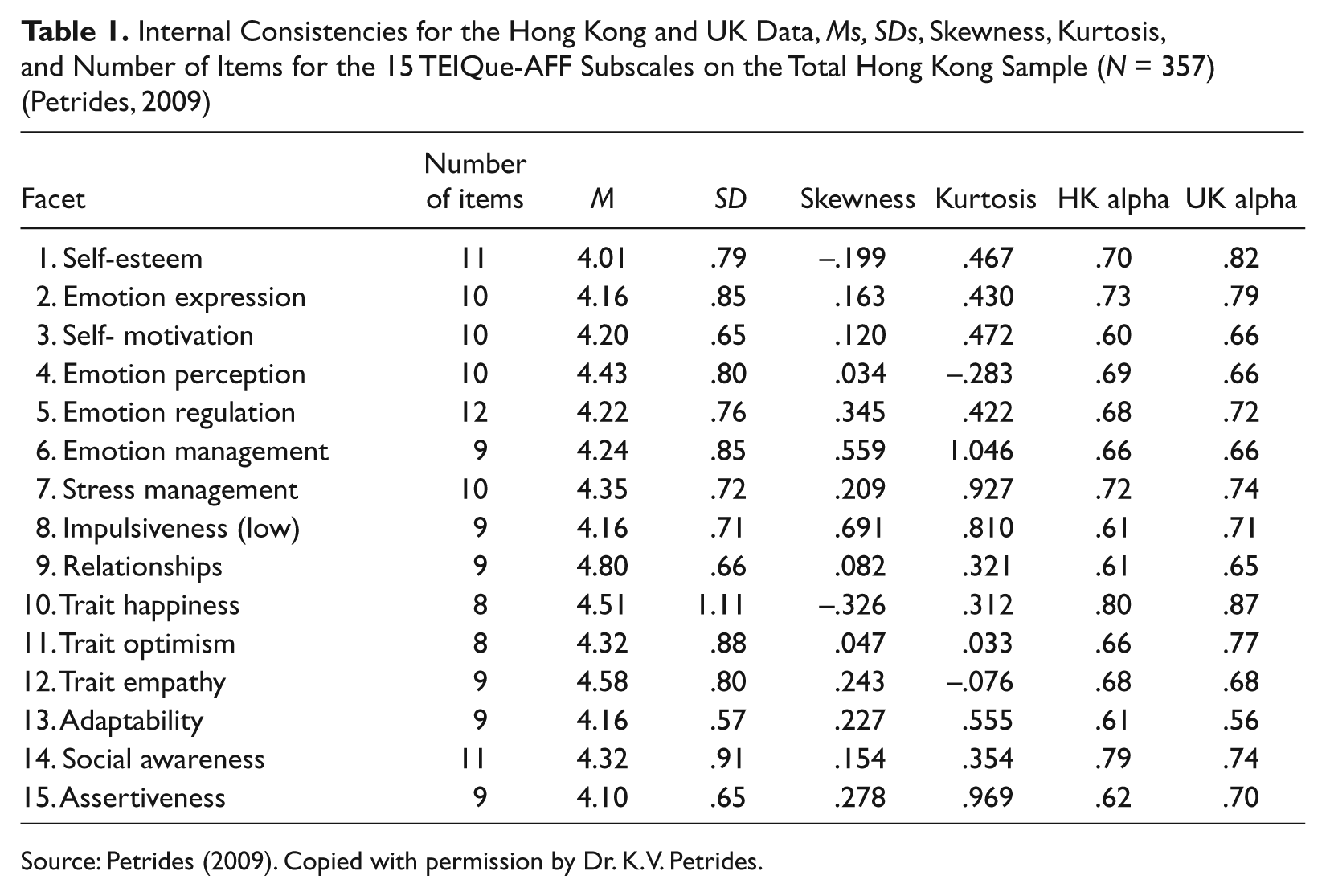
This form of the TEIQue has been successfully used with adolescents between the ages of 13 and 17. The–AFF is modelled on the full form of the TEIQue and is intended to yield scores on the same 15 facets and four factors. The main target audience is adolescents between 13 and 17 yrs. The internal consistencies of the adolescent sample are somewhat lower than those of the adult sample (Petrides, 2009). The Chinese version of the TEQue-AFF used in this study is based on the adult form freely available from www.psycometriclab.com. The wording of some items was modified to meet the culture of adolescents in Hong Kong. The final version was examined and discussed by three translators with background in psychology. These items were translated into Chinese again and back translated, and tested on a small group of adolescents N = 5. Comments were addressed and the final version of those items was reviewed by a group of psychologists fluent in English. The internal consistencies for the–AFF facets ranged between .60 and .80 in this sample (Table 1; Petrides, 2009). The corresponding internal consistencies drawn from a UK sample are also presented in Table 1.
Internal Consistencies for the Hong Kong and UK Data, Ms, SDs, Skewness, Kurtosis, and Number of Items for the 15 TEIQue-AFF Subscales on the Total Hong Kong Sample (N = 357) (Petrides, 2009)
Source: Petrides (2009). Copied with permission by Dr. K. V. Petrides.
Procedure
Data for the Hong Kong sample were collected from three state high schools during planned class periods. A letter explaining the purpose of the study was sent to all participants and they were informed that their participation was voluntary and that they could withdraw from the study at any time. The questionnaire was distributed to the students by the class teacher during the homeroom period which lasts for at least 30 min.
Statistical analysis
Factor analysis of the TEIQue-AFF was conducted to establish its factor structure. Principal Axis Factoring was the preferred extraction method (Cooper, 2002; Lowenthal, 2004) since it yields a simpler factor solution and has been the preferred method used in similar studies with Western samples (Mikolajczak et al., 2007). Although oblique rotations are generally more complex than orthogonal rotations, we used the Promax rotation because we expected the resultant factors to be interrelated.
Results
Descriptive statistics
Descriptive statistics, number of items, internal consistencies, and intercorrelations for the 15 facets of the TEIQue–AFF are presented in Table 1. Score distributions appeared relatively normal (< 1.5; Stevens, 2002), although the Kolmogorov–Smirnov (K–S) test revealed that perfect normality was not achieved for any of the facets (all ps < .05) because of the large sample size (N = 357). The K–S test revealed that normality was not achieved for the global score or any of the facets (K–S(357) = .079, p < .05).
Factor Structure of the TEIQue-AFF in the Hong Kong Data Set
A principal axis factor analysis was applied to the 15 TEIQue–AFF facets. Based on the a priori scoring key, four factors were extracted and rotated to simple structure via the Promax algorithm with the Kappa parameter set to four. The four factors collectively explained 65.98% of the variance in the 15 facets. All facets were represented adequately in trait EI factor space with communalities varying from .34 to .79. The facets that were well-represented in the trait EI factor space were ‘‘happiness,’’ (h2 = 0.79) ‘‘social awareness,’’ (h2 = 0.69), and ‘‘emotion perception’’ (h2 = 0.65). Facets less well-represented were ‘‘self-motivation,’’ (h2 = 0.32) ‘‘adaptability,’’ (h2 = 0.34), ‘‘assertiveness,’’ (h2 = 0.45) and “relationships” (h2 = 0.47). Happiness, social awareness and emotion perception seem to be most characteristic of trait EI, whereas self-motivation, adaptability, assertiveness, and relationships could be thought as least characteristic, although they are still well-represented in the construct. As can be seen in Table 2, not all facets loaded highly on the keyed factors.
Factor Loadings Based on the a Priori Scoring Key of the TEIQue-AFF in the Hong Kong Sample (N = 357)

Note: Extraction method: Principal axis factoring, Rotation method: Promax with Kaiser normalisation. Loadings above .30 are in italics.
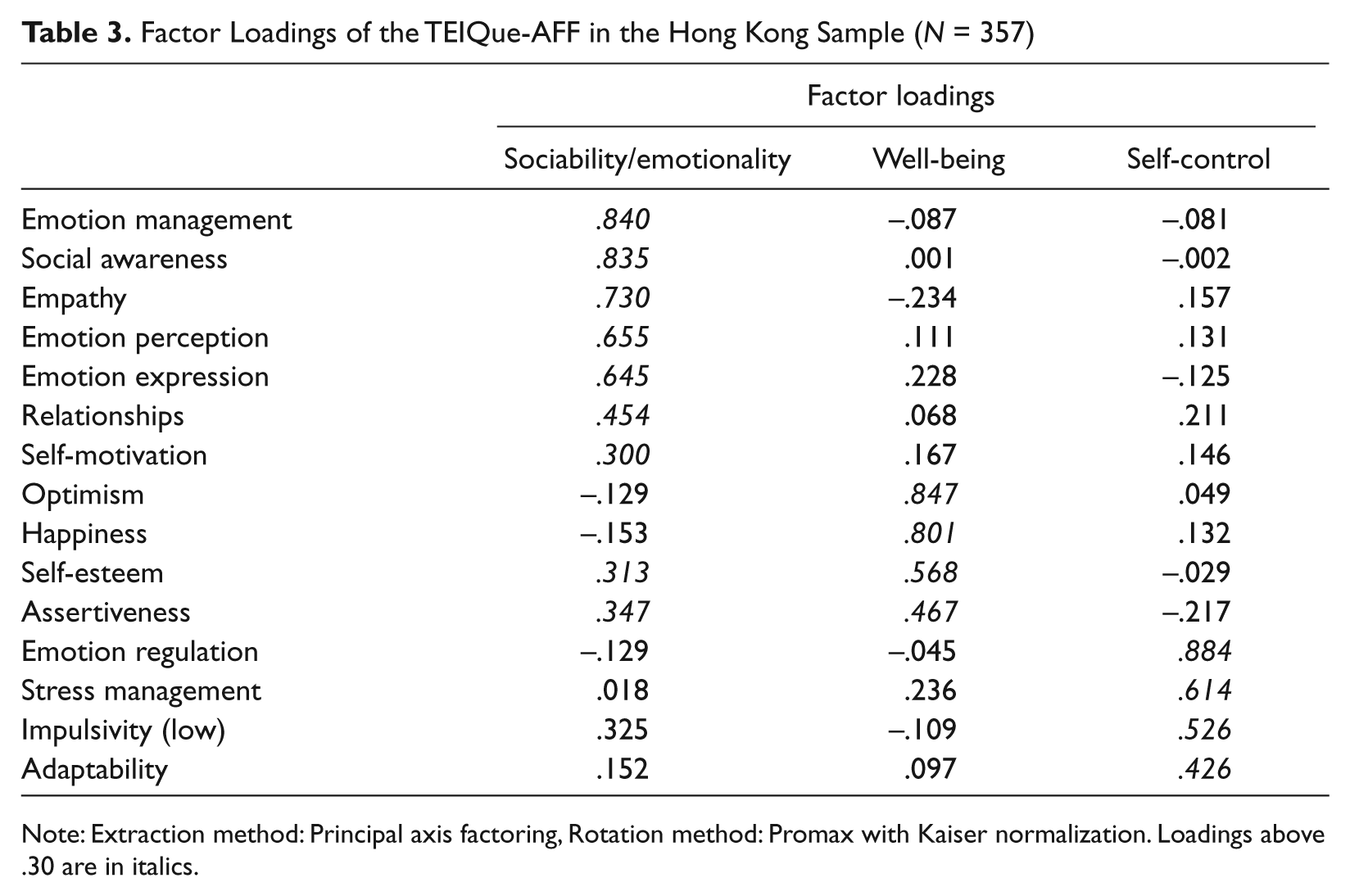
The analyses was rerun, and based on the Scree plot and the Kaiser criterion (eigenvalues for the first three factors were 6.33, 1.48, 1.41), three factors were extracted. Subscales loading highly on Sociability and Emotionality according to the UK data, clustered together in the Hong Kong data (Table 3).
Factor Loadings of the TEIQue-AFF in the Hong Kong Sample (N = 357)
Note: Extraction method: Principal axis factoring, Rotation method: Promax with Kaiser normalization. Loadings above .30 are in italics.
Parallel Analysis
It is generally advisable to cross-check the results of a factor analysis using multiple criteria (Thompson & Daniel, 1996), given the discrepancy between the priori and the statistical factor analysis results, we also applied Parallel Analysis (PA) to confirm that the extracted factors were not artificial. This method of factor extraction is preferred over others because it produces the most accurate factor retention results (Hayton, Allen, & Scarpello, 2004; Zwick & Velicer, 1986). PA works by producing average eigenvalues from randomly generated correlation matrices. The matrices are based on the same number of variables and participants as the actual data. We used the “Marley Watkins Monte Carlo PCA for Parallel Analysis” programme (Watkins, 2000) with the following specifications: 15 variables, 357 participants, and 100 replications. We then compared our observed eigenvalues to the 95th percentile of the eigenvalues generated from these random data to reject factors that were obtained by chance (at p = .05). The results of the PA for the Hong Kong sample yielded a three-factor solution. This suggested that the fourth factor that emerged from the a priori scoring key criterion was possibly an artifact of sampling error. Factor retention decisions are the most difficult and important part of factor analysis; considering the robustness of the PA, we decided to adopt the three-factor solution as the most suitable for our data (Table 3). However, we recommend that future research conduct factor analysis to replicate our results.
Comparison Between the Hong Kong and the United Kingdom a Priori Factor Structure
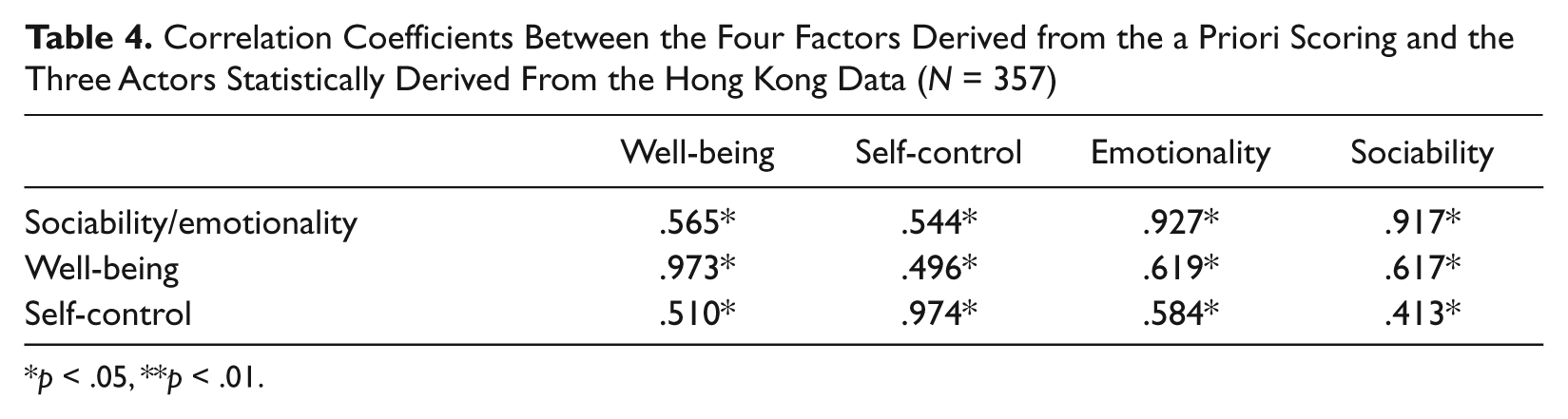
To examine the degree of concurrence between the two factor solutions generated by the Hong Kong data, we correlated the factor solutions that emerged from the UK theoretical factors and the three Hong Kong factors derived statistically (Table 4). Pearson’s correlation coefficient obtained for Well-being was .973, and .974 for Self-control. The third factor, Socioemotionality exhibited high correlations with Emotionality, .927, and Sociability, .917.
Correlation Coefficients Between the Four Factors Derived from the a Priori Scoring and the Three Actors Statistically Derived From the Hong Kong Data (N = 357)
p < .05, **p < .01.
Discussion
These results fit relatively well within the growing number of empirical studies examining the cross-cultural factorial stability of trait EI (Freudenthaler et al., 2008; Mikolajczak et al., 2007; Petrides, 2009; Russo et al., 2012). The internal consistencies of the 15 TEIQue–AFF facets and the four corresponding factors were generally satisfactory. It should be noted, however, that for some facets, that is[change to ‘that is’], “self-motivation,” “emotion regulation,” “empathy,” “impulsiveness (low),” “emotion perception,” and “emotion management,” the alpha coefficients were less than ideal. Bearing in mind the young age of our participants, lower than ideal alphas are not particularly surprising (Mavroveli, Petrides, Sangareau, & Furnham, 2009; Mavroveli, Petrides, Shove, & Whitehead, 2008).
The Hong Kong factor solution generated significant cross-loadings as well as a clear tendency towards a three-factor structure. The solution is somewhat less clear than the adult form, because self-perceptions are less differentiated in adolescents than adults (Mavroveli & Petrides, in preparation; Russo et al., 2012). In other words, the adolescent form falls somewhere between the–Child Form, which shows the least differentiation of emotional self-perceptions, and the–Adult Form which shows the greatest differentiation. For the Hong Kong sample, as opposed to the UK sample, there seems to be less differentiation than the UK adolescent sample, which created the discrepancy in the psychometric indices. It would be quite premature to conclude that Hong Kong adolescents reach maturity a little later, and hence the full four-factor structure could be recovered at a later developmental stage but this could provide a reasonable explanation. Within a collectivistic society, the expression of emotion is not particularly encouraged and this might lead to a limited development in emotional self-perceptions. This is a highly speculative conclusion and should be revisited in light of renewed future evidence.
In line with mainstream personality research, there are ethical issues involved in investigating and understanding cultural and individual differences (McCrae & Terracciano, 2005), such as the promotion of prejudice beliefs or cultural intolerance in cases where cultural differences are overemphasised without any attempts to understand and accept these differences and identify communalities. These underline the importance of employing suitable methods of data collection and analysis in examining psychological constructs across cultures. In this paper, we have used robust statistical methods to determine whether the same underlying dimensions or “factors” can account for the relationships among the TEIQue scales, and thus be meaningfully used to assess these trait dimensions in the Hong Kong culture.
The implications of this research are multifaceted for both lay people and scientists. First and foremost, this study expands the empirical repertoire of trait EI research and allows for the expansion of empirical work within the trait EI paradigm. Second, it provides insights into cultural parallels and differences that can help promote a better understanding and acceptance of people from different cultures in light of the increasing multicultural composition of Western societies. This study also adds to the bulk of research within the realm of mainstream personality and suggests that collectivistic societies perceive behavioral descriptions similar to individuals from Western cultures and they can form coherent and global perceptions of their emotional self.
Even though a handful of cultural psychologists argue against the importance of traits in understanding or predicting behavior in collectivistic cultures (Markus & Kitayama, 1998), it seems that Chinese adolescents hold accurate and differentiated self-perceptions of themselves. This holds true despite the use of a scale that contained items portraying behavioral descriptions of traits exhibited in populations that come from noncollectivistic societies. Therefore, future work should replicate our work and further examine whether the behavioral correlates of trait EI are similar across cultures. Future studies should examine the psychometric properties of trait EI not just as a manifestation of factorial structure but also by looking at construct validity indices.
Footnotes
Declaration of Conflicting Interests
The author(s) declared no potential conflicts of interest with respect to the research, authorship, and/or publication of this article.
Funding
The author(s) received no financial support for the research, authorship, and/or publication of this article.